Loading summary
Transcript68 lines
- [00:00]
A
Hey, listeners, meet Russell.
- [00:02]
B
Hey.
- [00:02]
A
Russell just launched a fitness app, and he needed to get the word out to busy professionals looking to stay fit.
- [00:08]
B
So I turned to Acast. I used their Smart recommendations feature to easily find shows that talk about health and fitness. Booking sponsorships through their platform was a breeze, and just like that, my app was in their ears during their morning run.
- [00:21]
A
Sounds like a smart move, Russell. How's business looking now?
- [00:24]
B
Sweat is pouring and so are the installs.
- [00:26]
A
Spread the word about your business with podcast ads on Acast. Start today at go acast.com advertise.
- [00:38]
B
Hello and welcome to Legacy AFWA. This is someone you'd be wanting to do pretty much from the beginning. So nervous we're going to do justice to this individual.
- [00:49]
C
Stakes are high for this one, Peter. I've basically got every gun in I've ever known holding me to a very high bar, because today we're tackling, really, the founding father of modern Ghana and a huge figure in my personal family story in the birth of Ghana, but not just Ghana, the whole African continent. Because as we'll hear, he was a pioneer for everyone who was colonized by the British and really all European empires. So, yeah, big subject. No pressure.
- [01:18]
B
Okay, well, why don't we start by listening to Nkrumah and hearing what his voice sounds like? It is my great pleasure to welcome you to Accra and to this conference of African freedom fighters and supporters of the growing movement for Africa's liberation and unity. Hello, and welcome to a new episode of Legacy. I'm Peter Frankipan.
- [01:48]
C
I'm Afwar Hajj.
- [01:49]
B
And this is Legacy, the show that explores the lives, events and ideas that have shaped our world and asks whether they have the reputations that they truly deserve.
- [02:08]
C
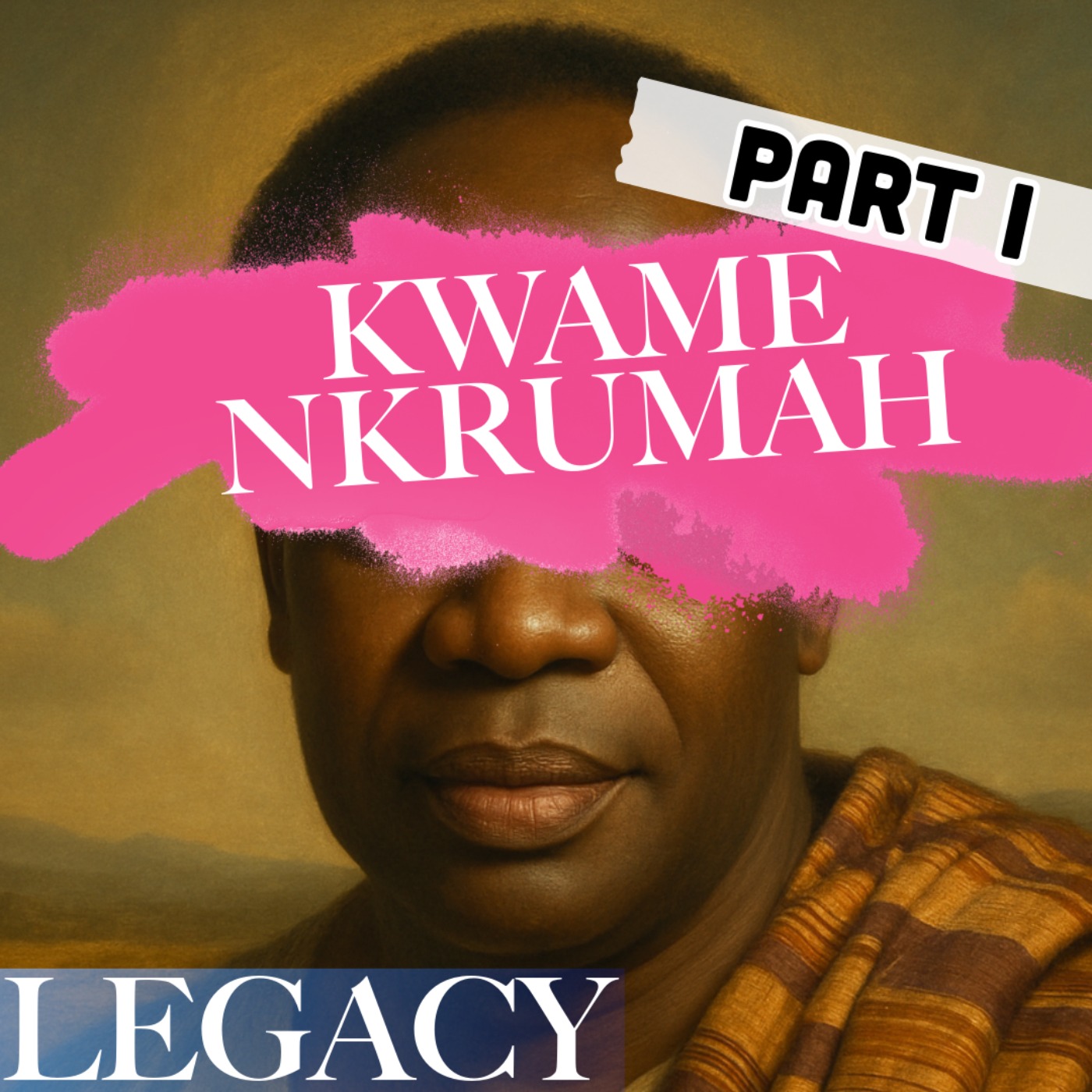
This is Kwame Nkrumah, episode one, the good subject.
- [02:19]
B
Afrogon. Start us off about who we were listening to. Start us off about who Kwame Nkrumah was.
- [02:24]
C
Kwame Nkrumah was the first leader of modern Ghana because during his childhood, it was the Gold Coast. It was regarded not just as a British colony, but Britain's model colony. And he ran riot through that system of colonial world order and led Ghana to become the first black African nation to free itself from. From colonial rule.
- [02:47]
B
But he wasn't just thinking about Gold coast in Ghana. He was a philosopher. He was a Pan Africanist. So he was someone who dreamt not just of his own country's independence and liberation, but the liberation of the entire African continent. So he has a huge significance outside Ghana too, right?
- [03:03]
C
Absolutely. And from his early Days in the Gold coast to his tireless quest, lifelong quest for united Africa. His impact is totally undeniable, Peter. He, he's inspired millions till today. He's often referenced on social media by people really trying to draw inspiration from that mid 20th century challenge for freedom. He disrupted colonial power and in many ways, and I think this is such an important part of his legacy that I can't wait to discuss with you. He laid the intellectual groundwork for post colonial African identity. But like all great leaders, as we know too well on this show, his legacy is far from simple. And it's marked by profound achievements, but also significant controversies.
- [03:46]
B
And I think it's fair to say, Afro you, that his name across Africa is incredibly well known. I mean, in 1999, listeners to the BBC World Service voted him Africa's man of the Millennium. You know, with your Ghanaian heritage, is Nkrumah a name that is known in other parts of the world outside Africa, in Europe, in England? Do you find yourself having to explain who he was? Have people heard of him?
- [04:07]
C
It's hard for me to say because I suppose I move in a world where people have heard of him. You know, I'm really plugged into Pan Africanist circles and not just in African societies, but in Europe, in America, I think there's growing curiosity about Pan Africanism. But in Ghana, his presence, his legacy is undeniable. I mean, he is all over the architecture of modern Ghana. He's on the currency, there are monuments, memorials to him, things named after him. And he's been given the honorific title Osejafo, which is a name given by the Akan people of whom he was a member. And it means someone victorious in battle. Although as we'll find out, he wasn't always victorious.
- [04:47]
B
And how close are you? Have you been honoured with the same title of Osagefo? Is that something that's coming? Do we need to get a lot of downloaders to petition? Is it something that gets given as formally? Is it something that you kind of reach a particular point? Is it still a title that's given out today?
- [05:04]
C
It's a huge honor and it's not something that you can kind of tee up your career for. It really recognizes fighting, winning and doing justice to the spirit of your people. So, I mean, yeah, as an aspiration, I think that, you know, if my life could live up to one where I fought for my community and did justice to their potential, that would be a huge honor. But there's nobody else, you know, who's known that way Now In a way, it's become synonymous in Ghana with Kwame Nkrumah.
- [05:34]
B
Okay, I'm just putting one out there that I want to do a legacy episode of the Legacy of Afwer Hirsch in due course. You know, we might have to do a few before we get back.
- [05:43]
C
I'll wish that, Peter, because we usually only tackle people after they're dead, so, you know, don't.
- [05:48]
B
We can make an exception. But anyway, look, join us as we unpack the life of a man whose influence went from local politics to the global stage. A man who was revered but also vilified. But he was a titan of 20th century Africa.
- [06:13]
A
Say hello to Mia.
- [06:14]
C
Hey there.
- [06:15]
A
Mia runs a pet grooming service in Chicago. But getting new clients was rough until.
- [06:19]
C
I started using acas. I recorded my ad, targeted pet owners in the area, and let ACAST do the rest. Now people all over the city know about my grooming services.
- [06:27]
A
Mia's business is looking sharp. What's your secret for happy pets and happy clients?
- [06:32]
C
A fresh cut, a friendly vibe, and a well placed podcast ad.
- [06:36]
A
Get the word out about your business through Acast. Visit go.acast.com advertise to get started.
- [06:55]
B
Okay, let's begin at the beginning. AFWA in the gold Coast. So what's roughly now modern Ghana, Where France. In we are, Corfi Nkrumah was born.
- [07:03]
C
I like your pronunciation, Peter. Have you spent time in Ghana before?
- [07:06]
B
Well, some of my great friends have Akan heritage. Afua. So I've been listening carefully to pronunciations, so I hope I get it right. You know, it's important to. To at least be able to say what people's names really were. You know, it's something we do really badly in England. You know, we get shocked by the idea that other people like to have words pronounced the right way. So if I've got that right, that's. That's great news. But that's a long. That's a long first name. Francisco Nkrumah. He's much better known as Kwame Nkrumah. Tell us about his early life.
- [07:32]
C
He was born in Enzema, which is a region to the west of Ghana, close to Ivory Coast. And Enzema people are. Are part of the Akan ethnic group, which is a kind of super ethnic group that dominates much of southern Ghana. But it's very specific. The Inzima region. I've been there. It's beautiful coastal, incredibly rich rainforest, very fertile earth. And he was born in a small village. And even though it's not an affluent place in the Modern capitalist sense. It's a place of abundance of fish, fruits, vegetables. His mother was a market trader and his father was a goldsmith. And it's also part of Ghana that is incredibly rich in gold, where many modern gold mines are and also many artisanal mines. And I think it was an artisanal mind that his father worked in these kind of traditional mines that people have been working in by hand for centuries. And so even though his parents weren't educated in European languages and writing, they were very schooled in the traditions of Enzima culture. And Kwame Nkrumah's father was very respected in particular and was often sought out to advise on traditional and domestic affairs in the community.
- [08:43]
B
Is it fair to say that Akan society is quite patriarchal? It's very respectful of older people. That was the case then as well, and still the case today.
- [08:51]
C
Right, yeah, that's actually a complicated question because it's a matrilineal society which means that you inherit through your mother. That doesn't mean it's matriarchal. You know, you can still be a matrilineal society where inheritance passes through the mother's line, but have patriarchal power structures. The time that Kwame Ning Krum was born, the Gold coast has only recently been kind of unified, all these different societies under the British flag. And it's actually the peak of Britain attempting to break down those matrilineal traditions and turn it into the kind of patriarchal, nuclear family formed society that adheres to the British idea of kind of good Christian Western values. And till today in Ghana, you can see the tension that many people in southern Ghana are Christian and they live in these European family units. But the old culture of living in more communal ways, polygamy, practicing traditional religions, is also still very visible. So it's a bit of a complex situation in Ghana. But I would say that women have their own distinct roles economically. They're very powerful. Trade and markets are controlled by women till today. And so the European concept of kind of women being confined to the home is one that's completely foreign in Ghana. And actually anyone who's visited a West African country, you don't need to be school schooled in the kind of sociology of power. You will see it, you know, you'll see the women in the marketplace, you'll see the women running the informal economy, you'll see the power women have in communities and households. And that's very much the world into which Kwame Nkrumah is born. And his mother, Elizabeth Nyanaba is a huge influence on him, and I find their relationship endlessly fascinating because as we'll get to the later part of his life, you know, as an adult who's becoming a huge leader, he always keeps her. And you can really see the kind of love and devotion that exists between them.
- [10:40]
B
And she's obviously quite a character. He's unusual in Crewmember. He's an only child, which is unusual in West African cultures. He's obviously a highly curious, observant child. He's a very good listener. He's very good at seeing what's going on because he's so sharp. His parents decide that they want to send him to school. But then he complains about the fact he's an only child, and his mother gives him a pretty good talking to to explain that he should be grateful for that, Right?
- [11:04]
C
Oh, I love this. That his mother said to him when he used to complain about being an only child, she pointed at the tall trees in the village and he said, you see those big trees? They stand alone. And, you know, I like to think that was kind of a guiding principle for him, because being a pioneer, being a leader is lonely. You're trying to do things that have never been done before, and you'll make mistakes and you'll find yourself betrayed. You know, it takes a certain courage of conviction and ability to walk alone. And I feel he might have got that from his childhood. And you're right, it's very rare. You know, having many children is very prized in Ghanaian cultures. Women kind of gains status the more children she has. So no one really knows why his mother only had one child. But you're right, he was very bright. Basil Davidson, who's a major biographer of Kwame Nkrumah, who's himself a really interesting character British man who was, I think, an intelligence agent during the war, wrote about Nkrumah that he was a shy child who preferred to stand and listen to his elders rather than merely run with the crowd. So that gives you a lens of the kind of person he was. But his whole life changes when he gets sent to school, Peter.
- [12:11]
B
I mean, he's one of those interesting people who's very shy on the one hand, but obviously is a natural leader. So it's reported that in a rebellion against his teacher's, you know, over strict implementation of corporal punishment, that he encourages his classmates to stay at home when the inspector of schools comes to visit, which is obviously very embarrassing, but the school itself been a very effective way of concentrating minds. So he's got that Kind of balance of someone who's quite reserved but finds it not. Maybe not easy to lead other people, but he knows that there's a kind of dynamic. Maybe that's something that he has as an only child that, like, often only children do, that they're. Because they are not socialized at home. They both hang back, but also want to get stuck in.
- [12:52]
C
But.
- [12:52]
B
But tell us a little about. About Gold Coast. I mean, here in Britain, people know about Ghana. They do know about the mineral wealth of Ghana. I mean, it's so famous, going back millennia of the. The fame of the gold mines and also the wealth of the societies. But tell us a bit about what this society that we're talking about in early 20th century looks like, how the British have got there, what. What they do with it, how that's changing Ghanaian society.
- [13:16]
C
Well, how the British got there is a long and complicated story. Ghana was the first country in Africa to experience a kind of formal type of European colonialism. When the Portuguese arrived in 1492 and built Elmina, which translates as the gold mine. It's a fort which you can still visit in western Ghana. And it later became a major hub for trading enslaved Africans. By the time Britain came along, and there were the Dutch, there was this. The Danes, There was this kind of cycle of European powers. By the time the British formally colonized Ghana, right at the end of the 19th century, it became a really important extractive economy for Britain. It was rich in gold, as you said, and cocoa. It still remains one of the largest cocoa producers in the world. But these are not crops for Ghanaians. These are all for export. And actually, they're so valuable to Britain that the Gold coast is cultivated as what economists call a monoculture. So essentially, you have this one crop, and you have this one mineral commodity, and the entire economic future of this colony is dependent on commodity prices remaining high. It also means that the infrastructure that was built in the Gold coast, which is often kind of touted by people trying to defend the empire as this benevolent gift to, you know, the Indians and Africans. We built railways and hospitals. In fact, the infrastructure that was put in place was really for the purposes of helping Britain extract wealth. So if you look at a map of Ghana, you can see that the historic roads and railways were built from major economic centers straight to the coast. They didn't connect people from one part of Ghana to another part of Ghana. They connected the places where the mines and the farms were so that they could be shipped out to Britain or to other countries where Britain was selling goods. And, you know, if you ever tap into any conversations about economies and development challenges in Africa today, it's still a massive problem. This legacy of colonial infrastructure that doesn't actually serve the needs of people. West Africa, I think it's important to understand, is very different from Southern Africa. You know, we've talked on the show about the Rhodes legacy, about South Africa, about apartheid, segregation. Ghana didn't have a formal system of segregation, mainly because there were relatively few colonial Brits there. Malaria is very prevalent in West Africa, and it meant that while Europeans at one point wanted to try and grab land and settle there in the way they had in other parts of the world, it was practically impossible. So they developed the system of indirect rule. And that's very relevant to our story of Kwame Nkrumah. What Britain did was train a small number of Africans to run the colony on its behalf rather than import many British administrators, because British people couldn't survive the climate and the malaria. So there were very few of them there. And that meant that people like Kwame Nkrumah weren't rubbing up against British power in a very personal way. It was more abstract. You know, Britain controlled the economy, it was extracting the wealth. But there were also opportunities and quite common. Groom is one of the very few, because there were very few educated people when the Gold coast was a colony. But those few had access to missionary schools where they were not just educated, but really, I would say, socialized into Eurocentric values. They were trained to be Christians. They were trained to behave like European people, to talk and eat and pray and behave in a way that British people thought was civilized. And so in that education, you can see where Kwame Nkrumah was beginning to experience this kind of duality of coming from a proud tradition of African heritage, but being taught that becoming more and more European was desirable.
- [16:51]
B
I mean, I wonder. I think one of the problems, particularly in Britain or the English speaking world, is that because we think of the experience of the British Empire as being exceptional, we don't sort of understand that there are parallels everywhere you look. So when you're just talking just now, you know, I work on, typically on empires based in Asia, often built by peoples from. From Asia. And, you know, all empires aim is to extract all empires, try to find ways of overlayering belief systems or ideas with local rulers or. Or people who are smart or connected or talented to try to help them administer. Because by and large, if you're in the great empire of Baghdad, you'd rather be in Baghdad rather than miles away. So empires, I think we. We got into discussion in the west here where we kind of think that there's this. Like you said, it's about railways bring good things as well as bad. All empires are trying to get things out of people. And then it's a very tricky balance because of course, there are local populations and leaders who can do quite well from that trade. The problem is, is that ultimately it's always about dragging things back out and sending to the center, whether that's in Baghdad, whether it's in London, you know, you name Madrid, et cetera. But also things also work back in the other way. So places like the Gold coast get used as dumping ground. So you get manufactured goods being brought not just from England in the mills, from Manchester and the industrial cities, but also from other parts of the British Empire. Because you're aiming to try to make everything a circular economy as you possibly can. And that means that you're constantly introducing new ideas, things that today we obviously have mixed feelings about. Cosmopolitanism, globalization. At what point is it a threat? When you have new ideas and impulses, and at what point are they being incorporated locally and who by? And it's. It's a sort of complicated story. But. But as you were talking just there, Alfred, you know, it definitely makes me think that it's. It's sometimes helpful to see this in. In wider context. You know, the Romans building roads are not doing it to allow people to get to A to B so they can visit their villas. They're doing it so that they can get wood or metals from one part of the empire to the other. But what's interesting in Ghana in particular is the disease, environment, mortality expectations are so bad that you. For white people who don't have natural resistance to things like malaria. So it's a place that the British are very keen to control with putting as little effort as they possibly can. So they're getting very good bang for their buck. So they're trying to constantly find ways of integrating or trying to take over societies while not really putting any benefits at all. But that also means that you get kind of weird hangovers today. I mean, like, Horlicks is still quite popular in Ghana, right?
- [19:27]
C
Yeah. I mean, when you're talking about the economic implications, you know, it's important to emphasize it's. We think about extraction, but it's also creating markets of British products, as you said. And, you know, that was a little bit too successful. If you go to Ghana today, it's really fascinating what has seeped into the Culture and now is kind of embraced as, as a Ghanaian thing to do. So it's called Milo. This drink that's made by Nestle, very popular across West Africa, which is basically Horlicks. It's basically sugar powdered milk, which is quite bad for West Africans who tend to be lactose intolerant and a few kind of vitamins. Condensed milk, very popular. If you are given a cup of tea in Ghana, you'll probably be offered some Carnation condensed milk. This is not a product placement for Carnation. It's disgusting. And then British made detergent soaps are still favored over locally made goods. And that's had a really long term impact on Ghana's ability to make its own natural products and its own manufacturing desirable because it created this layer where the imported goods from the imperial heartland were seen as aspirational. Another thing, you know, that I learned from you, Peter, and if you look at my copy of the Silk Roads, it's kind of absolutely full of notes scribbled all over your description. So the Ottomans, for example, because, you know, it was really interesting to learn from your perspective about other empires. I think something that makes the British Empire in West Africa stand out is that other empires, as you said, they were extracting, they were conquering, they were kind of grabbing land. But the Ottomans, as one example, and I say this knowing I learned basically all of it from you, understood the value of diversity, not really in the modern sense, but you know that there were ways they could incorporate local traditions and ideas that would strengthen Ottoman rule. The British didn't see it like that. The British regarded African culture as having nothing to offer. They had a very racist lens that's quite unique in history because it was based on this kind of pseudo scientific idea of the hierarchy of human species that put Europeans, and particularly Anglo Saxons at the top and black Africans right at the bottom. And they imparted this to the West Africans they raised within the colony. So they were teaching people like Kwame Nkrumah that his own race and heritage was shameful. And that, you can imagine, is a very complex thing for a young African to be learning. So, for example, the British colonial education system that Nkrumah was taught under taught him that Mungo park discovered the River Niger, that David Livingston discovered Lake Victoria. It's kind of suggesting that the Africans who'd been living there for millennia were kind of white wildlife. You know, they were just part of the natural environment. They weren't significant or consequential. And, you know, as a someone who was educated In a Christian missionary school, Kwame Nkrumah would have been taught that he was a descendant of Ham, the biblical figure who was cursed in the Old Testament. And many British people at the time believed that the descendants of Ham were the black race and the reason they were black were because of the this curse. So it's a really poison chalice, this Christian education. You are being taught to believe that you come from something that is inferior, that is subhuman. And you know, as modern African scholars have described it, Christian ideology was an ideally fashioned weapon for the destruction of the self image and value system of the African. And you know, I come from a family that have this kind of education. Many people of African heritage listening to this will recognize that. And the contradiction is how destructive and imparting of self loathing those ideas were and yet how our ancestors thrived in that system. You know, my grandfather did really well at school. That's why he ended up coming to Britain. Kwame Nkrumah performed really well at school. And in his case, in fact, he so impressed the school authorities that when he was 17 he was promoted to being a pupil teacher, which was basically a colonial system where a talented older pupil then began helping the missionary teachers teaching the younger children.
- [23:33]
B
I mean, I think that curse of Ham you mentioned and ideas about skin color and race, those do exist in the Ottoman world and in the great Arab empires too. You know, there's no question that one should say that there's more tolerance in one part of the world than in the others. I think there's enormous discrimination. But what is different is in the Ottoman world and in the Abbasid world, if you were from Slavic or Central Asian stock, you could marry the sultan or become one of the concubines. You could be the mother of one of the emperors. You could become the ruler of the empire in all but name. So you'd be the vizier who'd have control of everything. And those promotions of people from different ethnic and religious backgrounds happened in different ways to than how they did in Western Europe, there's no question about that. But it's not surprising then, Afwa, that you're going to find early independence leaders thinking about the ways in which the British are a problem and that the destiny and the future of Akan people, Gold coast people, Ghanaian people, should be in the hands of local leaders. Tell us about some of those early independencies before Omkrumah.
- [24:40]
C
Yeah, there is a really long tradition in Ghana of agitating for independence right back to really the early 19th century. In, if not before. So by the time Nkrumah was growing up, there were figures like Casey, Hayford and Horton who'd argued for a version of independence, but it's not really the one we would recognize. And essentially these were an earlier generation of educated Gold Coast Africans who accepted some of the premises of the European education they'd had. They accepted the idea that Westminster style democracy was this kind of superior system of governance, that Christianity was the truth, that the ways in which Europeans behaved was desirable. But what they were arguing was that they as Africans could, could live up to those standards. They could reach that behaviour themselves. And as a result, they rejected the idea that Africans are inferior, are less intellectually able, are inherently savage. They were kind of using Eurocentric ideas to try and prove their worth within an imperial context. So they wanted self governance. They wanted a transition towards letting not all Africans, because I think like European colonists, they would have regarded, you know, illiterate people in the village practicing their traditional culture as uncivilized. But they wanted those Africans who had been educated, who did practice these European values to have control over their own countries, over their own administration, to begin to have some kind of self determination. And now it's easy to be very critical of those ideas now because they seem to kind of assimilate many very colonial ideas. But at the time, it was extremely radical and people were actually being deported, exiled, banished, even imprisoned for propagating those ideas.
- [26:40]
A
Hey, listeners, meet Russell.
- [26:41]
C
Hey.
- [26:42]
A
Russell just launched a fitness app and he needed to get the word out to busy professionals looking to stay fit.
- [26:48]
B
So I turned to acast. I used their Smart recommendations feature to easily find shows that talk about health and fitness. Booking sponsorships through their platform was a breeze. And just like that, my app was in their ears during their morning run.
- [27:00]
A
Sounds like a smart move, Russell. How's business looking now?
- [27:03]
B
Sweat is pouring and so are the installs.
- [27:06]
A
Spread the word about your business with podcast ads on Acast. Start today at go.acast.com advertise.
- [27:27]
B
You've worked on so much on this. Afraid we want to get back to Nkrumah. But I mean, there is a way in which this all gets slightly distorted as well, because Christianity is not a European belief system. Christianity rises in Asia. Jesus Christ never set foot in Europe. So that idea of saints being depicted with blue eyes and white skin and this all being a European construct is itself a step removed from reality. So I wonder how that fits in, because you find amazing places like Ethiopia where saints aren't depicted the same way that they are in northern Europe. Do you see Christianity as a means to an end? Because rather than itself being the problem about how it's just a vehicle that allows colonial expansion to have a justification?
- [28:13]
C
Yeah, I mean, you know, I think all religions share similar spiritual doctrines, you know, especially the great monotheistic faiths. And yeah, I mean, I've been to Aksum in northern Ethiopia and I've been to chapels from the 5th century and seen a black Virgin Mary in this ancient wall painting. And the black saints and of course Ethiopians conception of the great figures of Christianity are Ethiopian in appearance, if not in heritage. And there's also the Old Testament stories about the Queen of Sheba coming from Ethiopia and having a child with Solomon who became the founding member of the Solomonic dynasty of kings in Ethiopia. So they're great African Christian traditions. There are also great African Judaic traditions. There are Jews in, in East Africa. There are theories that the Akan population in modern day Ghana actually descended from ancient Israel. I mean, there are lots of theories, there are lots of cultural similarities. If you look at ideas about food and circumcision, Even the name for God in Akan is Nyame, which is quite similar to Yahweh, which is the Old Testament name. You know, there's lots of things that are quite difficult to explain without seeing some kind of connected dissent. However, the thing about the Christianity Kwame Nkrumah is growing up with is it's not an Afrocentric Christianity and it's not advocating many of these ideas I think Jesus would have supported about justice and freedom. It's being used as a form of social control and it's being used as a weapon to show Africans that they are inferior and that they are savage and that they should aspire to a version of Christianity. And that looks very European. And to this day, if you go to Ghana, you go and visit ordinary people's homes, you will see, you know what you see everywhere in the world? Pictures of family, friends and relatives on the walls. And everyone will be black except a framed picture of Jesus which will take up pride of place in the room. And this person will have blonde hair and blue eyes. And it's always quite jarring to go into a very African environment where people are so proud of their beauty, their hair, their clothes, their incredible African traditions. But there's still center place this idea that the savior, the Christ is a blond haired, blue eyed dude. It just always strikes me as a real metaphor for the message that European Christianity brought, which is that at the top, the ultimate aspiration the ultimate goal is the white person, and you are somewhere down the ladder. And I think, you know, that's a very complex legacy. And the people who had a huge influence on Kwame Nkrumah's early adult life were grappling with that themselves. And one of them was James Kwadjir Agray, who is not very well remembered now, but at the time, he was almost a contemporary Nkrumah. He was a devout Christian, but quite a radical thinker towards African pride and self determination.
- [31:08]
B
So tell us about him, because, you know, we know that Nkrumah was very respected as a schoolboy. You know, his, his headmaster rates him, he's a pupil teacher, like you mentioned, so he's mentoring younger people. That speaks to his maturity and his charisma, of course. But there's a sort of particular moment, right, like that often happens where the principal of the, of the government training college, so Nkrumah is noticed when Que Agri comes to visit his school. Tell us about Queu Agri and his. His life and how he influences Nkrumah.
- [31:37]
C
Well, one of the things that's very unusual about Agra is that at this period in the early 1920s, he's already spent time in America. And as a result, he's been exposed to an idea of blackness that is very unfamiliar in the Gold Coast. That might sound strange to people listening because obviously the vast majority of people in the Gold coast were black. But, you know, if you're from a country where everyone's black and all of your ancestors and everyone you see in your daily life is black, you really don't have much of a racialized identity. You know, your identity is going to be the language you speak, the ethnic group that you come from, the region that you come from, maybe the class, you know, what your parents do, what kind of role your immediate family play in the community. But race is quite meaningless. Just as if you're, you know, white from a part of Europe that's never had any immigration. You don't really walk around thinking of yourself as white. So when you go to America, though, at that era, you've got Jim Crow segregation, you've got people who are descended recently from enslavement. And, you know, America has racialized blackness in a very legalistic, direct, violent way. So an African going to America is suddenly confronted with the idea that there are black people and white people and that there is this power struggle and this oppression going on. So those are quite potent ideas to bring back to a colony like the Gold coast, where the same ideas Exist, but. But they're much more subtle and maybe unfamiliar to the population and in America at the time. There's also this interesting ideological battle going on between. You could kind of summarize it as Booker T. Washington vs. W.E.B. du Bois. And Washington is advocating this kind of self help, this idea that people should really, like, embrace the land and their ability to cultivate their own future by building WB Du Bois is advocating a more intellectual idea that the most talented African Americans who've had this elite education should really enter those institutions and show a little bit like the earlier Gold coast independence leaders we were talking about, show that they're competent within a white system. And Agra is influenced by both these ideas and trying to figure out how they apply to the Gold Coast. And he's also influenced by Marcus Garvey, who we might do a whole series on Peter, the incredibly influential leader from Jamaica who ended up being a kind of founding prophet of Rastafarianism. But crucially, at this time, he's going around America telling black Americans that they should return to Africa, that Africa is for Africans, that the black race should reclaim its pride, return to the motherland, that they can never be free in America. And this is bringing the kind of struggle for race back to countries like the Gold Coast. Agray didn't really agree with that. He thought that harmony between black and white people was the ideal and that you shouldn't exclude white people in this kind of free and independent future. But he brought these ideas to a very young, impressionable Nkrumah. And you can see Nkrumah navigating those ideas and kind of being highly influenced by what Agra thinks.
- [34:43]
B
He was incredibly magnetic as a personality with this infectious laugh that impacted Nkrumah. But he, he loved his clothes, right? As so many Ghanaians do. Afware. But Nkrumah wrote about him saying he seemed the most remarkable man that I'd ever met. It was a real somebody that Nkrumah could engage with intellectually but also recognize that you've got to be able to communicate, you know, and politics is always about being able to tell a story and to be able to find an audience you can communicate that to. But he, he doesn't agree with Ag about everything. So when you mentioned that his idea about harmony was about was more, perhaps more idealistic and maybe less realistic. Therefore, as a result, you know, he felt agre that it was important to look for equality, whereas Nkrumah thought that more action was required than just to hope for the best. But how does that affect Nkrumah's journey coming under Agra's wing.
- [35:34]
C
Well, Nkrumah describes this period. So now we're in 1927-1930. He's at Teacher training college. And he describes this period as the happiest of his whole life. And I think having a role model like Agra, somebody who is committed to the Gold coast, the future for his people, but who's also an intellectual, who's traveled, who's connecting with other black intellectuals in Europe and America. This is really inspirational for him. And it's also a time when he's learning these skills of debating. He's part of a debate society. So these aren't just ideas he's grappling with in his head. He's taking part in these lively debates. I often think how amazing it would have been to be alive in that time. And, you know, these ideas that ended up playing themselves out in exponential ways later in the 20th century were all being thrown around by these energetic, clever young Africans at the time. And you can really see the impact of it in Krumah's behavior, because during this period, he goes from being an absolutely devout Catholic, you know, having had this missionary education, to starting to be skeptical about the church. He stops attending regularly. He at one point refuses to go to Mass altogether, which is highly frowned upon by the authorities at the college. So the kind of compromise is that during Mass, Nkrumah will stay in his dormitory and maintain a respectful hourly silence. You know, that gives you a sense of how serious it is to refuse to go to Mass. And he's starting to question everything. And there's one thing in particular, Peter, that is kind of like a grenade into this environment. And it's an article that's published in 1936. Can you tell us about that?
- [37:14]
B
Well, it's a very famous article called has the African a God? And it's essentially. It's a rejection. I mean, it's an illusion of Christianity and Europeans and whiteness and colonialism which blends all of them together, which is why it's a grenade. So it's written by a Nigerian nationalist called Nandi Azikiwe and a Sierra Leonean called Wallace Johnson, who had been the founder of a radical youth league in Sierra Leone. And they'd been to the Gold coast and they'd written this article, and they'd said that they personally believe that Europeans have a God in whom Europeans believe and who is representing all the churches over Africa. And the European believes in God, whose name is spelt deceit. I mean, that's a pretty aggressive refutation. Civilized Europeans are trying to civilize barbarians. That means white people are trying to make black people do what they do with machine guns and that Christians are coming or people are coming in the name of Christianity and doing terrible things, basically, as we talked about at the beginning, to extract and make other people pay for the lifestyles that they have back in their home countries. And not surprisingly, that doesn't go down particularly well, does it?
- [38:20]
C
It's extremely serious to cast this stout on European intentions in Africa. I mean, even though, you know, with the benefit of hindsight, it's obvious there's truth in this, that it's an extractive relationship. But, you know, Britain has been promoting the idea that it's this benevolent figure that's civilizing these Africans, you know, rescuing their souls from their savage, barbarian ways. So to suggest that actually it's Africans who have this spiritual intelligence and Europeans who are lying to people by saying they're religious, when actually they're using God as a cover for the machine gun. I mean, it's hard now to really emphasize how radical and criminal that was in the British eyes. So Namdi Azikiwe and Wallace Johnson were tried for sedition, and they were deported. And, you know, at the time, Sierra Leone, the Gold coast and Lagos and other parts of the southern Nigeria were all run basically as one kind of West African colony by the British. There was a lot of movement in between these territories. So to be deported, you know, was. Was considered a serious punishment. And, you know, you wonder whether actually they would have faced even more serious consequences had it not been for the fact that now they were gaining so much traction with their work and that actually, that could have made them martyrs. But it's too late anyway. The damage is done. People like Kwame Nkrumah, who's still a young student, are beginning to see that their peers have the audacity to question British authority. And they're beginning to see the hypocrisy and the double standards of colonialism. And that really, for someone like Nkrumah, shakes him up and gives him the courage to start asking questions that maybe he'd had in the back of his mind, but it just seemed so unthinkable to ask.
- [40:07]
B
Yeah, and I think it's. There's an even wider context. I mean, look, in the mid-1930s, discussions about race are taking place very aggressively in Europe about stigmatization and chronic anti Semitism that eventually leads to genocide and holocaust in the United States, racial divisions. There's no sign of things getting better. In fact, things look they're getting worse. In the period of the Great Depression, you see, independence movement started to be born in India. The overthrow of the Chinese emperor just about 15 years earlier also have seen a kind of an idea of people engaging with what does modernity look like? What does a world look like where some people are able to use force to create power structures and to stigmatize and inflame? So I suppose, you know, in a world which is more connected than ever in terms of how information is moving backwards and forwards, the role that Europeans play in Africa, the way that race is being used and being weaponized in lots of different parts of the world, the ways in which elites are monopolizing at the expense of the masses. I think it's an incredibly exciting and dangerous time where there's obviously scope and appetite for new ideas, that the challenge is, how do you take those ideas and get them into action? How do you mobilize? And as often happens, sometimes the solutions that head towards democratization, towards more freedoms, end up going completely wrong. And that's one of the big challenges of what comes next in this story. But how Nkrumah engages with it is he thinks that the right thing is to find people around him who are also interested and engaged, and that's finding people who are going to have ideas that are going to be interesting. So he establishes the Nzima Literature Society. He finds ways of thinking about how he might get to the United States to come and study. And eventually, in the early 1930s, he goes first to Britain to get a visa. But he's wanting to discover what the world looks like outside, partly to see how that can help him reconfigure what he thinks Gold coast or what become Ghana will look like in the future. Nkrumah is such an important global figure that early on, he's looking and thinking globally, too.
- [42:10]
C
So with the help of a generous uncle in Lagos in 1931, Nkrumah manages to raise enough money to fund his passage to the United States, traveling first to Britain to get a visa. And by the time he's leaving for America, he is in some ways, already well formed. He he's got strong nationalist sentiments. He's got a profound belief in the inherent freedom and right to freedom of African people. But the journey he's about to embark on is only just the beginning of what's to come. And we'll look at that in the next episode of Legacy.
- [43:02]
A
ACAST powers the world's best podcasts.
- [43:06]
B
Here's a show that we recommend.
- [43:09]
C
Hello, this is Jessie and Lenny. Ware from Table Manners, a podcast direct from our dining table where we talk all things food, family, growing up, and everything in between. And everything in between. This season, we've had Reese Witherspoon reveal the greatest cookie recipe. We had Gary Oldman, who's freshly knighted, Sir Gary Oldman. Sir Gary Oldman. We did some singing with Gloria Estefan. And Jeremy Allen White has shared some culinary stories with us. And it's not just this series. We've had plenty of other brilliant guests where you can listen back to all the episodes. People like Cher, Dolly Parton, Kate Winslet, Paul McCartney, John Legend, Benny Blanco, and Selena Gomez. We've had them all, and we fed them very well. Come and listen to Table Manners, the podcast with me, Jesse Ware and Lenny Ware.
- [43:55]
A
Acast helps creators launch, grow and monetize their podcasts everywhere. Acast. Com.