Loading summary
Transcript82 lines
- [00:00]
Financial Times Narrator
Don't raise your voice to prove you're right. Focus your mind with every word of irrefutable fact you can find, because conviction is the calm that comes when you know that you really do know. People who read the Financial Times know that they can shape their own perspectives with confidence because their viewpoints are informed by genuinely unbiased journalism, clarity and conviction. Source FT subscribe to the financial times@ft.comSourceFT.
- [00:33]
Afwa Hirsch
Today, we are looking at someone whose ideas have had profound implications on everything in modern life, from religious beliefs to the role of women, from how the state controls citizens to who was taught to read and who was not. I think it's fair to say, Peter, that today we are tackling one of history's most consequential figures.
- [00:54]
Peter Frankenbaum
That's Donald Trump. It's got to be Trump. You say consequential Afwa, and you have Donald Trump. I mean, all presidents, all famous people are consequential, right?
- [01:02]
Afwa Hirsch
We are in the era of meaningless fame. Maybe that's a topic for another day.
- [01:06]
Peter Frankenbaum
That is a topic for another day. We should definitely do the legacy of the people who don't have consequence, I think. Why not?
- [01:12]
Afwa Hirsch
Actually, it's kind of funny that you bring up Trump here because we're definitely not talking about Donald Trump, but there are areas of overlap between these two men, actually. Might be controversial to say, but I see it.
- [01:25]
Peter Frankenbaum
Well, let's talk about that. But the person we're going to talk about today was a rebel and a revolution revolutionary. He was a man who was brimming with self confidence and self belief. So, you know, there's something that you can see the parallels, I think, not just with Trump, but with a lot of the people we've talked about, too. But it's also somebody who I think is fair to say was a great talker, but maybe not such a great listener, but definitely somebody who changed the course of history.
- [01:50]
Afwa Hirsch
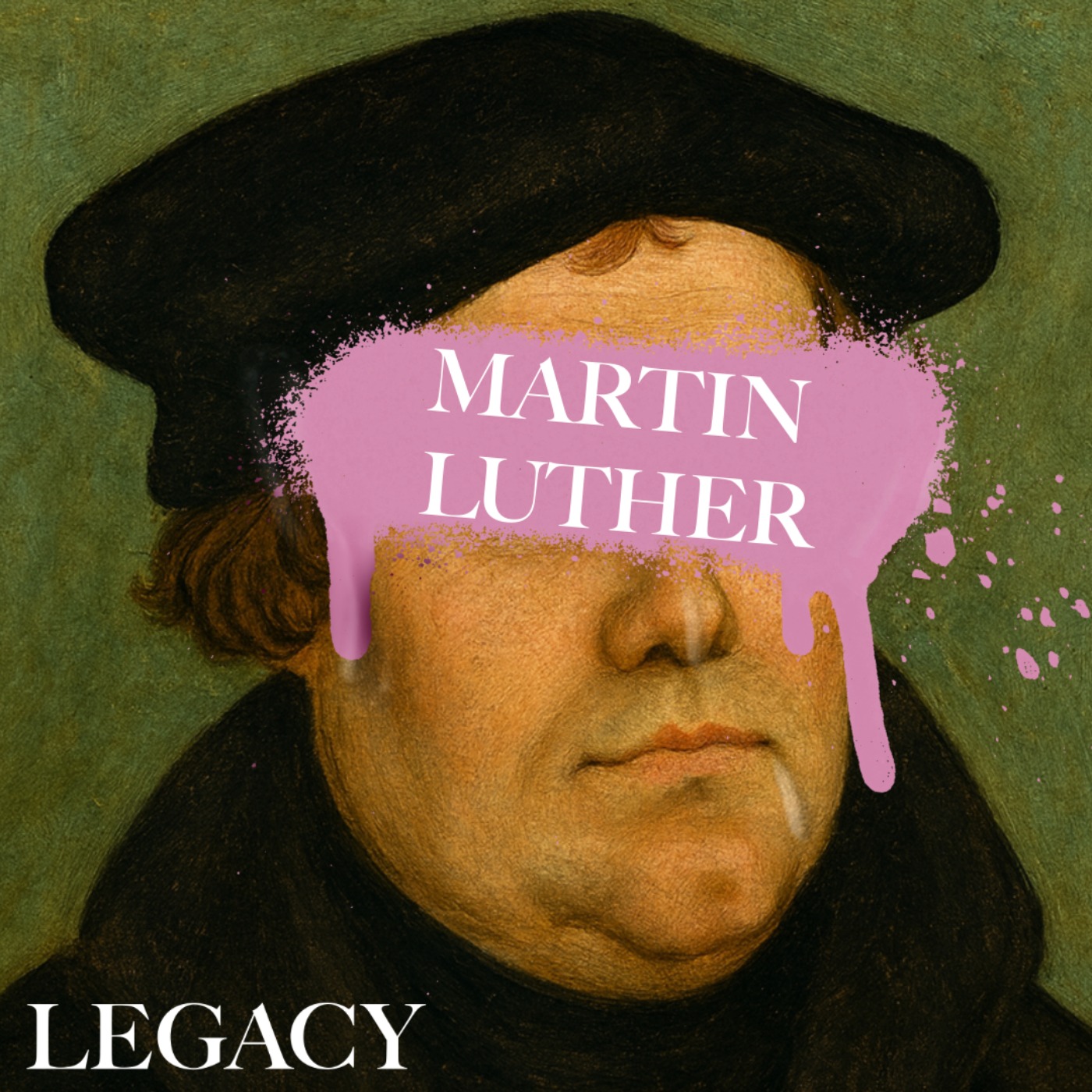
We are talking about Martin Luther.
- [02:02]
Peter Frankenbaum
From Legacy. I'm Peter Frankenbaum.
- [02:04]
Afwa Hirsch
I'm AFWA Hirsch.
- [02:06]
Peter Frankenbaum
And this is Legacy, the show that explores the lives, events and ideas that have shaped our world and asks whether they have the reputations that they truly deserve.
- [02:23]
Afwa Hirsch
This is Martin Luther, Part one, revolutionary hero and villain.
- [02:35]
Peter Frankenbaum
Okay. Afua, Martin Luther, big fan. Any baggage with any history with Luther?
- [02:40]
Afwa Hirsch
Yeah, I got baggage, Peter. I got a lot of baggage. Well, on one side of my family are Presbyterians from Ghana, very devout.
- [02:50]
Peter Frankenbaum
I didn't know that.
- [02:50]
Afwa Hirsch
Yes, well, they kind of dabble in between Presbyterianism and Methodist.
- [02:55]
Peter Frankenbaum
I thought if you're a Presbyterian, you're not allowed to dabble. Isn't that kind of rule one Ghana.
- [03:00]
Afwa Hirsch
We'Re talking about Peter, you know, like faith is where it's at and why restrict yourself to one when you can have a few? And none of those churches, I mean, you know, they range from more traditional to very evangelical. And none of them would exist without Martin Luther, arguably. But on the other side of my family, I'm descended from Jews from Germany who had to flee during the Nazi era. And I think for anyone of Jewish heritage, Martin Luther is a really problematic figure who was anti Semitic at the time, but so much so that he became an inspiration for later generations of really virulent, violent, genocidal anti Semites. So I think we'll come back to that. But I definitely, you know, have feel at the intersection of this kind of. He was a great man who left this legacy of reform and personal devotion in the church versus he propagated some of the most like dangerous and destructive ideas in history.
- [03:58]
Peter Frankenbaum
I heard you studied Martin Luther in your history classes at school. I remember having to do that a couple of times when I was, when I was a schoolboy.
- [04:06]
Afwa Hirsch
Not at all. And everything I've learned about Martin Luther I've learned subsequently. In fact, when I was at school I probably would have struggled to tell you the difference between Martin Luther and Martin Luther King, who obviously are very different characters.
- [04:20]
Peter Frankenbaum
It's funny you say that. We're going to come to look at the influence of one on the other a little bit later. But let's start at the beginning. So Martin Luther was born on 10 November in 1483 in Eisleben in the German territory of Saxony, which at the time was part of the Holy Roman Empire. And the next day he was baptized and named after Saint Martin of Tours, as was customary for a child born on the saints feast day. Tell us about his parents afterwards.
- [04:48]
Afwa Hirsch
His father was a miner and he wasn't a kind of working class man down the mines. He was also not from the ruling class. He was somewhere in the middle. He was somebody who owned mines but on leases, so fairly insecure terms. But they were definitely, you know, somewhere further up the social strata. And every biography I've read of Martin Luther has emphasized this mining background, that this environment of this, you know, industrial, I mean industrial in the terms of this late medieval period town had a really big influence on him. This wasn't the kind of rural, agrarian peasant environment that so many of the characters we think of from that era came from. And his mother MARGARET Luther also came from quite a middle class family. In fact, I think his father was regarded as having done quite well to marry her. And she is described as pious and strict. In fact, both his parents sound quite strict and a little bit joyless.
- [05:44]
Peter Frankenbaum
PETER well, he's sort of urban bourgeoisie. The family that Luther's born into, and you know, that means they're quite well to do and I suppose, you know, without over caricaturing it, it also means that you're kind of slightly looking over your shoulder at how you behave, what are your manners, how ambitious should you be? But, you know, Luther later wrote about his parents and that strictness and the discipline was driven into him at a young age. So, you know, he said that his parents treated him harshly and made him timid. That's something he dealt with later without access to a therapist. Timid was not one of Luther's later calling cards, but he said that his mother once beat him so hard for stealing a nut that he had to run away. And that sense of upbringing, of family, of a fear of authority, are things that start to appear in his later when he starts to write about theology. You know, he said that he had to endure the severest discipline at school so that he became terrified of his teachers. So that world he's growing up with, it's maybe not authoritarian, but it's incredibly strict, very devout. And that's why, I mean, I said there's a joke about Presbyterians, no dabbling. One of the things about Luther and Lutheranism is the way in which you have to live your faith incredibly starkly. So that discipline is a really important part of his youth.
- [06:55]
Afwa Hirsch
I think also the relationship with his father is something we'll come back to because I've heard various theories about that. But it certainly wasn't a boy who was showered in the love and affection of his father. And, you know, maybe that kind of yearning for paternal recognition and love is something that we can see manifesting in the way he later approaches his faith.
- [07:15]
Peter Frankenbaum
Do you think? Afro because we've done this a few times with the figures, people always have these terrible childhoods. Do you think, if you want to be consequential, that you need to have problems growing up so that you kind of find yourself or you push yourself? I mean, so many of the famous people we've covered in different series before have kind of these similar traumatic childhoods where, or at least childhoods they conceptualize later as being traumatic.
- [07:36]
Afwa Hirsch
It's a really interesting question, and I'm in danger of taking us On a tangent, because we're both parents, Peter, and I don't think, and I really hope I don't know a parent who thinks, I'd like to make sure there's some trauma in my child's life because otherwise they won't grow up to be consequential. Like, we. We don't want people to be damaged or angry or traumatized. But I definitely think there's an element of hardship in people who are driven to go on and create great change. I just wonder whether that could be a hardship that's not deliberately inflicted and that's not traumatic so that you remain a well balanced, functional person. But you're right, some of. In fact, most of the people we talk about on the show are not particularly well balanced or functional. And I would definitely put Martin Luther in that category. And he's now growing up and receiving a humanist education. And actually, humanism is something that comes up all the way through the story. So I wonder if you could tell us a bit about what it means in the context of this era, the 1500s in Europe, and you know, what it means in terms of education. And maybe later we'll get on to what it means in terms of Christianity.
- [08:42]
Peter Frankenbaum
Well, the education is about trying to use reason and discipline to be able to make sense of the world around you. That comes across through sciences, through the arts, also through theology. But, you know, the point of balancing respectability, a good living people in society look up to you is one of the reasons why Luther's father had want him to be involved in running of the city, to be a lawyer. And so he gets sent away to a school in Magdeburg that's run by the Brethren of the Common Life, which is a lay religious movement. So people who emphasize personal piety, the importance of education and simplicity in a way to try to get you to sort of live your life in a way that is faithful, but also live by example. And generally, these are not types of education that focus on your happiness or your mental health. They're ones that are constantly enforcing that whatever you're doing is not quite good enough.
- [09:34]
Afwa Hirsch
And added to that pressure, Luther's got this father who runs a mine who's able to educate his son and wants his son to become a lawyer, because as anyone who's growing up with a family business still today knows, it's quite useful to have a lawyer in the family. I don't know if you've watched Yellowstone, Peter.
- [09:51]
Peter Frankenbaum
Have you just started? Just started.
- [09:53]
Afwa Hirsch
Oh, well, it's a classic case, isn't it that, you know, if you're a big ranch owner or a business owner, you want one child that's going to take over the kind of getting their hands dirty running of the business, but you definitely want one who's going to take care of the contracts and the deals and the litigation. And that's Martin Luther. His father wants him to become a lawyer. And I don't get the impression from anything I've read that when his father wants something, it's a gentle suggestion. It's like this is what you will do. And to do anything else is a real act of rebellion that is controversial and unwelcome.
- [10:23]
Peter Frankenbaum
But Luther's got this work ethic, you know, he's very studious, he takes his studies very seriously and he has a very lovely treble voice. We know that's what he tells us any about himself. But he's described by his colleagues and his peers as being incredibly diligent, deeply absorbed in his books. He was very highly regarded by his tutors. And that sort of process of him avoiding the tavern and idle company, that's what one of his friends says. He always spends his time in the library or at his prayers. I mean, we're all studied with people a bit like that who are constantly working hard. And that can come at the expense of your sense of humor and sociability. But Luther's not unpopular with his peers and friends even at the time. But it's a very disciplinarian upbringing. But although he follows his father's wishes to study law, he does have an existential crisis af. I don't know whether you've had one of these moments or turning points in life where something has happened that makes you stop and think, but that does happen with Luther.
- [11:24]
Afwa Hirsch
I have, and I was also a lawyer. And on that track I became a barrister actually and had similarly a kind of existential crisis which made me radically change direction. So I relate to this. He was busy on track to become a lawyer. He got caught in a storm. And this storm was so terrifying, he later said, I thought I was being hunted by the devil himself. I was desperate. And in this near death experience of being trapped in the storm, he makes this pact that if he's saved, if God saves him, he will become a monk, which is quite a big bargain to make. That's not how I resolved my existence.
- [12:07]
Peter Frankenbaum
You resolved to become a podcast host and a bestselling author.
- [12:12]
Afwa Hirsch
So this is where his life takes a dramatic turn. And actually this is a moment that's changed history because, you know, if he'd become a lawyer who'd taken over his dad's mind, so many of the things that later happened would not have happened. I don't know. I suppose if you were a religious person, you could say that was divine intervention. Peter.
- [12:27]
Peter Frankenbaum
I mean, what's interesting is that he. He makes a lot of this. There's a parallel, of course, with the support on the road to Damascus. A kind of moment where suddenly you recalibrate your life. You think much more deeply about things around you. But when he'd been scared during the thunderstorm, he'd cried out to St. Anne. He said, Help me, St. Anne. I'll become a monk. And later he reflects on it and says it was interesting he hadn't called that to Christ, but he called out to a saint. He said, that's how confused my heart was. And he later criticizes that among himself about what is it about the medieval world that is putting people in the way of God and Jesus Christ? And then it becomes a turning point. So these things, they can happen. But in the case of Luther, the fact that he then decides to become a monk sets his father off against him. His father's not happy at all. Afraid. I don't know whether that happened to you when you decided to throw in or not throw in the towel, but stop being a lawyer. Yeah, maybe once a lawyer, always a lawyer. Maybe that's a more generous way to put it.
- [13:25]
Afwa Hirsch
It's not a fast track to pleasing your parents to get close and then decide to do an about turn, especially when you don't have a plan that's in line with their vision. And, you know, in my case, I became a journalist. In his case, he becomes a monk. And maybe we could actually talk a little bit about the church at this point, because, you know, as someone who didn't grow up Catholic or with really any Catholic influences, I never really quite got the role of saints. You know, you're just talking about how he prayed to St. Anne and actually the role of the saints in the church and the fact that you might pray to a saint instead of to Christ, which is what he did, is just one part of this picture of this church. And it obviously wasn't called the Catholic Church at the time. It was just the church in Europe that he becomes very disillusioned with as a monk and begins to sow the seeds of really radically rethinking what he thinks Christianity should look like. So can you tell us anything about saints and relics and icons and, you know, maybe people who are Catholic will still recognize many of these things, even though the Catholic Church has also changed so much since this period. But in this era, you know, this kind of paraphernalia of the faith plays a huge role in what it means to be Christian in Europe.
- [14:32]
Peter Frankenbaum
I think it can sometimes look like it plays more of a role than it does. I mean, it's not just Catholicism. I mean, across Greek Orthodoxy, Christian Church of the east, even with Protestantism too, there's a recognition that the story of Jesus Christ and his death, resurrection, is the key point. But there are lots of people who are part of that story too. You know, the raising of Lazarus, the apostles, what happens to the church, and the way in which the Christian messages disseminated around the world. And the role that saints play is about showing people who have lived their life through devotion by not just putting themselves or pursuit of profit first. And often they're people who have given up their money. Often they're people who've gone to help other people. Often it's people who live their lives in ways that are enduringly Christian. And so the reason why saints become famous is that they are easy stories that can access that mean something to local population. So quite often saints that become important in a particular area are, are people who live there. And therefore, you know, people know who they are. So the problem about the story of Jesus Christ's life is it all takes place in Judea and in Jerusalem and in Nazareth and Bethlehem. And so if you're living in central Germany, it's quite hard to make sense of that. So people who've lived devout lies beforehand are quite good sort of morality stories that you can learn from.
- [15:49]
Afwa Hirsch
Well, massively compounded by the fact that the Bible at this point is not available in a language you understand if you're an ordinary German peasant. So there's a huge issue of accessibility for all these stories. And you can see how the saints who are ordinary people, who might have been like you, but lived this pious life, are a way in of understanding what it means to walk the walk of the Christian faith, as well as just kind of show up at church.
- [16:12]
Peter Frankenbaum
And we'll get to that. And of course, knowledge is often protected by gatekeeping and whether it's through use of language or things that are very complicated. But one of the things about Christianity that is very important is the way in which parables are used. So ways in which sort of simple, everyday stories about the prodigal son, for example, about how you react if one of your children has disappeared and you've been scared about them, and they come back and the complications of what their sibling feels when the prodigal son returns. So that those are quite important, I think, parts of explaining to audiences what the story is all about. But, I mean, I think what's interesting in the case of Luther is that he thinks about this a lot, that that blend between the secular and the lay world, and the way he talks about it is that he doesn't particularly want to become a monk. He doesn't want to give up his life in devotion. But he says that he couldn't find any peace with his conscience, and he trembled. The thought of judgment and eternal damnation and some of those things about moral anxiety and about how you're scared about how you're going to be punished by the divine, it focuses the mind. So when Luther takes the vows to become a novice monk in 1505 and then becomes a priest in 1507, the monastic life is pretty extreme. But Luther throws himself into it completely, sort of fasting, praying, confessing, and obsessively performing penance.
- [17:28]
Afwa Hirsch
He said later, I was a good monk and kept the rule of my order so strictly that I may say, if ever a monk got to heaven by monkery, it was I.
- [17:37]
Peter Frankenbaum
He doesn't do things by half. I thought, you know, he's praying, he's fasting, he freezes, he does vigils. He's absolutely throws himself into it lock, stock and barrel. You know, he would go to confession, he wrote, and repent his sins over and over again. And yet his conscience could never be satisfied. And probably there's something in there about his upbringing. But I think it's also about the idea that, you know, if you're trying to be a good person, if you're trying to be as close to the Christian model as possible, you know, you can never be perfect because we're all human. So. But he takes it incredibly seriously. And you can see in that a kind of fundamentalist, not just being born, but becoming more and more fundamentalist as he goes through his training.
- [18:20]
Afwa Hirsch
And the attitude towards Christianity at the time, it really is quite scary. I mean, you're taught that if you don't confess your sins and you don't purge yourself of sin, you are going potentially to hell. And this is taken really literally at the time. It has a monopoly over the way people think about life and death. And you can imagine as a young, impressionable person craving this kind of approval and. And with a tendency to ask really deep questions about your morality. It's really Scary. If you're not getting there in terms of pleasing God and renouncing sin, you might be facing eternal damnation. You can see how somebody could get into the mindset that would make them obsessed by that prospect. And there's something really unhealthy about somebody who has that obsessive relationship, being in this closeted religious environment with this kind of one track mind, nothing to distract them from the idea that they must do more and they must get God's grace. And there's something that, you know, doesn't really square very easily with our modern idea about spirituality because this, this sounds fanatical and actually very unhealthy, but that's.
- [19:25]
Peter Frankenbaum
Not what everybody does, right? Luther is at the extreme end. We have a selection of what Luther used to say, written in something called the Tischehedl or the Table Talk, written by one of Luther's colleagues that remind us about what Luther did when he was growing up and so on. And he was obsessive in a way that his peers weren't. I mean, Christianity isn't just about punishment and how you're going to end up in the fires of hell. It's also about redemption, it's about kindness, it's about generosity. But Luther takes this all extremely seriously. But in 1508, Luther's sent by the Vicar General of the Augustinian Order, which is what Luther has joined, to teach philosophy and theology at the newly founded University of Wittenberg and Wittenberg for any German, anybody Lutheran, will know why that name is important. And he also begins the formal study of theology that eventually leads him to become a Doctor of Theology about four years later. But he's very influenced by other people who he relates to, like St. Augustine or Bernard of Clairvaux. And to think about how scholars have interpreted not just the Scriptures, but how they interpret that living in their real life. And he starts to become obsessive and fundamentalist about the importance of reading the written word that's in the Bible, particularly the Book of Psalms, but also letters of the Romans and the Galatians. He starts to become very Scripture centered and in fact his Vicar General tells him he's going too far. And he says, don't treat the Bible as a theoretical discipline, but treat it as a spiritual guide. Says to him, look at the wounds of Christ and see the mercy of God. And Luther says it was the best advice he'd ever received.
- [21:02]
Afwa Hirsch
In 1510, he is sent on behalf of the Augustinian Order to Rome, which is obviously the centre of the European church, the Western European Church at this time. And this is a real turning point again for him, Peter and it doesn't start out like that. I think it starts out kind of business as usual. He and another monk take the thousand mile journey from Saxony to Rome, traveling on foot across the Alps in northern Italy. It's a major, major endeavor. And as he later describes it, I went to Rome on behalf of my order, not to go sightseeing, but to conduct business. And he is, regardless of the fact that it's not for sightseeing, initially overwhelmed by the sights. And anyone who's been to Rome will recognize this, the grandeur and the history and the relics. It's all a kind of sensual sensory overload. And you can imagine for someone from small town in Germany, this is a very extreme immersion in power and grandeur of the church. I have to say, and I'm at risk of offending Catholics listening to this, that I have found Rome. When I visited, I think I expected it to be this incredible spiritual experience. And actually instead I found it an immersion in power. I mean, the kind of awe of the opulence and the power and the strength and presence of the institution. I didn't find it a deeply spiritual experience. It felt like going to a powerful capital city in an ancient place, rather than somewhere where you feel a direct connection to the kind of simplicity of the message of Jesus, for example.
- [22:42]
Peter Frankenbaum
Well, I guess it depends what you want, why you go there, and it is all those things. I mean, it is an ancient city, it is a place of enormous power, both political, so religious. But you know, Luther, his experience in Rome changes while he's there. So he's overwhelmed to start with, as many visitors are by the grandeur. He celebrates mass in St. Peter's with awe. And he's going to mass every single day, sometimes two or three times in a single morning. But when he goes to the Scala Sancta, which I don't know if you've been to Afro, where pilgrims traditionally go up on their knees. It's a staircase reputed to have been brought from the palace of Pontius Pilate in Jerusalem, and the one where Christ ascended on his way to the trial, he has another revelation, and this time, as he says, he was climbing up the steps on his own knees, reciting the Lord's Prayer on each one, when suddenly a voice comes to him and says, who knows if this is true? That's another lightning bolt moment, right?
- [23:41]
Afwa Hirsch
Doubt, doubt lurking its ugly head. He leaves Rome with that doubt growing inside of him. And it's a combination of Beginning to ask himself these really unaskable questions. At the time, it was so radical to interrogate the truth of these ideas, but also, I think, a little like my perception of Rome. He is a little bit unsettled by the worldliness of Rome, and he sees corruption, he sees a kind of irreverence of some of the clergy in Rome towards the practices. You know, they're kind of like churning out mass, you know, 100 miles an hour, just kind of going through the motions. Whereas for him, this is, you know, a really profound ritual that should be taken incredibly seriously. And so that is all combining in this sense of disillusionment, you know. Peter, just before we continue, I realize I haven't asked you about your religious background or your faith. How did you grow up? And are these rituals and places something that are part of your background?
- [24:42]
Peter Frankenbaum
Catholic. And I grew up as a choir boy, so I thought it was normal for the end of term to happen at 5 o' clock on Christmas Day. It turns out that lots of people have broken up for school weeks beforehand.
- [24:52]
Afwa Hirsch
I don't know why we haven't got you singing on this show. I had no idea that you.
- [24:55]
Peter Frankenbaum
We'll do that for a choral scholar, Peter, for club members and subscribers, you know, between many, many times and, you know, I think there is a balance between the grandeur and the splendor and the sheer wealth on display and. And the kind of simplicity of the story. For what it's worth, because I'm a historian, I look, I work on Christianity and it spread eastwards. You know, we sometimes center Rome as being the sort of center of the Christian world. And Jesus Christ never traveled to Rome. You know, the whole point of the spread of Christianity was how well it caught root falling off in Asia and more greatly than it did in Europe, too. But I recognize that people's reactions to Rome can be very different and also their reactions. Rome is a very. Is a very different city. There are lots of different parts of it, lots of different kinds of churches. But Luther's reaction when he's there is that he says he arrives as a pious and serious young monk. But he says, I saw things there that made me wish I'd never come. And that detachment from the apparatus of the Church, as opposed to what Christianity means, is something that he feels deeply in his heart to the point that, you know, he reacts so violently that he later writes that Rome is a place where everything holy is despised. If there is a hell, Rome is built over it.
- [26:11]
Afwa Hirsch
Those are really strong words, especially towards a Faith, which you still consider yourself a part, you know, to kind of go from critiquing some of the more worldly practices in Rome to actually kind of condemning the whole edifice, it just really goes to speak to the journey that he goes on. Because those are later remarks, aren't they? And he's kind of like back loading the later extremity of his position onto his earlier position, because at the time he just said, I wish I hadn't come. He doesn't say, you know, this is basically hell built on top of hell.
- [26:45]
Peter Frankenbaum
But then he also says that if he hadn't seen it, he wouldn't have believed that this is what it is. You know, lots of people listening today won't have been to Rome. Or we can forget, if you spend time in London or in Oxford, that most of the world's population haven't been there. And so how you conceptualize things, particularly things that are grand or famous, you know, you can think that the streets are paved with gold, you know, famously in London's case. But the reality of what a city is like and how institutions function is key. But by 1515, Luther is lecturing on Paul's letter to the Romans back in Wittenberg, and he has another of these breakthrough moments, Afra, where talk us through this one about his sort of intellectual discovery, his tower experience.
- [27:28]
Afwa Hirsch
Well, it's really important to say, actually, which we haven't made totally clear, that even though he's incredibly disillusioned with Rome, as we just heard, he's not questioning his Christianity at a deeper level. He is still devoted to scripture, to the story of Jesus in the Bible. So it's not that he is removing himself from the Christian faith. It's that he is really beginning to critique the way that faith is practiced, the institutions. You know, it's quite common today. If you ask someone, you know, oh, are you religious? They'll say, I'm spiritual. You know, I don't really align myself with the institutions. I say stuff like that sometimes because it is sometimes not the faith. You know, I think if anyone reads the New Testament, it's quite hard to see anything about Jesus that doesn't just really make sense as a spiritual message. Much like if you were to read the teachings of Buddha or if you were to read the Quran, you know, there's a kind of common thread through so many spiritual teachings and prophets that really resonate, I think, on a very human level. But it's the paraphernalia of the institution and all the rules and regulations and the Cultural aspects that can be a little bit disillusioning for people or just alienating if it's not what you're used to. And that's kind of what Martin Luther is going through now. He's not rejecting Christianity, he's rejecting the way it's being practiced, the way power is being extracted from it. And he now has what he describes as his tower experience. And this is where he understands the righteousness of God. And by that he means that God gives righteousness to the believer because the believer has faith, not because the sinner is trying to get to righteousness. And this is such a profound revelation to him that he uses a phrase which I think will be very familiar to everyone listening to this. He says, I felt that I was altogether born again. And you know, to me, as someone has African heritage, I mean, we love born again churches, everybody's born again. It's a way of describing that you go from going through the motions of a faith that you maybe may be born into or socialize into, to having a very direct relationship with the Scripture, with the message that you now feel a direct connection to Christ, and you feel literally reborn as a new person in this new light of this faith. And I don't know if Martin Luther's the first person to express it like that, but he certainly popularises the idea that being born again is something that you can personally experience through your direct relationship with faith.
- [29:59]
Peter Frankenbaum
Well, partly because that's sort of the Christian message, you know, the resurrection and coming back second time round. You know, I think there's the idea that you have a greater sense of enlightenment after the, the traumas. So I think the born again and the resurrection all fit very neatly together. I think what Luther feels that he has is also he has a messianic idea that he has seen a truth that other people can't see. And so he thinks that it's his job now to explain his own journey and to explain why other people are wrong. And as the smart boy in the class, very diligently brought up, afraid of authority, having seen something he thinks is right, his next thing is to explain that to everybody else. So very famously, on 31st October 1517, Luther goes to the door of Wittenberg Castle, as tradition holds, and he nails his so called 95 theses to the door of the church. And he's basically challenging the institutions, he's particularly attacking the sale of indulgences. He's got his I in particular on somebody called Johann Tetzel, who's a German Dominican friar who'd become the Grand Commissioner for indulgences in Germany. And Tetzel had been giving, I should say selling forgiveness in return for donations to the church. And he was a very famously smooth operator, Tetzel. He persuaded people to buy his indulgence to give access directly to heaven to people already dead, people who are in purgatory. And Luther's reacted to this is what he picks out as being symptomatic of how the Church has lost sense of what Christianity really means.
- [31:46]
Madupa Akinola
Hi, I'm Madupa Akinola from TED Business, and I'm here to talk about the Financial Times. Every day the world bombards you with endless headlines and noise. What matters most, facts and context. That's where the Financial Times comes in. With clarity, depth and truly independent reporting, the FT helps you cut through the noise and see what's real and why it matters. Stay informed with the trusted source. Leaders around the world rely on. Visit FT.comSourceFT to read more and save 40% on a digital FT subscription.
- [32:26]
Instacart PSA Voice
A PSA from instacart. It's Sunday, 5:00pm you had a non stop weekend. You're running on empty and so is your fridge. You're in the trenches of the Sunday scaries. You don't have it in you to go to the store, but this is your reminder. You don't have to. You can get everything you need delivered through Instacart so that you can get what you really need. More time to do whatever you want. Instacart for one less Sunday. Scary. We're here.
- [33:06]
Afwa Hirsch
We need to take a moment on this because again, anyone who's not experienced these ideas is going to find it really bizarre. But at the time, there were these ideas that were completely mainstream. And one was, as you said, could buy these indulgences. Literally kind of, it's like cash for honors, cash for forgiveness, cash for eternal honors. You know, cash that will get you out of purgatory, which could last thousands or even millions of years and help you get into heaven. So kind of buy your forgiveness in the afterlife. And Tetzel is someone you can just imagine on Instagram now. You know, sometimes I'm, I'm scrolling through my Instagram and I see, you know, a hair remedy, like use these drops and your hair will be waist length and thicker than it's ever been. And, you know, they can be quite seductive. The idea that you can just buy this magic product and it will solve all your problems.
- [33:55]
Peter Frankenbaum
I never get those on Instagram.
- [33:57]
Afwa Hirsch
You need my algorithm, Peter. I'VE got all kinds of miracle cures on my algorithm for all kinds of problems.
- [34:04]
Peter Frankenbaum
I've got old people playing cricket normally.
- [34:07]
Afwa Hirsch
Yeah, no, I'm not swapping algorithms with you. Sorry. And then the other thing you've got is these relics, which I just find fascinating. You know, people have a twig from the burning bush seen by Moses and they have, you know, rags from the shroud with which Jesus's body was wrapped after the crucifixion. And, you know, I sometimes think if you were someone who was really struggling and it all went tits up for you in this era, you could just go and snap a twig off a tree and say that it came from Gethsemane and you'd be laughing. You know, I just find it so interesting that people collected these things, items, and were believed that they had this incredible holy power and that if you could get to them or pay for access to them or buy them, it kind of gave you privilege. Because there's absolutely nothing in any of Jesus's teachings that suggests that cash is going to get you anywhere closer to heaven. And so these are all of the things that Martin Luther is, I think, quite understandably, railing against because they're so divorced from the actual religion and they're obviously these man made materialist inventions that have got between the believers and the beliefs.
- [35:17]
Peter Frankenbaum
And Luther is really angry about the fundraising that the church does and in particular the sort of the way in which it is selling cash for honors. Yeah, cash for indulgences or for the good of the soul, either in this life or the next. And so he rails against it. Luther is, I guess, lucky, if you want to see it that way, that the printing press allows copies of his theses to be printed and they spread everywhere and they start to provoke real alarm in ecclesiastical circles. And Luther gets challenged, so he then has to explain himself. So writing to the Archbishop of Mainz, he says, I just can't remain silent when the salvation of souls is endangered. And eventually he's called to Heidelberg, one of the great university cities in Germany then and today, to explain his theology more fully. And here he develops his idea of the theology of the cross, which contrasts with the scholarly theology of glory. So Luther starts to say things that the cross alone is our theology. We need to go, I suppose, back to basics. We need to forget about money. We need to stop thinking about the ways in which funding is connected to indulgences. It's about how you live your Christian life. So he sees himself as being someone who is rebooting Christianity to take it back to its closer origins. But that doesn't go down well afterwards. So what happens to him at the Diet of Worms, which, by the way, I spoke about the other day to some students, and I asked if they knew about the diet of worms, and they thought that that's something on their Instagram feed that's going to make them thin and beautiful.
- [36:51]
Afwa Hirsch
It is. I mean, they have all these diets in this period, which are basically like big meetings or conferences that go on for a long time. But, you know, the combination of there being a diet and it being held in worms, which was written like worms, is a kind of unfortunate juxtaposition. May be fitting for an event that we should all remember because of its importance. But, yeah, in the process of kind of defending this new concept of his theology, he's summoned two worms to explain himself and actually more than explain himself to apologize, because this is completely unacceptable to the established Church, that he is going around challenging their established practices. And by the way, these practices are a way of preserving power in the figures of authority in the Church. They're also a massive source of income. So, you know, this is very subversive and unwelcomely. So from the position of Church authorities, and he is expected to go to Worms and recant, repent, admit he was wrong. And to fail to do that carries the potential for death, doesn't it, Peter? I mean, people were executed for lesser wrongs than this in the eyes of the Church at the time.
- [38:00]
Peter Frankenbaum
I mean, he's looking for trouble. You know, he's already before the Diet of Worms. He has published a set of treaties that he sends out to the nobility of the German nation to explains everything that's going wrong in the Church. And he keeps writing things like, a Christian is perfectly. It's a perfectly free Lord of all and is perfectly dutiful. And it gets under the skin so that by 1521, he's been excommunicated by Pope Leo X. And rather than recant or try and explain himself, Luther doubles down, burns the bull and says, because you've confounded the truth of God, the Lord today confounds you into the fire with you. So he's taking on the Pope in person, and that's incredibly dangerous. The tricky thing is that his ideas about freedom, about more independence from Rome, about trying to play down the role that the Church plays locally, has plenty of support or falls on quite fertile ground, particularly with German princes who feel that the Church's tentacles are spreading too far into their own day to day decisions. So he's not completely on his own, he's condemned. But the orders of the Holy Roman Emperor to enforce punishment. He's given some protection, in particular by his great ally, Prince Frederick the Wise of Saxony, who shelters him in the Wartburg castle. And while he's there, you mentioned about language, Afwen, about knowledge being protected. Luther does one of the things that's most radical of all, which he starts to translate the New Testament into German to make it more accessible to common people so that his ideas could also be spread further as well.
- [39:38]
Afwa Hirsch
I mean, if you'll forgive the metaphor, it's a bit of an unholy alliance because princes like Frederick the Wise, as he's known, are not necessarily following Luther's teachings because they have their own profound spiritual revelations, but because, you know, they're united in finding the current control of the Church problematic. And you know, in the case of these princes, it's the constant financial demands that the Church is extracting, or you could even say extorting tithes and taxes. There's this whole system where, you know, the peasants and farmers have to go give a percentage of their produce to the Church, the landowners have to give a percentage of their wealth to the Church. A lot of people for different reasons are feeling oppressed by the status quo. And so Luther is kind of bursting onto the scene with his own reasons that I don't think have really anything to do with material interest. They're very spiritual in his case, but you know, it's very fertile ground. And so he's harboured in this castle and has time and you know, any writer listening to this, and I know we can both relate, when you have a big piece of writing to do, it's kind of the ideal to have a prince take you in and give you a writer's retreat in his castle. I can't speak from experience, it's not how I usually roll, but I would definitely take it. No, usually I try and find some little kind of cottage or quiet place in the countryside if I'm really on a massive deadline. But I'd take a castle, that'd be fine. And I think that's the perfect place for Luther to do something quite extraordinary. He translates the New Testament into German. He does it in, I think it's about 11 weeks, Peter. I mean, he does it really quickly. It's definitely an intensive writing retreat. And this is a big deal because ordinary German people who are literate, admittedly have not been able to read the New Testament in their own language. And by giving even a class who are literate the ability to read it, they can now read it to other Germans who aren't literate. And so the message is now able to be spread. And this one act of translating the New Testament into German has, I think, a huge legacy just on its own in actually what it does for the German language. Because he's not translating it into kind of Hochdeutsch, he's translating it into ordinary German. He often talks about what the woman in the market with the child would be able to understand. He's deliberately trying to use the language the people really speak the vernacular. He wants it to be accessible because he thinks that's where scripture belongs, with the people able to engage directly with the word of God as he believes it is. So it's a big deal.
- [42:06]
Peter Frankenbaum
Yeah, that's right. Afwa. And so now what happens is that the noise starts, the thunderclouds start to rumble through Europe. There's a peasants war in Germany that's partly inspired by Luther's messages of Christian freedom, the idea about salvation through faith alone, and his criticism of hierarchies, of the corrupt practice of the church that falls on fertile ground with the peasants and starts to lead to violence in Europe. And, you know, although the numbers of people who die in conflicts and uprisings vary, there's a bit of dispute amongst historians about exact numbers. It's certainly the tens of thousands, maybe a hundred thousand people. And Luther, to start with, Afro is. Is on their side. But he does change his opinion.
- [42:46]
Afwa Hirsch
I mean, this is a big deal, the peasants war. It's regarded now, I think, as the largest mass rebellion in Europe before the French Revolution, or, you know, second largest in history to the French Revolution. And there is this, like, groundswell of grievance from ordinary people against, as we were hearing, the Church, the established authority, this very exploitative relationship that the church has with the people. But actually this is an important part of Luther's legacy because we might think that he's out there on the side of the people, wanting to bring down the hierarchy. Not at all. He wants a kind of spiritual revolution where people have direct access to the word. He doesn't want to overthrow the aristocracy, the class system, the entire institutions of the state. And actually he condemns the violence of the peasants and in quite strong terms. And that's very alienating for many of his reformers who'd assumed that his radicalism about religion also translated into broader social upheaval. So I think we have to remember that when we're tempted to see him as this kind of 360 degree radical. He's got some very conservative elements about his attitude as well.
- [43:52]
Peter Frankenbaum
And some of those are to do with, you know, I suppose, what we might call democratizing instincts. So you mentioned his translation of the Bible or the New Testament, I should say, in 1522, just over a decade later, there's a complete German Bible that's translated from Hebrew and Greek with helpless scholars. And it profoundly shapes German language and Protestant identity. And, you know, the key to that is that Luther thinks it's important that a farmer can understand it and not just priests and scholars and specialists. And that falls through into things about public education as a Christian duty. So he writes, for example, to all the councilmen of all cities in Germany, saying that the prosperity of cities doesn't consist in great riches or in strong walls or beautiful houses, but in how many learned, wise, honorable and well educated citizens there are. And we're going to talk a bit about that, about the effect that there is on education. But Luther is, you rightly say, Alfred, he's looking for reform, but he's also insistent on it. So he takes everybody on left, right and center. And that process makes him physically frail in his later years. He does continue to write arbitrat disputes and travel.
- [45:00]
Afwa Hirsch
Earlier I mentioned Trump, Peter, and this is where I think there is a little bit to say, because the way that Luther, towards the end of his life, kind of gets angrier and angrier, you get the impression that he's someone. If he had been on Twitter, he would be firing off angry tweets at all his enemies and they'd be getting increasingly, I think that's right, restrained. You know, he really goes for people and he almost seems to feed off the kind of venom of firing shots. When they respond, he responds back. You know, we've all seen those threads of people who don't know when to back away from an argument.
- [45:32]
Peter Frankenbaum
He's one of those.
- [45:33]
Afwa Hirsch
Yeah, he is one of those people. It's not all conflict, though. He does marry. And I find the story of his marriage, you know, I'm a bit of a romantic. I think it's quite sweet because the woman he marries, Katerina von Bora, is herself a former nun who'd fled her convent. And, you know, that's something they really have in common. And it's quite unusual, I think, for two people who lived that cloistered life to leave and then find each other. And their marriage was this real personal bond, but it was symbolically public. Because they had a union that was bound in the values that they shared. And.
- [46:09]
Peter Frankenbaum
But Afra, look, I know you're romantic, right? So I'm going to say that. You're going to say that the bit that you. That warms you, your heart is when he writes and says there's nothing more lovely and friendly and charming in a relationship or communion than company, than a good marriage. But that's not the only thing he says about marriage. Tell us about why he wrote to his friend Wolfgang to say why he got married.
- [46:26]
Afwa Hirsch
Well, I mean, he is like a very fanatical Christian. I married to please my father, to spite the Pope and the devil.
- [46:33]
Peter Frankenbaum
There you go.
- [46:34]
Afwa Hirsch
And to seal my witness before martyrdom.
- [46:36]
Peter Frankenbaum
That's less romantic.
- [46:36]
Afwa Hirsch
No, but I don't think these things are mutually incompatible. You know, it's like bound up with his spiritual beliefs, but it's also something that he loves. And you're not going to be able to get the romanticism out of me, Peter. But also I think it's important because, you know, when we think about a monk in the 16th century in Europe, we're not thinking about somebody who would be able to have a happy marriage, love his wife. I mean, he. He writes in his letters about every bodily function, including sex and impotence. You know, he's having a sexual, physical life, and he doesn't seem wrought with guilt about that. And that's another big break from convention, where the Church has been kind of teaching that, you know, sexuality is basically undesirable and, you know, the sins of the flesh are to be minimized. And he's also rejecting that, which I think is quite compelling for a modern audience, this idea that you can be very serious about your faith, but be comfortable with your body, have a healthy attitude towards intimacy and sexuality. I know I'm giving it very modern language, but I don't think that's completely unfair when we look at his relationship with those things. So that's a lovely story. Thank you very much for letting me tell it.
- [47:45]
Peter Frankenbaum
Luther the romantic. I mean, the other thing is he's incredibly hard working, so. And throughout the 1530s, he's constantly preaching, writing commentaries, sending letters to everybody he could possibly imagine. And I think your point about him being on social media is well made. I find millions of followers and just always, always they're popping up, sending things out. But he gets increasingly more angry. He rails against the papacy, he starts to rail against Jews, and he writes in victrionic terms that, not surprisingly, are condemned later on, but also are grist the mill for anti Semites, too. That's a really important part of his legacy. He doesn't work himself to death, but he starts to get more and more frail. And in his last years, he's carrying on writing, constantly on the move. But in January 1546, he goes back to Eisleben where he'd been born, and he dies peacefully in his sleep. His last words that he writes are, we are beggars. This much is true. But I'd like just to. Just to finish off this episode, Alfred, because we're going to talk about his legacy spanning several centuries afterwards, but tell us about how we might sum up Luther and his legacy.
- [48:52]
Afwa Hirsch
I think it's a complex question because Luther was not the only reformatory voice at the time. I think it would be simplistic to. To say he was the Reformation personified. And obviously it's only called the Reformation later. But he is such a key figure. Peter and his ideas are so viral partly because they coincide with the print press being accessible technology. It means that his writings are able to be disseminated so widely. And there's absolutely no question that that reaches people across Europe at a really pivotal moment in history. And we haven't really talked that much about the geopolitical atmosphere, but, you know, this is a moment where Europe is scared of a kind of existential threat from the Ottoman Empire, which is encroaching into the Balkans. You know, they. They fear that Christendom could be over. You know, there's an atmosphere that this could be end of days in Europe, and everybody is in this kind of, like, heightened state. The stakes feel very high. And so he's throwing a firebomb into an already febrile environment. And I think that so many of his personal ideas are still very visible in what later becomes the Protestant church. So anybody who is a Protestant will recognize ideas that have their direct authorship in Luther. And, you know, in the next episode, we'll talk about what that meant for the world, for Africa, Asia, Latin America, Ireland, for the United States, where I think, actually we're hearing the kind of evangelical zeal of Luther's ideas manifesting in all kinds of strange places in contemporary politics today. So there's no question that this man's life, you know, which began at the end of the 15th century and ended in the middle of the 16th century, is completely far from over as far as legacy is concerned.
- [50:35]
Peter Frankenbaum
So, as my brilliant colleague at Oxford, Lyndall Roper, wrote in A Martin Luther Renegade and Prophet, which I recommend to Anybody who's listening. Luther's ideas, Lindel, Professor Roper writes, destabilize not just religion, but the entire structure of European society, creating an upheaval in every aspect of life, from the most personal to the most political. And that's partly because what Luther does is to help shape a new political order where the individual is strengthened against the power both of the church, but also of the state. So as Professor Roper writes, Luther's Reformation wasn't just about theology. It was also about making the Christian faith intelligible and accessible to the masses and empowering individuals to think for themselves. So there's so much that we wanted to look at for Luther the revolutionary before we cast our net wider to think about some of those legacies. But those legacies are astonishing and they're really genuinely global and they have consequences that could be traced even today, 500 years later.
- [51:34]
Afwa Hirsch
There's so much to say about Luther, Peter, that we've spent this episode really looking at his life, understanding better who he was and what drove him. But next episode, we're going to see how those ideas and how that life set off a chain reaction that has forever changed Britain, America, the United States. It's helped fuel the rule of Nazism. Even anti Semitism that still exists today can be traced to some of the ideas that Luther espoused. And it even helps explain why people are willing to pay such high levels of taxation in some countries, why scientific attainment in some parts of the world is higher than others. You really couldn't get a more widespread legacy than this, Peter.
- [52:16]
Peter Frankenbaum
Well, you're going to have to listen to our next episode which is out in a couple of days. So join us next time for Legacy Martin Luther Part 2.
- [52:37]
Hannah Burner
Foreign this is Hannah Burner from Giggly Squad. Opill is the first over the counter daily birth control pill available in the us. Let's be real. Getting a birth control prescription is not always easy and it's so much admin. In fact, about a third of women face barriers to access prescription birth control. Between scheduling appointments, missing work class or just trying to exist, it's a lot. But now opill is putting birth control in our control. Opill is a daily birth control that's FDA approved, full prescription strength and estrogen free and 98 effective when used as directed. Grab it online or at most major retailers. No prescription or doctor's appointment needed. So if you're thinking about birth control, check out opill to see if it's right for you. Use code giggly for 25 off your first month of opill at O-P-I-L-L.com. that's CodeGiggly at opil. Com. Birth control in your control. We love to see it.