Loading summary
Transcript71 lines
- [00:00]
Afua Hash
Wondery subscribers can binge seasons of legacy early and ad free. Join Wondery in the Wondery app or on Apple Podcasts.
- [00:08]
Peter Frankopan
Warning this episode contains descriptions of violence. Listener discretion is advised. Hello and welcome to the third in our series on Joseph Stalin.
- [00:29]
Afua Hash
We left Stalin in 1939. His great terror has wiped out hundreds of thousands of citizens in the USSR who live in fear of their leader and his non aggression pact with the Nazis has stunned his own people and shocked the world.
- [00:45]
Peter Frankopan
Stalin thinks war might be coming one day, but for now he wants the time to rebuild the Red army and get it back up to speed. Something that's important given he's murdered most of its most senior commanders. But Stalin is in for a rude awakening.
- [01:03]
Sarah Gibson Tuttle
Raise your hand if you want your nails to look perfect all the time. Me too. I'm Sarah Gibson Tuttle from Olive and June and this is exactly why we created the MANI system. We wanted to make it possible for everyone everywhere to give themselves a beautiful manicure at home with our tools and our long lasting polish. Each manicure with our mani system comes out to just $2. That's right, $2. No more. 30, 40, $50 manis that you get at a salon and they take hours. Now you can paint your nails on your time and love them more than ever. And by the way, when people ask who did your nails? Where did you get them done? You're gonna proudly say I did them myself. Get 20% off your first mani system with code freshmani20@oliveandjune.com freshmanny20 that's code freshmanny20 for 20% off at oliveandjune.com Freshmanny20 let's get you nails you can brag to all your friends about, shall we? Ladies, Is everyone trying to fix their health concerns with unproven gummies and tricks? Well, thank goodness low libido has a real clinically proven treatment.
- [02:14]
Unknown
Low libido can be so frustrating, but there is a treatment called addi.
- [02:20]
Sarah Gibson Tuttle
ADDI is the first and only FDA.
- [02:23]
Unknown
Approved pill proven to boost sexual desire.
- [02:25]
Sarah Gibson Tuttle
In certain premenopausal women. Isn't that great a clinically proven option for your low libido that comes from a doctor, not a gas station.
- [02:33]
Unknown
Learn more@addi.com and take charge of your.
- [02:36]
Sarah Gibson Tuttle
Sexual health with a treatment that's backed by science. Remember, that's addy a d d y.
- [02:42]
Unknown
I.com addi or flavanserin is for premenopausal women with Acquired Generalized Hypoactive Sexual Desire disorder who have not had problems with low sexual desire in the past who have low sexual desire. No matter the type of sexual activity, the situation, or the sexual partner, the low sexual desire is troubling to them and is not due to a medical or mental health problem, problems in the relationship or medicine or other drug use. ADDI is not for use in men or to enhance sexual performance. Your risk of severe low blood pressure and fainting is increased if you drink one to two standard alcoholic drinks close in time to your ADI dose 1. Wait at least two hours after drinking before taking ADDI at bedtime. Your risk of severe low blood pressure and fainting is also increased if you take certain prescriptions over the counter or herbal medications or have liver problems. Low blood pressure and fainting can happen when you take addi. Even if you don't drink alcohol or take other medicines, do not take if you are allergic to any of the ingredients in addi. Allergic reactions may include hives, itching or trouble breathing. Sleepiness, sometimes serious can occur. Common side effects include dizziness, nausea, tiredness, difficulty falling asleep or staying asleep, and dry mouth. See full PI and medication guide including boxed warning@addi.com PI or call 844 pink pill addy that's addie a-y I.com.
- [03:58]
Peter Frankopan
From wandering goal hanger I'm Peter Frankenburn. I'm Afua Hash and this is Legacy, the show that tells the lives of the most extraordinary men and women ever to have lived and asks if they have the reputation that they deserve.
- [04:22]
Afua Hash
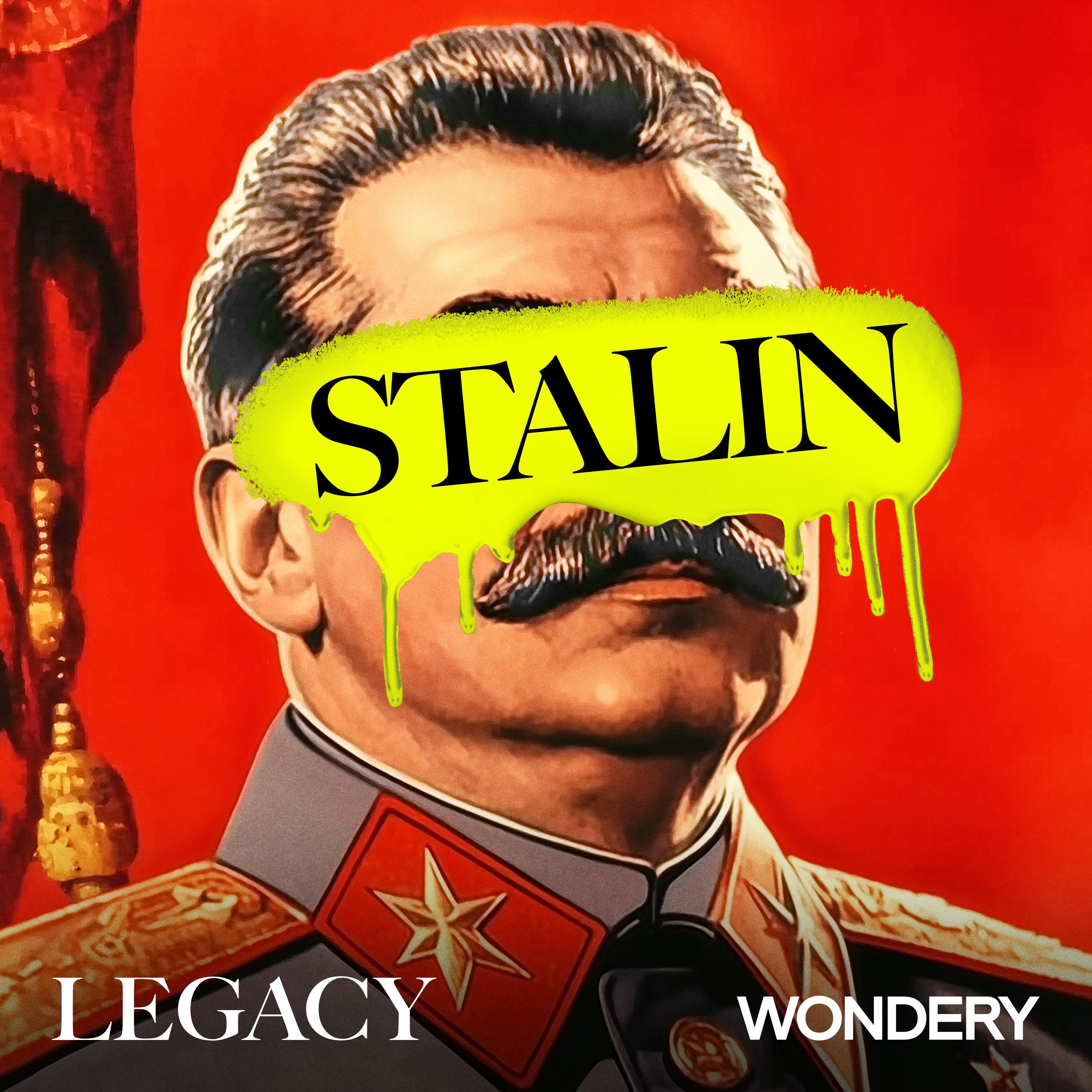
This is Joseph Stalin. Episode 3 Fighting Hitler.
- [04:40]
Peter Frankopan
We'Re in the summer of 1941 in the West. France has fallen in just 40 days. Britain is left alone, fighting for survival. The United States is watching from the sidelines, and Hitler's greedy gaze has swiveled east, as it was always going to. He wants Lebensraum land for the German people. And he wants oil, raw materials, wheat. In other words, Soviet land, Soviet oil, Soviet raw materials, Soviet wheat.
- [05:12]
Afua Hash
It's the early hours of 22 June. Soviet border guards can hear the sound of tanks. They've been hearing them across the German frontier for days now, but not this close. They peer into the darkness and all hell breaks loose.
- [05:51]
Peter Frankopan
June 22, 191941 Kuntsevodaca near Moscow, Soviet Union Stalin jolts awake in bed. It's before daybreak. Through the darkness, he can see the outline of an assistant hovering beside him. He rubs his aching eyes, tastes last night's vodka on his breath. What is it? He demands. General Zhukov is on the phone. A voice Tells him. He says it's urgent. Stalin fumbles for his dressing gown, stumbles into his study. A nagging thought plays on his nerves. Last night, Zhukov warned him the Germans were planning to invade. Nonsense. Stalin had told him. He scoops up the phone. What's happening, General? Zhukov tells him Hitler has launched a massive ground and air assault across the entire Western front. Millions of troops. Stalin takes a sharp breath. Hitler is on their side. They signed a treaty. Zhukov asks for permission to counterstrike, but Stalin tells him, don't do anything yet. Assemble the council. I'm coming to the Kremlin. An hour later, Stalin sits at a round table with members of the Politburo. Molotov is asking a question. Stalin cuts him off. Hitler can't know what's happening. We must inform him so that he can stop it. He sees them exchange quizzical glances. Zhukov clears his throat. We need to retaliate, Repel the attack. Leningrad, Kiev and Riga have all been bombed. Give me the order, comrade. Stalin paces to the window. He can feel their eyes on him. Outside, Moscow looks the same as ever. But he's being told they are under attack. Surely there's been a mistake. He sees someone enter and hand Molotov a note. Molotov stands abruptly. His face is solemn. Germany has declared war on us. Stalin feels the air rush out of the room. He sinks into a chair, hears a cacophony of voices aiming questions at him. But he can't look up, because that would mean accepting that Hitler, a leader he so admires, has betrayed him. It would mean admitting that the Soviet Union is at war with a better equipped and vastly superior army. And it would mean everyone knowing that he has been outmaneuvered by a more ruthless opponent with the power to destroy him.
- [08:49]
Afua Hash
Only four hours after the invasion begins, at 7:15, does the first order come from the Kremlin. Effectively, Stalin does nothing for the entire day. Peter, what is going on with him at this point?
- [09:04]
Peter Frankopan
I think he goes into a sort of state of shock. I mean, genuinely, the general consensus is he has some form of breakdown. He can't process what's going on. And that's all to do with what we just heard, that he can't believe that he's got it wrong. He can't believe the scale of the problems coming towards him, can't believe that he's exposed the Soviet Union to these kinds of risks. But you know, that's the problem. If you deal with the devil, the devil comes and takes your soul from you. And that's what's happened here.
- [09:31]
Afua Hash
He is back in action by the end of the day and then disappears again. He goes to his dacha and then when his colleagues try to find out what's going on, his aides say they don't know where he is. So this isn't just a quick breakdown before he snaps back into action. I mean, he's really falling apart at the moment, arguably, when the role needs his leadership the most.
- [09:53]
Peter Frankopan
So when Stalin disappears to his dacha as the Germans advance and they go right the way through the western frontier of the Soviet Union like a knife through butter, reaching Kiev in a matter of days and then putting pressure onto places like Moscow and Leningrad too, the question is, then who's going to start making decisions? So Beria, who's head of the nkvd, the secret police, rallies his comrades and persuades them to drive out to go talk to the boss, which is what, how they refer to Stalin, and they see him looking strange and guarded. And some historians think that Stalin was convinced that they've come to arrest him, because of course, that's what he'd have done in those circumstances. And of course, the irony in the 1930s accusing all the marshals and the generals in the Red army of plotting and planning and not being ready for action. It's Stalin himself on whom this one falls.
- [10:42]
Afua Hash
It's interesting to think about Stalin's general perception in the world at this point. I mean, in 1939, Time magazine had named him the world's most after the Molotov Ribbentrop pact. He's not Churchill, Peter. He's not one for rousing speeches and broadcasting over the airwaves with the patriotic message. But he does choose his moments. And when he does, he does really reach his audience.
- [11:09]
Peter Frankopan
Yeah, so you're absolutely right. Afua. So Beria and his comrades are able to coax Stalin back to the Kremlin. And Stalin gives a speech that is often compared to some of Churchill's great speeches. I mean, for what it's worth, Churchill's, we know cause we did a series on him. Alfredo, you may not have liked his politics, but he was a great writer and he was a great capturer of his audience. Stalin wasn't either of those. But the speech he gives does capture the imagination and is said to have reduced men, women and children to tears. I suspect that's not true at all, actually. I think that the sense of shock and fear at how the Soviet Union was in this position was absolutely critical. But Stalin says on 3rd July 1941, he makes a broadcast that says, comrades, citizens, brothers and sisters, fighters in our army and navy, it is to you I appeal, my friends. History shows that invincible armies don't exist and have never existed. Napoleon's army was considered invincible, but it was crushed in turn by Russian, English, German forces. The same has to be said about the present German fascist army of Hitler. This army has not yet met serious resistance on the continent of Europe. Only on our territory has it met serious resistance.
- [12:30]
Afua Hash
He's suddenly stepping into this role as a hero, you know, and thinking about how in Russia, the war is not called the Second World War, it's called the Great Patriotic War. And at the helm of this Great Patriotic War is this leader enjoying his finest hour. So I mentioned how in 1939, Time magazine regarded Stalin as the most hated man in the world. This is what they say of Stalin in 1942. The man whose name means steal in Russian, whose few words of English include the American expression tough guy, was the man of 1942. Only Joseph Stalin fully knew how close Russia stood in defeat in 1942. And only Joseph Stalin fully knew that, how he brought Russia through.
- [13:16]
Peter Frankopan
But yes, he's gone full circle from being a pariah and being the agent and the architect who helped launch the war in Europe to the only way in which the Germans might actually get stopped. What's amazing is how fast and extensive that march is that the Germans reach deep into the Soviet Union. Originally, the war plans have been to attack Ukraine and head towards the oil. But Hitler, being extremely indecisive, bit like Stalin, insisted on sending spurs of the German army up to Leningrad, which is subjected to a siege through which at least a million people starve to death over the course of the next three years. And then to Moscow as a symbolic attempt to try to chop the head off the snake. The sort of classic way in which military men sometimes think. By the winter of 1941, German motorcyclists are on the outskirts of Moscow, and it looks like Hitler is going to do what Napoleon had failed and to defeat the mighty Soviet empire, the Russian empire of old. And it's hard to understate how badly the Soviet army performs for those first six months, when it looks like things might be a disaster.
- [14:18]
Afua Hash
They are 20 miles from Moscow by the 2nd of December, and one indication of how seriously the Soviets take the threat is that they have Lenin's embalmed corpse prepared for evacuation from the Red Sea. It might not, to listeners seem like the biggest priority, but this is the core symbol of the Communist regime of the Soviet order. So they prepare for Lenin's body to be evacuated, and they prepare an armored train to evacuate Stalin. But, and this really is by the skin of his teeth, he never actually needs to take it.
- [14:52]
Peter Frankopan
It's fueled and ready to go. I mean, it's sort of blow the whistle and he's off. And I think that standing and fighting shows a bit of gumption and character, but a lot of the credit goes to Marshal Zhukov. I don't know if you've seen the wonderful Armando Yannucci film the Death of Stalin, where Jason Isaac plays Zhukov, this magnificently confident, barrel chested man with medals all over his uniform, very flamboyant. And that relationship between Stalin and Zhukov is unique. Zhukov is a confident man who's not gonna get bullied by Stalin, and he knows that Stalin now needs him, so he stands up to him. He tells Stalin what he wants and needs, and Stalin responds by confiding in him. But it's always tricky when you've got highly placed generals in any system because they're a natural alternative. So Stalin sees Zhukov with a lot of suspicion throughout his career.
- [15:41]
Afua Hash
Remember, Stalin's unique strength is the somewhat prosaic skill of organization. And wartime is when that really becomes useful. So leaving Zhukov to rally the army and actually, unlike some dictators, he is willing, threatened as he is by them, to put his general's advice into action. Stalin organizes the war machine, and he organizes it in a way that it's really hard to imagine could happen anywhere else on the scale and effectiveness of the Soviet Union. This huge, incredible command economy. Entire factories are packed up and moved east of the Urals so that they're out of Nazi reach. And then they're rebuilt in their new location. Soviet industrial output during this era reaches astonishing levels. In the last six months of 1942. The Soviet economy matches the German level of production for the entire year. In those six months alone, they build 15,000 aircraft and 13,000 tanks. It's an astonishing level of production and war effort.
- [16:48]
Peter Frankopan
Peter The Germans do get stopped, but the cost is felt by the people. One of the things that gets often ignored or left out of history of the Second World War is that minorities are sent to the front line to fight. So more Kazakhs died during the Second World War than British people fighting. But in the summer of 1942, the Germans come again. This is going to be the defining moment in the entire conflict. And it will come on the banks of the great river Volga, in the city that bears Stalin's own name.
- [17:46]
Afua Hash
The summer of 1942 is, is threatening to turn into a repeat of the previous year. German panzers sweeping across the steppes, the Soviets retreating in disarray. But then on the 28th of July, Stalin signs and issues order 227, no step backwards. It's read out to all the troops. Retreat equals treason. Panickers and cowards, it states, face summary execution. This is a really remarkably brutal order in wartime. It means that anyone who shies away from this lethal warfare that's almost hand to hand combat in some instances, will be shot by their own side for treason.
- [18:33]
Peter Frankopan
So the battle is being fought on the banks of the Volga in the city of Stalingrad. And that's where the Soviets turn to face the German invaders. And it becomes one of the most famous or perhaps infamous battles and sieges in history. The city is literally reduced to rubble, with the Soviet army occupying a slither on the west bank. Fighting from house to house, door to door. Somehow they managed to hang on. Hitler is determined to take it and pours in more and more resources. Conditions become terrible, particularly as summer turns to autumn and the rain, rainfall, and then winter in the snow, and man after man is fed into the meat grinder, as it becomes known, and the Soviets don't budge.
- [19:21]
Afua Hash
I'm going to ask you a really unfair question, Peter, and I know whole books have been written about this subject, but thinking about the brutality of order 227, no step backwards, do you think they could have still won Stalingrad without such extreme measures? Or was that kind of force and threat the secret to this really important victory from which, by the way, all the Allies massively benefited? It was existential to the future outcome of the war, wasn't it, that they held this city?
- [19:51]
Peter Frankopan
I think Stalingrad was symbolically hugely important partly because of its name and its position on the Volga. The key thing was keeping the Germans away from oil fields in Baku. So another question would be, what if Hitler, Hitler had withdrawn from Stalingrad and pressed onto things that were more useful. What did Stalingrad represent for the German army? The answer is not a huge amount. It shows a lot about the decision making in the Wehrmacht at the time. But I think the order was symbolically important to show this is what life under Stalin meant. And for death at Stalingrad, not taking a step back, that's sort of what the revolution and what communism was. For Stalin, anybody who took a step backwards in any point of his reign meant that you were considered a traitor. So I think it was as much for Showing that everything bows down to the needs of Moscow. Individuals, lives don't matter. I suppose that's what communism is. It's all for the greater good. But in terms of the suffering and the horrors at Stalingrad, it's just a game of maths. It's not human life at all. It's how many people could get killed. And the Germans kept throwing young men into it, as the Soviets did too. And it was completely senseless. Like the killing fields in the First World War, in the trenches.
- [21:01]
Afua Hash
Meat grinder really captures it, doesn't it?
- [21:03]
Peter Frankopan
Well, that's a word that's been used a lot now, you know, probably quarter of a million Russian dead fighting the war in Ukraine, another half million wounded. And it's just the relentless use of numbers to overwhelm. And a lot of that is about whether you've got the stamina to outlast your opponent. It's a terrible way of thinking, but it does work. Because eventually, in November 1942, AFWA Operation Uranus begins. And that starts to change the tide.
- [21:31]
Afua Hash
Within four days of Operation Uranus beginning, an entire German army is surrounded. The eyes of the world are on Stalingrad as the Soviet forces squeeze tighter. And the tide is really turning now. The German sixth Army, who'd swept all before them across the steppes just a few months earlier, is now being destroyed.
- [21:54]
Peter Frankopan
Back in Moscow, Stalin is waiting for news of the finale. On the ground is one of his most trusted lieutenants, Nikita Khrushchev, a name who we all know from post war history. But this is also where it all Begins for Khrushchev.
- [22:12]
Afua Hash
February 2, 1943. Stalingrad, USSR Nikita Khrushchev Peers through a broken window. He's in what remains of the German army's field command post in a bombed out department store. What was left of Hitler's 6th army finally surrendered earlier in the day. Germany is defeated at Stalingrad. In the streets, red flags flutter from the skeletons of buildings. A shroud of ice and snow lays across the demolished city. Khrushchev scrambles over debris, dodges mounds of rubbish and frozen corpses. He grins and congratulates officers toasting the Red Army's great victory. Clasping Zhukov by the shoulder, he tells him, Stalin and the USSR salutes you, General. The Wehrmacht is not invincible after all. Zhukov tips a glass of vodka and important, important victory, though we paid a high price. Zhukov flashes him a grin. But then, so did they. Khrushchev follows him up a winding marble staircase to the second floor. Through a gaping hole in the wall, he can see the streets below. Lines of German soldiers are being paraded through the city. Endless columns of ragged troops trudging through the snow. Hundreds of thousands of waistcoat wasted, faces etched with blood and defeat. As far as he can see. Khrushchev feels a swell of pride for the Russian motherland. He turns to Zhukov, laughing. So this is the famous master race we've heard so much about. No more than a bunch of Latvian farm boys. He surveys the city as flecks of snow bluster around him. It's as unrecognizable, recognizable, as the political landscape unfolding 600 miles away in Moscow. In both cases, there's the opportunity to rebuild. But he needs to act quickly, get back to Moscow, give Stalin his account of their victory and his hand in securing it. The tables have turned in the war, and Khrushchev needs to secure his seat next to the boss.
- [24:30]
Peter Frankopan
The numbers involved at Stalingrad are just extraordinary. The Germans and their allies lost around 800,000 men, and the Soviets lost even more. One and a quarter million, maybe more. About half of them dead. But it's such an important turning point for the Soviet Union for lots of different reasons. First, because it's a proper setback for the German army, the first sort of really major one that's taken place, and it shows that the Germans are not invincible in terms of the pushback to the Germans. It's then, how do you get your supply lines working? If you can't get to the oil that you are after, then is there going to be a chance you can stand up to a Soviet Union that's going to push? Particularly, the Americans have now entered in the west, so it starts the beginning of the end for the Germans. It takes another couple of years for the Allied forces to reach Berlin. But it also sets up that Stalin is going to have a stake in not just the play out of the war, but in what's going to happen afterwards. So Stalin and Churchill and Roosevelt, the three sort of main leaders, with, I guess, de Gaulle of the French on one side too, start to be talking about what's going to happen when the inevitable comes and Germany falls. But those losses at Stalingrad become symbolically, hugely important to Soviet identities and later to Russian identities. It's seen as like a boxer being on the ropes, punched again and again and again without falling. And that's taken as a mark of pride that the Red army took the pain for a lot of the rest.
- [25:55]
Afua Hash
Of Europe, it's so significant, and I guess people listening might be Wondering, Peter, we've been hearing about decades of horrific brutality by Stalin against his own people, against the citizens of the ussr, against the Red Army. They might be wondering why they were willing to make such a huge sacrifice under Stalin's leadership. Why fight for a nation that has inflicted such horror upon itself? Can you help us understand where that well of patriotism and sacrifice was still springing from at this point?
- [26:28]
Peter Frankopan
I thought the fear of being shot in the back probably helps. But, you know, on top of that, when your country's invaded, you know, then I think you do fight like a cornered cat or a rat. The shock of what the Germans will do to you and your family are real. The ways in which Soviet prisoners of war are treated by the Germans, first by being deprived of food and then being gassed to death in mobile vans, means that your life really does depend on it. And I think that it helps that the propaganda machine of the Soviet Union works around the clock to paint the story of what the Germans are capable of, often exaggerating it, but in lots of cases not needing to, because the ways that the Germans behaved towards minorities, towards Jews, but to many others too, was absolutely grotesque. So I think that all of those combined to provide the sort of backbone to stand and fight. But, you know, by the end of the war, we're talking about more than 20 million Soviet citizens dying. And that pain is immense.
- [27:26]
Afua Hash
And Stalin's not immune. In fact, his own family are affected, like every family in the ussr, by this war. And one of the stories that I find most remarkable, and it's a high bar, there are many remarkable stories in Stalin's life. Many stories of his capacity to be callous, is about his son Yukov, who was an officer in an artillery regiment and he was captured by the Germans. Remember, this is in a context under Order 270, where you are also supposed to fight to the death. So Stalin officially takes a line that his son has failed by being captured by the Nazis. When he is given a chance to rescue his son Jakob in a German prisoner swap, he refuses and says his son is only an officer and that he shouldn't have been captured in the first place. Really brutal. He could have saved his son, but he doesn't. But that doesn't mean it doesn't affect him. He is visibly upset by his son's capture. And the whole war effort takes a toll on him. He goes grey during the war. He's visibly aged. And exactly what is going on in his head, whether the fate of his son helps humanize the Loss of so many millions, we will never know. But you can imagine that it would have penetrated, even if a little bit his core of steel. And now we are at the point where the tide has really turned against the Nazis. But there is still a long way to go to get to Berlin.
- [28:55]
Peter Frankopan
Yeah, it takes another two years. It's hugely inefficient, but it's definitely right that the weight of the Soviet Union starts to lean further and further westwards. He also is quite flexible afra during the war, so he's very shrewd.
- [29:08]
Afua Hash
Stalin as a figure, he is very shrewd. He officially relaxes restrictions on trade and cultural expression. So poets like Anna Akmatova, who had previously been banned, is now allowed to publish again. Her poems are read on the radio. Shostakovich is allowed greater freedom. He composes his great Leningrad symphony while also working as a fire warden in the siege of the city. And there are cheap editions of Russian classics that are printed and devoured. So Stalin is shrewd and savvy about when to tighten restrictions on trade and culture and when to loosen them so that people could have a sense of greater freedom.
- [29:47]
Peter Frankopan
The discussions start to begin between Washington and London and Moscow about what's going to happen afterwards, who's got post war ambitions and what are they. And from the beginning, Stalin's very clear that his aim is to grab as much as he can Poland, which has always been a kind of problematic area for Russia because Russians in the past have fought many wars with Poland, hence a lot of the antipathy again we see today, but also the Baltic states. And he'd quite like to get lots of Germany too, because there's industrial wealth and there's vengeance that Stalin wants. So to get his way, he's got to outwit Franklin Roosevelt and Winston Churchill.
- [30:25]
Afua Hash
No small task. The three have their first in person meeting in the famous Tehran Conference in 1943. And on the surface it's amicable enough. They get on with each other. But of course, behind the scenes, Stalin is bugging the other's quarters.
- [30:41]
Peter Frankopan
By the time they get together again on Soviet soil in Yalta, in Crimea, it's obvious the war is just a few months from its end. So now the time has come for some hard bargaining. February 1945 Yusupov Palace Yalta, Crimea at the well stocked drinks cabinet, Stalin tugs the stopper from a bottle of vodka, pours a generous serving into Churchill's glass. He tops his own half, measure up with water and brings the bottle to their table by the fire. Only he and the British Prime Minister are left in the palace's large drawing room. Moments ago, Roosevelt was wheeled in his chair towards his chauffeured car, telling them, I've got a date with some bedbugs. Stalin raises his glass with a smile. The enemy of my enemy is my friend. Churchill flashes him a reproachful smirk. But deep down, Stalin knows the sentiment to be true. Despite their good humor, there's no genuine regard. Still, he's happy with the way the conference is going. He's getting everything he asks for. He watches Churchill tip the contents of his glass down his throat in one. For a staunch anti Bolshevik, he certainly drinks like one, he thinks. Stalin tops up Churchill's glass. When Hitler is defeated, my country expects reparations, he said. Churchill cocks an eyebrow. How much were you thinking? Stalin swills the contents of his glass. I think $20 billion would suffice. Churchill puffs thoughtfully on his cigar. Stalin knows it's a high figure, but he wonders how far Britain and the United States will go to accommodate him. Churchill pokes at a log on the fire, tells him it depends what terms they can come to regarding Poland. Since the conference began, the three leaders have been haggling over the country's future. With so much protocol, the official talks have been bogged down in detail. But in unguarded moments, alone with his opposites, Stalin feels more at ease. Churchill repeats his previous demand. Poland must have free and democratic elections. Stalin reiterates his the Soviet Union must have their spheres of influence throughout Eastern and Central Europe. But he reassures the Prime Minister the USSR is interested in the creation of a mighty free and independent Poland. He sees Churchill relax, sloshing more vodka into the glasses. Stalin teases these conferences make me appreciate how convenient it is being the head of a one party state. Stalin won't commit to anything now, but he'll keep things moving the best way he knows, with false promises and lots of vodka.
- [34:28]
Afua Hash
It's so incredible to think of these three in a room together. I mean, you couldn't get more diverging ideologies. And yet I guess the realities of power and the compelling nature of negotiations, it just goes to show can really bring anyone together at a table.
- [34:47]
Peter Frankopan
PETER the fate of other people being decided by two men sitting in a drawing room drinking vodka. About who gets to be free and who doesn't, who gets to to be within somebody's sphere of influence. This scene gets worse. Stalin puts three blue pencils down on a page and to the far left and says, we'll do this with Poland. We'll take a bit of Germany and we'll give a bit of Poland to the Soviet Union. And Churchill says, that's a bit glib, isn't it? We better make sure that no records are kept of this meeting because we've decided the fate of millions of people. And of course, Stalin keeps a copy of the minutes and so does Churchill's private secretary. Otherwise the notes were destroyed. We struggle as historians, we talk about the great man school of history being discredited, but it turns out that fate can get decided by a very small number of people who decide that they have the right to carve the world up. And again, that has a few resonances in 2025.
- [35:41]
Afua Hash
It's not only Stalin who is sitting there playing borders with the future of millions of people. These men are all imperial in their own way. And it's so incredible that they were sitting round a table playing politics with the future, literal future, geopolitical world order in their hands.
- [36:02]
Peter Frankopan
The irony though, Afro, is that as Britain is shedding its empire, the Soviet Union is adding to it. But I think that the way in which the world collapses in eastern Central Europe at the end of the Second World War, I don't think it's Churchill's fault. I don't think it's just because Stalin outplayed Roosevelt and Churchill. I think it's also to do with the exhaustion of Europe. With two world wars in the space of three decades, it just brought Europe to its knees and the idea that wouldn't it be better to find a way where people can function together, respect and live in hope that accommodation would surely be better than constant fighting. So I don't know whether you think Western leaders let Stalin get away with it, whether you think that they thought Stalin outplayed them, or do you think that it was just how it had to be? Because that was the weight of numbers of the Soviets pouring in from the east.
- [36:48]
Afua Hash
And the Soviets did have leverage. They paid the greatest price price for the war. And everyone sitting at this table is fully cognizant of that fact. And I know we've talked about the numbers and the numbers almost become meaningless because they're so huge. But just to reiterate, the estimated total number of Soviet dead, military and civilian, at the end of the war is 24 million, perhaps even higher. Some have estimated it to be closer to 27 million people. I mean, it's such a huge cost of human life. And 8 to 10 million of those are military, but the rest are civilians. And compare this. And not in any way to downplay the huge price paid by the US and the UK, but they have a combined shortfall of 1 million dead. Germany, which is obviously absolutely devastated by the war that it started, has suffered around 8 million. No country suffers more to defeat Nazi, Nazi Germany in human life and in every other way than the Soviet Union. And I think it's hard to really take a firm stance against Stalin at this moment, knowing that none of them would be around this table if it wasn't for that price that Stalin had willingly paid in the blood of his people.
- [38:03]
Peter Frankopan
It meant that Stalin, by being able to expand his umbrella, inflicted even more suffering and punishment on other people. And of course the leaders of that followed Stalin and the Soviet Union too. And that has a really profound consequence, I think, in the way in which people think about history. And I think that that set up some of the pathological problems that we've faced in more recent times. Because people in Russia, and I don't mean the Soviet Union, people in Russia feel that their place at the high table has not been recognized by the west, whereas most people living in central Eastern Europe, Ukraine, Poland and so on think that absolutely they paid the price. With 45 years behind the Iron Curtain.
- [38:42]
Afua Hash
That 45 years behind the Iron Curtain starts now. On the 5th of March 1946, Churchill gives a speech at Fulton, Missouri where he uses that iconic phrase talking of an iron curtain being drawn across the center of Europe, marking deep division and antagonism between communist and non communist Europe.
- [39:04]
Peter Frankopan
That's then followed by the United States putting its hand in its pockets to find cash to revive Europe. In June 1947, George Marshall, who's Truman's Secretary of State, announces the plan to revitalize the ravaged continent of Europe. And it will serve as a hugely important geopolitical tool in tying recipients to the U.S. it's one of the most important events not just in post war history in terms of 20th century, but in terms of a guideline for how to try to restructure and rebuild ravaged economies. So about $13 billion is pumped into Europe. That's about 150 billion today. That's a colossal amount. And it really helps pull places like France back into an economic kickstart after the traumas.
- [39:47]
Afua Hash
This is a carrot that's also dangled over Stalin. The possibility of the Soviet Union or Eastern Europe receiving a share of this cash. But the price would be adopting free market policies and Stalin would die before he saw cash capitalism in the ussr. And he makes sure his Eastern European Neighbors know it. This is not a choice that they're going to have.
- [40:11]
Peter Frankopan
Lots of peoples want to have their own independence. There are armed uprising in the Baltic states, in Ukraine, those get crushed by the nkvd, the precursor of the kgb. Anybody who's an opponent or a perceived opponent or anybody who's considered suspect, the intelligentsia, scholars, intellectuals, are either arrested or deported or executed in places like Hungary, Poland and Czechoslovakia. Basically puppet governments are set up. And Stalin is convinced that the west doesn't want war, so reckons that he can still take a few chances for controlled aggression. So the place where he begins to push is in Berlin, which he submits to a blockade. Starting in June 1948. The Soviets cut off road and canal links into the city, thinking they can force the Western allies out. But the Americans respond with a huge airlift flying in all the supplies and the food that the city needs for 11 months before Stalin calls it off. And that's a really important Cold War win for the US and just as.
- [41:14]
Afua Hash
Stalin has underestimated Hitler back in 1939, he's now underestimating Truman. So when Stalin backs communist North Korea and its invasion of the south of the Korean Peninsula in 1950, he's not expecting much pushback from the US and that is a big, big miscalculation. Truman does push back, he fights back. And communist advance in Asia is checked again.
- [41:43]
Peter Frankopan
And that's important because again, with such a good name for our series, that legacy of a divided Korean peninsula is still with us here and today, and is one of the acute geopolitical fault lines in the world. But that switch from the architect of the Second World War alongside with Hitler into an important ally, into the great rivalry, it's incredible how quickly that happens. So from 1941, Stalin is the Persona non grata and one of the evil figures in the world. Then he becomes a hero, Uncle Joe in Western propaganda, and then by 1945 is back to square one as being the greatest threat to the free world.
- [42:19]
Afua Hash
There's never a dull moment when Stalin is in town. And the next dramatic development is the realization at the end of the Second World War that the science and technology that the Americans have in being able to develop and deploy an atom bomb is something that the Soviets must catch up with. And so, in true Soviet style, scientists are literally locked in their laboratories until they can come up with their own atom bomb.
- [42:51]
Peter Frankopan
That story of how the Soviets got the bomb, I think is important because although they were looking at up scientists trying to get them to develop it, it owed a lot to sympathizers and agents and spies that the Soviet Union has long had across the Western world, in particular, elite institutions, people who thought the communist way deserved to be put on parity. That helped deliver some of these terrible weapons to the Soviet Union. And in fact, I think you could make the case that the naivety of people who thought that the world that Stalin sat on the top of was going to be one of freedom and opportunity were completely hoodwinked. But the question, I think, about how the west played into Stalin to increase his position in central Eastern Europe, to make him into a leader of a global superpower rather than just a global power. There's a role that the west plays in that, too.
- [43:40]
Afua Hash
For Stalin, let's remember he took the helm at a state that was rural, that was backward compared to most of Europe. Now he is at the helm of this industrialized war victor that has the capacity to rival Western powers with its own atom bomb.
- [43:58]
Peter Frankopan
So we're set up now as we enter the 1950s with a completely divided world in terms of political outlook, in terms of the ways in which states are structured. In the west, where you can change your leaders, whereas in the Soviet Union, you can't. And in the red half of the world, Stalin towers above everybody else. There are many in the Soviet Union, Soviet Union, who'd hoped that there would be a change after the war. There would be freedoms, there would be an opportunity to develop the great communist dream that had been deprived for the last 30 years. But Stalin is having none of it. Is he afwa?
- [44:30]
Afua Hash
He is as bullish as ever, even now into his 70s. And his health is not great. He keeps it a secret, but it's manifesting in his behavior. He is unpredictable, volatile. His levels of suspicion and paranoia have reached new levels. Anyone could be a threat. Even Zhukov, who was the hero of the Great War, has now been banished to a distant provincial command.
- [44:55]
Peter Frankopan
As 1953 approaches, Stalin decides it's time to turn back the clock, right back to the 1930s. It's time to return to the fearful knock on the door in the middle of the night. It's time to return to the terror. Just as long as his health holds up. That's next time on Legacy.
- [45:32]
Afua Hash
Follow Legacy on the Wondery App, Amazon Music, or wherever you get your podcast. You can binge seasons early and ad free right now by joining Wondery plus in the Wondery app or on Apple podcasts. Before you go, tell us about yourself by completing a short survey@wondery.com Survey from Wondery and Goal Hanger this is the third episode in our series about Joseph Stalin.
- [45:59]
Peter Frankopan
A quick note about our dialogue we can't know everything that we was said or done behind closed doors, particularly when we go far back in history. But our scenes are written using the best available sources, so even if a scene or conversation has been recreated for dramatic effect, it is still based on biographical research.
- [46:18]
Afua Hash
We've used many sources for this series, including a biography by Robert Servis. Legacy is hosted by me, Afwa Harsh and me pictures Chita Frankopone scene writing by Jack McKay for goal hanger, our.
- [46:31]
Peter Frankopan
Series producers are Kate Taylor and Anoushka Lewis. The associate producer is Robin Scott Elliott. Our production managers are Izzy Reed and Alex Hack Roberts. The executive producers are Tony Pastor and Jack Davenport.
- [46:46]
Afua Hash
Legacy is sound designed and engineered by Daniel King. Music supervision is Scott Velasquez for Fris? N Sink, our producer for Wondery is Emanuela Quinorti Francis and our senior managing producer is Rachel Sibley.
- [46:59]
Peter Frankopan
Executive producers for Wondery are Estelle Doyle, Chris Bourne, Morgan Jones and Marshall Louis.