Loading summary
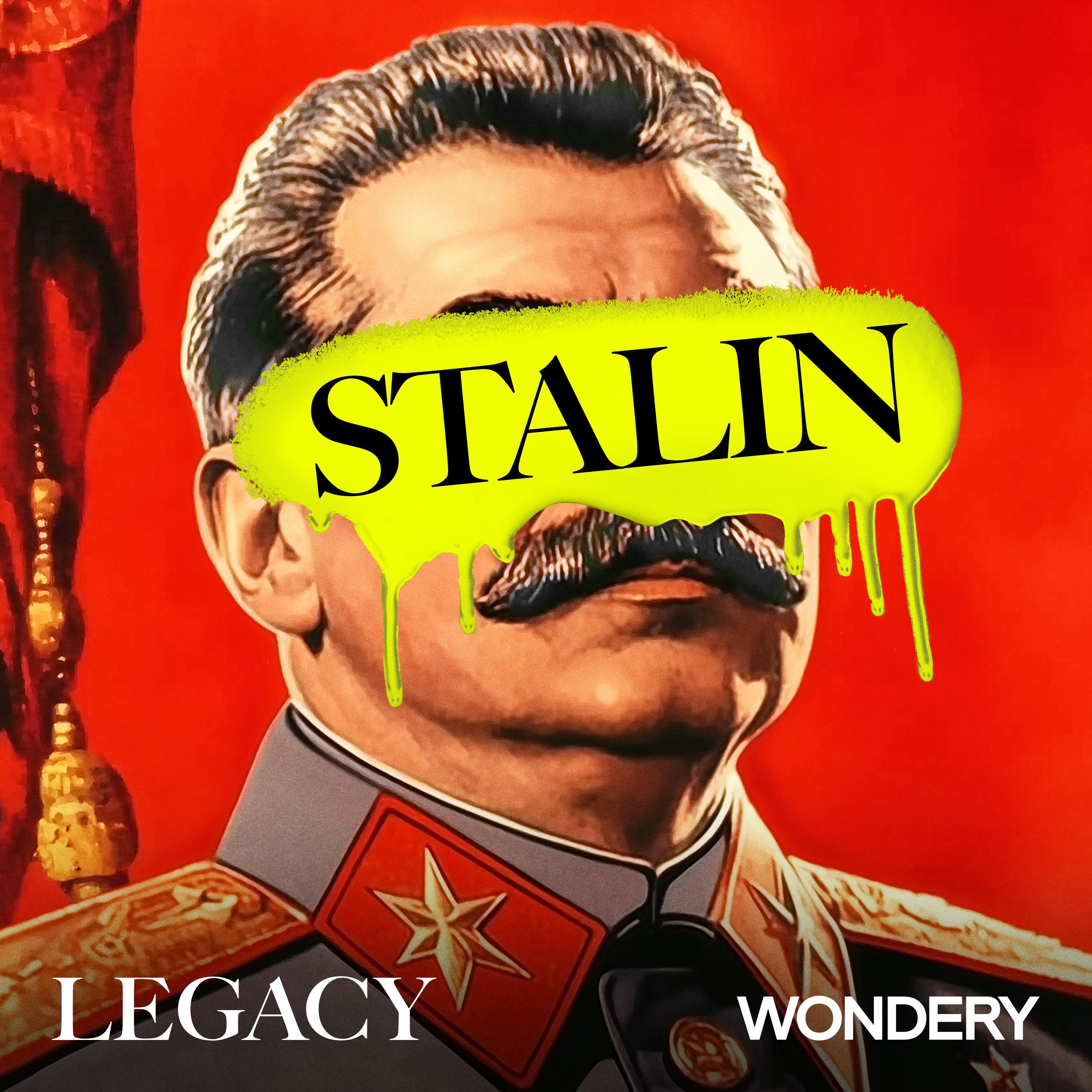
Transcript84 lines
- [00:00]
Afra Hersh
Wondery subscribers can binge seasons of Legacy early and ad free. Join Wondery in the Wondery app or on Apple Podcasts. Just a quick warning before we begin. This episode contains descriptions of violence. Listener discretion is advised. Wondering.
- [00:25]
Peter Frankopan
Hello, and welcome to a new series of Legacy. This time we're talking about one of history's most infamous men, the poet who became a dictator, a man responsible for the death of millions.
- [00:39]
Afra Hersh
He terrorized and starved his own people, with hundreds of thousands executed and many thousands more shipped off to the Gulag. But today, many of his countrymen see him as a hero, the man of steel who took an economically backward country and turned it into a superpower.
- [00:56]
Peter Frankopan
He's the man who did a deal with the Nazis, but he's also the leader, arguably most responsible for defeating the Nazis. He thrived through a civil war, a world war and the Cold war, and helped define some of the most decisive moments of the 20th century.
- [01:15]
Afra Hersh
We're talking about Joseph Dasaronovich Stalin. His actions laid the foundations for the geopolitical tensions and conflicts that still shape our world today. And while history may not like him, history cannot forget him.
- [01:47]
Peter Frankopan
From Wondery and Goal Hanger, I'm Peter Frankenpen.
- [01:51]
Afra Hersh
I'm Afra Hersh.
- [01:52]
Peter Frankopan
And this is is Legacy, the show that tells the lives of the most extraordinary men and women ever to have lived and asks if they have the reputation that they deserve.
- [02:10]
Afra Hersh
This is Joseph Stalin, episode one, the Georgian Bandit.
- [02:23]
Peter Frankopan
So, Afwa, we've got Stalin. What do you think? Did you study Stalin when you were young?
- [02:29]
Afra Hersh
I'm that generation whose school history lessons were basically the Second World War and that was it. So I definitely was familiar with Stalin. I have to say, Peter, I don't know why, but the magnitude of the mass murder and violence he unleashed had not fully sunk in until I did the research for this series and I found it pretty tough going. You know, when you get to the stage where statistics about millions murdered kind of stops meaning something because there are.
- [03:01]
Peter Frankopan
So many, he keeps on going, Stalin. But I mean, it's going to be great to talk about him, partly because as we mentioned at the beginning, there's a particular resonance and relevance that Stalin has today in Putin's Russia. The role that Stalin plays is really important in Russian contemporary psyche as well as thinking back about the 20th century. So I've got a question there for you, Afwa, and it's about my own affectation. So in English, we always call him Stalin, right? In Russia, it's Stalin, right? There's a little like they Call him Putin. And sometimes I drift off into the Russian speaking world by mistake. Will you keep me honest?
- [03:38]
Afra Hersh
Well, I don't know. One of the things that I'm proud of and actually that people compliment us for is our authentic pronunciations. When I say our, it's often mainly yours.
- [03:48]
Peter Frankopan
I'm not sure about that. I. I think when it comes to megalomaniacs, what is it about these destructive figures that we find so attractive? You know, from Genghis Khan now through to Stalin and everybody else. And of course, there are a couple of extra reasons to think about Stalin today. This is coming out in May 2025, around the time of the 80th anniversary of VE Day, the end of the Second World War. In Europe also, we're living in an age of new autocrats and powerful figures, all of them men. Where in the United States, in Russia, in Turkey, China, India, you name it. You see the rise of strong figures who do stay in power for a long time, build little courts around them. And Stalin was incredibly good at manipulating that inner circle. So I'm going to be really interested to see how you think he did that so well, Afra, whether that's his charisma, whether you need to be charming to be a dictator as well as merciless. We'll try to keep it as engaging as possible, but it is, as you say, a traumatic subject.
- [04:47]
Afra Hersh
It's a difficult task that we have with this podcast because we really won't shy away from the scale of that suffering, but it only really makes sense in the context of the person who unleashed it. And he was a person and he was a human, and he had a story. And without defending him in any way, I think it's gonna be really important and really interesting to understand how he became that person, how his character was formed, how he got to where he got and how he remained there for so long. He's born Joseph Dzikashvili in December 1878 in Gori, Georgia. And that's important because he is a Georgian, not a Russian, and very much from peasant Georgian culture. His father was a cobbler. His mother, Ketevan, was very fond of him and called him Soso. But they are poor things, were stable in their family life until Besarian, Stalin's father, turned to drink and often became violent at home. And this would have been a very traumatic experience for young Stalin. But it was also quite prevalent among that class of people at that time in that part of the world. And it's often interesting to hear Stalin's biographers talk about the kind of Georgian culture of blood feuds and village brawls. It feels like a place that violence can erupt quite easily.
- [06:15]
Peter Frankopan
Georgia is an incredibly old and important junction point that links the Black Sea and the Caspian, is a corridor from north and south, east and west. But this period of change in the 19th century, late 19th century, of railways being built, of high levels of literacy, of people having books to read, mean that you can move around, you can set your sights on something different. And Joseph is a good learner. He studies well at school. His father's not enormously keen on him getting ideas above his station, and takes him to go and work in a shoe factory. You know, it's quite a tough, dirty life in factories where you're not very well paid. No one has any particular concern for your health, and life is cheap. But his mother persuades Joseph and Joseph's father that he should go to Ghori and study with the priests. And there's a reason to do that. It's not just about spirituality. It improves your life if you can move into a monastery.
- [07:12]
Afra Hersh
Joseph's mother, Ketevan, is highly ambitious for her son. She really wants a different future for him. And as a devout Eastern Orthodox Christian in a community where the church plays a huge role, that is such a clear and really one of the very few paths to what I guess we would now call social mobility. His father eventually dies, and Stalin would later actually deny that his father was so violent. There's this sense that he was ashamed of that origin story, of having this really quite dysfunctional and violent man as his father. And it wasn't something that he was ever very transparent about himself.
- [07:48]
Peter Frankopan
I think there's nothing unusual about Joseph's family background. He's definitely tough and stubborn and determined. Childhood friends say that if he got beaten up, he'd find someone smaller to turn on. So you learn that the way to stay out of trouble is to become the bully yourself. But, you know, that's kind of just normal life. And I don't think that's unique to Georgia. I think that's just what life looks like to most people on the planet at the time. But there's something different about Joseph in the kind of the man he turns into later.
- [08:18]
Afra Hersh
And let's talk about what is unique to Georgia, Peter, because young Joseph is also growing up in a specific political and geopolitical context. Georgia is part of the Russian Empire, even though it's got its own very strong identity as this ancient kingdom, as you described. And there is this Georgian nationalist movement at the time. This, this sense of national pride that captures young Joseph's imagination.
- [08:43]
Peter Frankopan
I mean, Georgia had been annexed by the Russian Empire at the beginning of the 1800s. After Napoleon reaches Moscow in 1812, the Russian Empire grows at an average rate of 55 square kilometers per day for the next hundred years.
- [08:56]
Afra Hersh
I mean, that is. I just need to take a moment for that statistic because it's a lot.
- [09:01]
Peter Frankopan
It's a lot and it's very interesting. In today's world, people like Sergey Lavrov, the Russian foreign minister, talks a lot about how the west colonized peoples, but that Russia never did. And that's a very interesting way of thinking about Russian history, that other peoples like the Georgians are brought under the umbrella of Russia sort of somehow willingly. That's not really how that got seen in Georgia at the time and certainly not today, where there are violent protests trying to keep Russian influence away. But at that time, the questions about what political leadership looked like in Russia and across the Russian empire are hugely problematic. Because that role of an all powerful emperor who controls everything, not just in Georgia, but even closer to home and back in the imperial capital means that there are lots of questions about what kind of political systems and what kind of reforms are needed.
- [09:59]
Afra Hersh
February 1892. Gory Town Square, Georgia. 12 year old Joseph Tsugashvili jostles for position, his dark eyes locked onto the unfolding scene. On a raised platform, two men hang by the neck, their bodies thrashing in the air, gulping mouths gasping for breath. It's a public execution. The Russians have condemned two Georgian mountain bandits for theft. But something has gone wrong. It's taking too long. In response, the drummers beat louder and faster to drown out the grunts. Joseph's teeth clench. He fights back a sob. Instead, he imagines his hero, the fictional Georgian father, freedom fighter Koba, taking bloody revenge on the Russians. Koba would kill them all, make their mothers weep. As Joseph watches the convulsing bodies finally come to rest, he smiles at the idea.
- [11:06]
Peter Frankopan
So that figure of Kober Afwa is really interesting. It comes from Alexander Kasbegi's story called the Patricide, which features Koba as a abec or a bandit who is a man of the mountains and a resistor of Russian imperialism and a childhood friend of Joseph's says Koba was so. So Joseph's ideal and the image of his dreams. Kober became Soso's God, the meaning of his life. He wanted to be the second Koba, a fighter and a hero. From then Onwards, he called himself Koba. He absolutely didn't want us to call him by any other name. And that idea that Joseph, or now Koba, sees himself styled as the defender of Georgian freedoms, a daredevil, a bandit, was quite an important part of, I think, of Joseph upgrading his ambitions. And that also comes alongside what Joseph also starts to do at this period of time. Have a guess what his favourite pastime is, other than imagining himself as a hero. Sing a songwriter. He's a poet and I'm going to read out one of his poems in English translation from the Georgian. And I wonder what you think about this from a poetic point of interpretation. Afwe the pinkish bud has opened rushing to the pale blue violet and stirred by a light breeze. The lily of the valley has bent over the grass. The lark has sung in the dark blue, flying higher than the clouds and the sweet sounding nightingale has sung a song to children from the bushes. Flower, O my Georgia, let peace reign in my native land.
- [12:46]
Afra Hersh
My verdict is don't give up the day job Stalin, but don't tell him.
- [12:51]
Peter Frankopan
That in person if you see him.
- [12:53]
Afra Hersh
Although we could have had a very different version of history if he had just been a bad poet. And in fairness to Stalin, he does have some literary chops. He studies Plato, he learns Greek and Latin, and this whole seminary education does expose him to literature and reading. So while I think we can write off his poetry, he was somebody who engaged with ideas and writing.
- [13:19]
Peter Frankopan
He does discover radical bookshops in Tbilisi and he and his friends pay 5 kopecks to borrow a copy of Das Kapital by Marx. He studies the French Revolution, he reads Darwin and Lenin, who's eight years older but is already well established as a revolutionary thinker. I'm always curious to know whether he's really interested in ideas or whether he can sense that there's a means to an end here, whether he's betting on the fact that there's going to be reform and revolution and if that happens, whether there's positioning that he can do.
- [13:51]
Afra Hersh
And he's the age where young people head full of Marx and Lenin do tend to dream of revolution. And that's exactly where Stalin is. In 1899, approaching his 21st birthday. He has been consuming all this radical ideology and now he wants to see action. He leaves the seminary before his final exams and he decides that he wants to lend his body and his effort to the struggle to break the system. He's not quite sure what that looks like, but he is sure that he wants to be a Revolutionary.
- [14:52]
Peter Frankopan
So we're in the summer of 1899 in Tbilisi, Georgia. Joseph has left the seminary. But young revolutionaries still need to be able to eat. So he gets himself a job at the Physical Observatory, having quickly studied a book on astronomy. And he's employed to note down the readings of all of the instruments.
- [15:12]
Afra Hersh
And at this point, Joseph is becoming a staunch Leninist. He reveres Lenin and dreams of working with him.
- [15:20]
Peter Frankopan
Not only that, Afra, he also becomes a pinup. He's a good looking young man. I mean, there are these amazing photos of him dressed up. And there are descriptions of him by a friend saying he wore a plain black Russian shirt and a red cravat typical of all social democrats. In winter he also put on a long brown overcoat for headgear. He only wore a Russian cap. One did not see him except in a rumpled shirt and unpolished shoes. Altogether, he aimed to show that his mind was not a bourgeois one. So it's the kind of studied affectation of being a dandy without being over smart. But by identifying clearly and visually that he's someone who means trouble.
- [15:56]
Afra Hersh
There's something about a young revolutionary, isn't there?
- [15:59]
Peter Frankopan
I can see your eyes lighting up. Afwe.
- [16:01]
Afra Hersh
I'm thinking early Che Guevara, young Jerry Rawlings from Ghana in his flight suit. There is something about a young man this age who dreams of revolution, walks the walk, has a bit of a dandy vibe. I mean, I'm not saying that Stalin would have been my pinup, but I see it.
- [16:21]
Peter Frankopan
Do you know what? That presses some of my buttons, you know, because all those students have posters of Che Guevara and Castro and Stalin as he becomes, you know, I find them quite difficult and quite upsetting because.
- [16:35]
Afra Hersh
I mean, I don't think any students now would have posters of young Stalin, would they? Peter?
- [16:41]
Peter Frankopan
I think you're wrong. I don't. In the same way that Castro and Che Guevara and the communist star are all sort of worn with considerable pride by a lot of people, particularly young people. But not only I would push back.
- [16:53]
Afra Hersh
Against putting Stalin in the same bucket as Che Guevara. I mean, I get the idea of critiquing the romanticizing of young revolutionaries, but Stalin is in a bit of a league of his own. I'm just gonna tell you a quick story because when I was in my 20s, I did go out with a young communist just on a couple of dates. And I knew he was like very far left. But it was our second date, we had dinner where he told me that his mother was a Marxist, his father was a Trotskyist, but he was a Stalinist. And I am going to say that was fatal. I mean, I was like, I'm not open to Stalinism. I just don't feel part of a generation where that makes sense as an ideology. So that definitely killed the. The budding romance. He decides that he will commit to joining the Russian Social Democratic Workers Party.
- [17:54]
Peter Frankopan
It's been founded by Vladimir Lenin, or Vladimir Ulyanov as he's called. Lenin has been living in Geneva in exile. It's basically a classical Marxist socialist party.
- [18:04]
Afra Hersh
He's going to work as an agitator and he wants to recruit other people into action as well. Lenin is engineering both this developing ideology but also a split in the party. And that leads to two separate groups, the Bolsheviks, which translates as the majoritarians. This is Lenin's group and it's a convenient name because they're actually a minority, but just goes to show the power of branding. And the Mensheviks, which, which translates as the minoritarians, actually the bigger group, who have a slightly different vision for the future. They see a longer and more legal, lawful, orderly path to Marxist revolution. There must be a bourgeois revolution, there must be a period of capitalism, and then the circumstances will be right for socialist revolution. The Bolsheviks, on the other hand, are agitating for swift, violent, revolutionary change. Lenin wants to leapfrog that whole saga and go straight to socialism, socialist revolution, and he wants to go there now. Joseph, inspired by Bolshevism, is now a party worker. He is all in agitating for the Bolsheviks and he's sent to Batumi, which is the second largest city in Georgia on the Black Sea coast. His job there is to rally the workers, cause trouble for the bosses. And guess what, Peter? He is quite gifted at this role.
- [19:32]
Peter Frankopan
March 1902, Batumi, the black Sea coast. Joseph Dugashvili hoists a crimson banner as he leads the procession along the docks, bellows slogans to the boisterous crowd. Workers of the world, unite. He's been agitated for the Social Democratic Workers Party for months, writing provocative articles on labour rights organizing meetings to argue for industrial action. But his hard work is paying off. He's overseen collective strikes from several labour unions. Today the dockers have joined the action. He fills with pride at the defiant faces of the workers. It's like Lenin's writing made real. A thrill of excitement flashes through him at the thought of wielding such power. Joseph leads the demonstration to the deportation barracks where arrested strikers are being held. Pale Portly faces of government officials peer down from the upper stories, the cruel puppets of capitalism. Then shouts fill the air, followed by the sound of scuffles. He sees a line of police breaking from a side street and wading into the crowd. From the opposite side, more police intercept their flank. It's an ambush. As the fights break out, the panicking crowd surges forward. Stones whizz through the air, and Joseph breaks free from a policeman's headlock. Then a barrage of gunfire sparks a stampede of confusion. Darting for cover, he sees bodies on the road. He dashes down an alley and crouches low. His heart pounds. He knows they'll be looking for the organizers. He's escaped arrest before, but something tells him this time he won't be so lucky.
- [21:34]
Afra Hersh
And he isn't so lucky this time. It leads to his first arrest and first, but not last, exile to Siberia in 1903 and being exiled to Siberia, Peter, was really something that was common for troublesome political elements in Russia at that time.
- [21:52]
Peter Frankopan
Yeah, it's a gap year. It's a gap year for revolutionaries. You know, everybody goes there. If you haven't been, it's sort of, you know, you haven't really seen the world. But what's interesting is that Joseph doesn't use this as an opportunity to make friends or to network. He sort of keeps himself to himself. And I think that's because he sees himself as an outsider, maybe because he's Georgian, maybe because he's from a peasant background rather than from the literates in the city. But he sort of feels that he doesn't quite fit in. And I think that's something that's quite important for his later career, that he sort of sees himself as an outsider, not quite good enough, and therefore wants to pick people off who he thinks look down on him.
- [22:29]
Afra Hersh
I think we're also seeing here the beginning of some clarity that Joseph is not a cuddly character. He is somebody who is removed, who is not quick to laugh. A fellow prisoner says his character is glacial. So we're seeing the politician he will become being born at this point, somebody who has a lot of courage in his own convictions. He even attempts to escape from Siberia, and it's so cold that he ends up being recaptured with his face and ears completely frozen. But that doesn't stop him. And the second time he tries to escape, he is successful. He makes it back to Georgia, and that is just in time for him to play a role in the uprisings that will follow the 1905 revolution. And this Peter is a really important period of social and political unrest caused by widespread dissatisfaction in Russia with the Tsarist regime.
- [23:31]
Peter Frankopan
January 1905. Tsar Nicholas II's troops open fire on unarmed civilians on what becomes known as Bloody Sunday in St. Petersburg. But what's interesting is that Joseph has managed to find himself in the right place at the right time. And that's important because it gets you your credibility, stripes to be able to say that you were there.
- [23:50]
Afra Hersh
There are local uprisings all over the empire, including Georgia, where he's now positioned to play a leading role. And his role within the Georgian Bolsheviks gains him the attention of the party. So much so that he's sent to Finland a party conference. And this is a big deal because he gets to meet Lenin in person for the first time.
- [24:11]
Peter Frankopan
This violent and ruthless man is firmly on the path to political power. But it's not all work and no play, because he has set his sights on something besides revolution. It might seem unexpected, but Joseph has fallen in love.
- [24:57]
Afra Hersh
Ketovan Svanidze is a seamstress from Tbilisi. Her brother is a Bolshevik, which is how she comes to meet Joseph Dugashvili. And she is just the kind of woman he's looking for. Peter, sense of humor, sparkly eyes, sitting.
- [25:13]
Peter Frankopan
On a porch in a hammock and drinking Georgian wine.
- [25:16]
Afra Hersh
That's the kind of woman that I would like somebody to be looking for in me. Absolutely.
- [25:21]
Peter Frankopan
In fact, she's a woman that Joseph is exactly after. Who's gonna look after him? Cook, clean, keep home, have his children do everything for him? Robert Servis, one of Stalin's biographers, he says he can understand what he saw in her. But says Servis, what she saw in him is unknown.
- [25:42]
Afra Hersh
They marry in the Zion Cathedral in Tbilisi in July 1906 in a traditional Orthodox ceremony followed by a traditional Georgian celebration. He's only 26 when a year later in 1907, their son Jakob is born.
- [25:59]
Peter Frankopan
Joseph is busy with revolutionary duties. He spends time even in London for the party congress. He oversees a succession of bank robberies to boost party coffers. And life is looking pretty good for the young father and revolutionary until we reach November 1907, just as the autumn is starting to Turn into winter.
- [26:26]
Afra Hersh
November 25, 1907. Tiflis, Georgia. Joseph grips the edge of the coffin as he feels his legs start to buckle through tears. He gazes at the flower strewn body of his wife, Ketevan. A priest swings a silver thurible. White ropes of incense spill to the ground. Joseph curls his lip at the priest's tall black hat and the shimmering gold walls of the chapel. To an atheist like him, it's little more than a superstitious pantomime, another form of proletariat repression. He recalls how just over a year ago, he and Katavan married in this very church. Joseph's reluctance to a religious ceremony quickly melting under Ketevan's beguiling dark eyes. She was the family he always longed for. When Jakob was born, Joseph swore he would never abandon them like his own father did. Now he looks at his son fidgeting in his mother in law's arms and knows that's a promise he can't keep. His life is too unstable to take care of a child. Outside, in the frozen churchyard, Katavan's coffin is lowered into the grave. But the earth is too solid to shovel into the hole. Joseph gives out a sob and breaks from the congregation. On his hands and knees, he crawls to the edge of the pit, wishing he could crawl in too. Then he feels an arm around his shoulder. His friend Joseph Irimashvili pulls him to his feet. Earlier, Ira Mashvili confiscated his gun, convinced he was going to harm himself. Now Joseph hears him say, we'll persevere, Dzhugashvili. We'll keep fighting our cause for her. Touching his chest, he fixes his friend with a cold glare. Everything is so empty, so unutterably hollow. He shrugs off Imashvili's arm. She passed away. And with her have gone my last warm feelings for people.
- [28:40]
Peter Frankopan
I think this kind of scene sort of plays well if you're making a Hollywood biopic. You know, it's the bit where because she dies, all life and hope drain from him. And he decides that he's gonna become a lunatic afterwards. And that definitely gets projected backwards. I mean, one of Joseph's friends later says, you know, I knew afterwards that Koba or Joseph was bereft of any moral restraint. And he would from then onwards surrender himself entirely to his fantastic plans, which were dictated solely by ambition and by vengeance. I mean, look, I think first you've got to cut him a little bit of slack. That, you know, losing your wife and the mother of your child must be brutal and terrible. But I don't think that anything changes with Joseph. I think that cold fish that we've seen before, that stoic determination, is something that is benchmarked long before Ketevan dies. But, you know, I think that process of loss is a reminder that life is cheap and life is short. And if you're revolutionary, you know, you've got to keep on going.
- [29:39]
Afra Hersh
I think process is the right word, Peter. Cause for me it is a gradual thing that he experiences these tragedies and this won't be the last that do rock him and loosen his connection to the empathy of loving human relationships. It's almost like he's losing his ability to value life when you've experienced real pain and suffering and natural responses to protect yourself from being vulnerable like that again. And I don't want to over psychoanalyze Stalin's psychology, but I do think, and people close to him said it was these kind of experiences, not just this one, but these kind of experiences that did make it easier for him to harden his heart.
- [30:22]
Peter Frankopan
I probably see it slightly differently. I mean, if you are Joseph and you are a young man, there are plenty of fish in the sea. The fact that Joseph has a son, you know, he pays almost no attention whatsoever to YAKOV until about 11, 12 years later, completely detached, he throws himself into his work. And I don't think that's necessarily the mark of a wounded man who's traumatized by a broken heart. I think it's just a man who thinks that the world can be refashioned in his own image and that there'll be plenty of opportunities for him. He doesn't seem to spend a great deal of time in mourning. He moves in fact instead to Baku in modern Azerbaijan, the center of the oil industry in the Caucasus, to agitate amongst workers, where of course he gets arrested and exiled again. He seems to move on pretty quickly.
- [31:07]
Afra Hersh
You're talking to a die hard romantic, Peter. I'm really struggling to accept what you're saying. Look, there's a.
- [31:12]
Peter Frankopan
We talked about this already, Afwan. You told me that no one romanticizes about Stalin that they do about Che Guevara. And now here we go. He must be cuddly and soft and I can promise you he's not.
- [31:21]
Afra Hersh
So I think we've established he's not cuddly at all. But I think people deal with grief in different ways. And he's not sitting around weeping and writing love poems about his grief. But I think that this is a trauma that rocks him and it does resurface later in his life, you know, at later moments of weakness or sorrow. He will bring back the lost of his first wife as something that has stayed with him. But you're absolutely right, it doesn't get in the way of his Bolshevik activities. And in fact it only accelerates them. He's good at organizing and he is a journalist. He helps set up the newspaper Pravda ironically named the Truth. Pravda is still going strong today and is one of the things anyone who studied any of the Russian revolutions has heard of because of its huge impact on the course of those movements during the 20th century.
- [32:15]
Peter Frankopan
He gets selected onto the Central Committee, so he's right on the inner circle, right in the center of Bolshevik power. And in 1912, he stops being Joseph Dzhugashvili and becomes Joseph Stalin, taken from the Russian word for steel, stal. So he's Stalin. And throughout his adult life, Stalin was extremely conscious of his image. He's tough and that he's strong and that he's got vision. And even those references he makes back to his wife, Keta Van later, I think they're quite cynical ones. I think they're ones of saying that he too, has experienced suffering, he's experienced loss, and that a young, dead wife is the same as people who've been taken into the backyard and shot by the nkvd. So much less sympathetic to thinking that he's got a soft, cuddly side. He's very determined to present an image of himself, and he's aware of that from the beginning.
- [33:06]
Afra Hersh
I'm not gonna let you make me sound like someone who's advocating Stalin as a cuddly character.
- [33:12]
Peter Frankopan
He left him off.
- [33:13]
Afra Hersh
It's not going down like that.
- [33:14]
Peter Frankopan
Absolutely.
- [33:15]
Afra Hersh
Absolutely not. And as you know, Peter, I'm super interested in questions of identity. A lot of my work is on the subject, and I'm fascinated by the relationship that now Stalin, as he's rebranded himself, has with his Georgian identity. It's clearly a hugely formative part of who he is. But at this point, he's starting to minimize its visibility. He doesn't want to be seen as a Georgian. He's a Russian. He will speak Russian. He writes Russian. And I think part of this has to do with his Marxist Leninist ideology. They're internationalists. They believe that the struggle and the revolution must be international.
- [33:49]
Peter Frankopan
It's also a much bigger prize. Russia has a bigger pond to go fishing in than Georgia. So the reason he stays detached from Georgia and Georgians is also that he sees that there's a bigger destiny for him.
- [34:01]
Afra Hersh
And we're now on the eve of revolution. Life in Russia is about to change forever. Stalin's life is about to change forever. Let's just put to bed once and for all at this point any notions of a cuddly, sweet man. This is now Stalin, the hardened revolutionary. He has become adapted to underground life, to the brutality of tsarist soldiers. He is exiled repeatedly to Siberia. While in Siberia, he sleeps with the dawn daughters of families who put him up, sometimes their children who are still at school. He treats women terribly. He treats everyone terribly. His biographer, Robert Service, said he acted as if he had rights without obligations. He had contempt for all human conduct but his own. And, you know, to me and to you, I imagine that sounds pretty repellent. But this is revolutionary. And Lenin's take is people like him are exactly what we need.
- [35:03]
Peter Frankopan
Well, he's an enforcer. He's the sort of person who can get things done because he doesn't care who he leaves in his wake. And I think that's, I suppose, an attribute if you are a revolutionary leader. But it becomes the Achilles heel of what the glorious revolution is supposed to achieve. So Lenin and Stalin and others are professional revolutionaries, but they're all caught out by the start of the revolution, the chaos of 1914. The assassination of Franz Ferdinand leads to war right across the world, actually, but particularly fought in Europe, where you have the Western Front. But in the east, that confrontation is a dramatic one between the Germans and the Russians. Food supplies get short. There's incompetence through the tsarist authorities. The Tsar himself, Nicholas ii, is an impulsive, stupid man. But eventually, riots break out over food supplies in St. Petersburg, particularly about bread. Soldiers at the front start to refuse to fight. And it spirals so swiftly that on the 2nd of March in 1917, it's a tricky one. The Russians use a different calendar at this point. So the October Revolution and the November Revolution are different months that come later that year. But in the Western Calendar, 2nd of March, 1917, Tsar Nicholas II decides to abdicate in the expectation and hope that a family member will take his place. But they don't. Instead, a new government is appointed under the Duma, the parliament in Russia, headed by Prince Lvov and contains just one socialist, Alexander Kerensky of the Socialist Revolutionaries. And for the next few months, there's a kind of an idea that there's going to be proper political reform, that the Tsar, if one is reappointed, will be constitutional only, but that Russia needs to be modernized. So is this a moment where the proletariat could rise up and have power put in the hands of the masses? And that's a kind of incredible place to be in lots of Russian historians and people who specialize in this. Think about the kind of after dinner game over a glass of wine or shots of vodka. Would there have ever been a revolution in Russia without the start of the First World War. But there's suddenly this kind of moment where the whole like a petal is about to open up and there's going to be lots of argument about what the shape of the future will look like.
- [37:13]
Afra Hersh
I can't believe you just took us from 1914 Russia to 1917 in like two minutes. That's amazing.
- [37:20]
Peter Frankopan
I hope it made sense. I covered quite a lot of ground.
- [37:22]
Afra Hersh
In awe of that Peter. But Stalin is away from the action. All this is happening. He's in Siberia, having to watch from a distance as his dreams of revolution succeed in sweeping away the Tsar who is responsible for his exile. He boards a Trans Siberian train. He then takes another train for the long journey to Moscow. He is heading towards the heart of the revolution, to the place and the time he has been working his whole adult life for.
- [37:59]
Peter Frankopan
March 12, 1917. Nicola Station, Petro Petrograd. Joseph Stalin flashes his companions a grin as the train's shrill whistle erupts. The bright lights of Petrograd slip across the bare carriage compartment. Each man clutches his meager possessions. Looking down, Stalin realizes he's dressed in the same suit he wore when he was exiled four years earlier. He rubs his aching back from over a week. He and two members of the Bolshevik Central Committee have shared the cramped space, traveled from Siberia to join the call to action. As the train glides into the station, Stalin notices a fine dusting of snow on the platform. He's glad to be free of Siberia, where winters lasted nine months. Temperatures dropped to minus 60. He feels changed by the experience, older, but he reminds himself it's in the past. Now he's back. His sacrifice will be rewarded with a key position in the Party. A brighter future beckons. On the platform, Stalin cranes his neck for signs of a welcome party. But the station is quiet, almost empty. As the minutes tick by, he understands that no one is coming. One of his companions throws down his case and says, what now? Stalin fishes a letter from his pocket. The return address is the new Bolshevik headquarters, the former residence of Tsar Nicholas Mistress. He points to the station exit. Now we walk, comrade. Trudging through Petrograd, Stalin's disappointment festers. If Lenin weren't exiled in Switzerland, he would have come. He feels a knot of anger constrict his chest. He won't forget this. He's going to continue his work in the Party, consolidate his power and authority. Then he'll get the respect he deserves.
- [40:11]
Afra Hersh
It is quite gutting to feel so much anticipation, to become part of the thing that you've made so many sacrifices towards only to get there and realize that basically you have no friends in.
- [40:23]
Peter Frankopan
These days of turmoil. Information supply of what's happening, who's in power, what's going on, that sort of sob story that Stalin makes for himself that he's not being taken seriously enough, that everyone should be there to wait for him and celebrate him and give him flowers, you know, gives you a sense, I think, of the narcissism that sits behind Stalin, too, that he's so important that people should put him first and come to greet him.
- [40:47]
Afra Hersh
What he wants is what will happen three weeks later for Lenin when the leader returns to Petrograd's Finland station to find it packed to the rafters. I mean, one of the great set pieces of the revolution. So there's such a stark contrast between Lenin versus Stalin, who is kind of out on his own facing a battle for his future, and his belief in his role in Russia's future, which also hangs in the balance. So the stakes are high and Stalin feels, and rightly so, that failure could be fatal. That's next time on Legacy. Follow Legacy on the Wondery app, Amazon Music or wherever you get your podcasts. You can binge seasons early and ad free right now by joining Wondery plus in the Wondery app or on Apple Podcasts. Before you go, tell us about yourself by completing a short survey@wondery.com survey from Wondery and Goal Hanger this is the first episode in our series about Joseph's styling.
- [42:08]
Peter Frankopan
A quick note about our dialogue. We can't know everything that was said or done behind closed doors, particularly when we go far back in history. But our scenes are written using the best available sources. So even if a scene or conversation has been recreated for dramatic effect, it is still based on biographical research.
- [42:27]
Afra Hersh
We've used many sources for this series, including a biography by Robert Service. Legacy is hosted by me, Afwa Hush.
- [42:36]
Peter Frankopan
And me, Peter Frankopone.
- [42:37]
Afra Hersh
Scene writing by Jack McKay for Goal Hanger.
- [42:40]
Peter Frankopan
Our series producers are Kate Taylor and Anoushka Lewis. The associate producer is Robin Scott Elliott. Our production managers are Izzy Reed and Alex Hack Roberts. The executive producers are Tony Pastor and Jack Davenport.
- [42:55]
Afra Hersh
Legacy is sound designed and engineered by Daniel King. Music supervision is Scott Velasquez for Fris n Sync. Our producer for Wondery is Emanuela Quinati Francis and our senior managing producer is Rachel Sibley.
- [43:08]
Peter Frankopan
Executive producers for Wondery are Estelle Doyle, Chris Bourne, Morgan Jones and Marshall Louis.