Loading summary
Transcript64 lines
- [00:00]
Afua Hirsch
Wondery subscribers can binge seasons of legacy early and ad free. Join Wondery in the Wondery app or on Apple Podcasts. Welcome to the fourth episode in our series on Joseph Stalin.
- [00:22]
Peter Frankopan
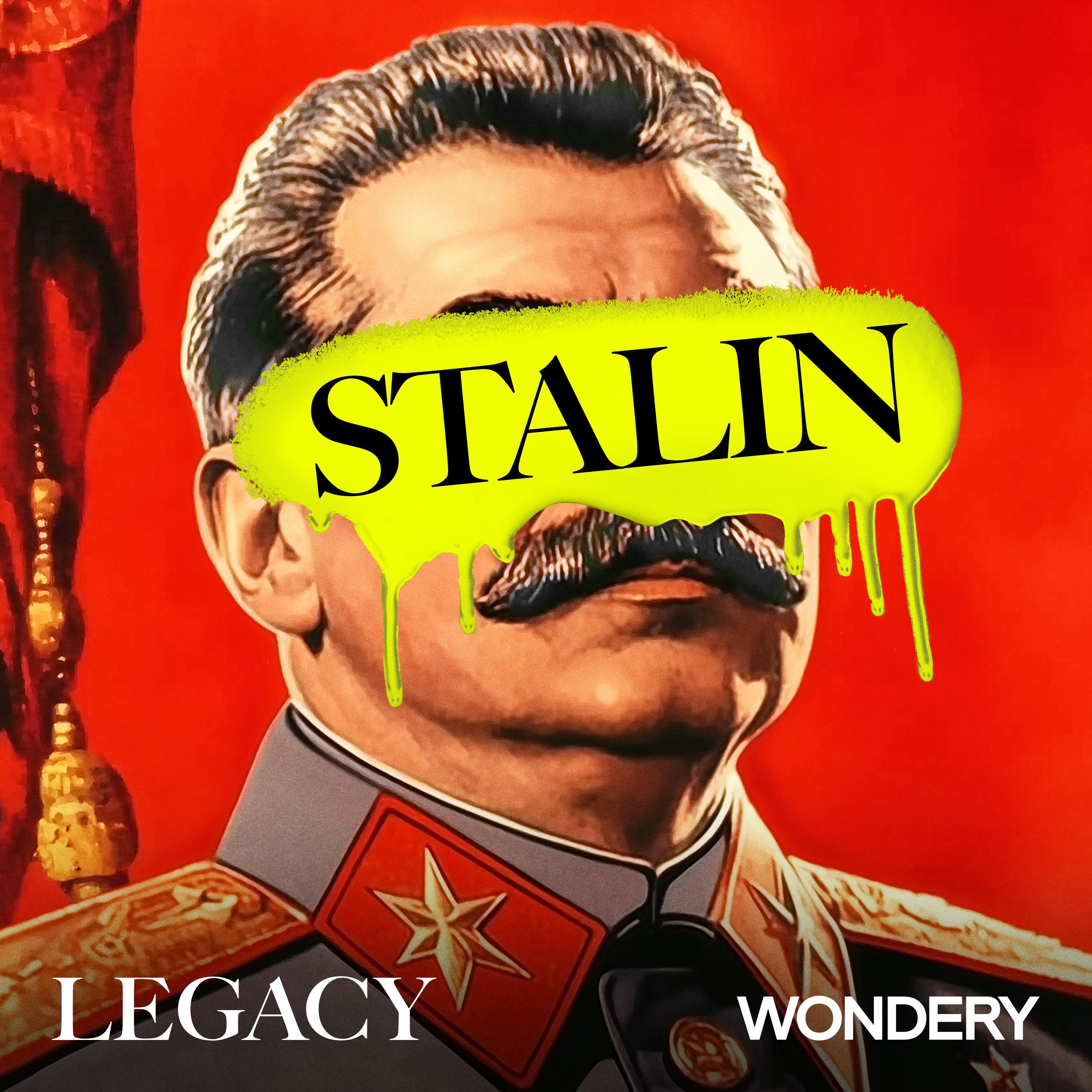
We left Stalin as the hero of the great Patriotic War, the architect of the victory against Nazi Germany. Soviet control now extends well across Eastern and Central Europe. China has also become an obedient ally. And the Soviets have the bomb. The USSR is a superpower with Stalin the Superman, at its head.
- [00:46]
Afua Hirsch
After the huge sacrifices of the war, the people of the Soviet Union hope for better times. But Stalin has other ideas. He's ruled by fear for over 20 years. Why change now?
- [01:05]
Peter Frankopan
Why are there ridges on Reese's peanut butter cups? Probably so they never slip from her hands. Could you imagine? I'd lose it. Luckily, Reese has thought about that. Wonder what else they think about. Probably chocolate and peanut butter. Hi, I'm Alison Marino, host of what's a podcast, the Revolution Redefined, a new documentary series from Oxford Road and the team behind Age of Audio. We dive in into how podcasting exploded into a storytelling revolution and how big tech and big money are threatening its future. Now you'll hear from podcast industry heavyweights like Ira Glass, Adam Carolla, Guy Raz, Leo Laporte, the Meisellis brothers, and more. What's a podcast? The Revolution Redefined is out now. Listen wherever you get your podcasts from Wandery and Goal Hanger. I'm Peter Frankopan.
- [02:02]
Afua Hirsch
I'm AFWA Hash.
- [02:03]
Peter Frankopan
And this is Legacy, the show that tells the lives of the most extraordinary men and women ever to have lived and asks if they have the reputation that they deserve.
- [02:23]
Afua Hirsch
This is episode four, the Stain of Stalin. Let's take a tour of life under Stalin. Peter as the 1940s turn into the 1950s, the few cultural freedoms that he was flexible enough to allow during the war are locked back up. And to make it worse as he ages, Stalin is only becoming more paranoid than ever.
- [03:01]
Peter Frankopan
At the end of the Second World War, this elation at the defeat of Hitler and the fall of the Nazis, you know the world is going to be a better place. But in the Soviet Union, things are never quite so simple. So in 1946, a combination of terrible drought plus catastrophic state management lead to a disastrous famine that claims hundreds of thousands of lives. So that's the first thing that the Soviet Union doesn't get the capacity to rebuild. Also, it's busy extracting businesses, industry people out of those parts of Eastern and central Europe that now has its hands all over. So it's a Time of misery. On top of that, Stalin has always had a strongly anti Semitic streak to him. Don't forget that Stalin had admired Hitler. And from 1949, Soviet Jews begin to be arrested, even those right at the top. So Molotov's wife is Jewish. She's called Paulina Zemstigina. And that doesn't spare her. She gets arrested too, even though Molotov is probably the most highest ranked member in the Soviet Union after Stalin himself. And Molotov writes to Stalin to apologize for not restraining Zemshulchina, his wife, a person close to me, from erroneous steps.
- [04:13]
Afua Hirsch
And it's just one of many things that make him more murderous, more terrifying. I mean, Peter, I found the scenes from this era in the Soviet Union, but also within the Kremlin just utterly depraved. Everyone close to Stalin knows that they're being bugged, knows that they or their wives or even their children could be arrested, deported, even shot. They are so fearful. And the only way they really know how to counter it is by sucking up to Stalin, ingratiating themselves with him, trying to rat out others in the hope that will buy them more trust and loyalty. I mean, it's a completely nightmarish scenario of everyone turning on each other in the hope that their tenuous hold on not just power, but their own life will survive another day. It's hard to think of a worse manifestation of the lowest forms of human behavior.
- [05:08]
Peter Frankopan
It's the world that Stalin built. You know, arguably it's the world that Lenin allowed to be built. It's the world that the Bolshevik Revolution created. And I mean, the irony, of course, is that what it was supposed to replace was the tsarist autocracy with a single person at the top and a ruling dynasty who took all the best things for themselves. And what replaced it arguably was worse, because at least in those contexts, you had family connections, et cetera. Here it's just about whim. So the Kremlin runs to Stalin's clock. Lunch is at 4 o' clock, dinner sometimes after 9 o' clock, sometimes it's after midnight. Stalin decides to start working, most of the times early evenings. So everybody has to work early evenings. You've got to be by your phone all the time in case Stalin rings. And if you're away from it, that could be you, your family put out to graze, or worse. It's a world of mirrors and of uncertainty and instability and chaos. And I think it's a grotesque world to be living in.
- [06:05]
Afua Hirsch
This is my nightmare. Dinner party. Scenario, you get called by Stalin at about 9pm to dinner. You cannot decline. You then are plied with alcohol, which you don't want to drink, while he refrains from alcohol, watching you get drunk, he then makes jokes about how he might have you shot, which aren't funny because he has had some of your friends and family members shot. And these dinners will drag on sometimes till 7:00am, I mean, all night, until people are by force so drunk that they wet themselves, soil themselves, vomit, and yet if they decline the vodka shot after vodka shot that's pressed on them, they might fall out of favour and lose their life. I mean, it's really just horrific. Robert Servis describes Stalin at this point as slow on his feet and looking like a gargoyle which had dropped off the guttering of a medieval church. I kind of imagine him so soaked in his own depravity that it actually manifests in his physical appearance. I mean, he really is a monster. And everyone close to him knows that they are not safe. He holds their lives in his hands and he constantly taunts them with this murderous power.
- [07:20]
Peter Frankopan
He puts overripe tomatoes on people's chairs to sit on. He puts pepper in their vodka as a joke, you know, when he wants to dance, when Svetlana's there and he insists on dancing, she doesn't want to, he drags her out of her chair by her hair, you know, and then on top of that, you can't escape, escape Stalin. That is the incredible thing about the Soviet Union, too. There are posters of him everywhere, there are statues of him everywhere, there are books about him everywhere. Stalin is the Soviet Union, he is the Communist Party, he is the Red Army. And of course, he always looks chiseled, broad shoulders, imposing, iconic. He's always presented as being taller than Lenin, who starts to be pushed out of the way. So I think all of that cult of the personality, it's completely overwhelming. And therefore, as he gets older, you know, it's an absolutely terrifying phone call to get, to try to come and treat Stalin in case you get things right, you get things wrong.
- [08:09]
Afua Hirsch
Pity the doctor who has to deliver bad news to Stalin and frequently they don't. I mean, it's not very strategic to make doctors so terrified of you that they're afraid to administer treatment. And there are a few reasons why he hates doctors. He hates to be confronted with anything that reminds him of his own mortality. There's the fact that many doctors are Jewish and are therefore caught up in his increasingly manic antisemitism. And then there's just the pervasive Stalinist suspicion. An article in Pravda at this time describes doctors as assassins in white coats, and he becomes fixated on this idea of the doctors, as another PRAVD editorial describes it, evil spies and murderers masked as medical professors. And this is a text that Stalin edits himself.
- [09:00]
Peter Frankopan
This is a time when the atmosphere in Moscow is really darkening. It's like the 1930s all over again, and Stalin uses terror and division to his advantage. He's always been able to attack anybody he likes, but now his luck is changing, and perhaps it has finally run out.
- [09:41]
Afua Hirsch
March 1, 1953 Kuntsevo Dacha near Moscow, USSR Pavel Lozgachev presses his cheek against the dacha's cold parquet floor. He's trying to see under the door into Stalin's room. He holds his breath while his heart thuds. If caught, he could be accused of spying, hauled off to a gulag or worse. But he has to do something. Lozgachev has been standing guard outside Stalin's quarters all day. It's normal for the leader to sleep late, but he failed to call for his mid morning tea. Now it's 9:30pm and there's still no sign of him. He squints his eyes, but the gap is too narrow to see through. He glances up at his colleague, who shrugs back. Before going to bed at 6am Stalin left instructions he was not to be disturbed. But if something is wrong and Stalin needs assistance, he could be accused of ignoring his duties. He might need a doctor. Losgarchev looks up as a soldier appears carrying a parcel. Make sure Comrade Stalin gets this in the morning, the soldier says. It's from the Kremlin. It's just the excuse Logachev needs. He presses down the handle and nudges open Stalin's door, the parcel tucked under his arm. Inside the room, it's quiet. As Losgachev's eyes adjust to the dim interior, he makes out a shadow shape on the floor. He dashes forward and crouches down. Stalin is dressed in a shirt and pyjama trousers. A dark stain around his body smells of urine. Loskarchev lowers his ear, but the faint mumbling noises coming from Stalin's lips make no sense. He calls out for help, the parcel slipping from his grasp. His colleague enters and they hoist Stalin onto a nearby divan, cover him with a blanket. The other guard leaves to raise the alarm, but Losgarzchev remains transfixed. He can't believe what he's seeing. The leader of the nation, his boss Joseph Stalin, helpless and incapacitated. He knows he should feel pity, but something checks the emotion. He recalls the years of terror, the lists and quotas of people to be abducted, sent away or murdered. The Great Dictator now reduced to a pathetic spectacle, a frail and needy human. After all.
- [12:21]
Peter Frankopan
It'S a pass. I mean, again, the death of Stahl in the Armado Iannucci film. It captures it as well as anything you know, the fear of standing guards too scared to come in to check on him. And then literally at the same time, there are doctors being tortured on the other side of Moscow. I don't know how you'd have done it, Afwa, if you were in the Kremlin at the time and you heard the drop of Stalin's body to the floor and worrying whether you'd be better off running for it or running for help.
- [12:49]
Afua Hirsch
I am so grateful that I was not a doctor in Stalin's circle in 1950s USSR, because what a nightmare. And nobody is relaxed. Not even when he's finally pronounced dead at 09:50 on 5th March, 1953, four days after the initial stroke, the inner circle are there by his bedside. His daughter Svetlana, despite all her ill treatment, collapses sobbing into the arms of Khrushchev, who has the knack always of being in the right place at the right time.
- [13:20]
Peter Frankopan
Stalin is taken off to Moscow to be embalmed, a process that takes longer than it should because of course, Stalin, the chief embalmer. I'm not going to ask you to guess Afwa, but had been arrested a year earlier. So this is what happens when you have total chaos, obviously.
- [13:34]
Afua Hirsch
Crucial enemy within the chief embalmer. I mean, dangerous figure.
- [13:39]
Peter Frankopan
Yeah. Then there are conspiracy theories. Right. What do you reckon to the idea that maybe he was bumped off?
- [13:44]
Afua Hirsch
I feel like if someone wanted to get rid of Stalin, they might have done it sooner. But on the other hand, he has become the worst version of himself in the latter years. And I suppose that could have pushed people over the edge, but we will never know. I don't find it difficult to believe that this was also the point at which Stalin just died of old age, Peter.
- [14:07]
Peter Frankopan
I mean, the autopsy report disappears and there's no doctor's report until July, so, you know, months afterwards. But I suspect that's just the sheer terror of not knowing what on earth to write. Cause if you say he died of natural causes, then someone's gonna accuse you of having cooked up a plot. If you claim it's a plot, then you're gonna get accused for serving somebody else's interests. So any which way. I think what's interesting is that the numbers of real plots against Stalin in his life look to me precisely zero or the ones that ever got anywhere. Because I think that the shadow and the fear factor that Stalin projected was so intensely all encompassing that the chances are everyone was absolutely too terrified to suggest anything. So I can't believe there would have been any murder. But in the first instance. AFWA what's amazing is that the whole of the Soviet Union melts down into woeful grief at the loss of their father figure. Thousands pour into Moscow for the funeral. The crowds are so large that hundreds are crushed to death. He's then embalmed and put alongside Lenin in the now renamed Lenin Stalin mausoleum in Red Square. And I wonder what Lenin would have thought seeing his old mucker and the one he'd chosen not to follow him put alongside him again.
- [15:19]
Afua Hirsch
He would have been turning in his grave if he'd been allowed a grave in which to turn. I think that this episode really highlights. I mean, I hate to use the word success, cause he was just such a terrible murderous psychopath. But it makes his choices make sense because this is what Stalin wanted. He wanted a world in which everyone would be too terrified to threaten him. And he succeeded in that regard. And he wanted a world where he was so synonymous with the Soviet UN that his death would be mourned like a religious figure or like the father of the nation. And that's exactly what happened. And something I struggle with, Peter, is how the people who suffered most under him were among those displaying genuine grief. I mean, Paulina, who we heard earlier, Molotov's wife, who was exiled simply because she was Jewish, in one of his fits of antisemitism, collapses when she hears the news and is genuinely grief stricken. His daughter Svetlana, who also suffered from his tyranny. You know, all of these people, some of whom were actually threatened with death by Stalin or had their wives or loved ones murdered because of him, are there grieving. It's really hard to understand unless you really see this as a kind of cult. I mean, it's taking the cult of personality to such a level that people couldn't separate any kind of rational judgment about what kind of man he was from their devotion to him and their emotional attachment to the idea that the Soviet Union without him was kind of unthinkable.
- [16:46]
Peter Frankopan
That's spot on. I think that word cult, you're absolutely nailed on the head as always. AFWA I think that loss of all sort of perspective. The idea that everything hangs on this man because it's been drummed into you visually and throughout the whole way in which Stalin has ruled, that the state is Stalin and therefore it's hard to conceive what happens next. And in fact, it takes quite a while for the succession plan to develop. There's lots of argy bargy between potential followers who might take over. Eventually it's Khrushchev who becomes the supreme leader. And one of the things he does in 1956, so three years after Stalin's death, at a closed session of the Party Congress, Khrushchev denounces Stalin. And it's sort of breathtaking, the reports, I mean, I've been through all this material of my own work that reach the west about the fact that Stalin has been denounced causes a huge kerfuffle amongst intelligence agencies around whether this is actually reliable, whether it's true, what's going on in the Soviet Union. It completely transforms China as well, because Mao has attached his wagon to Stalin's horse. And when Stalin gets denounced, it changes the direction of travel in China for millions of people, in fact tens of millions of people, as a result of the policies that Mao develops because of the denunciation. So that kind of process of taking Stalin from having been a saint who could do no wrong, who single handedly fought off Hitler, to Stalin being portrayed as a monster who sent thousands to the death and betrayed Communism and betrayed Lenin, is a really high risk strategy because it means that the Soviet Union is going to, in theory, should change.
- [18:19]
Afua Hirsch
Khrushchev is nothing if not a gambler. We talked a lot about the Cuban Missile crisis when we did the season on jfk, Peter, but he's a gambler and a showman. And this high stakes gamble to expose Stalin and present a different direction, I guess you could say it works in the short term, accompanied by no small amount of theater. I mean, there are some incredible moments at the beginning of Khrushchev's leadership, including one where he wheels out this old Bolshevik who hobbles onto the stage of the congress and tells the audience that Lenin appeared to her in a dream, demanding that he have the Red Square mausoleum to himself. I mean, of all the things that have happened, that one is actually believable to me. And it results in Stalin being unceremoniously removed from the mausoleum and reburied in the Kremlin.
- [19:09]
Peter Frankopan
And his resting place is marked by a simple bust and a plaque on the wall. And in the meantime, Stalingrad, that location of the Great Soviet military victory in the Second World War is renamed Volgograd. But Khrushchev doesn't last too long himself. In 1964, he's ousted by Brezhnev. But Stalin is always there in the background. He still has lots of supporters. That great man who saved the Soviet Union from Nazi oppression and terror that plays through in the 1960s. The generation that fought in the war don't like the direction of travel. There's an editorial in the late 1960s in Pravda that's removed at the very last minute that praises Stalin. But we know about it because it gets published in the Mongolian edition, because there's a time differences get pulled. Even just before Gorbachev takes over in 1985, there are high level discussions about whether Stalin should be rehabilitated as a kind of great leader who held the empire together, et cetera. So that spectrum legacy of Stalin has been persistently bubbling since he died.
- [20:10]
Afua Hirsch
It's interesting, isn't it, how the narrative about Stalin is like a weather vane for the direction of travel in the Soviet Union at any moment. So Gorbachev takes it a step further, and you'd think it's kind of past the point of no return for Stalin, calling him one of history's greatest criminals, saying he committed enormous and unforgivable crimes. And you know, Peter, if you hadn't mentioned Putin's rehabilitation of Stalin, you would think there's no coming back from that. And the scale of Stalin's killing really begins to emerge with much more clarity. For example, the Soviets admit to the Katyn Forest massacre of Polish officers in 1940, something that really shocks the world. And in a speech marking the 70th anniversary of the revolution in 1988, Gorbachev acknowledges publicly that for the first time that the doctor's plot was fabricated. And this is what he says of Stalin. The guilt of Stalin and his immediate entourage before the party and the people for the wholesale repressive measures and acts of lawlessness is enormous and unforgivable. This is a lesson for all generations. We now know that the political accusations and repressive measures against a number of party leaders and statesmen, against many communists and non party people, against economic executives and military men, against scientists and cultural personalities, were a result of deliberate falsification. It's pretty damning.
- [21:37]
Peter Frankopan
It's very damning. But Stalin doesn't stay buried, you know, he just won't die. That story of Stalin and his role as a strongman has had lots of appeal inside Putin's Russia. And Although Gorbachev was a bit, at least, open about the Katyn massacre and about the doctor's plot, that scale of uncovering of what the NKVD had done during the 1930s, it was only when Soviet archives properly started to open up after the Cold War that historians were allowed in to see what had happened. You know, the scale of suffering and the ways in which people's lives were decided on a whim was kind of completely breathtaking. And I think that the horrors of how autocracies can not only work, but can hide things became really clear. And, I mean, we're maybe not gone quite full circle today, but, you know, in today's Russia, we have another strong man who's willing to take risks and make sacrifices and use people's lives in not entirely dissimilar ways, and also to control the press. Russia ruled by Putin, a Russia once again dangerously suspicious of those surrounding it, and a Russia where individual freedoms have been restricted, opposition not tolerated, proponents imprisoned, or in some cases, even removed altogether. Is this the legacy of Joseph Stalin and his reign of terror?
- [23:19]
Afua Hirsch
Stalin is dead, Peter. So it's time for us to sum up his legacy. After his death, his desk was searched in the dacha, and three pieces of paper were found. One, a letter from Tito, the strongman Yugoslav Communist dictator, demanded that Stalin stop sending assassins, or Tito threatened he'd send one back. There was the note he'd received from Bukharin, who he condemned right back at the start of the terror, asking Koba, why is my death necessary for you? And there was the letter to him dictated by the then dying Lenin, demanding that Stalin apologize to Krupskaya, his wife, for his verbal abuse of her. And that was the last note that Lenin ever sent Stalin. How can we make sense of these three documents as the three things that Stalin preserved in his innermost sanctity?
- [24:15]
Peter Frankopan
We need to reassemble our crack team of psychoanalysts, I think. I don't know what it tells us, but, you know, to have these three notes that have three people who dare to stand up to him, that probably tells you something. I suspect it's that, like other autocrats and those with autocratic tendencies, in our world, even today, people bear grudges that are very deep. But it's important to stand up to strength with strength, rather than just buckle and fold over. And maybe that's why Stalin kept these three. What do you reckon?
- [24:43]
Afua Hirsch
I wonder if there's a type of personality or psychology where people are naturally expansive in their desire for power. They constantly push boundaries and try and accumulate more power to themselves. But actually, secretly or subconsciously, they're yearning for someone to rein them in. They really want to be restrained. I'm thinking about people in my own life in relationships, for example, who behave really badly unless there's somebody to kind of set boundaries. And they actually respond really well to that. I kind of wonder if Stalin was that person who deep down was looking for somebody brave enough, strong enough to curtail him. And he never found that. And it's not in any way excusing the kind of monstrosity that he became, but that maybe he actually hoped someone would counter him. And they never did. They capitulated to the fear and the threatening and the intimidation. And for somebody like Stalin, that might have actually been very disappointing.
- [25:46]
Peter Frankopan
I wonder what you think also about this historical legacy. So here's what Gorbachev said in 1987. There's now much discussion about the role of Stalin in our history. He was an extremely contradictory personality, I think extremely and contradictory are doing quite a bit of heavy lifting in that one. It says to remain faithful to historical truth, we have to see both Stalin's incontestable contribution to the struggle for socialism and. And the abuses committed by him and those around him for which our people paid a heavy price and which had grave consequences for the life of our society. So what he's saying, Gorbachev is, on the one hand, he murdered lots of people, but the good thing that Stalin did was he did make a decent contribution to the struggle for socialism that looks slightly better in 1987 than it did perhaps four years later with the fall of the Berlin Wall. But how do we see that in the world of thinking about socialism today? Is that an excusable way of thinking about hard left causes?
- [26:44]
Afua Hirsch
I think it was absolutely catastrophic for leftist ideology because now communism, even socialism, is associated with this kind of reign of terror, with mass murder, with a disregard for human life. And, you know, in many ways that's actually a very unfair legacy for the Marxist ideology that founded it all. This is supposed to be about a more just world where there's distribution of resources, where there's a way of designing human society that is based on merit, that is fair, that is not about the kind of excessive accumulation of capital, that's not based on greed. And, you know, I'm not saying that Marxist ideology is without its flaws, but I don't think Stalinism is a fair reflection of the idea at its source. But it has stained that ideology so catastrophically that I think it's Very difficult now for anyone to really embrace this communist ideology. And, you know, even if you don't believe in communism or you're not a leftist, our democracies work because you have a marketplace with competing ideas. You know, you have people who are on the right and you have people on the left. And it's healthy that those different value systems and ideologies are able to compete against each other. And I think one of the things that Stalin did was so destroy the left, so destroy its credibility, so destroy its reputation, make it so unpalatable and so associated with mass murder. So, I think, ironic that actually what he did, much as I think he did believe himself in Marxism, was make it a completely unviable value system for the modern world.
- [28:19]
Peter Frankopan
I mean, look, I agree with you about that completely, but I'm curious about why someone like Gorbachev would have it in the plus column in the first place. And it's not just about seeing that through the lens of the leader of the Soviet Union in the 1980s. Those legacies about Stalin have carried on. I mean, in Russia today. He has a huge rising and surging repopularity. He built the Soviet Union to industrial power. He made the Soviet Union proud. He kept the Soviet Union together, which, you know, is a key issue for Putin's Russia. He famously called the dissolution of the Soviet Union the greatest geopolitical tragedy of the 20th century. So Stalin has a legacy that people do want to claim. They want to choose the bits that they say, this bit was, okay, okay, leave all the millions of dead to one side. But at least he helped defeat Hitler. Therefore it's excusable. Or forget about the people he had shot in the head and sent to Gulags. But at least he managed to make Russia or the Soviet Union industrialize. So, I mean, just to give us sort of an idea about those numbers of the terror. AFWA. So between 1918 and 1953, figures collated by the KGB. Right. So these are not Western figures. These are ones internally produced. Have 4,300,000 arrests, of whom 835,000 are shot. So one in four at the peak of the terror, more than a million people are arrested in the course of a year, 1937 to 1938. And, you know, as we mentioned, persecution of Jews was huge under Stalin, but so too of all minorities, Koreans, Germans, Igarian, Finns, Karachis, Kalmyk, Chechens, Ingush, Balkar, Tatars, Meshketia, Turks. Peoples who most people in Europe and the UK have never really heard of as Minorities in Russia, but all who'd been colonized were those who were considered most suspect, too. So the kind of the scale of suffering a persecution was absolutely off the charts.
- [30:06]
Afua Hirsch
Yeah, I think it's really. We always push back, rightly, I think, against the balance sheet with these legacies. You know, you can't weigh the death and murder of millions on the one hand against anything on the other. There's no, I don't think, any innovation or industrialization or contribution to science that justifies mass killing. So I think that, you know, we just have to leave that as his legacy. That he just was a great murderer and butcher, really. And whether he believed it was for the greater good or not doesn't excuse it.
- [30:40]
Peter Frankopan
I've got a question though, for you, afa, which is why do you think he never faced a really serious challenge in his 31 years in office?
- [30:50]
Afua Hirsch
When I look at the atmosphere among those around him, I mean, it really does haunt me. It's almost a human experiment in how deeply you can sow seeds of fear and terror among those close to you that you keep them in such a state of feverish self preservation that they are not able to think about anything else. They lose all their imagination for a better future. They lose all their perspective on what an alternative could be. They completely abandon their values. They lose their own humanity. It's a kind of like Lord of the Flies scenario, isn't it, where you are really bringing out the worst in humanity, feeding people's lowest nature, their basest instinct to preserve their own survival. And it's, you know, just withdrawing myself from the horror of that is actually fascinating because there are not very many examples where somebody has had that tendency and carried it through to such an extent. And it does raise the question, like, does that work in his case? It seems like it did. Because if the goal was to prevent a threat to his power, it succeeded. And the thing that really stumps me, and you speak about it so powerful, Peter, is that even after it's all exposed, it could still enjoy a resurgence in our modern times, you know, that there could still be those who long for it, who romanticize that experience. I mean, that to me is really remarkable.
- [32:19]
Peter Frankopan
You talked about the cult. I wonder whether you think also the power of how Stalin projected himself, the dominance he had not just over the apparatus of the state that we know about, but also about the softer stuff, about being on posters everywhere, on statues that, you know, some of his enemies, people he'd sent to prisoner camps, cried when they found out he died. You Know, how important is the ritual side of Stalin's power?
- [32:42]
Afua Hirsch
I mean, we can all picture those images of Stalin, can't we? Like, I think everybody knows what he looks like. He's got one of those iconic faces. And not because there was anything intrinsically iconic about how he looked, but because it was so iconicized, it was turned into such a compelling motif. I guess now we probably call it a meme. And it works. You know, it sinks into people's subconscious. It begins to speak to their identity. You know, people who grew up with that image. And even people looking at the Soviet Union from afar. I mean, I remember as a child looking at the globe and, you know, just seeing this like, like vast swathe of USSR and asking my dad, is that really all one country? And him explaining that there's USSR and that Stalin created the stranglehold over it to unite it. And, you know, even as a child who didn't know anything about the politics, just being in awe that such a huge area could be run by one central authority and imagining what kind of person could do that. I guess this is the answer to the question, what kind of person can consolidate an empire on that scale and keep it under an iron fist? Only a Stalin could pull that off.
- [33:50]
Peter Frankopan
Okay, but tell me about that. Cause I mean, you've done so much on colonialism and on empire. You know, the British Empire was larger in sort of human territory, and of course, the oppressions and all that sort of stuff, we take it for granted. But however that was done by the British and other parallel empires, you know, the role of the king or the ruler or the supreme person at the center was not as powerful as Stalin was in terms of visual identities. I mean, you have the king on a banknote and things like that, and people wearing uniforms, but it was other people who did it. Whereas Stalin seems to be much, much more powerful than a Western colonial ruler. Does that sound right to you?
- [34:26]
Afua Hirsch
Do you know what I'm gonna say, Peter?
- [34:28]
Peter Frankopan
Yeah.
- [34:28]
Afua Hirsch
Capitalism, okay? That is the power of capitalism. The British didn't need that kind of centralized figure with literal physical force and violence because they had capitalism. They could bribe colonial subjects, they could co opt people in the colonies to do their work for them with the promise of the rewards of capitalism. You know, a better standard of life, more money, access to the elite, access to foreign education, access to expensive imported goods. And it's an inconvenient reality how effective that is. You know, Britain could never have maintained its empire with the same level of force and violence as Stalin did. Because they didn't have the same numbers, they didn't have British troops on that scale. They didn't have a military, they. They didn't have such effective centralized command. But they didn't need to because they had capitalism. They had the spoils. And when you start to introduce material reward in that way, it's a completely different picture. And I think that's what's so interesting about Stalin's rule is that what he was actually offering people was not materially very attractive. Many people were so much worse off because of communism. They lost their land, they lost the fruits of their labor, they lost. They lost their traditions. In many ways, you know, living in these collective systems and in this mass housing, it was a completely different way of controlling people. And what you need to do that is complete cult of personality, complete threat of force, total fear, total totalitarianism, control of all forms of messaging and repression of ideas. And I suppose that's why the two are such nemeses, because they're a completely different way of imagining what power and what society looks like.
- [36:11]
Peter Frankopan
I guess it's also about being inhumane. I mean, that's not to say that capitalism doesn't have its dark sides, but you know, Stalin as a father and as a husband had no empathy whatsoever. You know, that tells you something. I wonder whether you think that Stalin actually believed in ideas about Marxism and communism and socialism. It was just about power and the cult of the personality and was an imperial ruler rather than a communist one. I wonder whether you think that Stalin should be characterized as a monarch. I suppose a rule of one which is after what monarch means, rather than as someone who was there trying to build a country for everybody.
- [36:50]
Afua Hirsch
I mean, he was literally in factually that, wasn't he? Peter, I'm curious what you think, because I do think that he believed in Marxist ideology. I mean, even though he lived obviously as a. The definition of an elite, he had power completely concentrated in his own hands. I think that he clung to these communist ideals. And I would also add that in some ways it's easier to assess his legacy because so much power was concentrated in the hands of one man. We can blame him. When you look at, for example, British imperialism, it's much harder to assign blame. It was also catastrophic economically, culturally, leaves an enduring legacy. But we debate that and how much Britain is at fault for that because it's so much more subtle, so much more complex. You can't blame any one individual for it. And so while this isn't, I am not, I hope it's very clear from the series. I'm not romanticizing or apologizing for Stalin in any way, but there is something, I guess, for us, makes it neater to be able to so squarely put the blame on this man. There's not really a debate as to whether he was to blame for what happened in the USSR under him, because there was almost no decision that didn't come under his gaze, that wasn't on his desk. I mean, even the lists of the hundreds of thousands of people to be murdered, many of them he went through personally, made little pencil marks next to their names. Whereas other imperial and oppressive systems, the legacy gets lost in the complexity of how it worked and how its violence and suffering was unleashed.
- [38:19]
Peter Frankopan
So I think that I agree with you as far as it goes. But in Russia, people do push Stalin's crimes to one side. So Poland 2021 had 56% of Russians thinking that he's a great leader. There are Stalin centers that are popping up across Russia to talk of him as a great man in history. One of those reasons, because of Stalin's antipathy towards Ukraine, there's no doubt about that. But also to think about the ways in which the state was dominated from the center by a single figure that has obvious echoes for Putin, who, if he stays in power as long as some of us suspect that he will, will be in power in the Kremlin longer than Stalin was himself. And in fact, the way in which Russian history is being rethought, retold, and in fact, rewritten from school textbooks up and beyond, it's very striking. I mean, Putin himself has said that the Nazi Soviet Pact in 1939 was a diplomatic triumph for the Soviet Union. I mean, in fact, that in 2021, memorial, a civil rights organization in Russia that was set up to commemorate victims of Stalin's gulag, has been banned by Putin's government. We get lots of things wrong here in Britain, but, you know, we tend to be quite open about discussions and debates that might change. I mean, there are other parts of the world in the developed west where you can see similar kinds of things happening. I mean, you know that better than anyone afwer, particularly in the United States.
- [39:41]
Afua Hirsch
But not only I don't think it's an exaggeration to say that we are living through an era of the forgetting of 20th century history. Things that you would think are unequivocal lessons that we all learned that have been acknowledged publicly. Now that understanding is being chipped away at. We're beginning to forget we are in danger of repeating so many of these atrocities. And that is a very hard pill to swallow.
- [40:08]
Peter Frankopan
So I wonder if we had to wrap up. You're so good on your three words. It's a tough thing, this one. I've got about 20 words I've written down, but do you want to go first?
- [40:17]
Afua Hirsch
I'm going to be a little bit simplistic. Not simplistic, but I'm going to be quite unequivocal on this. And I've thought about it, and I think it's fair. So my three words for Stalin, history's greatest monster.
- [40:31]
Peter Frankopan
Hey, that's great.
- [40:33]
Afua Hirsch
Yeah, he was.
- [40:33]
Peter Frankopan
That does make it hard for us to go to other figures who might compete.
- [40:37]
Afua Hirsch
I don't think anyone compares on the scale of brutality, violence. I mean, the sheer numbers of people he was. I just can't think of any comparison. We talk about how many people were murdered by Hitler.
- [40:52]
Peter Frankopan
Yes. But we've said rightly that it's not about the scoreboard and the tally.
- [40:56]
Afua Hirsch
It's not, it's not, it's not. But when you get into kind of 20 million plus of your own people dying at your own hands, I just think you get to another scale, and it's not, you know, every single life counts. And this doesn't in any way undermine the horrors committed by other dictators. But I do think just on the scale of suffering and the degree to which he was able to live with it, Stalin is kind of in a. He's in a league of his own, Peter. So I'm going to stand by my history's greatest mortal. And you don't have to be a great monster, by the way, to have an interesting legacy. So I hope I'm not closing the doors to our future characters.
- [41:33]
Peter Frankopan
Dear listeners, at the end of episode four of this series on Stalin, you also don't have to agree with each other if you're a podcast host, so I think it's fair enough. History's. I was going to go for narcissist, megalomaniac, all that stuff. But then, you know, as we were talking, I think that the three words that sums up Stalin is that end justifies means. I've got a bit of verse missing in that one, so it should be the end just for as it means. But I think that that's what it meant, is that Stalin would do anything to get his vision. The bit that I've always found difficult is the kind of luster that socialism and communism claims for the integrity of its ideas and the mismatch with the implementation. And, you know, put Castro to that list if you like, put Mao to that list if you like. But I think there's something about the Soviet Union having grown up during the Cold War. You know, I think it's the higher ground that gets claimed by saying I'm doing this for good principles. And if it goes wrong, it's because of the frailties of one single individual who compromised it, rather than something a bit more profound than that. The monstrosity of Stalin is a very good way to think about him, and it's very troubling when you see people trying to justify what he did. There are plenty. And those numbers are growing, not just in Russia, I think. By the way, please join us next week when we begin the story of someone who could be described as the OG of Girl Power. She restored a monarch to his throne in three months when the men had failed to do it for a hundred.
- [43:01]
Afua Hirsch
Years and she got burned at the stake for her trouble. Yes, we're unraveling the incredible tale of the Maid of Orleans, Joan of Arc, who lived nearly 600 years ago, but whose courage and determination are still in inspiration today. And she didn't even live to 20. That's next time on Legacy. Follow Legacy on the Wondery app, Amazon Music or wherever you get your podcasts. You can binge seasons early and ad free right now by joining Wondery plus in the Wondery app or on Apple Podcasts. Before you go, tell us about yourself by completing a short survey@wondery.com survey from Wondery and Goal Hanger. This is the final episode in our series about Joke of Stalin.
- [44:03]
Peter Frankopan
A quick note about our dialogue we can't know everything that was said or done behind closed doors, particularly when we go far back in history. But our scenes are written using the best available sources, so even if a scene or conversation has been recreated for dramatic effect, it is still based on biographical research.
- [44:22]
Afua Hirsch
We've used many sources for this series, including a biography by Robert Servis and Stalin. The Court of the Red Czar by Siren Sebag Montefiore. Legacy is hosted by me, Afwa Hirsch.
- [44:33]
Peter Frankopan
And me, Peter Frankapen.
- [44:35]
Afua Hirsch
Scene writing by Jack McKay for Goal Hanger.
- [44:38]
Peter Frankopan
Our series producers are Kate Taylor and Anoushka Lewis. The associate producer is Robin Scott Elliot. Our production managers are Izzy Reid and Alex Hack Roberts. The executive producers are Tony Pastor and Jack Davenport.
- [44:51]
Afua Hirsch
Legacy is sound, designed and engineered by Daniel King. Music supervision is Scott Velasquez for FrissenSync. Our producer for Wondery is Emanuela Quinarti Francis. And our senior managing producer is Rachel Sibley.
- [45:04]
Peter Frankopan
Executive producers for Wondery are Estelle Doyle, Chris Bourne, Morgan Jones and Marshall Louis.