Loading summary
Transcript64 lines
- [00:00]
A
Hi, this is Jonathan Fields from Good Life Project. If you're not using Ironclad for contracts, you could be leaving millions on the table without knowing it. Every contract holds renewal dates, pricing terms, and obligations you can't afford to miss. But good luck finding them when it matters. Ironclad's AI instantly surfaces what matters so you can act before opportunities slip away. That's why they're trusted by OpenAI, L', Oreal and Salesforce. Find the savings hiding in your contracts@ironcladapp.com podcast. That's ironcladapp.com podcast.
- [00:36]
B
So, Afra, one of the questions I don't think I've ever asked you is, are you a big Japan fan? Have you been to Japan? Do you know much about its history and culture?
- [00:44]
C
Right at the top of my bucket list. I'm desperate to go to Japan. So growing up, my best friend at school was Japanese. She still is Japanese regular when she is actually. Hey, Emmy. She's a listener. She'll love the shout out.
- [00:58]
B
Love it. Okay. She.
- [01:00]
C
When she got married, that was my big hope. Finally, I'm going to Japan with my Japanese friend because, you know, you want to do it not as a tourist, but with a local.
- [01:08]
B
Right?
- [01:09]
C
But of course, she got married to her husband, who's Irish, in Croatia. Your neck of the woods, Peter. Nowhere near Japan. So that, that, that was it. That was my chance at the authentic Japan trip squandered. Although it was a lovely wedding. Thank you so much for inviting me, Emmy. So I've never. Japan. My daughter, who's 14, is a huge fan of Japanese culture. And not just sushi, not just anime. She's learning Japanese. She's super interested in everything about the culture. And I think that's quite common with that generation. They look at Japanese culture in the way maybe my generation looked at Hollywood.
- [01:45]
B
It's interesting. Japan's got so many of these enormous brands that, you know, people know quite a lot about Japan as a result. They know about Toyota and Sony, Nintendo, young people, fashion. Japanese fashion is just fantastic. You know, there's a whole thing, you know, about fashion that's iceberg that we've got to go through about fashion tastes. You know, all these.
- [02:05]
C
Do you wear any Japanese fashion brands?
- [02:07]
B
As it happens, I shouldn't show off on her, but I love my Miss Issey Miyaki. Jess. My wife introduced me to Miyaki long time ago. Yoji Yamamoto is a bit baggy for me.
- [02:17]
C
I got some Yamamoto jeans that I've had since the naughts. I think they're, they're banging.
- [02:22]
B
And then of course there's Uniqlo. Everybody's got Uniqlo. It's one of the fastest growing brands in the world.
- [02:26]
C
Is that how you pronounce it? Oh my God, I'm so embarrassed. I always pronounce a Uniqlo.
- [02:31]
B
We have to ask Em when she comes on our podcast.
- [02:33]
C
Yeah.
- [02:33]
B
To see how we get that.
- [02:34]
C
Right.
- [02:35]
B
But having said so, people know a bit about Japan. You know, people know about manga, anime, food, sushi and so on. You know, Japan, I guess, with its history and second awards accessible. But there are lots of kind of big blind spots. I mean, do you listen to any Japanese music? If I said Hikaru Tada, does that mean, does that name mean anything to you? Well, you're too young, actually. Afu. That's the problem.
- [02:55]
C
If you're watching this on YouTube, you will be looking at a blank face right now. Yeah, I'm embarrassed to say.
- [03:00]
B
No, J Pop. No, no J Pop. What about movies? Are you, Are you. I mean, I know we talked about. You watched Shogun. I love that. Right.
- [03:08]
C
I know. I'm really conflicted because I loved Shogun and I also think FX make a lot of quality tv, by the way. They're great. But I do feel like it's probably, I think, authentic as it is. And actually I know because I know the producers, they really went in on making the clothes with the same materials they were made within the period and paying great attention to historical detail and making sure the language was the correct 16th century version of Japanese that would have been spoken. So I think there's a lot of, as far as I know, historical accuracy in the depiction. But I still feel a way about learning a lot about Japan via a Hollywood studio that's owned by Disney. I feel like I should make more effort to engage with the Japanese platform that's telling the Japanese story.
- [03:57]
B
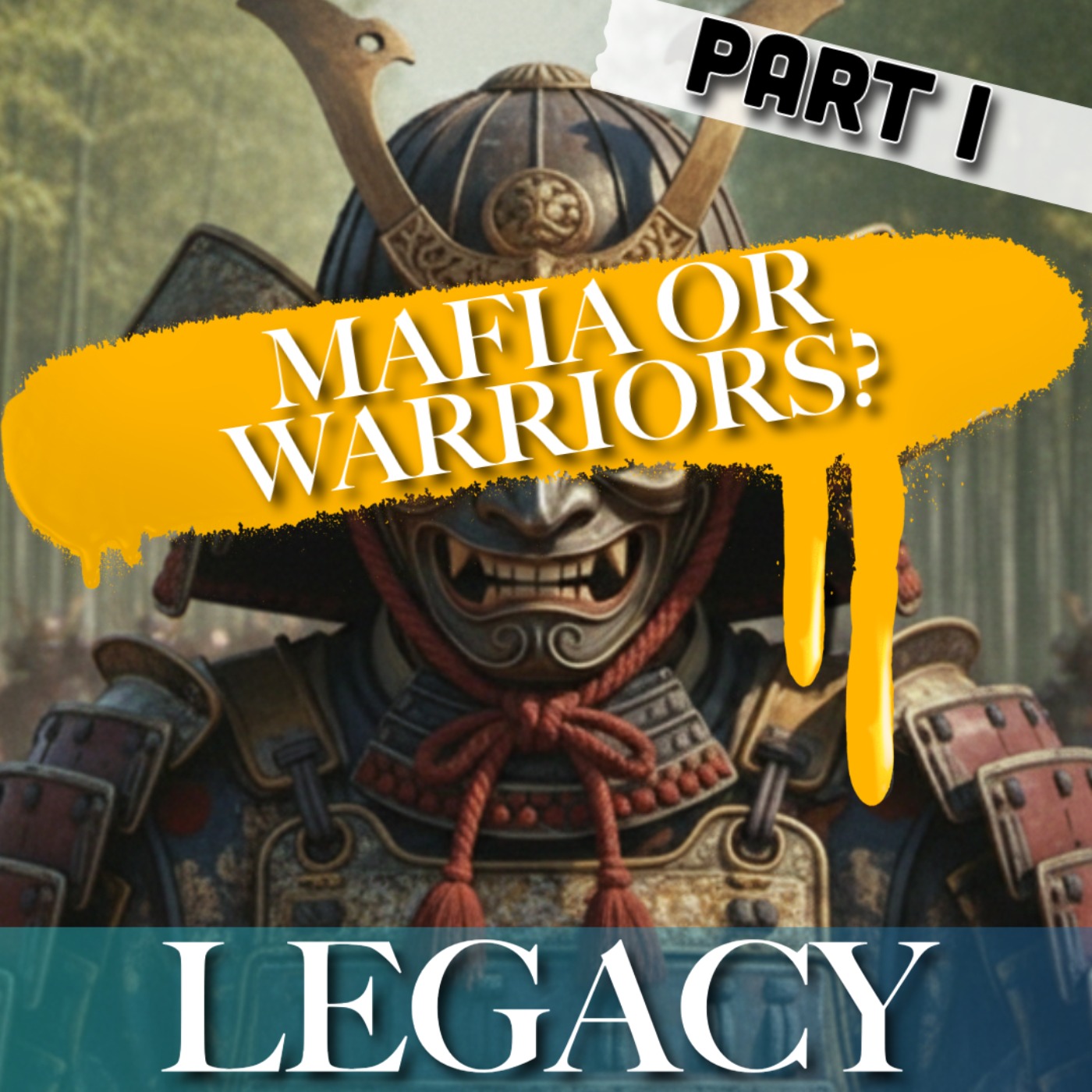
I think it's one of those funny ones where Japan has this incredibly rich imperial history, really exciting cultural mixes, the kind of the rhythms of what happens in Japan in the last 2000 years. And yet we sort of cherry pick. There are bits and pieces that people know about Japan. You know, they know about Godzilla, they know about sushi, they know bit about design. But films, literature, music, art, it's kind of left to one side. But there is one thing, I think about Japan's past that everybody does know. And a word that everybody knows. And the reason we're recording these two episodes is because there's an enormous big blockbuster show starting at the British Museum, if you're in London or lucky enough to be able to get to London by May, called Samurai. And so the topic we're going to talk about today is the origins and the legacies of samurai. And to try to do that in a way to help people who are going to go and see the show, or if you don't get a chance to come and see the show, to think about why this has a particular moment now in 2026. Hello and welcome to a new episode of Legacy. I'm Peter Frankenpern.
- [05:06]
C
I'm Afua Haysh.
- [05:07]
B
And this is Legacy, the show that explores the lives, events and ideas that have shaped our world and asks whether they have the reputations that they truly deserve. This is samurai the rise of the medieval warlord. What do you think of samurai? What do you think of. What's your kind of the first thing that comes to mind?
- [05:39]
C
I don't know. It's one of those things that I. Yes, I've heard of samurai. I know this Japanese warrior class, where I know them from, I think might be actually a little bit of a counterintuitive story. So I'm just going to be very upfront and say Wu Tang was a big source of education. There was a film in the Naughts when I was a student. I remember watching it. What's that independent cinema in Oxford called Peter?
- [06:05]
B
The Picture Palace, The Phoenix.
- [06:07]
C
Picture Phoenix. I remember going to the Phoenix must have been 2000, 2001, and watching the Way of the Samurai, which was an independent film with Forest Whitaker in which he plays this African American man who's trying to kind of re embody the samurai. And there's actually a really interesting strain of African American black diaspora fascination with samurai culture and that version of masculinity, the very disciplined strategic approach to using violence with a kind of spiritual principle. I don't know why it infused my world as someone who listened to a lot of hip hop and watched a lot of black cinema, but it was definitely that space that probably first introduced me to the samurai. So that's one way of finding out about samurai, but I feel like you would be able to give a more historically rounded introduction to samurai. So tell us what it is and where it comes from.
- [07:10]
B
So the samurai are a Japanese warrior class, exactly as you say, Afua, who emerge from provincial landowners rather than at the imperial court in Kyoto, which is the kind of the classic imperial capital of Japan. They start to emerge around about the Middle Ages, around about the year 800, as Central Imperial authority starts to weaken and local military power grows and they become enormously important in Japan's military history and the politics, I guess, as a warlord, and you'd expect that to happen, but they're really important and really interesting from the point of view of society and culture. And as I mentioned, the reason we want to do these two episodes is because Samurai runs at the British Museum from 3 February until 4 May. And it's visually completely thrilling. Some of the reason I think people know about samurai, one of the reasons why Forest Whitaker is so great in that role are the costumes are amazing because of the armor that the samurai wear. But there are incredibly tender love poems, love scenes, erotica, you know, you name it. So it's a whole kind of world to explore. And so I really strongly recommend, if you get a chance to go and see the armor art, clothing, ceramics, all that stuff curated by Dr. Rosina Buckland at the British Museum, I'd strongly recommend it. And those blockbuster shows are always sellouts and spectacular, so try to get a ticket if you can. But Afra, we talked about a bit of, you know, we're going to take a slight of a running jump to describe Japan in the early kingdoms period before the rise of the samurai. Tell me a bit about Japan before the rise.
- [08:42]
C
Well, I suppose in a way that's not that different from European countries that now we think of Germany as one country. Japan was not always one country. From the 5th century it was this landscape dominated by competing clan groupings which are sometimes described as early kingdoms. And power rested not in a centralized monarch, but in these elite families who controlled land, labour and ritual authority. It's fair to describe it as a feudal system, right Peter?
- [09:10]
B
That's right. Well, you're going to kick me off later. No, no, no, it's not complicated. It's that medieval historians here in Europe get very exercised about exactly what feudal means because these days it started has become less popular. But it's the idea about what's the relationship between land, landowners, peasants, the court and how do those obligations actually work. So the most influential of these kingdoms is the Yamato polity, which is centered in the Kirai region of Japan. And Yamato rulers don't govern directly, but they claim precedent through alliances through, through marriage and religious leadership. One of the reasons why historians get over exercised about ideas about feudalism is that it implies that if you're told what to do, you do it either legally or there's an obligation. And these things are much more fluid and much More chaotic. And in fact, even in the case of the Yamato rulers, Afwa, their authority isn't even across the archipelago too.
- [10:09]
C
No, their authority is quite unevenly distributed. So they're quite weak in the north, in and east of what's now Japan. And rule is personal. It's symbolic rather than bureaucratic. This is not a world of strong institutions, but of individual figures with sway and influence. And it's a world where status matters a lot more than territory and land. The political order depends on this constant balancing between rival elites.
- [10:38]
B
Look, one of the things that's interesting is that Britain has a long tradition of. Of collaboration with Japan, partly because we're both island peoples. And I think a bit like how sometimes one thinks about British history. We can assume that the British Isles are kind of separate from the history of the rest of Europe. And to some extent, of course, that's true because we're separated by water, and therefore we tend to be less multilingual. We tend to see the world in a different way. We tend to prioritize the sea and the navy rather than engagements in Europe, who we think of as much part of the family that we're included in. But also they're very different. Japan has a very similar kind of relationship with its neighbors, too. You know, Japan doesn't just exist as its own set of islands, but it's deeply shaped by contact with Korea and by China. So lots of similar kinds of things that happen in Japan happen in the British Isles. So migrations, envoys from different kingdoms, alliances, the ways that new technologies are brought, like radio writing or metalworking, weaving, architecture. There's a lot of correspondence. And that can mean that sometimes the way the history gets written gets edited out because of the complexities of those relationships in the past. But China is a kind of the ultimate model of civilization in this period In Japan, it's admired and imitated, but never copied wholesale. So borrowing is always taken sort of deliberately and specifically because Japan has its own very proud and different culture, but it's blending all the time.
- [12:06]
C
And Japanese elites are using the continental standards to strengthen their own authority within Japan. So they're actively selecting ideas that work for the local landscape and assimilating them into their own power structures. So it'd be wrong to look at Japan as an isolated society. It's a frontier society. It's absorbing these external influences, but using them to reinvent itself and its idea of itself and its own forms of power.
- [12:34]
B
So you've got lots of patchworks you mentioned already, Afwa, that Different parts of the islands or the main island is under weaker rule. So lots of high levels of difference. And that spreads through, as you'd expect, in religious beliefs. So there are spirits, of landscapes, of ancestors and of natural forces, and they mean slightly different things in different locations. Ecologies are different. The way in which people think about the natural world, the way the people think about their neighbors, depending on density, access to water, those kinds of things make a big difference. The location of mountains and volcanoes too. And so what happens in Japan is that ritual is more important than scripture or doctrine, which don't really exist. So political authority has to work alongside ritual authority. Rulers perform ceremonies to ensure that there's harmony between humans and the natural world and also with the spiritual world. And of course that means if there are things that go wrong, if there are misfortunes, if there are floods, if there are droughts, if there are natural disasters, it's a sign that there's imbalance. And that gets reinforced through clan power because people want to group together to have similar kinds of ideas. But that starts to change with the arrival of Buddhism in the sort of 500s.
- [13:46]
C
Peter, your work connects these big social and religious changes to natural events with the earth, weather systems, natural disasters and volcanic eruptions at this time had a huge impact on the spread of Buddhism further east into societies like Japan. Japan. So we also think about the world as geographically separated, but also natural events and climate as separated from social and political changes. But of course they're all interlinked. That's what I love about reading your books, is how much it really makes those connections. This is a great example. The arrival of Buddhism in 6th century Japan was directly influenced by these changes in climate, by this big volcanic series of eruptions. And, and it's traditionally dated to 552 as the official arrival of Buddhism. And it came via a diplomatic gift from the Korean Kingdom of Paekche.
- [14:40]
B
Peter, so we're good news is we are going to record an episode about exactly those volcanoes that aforementioned and about the ways in which they change the world. So you'll get a bigger story about that, about the impact it has on changes in society. But Buddhism has a kind of new burst of life connected to whole range of different functions. But the arrival of this envoy from paekche in the 550s is an introduction that splits the court. So some champion Buddhism as a source of protection from difficult conditions as well as prestige. Others see that as a great rival to traditional belief systems and that it's an outside influence. But as we Mentioned that selective borrowing is a sort of natural sort of door that's rotating, bringing new ideas into. But these disputes in Japan soon turn violent, and that shows you something, I think, about how closely religion and politics are intertwined, not just in Japan, but in history too. And ultimately Buddha starts to get proper roots and to grow, not because of popular conversion, but because it offers a new powerful language of authority that allows rulers, or gives them the incentive, I guess, to oversee patronage to cement their own positions. And it's a language of Buddhism that is universal, it's sophisticated, and also connects Japan more closely with continental powers in other parts of Asia.
- [15:58]
C
It's so ironic, isn't it, when you think about Buddhism and its teachings about peace and nirvana and, you know, inner happiness, that you don't think of it as something that would spread because it serves the interests of powerful elites. But of course, all religion is a tool for rulers, and Buddhism is no different in this case. And it's. You would think of it as this popular conversion of people kind of connecting to the message with their own inner lives. But no, actually it is its ability to offer a cohesive new system for rulers. And a great example of this is Prince Shokutu, whose life kind of transcends the end of the sixth and the beginning of the seventh century because he is a ruler who promotes Buddhism and Confucian ideals of hierarchy, harmony and ethical rule, thereby allowing him to consolidate his power.
- [16:50]
B
And it's an interesting one. Buddhism is a complex religion. I think we have a kind of happy, clappy version of it, certainly in the west today, of thinking that it's about chanting and connectivity with the natural world and different ideas about consumption and so on. But classical Buddhism in its origins is about self denial. It's about the promise that life is never going to end happily and you're going to be constantly recycled, and that it's about giving things up, suppressing ideas and beliefs and passions. And so it's quite a tough one to be selling. But if it's enforced from above, then you can see why it might catch, particularly if you give incentives. So Shotoku, the prince Shotoku, he authors what somebody called the 17 article constitution at the beginning of the 600s. And that serves not as a set of laws, but as a kind of moral guide. And it's exactly those Buddhist principles that encourage people to show restraint, to show respect for authority, to be loyal to. Think about your personal characteristics, the virtues that Buddhism promotes. And Shotoku imagines government not just as a political exercise or an economic one. But it's an ethical one that you lead through virtue rather than coercion. And of course, that sounds great if you're at the top of the pyramid. You know, perhaps more complicated if you're being told that this is what you're now going to do, this is what you're going to do from now on. And so those reforms that he does are quite aspirational, but they set an intellectual foundation for the demand of rulers to have higher levels of interventions in people's lives. By saying that there is a standardized way of living and behaving and supporting the person at the top, you can.
- [18:30]
C
Really see the aspiration. It's a very attractive idea for a ruler that rather than having to force your bureaucrats and officers to behave a certain way, they will internalize those rules by believing that it's this kind of spiritual truth, you should live with respect and restraint. And it kind of sounds better than using force to bully people to behave that way. But of course, it's never quite that simple. And there is a coup in 645 leading to the Taika reforms. Peter, tell us about that.
- [18:57]
B
So there are a set of reforms that basically tried to say how we're doing things in Japan, we can improve. It's a bit like, I guess, modern Britain. You say we're doing okay, but we should be able to punch above our weight. And so the model that gets looked for is Tang China. That itself has been reforming since the beginning of the 600s. Tang is a big dynasty that rules in China for about 300 years. And these reforms are really significant. So land is now being claimed by the ruler rather than by clans. Taxes start to get standardized. Provinces get reorganized and have governors appointed from the court to be in charge. Officials are ranked and paid as well in the sort of the order of importance. And that's something you find in lots of parallel empires in different parts of, well, Asia, going the whole way across to Europe at the same time, where you find courts that are thinking very hard about how to streamline and how to centralize. And that's partly about efficiency, that's partly about control, but above all, it's about power. And so that process means that you have to have law codes. You've got to write things down. And that's also quite efficient. If you could write things down, then you can show who owns land. You can settle disputes more quickly, but you can turn then a state into something more modern because it's not just family privilege. It's also about administrative process and that sort of sounds incredibly unsexy and unimportant, but the mechanics of how all of us live, it's all about what does our local council do for us. And lots of people complain about it, but if the traffic lights don't work, if the rubbish doesn't get collected, if there aren't any schools, all these things that we sort of take for granted and sometimes think aren't being done well enough, they're absolutely central to daily life, working.
- [20:42]
C
Now, if you study or work in many African countries, you really see how important bureaucracy is, because many countries that are young states, you know, they only got their independence from colonial rule in the last 50, 60, 70 years. They had to kind of start from scratch, building institutions, creating a culture of bureaucracy that didn't previously exist or was imposed in a very authoritarian and culturally inappropriate way by European colonizers. It really affects their ability to be transparent, orderly, functional, efficient. And so the opposite is true in Japan. You can see how this early formation of a bureaucratic government instead of this clan based personalized rule allows Japan now to become a different kind of society, one with permanent capitals, with commercial centers rather than just ceremonial cities, and one that is now becoming more integrated.
- [21:37]
B
PETER well, you know, I would love one day, Afra, we take our show on the road as I think we're going to to go do something in Fujiwara Kyo or in Nara. Nara is the kind of the key urban center in the kind of seven hundreds that sees Buddhism fully being integrated into statecraft, particularly under a particular emperor called Emperor Shomu, who commissions the Great Buddha at Todai ji in the 750s. But you see this sort of blossoming. I mean, it's funny, there's a some fantastic books about parallel empires that are obviously sparking off each other around about the same time in this kind of window that ironically in Europe has often been called the Dark Ages. And please don't write to me and complain about it. It's not my label and I'm fully aware of the problems. You say that, Afra, you laugh, I can promise you. Anyway, that's a whole other story. But in this part of European history that we typically call the Dark Ages, we see the blossoming of arts and cultures in the new Islamic world. In the Umayyad than the Abbasid Caliphate, we see the spread, enormous states spread across the spine of Asia, run by nomadic peoples. You see the Tang Dynasty, you start to see the rise of the Gupta and then others in India too. And you see the spillover as new states are starting to seed each other and they produce these glorious bursts of literature, of art, of architecture, of ritual that are all doing the same thing, which is projecting a sophisticated, joined up view of monarchy being sacred. So the kind of idea of the exchange of kings, of people learning from each other's court, are really important. The, the problem is, if you have a court that does that, it's quite expensive. I mean, artists aren't the best paid people in history, but if you've got lots of people doing big grandiose projects that show how great you are, then there's a cost. I guess today's obvious parallel would be President Trump, who loves a big building and loves things being named after him. But there's a reason why.
- [23:35]
C
Maybe that's why he has to furnish his room with accessories from Walmart and have them spray painted with gold. He's run out of gold.
- [23:41]
B
He does have it all painted, but there's a reason why that's what wealth and power look like. And it might be that you don't like that, but he does and that's what matters. And in fact, if you want to be in Trump's court, which I don't think either of us are at the moment anyway, you've got to like it too. So, I mean, there's some fantastic stuff. I mean, it's a bit of a, bit of a diversion, but you know, there is the kind of the mar a lago look now that you need to have in Trump's court of the facelift of the eyes, pulled back of the hair, etc.
- [24:06]
C
Don't forget the fake tan.
- [24:07]
B
Fake tan and not just women, which is the kind of traditional facelifter. But that's what power looks like. And I didn't have that on my bingo card comparing Trump to Nara period Japan, but it's something similar, which is that's what looks like when you have a ruler who is that powerful. People are expected to follow. But it's expensive financially and actually it's expensive politically.
- [24:29]
C
And I would say, Peter, that I find this era in Japan a lot more attractive than Mar a Logo era America. But maybe that's a subject for another day. It is highly sophisticated, but it's also actually quite fragile. And the court struggles to control its distant provinces. Monasteries are accumulating private power. Officials are relying increasingly on local strongmen to enforce authority, unable to simply call on the legitimacy of the ruler. And military force is available to the ruler, but it's secondary actually to rituals and administration. And by the late 8th century, the cracks in this edifice are really visible. It's an elegant court centered world. It's attempting to rule through culture, law and religion. But it's not enough. And we'll see how that leads to the emergence of a new warrior class after the break.
- [25:28]
A
Hi, this is Jonathan Fields from Good Life Project. If you're not using ironclad for contracts, you could be leaving millions on the table without knowing it. Every contract holds renewal dates, pricing terms and obligations you can't afford to miss. But good luck finding them when it matters. Ironclad's AI instantly surfaces what matters so you can act before opportunities slip away. That's why they're trusted by OpenAI, L' Oreal and Salesforce. Find the savings hiding in your contracts@ironcladapp.com podcast that's ironcladapp.com podcast before we had.
- [26:02]
B
At&T business wireless coverage, our delivery GPS wasn't the most reliable. Once our driver had to do a 14 point point turn to get back on route. A 14 point turn, an influencer even live stream the whole thing. Not good for business. Now with AT&T business wireless routes are updating on the fly and deliveries are on time. And the influencer did get us 53 new followers though. AT&T business wireless connecting changes everything. So in the early 9th century, Japan is still in theory ruled for an imperial court in Kyoto, which is a place of poetry and ritual and ceremony. But the system, built on a sort of Chinese style administration is starting to fail. And that's going to provide the context for the rise of the samurai. So we start to see from around about the year 800 or so, Census taking start to break down, tax collection starts to fail, land starts to be accumulated into private estates or shoen, which are owned by aristocrats or temples or by shrines. That's important because you start to weaken the throne because you stop paying taxes. A lot of these places get exemptions. The best thing that any priest in any religious belief system are able to do is to get tax concessions. So it means that you start to get autonomous units of land, holdings of monasteries that have their own resources and are either resistant to paying or have managed to squeak away to be able to get away with it. And then on top of that you've got a bit of climate instability, floods, cold spells, crop failures that does things with prices, undermines credibility and the court lacks the manpower above all to enforce authority that people are too busy keeping the emperor happy and smelling and sounding good. It needs a proper infrastructure.
- [27:58]
C
This is a familiar story when the authority of the ruler starts to falter. He starts relying on local strongmen who can protect his interests, enforce order. And these strong men are armed, they're mounted and increasingly powerful as the ruler starts to become more and more dependent on them. Now, initially, these warriors have a range of names. They're called mononofu armed men, or bushi military men. But later they come to have a name which has now become, I think it's fair to say, iconic.
- [28:32]
B
PETER Samurai. And it's from the Japanese word sabura, which means to serve. So samurai means attendants or retainers. And over time, these local enforcers start to form hereditary military families because the skills they have of archery, horsemanship, swordsmanship, first that they're passed from father to son. But violence becomes professionalized. So these groups are sent out to try to enforce order. But they quickly work out. I mean, and it's funny because samurai have got much better reputation than perhaps mafias do. But it's a similar kind of structure. It's about personal loyalty, it's about contractual stuff. It's about how you behave, it's how you treat each other. And they have a slight disdain, a bit like mafias, for court life. They think that they should be close to land, they should be close to danger, that fooling around in imperial courts to listen to songs being sung is not really what life is all about. So their identity gets forged with raids in disputes, in defense. And they don't have an enormous amount of time for ritual or poetry because the primary skills are what you do with your hands rather than what you do with your mind. So it's true that lineage and reputation matter, but the samurai are emerging as a social group that is important long before they start to rule Japan.
- [29:49]
C
It's so interesting, isn't it, because, you know, we often talk about masculinity and we're going to do a series on Hemingway, who's often looked up to as this kind of hyper masculine author. And it's this idea that's just so recurrent in different cultures and different times that there's something noble about the man who gets away from the effeminate ideas of poetry and this kind of soft court, pampered life and goes back to the land with the sword on his shoulder, the warrior on horseback. And it's, it's interesting because it seems to transcend specific cultures. PETER it's, you can find a version of this in almost every culture. But the samurai ideal is powerful globally, I think, men across the world in particular, and I don't want to overgeneralize. I'm interested in samurai, but I think that there is a way that men or people who aspire to the masculine ideal really look up to the concept of samurai.
- [30:38]
B
Look, I think that is right, funnily enough, when you're talking. I mean, in fact, how I would think about it is that what these groups do is that they're filling gaps. And that gap is created by the fact that the state is being inefficient. So the reason they can start to accumulate power means that there's an opportunity for them. And then the way which that power gets exercised is in reverse proportion to the center. So if the center is considered effete, then hypermasculinity becomes attractive. If the court keeps talking about religion and ritual, then riding a horse, polishing your armor, being able to use your sword becomes more important because you're defining opposites against what your sort of counter figure is. And so I think that it's about when the state struggles, then these vacuums get filled quite efficiently. And through all of that, of course, religion has to adapt because Buddhism, especially forms that promise protection and salvation and so on, gets remodeled by warriors. So the idea that you should be denying yourself and you should be not eating too much and you should be spending your life in contemplation and prayer means that temples become important because you're thinking about should you be making gifts before fighting battles to avoid disaster. There's tension, of course, between killing and karma, and that the way to fix that is through prayer or through patronage or belief in marriage transfer, which is a key part of obviously Buddhism too. So Buddhism blends with ideas from Shinto faith systems which tie to land and ancestry, which remain strong and reinforce local identity. But violence starts to be seen as not being irreligious. It has to be spiritually managed. And that fusion of faith and force becomes a really important part of samurai culture, as we're going to see.
- [32:19]
C
So now by the 10th century, you've got an emperor who reigns, but he doesn't rule in the sense that he is not the one really wielding power. He's got this ceremonial place. And there's a sanctity attached to the idea of him. Is it a little bit like the monarch in 21st century Britain? Peter we have, you know, the head of the constitution, the figure that everyone can identify as the head of state, but actually it's not where real power or decision making lies. And in our case, it's in parliament in. Well, you could argue it's Elsewhere also in 10th century Japan, it's in court aristocrats, especially the Fujiwara, These are a group of elites who dominate politics through marriage, through regency, and their court excels at culture. This is where the medieval poetry calligraphy ceremony that we so often associate with historic Japan is thriving.
- [33:14]
B
And we get the Book of Gaiji. It's normally considered the first novel written in anywhere in the world. And that kind of flourishing of arts and culture means that you've got to kind of, like you said, Afro. You've got a kind of spiritual center, and then you've got raw power. And that's not completely unusual. I mean, you have something similar in lots of Islamic states where you have a spiritual leader and then a sultan or caliph and then the sultan. So that kind of separation of spiritual and political, I guess you could see that in terms of the Christian church too, you've got an emperor and then you've got a pope or whatever it is. So it's not completely without precedence. Is that parallel with. With today in Britain, where you have a kind of constitutional ruler, or you've had that in Iran, I guess, too, where the supreme leader has been someone who has spiritual authority. But that separation between legitimacy and symbolism and coercive force starts to become permanent and the emperor gives authority and the samurai start to enforce it. And that's an important change in, I guess, the political DNA of Japan at this time.
- [34:13]
C
These events become part of Japan's cultural memory, and that's through the oral storytelling that later becomes the tales of the haiki or haiki monogatari. And this is written in the 13th century, and it narrates the rise and fall of these warrior houses through the lens of Buddhist impermanence. These ideas that glory is fleeting, power is transient. And the literature doesn't just record the samurai history, it shapes how the samurai see their own identity too, I guess, in the way that all good storytelling is a story that you tell other people, but it starts to change the way you tell a story about yourself. Right, Peter?
- [34:53]
B
Those rivalries, it's a bit like the sort of Montagues and Capulets, or the English and the French, or the English and the Scots, the Welsh, the Irish too. Okay, everyone's a happy family, but two clans dominate and shape each other. So in the 11th and 12th centuries, so from 10 hundred onwards, you have the Taira, the Heike, and the Minamoto, the Genji. Both are tracing their descent from imperial princes, and they blend martial power with aristocratic prestige. These clans, they grow, they serve at the court, they Put down rebellions and they compete for influence in Kyoto. So they're working out how the corridors of power work. And samurai warfare starts to become more structured under these two big groups. Mounted archery, the way you depict yourself on the battlefield with a banner, heraldry and sort of crests. Ritualized combat and honor and reputation are important, but what really matters in an age of rising violence is survival, you know, so that means that the stakes are quite high, and these two big rival factions are waiting to see whether there's an opportunity to push each other out of business. So I don't overuse the kind of idea of mafia or non state groups, but we can see that in lots of other different periods in history about people trying to take territory off each other. You know, gang warfare in la, you're waiting to see you can have a rivalry. You have the same kind of tools, by the way, and the tattoos instead of banners, and the. All the different symbols, what you wear. But there are clear divisions of what's acceptable, and those can sometimes spill over into something extremely dramatic. That's what happens in the 1180s.
- [36:26]
C
In the 1180s, we get the transformative moment where the samurai cease to be instruments of power and start to really meaningfully wield power. And that's the Genpei War from 1180 to 1185. And it begins as a conflict between the Taira and the Minamoto, the two clans, the Montagues and Capulets, or the Crips and the Bloods, as you drew those comparisons, Peter. But they both claim these ideas of imperial dissent and court legitimacy. So the stakes are set for this to be a battle to the end.
- [37:00]
B
And what is important about this war isn't just its scale, but its implications. So there are constant breakdowns. There's battles at Uji, at Ichirotani, and finally the naval engagement at Dan no URA in 1185, which shows that political authority really isn't flowing from the emperor, and it's about who these power brokers really are. So I guess the most important symbolic moment of this is the drowning of the child emperor, Antoku, which is kind of a hugely traumatic moment in Japan's history. It's extremely important because it shows that the. Although the imperial family keeps on going, that inviolability, that sense of aura of mystique, it's kind of gone, right? So it gets immortalized, this war, through the tales of the Heikyu, which frames the conflict as being one of Buddhist ideas of impermanence. But it does also show that what matters is brute force. So that literary flaming, which explain how warriors rise and fall like blossoms in the wind, is about how the samurai are starting to find their own way of expressing their own importance through moral language, through poetry and through literature, that.
- [38:06]
C
Literary framing really matters. It's giving the samurai a moral language that legitimizes the idea that you can reconcile bloodthirsty violence, because that's the reality of what it is with this cosmic order that has these ideas of the divine and the eternally just. And I think it's so interesting, Peter, how religions across place and time struggle to reconcile these fundamentally, in my opinion, irreconcilable ideas. But of course, religions, as you said earlier, have to adjust to meet the geopolitical and security needs of the people. And they are infinitely adaptable when it comes to being able to do that.
- [38:47]
B
Well, on top of that, you've got a period of climate instability at the end of 11th century, as we know, creates harvest pressures, harvest failures, pushes inflation, drives instability, and that heightens competition for land and for money and intensifies the stakes of warfare. So at the end of this war, it's unmistakable that Japan's future is not going to be decided by ceremonies that take place in the palace, but on battlefields, on who could control the apparatus of the entire state. And the samurai have proved that armed force can control the political center. So next time, we're going to take a look at how the samurai move from being enforcers to being right at the center as the motor and the driver of Japan's history. Thanks for listening to Legacy.
- [39:30]
C
Don't forget to hit subscribe on your favorite podcast player. And you can also watch all all our episodes on YouTube, so make sure you're subscribed there, too.
- [39:38]
B
And of course, we're on all the socials, so all the links are in the show notes, but you can just find us if you search for Legacy podcast. I'm Peter Frankopone.
- [39:45]
C
I'm Afua Hirsch and we'll see you on the next episode of Legacy. If you're not using Ironclad for contracts, you could be leaving millions on the table without knowing it. Every contract holds renewal dates, pricing terms, and obligations you can't afford to miss. But good luck finding them when it matters. Ironclad's AI instantly surfaces what matters so you can act before opportunities slip away. That's why they're trusted by OpenAI, L' Oreal, and Salesforce. Find the savings hiding in your contracts@ironcladapp.com podcast. That's ironcladapp.com podcast.