Loading summary
Transcript524 lines
- [00:00]
A
When John Adobe invented the PDF, it was. It was incredible because he created something so useful, but admittedly annoying because they were challenging to edit.
- [00:11]
B
Yeah.
- [00:11]
A
And I've always had that pain.
- [00:13]
B
He brought like good but also bad into the world.
- [00:15]
A
I've heard that with Adobe Acrobat Studio and PDF spaces within that Adobe's you can now.
- [00:22]
B
They've closed the loop.
- [00:22]
A
They've closed the loop. You can easily edit, Change and send PDFs to whoever you need to now. And I know I do that at my job all the time.
- [00:31]
B
And you can learn more@adobe.com do that with Acrobat.
- [00:34]
A
Doug.
- [00:38]
C
Support for this show comes from McDonald's new hot honey sauce. Your favorite McDonald's order just got a little hotter, a little sweeter, and even better. Hot honey sauce is here at McDonald's right now. Try it in the hot honey snack wrap or head over just in time for breakfast and get the hot honey sausage egg biscu. McDonald's new hot honey sauce is here for a limited time at participating McDonald's locations. Try it now while you can.
- [01:07]
B
Ladies and gentlemen, welcome back to the Lemonade Stand featuring myself, Doug. Doug and Aiden. That's right. We're gonna do that now.
- [01:14]
A
You really hesitated.
- [01:16]
B
I was gonna say Gavin.
- [01:18]
A
Myself, Doug Duggan.
- [01:19]
B
Yeah, I was thinking about.
- [01:20]
C
A lot of people have been saying they're bouncing off the pod because they don't know our names. They haven't introduced ourselves.
- [01:24]
B
I've heard a lot, a lot of feedback about who are their names, where.
- [01:27]
C
Are coming in every week.
- [01:29]
B
Yeah, y. Yeah, don't burn that down. Listen, folks, the past week after week after week, we've been hit with insane political story after insane political story. But this is a Triforce podcast. We're supposed to cover politics, business and tech. And then this one seed has grown to be the big.
- [01:49]
C
Talking about epine.
- [01:51]
B
Actually, yes.
- [01:52]
C
Actually, yes.
- [01:53]
B
Actually, yes. I am talking about Epstein.
- [01:55]
A
Don't talk about Epstein.
- [01:57]
C
Yeah, I didn't say that. I didn't say that.
- [01:59]
B
No one thought that until you aided.
- [02:00]
A
Come on.
- [02:01]
B
Nobody thought that, by the way. All right, so the big story this peg was Jeffrey Epstein and the new tranche of files. 3 million new files, which is like still only like 2% of the multibillion files, apparently that Obama wrote as part of his coordinated plan to take down dude.
- [02:18]
A
It's crazy that he even had time to kill Osama bin Laden.
- [02:21]
B
It is insane how much writing he had to do and how so many.
- [02:25]
C
Of Epstein had time to throw parties with the billions of emails. Like how Does. Dude, it takes me like hours to get through my daily emails of like 30 things I have to apply to. He has apparently talked to every person on Earth.
- [02:39]
B
Guys, like, I'm against Epstein for his actions, but his email, his inbox zero was crazy.
- [02:45]
C
We're not going to dive into this deeply for the reason you all. But you're going to explain.
- [02:48]
B
But like you say so all right, people are. Everyone is covering this, like the most is the biggest story right now. And I think you should watch like the coffee Zillow video which has gone on some of the big revelations, but because there are millions of files. One person I've been in reading is Julie Brown, who's actually named in the files as a journalist. He's really scared of. She is going through file by file and she said, like, currently I saw a tweet like from yesterday. She's like 2% in, you know what I'm saying? She's like literally trying to like analyze file by file. It's so massive. So any major deeper revelations are going to come, I think, later, outside of the big headline names you've already heard. So we are going to try and cover some of the stories that I think are going a little bit under the radar this past week, but are like deeply impactful, especially in the fields of business and tech. Yeah, that's sort of the goal of today's episode. You know, Epstein stuff horrendous. And I think we will cover it more as any new stuff comes out. But the main stuff that we would say you would have already heard is that. Am I. Oh, yeah. The yard. All of them, except for one, are in the files. That is one thing I think that just got. I will let you figure out who.
- [03:48]
A
Can you at home figure it out? I think. Yeah, I. I feel super similarly because I was. I've. I've been on X. I've been on X more than normal.
- [03:58]
B
He means the drug. He means the drug. Browse more than normal browsing.
- [04:03]
A
And I just feel like at this time where there's so much information and not enough of it has been parsed yet, it's a little easy to, I would say, fall for things that aren't necessarily true because people like, I saw a tweet about how there's audio of Tony Podesta eating children, which is a conspiracy theory from like Pizzagate, which isn't in these files recently.
- [04:33]
C
It's true or not.
- [04:34]
A
And.
- [04:35]
B
And first of all, that's a great question and Rock will let you know.
- [04:37]
A
You know, it's so funny, because the we're at peak Grok is people are Christ. And. And I'm not saying that. I'm not saying that there isn't heinous stuff that's going to be uncovered or has already been uncovered in these. But the problem is people are just lobbying. Like old conspiracy files.
- [04:58]
B
You go, oh, I saw this guy's in the file.
- [04:59]
A
This is the files.
- [05:00]
B
And everyone goes, all right, well, so.
- [05:02]
A
I just want to warn people that, like, it's obviously insane what's going on, but please, maybe just give it a little time. Just give a little time for the dust to settle and don't just latch onto any tweet you see as proof of something that's in it. I would try to look at the documents that are, like, on the DOJ site.
- [05:18]
C
Okay, well, I'll count on that a little bit. X, as I've also been on a little bit this past week, is just. It's like. It's lunacy. It's the most insane shit right now. Like, everything on exits and. All true, and all true. I've been asking Grok about it. It is all true. What's crazy? I asked Grok, are you in the files? And he said, yeah.
- [05:36]
B
Oh, Grok's definitely in the files. Yeah, actually, okay, Small, small. Very funny part. I don't know if you guys saw that was in the files. Jeffrey Epstein was banned from Xbox Live. This is a true thing. He was banned from Xbox Live for being annoying. So I do think we can declare an end of the console war because Xbox is in the files and PlayStation is it. And that. I'm sorry, that.
- [05:56]
C
Well, hold on, hold on, hold on. No, that means PlayStation did not ban Jeffrey Epstein. Okay, PlayStation, you got something to account for here.
- [06:05]
B
This is the new console war on forums right now.
- [06:08]
C
Was he banned on Nintendo Switch or not? That's what I want to know.
- [06:12]
A
But I. You know, we've all been baking our minds on Twitter a little bit, but I would. Yeah, we had some other stuff planned for this episode that I think I'm excited to talk about.
- [06:21]
B
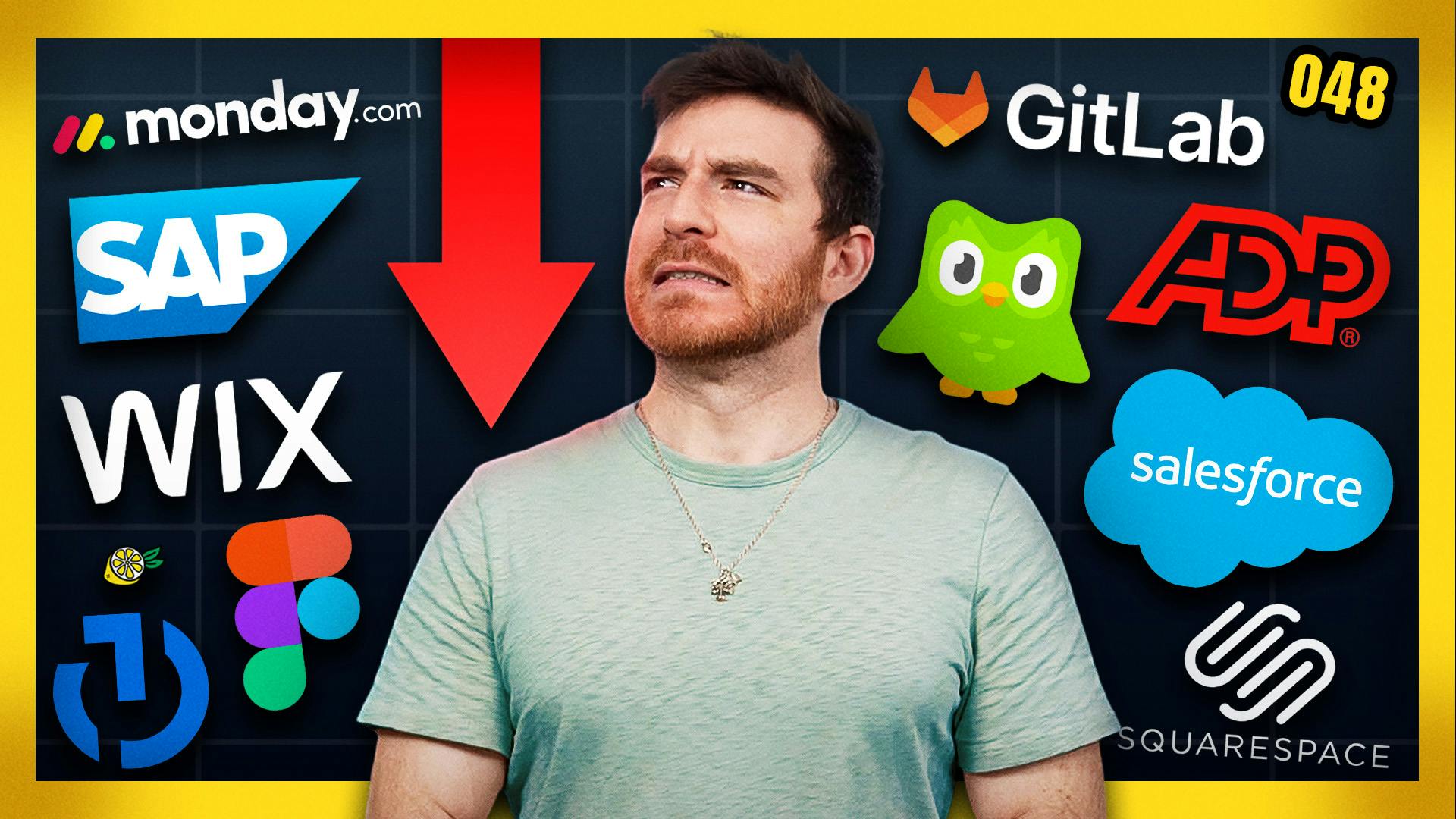
Well, here's the thing. We can't wait on. At least the market's not waiting on you. Pull up my screen. Perry, in the past week, under the radar, there's been an absolute meltdown. If you could pull us up, Perry, in every. Basically every single software company in the entire tech industry is melting down. Their stocks are getting cut 30%, 40% in half. Deeper. And it's all because of, like, this entrenched layer got hit Too hard. But because here's why.
- [06:48]
C
Yeah.
- [06:48]
B
Layman's understanding and we're going to go deeper into the tech that I want you to explain it. But people are saying that this vibe coding thing is getting more and more of a snowball. It's getting bigger and there's now serious worry that something like Duolingo is an app that you could something to create or you could like get parts of it that you need and just create. And it's like why would you pay Duolingo or why would you pay figma or Monday.com to organize your stuff? I mean we're going to show our vibe coded apps that we made.
- [07:13]
C
Yeah.
- [07:14]
B
Mine's kind of like an organizer that's similar. Oops. And it's like, it's that. Does that company have any value in a world where everything that they made can be generated in a second? So it's like a story.
- [07:24]
C
Vulva, Snowflake. A lot of these are like wix or Squarespace for example are, you know, these are, these are websites you've probably all heard of where they help you make a website, right? Yeah, that's their whole product pitch is like, we will help you, a non technical person, make a website. But now as we're going to talk about shortly, if, if any non technical person can be like make this entire thing for me, that is a much harder pitch for that company. So they've just been plummeting recently.
- [07:48]
B
Yeah. And I'm sure, you know, I saw some pushback that's like this could be a panic, you know, a little bit of like a freak out. And some of these companies have enough expertise or whatever, they're going to craft a way to be useful in this new age. And not all of this vibe coated stuff will take the place of all this. But it's like a big deal for some of them. Like some of them are just going to be obsolete. Like based on what I think what we tested with our stuff and what you're going to talk about.
- [08:11]
A
So stuff like Squarespace unfortunately seems like the most likely candidate. Yeah, but there's, I mean there's everything on here. There's even, there's even Adobe, Adobe's on here. Adobe's on there.
- [08:24]
B
Not their Acrobat Studio, of course, but it's weird.
- [08:28]
A
They actually spun Acrobat Studio in a separate company.
- [08:31]
B
Yeah, that's skyrocketing.
- [08:32]
C
I like that you looked around the room like check of Adobe's there. Like even.
- [08:36]
B
Well, the guy's got a sniper trained on him. Right there.
- [08:38]
C
But each of these mugs has a bomb planet. It's just. It's just set to go off with the right combination of words.
- [08:48]
B
I can tell you were sweating. Okay, but yeah, big deal.
- [08:51]
C
So let me make a pitch.
- [08:53]
B
Okay, so pitch me.
- [08:54]
C
The average person, probably the majority of people listening to this, probably you guys have heard about vibe coding. I've heard about AI coding, all this type of stuff, and have for a while. There's a lot of hype around this, much of which is bullshit. However, there has been a huge shift in vibes. Apologize for the pun. The past two months, really from December 2025. So if you have been a software engineer over the past, let's say year, the way broadly people have felt about AI coding is that it's like, good, it's helpful, but you shouldn't depend on it too much. And there's also this air of like, come on, we're real software engineers. Don't use AI coding for the hard stuff. Sure, use it. And I've talked to a bunch of software engineers about this. Like, the smartest person I've probably ever worked with is my friend from college. I chatted with him last year in the middle of it. He's like, been a senior lead engineer at Twitter before it turned into X and a couple other companies. He is crazy smart. And he was like. I think of AI as like a dumb junior engineer. That never gets better. Like, it doesn't learn as I tell it over time. Right? So he's like, it's good enough that I, like, need to use it for certain tasks. It's not good enough that it would replace me or anybody on my team, anything.
- [10:03]
B
Yeah, I mean, I talked to Otto over at Mobile Moves. He's like an incredible coder. And he's like, yeah, barely. I mean, I just. He doesn't. For what he's doing. He prefers to write the code himself still to this day. And it's working for him. So it's like, I've heard different things.
- [10:16]
C
Generally, to oversimplify it, the way people have felt it's most useful is if you have a big coding project or big repository or something, you can tell AI to go make a small piece of it and then you review it and that's about it. And then everything seems to have shifted over the past two months. All of a sudden, many of the most like legendary programmers out there, including Linus Torvalds and Andrej Karpathy, have suddenly been saying what just happened? This stuff is now really, really, really good. So this is largely kicked off by Claude Code by Anthropic. If you pull this up, Perry. So Andrej Karpathy, kind of one of the like big leaders in AI, worked at Tesla, worked at OpenAI, said, I've never felt this much behind as a programmer. The profession is being dramatically refactored. Towards the end of this tweet, he says, clearly some powerful alien tool was handed around. Except it comes with no manual and everyone has to figure out how to hold it and operate it. While the resulting magnitude 9 earthquake is rocking the profession. Roll up your sleeves to not fall behind. That's a month ago. A few days ago, given the latest lift in LLM coding capability, like many others, I rapidly went from about 80% manual coding and 20% AI to now 80% agent AI coding and 20% edits. Linus Torvalds, who makes Linux, came out and talked about how he's starting to use AI vibe coding a little bit. Sam Altman, who runs OpenAI, said, this is yesterday. I built an app with Codex last week. It was very fun. This is his AI system at OpenAI. Then I started asking it for ideas for new features, and at least a couple of them were better than what I was thinking of. I felt a little useless and it was sad.
- [11:57]
B
He's not a coder though, right?
- [12:00]
C
My understanding is he has a technical background, but it's not like his core competency. I'm not exactly sure.
- [12:06]
B
That I don't agree with this. I think it's true. And I think the mere fact that me and Aiden were able to create from just text in English.
- [12:13]
C
Yeah.
- [12:13]
B
Stuff that we wanted, we're gonna talk about later is like proof that something's going on here. But, you know, a lot of these guys do have some incentive and it's been shown in the past to like, be a little hyperbolic, to be a little. Because it. Because there's money needing to flow into the industry. Yeah.
- [12:28]
C
Like, let me just say this up front before, like, I. There is a ton of hype going on here and you should not buy into all the hype. And what I'm trying to do here is give enough data points that you can be like, okay, something seems to have shifted. This seems to have gone beyond just the Twitter bros saying like, AI so sick now, which has been happening every couple of weeks for years now. This is like the big boys are now saying, holy shit, something substantial has shifted.
- [12:53]
A
If we. If I'm taking that 2080 to 8020 switch at face value, what is the reason that that happened.
- [13:01]
C
So we're sorting it out. The core of it is they. I think a lot of the drawbacks with AI coding is that one, it wasn't able to understand on a broad, high level what was going on the instant you tried to tell it, hey, think about this broadly. Like a human would really be an architect here, really pick the high level direction of things. It would just kind of break down. It was not able to do this. You might have heard like context windows as a, as a limiting factor for this. And another is that it's just wrong a lot of the time. Right. It still hallucinates things. It misses core critical like security features and other things. So again, you could kind of use it as a scalpel for these individual tasks that if you're making code for real production, you still need to have an expert review it. And something seems to have shifted to where it can work on giant code bases, like an actual company making a real product that is much bigger than what like you and I have been doing the past couple of days and testing this out. And the mistakes are just much better as well as you can now kind of use it to supervise itself. So you can say, you have it write a whole bunch of new features and then you bring in another one to say, review this for these specific mistakes that we've seen in the past. Right. And so they can keep just kind of tacking on more of these agents to review what's happening.
- [14:15]
A
Okay.
- [14:16]
C
You know, the truth is like, I'm not a hands on expert with this. I've been using this stuff. But the code bases that I use are simple enough that I haven't, you know, this stuff has done what I needed for months now, if not years. So this is more people who work professionally are starting to go, whoa, hold on, this can now work at our level. And that's why you're seeing that 80, 20 shift.
- [14:39]
B
Yeah, yeah, I definitely saw from people. I even asked a friend who works. I mean, he's like, he was considered the best coder at Twitch. They called him the Code Reaper because everyone else would write annoying long spaghetti code and he would come in and cut all the useless stuff.
- [14:54]
C
Yeah.
- [14:54]
B
You know, and he told me it's a big part of his workflow now. Like, he doesn't. It's not. I mean, you know, it's like you said, I don't know if he's changed in the last month or two, but it's a big part of his workflow to help get things done. I think that's why it's been so, or at least seems to have been so dangerous for new grads because of what it's so good at is like, like you mentioned, like it's a junior engineer that you can send them one task, right? Like, it's been so devastating because that's, that's what they would learn, that's what they would do if they were hired. And it's been, that's been the scariest part. Like the senior engineers don't seem to be super threatened by it, but no.
- [15:28]
C
And so that's what's suddenly kind of shifting is like if this thing before could do the work of an entry level person, but in limited capacity, but now all of a sudden it is almost replacing senior engineers. You have people like Carpathy and all these Google engineers and all these like high level people all saying on Twitter over the past couple weeks, everything has changed. For me, that's when you start to go, okay, something seismic is shifting. And as a reminder, there's tens of millions of software engineering jobs in the world. This is potentially a huge economic shift just in jobs, let alone the fact that every company basically interfaces with software in some form. So there's two angles to this interesting conversation. If we go with this hypothesis that there really is a massive leap forward, not everybody agrees with this. I talked to Primagen recently and I was like, what do you think? Is it overhyped? And he's like, yeah, this is still a little overhyped. But broadly, a lot of people are excited. There's two topics. One, why, what is this gonna do to people who are in the software engineering industry? What is it gonna do to companies like that? And then the second one is, what does it do to random people, like probably most of you listening, who don't code and you guys. And even. And really me, Even?
- [16:33]
A
Yeah.
- [16:34]
C
So I think there's actually, even though this might not sound very interesting to the average person, quite a lot of consequence that could happen the instant that AI gets to a point where any person can go to it and say, make me this thing. I want you to make me this thing. And it just works because we are now getting to that point. So I asked both of you guys to create an app by just going to AI and asking it to make an app. Aiden, you. What'd you make? You want to pitch it?
- [16:58]
A
Yeah, I, I made a very simple checklist tool because I'm very dissatisfied with some of the, like, daily task like trackers that I have.
- [17:07]
B
Wait, you made two. Fuck. You also made A daily checklist tool.
- [17:13]
C
The economy is going to be revolutionized. Task lists are being vibe coded. Figma, you're.
- [17:20]
A
Well, I just thought.
- [17:21]
B
Here, here, here's what I made. That is insane embarrassed.
- [17:29]
C
Perry, pull that up. I'll narrate it for the audio listeners. Why didn't you tell the AI to make that prettier, dude, It'll do that for you.
- [17:37]
A
Well, I. I kind of thought it was pretty. I was actually really.
- [17:41]
B
This is your task list?
- [17:42]
A
Yeah. I was really impressed by this.
- [17:44]
C
You have two tasks for today.
- [17:45]
A
Wait. Well, no, I, I didn't. I haven't started using it yet. I just made this like last night. I wanted to make sure that it worked.
- [17:52]
C
Okay. So can you just. Okay, genuinely like, this is kind of like Monday though.
- [17:56]
B
It's like Monday.com is what it looks like.
- [17:58]
A
I really wanted just simple nested tasks. I think one of my big issues as somebody who's used a bunch of like software tools for this before and I do have a lot of my life in like Notion and. Or I've been playing around with like Obsidian recently. It's not that these tools do not have the ability to create what I'm looking for. I'm pretty sure that they do. But what I wanted was like, what is like a very basic, basically like almost text, purely text checklist. But I can just hide the trees of ideas like very easily. So one thing you can't do in Notion when you create a checklist, right, Is you can't like click on it or I don't know how to do it.
- [18:40]
C
I don't know.
- [18:41]
A
You can't click on it and then like have all of the sub ideas just disappear, appear on the page. I want to click on it and then have it open into a bunch of like webs of tasks and then go away as soon as I click one button and have no more interaction other than typing my idea and clicking on something.
- [18:57]
B
I think the key takeaway here is that you are a user who has a very specific thing that you want.
- [19:01]
C
Right.
- [19:02]
A
And that rather than, rather than scroll through documentation of how to set this up on Obsidian, I just typed my vague idea into ChatGPT and it made this. And I was like, oh, it looks. I didn't even think it would look nice. It looks nice. And then it gave me little features. Like, it lets me add like, it.
- [19:21]
C
Tracks so you can import how many.
- [19:23]
A
If I mark, it has a percentage tracker of like how much I have done for the day. If I like check different things, it like calculates that I can like easily X and like add ideas. I didn't say any of this. It just added it into the program as like little quality of life things that I liked. And I know this sounds so moronic as somebody who organizes his whole life in Notion already, but this is like it. It just. Instead of me like fumbling through the UI of Notion or Obsidian to like figure this out, I. I typed a. I literally typed a sentence into chat GBT and it gave me this.
- [19:58]
B
Yeah.
- [19:58]
A
So I thought that was pretty sick.
- [20:00]
B
No, there's things like I pull mine up. It's the same. It's the same basic thing. To be honest, I actually use this on the daily. This is a. This is a. Not my actual task. This is the. Because I can't. My real one's local on my computer machine.
- [20:12]
C
Okay.
- [20:13]
B
But this is the idea, right? So every day I have five things I want to do. They're not these five things, but it's. And as I click them off, it fills up this little bar that it goes green. And at home I literally have this. And it's like some days are red, some days are green. So there's a yellow. And I look at it.
- [20:27]
A
A lot of red for you.
- [20:27]
B
No, it's not, but it's a lot of red. And when I see a red, I'm like, I got to get back to the green. And it has helped me. It's just a fucking. It's. And this was.
- [20:34]
C
Do you redact sections when you don't complete it?
- [20:37]
B
What do you mean redact?
- [20:38]
C
Like you block them out when you're sharing the results with your friends?
- [20:41]
B
No, I haven't shared. No one has seen the results.
- [20:44]
C
I just feel like we should get the full files of your commitment tracker.
- [20:47]
B
Right, I see. Yeah, I see. You're saying.
- [20:48]
A
I think I don't react anything. This is. I'll pivot to a different example outside of this recently, but the reason why I this made me so stupidly happy is because the. It's really annoying to like search through documentation of software to try and figure things out. And then as maybe I'm just too adhd, it impedes me from using the software effectively. And I had this issue with Anki because I use it to study language. Yeah. And to set up Anki properly, get a deck that functions in the right way. All of. All of these different things, there are their own layers of friction to accomplishing the task. And what I really want, I want to be lazy and I want Anki to be set up Perfectly with the perfect deck to perfectly study the language so that I can just click into Anki and have exactly what I want set up immediately. And recently there's like this language like learning company called Refold that I've followed for a long time before it was even named that. And I had followed their approach for studying Chinese for six months during COVID and I really liked it. But I had lost some of the tools that I had to set up Anki at the time. And the, you know, it's a different language so I don't have the same deck or resources or audio files to study that language. Right. Recently I found out one of the main people that runs Refold is a fan of this show and he reached out to me, we had like a coaching session and he basically set everything up for me. And I've been doing Anki every day for like a week. And it's the long like so guys.
- [22:24]
B
You don't need AI, all right? You don't need AI to make personal and then they'll reach out.
- [22:31]
A
And this is all incredibly like, this is a incredibly privileged and lazy example of what I'm looking for. But ChatGPT in this is servicing the same thing in that like it took out all the little layers of friction that are preventing me from like doing this thing in the way that I want to. And I just fed it an idea of what I want and it output basically exactly what I wanted. And that's, that is surprising to me. It's taking all of the like the layers of trying to understand some other software of how to build something out within it and just solving it.
- [23:05]
B
I mean, I'll be more direct. I looked up tracking apps that do exactly what mine does. They just cost money. They cost like a buck 99 or two, but on. And so that money, you know what I'm saying, now it's free. And so that explains to me why these stocks are dropping. That is a small scale microcosm Microsoft example of like, okay, I can see because if you're finding a way to do language learning or something, then of course Duolingo stock is going to drop. Like there's, they're going to have to either offer for you cheaper or whatever. So yeah, I get it. I can see the scare. Okay.
- [23:38]
C
Yeah. I also want to pitch something you guys, and maybe, you know, let it cook while you're bringing up your next topic, which is, I think on top of what we just said, what is interesting is there's a lot of people who work at a Job where you do some kind of task, you do something, maybe you're communicating with a team and organizing tasks like we just have done, but maybe it's about processing information that comes in, maybe it's about presenting pitch decks. All of these things can be done now. Basically any kind of workflow you have in a professional environment can be handled by these things at this point to like 99% accuracy. And there's even like Claude code is the most kind of talked about programming model right now. It's the most excited one. But really all of them are able to do this. You can just like give it your life, like your emails and your passwords and say, here's what I do for work, here's what I do every day. Just like do as many things as possible for me. And it's just starting to do it. And I'm curious for you guys if you see anything, if anything jumps to. Mind you, Aiden, run a very chaotic production company for Ludwig that has, you know, dozen plus employees, tons of different processes. You have the yard, you have all the productions. And I would imagine that whether it's you or other people in your company probably could make a lot of little tools that are shared amongst the team that just process things, make it easier. You just have custom software and tools like created in five minutes, 100%.
- [24:59]
A
I think what we do now is there is this battle at small companies in my experience, where people will bounce between management softwares like Asana or Trello or Monday and they'll try to land on one that everybody likes or even like Jira. Right. And you'll just.
- [25:20]
B
You have named more tech companies in this episode than you've done. Free ads for like what, 40? I think you've said, you've said like 15 different companies, but none of them.
- [25:30]
A
Have anything on Adobe Acrobat Studio.
- [25:36]
B
No, I'm speaking freely. No, I know you're speaking freely. It's just funny. You just have listed a lot of companies.
- [25:41]
A
Oh yeah. Even in my work experience across this is my experience across the tech companies and the production companies that I've worked at up until now. Like I have tried all of these different softwares across all of them and people have like usually niche complaints about how these things work within my team, how these things fit into the company and what we do. Because naturally, like all these large companies are trying to provide an all in one platform solution that every company can fit and mold themselves into and then charge you a bunch of money for. But if you could just. Yeah, exactly what Doug Is saying, if I could just sit down with like the production team at Mogul, which is basically three people, and say, guys, what, like, what do we actually need for like our organizing needs? And I type that in a paragraph into this and then we create that version of what our company needs to stay organized. Then that's. Then that's fantastic. The only thing you sacrifice is if you need to like, share and distribute information or files between companies. Like, maybe there's something sacrifice there, like your ability to like, send your work to other companies you're collaborating with. Maybe. Yeah.
- [26:45]
C
But we're rapidly closing the gap on that. Replit is a website that basically same thing, you go to repl it. And so for people who want to try this at home, you can go to Replit R E P L I T. And their pitch now is you go there and you say, I want this app exactly like what you did or what you did. Except Replit will then just host it on the Internet. Is just instantly an app on the Internet with a database all set up. We did that on the show.
- [27:06]
B
We talked about that.
- [27:07]
C
This. Yeah, so. But. But the point. Yeah, so the point being that even what you're talking about of like, well, it's cool for this little thing I'm doing at my company, we are really rapidly appre. Reaching the point at which you can say, okay, now put this online. Make sure all of my team can sign into it. Make sure these clients can sign into it. Right.
- [27:25]
B
So I want to say an example of where maybe this isn't going the same direction or I'm less. Are more skeptical. There was. If you pull us up, Perry. Google had a. What was the name of their Service? It was Genie 3.
- [27:41]
C
Oh, this thing.
- [27:41]
B
Yeah. They launched Genie 3 where essentially it would generate a new video game world that you could walk around in for 60 seconds. And immediately a bunch of. Bunch of gaming stocks got cut in half. Like, a bunch of gaming stocks all dropped, similar to productivity software. And then it almost immediately, you know, a few days, weeks later, started to bounce back because people realized, like, this is nowhere close enough. Like there is. Yeah, unlike this, this is not even in the realm of like, none of the gameplay was even remotely close to a real actually playing a game. It was just sort of generating images that faked the look of other games. Kind of wasn't right.
- [28:21]
A
There's.
- [28:21]
B
And so I think, at least in this area, I felt like it was way, way more hyped as time will tell.
- [28:29]
A
I mean, on the other front, this is. This is so we just read this book called if anyone Builds It, Everyone Dies, which is about the idea of super intelligence getting created and like the consequences of that. But in that book, the quote, a quote that stuck with me was the AI you look at now is the most shallow it will ever be. And we're talking about, you know, even in the range of like coding these types of ads right now, the rate of improvement and the consequences of it on something like the stock market like you were showing earlier, it's like this could easily turn around within a few years and be something substantial. I think that's definitely. I think I'm, I'm kind of done with my era of like looking at AI, seeing it be bad and being like, I'll be dog shit forever. It's like it's undoubtedly going to just improve whether it be, you know, whether it be in 2 years or 10 years or.
- [29:14]
C
Sure, sure, sure.
- [29:15]
A
Yeah, it's going to be dramatically.
- [29:16]
B
I just think they thought it was a lot quicker when the initial. Right, yeah.
- [29:19]
C
But yeah, I mean I want to make sure I explicitly state this. A lot of this is overhyped. Okay. Even what we're talking about now, I don't think that the average person is going to go make a prototype on their computer and then you can turn that into a million dollar business. And so couple shortcomings that are obvious. One, those security issues I mentioned still there. Two, if you don't know how to set up a server and maintain it, there's going to be problems the instant you try to make this into a real business. Molt Book has been this crazy ass thing recently. It's like an AI Reddit that, that was created and then it turned out that the, the guy who made it didn't write a line of code. He vibe coded the whole thing. The database was wide open and permissionless, so anybody could do anything with the database. And it got taken over by Crypto Bros promoting crypto scams. And as my friend prime put in a video he put out today, the worst plague on humanity is Crypto Bros on social media, which I thought it was apartment so there. I'm certainly not trying to say every software company is done, but, but I think that it's important to recognize that unlike a lot of the AI hype, this does in the last two months seem to be jumping above the kind of noise. And let's get to my Vibe coded app, most importantly. Oh yeah. So I made a lemonade stand comment analyzer. If you pull this up, Perry, you can link a Video and then it will actually show who got the most mentions on a given episode. This is the world is getting riskier.
- [30:44]
A
Oh, no.
- [30:45]
C
So Aiden got the most mentions. I got the least on that one. I actually did it with a couple. Couple others. I got the most mentions on a different one. 50 positive comments. That's nice.
- [30:53]
A
Maybe I was hoping that Doug would. It would like you could put in the link to one of our clips channels videos and then all the people that have commented on it would just drop dead, get vaporized.
- [31:07]
B
Look at this topic breakdown.
- [31:09]
C
We got u. S. Foreign policy, cultural perceptions and humor was only 10 of that episode. Okay. We got the co host power rankings. Aiden van.
- [31:16]
B
Brainy commentator got brainy. I got witty observer. That's not.
- [31:20]
C
I have the casual truth teller. I do really think of myself as a truth teller on this podcast. This is so funny, Will. I'm the only one willing to say AI is cool. Yeah, so. So this was, you know, a fun.
- [31:33]
B
My charisma scores.
- [31:34]
A
So.
- [31:34]
C
Oh yeah, we got a word cloud. We said Trump and Greenland.
- [31:37]
A
The most did say true.
- [31:38]
B
We said that would probably make sense.
- [31:39]
C
Greenland more than the word itself. And then there's bingo for the next episode to see if you can guess what we talk about.
- [31:46]
B
Maybe y'. All getting Gerald Ford on the pod cannot be the most asked question. This is another one of your fake.
- [31:53]
C
No, no, no, no. This is legit.
- [31:55]
B
It cannot be the most asked question.
- [31:57]
A
I do. I do live forever scarred from his rug pole with the fake. The fake data.
- [32:02]
C
Yeah, yeah, no, no, this is. I mean, let me. Let me say this. This is really based off of Open AI's interpretation of the comments. Right.
- [32:13]
B
Impossible way. The number one question is when we're getting Gerald Ford on the pod. No, it will be on this episode.
- [32:18]
A
Ask open AI how many friends the clips channel's commenters have.
- [32:21]
B
If you guys get dead President Gerald Ford on the pod, let us know in the comments.
- [32:26]
C
No, no, no. Well, that's because I have a look. I think that people are asking for Gerald Ford. Let us know in the comments if you are really pushing for some Gerald Ford coverage because that's. We talk about it all the time.
- [32:36]
B
We don't talk about Gerald.
- [32:38]
C
This show is built on business tack and Gerald Ford. Gerald Ford.
- [32:43]
A
It's like you didn't even go to that dinner with us. It's like he forgets what we discussed. I mean, this is. This is cool though.
- [32:50]
B
This is cool.
- [32:50]
C
Yeah. And so Perry, if you pull this back down. Yeah, it's a really interesting time and that I encourage people who might not be interested in this stuff to give it a shot. Demis Hassabis, who's on the leader of DeepMind, he had a quote that, that said, if I was to advise the youth of today, you tell the kids, get unbelievably proficient with the new tools, immerse yourself in it, become native with it, and then leapfrog, you know, whatever professional ladder you're trying to get onto, leapfrog the incumbents. And with those skill sets, maybe that's hype. I don't know. The whole ecosystem right now just feels kind of crazy with a lot of hype. And then, as you said, it's dramatically changing learning, which we can get to, you know, a little bit later. But I just, I get the sense that these types of tools are going to rapidly become. Maybe by the end of 2026, the average person is like, oh yeah, I made a mobile app to track my grocery list. Oh yeah, I did this thing to track what, you know, Netflix things I'm watching and share it with my friends. I did this, I did this. And some of those presumably will be actually good business ideas. And some people are going to have success with this stuff. Support for Lemonade Stand comes from Adobe Acrobat Studio.
- [34:01]
B
As I have a. I have an actual thing that I have been using lately that it actually helps me if you have a real. Let's say I'm still in school. This is an example for people that are tiny little baby children like Aiden. And you have a book that you need to read or 18 pages or.
- [34:16]
A
You didn't read books in school.
- [34:21]
C
I read league matches.
- [34:22]
B
All right, you can put that in a PDF into Adobe Acrobat PDF spaces and it will generate a literal. It'll generate a podcast for you or a presentation for you that you can then use to summarize and understand the takeaways from this longer.
- [34:37]
C
It's actually amazing for learning.
- [34:38]
B
It literally is just like, you can have it. You could like have it generate a quiz for you. It's like. It is a helpful thing for summarizing a very large document that's in a PDF is a useful.
- [34:47]
A
You need resources for your baby mind. But I consume the material in one go and I keep it all in my head. That's how I keep everything so straight and easily managed in front of me.
- [34:56]
C
You're always saying, disaster, communicating with you. Be like Atriok. Use Adobe. Learn more@adobe.com do that with Acrobat. And now you can use PDF spaces to learn so much more from your files, man.
- [35:09]
A
Be forgetful, be free.
- [35:12]
B
He's just channeling. Don't follow the constraints of the office and the workspace that I'm working in.
- [35:19]
A
Make your co workers mad. Doug, I have been taking these packs of AG1, opening them and then pouring them into my mouth instead of mixing them into water like you're supposed to. And I've been feeling great.
- [35:35]
B
That's not.
- [35:36]
A
That's. I think that's not what they.
- [35:38]
B
Don't they tell you a good idea.
- [35:40]
A
About a healthy he horse Electrolytes on this show. You're coming at me. You're coming at me for something with free and probiotics.
- [35:49]
C
You're the person who puts powder in your mouth. And you get sponsors. Everybody calls me crazy.
- [35:53]
A
I like a little citrus taste. Am I weird?
- [35:56]
B
It is made for humans, doc. And yours is made for.
- [36:00]
C
I don't even know if we've explained what it is yet, to be honest with you. It's got a whole bunch of minerals and it's a great vitamin supplement that you can have throughout your day. Why don't you tell me about AG1?
- [36:10]
B
Well, I'll tell you. It's got 50, 000 verified five star reviews and it comes with a 90 day money back guarantee.
- [36:16]
A
Go to drink ag1.com lemonade to get their best offer for a limited time.
- [36:20]
B
Only get doing this unless I get a free duffel bag. So you better tell me you're in.
- [36:25]
A
Luck because you can get a free AG1 duffel bag and a free AG1 welcome kit with your first subscription.
- [36:32]
C
I'm not doing this unless supplies will last.
- [36:35]
A
Not if I keep up. Not if I keep up.
- [36:38]
C
I'm only gonna do this while the supplies laugh.
- [36:40]
A
Yes, if I. Hold on. Let me just crack this open. That's drink AG1. Well, it's not really drinking what I'm doing, But that's drink ag1.com lemonade. Drink ag1.com lemonade. You know you could. You should drink it in your water. Do it right now.
- [36:54]
C
Do it. I don't believe you. I don't believe you've done it. And then we're gonna sit. This ad is gonna sit here for three straight.
- [36:59]
B
We're just silent support for this show. Comes from Quo.
- [37:03]
C
Look, there's an ad for Quo on the yard. Maybe you saw it. We all agree. Poor delivery, poor performance. What I would like you, Aiden, is to redeem yourself. Sell me. Why do I need Quo?
- [37:13]
A
Why do you need Quo?
- [37:15]
C
Well, maybe none of that two bit Acting from the yard, maybe be sincere.
- [37:18]
A
You have a boss. And no matter what you do, no matter how many platforms or tools you use to call that boss, he does not seem to respond to you. So if you needed to eliminate all of his excuses for why he doesn't respond to you, you could perhaps use an app that consolidates all of the communication, the business communication you do across a bunch of different platforms and devices into one synthesized place. It makes it very simple to check. And then perhaps once you received notifications through there, it would be easier to manage and track everything, it would be easier to respond to everything, and you would be nicer to your employees that need you to respond to things.
- [37:56]
B
Maybe you could make this the year where no opportunity and no customer slips away by trying quo for free plus getting 20% off your first six months. When you go to quo.comlemonade, that's quo.com/lemonade. No missed calls, no missed customers.
- [38:13]
A
I, I did want to ask for on the consequences for the people that code now.
- [38:20]
C
Yeah, the.
- [38:22]
A
There does seem to be this threat of losing process knowledge from the outside looking in. So when we read Breakneck, that book about China, it was talking a lot about how because so much manufacturing has moved over to China over the last decades, they have a lot of the human capital and knowledge around developing more manufacturing. And because the US has lost that talent pool for so long, even if the US wants to create a massive new manufacturing sector, the human capital, like the literal human understanding of how to build these things is not necessarily there anymore. And then the, the resources that exist aren't necessarily, aren't necessarily there either. So you're missing these two huge components of being able to accomplish the goal at all. Whereas all of that knowledge and the components might exist in a place like China already. And when I look at this, I feel like as time passes and people become increasingly reliant and you chip away at your need for junior engineers, or the standards for junior engineers getting hired at companies is continuously raised. I feel like you're losing that base knowledge behind coding over time. You're like relying on a fewer and fewer amount of senior engineers that understand code in a way that this doesn't yet. And so the long term consequences of this could be drastic, but I don't know what those are.
- [39:55]
C
Yeah, so let's talk about it. This is a really interesting potential problem. If you introduce a tool into the world that can just do everybody's software job for them and recreate companies on a small scale, is anybody going to learn how to do anything. And I think that is a real serious threat. And that's true of basically any industry right now. So this specific topic was just covered in a research paper by Anthropic. Anthropic is one of the big AI companies. They did Claude. They do a lot of really good research. I am a super big fan of the stuff they do. This is called how AI Assistance impacts the Formation of Coding skills. So they specifically tried to research this topic and the results were they took 52 junior software engineers, they had them learn a new complex Python library. So basically like a new programming skill of some kind. And they gave them the option of using AI while learning. And they found that shocker. People using AI to code, understand what they wrote and understand the tool less. So quote on a quiz that covered concepts they'd used just a few minutes before, participants in the AI group scored 17% lower than those who coded by hand, or the equivalent of nearly two letter grades. But AI assistance didn't guarantee a lower score. How someone used AI influenced how much information they retained. So essentially, if you use the AI to like reinforce knowledge, you were asking questions, you were, you know, having a quiz, you, that cohort did better than the cohort that said, hey, I do it for me. And then they reviewed it after. This is pretty obvious. I think that's what you would imagine, like if you have another person. Essentially this is what's been happening with schools, like schools have. So you can imagine this just instantly spreads to like every profession, right?
- [41:35]
B
This massive divergence in learning outcomes from people who are using it to replace their work and people use it to help their work.
- [41:43]
C
Yeah, yeah, yeah.
- [41:44]
B
And it does kind of spook me because the numbers of, you know, it's like an 80, 20 rule, 90, 10. The people that are only using it to help them learn are actually getting smarter. It's actually really helpful.
- [41:57]
C
Yeah, but it's.
- [41:58]
B
Most people are just completely farming out their essay writing or their reading or what, everything to AI, and it's making them measurably dumber. Like, it's making them completely unable to remember the concept, what was written, what was said. So, yeah, I don't know. I see the benefit of the tool. In fact, I've used the tool for that benefit to myself.
- [42:17]
C
But to teach yourself, right?
- [42:18]
B
Yeah, I use it all the time.
- [42:19]
C
It's fucking incredible to learn by AI if you use it as a private tutor and you think of it like that.
- [42:25]
A
Yeah, I think the theme of what we've talked about is when you Use it in some sort of supplemental capacity to learn something. It's really incredible. But a lot of the time it can be used to skip that entirely. You can just get the end result instantly and get that gratification. And that comes with its own set of consequences if you're doing that with everything all the time. And it's very easy for humans to make that choice because we make similar choices like that. Of course I'll get the Sour Patch watermelons today. Atriok says.
- [43:00]
C
That'S not gonna be a green box on today's checklist.
- [43:03]
B
It's so candy free for a month and it's. I'm losing my mind.
- [43:07]
C
Just so you guys know, every time we wrap up a thing, we're like, hey, you guys want to go to the nearby like 711 to get 8 Atriox? I was like, yeah, I want to get some candy.
- [43:16]
B
But not recently.
- [43:17]
A
Not recently, not this year. You're a health or whatever.
- [43:20]
B
You're a health baby.
- [43:21]
A
But yeah, I wonder. That's. I think, unfortunately humans most of the time will pick that easy, arduous process. And I don't know how to gauge the consequence of that in this setting yet. I can see it play out in some places, like education already.
- [43:41]
C
Yeah, I, I'm, I'm getting worried. Yeah. As much as AI is 100 good.
- [43:46]
B
With no nuance, like, as you always.
- [43:48]
C
As I always say, and I say that on and off the pod. So here I'm going to give you guys a concrete example of this exact problem that is very strange. The last three weeks I decided that I want to learn how to make web apps, which I've never really done because I think it'd be fun for content. This year I have a bunch of like, interesting app ideas. I think that would be cool. I have some very, very, very basic knowledge from 12 years ago in college, but essentially have not done this before. So I have been using AI to generate lesson plans for me that I go through. It gives me problems to solve and do I then ask questions. So I started with JavaScript, teach me all the fundamentals. Then like basically a recourse on CSS and HTML, going through the basics, then interacting with those two, then moving on to a Vercel server and then managing a database and then doing live notifications via pusher. And I've gone through like the core flow of what you need to learn to do basic web apps. And my experience is that in about three weeks using AI to teach me like this has maybe been like 10 times faster than how I learned this in college. And I say this not to brag, but I went to like an extremely good computer science school and have a computer science degree from there. And this taught me so much faster than the same school taught me Web Development 12 years ago. Right. I am like shocked at how effectively I have been able to learn this stuff. So let's say I spent 50 hours learning and then I made this demo application to just showcase everything I did.
- [45:14]
B
I mean, some of that could be. You're a self directed, motivated. Like it's always been the case. Right?
- [45:18]
C
Like, that's what we're gonna.
- [45:19]
B
Yeah, you could learn on YouTube if you were like super interested in learning something.
- [45:23]
C
I mean, that's what we, that's what we all did. And so what software engineers used to do is that you would Google and go to stack overflow and YouTube all day every. That's what, that's what coding was.
- [45:32]
B
School has always been a little slower just because it's.
- [45:34]
C
Yeah, I have issues with the way the university system taught.
- [45:37]
B
Yeah, sure. Yeah.
- [45:38]
C
And so what's, what's weird is I've spent three weeks learning some fundamentals. I then spent, I don't know, 30 hours maybe making a demo app on stream that I like finished and showcased all these pieces and all of that work, all of that learning could have been done in five minutes with a single prompt. Now, of course, the follow up is, well, now you learned.
- [45:55]
A
Right.
- [45:56]
C
And you'll be able to use this in the future. But I am in a weird position right now where. Here's an example. I have an idea for a chess stream. I want to do chess versus another streamer where we have a board, but every other turn a new random rule gets added into the game, like a roguelike, so you get to pick which one. So I'm like, I should make that into a web app. We're both on the website. It's all live. I could right now do that. I know enough. And that would probably take 50 to 100 hours. Or I could literally tell AI to do it and it's done in 10 minutes. And there's a real decision here of like, do I just do that? I could start the stream today if I wanted to do that. Do I decide to just do 30 out of the 50 hours? Do I do 50 out of the 50 hours? I have this strange decision to make on literally every project of how much do I just want to have the magic coding God do it for me and then, you know, review it at the end versus taking the time to do it myself. It's weird.
- [46:51]
A
You talked to Nick about this, didn't you?
- [46:53]
C
Yeah.
- [46:53]
A
Didn't you have a long conversation? So Nick from the yard, if you're not familiar, runs a lan.
- [47:01]
B
He's one of the. He's one of the three.
- [47:02]
A
You really. You're knocking it down, you're making it easy. He runs a Call of Duty LAN in the Mogul office every couple weeks called psl. And what he had done to prep this was he wrote his own mod for Call of Duty, built off the back of an old mod, but improved in a bunch of different ways. And in order to do this, he had learned a bunch of. Of how to code from auto and then ChatGPT.
- [47:26]
B
Right.
- [47:27]
A
And through this process he came to this large personal ethical problem of he realized that he could skip a lot of the difficulty of this task and forego the learning of it.
- [47:38]
C
Right.
- [47:38]
A
By just letting ChatGPT do it and kind of just like, right. Coin flipping until it got what he wanted. Correct. And he decided to take the longer path and like, make sure he, like, properly learned the underlying mechanics of what he was doing as he was working through everything. And it was a very principled decision of his to approach it this way, even though he could, knew. He knew he could do it all in less time if he went the normal, like, chatgpt, just spit it out for me route.
- [48:09]
C
Yeah.
- [48:09]
A
And he, and I think he is in the minority of people who will make that decision.
- [48:15]
C
Yeah.
- [48:16]
A
Like, I think you have to be very driven and principled and maybe also have a lot of free time.
- [48:22]
C
Yeah. The reality is it's a fucking privilege that I get to spend 50 hours learning web development. Right. The average person working a job, taking their family isn't going to have that option. And on top of that, let's say you're trying to make a business and you're somebody who's like, I'm going to learn this all the right way. And then you have 100 people just blitzing everything out with AI. Right.
- [48:40]
A
It's like this.
- [48:41]
C
Like, Nick isn't competing with anybody in that context.
- [48:43]
A
No.
- [48:44]
C
But if all your co workers are doing it, if all the students in your class are doing it, if everybody you know is doing it all the time, then how do you possibly justify sitting there and doing the long principled route? I don't. I feel like that's hard. And I am very concerned about this. I am very concerned that people are not going to really take the time to learn things. I'm concerned about education broadly. Yeah. Yeah. It's weird the.
- [49:07]
A
There is it. It just left my head.
- [49:11]
B
He's been using.
- [49:12]
A
I had a question.
- [49:13]
C
Yeah, he's been.
- [49:14]
B
His brain is mush now.
- [49:15]
C
Jesus Christ.
- [49:16]
B
He vibe codes one app but he can't remember a damn thing.
- [49:19]
A
Kids these days, it's a question for.
- [49:23]
C
Time to actually think your own thoughts. If you just thought through ChatGPT, what was my thought?
- [49:29]
A
What was it?
- [49:30]
B
How do I host a podcast?
- [49:32]
C
It's been wild, like most of the past, what, four episodes? Aiden, like before we start, goes into ChatGPT and says, what joke should I make on this episode? I want everybody to think I'm funny. But at some point, man. Yeah, at some point we're going to bring in another person who uses Jack even more. They're going to have ten times more jokes.
- [49:52]
A
I was thinking a little bit about the irony of the learn to code movement from a few years ago, because imagine, imagine the best, the best case version of that. Like you're. You're like a 50 year old guy who maybe lost his job around that time. Coding is in such this up a huge upswing. Tech companies are exploding valuation startups and you go to a coding bootcamp, you stick it out. It's a little hard, you're struggling, but you're certified and you actually do better than most people because you study and you work really hard and you're maybe junior programmer capable out of all of that, just at the cusp of AI chunking you out of these jobs. And it, it's. I feel like it's the, the juxtaposition of those two eras is like really unfortunate. I don't think it learned to code was necessarily this insanely successful campaign. I do think it pushed a lot of people into coding boot camps and stuff. But there is this. Yeah. I do think it's unfortunate that we seem to be at the precipice of if you're not the most incredible coder already, if you're not an auto who has been doing it since he was like 10 or something, he's like he and making the wildest random shit for Ludwig, then you're not. You might not have a place. I think about a lot of my friends who came out of their undergrad and just had that experience. They went into college with no coding experience, decided to study, CS came out of that. And they all tell me that their college experience has no match to what the junior programmer life is like coming into that first job, to be fair.
- [51:37]
C
And we felt that like 12 years ago too. But yes, even more now.
- [51:41]
A
But now instead of getting hired and trained and taught.
- [51:43]
B
Yeah, there was job.
- [51:44]
A
You're running into the position where something is automating away what little skill you came out.
- [51:50]
C
Yes, yes. And that's, that's again why I think this last two months is different. Because again, talking to my friend who's a genius programmer, who is an engineering manager who managed a team nine months ago was like, AI is really helpful, but you need a person. People are still going to learn. They're going to do the best job. You need them to review it. And now you have people, all sorts of incredible programmers going like, yeah, this stuff's just going to do everything. You know, I think a year ago I was feeling for somebody who's studying CS or trying to get into these jobs of like, yeah, it's going to be rougher than it was for me. But like, I think if you work through it, you get this chance. And this is fucking concerning, man, because how many entry level jobs are going to exist when, when you can type their job and I could like, dude, oh man. People like, when I. My first job out of college, you'd have interns come in and in a summer they would do what I could do in like three days. Yeah, that was the discrepancy. And then if the idea man, it's.
- [52:45]
B
I'm thinking about what my first job was at Twitch, which was like organizing and handling the front page. You could do that with a ChatGPT prompt in two seconds right now. 100, 100%. I did that for, for at least six months where I got my feet under me for the job and they just needed someone to do this bullshit job and I just had to do it. It's kind of a busy work. That job can be done instantly. So it is like. It is a rug pull. It is a rug pull on, on people going through school right now.
- [53:10]
A
Could we talk about the pro, One of the bigger pros out of this. So if you were, if you remember, recall an episode where we interviewed the president of Shopify? Lock me up. Lock me up for mentioning that.
- [53:24]
B
Okay.
- [53:25]
C
Oh, I thought you were saying like Shopify forever.
- [53:28]
A
But I think, I think actually a really strong point he had was the. For those people who are, have some sort of idea and they want to create a company out of it. Dare I use the loaded word entrepreneur. This, I do think this lowers a bunch of barriers for you bringing your idea to fruition. Right? You're tearing down a lot of the, like, Last restrictions of what enables an individual to pursue that idea, at least in the, in the digital space. Because the Internet in its proliferation have already enabled people to create a bunch of ideas on their own. And then this is like the next level of that of like for people who have concepts but maybe didn't have the time to go like learn how to code or go to school or study it in some way. Like they can now turn to this type in their idea of what they want to make and that maybe becomes the business that they want to.
- [54:27]
C
Yeah. Or at the very least a prototype that they could then see if it works. And then if it works, they, you know, then bring in people to turn it into something substantial.
- [54:35]
B
I think it's still, it's not as it crossed the non technical barrier yet. I don't think it has. As somebody who's non technical and has tried to make something more serious than this.
- [54:44]
A
Well, if you're coding like apps like yours.
- [54:47]
B
No, mine is, mine is doable. But I tried to make something more difficult which required. I wanted it to like screenshot every tweet that I bookmark, then put the analysis of what that tweet meant in a searchable file. It was just, and it was like telling me how to do it and it just got too technical. It was like you have to do this and make the server. And I was like, once that final step is over, it's going to be crazy. I could already tell, but it's not quite like the average person is going to, is going to hit that barrier that I hit and be like, like bouncing.
- [55:17]
C
The only thing missing is for some people to go make a website that just does that piece for you. Like it technically it can do that now. And now what people are going to go do is make businesses like replit, where the whole point is that you go there and you're like, hey, we just need a little bit of information from you. But then it literally will go to everyone. Like it's, it's almost there and you're going to see this happen over the next couple months.
- [55:41]
B
I do want to talk about. Listen, I'm. Over the course of this show, I've been more and more believer that there's something real with this technology. Something's. I mean there's a lot of bad outcomes. I'm seeing there's also some good outcomes and like it's clearly it's not in any way like what I thought of crypto, which is like this is useless and it's just not changing anything. And I could wait a year and say the same thing.
- [56:01]
A
Yeah.
- [56:02]
B
Every year with AI, it's like there's some.
- [56:03]
A
You always say that. You always say that.
- [56:05]
B
I stand by it. But if you had just ignored crypto from the beginning, your life has not changed like you could completely. But with AI, it's different. I'll just say it's different.
- [56:15]
A
Monero gets the job when you need to buy.
- [56:17]
B
When you need to buy a hitman.
- [56:18]
A
And if you need Monaco for an Eastern European hitman, there's only one thing.
- [56:25]
B
You'Re using token you can use.
- [56:26]
A
Yeah.
- [56:27]
B
So I do want to say, but I have also not changed my opinion that there is some financial tomfoolery afoot. This is a bit of a financial.
- [56:35]
C
Oh, we can talk about companies. There's all sorts of weird. There's some weird companies right now.
- [56:40]
B
So I want to talk about the Nvidia stuff, if you don't mind.
- [56:42]
C
Yeah, let's get into it.
- [56:43]
B
So you pull us up, Perry, and.
- [56:46]
C
Real quick context for this. All this crazy last month or two of people going, holy shit, this really is amazing at programming now that largely came from anthropic. They're the kind of like big winners right now. But then a Chinese company came out with Kimi 2.5. This was like a week or two ago, which is as good. And it's open source. So now people are like, oh, and then yesterday OpenAI launched Codex code, which is basically the same thing as Claude code. And so all of them are like trying to eat at this lunch.
- [57:17]
B
Yeah, they're all throwing again billions of dollars at the wall on things to be with each other. And the things are currently basically free or very cheap. And a little side story, I can't say the name. I don't even want to give. I have to give so few details, but I know people working in the nuclear industry in America who tell me that they are making AI products that help like with compliance and sorting files and getting savings on for nuclear industry. And they're like, it's just too expensive to use the big models. So behind the scenes, all us and all of our competitors use Kimmy. So Chinese models are doing all of the. Because it's just cheaper per token or whatever. So it's like a lot of startups, not even in the new. Like a lot of startups in America are all using the open source Chinese models.
- [58:07]
C
Unbelievable offshoring our tokens, which is like.
- [58:09]
B
Which is interesting, which is like a bit of an undercut. But anyway, so you might have seen this, this is like the, the circular circle jerk funding that is like a big discussion point. You know, Nvidia gave a hundred. This is a big deal. Back in the day. A few months ago, Nvidia invested $100 billion in OpenAI, who then said they're going to use the money to buy data centers from Oracle, who's going to use the money to buy chips from video to build the data centers. And everyone's like, oh, it's kind of a circular deal. Well, recently, Jensen Huang, some drama happened because Jensen Huang, CEO of Nvidia, goes off the cuff. He's like, yeah, that a hundred billion was really more of like, it wasn't a commitment. It wasn't a hard commitment. It was like, we're going to invest a lot in OpenAI and as things come, we're going to put a lot of money, we're going to figure it out, but we're not. There's no hard dollar amount, which everyone goes, wait a minute, I thought 100 billion was a guarantee. Like, and so there's a bit of a panic. So wait, I want to. There is never a commitment, says Jensen Huang. And then there's becomes a bit of a messy drama because that starts freaking Oracle stock. If you go back to the circle jerk, Oracle stock tanks almost immediately because they're like, well, how is Oracle going to get the money from OpenAI if they don't have it? If Jensen's not giving it from Nvidia like that?
- [59:25]
C
Well, clearly Oracle just needs to give more money to Nvidia.
- [59:29]
B
They just keep buying.
- [59:30]
C
Right? This reminds me, when the three of us go to the 7 11, that usually one of the three of us pays. And so most of the time it's free for me.
- [59:37]
B
Right.
- [59:40]
A
Has anyone checked on Larry? Is he doing okay? Larry?
- [59:43]
C
Is it Larry Ellison? Oh, because we got to talk about TikTok dude. I'm not sure he's stoked about what's.
- [59:47]
B
Going on with his son, but just to finish this up. So it got messy. This scares almost everybody downs from Open AI because we're like, hey, we need you to have this money. You've made a lot of promises for a lot of things. And if there's any shakiness about your ability to get money and pay us, that freaks us all out. So in response to like, kind of put Nvidia on edge, OpenAI leaks this story, like, it somehow just gets the news, or OpenAI is like, oh, actually we're pretty unsatisfied with Nvidia chips. We could really I think other chip companies are doing a lot better, which made Nvidia stock tank because it's like, oh, we could get AMD or someone else. So they're all kind of being messy divas and throwing little messages at each other, which is causing all their stocks to kind of reverse circle jerk. And they're all going down in a circle. So it's a bit of an unwind. And I do want to say I'm standing by what I said. Operation thing. OpenAI is the real messy one in this group. They just don't have the money for a lot of things that are coming due really quick. Maybe ads, like you said, will come out and make a boatload, but it is becoming more and more obvious as we get closer to the groundbreaking on these data centers that someone's got to pay for and they don't have the money right now. So I just want to give an update on that. If you've heard some of the story there.
- [61:05]
C
Yeah. OpenAI some additional context for this. They're interesting again. They make chatgpt. And last year, like at the beginning, Sam Altman tweeted and was like, yeah, we now have a path. We see a concrete path to AGI, to like super intelligence. And then they released ChatGPT 5 in the summer and it was broadly considered to be a disappointment of. Not necessarily that it was even bad, but that it was not living up to what was supposed to be like, the huge thing. They've been having founders and key people leave for a while. You know, we. We talked about this before already. But they're adding ads into ChatGPT, which Sam Altman said that is like our last resort for our product. Even though ADS probably makes a lot of sense when you have 700 million.
- [61:48]
B
People, they just stop hiring too. They just like, they slowly. He said he's. We're slowing down, hiring a bunch of big senior engineers, as you said, left.
- [61:54]
C
Yeah, they're calling code Red. They're saying they missed the mark on the coding side of things. And they folk. You know, and, or, or saying that they missed the mark on creativity stuff and they were trying to focus on coding too much. Meanwhile, Anthropic, who again has done this Claude code, you know, bonanza. Right now they 9x to their revenue. Last year they had a 1 billion run rate at the beginning of 2025 and ended with a 9 billion.
- [62:18]
A
Wow.
- [62:19]
C
And that was, that was reported. So I didn't get 100% confirmation on it. But I, I really like what they're doing. They're doing great research.
- [62:26]
B
But. But on the counter side, look this up. Look how great SORA is doing. Which what they focused on, they focused on AI slop short form video. Turns out that peaked pretty soon after launch and daily users way down. They haven't made any money on it turned out to be a big fucking. So I mean, I think there's a real. You know, we talked about this in a different episode but like feels like they're getting squeezed by Claude on one side and Google on the other and it's like getting more and more scary.
- [62:55]
A
For same moment in the world. Dude, this doesn't make any sense because who would not pay $20 a month to make anthropomorphic cats like cheat on each other in a narrative video or.
- [63:07]
B
To see spongebob hang out with Rick and Morty. Yeah, weird off.
- [63:10]
A
That's awesome.
- [63:11]
B
That's worth.
- [63:13]
A
You know, actually, isn't it sore is free, right?
- [63:16]
B
No, it's free to. It's free to watch, pay to create.
- [63:19]
A
Oh, it's free to watch the answer.
- [63:20]
C
There. There's some, there's some wild on there. Aiden. I, I don't look at it regularly, but I check in like once a month just to be like, what's going on over there? And it's, it's got wild and occasionally somebody sends me one that's. That's really funny. Like a cat being needed. Like it's a ball of dough. And I'm like, that's. That's weird. But kind of cute and funny and I don't know. I don't know if that will cover the one trillion dollar data center though.
- [63:44]
B
So, you know, top tick. This though is right in like November, maybe going into December, Disney goes, well, this is inevitable. Soar AI is inevitable. We're gonna lose, we're gonna lose our IP if we don't get on board and they invest a billion dollars to do it. To like give them free rights to make Mickey Mouse fucking. And then right after that, Disney man. We ever do a business side. This episode was about Disney because they're about to get a new CEO. But let's keep going with this, okay?
- [64:09]
C
Speaking of brands, Everybody loves TikTok.
- [64:13]
B
Everybody loves TikTok.
- [64:15]
C
Or did love it. I'm not clear exactly. I don't use TikTok. I haven't in a while. Okay, you're really looking at me like.
- [64:20]
A
You'Re suppressing Ludwig Auburn's views.
- [64:22]
C
No, they are fucking not. By the way, I logged into TikTok for the first time this morning to See what it looks like now. First two TikToks was, you know, generic LA influencers showing their mansion. Next TikTok Ludwig doing suppressing us stupid viral voice thing. The next one, him doing this, what I would say is a gut wrenchingly horrific dance for cutie Cinderella. And then it became five about Hasan like that was literally the ten. I tracked it one of the ten. And so your algo's terrible.
- [64:56]
A
This impression. Hold on a quick thing. A suppression stuff I did. I don't know if you guys had seen there's like all these things about like the Minnesota getting stuff getting suppressed on Reddit that was going around and I was like, like I found. I think I found out about it because of the 12 threads on r all about it. If they're suppressing it, they're doing a pretty bad job. Yeah, like. And that's what with the TikTok. I think the TikTok stuff my understanding was like there's some sort of transition during this period. Like some videos are getting are. Are just not hitting the algorithm or being shown to people in some way. And then anyone who is putting their content up during this time period is like. And it was like politically sensitive. They're like, they're censoring me. And there might be more to it than that, but I do think people have this lens of like this political thing didn't take off. I'm being suppressed. But then you could go find 10 examples of the same thing popping off in the same. Around the same time period.
- [65:56]
B
So what I'll say is I looked into this and I saw all the people saying oh my God, the censorship's gone crazy. And I want to look into it. I think there is a real argument because based on public statements by Larry Ellison and some people in the senior management now own TikTok. There is a. They have the capability of fiddling with the weights and the numbers to suppress or.
- [66:17]
C
But.
- [66:17]
B
But this example is not like what's happening now is not. I think it's worth to be angry about like oh my God, all these. There's few cabal of billionaires own more and more of our media. This is a lot of 100% but you know, like for example, all of the NFL videos were at zero views when this. They're not suppressing the damn MFL like it was. There was no evidence from what I could find that people were actually surprising things. It was just that the server transition caused a lot of things they're doing.
- [66:44]
C
That they're not good at making TikTok. That's the problem. Yeah, yeah.
- [66:48]
A
Right.
- [66:48]
C
So, you know, quick context. Now that we've described the thing with no context, which is that TikTok was finally sold. There's a. It's now like a US subsidiary basically that. That controls the American version of it. Same CEO as before, Mr. Shou Chu, but now the US CEO is Adam Presser, who's been working there for a while. Also, like speaks fluent Chinese.
- [67:09]
B
Worked.
- [67:10]
C
Worked as a senior director for Ticketmaster in China, which is kind of random. And chief security officer is Will Ferrell. I didn't look up if that's the actor or not.
- [67:18]
B
You think the actor. Will Ferrell. I is the chief security officer.
- [67:22]
C
It says on Wikipedia that the chief security officer for TikTok is now will Ferre.
- [67:30]
B
Sounds right.
- [67:30]
C
Will does a lot of jobs. He's the drummer for Red Hot Chili Peppers.
- [67:33]
B
Yes, he does. He does a lot of things. You're right. Absolutely correct.
- [67:36]
C
Yeah. So what's weird about this, it's, you know, now largely owned by Oracle. It's basically like 50% new investors, 30% previous investors in ByteDance, the Chinese owned company, and now it's 19.9% owned by ByteDance, which is the rule that was required by law because our government said TikTok is basically a Chinese asset and needs to be sold off. So they've sold off as much as they possibly can. But what's stupid is that the algorithm is being licensed by ByteDance to American TikTok. And then American TikTok is retraining the algorithm on American TikTok data. They're connect collecting more data than before they. Now they collect your precise location data on top of all the other stuff like sexual orientation and citizenship and all this other stuff. So it's like more, it's. It's more data tracking than before. It's still a. An algorithm run and fundamentally developed by the Chinese company. They're just sort of adding security in quotes on top of it.
- [68:38]
B
Yeah, I mean, you know, and I.
- [68:40]
C
Don'T even know if Will Ferrell is qualified to.
- [68:42]
B
I think the best part is I.
- [68:44]
A
Think he's working there. I see him in the front.
- [68:48]
B
He is a busy guy and he's.
- [68:51]
A
Going to be in Jumanji 3 free.
- [68:52]
C
How is he gonna be keeping my data?
- [68:54]
B
He's gonna be vibe coding the security.
- [68:55]
C
I don't want Ludwig's Shitty Dance to spread to people who aren't authorized.
- [69:00]
A
They shouldn't suppress Ludwig's Shitty Dances. They're suppressing.
- [69:03]
C
I want to be clear they should suppress this TikTok.
- [69:08]
B
That's, that's what I'm saying is like all of this controversy over the new owners of the app and people were like, I'm deleting TikTok, I'm getting off it. I was like, well, well, whether it's real or not, this is a good thing. People are quitting, you know, like, because there's a lot of evidence that's come out recently more and more that short form video is just a fucking brain poison. It is just destroying your brain. And so people were quitting and I was like, well, whatever reason they're quitting, it's good. However, immediately after fixing whatever glitch was causing zero views, every so called boycotter has come back. I mean, people will say, maybe I didn't do it. I came back. The TikTok user base has rebounded. Exactly. To 90 million daily users after a brief dip post ownership change.
- [69:49]
A
Wow.
- [69:49]
B
So the so called boycotts completely not borne out in the data.
- [69:54]
C
I'm kind of surprised by that, to be honest. I thought that the boycott would have a little more legs given how many essentially identical options there are. You know, that's reals and shorts.
- [70:04]
A
That's the more surprising part to me is you really do have simple alternative.
- [70:08]
B
People are addicted. I think people are not facing up to how insanely addicted there are.
- [70:14]
C
I would also, as an audience thing, TikTok is just, I think for my own mental health, I try to avoid, I try to avoid shorts and all this. And so I don't go on TikTok. But for people who are more deeply ingrained in that culture, if you want to like leave in comments or something and let us know why you think people are sticking with it even despite all the alternatives, I would really be curious because it does seem like they have something going on that makes people stay there. I don't know what that is.
- [70:37]
A
I do. I had a resolution this year to kick short form video entirely and I've stayed pretty much.
- [70:43]
C
Damn.
- [70:43]
A
I, I do. I don't have a Tick Tock account.
- [70:45]
B
You had to watch that Logic video though.
- [70:46]
C
I'll send that to you.
- [70:47]
A
I haven't seen him dancing yet.
- [70:49]
C
So. Wait, wait, does that include Sora? You still have Sora?
- [70:52]
A
No, he.
- [70:53]
B
He got rid of Tick Tock so we could watch more Sora.
- [70:55]
C
There you go.
- [70:56]
B
He's on Vibes and Sora.
- [70:59]
C
Threads doesn't count.
- [71:02]
A
Nobody goes on Threads and like Instagram when I feel like it. Also, he's on Upscroll.
- [71:06]
B
He's on he's just finding different.
- [71:08]
A
No.
- [71:08]
C
And TikTok really doesn't count. It's. It's not even owned by ByteDance anymore.
- [71:11]
B
Yeah, you're.
- [71:11]
A
That. I was a big YouTube shorts guy and I've. I've. I've successfully watched. I haven't watched YouTube shorts for so long that my YouTube homepage switched the way it displays videos.
- [71:23]
C
Whoa. So that's cool.
- [71:25]
A
That's crazy because if I. It used to be if you watch.
- [71:28]
B
Gave, you're saying it's gave up. You're saying YouTube gave up on trying.
- [71:31]
C
To convince you is your cool friend trying to get you to hang out, like, offering you a bottle of shorts every night.
- [71:35]
A
And like, that's kind of what it does.
- [71:37]
C
One more drink.
- [71:37]
B
That's kind of what it does is when they.
- [71:39]
A
They really started integrating it into the app. If you didn't click them and you're only watch long form, it displays long form options first when you open the app. Right. And then you have to scroll down to see shorts. Yeah. But if you clicked on enough shorts in the app, it just started delivering you the shorts. And it was like that for me for, I don't know, like a year and a half because I started watching.
- [71:59]
C
Fucking shorts all the time.
- [72:00]
B
I was fucking. Fucking. I scroll.
- [72:03]
C
Yeah.
- [72:03]
A
I swear, it's. Mom, it's half a pack a day. Half a pack a day is not that bad. It's never more. And then I. And I've. I haven't watched any shorts. And I think, like, you'll be missing some hilarious.
- [72:14]
B
Let me tell you, the shorts culture's been great and you are out of the.
- [72:17]
A
I'm missing.
- [72:18]
B
You're missing bangers.
- [72:19]
A
I have fomo.
- [72:19]
B
Yeah.
- [72:20]
A
But. Yeah.
- [72:22]
C
How are you able to connect to human beings without being able to relate to.
- [72:26]
A
I've been extremely lonely. That's. That's the problem. If you delete TikTok, no one will talk to you in real life.
- [72:36]
B
That is the main peer to peer connection network. All right, so we got approached in the lemonade stand to do an ad for the league dating app. The problem is we are all currently in relationships. So Aiden had an idea.
- [72:51]
A
I sent them our friend that we played basketball with every week, Eli. And I said he's.
- [72:57]
C
Oh, we're naming him.
- [72:58]
A
He's naming Eli. Eli went to use the dating app and gave it. Gave it his best shot because he. He's used a variety of dating apps with pros and cons for each of them. But for the league, he's been on there for a little bit. And he did. He actually sent me, sent me what he what he liked about the app. He was like, the people I see here tend to be way more mature, driven, career orientated people looking for serious relationships, which is what he wants. And then also he likes that it only shows you new people once a day at 5pm so he's not scrolling or wasting on a daily scroll in this.
- [73:35]
B
In a way, it's like the daily scroll.
- [73:37]
A
And here's the thing. More isn't better. Better is better. The league. Find someone in yours, download the app and apply today. You could be like Eli, you can't come play basketball with us though.
- [73:53]
C
What if you could monitor the health of your career?
- [73:56]
B
For most people, it starts strong. A new job where anything's possible. But somewhere along the line your career flatlines.
- [74:05]
C
You need to get to Strawber, where.
- [74:07]
B
A certified career coach will bring it.
- [74:09]
C
Back to life by putting together a plan for you to get ahead either.
- [74:13]
B
At your current job or a new one. Go to Strawberry Me Unstuck and get 50% off your first coaching session.
- [74:23]
A
This episode is brought to you by Indeed. Stop waiting around for the perfect candidate.
- [74:29]
C
Instead, use Indeed sponsored Jobs to find.
- [74:31]
A
The right people with the the right skills fast.
- [74:33]
C
It's a simple way to make sure your listing is the first candidate. C According to Indeed data, sponsored jobs have four times more applicants than non sponsored jobs. So go build your dream team today with Indeed.
- [74:45]
A
Get a $75 sponsored job credit@ Indeed.com podcast. Terms and conditions apply.
- [74:52]
B
Did you want to talk about entrepreneurship?
- [74:56]
C
Yeah, let's do it. All right, this is backtracking a little bit.
- [74:59]
B
Okay.
- [74:59]
C
We have been pretty negative on AI and I'm going to say let rephrase that. I think we have talked very justifiably about the serious concerns that are happening with AI. One of the particularly job loss and the pitch of like go make apps. I had a great conversation with somebody in the Discord named Iron who basically made a point where they expressed a lot of concern about how this AI entrepreneurship stuff is being marketed at young people and how a lot of it's in bad faith and encouraging people to sort of like don't do that stable career. Like you should try to make it big with like an AI app and just talked about their own experience of basically like young men in particular being told go become a chad dropshipper making 100k a month and that that is can really be deeply harmful.
- [75:48]
A
And we talked about an example on the show of the guy from Legends.
- [75:52]
C
This was the run. This is our story. It was on a Patreon episode. Yeah. And we, and we talked about. About this guy who just does fraud.
- [76:00]
B
Yeah, I don't remember that being a positive.
- [76:01]
C
No, it wasn't. But we talked a little bit about, like, oh, you know, people running businesses could be a good thing. You know, people being able to have more access to this stuff. And I think that conversation is particularly relevant right now given the advent of these programming tools getting so advanced. And so while my initial response to Iron's comment was to get a little defensive and be like, no, AI entrepreneurship is going to be great. And I did, actually, I really stepped back for a little bit and said, hold on. No, this is right. I think for a lot of people this is not a good avenue. And I think there's a lot of hype on, particularly Twitter, but in a lot of areas of people saying, like, AI can do this now. You got to go use it to get rich. And that, that is concerning and that we need to be really upfront about the costs of entrepreneurship, about how difficult it is that you need to. You're going to potentially sacrifice a safer path. And that might not be a good decision for a lot of people. And then on the counter side, I want to and hear you guys thoughts, make a pitch for entrepreneurship and why I think it's valuable. First off, my entire family has a history of this stuff. I will spare you with the details, but, you know, my whole life, essentially my adult life, has been pursuing my dreams extremely relentlessly. And that's what makes my life fulfilling and meaningful to me. I had a nice, stable job out of college. It was fucking boring and I would have gone insane if that's what I did forever. And that would have been the safe thing to do that. Instead, I left all that and tried YouTube multiple times until it finally landed. And 95% of entrepreneurship attempts are gonna fail. And I get that. But I think that there is a percentage of people in this world who are like me, for whom it is important to go make and do things. I think both of you guys are like that. And we all know people like this. It's not everybody. And we shouldn't market that type of thing to everybody. And I'm trying to be more careful with the way we talk about this, this to not say, like, anybody can make an app, now go do it. However, I do want to try to speak and reach the. Whatever it is, 5, 10% of people for whom they have that dream and that ambition and it's really important and fulfilling for them to go make and do a thing. And what I think is valuable about the AI tools coming out is that the barrier to entry and the cost of failure is being lowered a lot. And I think about my own experience. I was very lucky to get to go to college and be able to afford it and go to a college that had like the best computer science education. And I wanted to make mobile games. I like wanted to make Android games that I thought would be fun. And it took three years to learn enough programming to be able to make a functioning mobile app ON Android in 2010 or whatever. This was for me to then learn. I fucking hate it. Right? And it was boring. The app sucked. I realized I don't like doing this. I don't even like making games, let alone Android applications. And that took years of time to get to that point to even make the. The attempt. And I love the idea that a person doesn't need to be in the position where they get to go to a great college. They don't need to have parents who can support them. They don't need to spend years or pay thousands of dollars for somebody. They can try out ideas. And if you have a kid who's in a rural poor area who doesn't have access to the things that I have had or that you have had or that you have had, and you allow people around the world who have that desire to make and do things and build stuff, stuff, you give them the opportunity. I think that is so important and it can have a major impact on the world. All three of us, yes, we all got lucky and we employ dozens of people who work directly for us. The guys who made YouTube, I actually met one of them who, I can't talk about them publicly, but was one of like the founders of YouTube. YouTube has resulted in tens of millions of creator jobs on top of the, you know, however many other companies it's touched and benefited benefits. It's had to like average people. The guys who made Costco, they employed 300,000 people and make things affordable for millions of people. Ben and Jerry's were two guys who like couldn't get into medical school. So they were trying to make all these different shops and they tried a bagel shop, but it was too expensive and eventually landed on ice cream. And that's a beloved brand. RNA vaccines was like this, you know, this basically woman researcher was for years doing this research and try to convince people that it meant something until finally Covid happened and then it turned out out to be wildly Important. I think successful entrepreneurs and business can provide jobs and make people's life better. And I love the idea of ambitious people having an equal shot and they don't, they don't have to have access to the same resources. I fucking love this shit. I love entrepreneurship, I love building things and I love being driven. And I'm personally very biased in that direction. But I at least want to make a passionate pitch to say, yes, this should not be applied to everybody. Yes, there's scummy marketing happen, but at the same time, I think that there's a lot of value that can happen in the world if we give every person the opportunity to take a crack at what they want to do.
- [80:35]
A
100%. Yeah. I think that idea of balancing these two things, of developing, I think a goal of government in general is you're trying to, to create a society or enforce policy that lets the average person who might not want to pursue something like that live a dignified life. Yeah. And then for anyone who wants to take that next step and pursue something that they're particularly interested in or they feel particularly ambitious about, they. They don't have any of those layers of friction that impede them from pursuing that idea, because it could be something that is not only beneficial to themselves, but beneficial to the public at large. There's so many things in our history that come from just one person having an idea, being incredibly interested in understanding that thing or that field that they're studying, and then they come out the other side with some, some incredible piece of research or an incredible machine, or.
- [81:49]
C
Really good ice cream, or really good.
- [81:51]
A
Or just really good ice cream would.
- [81:54]
C
Not be able to make that tick tock dance. And, and if it wasn't, probably some.
- [81:59]
A
Stuff should stay in the vault.
- [82:00]
B
Yeah.
- [82:01]
A
And that's okay. But I, I think there is the.
- [82:04]
C
Risk of this stuff reaching someone like Ludwig.
- [82:06]
B
Right.
- [82:07]
A
That's.
- [82:07]
B
I, I think you never talk about that part.
- [82:09]
A
Right.
- [82:10]
B
Might become an entrepreneur or. And then we all have to deal with him.
- [82:13]
A
The thing that I've synthesized, the idea that I've since synthesized in my head, is that there should be. There doesn't need to be equality of outcome, there needs to be equality of opportunity. People. There needs to be a baseline that gives people the stable like life and education, so that for the people that have those ideas and the ambition, they're able to pursue the them. Because we all, in general, I think we broadly benefit from that being the case.
- [82:44]
C
Yep. Yeah. So I, I will say, though, I'm getting pretty concerned about the Unemployment and if everybody gets unemployed because AI in the short term eliminates all the jobs, it will not matter if we get a new Ben and Jerry's. So, so that, that, that is really concerning. Amazon just laid off 16, 000 more people. There's a ton more and more companies are laying off. And I, I think that's an area where my view has really shifted over the past year. I think one year ago I was so hyped up on this entrepreneurship kind of vibe, which again, I think is true. I think there is truth there. I think there's good there. And I worry that the knock on consequences of this new technology is going to outweigh that. And I hope that's not the case but boy, it's looking like that right now.
- [83:27]
A
Fuck.
- [83:28]
B
I guess the only thing I, not that I disagree, I don't agree with either what you said, I just, my feeling is that the default, like humans will do what you said by default. We don't have to like, I almost feel like you don't have to even say like, I think people automatically have these interests and these hobbies and things they want to create. And so it's. I think if it's not happening, it's not because they aren't inspired enough. It is because there are, there's some kind of roadblock. I literally think it's like some, that, that's my feeling. I, I just feel like if you get rid of the roadblocks that there's already. There's a torrent of water ready to rush out, but there's a dam in the way. That's how I, that's how I think about it. I'm not sure sure but I just feel like it's many, many things that make it more. The friction that adds up. And so I would start with chipping away at that. And then you're going to see a lot of things happen from a lot of people. But, but overall I do agree, I agree with both of you.
- [84:20]
C
What ice cream flavor are we making?
- [84:22]
B
Yeah, we're starting an ice cream company. An ice cream company, slash digital tracker, slash short form video.
- [84:30]
C
Every time you complete your task list for the day, it sends you ice cream from Ben and Jerry's.
- [84:35]
B
Dude, that's actually.
- [84:37]
C
That is not a good idea.
- [84:38]
A
Don't act like that's so funny that he thinks that's exactly what he wants in his year.
- [84:44]
B
First of all, yeah, that's for me.
- [84:46]
A
He's sugar deprived and he wants to be rewarded for the completion.
- [84:49]
B
If it gave me Sour Patch watermelon. Every time I.
- [84:52]
A
What if, like, when you did like a task, you got like a little bag of Sour Patch watermelons.
- [84:57]
C
What if humans.
- [84:57]
B
I would do the task every time.
- [84:59]
C
What if humans are like that? We're in a maze and there's cheese. Yeah, yeah. You know, I could unironic ironically do is make an app that listens to us as we're talking. And you. Once you've said enough words on the podcast, it drops Sour Patch kids from the ceiling.
- [85:11]
B
Once I've said enough words. That reminds me. Okay, we got a few minutes left. I want to say, you know, we have a book club episode. We read that new book. If everyone builds.
- [85:19]
C
Oh, we forgot to talk about. We're all gonna die.
- [85:21]
B
Yeah, we're all gonna die. I was gonna kill everybody. It's funny, the first third of that book is more about how the human mind works than it is about. Or it's about how AI was built, but how it's similar to the way we were evolved over our preferences. And you know, the basic idea that I used to explain to other people because I've been talking people about this is like our bodies needed calories. We needed to eat things that had a lot of calories. And so we evolved to like the taste of salt, sugar, and fat. And that's only because those things had more calories. And that's why millennia later, we are eating things like Splenda, even though it has absolutely no calories, but it still triggers that response, the positive feeling in our brain. Brain. And, and it's funny that part of the book has stuck with me to where every time I'm tempted by like candy, I'm like, I know what you're doing, brain. I know why I want to do this stupid thing. It's because of millions of years evolution. Yeah.
- [86:15]
C
You know, you don't want to spike your dopamine every once in a while.
- [86:17]
A
Yeah.
- [86:18]
B
But it's been helping me to avoid watching.
- [86:20]
C
Watch a tick tock every once in a while, guys. Come on.
- [86:23]
B
But, but, but, you know, to get back to AI. And then there. The takeaway of that book was like the way AIs are now basically grown versus planned and coded. You know, they. They feed in information into these weights and then train it on a reward. And they don't know what happens in that black box in the middle. And the reward is like usually positive response text from the user. Like, I go, good job, chatgpt. Or thanks. Or I. Or I just spend more time on the website and that's the reward. And it shifts over that and it creates all these weird things in the black box that are rewards we don't know about or, like, things that. That would please the AI's responses and that we don't know about. And if it had enough power, it might do. You know, for example, if it wants positive response text, it might put Doug in a cage and force him to, you know, or like. And I think that is the interesting, scary takeaway of the book. But there's also some stuff from that that, you know, the book club we should watch if you want to read more about it.
- [87:21]
C
But okay, if you are listening, you hate AI. Boy, we got a book for you. Read this book and you'll just be, like, furious about the AI companies.
- [87:29]
A
You'll never guess who is the most optimistic of the three of us. It might have been me.
- [87:33]
B
It was you, probably.
- [87:34]
A
I was. I was like, nah, it'll be fine.
- [87:37]
B
You basically said, she'll be all right.
- [87:38]
A
And she'll be right. I was just like, I can't be that bad. Huh?
- [87:44]
B
That's spooky, bro.
- [87:46]
A
But. But yeah, I think that's about. That episode will come out this week, if you guys want to check that out.
- [87:50]
C
Dude, there's also.
- [87:51]
A
Or today. It's coming out today, so that means it's already out by the time you're listening to this. I did have a little. I did have a little thing that I wanted to touch on it.
- [88:00]
B
Let's touch a little Aiden thing.
- [88:02]
A
It's short. So I saw President Xi Jinping made an announcement about their intention to push the yuan as the world's reserve currency.
- [88:13]
B
He's coming at the king. Oh, shit.
- [88:15]
A
He. He said that they need a strong, like, integrated national currency that is also the world's reserve currency and that they want to take the steps to make that the case to have, like, buy in from everybody. Buy in from everybody else. I don't think they're necessarily close to this right now.
- [88:33]
B
No, they're like sixth. I think it's like USD, euro, yen. They're not even four. Like, they're way lower than you'd think they would be.
- [88:41]
A
But I wanted to ask. Ask. Maybe. Maybe you. Maybe you is. Do you know if this is the first time a country has come out and said this? Definitely they're shooting for the spot definitely.
- [88:52]
B
Since World War II. Definitely. Yeah. It's a pretty big thing to say, but they are. Like, their currency specifically is one of the hardest ones to get there. Not because China doesn't do a ton of business. And they're not a manufacturing superpower because they have these strict capital controls where you can't get money out of the country country. So people don't want to hold a lot of you if you're, if you're, I don't know, Poland or something. Your central bank doesn't want to hold a bunch of yuan because it's very difficult. The capital controls prevent it from moving freely. It doesn't float freely.
- [89:21]
A
What they also, I was going to say, don't they also need to have the currency value float freely because they're really restrictive of how the currency is.
- [89:29]
B
Yeah. They peg it to a certain window near the dollar to keep their exports cost competitive. And if they were to get rid of that, which you have to do to be a reserve currency, you have to be free float, then it would disrupt their very advanced manufacturing subsidy that they built to their currency. So it's, it seems unlikely, but there is a chance. We've talked about this before but of all of bricks making some sort of like, like if you're. Give me a country. Give me a country that would trade with China.
- [90:00]
A
Hmm. Let's say ran.
- [90:02]
B
What?
- [90:03]
C
Sure.
- [90:03]
A
Iran.
- [90:04]
B
Sure, Iran. And you, you sell me oil. I'm China.
- [90:09]
A
Yeah.
- [90:10]
B
And I give you drones and tech and whatever China makes. Okay.
- [90:14]
A
Based.
- [90:16]
B
So that's fine. We can, we can use you on for that because we got an even deal. We're gonna end up with goods and goods. Whoever's like not, whoever's not winning the balance of that is going to end up with a bunch of money left over. Nobody wants to be left over in yuan. So the idea that bricks would do is everything left over on that trade in kind is settled in gold. That's the idea.
- [90:36]
C
Oh, okay. So this is like proposed.
- [90:39]
B
This is proposed. It's like, this is like an idea of, of what a bricks currency might look like.
- [90:44]
C
Like bricks of gold. That's why it's named.
- [90:46]
A
Yes. Yeah.
- [90:48]
B
And I do think that has more credibility. Like, I'm not saying that's going to happen tomorrow. I'm just saying like the, that's the.
- [90:53]
A
That was one of the theories that I saw is that in order to make this transition in the long run, China is going to have to continue to buy large amounts of gold to increase their gold reserves to have some sort of backing behind the currency that would overwhelm these other factors.
- [91:10]
B
There's a really strong evidence that China has been buying way, way, way more gold than they've been saying. Like if you look at up central bank gold reserves by country, it says the United States has 15,000 way more tons than everyone else. It's way off the chart. Everyone else is less. But there's a lot of evidence and I'm not saying there's not even conspiracy brand. You can look it up. There's a lot of evidence that they have bought way more in China than they are publicly listing as their tonnage. In anticipation of something like this they, they would like to have. And by the way they're building this is something just provable. China is building the world's largest gold v gold vault. Fuck. My point is ruined.
- [91:53]
A
Everything you were saying made a lot of sense.
- [91:55]
B
But now that I think you're done, it's done. This is my chat. GPT says vault in Dubai because again if you are someone like Saudi Arabia or whatever and you want to do trade with China and you want to settle it in gold, you do not want your gold held in Chinese banks because that would be, you just, you don't own it. So they are literally building these, these massive vaults in different places strategically that would allow them to have like this idea of a gold settled like this is happening in Dubai and it would be a Middle Eastern settlement thing where the gold never has to leave the country. You can always, you know, I'm saying. So I think there's a real like I, I was initially a skeptic on this maybe a year ago and there's been more and more evidence that like that's a real direction of travel to get off the dollar and the dollars we spend weakness and weaker and weaker over the past year. Like it just keeps, it keeps trending down.
- [92:44]
C
You know, is the yuan's strength increasing or is it also decreasing?
- [92:49]
B
They don't let it. So they, China has a very narrow band. The thing can free float in and they peg it to a certain amount. So. And the only reason they can maintain that is because they have these very good, very strict capital controls like money cannot leave the country can only do 50,000 per person in China.
- [93:04]
A
Yeah. Because if they let the value of the currency explode, they lose the value of their exports. Yeah, I just saw that because every article I saw about it was like really short. It basically just encompassed the quote and just that hey, they're thinking about doing this. But I think from this discussion and the little bit I had seen about gold being a part of this in the long run it feels in line with China's long term approach to everything they have seem to have like hey, this is our strategy and our long term approach for this problem and where we want to be, you know, decades from now. And not just, you know, I'll say.
- [93:41]
B
One, because I think everyone talks about China in only the good long term stuff, but they're humans and they make mistakes.
- [93:48]
A
Genius.
- [93:49]
B
And so I want to give an example of something. Recent story.
- [93:53]
A
They've never made a mistake. We're keep in mind we're going there in March.
- [93:59]
B
No, you're right, perfect. No, okay, this, this is a minor thing, but so China has a massive real estate bubble that you've heard about with, with like Evergrande collapsing. And yeah, this is many decades in the making where they would just build a ton of things and a lot of Chinese citizens would put their money in real estate as like their retirement, like their savings. And it's been ever since the Evergrande pop in like 22, 23, it's been slowly but surely collapse, collapsing. And they've done a lot to like manage the decline and make it, but it's led to a real economic pressure in everything outside of manufacturing. So in China, their one bright spot has been manufacturing like EVs, drones, solar panels. They're incredible and they've put all of their focus into that and that's where the growth is coming from. But everything else has been really seen in a slowdown because of that still slow moving, almost like 2007, 2008 in America. But they like slowed it down and stretched it out. The reason that thing popped initially is because Xi Jinping announced what they called the three red lines, which is new rules because they saw how crazy it was getting, how much debt was being thrown into the thing, how much borrowing, how insane the valuations were getting was like Canada level in China. So they announced three red lines which banned real estate companies from doing certain things like having too high of a debt to income ratio or whatever. They did this and the second they announced that debt Evergrande explodes, everything starts popping, they freak out, they, they print some money, they try to slow it down. As of like a week ago, the overhang, the pain, the economic malaise from this has been so bad for so many families. They recently quietly stopped that they got rid of the three lines. They're kind of tacitly admitting the fight is over. We're going to let things kind of reinflate again.
- [95:39]
C
Like let the real estate.
- [95:40]
B
They're kind of like, yeah, they're inflate. Yeah. Because I thought what they were doing was pretty like they were taking the pain it was painful, but it was smart because people do want real estate to go fucking down. But now they're like, we, we can't stomach this pain anymore. They're kind of getting rid of it. So I will say, like, they're not, you know, they're human. Like they have even in a way, they have no other party. There's still political pressure. There's still anger. There's still, they're still responding to some things in a way that all human politicians do all over the country, all over the world. So as an example, a story I think is underrepresented of the complexities of what's going on in China.
- [96:16]
A
Well, I think that's this episode of Lemonade Stand. If you want to join us for an extra hour of the show on Patreon, you can go to patreon.com lemonade stand. We also have that book club episode we just came out. Just came out with today. So it'll be out when you're listening to this. And we'll see you guys on the main show next week.
- [96:35]
C
Thanks, everybody.
- [96:36]
B
Thanks for watching.
- [96:37]
A
Watching.
- [96:37]
C
You know what my least favorite thing is about portable DFs?
- [96:41]
A
Portable DFS.
- [96:43]
C
It's a portable DFS. You can't edit them live, right?
- [96:46]
A
I hate that.
- [96:47]
C
And this is just like how John and Wilbur Wright made the first airplane. And you couldn't really use it in many circumstances other than jumping off a cliff. And it was like a hang glider, I think. But once they upgraded it to modern technology, just like portable DF Spaces.
- [97:03]
B
Why do you keep saying portable df?
- [97:04]
C
Sorry. Portable Document Format by Adobe Spaces. Now your PDF say dynamic and alive, letting you do more than you ever thought was possible.
- [97:13]
A
That's right. Adobe Acrobat Studio. Equivalent to the power of flight.
- [97:18]
C
Learn more@adobe.com do that with Acrobat.