← Les Clés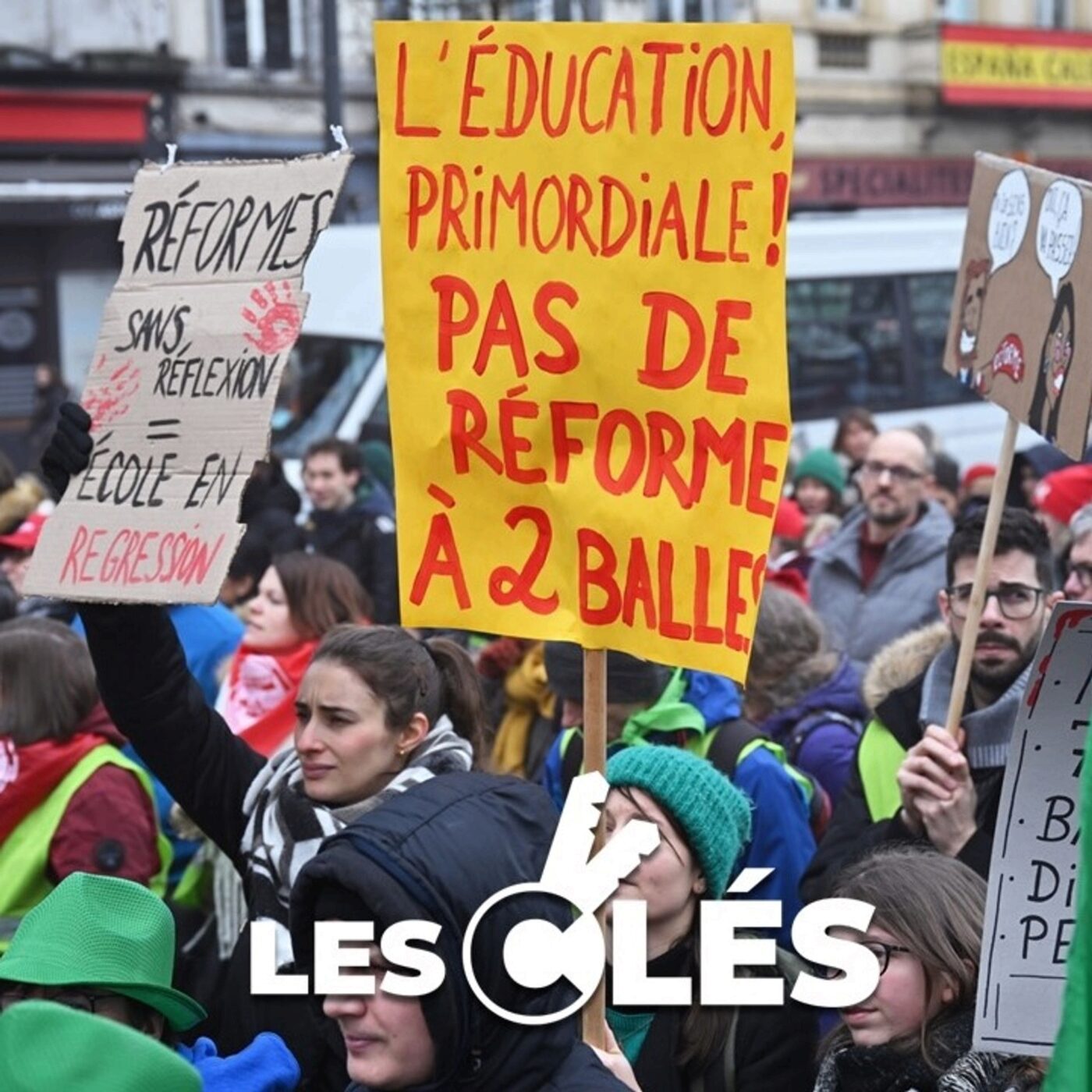
Les Clés
Enseignants : les raisons du malaise
00:27:40
Ces derniers mois, le monde enseignant a exprimé son mécontentement et plus largement son malaise à plusieurs reprises. Les réformes et annonces qui se succèdent plongent en effet la plupart des profs dans l’incertitude. Analyse des problèmes avec Marc Sirlereau, j...
Loading summary
Transcript54 lines
- [00:01]
Sarah Poussey
Être nommé, c'est un peu le Graal pour les enseignants. Mais se dirige-t-on vers la fin de ce système?
- [00:06]
Marie Goranson
La première, fin du statut suppression d'options d'économie à tous les étages.
- [00:10]
Marc Sirlero
J'ai besoin de repères.
- [00:11]
Valérie Glatini
Un salaire de prof sur cinq est payé par de l'emprunt.
- [00:14]
Sarah Poussey
Les clés, l'enseignement et le parent pauvre, comme le soin de santé, comme la culture.
- [00:20]
Marie Goranson
Arnaud Reussen.
- [00:21]
Narrator/Host
Bonjour à toutes et bienvenue dans les clés pour un épisode où l'on va essayer de comprendre le malaise du monde enseignant chez nous en Belgique francophone. Un malaise qui s'est exprimé à de multiples reprises ces derniers mois suite à l'annonce de mesures comme l'augmentation du nombre de périodes à prester devant la classe pour les profs du secondaire supérieur. Un malaise renforcé sans doute aussi par l'empilement de réformes disparates et pas toujours concertées. La remise en cause aussi de certains points du pacte d'excellence. Bref, on va prendre 27 minutes dans les clés pour tenter d'y voir clair sur tout cela.
- [00:54]
Marie Goranson
La première, les clés.
- [01:06]
Narrator/Host
C'est le blues. Au fil des conversations avec les enseignants ces dernières semaines, ces derniers mois, que ce soit dans le fondamental, dans le secondaire, dans le général, dans le qualifiant, beaucoup de profs d'instit en ce moment broient du noir.
- [01:24]
Teacher
Ça me rend triste et en colère qu'on s'attaque tant à ce beau métier qui n'est pas reconnu à sa juste valeur. Il me semble que l'enseignant a une place importante dans la société. C'est un de ces métiers qui fait avancer la société. C'est ce qui prépare les générations futures. Et là, on ne reconnaît plus ça aujourd'hui. On a l'impression d'être une variable d'ajustement.
- [01:48]
Narrator/Host
Au cœur du malaise, des tendances structurelles. Cela fait longtemps que les enseignants ont l'impression que leur travail n'est pas reconnu à sa juste valeur. Ces dernières années, beaucoup ont d'ailleurs décidé de quitter l'école, parfois après seulement quelques années, voire quelques mois d'enseignement, estimant le métier trop pénible. Des enseignants qui ont souvent aussi l'impression de subir des réformes successives sans être toujours suffisamment compris ou écouté. Mais à cette trame de fond, sont venus s'ajouter de nouvelles réformes ou projets de réformes ces derniers mois, dont une est particulièrement mal vécue. L'idée d'augmenter, pour les enseignants du secondaire supérieur, le temps passé devant une classe. Passer de 20 à 22 périodes de 50 minutes par semaine. Une mesure justifiée en ces termes par la ministre MR de l'enseignement obligatoire, Valérie Glatini.
- [02:54]
Valérie Glatini
Ce qu'on va mettre en place, c'est une égalité avec les profs du secondaire inférieur, sachant que nos profs du secondaire supérieur gagnent 25% de plus aussi, et qu'au niveau de l'OCDE, nos profs du secondaire supérieur travaillent 30% de moins en face classe. Est-ce que ça veut dire que cette mesure nous fait plaisir? Non, mais en effet, on sait qu'on a une situation budgétaire extrêmement compliquée, surtout une pénurie d'enseignants, Et donc cette mesure ne touche pas à une autre mesure qui est centrale pour nous, c'est augmenter l'accompagnement de nos élèves. Ça, c'est vraiment une priorité.
- [03:29]
Narrator/Host
Mais les profs, eux, ne l'entendent pas de cette oreille. Et ils l'ont dit lors de plusieurs manifestations fin de l'année dernière. Avant, on pouvait se permettre d'organiser une.
- [03:41]
Marc Sirlero
Sortie, ce qui prend énormément de temps. Si on a une charge supplémentaire, on.
- [03:45]
Teacher
Va se retrouver à ne plus pouvoir.
- [03:47]
Marc Sirlero
Faire ces accotés qui permettaient d'avoir un enseignement plus agréable.
- [03:50]
Marie Goranson
Je ne travaille jamais à temps plein, parce que je trouve qu'un temps plein de prof, c'est insurmontable. Donc, rajouter deux heures au travail qu'on a déjà, c'est vraiment une folie.
- [04:00]
Narrator/Host
Avec l'idée aussi que cette augmentation du nombre de périodes va signifier pour beaucoup de jeunes enseignants de perdre leurs heures dans les écoles où ils sont les derniers arrivés.
- [04:13]
Teacher
Chez nous, on estime à plus ou moins 15 enseignants qui risquent effectivement de ne plus avoir leur place dans notre école. Une majorité de ceux avec qui j'ai pu discuter m'ont carrément dit qu'ils allaient changer de métier. Donc quand on entend dire que, oui, ces enseignants-là vont retrouver des heures ailleurs parce qu'il y a une pénurie, il faut d'abord savoir quelles heures vont être retrouvées dans quel établissement, proche ou loin. Et donc, dans ces circonstances-là, effectivement, bon nombre d'entre eux, à mon avis, changeront tout simplement de métier. Donc voilà, les conditions ne vont pas du tout s'améliorer.
- [04:49]
Narrator/Host
Mais ce n'est pas tout. Car ce qui suscite beaucoup de colère et de découragement chez les profs rencontrés, c'est l'empilement de diverses réformes et le flou. Il y a eu la fin des septièmes secondaires dans l'enseignement qualifiant. Il y a la volonté de mettre fin aux nominations, mais une volonté dont la mise en œuvre concrète pourrait être remise en cause ou postposée vu le coût pour les finances publiques d'une telle mesure. En attendant, la ministre veut avancer sur des CDI pour les enseignants qui débutent. Il y a le projet de relever les seuils de réussite 60% au lieu de 50% pour les épreuves certificatives. La modification du tronc commun, avec l'idée d'ajouter finalement des options orientantes en troisième secondaire, pour un tronc plus si commun que cela dès lors, ce qui vit d'une partie de la substance d'un maillon central du pacte d'excellence. Le tout dans un contexte d'économie budgétaire pour une fédération à l'Uni Bruxelles désargentée et face à cela des profs qui demandent que leur colère et que leur expérience de terrain soit entendue.
- [05:58]
Marie Goranson
On a envie que ça change et surtout qu'on nous écoute parce que les concertations avec les professeurs il y en a eu auparavant et là le gouvernement.
- [06:03]
Sarah Poussey
Actuel a décidé que ça cessait en fait.
- [06:05]
Marie Goranson
Il prenait des décisions sans nous concerter.
- [06:08]
Narrator/Host
Alors, le gouvernement de la Fédération Wallonie-Bruxelles est-il en train de perdre les enseignants au fil de ces réformes? C'est ce que nous allons maintenant explorer. Et avec nous pour cela, il y a notamment Marc Cirleau.
- [06:24]
Marc Sirlero
Bonjour. Bonjour.
- [06:25]
Narrator/Host
Vous êtes journaliste ici à la RTBF et vous suivez en particulier les questions d'enseignement pour nous à la rédaction. Ça fait longtemps d'ailleurs que vous allez régulièrement rencontrer les acteurs de l'enseignement et les enseignants en particulier. Est-ce que vous avez déjà ressenti un malaise aussi important que celui qu'on a l'impression d'entendre aujourd'hui?
- [06:45]
Marc Sirlero
Je vais être franc avec vous, depuis que je couvre la politique et que je couvre notamment la Fédération Wallonie-Bruxelles ou Communauté Française, depuis plus de 30 ans quasiment, j'ai toujours ressenti un malaise et des difficultés. Prenons ce qui s'est passé entre 1995 et 1999. La Communauté Française était déjà en difficulté budgétaire. Qu'est-ce qui est arrivé? Le gouvernement de la Fédération Wallonie-Bruxelles de l'époque a supprimé 3000 postes d'enseignants dans le secondaire. Et à ce moment-là, il y a eu, rappelez-vous, des grèves, des manifs, mais c'était l'aboutissement d'un processus depuis la communautarisation de l'enseignement en 1988, il y a eu des crises en 90, il y a cette crise-là pour la communauté française, donc avec Loretta O'Cullings qui était à l'époque ministre-présidente, et puis après il y avait un peu de refinancement, Mais à chaque fois, il y a des hauts, beaucoup de bas, un peu de haut, beaucoup de bas, et donc depuis 30-40 ans, j'ai l'impression que quand vous rencontrez un enseignant, il se pose beaucoup, beaucoup, beaucoup de questions. Ici, à nouveau, c'est remonté, il y a une certaine morosité dans l'enseignement, parce qu'il y a beaucoup de flou sur bon nombre de mesures, vous l'avez évoqué dans les sons qu'on a entendus, des jeunes enseignants qui espéraient être nommés, alors qui Chaque année se demande où ils vont aller, ils se disent c'est bien beau si on nous met un jour un CDIE, mais nous on espère être nommés. Ils ne sont pas sûrs qu'ils le seront ou pas, on ne sait toujours pas, ça crée une incertitude. La fin des septièmes dans l'enseignement qualifiant, ça a perturbé des étudiants qui se demandaient où ils allaient pouvoir faire une septième année et rester dans leur école, ou se retrouver dans l'enseignement pour adultes. Donc des inquiétudes pour les étudiants, des inquiétudes pour les enseignants qui ont perdu des heures. Et puis il y a tout ça qui se met en place, et puis il y a ces deux heures en plus décidées, donc en octobre dernier lors du conclave budgétaire pour le budget 2026 du gouvernement de la Fédération Mélanie-Bruxelles, et là ça remit un peu le feu aux poudres avec des enseignants qui ont eu l'impression qu'on les considérait comme des finéens, en disant vous pouvez faire deux heures en plus sans aucun problème, comme si finalement donner cours deux heures en plus et tout simplement se retrouver devant une classe et ne rien devoir préparer. Le sentiment qu'ils ont eu c'est qu'on ne considérait pas leur travail et qu'on ne tenait pas compte de tout ce qui se faisait en amont et en aval. Alors vous mélangez tout ça des incertitudes avec le pacte d'excellence qui était quand même, il faut bien le dire, et je pense qu'on y reviendra avec madame Goranson, mais c'était plus que nécessaire parce que les constats de l'enseignement il y a dix ans C'était aussi la première préoccupation, ce sont quand même les élèves et les étudiants, avec des résultats, le taux de redoublement notamment, qui n'allait pas du tout. Alors si vous mélangez tout ça, c'est un cocktail un peu explosif.
- [09:21]
Narrator/Host
Et justement, avec nous, vous l'avez dit, Marc Sirlero, il y a une deuxième invitée, c'est Marie Goranson. Bonjour.
- [09:26]
Marie Goranson
Bonjour.
- [09:27]
Narrator/Host
Merci d'être là. Vous êtes professeure à l'ULB spécialisée dans les questions de gestion publique et vous avez accompagné de près, d'ailleurs, la mise en œuvre de ce pacte d'excellence. Un mot d'abord sur ce qui vient d'être dit ici par Marc Sirlero, sur cette impression de malaise un peu en continu avec des hauts et puis des bas, voire des très bas du côté du monde enseignant. et cette impression parfois de ne pas être suffisamment entendu, de ne pas être suffisamment toujours pris en compte dans la réalité de l'exercice du métier d'enseignant sur le terrain au fil des réformes qui s'accumulent et qui se précipitent un peu ici dans un contexte d'économie budgétaire. Vous avez aussi ce même ressenti au contact régulier justement des acteurs de l'enseignement?
- [10:10]
Marie Goranson
Oui, absolument. Je partage les constats qui ont été posés, notamment sur une notion importante qui est vécue, c'est l'incertitude. Pour moi, c'est vraiment ce mot qui décrit le mieux le contexte scolaire aujourd'hui pour les profs, mais aussi pour les directions scolaires, pour les réseaux, pour les organisations syndicales. C'est vraiment ce contexte d'incertitude qui est très présent.
- [10:34]
Narrator/Host
Alors incertitude et puis cette impression parfois que leur travail n'est pas reconnu à sa juste valeur. Un mot quand même sur justement cet enjeu des doseurs en plus. On va quand même préciser, parce qu'on vous avait reçu justement dans les clés à ce sujet, que vous faisiez partie de ce panel d'experts qui avait fait une série de suggestions au gouvernement de la Fédération Wallonie-Bruxelles, de suggestions d'économies possibles. Et parmi ces pistes d'économie, il y avait cette idée de faire travailler deux périodes. En plus, devant la classe, les profs du secondaire supérieur. Vous comprenez que ce soit mal ressenti par les profs à qui on a imposé ça tout d'un coup et qui se disent « on nous a pris pour des fenéans, on a cru qu'on ne faisait rien pendant ces deux heures-là.
- [11:11]
Marie Goranson
». Absolument. Et au sein du groupe d'experts, ce point, cette réception très douloureuse de cette proposition, elle avait été évoquée, bien entendu. D'ailleurs, dans les propositions, et je dis bien, ce sont des propositions qui avaient été faites et vraiment, nous l'avions formulée comme telle, des pistes. Est-ce que ça peut être creusé? Est-ce que ça peut être discuté? Mais je voudrais surtout dire que c'était la dernière des possibilités. Nous avions mis en évidence d'abord deux choses très importantes qui sont porteuses d'économie et qui s'inscrivaient dans un chemin tracé, discuté, concerté. C'était l'allongement du tronc commun jusqu'en troisième secondaire avec aucune activité orientante. et deuxièmement, la fin du redoublement. Et ces deux éléments-là, c'était vraiment au cœur de nos propositions en disant, si vous voulez faire des économies budgétaires, il faut continuer à s'inscrire dans les démarches relatives au pacte d'excellence et c'est cela qui va vous permettre réellement de faire des économies. Après, effectivement, on nous a un peu demandé aussi de faire la liste des choses qui pouvaient éventuellement être des ressorts, mais il n'y avait pas cette idée de dire, c'est ça qu'il faut faire, imposez-le et maintenant ça va marcher. Et donc effectivement, quand je dis qu'il y a une incertitude, je pense que celle-ci, elle est due aussi à des vraies ruptures qui existent aujourd'hui dans l'absence de concertation qu'il y a des mesures. Et les deux heures ajoutées, c'est un très bon exemple, mais vous avez aussi cité la fin de la 7e qualifiante, les activités orientantes. En fait, toutes ces mesures, elles viennent sur la table et elles vont être décidées par les acteurs politiques. Et puis ensuite, on va voir avec les acteurs de terrain dans quelles mesures on peut les mettre en œuvre. Mais c'est une rupture fondamentale avec la façon de fonctionner qui était celle qui prenait place depuis 6-7 ans où en réalité, comme il y avait une feuille de route qui était dessinée par le pacte et qui était très importante avec des changements très importants et parfois douloureux, personne ne le conteste, mais l'idée était que tous les changements n'allaient pas être décidés politiquement et puis discuter pour la mise en œuvre à la marge, mais allait être co-construit avec les acteurs. On allait rentrer dans une démarche où, en fait, il faut se rendre compte que depuis 2017, une fois par semaine, minimum deux fois par mois, la ministre, l'administration, les membres de cabinet, les organisations syndicales, les réseaux, les associations de parents se voyaient dans ce qu'on appelait le comité de concertation qui est devenu le comité du pacte et qui écrivait ensemble les mesures. Et ça, ça n'existe plus aujourd'hui. Et donc aujourd'hui, les acteurs de terrain, ils reçoivent des réformes dont ils n'ont pas contribué à la création, au développement. Et je pense que ça, c'est un des points fondamentaux qui expliquent le.
- [13:47]
Narrator/Host
Malaise enseignant. Donc là, il y a eu une vraie rupture qui existait avant dans... la co-construction, parce qu'on pourrait presque le dire comme ça, à partir du moment où on essaye de construire avec les acteurs les mesures et pas de leur imposer des mesures en les négociant à la marge, ça, ça a fondamentalement changé ici depuis cette nouvelle législature. Donc les enseignants n'ont pas tort quand ils disent qu'ils ne sont plus autant écoutés, concertés sur.
- [14:09]
Marie Goranson
Les mesures. Oui, absolument. En fait, on est revenu à des modalités de mise en œuvre des réformes beaucoup plus classiques, où il y a d'abord le jeu politique, les intercabinets, les accords au niveau du gouvernement. Et puis seulement, avant le passage en Parlement, c'est un peu technique, mais en deuxième lecture, alors à ce moment-là, on fait revenir les acteurs de terrain. Mais depuis 2017 jusqu'en 2024, en fait, les acteurs de terrain étaient consultés avant même le passage en gouvernement. Et donc c'était aussi très intéressant de voir que quand la ministre arrivait ensuite en gouvernement, elle avait déjà travaillé avec les acteurs de terrain qui, eux, ne se voyaient pas imposer des nouvelles mesures, comme ça a été le cas pour les deux heures, pour la septième, sans même parler du.
- [14:51]
Narrator/Host
Contenu ici. Donc ça, c'était quelque part une forme de culture, de réforme qui avait été associée au pacte d'excellence, qui est, on le sait, un chantier énorme pour l'école. Marc Cyrillerault, on en parlait. Ce n'est pas étonnant qu'on ait des crispations de base avec la mise en place d'un chantier comme le pacte d'excellence. Vu l'ampleur des réformes qui sont proposées pour l'école, on savait de toute façon qu'on allait avoir des années compliquées à gérer. Ce qu'il y a ici, c'est qu'on est en train de rajouter des éléments en plus qui n'étaient pas prévus, de détricoter en partie aussi certains éléments du pacte d'excellence. C'est ça qui vient rajouter de la colère sur un sentiment qui était déjà un peu compliqué et c'était normal à.
- [15:32]
Marc Sirlero
La base. Marie Göransson a bien expliqué comment on a mis sur pied le pacte d'excellence, des constats qui étaient quand même très clairs sur l'école.
- [15:42]
Narrator/Host
Inégalitaires, inefficaces. Beaucoup de moyens investis pour pas toujours beaucoup.
- [15:46]
Marc Sirlero
De résultats. À ce moment-là, il fallait changer les choses. il y a eu une application de tous les acteurs. C'est très rare, souvent c'est le politique qui décide, il consulte un peu. Ici, ce sont tous les acteurs de l'enseignement, les parents, les syndicats, les pouvoirs organisateurs. Et puis la politique est venue, ça a appliqué, mais ça veut dire que c'est un projet qui émanait de tous les acteurs de l'enseignement, c'est suffisamment rare que pour le souligner. Mais peut-être que les enseignants de base se sont peut-être pas retrouvés suffisamment dans ce qui était décidé, et on leur a rajouté des missions en plus, qu'ils ne comprenaient pas toujours. On a dit il faut des plans de pilotage dans les écoles, donc des projets d'école. Alors un tas d'enseignants se sont impliqués sans très bien savoir où ils allaient. Mais c'était du boulot en plus, sur le plan administratif, des réunions en plus. Et tout ça fait que des enseignants, parfois, n'ont pas très bien compris le pacte d'excellence, même s'ils étaient d'accord sur l'objectif. Ils disent « ouais mais on nous demande des choses en plus, on va vers où on a changé les référentiels, c'était pas un luxe, on a changé les référentiels, ça veut dire que pour un enseignant,? ça implique aussi peut-être de devoir revoir ses cours, sa manière d'enseigner. Donc vous voyez, c'est une réflexion à tout ». niveau, ce qui peut expliquer peut-être aussi les difficultés du monde enseignant aujourd'hui. Beaucoup de réformes, le pacte d'excellence, bien vu par la plupart des enseignants, mais attention, peut-être qu'il ne s'est.
- [16:56]
Narrator/Host
Pas trouvé directement appliqué. Réaction là-dessus, Marie-Goranson, puisque vous avez bien suivi l'application. Si beaucoup d'enseignants sont d'accord sur l'objectif de problèmes, notamment sur l'inégalité dans notre enseignement, ils n'ont pas toujours compris, ils ne comprennent pas toujours comment tout ça est mis en œuvre et ils le vivent parfois difficilement dans leur quotidien de devoir.
- [17:14]
Marie Goranson
Rajouter tout cela aujourd'hui. Mais donc d'abord c'est évident qu'une réforme de cette ampleur, ça bouscule, ça fait changer l'ensemble des certitudes, des comportements et ça demande un surcroît d'effort. Donc évidemment que c'est un contexte d'effort qu'on a demandé à l'ensemble du monde enseignant, qui l'a pris avec courage. Et les responsables, les directions d'établissement, les responsables de réseau, ils ont fait un travail incroyable et ils ont porté cette réforme aussi parce qu'ils ont compris l'importance et l'urgence du changement. Mais effectivement, ensuite vous avez un monde qui est très hétérogène au sein des écoles, 100 000 enseignants, donc évidemment que chaque enseignant n'a pas vécu tous ces changements en s'y flottant et en se disant c'est génial, je revois, je dois revoir les choses, je dois peut-être davantage m'investir dans des dynamiques collectives et peut-être que c'est là qu'on trouvera des réponses par rapport aux changements et aux problèmes qui sont vraiment très importants chez nous. Donc évidemment que c'est difficile à vivre. Mais si vous rajoutez à cela la couche d'incertitude, alors là vous obtenez un chaos. Pour moi, vous avez mis en évidence l'importance, l'ampleur de la réforme. Et pourquoi c'est une réforme de telle ampleur? Parce qu'on a pris conscience que pour apporter des réponses aux problèmes qui étaient les nôtres d'inéquité, d'inefficacité, de difficultés de parcours, eh bien il fallait une réforme systémique. Ça veut dire quoi? Ça veut dire qu'on ne peut pas juste changer, par exemple, les référentiels. On ne peut pas juste changer la formation des enseignants. On ne peut pas juste changer le métier de directeur. En fait, c'est un ensemble très important de changements qui sont interdépendants, interconnectés, si vous voulez. Et la grande force du pacte, c'est d'avoir dit OK, on va tout changer avec un phasage, avec un temps long. Maintenant, ce qui se passe, c'est que quand vous ajoutez des changements qui touchent à un point, en fait, vous fragilisez l'ensemble de l'interdépendance. Et les enseignants, les directions d'école, les PO, ils voient bien cela. On prend l'exemple de l'augmentation probable des seuils de réussite. Donc, vous l'avez dit, on va augmenter les seuils de réussite CEB, CE1D, CESS. Et pour réussir, maintenant, il ne faudra plus avoir 50%, mais il faudra avoir 60%. Cette réforme, comme ça, bon, déjà, elle ne provient pas, si vous voulez, d'une évaluation. C'est quand même important de le dire. Il n'y a pas eu d'évaluation pour dire ça va faire la différence. soit. Mais en tout cas, tous les profs et tous les directeurs d'école, ils se rendent bien compte que ça va avoir plein d'impact. Ces profs, ces enseignants, ces directions, ils ont des objectifs en termes de redoublement. On leur a demandé la baisse du redoublement. C'est un objectif clé pour l'amélioration de notre système. Mais si vous.
- [19:45]
Narrator/Host
Augmentez les seuils de réussite, ça peut être contradictoire, évidemment. Donc ça c'est un des éléments qui pourrait venir fragiliser l'équilibre d'ensemble du pacte d'excellence. Il y a aussi un autre gros chantier initié par la ministre Valérie Glattini sur le tronc commun et le fait de revoir en bonne partie cet enjeu du tronc commun autour de la troisième secondaire. Alors on va peut-être essayer d'y voir clair dans ce qui est annoncé par ce gouvernement-ci en termes de réforme du tronc commun et ça.
- [20:10]
Sarah Poussey
C'Est avec Sarah Poussey. Le tronc commun sera déployé dans l'enseignement secondaire dès la rentrée 2026, avec déjà quelques changements par rapport au projet initial. Pour la première année secondaire, la ministre Glatini a décidé d'ajouter une heure supplémentaire de mathématiques, une heure en plus aussi d'éducation culturelle et artistique, Et puis elle a précisé le contenu des trois heures de formation manuelle, technique et technologique. En fait la formation sera surtout numérique puisque deux heures sur trois devront être consacrées aux compétences de base en la matière et notamment à l'utilisation de l'IA. Et pour caser tout cela on fait sauter le latin qui ne sera donc obligatoire qu'en deuxième secondaire et non plus en première. Changement aussi pour les élèves qui n'obtiennent pas leur CEB. On supprime les années différenciées. Avec ou sans CEB, tous les élèves seront dans les mêmes classes de première année, mais ceux qui n'ont pas réussi le certificat de fin primaire bénéficieront d'un accompagnement renforcé. Le cheval de bataille de la ministre Glatini, c'est surtout aussi d'augmenter les activités orientantes et les contacts avec le monde du travail. Dès la première secondaire, les élèves auront donc deux journées de découverte de métiers, par exemple la visite d'une entreprise ou d'un restaurant. En deuxième, on passe à huit demi-jours avec aussi des stages très courts et des rencontres avec des professionnels. Et puis en troisième année, ce sera un stage de trois jours accompagné d'un projet d'orientation à présenter devant un jury en fin d'année. La grosse différence voulue par la ministre de l'Éducation, c'est aussi de réintroduire des options en 3e secondaire à la place d'un programme commun. Les élèves de 3e suivront donc 8 heures par semaine de deux cours différents, au choix, parmi des modules théoriques de science ou de langue, ou des cours plus pratiques, par exemple d'électricité ou de menuiserie. Ces cours, tout comme le projet d'orientation à défendre oralement, auront autant de poids dans la réussite de l'année que l'examen commun à tous les élèves de 3e. La ministre prévoit aussi un renforcement de l'accompagnement personnalisé avec un budget de 7,5 millions d'euros prévus par exemple pour organiser.
- [22:33]
Narrator/Host
Des heures de co-enseignement. Voilà, officiellement, on ne remet pas en cause complètement l'allongement du tronc commun, on le modifie avec ses options orientantes. Est-ce qu'à votre avis, Marie-Gorenzon, on change quand même la philosophie sur un point important du pacte, cet.
- [22:50]
Marie Goranson
Allongement du tronc commun? Oui, pour moi d'abord au départ le pacte dit ce qu'il faut c'est retarder un maximum le tri qui peut s'opérer entre les élèves et il faut qu'ils aient un maximum de formation commune pour plus d'équité parce que en réalité tous les systèmes internationaux le montrent en fait plus vous triez tôt les élèves et plus en fait c'est dû à des différences socio-économiques et cela traduit un manque d'équité. Et donc ici l'idée c'était vraiment de se dire, et à la base du pacte il y avait un ajout du numérique, il y avait des questions sur le parcours culturel et artistique bien entendu, parce que l'idée c'était aussi de se dire il faut pouvoir faire découvrir plein d'options différentes pour tout le monde, mais pour tout le monde. Si vous retriez les élèves à partir de la troisième secondaire et que vous faites des différences où les élèves sont séparés, alors vraiment vous faites une rupture par rapport à.
- [23:42]
Narrator/Host
La philosophie du pacte. Et ça pose aussi des questions pour les écoles parce que là tout le monde s'était mis un petit peu dans cette logique de la trajectoire du pacte où c'était phasé, on savait ce vers quoi on allait, on allait avoir l'allongement vraiment du tronc commun jusqu'en troisième qui était couplé aussi avec des réformes dans l'enseignement qualifiant. Ceci vient un petit peu perturber tous les équilibres qui avaient été.
- [24:03]
Marc Sirlero
Pensés dans cette trajectoire. Oui, c'est une certitude et je vais vous prendre un cas bien précis, j'ai rencontré des directeurs d'école où ne me donnent que de l'enseignement général, ça veut dire qu'ils n'ont pas d'atelier pour faire de la pratique professionnelle ou de la pratique technique, et ils me disent, parce que ici le changement voulu et proposé par Valéry Glatini, dit que des étudiants pourraient choisir deux fois quatre périodes de cours techniques, qualifiants. Eh bien dit, dans notre école, on ne.
- [24:28]
Narrator/Host
Sait pas le faire. Il faut des ateliers.
- [24:30]
Marc Sirlero
Il faut des infrastructures. Il faut des ateliers, donc il faut soit qu'on les conduise dans une école qui se trouve à 20 minutes, ou on trouve des collaborations avec d'autres écoles. Donc vous voyez, d'un point de vue pratique, on dit déjà que les directeurs sont un peu dépassés par tout ce qui arrive, mais ça c'est.
- [24:41]
Narrator/Host
Un problème en plus. Oui, et ça renvoie à cette idée d'incertitude dont parlait Marie Goranson. Un commentaire politique quand même, Marc Sirleau, vous suivez aussi ça d'un point de vue politique. On peut rappeler quand même que cette majorité, elle est composée d'UMR et des engagés. Les engagés qui, à l'origine, avec d'abord Joël Millier et Marie-Martine Shins, avaient été quand même à la base de la construction de ce pacte d'excellence et des modalités de sa gouvernance, de sa concertation. Quelque part, eux-mêmes sont en train de revenir sur quelque chose.
- [25:11]
Marc Sirlero
Qui était leur bébé. Oui, c'est vrai, mais vous savez que la première force politique en Fédération Wallonie-Bruxelles, c'est l'EMR. L'EMR n'a jamais été directement impliqué de la même manière dans la mise en place du pacte d'excellence. Oui, sous la précédente législature, où il y avait notamment Pierre-Yves Jollet qui était ministre-président, mais à l'initiative, au départ, ce n'était pas une initiative du EMR et c'est vrai qu'ils ont toujours mis quelques réserves pour ne pas dire des critiques. Et donc ici, très clairement, ils veulent changer la manière dont le pacte se fait, et les engagés doivent l'accepter. Même si, du côté des engagés, beaucoup de mesures qui sont décidées par Valéry Glatini, qui sont annoncées par Valéry Glatini, viennent des engagés. On peut penser à la fin des nominations, ça se retrouvait plus ou moins clairement dans le programme des engagés. Vous voyez, tous ces aspects-là se retrouvaient déjà dans le programme des engagés, sur le tronc commun et le pacte d'excellence, c'est vrai qu'ils donnent l'impression de reculer par rapport à ce qu'ils ont mis, eux, au départ en.
- [26:08]
Narrator/Host
Place avec les socialistes. Un.
- [26:10]
Marie Goranson
Petit mot encore, Marie-Gorenzel? Oui, je pense quand même qu'il y a deux visions qui s'affrontent et qui, aussi, retardent les décisions. Donc, le fait qu'il y a des textes qui ne sont pas encore votés alors qu'ils vont concerner la rentrée prochaine, eh bien, ça traduit aussi, finalement, une confrontation de visions au sein des.
- [26:26]
Narrator/Host
Deux partenaires du gouvernement. Voilà donc, pour cette analyse, forcément incomplète vu tous les tenants et aboutissants de ce très large dossier qu'est l'enseignement. Notre objectif, c'était surtout d'essayer de comprendre les raisons d'un malaise, tout en analysant les conséquences dans une école en plein chantier pour la mise en œuvre du pacte d'excellence, un pacte qui est lui-même en train d'être en partie modifié en cours de route. Merci à Marc Serloro et Marie Gohansson pour leurs analyses croisées. Merci à Antoine Duhartz pour la réalisation sonore de cet épisode. À la préparation, Sarah Pousset et Arnaud Reussen. Et si la question du tri des élèves qui a présidé à l'idée de l'allongement du tronc commun vous intéresse, on va vous republier le podcast d'un épisode que nous avions consacré précisément à cette question, en compagnie d'ailleurs de deux classes, de 5e et de réto, Je vous rappelle aussi que si vous souhaitez nous écrire, vous pouvez toujours le.