Loading summary
Transcript35 lines
- [00:00]
A
If the United States, or the world for that matter, has any hope, it can't be by whoever we elect. As if, if we elect this person, we have hope, or if we elect this part, we have hope. Because change has to come from bottom up. And this takes time. This takes a lot of awareness raising. This takes a lot of courage and self reflection and repentance for and the realization and confession of all the mess that your tax money has caused all over the world.
- [00:38]
B
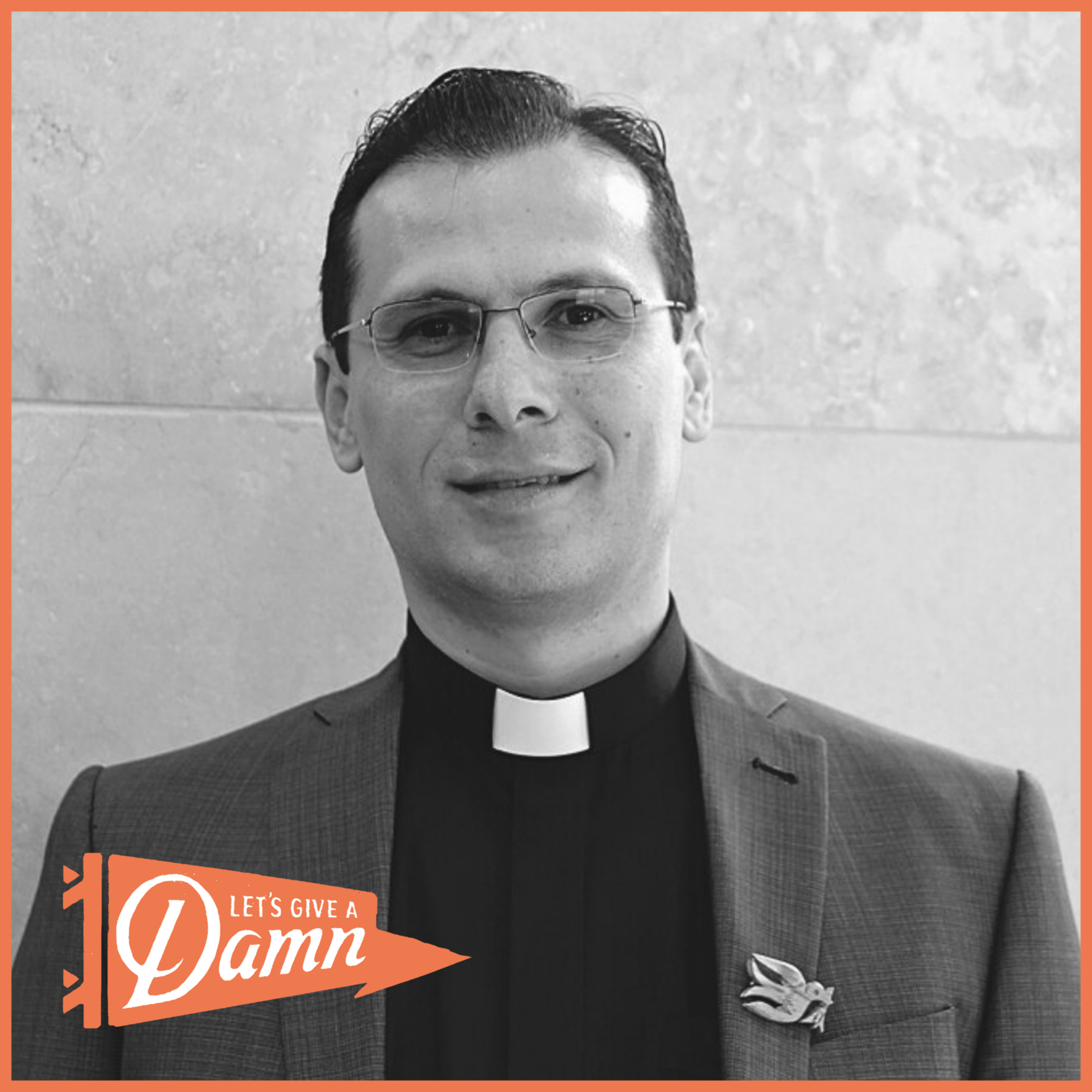
Hello friends and damn givers. Welcome to the let's Give a Damn podcast. A show where I get to have conversations with incredible people who aim to lead the planet much better than they found it. And then I share those conversations and these brilliant guests with each one of you. I'm your host, Nick lapara, and I'm so delighted you're here. Now, friends, I get asked often why I talk so much about the genocide happening in Gaza. Nick, don't you know there are other things going on in the world, Other horrible, horrific, terrible things. Now, I could talk for hours about why I speak up so loudly and often for occupied Palestine, but I'll keep it short as I introduce this new episode. I talk about Gaza so much because I believe, I genuinely believe that the Palestinian struggle is all of our struggle. How we respond to this genocide is how we are going to respond to everything else in life. It's that important. Now, 402 days ago, the genocide in Gaza began. Gaza is in shambles. Palestinians are being ethnically cleansed before our eyes. There is a full blown famine happening in parts of Gaza and tens of thousands of Palestinians have been slaughtered by Israel. That number rises each hour of each day. Outside of Gaza, terrorist settler violence is growing by the day. In the west bank just yesterday, an elderly man was killed while picking olives on his property by terrorist settlers and Israeli terrorist settlers. Every single day this is happening. There's also been a rise in attacks and violence by the IOF against Palestinians in the West Bank. And the world continues to stand by. Our politicians continue to stand with the terrorists and our tax dollars continue to pay for this genocide. What the hell are we supposed to do? I believe our guest today can help us. My guest is the incredible Munter. Izhak Munter is a Palestinian Christian pastor and theologian. He now pastors the Evangelical Lutheran Christmas Church in Bethlehem and the Lutheran Church in Beit Sahur. He's also the academic dean of Bethlehem Bible College and is the director of the highly acclaimed and influential Christ at the Checkpoint Conferences. And he's quite smart. He has a bachelor's in Civil Engineering from Birzait University in Palestine, a master's in Religion and Biblical Studies from Westminster Theological Seminary in Philly, and a PhD in biblical theology from Oxford center for Mission Studies in Oxford, England. For millions of people of faith and many others, Munter has been a guiding light and an enormous help over the years, but especially this past year. During our conversation, we discuss his childhood and family, why he chose pastoring over engineering, how they get through each and every horrific day in occupied Palestine, and what Americans should be doing right now to continue fighting for free Palestine, and so much more. Before we begin, a quick reminder, as always, that you can email me anytime and for any reason@ hello, let's give a damn.com to ask questions. Recommend future guests tell me how much you love or hate the show. Anything, really. I just love hearing from you. And now let's get right into my conversation with my friend and hero and incredible damn giver, Munter Ishak. Let's go. Pastor Munther, welcome to the let's Give a Damn podcast. I'm so glad you're here. Welcome.
- [04:23]
A
Thank you for having me, Nick. Of course.
- [04:26]
B
This has been a. A few months in the making. I've been following you work for a long time, especially, tragically, more this last year. But yeah, we were supposed to do this when you were here in New York speaking at the Riverside Church, which was just an incredible, an incredibly impactful evening and we ran out of time. You were obviously so busy running all over the city. But I'm so glad that here, months later, we are doing this. Another note that people won't know and may not care about is we were supposed to record this last week on election day, or rather, yeah, yeah, yeah, it was election day. And so which is obviously just a ridiculously incredible time here in the US as you know. And there's so many implications, and we'll get to that later in the conversation about the election here in the United States and what that means for your homeland and your people. And so we'll get to that in a minute. But yeah, there's just so much going on. I'm so glad that you've carved out at the beginning of my workday, at the end of your workday, some time for us to chat, I guess my first question is, before we get into all the big stuff, how are you doing? Doing today? Like, I can't. I have so many Palestinian friends, some that have, some that have been evacuated, many who are still there. I'm currently raising money for several different Palestinian families and groups. And so, and we talk every day on Instagram and we're back and forth. How are you doing right now in this moment, on this day, November 11th? And again, we'll also talk about the fact that we're talking on Veterans Day and, and this military industrial complex, United States, and how we have days honoring the endless wars that we've perpetuated. We have this day that honors the soldiers that have done so much of this killing and raping and pillaging and stealing over the years, decades and centuries. Yeah. How are you doing today?
- [06:33]
A
Yeah. So given the circumstances, we're okay. And given the fact that just few kilometers from what I. From what I'm speaking in Gaza, there is a genocidal war happening right now here in Bethlehem, we can't complain, although it's really bad here, even here in Bethlehem, it's not safe. It's getting worse and more unlivable, if I may say. And then the psychological impact on all of that, living in a state of anxiety, living in a state of anticipation and looking, you know, as I said, from where we are to Gaza, a few kilometers from here, and thinking, will this ever be our fate? Or more importantly, when will this stop? It's hard to continue to watch the images on the screen. It's hard to continue to try to complain and argue to the world and advocate for a ceasefire. So, given that I'm here in Bethlehem and given the circumstances, we're okay. We have roof on the top of our heads and food to eat. We're okay. Thank God.
- [07:53]
B
Thank God, indeed. Well, I'm glad you're okay. And, yeah, we'll get into all the implications of the statement you just made here in a few minutes. I've heard you, obviously, and many people listening have heard you talk extensively about what is happening in Kaza and the, the genesis, all the stuff that you've been talking about this past year. But what I haven't heard you talk about, Pastor, is a lot of. About your upbringing. And I always love to start my conversations with my guests trying to figure out how you got here, you know, today, how you got to this place. And a lot of that starts with upbringing and childhood and influences and the things that happened or didn't happen to us. And so if you don't mind, let's spend a few minutes on. Let's go back as far as you're willing to go. Let's begin with this question. What was your. Tell me about your family and the environment in which you Grew up.
- [08:48]
A
So I was born into a Palestinian Christian family, Arab, here in the outskirts of Bethlehem, in a town called Beitzahur, also known as the Shepherd's field. Traditionally we believe that this is the place in which the shepherds were when the angels appeared to them and proclaimed the good news that Jesus was born. I mean, literally one, two minutes walking from where I live is one of the oldest churches in the world or all those monasteries here in the chapel's field. We only have the ground of it in caves here in Beit Sahur. And then of course, we're five minutes from Bethlehem. My family is traditionally Orthodox, Greek Orthodox. From an early age I began attending an evangelical church. So I grew up pretty much most of my childhood in teenage and then adulthood life in an evangelical tradition, firmly believing, you know, not just the Bible, but the importance of a personal relationship with God and always sharing your faith and so on. You know, the evangelical kind of upbringing. And at the same time I grew up as a child, I remember very well the first Palestinian uprising intifada, the second one as, as a university student. So my whole personality, if you wish, is shaped by all of these. Firstly, political events, the reality of military occupation defining everything in our lives. Checkpoints and walls and even an early stage demonstrations in the streets all define your life in a way. And then at the same time being having been raised in an evangelical tradition, wrestling with the Bible has also been always part of my, you know, the things that shaped my identity because I was always taught to take the Bible seriously. I loved the Bible from an early on age. I, I was one of those who would have a, you know, diary with which four chapters to read a day so that you finish the Bible cover to cover from January to December. I think I was, I can't remember whether 13 or 14 when I did this the first time. And I would do it every year. So I grew up memorizing, knowing the Bible. So with everything happening in our land, wrestling with the Bible has always been part of my upbringing. What does it say about violence, about the enemy? But more importantly, does it say that the land belongs to our occupiers? That's a question. Even as a 14, 15 years old. I thought of search early on in high school, I think I was 15, I wrote a research paper, I still have it. Who are God's chosen people? And I wasn't looking at it from a systematic theology point of view as much as I was trying to answer the question, do the other side still get our land because they're in fighter To. Did God give it to them?
- [11:53]
B
Wow.
- [11:54]
A
And of course, a lot has changed in my thinking since then, but just to see you how, you know, these things, faith, the Bible and then the political reality have always been kind of, you know, shaping, pushing me right and left and shaping my identity to who I am today.
- [12:15]
B
We have some parallels in our upbringing. I grew up in a very. Not evangelical, but. But a very fundamentalist, conservative Christian cult. But the similarity we share is that I grew up with a love for the Bible. I too, around that age, it was probably 12 or 13 that I started reading the Bible from COVID to cover every single year. In fact, one year I read it twice in one year. So every day, whatever the four chapters or five chapters it would say, I would read them twice in a row.
- [12:50]
A
So that in one year, did you highlight, in different colors, the whole thing? Of course I, I ended up.
- [12:55]
B
I, I was, I was that. Yeah. That nerdy kid that, you know, I look back and I was like, was I doing that? Was I reading the Bible because I was sort of compelled to or forced to by, you know, the people or the church? And I come back a lot to this realization that, like, no, I. I think I really, I really enjoyed reading it. I mean, yeah, I had, I had to go through. Yeah, I had to go through. I had to go through multiple books, Bibles in my growing up years because I just wore them out from reading it so much.
- [13:25]
A
And to be. To be honest, I'm very grateful for that upbringing, you know, to be. I don't look at it as a negative part of my life or as if, you know, I regret or. No, no, on the opposite. I think it was an important period, long period in my life. It made me who I am today. And the seeds of faith that were planted in me then still remain. So I'm indebted to that church, to the people who taught me the Bible, who encouraged me, and I definitely read the Bible because I loved it. No one compelled me to. Yes. So I'm grateful for that. Yes. People evolve. I evolved. I still call myself evangelical. I don't know what that means, how people interpret it, but definitely people evolved.
- [14:12]
B
So that was my next question. I'm glad you said that because here in the US for, For. For the wider American population, but also for those of us. I'm. I'm looking at myself now for those of us that were badly hurt in many ways by our Christian upbringing, the, the abuse of God that we were taught about. And, and now in the last eight years, we've seen that the word evangelical has been hijacked by white nationalists and by, you know, 92% of evangelicals in the U.S. voted for Donald Trump. Right. And so, so I guess the question I have is, you know, you, you talked earlier about growing up in the evangelical sort of space. And, and then just now you said, I still call myself that. And I don't, you know, quite know what that means or what people think about that. What would the difference, though? I imagine evangelical for you means something way different than what has become of the American evangelical church that claims to be about holiness, about doing, you know, sort of carrying out the things of God in the world, doing, doing good, being good, you know, but here it doesn't mean that anymore because they're voting for a man who is a rapist, who's a liar, who's a cheater, and they're. And they're actually using their faith as the reasons for doing it. Hey, you know, this is the man of God. This is the, this is the person that God appointed. Right. And so evangelical means something way different here. So what does it mean? What do you think the differences are between American evangelicalism and sort of the evangelical sort of environment that you grew up in and still live in and work in?
- [15:58]
A
Yeah. And let's remember that even in the American context, the world evangelical means different things to different people.
- [16:05]
B
True.
- [16:06]
A
Even within the evangelical tradition, there are some who are very, you would say, on the left, progressive, some on the extreme right, and many in the middle. You know, I have a fellowship, a partnership with the Evangelical Lutheran Church in America, which is a mainline Protestant by many standards, liberal church, yet still hold to evangelical ethos. They would argue, they would say that, so the world evangelical means different things to different people. I think one of the biggest differences that I realized from an early on between what we call evangelical here and the west is that to a certain degree, you know, everything is contextual.
- [16:52]
B
Sure.
- [16:52]
A
And we, you know, the context shapes a lot of the way you think. For example, you know, one of the biggest things that immediately began to me create some sort of a gap between us here and evangelicals in the west is definitely the issue of Christian Zionism. That's one of them. And then, in addition to Christian Zionism, as you continue, because when we began addressing the issue of Christian Zionism and engaging with evangelicals in the United States on it and getting into issues of interpretation in the Bible, we immediately realized that there is also a different understanding of the notion of mission, the kingdom of God. We look at it More holistically, justice is integral to the gospel message. To us, the idea that the kingdom of God extends beyond the personal, I and me and so on. And to me, for example, when I speak about what many would call political issues, I'm doing so as a pastor because you cannot separate, you know, we're shepherding our people. And when you shepherd your people, you have to engage with issues that directly impact their lives. And having moved to the Evangelical Lutheran tradition, which is, you know, in Palestine, the mainline denomination, I love the liturgy in our church. I love the structure of our church. I love that, you know, it's not a one man show where the pastor is everything. There is so much accountability, so many layers of accountability. Even in our worship, there is again, the liturgy gives us structure, depth, meaning, the importance of sacraments. But at the same time, we still hold very, what I call evangelical ethos. The good news of the gospel that God meets you where you are, not because of any merit in you. He offers his grace and salvation and then lets you to the world, sends you to the world to make it a better place. So this whole idea of, you know, grace, God's grace, meeting you where you are not by merit, I think to me this is still something that is unshakable not merely because I would, as if go to a text and argue with it and debate with it, but because it's my life story and it's the story I see whenever the gospel is preached in the lives of people. This is the essence of it. How do we make God close to people, get near to people, impact their life and really transform people's lives and hopefully by extension, societies as well. And to be honest, you know, when youth, when, when there was a moment in my thinking and especially, you know, impacted by the Bible Coalition and the Lutheran Church, when I was finally liberated from the molds of Western Christians on how they like to categorize everything, you know, you feel free because to be honest, to many in the Lutheran tradition worldwide, I am conservative. To many in the evangelical tradition worldwide, when they look at me, they think he's too liberal. And I say live with it to both sides, this is who we are. You know, we're not defined by the social battles of the West. You know, we don't have them. And at the same time, as I said, when we talk politics or so on, and these are issues that are very natural to us. So don't try to put us in the western categories of where you belong. And honestly, you know, the west loves to do this they love to, as if there is a checklist on whether you are with us or not with us. And I can tell you, you know, incredibly funny and silly stories just to articulate this. I remember as a, as a teenager when I was still part of the evangelical tradition, when a pastor from the west kept arguing with me, which Bible version do you use? King James or Niv? And it's like we use the Arabic version. No, no, no, no. You have to tell us which one we use. The Arabic version. I mean, come on. So you see, the idea is they expect everyone to behave in a certain way based on their own thinking, not realizing that their thinking is too contextual to begin with. That's another topic. But yeah, so bottom line, Nick, don't try to put me in a box. I try to find, you know, checklist. Where does Mundar fit? Is he with this tradition or that? You know, we are different context, different ways. And I'm happy to have a conversation over theology at any time. But to me, what matters most? How can we bring the gospel into people's life in a more real way?
- [21:55]
B
I love that. I would love to have more conversation about that another time. This is certainly not the place. We've got other things to talk about. I will just mention that, you know, I, I, A lot of the reasons that you said that you love existing in the sort of Lutheran space are the reasons that, like I'm Anglican and I spend lots of times in the Anglo Catholic and Episcopalian churches where I go to mass and where I, you know, sort of spend time. And what I love is a lot of the things you mentioned. It's not pastor centric, it's not a 45 minute sermon. It's, it's very communal, it's very involved, the whole community is involved. But also that there are a few things that we're about. Right? There's a few things that we, that we are about. But there's so much that is left up to. We don't need to tell people who to be or how to think or to. The silly story you told, what Bible translation. To read like that is just nonsense to be fighting about. That is truly where I grew up as well. It was, it was until I was 18, I couldn't even look at another Bible besides the King James Version because God forbid, like this is the, you know, this is the inerrant word of God. So, yeah, we have a lot of similarities there as well. One more question about your upbringing or sort of your, your journey here before we get into other stuff. How did you become? Because maybe I've heard you talk about this. I, I don't recall. How did you become a pastor? Because you didn't start out wanting to be a pastor. I think you went to school for civil engineering, which I assume was related to some sort of career field that you wanted to be in. And now you're, you've been a pastor for, you know, quite some time. So how did that transition happen? Obviously you're well suited for the pastorate and for being in, in the, in the career that you're in. But how, how did that change happen? When did that change happen?
- [23:38]
A
Yeah, well, my passion has always been either theology or music. No one, you know, encouraged me to do so. They said, you have a bright career in front of you. Your high school grades enable you study engineering, so go for it. So I ended up studying engineering honestly to please my parents and you know, because I was able to, because this is, you know, a good career and everyone, if you have a good grade and you can enter the engineering school, by all means you should. I realized early on that, you know, I don't believe the construction sites. However, you know, I finished and I got the degree. And throughout the five years of engineering studying in a very influential university in Palestine that's, you know, where most leaders go. And it's in Ramallah. It's Birzai University near Ramallah, the political hub of Palestine, if you wish, and numerous discussions on religion, on theology, on politics, life. So, you know, it was an important part of my, my life journey and I was heavily involved with students, ministry, leading Bible studies, Christian conferences, traveling to Christian conferences. You know, my friends used to joke that I am a part time student and full time, you know, conferences and music and music band in the university I was in. So when I finished, I just followed my calling passion. I felt strongly called to study. And while in university I sent several, I said two seminaries. Westminster Seminary accepted me in Philadelphia, Conservative Presbyterian Seminary. So I just went there honestly not knowing what I want to do with my life. I was just ready to be independent and to follow the things that I have passion for. And I strongly felt called to study theology. And I strongly felt that this is how I can help my people. Especially when I went there, it was at the midst of the second intifada. And while in seminary, the Bible college recruited me to come and teach in Bethlehem when I finished. So spent three years in Philadelphia, finished my degree and came back to Bethlehem and began teaching at the Bethlehem Bible College. While teaching I got my PhD and began my advocacy work through Christ at the checkpoint. And eventually the Evangelical Lutheran Church approached me and said, we would like you to join our pastoral team. I was beginning to attend the church by then. I was beginning to make a strategic, or not strategic, I don't know how you call it, an important shift in my life. And, you know, me and my wife were really considering, you know, our first son was born Karam, and we thought, we need now to commit to a tradition that where Kam is baptized, and then this is it. So that's when we decided to step from the Evangelical church I was part of all my life into the Evangelical Lutheran Church. And immediately upon joining, they said, no, We've always thought of you as joining our pastoral team, and we wanted to talk with you for a long time. So it felt like a natural shift, if you wish. And it's been excellent since then. Yeah.
- [27:02]
B
Well, I'm so glad that you chose this path instead of civil engineering. Engineering in general. Not that you wouldn't have been great at that, but you truly have helped not just your people in occupied Palestine, but all over the world. And I'm one of them, and I'm super grateful. Let's shift a bit here. Since October 7th, every single podcast that I've done has been centered around the genocide happening in Gaza. All of my work has been about what's happening in Palestine. I've been a part of raising several million dollars over the past year for Palestine. And I get all the time. People approach me all the time, and they're like, why are you so obsessed with what's happening over there? Why? Like, what about what's happening in Sudan and Congo and Haiti? What's happening here? What about what's happening here in America? And my answer is always, it comes really quickly. I didn't have to think about it when they started asking that. I've also lost a lot, like many. And I'm not playing a sympathy card here. I've lost so much work. I've lost so much money this year. This has been the hardest year of my career because of what I've chosen to speak up about. And my answer is always like, it doesn't even take me one fraction of a second to think of my response. My response is the Palestinian struggle. This is a litmus test for the world right now. The Palestinian struggle is our struggle. The way that we respond to what is happening right now determines how we do everything else in life. So the reason I've been, to use their word, quote, unquote obsessed with speaking up and talking about and helping and sending money and doing podcasts and doing events and all these things is because I think that we are being. We are being tested right now. Listen, Empire is stronger than ever. Fascism is at our doorstep for far too long. The powers that be have gotten away with so much shit, and if we don't, this is the moment for us to step up and unite and stand for the oppressed and stand against the oppressor sort, not once and for all, because I assume this will keep happening. But. So here's what I'm getting at is like, this has been just an incredibly. An incredibly wild year for all of us. And now we are. Now we just had an election that just happened where, you know, this. This. This genocide enabler didn't win, but the guy that's a rapist that has promised to do worse did win. And there's just so. There's so much going on right now, but I feel like we have to. This is this. We're talking about collective liberation right now. If we can't stand up for Palestine, then we can't stay. Then what are we doing in this work at all? Okay, so a year ago, not. Not quite a year ago, you gave this Christ under the Rubble sermon at Christmas time at your church. That sermon. I don't know what you expected to happen from that sermon, but it went all over the world. It went everywhere. It was even brought up at the icj. It was used in. In the icj. Tens of millions, maybe hundreds of millions of people have listened to that sermon. And you have helped them process through what is going on and how the Palestinian struggle is all of our struggle. What I'd love for you to do right now, because a lot of times when a guest has something to talk about, like a book or a film or whatever, we keep that till the last section. I want to do that right here because it has been so much of your work this past year, and you do have a book coming out in a few months I would love for you to talk about. You know, In June of 2020, you wrote a book called the Other side of the Wall, an incredible book that again, has helped so many. And then in a few months, you have a new book coming out, Christ in the Rubble, Faith, the Bible and the Genocide in Gaza. Talk about that book and also just talk about it alongside this past year for you. I could. I don't want to talk about this past year, what it's been like for me and the work that I've done and sort of what we've been doing over here in the States, that's. I don't want to talk about that. I want to talk about what it's like for you to be, as you pointed out in the introduction, you are a few kilometers away from just utter ethnic cleansing, destruction, just pure evil, like in its, in its most visible form. So talk about the book, what has happened since you delivered that sermon on Christmas Eve last year and sort of what the last year has been like for you.
- [31:51]
A
Yeah. So the book is actually about the last year. The book looks at. I, you know, I look back at how I got into this position, which I find myself, surprisingly speaking in major news outlets, videos going viral, as you mentioned, beginning from the Christmas cliche, Christ in the rubble. And, you know, maybe even before we talk about this book, because many people only know me because of the Christ in the rubber. Many people were introduced to my work because of Christ in the lover. And I understand that. And I feel that all the years prior to that were as if God was preparing me maybe for all of this. Now, given that I spent years advocating, writing, traveling the world, talking about Palestine, God knows how many conversations I've had over the years with church leaders, with theologians, in seminaries, in churches, in parliament, in the Congress, even before the war, this has always been a passion to me and the idea of Palestine being a test to humanity. We speak. We said this, I've said this before, October 7th, and I remember very well even South African theologians, Ilan Bosak and others saying this, this is a test to humanity. Now Palestine is the gauge. As if. But the last year was different. Last year took me on a different level. And of course, in a typical. If you believe in divine ordination, you know, it's definitely, you know, nothing you plan. It's what God leads you to do. And so the book is about the last year, the speeches, the calls we've made, the lectures I gave, the sermons I gave, the things I've done in the White House, in the Congress, in London, and my position, which really reflects the position of many Palestinian Christians and many Palestinians about the war, why we consider it a war of a genocide. I mean, just the idea that many, that there are those who still resist the idea that this is a genocide, war. How can you argue otherwise? Really? How can you argue otherwise? But, you know, last year it all began when, in a response to one of the early massacres in this war, particularly the one that hit the church, where 18 people were killed, including nine children that was a very difficult moment for us for several reasons. Pastorally, I have church members whose siblings, you know, one church member, her sister was killed in the bombing, and many friends who lost immediate relatives, many whose relatives were injured. We know people in the church we were trying to reach out to. So, you know, it's hard for us on that level, and it's nothing compared to what they're going through, you know, try to imagine. But as a pastor, also for me personally, that same day, because the attack happened in the night, that same day, which was a Friday, we were leading, I was part of an ecumenical prayer service for Azzan, for a ceasefire. So we as clergy and people in Bethlehem, in the Nativity Church, I think if I'm not mistaken, we're meeting to plead for a ceasefire with God. And we go home to our tablets, as always to our phones, only to discover that the church is hidden. You know, honestly, I can't but wonder, does God care or listen? You know, where is God when this happens? Why doesn't he respond? Why doesn't he deliver? The next day, we visited the relatives of those who lost loved ones here in Bethlehem. And then on Sunday, I preached one of my, you know, sermons that many shared and were touched by. And it was one of those sermons where I let my emotions go, you know, because we were angry. Angry at not just the genocide, the silence of the world, the tragedy that this was, but even angry at God. Where is God? And in that sermon, I said, where is God in this land? It seemed God himself is a victim of violence, because God and violence is an important question. And theologically in the Bible, the answer is that God is the victim of violence. And the cry that we cried, why? Where is God? Why has he forsaken us? Is the cry that Jesus cried on the cross. So interestingly, even when Jesus came to this land, he suffered the same fate. He shared our faith. And I said, I said, when we search for God, we find him under the rubble in usa. And many, you know, caught this slogan, God is under the rubble. And it became kind of that many thought of circulated. And this was almost a month or so before Advent, when Advent came. And we, at that time, we usually create our Ranger Christian Church. Of course, we decided no Christmas tree. The heads of churches said no Christmas tree. And the idea came to me that let's create a manger in which Jesus is in the rubble. Because one of the things I said also at that sermon is that we see the image of Jesus in every child pulled from under the rubble. So let's create something like that. And honestly, the beginning of all of this was a pastoral move. It wasn't as if I was trying to make something that speaks to the world something controversial. It wasn't as if, how do we reach out to the Western world? No, honestly, it was, how do we respond in Bethlehem, the city of Christmas, the capital of Christmas, how do we send a message to Palestinians, to our congregants about the, you know, the solidarity of God with us? I shared the idea with some church members. They supported us and we created the Christ in the Rubble, which was the first thing that went super viral. I was, to be honest, I mean, immensely surprised, overwhelmed. I really can't when I think of the impact of that image, which went all over the world. I was overwhelmed with interview requests. All I did is put it on my Facebook. Back then, I wasn't active on Instagram or Twitter or any of that, was just Facebook. So I shared it on Facebook and it went, as I said, super viral. Next day, next day, you know, the next week, every day I would do seven to eight interviews. Wow. I canceled all my appointments and just sat in my office and in church entertaining one TV station after the other, one media outlet after the other. And it all culminated with many friends around the world saying, you need to send us a Christmas message from Bethlehem. That's when I sent the sermon. And that was a sermon I preach in English. I don't usually preach in English. I hope people understand that. But we did a special prayer, special Christmas prayer service for Gaza. We called it Christ in the Rubble. And the message was a message from Bethlehem. The idea was a message from Bethlehem to the world. I'm grateful. Many of our friends, Red letter Christians, Churches for Middle East Peace, and many others shared and helped. Kairos Palestine, of course, the Bible College, Christ at the Checkpoint, our church, we all shared it on the same time at the social media. And as you said again, I never expected that I would preach a sermon in Bethlehem and it would get tens, if not more of millions of views if I, if I can, you know, be very honest and transparent. I still don't know what to think of it because it's conflicting. At the one level, I'm grateful. I understand the power of pulpit when we preach with conviction and without compromise and not with diplomacy. At the same time, I'm, you know, troubled that we accomplished nothing. And more than a year after the war started, almost 13 months after I preached that sermon, so we're still 11 months, we're still pleading with the world that this war stops. And so what did I accomplish? Honestly? That's why I say I feel conflicted, because this was meant to be a call to the world. And what good does it do that many listen to it and send supporting messages or began doing advocacy? And certainly this was maybe the biggest impact of that sermon is that it caused many to say, okay, we're not going to be silent again. And many began their advocacy afterwards. But then some of something in me, or part of me feels we failed. I failed. Part of me feels grateful. Part of me even feels sometimes guilt. Is it drawing too much attention to a pastor in Bethlehem when the attention should be in Gaza? And at the time, actually, when I was. I remember really overwhelming with many requests for media that I began a bit angry when I talked to them, say, why are you here? Why do you want to talk to me? To go cover the news. And they said, we can go to Gaza. You seem. You have a compelling news. That's why we're here. But at the same time, I felt that I was put on a trail, as if. And it's taking me places that I never, ever expect to find myself in. And I have heard from people that in my wildest dream, I wouldn't think I would hear from. And I am humbled whenever I meet with church leaders all over the globe who tell me, we look for you for guidance. We listen to your sermons, we read what you say, we read what you share on social media. I'm humbled, and I feel as if it's a responsibility. But at the same time, maybe if there is something I can feel some pride in or as if not pride. I don't know how. If something that I can. That gives me satisfaction. There's something that gives me satisfaction is the impact it had locally and in the Arab world, to be honest, even in the Muslim world, how many people stopped me in the streets to thank me? The incredible amount of messages, I can't put them in numbers I receive on my social media. People saying, you are the one faith leader, not just one pastor. You are the one faith leader we listen to. How many people told me, you saved our faith, we stopped going to church, but we only come to church to listen to you, or we only turn to your sermons and so on. I've heard it so many people. And the idea that I was also given a platform in the Arabic world. I speak a lot in Arabic media outlets, podcasts, you know, the idea of a theology of justice and liberation and the idea that there is this Pastor who's very politically engaged, yet is not political somehow. You know what I mean? He's not part of a political party or he's not calling for certain political dilemma, but he's very engaged on defending the human rights of Palestinians and uses Christian language, biblical language, faith language. I certainly, you know, we created a lot of controversy in the Arabic Christian world because some think I'm too political, and some have written against me, this pastor shouldn't do this. And it's been wild, to be honest. And I feel that. I really feel led. And I know that, you know, this is. This is the evangelical part in me, that I still feel God is heavily involved in my life, and I'm grateful. And at the same time, I feel not just overwhelmed, but I feel the weight of the responsibility to carry on with faithfulness. Hopefully, you know, this movement will make a difference in the church and in the world as well. Where we're more concerned about 17,000 children massacred in one place, where we don't have to respond to the news or to the idea that children are killed in Gaza. But what about an event in October 7th? Or why aren't you talking about South Sudan, which is tragic and we should talk about it, but you know what I mean, where we don't have to always argue as if it's okay that these 17,000 children are killed in Gaza. I hope we don't have to get to a day where it's just another news and the church should be okay. Especially. Especially. And this is the thing that this is a war. Here is something distinct about the war in Gaza that is defended by the Bible. I mean, people use the Bible to defend it and justify it. Christians and Jews.
- [46:33]
B
Yep. Yep.
- [46:35]
A
So we can't be okay with this. We definitely cannot be okay with this. And so we have to continue to speak about it. And hopefully my work has made some difference, if not to stop the war, at least to awaken the conscience of the church and others in the world.
- [46:57]
B
Thank you for sharing all that. That was heavy. There was some hopeful moments in what you shared, but it was also very heavy. I hate that you. I really hate. Like, it just aches me that you feel that you even feel that conflicted about sort of how you've been elevated this past year and all the things that you just mentioned. You know, I just did. I do some consultant work with Unrua usa, and we just did a. We just did a fundraising tour, and Motaz Aziza was with us, and I had many similar conversations with Motaz as well, where he, you know, he's got, you know, 18 million Instagram followers. He's got all these followers, all this, like, quote unquote fame now. And he feels absolutely horrible about that, that he went from being just a kid in Gaza to now being famous. I mean, can't go anywhere. He gets recognized everywhere, right? Like, he's, like, he's fucking Brad Pitt. You and Pete is walking through the airport, he walking down the street, whatever. And yeah, that must be such a. With you and with him and with many other people, like, it's got to feel so, yeah, that I hate that conflict that you're. That you're dealing with, where it's like, of course, like, on the one hand, give me all the eyeballs in the ears so I can continue talking, I can continue sharing, I can continue trying to convince you. I shouldn't have to convince you, as you pointed out, but trying to convince you that this genocide is horrible and do everything you possibly can to stop it. And so I hate, you know, I wanted to reach through the screen and hug you because I just feel so, like, I just feel so bad that you feel conflicted doing the work that you do.
- [48:45]
A
And what I did is nothing compared to what Ma' Ataz and others did in Gaza or what they've been through. They've been through hell. And I must acknowledge that. And at the same time, I also want to say, the difficult part, honestly, Nick, is that it feels weird fighting for the world to see us as humans, to humanize Palestinians, because it's been, as you said, 13 months, and we're calling for this bombing to stop. It's unreal, honestly. It's really unreal. And that's why I say it feels we're not advocating for a ceasefire, but advocating for the world to see Palestinians as equal humans.
- [49:27]
B
Okay, we're coming up on time here. It's late in the day for you. Let's talk for a minute, though, about. Let's talk for a minute about. About the U.S. one of the greatest gifts that James Baldwin ever gave us or and gave himself was when he left the U.S. right? He was here, you know, every single day. It was like, am I going to be killed? Am I going to be, you know, there? He's always in fear here in the US and he did get to the point where he said, I've got to leave or else I'll be killed or I'll kill someone. And so he went to France and he was able to. He did his best work regarding The US Looking at the US from the outside in. So that's a different story than yours. But, but the parallel is that you get to see us. I have the let's Give a Damn podcast has listeners all over the world, 80 countries or so, but most of them are naturally in, in the U.S. and so you have a unique perspective on what's going on over here. I'm not asking you, I don't want to ask you to give any political commentary, but you know the political situation we're in, right? I'm going to pan my camera down here to my hoodie. I don't know if you can see my hoodie. It's a picture of the White House and it says Israeli occupied territory. It gets lots of eyeballs here in New York when I walk around with this hoodie on. But we're in a very horrific situation here in the US Where I and millions, tens of millions of others are completely and unequivocally opposed to what's happening in the Middle east, in Palestine. But my tax dollars and our government continue to fund it. And so I know that you primarily talk to, you're trying to talk to the church, right? You're trying to talk to people of faith. But because of what's happened over the last year, you have, for lack of a better term, you have fans, you have people that follow your work of all persuasions, no faith, other faiths, the Christian faith. And so in this moment, again, no political commentary needed, but you know, the moment we're in, in this moment, one week out from this election, so many, so many withheld their votes, so many voted to prevent something worse from happening. There's, there's, it's a very tumultuous time here trying to figure out how to move forward. And so from the outside looking in like James Baldwin was able to do, you, you travel here, you speak here, and then you go back to, to serve and to help the people in, in your place, again, in a place that is doing better than Gaza but not doing great and could also become Gaza at some point. And so what would you, what would your word be, not just to the church in America, but right now, in this moment, there's been an election. That person has not yet been installed. Both, all of our options were terrible. What do you say to those of us, to those listening that are trying to figure out how to continue being faithful in not just calling, as you pointed pointed out multiple times, not just calling for a ceasefire, but calling for the world to see Palestinians as the Exceptional humans that they are and that we have to stop this right away. What would your word be to them?
- [52:46]
A
Yeah, we want the world to look at us as equal, not exceptional. Honestly, we'll take that. It's complicated. Every time I travel to America, I'm troubled. Honestly, I'm troubled by what I hear, especially from when I go to the Congress, the whole concept of democracy that allows lobby groups to dictate what politicians think. And then you call it democracy. The fact that AIPAC can invest millions of dollars to defeat in the primary for one party, you know, to defeat a pro Palestinian candidate tells me it's not really democracy. It's those with power and money control the outcome as such. But somehow, you know, it's still considered democracy. I'm also always troubled by the blindness of many on both sides. I wouldn't call them to their blind spots because they're not blind spots, they're in your face. You choose to ignore them on both sides, you know, and, you know, highlighting one ethical issue and turning a blind eye to nine and behind that is usually looking at the world within a, you know, bipartisan way, political way, you know. And so when you look at how Christians are divided in the United States, they're divided across bipartisan ways. You know, there are some who are, were either, you know, think 100% conservative and one who think 100%, you know, Democrat, or, you know, and to the extent that there are many where, you know, I consider friends and allies on the, for example, to be very honest on the Democratic side, who would point to all the horrible things in Trump, but can see that Harris was complicit in a genocide and I couldn't believe it, you know, and somehow, you know, we want to compromise one thing. So what would I say to all of this mess? You know, I think the main message is that people of faith in the United States, especially those with, within the prophetic tradition, have to realize that salvation is not found in a, in a corrupt political system. And that if the United States, or the world for that matter, has any hope, it can't be by whoever we elect. As if, if we elect this person, we have hope, or if we elect this part, we have hope. Because change has to come from bottom up. And this takes time. This takes a lot of awareness raising. This takes a lot of courage and self reflection and repentance for and, and the realization and confession of all the mess that your tax money has caused all over the world. That's something I, I talk about in my coming book, the United States role in all of this, you know, and when people on the ground change, they. This is when real impact change. You know, it's the end of the liturgical year. Let's talk about why we love this. We think of the end days and times, and many like to think of it as this one Big bang event. You know, think of the movies people make about the end of the world, right? And we forget that Jesus taught us that the kingdom of God change happens. The kingdom of God is like a small seed that you plant. And this is where the energy of the people of faith and the energy of the church should be focused on the small acts of good, the small initiatives, raising awareness, helping people. And then this is how gradually, you know, when we do this faithfully without thinking of our fame and with being willing to pay the price, blessed are those who are persecuted for righteousness sake. And all of a sudden we will be surprised that, look, it's a tree and people come under its cover. I hope this is the lesson learned. Because so much energy is put by people of faith on both sides to elect one candidate over the other, given the impression that salvation lies within that person. Not realizing not just the deficiencies in the character of the candidates, but also the deficiency in the system of self, how corrupt the system is internally, and how complicit the system has been in so much of the tragedies of the world today, how much the United States empire, how much damage it has done and continues to do all over the world, once that has happened and you know, you stop putting your faith or your trust or putting so much energy behind one candidate over the other, that's when I will have hope that the United States can turn and can shift and can be. But the way I look at many Christians and how they feel as if they are compelled to support one candidate over the other or one party over the other. And then, and as I said, what shocks me is that there is no middle ground. It's as if you're this or that, you know, it's as if you're pro Trump or pro, you know, the, what the Democrats are arguing for. And it tells me that, you know, you're not thinking freely, you're not thinking biblically about things. And definitely you're not aligned with the agenda of the Kingdom of God, and not just the agenda of the Kingdom of God, but also with the means, how the kingdom of God is supposed to make an impact in our world. You know, we in Palestine are small in number. The Christians, we're part of the Palestinian people, of course. So we don't really see ourselves as a minority. But as Christians, we're small in numbers. And sometimes when we think of our impact and talk about these issues, we always mention the numbers. And the late Latin Patriarchate in Jerusalem, Patriarch Michel Sabah, for those who know Palestinian theology, know that this is our godfather. This is the most respected, if I can say that, Christian in Palestine. This is the person we look up to. He's now in his 90s and we still look up to him for guidance. And he always tells us in his slow and fail voice. Jesus didn't say, if you have numbers and money, you can move mountains. Jesus said, if you have little faith, you must have little faith. This is how we align with the Kingdom of God. When we remember that, it's through faith, through the small mustard seeds that we plant. And then without anybody knowing, they grow and they make an impact. And not through one political party over the other. That's why when I was in Riverside and in my tour in the United States in August, I said, I have more faith. The grassroots movements that I've seen being created among people of faith, Jews, Muslims, Christians and many in the church, definitely. But also back then the university thing was big. I have more hope in that than I have in whoever is elected in November because that's where real change happens.
- [60:43]
B
That is a really, really, really good word. Thank you so much for sharing it. I'm going to be going over that over and over again and lots of great stuff there. So March of 2025, the new book, Christ in the Rubble, Faith, the Bible and the Genocide in Kaza. We'll have the link in the show notes for those listening that want to.
- [61:01]
A
Preorder and hopefully, hopefully earlier. It's available for pre order but hopefully earlier than March. We'll see.
- [61:07]
B
Oh, amazing. Okay, so yeah, it's always important to obviously support our authors and our artists and all that and pre orders are a huge thing for, for authors and their publishing houses and all that. So friends, let's give a dammers. We are going to pre order and help boost those numbers and it's going to be an incredible book when it comes out. Pastor, thank you so much. I know you are incredibly busy. You have so much going on and you gave us an hour and I'm just really, really grateful for you. We are here to support all that you're doing. Thank you, thank you, thank you, thank.
- [61:44]
A
You, thank you.
- [61:51]
B
Friends, thank you so much for showing up and for spending time with Munter and me. Today to find links for everything mentioned in today's conversation and to keep up with all things let's Give a damn visit let's giveadam.com please share this episode with a friend. Please leave us a five star rating and review on Apple Podcasts or Spotify. And please show up next week. We have many more incredible conversations coming your way. Chad Snavely, Jess Collins Harn and the incredible team at Soundon Studios made this episode. The music is by our friend Propaganda. You can reach out anytime and for any reason at. Hello letsgivadam.com keep giving a damn my friends. I love you all. Bye for now.
- [62:34]
A
Sa.