Loading summary
Transcript97 lines
- [00:01]
Stef
Then you have fraud, which is probably another 20%. Then you have unviewable ads, which is.
- [00:07]
Bob Hoffman
Estimated between 25 and 50%. And by the time you get down.
- [00:12]
Stef
To it, according, you know, I'm no statistician, but my best calculation is that for a dollar spent on programmatic advertising, you get about 3 cents worth of real ads in front of real people.
- [00:26]
Unknown Host
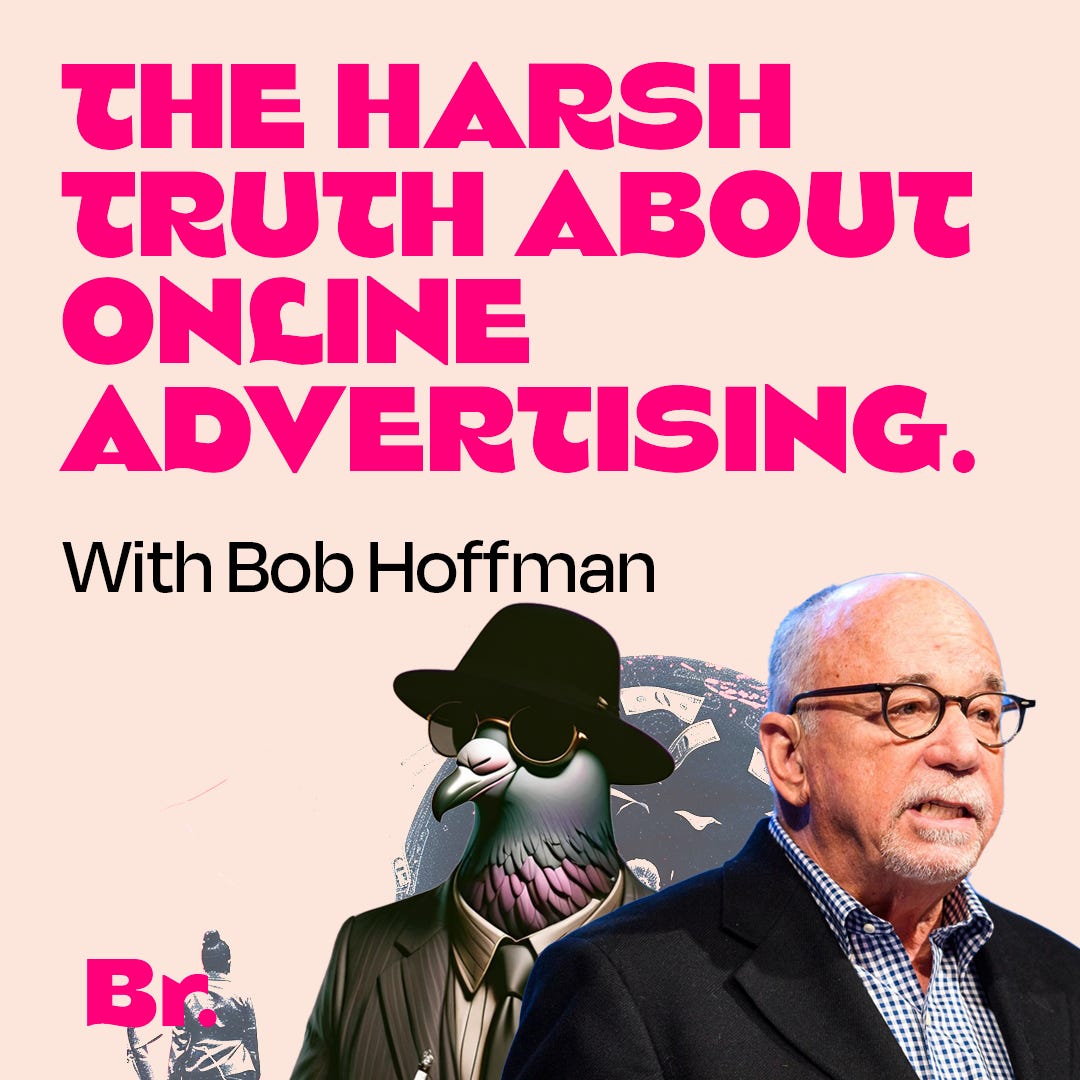
Hey everyone. In this episode we're talking with Bob Hoffman, AKA the ad contrarian. And boy, oh boy, Bob does not disappoint. We talk about some of the harsh truths about online advertising and ad fraud, but also about how creativity can be an antidote to all of this. So buckle up and let's talk branding. This episode is sponsored by Creative Business Company, but more on that later.
- [00:56]
Bob Hoffman
I'm Bob Hoffman. I'm a writer and sometimes speaker and I'm a retired advertising executive. I live in California and I was chief executive of several agencies here in the states. And now I'm just a loud mouth pain in the ass who likes to talk about advertising.
- [01:20]
Unknown Host
I love that. Maybe like because you're online, you're quite well known as like the ad contrarian. But were you always like that or like how did you grow into that role of being a bit of like the, that person that can really shake the industry up?
- [01:38]
Bob Hoffman
Well, I was always a skeptical person from the time I was a child and I got into the advertising business at the age of 25. I had never studied advertising, I'd never taken an advertising course or a marketing course, but I got into advertising and my first impression of the advertising industry was these people don't know anything. They think they know a lot of things, but they really don't know anything. And it's pretty much hasn't changed in 100 years since I started in the advertising business. And so I've always questioned the things that we held to be truths in the advertising and marketing world and I still continue to do that.
- [02:35]
Unknown Host
Yeah, and maybe like you've written about a lot of things and we'll definitely talk about ad fraud and this sort of stuff, but maybe like what is some of the biggest bullshit you've recently heard in marketing?
- [02:50]
Bob Hoffman
I think the most, I don't know, not dangerous, but silly idea in the advertising business in the last four or five years is the concentration on one to one personalized advertising. I don't think advertising works that way. Advertising works mostly by making you famous and you don't become famous one person at a time. You become famous in public where a lot of people can see and Hear you. And if you look at all the major brands in the world, they have one thing in common. They're all famous. And how did they get famous? They got famous substantially through doing mass advertising. Not every brand, but most brands got famous by doing mass advertising, not by doing one to one personalized advertising. And so to me that's, you know, as far as the. That's my dog, he doesn't like one to one personalized advertising either. Yeah, to me that's the silliest idea that you know, we do it now because we can do it right, because online advertising made it possible to reach one person at a time. But simply because we can do it is not a good reason to do it in my opinion.
- [04:21]
Unknown Host
One of the biggest challenges in my own career has always been to convince business leaders that brand is one of the most important assets in their company. And, and even though dozens of studies have shown that getting the right strategic positioning can get you a 5x performance on your ads, sometimes convincing executives to prioritize their brand strategy can be challenging. That's why this episode is sponsored by Creative Business Company, a strategic consultancy on a mission to make brand more accountable and more effective. They take the lessons they've learned from over a decade of experience of working with brands such as Morningstar and Shell and Formula E and adapt them to smaller, fast growing companies to help them get more attention, convert leads and drive sales. So if you're trying to get budget for brand, create messaging that converts or lower your cost of acquisition, check out creativebusinesscompany.com for ideas, evidence and tools that will help you make an impact. Interesting. Maybe like obviously I've read your book adscam, which I highly recommend to anyone in marketing. I think it's one of those books that you just like I read through it in like day and night because it was so very, it pulled me in. So maybe walk us through the premise of like what you describe in that book because like I'm surprised that a lot of people really don't know about this.
- [05:54]
Bob Hoffman
Yeah, there's a lot of fraud and corruption and double dealing in the advertising world and it's concentrated on the programmatic advertising system. I don't know what you call apparatus, if you like. And it's full of, full of criminals, it's full of creeps and people don't know what they're getting. You know, people are buying advertising online, they don't know who they're buying it from, they don't know what they're getting, they don't know what they're paying and they don't know who's seeing it. And they think they do because we have all this so called metrics. And the metrics are highly unreliable at best. In some cases they're fraud. And there have been plenty of instances where this has been revealed. But for some reason the advertising and marketing industry doesn't want to face the reality of what's happening. And they continue to throw away tens of billions, if not hundreds of billions of dollars a year on online display advertising bought through the programmatic apparatus. And they're buying nothing. They think they're buying ads on website. In many cases they're buying nothing. And the only things that are viewing their ads are bots. And in some cases the websites they're buying don't even exist. They're buying fraudulent things that look like websites but aren't really websites. They're buying people who look like people but aren't really people. They're buying clicks that look like clicks but aren't really clicks. And the evidence of this is overwhelming. If people would take the time to learn what's really going on instead of believing everything that people around them are saying, they would discover this. And it's a remarkable thing how you know there's going to be $650 billion spent on online advertising this year. About 80% of it is going to be bought programmatically. Probably nobody knows, you know, nobody knows for sure anything that's happening online, but probably 80% is bought programmatically. And of that we know that 50% of every advertising dollar that is spent goes into the programmatic. It doesn't go to pay for advertising, it pays for programmatic services, whatever the hell they are. That's 50%. Then you have fraud, which is probably another 20%. Then you have unviewable ads, which is estimated between 25 and 50%. And by the time you get down to it, according, you know, I'm no statistician, but my best calculation is that for a dollar spent on on programmatic advertising, you get about 3 cents worth of real ads in front of real people.
- [09:41]
Unknown Host
Yeah, it's really fascinating how we are able to have this scale of fraud and money waste in an industry that is quote unquote, like very obsessed with roi.
- [09:56]
Stef
Yeah, we're really not. I mean the agencies are obsessed with roi. They know that know two thirds of their money these days, according to the latest statistics I saw, two thirds of their revenue is coming from online advertising. And they don't want to kill that golden goose. So they're not going to make any noise. And you know, the marketers are, you know, with all due respect, many of them are idiots and they don't know what they're buying. And consequently we have this ridiculous system. If you set out, if you had set out to create a wasteful, corrupt system, you couldn't have done any better than we have done with the programmatic advertising apparatus.
- [10:52]
Unknown Host
Maybe just out of curiosity, because this is mostly about display ads being shown on different website is.
- [10:59]
Bob Hoffman
Yeah.
- [11:00]
Unknown Host
Does this level of fraud also apply to things like social media ads where they're mostly displayed on the platforms?
- [11:08]
Stef
When you buy directly from a social media platform, you are generally not as subject to fraud, generally if you buy the social media's primary website. The problem is the social media companies now Facebook and others, and Google is into this, have networks of websites which are not part of their system that they, if you're not careful, they, and if you're not specific in what you're buying from them, they will take your money and put it on those things. And those things are horrific. Also the, what we call the walled gardens, the Facebooks and the Google. When you buy their primary website, you cannot, you cannot believe the metrics they give you because it's been shown over and over that they lie about their metric. I mean, Facebook, famously, I wrote about this, had more people on Facebook than existed in the world in some of their sales materials and some of the blocks they were peddling to, to marketers. So you really have to be very, very careful when you're buying online advertising because the whole thing is, is highly unreliable. And you know, the ironic part is when online advertising became a thing in the, you know, early 2000s, the way it was sold to us in the advert, well, you're going to have perfect information. You're going to know exactly who's looking at your ad, exactly how many people you reached, exactly what they did, exactly what you got for your money. And it has turned out to be the exact opposite. There is more questions now about what we're actually getting for our online advertising dollar than there ever has been in the history of advertising. So that's the irony of it all.
- [13:26]
Unknown Host
Yeah. And this reminds me a lot of like, I mean, I run my fair share of campaigns on meta on Facebook and you see these huge numbers like whatever, millions of people have seen this ad, but you almost never hear them from people like talking to you about them seeing it. And then sometimes you have people that have seen your ad like 17 times a day and they're annoyed with it. Like, stop. Stop showing me it. So it's very random of, like, where it happens and when it happens and how much. So. So I totally see that even on. On platforms, the effectiveness is probably, like, way off. And what's interesting to me is, like, there's this level of it. It doesn't really work, but then there's an even bigger level, which. Which you talk about a lot, and there's the societal impact of this whole system. Could you talk a bit more about that?
- [14:17]
Stef
Yeah. We have a very dangerous thing going on in social media, and that is the creation of algorithms that describe us. So you are.
- [14:32]
Bob Hoffman
Let's take your Facebook page, for example.
- [14:35]
Stef
Your Facebook page looks completely different from my Facebook page. And why does it do that? Because Facebook has collected information through tracking over the years in which they have created an algorithm that looks like Steph and an algorithm that looks like Bob. And they know what to feed us to keep us engaged. In 2018, some Facebook executives did a study and they found that of two thirds, two thirds of people who joined extremist group groups on Facebook were led there by the Facebook algorithm. And we know how divided. I don't know how it is where you are, but here in the States, the division in the population is stark and dangerous. And a lot of that, in my opinion, has been driven by social media algorithms that feed us, to keep us engaged. They feed us more and more lurid versions of our own predispositions. And that takes us down rabbit holes, and we go down rabbit holes and we find people with extreme, extreme versions of our own opinions. And it has a tendency to radicalize people. And that's what has happened. And that has caused deep divisions in society. And I think it has been very dangerous. And I think we need to be very careful because what is supporting all of this? It's advertising dollars. Why do they have. Why do they do all this tracking of us? Why do they create these algorithms for the benefit of advertisers? So we are essentially funding some very dangerous aspects of democratic societies that are doing harm to individuals and are doing harm to the integrity of our political systems. And I think if you read my books, you'll get a more. What shall I say, a more detailed.
- [16:57]
Bob Hoffman
And more.
- [17:00]
Stef
Broader view of what I'm trying to say here.
- [17:03]
Unknown Host
Yeah, and I mean, I've seen this firsthand. Like, I've done some research here locally. And our biggest, like, party right now in Belgium is a very extreme right wing party. They're the biggest spenders on Facebook. So it's pretty clear that like these guys know how to play that and you know, it's working for them, but it's not working for society. For sure.
- [17:29]
Bob Hoffman
Yeah.
- [17:29]
Stef
And it's not just the ads they're buying, it's the algorithms.
- [17:34]
Unknown Host
Yeah.
- [17:34]
Stef
That are driving individuals into places that are creating misinformation, are fomenting hatred and lies and it's, it's just not healthy. Yeah. And, and you know, the, and the, the social media, the, the owners are very irresponsible. They do not, you know, they say they police the messages, but they don't. And it's, it's a big problem.
- [18:20]
Unknown Host
Yeah. So let's say hopefully everyone catches on to this problem, we drop the whole tracking spying situation. Not very likely. But anyway, like, how can, how can, like how does it look like in a, in a post tracking world? Because like online and digital isn't going nowhere but like, what does it look like then?
- [18:49]
Stef
Yeah. You have to remember before tracking, before spying on people came along, advertising was very successful for decades without spying on people. Right. The idea that we have to spy on people in order to be successful advertisers is bullshit. It's nonsense. We were very successful and very profitable and brands were very successful and very profitable before spying and tracking came along. It's totally unnecessary. The online advertising industry claims that it's essential to their business model, that tracking is essential to their business model. Well, if online advertising is such a weak force that you have to spy on people in order to make it successful, how did these companies become some of the most profitable companies in the history of the world? I mean, it's total bullshit. And for some reason, you know, I was in your country not long ago and I spoke at the, at the European Parliament. Somehow these regulators and these legislators have been convinced by the big money in the ad tech industry that tracking is necessary and that it's not harmful. And you know, somehow we have to get over that. The only way to get over it is if people say, no, I've had enough. I mean, we would never tolerate governments spying on us. Governments knowing everything we're doing, everyone we're talking to, everything we're saying we would never tell, but somehow we tolerate it from the marketing industry. I mean, by the, you know, there was a, there was a report to.
- [20:53]
Bob Hoffman
The British Parliament not long ago that.
- [20:55]
Stef
Said by the time the average child In Europe is 13 years old, the ad tech industry has 72 million data points on that child. There was a, there was a recent article by a woman Who's a journalist. She wanted to know what information Facebook had on her. And there is, there's a regulation now in Europe and cma, I don't know what it's called, all these three letter acronyms. But anyway, there's a regulation that if you ask, they have to tell you, they have to show you all the information they have on you. So this woman went through a whole thing and she finally got Facebook to give her the information they had on her. Take a guess how many pages of information they had on her.
- [21:56]
Unknown Host
Say 50.
- [21:57]
Stef
Ready? 20,000. 20,000 pages of information on one person. It's beyond belief.
- [22:09]
Unknown Host
It's, it's crazy. And on the one hand, like you would think that like with all of this data, like, it would be a powerful tool in terms of like then advertising, people.
- [22:21]
Bob Hoffman
People.
- [22:21]
Unknown Host
But apparently then on that side it totally falls flat.
- [22:25]
Stef
It's a powerful tool in convincing marketers to use their platform. That's what it's powerful for. I mean, and you know there are, there, there are successes on, I'm not gonna deny that there are successes, but are, but it is what's more important, the convenience of marketers or the privacy rights of individuals and the integrity of democratic institutions? I mean there's no question what's more important. So I don't care if there have been some, you know, there's some successful, you know, marketing, you know, case histories online after, of course there are going to be some. But that doesn't justify it. That's not enough. The convenience of marketers is not enough to overcome the, the privacy rights of individuals and the integrity of democratic institutions.
- [23:28]
Unknown Host
I created this podcast to help myself and others understand the power of brand building without all of the bs. So here's three no BS guides from my friends at Creative Business company that you can download for free to drive impact. The brand investment blueprint outlines the exact process they use to convince skeptical executives to invest in brand building projects and campaigns. How challengers can position for growth explains how brands can find and leverage their hidden advantage to create brand marketing that sells. And last, my favorite how to build a big brand on a small Budget explores how to outsmart and overtake market leaders with more cost effective marketing. Go to creativebusinesscompany.com staff to download your free guides today. That's creativebusinesscompany.com Stef to download your free guides today. Back to the podcast. Exactly. And I think they're a, a big part of it is indeed like this almost marketers can feel like they well they can be a lot more lazy because it feels like you can be in this, like, clean cockpit just dialing up stuff and you see the results happening even though it's a fake, like you're not really there. But I think that's a big part of it.
- [24:50]
Bob Hoffman
Yeah, I think you're right. It's the, what the false belief in control. You think you're, you dial it in and you think you're in a cockpit of an airplane or something and you're.
- [25:07]
Stef
Not, you're, you know, you're at the mercy.
- [25:10]
Bob Hoffman
You don't, you know, they give you numbers. You don't know if the numbers are true or not. And if you look into it, you very often find that a lot of it's baloney.
- [25:18]
Unknown Host
Yeah. And, and that's why I think, like, you also talk a lot about creativity almost as a sort of like, antidote for, for this problem or at least this type of advertising. Like, maybe if you, you think about that, like, how can we go back to that as marketers?
- [25:40]
Bob Hoffman
We probably can't. I think the marketing industry has put all its chips down on technology rather than creativity. And you know, I'm not going to change that. You're not going to change that. That's what they believe in. And, but if you look, you know, take a big picture look at advertising, ask anyone, ask any senior serious marketer who's been around for a while and ask them, has advertising become more effective or less effective? And you will hear almost unanimously, advertising has become less effective than it used to be. That 20 years ago, 30 years ago, 40 years ago, before you were born, advertising was more effective than it is now with all this technology. So look, in any other field, are cars less effective than they used to be because of technology? No. Are airplanes less effective? No. Is medicine less effective? No. It's only advertising that has gotten less effective with technology. And why is that? Because we have devalued creativity. And creativity is what people remember about advertising. They don't remember reach, they don't remember frequency, they, they remember ideas, they remember creativity. But you know, the advertising industry has given up on that.
- [27:17]
Stef
Not all.
- [27:18]
Bob Hoffman
I mean, there are some, still, there are some great advertising agencies, there are some great creative people in the business. But I mean, the association of National Advertisers here in the US issued a, some kind of statement, maybe it was last year, saying, we have a crisis. Creative people do not want to go into the advertising business anymore. There are too many other options for good creative people these days. And the advertising industry because it has been. One of the problems is we have become corporatized, we have become industrialized, and now we don't. We're not optimizing for craftsmanship, we're optimizing for efficiency. That's. That's what industrialized. That's what industrialized businesses do. They optimize for efficiency. So you, you know, you make one pencil and you have a, you have a nice template for what a pencil looks like, and then you can make 10 million more pencils just like it. And that's optimizing for efficiency. When you optimize for craftsmanship, each pencil has to look a little different, has to be a little different, has to, you know, you have to think about a little. What could a pencil actually be? What kind of eraser could we have that we don't have on this? Well, we're not optimizing for craftsmanship anymore. And I don't know, maybe it's. I think it has a lot to do with the fact that the, the agency business has become so consolidated. There are so few independent players anymore who are substantial and, you know, there's too much power and too few hands in the advertising business, in my opinion.
- [29:29]
Unknown Host
Yeah. What's also interesting, like, I don't know if you've heard the latest podcast episode on Uncensored CMO with Scott Galloway. He made some pretty interesting remarks. You know, his whole spiel about brands are dead because. Yeah, I mean, I don't like that one too, but it's kind of interesting because in a way I see some overlap where he's saying, like, you know, this whole online world has got us navigating in a different way to find out stuff that we want and it isn't through traditional, you know, brand building anymore. However, I disagree on it. I'm curious, like, about your thoughts on it. I already feel I've heard this so many.
- [30:14]
Bob Hoffman
First of all, first of all, let me tell you a little about Scott Galloway. I know the guy. My former business partner was his. Roger Lewis was my former agency business partner. And Roger taught Scott in a. In. I think it was his master's class in market. I don't know, something at University of California. And Scott, I would see him around the agency. From that he would come, our agent, hang around for a very smart guy, very smart guy.
- [30:49]
Stef
But brands are not dead.
- [30:53]
Bob Hoffman
I've heard that so many times. Oh, brands are dead. Marketing is dead. Advertising is. Everything is dead. Bullshit. I mean, just look at people go into a supermarket and look at people shop. What is a brand It's a name. A brand is a name. Our name's dead. Our products. Not going to have names anymore. Of course not. Go watch people, they know what they want to buy and they, they take this and they take that and. No, brands are not that.
- [31:27]
Unknown Host
No, it's. And first off, totally agree. I think it's part of his spiel there is just to get people to, to engage and to, you know.
- [31:37]
Bob Hoffman
Yeah, he's, you know, I know what that's like. I'm the same way. I like to say outrageous things to stir up a conversation. And that's fine. We need that. That's great. But, you know, I'm wrong sometimes and he's wrong sometimes. And brands are not dead. As a matter of fact, the less, the less attention people pay to sussing out the meaning of brand. All of the more important a big brand name becomes because people, they don't have the time, the energy or the, or the incentive to study everything they buy. And what does this mean? And what does that have in it? And you know, mostly we buy products we're familiar with and comfortable with. And that's mostly if. Go into your refrigerator, take a look, go into your cupboard and take a look at what you've bought. And it's mainly stuff that you're familiar with and comfortable with. You don't do most people. Now, there are some people who study, you know, there's some whack jobs. Every little thing. What's every. But most of the people who are not like you and me and Scott and pay attention to all this, they just buy what they're familiar with and what they're comfortable with.
- [33:09]
Unknown Host
Yeah. I think what's interesting to me is like, in some way, it's probably not like we can't really go back to the golden days of. I mean, that's over.
- [33:21]
Bob Hoffman
There were no golden days. That's all advertising. Advertising was always mostly crap. That hasn't changed. I mean, I've been in, I've been in and around the advertising business for a hundred years, and it's always been 85% crap. Now it's 93%. It's a little more. It's more crap. But, you know, so it used to be 15% good stuff, now it's 7%. That means the good stuff is there's half as much good stuff as there used to be. But it's always been, there's never been a golden age.
- [33:53]
Stef
Don't buy that baloney.
- [33:55]
Unknown Host
No, that's true. And. But I think it's more like My question would be about, like, channels.
- [34:01]
Bob Hoffman
Yeah.
- [34:01]
Unknown Host
Like, the question is tv. A lot of these things. It's also like, it's harder to get, like, as a smaller brand, basically, you can't afford these things. That's always been true. But like, how do you build a brand without, like, without the tracking thing and also without going into like, this super expensive stuff?
- [34:22]
Bob Hoffman
I don't know. It's very hard. It's very hard. I don't know how you do it. I mean, the most important thing you can have is word of mouth. I mean, if you go back and you look at the history of some of the largest brands in the world right now, Google, for example, that was built on word of mouth. They didn't do advertising for many years. Same with Facebook. They never did advertising for many years. It was built on word of mouth. So that's. If you can do that, that's great. But the most important thing, if you want to be successful as a small brand, if you want to build your brand, the most powerful thing you can do is to become famous.
- [35:08]
Stef
Now that, that, that is the, that.
- [35:13]
Bob Hoffman
Is the most powerful tool you have is fame. If you think about it, famous. If you're famous, you have such an immense advantage over your competitors who are not famous. And that, that's not just for brands. That's for human beings. I mean, why am I on this podcast today? There are a thousand people in the marketing business who are smarter than me, but I have this kind of slight fame in our stupid little advertising and marketing culture. And, you know, and that's why I'm here and the other 999 people are not here. Fame is an immense advantage. And whatever you can, whatever budget you have as a, as a small brand, use that to make yourself famous. Any way you can do that. You, you know, that's my advice.
- [36:14]
Stef
I'm not a media.
- [36:15]
Bob Hoffman
I'm a copywriter. I'm not a media specialist. I don't, I, I don't give people advice on what media to use.
- [36:21]
Unknown Host
Yeah.
- [36:21]
Bob Hoffman
But I do give them advice on this, and that is try to become famous. If you can become famous, you have such an advantage over your competitors.
- [36:31]
Unknown Host
And, and like, what's super fascinating to me is like, even in this digital online, like, the, the people right now that, that are building huge businesses are often like creators like Mr. Beast and these YouTube people. And the thing they have in common is like, they are entertainers and they're becoming like, immensely famous, which is, I think, something companies could learn a lot from. But like, apparently Very hard to see.
- [37:03]
Bob Hoffman
Yeah, everyone's focused on the, on the little things. They don't see the big picture. And not everyone, but a lot of people are focused on all the little detail. They, they see every tree, but they can't see the forest. And the forest is. Become, become famous. If you can do that, you, you, you have a much better chance of success. Now are you guaranteed success? Absolutely not. There are famous companies that go out of business every day because stupid is more powerful than fame. But, but fame is still. You know, when I grew up in the agency business, what we were focused on was differentiation and positioning. These were the two things that advertising was supposed to do. And as I have seen more and more of it, I don't buy that anymore. The differentiation and positioning are important, but the best differentiation you can have is to be the most famous company in your category. And the best positioning you can have is to be the most famous. Is to be the most famous company in your category. Those are the best differentiators and the best positioning. And if you look in every category, not every category, but most category, who's the leader in the category? It's usually the most famous person. The most famous brand in the category.
- [38:32]
Unknown Host
Yeah, I have some listener questions. I can't do all of them, but I don't answer.
- [38:39]
Bob Hoffman
I'm sorry. No, listen. Okay, let's go.
- [38:43]
Unknown Host
So Nick Asbury, also an amazing writer, at least from my perspective.
- [38:50]
Bob Hoffman
Yep, yep.
- [38:52]
Unknown Host
So he says. I love Bob's 2016 essay or talk the devaluation of creativity. Is there anything he changed or update about it now? And does he think it's a coincidence that created creativity declined as purpose rose? Nick is a purpose guy.
- [39:11]
Bob Hoffman
Yeah, he is a purpose guy.
- [39:13]
Unknown Host
Well, anti, Anti purpose. The anti purpose guy. Yeah.
- [39:17]
Stef
Good.
- [39:18]
Bob Hoffman
Glad to hear it. I thought I was it, but. Okay, I'll give up.
- [39:23]
Unknown Host
He's coming for you.
- [39:27]
Bob Hoffman
I don't remember what I said in that essay, so I can't really comment on whether I changed. I'm sure I changed something. You know, it's what, six, seven, eight years later? So there had to be wrong about something in there. I, you know, you're never 100% right, but as far as. Did creativity suffer as a result of purpose? Absolutely, because purpose got us off the track. You know, one of the problems in the advertising business is that we forgot that advertising is not about the consumer. Advertising is about the brand or the product. And we stopped talking about. We didn't stop, but a lot of advertising became about your lifestyle.
- [40:20]
Stef
And we're you know what?
- [40:23]
Bob Hoffman
People don't need to hear that bullet. They know what their lifestyle is. That's a focus on. Focus on the amazing thing your product does that. That makes it so much more famous and important than other products. That's where. But. And brand purpose took us away from that. Brand purpose took us into ideology and into politics. And, you know, people don't need more politics. They don't need more ideology. They need more good products that make them look good and feel good and taste good. Yeah, so I'm an. I'm with Nick on that. I'm anti purpose. I think a lot of it is just masturbation. People talking to themselves, making themselves feel good.
- [41:18]
Unknown Host
Austin Franke, a good friend of mine, he said, if marketers are from Mars, where are brand strategists from Venus?
- [41:32]
Bob Hoffman
Brand strategists are. You know, brand strategy is like creativity. You can't say it's all good it or it's all bad. There are some awful creative people, and there are some brilliant creative people. And the same with brand strategy. Most of the brand strategists that I've had the opportunity to talk to and meet with and work with have been very mediocre, have not really. I'm not going to mention any names because I don't want to get into trouble, but I've very, very famous creative person who everyone who's listening will know the name. Once we were sitting in my backyard having a glass of wine, and he said to me, you know, the planners write the bad headlines and then we write the good ones, I think that's pretty, you know, that sums it up pretty good, I think, except for a few who really are brilliant and they do a good job and they, you know, they come up with insights that really mean anything. But you know what? If you take this, a strategy from one planner or one brand strategist, and you give it to two different aid. You give it to a bad creative agency, and then you give it to a good creative agency. You will come up with completely different campaigns, and the good agency will create a wonderful campaign and the bad agency will create a lousy campaign. And they both derived from the same quote, brand strategy. So it's. So much of it is about how good the creative people are rather than, oh, the strategy. Nailed this one. You know what I mean?
- [43:37]
Unknown Host
Yeah. Interesting. Actually, I have another question. I just need to quickly see a listener. Yes. Yes.
- [43:46]
Bob Hoffman
Oh, man.
- [43:49]
Unknown Host
It's the three listeners that I have.
- [43:51]
Bob Hoffman
So all three of them have questions. Okay, Chris, are we doing this live? By the way, this is live.
- [43:59]
Unknown Host
It's not live as in it's being streamed right now, but it will be published like that. So Don, Marty asks. It's been, yeah, don't know Don. But anyway, I know Don very well.
- [44:12]
Bob Hoffman
He's a wonderful, brilliant guy.
- [44:15]
Unknown Host
It's been almost 10 years since Bob's original refrigerator test. Don't know what that is. What are some online brands that have been suggested as counter examples and how are they doing now? Man, easy question.
- [44:32]
Bob Hoffman
Give me a break. What are some online brands? Well, the refrigerator. I'm not sure I can answer that question. Well, because the refrigerator test is when people say to me, oh, I don't. There were actually two refrigerator tests, but the one I think he's talking about was people said, well, advertise, I don't pay any attention to advertising. I said, okay, here's what we'll do. I'll bet you $100 we'll go to your house right now and we'll take everything out of the refrigerator and put all the things that are advertised in one pile and all the things that are not advertised in another pile. And if the non advertised pile is bigger, you win. And if the advertised pile is bigger, I win. And I usually get a hundred dollar bill handed to me before we even go to the refrigerator. But anyway, how the refrigerator test, it's about, you know, fast moving consumer goods, supermarket stuff that's what winds up in your refrigerator. And there haven't been that many online brands that have created successful packaged goods. What? You know, most of the successful online brands, most of the successful brands that have been created online have not been supermarket refrigerator brands. So I, you know, I, I, you know, and also I haven't been paying that much attention recently to advertising, so I can't really answer that question. But it's actually I owe you a meal because last time you didn't need anything. Don and I had. It's a long story, but go ahead. Okay.
- [46:21]
Unknown Host
No, but anyway, the refrigerator test, I love that. And I guess like indeed a lot of online brands, D2C Brands was a big promise, but it didn't really pan out as such. So we'll see about that. But maybe just to wrap it up, any new books or exciting things coming for you?
- [46:40]
Bob Hoffman
Yes, I have two new things and they're free. They're both free? Yes, I have a, I have a book called Inside the Black Box and you can download it free from my website, which is Bobhoffman's website dot com. Isn't that a brilliant title for you and I have another free book that you can download from my website and and it's called Marketing Stinks and they're both downloadable and free. So go there and download them both and then if you like them then you can buy my books that I'm going to charge you for.
- [47:28]
Unknown Host
That is some proper marketing there.
- [47:31]
Bob Hoffman
Right. These are sampling. It's sampling that I'm doing here. Yeah.
- [47:37]
Unknown Host
Amazing. Well, I'll put those links in the show notes. Thank you so much, Bob for coming on the show. This was really fun.
- [47:44]
Bob Hoffman
My pleasure, Steph. Thank you for inviting me and good luck to you and to all your listeners.
- [47:50]
Unknown Host
All right, that was it for this episode. As always, if you want to stay up to date on the latest episodes, check out the show notes and find out more interesting stuff about brand strategy and brand building, visit letstockbranding substack. Com. That's letstockbranding substack.com.