← Liberty's Highlights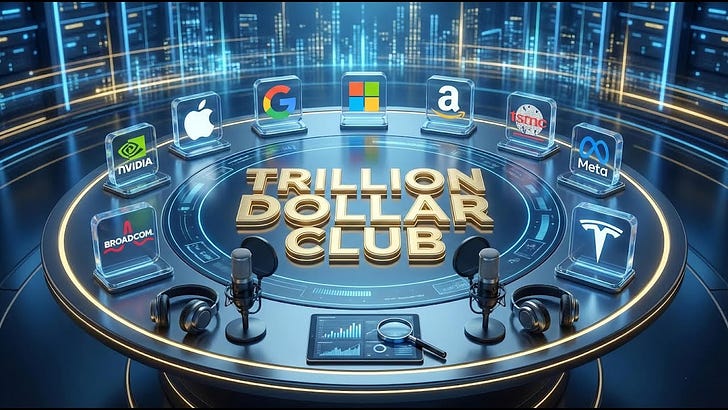
Liberty's Highlights
Trillion Dollar Club with Mostly Borrowed Ideas (MBI): Nvidia, Apple, Google, Microsoft, Amazon, TSMC, Meta, Broadcom, and Tesla 🏆💰📈🤖🚀
01:55:37
Loading summary
Transcript374 lines
- [00:01]
A
I considered having two instances of cloud code record this podcast in our place. That would have been very in keeping with the Zeitgeist. But I couldn't pass up a chance to talk to my friend, the excellent mbi. How are you?
- [00:13]
B
I'm good, I'm good. I'm the real me, not some AI version of me. Although you can't probably tell at this
- [00:18]
A
point right now we can probably still tell, but in a year or two, maybe not.
- [00:23]
B
Maybe not.
- [00:25]
A
So the idea for today was very, very simple, right? We've been following all these big tech companies and they're at the center of everything these days. So we thought like, let's go down the list and talk about them, share our thoughts. Like, we may skip Saudi Aramco and everything because it's not really on a wheelhouse, but let's look at the trillion dollar companies. How can we make a concept like this real? How can we make it really, really official? And I figured it out. What we needed was an intro song.
- [01:01]
B
Titans at the trillions on the board
- [01:04]
A
Nvidia, Apple, Google, can you keep the score?
- [01:06]
B
Microsoft, Amazon, Meta in the race tsmc,
- [01:09]
A
Broadcom, Tesla, who's in first place? It's a trillion dollar club Liberty and
- [01:14]
B
me I breaking it all down Trillion dollar club
- [01:19]
A
the biggest game in town. Don't you feel more psyched about it now?
- [01:25]
B
I am. I am now. Although you definitely used AI to do this, but now it feels like this conversation is definitely not AI Because AI can't really probably still surprise you in this way, right? Totally random thing just thrown into the conversation, making it more human, like, right.
- [01:45]
A
That's going to be my mode for the next few years. It's going to be even more like random dad jokes and all that stuff.
- [01:51]
B
Did you use SUNO or something else to do this?
- [01:54]
A
That was suno. And surprisingly now when you generate something, they give you four and so two with the old model and two with the new model. And I thought the old model one was better, so I don't know why, but this one came out better.
- [02:05]
B
I have written a bit about probably two pieces on music's AI mess. And it's funny because just today I listened to an artist whose song I found really beautiful and very human. Like I could definitely not tell it's AI generated in millions of years. I forgot the name of the artist, but it's the same artist whose song was actually shared by Selena Gomez, I think during Golden Globe or something like that. Probably without understanding that this is an AI generated song. I feel like Music is solved. We may have preference for human made music because we are drawn to characters, personalities and their stories. I think we're already there if you just judge based on their output. I am not a music connoisseur. I'm probably more a normie when it comes to music. And I am definitely not in a position to differentiate between AI generated music versus, let's say, human made music.
- [03:07]
A
Yeah, I think that's probably the case for almost anyone. You could stop on the sidewalk and do the double blank test or like. Yeah, it's gotten very good very fast. Back to the game.
- [03:17]
B
Back to the game.
- [03:18]
A
Historical context, right? Apple became the first trillion dollar company in 2018. That's a little over seven years ago. And today there are 11 trillion dollar companies. In early 2020, Microsoft was the most valuable, $1.3 trillion. Now that sounds little. Nvidia at the time was 140 billion. Now today, Nvidia alone is worth more than the entire UK stock market market cap. It's larger than France and Germany's stock markets individually by over a trillion dollar each. And these 11 companies combined, that's $27 trillion of market cap, which is insane. And just looking at the list, right? No healthcare company though Eli Lilly is very, very close. No energy company other than Saudi Aramco. But if you look in the past at the top companies, you always saw like ExxonMobil and all those. No financial company, unless you count Berkshire, it's Canada, But a lot of other things too. JP Morgan is very close. Walmart, the only retailer that's very close. I think that tells us a lot about how dominant tech is right now. It's everything right now.
- [04:24]
B
Just as you were kind of narrating that, it reminded me of the exact moment when Apple became trillion dollar company. I remember when exactly I was actually.
- [04:35]
A
It's like your moon landing.
- [04:38]
B
I was sitting at Cornell's. I think I was in a class which was taken by actually my favorite professor from Cornell, whose name is Sanjeev. And Sanjeev was basically kind of mocking investors at that time. I think it may not have been actually the day Apple became a trillion dollar company. It was actually the day Amazon became trillion dollar company. And I think I was sitting in the class at Cornell and my professor Sanjeev was basically telling how ridiculous it is that these are trillion dollar companies. And I think he was particularly offended by Amazon being a trillion dollar company.
- [05:12]
A
Where are the profits, man? GAAP earnings.
- [05:16]
B
I think it was definitely some financial accounting class or something like that. And he was mocking by saying that, you know who the Wall street is saying is going to be a $2 trillion company before anyone else? It's Amazon, which is nuts. Like, you know, this company has no profits. They never bother to, you know, post any sizable amount of profits and all that. You know, he was my favorite professor, so I had to do. So I had to do some unlearning after, after my mba.
- [05:43]
A
Well, you learned some lessons by reverse, right? What not to do.
- [05:47]
B
Yeah, maybe he's still, I mean, I still have immense respect for him. I wrote about it before this idea called, and I think I haven't actually come up with this myself, I heard it on a podcast about this east coast philosophy versus west coast philosophy. I think I'm still more drawn to east coast philosophy of investing, where you do care about cash flows, you do care about valuation, you do care about unit economics and how where the business stands today, not just this imagined future in five, ten years down the line, which is more of a West coast thing. And as you were just going through the list, it feels like the world is increasingly dominated by this west coast philosophy. And it's probably fitting that I am right now in the West Coast.
- [06:31]
A
Let's start, let's go down the list. And this one, I know you did a bunch of research to do a deep dive on. I'd be curious to know what kind of wild goose trades that was. But with Nvidia Right now, 4.58 trillion, the first company to hit 5 trillion briefly, now the world's most valuable, they have this extreme co design narrative going on right now, which is like, look, we make a chip and release it once in a while, but like we make a bunch of chips and these chips are parts of systems and there's the whole software around it and they almost sell them by the data center. Now we're pretty far from the gaming GPUs from a few years ago. So, first thoughts on Nvidia, what do you find out? Studying them.
- [07:10]
B
Yeah. So where do I start? I think I mentioned this before. So I do like this 10,000 steps every day. Right. And there is a particular sentence that I almost murmured to myself during some of these walks every once in a while, which I read probably a couple of weeks ago, there's this annual reflection letter published by this AI researcher, I think called Samuel Albany or something like that. He had this idea called Compute Theory of Everything. And he got the idea from this 1998 paper by Hans Moravec, right?
- [07:46]
A
Yes.
- [07:46]
B
Now Hans Moravec is sort of a familiar name to most people due to Moravec's paradox. Right. How robotics is such a mind bending, difficult problem for AI, although reasoning or like, you know, more analytical stuff is actually more easy for these AIs.
- [08:00]
A
Right.
- [08:00]
B
So that's a paradox and I heard about it, but I have never really actually looked into the paper itself until I read that letter by that AI researcher. And in the very abstract of that 1998 paper, the first sentence is just so intriguing to me that I almost murmur to myself every once in a while. And I'll tell you what that is. This is how it reads. The performance of AI machines tends to improve at the same pace that AI researchers get access to faster hardware.
- [08:32]
A
And that's your mantra while you're walking around beautiful California. You're such a nerd.
- [08:36]
B
No, I feel like this is, this is actually a very deep.
- [08:40]
A
No, no, it's deep goes with the bitter lesson and all that. Like we tend we need to be so clever, we need all that. But a lot of the time the tools get better and you make the new discoveries or you train the new models or whatever it is.
- [08:50]
B
Right, yeah, it is from 1998. I think that's also important to remember. Right. This is not something someone wrote like you know, last year or so after looking at Nvidia's Blackwell chips. Right. This is all before anything that, that we're seeing these days. Sitting in 1998, he looked at last 30, 40 years of AI progress and the bottleneck that AI faced and came to the conclusion, I would say. Right, conclusion, that there is this peculiar tendency of AI progress getting faster and faster. The moment AI researchers get access to faster and faster machines. He actually literally predicted, it's in the paper in 1998, that the machines will reach the capability of human brains by 2000 and twenties. Right now we can debate and we can argue whether obviously there are still four years left or almost five years left in this decade. So we can still choose to be patient and have this debate in 2029, December 31st. Right. But I think it is quite telling the thought process of Moravex and how he came to that conclusion. And the reason I'm mentioning this while discussing Nvidia, because I think it has a very deep meaning in terms of what it means for Nvidia if compute is everything. You know, there's this joke that we tell on Twitter. Everything is computer.
- [10:13]
A
Everything is computer.
- [10:15]
B
Right. And let's say if it's. This is not a joke, there's like a fair amount of truth embedded in that joke. Right? If that is the case, and if AI progress is actually hinged on Nvidia's ability to improve the machines and make the machines faster and faster every year going forward, they are in a very accelerating cadence compared to even five to 10 years ago. If that's the case. I think I should also give some context here. I spent three weeks studying Nvidia and then decided not to write a deep dive. It's not like I didn't do a lot of work. I did do a lot of work and then I just felt lost. Somewhat lost, right? Like, for example, everything that I just mentioned about, like compute theory of everything. What does that mean? How do I take that idea and reflect that idea in, let's say, my spreadsheet? Right. I don't even know how to encapsulate this qualitative idea into quantitative form and have some sort of calibration in terms of whether I'm being too optimistic, too pessimistic, or kind of fairly calibrated. I just don't have a good sense. And so I kind of told myself, you know what? I'm probably not in a great hate space to write a deep dive on Nvidia, given my state of confusion. Let's just wait and observe this company for the next couple of years or so. I think one of the challenges, someone like me who has been looking at a company like Nvidia for the first time, obviously this company has been public for 30 years, right? So I'm looking at it for the first time and I haven't really gone through all the cycles. And there is a pros and cons of observing the past cycles. If you followed Nvidia for the last 15, 20 years, you are probably too entrenched in your mind that, oh, it's a cyclical industry. There will be a cycle. We'll go through ups and downs and let's just wait it out. There will be a down cycle. We'll buy the company, buy the stock when it's down a lot, versus someone like, let's say, me, who stumbled onto this company in the last year or so. And on one hand, I don't have the full breadth of experience of covering Nvidia over the course of cycle. On the other hand, I do have fresh perspective, fresh eyes to look into a company who might be in a very different position and trajectory compared to the last five years. Last 10 years might be a noise, right?
- [12:42]
A
And maybe the company is in a particularly west coast moment right now. It's Almost like the whole thing was refounded as a new startup a few years ago because all of the gaming stuff that they did for 20 years before that was a nice bootloader. Right. It kind of bootloaded the AI moment. It got us here. But now that's a tiny fraction of not only the revenue but the growth of the company. So it's a totally different company that grew out. It's like this tiny acorn that was planted and now it becomes. Became bigger than what was there before. And so you almost have to look at it through this west coast startup model in the same way that OpenAI is called a startup, even though they're gigantic. Startup is a weird word these days, but maybe in a couple years they'll be more mature and you can look at them more through the east coast model. But that's another question we could have. Right. What do you think of how Jensen has been using this scarcity of compute supply to kind of like play chess on the whole board? Right. And he's like supplying, you know, the neoclouds to have more buyers. And everybody is kind of like they're a customer, but they're competition at the same time. People call it circular financing. He's taking stakes in all kinds of companies. He's helping people pay Capex. That goes right back to buying GPUs. What do you think of this situation? Some people seem to think it's a. It's a whole house of cards type of thing. Yeah, I wouldn't go that far. I think it's very different from the dot com bubble and pets.com and buying eyeballs. But there's still something a bit special about this dynamic.
- [14:11]
B
Yeah, yeah. You know what? I think I probably should mention a couple of things before addressing this circular deal stuff. I think one of the realizations that I have after following some of these big tech companies for the last five, six, seven years at least, standing today at this point of time, I feel like from the outside we cannot quite argue effectively against any of the big tech CEOs positions or decisions that they are taking today. Every single big tech management's positions are very well thought out. They understand exactly what they're doing. But it does not mean that everything will be great for all of them. Right. What I'm really trying to say is as an investor standing today here, I feel like my job has increasingly become. It has always been the case, but it is especially so, and this is my kind of my realization over the years that my job is basically just pick the Hand that I like the best. None of the big tech companies that we are going to discuss today, I'm not going to say, oh, what Jensen is doing is stupid or what Zuckerberg is doing is completely stupid. Like, and it makes no sense, it's irrational and all that. I'm not going to say any of that for any of the companies. I think all the CEOs, what they're doing from their vantage point, from their position, from whatever hand that they have been dealt, I think they are making at least big tech world. In the big tech world, remember, I think people forget. I feel like these are the pinnacles of management. Yeah.
- [15:47]
A
You don't get there by being stupid and stumbling into a trillion. Yeah, you can still make mistakes. You can be wrong, but it's not because you're dumb.
- [15:54]
B
Yes. And I would say even the mistakes that we assign, oh, this was an error. Like, oh, Satya didn't bet on AI or Sundar didn't launch ChatGPT before OpenAI did like all that stuff. I think people either don't have all the context of all the calculation that
- [16:11]
A
went into hindsight is 20 20.
- [16:13]
B
Right, right. That's one. And also, like I was saying, our job as investors have been increasingly become, not to criticize, you know, minute little decisions by each of the CEOs, but to say, I don't like, let's say Meta's hand, I like Google's hand. Right. Like, for example, I do think Zuckerberg is marginally better as a CEO than Sundar Pichai, let's say. Right. But is it enough that Zuckerberg would be ahead of Google despite all the other shortcomings that Meta may have? I don't think so. I don't think speech high is that far behind. Right. Even if you assume that he is a bit behind than Zachary Barkasati, none of them are.
- [16:50]
A
Steve Ballmer.
- [16:51]
B
No. Right. Well, no comment on Ballmer because I haven't really religiously followed him when he was at the helm of Microsoft and I know, like, you know how it feels like in hindsight every.
- [17:03]
A
And I don't want to be unfair, like, oh, yeah, the metrics went well, everything. But he did destroy a lot of value through M and A. And yeah. Anyway, that's a whole separate discussion.
- [17:11]
B
A whole separate discussion. Right. So that's my first point. That's how I feel about kind of my role as an analyst or as an investor. Like, you know, instead of arguing, hey, why Jensen is doing all the circular deals. Like, the question to me is, Do I like the hand Jensen has at this point? Right. So that's one way I look at things. The other way is I feel like, I suspect there is still a lack of recognition among many analysts and investors how the job of analyst is changing. And I can probably share kind of my experience and how I feel things have been changing and how I feel I need to adapt in certain direction. When I look back in the last, let's say, 10 years or so, right? Like, okay, these companies are like, you know, 2 trillion, 3 trillion, 4 trillion. Nvidia's $5 trillion company, right? What were the source of value creation of this? Like, you know, trillions of dollars, right? And if you go back and kind of rummage through all the sources of value creation, I think people still don't quite appreciate how much value creation was done by just academic papers. Like someone somewhere in these big tech companies thought about an idea, wrote a paper, and people kind of quickly realized, oh, this is a gold mine, we need to kind of harness it. If you think about the cat paper from 2012, right? It's stupid. Like, you know, even if you gave me that paper, I would just read it. I'm like, oh yeah, that's interesting. And I would not think anything more beyond that, right? But people who are actually in the very near that locus, they probably understood the deep implications of this paper and how it may unlock a lot of value through superior algorithm, right? Through Meta's apps, TikToks, Google's YouTube, Spotify. So many companies have been able to generate incredible value probably based on just paid rank, right?
- [19:10]
A
The og, the page way of ranking web pages. That's worth a few trillion dollars.
- [19:16]
B
Yeah, absolutely. For sure, for sure. I think you're probably alluding like, yes, this was always the case, but I think this is because becoming even more decades. Like the point I'm trying to make is forget Nvidia, obviously Nvidia, you can't really couldn't possibly express your point of view about Nvidia in a spreadsheet. You just couldn't five years ago, right? Forget Nvidia. Even for Meta, which we all thought this is much more amenable in terms of our ability to forecast, right? Hey, we have the data. How many people use these apps, right?
- [19:48]
A
We have the ARPU, DataUS, ARPUs, all these numbers, multiply them by each other, put a margin on it.
- [19:54]
B
It's so beautiful, right? It's so simple and beautiful and we all feel like we get it. We understand in Meta, this is more modelable company, right? Here's the thing. Like now, when I look at my model from three, four, five years ago versus, let's say, what META is reporting today, it's Nowhere close, right? Like 25% growth, 26% growth in year 2025. No, I did not expect that. I wasn't even close to that. So the question is why I'm so off, Right? And if you think about it like, you know, the core idea of why these companies are able to generate so much value. Right. They have generated so much value. I'm intentionally not using the word extract because I think they have actually given more value than they extract. Oh, yeah.
- [20:36]
A
I think they capture a fairly small percentage.
- [20:40]
B
Right, exactly. And if you think about it like, it's not the cat paper. Attention is all you need. 2017 paper, right. Chinchilla 2022 paper, right. So the conclusion that I kind of came to realize that maybe today there is an academic paper out there which is probably creating enormous value. Three, five years, 10 years down the line, if not today, maybe tomorrow. Right. You know, and that's why you would probably notice that I have been actually spending a lot more time just going through papers instead of, let's say, going through expert network calls or like, you know, transcripts from. I'm doing all of that. This is why I feel like I'm the individual embodiment of Jeevan's paradox. Like, you know, AI has just accelerated my work.
- [21:21]
A
The more productive you get, the more stuff you have to do.
- [21:24]
B
Yeah. I think it was Kevin Kelly, right. Who said the reward for good work is more work, right?
- [21:28]
A
I think so, yeah.
- [21:28]
B
Yeah, I think so. I think it really resonates. Yes. I've been going through all these academic papers and I've been also doing all the stuff that I already was doing. Right. So I'm not really deducting any of that. So I think it's very interesting phase that we investors or analysts are currently in. The job is getting more difficult. It's not getting easier. Many of us may be under the false impression that because of ChatGPT or Gemini, our job is getting easier. I think it's the opposite. The job is getting more difficult. Even if you gave me CAT paper, I am not in a position to be able to tell the full range of implications of the CAT paper or even attention is all you need. I'm not saying that even if you're a technologist, you'll be able to say all of that, but you may have a better appreciation than, let's say, most generalist Analysts like me out there may have thought by reading these academic papers,
- [22:17]
A
and even if the tools make you way better at researching things, finding more things, understanding way more complex things, right? And all that, it's standing on tiptoes at a parade because everybody else in the market is also using the same tools and finding more stuff, understanding complex things better without having a PhD tutor next to them. Right.
- [22:36]
B
I want to go back to the question you actually asked, right? So I didn't really respond to it yet. For instance, a circular deal, right? And I want to give like a more preface by saying that if you think you are in a position to debate vigorously with Jensen why he's doing this circular deal, almost be certain that you don't have the full context, right?
- [22:57]
A
I would probably be on Jensen's side, to be honest.
- [22:59]
B
Yeah. I don't know what's your rationale, but I too am on Jensen's side. And the way I kind of think about it, a lot of people who cover big tech look at Meta, Google, Amazon or even Microsoft and say, oh, their free cash flow is evaporating. They don't have free cash flow, Right. They're just plowing all it back on capex, right? Buying GPUs. Nvidia is on the other side of the transaction, right? So people would say, oh, they have so much cash. Right. It's great, great business, Right. I think people underestimate what it means in the long term. Imagine like if you take the assumption that AI is this great new thing, the revolutionary force that's going to be around forever from now on, right? Why do you need free cash flow? We want to be able to reinvest your operating cash flow at a attractive roic. That's the name of the game. Not that I need, you know, trillions of free cash flow. No, in fact, if it's the opposite, like imagine what Nvidia's position is, right? Nvidia is selling gobs of chips to these hyperscalers and they have gobs of cash. Now if they don't have a good use of this cash, what's going to happen? Your ROI is just going to drastically fall, Right. They may not find any use of cash. They will be forced to buy back stock. What's the value of Nvidia stock if, let's say they're wrong on AI? Well, not much. So why are you buying back the stock which may not be worth myself? That also is a circular deal if you think about it, right? So that's one way. And the other is if you truly believe the takeoff scenarios this AGI scenarios if you are AGI peeled. To put it in that way, I do think you have to own a model if you are AGI peeled, right? Nvidia does not have a model like Nvidia helps people. They are selling picks and troubles to.
- [24:44]
A
They have some models, but they're not quite on the frontier, right?
- [24:46]
B
Exactly. They're not frontier. Right. It makes sense to me that the more A.J. pill Jensen is, the more he should be willing to spray his bets to model developers. Right now he doesn't know whether OpenAI will have the AGI or Cantropic or XAI or Google. If it's Google, that's bad news for everyone else, right? But if it's not Google, then it's this other three, four options that's out there. And to me it almost doesn't make a huge difference whether Nvidia, with that free cash flow is buying back their own stock or just spraying the bit around. Yes, they are going to lose some money if you assume all three or four of them, xai, Anthropic and OpenAI, let's say all three or four of them are not going to be super valuable companies in 10 years, right? If that's the case, then Nvidia will lose some money, but maybe that will be adequately captured by the one who's going to actually win. And also, this is not the end of the road. Nvidia is still going to generate hundreds of billions of dollar cash flow next year, the year after. Right? And if that's the case, as we move forward, maybe we'll have better idea who is closer to AGI, right? Who is closer to this sort of like takeoff scenario. Again, I'm saying AGI not in that I believe that it'll happen. I'm saying if we get this idea that we are getting closer and closer, if that's the case, then maybe Nvidia will eventually say, you know what, I'm not investing in XAI anymore. I'm just going to plow 80% of free cash flow to Anthropic or OpenAI and maybe use the rest 20%, 30% to buy back some shares and all that. And that makes sense to me. I don't think it's like preposterous, irrational that some, let's say AI bears makes it out to be like if AI is a bubble, it almost doesn't matter. Nvidia just buys back its own stock. Like what? What do you plan? What do you want them to do? Do you want Them to just let the cash pile up over time, it's going to be a significant amount. Right. And then there will be a other approach, like, hey, why are you letting cash pile up in your balance sheet and not doing anything? Right. And it also makes sense, like the fact that they are funding core weave and like other random new clouds. If I were in Jensen's position, I want things to be fragmented.
- [27:00]
A
Yeah. You don't want to man up Sunny or the hyperscalers to have all the leverage.
- [27:04]
B
Yeah. And you can say that the Neo clouds are going to lose against AWS or Azure or gcp, that's fine. But it's also understandable why Jensen might want it to fragment it. That's what I'm saying.
- [27:16]
A
Even if they eventually lose down the line, in the meantime, they keep pricing and competition higher among Nvidia's customers. So anything they invest, they probably make back or more in that more attractive market. I generally agree with you. I'll kind of like reinforce what you said from a slightly different angle. So if I look at Nvidia as a vector, right, the company is a vector. They have a certain velocity, they're going in a certain direction. Jensen as a capital allocator, he has this cash coming in and he has a few decisions to make. He can pay a dividend, he can buy back stock, but at these valuations, he's going to buy back like a percent or something of the company. It's not going to move the needle very much. Right. Y you can reinvest in R and D and Capex, but they're already investing a ton. They don't have anywhere to invest all that money at attractive rates or to move the needle.
- [28:04]
B
Right.
- [28:05]
A
So what's left is nudging the probabilities that things keep going. Well, it's about like the kind of terminal value of the company. All these big AI labs. Unless you're Google or Meta, you don't have a cash engine that's just spewing cash everywhere that you can reinvest. Right. So they have to raise money from VCs from everywhere. Well, if Nvidia provides them capital, it increases the odds that they keep going, they succeed, they get somewhere. So it increases the odds that Nvidia benefits from that. So by investing a percent or two of market cap or whatever, which is not a huge amount, if you can increase the odds of success by 5%, 10%, whatever, that's a great investment. That sounds like a great way to do it. And all that money is not just leaving the company, most of it is coming back because people are buying your stuff. And by buying your stuff, they're giving you more scale to better compete. Right. You have bigger orders from TSMCs, you get better wayfare prices, more people are writing stuff on Cuda and on your software. All of that compounds in all kinds of ways. So by investing what is a relatively small percentage of market cap, even if it's a big absolute number, Jensen is improving his odds of this huge price. The price is so huge that a smaller percentage nudge is worth a lot. That's how I look at it.
- [29:20]
B
I largely agree. Like I said before, I'm not in a position to argue and win against Jensen. Like Jensen has thought it through and he's not making any.
- [29:30]
A
Don't listen to that though. You meeting Jensen, that'd be great. You get so many subscribers from it.
- [29:38]
B
Oh no thank you. I'm going to lose more subscribers. I'm going to. So embarrassing.
- [29:45]
A
No, no. You would be sitting at a table at like an Asian night market, like with a big beer and everything and Jensen would be so cool in his leather jacket. It would be a great photo op.
- [29:55]
B
Yeah, yeah, for sure.
- [29:58]
A
I think we have to move on because we'll never get.
- [30:00]
B
I told you that it may not be a podcast, it might be a seminar. Six hour long seminar.
- [30:05]
A
Well, it's a high quality problem to have. Next one is Apple. Very, very different. The kind of OG of the most valuable one, the trillion ones. It's still second, which is probably surprising to a lot of people. Buffett really picked a good time to invest and maybe to get out. That we'll see. So Apple right now isn't really in the game for AI at the frontier. They're probably trying to be kind of like this neutral, like Switzerland of AI. We can use anyone's model. We make deals and partnerships and we provide a kind of distribution channel. We provide a user base to others and we capture some value from there. That's kind of how I look at it. But the company looks like at a moment where it's about to kind of reboot, right? Probably get a new CEO. A bunch of executives are leaving. There's going to be some turnover. So I don't know. The company is an interesting moment. This could be kind of like soon to be peak Apple as OpenAI and others release new hardware. Maybe Google gets so far ahead in AI that it's Android gets more attractive all of a sudden. I don't know. So that's kind of like my table setting for Apple. Yesterday's darling of tech and now are they being left behind by AI? That would be the headline, the scary headline.
- [31:14]
B
Yeah. I mean I think Apple is making the bet that there will be no special model. Right. And they can always.
- [31:21]
A
Or if there is, they can just license it, they can make a deal and use it anyway.
- [31:25]
B
Yeah. I mean there are ways. How, how that might be true. If Apple has the prime location in terms of owning the hardware. Right. They are the hardware owner. Even in the AI age, if that
- [31:41]
A
remains true, the hardware platform stays important, relevant.
- [31:45]
B
Yes. If that's the case, I think you can see a scenario. Even if there is a special model, even that special model would still want to have access to queries from billion devices. Right. I think sometimes you pose this question whether you want Android in an iPhone or Google phone in an iOS software. Right. So it could be something similar like which one do you prefer? More like do you want to have access to a particular model and who has the leverage?
- [32:17]
A
Right. If Apple makes a deal with an AI company for a model, is Apple paying them or is the lab paying Apple to access? Right. It's kind of like Nvidia's deal with AMD versus AMD's deal with OpenAI and one of them got warrants and the other got equity. Like who has the leverage in the deal? Basically, yeah.
- [32:35]
B
The primary reason I see is that bet Apple is making that we are at the end state of hardware. Right. To me, I don't know about you, but I feel like anytime I hear that that's a risky statement. Right. Anytime I hear this is the end state. Right. Obviously I can't really conjure up and imagine what the next hardware going to be. We have tried VR is definitely not it. Glasses might be. There is a possibility, I think Google is going to launch AI Glass this year, probably later this year. I'm actually really looking forward to it because I feel like there is a potential that they might actually. One shot, you know, meta's Raven glasses.
- [33:17]
A
That's the thing, right? When you start too early and you spend years and years working on a problem and someone else starts at just the right time when all of the unlocks are there and they, they speed past, right. You right. People may be working on glasses and then we get AGI and everybody has a neural link implant the next day or something, right.
- [33:33]
B
You never know. You never know. So that's the thing, that's the risky part of the bet. I feel like it's been what, 17, 18 years since iPhone and to the next 10 years, 20 years is going to be the same. Obviously Apple is also going to launch Glasses. I have this spidey sense that OpenAI's hardware will be a hit. I know OpenAI is probably going through a bit of a sluggish couple of months maybe at this point, but I still think some people underestimate what this company has achieved in the last.
- [34:01]
A
Like they have good product sense and good velocity.
- [34:05]
B
Yes.
- [34:05]
A
I don't know hardware, hardware can be very like. Google has pretty good software product sense on the stuff that they focus on, but they don't focus on. They all kill. But that doesn't always translate to hardware.
- [34:16]
B
Right.
- [34:16]
A
Google has had a much harder time with hardware even though they've hired a bunch of ex Apple people and that can be tough. So I'm very curious if Jony I've is too rich and too old and too like he's not as hungry as he was in the late 90s, right? I don't know.
- [34:30]
B
Yeah. I mean what you are saying is probably should be the base case. That's why I said I have this spidey sense that OpenAI's hardware may be a hit. Right. If they can kind of affect that narrative, that would be a great test. I would say already by this now, a lot of people have incredible affinity towards ChatGPT. Right. If that translates farther to a particular hardware, that's not a great position to be in if you are Apple and it is clear, I think even the, I would say diehard Apple fanboys would not vehemently disagree at this point. That this company does not seem agile at this point. Feels like this revolution is kind of, you know, passing them by. Like, you know, they're kind of just trying to leverage what they already have. Yeah, it's a great place to be because they had such a coveted place in the earlier computing platform. But to hold on to that and to kind of milk it for the years and years, I would be most nervous about Apple. But obviously a lot of public market investors have been nervous about Apple when they have been wrong all the way up. Exactly. So I don't take my concerns too seriously. But at the same time I do have the nagging feeling that Apple should try to at least be much more agile than they have been the last two years.
- [35:44]
A
Yeah, it's a case of your strengths are your weaknesses. Right. So Apple's DNA has been amazing to make high quality hardware. And for hardware cycles, the cycles are two, three years in advance. Like you need to plan everything out. You can't Fix a bug if it's a hardware bug. Right. You have to work in a certain way while with software, with services like you iterate quickly. Everything is changing all the time and AI feels a lot more like that than Apple's model. So they don't feel a good match for it. They're probably playing the hand the best they can by trying to be this Switzerland of AI where well, okay, we're a platform and so everybody's welcome on the platform. We're going to partners with who we think could be a good partner and try to do it that way.
- [36:28]
B
But yeah, one thing that I would highlight here, like the earlier point that I mentioned, that as investors or as analysts, we should just think about which hand do we want to pick. I think it's also important to understand that the reason I mentioned that I think is because people need to appreciate how these companies have found themselves in current position with their current hand. Right. So the reason, for example Google is in this kind of position, they made this bet like long time ago. It's not like they woke up when ChatGPT was launched. No, they made all these AI bets a decade ago after the Cat paper probably. Right. So they are way ahead of everybody else in terms of the direction, who knows, the execution and all that. Like that remains to be seen along the way. But the direction, it's the most perfect direction that you can think of. Like imagine OpenAI anthropic, these, all these companies were basically born to tackle Google. Right.
- [37:24]
A
And everybody at the top of these companies used to work at Google or DeepMind or Google Brain, whatever.
- [37:29]
B
Exactly. So Google was just so damn right in their bet. Right. And I think about someone like Microsoft. I know we may talk about it, but it's probably a good point to make. So in Satya Nadel, I think probably somewhere, I don't know, 10, 15 years ago, he became the CEO. He was dealing with a very different environment. He was trying to ride the ship. He was trying to make the company more services focused and Windows focused. He had different problem sets to deal with. He was doing all that when Google was facing barrage of criticism from Peter Till. Google doesn't invest enough. Google has no idea how to invest. So Google was probably internally going through some sort of soul search, like where can I prodigiously invest for the next 10, 20, 30 years? Right. And they came to the right conclusion. It's AI, Right?
- [38:22]
A
Well, it was GCP first, but then AI.
- [38:24]
B
Yes. I mean these are all sort of concurrent bets, right? In all different flavors of the same bet right now, Apple was again, they were dealing with a probably slightly different thing. Like we're saying hardware is a different mindset, different sort of, you know, problem to deal with. And they were under the scanner of like, okay, obviously the modular solution Android is going to be the winner. It's not iOS now. It's going to eventually die and lose against something like Android. Right? That was the kind of narrative they were dealing with like 10, 15 years ago. Right. It's the kind of problem set that each of the companies that we're dealing with, let's say 10 years ago, may have directly contributed to where they are today. Like even, Even for Nvidia, GPU is not last year's concept or 2020's concept, right. The core idea of GPU was like in 1970s, right? And then Nvidia was kind of, you know, stumbled onto the idea like, hey, it can have like wide ranging application by mid 2000s, right. And he invested heavily on Cuda and kept it free for years without paying. Having any clear understanding really what's the applications of this and how big can it be, right? But he made that bet correctly long time ago. So for anyone with alternative to Cuda, all of a sudden, just because there's so much money involved, may not be super easy, will remain very, very difficult, right? So similarly, like Apple and all, even if they realize, hey, we need to get up to speed on AI, it can take more than a few years to be able to actually put up with the companies who are currently at the frontier because they have made the correct pay 5, 10 years ago.
- [40:06]
A
Before we move on to Google, one last thing on Apple that is not about AI. I know it's religious these days to not talk about AI, but what do you think about their exposure to China and their supply chain and all that? That's not one that feels like if something happens there, it could be very, it could be very bad for everybody if TSMC or some, something gets taken off the board.
- [40:25]
B
But Liberty, you just have to be philosophical about it. It's okay.
- [40:30]
A
What can you do anyway, right?
- [40:31]
B
Yeah, exactly. You just have to be philosophical about it. Yeah, it's fine. Our forefathers, you know, went through Great Depression, maybe we'll have to go through one. That's fine, we'll fine, we'll be fine. That's desperate positive, but yeah, exactly.
- [40:46]
A
All right, let's talk about Alphabet, about Google, about the collection of bets that this is, right? Because it used to be a search engine but now like YouTube alone is gigantic. Waymo is getting there. The AI stuff is in itself huge. GCP is a huge cloud too, growing fast. Everybody's been talking recently about the TPU program. Like Google has its own Asics because that's another bet that they started like over 10 years ago, I think 2013 they first started working on that. They have this collection of assets of smart people and of huge distribution channels that are pretty unmatched. The only downside is kind of like sometimes they have to get out of their own way. Right. They can get bureaucratic, they can have five things they're doing in parallel competing with each other and none of them is quite good. And they kill a bunch of product. That's kind of like the dark side of Google. But if you look at the hand that they have, seems pretty solid to me.
- [41:36]
B
Yeah, I mean, I think there were definitely a couple of moments where people thought Google might be cooked, but obviously that narrative has completely died down.
- [41:49]
A
There's an alternative universe where we all switched to Bing and Microsoft made them dance.
- [41:57]
B
Yeah, I feel like it is bit of a surprise. Well, it's getting close, so maybe not as surprising to me based on what we know so far today. Like obviously a lot of things can change going forward, but based on what we understand today, it feels like Alphabet should be the largest company in the world based on, you know, a lot of their bets are not really generating a lot of revenue and cash flow yet. So you have to entertain some west coast philosophy here. Right. But the thing is, Alphabet, I think has since its IPO days, has a very core, I would say value investor shareholder base. Right. That's why it has hardly traded at a nose bleeding multiple ever. Right. A lot of things have changed over the years, but it has kind of traded. Let me put it this way, if you did good work on Google at any point of time since ipo, you would find so many opportunities to buy the stock because it just keeps coming back to a pretty reasonable multiple where you can see the risk reward is probably pretty lopsided to more rewards and risk. So if you still look at Google more through their earnings stream that you have already seen or are about to see, that's the next year or two, then I can see why Nvidia would still be the largest company in the world. But if you play out the long term implications of all their bets and how all have this kind of horizontal layer of AI to all their bets. Right. And if you think AI is the future, AI is going to feed everything right in every nooks and Crannies of all technology, then it seems like, yeah, we may not be able to pinpoint a particular cadence of revenue or earning stream, but it feels almost inevitable that they will become the largest company in the world. I mentioned the caveat before. Unless they bungle up on execution. Right, but. But I think their hand is so good that even if they miss a couple of bets, it's still probably fine. Right. The founders are not involved on a, let's say, operational basis.
- [44:07]
A
Well, Sergey is kind of back, but.
- [44:08]
B
Kind of back? Yeah, yeah.
- [44:10]
A
So the AI lab, I don't think he's looking at everything else, but I
- [44:14]
B
do think it's telling. Like if you want to look at the kind of people who used to work, like people keep saying, oh, they all left Google. And I kept thinking about, my goodness, how on earth this company was able to amass all this talent in the same umbrella. It's incredible. Google wasn't the largest company 10 years ago. In fact, if I remember correctly, Sometime I think 2015 or 2016, I may get the exact number wrong in one year. I think Amazon, Google and Meta had pretty similar enterprise value. Pretty similar.
- [44:49]
A
Yeah, I remember that.
- [44:51]
B
Right. And obviously Microsoft and Apple were even bigger. So it's not like Google had all the resources in terms of cash and profits and all that. No, all these other companies were probably in a position to attract this deep talent base across Silicon Valley and it was Google who was able to do it. And of course, like you have so much talent under the same umbrella, it's not possible to actually be able to retain all of them. But it says something that they are all there in the same company. So I think the core direction that some of many of these people actually probably helped Google make put them in such a position that they are in an opportunity trajectory where they can face competition, they can miss on some bets, they can misexecute on something and may still come ahead over everyone else.
- [45:41]
A
And I have a theory about the talent thing. So AI, the world of AI went through a bunch of AI winters, but I think Larry Page was way into AI even in like late 90s, and he kept focus on it even through the winters. And so they got all these researchers working at Google during a time when nobody else was interested in AI. Nobody thought it was interesting or it worked or anything. So they got all these people. But I think over time Google got kind of like more bureaucratic and all these people were doing work, but that that thing was kind of coming out as products. And so that's probably when A bunch of them left and went to these other labs. But DeepMind was kind of the saving grace because they were over there in the UK and they were operating more as a startup and they kind of did a reverse takeover of Google's AI division. Right. And it's kind of like Steve Jobs coming back with next, putting new life into apple. I think DeepMind kind of like did that for Google's more bureaucratic and divided and siloed AI efforts everywhere. And they refocused them and this may turn out to be one of the best acquisitions of all time. And all these companies have a lot of these on the board. Right. Even before the Transformer moments, I was reading about how some of DeepMind's work was used to optimize Google data centers and all that and saving hundreds of millions of dollars and basically paying for the acquisition of DeepMind easily. Anything else on Google before we move to Microsoft?
- [46:59]
B
I haven't seen a lot on Google in the last, I would say six months or so. Ever since I kind of changed my mind that the search related concerns are a bit of a head fake. I'm not saying Google search will remain as entrenched as it has been, let's say last 10 years.
- [47:17]
A
Yeah, I don't know about you, but I feel like I do way fewer vanilla searches nowadays. If I want to find something or know something, I'm way more likely to go to a chatbot. Not always the same. Or sometimes I'll put the same queries in the three top ones and see which one is best. But I very rarely anymore just go to Google. And even when I go to Google I often use the AI mode.
- [47:39]
B
I see. No. So I do have still a lot of vanilla queries. So it may be different in terms of how I use the chatbots. My chatbots are always. I don't casually chat with chatbots. All my queries on ChatGPT or even Google or Gemini, I use the most premium version like gemini Pro or ChatGPT Pro model. And then I also use the extended thinking.
- [48:02]
A
That's the way.
- [48:03]
B
Right. And deep think for Gemini. Right. So if you use that, you really can't chat with these models because ChatGPT takes like 20, 30 minutes to answer anything to me. Right. So I can't. So I feel like my habit is checked by the delay. It's like I have an employee that I chat every day instead of like, you know, this friend that I have, like ChatGPT is not my friend. It's like a colleague to me. So that's how I kind of, you know, treated. I think, you know, one thing that I people are coming after Sundar Pichai. Not so long ago, like how even Ben Thompson kept saying he should probably resign. Right.
- [48:42]
A
Well, for a while with Bard and all that, it looked bad. For a while it looked like they were very dysfunctional internally.
- [48:49]
B
Yes, obviously Google Search has such an entrenched position, right. De facto monopoly. And when you are in that position for such a long period and all of a sudden you face a jolt, it probably takes a while to respond. But the point I'm making is I think people forget it's not just Sundar Pichai, but also Demi Sasabes. And if I learn anything by studying Demis Wasabes. And it's also probably true Larry Page and Sergey Brin. These people are not going to give up. If AGI is possible, these people are going to get to it by hook or by crook. In fact, I think Shane Lake, who is one of the co founders of DeepMind, I think he wrote this blog post in 2009 just before, I think start starting DeepMind and he basically said some, I think something like that we are going to have AGI in 2025 or something like that. And he did say people are not going to believe when we actually have it. Right. People are going to debate and argue and all that. And again, to go back to my sort of like in a point that I mentioned before, a lot of people said things long time ago that had this almost airy level of predictability embedded into it, which I think is very curious. And even the AI Winter stuff that you kind of alluded to, I would highly encourage you to go back and read 1998 Hans Morav essay. He had a very succinct and compelling explanation why from 1950 to 1990 there was an AI win. Frankly speaking, after reading that, he probably converted me. Believing that we're not going to face AI Winter anytime soon.
- [50:35]
A
I would be very surprised. Now I was reading about John von Neumann and he had these ideas about AI in the 50s. And there was this conference of AI researchers in the. I don't know if it's the 50s, early 60s. They were like, oh yeah, we should solve this in a couple years, right? So at first people are very optimistic, but then they figure out, okay, we don't have the compute at all, we don't have the data that'd be algorithms. But yeah, it's funny how this is,
- [50:56]
B
but you never know. There's always a curveball. You know, it probably doesn't matter much in the grand scheme of things if we get to AGI in 2200 or 2026, like the world will be fine. Right. But obviously it matters the greatest for us. Exactly. It definitely matters to us, people like you and me. But the reason I'm saying, if China invades Taiwan, or I don't know, or US does something stupid, let's say, right, we shouldn't assign only this unpredictability to China. US can be unpredictable as well, right? So let's say if either of these two countries does something untoward to make the geopolitical situation unstable and we lose this access to faster and faster chips and machines, right then, as I laid out, we won't get better AI.
- [51:49]
A
You can't do it right now without tsmc, the momentum is lost for a long while.
- [51:55]
B
Exactly. So there's always a possibility. But even if we do face this possibility, I think that core idea, the one sentence that I mentioned, I think that is onto something and we'll eventually get there. We will eventually have very powerful machines, very powerful AIs. But the timeline can be a real curveball because the world obviously can throw curveballs at us. But in the grand scheme of things, it don't matter. We'll eventually get there, but it may not be you and me, maybe our son, maybe our kids, maybe our grandkids, but we'll eventually get there. Because I think we know what it takes to get there. It may be a zigzag way to get there. Who knows?
- [52:32]
A
Speaking of curveballs, see how I'm good with transitions? Now Microsoft, Microsoft is an interesting one because they're like what, 50 year old or something? They are a company that has gone through cycles and waves, and for a while they were kind of lost in the wilderness. With Balmer still a monopoly, still very profitable, but nobody kind of saw future for them. Right. And then Nadella refounded the company. You kind of alluded to how he had to change how the company saw itself and what they were focusing on and all that did great. And then for a while they looked like they could do no wrong, right? The partnership with OpenAI, they invested early in OpenAI made it happen. They seem to be like the biggest, best position in AI. They were growing COMPUTE and Capex faster than anyone. They were getting great access to Nvidia GPUs. Everybody assumed that with all this access to OpenAI IP and everything, it would be in every Microsoft product, making them better, increasing RPUs. Everything seemed amazing. They were feeling so great about themselves. They were even taunting Google. Right. We're going to make them dance and even Bing is going to be amazing. And then recently they kind of like feel like now they're back in the doghouse a little bit. What's your view on Microsoft right now?
- [53:44]
B
Yeah, I mean there's this tension between OpenAI and Microsoft. Right. So if, for example, I think Microsoft would be a lot more formidable if OpenAI just chose to focus on consumer and gave Microsoft more license to really go after the enterprise market. Right. Yeah.
- [54:02]
A
Or if Entropic didn't exist.
- [54:04]
B
Yeah. Right. Right. So there's this tension even in that partnership. And Sam Altman has this grand ambition, like he wants to go after everyone. He doesn't want to say no to any opportunity that's out there. Right. So that itself creates a lot of tension, I think in that partnership. And like I said, Microsoft just doesn't have as good of a hand. Even though people thought otherwise in theory they should.
- [54:30]
A
Right. I feel like they may have fumbled it a little bit. I don't know if it's just when they took their foot off the gas. Najala as a good explanation, why did that? I think as long as they were like 300 times bigger in OpenAI, the partnership was great. But now OpenAI is so big and throw its weight around and bully Microsoft a little bit. Right. Use other players to get leverage on Microsoft and now they. I don't know.
- [54:53]
B
That's what I'm saying. Like, looking at the facts, I feel like Microsoft was never quite in a and viewable position in this AI race. They don't have the model. They never had the model. Right. They have this license and contract and partnership and the language is like, who knows how that will be interpreted? Maybe OpenAI will declare AGI and they don't share like all these sort of like, you know, potential bombs in that partnership that you don't know how those bombs will be burst.
- [55:21]
A
They were so early. They were seeing what OpenAI was doing in like 2019. They were first in line to see ChatGPT from the inside. It feels like they should have built their own team and grown a better team. Right. Even if they offloaded a lot of it to OpenAI as partners and everything. It feels like in parallel they should have gotten ready for this. Not a divorce, but this estrangement.
- [55:44]
B
Yeah, I mean, you can probably say that. My guess is they are also kind of too focused on Azure and making themselves ready to compete effectively against AWS and GCP. Yet obviously they did invest in OpenAI and they thought they were in the race through that sort of partnership, but obviously it's not the same till you actually completely own them. Right. Partnership is not necessarily a stable thing.
- [56:11]
A
Well, at first everybody assumed that Microsoft had all of the leverage because OpenAI needed the money and the compute and Microsoft had the money and the computer.
- [56:19]
B
Yeah.
- [56:20]
A
So it seemed like they were basically a controlled entity. Right. That's kind of what people were saying at the time. It's like effectively they own open, they have all the ip, they make all the decisions, they have right of first refusal for everything. And somehow Altman found a way out.
- [56:36]
B
Yeah, it's not easy to bully Altman. Like I said, these are all big personalities. I'm actually curious to see how Elon Musk vs Altman lawsuit, how that's going to play out. Elon Musk will be very determined to, to divulge all the dirty laundry of Altman, so. So we'll see how that turns out. I think it may be possible that Elon Musk may be the final boss for Sam Altman. And if he's unscathed from that, you know, exercise, I feel like we may worry a bit more about OpenAI's ability to compete against some of this in a big text. Anyway. So to go back to kind of, you know, Microsoft, I would say they never had the model, they never had their own chip. Like, for example, Google has tpu. They're always going to be reliant on Nvidia.
- [57:23]
A
Yeah, they have the MEA stuff and all that, but it didn't turn out very good.
- [57:26]
B
It's not going well so far. As far as we understand now, who knows how that's going to change in the future. They may be in a bit of a doghouse, but at the same time, let's not forget the advantages as well. Like, they do own the enterprise relationships. And my wife works for the state of California and I hear stories from her how people are using technology in their organization. And increasingly it feels like Microsoft will be fine.
- [57:55]
A
They've been through the past 50 years of tech changes. People are still using the same products.
- [58:00]
B
Yes, yes. People say, oh, Claude, cowork is going to disrupt. Like I. Oh my God. You don't know how people outside Silicon Valley use technology. Right. And again, my wife works at California State, not like random country out there. It's possible that some of These startups, like OpenAI, Anthropic, or even maybe some of the big tech, it's possible they may be overestimating, especially in the Enterprise setting people's ability to, you know, adopt new technology. If that's the case, like, you know, we all kind of ridicule Copilot, like oh, it's kind of, you know, it doesn't work or it doesn't work as well. They keep kind of push it to users and users are increasingly annoyed. Especially if you use like ChatGPT and Gemini. Like you don't really want to use Copilot, but if you go to work in vast part of the world, Copilot is all you have.
- [58:51]
A
Probably a lot of people just like bolding text and putting italics is asking a lot, right? The range of ways of using tech is very, very, very wide. And those of us who are like trying all the new models all the time, using AI every day, forget that Diffusion is not going to be immediate, even if it has a big impact. Coding is going through a huge disruption right now, but in a lot of other parts of the economy, I think it's going to be a lot harder.
- [59:19]
B
It's kind of a similar hand as Apple, let's say. I think Microsoft has a better hand in my opinion than Apple. It's not like Microsoft is getting obsolete or getting irrelevant. But I think the real debate is it's not just for Microsoft, but also for all the incumbent software companies. Companies like Microsoft or even Salesforce, let's say ServiceNow, Viva, their current business is probably are going to be fine or let's say more immune than most other enterprise software companies. I think the real legitimate debate that I see is whether these companies are the ones who will be able to capture the upside of AI. Microsoft did lose a lot of share to let's say Google Docs, people who have entered the workforce in the last five years or so. These are the kind of people who grew up with Google Docs, right? And now let's say in the next five, 10 years. If the kind of people who keep entering workforce with little connection with Microsoft Office, you can see over time how that's almost like a ball in the frog, right? And over time it's just going to be very difficult for them to keep growing. Right.
- [60:24]
A
Next one is Amazon, another very interesting one. A few years ago it was riding high. Everybody expected it to be the biggest company in the world. AWS was the huge thing people were starting to get that retail was not just like a charity run for whatever, right. The phrase was. And since it's kind of done like it's kind of been flat for a while, the Stock Anyway, it's $2.5 trillion on AI. They kind of have a few things going for them. They're getting closer to anthropic. Their Trainium seems to be getting more traction. It seems to be one of the Asics that will survive, that will be in wide use. But Andy Jassy has been getting some flack on Twitter recently. Is he the right guy for this? Does he understand things? Is he just not flashy? But in the background, AWS has huge, many gigawatts of power coming in the pipeline. They seem to be quieter about it, but doing good stuff in the background. Is it just because we're not seeing it yet, it's not online? Or have they kind of taken the wrong approach to this new paradigm?
- [61:23]
B
I think they're going to be fine. Yeah, there are some, let's say, blemishes here and there in their broader narrative, but when I look at them, I feel like they have the right things in place. Yeah, they don't have the model. I think they are going to keep at it at Trainium. I don't think they are going to give up on that. So they have the chip, they don't have the model. They are probably going to be pretty good contender in robotics in the next like five, ten years.
- [61:48]
A
And as a first customer for it too.
- [61:50]
B
Exactly. It seems very symbiotic to what they're doing. Retail. I personally think retail is underestimated. I think it's a great position to be into US economy. 70% is consumer spending. Right.
- [62:03]
A
And advertising is where they make a lot of the money on retail. And people kind of see that as two separate things. But without retail you don't get 50 billion or whatever in advertising, the same integrated thing.
- [62:14]
B
So I think retail is a great business. It's super hard, I think, to compete effectively against Amazon on retail. I think the only company which can probably create this entire Amazon alliance is Google. If you want to recreate Amazon's logistics, it's not a good idea. It's going to take years and years and you're never going to catch up. Right. But if drone delivery is something that narrow the difference or eliminate the difference, and of course the Krogers, the Albertans of the world, they're not going to be able to invest to build drones. Right. Google can. Right.
- [62:48]
A
Maybe partner with Walmart and Shopify. They already did create a. Yeah, they already did.
- [62:53]
B
Walmart has been a very smart company in the last 10 years or so, kind of sneakily, and I think market has increasingly appreciated that. And they partnered with Google. I think that's the right call. Walmart should not want to be the next Amazon. Like it's probably a losing bet. So you need other helping hands who can help you with on a technology level. Right. And then you use your current existing distribution mode to kind of narrow that moat that you have versus, let's say Amazon. But even then, I think retail is such a big industry. Like anytime I talk about how I like Walmart and how Walmart is doing great, people keep asking me, hey, are you worried about Amazon? Like it's so big, it doesn't matter. It's okay, fine. Walmart keep improving. I'm supportive of that. It's totally fine. Retail is such a large part of the economy and you are saying that Amazon should be shivering by the thought that Walmart is getting a. No, it's fine. Both can survive and coexist successfully.
- [63:58]
A
In fact, your point about Google is a good one. And many people don't realize that the biggest competitor to Google as a search engine is Amazon. Amazon is unbundled a retail search engine and people start their search for goods on Amazon. Right. So, but it goes both ways. Like the same searches could be done on Google as long as you figure out a way to get physical distribution of goods.
- [64:22]
B
Yeah. I mean they're obviously, like I said, you know, there are some blemishes here. Like Amazon doesn't have hardware. Right. There's this talk about like it's possible maybe more and more people starting their shopping journey from chatbots. Right. And if that's a third party chatbot like ChatGPT or Gemini. Yeah.
- [64:40]
A
Who has the leverage? Right.
- [64:42]
B
Yeah. So there are definitely some blemishes there. So far this chatbot experience are not quite integrated yet. People obviously care about shipping speed and be able to track when something's going to be delivered. And those small bits and pieces of the whole topping experience is not quite there in the third party chatbot app. Amazon is betting that they can deliver it in a more seamless way through their first party chatbot experience. That remains to be seen. But at the same time, I feel like Amazon has outright dominance on more and more non discretionary spending. Right. The more non discretionary it is, the more I am unwilling to start my journey from ChatGPT or Gemini. Right.
- [65:26]
A
Yeah.
- [65:26]
B
Amazon is so big, there's always discretionary part. There's a non discretionary part. There are some parts of the spending on Amazon that's probably vulnerable to chatbots. Like they may have to share some economics.
- [65:38]
A
Yeah. Be more of a platform like buy with prime type of thing and they may get less of a good deal than to not lose the space to others.
- [65:46]
B
Basically. I forgot who said maybe it's Eric Seufart or maybe it's Ben Thompson. I'm not sure who exactly said this. It's actually more important for OpenAI to have Amazon as partner than let's say Amazon to have OpenAI as partner. least today. Like who knows what's going to happen 10 years. It makes total sense to me that if I were OpenAI and I don't have the behemoth in the industry who can suggest the search result in your
- [66:15]
A
query, that people can just with a couple clicks get something delivered within ChatGPT because of integration you don't have that people won't go to you for shopping.
- [66:24]
B
Basically, yeah. So I do think at times OpenAI is probably a bit high on their own supply, you know, like they probably feel too powerful. Sometimes it helps because it's almost like a manifesting destiny. Right? You feel like you are very powerful and then you kind of.
- [66:41]
A
We have demanded from heaven.
- [66:43]
B
Exactly. But sometimes it's just not true. Amazon can sit out maybe if it's TBD in 5, 10 years down the line, but OpenAI may not have 5 years if they don't have more and more use cases convincing 90% of the people to come back to their app more frequently. Use their app for various use cases, not just on top 1 to 5% users. If I were Amazon, I would feel pretty good about my position in that context. But there are blemishes in Amazon's narrative for sure.
- [67:16]
A
The next one is the one on which all of the others are built. TSMC.
- [67:26]
B
That's it. I have nothing to add.
- [67:28]
A
Yeah, $1.7 trillion now. The kind of choke point of the whole world at this point, right? It's like the. We discussed it with the inverted pyramid where there's this one company at the bottom and how many tens of trillions of dollars of market cap are resting on this one company. It's pretty incredible. Intel is now like semi nationalized and trying to go down the nodes Samsung is hanging on. But so much risk concentrated in one place, one company. It's. I don't know, maybe as you said earlier, right? What can you do about it? Just you keep smiling and keep whistling in the dark and keep going, well,
- [68:06]
B
fine, like that's how I made a piece. Like, I don't own tsmc. I probably will never own tsmc. But I do understand like this is probably the most mission critical Company on Earth as of today. If they go down. Yeah. We'll go through probably an extended period of economic depression. And that's okay. That's okay. That's okay. Like, you know, things happen. I keep reminding myself if. If our forefathers had to endure great depression, we can do the same. We are resilient people.
- [68:36]
A
That's wise. I need to absorb some of your Zen.
- [68:41]
B
No, you know what? I'll mention something about AGI and probably connect this to what we were discussing. I feel like if there is AGI, yes, I would like to experience it. I have one life. It's not like I have 10 more lives to be lived. I have one life. What I don't want to do is to live through a period of stagnation like nothing happens. Everything's. Even if things are great, but everything's remain exactly the same. Great as it is today. Right. I don't have any many complaints about my life today. Right. It's fine. If it remains as it is today. Fine. I'm not going to be sad, but I would probably prefer to not live in an era of stagnation. Right. Some volatility where I'm losing a lot of money, I'm becoming poor, then I'm becoming rich. It's definitely stressful, but I feel like it's a basis thing. If you are 80 years old.
- [69:32]
A
Yeah. Regret minimization.
- [69:33]
B
Which one would we prefer? Do you want to experience volatility but also get to go through different experiences or maybe an elevated period of technological progress? I want to experience all of that in my own lifetime.
- [69:47]
A
Well, I think we are experiencing it right now.
- [69:49]
B
Exactly. Yeah.
- [69:50]
A
I would take the fast progress, but lots of uncertainty that I can take. Stagnation would suck, but I would take it. What I'm afraid of is going backwards regression like world wars, like famines and death and destruction and losing freedoms and institutions. That's a different discussion, but that's the part I'm worried about. I'm not worried about some lines going up and down a computer for a while.
- [70:13]
B
Obviously I'm not saying that's ideal. That's definitely not ideal. But as I said, things happen.
- [70:18]
A
Liberty TSMC gets us talking about heavy shit. Let's go to the next one. A very low drama company, right? Meta platforms.
- [70:28]
B
Oh, very low drama.
- [70:29]
A
That one. You know very well. $1.66 trillion went through incredible volatility in the past few years. Zuck's year of efficiency seems to have worked. And now spending a ton on AI for a while, they seem to be right. They're on the leading edge of it. Everybody was talking about Llama and somehow they kind of fumbled the ball and lost it. Now they're cutting some of reality labs. They are trying to do a reboot. Hired a bunch of very smart people I've always liked Nat Friedman and Gross. All these guys.
- [71:00]
B
Yeah.
- [71:01]
A
What do you think? Is the reboot going to work? Can they come back from it? Or are things moving so fast that once you get left behind, you can't probably. They do have that huge cache engine. They're increasing Capex projections. That seems to be one competitive advantage that they have over a bunch of the other labs. More money. Right. Maybe that's, that's the moat. What do you think?
- [71:20]
B
Yeah, I'll say a couple of things here. First, what I think is still perhaps a bit underappreciated and then one that frankly speaking, is confusing for me. So first, what's underappreciated? Like when I pull up my phone and go to Instagram, I'm pretty much guaranteed to be able to smile in two minutes. I go to reels. In my algorithm. There are lots of stand up comedy, there are lots of jokes, lots of parenting.
- [71:48]
A
I have to admit that Reels is very, very good as an entertainment platform. Mine is full of guitarists and fitness stuff and science stuff.
- [71:56]
B
Yeah, yeah. I don't want to argue against people. I know a lot of people have a lot of complaints about Reels short form videos. I actually think it's pretty obvious what I'm going to say, but I don't know whether it's obvious to a lot of people. I think the fact that you can pull up your phone and in two minutes you can smile or you can find something that is deeply attuned to your interest is magic.
- [72:17]
A
But you're using it. Right. Most people, if you look at their Twitter, at their reels, it's full of politics and stuff that makes them angry and stuff. So I think that's probably the disconnect. Right? Two people, they think they're talking about the same thing. Oh, I like Instagram. Oh, I don't like Instagram. But their version of it is very different.
- [72:34]
B
Absolutely, I agree. That's why I really liked the recent update by Instagram where you can actually change your algorithm.
- [72:41]
A
Yeah, I saw that. That's pretty cool.
- [72:43]
B
Let's hope people are going to use that. If people don't use it, then it doesn't matter.
- [72:46]
A
Right, so revealed preferences. Right, Exactly.
- [72:49]
B
Who knows how people are going to use. Maybe people want to Be in range about politics all the time. Right. If that's the case, then that's bad news. Anyways, point I'm trying to make is imagine that, but for advertising, I once kind of, you know, sat down and calculated how many ads do I see on Meta each year. I calculated something like an average user, I think see somewhere between 30 to 40,000 ads.
- [73:13]
A
Wow.
- [73:14]
B
Right. And I think they convert only probably somewhere between, I think, 30 to 40 ads. It's a very minuscule number of ads. I think the bull case for Meta is what we are saying about reels. Like you basically pull up your phone and you see exactly what we're interested in in seconds, in minutes. Now imagine that for advertising, right.
- [73:42]
A
I have to say that Meta's ads are surprisingly effective. I'm very annoyed by ads generally. I try to avoid them and in that case, I don't mind them too much because they kind of know me and they. For me, it's like ads for music. Okay. And if I compare it to Google, I find Meta's ads more pro social. A lot of Google Ads is kind of a skim on like a company's own name. And like most regular people don't differentiate between the ads and the search results. And so a lot of companies are bidding on their own keywords and their own things. And you click on an ad, if the ad was not there, you would click on the same link just a little way below. Right. But you have to pay for that click. While with Meta, I'm discovering new stuff like Japanese chef's knives or whatever that I would not have known otherwise. While with Google, I kind of end up mostly in the same place I would have, but someone's paying for it.
- [74:31]
B
I feel like Meta's ads have infinite degree of improvement possible. It's an asymptote, there's no end to it. The ideal state is it's not like Instagram is always going to show me the perfect ad which will convince me to pay for the product. I feel like the ideal end state is basically Instagram to be able to understand me so much that, you know, you can really keep going to an infinite degree. Like in terms of how much ads do you want? Like, you know, for example.
- [75:01]
A
Well, human needs are infinite, right. So you can always find something else you didn't know. Like, it's kind of like my tagline, right? Your next favorite thing is out there, you just haven't found it yet.
- [75:09]
B
But for ads, yeah, absolutely. I think that's exactly it. In most cases, we don't even know what we need or what's out there. That's Meta's job to kind of surface that in front of me based on my interest. If I'm interested in something, what else I might be interested in, like all those sort of like, you know, combination of ads that they can show me. Meta is actually explicitly saying this, that they want to get to a level where if you are put off by ads, obviously there are degree of attitude in terms of receptability of ad loads. Right. So if you are put off by ads, then you show very few of them. And if you actually enjoy them, if you actually enjoy the fact that meta is surfacing the right ads in front
- [75:49]
A
of you, if it's just more content, if the ad is basically more content and you don't mind.
- [75:52]
B
Yeah. Then you can ratchet it up so
- [75:55]
A
you basically an optimization process.
- [75:57]
B
Right.
- [75:57]
A
Finding the right point of the curve. Because more is not necessarily better. If more makes you churn, then that was the wrong move.
- [76:03]
B
Exactly. So I feel like there should be a long way to keep improving their ad experience. Their content experience, not just ad, the content experience in many different dimensions. I feel like you'd be hard pressed to find any single article in any mainstream newspaper which has, let's say, largely positive tone about short form video. It's all negative. It's all negative. Everything is negative about social media. About short form video. I think you'll be very hard pressed to find anything. Like every time I say something positive about reels or short form video, I get like a bunch of emails disagreeing with me. Hey, it's no, it's a brain rot and all. Nobody says the opposite. Nobody says you are exactly right.
- [76:42]
A
To be honest though, I agree with a lot of negative stuff, but it's so well covered that I think we should talk about the positive and balance it out and be well calibrated about it. While if everybody was always saying only positive stuff about it, I would be more tempted to point out some of the negatives. I think just to be clear that both sides have some good points.
- [77:00]
B
Yeah, no, of course, as you mentioned, if you are constantly watching political videos and getting enraged by the minute, that's a positive.
- [77:08]
A
Or even if you're watching very good things that make you in a good mood, but you do it for four hours a day.
- [77:13]
B
Yeah.
- [77:13]
A
Probably too much, right? Though at the same time, tv, if you look at the number of hours that Americans have been watching TV for the past 60 years, the more things change, right?
- [77:23]
B
Yeah, exactly. That's what I'M saying people will be fine. If you survived watching six, seven hours of tv, you'll be fine watching a couple of hours of short term video. But as you said, it's probably healthier if you don't consume things or teach algorithms, the kind of things that show you content that is probably not as healthy for you. Right.
- [77:43]
A
Addictive, but bad for you.
- [77:45]
B
I think this is why I feel like this is an increasingly common narrative, especially in the western hemisphere, if not the entire world. I feel like we are so molecular at this point. Like it's not our fault, it's all tech companies fault. They are.
- [77:59]
A
Nobody has agency, right?
- [78:01]
B
Yeah, I can't really help myself. I have to watch this, you know, I have no options. Like you know, I'm just scrolling every day. Instagram. No, you have, you have agents, you have, you know you can show exact control on these things, right? I wish we could say things like for example, I think I mentioned this before to you. I have a very hard time watching Netflix. I ended up binge watching. I unsubscribed. I have agency. I unsubscribe Netflix. Right. If it's so bothersome to you, don't use Instagram. It's okay, it's fine. You're going to be fine. You're going to be fine. Trust me, you're going to be fine if you don't use Instagram. But just don't complain too much and create these cookies and all that stuff to deteriorate the experience for the rest of the people who have control.
- [78:43]
A
EU banners everywhere.
- [78:46]
B
I do have something that, as I mentioned, that is confusing for me when it comes to Meta. The more I observe their AI, the more I feel confused whether actually Understand what why OpenAI, Google or Anthropic are so successful because I can't quite explain what Meta doesn't have. Meta has talent. They have hired a bunch of talent from all these companies paying sometimes hundreds of millions of dollars, allegedly billion of dollar. Right? So they have ample compute. They have talent, they have compute, they have future cash flow and they are investing heavily. They have infrastructure, they're not dependent on the hyperscalers. They have their own infrastructure. They don't have the chip yet, but they are kind of working on it. Success of which is probably bit spotty. It may not work, but they are kind of still in the race. They're not quite out of it yet, but I can't quite explain, yeah, something's
- [79:41]
A
not working right and even I don't even trust their user numbers. They find so many ways of getting me to click on the thread thing just so they have me as MAU or. I feel like the actual usage is probably lower than whatever number they reveal. But I'm also wondering why we do
- [79:57]
B
know that their model is not that good. That's we're certain about. Right? For sure. Now the question is, why is that? I don't have a good explanation for that. Why is their model not like, you know, at the frontier? What's stopping. They have plenty of GPUs, they have talent, they have infrastructure, they have the cash. And they have a founder who is pretty motivated to be at the frontier. They probably want it to be where Deep SE is. Yeah, right. Think about where is Deep se? They don't have as much cats, they don't have as much compute. They don't have probably not as much talent. Who knows?
- [80:27]
A
They have less of everything.
- [80:29]
B
Everything.
- [80:29]
A
And why are except ideas.
- [80:31]
B
There you go.
- [80:32]
A
Talent density. I guess Z got that one right. Right. He figured out that it's not about throwing like thousands and thousands of people into an org and hoping it's the mythical man thing.
- [80:40]
B
Right.
- [80:40]
A
So he. He's reduced the size of the team, he's given them more compute per researcher. But I don't know, it's kind of like the lag time between when you make a change and when you see a result may just be too long. And by the time they come out with something, the other labs are racing ahead. Right. They're moving target.
- [80:57]
B
Yes, that's what I'm saying. Like, I look at their AI bed very closely and I come away with almost no explanation why they are behind.
- [81:06]
A
Yeah. What does it take to be actually good at this stuff?
- [81:09]
B
Exactly.
- [81:10]
A
Clearly it's not just like money and compute and resources and. And talented researchers. You could think that these are the elements and you put them together and voila, you have. But something else is missing.
- [81:20]
B
That's what Zach thought. Right? Zach thought. Okay, what do I need? He got everything.
- [81:24]
A
Shopping list.
- [81:24]
B
And he got everything with soup and all. Everything. Right.
- [81:31]
A
What more can you ask?
- [81:33]
B
Exactly? I think the most negative thing about Meta is maybe Zuckerberg is also confused. Like, hey, what can I do now? It's been a while and we haven't seen anything from them.
- [81:43]
A
Yeah, cloud code was coded in a couple of weeks. What are you doing, Meta?
- [81:47]
B
I don't know what's going on. So anytime you don't understand, anytime you can't explain, that itself may be a sign of weakness, whatever you call it. But their core business, I think is still so good that may itself hide the other weaknesses.
- [82:04]
A
Here's an important question though, about their core business. What do you think the impact of AI content will be on Instagram and so on on Facebook? Right. Is it a positive? Because there's going to be so much slop, so much crap, but somehow the algorithm will find the actually good stuff and the absolute amount of good stuff is still going to rise. Right. The cream rises to the top and people using the apps are having a better experience. And once in a while it's a real person, once in a while it's AI and somehow it's all good. Or do you think the tidal wave of slop and crap will kind of break this connection that people have with creators and with other humans like Sora? It didn't last that long as a thing. Is Meta's core business threatened by this type of thing or. I don't know. I can see kind of both sides. Right. I'm curious what you think.
- [82:47]
B
I don't see the both sides. I actually don't think the bear arguments on this, I don't buy it. I think Meta is an algorithm company at this point. The more content that's out there, whether it's AI generated or human made, it doesn't matter. The more content there is, the more valuable the algorithm is. Right. And the algorithm is in a pole position. Like as a user, I simply do not care whether something is AI generated or human generated. All I care if I like it, if I like the content, if I enjoy the content, if I don't enjoy, it's not like I feel good. Oh, it's human made content at this point. Like come let's, let's be honest, like most of the content that you are going to see on the Internet will have AI element to it, right. The idea will be generated from AI or maybe some edits or something.
- [83:31]
A
Even pre AI, all the filters and like people, people don't look like that in real life.
- [83:36]
B
Yeah, the bear case. You can always come up with something, but I don't think it's real. There might be some bear cases out there. I don't think this is the one that there will be too much content. There is already too much content. The more content that's out there, it's all the better. The algorithm needs trillions of options to choose from. Right? The more the options they have, the more fine tuned it can be in terms of what it can show. Zuckerberg is almost too paranoid about, you know, their core business.
- [84:05]
A
Next one broadcom there's more? Yeah, there's more. We're almost done. But broadcom is now 1.6, $1.63 trillion.
- [84:14]
B
I have to pass because I have not studied Broadcom.
- [84:17]
A
I don't have too much to say about it, but it kind of had this moment when everybody was looking at Nvidia and all of a sudden all generalists learned about Asics and all these chips, GPUs and figured out that, oh, Broadcom was working with Google to make TPUs. They have all these IP blocks that help people design chips so you don't have to reinvent the wheel, right? You figure out your design at higher level and then you can use IP from Broadcom to tape out the chip. They have a bunch of software. The Asics got the spotlight, but the bottleneck in AI is kind of moving around, right? And for a while people were like, oh, networking is also important. Who has the best networking? Oh, Broadcom. Lately it's all about like memory and HBM and SSDs and all that stuff. So Broadcom seems to be pretty well positioned. But I think one of their problems, that their customers are so large and so sophisticated that over time they kind of disintimidate them. Right? Google is working with some Marvel stuff. They're doing more internally over time. Maybe Amazon is doing more of the Trainium internally. That could be a threat for them. But we don't have to spend too much time on it. I don't have that much to say about them. Seems like a great company. Seems to be well positioned to benefit from multiple different tailwinds, but always some risks. Okay, here's one that's kind of crazy because it's such a strange company. Like what do they even do, right? Tesla, Is it a car company? Is it an AI company? Is it a robot company? What the hell are they? They're valued higher than what, like the next 20 car companies combined? Yeah, Elon with a finger in every single pie of every news cycle of every industry. Any thoughts on Tesla?
- [85:48]
B
Yeah, Tesla is the quintessence west coast company. That's how I put it. To be specific, Tesla has a West coast shareholder base, right?
- [86:00]
A
Yes. The PE ratio is not even registering.
- [86:04]
B
The shareholder base has this west coast philosophy to value the company always based on future. And not just near term future, but like more of a five to ten years future. Right.
- [86:17]
A
Or more the Martian future and more.
- [86:20]
B
Right. I think, you know the fact that SpaceX is able to relaunch rockets and nobody else can.
- [86:29]
A
Oh, Starlink. Yeah.
- [86:31]
B
Yeah, so I mean things like that are probably what convinced Tesla shareholder base to trust Elon's bets, right? And the kind of bet he's making. Like for example, obviously Waymo and Tesla have a very different approach, right? But clearly Tesla shareholder base believes in Tesla's bet. It used to be that FSD is the core bet. Now it's more like FSD is probably, I don't know, 30% of the bet and 70% is probably the Optimus and all that, right? So it's mostly bet on this fantastical future. We don't really see the, the financials, don't really see it yet. I mentioned this probably a week ago or so on my blog. I think a week ago I saw this reel on James Cameron and how he navigated from one area of science to another, to filmmaking, to marine biology, to deep sea engineering. It's pretty mind boggling, right? That one person with no pedigree, he
- [87:36]
A
was a truck driver, right? And now he's kind of a truck driver engineer basically.
- [87:40]
B
Yeah. He has incredible capacity to go from one area to another and be very accomplished and proficient at it, right? Almost some of the world's best at it, right? It's pretty mind boggling to do that without any pay degree, any credentials or any sort of background in those areas. In some sense I feel the same way about Elon Musk in the business world. If you look at his sort of like bets over the years, like he made money in PayPal, then built these two companies and SpaceX is probably going to be more than a trillion dollar company this year, right? At least for SpaceX. So far he has been able to do something that so far we have 8 billion people in the world and we have not been able to do it right.
- [88:26]
A
So his talent stack is somehow unique, right? Because there are a lot of very smart people, there are a lot of very entrepreneurial people, there are a lot of very risk tolerant people, but few people combine all of these. And on top of that, I think maybe the rarest quality that he has is ambition. Because a lot of these other super smart people are not like, I'm going to build a city on Mars and I'm going to vertically integrate a whole new car company in a country where no new car company has succeeded in like 100 years. And then on top of that I'm going to put thousands of satellites in space and like ambition. Even if someone else has the same skills and same capability, they would not even attempt these things.
- [89:03]
B
Yeah, no, for sure.
- [89:04]
A
Then the pain tolerance to keep going through all the long periods when it doesn't work.
- [89:09]
B
When you look at that, it is not nonsensical to bet that he will be able to come up with something, something that justifies again, it's not for everyone. I am not a Tesla shareholder, right. And it's probably unlikely that I will be one anytime soon. But it's just a very different lens.
- [89:30]
A
Yeah, it's like some people go to the racetrack, the casino, some people invest in angel investing, vc. There's all kinds of investing. And while it's not for me, I can also see why some people look at that and are like, this is the sci fi bet I want to be on. Right. And he's going to put it out of Rabbit out of the hat again.
- [89:46]
B
I do remind myself a very recent example, I think I mentioned this a couple of times before. Reels, for example, was a $1 billion ARR product three years ago. Today it's $50 billion.
- [89:58]
A
That's crazy.
- [89:59]
B
So since we have. The whole world has Internet penetration, everyone has a mobile phone, right? The pace of diffusion in consumer case when they have the right product market fit can be super fast.
- [90:12]
A
Not railroads and steamboats anymore.
- [90:14]
B
No, not anymore. So who knows? I feel like it's the more likely scenario in sometime in the next 10 years that Elon Musk will probably have one company where he will have everything. Right.
- [90:26]
A
And that's the thing, right? Even if Xai is losing money, but then he can just, he can just absorb it in Tesla or SpaceX or whatever.
- [90:33]
B
Yeah, I think he keeps saying, actually I think he keeps reading about this like none of his investors have ever lost money if you invest and basically stayed invested. And I think that's probably true. I don't recall something that went out
- [90:48]
A
of business, even Solar City, even like nothing.
- [90:51]
B
Right. So as someone with east coast leading philosophy in investing, you can mark his way of describing things or like, you know.
- [91:01]
A
Yeah, his timelines are timelines flexible.
- [91:05]
B
We have to say that there is some truth that the fact that people
- [91:09]
A
have not lost money, he eventually gets
- [91:12]
B
there, eventually gets there and eventually can keep shift in the future. But people seem to believe it, so who knows.
- [91:19]
A
One thing I'll say about Tesla, as someone who's been into electric cars for a very long time, I don't know, 20 years maybe. Plus I actually met Elon at the auto show. And you put a photo of it in your. A photo. I had never seen a photo taken by someone else where Elon and I are in the same photo. Anyway, as Someone very interested. I wouldn't want to lose SpaceX because SpaceX is probably my favorite of his companies. But I kind of wonder, what if he had been focused on only Tesla all this time? Right. Because I feel like at one point he kind of lost interest in EVs and the products have kind of stagnated. Like the number of new models, updates are rare. And I kind of wonder how EVs with this product focus work.
- [91:59]
B
What would that accomplish if you were focused?
- [92:01]
A
I'm just thinking about how like Model 3, Model Y, they haven't been updated in a while. There's some changes, but not that many. They could have entered many other verticals. They could have made a more traditional pickup truck that would have sold way better than the cybertruck, like the Model X with the gull wings, the Falcon wings, whatever they call them. They could have had more models and sold way more EVs. It feels like they could have iterated faster, kind of like the Chinese are doing. I kind of feel like he's kind of lost interest in the EV part of Tesla and he's focused on other things. It's not the end of the world because the other things are so valuable and interesting that I'd rather he do that. I'm not saying it would have been better for him to do that, but as an EV enthusiast, I would have liked to see that.
- [92:37]
B
Yeah, I definitely see your point, but I think the writing is on the wall and he sees it, that EV is just not going to be.
- [92:45]
A
Yeah, it's all robo taxi differentiated.
- [92:46]
B
Yeah. So it has to be a robotaxis, it has to be self driving technology, it has to be in a robotics, the Optimus and stuff like that. And it's possible that as he gets closer to that future, he realizes it's not going to be differentiated enough. So he will move the goalpost to something entirely different. Right. Love him or hate him, if you can do that, if he can keep maneuvering that in the process, if he can shift the technology forward, maybe even neuralink will be commoditized. More companies can build that. Even the, you know, Blue Origin and other companies will be trying and maybe, you know, relaunching rockets will be commoditized at some point to who knows, right. Even if that's the case, if Musk can continue to shift the technology curve forward, that's a win. We don't have to invest in that necessarily.
- [93:35]
A
I'm glad he's trying and I'm sure someone is screaming at their podcast player. Right now because we haven't mentioned it, but we're talking about Elon as an industrialist and I think he's pretty unmatched that we won't talk about him as like a political figure, about his ethics, about like all that. Like that's another discussion. But as an industrialist, I think he's pretty incredible.
- [93:55]
B
Is the Henry Ford of our time accepted?
- [93:57]
A
I think he's left Henry Ford in the dust by now. Henry Ford wishes he was Elon on the industrial side of things.
- [94:05]
B
Oh, for sure, for sure, for sure.
- [94:08]
A
That was the last one. I think we can skip Berkshire because it's not the same company anymore. Like the greatest investor of all time and the greatest teacher. As retired, I suspect we both feel the same way about Buffett, about how much we've learned from him. So yeah, I'll leave it there. I feel emotional just saying this.
- [94:24]
B
We are never going to see another one. Yeah, that's it.
- [94:26]
A
And same for Monger. I'm saying we lost him.
- [94:29]
B
I'll emphatically mention that for Buffett more than anyone else. There may be anyone else who will have eventually have better returns. Maybe if you bought Bitcoin or something like that, I don't know, like you'll be able to beat Buffett's 60 year track record or something like that, but you are not going to be able to find another one who have similar level of integrity and pedagogy. And I think the fact that he did it with so little compensation in an industry which almost seems to be the patience in, you know, extracting value and extracting valuable. Right, exactly. I think people underestimate what that means. I think. And the reason down there is because people who are in the industry, they don't want to focus on that too much because they feel bad about themselves.
- [95:17]
A
Makes them look bad.
- [95:18]
B
Yeah, right, exactly. And people who are outside the industry, they don't understand what 1% fees mean. Right. Over the course of 60 years. Yeah.
- [95:27]
A
Not to say 2 and 20.
- [95:30]
B
You don't survive for 60 years if you charge 2 and 20. You usually go out of business before that.
- [95:35]
A
I'll double highlight what you said. Right. It doesn't show in a spreadsheet, but character, someone's character has to mean something.
- [95:42]
B
Yeah.
- [95:42]
A
That's what we should learn from and emulate because at the end of the day we're not just a number somewhere, but we are, you know, fathers, friends, husband, whatever. And it's our character that matters there. And we have to pick the right mentors and the right heroes and it's hard to find a better one. So, quick lightning round, I have a few questions before we go. And this one was your idea, actually. It's kind of a Tyler Cohen type of thing. Overrated or underrated on the CEOs of the current crop of trillion dollar companies? Jensen? Overrated. Underrated. What do you think?
- [96:17]
B
Slightly underrated to fairly rated. Somewhere between that. So we are doing this on January 14, 2026.
- [96:25]
A
Yeah, yeah. Everything could change.
- [96:28]
B
These sentiments shift wildly. Right. So I would probably say some of these opinions in a different way. If we were like, I don't know, maybe six months ago or six months later, who knows? But today, as of today, Jensen is probably still slightly underrated to fairly rated.
- [96:44]
A
Yeah, that sounds about right. For a long time he was underrated. He was one of the last founders in charge. He's the closest thing to Steve Jobs, basically that's still around in the tech world. And for a long time, I guess because his end products were not so mass market that people kind of overlooked him.
- [97:00]
B
Right.
- [97:00]
A
He wasn't in the headlines as much, but yeah, I agree about that. Next one would be let's do Elon because we just talked about him underrated as an industrialist. Right. Let's keep it to business.
- [97:12]
B
Yeah.
- [97:12]
A
Because I think for other things he's pretty bad.
- [97:17]
B
Yeah, yeah. I mean, obviously he has a huge fan following and all that, but he also has a huge detractors. Let me kind of put some context here. I'm saying underrated and overrated from not only my perspective, but also the kind of people I interact with, let's say.
- [97:34]
A
Yeah, yeah. Let's do kind of like what you see out there. Right. Not just our own perspective, because it's impossible to be anything else than fairly rated from what you believe.
- [97:42]
B
Right, right, right. So because he's so political these days and some of his tweets are dumb. Right. And people have probably still have tendency to somehow downplay some of the incredible fiat he has accomplished. I can't quite make sense like, you know, let me put it this way. Sometimes I do feel that it is embarrassing in a way how much he has been able to accomplish. Whereas the vast majority of the humanity just basically just go through the motions. And I'm not pointing fingers to anybody else. I'm saying to myself that thought occurred to me after watching that James Cameron reel and then kind of telling myself, Elon Musk is probably closest to what James Cameron is in terms of this accomplishment. To me it's preposterous that Elon Musk has been able to accomplish SpaceX and Tesla and Neuralink compared to each of those respective industries. In that sense, it feels like because of his politics, his accomplishments are currently being diluted a bit and may continue diluted for a long time. But from my vantage point of that's a business or investing, I think he, as a CEO, probably underrated. Still underrated. Obviously, his companies are wildly valued. So, yeah, you know, it's, it's, you know, so you have to kind of, you know, contextualize that. But as a CEO, he's probably still underrated.
- [99:07]
A
I would tend to agree with that. I think in certain circles, he's fairly rated. But if you go outside of that, you go on Reddit, and there are so many memes because people don't want to like him because they disagree with a bunch of his politics or he's done so many stupid things right, so people don't want to like him. So they have this motivated reasoning to say, I don't like that part of him. So everything else has to be bs. People like, oh, yeah, he's got everything handed to him. His father had an emerald mine and he started on third base, and it's all his engineers doing everything and he's taking credit for everything. And there's all these memes about how, like, he's basically not that good and not that smart and like. Yeah. So I think he's underrated because there's this other thing that's clouding people's judgment on his industrialist side. Next one is Zuck. I know you know a lot about him.
- [99:51]
B
There were moments, I'd say In the last 12 months or so where I felt he was fairly rated.
- [99:56]
A
Do you think he was overrated for a while? There was kind of like the Summer of Zuck or something where he was so cool. He was such a Chad. For a while, everybody were talking about a transformation. I don't know if he. He got a new PR firm or something with the gold chain. And it was almost like the photo of Bezos walking like the Terminator. Right? Zucker at that moment. For a while, there was the Llama on top of the world moment where he could do no wrong. So maybe he got overrated at that point. I think since then, it's going back down.
- [100:22]
B
Yeah. I mean, I would say for vast majority of Meta as a public company, Zuckerberg was underrated. And he's probably right now slightly underrated, but not by a lot, just slightly underrated. Again, it's not nuts to me that he's running this company since the age of 19. I keep telling people, just look around 19 year olds and imagine one of them was Zuckerberg. When he started this company and made like a one and a half trillion dollar company, it's completely nuts to me. These are people like you and me, and it's incredible what they have been able to accomplish. So like I said, social media is just so incredibly vilified.
- [101:03]
A
I think a lot of what we said about Elon applies to Zuck. Right. A lot of people don't want to like him. There was like, you know, the testimony in front of Congress and him acting like a robot and all the memes about Zok, a lot of them come from that type of place.
- [101:15]
B
Yeah, yeah, agreed.
- [101:17]
A
How about Satya Nadella? He had a moment too, for a while. You had the chat moment too. Every one of everybody goes through that, I think.
- [101:29]
B
Probably slightly overrated, I would say, but I had to think Satya Nadella. You know, when I look back to his kind of arc of life, like he was born in India, right? You know, went to, I think a public school in India, came to the U.S. a foreign country. He had a really personal tragedies like he had, I think.
- [101:51]
A
Oh, I didn't know that.
- [101:52]
B
Yeah, he had, I think. I'm not sure. He probably has one or two kids who are disabled, and I think either one or two. Well, both of them died, I think pretty recently, actually. Within the last like five to 10 years, I would say. So imagine running Microsoft, going through the ranks and dealing that in your personal life. We are fathers now, so we can imagine how it must be. And to take the baton from Steve Ballmer and run the largest company in the world. He may have been going through a bit of a rough patch, let's say in recent months, but I don't think he's like, you know, severely overrated or anything.
- [102:32]
A
Yeah, no. Anytime I've heard him on the long form, like a podcast where he has the space to really think out loud, I've been impressed by the clarity of his thoughts and strategy.
- [102:41]
B
Yeah, he's a deep thinker. He's a deep thinker. He's definitely super smart, intelligent, obviously don't really get there without being any of that. When I started his life and looked into his trajectory, it is quite an incredible journey.
- [102:55]
A
How about Sundar?
- [102:57]
B
I think he is probably the most underrated among these CEOs, and I think one of the reasons is I think
- [103:04]
A
he's probably the least charismatic of them. All. Right.
- [103:06]
B
Yes.
- [103:06]
A
That doesn't help. And for a long time, he was kind of beige to me. I couldn't see him. I didn't know who he was. Every time I heard an interview, it was very political, kind of like carefully worded and not interesting. Right. So I probably was not rating him very high for a long time. And then I think it got better lately, probably as Google has executed better. Maybe a lot of that is Demis. Maybe Demis should be CEO of the whole thing. I don't know.
- [103:31]
B
Yeah. No, I think the reason I'm saying he is the most underrated because he comes across somewhat average when you compare to the rest of the pack. Right. But on his own, I think he's super good. And because people focus on, oh, look at Zach, look at Satya, look at Jensen, and then he kind of falls short. Right. Too short than what he actually is. He also kind of went through, I would say, somewhat similar trajectory as Satya Nadella did. Unlike Nadella, he didn't go through those personal tragedies, but he did play a pretty significant role in some great accomplishments at Google.
- [104:08]
A
Yeah. Wasn't he in charge of Chrome? Yeah. Yeah.
- [104:11]
B
So I think people kind of forgot that. And again, I do think the current hand that Google has right now, it was decided, like, 10 years ago. They knew they found a gold mine in Sarge, like, a long time ago. And they have been trying very hard to not say too much about it.
- [104:25]
A
Yeah. Reinvest everywhere, kind of hide the profitability.
- [104:28]
B
Right. They know that the FTCs, the government, will eventually pick their nose into their profit pool, and they have been kind of building up their business and managing the business in a way that makes sure that they can protect this profit pool. Right. So maybe it's part of the reason why Sundar, who is not as charismatic, who is not as Pumpkin.
- [104:49]
A
It's part of the. It's like the cloaking device for the company. It's kind of like, you know, when there were all the congressional testimonies and nobody ever asked anything to Nadella and Microsoft, but they were the old target of antitrust and everything. But now somehow Nadella was just blending in and nobody was targeting him. Maybe Sundar is kind of like that.
- [105:10]
B
I actually remember, I think in that hearing, some of the senators were very antagonistic to Zuckerberg and I think Bezos or. Yeah, but they were. Actually, I. I felt more respectful to Sundar Pichai just the way. Just the way he talks and the way he handles things. He also comes across as more, I don't know, like, you Know, reserved, respectful, maybe part of the reason. But anyways, I think the point is people were probably a bit too harsh.
- [105:37]
A
I would agree with that.
- [105:39]
B
Yeah.
- [105:39]
A
How about Andy Jassy, who's almost a founder, but not really. He's a founder of AWS in many ways. He's been at Amazon from the beginning. So people talk about, oh, Amazon doesn't have a founder at the helm anymore, but Jassy's kind of almost one. Kind of. I don't know, what do you think of him?
- [105:55]
B
He's probably too early to have very strong opinion about Jassy at the helm.
- [106:01]
A
That's not stopping people on Twitter.
- [106:03]
B
But no, they're putting bikini on anything.
- [106:06]
A
Yeah, pitchforks are coming out.
- [106:09]
B
So, yeah, I mean, yeah, Jesse had a difficult hand when he actually got the responsibility. He was dealing with lots of fires. It does feel better. Bezos didn't have full attention to Amazon, at least in the final few years. Obviously he's a great CEO and all that. He played an instrumental role for Amazon where it is now. But it does feel the company was probably not seeing the ball. And again, like I said, whatever we are seeing today was kind of decided seven, eight, ten years ago. So Amazon, the pandemic definitely helped them, I think over the long term in the retail side of the business. But they are somewhat behind on the AWS side. Obviously they bought Annapurna, which was a great deal. They're still catching up. They're not quite out of the picture yet. They are probably ahead in their chips ambition compared to Microsoft. But also they don't have the luxury of partnership with OpenAI. So too bad.
- [107:07]
A
Antropic is not for sale, right?
- [107:10]
B
Anthropic is not for sale, but they do own good chunk.
- [107:12]
A
Yeah, no, Google and Amazon both own a big chunk.
- [107:15]
B
I think Amazon probably owns a bigger chunk than Google.
- [107:18]
A
Yeah, I think so because they reinvested
- [107:20]
B
more recently and they also had convertible bonds. I think they probably converted those two shares. So that's also probably helped them to have a higher chunk of the shares than Google. I don't know. I feel like it's too early. I would probably just say fairly rated. As for now, most people have already kind of written him off. I have not. I think it's probably too early. He obviously, you know, aws, like you said, he's probably the founder and we know what AWS has become. If you forget AWS in the last three, four years, I'm pretty happy the way retail side of the business has turned out. Right. And if you think about it like three years ago when he became CEO. Three, four years ago. I'll be more worried about his ability to run the retail business.
- [108:03]
A
Business, yeah, that was a big question.
- [108:05]
B
Right. I'm pretty happy with retail. So in that sense he's fine. He's done better than what I expected. But then again Amazon is a bit behind on AWS at this point. Right. You know, in some direction.
- [108:16]
A
So yeah, I'll say that. I hope that he's underrated but we will have to wait and see.
- [108:25]
B
True, true.
- [108:26]
A
Last one. How about Tim Cook and for him we pretty much have the whole run.
- [108:30]
B
Right. Because he's retiring soon, I think history will judge him as probably a bit overrated. Whatever hand Apple has today, even if they may be fine, I think it's like a different branch of trees. Like for example, whatever that's after AI to get to that branch you have to be in AI. Right. And Apple is not in that. Apple is like two steps behind that branch. So I think it's a 50 year old company. It behaves like a 50 year old company which is not a compliment, especially in technology industry. What's the GE CEO's name?
- [109:06]
A
Jack Welch.
- [109:07]
B
Jack Welch, right. He was pretty celebrated.
- [109:10]
A
Not anymore.
- [109:11]
B
Back in his day. Not anymore. I'm being unfair to Tim Cook. He's not Jack Welch. I think hopefully he's currently fairly rated but I, I feel like history will judge him as overrated or slightly overrated because Apple's bet that they're making that they are at the end state of hardware, which I find unlikely to be the case.
- [109:34]
A
I'm of two minds about Cook. Like he's basically a great coo, right? Apple for a long time did not have that and when he came in he created the conditions that allowed Apple to become this multi, multi trillion dollar company. Kids could not have done that without his supply chain expertise and how he managed all of that. So on that I think he's probably underrated. People underestimate how difficult it's been to scale to Apple level with physical products that need to come out like clockwork every year and without big problems like Samsung had exploding phones like everybody. It's been hard for a lot of people making way fewer phones and way fewer devices than Apple. The other side of the coin is that he's not a product person. I don't think he knows that. He's tried to delegate that to others. I don't think he's done a very good job there. I think Jony, I've without jobs balancing him out Wasn't the right person. And Alan Dye was terrible. I'm glad he's gone. It's probably bad for Meta. Now he's at Meta. So great, great coo. Probably not the right person to lead a product company. But that said, with the hand he was dealt. Right. Because he was there. I think he did about as well as could be expected from his skill set. He didn't screw up a company that was writing one of the biggest products of all time. Right. And that's pretty impressive. So kind of underrated SEO, not the right person to be there. But considering he was there, I think he did way better than almost any other type of steward type of person. So I don't think that's a real answer. I'm kind of giving a non answer, but that's how I think about him.
- [111:06]
B
Yeah, I mean I think we all, we probably agreed on this at the start of this conversation that all these people have to be pretty good. Like you know, we can't really argue against the decisions. They are there at the pinnacle of management because these are extremely capable people. So that's why I kept mentioning slightly underrated.
- [111:24]
A
We're griding on the curve here. Right. These are not junior miners.
- [111:30]
B
Yeah, yeah. No, these are all amazing management investors of all these companies are pretty lucky to have all of these people and they help.
- [111:39]
A
So I kept the toughest question for last. Get ready, man.
- [111:42]
B
Okay, okay.
- [111:44]
A
If you could own only one for like the next like 20 years, whatever. Right. To remove some factors. Right. Because I don't want to take valuation into account. Just you own the whole company. You are the owner of 100% of the 1 of these companies just out for market cap, whatever. Right. You have the same. Well, but which one would you pick as your horse for the next like multi decade.
- [112:04]
B
Multi decade. It's a toss up between Meta and Google. Probably Google will inch ahead of Meta. Yeah. If MSL delivered some hope for me in terms of their ability to develop Frontier model, I would probably think about it more. But I think, yeah, multi decade. If you believe in the theory of compute of everything and Google has every part of the stack, they have the people who will simply never give up. It was Larry Page who said he's ready to be bankrupt.
- [112:37]
A
I would rather go back. Well, he did say about Google too that he would never give up. But this time it's probably more correct.
- [112:44]
B
Yeah, yeah. What's the point if you can't even lead an AI if you are Google? If I were in Larry Page's position, I would have the exact same mindset. Like yeah, I don't care about, you know, generating 10% or 12% IRR or I do care about leading the AGI or you know, leading the frontier of AI. Obviously they can still bungle it up as you mentioned, but yeah, any big
- [113:07]
A
company can turn into IBM for sure. I suspect we're thinking about similar lines. I would also pick Google because today, like I don't know if it's leadership, but very close to leadership in AI or hanging out at the frontier of AI. It's also like pretty diversified set of bets.
- [113:23]
B
Right?
- [113:23]
A
Just YouTube on its own is kind of like similar to Meta in some ways.
- [113:27]
B
Liberty, how old is Jensen? Is he 60?
- [113:29]
A
Jensen is 62.
- [113:31]
B
Do you have any idea who might be succeeding Jensen? That's also something I was thinking when kind of answering the question, like who can stay and run and operate the company for the 20 years? Zuckerberg and the Google guys will be around. And by Google guys I basically mean, I mostly mean Demis Hassabis. Right. At this point. So you'll be there. He's pretty young. Zuckerberg is pretty young. Jensen may not be around for the next 20 years. I don't know much about Nvidia that whether they have.
- [114:02]
A
That's a good question. Right. Because Nvidia seems to be so tailored to Jensen's personality. Right. There's the metaphor about the F1 racing car that he's driving. Right. So losing Jensen like the keyman risk there could be high.
- [114:17]
B
So that's kind of narrowed it to Google and Meta. But Meta doesn't have some key ingredients of the future yet. So Google kind of wins out.
- [114:28]
A
I think that's a good place to leave it. Before we go, anything you want to leave the listener with? Anything we forgot? Anything you want to add?
- [114:36]
B
No, I thought it was going to be a seminar and it was pretty close to a seminar.
- [114:41]
A
Well, I wish I had seminars like that when I was still in school. That was enjoyable. Thank you very much. I will put all of your links in the show notes. I hope people will go check out. We do now daily posts. You are very prolific and it's great stuff. So I encourage everybody to check it out and I will play us out.
- [115:00]
B
Okay,
- [115:11]
A
Titans at the table. Trillions on the board. Nvidia, Apple, Google, can you keep the score?
- [115:16]
B
Microsoft, Amazon, Meta in the race.
- [115:18]
A
Tsmc, Broadcom, Tesla, who's in first place? It's a trillion dollar club. Liberty and me.
- [115:24]
B
I breaking it all down. Trillion dollar club,
- [115:29]
A
the biggest game in town. Right now. Bye, everyone.
- [115:33]
B
Wow. Bye.