
Podcast
Lightcone Podcast
Hosted by Y Combinator · EN
Techno optimism for technical founders
20episodes
Episodes
Newest firstAll episodes
What Founders Have To Unlearn To Become Great CEOs
Dec 300:44:21Tap to summarizeSpenser Skates has spent more than a decade building Amplitude from a YC startup into a public company, and in that time, he's had to reinvent himself just as much as the product.Joining the Lightcone pod, he talks through the shift from founder to large-company CEO, the skepticism his team initially had toward AI, and the moment they realized the next wave of analytics would require a full reset.He walks through the hard reorganizations, the bottom-up experiments, and the mindset changes that let Amplitude move fast again.
Transcribe →
AI Is Eating Logistics
Nov 1400:33:40Tap to summarizeLogistics is a multi-trillion-dollar industry that quietly powers the entire global economy — and it's shockingly manual.Ryan Petersen, founder & CEO of Flexport, joins the Lightcone to break down how AI is finally touching the physical world: making shipping cheaper, speeding up global trade, and automating work that used to live inside emails, spreadsheets, and phone calls.
Transcribe →
Inside The MIT AI Study Everyone Misunderstood (And What It Means For Startups)
Oct 3000:21:43Tap to summarizeMIT's new State of AI in Business report went viral for claiming that 95% of enterprise AI projects fail. But the real story isn't that AI doesn't work — it's just big companies can't build it.In this episode of the Lightcone, Garry, Harj, Diana, and Jared break down what the study really says, why in-house enterprise AI efforts keep stalling, and how startups are filling the gap with products that learn, integrate, and actually deliver value.
Transcribe →
Unpopular Ideas That Became Billion-Dollar Businesses
Oct 1700:37:42Tap to summarizeNine out of ten people might tell you you're crazy. The tenth might see what you see.Garry, Harj, Jared, and Diana talk about contrarian bets — the ideas that look impossible until they work. From Uber and Coinbase to DoorDash and Flock Safety, they share how founders find opportunity where others see dead ends.
Transcribe →
The 7 Most Powerful Moats For AI Startups
Oct 300:45:05Tap to summarizeIn the early days, the only moat that startups have is speed. Once you make something people want, the question becomes what deeper moats can you build on to defend against the competition?Garry, Harj, Diana, and Jared dive into Hamilton Helmer’s Seven Powers framework to find out how these moats show up in practice today in AI startups.
Transcribe →
The FDE Playbook for AI Startups with Bob McGrew
Sep 1200:50:42Tap to summarizeBob McGrew helped build some of the most influential technologies of the past two decades. Bob was an early engineer at PayPal, an early executive at Palantir, and was recently Chief Research Officer at OpenAI - where he led the development of ChatGPT, GPT-4 ,and the o1 reasoning model.During his time at Palantir, he was a pioneer of the Forward Deployed Engineer (FDE) model, a strategy that is at the heart of the AI boom today. On this episode of The Lightcone, he explains how FDEs became central to today's startups, why "doing things that don't scale at scale" works, and where he sees the biggest opportunities for founders working in AI.
Transcribe →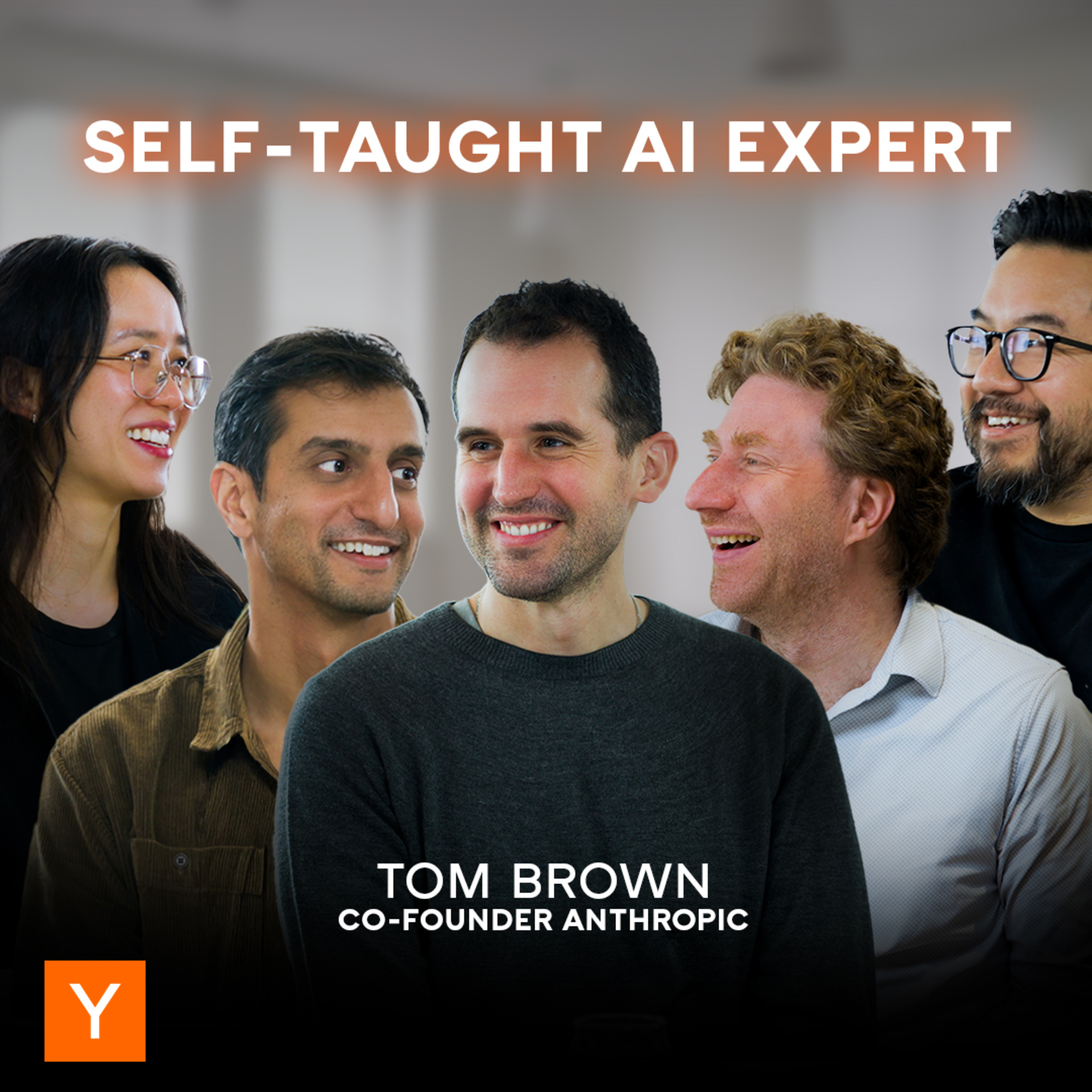
Anthropic Co-founder: Building Claude Code, Lessons From GPT-3 & LLM System Design
Aug 2100:35:56Tap to summarizeTom Brown co-founded Anthropic after helping build GPT-3 at OpenAI. A self-taught engineer, he went from getting a B-minus in linear algebra to becoming one of the key people behind AI's scaling breakthroughs. And his work is paying off.Today, Anthropic's Claude is the go-to choice for developers, and his team is overseeing what he calls "humanity's largest infrastructure buildout ever." On this episode of The Lightcone, he discusses his unconventional path from YC founder to AI researcher, the discovery of scaling laws that changed everything, and his advice for young engineers entering AI today.
Transcribe →
How to Spend Your 20s in the AI Era
Jul 8, 202500:38:55Tap to summarizeAI has upended the once "safe" CS career path.New grads are facing unemployment rates twice those of art history majors, and a CS degree is no longer a surefire ticket to wealth. At the same time, small, focused teams are scaling from zero to eight-figure revenue in months.In a special Lightcone Live at AI Startup School, Garry, Diana, Harj, and Jared discuss why it's now more important than ever to focus on building real skills, domain expertise, and agency rather than just chasing credentials.
Transcribe →
Alexandr Wang: Building Scale AI, Transforming Work with Agents & Competing With China
Jun 18, 202501:01:12Tap to summarizeAlexandr Wang started Scale AI to help machine learning teams label data faster.It started as a simple API for human labor, but behind the scenes, he was tackling a much bigger problem: how to turn messy, real-world data into something AI could learn from. Today, that early idea powers a multi-hundred-million-dollar engine behind America's AI infrastructure—fueling everything from Fortune 500 workflows to real-time military planning. Just last week, Meta agreed to invest over $14 billion in Scale AI, valuing the company at $29 billion.Alexandr joined us on the Lightcone to share how Scale AI evolved from a scrappy YC startup into the backbone of some of the world's most advanced AI systems, how he thinks about competition with Chinese AI labs, and what it takes to build infrastructure that shapes the frontier.
Transcribe →
State-Of-The-Art Prompting For AI Agents
May 30, 202500:31:26Tap to summarizeAt first, prompting seemed to be a temporary workaround for getting the most out of large language models. But over time, it's become critical to the way we interact with AI.On the Lightcone, Garry, Harj, Diana, and Jared break down what they've learned from working with hundreds of founders building with LLMs: why prompting still matters, where it breaks down, and how teams are making it more reliable in production.They share real examples of prompts that failed, how companies are testing for quality, and what the best teams are doing to make LLM outputs useful and predictable.The prompt from Parahelp (S24) discussed in the episode: https://parahelp.com/blog/prompt-design
Transcribe →