← Literature and History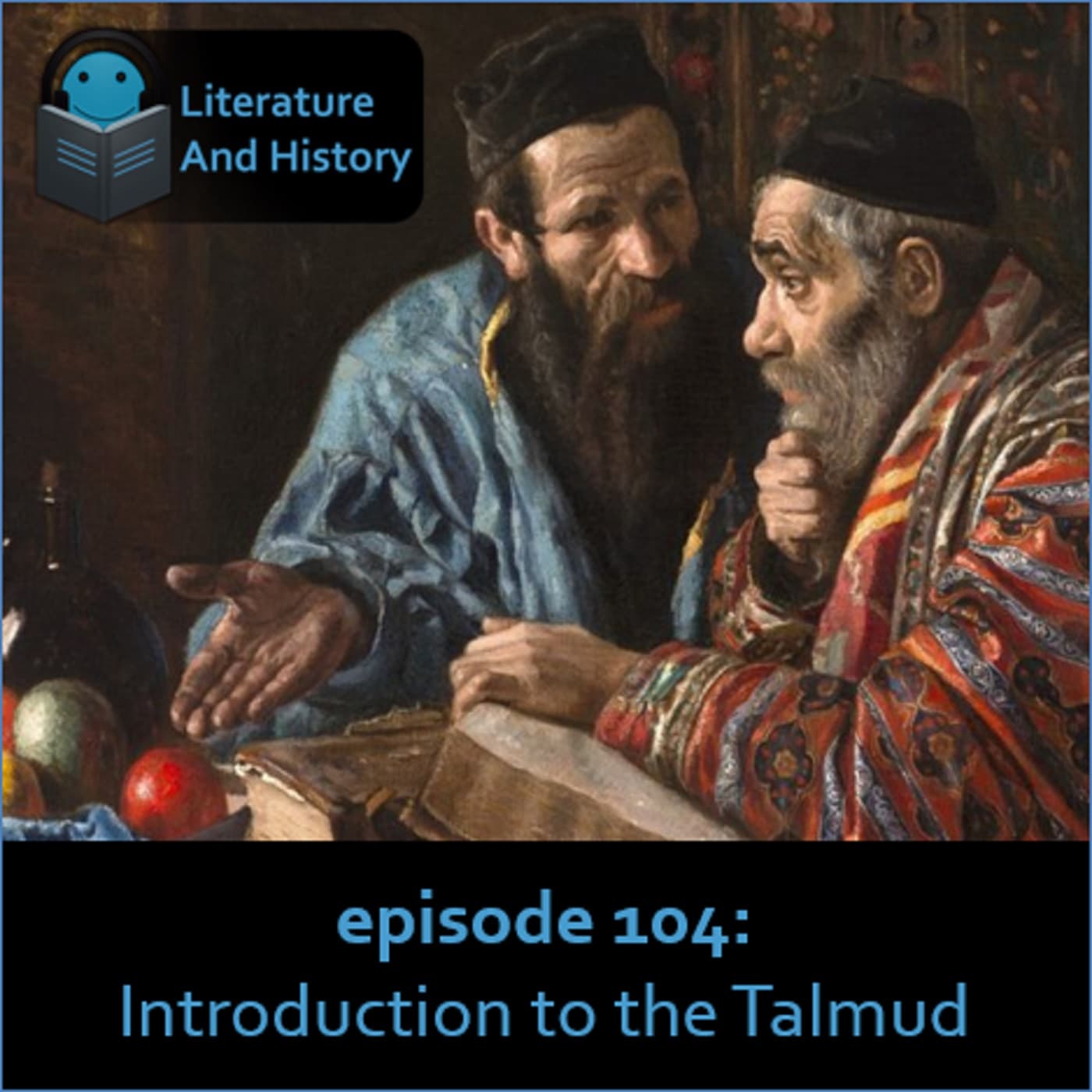
Literature and History
Episode 104: An Introduction to the Talmud
02:21:51
Second only to the Tanakh, the 63 Tractates of the Talmud are the main text of Rabbinic Judaism, containing the teachings of thousands of ancient rabbis. Upcoming Seasons: Episode 104 Quiz Episode 104 Transcription: Song Bonus Content: ...
Loading summary
Transcript20 lines
- [00:02]
Host
Literature and history.com.
- [00:12]
Co-Host
Hello and welcome to Literature & History. Episode 104 An Introduction to the Talmud in this episode we will explore the Talmud, a vast collection of ancient Jewish laws, narratives and layers of commentary on those laws and narratives completed around 600 CE and having been at the heart of Rabbinic Judaism ever since. For practicing Jews, the Talmud is a sacred body of work, second only to the Tanakh, or what Christians call the Old Testament, in esteem and cultural centrality. A gigantic collection of more than 2.5 million words or more than 8,000 pages is put into standard print. The Talmud is a finished, revered text in tens of thousands of synagogues and yeshivas today. But the Talmud is also a text that by its very nature invites questions, commentaries and further analyses. The Talmud is profound and encyclopedic. It is sometimes maddeningly dense, but it's also a deeply practical, self conscious search for truth and dignity from the heart of late antiquity, an immense group project in which hundreds and likely thousands of ancient Rabbis between about 100 and 600 CE mapped out how to honor their venerable traditions and to stay true to their ancient scriptures while simultaneously living under the heels of great empires, whether the Romans to the west or the Parthian and Sasanian Persians to the East. Lets begin by discussing what the Talmud is at a basic level. If you enter the office of your friendly neighborhood rabbi, you will very likely see prominently displayed on his bookshelves, right next to the Hebrew Bible, a set of two or three dozen volumes bound in cloth, leather or vinyl, about 14 inches in height and altogether two or three feet wide, depending on the printing and edition. These volumes are the Talmud, and on the shelves of any studious rabbi, their pages are thoroughly read and annotated. The word Talmud is often translated as study or teach, and in rabbinic Judaism, the Talmud is an activity as much as it is a set body of writing. In today's synagogues, the Hebrew Bible or Tanakh, and especially the first five books of the Tanakh, are regarded as divinely inspired writing, infallible and given direct to humanity. In contrast to the Hebrew Bible, though, the later and massively longer Talmud is understood as a human work and even a work to be scrutinized, and controverted, particularly by qualified specialists. Those two or three dozen volumes adjacent to the Hebrew Bible in so many rabbinic offices and libraries are profoundly respected. In Judaism, the Talmud is considered a repository of the wisdom of some of the best and brightest minds of the past 2000 years of Jewish theology. The Talmud, though, to repeat, is not considered a final and irrefutable authority, but instead a collection of writings, laws and narratives, and then commentaries on those laws and narratives. A text to read and to revere, but also to engage with and to question. So, on the simplest level, the Talmud is that 2.5 million word mass of pages that sits to the right of the Hebrew Bible in rabbinic Judaism. Let's go a little deeper. Let's once again pretend that you're in your neighborhood rabbi's office and you ask him if you can open one of the many volumes of the Talmud and take a look at what's printed there. Assuming that this rabbi were an obliging fellow, he would select a volume and open it up and set it on the desk in front of you. And actually looking at any given page of the Talmud would be the point at which most of us, even practicing devotees of Jud, might start to feel a little bit intimidated, because the pages of the Talmud don't look like anything most of us have ever seen before. The pages of the Talmud do not display the simple prose blocks of modern novels, nor the familiar double column print of a Bible. The page design of the Talmud is and has always been very unique. If you opened a standard edition of the Talmud on this hypothetical rabbinical desk, you would see the following and listen very carefully. You would see a central rectangle of prose inside another rectangle of prose, sometimes with partial third rectangles of prose around the second, and often with printed notes on the outermost margins of the page ringed around the inner concentric rectangles of writing. And if you asked your helpful rabbi acquaintance what the different rectangles of writing were, he would tell you this central part is the Mishnah and Gemara. Over there to the right is Rashi, and to the left is the Tosephist commentary. Down here to the lower left is Nissim ben Jacob. And then if you were me, you would stare at those nested rectangles of writing in utter bewilderment and partially just to say something. You might ask this rabbi, and this is Hebrew. And he would tell you, this here and this are Hebrew. This one is of course Mishnaic Hebrew, and this is our Tanakh. So it's Biblical Hebrew, but this part here is Talmudic Aramaic. And in providing these explanations, by the way, your friendly neighborhood rabbi really would be offering you a basic, courteous orientation session to what the Talmud is and how it works. It's just that the Talmud is, even on an elementary level, such a complicated document that it requires some specialized vocabular to understand it, since there's really nothing else quite like it out there. Before we get into the history of the Talmud and how it first came together between about 100 and 600 CE, I want to give you a crude but hopefully helpful analogy to explain what the Talmud is and how it works in just one paragraph. So, all hands on deck, kindly listeners. This explanation will be very important to the remainder of this program. A moment ago, I explained that any given page of the Talmud has a central rectangle of prose wreathed with a surrounding rectangle of prose, and frequently partial third rectangles of prose around the second one. The analogy I want to give you up front is Picture a log from a giant tree, a very old redwood. This redwood Tree lived for 2,000 years and then someone sawed it into cross sections, many very thin cross sections. In our analogy, each cross section of the tree is a page of the Talmud. The oldest part of the page or core of the tree is in the middle. The outer rings are increasingly younger. The innermost ring contains what are called the Mishnah and Gemara. I'll explain what these are in a moment. And all the concentric rings are younger commentaries on the Mishnah and Gemara, commentaries that have accrued over about 2000 years. That is how any given portion of the Talmud works. There is a textual centerpiece that's the oldest, and then there is an outer framework of ancient but somewhat younger scholarly analysis surrounding that textual centerpiece, a heartwood around which there are later growths. And before we go any further, I want to look at one a single pairing of what again is called Mishnah and Gemara. Out of the thousands of such pairings of Mishnah and Gemara in the Talmud, because the Talmud beyond yeshivas and rabbinical offices is often mentioned, but just as often misunderstood, the subject of Christian denunciations and a text occasionally vilified and burned by the Catholic Church. Outside of Rabbinic Judaism, the Talmud has generally been specialist territory at best, and slandered and misrepresented at worst. So let's begin by looking at a single page of the Talmud, because as complicated a work as it is, a single page will illustrate how the whole thing works. Alright, we have a page of the Talmud open in front of us. This page is from the third order Nashim, or women, and the second tractate within that order Ketubut, an order having to do with marriage entitlements. And it's about 3,000 pages into the Talmud's total of 8,000 or so on the page that's open in front of us, we will just focus on the square of text at the center of the page. The oldest part of our tree ring, so to speak. The oldest part of the Talmud is what is called the Mishnah. Mishnah in Hebrew means repeated study or study by repetition. And Mishnah will be one of our mandatory vocabulary words for this program. So let's learn it right now. In the middle of each page of the Talmud is the Mishnah, each of which helpfully starts with the Mishnah are one of two sorts of things. Some mishnayat are discussions of law, or halachah, the middle syllable of which kind of sounds like the word law. Halachah, A nice etymological coincidence. Halachah, law. Other mishnayat are short narratives or essays followed by discussions called agadah. So each Mishnah in the middle of each page of the Talmud is a discussion of law called halachah, or an instructional narrative and subsequent commentary called agadah. That's again halachah, or legal discussion, and agadah, or narrative and commentary. Let's hear an example that will help make all of this clear. The example that we'll look at is a Halakha, or legal discussion. This Mishnah is on the subject of women's duties to their husbands after marriage. And although this Mishnah begins with what sounds like a fairly standard legal directive, you will see that it quite quickly does something you might not expect if you are not familiar with the Talmud. This is from the Norman Solomon translation published by Penguin in 2009. There are things a woman must do for her husband. She must grind, bake bread, wash clothes, cook, nurse her children, make his bed, and knit wool. If she brings one maidservant with her, she need not grind, bake, or wash clothes. If she brings two maidservants, she need not cook or nurse her children. 3. She need not make his bed, nor knit. If she brings four maidservants, she may sit upon a throne. Rabbi Eliezer says, even if she brings a hundred maidservants with her, she should still knit, because idleness leads to wickedness. Rabbi Simeon ben Gamliel said likewise, if a husband made his wife swear not to knit, he should divorce her and pay her remuneration of their marriage contract, because idleness leads to madness. That, again, is an example of a single Mishnah from the middle of a Talmud page. It begins with a relatively straightforward law stating that women can be absolved of their duties to household work if they bring maidservants with them. But then, following this law, we hear dissenting opinions. One rabbi emphasizes that people really shouldn't just sit around because they will become wicked. And then a second rabbi responds, saying that a husband should never force his wife to stay idle because idleness is bad for you. And any woman who was just forced to sit around ought to have the full price of her marriage contract paid to her and then be released from that marriage. The many Mishnayat of the Talmud work this way. We hear a law presented in the Halachah or a narrative offered in the Agadah. Then we hear a combination of analysis and or dissenting opinions by different rabbis. It is an unforgettable experience to read the Talmud. If you have read other works of Abrahamic theology, like the Hebrew Bible, the New Testament Quran, and tracts of the Christian church fathers, we expect a monolithic story or statement or mandate, something that enforces dogma and piety. Instead, we get a giant dialectic system made of smaller dialectics. Here's a hypothetical situation, Here's a law or narrative. This person said this about it, this other person observed this, and this third person went in a totally different direction and brought this other thing up. The end. We'll look at more of the Mishnayat later on, but I wanted to begin with that example of a single Mishnah discussing women, marriage, and maidservants. Now, to move on from the Mishnah in the middle of the page, let's stay on that same page of the Talmud, and let's keep reading a little further down. The Mishnah that we read was again a Halakha, or legal discussion of women's ideal roles within marriages. And printed below the Mishnah on the Talmud's many pages, and still near the center, is what is known as the Gemara. The Gemara were written a little later than the Mishnah, and you can think of Gemara as comments sections on the Mishnah and very informed collegial comments sections. Let's look at a Gemara. I will quote part of the Gemara that responds to the Mishnah we looked at earlier, again on the subject of women's roles in marriage, and again from the Solomon translation. The first commentator in this Gemara writes, this Mishnah does not accord with what Rabbi Hiya taught, which was that wives are for beauty. If you want to make your wife radiant, buy her silk garments, and if you want to give your daughter a fair complexion, give her chicken to eat. And milk to drink and the Gemara changes subjects to discuss the Mishnah's mandate on nursing nurse her children. Is this Mishnah contrary to a ruling of the School of Shammai? Tosefta teaches if she swore not to suckle her child, the School of Shammai say she removes her nipple from its mouth. The School of Hillel say he may force her to nurse it. Notwithstanding the oath, if she is divorced from the father of the child, he cannot force her. But if the baby recognizes her and refuses to suckle from anyone else, the ex husband must pay her and force her to nurse in case of danger to the baby. So that Gemara, or to use our earlier analogy comments section, responds to the Mishnah about women's roles within marriages. This particular Gemara goes on for several pages too, reading the Mishnah at a very granular level and citing other Mishnayat and other rabbinical pronouncements that contradict or complicate the Mishnah under discussion. It asks whether all women should indeed be required to work. And then separately, the Gemara explores rules regard breastfeeding in different marital situations, winding along in a centipede of discussion that soon takes on a life of its own. So that is the Gemara, the thing that sits below the Mishnah on each page of the Talmud and analyzes the Mishnah. And we should remember that the Mishnah under discussion already contained an inset discussion. In other words, before the comments section, the Mishnah already commented on itself. What I just read to you, then, is a core sample of the Talmud and how it works. At the risk of being patronizing, let me review what we've covered so far. The Mishnah at the middle of each page of the Talmud is either a halacha or legal discussion, or an agadah or narrative. The Mishnah also contain discussions within themselves, and below the Mishnah on the page of the Talmud is the Gemara or chain of comments. In the Gemara, the opinions of later rabbis are discussed and other Mishnayot are cited that contradict or underscore the main Mishnah under discussion. There are other things on the Talmud's pages, and we'll cover those outer tree rings a little later. But what I just explained to you is strictly speaking the Talmud, Mishnah and then Gemara, Mishnah and then Gemara, Mishnah and then Gemara, and 2.5 million words of this, covering a gigant array of subjects divided into six orders and 63 tractates and produced between about 10 and 600 CE, principally in modern day Israel and then later in modern day Iraq. We will return to a more detailed look at some representative Mishnah Gemara pairings a little later in this episode and learn about the other stuff on each page of a modern Talmud. But what I want to do now is to close the Talmud for just a little while, now that we have a fundamental grasp on what it is, and to turn to ancient Jewish history History One of the great misconceptions about ancient Jewish cultural history outside of Judaism is that the sacred literature of Judaism more or less concluded with Malachi, the final book in Protestant Old Testaments. Christian church fathers were fond of citing the silence between Malachi and Matthew, in other words, the blank page between the Old and New Testaments, and inverse doing so tacitly emphasizing that after the Babylonian captivity, the luminaries of Judaism returned to Jerusalem, worked on the Second Temple and wrote Ezra and Nehemiah, and then round about 500 BCE put their pens away, stopped writing, and concluded their contributions to world culture. On the contrary, and as we've learned in past episodes, contemporary biblical scholarship studying Greek and Persian loan words in books like Ecclesiastes and the Song of Songs and various multicultural influences, and the multilingual composition of later books like Tobit, Daniel and later parts of Esther have shown that the Tanakh continued to be written up into the middle one hundreds BCE and that some of the novelistic late books like Tobit and Jonah and the Greek portions of Esther even exhibit the possible influence of Hellenistic prose fiction. Put much more simply, as BCE headed toward CE and as Hebrew slowly soaked up Greek, Persian, and above all, Aramaic influences, ancient Jewish believers never stopped producing new theology. Their most enduring theological project once the last books of the Tanakh were concluded and before the Talmud began, a critical phase of which took place between 150 BCE and year zero was called the Oral Torah. According to ancient Jewish traditions, the first five books of the Bible were given to Moses as the Israelites made their way from Egypt and up toward their eventual homeland in Canaan. These first five books Genesis, Exodus, Leviticus, Numbers, and Deuteronomy, to use their familiar English names, are in Hebrew called the Torah Moshe or Law of Moses, or just the Torah. Earlier in our podcast, we studied the documentary hypothesis and contemporary biblical scholarship on the Torah and its real historical roots in the 7th and 6th centuries BCE. But let's bracket that for now. Whether you're a practicing Orthodox Jew or a religious skeptic, the Hebrew Bible and especially its first five books, most definitely from the 6th century BCE onward have been at the heart Judaism. The Hebrew Bible and especially the Torah are full of laws. Modern Christians are accustomed to hearing about the Ten Commandments, but of course the Hebrew Bible has far more than these. To quote the Talmud on the subject Rabbi Simlay expounded, 613 commandments were declared to Moses, 365 prohibitions corresponding to the 365 days of the solar year, and 248 positive command to the 248 parts of a man's body. Every Bible out there that I know of contains those 613 commandments in Hebrew called the Tariyag Mitzvot. As all Bibleshebrew, Tewaido, Greek Orthodox, Slavonic, Catholic and Protestant, they all begin with the five books of the Torah or law of Moses. The Torah contains regulations related to animal sacrifice, temple rituals, crime and punishment, religious faith, personal cleanliness, sex, marriage and childbearing, and nearly every component of life germane to a late Iron Age settlement like Jerusalem. Mosaic Law as it's printed in the Bible by contemporary standards runs the gamut between fair and far sighted on one hand and blunt and brutal on the other. The Torah has sophisticated regulations related to financial remunerations and practical immunological directives. It also mandates that wizards must be killed, prostitutes burnt alive, pigeons must be sacrificed in just such a fashion. And it promises that animal blood on one's thumb can cure illness. Christianity's solution to the sometimes antiquated looking laws of the Hebrew Bible was over the course of the first century to emphasize that new Gentile converts didn't necessarily have to follow all the dietary rules, that Christ's sacrifice for humanity made all of the fur and feathers and sacrificial altars unnecessary, and that no one had to be circumcised in order to be saved. But Jewish thinkers, long before the birth of Christ, were already considering how to interpret, augment and update the old laws of Moses to fit the increasingly cosmopolitan societies in which they found themselves living. As the Persian and then Macedonian and then Roman empires blended the peoples of the Eastern Mediterranean together in new groupings century after century. To understand the Talmud's long history, the first step is to understand the Oral Torah. Put simply, the Oral Torah was a collection of interpretations of laws and additional laws not set down in the Hebrew Bible. The Oral Torah justified the curious and backward parts of the old Mosaic laws. The Oral Torah also added new rules pertinent to the societies in which Jewish believers found themselves living. Long after the Torah was set down, the Oral Torah, as the name implies, was allegedly passed down through generations and generations of Jewish sages. Different sects of Judaism have different ideas about when the Oral Torah first came about. Some believe that it dates back to the very moment Moses returned from the peak of Mount Sinai with the Tablets of the Commandments. Some believe that parts of the Oral Torah have this very ancient origin, but other parts came along later. And a more skeptical perspective is that the Oral Torah was born much, much later in ancient Jewish history, during the last few centuries BCE rather than the Bronze Age epoch of the biblical patriarchs. However it came about. The Oral Torah was a regulatory framework that once surrounded the Hebrew Bible, passed down in oral tradition between ancient Jewish believers, which helped annex and justify the ancient Mosaic law codes along with the historical, prophetic and wisdom books of the Tanakh. A decent piece of historical evidence for the existence of the Oral Torah comes down to us from the Jewish historian Josephus. In Josephus Antiquities, a volume on ancient Jewish history written for gentiles in about 93 cells, the historian Josephus records much about the different sects of Judaism as they had existed back during the 2nd century BCE. One of these sects, and by far the most important for the eventual history of Rabbinic Judaism, were the Pharisees. Josephus describes the Pharisees somewhat ambivalently in his works of history. On one hand, the Pharisees are a dastardly bunch, demagogues firing up the agrarian masses of ancient Israel and conniving to manipulate the Jewish Hasmone dynasty, those monarchs who enjoyed roughly a century of miraculous home rule from about 140 to 40 BCE. On the other hand, Josephus describes the Pharisees as a genuinely devout, deeply studious group who lived modestly and always resisted the temptation to let Jewish culture in present day Israel dissolve under the pan Mediterranean influence of the Greeks and Romans. And most importantly for our current purposes, Josephus writes that the Pharisees, over the course of the 100 BCE have delivered to the people a great many observances by succession from their fathers which are not written in the laws of Moses. The Pharisees, we learn from Josephus from about 140 BCE onward and perhaps long before, pay a respect to such as are advanced in years, nor are they so bold as to contradict their elders in any thing which they have introduced. And Josephus wrote again in about 93 CE that the Pharisees are those who are esteemed most skillful in the exact explication of Mosaic laws. Josephus then describes the Pharisees as a volatile and semi autonomous group in the complex world of ancient Israel in about 150 BCE1 not above the occasional cloak and dagger monarchical manipulation, but also one whose religious ideology was rooted in a respect for inherited custom and a reverence for unwritten law codes passed down from elders to return to the Oral Torah. Then evidence for the Oral Torah begins to show up on the historical record right around the middle of the 1/ hundreds BCE this was a fascinating time in theological history. The mid second century BCE likely produced the first two books of Maccabees, the book of Daniel, Judith, first Enoch and Jubilees. And so of course, we can imagine that oracular Jewish culture was developing add ons and asterisks to existing books of the Hebrew Bible as well as writing new ones in their entire. To quote an academic source on the emergence of the Oral Torah, scholar Anthony Saldarini writes that the idea of some monolithic, consistent Oral Torah is of limited value as a category because in a sense, all Jews had their own Oral Torah. That is, each locale and probably each subgroup or social class had its own customs and specific rules for how to live Judaism. These laws and customs had developed over decades and centuries. The Pharisees and later rabbis promoted a certain vision of such rules with their underlying vision of the Jewish way of life. So to review what we've learned so far, then the first thing that you need to know in order to understand the Talmud's history is the Oral Torah. The Oral Torah was a collection of additional laws and interpretations, never written down, that supplemented especially the first five books of the Hebrew Bible. According to some traditions, the Oral Torah was a monolithic thing handed down as a consistent mass from the time of Moses onward. According to modern scholarship, solid evidence of the Oral Torah's existence starts to emerge decisively in the mid-1002 BCE. And the oral Torah at this point was associated with the Pharisees, ultimately the most important and influential sect of Judaism to emerge before the Common Era. Whether we believe that the Oral Torah was one thing handed down by generations, as Orthodox Judaism generally teaches, or we take a modern scholarly approach and assume that supplementary laws and interpretations grew organically in Jewish communities according to the needs of different places and times, one very simple thing is certain. In the final two centuries BCE, there was an immense amount of energy in devout Jewish communities to comprehend, to clarify and to add to the existing books of the Hebrew Bible. Oral traditions in these communities by the first century CE had begun to have the force of doctrine and Judaism as a whole began to do something at once paradoxical and astounding. By year zero, the Roman Republic had become an empire. Greek was the international language of the Eastern Mediterranean, and indigenous religions rooted in specific temples, were washing away under the press of salvific cults and Roman whims. More than ever, the ancient truisms of the Torah seemed to need qualifications. The biblical kingdom of Judah had become the Roman province of Judea, and a Roman fortress sat adjacent to the great Second temple of Jerusalem. Jews were living all over the place, speaking Greek and hanging out with Greek and Latin speakers. Sacrificing animals at the Jerusalem Temple wasn't possible for the diasporic community. It did not seem as though some sort of Davidic monarchy rooted in a pastoral and agrarian economy in the small territory of the Levant, had a realistic shot at pummeling the Roman and Parthian empires on either side of Jerusalem into submission anytime soon and ushering in a final epoch of prosperity. Further, the law codes of the Torah, while majestic in their language and well known in practicing communities, sometimes had all the subtlety of a sledgehammer and didn't always serve very well. To help navigate morally and legally gray areas where finer instruments were needed, the religion required a new tool. A tool which conservatively held up the sanctity of the oldest scriptures and at the same time progressively augmented them to fit the more complex realities of the first century ce. This tool was called the Mishnah. And the Mishnah by all means the heart of the Talmud on the middle of every page was set down between about 10 and 220 CE. What we call the Mishnaic or sometimes Tanaitic period, lasted from about 10 to 220 CE. Between 10 and 220 CE, the Mishnah was produced as a tool to codify and clarify the Oral Torah for posterity and to offer Jewish communities at home and abroad a decisive compendium of non biblical Jewish wisdom. The Mishnaic period bookended two extremely eventful and harrowing centuries for Jewish residents of the Levant. So let's take a moment to review some of the salient moments of Jewish history during the Mishnaic period, because a couple of events almost always get brought up as primary motivators for what eventually became the main substructure of the Talmud. When we read the Mishnah, those tree ring centers or seeds of discussion at the core of the Talmud's pages, like the one we looked at earlier, their measured acumen and their courtesy seems surprising. Considering the traumatic events that unfolded in Jewish history between 10 and 220 CE, the first of these events was the first Jewish Roman war of 66 to 73 CE. We've talked about this war before, but let's do a quick recap. By the 50s and early 60s CE, many of the Jewish inhabitants of the Roman province of Judea weren't too keen on having Latin and and Greek speakers stomping around their streets and farm fields doing iffy pagan stuff, inviting Jewish kids to pal around with Greeks, to the bathhouse, to hang out at the theater, or to watch sacrifices made in the names of Roman emperors. While by year zero, the religious masses of ancient Israel had paid their taxes to distant emperors and swallowed their nationalistic pride for many generations, there were still certain lines that colonizing forces absolute could not cross. One of these was the profanation of the sacred Jewish Temple. The Seleucid king Antiochus IV had made this mistake back in the 160s BCE, which led to the Maccabean revolt. And in 66 CE, another foreign overlord pushed the devout populace of Jerusalem too far. This was the Roman procurator Gesius Florus, an openly anti Semitic provincial governor who favored Jerusalem's Greek populace. Population disregarded Jewish legal complaints when Greeks profaned their worship sites, stole 17 talents of gold from the temple treasury, and then, when Jewish satirists dared to mock him, murdered and tortured these dissidents and other city leaders. These offenses led to the assassinations and insurrections that began the first Jewish Roman War, a war which resulted in the destruction of the great second temple in 70 CE and a final awful siege at the fortress of Masada over the last months of 72 CE. The destruction of the second temple in 70 CE is deservedly seen as a watershed moment in ancient Jewish history. Much of the Torah, after all, assumes the existence of a central temple in Jerusalem. And so after 70 CE, more than ever, the religion needed ways to adapt to a changing and unstable world. World scholars believe that the Mishnah, that oldest central part of the Talmud, was commenced half a century before the destruction of the second Temple. While the Temple's destruction and Roman victory in the First Jewish Roman War of 66-73 CE remains one of the great tragedies of Jewish history. This turning point also inspired devout Jewish sages, both in Judea and elsewhere, more than ever to engage with the Hebrew Bible, so that its laws and lessons were still potent in a world that was transforming with dizzying speed. The 70s and 80s CE brought important changes to the central religious hierarchy of Judaism. The Talmud itself tells of friction and contrasting opinions between the religious leaders of Jerusalem while it was under siege by Romans, some authorities advocating appeasement and others fiercely opposed to any measures that would impinge on following Mosaic law. During the First Jewish Roman War of 66-73 CE, a famous religious leader known as Yohanen Ben Zakai, or Ribaz, was allegedly smuggled out of the city in a coffin, after which he negotiated directly with the future emperor Vespasian. Ribaz wanted to secure a safe location for Jewish sages to continue their religious studies beyond the immediate war zone of Jerusalem. Ribaz, one of the earliest and most beloved rabbis in Jewish tradition, then set up a new scholarly operation in the village of Yavneh, about 30 miles west of Jerusalem, while the war was still raging on. It's a narrative worth reading in the Talmud, a sort of ultimate tale of adaptation and innovation in the midst of persecution. Yohanan Ben Zakai's story is not only a poignant one. His escape from besieged Jerusalem also marks an important transition in the history of Judaism's leadership structure. This transformation was a gradual move from a dynastic priesthood seated in the Second Temple in Jerusalem and a central council that surrounded that priesthood, toward a more decentralized and meritocratic body of leaders called rabbis. Rabbi comes from the Hebrew word rabbi, which means my teacher, demonstrating that the office of the rabbinate in all likelihood evolved from arrangements between instructors and students. It is during the Mishnaic period, once again, roughly from 10 to 220 CE, that the work rabbi starts being used in scholarship to describe a definitive clerical office. And Yohanan Ben Zakai, that religious leader willing to compromise with Roman military strongmen to relocate, to evolve, and to keep the intellectual engine of Judaism running in spite of the war going on, is the earliest person called a rabbi in the Talmud. Yohanan Ben Zakai, then, often gets the credit for being the first rabbi, and certainly laid the groundwork for rabbinic Judaism forever after. Inasmuch as Yohan and Ben Zakai did help continue the studious traditions of the Jewish clergy right through the war, we should remember that the vocation of rabbi likely grew naturally through communities outside of Jerusalem and the greater Diaspora, rather than due to some decisive announcement broadcast after the destruction of the second temple in 70 CE. In parallel movements over the course of the second century, the office of the Episkopos, or Christian bishop, also seems to have begun to solidify, just as the office of the Zoroastrian Magi was developing in the Parthian Empire to the east. During the same period, devout believers within great empires needed community hubs in contact with one another. And over the 1/ hundreds and 2/ hundreds, rabbis, bishops and magi served to lead like minded congregations in heterogeneous and intercontinental empires. To turn back to the Talmud, though the heart of Judaism's great dialectic text was already being written by the time the second temple was destroyed in 70 CE and the Mishnah continued being written through the next rocky century, continued friction between Jewish communities and Greco Roman civilizations and officials, predominantly in Judea but also Alexandria, resulted in a series of bloody uprisings between 115 and 117 uprisings in present day Libya, Egypt, Cyprus and Israel. In all cases, Jewish insurrections were forcibly put down. The Talmud laments the death of those slain at Lydda, which may describe Jewish rebels massacred southeast of Tel Aviv or or perhaps Laodicea in western Anatolia. These revolts of 115 to 117, undertaken while the Roman Emperor Trajan was fighting wars with the Parthian Empire to the east, grows out of a combination of Jewish frustration, of mistreatment of diasporic communities, as well as Jewish nationalism in Judea itself. And while the geographically dispersed events of 115 to 117, generally called the Kidos War by historians, are poorly recorded in a scattershot array of different sources, the events of the Bar kokhba revolt of 132 to 136 CE or the Third Jewish Roman War are far better attested. By the 130s CE, Jerusalem already bore the scars of the past generation's wars. Temple Mount still rose over the Old City, but it was now crowned with rock and ruins. Mutual prejudices between Greco Roman and Jewish citizens were exacerbated by the recent history both sides had shared and by Rome's provincial policies continuing to discriminate against Judea's native population. In a chilling repeat of the events of 66 to 73, the firebrand that began the war involved Temple Mount. The Roman emperor Hadrian, on the throne from 117 to 138, had begun a reconstruction of the Old City, naming it Ilia Capitolina and commencing a third temple there, a shrine honoring Jupiter atop Temple Mount. This temple was beyond the pale for the devout masses of Jerusalem, as low as their expectations must have been by that point. Another uprising followed, this one spearheaded by a charismatic and authoritarian military leader named Simeon Barkley. The war that stretched between 132 and 136 was again won by Roman forces, but as before, at an unexpectedly great expense to the empire. And while the Roman emperor Hadrian himself and his best generals were all marshaled to defeat Judea's rebels, the cost to the old Jewish heartland was cataclysmic. To quote the Roman historian Cassius Dio, who wrote the following passage earlier, around 200 CE, by the end of the war, 50 of the most important garrisons of the Jews and 985 of their most renowned towns were blotted out. 58 myriads of men, or 580,000 men, were slaughtered in the course of the invasions and battles, and the number of those that perished by famine and disease and fire was passed, all investigating. Thus nearly the whole of Judea was made desolate. Very few of them survived. Judea and its neighboring provinces of Galilee and Samaria were consolidated into one administrative region called Syria Palestina, an ancient name for the region harkening back to its earlier Philistine population that the Grecophile Hadrian may have learned of in the pages of Herodotus. While Jews continued to live and work throughout syria palestina after 136, the Bar Kochba revolt and its aftermath led to ever greater diasporic populations of Jewish settlers scattering more and more widely, most importantly for the purposes of the Talmud, into the eastern lands of Mesopotamia and the aging Parthian empire. So that was the history of the three wars that Jewish men and women fought with Rome between 66 and 136 CE, a history pivotal to the creation of the Talmud. While this 70 year period gave rise to a diaspora that endured for the next 1900 years, it was also the core of the Mishnaic or Tanitic period, the period that produced both the Mishna. In addition to laying the seeds of the Rabbinate as an increasingly standardized clerical position, the Rabbinate seems to have emerged slowly as an office. Scholars Hannah Cotton and ada Yardeni, surveying 60 primary manuscripts from the Judean desert dated between 66 and 135 CE, found that none of these manuscripts calls anyone a rabbi at all. While the aforementioned Yohanan Benzakai, smuggled out of Jerusalem around the year 70, often gets called the first rabbi, the formal title only appears in the historical record during the third century. And central to the emergence of the Rabbinate as an office was a man named Judah Hanasi, or Yehuda Hanasi. Judah Hanasi was the great great grandson of Gamliel the Wise pharisee teacher of St. Paul, who, according to the New Testament Book of Acts treated Christians with a live and let live attitude. Through this great great grandfather Gamliel, Judah Hanasi traced his own lineage back to King David. By the year 200 CE, Judah Hanasi was a respected theologian and two generations had passed since the events of the Bar Kochba revolution. During these two generations, Roman animosities against Jews seem to have died down to such an extent that if we believe the Talmud on the subject, Judah Hanasi was rich and widely respected in the Roman capital. Judah Hanasi may have been regarded by Roman officials as a useful middleman between Rome and Jerusalem. A religious leader able to resolve disputes on his own without troubling Rome's procurators and other provincial officials angels. Judah Hanasi's name is actually a title. The title Nasi, plural Nissim means president or prince. And the Naeum rose to prominence in Palestine from the 200s to the 4/00 CE. The Naeum, again presidents is a common translation, can be understood as Judaism's religious patriarchs in the province of Palestine during this period of late antiquity. During these centuries, Judah Hanassi and his successors promoted the Rabbinate as the clerical office of Judaism and they promoted the Mishnah as second only to the Tanakh among the Jewish clergy. The Nissim, latter day high priests of Jewish late antiquity had to walk a fine line between exerting their authority in the province of Palestine while at the same time deferring to Roman rule and later Roman Christian rule rule. The patriarchate established by Judah Hanasi seems to have guttered out between 400 and 450 as adjustments to tax law. Reflecting the growing intolerance and extremism of St. Augustine's generation of Christians made it difficult for Judah Hanassi's successors to do their jobs in spite of Christian prejudices turning against them. Though the Nissaeum had ultimately been successful in spreading the rabbit as an office and the Mishnah as its theological instrument. In addition to helping to consolidate the office of the rabbi, Judah Ahanasi left something more material behind. What he left behind was a redacted or edited and arranged version of the Mishnah, the nucleus of the Talmud. The Mishnah, a central rectangle of prose at the heart of every page of the modern Talmud. Talmud was the Oral Torah set down for posterity. The Mishnah, however, was only the beginning of the Talmud. Its completion and redaction at the hands of Judah hanasi roughly around 220Ce marks the end of the Mishnaic period. What came after it was what we call the Amaric period. During this period, the Gemara, or first main commentary on the Mishnah, would be created over a vast expanse of territory. Territory much of which was far away from modern day Israel. The story of Judaism, as always in history, ranges far more widely than the heartland of Israel. Back during the glory days of Rome, the writers Cicero and Ovid and Seneca were all exiled from the capital to outlying provinces and each man bemoaned his banishment in copious tear stained letters and poems. Neither Cicero nor Ovid nor Seneca ever thought of simply leaving Rome altogether and venturing out into the wild blue yonder of greater Eurasia or Arabia or Africa. But late antiquities Jews faced migrations far longer and more severe than those of Rome's patricians. And while a lot of late antique Jewish history was rooted in modern day Israel, an equal amount of this history was rooted rooted in modern day Iraq and Iran. Let's picture Iraq and Iran in our minds for a moment and get the centuries of 200 to 400 in our heads. In the pages of late antiquity's Jewish historians, this region often gets the confusing name of Babylonia. This is a confusing name because by the year 200 cells, the empire of Babylon had been extinct for over seven centuries. The name Babylonia, however, lived on as a descriptor of a certain region of the Persian Empire. The remains of the once great city of Babylon sat roughly 50 miles downriver from modern day Baghdad. And for our purposes, Babylonia is more or less synonymous with what Greeks and Romans called Mesopotamia, the land between the rivers and the agricultural breadbasket of modern day Iraq. By the year 200 CE, Babylonia or Mesopotamia or whatever we call it, was and had for a long time been part of a much larger empire. The greater territories of modern day Iraq and Iran were home to two Persian empires while the Talmud was being written. First the Parthian Empire, which lasted until 224ce, and then then the Sasanian Empire which took its place after 224. Rome's eastern neighbors held their own innumerous conflicts during and before the five centuries of the imperial period. The Parthians and the Sasanians, like the Romans, were gigantic entities that sponged up all sorts of populations over their long tenures of rule. One of these populations that they sponged up were diasporic Jews. Especially after the Jewish Roman wars that we discussed earlier, Jewish immigrants often found the Persian empire to the east more accommodating than the streets of Jerusalem, Such that by the mid-1100s, Jews in the Parthian east were governed by an official called the Resh Goluda, or head of the Exile or Exilarch. This exilarch over the 200-00 and-300-00 and headquartered in Babylonia, oversaw the bustling and itinerant masses of Judaism's Eastern theologians. Two of these theologians, Abba Ben Ayu, or just Rav and Shmuel, or sometimes Shmuel, were instrumental in bringing the Mishnah out to the Persian East. They were at the center of the creation of the Gemara, that second main component of the Talmud, that is a commentary or elucidation of the earlier Mishra. As the Eastern rabbis, Rav and Shmuel brought the Talmud from its first phase of production, the Mishnah, to its second phase, the Gemara. They accrued many followers and they added their own writings and rulings during the first half of the 200s CE. The changeover from Parthian to Sasanian leadership in 224 CE was at first a bumpy for Jews in the Persian East. The ancestral religion of modern day Iran, Zoroastrianism, was solidifying into consecrated offices, and Sasanian Zoroastrianism slowly hardened into a state religion as the two hundreds led to the three hundreds, a century before Roman Catholicism did the same to the West. A short precept of the third century Rabbi Shmuel was that the law of the realm is law. The statement appearing near the beginning of the Talmud's fourth order, concisely tells readers to curb their religious zeal and keep their heads down when occasions require it. Chastening but practical advice for a minority religious population in any place and time. It was evidently a directive that Shmuel himself practiced, because the Talmud records this Eastern rabbi having a very friendly relationship with the powerful Sasanian emperor Shapur I, who ruled from about 241 to 272. The Eastern rabbis, whom the Talmud calls Rav and Shmuel, central to the creation of the Gemara, along with their students and the next few generations of Jewish theologians, lived through a period of bifurcation. Jewish history over the course of the two hundreds and three hundreds to the west, between 200 and 400, Rome was a mess. Barbarian migrations and civil wars made life difficult for everyone. And after the Emperor Constantine's conversion to Christianity in 312 and the Edict of Milan in 325, imperial policy grew increasingly intolerant of communities that were not Nicene Christian. In Contrast, though, between 200 and 400 over in the Persian east, the new Sassanian regime was comparatively stable, and Eastern rabbis and exilarchs seem to have been adroit at keeping their communities safe and secure. What these Eastern communities produced was the Gemara once again that commentary or elucidation of the Mishnah, which itself was a redacted oral Torah. As we learned earlier, a Mishna is either halacha or legal discussion or agada, meaning narrative and commentary, and the Gemara follows each halacha or agadah as an extended further commentary. The other components of the Talmud, put very simply, are further onion layers of commentary by later generations. But all of it orbits around the Mishnah and Gemara at the heart of each page. The text that we call the Babylonian Talmud or Bavli, came together over a long period of relative stability in the Persian Sasanian empire between about 220 and 600 CE. For most of late antiquity then, Jewish intellectuals had a relatively secure region in which they could live and work as the Gemaras commentaries were added to the Mishnah. Over these centuries, the Sasanian Empire seems to have seen the Roman, Roman and Byzantine empires as far greater threats than minority religions, and Judaism appears to have fared fairly well there. It's interesting to consider why, for one, ancient Judaism and Zoroastrianism seem as a rule to have always coexisted harmoniously alongside one another. Late antique Jews would have remembered all the positive press that the very ancient Persian king Cyrus the Great receives in the Tanakh. And from the moment this Achaemenid monarch helped liberate Jewish captives from Babylon way back in 539 BCE, we have far more records of Jewish populations rebelling against Greek and Roman regimes than Persian ones. For two Relatedly, Judaism and Zoroastrianism are each ethical monotheisms with vast scriptural traditions, apocalyptic and messianic prophecies, and perhaps overall more cultural similarity to one another than Judaism had shared with the sexually freewheeling theologically non committal ranks of ancient Greeks and Romans. For three if the Gemara were indeed the main intellectual project occupying Sasanian Jewish rabbis during late antiquity, it is hard to think of a less threatening activity for a religious minded minority population to be undertaking in a great empire. A multi generational disputation about, for instance, the correct clothing deportment for those preaching, or fiscal inheritance rights for Jewish sons and daughters, or rules related to whether hermaphrodites can issue binding vows. And these are all the subjects of real Mishnah Gemara pairings in the Talmud. These sorts of intricate discussions didn't exactly threaten threaten the sovereignty of a ruling empire. Put briefly then, late antique Jews in the Sasanian Empire were for the ruling officials there, a known quantity not bent on proselytizing, cooperative with shahs and nobles, and more likely to while away the hours with theological dialectics than to foment a rebellion or skimp on tax payments. And Babylonian Jews, those within the smaller region of Mesopotamia, also had a direct line of communication with Persian Sasanian kings, as the exilarch, along with other minority religious leaders, seemed to have been permitted audiences with Sasanian monarchs between 200 and 600. Then, especially in Mesopotamia, the Gemara were appended comment by comment by comment by comment comment to the already existent Mishnah. These were centuries of remarkable religious diversity in the Sasanian Empire. And so it's little wonder that Rabbinic Judaism's signature creation is so complex, polyvocal, and so intensely self aware. It's also little wonder that subsequent generations continued to contribute their own commentaries. And while we've covered a lot of background already, and I can't wait to look at some more of the Talmud in detail with you in a min minute, I want to tell you just a little bit more about the compositional history of the Talmud. There's a lot more we could discuss, even in this introductory episode about the Talmud's composition, what happened to it when the Sasanian Empire collapsed in the 630s and 640's an important epistle from the year 987 CE from which a lot of the history on the Talmud comes down to us, and when it started getting set down in manuscripts altogether and carted around like so many other works of sacred literature. We don't have some master copy of the Talmud dated to say, precisely 630 CE that was packed in a suitcase in the ailing Sasanian Empire and safely locked away for posterity. The earliest extant copy is actually from 1343, and the earliest manuscript fragment can be dated to 1123. The porous nature of the Talmud is another subject that's been under discussion since the late 1960s. When you have a sprawling document with thousands of quotes attributed to named and anonymous rabbis, it would have been pretty easy for a copyist in the year 300 or 400 or 500 to insert his own editorializing into the text and pass it off as wisdom received from previous centuries. While we can pass over some of the more recent scholarship on the Talmud, we do need to cover a final couple of facts about its compositional history. The first of these is that there are actually two Talmuds, the Babylonian Talmud, or Bavla, and the Jerusalem Talmud, or Yerushalmi. In this episode, we are following most extant rabbinical Jewish history by concentrating on the longer, more complete and less fragmentary Talmud again, the Babylonian Talmud. The Jerusalem Talmud, also important to Jewish history and currently a very fertile ground for scholarship, was finished earlier in about 450 CE than the Babylonian Talmud. Authored in the synagogues in the northern part of the province of Palestine rather than down in Jerusalem, the Jerusalem Talmud seems to be less tenacious about reaching legal decisions in case discussions and is more peppered with Greek language and aphorisms than its Babylonian counterpart. Though both the Babylonian and Jerusalem Talmuds explore the Mishnah, the Babylonian Talmud was embraced by heads of Jewish accounts academies during the first Islamic caliphates, while the Jerusalem Talmud fell into comparative obscurity and did not survive in its entirety. So put plainly, there are two Talmuds, but the Babylonian Talmud is the one that's been at the heart of Rabbinic Judaism, and so it's the one on our desk today. So the Babylonian Talmud, hereafter, as before, just the Talmud, even when extracted from the wreaths of commentary that frame it to bring it to that age 8,000 plus page monolith on so many rabbinical bookshelves, was still a whopper of a text by the end of late antiquity. It was also quite a challenging text. First of all, the Talmud's core tree rings, to use our earlier analogy, were written in different languages. The Mishnah were authored in a language called Mishnaic Hebrew. Mishnaic Hebrew was a descendant of Biblical Hebrew Hebrew, and it appears in archaeology from roughly 0 to 300 CE. Not uncoincidentally the centuries that encompassed the writing of the Mishnah. The language of the Mishnah is therefore a Hebrew 500 years younger than Biblical Hebrew, and inflected with the linguistic changes that swept modern day Israel during these centuries, the language of the Gemara, again the comments sections, is a different one. One the Gemara is written in a language called Talmudic Aramaic or Jewish Babylonian Aramaic. Aramaic, more generally was one of the most pervasive languages of the ancient near east, the spoken tongue of the Neo Assyrian and Neo Babylonian empires, and the language that during Old Testament times, Jewish expatriates would have heard being spoken on the streets of Babylon way back during their captivity in the 500s BCE. If Greek were the language of the Aegean and later the lingua franca of Alexander's empire, just beneath Greek in the near east, was the older lingua franca of Aramaic, one that could get you by well into the common era throughout a lot of modern day Iraq, Syria, the Caucasus region, Anatolia and the Arabian Peninsula. Even though all of these regions had their own Arabic of native languages, Talmudic Aramaic then, or Jewish Babylonian Aramaic was the spoken and written language of the Mesopotamian Jews who contributed to the gemara between about 220 and 600 CE. Anyone who wants to read the Mishnah and Gemara then needs fluency in these two languages. But there are far more complex to the text than dialectical. Chains of comments are often printed with abbreviations and make reference to a huge array of bygone rabbis without specifying which rabbi is which, or clarifying, for instance, which Rabbi Yehuda is being referred to. The Talmud lacks quotation marks, references to chapter and verse, or references to other Mishnayad being quoted. And without such differentiations, the Mishnah Gemara pairings can be completely bewildering. A law might be stated in a Mishnah and then two named rabbis opinions are recorded. But as Mishnah ends and Gemara begins, a swath of text unrolls in which the Tanakh, Mishnah and dozens of different rabbinical opinions are printed, unmodulated by modern typography. For this reason, for the past thousand years, the Talmud has accrued two main uber commentaries designed to make the central Mishnah Gemara doublets easier to understand. The first of these commentaries is that of a famous rabbi named Rashi. Rabbi Shlomo Yitzchaki, or rashi, lived from 1040 to 1105 in the northeastern part of modern day France. During the 10th and 11th centuries, a steady trickle of texts was coming into Europe from Islamic Golden Age cities in Syria and Mesopotamia, through North Africa Al Andalus, and into Europe. While the Babylonian Talmud, with its massive methodological approach to Jewish law, had remained a fixture of Jewish religious schools in Babylon, the Babylonian Talmud in the year 1000 was only slowly making its way into circulation into the Jewish communities of Western Europe. Rabbi Shlomo Yitzchaki, or again just Rashi, was not the first Western European rabbi to read or comment on the Talmud. But Rashi was inexhaustible in his desire to clarify and explain the Talmud's most daunting passages. Disentangling complex syntax, differentiating questions from statements, and sorting out confusing pronouns were all part of Rashi's detail work. Rashi also, hundreds of times over the Talmud's thousands of pages, simply writes, this is the correct reading, aiming to lift some ideological consistency out of the Talmud's many meshes of contrasting opinions. While never considered infallible, Rashi's relentless desire for clarity has made his commentary on the Talmud an essential part of the text for nearly a thousand years. And on the right side of the Mishnah and Gemara in today's Talmuds, Rashi's steady stream of marginal notes remains a life preserver for those new to the Talmud, which was exactly what he intended when he wrote them back in the late 1000s. Two other commentaries frame the Mishna Gemara double throughout a vast quantity of the Talmud. One of these is the commentary of Nissim Ben Jacob, a slightly earlier contemporary of Rashi, who worked in east central Tunisia during the first half of the 1000s CE. His commentary Hamaph Teach or the Key, offers source notes on the Talmud's thousands of cross references, in other words, chapter and verse, for places where a Gemara references or quotes a Mishra without specifying the source. And while Nisim Ben Jacob pinpoints these cross references, he also offers explanations and comments on them too. And a third commentary, alongside that of Rashi and Nisim Ben Jacob also reads the Mishnah Gemara pairings across the Talmud. This third commentary is called the Tosaphot, and it sits to the left of the Mishnah and Gemara, opposite the older commentary of Rashi and often adjacent to the notes of Nissim ben Jacob. Tosaphot comes from the Hebrew word meaning addition, and the Tosephists who wrote them were rabbis who worked and lived in France and Germany between the 1100s and 1400s. There were dozens of these rabbis. The earliest of them were Rashi's descendants, and so the Tosaphot commentary sometimes comments on Rashi's comments. But much of the Tosaphot is just analysis and explanation of the Mishnah and Gemara themselves, too, diving into some of the more difficult passages of the Talmud. Written at a point when much of the Talmud was already a thousand years old, the Tosaphot, or sometimes Tosephist commentary, is sometimes unapologetically convoluted. Its authors, after all, lived in the wake of generations and generations of qualified Talmudists and lived and breathed not only Halachah, again rabbinic Jewish law, but also lived and breathed a whole history of detailed disputation about Halacha, while Rashi's commentary to the right of the Mishnah and Gemara is a continuous one, penned by a single individual with an overall desire for clarification and legal consistency. The Tosephist commentary to the left of the Mishnah and Gemara is more complex and academic, often as interested in critical debate as it is interested in the Talmud itself. So to take us back briefly to the beginning of this episode and to review if you went to your neighborhood synagogue and asked the rabbi if you might please take a look at the Talmud when he set it down on his desk and opened it in front of you, you would see the column in the page's middle is the Mishnah, a compendium of halacha, or laws and discussions of them, and the Agada, or short narratives and discussions of the them. The Mishnah in Mishnaic Hebrew came together between about 10 and 220 CE, and the epicenter of its composition was northern Israel. Below the Mishnah you would see the Gemara in Jewish Babylonian Aramaic, a commentary on the earlier Mishnah, which was produced largely in modern day Iraq between about 220 and 600. To the right of the Mishnah and Gema Gemara, you would see the helpful and dependable commentary of Rashi, written during the late 1000s in France. To the left of the Mishnah and Gemara you'd see the Tosephist Commentary, a more academic and polemical critical commentary that discusses everything on the page done in France and Germany between about 1100 and 1450. And in places to the lower left you'd see the notes of Nissim Ben Jacob, particularly on sources of quotations in the Mishnah and Gemara set down in what's today Tunisia in the early 1000s. And that in a mere 10,000 words, by the way, is a basic explanation of a single page of the Talmud. There are other glosses and marginalia printed in modern Talmud, some of them fairly important, but for our purpose purposes, Mishnah, Gemara and the commentaries of Rashi, the Tosephists and Nissim Ben Jacob are plenty to learn about in one podcast episode. While the Babylonian Talmud is, to be very precise, just the Mishnah and Gemara in today's yeshivas, an understanding of the core Babylonian Talmud alongside the additional elucidations of Rashi Jacob and the Tosephists, is considered the foundation of Talmud. Again, learning what you see then, when you look at a page of the Talmud is something like a prism, with the Mishnah being the beam of pure white light and all the commentaries around it, the multicolored interpretations and discussions of a subsequent Thousand and a half years of scholars, scholars from all over the Middle East, Europe and North Africa, Jewish or gentile, rabbi or laity. It is a complex document, but also, apart from some gnarled portions of the Gemara in Tosaphot, a surprisingly friendly one. Today, the 42 volume Koren Talmud provides a full scholarly edition with color illustrations and bilingual page design for speakers of English and Hebrew. Several organizations have offered hyperlinked and cross referenced online editions for free. While these modern resources help newcomers understand this vast work, really the work of the Talmud has always been about teaching and instruction. From the early first century when Jewish residents of Roman Judea sought to formally codify the Oral Torah, up until today, when millions and millions of words have been added to the Talmud and materials often associated with it. So now you know the history and structure of the Talmud, what we need to do now find, finally, is to discuss its contents a bit more. With six orders containing a total of 63 tractates, each order contains somewhere between six and 12 tractates. The Talmud aims to take the ancient framework of Mosaic law and the long history of the Oral Torah and create a guide for how to be a devout Jewish person in a complex world. Let's talk about the overall architecture and contents of those orders and tractates. The first order of the Talmud, Zeraim, or seeds, covers land ownership, law, laws, charity to the poor at harvest time, the bestowal and celebration of first fruits, challah, bread and other important foods in their preparation and purity, tithing and debt payments, leaving fields fallow during Sabbath and jubilee years, and the correct germination of crops, including regulations on crossbreeding and combining different produce in different fields on down to trellises, layering, grafting, and so on. When the order Zeraim was written, the province of Judea, later Palestine, was under foreign rule. And so not all of the 600-year-old land laws and agricultural regulations of Leviticus and Deuteronomy fit very well with the realities of Jews living in a Roman world of commerce and coin money. Nor certainly later commentators lived in the Sasanian empire and later still commentators living in medieval France. In Germany, the first order of the Talmud, Ziraim again Seeds, seeks to expand, update and develop sacred law regarding property and agriculture. Tithing is a topic of particular importance in this order, and somewhat of a touchy one. The agricultural and pastoral offerings require of temple attendees in the Torah were a partial anachronism in the later Roman world, with no temple and so long, generations of rabbis had to clarify how congregations might make offerings. These tithing congregations in turn created a subgroup of worshippers sometimes resented by the larger body of non tithing Jews where they lived. So again the first of the Talmud's six orders orders is zeraim or seeds. The second order of the Talmud is Moed, meaning festivals or appointed times. This order first deals very extensively with Sabbath regulations, rules governing sunset on Friday up to the time when the stars are in the sky on Saturday night. Moed covers Hanukkah fairly quickly. This was a delicate topic for Jews on Roman soil because its roots lay in the Maccabean rebellion of the 160s BCE and then in some of the most heavily trafficked chapters of the Talmud today. The second order Moed lays out what is permitted and what is forbidden on the Sabbath with a special tractate devoted to traveling on the Sabbath. The second order Moed then goes on to describe Passover regulations, related scheduling rules around leavened bread and all the new foods diet diasporic Jewish people were encountering, what to do when Passover directives contradicted Sabbath directives, and how to hold the Passover meal. Yom Kippur is detailed next its prohibitions and correct preparations for it, and then Sukkot and the construction of booths, and then more clarifications of how Sabbath law dovetails with the laws of other sacred holidays. The order Moed then lays out rules and discussions on Rosh Hashanah and more generally the Jewish annual calendar, then public fasts held for ritual purposes during long droughts, and then Purim. In the reading of Esther, Moed clarifies what the middle days of multi day festivals are to be used for and sets out certain key exceptions and that's Moed meaning festivals, the second of the Talmud's six orders. I should pause here for a moment as I offer you this high level level summary and reminds you that the Talmud is neither linear nor dictatorial. When you actually read one of its tractates, the fundamental architecture of the text is such that rules or illustrative narratives are set out. But then often rules or narratives are questioned and exceptions are entertained and discussed, and such discussions become discursive, winding into other related topics and sometimes tangential topics. This is part of what makes the Talmud challenging, but also fun as a discussion of the minutiae of correct clothing deportment or what constitutes the corner of a property can blossom into a profound conversation of much more consequence than the subject ostensibly being analyzed. As you return to the rest of this summary, then remember that the Talmud doesn't slam down rules rules with the unselfconscious brazenness of Exodus and Leviticus, but instead using rules from these older books, discusses their application implications and sometimes fallacies in the real world of late antiquity. On to the third of the six orders of the Talmud. This is Nashim or women. Nashim begins by exploring the nuances of Mosaic law on what are called leveraging marriages, the name for a marriage when a married man dies childless and his brother marries his widow. Nashim's discussion of vaginal contraceptives rules that certain kinds of women are allowed to use pads, either diaphragms or cloths to try and swab out semen retroactively, while on the subject of genitals, Nachim then explains what ought to happen when Conrad converts have improperly performed circumcisions. Nahim explores the implications of Genesis directive to be fruitful and multiply, considering how this command might apply differently to men and women. Nashem explores what should happen when women's husbands go missing permanently and then specifies rules on marriage contracts or ketubot. The content of marriage contracts is clarified in detail and then how often married couples ought to have sex, what sorts of things a wife can do to invalidate her marriage contract, bankruptcy in marriage and more generally, oaths, vows, and rules for annulment. Nashim, again the third of the six orders meaning women, then goes on to discuss Nazirites. Nazirites must not be confused with Nazarenes, a term used in the New Testament Testament to describe people from Nazareth. Nazirites in Judaism by the late Second Temple period were those who took a temporary, generally 30 day vow of sobriety during which they let their hair grow and lived a pure clean lifestyle. And the Talmud, which has no problem with such purifications, recommends some rules for Nazirites. Then, moving back toward the subject of women, Nahim sets out to discuss discuss the process for confirming and adjudicating adultery, and then offers regulations for divorce. And finally, Gnashim touches on the subject of betrothal or engagement, saying that both require the woman's consent. Except for when fathers are contracting marriages for their underaged daughters, ancient Jewish girls, like ancient Roman, Greek and Arab girls, were compelled to marry women when they were very young. Nahim at one point discusses intercourse with 10 and 12 year old girls, but a later rabbinical discussion appears queasy about fathers auctioning off their daughters without those daughters approval. The rabbi called Rav or Abba Ben Ayu, that early Babylonian architect of the Gemara, is quoted as saying, a man is forbidden to accept a proposal on behalf of his daughter until she is old enough to say, I like this one and not that. So that was the third order of the Talmud Nashim, or women. The fourth order of the Talmud is Nizikin, or damages, and its focus is on crimes and punishments. The sages and rabbis who wrote the Talmud's criminal law codes had a challenging task to accomplish. Being a minority subconscious group in Seleucid or Ptolemaic empires, and later under Roman rule or Sassanian rule, the Jewish clergy had to write law codes that honored the Torah, that were palatable to diasporic Jewish populations, and that also meshed with greater imperial law codes around them. Criminal law is always a labyrinthine subject, and the Talmuds is no exception. So to give you a rough idea of what's in the fourth order Neziken, let me offer you a list of subjects covered there. Neziken includes law codes that first define many gradations and types of damages, paying special attention to the way that imperial law codes often disfavor Jewish subjects. The order Neziken looks at the eye for an eye verses in Leviticus and rejects a literal interpretation of the code, offering a more humane set of remuneration laws and setting monetary compensation in the place of retaliatory mutilation. Nazikin includes understandably harsh condemnations of Roman tax farmers. The order prohibits trafficking in stolen goods and includes rules on missing property interest, the rights of laborers, custodianship of property, laws for loaning and tenancy and excess charges. It discusses squatters rights, economic partnerships, rules for neighbors inheritance, and appropriate contracts and records for these subjects. And it discusses how wills work. The fourth order of the Talmud. Neziken then goes on to discuss how Jewish courts work and how they're structured in different circumstances. Corporal and capital punishment are discussed. And while the Talmud emphasizes that it is permissible to commit murder in order to prevent a murder or a rape, the Talmud is also extremely cautious about recommending capital punishment, with some rabbis desiring a complete prohibition of it. The fourth order, Nezikin then concerns itself with some of the nuances of making and keeping oaths. It explores how to deal with idolatry in and beyond Israel following the Bar Kochba war's end in 136, including what sorts of non Jewish goods can rightfully be used. And it wraps up with a long explanation of how decisions and rulings are reached. Order five out of the six in the Talmud is Kedoshim, or holy things. This order deals with animal sacrifices and dietary laws in the Torah, laws for animal sacrifices are given extensively detail. Not only did Mosaic law outline the mechanics of sacrifices, including correct consecration and which animal parts went to the priestly caste, but also how atonement through sacrifice worked, how different offerings constituted penance for different transgressions. But Torah law also emphatically stated that animal sacrifices must only take place at the Jerusalem Temple, which was not possible anymore after its destruction in 70 CE. Thus the order Kedoshim delves into the protocol for sacrifice largely out of reverence for the old Mosaic laws, happy to consider them in theory, even though history had interrupted their practical application. While the fifth order Kadoshim takes the Torah's laws on foods and their intermixture very seriously. Kudosham also uses fine points of dietary law in order to launch wide ranging discussions of other subjects. The closing tractates of Kudoshim review the laws around exiling someone from a Jewish community, what to do when sacred temple offerings or property are misused, the proper liturgy, care and cleaning of the temple, and a meticulous description of the second Temple following the renovations of Herod the Great Great in 19 BCE. We should note, by the way, that the plentiful discussions of the temple throughout Kadoshim were aspirational for many who wrote them. Late antiquities Jewish sages and rabbis envisioned a final temple to be constructed in the future, and this third temple has been a part of Jewish eschatology for a long time. Now on to the sixth and final order of the temple Talmud. This is tahorat or purities, the Torah and much more. So the Talmud have meticulous systems for what is impure and how impurity passes from an impure thing and onto a person. Purity regulations were common in ancient societies, but the Talmud being the Talmud has a giant classification system worked out for how one thing defiles another thing depending on the nature and composition of those two different things. Things that defile include semen, menstrual blood, birth corpses and rotting meat, reptiles, abdominal discharges and certain sacrificial rites. A common section in the sixth order is the description of a case of impurity and then a diagnosis of the magnitude of and purification ritual for that impurity. For instance, a tractate brings up what happens when someone accidentally plows over an old grave. Since dead human bodies are the most impure of all of the Talmud's impure things, unearthing a corpse is considered a big deal. The Talmud tells us that in such cases the plough must be purified. Then the slope where the body has been found must be considered considered and then soil or rocks must be removed and replaced with fresh ones, or the place where the corpse was may be paved over with interlocking stones. There's more to it than this, but in any case, that's an example of a purity law in the sixth order. Tahor Tahoret's purity laws go on to consider how plague victims must be quarantined and cared for, how immersion in water is a ritual of purification, rules surrounding menstruation and obstetrics, how ejaculation, menstruation and sex make us unclean, and for how long correct deportment for keeping one's hands clean and finally, which waste material from fruits and vegetables is unclean. So that, ladies and gentlemen, is basically what is in the six orders and 63 tractates of the Talmud. A lot of it feels pretty familiar if you've logged hours in with the first five books of the Bible. Its length is never a result of repetitiousness, but simply due to the immense range of material covered and the thoroughness of discussion on that material. Giving you a short history and overview of the Talmud, though, still isn't enough to illustrate what makes this text so unique. What I want to do now is to try and give you a sense of the tone and timbre of the Talmud, what reading it is actually like. It is a text that I think for us today feels surprisingly modern. As enormous as the Talmud is, it is also extremely concise and laconic on the level of individual laws and stories. Rabbis do not bloviate at length, and Agadah, again illustrative story, don't go on for much more than a paragraph. The whip sawing interplay between Mishnah and Gemara has the feel of a living discussion board, where comments are still replying to one another. As a result, the text is more of a living organism than a finished monolith, one that is as aware of its own predilections and proclivities as it is the manifold complexities of the world that it works so hard to understand and legislate. At the heart of this work is often, and this is a word I encountered often when researching the Talmud, pragmatism. The Talmud is never above hair splitting when necessary, but generally the goal of the Mishnah and Gemara is to extract useful, sensible directives. I want to take a look with you now at a couple of junctures at which the Talmud sometimes very amusingly sets aside quibbling for the sake of pragmatism. The very first traction of the Talmud offers A Beautiful Formula for Prayer A Mishnah discusses how prayers of thanks to God ought to be carried out. There is a formula introduced that begins, blessed are you God, our God and Ruler of the world. After which there follows an example formula for saying thank you for wine, thank you for fruits, thank you for vegetables, thank you for bread, and so on. The Gemara, or responses that follow, are initially skeptical, emphasizing that such prayers of thanks are not mandated in the Torah. One suggestion is brought up, what about Leviticus 19:24? In the fourth year all their fruit shall be set apart for rejoicing in the Lord. Well, perhaps as a different disputant but close application of Leviticus 19:24 to this prayer of thanks would indicate that the prayer of thanks ought to be said after one enjoys food or drink, rather than before, as the Mishnah proposed. And besides, Leviticus 19:24 has only to do with the fruits of the vineyard. Adds another voice. Do flour and wine, Someone else says, mandate the same formula of thanks. And what about olives? Note Judges 15:5. Perhaps, says another still, the praises of thanks only apply to foods consecrated for the altar. But at the end of this convoluted discussion that ensues in this first tractate of the Talmud, a rabbi simply abandon the search for scriptural basis. We conclude that it is common sense a person should not enjoy anything in this world without blessing his creator. The Talmud then, from time to time tolerates quibbling only up to a point point. In one of the funniest moments of the entire text in the fourth Order Neziken, which again covers crime and punishment, we find an energetic discussion of what happens when a baby dove is found, specifically to whom this baby dove rightfully, legally belongs upon being discovered. The Mishnah on the subject states that if the little dove is found within 50 cubits of someone's dovetail, it belongs to that person. And if it's found beyond 50 cubits of a dovecote, it belongs to whoever found it. And that if it's found between two dovecotes that are close to one another, it belongs to the owner of whichever dovecote it is closest to. And if it's found equidistant between two nearby dovecotes owned by different people, the owners each own half the value of of the chick and must find a way to square payment. It's a little complicated, but it does very logically cover all cases. Or does it? Because a moment later in the Gemara, a rabbi interjects, wanting to know what happens when a baby dove is found with one foot on the inside of the 50 cubit line and another foot on the outside. Who would own the baby dove then? The Gemara then tells us. And it was for his question about this far fetched scenario that they removed Rabbi Yermea from the study hall as he was apparently wasting the sage's time. The rabbis who wrote the Gemara In Babylonia between 220 and 600 CE then had limits to what they thought constituted worthwhile knit picking. And while the Talmud sometimes breaks itself off for the sake of pragmatism, it also reveals self consciousness about its own vastness. The 2nd century Rabbi Simlai was the first to calculate that there were 613 commandments in the Torah, but after mentioning the 613 commandments, the Talmud cites Psalm 15 as an effectively concise summary of the moral obligations of the pious believer. The authors of the Mishnah and Gemara, after all, were amply aware that some outsiders saw the sheer breadth of Jewish law as burdensome. And while the text didn't opt for concision in the long run, it at least occasionally acknowledges that brevity is useful as well. Sometimes, however, the Talmud's excursiveness is part of what makes it fun to study. Study. Obscure hypothetical case studies can prompt very profound and general meditations. An example of the latter is as follows in the context of a discussion of Sabbath law. As most of us know, in Judaism, one is not supposed to do work on the Sabbath, including carrying anything. By extension, the Talmud holds that one must not make one's animal work on the Sabbath. A story is offered in the Tractate Shabbat in which a rabbi takes his neighbor's cow for a walk. The neighbor's cow is wearing ribbons between her horns, and this technically counts as carrying something. The same Mishnah notes that donkeys can't wear saddle cloths or bells, and even roosters aren't permitted to go out with strings wrapped around their feet. After quite a long analysis, the Gemara holds that the rabbi in question is responsible for the transgression, since he ought to have told his neighbor that a burdened cow on the Sabbath was not allowed. What follows is a long discussion of what we might call guilt by association. Are we indeed ethically obligated to point out and critique the misdeeds of others? By extension, to what extent are we obligated to speak up about the wrongdoings in the world around us? Is silence a marker of complicity? And can we indeed sit still on a moving train, so to speak, and as for the clergy, are clergymen morally obligated to call out the transgressions of kings and princes, even at peril to themselves? There are no answers to these questions. But the culpability of the righteous individual in a morally gray world is one of the great questions of ethical philosophy, and the Talmud dives right into it, all due to a story about a rabbi who takes a walk with a cow who wore a ribbon on a Saturday. In summation, then, sometimes the Talmud can delight us with sudden blunt pragmatism. At other points, though, its discursive meanderings on the Talmud, tiny details of Mosaic law can break into rich philosophical discussions. The great French philosopher Emmanuel Levinas wrote his most famous works after studying the Talmud. And though his university positions were secular, he wrote and lectured on the Talmud for much of his career. One of the cardinal principles of Levinas philosophy is that ethics are anchored not in solitary contemplations of oneself and universal absolutes like the good and the virtuous, but instead that interacting with others and doing so in an open, genuine manner was the gateway to a more ethically harmonious human civilization on earth. A student of the polyphonic and never ending chapters of the Talmud, Levinus knew that the 2000 year old group project was motivated by pilots, but also by accountability and a respect for a gigantic array of contrasting opinions. The authors of the Talmud, who lived long before theology and philosophy, were separated into different sectors of academic study, absolutely would have considered their work to be a project that was as investigative and farsighted as it was devout. And while part of their work is collective system building, another part is debunking what the sages and rabbis consider to be contemporary superstitions. To offer a few examples, the Talmud doesn't place very much stock in dream interpretation, in spite of famous biblical scenes of dream interpretation taking place in Genesis and Daniel. While Jewish mysticism has never shied away from astrology, the Talmud itself strongly emphasizes that Israel and the Israelites are not determined by the flux of constellations, but instead by the will of God. Moreover, the Talmud is frequently ambivalent toward or outright opposed to the traditions of Jewish mysticism. In one narrative, four rabbis go on a celestial journey, such as we might find in Gnostic or Kabbalah texts. But in the Talmud they meet bad ends, with only one of them surviving. There is a huge tradition behind this story and complex gemara in stories about the single rabbi who survived. But let's stick with the Talmud. The authors of the Talmud had good reason to generally set themselves against esotericism. For one, by the second century ce, Gnosticism had denigrated the Jewish God as a grotesque fallen angel called the Demiurge. And moreover, however, mysticism and esotericism both tended to offer fast tracks to final salvation if adherents only acquired this or that body of sacred knowledge. To the majority of the Mishnah and Gemara's authors nothing if not sticklers for tradition and correct history, mysticism was trendy rubbish. Alongside the storied, scholarly, immense and ancient world of real Judaism, there is another contemporary theological trend with which the Talmud briefly engages, and this is Christianity. Scholars have undertaken an immense amount of research on the Talmud's references to Jesus, two of them unmistakably about Jesus Christ, and a few others about figures who may or may not be Christ. This is a sensitive issue, and it has been emphasized and de emphasized over the generations, according to who is reading the Talmud. To tell it very plainly and concisely, the two references definitely about Jesus of Nazareth are not complementary ones, the first of them describing Jesus as a sorcerer who was stoned for leading Israel toward idolatry, and the second as someone who has mocked the words of the sages and will be boiled in excrement in the afterlife. I won't try and be an apologist for these passages because they are pretty nasty, but they're also par for the course in a late antique world in which both Christian and Jewish theologians were distancing themselves from one another. We have in our podcast recently come from Augustine's City of God and in Augustine and less famous church fathers, by the late 4th century an entire genre called the Adversus Judaios, or a gift against the Jews, had come to life. The Talmud then engages in occasional theological pugilism in a style endemic to its time. Unfortunately, readers who have focused on the Talmud's scant references to Christianity have singled out a small ornery tree in a vast and intercontinental forest, and in doing so made the text seem more like a polemical tract than what it actually is, is a voluminous and often practical guide on how to be a Jewish believer in an endlessly complicated world. As a corrective to any notion that the Talmud focuses unduly on castigating outgroups or more generally lays out some occult set of practices not rooted in the Tanakh, let's look at some of the hundreds of instances in which the Talmud advocates tolerance and humanism. First, an entire tractate of the Talmud, called Peya, is dedicated to charity, laying out very specific regulations on how crop Yields accidentally dropped or left behind along with corners of fields by sacred law, were to be reserved for widows, orphans and strangers passing through the land. While charity has always been a cornerstone of Judaism, the authors of the Talmud had to deal with cultural outsiders far more often than their ancient forefathers who had written the Torah in pre and post exilic Jerusalem. And much of the Talmud suggests an open minded pluralism rather different than what we find in the pages of Numbers or Joshua. One of the Talmud's longer stories, nested among the Sabbath regulations, tells of three plucky Gentile converts going to learn about Judaism from a celebrated teacher named Hillel. Active in Jerusalem during and a little before the light of Christ, the Gentile converts are assertive, entitled and annoying, but gradually they observe Hillel's sparse eloquence and his great patience. They eventually realize that although the Tanakh indeed teaches that outsiders to Israel's sacred spaces are to be killed, Hillel has treated them with gentleness and compassion and in doing so brought them into the presence of God. The story embedded in legalistic materials regarding the Sabbath is a tacit update on the Torah's sometimes belligerent rules regarding cultural outsiders, and it's one of many such updates. On the same token, the Talmud even handedly describes the authorship of the Septuagint, or Greek translation of the Hebrew Bible, widely used in the ancient Mediterranean after the 2002 BCE. The Talmud cites the old story that 72 separate translators created 72 identical Greek translations that were completely identical. The Talmudic commentary concerning the SEPTUAGINT, written some 500 years after the Septuagint, was authored in an Eastern world of Hebrew and Aramaic. And it might have criticized the Greek Septuagint's various mistranslations as the result result of aberrant pandering to Westerners and Philistines. But it doesn't. Instead, the Gemara lists the mistranslations in a modified form that minimizes their incorrectness, and then, quoting Genesis, it announces that God will grant beauty to Japheth and Japheth will dwell in the tents of Shem. The passage seems to emphasize the harmonious coexistence of Greek, Greek and Jewish culture, stating that Greek culture will shine beautifully in the tents of Jewish culture, just as the Greek Septuagint, in spite of its small faults, was a beautiful and important rendition of the Tanakh. While the Talmud sets aside some of the Torah's xenophobia, the Talmud also shows the sages and rabbis of late antiquity updating the Old Testament's laws to be more humane and flexible, particularly the Fourth Order Neziken on crimes and punishments. As mentioned earlier, eye for an eye punishments are replaced with laws on fiscal compensation for harm incurred. On the subject of capital punishment, the Talmud emphasizes that witness testimonies must be taken extremely carefully, and a mishnah on the subject states that any Sanhedrin or court that executes a capital sentence once in seven years is known as a brutal Sanhedrin. Rabbi Tarfon and Rabbi Akiva say, had we been in the Sanhedrin, no one would have ever been put to death. Rabbi Simeon ben Gamliel commented such killings would have increased bloodshed in Israel. The summary of opinions here is clear and unambiguous. Some rabbis quoted say the death penalty is brutal and should hardly ever be used. Some say it should never be used at all. While the Talmud pulls back from the Torah's frequently severe sentences for various crimes, the Talmud also writes laws to help protect certain vulnerable members of the population from abject poverty. Biblical inheritance laws long held that sons, brothers, and uncles would inherit a deceased man's property, which potentially left widows and daughters moneyless. But the Talmud carves out special provisions in which widows and daughters are provided for during inheritance transfers and takes special care to ensure that when very small estates are passed on, widows and daughters are given first priority for their stipends, even if it means denying male heirs their share of the estate in certain cases. Cases the laws and the legal analysis that we read in the Talmud had undergone centuries of discussion, and that discussion often resulted in regulations far more considerate and thorough than the comparatively shorter rules of the Torah. Now, I don't want to give the impression that if we read the Talmud today, its principles are aligned with those of a modern advance advanced democracy. Indeed, many stretches of the Talmud will seem strange to modern readers attractate in the order. Nashim imagines a scenario in which a man falls off of a roof and accidentally has sex with a woman when falling on her, and then speculates extensively about the legal remunerations due in the event of such a surely very common incident. The first Tractate of Kadoshi contains a long and vigorous discussion, anchored in the ancient lines of Leviticus, about whether priests with blemishes are allowed to eat temple meat offerings in a Gemara done long after the Temple was destroyed in 70 CE the 4th tractate of Tahoret outlines the extremely elaborate ritual killing of a red heifer as a purification ceremony for one made unclean by conflict with a corpse. These sorts of bizarre and archaic discussions are everywhere across the six orders of the Talmud. The Talmud's magic, then, is not that its ideology is thoroughly consonant with modern times. The Talmud's magic is that it is both a progressive document and a conservative one, energetically analyzing laws of the ancient past while at the same time considering their application in the present, present, and the future. The present episode took me a long time to write. While I won't pretend that I read the entire breadth of the Talmud's two and a half million words together with rashi and the tosaphot, I read a lot of it. More indeed than was strictly practical. I had studied it before in graduate school, in one of my extramural reading adventures that had nothing to do with my coursework. Coming back to it, though, especially after the journey that we've taken together in literature and history, I was struck anew at its immensity and vitality. The Talmud is many things, but it is never boring or tiresome. With no desire to proselytize, the Talmud has little need to compress Judaism into appealing sound bites or to trumpet its own veracity. It does not belabor points or include long didactic homilies. It does not, apart from the occasional agada, set up straw men dialogues that insult our intelligence, in which one interlocutor is just and wise and the other is a witless nonentity. Rabbinical interlocutors are peers, and while the Talmud does strive toward decisions and interpretations along the way, mutually logical but contradictory opinions are shown as valid and honorable. With unflagging stamina, the Talmud moves from sand grain to sand grain without waxing on about the greater beach. Coming to the Talmud, as we have from Boethius and Augustine's City of God, we see a great many differences. But these differences can perhaps be summarized by a single point of contrast. Augustine aimed to create a finished theological system. The Talmud did not create a theological system but instead a database and a process for using that database. As scholar Norman Solomon puts it, the Talmud's authors do not formulate systematic philosophical answers. If theology is taken to mean the study of God's word, they were theologians. If it is indeed taken to mean the construction of rational systems of thought to explicate God's word, they were not. The Talmud may provide building blocks that theologians can use to construct their systems, but it does not itself engage in systematic speculation. There is an appeal to each approach, of course. Philosophy's system builders, philosophers from Plato to Aristotle to Augustine to Aquinas, Spinoza, Kant and Hegel and more have a go at explaining it all, and their enduring popularity attests to the appeal of their innovations. Remove a pillar here and a crossbeam there, though, and such thoroughly interlinked systems can start to buckle pretty quickly. The Talmud, however, is a different story. Its process is simultaneously constructive and destructive. It is a legal corpus, certainly, but also an ancient forum for hypothesis testing, concerted debate and reference checking, in which tens of thousands of contrasting opinions symbiotically explore how to be devout, how to live well, and how to be a good person. The idea that the search for truth ought to be collectivistic, which the Talmud so clearly endorses page after page, the idea that the search for truth ought to be a group project in which we serve as checks and balances to one another, is one of the more grown up ideas in philosophical history. It is such a rare and special idea that I think we should consider it for a moment, this notion that we are intellectually and ethically better off working together than alone. More common today in the Anglophone world, in the wake of Stoicism and Christianity and Romanticism and Existentialism, is the notion that the self is an embattled thing muffled by the strictures of society or even the material world, that we might otherwise be free and clear to lead an unmediated existence. We seem to like stories about people extricated from caves and into the light, and religions that promise us esoteric truths and transcendence, and philosophies that offer to disabuse us of the putative misconceptions of the supposedly corrosive societies around us. Almost 2,000 years ago, the Stoic philosopher sends Seneca hardly had a single good thing to say about other human beings and the spurious worlds in which they lived, other than that their vulgarity and abuses hardened the resolve of the Stoic sage himself. One of Seneca's contemporaries who wrote the New Testament Epistle of Second Peter, explained the goal of Christians was to escape from the corruption that is in the world and become participants of divine nature. What so many of these ideologies have in common is a simple dichotomy. The self is good, society is corrosive. The self is truth society is a marionette show of various falsehoods. While Stoicism and Christianity and Romanticism and Existential are very different branches of ideological history, it's worth considering here the essential misanthropy that many of them use to entice conversions, as their various offers of deliverance or social melioration are couched in sharp condemnations of the greater mass of human civilization as it is and has come to be, and sometimes condemnations of the material world itself. But these Romantic approaches to understanding the self, these notions that the vulnerable individual is trapped in the morass of society, these are not philosophy's only means of trying to formulate what it means to be a person in a large and diverse world. Britain's empiricist philosophers took a different approach, with John Locke emphasizing that the self is nothing more nor less than a blank slate slowly accruing impressions. David Hume saw the self not as the luminous core of human experience, but instead as a rather unstable thing, a composite of perceptions understood through a framework of shared customs. Hume's friend Adam Smith felt that the experience of sympathizing with others created a sort of inter subjectivity in the individual, during which we constantly project ourselves into the vantages of others, and that the compassion and respect fostered by such projections is the fundamental adhesive of society. A far cry from romantic notions of selfhood, then, Locke and his philosophical heirs held that the individual, unshaped by the nourishment forces of civilization, was a nonentity or a hermit, or just an animal. In summation, in contrast to the Romantic notion that the self is under siege by society, beginning in the 17th and 18th centuries, more optimistic Enlightenment philosophies burgeoned, holding that society takes the boorish, uninteresting raw materials of a human human and fashions them into an educated, ethically conscientious citizen. Speaking personally, when I first encountered British empiricism my junior year of college, I found for the first time a branch of philosophy that did not try to tell me that my whole reality was false and sell me something else. Undergirding these Enlightenment discussions are fundamental ideas about the nature of truth. The romantic approach, with roots in Platonic philosophy and through it, Christianity, is that there are absolute extrasensory truths or beings beyond the stars, that there are innate ideas and identities with which all of us are born, and that anything that gets in the way of our apprehension of these truths or beings or ideas is bad. The enlightened approach, by contrast, is that the pursuit of truth is collectivistic, albeit imperfect, a herringbone assembly of shared assumptions held until disproven by posterity and at that point, updated. Implicit in the Enlightenment approach is an amiable optimism toward the opinions of others and a corresponding sense of the finitude and the fallibility of the individual. The Enlightenment approach, then, does not shy away from relativism, that notion that truth is constructed from interlocked conventions rather than existing somewhere out there beyond the stars. The Enlightenment approach holds that scientific inquiry and communal pursuits of knowledge, while not perfect, are still the best tools that we have for making the world a better place. And in the pages of the Talmud, archaeological and labyrinthine as they can sometimes be, we see the Enlightenment spirit of collective inquiry alive and well a thousand years before Locke, Hume and Smith. The Talmud is not a book so much as it is a self contained academy, complete with primary sources. And then early generations of scholars and subsequent generations of scholars, and finally scholars who specialize specialize in scholarly history. As we learned in an earlier episode, St. Augustine, in 417 CE crafted his definitive formulation, stating that humans were broken things, stained by original sin and helpless without recourse to the salvation of Christ. The authors of the Mishnah and Gemara, while they had their quirks and frustrations, did not possess such a pessimistic view of humanity. For the sages and rabbis of the Talmud, there was always plenty more to be said on the subject, and the disputations of fathers encouraged the elucidations of sons, provided that all maintained an eye for detail and a respect for posterity. The Talmud, of course, is not a secular work. It sees the Torah and tells Tanakh as God given utterances, every word of which repays careful contemplation and study. But the study that it models is not the passive absorption by an individual of a divine message. The study that the Talmud models is intense, collectivistic, and continual in that great philosophical divide regarding the self and the other. The Talmud, page after page after intricate page, places faith in human reason as well as God, demonstrating that anyone desirous of living a holy life needs to make use of the wisdom of humanity as well as the words of holy writ. Its hundreds of Mishnahs and thousands of Gemaras show tract date after tract date, rabbis interacting with one another and sometimes doing so tumultuously. But the thousands of disagreements that the book chronicles, in which as many rabbis and sages are corrected, disparaged, called out, questioned, arrested, and sometimes outright assaulted, present disagreement and confrontation as educational and productive processes. On a collective level, the 2000 years of disputations that the Talmud chronicles were what forged and continue to forge rabbinic Judaism as a religion, religion and more broadly, Jewish culture. And on an individual level, the careful reader of the Talmud, though he or she is often confronted with the bruising difficulty of the text, engages with an ancient tradition that spans place as well as time. So to Close out this introduction to the Talmud, certainly one of the most overwhelming cultural achievements of late antiquity. Let's hear one final story from the text, a very famous story in Judaism, a certain tale in which several rabbis are discussing an oven, and one which I think you'll remember, this story usually gets called the Oven of Akhnai. By the way. The discussion at hand, which takes place in the Order Neziken, is, at a basic level, a conversation about the pureness of this oven, a new type of oven not yet scrutinized by rabbinical expertise. The main character of this story is called Rabbi Eliezer Ben Hyrkanis. Rabbi Eliezer was a real person, a Talmudic sage at work. In the decades around 100 CE, Eliezer shows up often in the Talmud, weighing in on various subjects with acumen and generally appearing as a conservative figure who objects to debates that stray too elaborately far from the Torah. In the story with which we shall now close, Rabbi Eliezer has decided that the oven under discussion is fine. In other words, that the oven was ritually pure and it wouldn't make any food cooked in it unclean. Rabbi Eliezer's colleagues, however, differed, asserting that the new fangled oven was liable to ritual impurity. Hearing that his colleagues disagreed with him, Rabbi Eliezer, frustrated, exclaimed, if the halacha is in accordance with my opinion, this carob tree will prove it. And suddenly, sure enough, the carob tree flew up into the air. Maybe a hundred cubits and maybe 400 cubits, the Talmud says. Perhaps thinking that he had found incontestable proof of his point, Rabbi Eliezer was doubtless surprised at his colleague's continued skepticism. The other rabbis said, one does not cite halakhic proof from a carob tree. Close quote. Rabbi Eliezer, knowing that he had God on his side in the debate about this oven, then doubled it down. Eliezer said that if the oven were indeed ritually pure and the law were in accordance with his interpretation of it, a nearby stream would flow backward. And sure enough, the stream suddenly began to flow backward. But Eliezer's fellow rabbis remained unconvinced. A stream suddenly flowing backward, they said, was no evidence of the oven's purity and really had nothing to do with the issue at hand. Eliezer pressed his case. He said that if indeed God and the law were on his side, then the very walls of the rabbinic study hall would show some sign. And indeed, the walls did. The walls began to lean inward, seeming about to touch couple one of Eliezer's argumentative adversaries. Then chastised the walls. This other rabbi asked, if Torah scholars are contending with each other in matters of halachah, what is the nature of your involvement with this dispute? And the walls only partially collapsed, stopped, as if in response, wholly at a loss. Now, and obviously believing that he had called down three divine signs of his veracity, Eliezer said that if they didn't believe flying trees or gravity defying streams or collapsing walls, then the other rabbis should listen to the very voice of God. And Eliezer asked for heaven to prove the correctness of his interpretation. The voice of God spoke. God asked Eliezer's argumentative opponents why they were contradicting Eliezer. Eliezer. Rabbi Eliezer said the voice of God was correct in his interpretation of the law. Why then were the other rabbis questioning Eliezer? Eliezer's chief adversary spoke up. His name was Rabbi Yehoshua. Yahushua cited a line from the book of Deuteronomy in which Moses, describing one of his commandments, had said, it is not in heaven. In other words, the laws of God have been passed down to earth, and our only framework for understanding them is reason and disputation. Because, as Moses puts it, in Deuteronomy, no one can go up to heaven. To get points of clarification, the phrase not in heaven here in the Talmud is important, and we'll come back to to it. To return to the story, then, the gutsi Rabbi Yahushua told God that the Torah was no longer a thing of heaven, but of earth also to contradict God's voice, the rabbis noted that God had given Moses and the Jews the Torah at Mount Sinai, and the Torah was once again not in heaven. And thus a divine voice was inadmissible as part of the discussion about the oven. No, indeed, the rabbis concurred. A majority of them disagreed with Rabbi Eliezer. The miraculous stuff was irrelevant, and the oven was thus decreed as ritually impure according to the council's vote. And that was that, years later, we learn in a little coda. At the end of this story in the Talmud, one of the rabbis involved in the affair encountered the prophet Elijah. This rabbi asked the prophet Elijah if Elijah knew how God had reacted to the council ignoring the divine intervention and settling the case about the oven as they saw fit. And the prophet Elijah reported that God smiled and said, my children have triumphed over me. My children have triumphed over me. And Rabbi Eliezer, who glowered at his peers and invoked divine aid to contradict them, was removed from the rabbinical council. And that that is the story of Rabbi Eliezer and the oven from the second tractate of the fourth order of the Talmud, told in just about 500 words in the original text. Its theological implications are staggering. On one level, it is a bit like the Grand Inquisitor episode in the Brothers Karamazov, though without the morose gravity of Dostoevsky, this tale of God no longer being relevant to a clergy enmeshed in its own concerns. But this tale from the Order Neziken is also realistic and practical. The Talmud here acknowledges that real members of any established clergy don't have access to prophets or miracles or collectively audible divine voices, as the rabbis of the Amoraic period knew. Clergy and laity alike may have what they believe are divine encounters and messages, but this is all very slippery stuff. Much less slippery are the texts that we have inherited from the past, texts which, as Deuteronomy puts it, are not in heaven, but instead with us here on earth. The story of the oven was written by an older and maturer clergy than the ancient temple priests, priests who drafted stories about God killing and maiming the Israelites throughout Exodus and Numbers for their impieties. Because when God says at the close of the story about the oven, my children have triumphed, he doesn't mean that the Amoriac period rabbis have superseded him. He means that they have learned how to use the consistency considerable analytical ability that his laws required, and that this intelligence and spirit of democratic human communal inquiry was their great victory on Earth. Sa well everybody, thanks for being interested in the Talmud. It is one of the most remarkable creations in human history. Although due to an intrinsic complexity which you can now understand, not many of us know very much about it. A couple of announcements. First, I've completely rebuilt the Literature and history website. That's literatureandhistory.com for reasons having to do with evolving Internet technologies, I had to rebuild the whole thing on a new platform, and because the site gets a lot of traffic, I tried to make it more useful than ever. There are new summaries of the seasons and a long page detailing summaries of upcoming seasons. I've linked to that page in your podcast app's episode notes and would appreciate it if you opened that page and took a look. Speaking of upcoming programs, I hope to take us to the end of late antiquity soon. While I've only released a tiny trickle of episodes these past couple of years, I've been researching and writing future episodes. And to put it concisely, I am now planning an unusually polyglot and multicultural history of the Middle Ages rather than an American English department, one that hunkers down over England and France and the Papacy and ignores all of the fantastic literature produced elsewhere during the 900s, 1000s, 1100s and afterward. In order to bring the podcast through a healthy sampling of Medieval Arabic, Persian, Old Norse, Old Irish, Middle Welsh, Middle High German, Old Spanish, Byzantine, Greek and Chinese texts, in addition to the usual English and French ones, I have had to do a bit of reading and I'll go into some more detail about that at the close of the present season. For the moment though, we are going to do something very traditional to Anglophone studies of the Middle Ages and learn about Mary of Indian France through the wild, Weird History of Gregory of Tours Gregory lived from 538 to 594 CE and his history of the Franks is one of the great books of the 6th century. In a post Roman world where warlords and their heirs were subdividing former Roman provinces, the Merovingian Dynasty, which Gregory chronicled, is a good case study of early medieval European history, a place and time when hereditary monarchs and a wealthy upper clergy had become the new power players in kingdoms that quickly begin to look less and less like the Roman Empire. I have a quiz on this episode if you want to give it a shot for you Patreon supporters. I put together a video of some highlights of a couple of podcast tours I've been on over in Greece the past couple of years in which you can see me making making an idiot of myself in various storied locations on the mainland in Peloponnese. Got to meet a lot of listeners on those tours and it was just terrific. Can't wait to get back and if and when there's another tour coming up, I'll announce it everywhere as soon as I can for everybody. I have a song coming up if you want to hear it, and if not, I'll see you soon. Still listening? Well, I got to thinking about what would make a good song to honor the Talmud, considering the fact that Jewish folks over the past few centuries have had such an outsized role in especially classical music and then the popular music of the 20th century. The thought of writing a song about the Talmud made me feel a bit like an ant wandering around the base of the Himalayas. That's not an uncommon feeling for me though. So I still gave it a shot and put together the following tune, creatively entitled the Tower Talmud Song, with a modest flavor of klezmer. That's really just an overview of what the Talmud is and how it came to be. I hope it's fun and good old Gregory of Tours and I will take you through some Merovingian history next time.
- [138:16]
Host
This. This is the story of the Talmud, a tale of ancient Jewish folks in late antiquity. In the post exilic world, Jewish Jewish boys and girls frequently unfurled their sacred scrolls.
- [138:47]
Co-Host
But the Torah, it was old.
- [138:49]
Host
Its optimism seemed quite bold. And it was really hard to uphold all the rules. So they built the Oral Torah, a way of keeping score of quite a large plethora of decrees. This set of customs grew atop the written rules they knew to help them prosper and get through in places not ideal for Jews. So Abraham and Sarah came into the common egg and the first rabbis prepared something new. The Talmud.
- [139:15]
Co-Host
The Temple.
- [139:16]
Host
It got plundered and from 0 to 600 they moved around and wondered what to do. By 135 CE, many Jews had had to flee the land of milk and honey and migrate to help their worn morale. But they slowly wrote the Talmud.
- [139:31]
Co-Host
Thou shalt not and thou shalt.
- [139:32]
Host
Flooding each page, the myth Krishna first recorded what was in the Oral Torah. How to light the bright menorah and to steer clear of Gomorrah Halacha for the laws of Nagada. Just because stories make us pause and ponder too.
- [139:46]
Co-Host
The Talmud central on a Talmud page.
- [139:51]
Host
The Mishnah. They engage with topics of the rage in ancient synagogues.
- [139:55]
Co-Host
The Mishnah bring up questions, laws and.
- [139:57]
Host
Stories that teach lessons kept ancient rabbis gathering, guessing for a while. Tales in discussions, analyzes on repercussions enough to cause concussions in the young. They do not make conclusions. Thus the Mishnah are confusing in their plentiful illusions and their dizzying profusion. But together and combined, they are rightfully enshrined as a sacred text and a whetstone for the mind.
- [140:20]
Co-Host
The Talmud.
- [140:23]
Host
Below the Mishnah are the sections that we call Gemara, and they frequently stray far from where they start. There are ancient comment sections where the rabbis make corrections and augment law collections left and right. Gemara are specific, uncommonly prolific, and really quite terrific in detail. They say this rabbi said that and.
- [140:43]
Co-Host
This other rabbi lost his hat and.
- [140:45]
Host
This third rabbi almost spat. But in the end they all three sat and they agreed to disagree and scratch their heads and drank some and guarantee they'd start again right after lunch.
- [140:54]
Co-Host
The Talmud. What? No, it wasn't. Did you hear the not in heaven part? The Talmud is all about being a good person here on earth. It's about reason and mental precision. And collective inquiry was not actually the stairway to heaven. Nice save, guys. Maybe listen to the episode again, huh?
- [141:34]
Host
Literature and history.com.
- [141:42]
Co-Host
Sat.