← Live Wire with Luke Burbank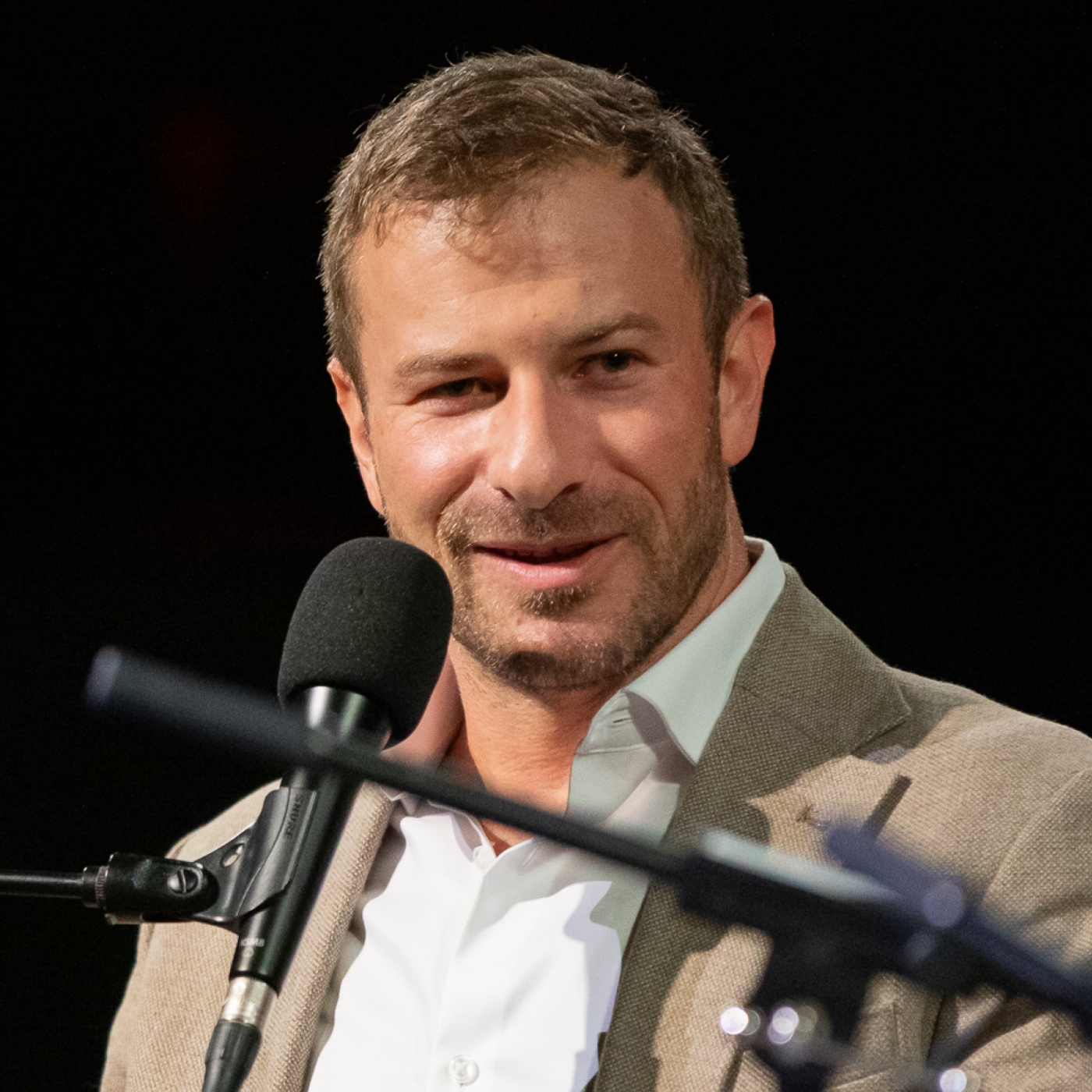
Live Wire with Luke Burbank
Gabe Henry, William Nuʻutupu Giles, and Sir Woman (REBROADCAST)
00:51:55
This episode features writer Gabe Henry, poet William Nuʻutupu Giles, and music from soul group Sir Woman.
Loading summary
Transcript229 lines
- [00:03]
A
Hey there. Welcome to Livewire. I'm your host, Luke Burbank. This week on the show we are talking spelling. Now don't worry, there's not gonna be a test, but there will be a chat with the writer Gabe Henry about his book Enough is Enough. That's E N U F. It details the 500 year history of something called the Simplified Spelling Movement. This is where folks like Ben Franklin and Mark Twain and others have sort of tried to make spelling easier and more intuitive here in America. We'll also have Gabe try to interpret a real six year old's spelling attempts in what might be the most adorable segment in Livewire history. And that's really saying something. We've also got poetry from William Nuutupu Giles and music from Austin based soul funk band SirWoman S T I C K A R O U N D Because Livewire gets started right after this. Hey there Livewire listeners. Spring is in the air and so is Livewire's annual membership drive. Here is what we are trying to do. We have set a goal to get 50 new members to help keep Livewire fully charged all year long. We need our members to help us make this show. I can't overstate that. Members also receive exclusive discounts on live events. You get on air mentions and you get bonus content in our monthly newsletter. Here's how you can join Livewire. You head to livewireradio.org and become a member. We're trying to get 50 new members this spring and here's where the producers have written in Sing Please Please Please by Sabrina Carpenter with the words Please, please please become a member. I don't know if that was a good idea, but I just did it.
- [02:00]
B
This show is supported by Blueland. We hear a lot about microplastics in oceans and food, but they can also come from products we use every day at home, including cleaning products. Blueland is on a mission to make it easy for everyone to make sustainable choices. Blueland believes that hardworking clean products can be the norm, not the exception, so that you can do better for your family and the planet at the same time. From cleaning sprays and toilet bowl cleaner to dishwasher and laundry detergent tablets, Blueland's products are independently tested to perform alongside major brands and the formulas are free from dyes, parabens and harsh chemicals. You'll love not having to choose between the safe option and what actually gets your house clean. Blueland is a certified B Corp and Leaping Bunny Cruelty Free certified. Their formulas are EPA Safer Choice certified and Many products have also earned Cradle to Cradle's Gold material health certificate. If you're looking to make a small change in your routine, you can get 15% off your first order at blueland.com prx get 15% off your first order by going to blueland.com prx blueland.com prx this show is supported by Odoo. When you buy business software from lots of vendors, the costs add up and it gets complicated and confusing. Odoo solves this. It's a single company that sells a suite of enterprise apps that handles everything from accounting to inventory to sales. Odoo is all connected on a single platform in a simple and affordable way. You can save money without missing out on the features you need. Check out odoo@odoo.com that's o d o
- [03:37]
A
o.com this episode of Livewire was originally recorded in July of 2025. We hope you enjoy it. Now let's get to the show.
- [03:47]
C
From prx, it's Live Wire. This week, writer Gabe Henry.
- [04:00]
D
I was a big grammar nerd. I would go further. I would say I was a big grammar cop. I mean, I would correct people. I would judge people on spelling, on commas.
- [04:12]
C
Poet William Nuutupu Giles.
- [04:16]
E
For so long, writing was like something I did shamefully in my diary, away from anyone humanly possible.
- [04:22]
C
With music from Sir Woman and our fabulous house band. I'm your announcer, Elena Passarello. And now the host of Livewire, Luke Burbank.
- [04:35]
A
Hey, thank you so much, Elaina Passarello. Thanks to everyone for tuning in from all over these United States. We have an absolutely great show in store for you this week. First, though, of course, we gotta kick things off with the best news we heard all week. This is our little reminder at the top of the show that there is, in fact, good news happening somewhere on this planet, and we're gonna find it for you and present it to you right now. Alaina, what is the best news you heard all week? Dog news. Dog news.
- [05:11]
C
Happy dog news. Woof, woof, woof, woof, woof. If a walker spring, our amazing composer ever needs an apprentice. I think I just. That's my audition right there.
- [05:22]
A
No notes. I mean, I love that it's worth
- [05:24]
C
singing about this news. I love it. So last month, there was a pet adoption event in Rustburg, Virginia, and a volunteer was walking a lab pity mix named C. Sienna around, sort of showing her off. And all of a sudden, the leash goes tight and Sienna just makes a beeline across the event to this guy, 46 year old guy named Josh Davis, and puts her paws on his chest and says hello, I guess, and like, won't leave his side, won't budge. Is doing that dog thing in the movies where like Lassie's trying to get your attention because Timmy's down the well or whatever.
- [06:02]
A
Yeah, yeah.
- [06:03]
C
And everybody's like, what's going on? And then his wife came over. Josh Davis's wife came over and was looking at him and she can tell he's an epileptic. And she could tell by the way that his eyes were moving that he might be on the verge of having a seizure. And he remembered that he had forgotten to take his medication that day. And, you know, so this dog, who they think is completely untrained astray, was actually able to warn the sky on the other side of the room that. Yeah, yeah. That he was about to have a seizure. So dog of the year. But you know what would be the perfect happy ending to that story would be if Josh then got to take the dog home.
- [06:41]
A
That couldn't happen though, right? I mean, not in, not in this economy.
- [06:44]
C
It didn't happen because Josh and his wife already had three rescues at home. I saw a picture of them. They're very cute, but they also look like divas. So maybe not so much, but fourth dog. But the second best happy ending would be, if not too long after that, a family who also has an epileptic son brought her home. And now Sienna is a happy member of Shannon Sweeney's family, where apparently she throws all 60 pounds of her onto her loved ones and smothers them with kisses. She's the cutest dog. So all is well that ends well in Rustburg, Virginia.
- [07:20]
A
Amazing that this dog, without any formal training, had sort of just intuited this. I mean, that's.
- [07:25]
C
I guess that's how they figured out that dogs could do this. You know, like there's just something about the way that they can tell behaviors.
- [07:32]
A
They are very. I mean, I would say this kind of goes for dogs and cats in my experience is like they can sense when your emotions shift. It would seem, you know, like they're pretty keyed into what's going on with us, which is incredible. Speaking of the emotion known as love, Elena, you know that I'm big on romance. It's my middle name. It's why I've been married so many times. And I've got a story about romance for you, which sort of unfolded a couple of weeks ago on a beach on the southwest coast of Ireland on The Maharaez Peninsula. Kate and John Gay were walking along the beach and they found a bottle on the beach and so they brought it home. And in fact, they got together, they're in part of a conservation group there in Ireland that's looking to take care of this peninsula. So they got their friends together and they opened up the bottle and the bottle had like, I guess you would sort of call it like, not so much a love letter, but like a love diary entry. Like, it was written by two people named Brad and Anita. And what they wrote on the piece of paper that was in the bottle that was found in Ireland was, today we enjoyed dinner. This bottle of wine. And if there's children in the room, shield their ears and each other on the edge of the island. I don't know, take that for whatever.
- [08:50]
C
So they had a little, let's say, al fresco experience.
- [08:55]
A
I mean, I guess that's what's implied here.
- [08:57]
C
And then chuck the bottle of wine that they had drunk into the ocean.
- [09:01]
A
Into the Ocean in Newfoundland 13 years ago. Because Brad and Anita, at the time they were dating, he was living. And we find this out now, he was living in British Columbia. He was a police officer. She was going to nursing school in Newfoundland. And so they were visiting each other and they were having a lovely little time together and threw the bottle into the ocean. Well, Brad says he actually didn't think it made it into the ocean. He said he gave it, quote, all he had, but he thought it definitely smashed on the rocks.
- [09:35]
C
Well, he was probably tired after all that.
- [09:38]
A
Seriously, the wine, the other stuff. So Brad and Anita had no idea that this bottle had actually gotten into the ocean and had then drifted across the Atlantic Ocean and ended up in Southern Ireland, where the folks that found it went and got online and were able to figure out that Brad and Anita were Brad and Anita Squires, who are married with three kids. This was sort of, I guess, maybe the moment that kind of sealed the deal for them. Since then, they've been married, they've raised a family together, they're living like, by all accounts, a happy and romantic life all these years later.
- [10:22]
C
That's wonderful.
- [10:23]
A
I know. Isn't that sweet? I mean, you would think that the chances are pretty slim that the two people who were downing the wine and having public sex would be able to piece that together for a happy and functional marital life together. But maybe that's their secret. I don't know. But shout out to Brad.
- [10:43]
C
I'll get on that. I guess.
- [10:44]
A
Seriously, it's going well for the Squires. And that's the best news that I've heard all week. All right, let's get to our first guest this week who has spent more than a decade exploring the history of something that I had no idea about, Elena, until we got this book. It's the simplified spelling movement. Basically, it's been this attempt over many, many years to change the way we spell a lot of words in the English language, including laugh, like changing it to laf or love changing it to L, U, V. It was unclear what these people's plan has been for Liv, but, you know, we can deal with that later. Now, by his own admission, the research on this project has actually kind of left him maybe with more questions about spelling than he started out with. But it's generated this really fascinating book which is called Enough is Enough. Our failed attempts to make English easier E E Z I E R to spell, which the Wall Street Journal calls a smart, light hearted chronicle of the simplified spelling movement. Take a listen to Gabe Henry, who joined us at the Alberta Rose Theater in Portland, Oregon. Gabe, welcome to the show.
- [12:08]
D
Thank you for having me.
- [12:10]
A
This book was really incredible. I've learned so much from it, but it's written with such a light touch. It's a really fun read. I'm just curious, though, because it really dives deep on language and spelling and grammar and things like that. What was your sort of, like, I don't know, grammar nerd status like before you started on this book? Were you always someone who was tracking that kind of stuff? And it's not just grammar, it's spelling. But were you a word person?
- [12:32]
D
I was a big grammar nerd.
- [12:34]
A
Okay.
- [12:34]
D
I would go further. I would say I was a big grammar cop. I mean, I would correct people, I would judge people on spelling, on commas. And I think writing this book kind of softened me. It made me a little bit more accepting of those people who stray from the grammatical path
- [12:57]
A
and the spelling path. Right.
- [12:59]
D
And the spelling path.
- [13:01]
A
So one of the things you mentioned in the book, which had never occurred to me, is that basically English is the only language where we have spelling bees. And that tells you something.
- [13:11]
D
It's true. We have the most complicated, irregular, inconsistent spelling. And a lot has to do with our history. England was invaded so many times over hundreds of years by the Romans who spoke Latin, and the Vikings who spoke Norse and the Germans and the French. And then over time, all these languages kind of merged and mingled into this messy hodgepodge that we call English.
- [13:39]
A
You know what's funny, Gabe, is my Next question to you was, can you give me a little the history of the English language? And then my joke was going to be to say, can you do it in 30 seconds? But you just did that. You actually really did that. Very. You summarized it very neatly.
- [13:51]
D
You're welcome.
- [13:52]
A
Thank you. But this is not the case with a lot of other languages. I just assumed, because I'm a fairly unsophisticated person, that every language had its weird spellings and just quirks. And this is not the case, though, to the degree it is in English.
- [14:07]
D
People who are bilingual, people who learned English as an adult, you'll know that it takes a lot longer to learn our spelling. It's less regular. And we have a lot of silent letters. A lot of languages have silent letters. It's more the inconsistent distribution of these silent letters. So think of the letters like ough that can be pronounced through, though. Tough cough, bow thought.
- [14:37]
A
Right?
- [14:38]
D
Those are the six main ones. And then there's the old English hiccup, which used to be spelled hiccough. I mean, it goes on and on. You get the idea, right?
- [14:50]
A
Is this because we have a too many sounds, not enough letters problem?
- [14:55]
D
Yeah. So people who study this, linguists, they identify that a lot of our problem comes down to we have 26 letters, but 44 sounds in our language. So a lot of those letters have to do double duty, triple duty, to make up for those 16, 18 missing phonemes. So it's like. It's like having 44 jobs that need to be done and having 26 employees. No one's happy. And then the result is that English, it takes children up to two to three times longer to learn spelling compared to, like, Spanish or German or these more phonetic spellings. We also have twice the rate of dyslexia. I mean, there's some real world consequences for all this.
- [15:48]
A
This is Livewire from prx. We are talking to Gabe Henry about his book Enough Is Enough. Our failed attempts to make English easier to spell stick around. We have much more with Gabe and what I think might be the cutest segment in Livewire history coming up after this break. Welcome back to livewire. I am your host, Luke Burbank, here with Elena Passarello. We are listening to a conversation that we recorded with Gabe Henry talking about his book Enough Is Enough. Our failed attempts to make English easier to spell. We recorded this live at the Alberta Rose Theater in Portland, Oregon. Let's get back into it. Can you tell me about some of the pretty well known people who have tried to fix this Situation over the years.
- [16:43]
E
Yeah.
- [16:43]
D
So a startling number of historical figures have tried to fix. Fix our spelling. Benjamin Franklin, he came up with this Alphabet in 1768 that removed six letters and added six new letters and respelled words phonetically like busy bizi and U is iu. And that proposal didn't go that far, but.
- [17:10]
A
Well, didn't he send a letter to like a lady friend written in this language and she was like, honey, no, no.
- [17:18]
D
So Franklin wrote up this proposal, he sent it to one friend. It's kind of his confidant, this woman, Polly Stevenson. And just asking her for advice. And she took three months to respond. So that's an indication right there.
- [17:32]
A
It was the equivalent of like the three dots under a text.
- [17:35]
D
Yeah, she left it on read. And then when she finally did respond to. She was, she was not happy. Like she was not happy to receive this letter and then have the responsibility of giving Benjamin Franklin the Benjamin Franklin advice on what she really realized was impractical. So she responded and her response was so lackluster that Franklin really never spoke about it publicly again.
- [18:01]
A
Didn't he sort of bring it up?
- [18:03]
D
Was it with Noah Webster?
- [18:05]
A
Noah Webster, he kind of revisited it with him at some point.
- [18:08]
D
He revisited it about 20 years later in 1789. Noah Webster, who we all know as the creator writer of Webster's Dictionary. He's a young man, he's 27. He's rubbing everyone the wrong way. No one knows who he is yet.
- [18:22]
A
Oh yeah, can we read? I have this right here. Some of the insults that people at the time were saying about the guy who invented our dictionary that we go to. This was amazing to me. He was so off putting as a person that people called him a pusillanimous, half begotten self dubbed patriot. That actually sounds familiar. A toad in the service of sans culottism. A great fool and a bare faced liar. A spiteful viper. A maniacal pedant, A dunghill cock of faction.
- [18:59]
C
I'm saving that one.
- [19:00]
A
An incurable lunatic and a deceitful newsmonger.
- [19:05]
B
Yeah, so.
- [19:07]
D
So this is the man that we're getting all our words from. This deceitful viper.
- [19:12]
A
Why did people not like him?
- [19:14]
D
He had this personality where he was very arrogant, looked down upon people. He would give these lectures where he would basically call out people for their grammatical failures.
- [19:24]
A
Oh, like you used to like me.
- [19:27]
D
And I've changed my ways. Noah Webster didn't. And that's just his personality. But his proposal for spelling reform in 1789, this is the birth of The American Republic and all the founding fathers are trying to figure out ways to distinguish American culture, identity and language from that of its former oppressor, England. So there were discussions about what our new language would be. Some people posed French would be the new American language. Other people said Greek. And Noah Webster comes along and he says, we can continue to have English, but we'll write in American English and this American English will be simplified. We'll write laf as laf tuf as t u f though as t h o tung as t u n g. And it was this radical proposal and he published this. The response was just pure indifference at best, mockery at worst. And it was incessant, it was relentless. And he basically eventually withdrew this proposal. But before he did, he was working on it in collaboration with Benjamin Franklin, who he saw as his mentor, this elder statesman who had attempted this once before.
- [20:49]
A
Can we talk about Samuel Johnson a little bit? First of all, remind folks who, who Samuel Johnson was and then how he sort of played into the situation.
- [20:56]
D
Samuel Johnson was the first lexicographer, meaning dictionary writer, the first major dictionary writer in English. He was British though, and he published his dictionary in 1755. It was a huge two volume tome. It weighed, I think I did this calculation. I have it in the book. It weighed as much as a car tire. And he was the first person to, in a thorough way, in an authoritative way, to crystallize and concretize English spelling and words as we know it. But the thing is, he did this out of a place of patriotism because he loved England. And as much as he loved England, he hated America. So he inserted in his dictionary all these slight insults to America. Scotland, Wales, Ireland, all these places that he decided were not up to snuff with England.
- [21:59]
A
Well, because this is what I, of course, didn't think about until I was reading the book was that people made up the dictionary at some point. I mean, you know, they were trying to research it and trying to be accurate and collect up what everybody was meaning when they would say a word. But at some point there was a lot of judgment calls. And it's just basically one person making a list of words.
- [22:17]
D
It's one person alone in the room for 20 years making a list.
- [22:23]
A
And he also. I'm trying to find the exact spot in the book. He had some pretty questionable definitions that you write out these like, I don't know if you'll remember off the top of your head, but yeah, he had a like belly God.
- [22:36]
D
Belly God. One who makes a glutton of himself with food. He's a belly God. He eats everything. Which I kind of want on a T shirt.
- [22:46]
C
Yeah.
- [22:48]
A
Can we talk about the Funny Fellows? Kind of like the proto standup comics, as you put it in the book.
- [22:54]
D
So after Noah Webster, simplified spelling starts gaining momentum and a lot of proposals come out, dozens of proposals, all varying in their angles and their degree of simplification. Some of them were brilliant, some of them were absurd. But as simplified spelling gained momentum in the 19th century, America's humorists couldn't resist poking fun at it. So a group of writers calling themselves the Funny Fellows. Funny spelled ph. Fellows spelled ph. They kind of turned simplified spelling into this micro literary genre and turned deliberate misspelling into this popular thing. And they kind of made a name for themselves. And they're deliberately misspelled humor pieces.
- [23:39]
A
But you. But you. You sort of say in the book that the Funny Fellows kind of hurt the movement, this simplified spelling movement, because they turned it into a big joke.
- [23:47]
D
Yeah, it's. First of all, it's very easy to make fun of simplified spelling because it looks like child writing. It is as simplified and phonetic as you can get. If you ask a 4 year old to sound out enough, they would probably spell it E, N, U, F. So this is. Even though these simplified spelling proposals came about in a serious way, it was just very easy to mock. And because the Funny Fellows had such visibility and such literary prestige, they kind of killed the movement. Not entirely, but they made it a target of ridicule for the rest of time.
- [24:24]
A
Has it in some measurable way held us back as a society, the fact that we have this complicated language?
- [24:32]
D
Yeah, I mean, I think that the language as we have it now, as I said, because it halts childhood learning, it is a barrier for English as a second language. It is also a big barricade for anyone who's trying to become literate as an adult. Maybe for whatever reason you didn't learn how to read growing up, but learning as an adult now you have to struggle with all these versions of ough and words like womb, which rhymes with room but not with comb.
- [25:05]
B
Right.
- [25:06]
D
Or choir, which rhymes with lyre and. As well as squire and fire and pyre and friar and probably a dozen more. It has held us back, I think. And. But the question of, like, whether we should become simplified spellers, I don't know if, like, that's really the way to go, to artificially push us in this direction. I think that change in that way comes more from the bottom up, not from the top down.
- [25:32]
A
And yet we have texting, which you talk about in the book. It's like, you know, nature bats last. We've just landed on this kind of, you know, simplified spelling for convenience sake now kind of without anyone making us do it.
- [25:48]
D
Yeah, I mean, that's the great irony that for centuries these reformers were pushing their simplifications upon the public to no success. But when left alone, the language seems to be naturally simplifying, at least in this informal digital shorthand way. And it's to fit the needs of our more interconnected society, our faster paced society, just our more modern world. And I think there are words today we use all the time, like though spelled T, H, O, which I probably text three times a day. I think my dad texts about 20 times a day just to say it's not generational specific. It's all. And words like through thru. These are more common now than Noah Webster ever could have imagined when he proposed them back in the 1700s.
- [26:39]
A
The book is enough is enough. Gabe, Henry, stick around for a quick second. We want to do one more exercise with you because we know that you've been spending a lot of time immersing yourself in the simplified spelling movement. There's another. I don't know if you know about this. It's a kind of an intuitive spelling movement that's going on. It's called brave spelling. This is a real thing and it's where you sort of let kids try to spell things themselves and just kind of see where they end up. And it turns out there is a practitioner of this method here in Portland. She's a kindergartner named Poppy. Also happens to be the child of our executive producer, Laura Haddon. Here's what we want to do with you, Gabe. We want to sort of do like a reverse spelling bee. Okay.
- [27:22]
D
Okay.
- [27:23]
A
So we had Poppy, who is six years old and in kindergarten, try to spell some words and we recorded that and we're going to play you, Poppy, trying to spell these things. And we want to see if you can guess the word that Poppy was trying to spell.
- [27:38]
D
Okay, I'm ready.
- [27:39]
A
Okay, here comes the first one. Some brave spelling from Poppy.
- [27:43]
C
T, A P, L, D I S
- [27:48]
A
E M C, A P L, D I S E M.
- [27:56]
D
Capitalism.
- [27:57]
A
That is exactly right.
- [27:59]
E
Yes.
- [28:00]
A
Well done. Let's go to Poppy for the answer.
- [28:06]
C
Capitalism.
- [28:11]
A
Great work, Gabe. It's clear that you have been studying your spelling.
- [28:14]
D
I just have the brain of a four year old. Six.
- [28:17]
A
Six year old. Six year old. All right, here is word number Two spelled by local Portland resident Poppy.
- [28:24]
C
M I, s T I L A
- [28:28]
A
N E I, s. That's M I, s. T I L a N E I, S.
- [28:37]
D
That's. There's a real. There's a real phonetic logic to all of this.
- [28:42]
A
Yes.
- [28:43]
D
Is it miscellaneous?
- [28:44]
A
It is miscellaneous. Very good. Here's Poppy with the answer miscellaneous.
- [28:53]
D
All right.
- [28:54]
C
Said fast.
- [28:55]
A
Yes. Well, I think what I cut out from that. Let's see if we can go back to the original source file. If I can do this on the fly. It was Laura trying to coach Poppy through saying it more quickly.
- [29:11]
F
Okay. Can you say it faster?
- [29:13]
C
Make it my knees.
- [29:18]
A
You're doing really, really well, Gabe. This is impressive. All right, here's our final word. See if you could figure this one out from Poppy.
- [29:26]
C
D O D U r D D
- [29:29]
A
O D U, r, D. It really
- [29:33]
C
is just like a spelling bee.
- [29:37]
D
Daughter.
- [29:37]
A
Daughter is right. That's right. Daughter.
- [29:41]
D
Wow.
- [29:41]
C
It's interesting that she wanted to put the d on the end. There's something about what the R does that makes her want to put, like, a terminal.
- [29:47]
A
Right?
- [29:48]
D
Yeah.
- [29:48]
A
You know.
- [29:48]
F
Gotcha.
- [29:51]
A
That's incredible. Gabe, I want to play one last thing. We did try to get Poppy to spell patriarchy, and she was uninterested. Take a listen to this.
- [30:03]
C
Can you spell patriarchy? Yeah. No, I only doing happy.
- [30:24]
A
If you want to take Poppy on the rest of the book tour with you. Gabe, I think.
- [30:27]
D
Well, I was actually looking for an audiobook narrator.
- [30:30]
A
Yes. You found him. That's how you play reverse spelling bee. Gabe Henry, thank you so much for coming on Livewire. Great job.
- [30:38]
D
Thank you so much for having me.
- [30:43]
A
That was Gabe. Gabe Henry, right here on Livewire. His book enough is Enough. Our failed attempts to make English easier to spell is available right now. And a fun update from Gabe. He is going to be appearing at the Planet Word museum in Washington, D.C. on May 30 to host a special adult spelling bee as part of this year's Scripps National Spelling Bee. Festiv. Hey. Special thanks this week on Livewire to Toby Fitch of Portland, Oregon. I'm gonna throw Terry Fitch in there as well. I know Toby and Terry. They are wonderful members of the Livewire listener community, and they are generously supporting the show with a donation each month. And we are incredibly grateful for their support because it is how we are able to keep Livewire going. So, Toby and Terry, y' all are the best, and we couldn't do this without you. This is Livewire. I'm Luke Burbank here with Elena Passarello, of course. Each week on the show, we like to ask the Livewire audience a question. This week, we were inspired by Gabe Henry's book about spelling. So, Elena, what did we ask the audience?
- [32:02]
C
We wanted the audience to tell us a word that they have a hard time spelling.
- [32:07]
A
Oh, gosh. Restaurant definitely defy a nightly.
- [32:12]
C
Yeah, you got to put finite in there.
- [32:14]
A
Yes. Here's what we did. We actually went into the live audience at a recent taping of the show and asked folks to tell us about the words that they have a hard time spelling. Here's Megan and Jonathan.
- [32:26]
F
Worcestershire sauce. Yeah.
- [32:28]
D
Worcestershire.
- [32:29]
C
Worcestershire sauce.
- [32:31]
A
Spell that one.
- [32:31]
F
You spell it.
- [32:32]
A
You spell it. Oh, W O R C E S T E R S H I R
- [32:37]
C
E. Although everybody in Worcester, Mass. Totally knows how to spell Worcestershire.
- [32:42]
A
I mean, I'm still on the same bottle I bought in my 20s. I don't understand the business model of that sauce. I believe they sell you one bottle per lifetime.
- [32:51]
B
Yeah.
- [32:51]
A
All right, here's a word that Cameron, a recent attendee of a Livewire taping, has trouble spelling. Gruyere.
- [32:59]
F
Gruyere.
- [33:00]
A
Gruyere.
- [33:00]
C
Like the cheese.
- [33:02]
D
Yeah.
- [33:03]
A
G R, U, A R, R. I don't think that was right.
- [33:09]
C
No, I don't think so. I think you got to get a Y involved for sure.
- [33:13]
A
I feel like you should get also a special dispensation if it's a word of, like, a different origin in terms of language, like French cheeses.
- [33:21]
C
Yeah. Or hors d' oeuvres duvers. Yeah. There's always that moment, like, if you've only heard a word the first time that you see it in print, and you're like, what is. Oh, that's how you do that. Like, facetious. The first time I saw facetious, I
- [33:36]
A
was like, I am still having that experience at 49 years of age.
- [33:40]
B
Yeah.
- [33:41]
A
Okay. This is Colin. Now, this is a little bit. I mean, this is sort of a word about a bodily situation that I think we can play on public radio. Okay. But this is Colin having trouble spelling this word.
- [33:53]
D
Diarrhea.
- [33:54]
E
Yeah.
- [33:55]
F
Can you attempt to spell diarrhea? Yeah, just do it.
- [33:57]
D
From England.
- [33:58]
C
Yes.
- [33:58]
D
I think something like D I A R R R H
- [34:07]
C
O E A. Yeah. Because it's spelled. This is part of the. The book. Right. Like, it's spelled differently over there. Because by. When people came here, there are certain English words that were spoken in the UK that we decided to take, like, the U out of flavor and labor.
- [34:26]
A
Color.
- [34:27]
C
Diarrhea, for some reason, got a new spelling, but but it's also impossible. So. But over there, it ends in an oea.
- [34:34]
A
I think my hope is that I don't have to spell that word very often on either side of the Atlantic Ocean, you know.
- [34:41]
B
Yeah.
- [34:41]
C
And there's only four letters and runs. So, you know, like.
- [34:45]
A
Yes, that's my version. It's sort of like you might call it Porky pigging it. Like, you take on a word, you realize I'm not going to be able to spell this. What's the shorter version of this word that will convey the same meaning?
- [34:56]
C
Yeah.
- [34:57]
A
Anyway, I don't know if that segment made us smarter or just feel less bad about the fact that none of us can spell anymore, but thank you very much to our brave listeners who weighed in on that. Our next guest here on Livewire is a national poetry slam champ whose work has been featured on hbo, NBC News, and the National Park Service, among other places. They've performed across the country, from the San Francisco Opera House to the Kennedy center to Broadway to the Hotel Crocodile in Seattle, which is where we met up with William Nutupu Giles, who joined us for a special Livewire event. Take a listen to this, William. Welcome to Livewire.
- [35:38]
E
Thank you. I am very, very excited to be here.
- [35:41]
A
I'm curious. Well, first of all, where did you grow up?
- [35:43]
E
Honolulu, Hawaii.
- [35:45]
A
What was the. I see some people just flew in. What was the kind of spoken word culture like that you grew up with the poetry? What were you hearing as a kid?
- [35:56]
E
I feel really lucky. I found a poetry community called you'd Speaks Hawaii, where basically a bunch of teachers, after they got done teaching school, decided to run poetry workshops and open mics for young folks. I got really lucky to just have amazing mentors and be able to find a community, because for so long, writing was like something I did shamefully in my diary, away from anyone humanly possible, really. And so it felt really cool to find. Find a place where, like, I could polish my little gems in secret and then find people both to listen to and also to share with.
- [36:27]
A
So you were one of those kids who kept a diary, and that was how you were sort of processing your feelings and trying to make sense of your world?
- [36:33]
E
Yes, absolutely. Not by talking to other people, simply by talking to my notebook.
- [36:37]
A
Honestly, you'll fit right in with the Livewire listeners. Do those diaries still exist?
- [36:41]
E
I'm sure I have a few of them that I will lock in a vault soon and never show anyone, really.
- [36:48]
A
Were you a hip hop kid? Were you listening to hip hop? Were you listening to, like, Spoken word in the sort of more pop culture way?
- [36:56]
E
No, I was listening to musical theater and, like, acoustic music and Hawaiian folk, like, everything and everything.
- [37:03]
A
Because then you. I know that you went through this spoken word and hip hop program in Wisconsin. Right. Which I think you were saying is pretty. Was pretty pivotal in your development. First of all, Wisconsin known hotbed for hip hop. But, like, what was that program like, and what did you learn from it?
- [37:20]
E
Yeah, it's through the office of Multicultural Arts Initiatives. Oh, my. It was just a phenomenal, like, hip hop learning theater program. They recruited 15 students every year. And for me, it was like the first time I'd seen arts invested in similar to, like, a sports program. So that felt very cool. It was like 15 of us of singers, dancers, poets, break dancers, graffiti artists. And they were like, great. Your first assignment is to work together and use all your talents and create a 15 person play. We're like, what? But it was beautiful. Like, I got to work with poets. I got to perform a poem. While if someone break dance and another person played the cello, it was just so cool to see all these intersections of art.
- [37:59]
A
Well, can we hear a poem?
- [38:01]
E
Yes, absolutely.
- [38:02]
A
What can you tell us about this?
- [38:04]
E
This is a poem I wrote with, actually one of my mentors, one of the co founders of you speaks Hawaii, where I started writing Travis Thompson, a phenomenal Hawaiian poet. And we wrote this piece to kind of share at the national poetry slam in 2014 how it feels to be an indigenous person. I'm of Samoan descent. I was born and raised in Hawaii, and he's Hawaiian. And it was like, how do we feel that our entire artistry is in a language of someone who colonized our people? And it's like. It was like, is this empowering? Is this disempowering? Do I feel good about? Like, it was just a very interesting kind of, like, cultural reflection and a chance to kind of bring the same sort of academic rigor to our research and then present that sometimes difficult, sometimes, sometimes difficult history in hopefully a beautiful or less painful way.
- [38:52]
A
All right, let's hear that now. This is William Nuutupu Giles here on livewire.
- [38:57]
E
For over three and a half millennia, the islanders of Pacifica spoke without Alphabet or written language. So spit me a poem with the names of the wind and the rain. The sacred spaces of your gods and ancestors. The people of Oceania retained all knowledge and all history through the shaping of spoken word into muscle memory. Every story a poem. So spit me a poem of how the world was made, beginning with your grandmother's face. How every speck of land on this earth was poured from the thick cocoa of her eyes. Every island and continent broken only by her blinks. You see, an ocean erases all that is written in sand. So my ancestors etched everything into the tides of their tongues. Now, as a historian, while I retell the tales of my ancestors using a colonizer's English, I am unsure if the act is one of resistance or oppression. I sometimes still see my tongue the way an amputee feels. The itch of a dismembered limb. It aches when I say my own middle name. See, I was born with the pride of my history, but no knowledge of my language. Speaking with the pride of a skin I lived with, but not in. Imagine. Imagine the entire knowledge of the world ended with what you could remember. In ancient Polynesia, the children with the best memory skills were chosen to be the culture keepers, the storytellers. They were hand picked to be poets, weaving today's events into yesterday's lore. They were practicing immortality and breath with weaving generations through the genealogies until foreign diseases interrupted entire bloodlines with death. In just over 100 years of the arrival of the west, nearly 90% of the native Hawaiian population was dead and their language was banned. Only 1 in 10 survived. So a knowledgeable person's death was the same as a library burning down. Today, we are still sifting through the ashes of a culture once deemed illegal. We are the descendants of the 10% who learned to speak and smoke. And sometimes I still see my tongue as just a colonizer's shovel. With most words, I am unsure if I'm burying my ancestors or digging them up. So spit me a poem about rebirth and redefining home. About the ways your forefathers died and the ways that you have grown. Though I do not sound like my ancestors, I still practice their traditions. These bones still remember their stories. And I cannot escape the history of colonization any more than I can escape their near extinction. So my own personal culture must be more than language. It is practice. So I'll spit you a poem without Alphabet or written language, weaving today's events into yesterday's lore. I will spit you a poem with all the knowledge of the world, ending with what I can remember and more. I will teach a hundred years of colonizers that a language is the most dangerous weapon you can give to a bloodline of storytellers, culture keepers with a responsibility to speak, no matter the spirit. So spit me a poem that is more rope than it is stone. And I will weave Your story into the library Born within these bones. So that our stories will never have to die. So our stories will never have to live alone.
- [42:07]
A
That was William Nuutupu Giles, recorded live at the Hotel Crocodile in Seattle, Washington. You can check out their work and many other talented poets in the new book we the Gathered Heat, Asian American and Pacific Islander poetry performance and spoken word. All right, we gotta take a very quick break here on Livewire, but do not go anywhere. When we come back, sir, woman will play us a song that you do not want to miss. I've already heard it, and I can verify. It's really good. Stick around. More Livewire in a moment. Welcome back to Livewire from prx. I'm Luke Burbank here with Elena Passarello. All right, I could see you furrowing your brow, Elena, because you know that it is time for station location identification examination. This is where I like to quiz our esteemed announcer Elena Passarello about a place in the United States where Livewire is on the radio. And Elena's gotta try to guess where I am talking about. Okay. This city is located in something known as Driftless Area, also known as Bluff country, or the Paleozoic Plateau, which means it's a part of the country that was never covered by ice during the last Ice Age.
- [43:29]
C
Huh. So it's a place that gets cold. That's east of the Rocky Mountains.
- [43:34]
A
Yes, yes, yes. I like how you're thinking. It's also home of the Westerheim Norwegian American Museum, which every July hosts the Nordic Fest, which includes a variety of activities ranging from the Nordic rock throwing competition to my favorite, the lutefisk eating contest. You should see me put back the lutefisk, Alana.
- [43:55]
C
Well, now we're definitely going to be up there in the sconcy. Minnesota.
- [44:00]
A
You would think so. It's. It's. It's up near there, but. But go. Go a little south. Go a little more.
- [44:06]
C
Iowa.
- [44:07]
A
Yes. You're in the state.
- [44:09]
C
Okay. And the bluff. And there's a lot of glacier coverage in Iowa. So we're in the. Definitely in the eastern part of the state.
- [44:16]
A
Yes. The next hint I have for you is also extremely old. It's 470 million years old, which I don't know if that's going to help you. A meteorite as big as a city block smashed into the place. That is where this city now is. The impact dug a crater nearly four miles wide that now lies beneath the town and is filled by an unusual shale that formed. I see you Nodding your head like this actually means something to you.
- [44:40]
C
Well, you know, I lived in Iowa for three years.
- [44:42]
A
I do know this.
- [44:43]
C
We drove to absolutely everything that you could do, including the world's largest pineapple. I feel like maybe we did go to the Meteorite and it was like debut.
- [44:52]
A
Okay.
- [44:53]
C
D Decorah.
- [44:54]
A
Decorah, Decorah, Iowa.
- [44:57]
C
Decorah.
- [44:59]
A
Good old Decorah, Iowa. Which is where we're on KLNIFM Radio. Woohoo. Shout out to the folks tuning in in Decorah, Iowa. All right, before we get to our performance by Sir Woman, a little preview of what we are doing on the show next week. We are going to talk to Earlonne woods and Nigel Poor from the incredible podcast Ear Hustle. They're gonna be talking about how they created the show while Earlonne was still in prison. Then we're gonna get some comedy from Dylan Adler, who will reveal what he considers to be a real missed opportunity on his college admissions essay. Then we're gonna have a chat with and hear a tune from our friend, the Americana singer songwriter Margo Silker. We've got an incredible hour of radio coming your way next week, so don't miss it. This week on the show, our musical guest features the Austin based musician Kelsey Wilson and her band playing their unique blend of soul and funk and R and B which earned Kelsey Artist of the Year award at the Austin Music Awards and also has garnered more than 30 million Spotify streams. This is sir woman who joined us at the Alberta Rose Theatre in Portland, Oregon. Take a listen. Hi. Hello. Hello. Welcome. I know, Kelsey, that you get asked about the name of the project a lot, but I was reading about it on your website and I thought this is actually Bears talking about because the way this name came about for the band or for your performing as this band also oriented your thoughts about the kind of music you were gonna make.
- [46:33]
F
Yeah, that kind of just all happened at once. I'll give the NPR version of the story. When you first brought it up, I was like, this is not like super family friendly. I was on a lot of mushrooms and I was in Florida, which is an important detail. Love you, Florida. I was with another band for about 15 years touring and playing music and it's called Wild Child and it's more like indie folk. It's very sweet ukulele. And I was on a bunch of mushrooms and we were playing a festival. I think Snoop Dogg was a headliner. It was like Snoop Dogg and the Funky Meters. And it was like, choose between the Funky Meters and Snoop Dogg. And I was like I want to see the Funky Meters. Cause I hadn't before. No one was there. Everyone was watching Snoop Dogg. But I'm watching the Funky Meters by myself. And I like walk back to the artist lounge. Cause I don't know, I think I'm gonna meet them or something again. Tripping. And I'm wearing all these jackets and stuff because it's kind of cold and security can't see me. And they just start yelling at me
- [47:42]
G
and saying, sir, sir.
- [47:44]
F
And I just keep walking because they're not talking to me. And then she says, woman. And I was like, whoa, okay, sir woman. She was talking to me. I am sir woman. And it just kind of all clicked. I was like, I am not supposed to make indie folk music. I don't listen to indie folk music. I like the Funky Meters. I'm watching the Meters and not Snoop Dogg and not the Chain Smokers or whatever other DJ was happening. I was like, this doesn't fit, Sir. Woman is something else. Someone else. She's this creature in the woods that's not supposed to be there. And yeah, just kind of all. I had all these songs start like, happening in my head after the name appeared. And yeah, now we're like a 20 person band.
- [48:34]
A
Yeah, right.
- [48:35]
F
Yeah.
- [48:38]
A
You have this new double album release. If it all works out is one of the albums. And then if it doesn't, it's the other album. It's really covering your bases there.
- [48:46]
F
I'm a very serious person. I don't know if you can tell. Yeah, they also are supposed to come with a mood ring in the shape of a 69. And it gives you like a mood chart. So you put on a mood ring and it'll tell you what album you need to listen to.
- [49:03]
A
Gotcha.
- [49:06]
F
Yeah, but the mood rings didn't come out. You have to, like, they're temperature controlled and it has to get like over 200 degrees to change colors. So you don't get a mood ring. But the idea was there. You just have to know what mood you're in.
- [49:21]
A
Yeah. Trust your heart as to which one of the albums that you should be reaching for.
- [49:25]
F
It's from. I have this quote that I kind of live by. It makes me feel better about absolutely everything. It's if it works out, great. If it doesn't, even better. Like, even better. We have no idea.
- [49:37]
C
Right.
- [49:38]
F
Feels good. So it's kind of like, yeah, it sounds like it's an album for a good day and an album for a bad day, but it's actually album for a good Day and an album for an even better one.
- [49:49]
A
Nice.
- [49:50]
F
So that's kind of where what it's for.
- [49:53]
A
Well, what song are we gonna hear?
- [49:56]
F
We're gonna hear a song off if it all works out okay, called High Praise.
- [50:02]
A
All right. This is sirwoman on Livewire.
- [50:16]
G
You're giving me this high praise? Acting like you know me well? You think I don't have bad days? Well, baby, let me break this spell? Oh, you know nobody's worth it? Can't see what they can take from you? So if it really hurts, baby, just tell them what you're going through? High praise? You're giving me this high, high praise? I'm giving you this high praise? Cause you never did me wrong? You don't owe them a damn thing? Just say you love them, move along? Oh, you know nobody's worth it? They can't see what they take from you? So if it really hurts, baby, just tell the what you're going through. I know why you call? I know why you call? I'm giving you this high praise? I'm giving you this high, high praise? I'm giving you this high praise? I'm giving you this high, high praise? When you need me, know I'll be there? But baby, you got what it takes? So just call me, I'll remind you if I have to do it every day? I know why you call? I know why you call? I'm giving you this high praise? Cause you never did me wrong? You don't owe them a damn thing? Just say you love them, move along. Oh, you know nobody's worth it? They can't see what they take from you? So if it really hurts, baby, tell them what you're going through? You're giving me this high praise? You're giving me this high, high praise? You're giving me this high praise? You're giving me this high, high praise? I know why you.
- [52:58]
A
That was Sir Woman, right here on Livewire. Recorded live at the Alberta Rose Theater in Portland, Oregon. Their double album, if It All Works Out, Slash if It doesn't, is available right now. Well, this all worked out. I think this was a great episode of Livewire, which we find ourselves now at the end of a huge thanks to our guests, Gabe Henry William, Nutupu Giles, and Sir Woman. Hey, special thanks this episode to Roger Meyer, the Hotel Crocodile, and Tonya Zubia.
- [53:32]
C
Laura Hadden is our executive producer. Heather D. Michel is our executive director, and our producer and editor is Melanie Savchenko. Our technical director is Eben Hoffer, with assistance from Ness Royster Hazik bin Ahmad Farid is our assistant editor and our house sound is by Daniel Blake. Ashley park is our production fellow, Valentine
- [53:49]
A
Keck is our operations manager, Andrea Castro Martinez is our marketing associate and Ezra Veenstra runs our front of house. Our house band is Sam Pinkerton, Ethan Fox, Tucker Eyal Alves and A. Walker Spring, who also composes our music. This episode was mixed by Eben Hofer and Hazik bin Ahmad Farid.
- [54:08]
C
Additional funding provided by the City of Portland's Office of Arts and Culture. Livewire was created by Robin Tenenbaum and Kate Sokoloff. This week we'd like to thank member Toby Fitch of Portland, Oregon.
- [54:19]
A
What up Toby and Terry. For more information about our show or how you can listen to our podcast, head on over to livewireradio.org I'm Luke Burbank for Elena Passarello and the whole Livewire team. Thank you for listening and we will see you next week. Hey, if you appreciate the work that Livewire is doing to amplify riveting and unexpected voices to a national audience, and I gotta tell you, it's a big audience these days, please, please, please consider offering some monthly support by becoming a member of our League of Extraordinary Listeners. Here's how it works. Membership starts at just five bucks a month and there are great perks at every level, including a special shout out on the broadcast. Impress your friends by being shouted out on Livewire. It means the world to us and really does make it possible for us to do the show. So please, if you can, help, support us by visiting livewireradio.org Memberships.
- [55:24]
C
From prx.