← Live Wire with Luke Burbank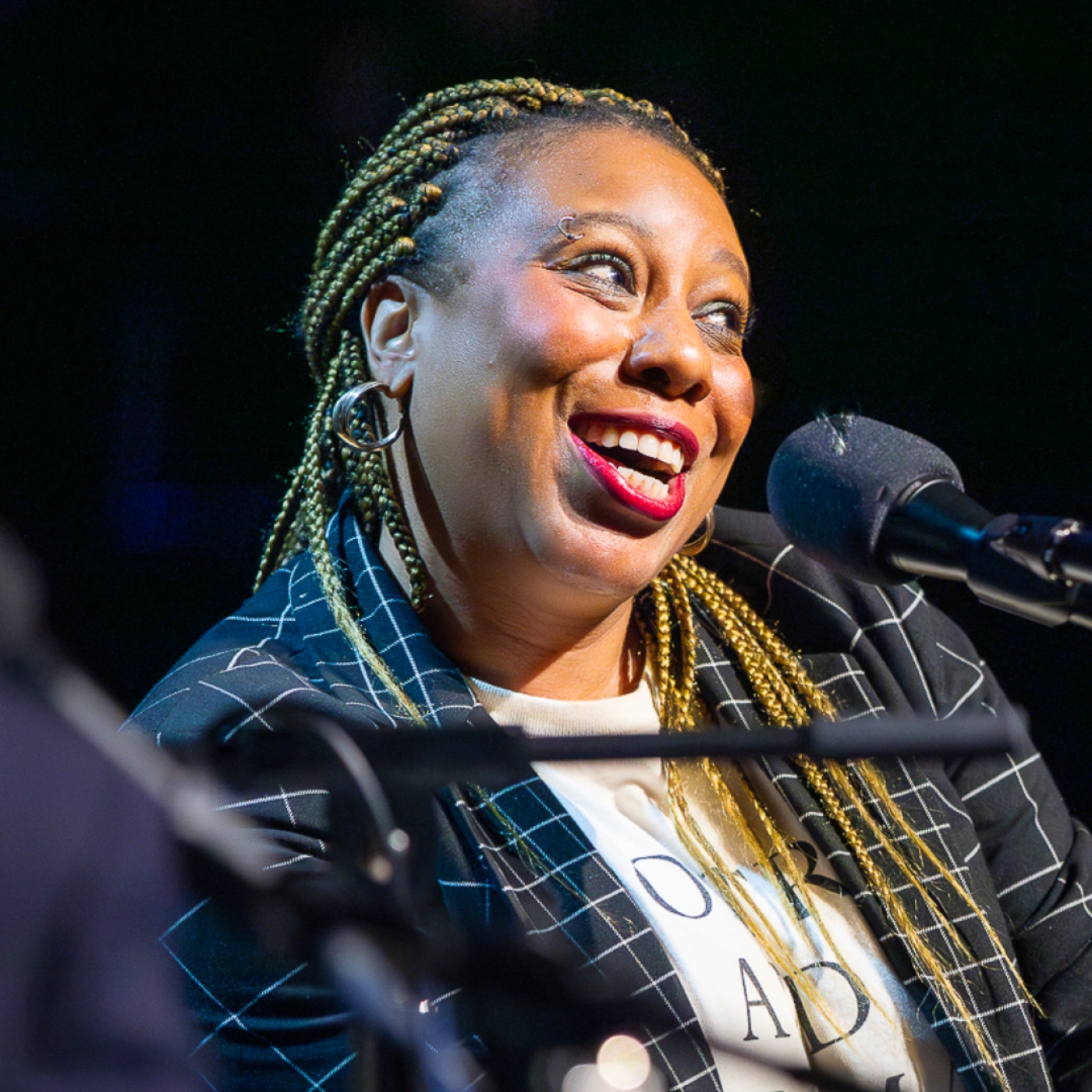
Live Wire with Luke Burbank
Morgan Parker, Georgia Cloepfil, and Rogê (REBROADCAST)
00:52:25
This episode features poet and essayist Morgan Parker, athlete and writer Georgia Cloepfil, and Brazilian singer-songwriter Rogê.
Loading summary
Transcript179 lines
- [00:03]
A
Hey there. Welcome to Livewire. I'm your host, Luke Burbank. This week on the show, we are kind of adventuring around. First we're gonna talk to the poet and author Morgan Parker about her debut collection of essays, you get what you pay for. It's got all kinds of insights into her life and also helpful tips. Like, if you're in Manhattan and you want to know the best store to cry in after you leave therapy, somebody should make an app for that. Probably. Then we're gonna pop over to the Sports Brain Bra sports bar in Portland, Oregon to chat with professional soccer player turned writer Georgia Clopeville. And then lastly, but definitely not leastly, Brazilian sensation Hoshe will play us a tune that'll have you dancing or tapping your feet or like, whatever that looks like for you. No judgment. Anyway, do not miss a beat of this week's episode of Livewire, which gets started right after this.
- [01:00]
B
Taking care of your eyes shouldn't be a hassle. That's why Warby Parker is a one stop shop for all your vision needs. Our prescription glasses and sunglasses are expertly crafted and unexpectedly affordable. Stop by a nearby store or use our app to virtually try on frames and get personalized recommendations. Did we mention we offer eye exams and take vision insurance too? For everything you need to see, head to your nearest Warby Parker store or visit warbyparker.com today. That's warbyparker.com this show is supported by Odoo.
- [01:32]
C
When you buy business software from lots of vendors, the costs add up and it gets complicated and confusing. Odoo solves this. It's a single company that sells a suite of enterprise apps that handles everything from accounting to inventory to sales. Odoo is all connected on a single platform in a simple and affordable way. You can save money without missing out on the features you need. Check out odoo-o o.com that's o d o o dot com.
- [01:59]
A
This episode of Livewire was originally recorded in March of 2025. We hope you enjoy it. Now let's get to the show from prx.
- [02:09]
D
It's Livewire.
- [02:18]
E
This week.
- [02:18]
D
Poet Morgan Pot I honestly remember praying to God that the rapture wouldn't happen until after I wrote a book. Like, I'm just like, please, I have the stuff I want to do.
- [02:30]
F
Writer Georgia Clopeville we have this goal in mind. I really just want to get this promotion. I really just want to play on this sort of team. And then once we get there, everything recalibrates. And now there's something else that we.
- [02:44]
E
Want with music from Roger and our fabulous house band. I'm your announcer, Elena Passarello. And now the host of Livewire, Luke Burbank.
- [02:57]
A
Hey. Thank you so much, Elena Passarello. Thank you to everyone tuning in from all over America. We have all kinds of different perspectives and art forms and just a lot of entertainment coming your way over the next 60 or so minutes. But of course, we've got to start things the way we always do with a little bit of the best news we heard all week. This, of course, our little reminder at the top of the show, there is good news that is happening in the world and maybe even some here in America. You just have to look for it. We have found it. We will present it to you. Alayna, what is the best news you heard all week?
- [03:39]
E
Okay, Luke, I know that you have been the owner and protector of multiple cats throughout your life. Is there ever been a cat behavior that you completely didn't understand that one of your cats did?
- [03:52]
A
Oh, multiple behaviors. Honestly, like, I, I, I still don't know what's going on in that little walnut of theirs.
- [03:59]
E
Well, you're in luck, because there is a new study that's getting kicked off this year through UMass's Chan Medical School with scientists at the Broad Institute. It's called Darwin's cats Project.
- [04:13]
A
They didn't go with Schrodinger.
- [04:15]
E
No. I mean, well, you know, like, I.
- [04:17]
A
Guess that's already a study or it's already what? What a theoretical exercise.
- [04:21]
E
It's also kind of a bummer.
- [04:22]
A
Yeah.
- [04:23]
E
You know, so this, we want all these cats to, to thrive. And basically, the plan for Darwin's Cats Project is to create a genetic database that will help us better understand cats biologies and behaviors. Because, you know, cats were domesticated, like, thousands of years after dogs were. We know surprisingly little about them, and they are so idiosyncratic. Anyway, like, we just need to do a little bit more research. This comes after speaking of dogs, the Darwin's dogs project, which published its findings in 2022, they collected the DNA of 2100 dogs, and then they interviewed owners of about 18,000 dogs, and they got a whole bunch of information of about breed and behavior. And they're going to do the same thing with cats. And what they want people to do is mail in fur samples, and they want to get 100,000 participating cats. Then there's a survey, and they want to get information about the behaviors of the cats from the survey and the genetics of the cats from the sequencing of Course, sequencing is a little expensive, so they suggest $150 donation when you. You send in the stuff. But if I know anything about the behavior of cat owners, they will pay that money just to learn a little bit more about their beloved Mr. Twiggle Pants, or whatever they're calling their cats.
- [05:52]
A
What do you want to understand about your cats?
- [05:54]
E
I'm of two minds, so. So if I could answer any question about my cats, I would want to know why my cats don't. Don't snuggle with each other like all the cats on Instagram do. Over the course of my life, I've always had little groups of three cats, and they never like each other.
- [06:09]
F
So I want to.
- [06:10]
E
I want to know what. What am I doing to so such derision? But honestly, I kind of like the mystery of cats. Like, I like not knowing exactly why they run into the room, roll over on their backs, act insane, jump into a box, and then go to sleep.
- [06:25]
A
You know, crab walk out of the room or something. Yeah, I want to know my cat Bubbles, who is a Bengal. I don't know if this would be answered by this study you're talking about, but I would like to know how many generations this Bengal has been domesticated since its ancestors were, like, in the jungles of Indonesia. And then I would like them to add three more generations, because Bubbles is not really ready for domestic American life. She is still somewhere out there in the jungles, and that is why she is very, very annoying to live with. All right, the best news that I heard this week. Alaina. And this is not news that's exactly headlining the New York Times, but in our world, it's really good news. We are now featured as part of the weekend lineup of WNYC radio in New York City. That's right. Livewire has made it to the Big Apple. This is really exciting for us as a show, actually. I mean, one. Because it means we're going to reach a lot more people because New York's a huge public radio market. Also, I just have to say for me, personally, as a person who used to work at WNYC, like, 20 years ago or something, back when the radio station was located in a government building down at 1 Center street, you used to wait in line with the people that were there to get married at the city building. Like, I would be late for work, and I would be waiting behind, like, seven couples that were on their way to go upstairs to the justice of the peace.
- [07:59]
E
Cause you had to go through, like, a security checkpoint or something.
- [08:01]
A
Yes. There was a security checkpoint. I mean, it was New York Post 9 11. So there's a lot of, particularly down in southern Manhattan, a lot of security. And it was like, you know, listen, I'm gonna be honest with you. The fact that having worked there and done such a questionable job as I did as a cub reporter working for the WNYC newsroom, well, c, they have now allowed me and you back on their fine airwaves doing this radio show Livewire. Like I said, About 20 years later, it is a real full circle moment. And I'm just so, so excited that we're getting to reach all these fine people in the five boroughs of New York. So being on WNYC is the best news that I heard this week. All right, let's get to the real shit. Our first guest is the author of many things, including the poetry collections Other People's Comfort Keeps Me Up At Night and There Are More Beautiful Things Than Beyonce. Her latest work is something that's new for her. It's her first book of essays. It's titled you get what yout Pay for, which traces the difficulty, but also the beauty of existing as a black woman throughout American history. Morgan Parker joined us as part of the Portland Book Festival at the Patricia Resource center for the Arts in Beaverton, Oregon, to talk about it. Let's take a listen.
- [09:30]
C
Hello.
- [09:30]
A
It's so nice to see you again.
- [09:32]
D
Yeah, you as well.
- [09:33]
A
Thank you so much. This book is absolutely fascinating. Like, I just went from COVID to cover, and this is a book that's written from your perspective. I don't even know if, as like, a straight white male, if I am the intended audience, but it spoke to me in this really deep way. Who were you thinking about when you wrote this book?
- [09:51]
D
Well, I was thinking about myself a lot. Too much. But I was thinking about all of us, you know, and looking at history. The more that you kind of uncover, the more you see how connected we are by the facts of history and how much has been designed, you know. And thinking about the current world, I just can't help but look back and think about how we got here and what are all the pieces to that puzzle. And I think that it's something that we don't think about a lot as Americans, or we try not to, but I think it's something that we all feel as Americans, this, like, heaviness of history. So I do think it's relatable whether or not, you know, it's from a perspective that you have experienced. We all live here together. You know, and we all have seen a lot of the same things and had a lot of the same questions, whether or not we're able to admit it.
- [10:52]
A
Much like myself, you grew up going to Christian school and not, like, Catholic school, where there's mass a couple of times a week. Like, hellfire, damnation, hardcore stuff. What did that do to your young brain?
- [11:07]
D
Oh, my God. Well, the young brain is still in therapy. We'll say that.
- [11:12]
A
Okay.
- [11:13]
D
We're still undoing.
- [11:15]
A
This is my form of therapy, unfortunately for everyone.
- [11:19]
D
I mean, but there's. When I think about it, I'm like, I didn't stand a chance. You know, we learned the Bible, we learned Genesis and Exodus, and then we learned Job, which is just like, you must suffer, and that's what life is. And then we learned Revelation.
- [11:37]
A
That was fun.
- [11:37]
D
This is, like second grade, my dude. Like, this is like. And I'm a kid who wants to be a good kid. So it's just, like, an unhealthy kind of responsibility to place on a child. And I remember them asking me, are you ready to die for your beliefs? And I'm like, I honestly remember praying to God that the rapture wouldn't happen until after I wrote a book. I'm just like, please, I have stuff I want to do. I've still never had oysters. I don't know.
- [12:10]
E
But when you were young, young, you knew that you wanted to write a book was, like, your number one goal. If you were gonna bargain for when the rapture happened, that's what you wanted.
- [12:18]
D
Yeah, well, it was like, I felt that I could do it, which is you have to be delusional. And, you know, you have to be delusional every single time you sit down to write a new book. Cause even having written them before, it's like, well, I know I'm able to do that, but am I able to do this? And you just kind of don't know until you finish the last page. But it was always something that I felt that I wanted to make an offering to the world, you know? And writing has always been my way of communicating. And it's always been an easier way for me to be honest. Mostly because of all that trauma where it's like, you cannot be yourself, otherwise you'll die.
- [13:06]
A
Right. This, like, both sort of overt and covert messaging to you that the only way for you to be allowed in the world is to make sure that you're not ruffling any feathers and that you're doing everything the way you're supposed to do.
- [13:17]
D
It essentially, which is like totally impossible and also against my spirit, you know, so like trying to figure out, figure out rebellion, you know, was really hard and confusing because I wasn't sure what was allowed for me. And yeah, there's still a lot that isn't. You know what I mean? I think there's a way that even if I'm able to give myself permission, I'm hit with all these roadblocks in society. So part of this book and being so vulnerable in this book was a rebellion against that. Of all the times I have felt that I'm not allowed and that I'm not heard or that I don't have permission to just be or say and provide permission for other people.
- [14:04]
A
Yeah. When we come back from this break, I want to talk about what dating is like with this book now being in the world. So we'll get into that and other things with Morgan Parker. The book is you get what you pay for. This is Livewire coming to this week as part of the Portland Book Festival. We are in Beaverton, Oregon and we will be back in just a moment.
- [14:38]
C
This show is supported by Blueland. Each year Americans throw away 25% more trash from Thanksgiving to New Year's. This year let's turn our New Year's resolutions into actions that make a difference by reducing single use plastics. Blueland makes that easy. Blueland believes that hard working clean products can be the norm, not the exception. From cleaning sprays and toilet bowl cleaner to dishwasher and laundry detergent tablets, Blueland's 100% microplastic free EPA safe choice certified formulas are safe to use around family pets and plants. You'll love not having to choose between the safe option and what actually gets your house clean. Blueland products are independently tested to perform alongside major brands and the formulas are free from dyes, parabens and harsh chemicals. Plus, Blueland is a certified B corp and certified cruelty free by Leaping Bunny. Their formulas are EPA Safer Choice certified and many have received the gold material health certificate from Cradle to Cradle. And right now, Blueland has a special offer for listeners. Get 15% off your first order by going to blueland.comprx you don't want to miss this. Blueland.comprx for 15% off that's blueland.comprx to get 15% off.
- [16:12]
A
Welcome back to Livewire from prx. I'm Luke Burbank. That's Elena Passarella. We're at the Research center for the Arts as part of the Portland Book Festival this week and we're talking to Morgan Parker. Her latest book of essays is you get what you pay for. You mention in the book you talk about going to therapy and you say in the book that's the least black thing you could do.
- [16:32]
D
I thought that was the least black thing. And I listened to indie rock. That's like the line like this. Even less black than that.
- [16:40]
A
What was it like to start your therapy journey and how has it been for you?
- [16:44]
D
I guess it's been long. And there's the book. Kind of follows all the different therapists I've had since my first one. Not all of them, but, you know, defining. Like my last white therapist. The therapist that I had in college.
- [17:00]
A
The therapist that made you basically, like, have a final breakup.
- [17:04]
D
Yes.
- [17:05]
A
Heart to heart. Which seems.
- [17:07]
D
It was really painful.
- [17:08]
A
Also deeply unprofessional.
- [17:10]
D
A little bit, yeah. I mean, that was a weird relationship because it was also, you know, that was a moment where I was like, oh, this is for my blackness also. You know what I mean? And I was able to kind of synthesize that in a new way versus thinking this is my mental health and this is my cultural health, to see how they were interacting. And that essay, that therapist that took place in, I think, 2016 and Michael Brown had just been killed. And that therapist made me explain to her what happened because she didn't know.
- [17:47]
A
This was the murder of Michael Brown. In Ferguson.
- [17:49]
D
In Ferguson, yeah. And that is when I was like, this doesn't feel good. This doesn't feel like it's helping me. And yeah, it just made me contend with the purposes of therapy, I think, and how it could help all the different areas of my life rather than just being very narrow minded about my mental health and seeing it as separate from me in the world. You know what I mean? But that's also a product of having started my therapy journey at a time when it was like, just very separate from everything. Like, I didn't tell my friends. It was even like just our, you know, our family, not extended family. It was very just like, oh, this is Morgan's little thing. And as I got older and had all these other therapists and all these other life experiences and continued to be American, I have really grown to understand the way that my mental health has been influenced by just being a black American woman. And that's been nice to like, integrate that into my therapy as, you know, just part of my mental health and part of that, well, being to realize.
- [18:56]
A
Essentially, you're not crazy or you are crazy, but that part.
- [18:59]
E
Exactly.
- [19:00]
D
You're not crazy about it. Yes, I am crazy. But there's a lot of things that I thought was my crazy, and it's not. It's America's crazy. And that really kind of blew my mind. Obviously, growing up in Christian school, shame is very familiar to me. So I've spent a lot of time just being ashamed of my feelings and taking responsibility for them rather than analyzing all the things that made me think that way. So this book was an exercise in kind of backtracking. Okay, these are the falsehoods I have believed about myself. Where did that come from?
- [19:37]
E
Is that what made you turn to essays? You have three books of poetry. Is that sort of. Does analysis make more sense in that kind of a format than poetry, or.
- [19:44]
D
Am I. I think so. I think, you know, this book, it's not anything that I haven't said in poems, I don't think. But in a poem, I can basically say, big Pimpin video, slave ship. And it's just line to line, and the poem does the work. But this is like, I write 20 pages about how the slave ship is like the big Pimpin video. And it's a practice of connecting all the dots, which then forces you to bring in other voices and theories and history. So as I was kind of breaking down the kind of themes that I usually work with, I just wanted to spend some time really kind of digging deeper and. Yeah, just kind of like laying it all out very, very clearly.
- [20:35]
A
You write in this book that situationships are like a wax fruit in a bowl. First of all, for this crowd, can you explain a situationship? And then can you explain why it's like wax fruit in a bowl?
- [20:45]
D
You know, we're just hanging out. You know, we're talking undefined, like something.
- [20:50]
A
Romantic, but without all that commitment.
- [20:54]
D
We don't. We're not dating. We're hanging out. We're talking. Which, like, what does that mean?
- [21:01]
A
I'm of an older generation, so, you know, I'm less familiar with it. Is this now has this become a fairly common kind of default setting in a lot of ways that people are interacting romantically? Like, how big is the situationship problem in America?
- [21:16]
D
I don't know. I don't know. It's a big problem in my life. Okay, So I can't speak for the rest of y'. All.
- [21:21]
A
In the America that is Morgan Parker's life, it's a big issue.
- [21:25]
D
I mean, I do think, like, younger people are doing less, like, formal dating. I can't tell you how many times I've been like, am I on a date? Like, I'm truly not sure because they just asked me to hang out. But it feels like a date. But no one's gonna use those words. So there is, like, a vagueness in, like, how young people court.
- [21:46]
A
Yeah. Well, in reading this book, I felt like I had such a view into your life and your thought process and the things that have traumatized you and the things that have brought you joy. Like, I felt like I really knew you afterwards. I'm wondering, have you been on a date with someone who has read the book? Because I feel like that would be a real unfair advantage for them.
- [22:06]
D
I keep saying, like, you have the handbook. Like, you can know everything about all five books. Oh, my God. You know more than I do about myself, you know?
- [22:14]
A
Right.
- [22:15]
D
Take the freebie, do your homework. Exactly. This should be easy. You know, I laid out positives, negatives, et cetera.
- [22:24]
A
Yeah. This is the manual for dating Morgan Parker.
- [22:28]
D
Yes, totally.
- [22:29]
A
But I don't want to keep going toward. This book is full of the whole range of human experience, really. But. But there are some things that you said that really stuck with me more on the emotional side. Like, the Gap is the best place to cry in public. Why is that?
- [22:43]
D
In New York City, at least. Definitely.
- [22:46]
A
What does the Gap have going for it as a place of public crying?
- [22:49]
D
Honestly, better than the subway, for sure. Better than, like, Sephora or anyone who's gonna try to give you samples and.
- [22:55]
A
Sephora, they're gonna come over and try to treat it right.
- [22:56]
D
They're really non intrusive. I've cried in many a Gap, and they don't bother me when I'm crying. And after I'm done crying, they're like, would you like to try on these jeans? You know, and it's just like. That was a kind of a delightful cry, and I'm glad no one bothered me during my little afternoon cry. But there was one next to that white therapist's office that I would just always kind of like, go in there and the Gap and then just like, come down from the therapy. Really, it's really calming. Just like a lot of white T shirts and, you know, versatile basics.
- [23:33]
A
Are you gonna continue writing essays? Did you find this. The process of making this book and expressing yourself in that way to be rewarding and something you want to keep doing? Cause you're really good at it.
- [23:42]
D
Thank you.
- [23:43]
A
Honestly, this is just so well written.
- [23:45]
D
Thank you. It's fun. For me, though, it was painful in a different way than writing even very dark poems. Was, I think, just like being face to face with the sentence. The I statement sentence is really. It hurts sometimes. But I really did fall in love with the form. And I love being in conversation with other texts. So that was a big deal for me. And just to be able to, you know, I love research. I'm just such a nerd that it allowed me to bring in a lot of other disciplines that I'm interested in. So. Yeah, but I don't know what the essays may be.
- [24:27]
A
Well, I mean, the thing, I mean, this also applies to poetry, I would imagine. But it's like your life is a naturally renewing resource. Totally of essays. Right. Like you're gonna keep living and the ideas will keep coming, I would say absolutely. So. Well, I hope you keep doing it because this book is a real revelation. Listen, if you see Morgan Parker crying in the gap, leave her alone. Leave me alone.
- [24:47]
E
Yeah, it's all according to plan.
- [24:49]
A
She's just been in therapy and she's now doing her come down process. The book is you get what you pay for. Morgan Parker, thank you so much for coming on Livewire.
- [24:55]
D
Thanks, everyone.
- [25:00]
A
That was the author and poet Morgan Parker here on Livewire talking to us as part of the Portland Book Festival. Morgan's latest book, you get what yout Pay for, is available for you to read right now. Hey, it's Luke. You know what's better than hearing Livewire? Watching us make the Show Live. And February 19th, we'll be recording at the Alberta Rose Theater in Portland with award winning chef Sean Sherman, plus writer and culture critic Chuck Klosterman and music from Georgia Mack. You can get tickets and more information@livewireradio.org and we'll see you February 19th. Hey, special thanks this episode to Phyllis Fletcher of Seattle, Washington, and Lori Coleman of Portland, Oregon. Phyllis and Lori are part of the Livewire member community and they are generously supporting our show with a donation each month. And we are really grateful for that because it is how we are able to keep Livewire going. So a big thanks to Lori and Phyllis for keeping Livewire in business. You're tuned in to Livewire, of course. Each week we like to ask our audience a question. And so this week, inspired by the guest that you're about to hear, her name is Georgia Clopeville, who had her dreams of being a professional soccer player. Those dreams came true for her. We asked the audience a question. Elena, what did we ask the audience?
- [26:39]
E
We wanted to know. When you were a kid, what is the wildest thing that you wanted to Be when you grew up.
- [26:46]
A
Okay, so here's what we did. We actually collected up answers from audience members at a live taping of Livewire at the Alberta Rose Theater in Portland, Oregon. Let's take a listen to some of the childhood plans for adulthood employment from Carli, who was at the show.
- [27:03]
D
I wanted to be, like, all at once a ballerina, a baker, and an astronaut simultaneously.
- [27:11]
A
I feel like that's a pretty strong kid move. Is multiple different sort of jobs that are usually considered to be unrelated.
- [27:20]
E
Yes. Like, I wanted to be a chef and a professional cheerleader.
- [27:24]
A
Okay. I went with marine biologist. I didn't even really know what they did, but I noticed that it made adults seem to like that response.
- [27:34]
E
Yeah.
- [27:34]
F
It sounds like science.
- [27:35]
E
They're like, oh, good job.
- [27:36]
A
It sounds like something that just showed you. Early on, I was obsessed with what other people thought of me. Like, I also thought, like, NBA basketball player, like, way further into my life than made sense based on any of the feedback I was getting on the basketball court.
- [27:51]
E
Can I just say, I think Carly's interest in being a ballerina and an astronaut, I think that would help, right? The microgravity. But being a baker and an astronaut, maybe that would make it worse.
- [28:02]
A
You're absolutely right. Forget waiting for your cake to rise. Right. Let's hear what Josh had to say about the jobs that Josh was looking forward to having in adulthood, or at least the wild fantasy about those jobs. When I was a kid, I wanted to be, like, a Coast Guard helicopter pilot. And I told my grandma that I would fly to her house and then lower down the basket and pick her up. Aww. Immediate court martial.
- [28:29]
E
But not from Grandma. Grandma, you'd be like favorite grandchild forever. Could you imagine having a little bitty face tell you something that sweet?
- [28:37]
A
Oh, my gosh.
- [28:38]
C
Right.
- [28:38]
A
Because it's not a statement about being in the Coast Guard. It's a statement about loving your grandma. Let's hear what Shanae had to say about her dreams in adulthood of the kind of work she might do. Fly Girl, Living Color. Kind of like where JLO got her start. Oh, my gosh.
- [28:56]
E
Yes. Yes. Sunday nights, me and JLo and Rosie Perez. Roger Rabbiting with limited success on my part, but, God, they were so good at it. Oh, love that.
- [29:08]
A
I wanted to be Fire Marshal Bill, who was not a real person, but a character on that show In Living Color. I feel like if you're of a certain generation, that we are and that Shanae might be, like, we were all taking different parts of In Living Color as Motivation for our adult life. All right, let's hear one from Mark. Something that Mark thought he might be doing wild and fantastically in adulthood. I wanted to be a duck because.
- [29:33]
G
Then you could fly and swim.
- [29:38]
D
Do we think like.
- [29:39]
A
I mean, I guess ducks swim. They do. They go. I feel like they're more on the surface of the water or in the air than under the water, but would you call it swimming?
- [29:47]
E
Yeah, I guess that's. It's more gliding.
- [29:49]
A
Yes.
- [29:50]
E
Floating. Float. They float.
- [29:52]
A
I have. I've told you about this before, Elena. I have something I call intrusive animal empathy, where if I just start thinking too hard about animals in the world, I get a little overwhelmed. And I live kind of by this pond. And when it's very cold in the winter and I see ducks and geese out there, I get very worried about if they're too cold or not. You've studied birds. You've written about birds. Are they getting cold out there?
- [30:14]
E
You should do a little fun research project into what their feathers, their down, what it's made out of, what it's coated. I mean, they're based basically, like, north facing their way through, like, polar fleece. They've got a lot of really great water resistant.
- [30:30]
A
Okay, I've read that stuff. But I always worry that we're overstating it as humans just because none of us ever been feathered up and sitting on a pond somewhere near my house. All right, thank you to everybody who answered our listener question. We really do appreciate that you are tuned into Livewire from prx. I'm Luke Burbank. That's Elena Passarello. Our next guest is a former professional soccer player who got her start right here in Oregon before playing all over the world. These days, she's a writer whose work has appeared in the New York Times Magazine and the Yale Review. Her debut book is called the Striker and the Clock on Being in the Game. And we thought, what better place to talk to Georgia Clopeville than at the already legendary Sports Bra sports bar in Portland? They only show women's sports on the televisions, so take that, Buffalo Wild Wings. All right, let's get into this conversation with Georgia Kloepville. Georgia, welcome to the show.
- [31:30]
F
Thank you.
- [31:32]
A
I'm curious if there was a moment for you where you sort of had a realization that you were, like, a lot better than the other kids on the field. Is that something that came in? Did you have a moment of saying, oh, I'm actually really, really good at this?
- [31:49]
F
I feel like you always have to Believe that a little bit for every year of my life, I probably believe that a little bit, but I think really more than that. I went to college at a Division 3 school, so I sort of chose to go the academic route rather than athletic. And there I really sort of stood. Stood out athletically. And I think was the first time I was thinking, you know, I don't feel done. I still feel like I have room to grow and want to continue and want to find other opportunities to keep playing, and I might be good enough to do that. But you have to have a sort of arrogance the whole time.
- [32:26]
A
I'm wondering in the book you write about years later, going back and watching some, like, a video of the state championship game or a high school game that you played in, and you said you only watched it for a few minutes, you, like, actually kind of didn't enjoy the experience. What didn't you like about what you were seeing?
- [32:45]
F
I mean, I think sports are so. Soccer for me is so imbued with nostalgia. I have, you know, memories of times that I don't think quite map onto the reality of those experiences. And I. Yeah, like you said, I didn't stand out in ways that I felt I did. Once I grew into myself as a player, professional, probably at age, like 26, I was playing actually sometimes still, I think in my indoor league. I'm still playing the best soccer I've ever played, really. But, you know, intellectually, maybe not physically, but. Yeah. So I think I had a hard time reckoning my memories of soccer and myself and how much space it took up in my soul with the person. I was very small on the sideline of the high school game.
- [33:31]
A
So you played college soccer in Minnesota, and when that was sort of coming to a close, it sounded like you were really sort of trying to decide what the rest of your life was going to look like. And you came to this point where you realized, I'm not actually done with soccer. I'm not going to go just kind of enter the workforce, what was it about the sport that you weren't done with?
- [33:53]
F
I think, again, the path that I followed, for whatever reason, led me to this small school where I really thrived and got to be myself and feel super confident on the team. And that led me to feel like I had more to give. My book is all about the relationship between myself as a writer and as an athlete, and I surrounded by people who had more than one self. And that made me enjoy the experience a lot more because it was just like this quirky Division 3 liberal arts team. So I think that. And the success that I had. And also just being a very lost college graduate like everyone is.
- [34:33]
A
I don't know if you can do this from memory, so no pressure if you can't. But can you name all the different teams that you played on? Let's say, like starting in college, I.
- [34:45]
F
Played at McAlester College. We were the Fighting Scots. Now they're the Highland Cows. So, yes, then I went on to Australia. I played for Ashburn United, a semi pro team in a suburb of Melbourne. And I played for the Melbourne Victory the same year. Then I moved to Sweden. I played for Ravousen ik, which totally never got a good Swedish accent, so I hope they're not listening. And then I went to Korea. I played for Hwachun, KSPO, KSPPO, outside of Seoul, in Incheon, right by the airport, actually. Really romantic setting. And then I went to. Where did I go? I played in Seattle with the rain for a few months in their preseason and training. Didn't get a contract. Went to Lithuania to play in the Champions League with a team there called Gintra. And then I came back, played in Norway. I went to Bergen, played for Arna Bjornar, Little Bears. And then I went back to Seattle, played for the summer, didn't get a contract, went to grad school.
- [35:57]
A
That's quite a journey. I mean, there are a lot of like, sort of great details, small details in the book about what your life was like in all of these different places. But, you know, for folks who haven't been on that journey, what are some things that might surprise people about, like playing professional soccer overseas, at least in your experience?
- [36:20]
F
This might not surprise anyone, but it's not so glamorous for a women's soccer player. Fifteen years ago, outside of the spotlight in those settings, I made very little money. I have a page in the. I won't spoil it, but I list all my salaries in every country I played. But I did go to Korea because, specifically because I could make a living wage there. I think I made like $50,000 in the year, which felt enormous to me. And that was interesting. I said before about how that changes your relationship to the sport, really changed the environment of the team in both positive and negative ways. We are all full time employees. But the drudgery of that, as we all know, definitely overtook the atmosphere in some ways that I was very surprised by as a, you know, just earnest American going out to play a sport and, you know, chase my little dream. It was a bit of A reality check with sort of the relationship between money and joy and work.
- [37:23]
A
So the more money that there was, the sort of less joy there was.
- [37:27]
F
Which is sort of terrible to hear you say, because I'm here thinking like, no, but women's sports needs more money and female athletes should make more. And I think I try to hold both of those truths in my mind.
- [37:40]
A
I would say that it seems reasonable to think that female athletes should be just as entitled to being miserable and rich.
- [37:47]
F
Exactly.
- [37:48]
A
As other athletes. I don't think that should be stuck on one side of the scale. You use a phrase in this book that I had never seen before, but I've been following, fascinated with it now because I think it describes something I've experienced which is a rival fallacy. Can you kind of unpack that?
- [38:07]
F
Yes, it's some sort of. Again, I'm a real layperson when it comes to psychology, but it's sort of the concept that we're all colloquially familiar with that we have this goal in mind. I really just want to get this promotion. I really just want to play on this sort of team. And then once we get there, everything recalibrates. And now there's something else that we want. And that is very relevant in the life of an elite athlete because you will discover there's no end point. And just for all of us, there's no end point if we're sort of goal oriented striving like that, which is really a key ingredient in the recipe for success for someone in the field of sports. But it's also part of a. Yeah, it's a torturous element.
- [38:51]
A
I hadn't thought about that, but I feel like in a lot of areas of life where the advice is don't try to be fixated on an outcome. Don't try to take it so seriously. Just let it be what it is and that's where you'll find your happiness. And none of that applies to elite sports. You cannot just be like, let's go where the wind takes me on this soccer field. You have to be totally goal oriented. I mean, literally and figuratively if we're talking about soccer, because you have to set an expectation for yourself and a destination and then try to get there. Right. So trying to have some sort of emotional piece within this thing that's almost designed to create a rival fallacy must be kind of a mind f. Totally.
- [39:34]
F
That's why it was really hard. The whole time I'm playing, I'm thinking about, when am I going to stop playing, what am I going to do next, when should I retire? But there's one more year. One more year, one more year. And so also came writing this, the same problem, which is like, how do I end this? When I feel like my relationship with soccer didn't ever have a clean break or a very certain end to it, it just sort of like faded away. Like a lot of the things that we love and grow up away from.
- [40:05]
A
How does it feel for you to be here where we're recording this conversation in the Sports bra in Portland, Oregon, which is a sports bar where the focus as far as the televisions and the sports that are shown in this bar are primarily, if not exclusively, women's sports. For you as an athlete and as a woman, what's it feel like to see something like this? And how do you feel like the progress is going in terms of how we think about athletes of any gender?
- [40:36]
F
I mean, there's so much there. I am so thankful that places like this exist now. I was thinking when I walked into the bathroom and the walls were covered and advertisements and pictures of if the whole world was like this, if I could see this when I was a kid. And then I was thinking, this must be how men just feel like walking into a regular sports bar. Really cool, really uplifting. And also, I mean, if you build it, they will come. It's like everything in women's sports, if you put them in a bigger stadium, it will fill. If you put it on tv, they will watch it. If you build a bar like this, the community will form more important all the time for women, for queer people to have a place to celebrate women's sports. It's always been like a really inclusive thing and I feel like a bar like this really uplifts that and it's awesome. I'm super happy to be here right now.
- [41:26]
A
Do you feel like more broadly like outside of this little cocoon of equality, do you feel like you see tangible changes more broadly that are making a real difference in terms of equality in sports?
- [41:41]
F
Oh my gosh. Thankfully, the details of my book will be irrelevant really soon. Yeah, I feel, you know, I think Naomi Girma just got a confirmed million dollar transfer offer from Chelsea. It's the highest in the world ever. Every week there's some news like that. There's like hundred more superstars than they were when it was just me at HAM when I was growing up. You know, because they have so much exposure on the Internet and tv, so much more access, so much more money. All of these things are amazing. I feel like I really resist the narrative that, like, women's sports is really having a moment. It's like, absolutely not a passing moment. Right. It's just a growing thing. All the time. It's growing. So, yeah.
- [42:27]
A
This book tells the story of kind of your journey in soccer and playing professional soccer. It tells that story in a really engaging way. I'm curious, though, if there were other conversations that you wanted to start with this book, other stories you wanted to tell. What are you hoping people take away from it?
- [42:45]
F
I mean, I think the biggest thing for me is that it's not really just about sports. It is definitely about sports. I love sports so much. I have my whole life. But I have really enjoyed hearing from people who are, you know, trying to be a traveling musician or trying to be an actor living out of a suitcase. You know, this sort of, like, how we engage with our passions, especially as we get older, and how we relate to them once they are gone from our lives and the everyday practice of them. I think everyone would have something like that in their life, so. So I think that, to me, is part of the core of the book that really everyone can engage with that I think is most important, and that.
- [43:29]
A
Will be relevant even when female athletes are getting paid millions of dollars. My point is this book has some durability to it, so you should go get it right now. It's the striker and the clock. Georgia Clopeville, thanks for coming on Livewire.
- [43:40]
F
Thank you.
- [43:43]
A
That was Georgia Clopeville right here on Livewire talking about her new book, the Striker and the clock, recorded live at the legendary Sports bra sports bar in Portland, Oregon. This right here is the legendary Livewire radio show. But, of course, even legends have to take a break. Alaina. So we are gonna take a very quick one, and then we'll be back with more Livewire. Stay with. Hey, it's your friend Luke reminding you, as if you didn't already know, that Livewire has sort of always been a show that does not really work out on paper. The math doesn't totally math, as they say. We're a weekly national broadcast. We do dozens of live events that are produced on a budget that is mostly held together by, like, duct tape and determination, I guess. So, as you have probably already heard, things are really tough out here in public radio, especially for shows like Livewire. Government arts fundings have been slashed. There are a lot of stations that can no longer pay for the show, and ticket sales and sponsorships are down across the entire industry. These are all the ways that we've Been able to kind of balance our books over the years, and those are going away. We have somehow survived for two decades, basically by being too stubborn to quit. And we are not going to quit anytime soon. But we cannot do this alone. If you are hearing my voice right now, we need you to join us to make this radio show and this experience happen. Look, maybe you discovered a musician on Livewire that you weren't hearing on like the top 40 radio. Maybe you found like your next favorite book or author. Maybe you ugly laughed alone in your car or ugly cried. No judgment. Look, if this show has been there for you in any way, shape or form, we are asking you right now to help us build a version of Livewire that can't be defunded, can't be canceled, and can't disappear because budgets get tight, which is what we're in danger of having happen now. Right now, if you can, join our fully charged campaign@livewireradio.org fullycharged and you will help us keep the lights on and keep the weird, wonderful conversations that Livewire is known for flowing. So thank you so much for stepping up and doing your part to keep Livewire going. We can't do this without you. Welcome back to Livewire from prx. I'm Luke Burbank here with Elena Passarello. Okay, we have made it to the part of the show that is arguably my favorite, although Alayna, you may have some different thoughts on it. This is where we quiz you in a little exercise we call station location identification examination. This is where we talk about a place in the United States that Livewire is on the radio. Elena has to guess the place that we are talking about. Are you ready?
- [46:54]
E
Weddy.
- [46:54]
A
All right, this place that I'm thinking of was sort of considered a yellow cake box boomtown when uranium ore bearing minerals were discovered in the area, AKA Yellowcake. So this was a place they found yellowcake and it really, I don't wanna say, exploded. The town. That's a very. It's a complicated phrase, but it made the town a lot more populated.
- [47:16]
E
Okay, so we're in the west.
- [47:17]
A
There you go.
- [47:18]
E
Probably the southwest.
- [47:19]
A
Uh huh. Let me give you a little more help on this. You're definitely in the right part of the world. The world's largest concentration of natural stone arches. We're talking more than 2,000 are located just outside this town.
- [47:33]
C
Oh.
- [47:34]
E
So Arches National Park. That town is Moab, Utah.
- [47:41]
A
Moab, Utah. You're absolutely right. Very, very impressive. Yes. We are talking about Moab, Utah, where folks are tuning in on KustFM, which is part of Utah Public Radio.
- [47:55]
E
I love that town. I love moab.
- [47:57]
A
Well, very nicely done indeed.
- [47:59]
D
Thank you.
- [48:00]
A
This is livewire. Okay, before we get to our musical guest this week, a little preview of what we are doing next week on the show. We are celebrating Black History Month because black history is everywhere. We're going to be going everywhere. We're going to be diving to the bottom of the ocean with National Geographic explorer in residence Tara Roberts. Then we're going to jump into the rodeo Rock with photojournalist Ivan McClellan. His latest project is the book Eight Seconds, which explores black cowboy culture in America through his photographs. He's also gonna tell us how he was inspired to start his own black rodeo in Portland. Then we're gonna hear some music from singer songwriter Danelia Cotton. She's got a record out that honors Charley Pride, the first black country singer inducted into the Country Music hall of Fame. So make sure you tune in for that next week on Livewire. Hey, there, it's Luke. Did you know that Livewire is also available as a podcast? Of course it is. Everything's a podcast now. And our podcast features the same engaging conversations, live music, original comedy, and all the stuff that you love about the Livewire radio show. But now you can listen when you want to. Where you want to go over to livewireradio.org to download the podcast or get it anywhere you get that kind of stuff. All right. Our musical guest this week is a Latin Grammy nominee who's been reimagining Brazilian pop music for over 20 years. He's released seven solo albums and even helped write the theme song for the 2016 Olympics in Rio. His latest albums, Curry man and Curryman 2, celebrate the vibrancy of Brazilian culture while tackling the country's complex history so that, in his words, we don't give in to sadness, to laziness, to lack of desire to move on with life, which is, you know, not, not how it feels here in the States these days for a lot of people. Jose joined us at the Alberta Rose Theatre in Paris, Portland, Oregon, to play us a song. Take a listen.
- [50:15]
G
How are you, everybody?
- [50:21]
A
First of all, I've been loving your music since I was turned onto it a few months ago. And then I was reading your background in Brazil and the incredible accomplishments you've had. What was it like for you to go from Brazil to come to Los Angeles and suddenly be in the US where maybe there's less of an awareness of your career and your music?
- [50:41]
G
Yes, it was Six years ago, I came from Rio. I came with my family, my wife and two boys. And that day in Brazil is not a good time. You know, there's a very, very complicated. A lot of crisis, political crisis, economic crisis, crisis.
- [51:01]
A
Well, you got here just in time. Yeah, yeah, yeah.
- [51:05]
G
No, and I. When I arrived here, it was very tough too. And so. But it was. Was good. It was a great challenge. And. And I'm happy. Very happy.
- [51:15]
A
Good. What song are we gonna hear?
- [51:19]
G
Yeah, do you wanna something more upbeat or. Relax.
- [51:23]
A
Let's go upbeat if you're feeling it.
- [51:26]
E
What do you think?
- [52:43]
A
Did. Give us.
- [53:33]
G
Sabik.
- [54:24]
F
Voice.
- [55:01]
C
Thank you.
- [55:02]
G
Thank you, thank you.
- [55:08]
A
That is Jose right here on Livewire. That was Jose right here on Livewire performing a tune called Existe Uma Vos from his first solo album, Curry Man. All right, that is gonna do it. For this week's episode of Livewire. A huge thanks to our guests Morgan Parker, Georgia Clopeville and Hoshea.
- [55:36]
E
Laura Haddon is our executive producer. Heather D. Michel is our executive director. And our producer and. And editor is Melanie Savchenko. Our technical director is Eben Hoffer. Hazik Bin Ama Farid is our assistant editor. And our house sound is by Nate Zweinlesk, Eben Hoffer and Dneil Blake. Ashley park is our production fellow.
- [55:54]
A
Valentine Keck is our operations manager, and Ezra Veenstra runs our front of house. Our house band is Sam Pinkerton, Ethan Fox, Tucker, Eyal Alves, and A. Walker Spring, who also composes our music. This episode of Livewire was mixed by Eben Hoffer and Hazik Bin Ahmad Farid.
- [56:12]
E
Additional funding provided by the City of Portland's Office of Arts and Culture. Livewire was created by Robin Tenenbaum and Kate Sokoloff. This week, we'd like to thank member Phyllis Fletcher of Seattle, Washington, and Laurie Coleman of Portland, Oregon. Also, a very special thanks this week to the great Amanda Bullock and the Portland Book Festival.
- [56:29]
A
For more information about our show or how you can listen to our podcast, head ON over to livewireradio.org I'm Luke Burbank. For Elena Passarello and the whole Livewire team. Thank you for listening and we will see you next week. Dear Livewire, when we first met, I was really shy. I had no idea we'd spend so much time together or that you'd be one to fill my heart with joy and make me want to be a better person. Oh, I'm sorry. I didn't know you were here. I was busy reading a review from one of our many, many rapturously smitten listeners. Oh, wait. Actually, no. Sorry. This is from Elena. Anyway, the point is, it would be really helpful if you wanted to leave us a review. Feel free to say really nice things about us, and we'll even read them now and then on the show so you might hear your review of Livewire read on the program itself. Reviews help other people hear about the show, and then we can keep doing this for a long, long time because we love having this job. Thank you so much. If you've left a review, and if you're about to leave a review, you can go ahead and do it right. Where you get the podcast.
- [57:46]
E
From pr.