← Locked On Cowboys - Daily Podcast On The Dallas Cowboys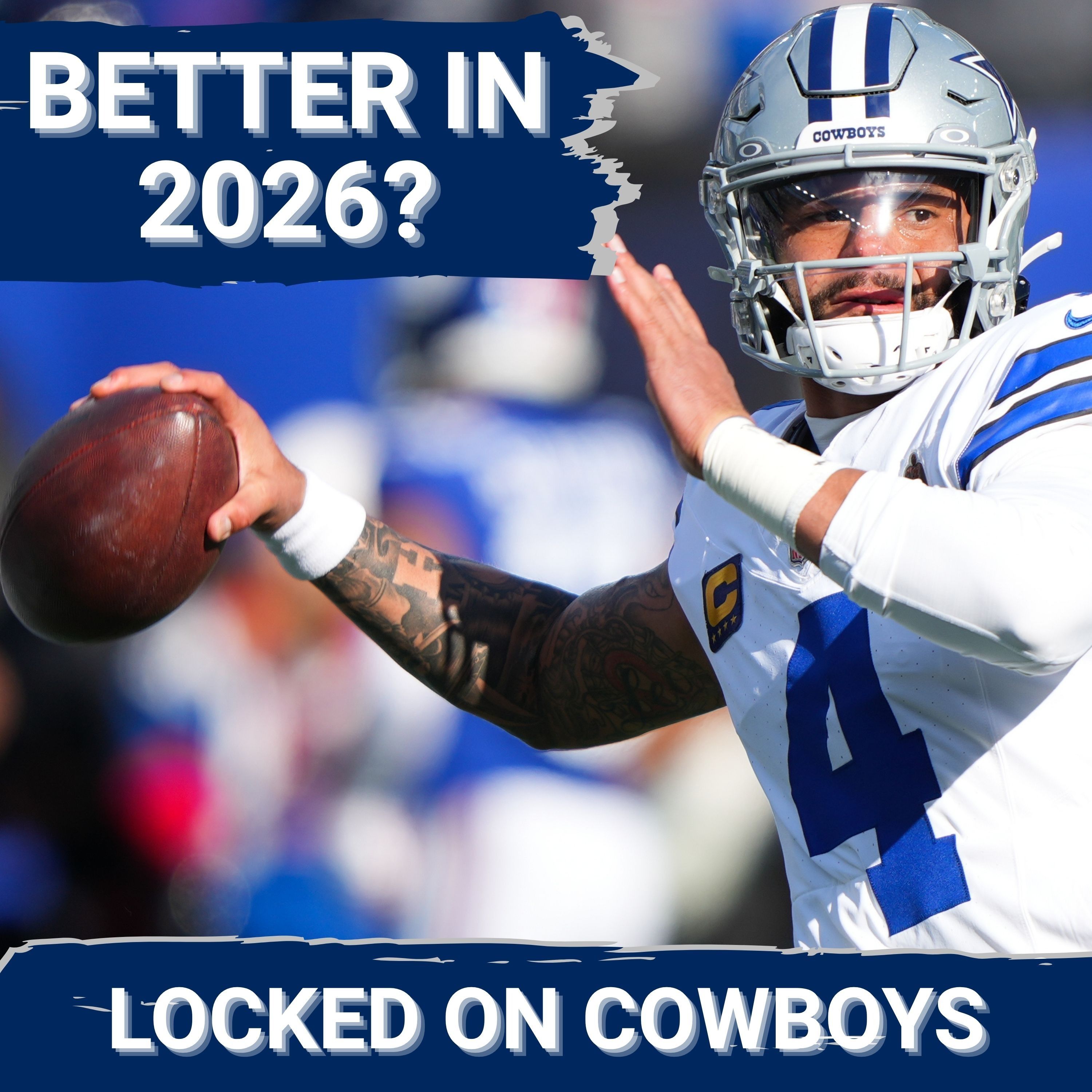
Locked On Cowboys - Daily Podcast On The Dallas Cowboys
OPTIMIZED: Can The Dallas Cowboys Offense Be EVEN BETTER During 2026 NFL Season?
00:27:02
The Dallas Cowboys' offense is primed to surpass last year’s high-powered performance—will improved health and efficiency fuel a Super Bowl run? Marcus Mosher and Landon McCool break down why the Cowboys’ offensive line continuity, a healthier roster, and potential leaps from players like Tyler Guyton and Ryan Flournoy could unlock new levels for Dak Prescott and company.
Loading summary
Transcript42 lines
- [00:02]
A
It's the Locked on podcast network your team every day.
- [00:12]
B
Liberty Mutual customizes your car and home insurance to save you money. That's it. That's the ad. No bells and whistles. No guys. I said no bells and whistles. No. Trombones are fine. Visit libertymutual.com and make the switch today. Liberty. Liberty. Liberty. Liberty. America's best network just got bigger.
- [00:40]
A
Switch to T Mobile today and get built in benefits the other guys leave out.
- [00:45]
B
Plus our five year price guarantee.
- [00:47]
A
And now T Mobile is available in US Cellular stores.
- [00:53]
B
Best mobile network based on analysis by Oogle of speed test intelligence data 2H2025 bigger network. The combination of T Mobile's and US cellular network footprints will enhance the T Mobile network's coverage price guarantee on talk
- [01:02]
A
text and data exclusions like taxes and fees.
- [01:04]
B
Applied CT mobile.com for details. The Dallas Cowboys offense was really good in 2025, but it might be better this year. We'll tell you why next. You are Locked on Cowboys, your daily Dallas Cowboys podcast, part of the Locked On Podcast network your team every day. Welcome back. I am your host Marcus Mosher. He is Landon McCool and on today's show we're discussing whose job is more in danger, Tyler Guyton or Jake Ferguson. Can you pay two star receivers but Landon, I want to start with this. We had several people over the last two days asking us about the offense because for the most part the Cowboys completely ignored that side of the ball this offseason. They signed Sam Howell, they reworked Jonathan Mingo's deal, they drafted Drew Shelton, and that's about it. There's some concern that the offense could take a step back this year after not making any improvements. Do you think that's going to happen or do you think they'll actually be better in 2026?
- [02:15]
A
So it's interesting. Obviously regression to the mean is kind of the, the hot topic here, right? Like can, you know, is there a fall back to the norm? Right. And to me, if anything, the fallback to the norm is going to be about hopefully the Cowboys getting a healthier season out of their offensive line this year. Right. Like just to throw out a couple different numbers, if the Cowboys start the same offensive line group that we're expecting them to start, this is I think the first time in, in five or six years since they've had the same starting lineup in back to back years. I think it's since 26 or 20. And on top of that, last year, the longest stretch that the Cowboys had the same starting five units Back in in a row was three games. Like that's wild. Right? They had four other plus players besides their actual starting five that had to start games for the Cowboys last year. And look, ultimately the Cowboys offense performed extremely well. Obviously they were top five in a lot of different metrics. We felt like the run game took a big step forward. Obviously at certain points it felt like the offense was unstoppable. But that was all kind of despite the fact that the Cowboys were going through a really extremely rough patch of offensive line injuries that they were able to kind of make their way through because they had a lot of talent, a lot of depth at the offensive line. If they're able to just simply have normal health on the offensive line and able to retain their starters for longer stretches of time. Time. I think that continuity alone and added in the fact that you have a bunch of really young up and cominging players on the offensive line. I think those two facts are more than enough to counteract any sort of regression in this offense if you're able to achieve it.
- [04:12]
B
Yeah, and I generally don't believe in like, hey, just stay healthy and we're going to be much better on that side of the ball because injuries happen and every team has injuries. But you're right, they got to a point last year where I mean there was even some games like against Green Bay where it was. I think it was Nate Thomas at left tackle. T was it Brock Hoffman, Akeema Dinijay, Brock Hoffman, T.J. bass, right guard, and then Terence Steele. Like you were down four of your starting five offensive linemen five games into the season. Like that's pretty rare now. I think that is one way they can improve. The other way is just by being more efficient. And I've got some numbers for you here. Despite being one of the best offenses in the NFL last year, Landon, the Cowboys are 25th in red zone scoring percentage. That to me that's the number one. Like if they're just better in the red zone, they're going to be a better offense. They were 18th in red zone touchdown percentage. Again, you just be. If you get to 12, you're probably going to be averaging three more points a game. They were 17 and 17th in giveaways. That's. That can be a little fluky. So I'm not super concerned about that one. But they had, they ranked 22nd false starts, 28th in offensive pass interference and they were 31st in penalties altogether on offense. Like cut down on the penalties, be a little bit more efficient in the red zone, score three or four more touchdowns rather than kicking field goals. Or there were a bunch of times like I'm sure you remember that Philadelphia game right before Thanksgiving, like they just got stopped on fourth down, I think twice inside the five yard line. Score a couple more touchdowns and the offense is going to be a lot better.
- [05:55]
A
And guys like, I know he just listed off a lot of different things, but honestly there's a ton of synergy between what we're just talking about like the red zone efficiency, the false start penalties, the, the, the, the short, the short yardage stuff. A lot of that is tied into the fact of not having continuity of your very expensive, very highly paid for or very talented offensive line all on the field at once. So if you get more opportunities with the guys who, again, like, you've invested a lot of your resources into this offensive line, you were able to absorb injuries, but you also weren't able to get the value that you're expecting out of having all those talented offensive linemen on the field at the same time. So you, if you get just, you know, a normal amount of health along the offensive line, more than just. And this is the other thing too, Terrence Steele was the only offensive lineman who started all 17 games or all 16 games of the season last year. So I think if you were able to get just even slightly better health, the chances that this has a cumulative effect and it kind of affecting a lot of the things that Marcus just listed is very likely now to be transparent.
- [07:05]
B
I do wish they would have done a little bit more on offense just because I thought they could have maybe upgraded the tight end position and the running back spot. Although I devalue it more than most people do. We, we were both hoping to see at least one other guy in there that could be a suitable backup for Javante Williams if he went down with an injury. We still think that could potentially happen down the road. It didn't happen in free agency, it didn't happen in the draft. But there are three other things that I wanted to mention that could potential happen this year to help this offense get better. And the first is just coaching. You had Brian Schottenheimer last year, first year as a head coach, first year calling plays with his offense. I think it's natural to assume that he's going to be 2% better, 3% better as a play caller. That'll help. George Pickens, Year two in the system. I think this was right around the time the Cowboys acquired him last year. I think that'll help. And the Third one is Ryan Flournoy who was released late August last year, spent the first couple of weeks on the practice squad. He really emerged in the second half of the season. If he can, you know, just take tiny steps forward and give you a viable third receiver. Now you're going to have so many weapons at your disposal and the floor just as much higher like, because last year they had CD Lamb get hurt and week three now you feel like it's not that big of a deal. I'm so big deal. But it's not as big of a loss if CD goes down for a couple games.
- [08:36]
A
Yeah. I think Flournoy showed you that he may have a little bit higher ceiling than we even imagined, right?
- [08:41]
B
Yes.
- [08:41]
A
And I think he showed that he developed a little bit and if he could take an even further step, I, I think he's kind of right at the area where not only is he a wide receiver. 3. I think if he was on some teams, he might be their wide receiver too. Like he's on that level of improvement. I think. So we'll see what kind of step he takes next year. I'd also throw out Brevin Span forward in this case. Right. If he's even to be able to become a ten better receiver, you. It becomes a much more viable option to deploy him more regularly. And I think that he has a big body that you can deploy in the red zone a little bit more often than maybe Ferguson and he gives you just a different type of, of receiver of the football to kind of throw down there, there.
- [09:24]
B
Well, and what's funny, Landon, is there's so many players in this offense that if they just outperform their expectations by like 10 to 20%, it just changes all the angles on offense. I'll give you a couple names. If Jaden Blue ends up taking a huge step forward in year two, that's going to make the run game so much more dynamic. If Tyler Guyton in year three really turns into, let's just say a good starting left tackle, you can do so many more creative things. Right. Flournoy is another one. Or let's say Tyler Booker takes that step and goes from a really good guard to an all pro caliber guard now, you can be even more dominant up front. They were already a really good offense, but they just need one more thing to go their way for this to kind of tilt back to being a completely dominant unit.
- [10:11]
A
Yeah, it's. There's a lot of different angles for improvement. Right. It doesn't necessarily have to be about adding players. So, you know, if they get any one of these things to hit an improvement by one of these players, offensive line continuity, it's, it's going to improve their offense from where it was last year.
- [10:28]
B
It's almost like, you know, when you're in a game having different paths to victory, Right. That's the way I feel about this offense. If just one or two of these things go the way if they go from 18th in red zone scoring and touchdowns to like fifth, they're going to be in the playoffs. I can guarantee you, like that's, that's how slim the margins are in the NFL. All right, let's talk about the strategy of paying two receivers big time money. We've talked about the George Pickens saga ad nauseam, but let's talk about the general philosophy. Can you pay two receivers big money? We'll get to that next. This episode is sponsored by BetterHelp. May is mental health awareness month, and it's an important reminder that, that whatever you're carrying right now, you don't have to go through it alone. Life can feel overwhelming sometimes. Whether it's stress, uncertainty, anxiety, or just trying to manage everything by yourself, it's easy to feel like you need to figure it out by yourself, or at least you're going to try to. But therapy can be a place to get support, gain perspective, and talk things through with someone who's there to listen and help you on your way. BetterHelp connects people with licensed therapists, and it makes it easier than ever to get matched with someone who fits your needs and your goals. I think a lot of us have these moments where stress or anxiety can keep us up at night. And it helps to remember that asking for support is a sign of strength and not weakness. And having someone with you, someone to listen and support you, can make a real difference. You don't have to face this journey alone. Find support and have someone with you in therapy. Sign up and get 10% off at betterhelp.com/locked on. That's better. H E L P.com Locked on hey
- [12:17]
A
everyone, this is Ross Jackson, one of the hosts of the Locked On Podcast network. If your group chat's been a little quiet lately, I want to invite you to come and join ours. If you sign up for the Everyday Club, you get access to the members only group chats for your favorite teams, plus national chats for every sport. Personally, I love watching folks talk a little smack in the NFC south trash talk chat. You also get an ad free version of your favorite Locked on show and a whole lot more. You can check it out by tapping the Everydayer Club link in the show notes.
- [12:48]
B
Welcome back to the Locked on Cowboys podcast. We'd like to thank you for making us your first listen every single day. Don't forget to check out the Everydayer Club for ad free episodes and access to a group chat with Landon and I and other listeners of the show. Tap the link in the show notes or go to Locked On Cowboys. All right, Lane, and we got some really good questions that we want to get through. And this one's from Jake. He wants to know, does it make sense in this era of the NFL to pay two wide receivers big time money? Obviously he's alluding to CD Lamb and George Pickens, but just remove the names for a second. Can you be competitive, be a Super bowl champion or super bowl contender while paying two receivers big time money?
- [13:35]
A
Yeah, I mean I, I would like generally kind of advise against this type of thinking. I, I do think it's possible to look, it's possible to do this a whole bunch of different ways. And certainly like there have been recent examples of, of teams paying, you know, two wide receivers and winning the Super Bowl. I'm sure you've got a couple lined up. But before we get to that, I do think that it's worth pointing out that we've seen all different types of team builds win Super Bowls. I think the era of it being kind of a single path that wins the playoff and gets into the Super Bowl, I think that's incorrect. I think you have to find ways, a lot of different ways to win these games because you're going to face a lot of varied opponents that play a lot of different styles of football. I think that there's still a tendency to play that defense and the run game are important as the seasons go on. But I think generally speaking, there are so many different ways to get where you need to go to win the Super Bowl. And I think it varies, you know, slightly year to year anyways, that I just would generally caution against this kind of line of thinking, you know, of just ruling one pathway out. And having said that, I think even though we just saw defense, you know, really kind of be the forefront of this current super bowl winner, it's not that the offense wasn't good. Obviously they had an elite wide receiver on that offense, to say the least. I just think that there is going to be times when an offensive led team wins the Super Bowl. There's going to be times when a defensive team led the super wins the Super Bowl. There's going to be a time when you're going to have an all pro hall of Fame quarterback. There's going to be a time when it's Trent Dilfer that's. That's playing quarterback for you. There are just a lot of different ways to do this. And the answer to solve it simply is, yes, the Cowboys can, I think, win this.
- [15:28]
B
And I think if you're always chasing what won the last year's super bowl, you're always going to be behind. And that's why I remember at this time last year, everybody was saying, okay, you can't pay a Sam Darnold $30 million a year and think you're going to win a Super bowl, right? That's a journeyman quarterback. And Seattle did it, right. And there was this notion that you can't, you know, you can't pay big these quarterbacks big money and win Super Bowls. And that certainly happened with Jalen Hurts and Patrick Mahomes, and it goes on and on. So I think I'm of the belief that there are many different paths to winning a Super Bowl. You need a lot of luck to get there. And I think if you have these hard, fast rules of like, hey, we can't pay two receivers, or, you know, you know, we have to have this much money allocated to defense and this much money allocated offense, you're going to get in trouble. And I think for the Cowboys right now, if we're going to use them as an example, their best path forward is to be dynamic and dominant on offense and just have a defense that is good enough to get you some takeaways, get some timely stops. That's their best path forward right now. I don't think. I don't think losing George Pickens and putting that money into defense is necessarily going to be good enough. Because we saw them in 2022, I believe, the year they lost to the 49ers in round two, they were short one weapon in the passing game and they completely crippled their offense.
- [16:51]
A
I think the key thing is just to be flexible enough to be able to solve a whole bunch of problems because that's ultimately what's going to get thrown your way is a lot like more and more teams are playing with wider and wider variety of formations and game. Game styles. There's different, just different types of team styles. So I think having enough solution to face, that's the important thing. You know, can you get too myopic at wide receiver and then forget to allocate resources to other areas and that can cause you problems 100%. But that doesn't mutually have to be like, oh, once you've paid two wide receivers, you can't do all that you need to do to get where you need to go. You just have to be smart about it and understand that when you're robbing Pete, sometimes you're robbing Peter to pay Paul. And if you can figure out how to cheaply solve solutions elsewhere, then you can afford to push money into the positions like wide receiver.
- [17:49]
B
Yeah. And we just know the way that the, the Cowboys are going to operate. They're never going to steal a bunch of money from three, four, five years from now to really go for it. Now they always kind of want to be competitive, so you're going to have to figure out ways to get through that, through those restrictions. And I think if they decide to go forward with this idea of paying two receivers, you probably don't need to be paying a tight end top 10 money as well. They already paid Javante Williams. He's not getting paid a ton. But I think running back is obviously a position that you could cut back on. But I think the offensive line is one. Like, if you're paying a quarterback a ton of money and two receivers a bunch of money, you can't also have the highest paid offensive line in the league. And they don't right now. Right. They've got a lot of these guys on rookie contracts. The only ones that they're paying are Kyler Smith and Terence Steele. You're probably just gonna have to pick two guys that you want to keep and rotate those other three in and out. Other teams have done it. There's teams that have way less investments in the offensive line that are able to cover it up. Those are some of the trade offs that you're going to have to make. We can debate whether those are smart or not, but I think at the end of the day, having those two receivers on the outside can cover up a lot of flaws up front.
- [19:02]
A
Yeah, Again, it's about being able to solve problems. And sometimes having those two wide receivers is a problem solved for a lot of different issues, including a struggling run game. Right. Because if you have to take care of the two wide receivers, it opens up opportunity for your run game. So, yeah, I don't think it's. There's a checklist or you have to have your offense or your defense or your roster in. In any, you know, resources allocated to certain positions only a certain way. There are many different ways to do it. You could pay your quarterback a lot of money. He could be on a rookie deal. He you could pay two wide receivers a lot of money. You can have a bunch of free agent guys if you can still solve the problems that you need to win the games.
- [19:45]
B
I'm curious how they're going to handle the post Dak Prescott era, though. Are they going to try to go cheap at quarterback and really build up the offense? That's a discussion for a that's stressful to even think about that. But let's talk about Tyler Guyton and Jake Ferguson, two players that disappointed a little bit last year, who is in more trouble going into 2026. We'll get to that next. This episode is brought to you by Rugby the NHL playoffs are here, where every shift matters, every moment is intense and the pressure is at its highest. And just like performance matters on the ice, it matters off the ice too. And that's where Rugiate comes in. Rugiate offers treatments designed to help you get ready and stay ready when it matters the most. Their top option, Rouge Ready, combines clinically proven ingredients and a simple mint that dissolves under your tongue. It works incredibly fast, usually in about 15 minutes, and the effects can last up to 36 hours. And they also offer Go Long, designed to help with both performance and control. It's all about the confidence that you need and feeling like yourself again. Head over to Rujia.com lot NHL and get 15% off your ED treatment. That's R U G I-E-T.com lot NHL for 15% off Rouge Performance Medicine for men Foreign welcome back to the Loton Cowboys podcast. We'd like to thank you for making us your first listen every single day. Landon We've got a question from a longtime listener, Gorn. He wants to know which player is in more trouble going into the 2026 season. Tyler Guyton at left tackle or Jake Ferguson at tight end?
- [21:36]
A
I think it's Jake Ferguson just because I think you still got guidance under a contract that is pretty nicely controlled. I mean, we'll see about the fifth year option eventually. That's going to be very dependent on what we see this year. But I I think Ferguson, you know, he just signed that deal last year. It's been up and down to be to be nice. I also think that he's probably a more easily replaceable player than than Guyton is. I mean, not that I mean Guyton didn't play a ton last year, but I'm saying trying to find a starting offensive tackle is difficult and and certainly more difficult than I think getting production out of the tight end position as receiver. So I, yeah, I think both of these guys have got to play good football this year. Both of these guys have pretty serious questions. I, I think for Guyton, it's, it's, I think for both of them in some ways it's about staying healthy a little bit. But I think with guidance I can at least say I feel like when he's been on the field, I've seen improvement from him. I feel like he's, he took a step in ability from year one to year two with Ferguson. I'm starting to question that now. Right. I'm starting to question if we haven't seen the best of Jake Ferguson at this point and is he actually going to be able to continue to be a plus player that's worthy of the contract that he has. And again, going back to the, the segment that we just talked about last year last, you know, the last segment is if you have a situation where you're thinking about paying George Pickens long term money eventually, you know, it kind of doesn't always make sense to be paying a tight end, especially if he isn't performing the way that you want him to.
- [23:20]
B
And this is, this is my concern or was my concern about Jake Ferguson when they drafted him coming out of Wisconsin, he ran a 481-40-yard dash at £250. That is incredibly slow for a modern day tight end. We saw tight ends at the NFL combine this year running sub 4, 5 right I think was it Kenyan Sadiq ran a 439 right now, it didn't, it didn't hurt Ferguson early in his career, he was explosive. He was making plays after the catch. Last year he averaged 3.83 yards after the catch per reception and that was the worst in the league for any tight end that saw over 20 targets by a mile. And it's, it's shocking. Like I, I urge you guys, go watch some Jake Ferguson highlights in 2022 compared to 2025. And the difference in athleticism is drastic. And I know he's been battling some injuries, but you wonder like, are we at the point now where he's just lost the explosiveness and he's, he's not a big player and a lot of his game was built on making plays after the catch. And if you can't do that, just how valuable of a player are you?
- [24:31]
A
Yeah, it's, it's a legit question. And it feels like you got a couple of years of really good production, which kind of made you feel like the investment was maybe worth it at certain points. And, and honestly it, it, I hate to, I hate to do this, but the Ferguson deal in some ways felt kind of like, was it the second Zeke deal that was like where, where you signed him and, and it was kind of proving that they were willing to sign a deal to Dak or something like that? Yeah, yeah.
- [25:03]
B
I think of the Jalen Smith deal I think when they were trying to,
- [25:05]
A
yeah, that's maybe, maybe a better example where, you know, it's like, it feels like they got a deal done with the guy that they probably wanted to get a deal done, but they accelerated it to almost in spite of, of another players that's, that's having a contract situation. Yeah, I, I just feel like so far we saw a little bit of good Jake, I think at certain points last year, but it's been a really long time since we've seen the kind of high highs that he saw he had a few years ago. And, and honestly, I mean, I hate to kind of open up a new can of worms on this, but I, I, I, I've started to wonder whether the Cowboys shouldn't have just kept Dalton Schultz before he left. You know, he, with the way that he's played with Houston. Yeah, it feels like Ferguson was great for a couple of years, but I just wonder if they wouldn't have found a little bit better consistent player with Schultz.
- [25:59]
B
I think they just need to change how they're using Jake Ferguson. Like early in Ferguson's career we would see a ton of these like early down bootlegs where you get hit in the ball in the flat and he cuts up field and that's how he makes his hay. He just can't, he can't win that way anymore. Right.
- [26:15]
A
He doesn't have that explosion anymore.
- [26:17]
B
No.
- [26:17]
A
Like that.
- [26:17]
B
So, so wait, what you maybe need to turn him into is more of like the, hey, we're gonna have you run an option route, 7 yards, go pick up the first down, catch the ball, get down. Basically what like old man Jason Whitten was doing in Dallas. And it kind of sucks to have to turn him into that player, you know, at this stage of his career, but that's the best way I think you're going to get value out of him.
- [26:39]
A
It's, it just sucks because, and I guess maybe with Trig we'll get some kind of semblance of this, but it's just, it just sucks that we have maybe the best seam ball thrower in the NFL. And certainly the most daring seam ball thrower in the NFL. And it does, it just doesn't feel like Dak has ever had kind of a top end athlete at the position that he could really exploit.
- [27:01]
B
Well, and there were multiple times last year where Dakota. Thinking back to the first Philadelphia game in week one where Dak threw a beautiful ball, Ferguson juggled it, didn't catch it. He ended up drawing the penalty. But Miles Sanders fumbled on the next play. That should have been a touchdown to take the lead in that game. And that kind of play happens over and over again. And that's the difference between sometimes being one step quicker, you know, three, four years ago than what he is now. So I, I think Guyton's going to have a job here for the next two years because he's cheap. Ferguson this year needs to show that last year was a fluke and that he can stay healthy and he could be explosive again.
- [27:40]
A
Yeah, they, they can work around Guyton. If he's bad for some reason, they, you know, because he's cheap. He's certainly good enough to be on the field if he's healthy. If Ferguson's just not good. Like you're wasting opportunities with a player like Dak who loves to throw the ball down the seam. You need to find a replacement sooner.
- [27:57]
B
All right, that is it for today's show. We'd like to thank you for making Laton Cowboys your first listen every single day. Make sure you subscribe and follow the podcast so you get all of the latest episodes. And if you never miss an episode, the everyday club is built for you. Get locked on Cowboys ad free, plus members only, Discord Access, and so much more. Head over to lockdown cowboys.supercast.com to join the club. And for those of you on video, we can send you the first ever 24. 7 national NBA YouTube channel. And on audio, make your second listen the Locked on NFL Draft podcast. Follow Landon on Twitter @mccoolbcb. I'm @Marcus Underscore Moser. We'll see you right back here tomorrow. And Doug, there's nowhere I wouldn't go to help someone customize and save on car insurance with Liberty Mutual.
- [28:48]
A
Even if it means sitting front row at a comedy show.
- [28:52]
B
Hey, everyone, check out this guy and his bird. What is this, your first date? Oh, no. We help people customize and save on car insurance with Liberty Mutual together. We're married. Me to a human, him to a bird. Yeah, the bird looks out of your league. Anyways, get a quote@libertymutual.com or with your local agent. Liberty. Liberty. Liberty. Liberty.