← Locked On Cowboys - Daily Podcast On The Dallas Cowboys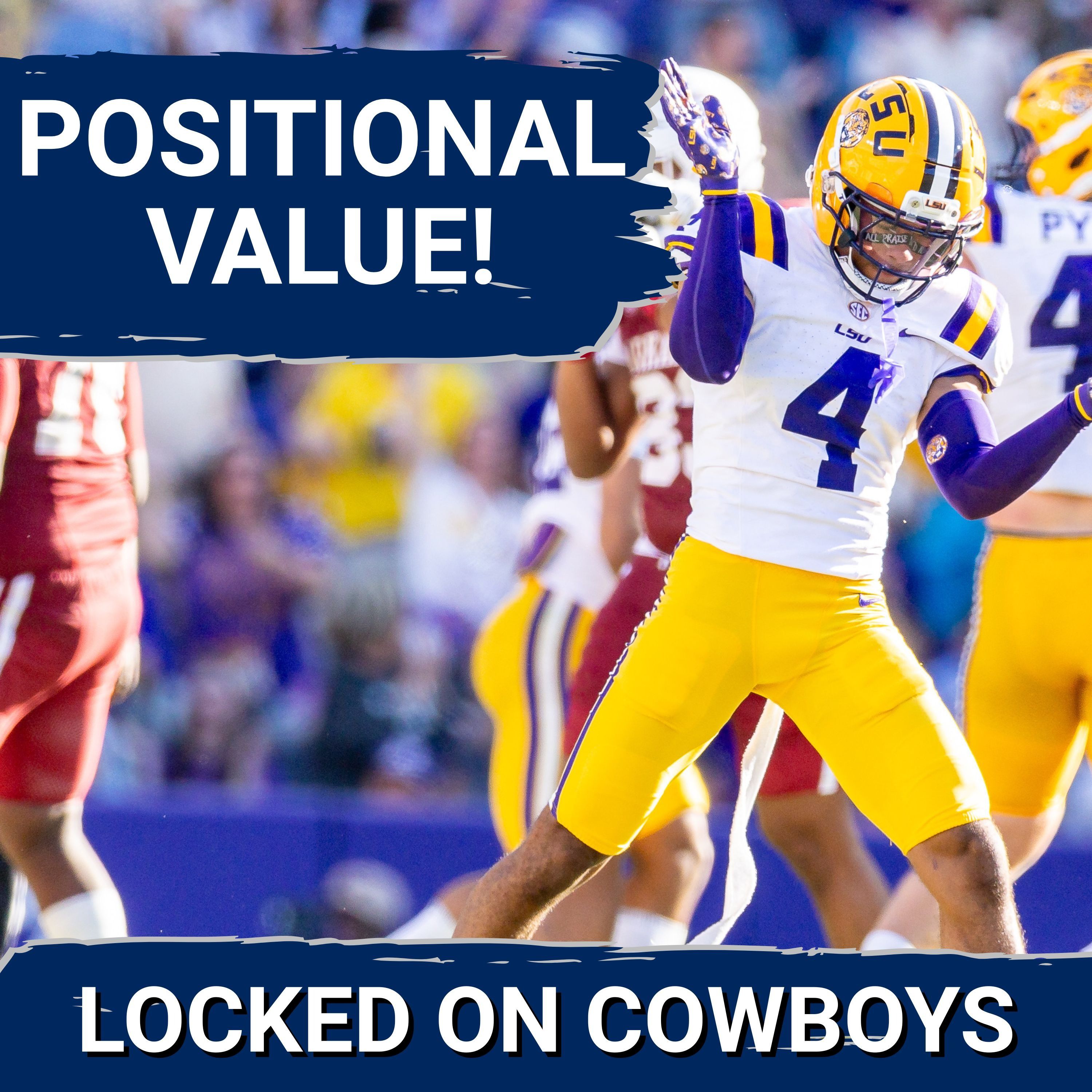
Locked On Cowboys - Daily Podcast On The Dallas Cowboys
VALUE PLAY: How Much Should Dallas Cowboys Care About POSITIONAL VALUE During 2026 NFL Draft?
00:28:06
The Dallas Cowboys face pivotal NFL Draft decisions as positional value shakes up their offseason strategy. Are Money 5 positions like quarterback, edge rusher, and cornerback more critical than ever, given the team’s tight salary cap?
Loading summary
Transcript47 lines
- [00:00]
Marcus Moser
Foreign.
- [00:10]
Commercial Announcer
The playoffs are on and fnatic's merch is 30% off with pays, a fast online checkout offered by banks and credit unions. So snag team gear like jerseys, caps, sparkly boots, even giant inflatable tube men. When you use pays at checkout, your actual card numbers aren't shared with merchants, so you can lock in your gear with added security and let that giant inflatable tube man thrash with confidence. You use pays with code. Pays perks for 30% off at Fanatics until March 31, 2026. Terms apply@fanatics.com pays prime one day delivery's fast.
- [00:42]
Marcus Moser
How fast we talking? We're talking yoga mats and fitness trackers.
- [00:46]
Landon McCool
Delivered so fast you can kick off your routine tomorrow.
- [00:48]
Marcus Moser
Fast.
- [00:49]
Landon McCool
We're talking weights at your door without really waiting.
- [00:51]
Marcus Moser
Fast.
- [00:51]
Landon McCool
Water bottles and hydration backpacks.
- [00:53]
Marcus Moser
Fast and fast.
- [00:54]
Landon McCool
The resistance spans faster than you can say. Feel the burn.
- [00:57]
Marcus Moser
Fast. More jump ropes.
- [00:58]
Landon McCool
Just a hop, skip and a jump away.
- [01:00]
Marcus Moser
AKA fast.
- [01:03]
Landon McCool
That was actually a good workout.
- [01:04]
Marcus Moser
Fast, Fast. One day delivery for all things fitness.
- [01:08]
Landon McCool
It's on Prime.
- [01:11]
Marcus Moser
The Dallas Cowboys are going to have to make some big decisions in the NFL draft. We'll tell you how positional value can help them next. You are Locked On Cowboys, your daily Dallas Cowboys podcast, part of the Locked On Podcast network. Your team every day. Welcome back to the Locked on Cowboys podcast, part of the Locked On Podcast network. Your team every day. We'd like to thank you for making us the number one sports podcast network. I am your host, Marcus Moser. He is Landon McCool. And on today's show, we're going to talk about positional value. This is something that has been thrown around all these podcasts and articles over the last couple of years. I'm sure you've heard us talk about this before, but we wanted to really dive into what it means, why it's important, and how the Cowboys can use it to help them make decisions this offseason. So, Landon, the floor is yours. Do your best to explain to our listeners what positional value is.
- [02:22]
Landon McCool
Well, you know, it starts with, you know, the money that these players are expected to earn on a free agent situation. Right? And, and that's kind of where we start. The conversation is some players, because of scarcity of their body type, because of the value that they have to the team versus relative to other positions, every position is kind of valuated at a different rate. And I mean valuation literally. I mean like at a dollar and dollar and cents sort of way. And that bleeds into the conversation of, of drafting. Right. Because even though there is a salary cap and even though that the rookies are on a different scale than the veterans, it's, it's effective and it's all affected by what they ultimately will make, what this, what the franchise tags are. And it's all kind of connected. And so positional value is about keeping in mind which positions are paid the highest on a kind of free agent basis or when you, when it's time to resign them and trying to get the most amount of value by drafting those positions high and in controlling those costs on a rookie deal and leveraging that as best you can. Now, I think there's a point where people maybe go a little too far. We'll talk about that too, but never. But I do think that it is an important thing to pay attention to. It's more than just a tiebreaker, I would say. It's, it's a huge part of, of long term team building to make sure that you're controlling your costs by making sure that you're drafting expensive players on onto cheaper rookie deals.
- [04:10]
Marcus Moser
Generally, the way that the NFL has looked at it, we call these the money five positions. The five positions that are the most important to winning. Now we can debate the order a little bit, but for the most part it goes quarterback, number one. That's, I mean we all know that that's the most important position. Edge rusher, offensive tackle, wide receiver, cornerback. Those are your top five. I do think it's changed a little bit in the sense that defensive tackle and edge rusher are really the same. We could just call it pass rushers. Those are the guys that are really, really valuable and then there's a drop off. And I think when you get to guards, centers, run stopping, defensive tackles, off ball linebackers, running backs and safeties, they're just on a different tier. Now the tricky part of this, and this is what we're going to talk about today, is how, how big is the gap between those money five positions in the next tier positions and how much better does a, you know, does an off ball linebacker need to be than an offensive tackle in order to get drafted high? All that's up for debate, but I think if you just stick to those money five positions, and those are typically the positions that get paid the most on the open market and in free agency, you'll see a trend of those guys, you know, becoming more valuable than everybody else.
- [05:37]
Landon McCool
Yeah, and as we've seen like there's been some calibration there a little bit with some of that like it used to be that it was only the left tackle. That was considered to be money five and yes, and that's changed over time. And, and, and honestly it was, there was a time when it was, the thought was wide receiver ones really are only the guys that kind of you want to pay. But that's not necessarily been even true these last few years. So there's definitely been a lot of. And this is constantly being kind of recalibrated depending on a number of variables. Not just, you know, the, the inherent value of the position as I just discussed, but also trends and changes in the game and stock, a draft stock on a year to year basis may have an effect there as well. So yeah, these are, there's lots of variables here. There is some kind of steadying elements to it that seem to kind of, you know, hold true throughout the years. But there is also a lot of room for this to kind of change and reform depending on the way that the game is going and the way that the kind of contracts or situations are going as well.
- [06:44]
Marcus Moser
Well, and we should mention contracts because this is a big thing when we talk about like fifth year options and franchise tags. And one of the big problems the NFL has right now is they don't describe the positions well enough. And what I mean by that is they only have a couple designations for these positions. It's quarterback, wide receiver, linebacker, offensive line, defensive, defensive end, defensive tackle, corner safety, tight end, running back, special teams. What makes this hard for like a, for a guard. And let's use the Cowboys example of Tyler Booker. The NFL does not really categorize it as a tackle versus a guard. So when a fifth year option comes up, like an example would be this year, Tyler, Tyler Booker, if he doesn't make a Pro bowl, is going to have a fifth year option of $20 million if he makes one Pro Bowl. The fifth year option is going to be $25 million. If he makes more than one Pro bowl, you're talking about $28 million. Obviously you're going to be happy if Tyler Booker makes a Pro bowl, but now you are paying a right guard, left tackle money. And that's where things get really tricky. And when it comes to this, this upcoming draft class, if you're looking at somebody like let's say Sonny Styles, Right. Because players like Micah Parsons and T.J. watt and Miles Garrett are called linebackers in a 3, 4. The NFL views them as linebackers when it comes to the franchise tag and the fifth year option. So if you were to franchise a Linebacker, it would cost you 28 million. Landon, is there a linebacker outside of, I mean, maybe even including Fred Warner, that's worth 28 million for a single season right now?
- [08:37]
Landon McCool
Yeah, I mean, that, no, there's not. And that's, that's the problem. Right. And I think that it's, it's, it feels like this is something that has been a shared problem between the NFL ownership and the agents. Right? Like, there's been manipulation on all sides here as these, you know, they try to negotiate the high, the best price or the highest salary for their respective sides. But yeah, it's become extremely problematic when, you know, and, and, and it even gets broken down further than that. Like, you know, the, the particular type of safety that you are could really dictate the amount of money that you make. You know, the, the type of wide receivers that you are could really dictate the type of, of money you can make. So I, I, I, I think that, you know, it probably doesn't need to be quite broken down to that level, but it certainly needs to be broken out and resorted in a way that it feels like the position and the way that they're bucketed needs to be kind of fixed. And the edge position, outside linebacker specifically, is, is incredibly egregious because of what it does to the, to the linebackers and because edge is, well, I mean, like, you know, offensive line is just as bad, right, because it includes 25. And they gotta find a way to kind of break those, those groups apart, bucketize them a little bit more, and prevent agents and teams from manipulating the system by improperly labeling or improperly bucketing these guys into the wrong spot.
- [10:04]
Marcus Moser
Now, I'm not saying that you need to completely avoid like a Sonny Styles because you're worried about the fifth year option. And I know there's people saying, well, just sign him to a contract earlier and you don't have to worry about it. Well, if you're. So he knows that a fifth year option is going to make him the highest paid linebacker in the league by a ton of money. So that's it. It's fully guaranteed. So that's just going to be factored into any contract discussions. Maybe this will get changed in the next cba, but as it stands right now, it's a really, really big deal and it should impact how you're valuing these positions in the draft. We'll talk about how the Cowboys can use it to their advantage next. This episode is brought to you by. Indeed. If you've ever hired someone who looked good on paper but but wasn't the right fit. You know how important that is when you want candidates who truly match what you're looking for. Trust Indeed. Sponsored Jobs Hiring Indeed is all you need. Stop struggling to get your job post seen on other sites Indeed Sponsored Jobs. Put your posts at the top of the page and help you reach the right candidates faster. I know that if I ever needed to hire someone for this show, I. I would go straight to Indeed and be very specific about what I needed, which is real experience and not just some resume buzzwords. Spend more time interviewing candidates who check all of your boxes with less stress, less time and more results using Indeed Sponsored Jobs and listeners of this show. Get a $75 sponsored job credit to help give your job the premium placement that it deserves. And at Indeed.com lot NFL just go to Indeed.com lot NFL right now and support the show by saying you heard about Indeed on this podcast. Terms and conditions apply. Hiring. Do it the right way with Indeed. Oh, could this vintage store be any cuter? Right? And the best part, they accept Discover. Accept Discovery in a little place like this? I don't think so, Jennifer. Oh yeah, huh. Discover's accepted where I like to shop. Come on, baby, get with the times. Right. So we shouldn't get the parachute pants. These are making a comeback, I think. Discover is accepted at 99 of places that take credit cards nationwide. Based on the February 2025 Nielsen report. Welcome back to the Lockdown Cowboys podcast. We'd like to thank you for making us your first listen every single day. If you haven't done so already, check out the new Everydayer club. You're going to get ad free episodes to the Lockdown Cowboys podcast for just $5 a month. Go to lockdown cowboys.supercast.com to join the club or tap the link in the show notes. All right, later, let's talk about the Cowboys biggest needs this year. We know that they need linebacker help. We know that they need edge rush help. They also need corner and safety help. How should they prioritize these needs? I mean there's, there's varying levels of needs with positional value. Because I'm looking at their first, you know, the two first round picks and you look at like some of the consensus boards and it's a lot of safeties, linebackers at the top of the draft. How would you value it here for Dallas?
- [13:28]
Landon McCool
You have to be really careful here. Right? Like, and I think that's, this is where people make mistakes with positional value. Is that they, they listen too much with their pocketbooks and they don't watch. They don't, they're not watching with their eyes, right? And I, and I think that what it is, is that you have to take, you have to take it all in and consider the money that's, that's there. And I think there are. I know I spent the last segment saying that it's more than a tiebreaker, but there are times when you have to realize that it's, it can't be more than a tiebreaker, right? Where if there is a guy that is, you know, a step up, even if he's at a position that's less valuable, then you should take the better player, right? And I think that the, I think there is a point where that may, you know, there may be diminishing returns there, and I think that that's where you have to be careful is kind of. Because what you end up having to do is kind of valuate the difference between the two players, right? Is the, you know, if, if I'm going to be paying this player, you know, $4 million over the average linebacker because he was drafted at a certain spot, and I'm saving $3 million at the average cornerback spot by drafting a cornerback at that equivalence spot, then is the difference, you know, that $1 million difference or $7 million difference worth it for this player? Is he that much better? I think that's a really hard thing to do, right? So to me, I think you have to look at the ones that are the money five, right? The edge of the corners, and you give them slight difference. And, and if all things are being equal there, I think the, the need is probably, probably equal. I, you know, you probably could say the corner might be a little bit more of a need, but I, I think if they were all being equal as far as need levels, I think that you look at the situation and you say edge, corner, those are your money, money, five spots. If we get to 12, there's somebody at, at equal levels of, at all three spots, I'm going to take a preference at edge or corner just because I'm going to end up saving a whole bunch of money by doing so. And you know, like you said, especially with that high, as high as 12, you know, there's some pretty significant amount of money that you're going to have to pay a player like Sonny Styles if you want to pick up his fifth year option and, or resign him, because that money is locked in as soon as you draft that guy.
- [16:05]
Marcus Moser
And this is where I struggle a little bit. I mean, longtime listeners of the show know my biases against running backs. However, I'm looking at like the 2023 draft. The Falcons hit on Bijan Robinson. He's everything they could have imagined and more. They drafted him with the sixth overall pick. He was the fifth player on the consensus board. So technically they got value. Really good pick. And then you watch the super bowl and you see someone like Christian Gonzalez, who was eighth on the consensus sport, so a little bit lower, but at a more important position. And I think to myself, what would Atlanta have to trade with Bijan Robinson right now to get Christian Gonzalez? Like, there's no way New England would flip those two guys straight up. In fact, they would probably want multiple picks attached. And if both of those guys were available in free agency right now, Gonzalez is probably making upwards of $8 million more a year. This is where I struggle. Like, how far down do you value? Like if, if, you know, if a guy's six on your board and he's a linebacker but a Corner is ranked 9 on your board, do you take the corner or do you just simply take the better player?
- [17:16]
Landon McCool
To me, I view it, I don't view it like, like positioning. I view it more like certainty, right? Like, that's where I think I want to be making the decision on that, on that level. It's like, do I feel like, hey, I feel really like this guy is an extremely high floor linebacker, right? Like, that makes me feel like, I think that I have a higher rate of, of odds of success because I think that this guy is going to come in and there's very little chance that he's going to bust versus a cornerback who, and again, I'm just putting out a hypothetical situation. I'm not saying that this is all, all situations against a cornerback who maybe like you view as a high variance corner, right? Like, oh, he could be a superstar, but he could also be out of the league in three years, right? So I think to me that's kind of like how I would view those situations through that lens. Like, if I feel like that player is a more high floor player at that position, then I'm going to ignore some of the positional value because I'm factoring in the fact that I think he's going to make it versus how detrimental it would be to have to cut a first round corner, regardless of how much money I'm saving, you know, from him at a position if he can't even start on my team. So I think that's Kind of where to me I would reach past positional value and say, no, no, no, I don't care. I'm taking the player that I feel like has a higher likelihood to hit. But, but outside of that, I think you're right. Like, I think, you know, you know, just to a certain degree, I'm probably not going to draft a running back in the top 10. And again, well, at least as soon, you know, like there's certain positions that you feel like there's just better options, right? There's just better, better choices.
- [19:10]
Marcus Moser
Now the NFL has done a good job of, you know, pushing the rookie wage scale down. It used to be these guys would come into the league and they would already be some of the highest paid players at their positions. It's still the case that way for a couple spots. Like again, if you're drafting a linebacker inside of the top 10 this year, I think that linebacker, again according to like off ball linebackers, is already going to be a top 10 paid player at his position. The same is true for running back. So my question is, is if you're drafting and it doesn't even matter, let's say it's Sonny Styles, Sonny Styles at nine and he's the eighth highest paid linebacker, are you really getting any value? And my concern is you might think he's a really high floor player and we both love Styles, but if he ends up being the ninth best linebacker in the league, are you actually losing value there?
- [20:02]
Landon McCool
Well, and then here comes the other part of that is how much do you value getting value? Right? Like, I mean, are you like, are you comfortable with taking less value at this spot and maybe getting more value at another spot? I think that that's when you kind of have to take a step back and say, look, I mean, I'm not getting great value, but the player that I'm getting, it's in Sunny Styles is something that I'm willing to pay a little bit more for because you know, again, sunny style is probably not the best example because. No, no, yeah, but, but, but again, like if, if all things being equal and you're not so sure about it, I wouldn't necessarily poo poo it. I'd be like, you know what, I'll pay a little bit more here and I'll try to find value in the back end someplace else. See if I can do it. It just doesn't always work out that way.
- [20:49]
Marcus Moser
No, it doesn't always work out that. But, but I do wonder with a team like the Cowboys that has a quarterback that's making a lot of money. And he yes, rightfully so. They're paying a wide receiver a ton of money. George Pickens is going to get a ton of money. Is it even more important, considering their cap situation, to value, you know, the positional value?
- [21:08]
Landon McCool
Yes, it is. And that's where we should have the Cowboy specific part of this conversation because my argument does apply in general. But where the Cowboys are right now, in a short window at a high leverage spot where you've got a ton of guys, not a short, small amount of guys making a ton of money at the top, you kind of have to be a little bit extra on the ball with, with that money because, you know, you just don't have as much of it to spin around. So you, you do need to calculate for value a little bit more when you haven't calculated for value when resigning all the rest of the guys that you really like.
- [21:44]
Marcus Moser
All right, so let's put some names to this discussion because the Cowboys are going to have some big decisions to make at both picks 12 and 20. We'll tell you how they might stack their board next. This episode is brought to you by FanDuel. The Winter Games are officially here, and if you're anything like us, you're locking into the events that you only get to see on the biggest stage every four years. And that's why following the Winter Games on FanDuel just makes so much sense. From medal counts to individual events to finding your angle on the sports that you care about the most, FanDuel gives you more ways to stay connected to the action. The curling has been unbelievable so far. We're going to get some awesome hockey matches coming up in the next couple days. FanDuel keeps the entire Olympic experience engaging from start to finish. It's already been a fantastic week of games, and it's only going to get better. The Winter Games are on, and there is no better way to follow them than with fanduel. Fanduel Play your game. Game.
- [22:54]
Commercial Announcer
The playoffs are on and fnatic's merch is 30% off with pays, a fast online checkout offered by banks and credit unions. So snag team gear like jerseys, caps, sparkly boots, even giant inflatable tube men. When you use pays at checkout, Your actual card numbers aren't shared with merchants, so you can lock in your gear with added security and let that giant inflatable tube man thrash with confidence. Use pays with code Payz perks for 30% off at Fanatics until March 31, 2026 terms apply@fanatics.com pays foreign.
- [23:27]
Marcus Moser
Cowboys podcast. We'd like to thank you for making us your first listen. Every single day we are discussing positional value. And later, let's go ahead and talk about some names that the Cowboys could consider. We've talked about Sunny Styles a bunch. You and I both really like him. I'm looking at the expert consensus board right now. Sunny Styles is 7, and the name that we brought up before is Van Sewer Delaine, the corner cornerback from lsu. I think if you and I were grading these players, we would both have Styles probably ahead of delay. And I don't want to speak for you, but that's. At least. That's my evaluation. But if both are available at 12, considering cowboys have needs at both spots, but the cornerback position is far more valuable. How do you stack these ones up?
- [24:13]
Landon McCool
Yeah, I think that's. That's a tough one to me. I think that I would probably put Styles right, just right above Delane, just because I think Delane has some limitations and we'll. We'll talk about correct as a prospect. And I think if we're drafting them, I think it's probably Delane. Right. Like, I mean, I don't know. Like, that's. That one's actually a good example because it's close to me, because I. It kind of speaks to what I talked about, where I have not some bust concerns with Delane, but there's some physical aspects of his game. I have concerns about, like, and. And that. That make me worry that, like, could there be a translation problem? And so I think people like that. It's players like that where I have concerns about their ability to, like, do they have any kind of bust level in them? Right. That's where I kind of have some. But I do think that even with that considered, I, I. Well, no, I. Probably still picking Sunny Styles. I think I, I just. I. Sunny Styles is a bad example because I love Sunny Styles.
- [25:26]
Marcus Moser
We both love Sunny Styles. He's an awesome player. It's just. It's. Well, there's also the part of it. This is a really good linebacker class or easily replaceable.
- [25:35]
Landon McCool
There's a lot there. There's a lot of variables there, you know, that are pushing in opposite directions.
- [25:40]
Marcus Moser
Let me give you a different one. We both like Caleb Downs. I think a lot of people view Caleb Downs as a top five player in this class, but would you draft them ahead of David Bailey? And again, I know that these guys probably won't be available for the Cowboys.
- [25:53]
Landon McCool
Yeah.
- [25:53]
Marcus Moser
But when you start to consider positional value, David Bailey just plays a much more important position and I know Caleb Downs can play in the slot a little bit. Would you take Downs over Bailey or Reuben Bain? Either player.
- [26:08]
Landon McCool
Oh, man. Yeah, I think I would, I think I would take Downs over Bailey, but not over, bang. I have Bane very high on my board. Bailey I like a ton. And, and Bailey I probably, you know, Bailey is again, this, you picked a really good guy because I think he's probably right there because of the position value. I think Caleb Downs is special. And I also think, again, like you said, he plays some nickel. I, I, so I think the, the positional value argument is lessened there just because he can give you value in other spots too.
- [26:46]
Marcus Moser
And this is the hard part. Like, I mean, I, I probably would say Downs as well just because I think he's versatile enough that you can get your value. But if this is your typical safety, your typical free safety, I don't know that I could take it, take that over an edge rusher that's going to play 50 snaps a game, 40 snaps a game. And we know they hit free agency. And this is the other part of it that I wanted to ask you about is how do you, how do you value the players? It's almost like a car, right? You buy a new car, the moment you drive it off the lot, their value depreciates and it goes down. Yeah, there are some positions like that that, you know, the running back is one of them, linebackers another, that every mile that you put on them, they get worse and worse and worse from a value standpoint. But like you draft a defensive tackle or an edge rusher. Look at Quinn and Williams for the jets, right? The jets spent the third pick on the, in the draft on Quinn and Williams. They had him for six years and then they were able to cash him in for a first and a second round pick. That's got a, that, you know, that's got a way in this as well, correct? Yeah.
- [27:52]
Landon McCool
But I also think that there's another side of that too, where if you look at defensive end, which is frankly defensive tackle, which is both notoriously slow positions to kind of develop in, right. You're losing two years of cheap labor if they aren't producing at a certain level. Right. And that you, and, and I don't think you're going to get that with a guy like Caleb Downs. I think a guy like Caleb Downs probably comes in and hits the ground running. So that's why I think the positional value argument is, is an important one, but it's often way more nuanced than we give it credit for because each one of these situations kind of has its own angle that kind of pushes the value one way or another, depending on the situation.
- [28:34]
Marcus Moser
The way that I generally view it is if I'm taking a non money five position in round one, I really want it to be like an excess value in first round. Like a guy that you had fifth on your board, you drafted at 12, or he was six on your board, you drafted about 13. But if it's a money five position, you know, I'm actually willing to, you know, draft right on value or even reach maybe a couple spots knowing how valuable they are. Again, that's just my philosophy. That's not every team's philosophy, but I think that's generally a good way to make sure that you're still drafting the right players at the right positions.
- [29:11]
Landon McCool
Yeah. And I think you also got to have an idea of your larger book. Right. Like, because if, if you've got Tyron Smith on a $10 million a year deal, man, you can afford to screw up and overreach and overpay a rookie here and there because you're saving so much money over there. So there's, like I said, lots of very specific inputs here that kind of can be variables to push this one way or another.
- [29:36]
Marcus Moser
All right, that is it for today's show. We'd like to thank you for making Locked on Cowboys your first listen every single day. If you never miss an episode, the Everydayer club is built for you. Get Locked on Cowboys ad free plus members only, Discord access and so much more. Head over to lockon cowboys supercast.com to join the club. And for those of you on video, we can send you the first ever national NBA YouTube channel on audio. Make your second listen the lockdown NFL podcast. Follow Landon on Twitter @McCool BCB. I'm @Marcus Underscore Moser and we'll see you right back here tomorrow. Foreign.
- [30:17]
Commercial Announcer
The playoffs are on and fnatic's merch is 30% off with pays a fast online checkout offered by banks and credit unions. So snag team gear like jerseys, caps, sparkly boots, even giant inflatable tubemen. When you use pays at checkout, your actual card numbers aren't shared with merchants, so you can lock in your gear with added security and let that giant inflatable tube man thrash with confidence. Use pays with code pays perks for 30% off at Fanatics until March 31, 2026 terms apply@fanatics.com pays with Venmo stash a tag on one hand and ordering a ride in the other means you're stacking cash back with Venmo Stash. Get up to 5% cash back when you pick a bundle of your favorite brands. Earn more cash when you do more with Stash. Venmo Stash terms exclusions apply. Max $100 cash back per month see terms of Venmo me stashterms There's a.
- [31:02]
Marcus Moser
Reason Chevy trucks are known for their dependability. That's because they show up no matter the weather, push forward no matter the terrain and deliver. That's why Chevrolet has earned more dependability awards for trucks than any other brand in 2025, according to J.D. power, because in every Chevy truck, like every Chevy driver, dependability comes standard. Visit Chevy.com to learn more. Chevrolet received the highest total number of awards among all trucks in the J.D. power 2025 U.S. vehicle Dependability Study Awards based on 2022 models. Newer models may be shown. Visit J.D. power.com awards for more details. Chevrolet Together let's drive.