Loading summary
Transcript76 lines
- [00:01]
Isolde Raftery
On the latest Sound Politics Seattle Mayor
- [00:03]
Ella Husagan
Katie Wilson faces her first test in
- [00:06]
Isolde Raftery
office, which she addressed but didn't answer at her first State of the City address. And in Olympia and across the country, tax the rich efforts are taking shape here. The question is, can a millionaire's tax pay for everything the governor and Democrats want it to? I'm gonna guess no, but we'll talk
- [00:23]
Ella Husagan
about it on Sound Politics, wherever you get your podcasts.
- [00:31]
Isolde Raftery
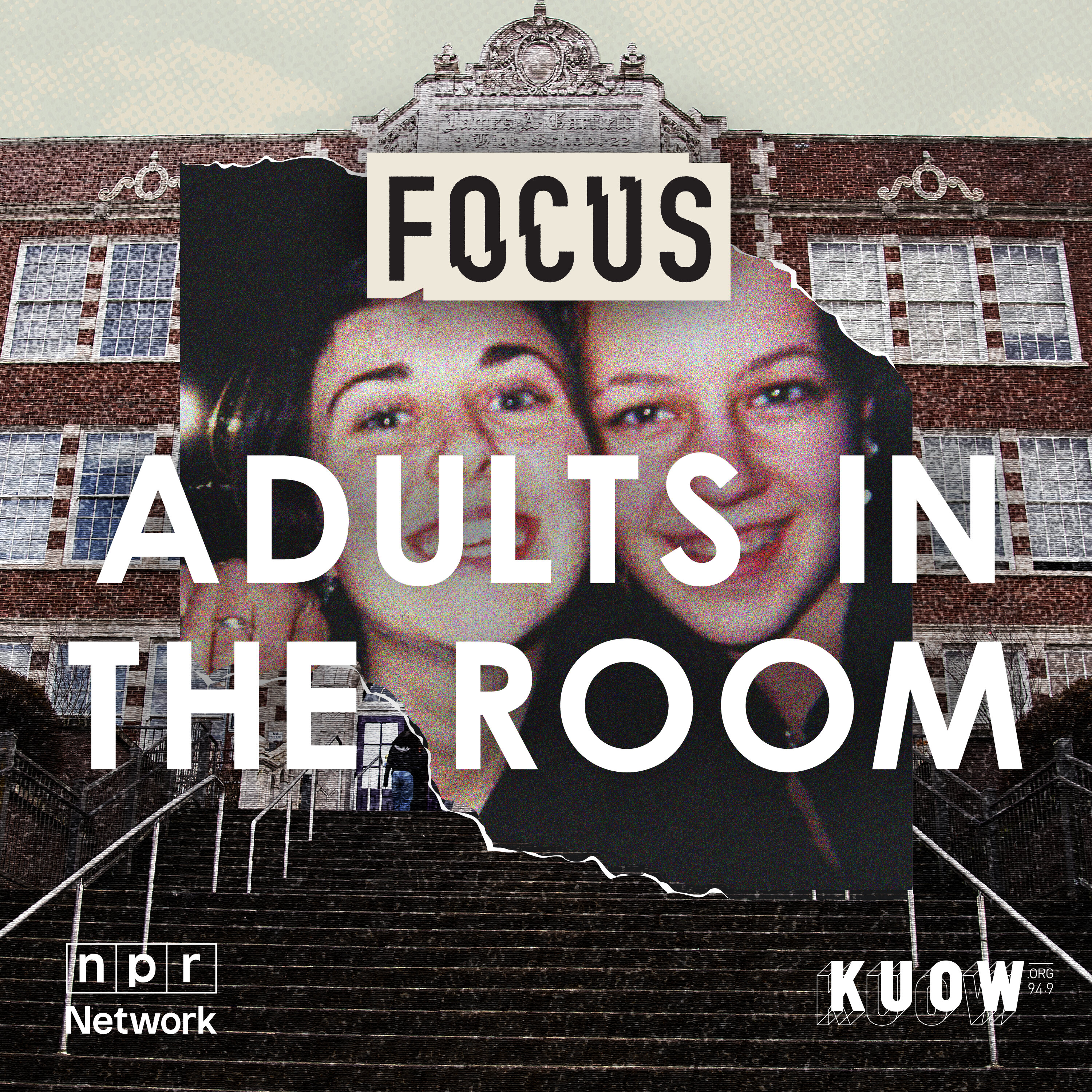
From KUOW in Seattle. Welcome to Focus, your home for immersive audio documentaries in the Pacific Northwest this season. Adults in the Room When I was a senior in high school, my best friend Ella Husagan and I heard a rumor a popular teacher was abusing a boy at our school. Maybe abusing a boy. Maybe more than one boy. Lots of maybes. Zero proof. We told authorities what we'd heard. When they didn't act, we raised hell. And then our friends, parents, teachers, even a columnist at Seattle's biggest newspaper called us gossips, rumor mongers, character assassins. Our high school turned on us and made us pariahs. And those abuse allegations against our teacher? They were never proven. We graduated high school in 2000, and since then, Ella and I have had the same conversation on a loop. How did this man, who we saw as manipulative and potentially evil, convince the rest of our community to defend him, to celebrate him? One morning during the pandemic, Ella called. I was in my yard pruning the roses. We should find out if our teacher really was a predator, ella said. If I thought, why was she even questioning this? Everyone was in denial about him, I replied. We weren't, Ella. You know we did the right thing. She got quiet. Then she said something that hit me in the gut. How can we be so sure? For 25 years, I was positive my instincts were right, and I thought Ella felt the same way. But the past gnawed at her, and her question ripped a hole in my narrative. Today, Ella is a civil rights attorney in Los Angeles, taking on institutions and big companies. I'm an investigative journalist in Seattle. We are the people to figure this out, ella said. I don't typically say no to her, but boy, did I want to in that moment. Senior year was one of the worst times of my life. The last thing I wanted to do was knock on the doors of classmates and parents and teachers who'd made it so bad for us. And if I was wrong about my teacher all those years ago, I wasn't sure I wanted to know. Maybe Ella could sense my hesitation, because then she said, isolde People think we killed a man. I need to know. If we did, we would learn much later. We didn't know the truth. We barely knew anything at all. From kow in seattle. This is adults in the room. Episode 1 mounting danger I'm isolda raftery. Over the years, other classmates said I should look into the volatile events of our senior year. They know what I do for a living and they want answers too. I always brush them off. But Ella is different. When I met her, it was like love at first sight. She was the new kid in my sixth grade class. Tall, gangly, scowling. We hit it off right away. And Ella says she looked up to me from the start. I remember those what would Jesus do Bracelets. I sort of in my head will often be like, what would Azolda do? She always had a lot of friends and I was her best friend. So I kind of got to go along for the ride. The truth is, I feel like I'm always following her. Like when she decided to go to Garfield, a big public high school in Seattle Central District, I wanted to go there too. If you could describe a school as extroverted, Garfield was extroverted. Loud, big and a little obnoxious. It was such a weird, funny place and we all were just drinking the Kool Aid. You know, we found our people. We found our people in Seattle. Garfield isn't just a high school, it's a calling card. Quincy Jones was a bulldog. Jimi Hendrix a bulldog. The guy who designed the World Trade center in Manhattan, also a bulldog. There were more National Merit Scholars at Garfield than the private school Bill Gates went to. We had the best jazz band in the nation, an award winning student newspaper, and a one of a kind wilderness program that took city kids scuba diving and mountain climbing. The program was called Post 84 and it was run by a teacher named Tom Hudson. Mr. Hudson was legendary at Garfield. He was well over six feet and nearly 300 pounds. I know this because he loved to tell us he weighed more than one eighth of a ton. He had a voice that purred in a whisper and thundered when he yelled. Mr. Hudson had an inner circle of students, mostly skinny white boys in Gore Tex parkas, looking like a gust of wind could knock them over. Those kids called him Tom. The rest of us called him Mr. Hudson. I had Mr. Hudson for biology freshman year. He was dynamic, entertaining. But once that class ended, I didn't think about him much until July 1998. The summer before my junior year. Mr. Hudson was headed out with six post 84 kids. The plan was to climb Mount Olympus. It was. It's a few hours from Seattle in an extremely remote part of Olympic National Park. The expedition included a 20 mile backcountry hike through the forest and across the Blue Glacier, one of the most studied glaciers on Earth. Most of us had never done anything like that before. Rosie Bancroft was a classmate of mine and one of the few female members of post 84. She was the only girl on the Mount Olympus triple. No radios or communication with the outside world.
- [07:32]
Ella Husagan
There were seven of us on two rope teams.
- [07:34]
Isolde Raftery
Ocean Mason was a year older than me, a towering blonde kid who seemed shy at school in post 84, though, Ocean exuded confidence.
- [07:45]
Ella Husagan
We hiked in for the first two days, so about nine miles each day to the bottom of the Blue Glacier.
- [07:54]
Isolde Raftery
The Blue Glacier really is blue, which I guess isn't surprising given its name. But this is supernatural blue electric. When you peer into the cracks, there's a ribbon of neon light at the bottom that glows. And getting there can be dangerous. Ice climbers often avoid the Blue Glacier because of all the cracks on its surface. Mountaineers have more than a dozen words to describe those cracks. Crevasse, moat, bergs, grund. They're mostly just slivers. You can step over them, no big deal. But some are gaping 15 foot fissures and others are hidden because snow covers the seams. That's why the post 84 students were tethered to each other with long ropes. That way, if someone stepped into one of those hidden rifts in the ice, the other climbers could hold onto the rope to break their teammates fall. This usually works, but not always.
- [08:57]
Ella Husagan
We were getting near the top and I heard a yell and the person in front of me was bracing to hold the rope was on the ground. And so I dived down and dug in the rope, but no pull ever came.
- [09:13]
Isolde Raftery
Mr. Hudson had stepped onto what he thought was solid ground, but the snow gave way under him. He fell 30ft, the height of a three story building. Mr. Hudson's backpack wedged into the ice, making it impossible for him to move. He was conscious but dazed and in pain. He pushed snow off his face so he could breathe and yelled up to his students for help. Six teenagers and one injured adult were now stuck in the middle of nowhere. They had no way to communicate with the outside world and they had to act immediately. If the students didn't rescue Mr. Hudson before nightfall, he could freeze to death. They could all freeze to death. You know, you're a teenager, you think you're totally invincible. We didn't really let in how close we were to really being in trouble. The students lowered their most experienced climber into the crack. He cut off Mr. Hudson's backpack and connected him to a rope up top. The students assembled a pulley system to haul Mr. Hudson out. A pulley system. He taught them in safety drills. Slowly, carefully, the post 84 kids hoisted this man. Remember, he weighed more than one eighth of a ton up over the steep wall of ice and snow.
- [10:41]
Ella Husagan
I don't remember it being hard at all. I remember it working exactly like it was supposed to.
- [10:47]
Isolde Raftery
Mr. Hudson couldn't move his arm. He couldn't put his full weight on one leg.
- [10:52]
Ella Husagan
He was so hypothermic he couldn't speak. It's cold down there. It's like a refrigerator, especially if you can't move.
- [11:00]
Isolde Raftery
Mr. Hudson's pack was still down in the hole. The team thought they might need it to survive the night. They lowered Rosie into the moat to get Mr. Hudson's backpack. Ocean stayed with Mr. Hudson.
- [11:13]
Ella Husagan
He and I huddled together under a space blanket, but there was too much wind. Like he was just, it was just cold. He wasn't hardly talking.
- [11:24]
Isolde Raftery
Mr. Hudson couldn't stop shivering. Ocean knew they had to do something.
- [11:29]
Ella Husagan
We decided to start moving and so he and I started hiking down and I short roped him so I was like holding onto the rope close to him because I was afra that he was going to fall.
- [11:41]
Isolde Raftery
The others pulled Rosie and the backpack out of the hole. Then they followed Ocean and Mr. Hudson down the mountain to their base camp. The Post 84 team had 10 hours to hike back down to their tents. It was a race against the setting sun. And by this point, Mr. Hudson wasn't the only one in bad shape. After the like 45 minutes in that crevasse and then the hike out, I had frostbite in most of my toes. I had like trench foot. I was walking downhill for 20 miles with a huge pack on because we all split up. Tom's stuff, he couldn't carry anything. I just was like, yeah, this is what we're trained to do. We did great. Yes, the students were in a dangerous situation. But consider how exhilarated they must have felt. These teens gave up weekends to drill for a situation like this. Exercises in drudgery for a moment that would surely never come. But now the moment was here and the students rose to it. They saved their teacher's life. The same teacher who trained them how to survive in the wild in the first place.
- [12:56]
Ella Husagan
There's something about that, that felt very circular, like being treated as adults as like not just as kids, as like people who knew things, who had skills. We were able to do these things that are hard, that are complicated. We were proud of it.
- [13:13]
Isolde Raftery
Mr. Hudson and the students barely made it down the mountain before nightfall and set up camp. A park ranger stopped to chat with the group. The next morning Mr. Hudson and the kids hiked to the car. He had recovered well enough to drive them back to Seattle where the story of the students heroic rescue started to spread. But at Olympic national park, the rangers, the people charged with keeping hikers and climbers safe, had a very different view of the rescue. And I would be the first to hear what they had to say.
- [14:14]
Ella Husagan
Hi, I'm Joshua McNichols.
- [14:15]
Isolde Raftery
And I'm Monica Nickelsberg.
- [14:17]
Ella Husagan
We host KUOW's economy podcast. Booming.
- [14:20]
Isolde Raftery
If you have sticker shock at the grocery store, you're not alone. In Seattle, the cost of groceries is about 30% higher today than before the pandemic.
- [14:28]
Ella Husagan
On the latest episode, creative hacks for putting food on the table. Now that your dollar doesn't go as far as it used to find. Booming on the KUOW app or wherever you listen.
- [14:45]
Isolde Raftery
When school started that fall, Ella and I were both reporters for the Garfield messenger, the school paper. Zolda and I both worked hard to like be, you know, messenger groupies. Not groupies, but you know, we wanted, we took it seriously. We'd stay until 10pm in this big open classroom that as a journalist today I can say was a legit newsroom. Know it alls, arguing, hashing out stories, lots of bravado and casual cursing. I wore a quasi uniform, what I thought a real journalist would clogs a turtleneck and sometimes a long black peasant skirt. My idol was Joan Didion. I was a cub reporter looking to prove myself ambitious and unrelenting. The year before, when I applied to be on the messenger, the teacher who ran the paper told me he didn't want me there. You were the homecoming princess, he he said, how serious can you be? So I squatted in his class for the first week, literally. I sat on the floor next to Ella's desk until he gave in. The Mount Olympus Rescue was my first assignment of the semester. It was a straightforward pitch. Kids save the mentor who trained them. A narrative Mr. Hudson was promoting. He said that after 30 years of climbing mountains, that was the low point since, you know, he almost died up on the mountain. Jonathan Hill was a core Member of post 84. One of those kids who called Mr. Hudson Tom, but also the high point because students who he taught these rescue
- [16:26]
Ella Husagan
skills actually saved him.
- [16:28]
Isolde Raftery
Jonathan skipped the Mount Olympus trip, but Mr. Hudson told him what happened. One of his lines that he had after that is, if something is worth
- [16:37]
Ella Husagan
learning, it's worth learning well, because you
- [16:40]
Isolde Raftery
never know when it might save you or one of your friends lives. I would have reported this story as a sign until I went to a party for my dad's work. And there I stumbled onto my first honest to God scoop. One of my dad's co workers volunteered in mountain rescue. So I asked him, have you ever heard of Tom Hudson? He raised his eyebrows and gave me a look like ugh, that guy. He said Mr. Hudson would climb mountains near Seattle on his own and he needed to be rescued a lot. My dad's co worker had been dispatched to save Mr. Hudson more than once. This was not a good thing, he said. Mr. Hudson had a reputation with rescue volunteers as someone who took unnecessary risks. You should call the ranger station at Olympic national park, he told me. Find out what the rangers who were there have to say about the rescue. Ocean recalled seeing a ranger at camp.
- [17:43]
Ella Husagan
I remember him talking to Tom. I think he was kind of pissed.
- [17:47]
Isolde Raftery
I called the ranger station. The guy who answered sounded annoyed. I couldn't tell if it was at me or at Mr. Hudson. Then he explained. He said Mr. Hudson hadn't checked in with them. A protocol for climbs to the Blue Glacier. If he had, the ranger said they would have discouraged him from taking his students up the mountain alone.
- [18:10]
Ella Husagan
Just having one additional adult would have made the safety margin so much larger. I think I probably would have, yeah,
- [18:19]
Isolde Raftery
had probably three adults on a trip like that.
- [18:22]
Ella Husagan
Especially with a bunch of relatively new climbers with me.
- [18:27]
Isolde Raftery
That's Nick giger, the ranger Mr. Hudson talked to at the base camp all those years ago. He still remembers the accident. Nick was doing his rounds at the camp when he encountered Mr. Hudson. He asked how the hike went and was shocked when he heard what happened.
- [18:44]
Ella Husagan
The first thought was, wow, really lucky. Incredibly lucky.
- [18:52]
Isolde Raftery
I still remember the surprise I felt on the phone. In 1998, Mr. Hudson had sidestepped basic safety protocols on Mount Olympus, and this ranger was mad about it. My Mount Olympus assignment wasn't just a hero story after all. This fueled my ambition like nothing I'd felt before. Mr. Hudson was a demigod at Garfield. But now I had a story that was calling his mythology into question. I thought I was the only one who saw Mr. Hudson's fallibility. But someone else was questioning his judgment too. Rosie Bancroft was one of the heroes of the Mount Olympus trip. I liked Rosie a lot. She was loud with blonde ringlets and a busted gut laugh. When I started reinvestigating this story, Rosie told me her dad was livid about what happened on Mount Olympus. I mean, Rosie was hypothermic. She lost three toenails to frostbite. Another student got so badly sunburned on the mountain, he was hospitalized.
- [20:02]
Ella Husagan
I called Tom several days later, this
- [20:06]
Isolde Raftery
is Rosie's dad, John Bancroft, and said,
- [20:11]
Ella Husagan
I hope you'll be getting the parents together at some point pretty soon and just telling us what went on. And he basically said, well, it was a fairly typical mountain accident and the kids did a great job of dealing with it. And I thought that's it.
- [20:35]
Isolde Raftery
John kept detailed notes about the Mount Olympus rescue and wrote at the time that Rosie didn't want him to question Mr. Hudson. She said he was in a fragile state after his fall. To John, this was a red flag. You're the kid, he thought to himself. Don't worry about the grown up. First we just want to talk about some of the business things and then we can talk about an accident that happened this past summer with some of the post members and Mr. Hudson at Mount Olympus. John decided to confront Mr. Hudson a few months after the accident at a public Q and a about the Mount Olympus trip. It was hosted by Post 84 at the REI flagship store in downtown Seattle. The audience was mostly parents who admired Mr. Hudson. John remembers it well.
- [21:27]
Ella Husagan
I think people already knew that I was really almost a party of one raising questions about.
- [21:36]
Isolde Raftery
John set up a video camera in the center aisle of the meeting room, facing Mr. Hudson. Decades later, he shared his video with me. Tom, you want to talk about what that is? Yeah. Let me give a brief introduction and we're going to look at some slides. That's Mr. Hudson. He stood behind a table, a vision of 90s smart casual, dark crewneck sweater and old khakis towering over the post 84 students sitting on either side of him. He described falling into the ice on Mount Olympus. I was trapped there by the snow and ice and was unable to breathe for a bit of a period of time. And with the one hand that was free, I was able to move snow
- [22:22]
Ella Husagan
from my face so that I could
- [22:24]
Isolde Raftery
establish an airway, blocks of snow off my chest so that I couldn't read. After Mr. Hudson finished describing the accident, he took questions. John stood up to speak.
- [22:35]
Ella Husagan
So, well, I guess I have a question about having Tom, you go as the only adult on the trip. And that's not in any way to, you know, minimize the skill that the other climbers had, but it just seems like a trip was something that's serious, can happen. I, I guess I question that. Yeah, yeah, we were registered.
- [23:00]
Isolde Raftery
We had, we had a backcountry permit indicating our, our intent to climb, to climb the mountain. And there is a log. Hudson's response is hard to make out, but he said they'd gotten the necessary permits and they'd registered with the National Park Service as a climbing party. As for not signing in at the trailhead, well, it was dark and it was difficult to see the sign in station from the entrance they used. Also. Sure, more adults would have been great, but the young man who pulled him out of the ice was just as experienced as any adult. We made it clear to all the parents of all the people who were going too. That was the leadership structure, that I
- [23:41]
Ella Husagan
was the only adult parents.
- [23:43]
Isolde Raftery
Mr. Hudson said the parents, his parents knew beforehand that he was the only adult on the trip. And parents who were uncomfortable with that, well, they probably shouldn't have let their kids go in the first place. I don't think we were understaffed. I don't think we were understaffed. He said. I would climb it again with the same kind of leadership. I would climb it again with the same kind of leadership questions. And with that, the Q and A was over.
- [24:12]
Ella Husagan
Thanks.
- [24:13]
Isolde Raftery
Thanks a lot. Mr. Hudson didn't think he'd done anything wrong. That worried John.
- [24:26]
Ella Husagan
I was starting to think, I don't want this guy to be teaching and running this post to my daughter, first of all, and then the other kids. I wasn't sure exactly what that would mean.
- [24:39]
Isolde Raftery
John saw how students and parents loved Mr. Hudson. They were almost reverential toward him. That scared John, too.
- [24:48]
Ella Husagan
This is a pattern of you're doing wonderful things for kids and then the next step is always doing bad things with kids.
- [25:01]
Isolde Raftery
John was uneasy. He'd seen this behavior before. When he was young, John had a camp counselor he idolized who would later sexually abuse him. Mr. Hudson reminded him of this counselor. But in the end, John told me he stopped pushing Mr. Hudson. His daughter Rosie loved Post 84 too much, but he still felt uneasy about him. So did I. For one thing, Mr. Hudson really liked practical jokes. One time in my first period biology class, in the middle of a test, Mr. Hudson dropped a live tarantula on a kid's desk. The kid froze and then he screamed. Mr. Hudson laughed and laughed. Another time, ocean found a dried up deer leg during a Post 84 outing and gave it to Mr. Hudson. Mr. Hudson put the deer leg in his biology classroom and I remember a
- [26:01]
Ella Husagan
kid fell asleep during class and he rub the deer leg like across their shoulder to wake them up.
- [26:07]
Isolde Raftery
The kid freaked out and Ocean felt badly about it. Like any good journalist, I asked Mr. Hudson for an interview for my Mount Olympus article. To my surprise, he declined. Let the kids shine, he said. But then Mr. Hudson heard about the more critical direction my reporting was taking and suddenly he wanted to see me.
- [26:50]
Ella Husagan
Everything is expensive in Seattle, but when it comes to restaurants, I got a lot of tricks and tips up my sleeve to help dinos eat well in the city. I'm Ton Bend, host of Seattle Eats, a food podcast from the Seattle Times and kuow, part of the NPR Network.
- [27:06]
Isolde Raftery
I'll share about the latest buzz in
- [27:08]
Ella Husagan
the Seattle food scene, like the hottest openings and the best bites that are worth your money. Listen now to Seattle Eats on the KUOW app or wherever you get your podcasts.
- [27:21]
Isolde Raftery
I was in sixth period journalism when a big kid named Bubba walked in. Tom wants to talk to you, bubba said. Bubba was close to Mr. Hudson. If you saw one, the other was probably nearby. Bubba and I walked down the long hallway in silence to Mr. Hudson's empty classroom. We went to the back into Mr. Hudson's small office. He was standing there, his mouth set in a grim line. Bubba shut the door and stood next to our teacher. They looked like a wall of man. Mr. Hudson told me not to write anything that suggested he'd been careless on Mount Olympus. He said I could ruin his program. Then Mr. Hudson reminded me once again that he weighed more than one eighth of a ton, and he laughed. Why is that so funny to him? I wondered. And also, why was Bubba part of this conversation? Bubba goes by a different name now. Ocean.
- [28:26]
Ella Husagan
Did we have Japanese together too? Yeah. Okay, yeah. I was trying to remember. I was like, wait a minute. Like I know we had a class together at some point.
- [28:35]
Isolde Raftery
Do you remember that I was writing an article about the Mount Olympus trip?
- [28:41]
Ella Husagan
No, I don't remember that.
- [28:43]
Isolde Raftery
And he dispatched you to come get me out of the messenger room, and you brought me back to his office, which you recall is a tiny little office, and you were there and he was there kind of looming over me, and he was telling me not to write the story. And at the time, I mean, I would have weighed 80, 90 pounds soaking wet, right? Like I was tiny. And so to have him say all that, I remember thinking, he can't be threatening me, is he threatening me? He's definitely trying to intimidate me. And I just remember he had kind of used you to put me in the room with him. And I wondered, do you remember that at all?
- [29:34]
Ella Husagan
I don't. I don't have any memory of that. And I'm so sorry.
- [29:41]
Isolde Raftery
Oh, no, no, no, no. I wasn't saying that to make you.
- [29:44]
Ella Husagan
No, no, no, no. I know you're not. I just feel. Just a tremendous, like sadness and compassion for, for you in that situation.
- [30:01]
Isolde Raftery
Ocean has a really big heart and I wasn't surprised they felt sadness for teenage me. But grown up me does not feel sadness for teenage me. Because in that moment in Mr. Hudson's office, something clicked into place. Mr. Hudson was using his body and Bubba's body to try to get me to change my Mount Olympus story. But he slipped up. Mr. Hudson showed me he was worried what my article would reveal about him. That he cut corners and endangered the lives of students on the mountain. That's when my anxiety gave way to a sense of total calm. I didn't need to be afraid of this man. He was afraid of me. Grown up me looks back on teenage me with pride and fondness. Like, hell yeah. Because in 1998, there was no narrative for girls my age to feel powerful when up against middle aged men. This was the year everyone blamed 22 year old intern Monica Lewinsky for seducing the 49 year old President of the United States.
- [31:08]
Ella Husagan
Indeed, I did have a relationship with
- [31:10]
Isolde Raftery
Ms. Lewinsky that was not appropriate. The year when 17 year old Britney Spears wore a bra and underwear on the COVID of Rolling Stone. You're really young.
- [31:20]
Ella Husagan
What are you, 17?
- [31:20]
Isolde Raftery
I'm 17, yet I'm old enough to be. I don't want to see you in that shirt again unless you ever go. I'm so glad you're bringing this up. I was so humiliated. The country was obsessed with girls my age and not because of our brains. We were bodies to look at, bodies to use, bodies to intimidate. As an adult journalist, I notice this thing Sometimes when I'm reporting a contentious story. Some men will get just a little too close and it feels kind of threatening, like they want to remind me how much bigger they are. When that happens, often in hallways, outside school board rooms, or at protests. I think about being in Mr. Hudson's office and I tell myself they're puffing up their chests to get me to back down. They're scared of me because I know their truth and I am not going to keep their secret. I published the article about the Mount Olympus rescue in the Messenger, I wrote that some kids felt ill prepared. The headline was mounting danger. This wouldn't be the last time I'd investigate Mr. Hudson. Senior year, Ella and I would hear secrets about him that we couldn't ignore. Secrets that would cost us friendships and turn us into outcasts. Secrets that would eventually lead to tragedy at our beloved Garfield. Secrets that after 25 years, I'm not keeping anymore. That's coming up on Adults in the Room. In episode two of Adults in the Room, Garfield High School is shaken by a scandal. They put out this announcement that was very vague. It was like, oh, you know, inappropriate relationship with a student. What Ella and I chose to do next, put a bullseye on our backs and forever changed our school and our lives. I have no idea what to do about it or who to tell. I think I, I was like this. This is the chance. Adults in the Room is part of Focus, a dedicated documentary channel from KUOW Public Radio in Seattle, a proud member of the NPR network. Original reporting for this project was done by me, Isolde Raftery, Jeannie Yandel and Will Jean. An extra special thank you to Ella Hushhagen, without whom this project would not have happened. Our producers are Will James and Alec Cowen. Our editor is Jeannie Yandel. Music by B.C. campbell. Additional music by Alec Cowan. Logo design by Alicia Villa. Amelia Peacock manages our marketing and promotions. Kow's director of new content is Brendan Swift Sweeney. Our director of marketing is Michaela Giannotti Boyle. Kow's Chief Content officer is Marshall Eisen.
- [34:43]
Ella Husagan
I'm a firm believer that nature is healing in these chaotic times. I invite you to take a breath and reconnect with our natural world. Wow. Right in front of us. I'm Chris Morven. Join me on the Wild as we explore stories of hope and resilience in nature. We'll bring you up close to some extraordinary species and learn how they are finding ways to adapt and thrive in fast changing environments. Listen to the Wild on the KUOW app or wherever you get your podcasts.