Loading summary
Transcript37 lines
- [00:04]
A
You are listening to Love and Radio. Your host, Nick Van Der Kolb.
- [00:13]
B
So. So a lot of people hearing you talk about this are just absolutely not gonna understand.
- [00:21]
A
Oh, yeah. Also, this episode contains descriptions of graphic violence, including blood and visceral carnage. Please do not attempt the activities described in this episode.
- [00:41]
B
Oh, it's very difficult to relate to. You know, I'm just. I'm just. Yeah, I just wonder if there's anything going on. When did the. The idea come in?
- [00:57]
A
Oh, 1973. Where I lived in T Pierre, Wisconsin. That's a suburb of Green Bay. I met a young man, about 16 years old. His name was Pete. He was brought to my house as a visitor. Of course, right away, I noticed that he was missing his right hand. The end of his arm was all bandaged up in a ball. As we talked, he said he lost his hand in Vietnam. I had the feeling that he felt uncomfortable talking about this, so I didn't press the issue. We didn't know each other very well. Sometime later, I learned through neighborhood teen friends that he didn't lose his hand in Vietnam, but on his dad's farm. Pete was making a pipe bomb with gunpowder. It exploded, shredding his right hand and several fingers on his left.
- [02:03]
B
So he was 15 years old and was telling people he had been to Vietnam.
- [02:08]
A
I believe he was about 15 years old, maybe 16.
- [02:12]
B
And how old were you at the time?
- [02:14]
A
I think I was 32.
- [02:18]
B
So did you have kind of like a fatherly sort of relationship with him? Like, what was your relationship like?
- [02:25]
A
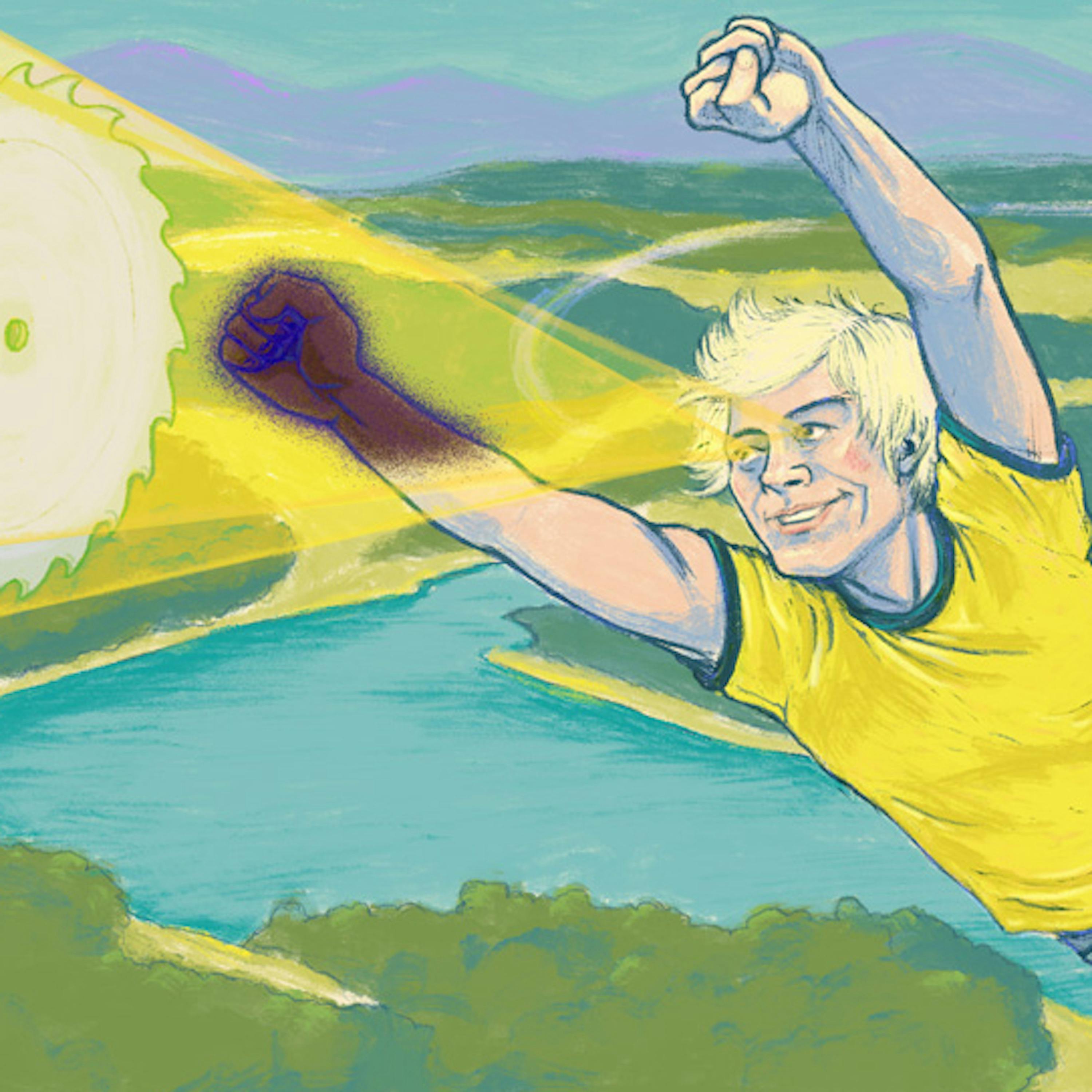
Father. And also just a good, close personal friend. When I first met him, he was very quiet and shy and reclusive, not willing to talk about or even show his arm to other people. Well, I looked at it and said, gee, that's no problem. It's sort of a handicap, but a person can do anything he wants. I thought, gee, I'm going to try and help him as much as I can. He needed all the confidence I could give him. I was quite excited when he came over to my house one evening after dinner. He was wearing his prosthesis. Wow. What's that you got there? I said excitedly. I could sense that he was testing me to find out how I felt about it. This was the first time I'd ever seen one close up. I could see the reaction on his face. He was glad I liked it. Over the months, our mutual trust grew. Yeah. One Saturday morning, as we gathered around the living room stove to dress, to go out, Pete had his youngest brother tie his boots. As usual, I was a bit surprised at this as Pete was quite able to do most everything himself now that he was using his hook every day. The next morning I had an idea. While putting on my boots, I watched Pete for a minute, then said, pete, why don't you try this? I use a pair of pliers in my right hand. As he would have used his hook, I gripped the laces with the pliers and tied my boots. It wasn't long before Pete was tying his own boots faster than anyone else. It was a matter of having self confidence. He needed to attempt these new things. I felt a warm glow inside from my friend who had made so much progress since that first night when he came to my house with a cast on his shortened arm. He was becoming more accepting of himself and his condition. I felt there was no stopping him now. He was gradually regaining the confidence that was blown away last summer. One crisp, clear Friday afternoon in February, Pete, his brothers and I went out to a field near my house to launch some of their solid field rockets. We had a small square of plywood that served as a launching pad. On top of this was mounted a small support stick which held the rocket and guided it as it was launched. The launcher arm wasn't sturdy or long enough to properly support the missile on the launch pad, so I elected to design a better one. The next morning I told them I'd have it ready when the guy came over later that day. Here are my simple do it yourself rocket launcher building instructions. Step 1. Cut the 10 foot 2x4 down to a piece 2ft long. Turn on the SAW motor. Step 2 pick up the long board to be cut and place it on the table saw. Be careful not to step on those dangly nylon bootlaces. One could trip over the planks of wood lying on the floor in front of the table saw. Well, as luck would have it, I wasn't careful. As my instructions suggested, I did trip and fall right into the whirring 10 inch saw blade. My first thought was, my face is crashing right down into the saw blade. I must stop myself. Well, I tried to break my fall of my right arm and in the process it struck the top of the table and as I continued to fall forward, it slid across the table into the blade. The motor stalled as my arm went through the blade. It was too much of a load too fast. This most intense pain that I think a person can feel. If you've ever bumped your crazy boat in your elbow and you get a very sharp, painful feeling, that's what it felt like. It was heavy, heavy pain in my arm from the nerves that were all cut right, just right above my wrist. All those nerves in that arm are screaming, screaming at the top of their little voices saying, ow, this hurts. I had taken a lot of first aid courses. I grabbed a towel and put it around my hand and I knew that I had to hold my vein in my arm so that I wouldn't bleed to death. In the meantime, I got my phone, put it up to my ear and dial O and then get back to holding the artery so it wouldn't bleed. I told the operator this was an emergency and I wanted to talk to the hospital. I said I'd be there in about 10. Then I told the operator to ring my friend Todd, who lived just behind me on the next street. So my friend came over and I grabbed a towel and put it around my hand and got in the truck, put the towel with my hand hanging in it. Darn thing was still attached to me with some skin, you know. My friend drove the truck. I can remember his foot shaking on the gas pedal. He was so nervous. Oh my gosh. What did you do? What did you. I was okay, but he was quite shook up.
- [08:41]
C
This episode is brought to you by Rakuten. If you're shopping while working, eating, or even listening to this podcast, then you know and love the thrill of a deal. But are you getting the deal and cash back? Rakuten shoppers, do they get the brands they love, savings and cash back. And you can get it too. Stack sales on top of cash back and feel what it's like to know you're maximizing savings. It's easy to use and you get cash back sent to you through PayPal or check. The idea is simple. The brands you love pay Rakuten for sending them shoppers. And Rakuten shares the money with you as cash back. Download the free Rakuten app or go to rakuten.com to start saving today. It's the most rewarding way to shop. That's R a K u t e n rakuten.com.
- [09:26]
A
The hand was beginning to feel mentally more apart from my body. As I sat there thinking about was just dead weight attached by some skin to the end of my arm. The emergency staff was waiting for us. We pulled up to the entrance. An elderly nurse took me up to the operating room. Instead of a general anesthetic, they gave me a nerve block. Then we all waited for them to take effect. The surgeon began by sawing off a small section of bone from the end of my arm. Then he neatly filed the ends of the bones to round the edges. I couldn't see what was being done, but I could sure feel it. The best way I can describe the pain is white hot. It's a good thing they gave me a nerve block or it would have been really bad. So this is what it feels like to have one hand missing. I wonder what they did with was perfectly good. I did just cut my fingernails the day before. I guess it could be preserved in a jar from aldehyde, but that would be gross. It feels like my armor spring loaded. It wants to pop up all by itself. You can get enough feeling from the muscles that are still there to do things like count by moving your fingers. Right now I can move the muscles connected to like my thumb and all my fingers individually. 1, 2, 3, 4, 5. The fingers don't touch anything, but they move. And I could even like tap my fingers on the table, but of course there's nothing there. So the muscles are moving in the arm, but they don't do anything. Good friend of mine, Bill, who I'd known for quite a few years, and he came in and he said, how did you go last night? And I said, oh, I spent a very restless night. That was my joke. What a big moment. When Pete and his family came to see me for the first time. I expected him to laugh his ass off, but he was reluctant to joke with me. Pete seemed a bit puzzled by my rather jovial mood. I didn't press the issue. I understood the conflicting thoughts that he must be feeling. It was good to be able to shift some of Pete's emotional pain back to me for a change. It had been a long, hard struggle for him. I allowed him every possible opportunity to feel important.
- [12:40]
B
Did you feel closer after you lost your hand?
- [12:44]
A
I think so. Yeah, definitely. I never forget the night we went down to the newsstand to buy a tin of our favorite pipe tobacco. It came in a flat round can which was vacuum sealed and had a screw off lid. Pete with one hand and a hook and me with only one hand. We couldn't get the top off. What a bear. When we got out of the car and put the can down on the pavement in the middle of the street, Pete held the can between his feet while we attempted to twist the lid off. We grunted and strained and swore and broke our fingernails. The COVID wouldn't budge. Finally, in desperation, we returned to the store to ask the man behind the counter if he would open the can for us. As it was dark outside, we Couldn't read the large letters around the edge of the can that read, to open, insert coin and twist. The clerk put a penny under the edge of the lid and popped it open. Instantly I felt that I could show Pete how I was living my life with one hand. If he was having difficulty with some particular thing that he could see that it could be done that way and help him out in his struggle to be a one hander. When I had only one hand, we were both equal. But I never told Pete that I did it intentionally. I thought that that would be too complicated for him to deal with. Now here's the real story. I can't say exactly when the idea of becoming a one handed person myself came about to me. I think it just sort of creeped in little by little and thought, gee, it would be kind of neat to have just one hand. That would be quite a unique experience. And I think that's basically how I came to the conclusion that I was going to cut off my own hand. How to do it. That was the trick. Well, a lot of people have lost hands in various kinds of machinery, especially farm machinery. That was pretty common in Wisconsin. I didn't have any farm machinery myself that would gobble up a hand. I thought, see, a table saw seems like the most logical and easiest, quickest, cleanest way to do it. So I decided to cut my hand off with a table saw. It was kind of a clear but cold Saturday morning, frosty outside. So I had my boots on, probably didn't have a coat on. I think I just had my wool shirt and turned on the saw and stood there. Well, I probably stood there for, I don't know, a good five minutes. Do I want to do this? How is it going to feel, feel, feel? I just finally said, okay, this is it, turned on the saw, grabbed my right hand with my left hand, put my arm down on the bed of the table saw and pushed my arm through. I did it so quickly, with so much force. I just wanted to do it and get it done. With that I stalled out the blade, it wasn't completely cut off. My hand was still attached by a piece of skin. Oh gee. So, okay, I did it again really quick. I rushed to do it and get it over with. I guess I went just a little bit above where I cut last and still had the hand attached by a piece of skin. Okay, that's good enough. Remember after doing it standing at the saw, I thought, wow, I finally did is over. Let me get on with my life and go to the hospital.
- [17:05]
B
I guess the most natural question is, why did you. Why did you do it?
- [17:12]
A
That's a good question. Why did I do it? I didn't know at the time. I just wanted to. Over the years, I've thought about it quite a bit. The best answer I can come up with is that being. I had so much experience with Pete and his difficulty in accepting his problem, I could look at it and say, well, gee, that's not. It's not really a problem. No big deal. I can do it. Showing him that somebody that was normal and a happy person could also cut off a hand and not be devastated by it. I wanted him to see that, definitely.
- [17:55]
B
When's the last time you got to see him?
- [17:58]
A
I eventually sold the house in the neighborhood where Pete lived and bought a farm out in the country. I don't think I saw much of Pete after that because I wasn't in his neighborhood anymore. Over all the years, I've never seen Pete again. So I have no idea how he is, how he's doing, or what he might have thought about what I did.
- [18:24]
B
Because he never found out, right?
- [18:27]
A
No. I actually wrote him a paper letter in the mail. And I think it would be quite an experience for him to know that because of him losing his hand, I decided to do it myself. He just didn't reply. So he was a rather private person. I guess he still is today. I think it was 2002. I wrote a book about my experience. The book is called Losing a Hand. In that book, I explained how I did it. I did give that book to some friends that I knew later. Everybody seemed to accept it. Okay. Nobody really was shocked. At least they didn't let me know that they were shocked.
- [19:15]
B
That's very surprising to me.
- [19:18]
A
Yeah.
- [19:18]
B
No one would be shocked.
- [19:22]
A
I'm thinking, is there anyone? Yes. There was one person when I lived down in Oregon. I think when he found out, he sort of disowned me. He didn't want to be my friend anymore. And I thought that was kind of sad because we had been very good friends. He couldn't accept it. He thought it just was not the thing to do. I can understand that. It's perfectly logical. It's probably not logical to want to cut it off. That's just not something that sane people would do.
- [20:04]
B
If that's true, how did you, you know, that you were sane?
- [20:10]
A
That's a good question. It's very rather difficult to describe. I don't know.
- [20:17]
B
Is there anything you could say that would convince them?
- [20:22]
A
Oh, well, you know, some People won't head out. They want to go mountain climbing or, or surfing, huge waves, that kind of thing. It's a challenge having to figure out how to do things as you learn how to live in the world with one hand and one hook, what kind of a device, what kind of a prosthesis, what kind of a technique. I thought it would be a lot of fun.
- [20:53]
B
So were you at the time that you did it, did you. Were you feeling like a bit. A bit bored with life, like you needed to add extra challenges?
- [21:02]
A
It could be. It could be. I felt bored with what I was doing. Losing one hand was definitely a big challenge and that's why I went for it.
- [21:14]
B
So what's that mean for you today?
- [21:18]
A
I'm bored. Are you bored right now? Yeah. Yeah.
- [21:25]
B
Can you take off a leg next?
- [21:27]
A
No, no, no. Yeah, I've done them since. A lot of people have different wants and desires. A lot of people want to cut off toes and fingers. Some people want to cut off one or two legs. I think as long as what they do doesn't specifically hurt other people, you know, what's the problem? It may not be socially acceptable. People think you might be crazy, but, well, you might think I'm a nut, but I'm okay. I know that. And so it doesn't bother me.
- [22:32]
B
That's it for Love and Radio. This episode featured original songs from George Langford. During the table song segments that that you heard, you also heard music from Murkoff and Eric Chufage, Mark Bereca, Richard Horowitz, Caitlin Aurelia Smith and Suzanne Ciani, Helado Negro and Michelle Mercury. As always, you can find playlists on all the music we use on the show up on our website. It's loveinradio.org love and radio is produced by Stephen Jackson and Julia Dewitt. Our managing producer is Phil Domhofsky. Love and radio is a labor of love and radio and made possible thanks to our supporters on Patreon with extra special thanks to Ali Mothra Perry, Casey Pamela Anderson, Chakrit Footeidon, Sudha Chan, Bam. Bam. Dan Palmino, Jacqueline Potato Leak, Jason V for Vendetta, Joe Palmieri, Mark Dunksasan, Sam Huffman, Huffman, Sandroo. Nick actually has to read this. Schroeder and William Stabby Spears. If you want to join the group of wonderful human beings who make love and radio happen, you can help keep the show going by becoming a member yourself@loveandradio.org Member, I'm Nicholas Sardine. Punch. Punch Vanderkolk. Thanks for listening.
- [23:57]
A
Sam.