← Lovett or Leave It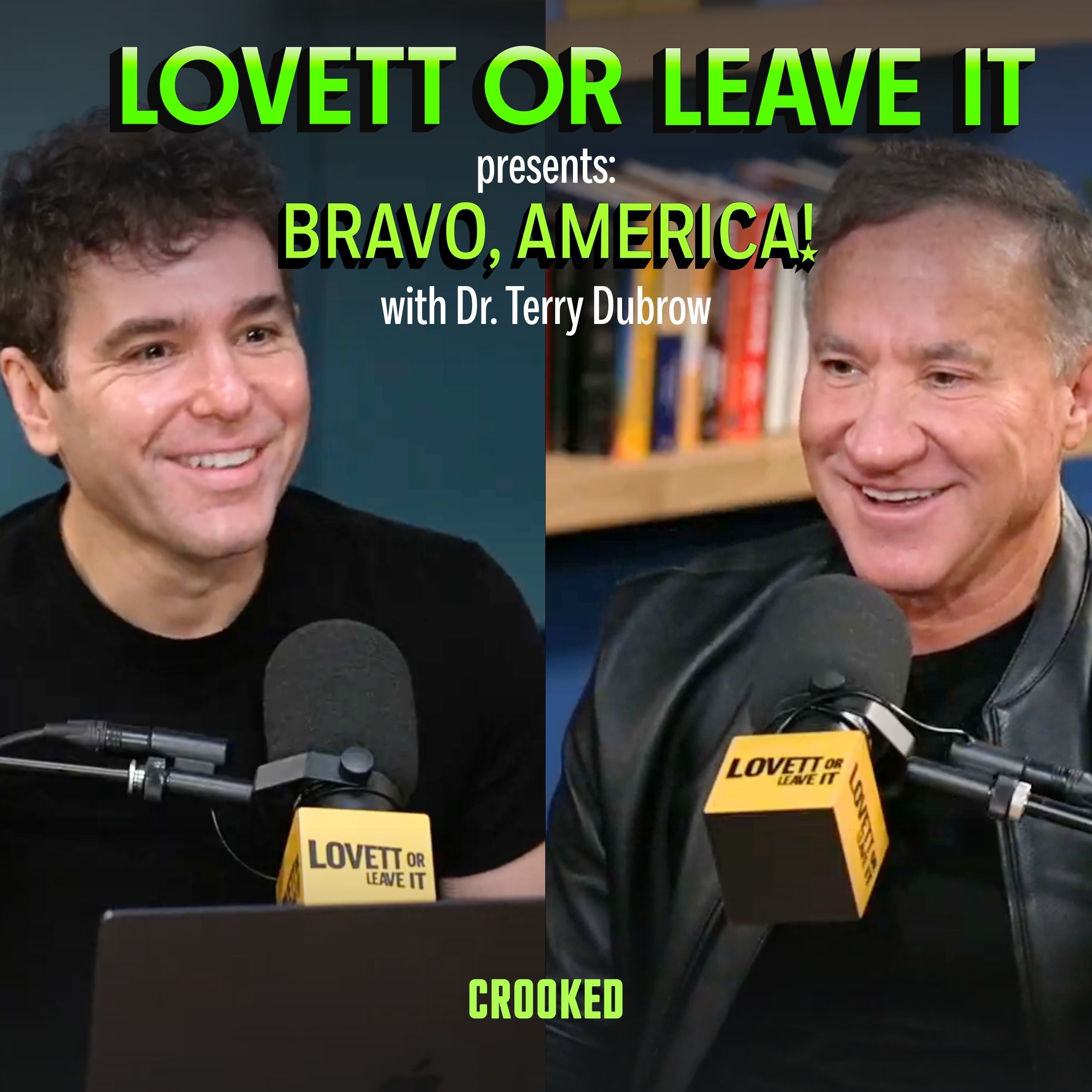
Lovett or Leave It
Lovett or Leave It Presents: Bravo, America! (with Dr. Terry Dubrow)
01:12:31
In our premiere episode, Lovett goes under the knife with Dr. Terry Dubrow, an icon of reality TV who has lived his life as a surgeon, husband, and father in front of the cameras on shows like Botched, The Swan and of course the Real Housewives of Orange County. You can see why Terry is considered one of the best dads and spouses in the Bravo Universe. And in this surprisingly open conversation, he also goes off on what he dreads most about filming Real Housewives, the ways housewives manufacture controversy to cling to fame, the risks of being a parent on television, and why he keeps coming back for more. Oh, and Lovett also asks him, “What kind of plastic surgery should I get?” because of course he did. In this special limited series, Lovett sits down with reality icons who helped lead a hostile takeover not just of television, but of our culture. In intimate and revealing conversations, Lovett and his guests explore the ways these shows blur the line between authenticity and p...
Loading summary
Transcript380 lines
- [00:00]
A
When's the last time you got something.
- [00:02]
B
That was fast, reliable and affordable?
- [00:04]
A
Like almost never, right?
- [00:06]
B
Well, US Cellular home Internet is breaking that streak. You get fast speeds, a rock solid connection, and a super sweet price, just $39.99 a month.
- [00:14]
A
When you bundle it with a wireless.
- [00:15]
B
Plan, that means you can stream, scroll.
- [00:17]
A
Shop and binge without lag or crazy bills.
- [00:19]
B
It's not magic, just really good Internet. Check out U.S. cellular Home Internet Today.
- [00:24]
A
Built for U.S. terms apply. Visit uscellular.com for details.
- [00:28]
B
Were there ever moments where you felt like politics was unavoidable?
- [00:33]
A
I knew you would dive into politics at some point of this.
- [00:44]
B
Hey, everybody, it's Jon Lovett. Back in January of this year, something really big happened, which is I started watching the Real Housewives of New York, and if you're like me, you're binging reality TV after mainlining news all day. I've always loved reality tv, but the more I watched Real Housewives and a bunch of other shows in the Bravo universe, it became clearer to me how much reality TV changed television, but also how much it has changed basically everything. It's obviously changed politics. Jon Favreau and I Talked to Sarah McBride about this, and here's what she said. Some of my colleagues are treating me the way they are treating me for a couple of reasons. One, it's because they want attention, right? They want to employ the strategies of a Bravo TV show to get attention in a body of 435 people. And the way to do that is to pick a fight with someone and throw wine in their face. Look, there are people who love reality TV and there are people who say reality TV represents all that went wrong in our society. But the truth is, I don't care about that debate even a little bit. You think it's trash. I was just like you. But we got to take off our white gloves and opera glasses and be for what's happening. And I genuinely believe that you cannot figure out how to win in politics if you do not understand the way Bethany won out over Jill on Real Housewives. Trump gets this instinctively. Do your favorite Democrats? I don't think so. The way these shows blur the line between authenticity and performance, the ways in which being interesting and horrible can be more valuable than being decent and boring. The way the greats of reality TV wield drama like a sword. I am fascinated by it. So I'm sitting down with some of my favorite personalities from reality TV and. And every conversation seeks to answer three big questions. What did they learn about Reality tv. What did they learn about themselves and what did they learn about this country? And trust me when I tell you, I was genuinely shocked by what some of these guests were willing to reveal. You don't want to miss these conversations. This is Love it or Leave it presents Bravo, America. I'm so excited about our first episode. It's with Dr. Terry Dubrow. He's. We know him from Botch. Botch presents Plastic Surgery, Rewind the Swan, which was very controversial. And of course, you see him with his wife, Heather Dubrow on the Real Housewives of Orange County. You can tell that Terry takes really seriously being a good husband and father, and he's excited to be doing his best work as a surgeon and helping people. He also goes off about how he and his family actually came to be on the Real Housewives. He talks about how housewives cling to fame through controversy and how that's a necessary evil in order to stay relevant. He acknowledges the trade off he made by staying in the spotlight to enjoy his own fame and platform, which he says he's now committed to using only for good. I also was genuinely interested in what it's like to be a doctor on television and the ethics of that and the compromises of that and what he's learned about that over a long career of being a renowned physician and somebody who is practicing medicine with patients and front of the camera. He's funny, he's honest, he's thoughtful. Please enjoy this conversation with Dr. Terry Dubrow. Thank you for being here. Nice to meet you, Dr. Terry Dubrow. Can I call you Terry during this conversation?
- [03:59]
A
Call me Terry. Yeah.
- [04:00]
B
All right. So first of all, I just want to kick things off. Let me tell you what I've done, all right? I got three hair transplants.
- [04:08]
A
Looks good.
- [04:09]
B
Pretty good, right? You would have known. I should have asked you to guess.
- [04:13]
A
I. I would have said a little Botox to the forehead. That's all I would have said.
- [04:16]
B
Really? That's so nice of you to say. I haven't. I guess, like a long time ago. I did it like once or twice.
- [04:21]
A
It's worn off.
- [04:22]
B
It's worn off. Right. But, but, okay, great.
- [04:24]
A
Well, you're young.
- [04:26]
B
How old do you think I am?
- [04:30]
A
You know, that puts me in a funny position because I have to take my. The age that I actually think you are, then subtract 4 to be. To be kind. Right. To be polite.
- [04:39]
B
Right.
- [04:40]
A
So I'm going to say you're 34. Wow.
- [04:44]
B
You got it right on the. Right on the money. I'm 43.
- [04:47]
A
Okay, you look pretty good.
- [04:48]
B
But see, but then I got to take another four off because you told me about the first four. But even then, I'm still in the money, right?
- [04:53]
A
I thought you were 38.
- [04:55]
B
Great, I'll take it. I want to start by talking about what you've learned about reality tv. What was your conception of it before you were a part of it?
- [05:07]
A
Well, my journey into it was born out of sort of an effort to. It was 2000, sort of 7 and 8, the global financial crisis, and I was plastic surgeon, and business just died. Yeah, it was over. And I was a very busy plastic surgeon because I had done a reality show show in 2003 and four called the Swan. And that just happened accidentally. And that was sort of before, I think reality TV was where it is today. It's changed a lot. But in 2007 and 8, business went away. And I said, what should I do to increase my business? I know I'll put my wife on television because I have a wife who was kind of a well known actress for a while, and then she had four kids. It was not on TV anymore. So I started pitching her around town with her friends to do a. A restaurant television show. And everyone was interested in doing this show. These beautiful women, wealthy in Newport Beach. And then as the final meeting I took, I took a meeting with Evolution, a guy named Alex Baskin. And I said, hey, so this restaurant show, these women are going to fail. It'll be funny. They're beautiful. Every one of their husbands is sort of captain of their industry, and it'll be a funny reality TV disaster. And he said, that sounds great. How'd you like to incubate that show on the Real Housewives of Orange County? And I said, I don't think I could sell that to my wife because that would be the final nail in the coffin of her TV career. So I went down and she said, long story short, she said, absolutely not. Would never do that terrible reality show. And so I called Alex Baskavac and I said, she'll do it. And so for like the next two weeks, I sort of strung him along. And finally I got her to do it. And we put our family on the. On the show. And my kids grew up on the Real Housewives of Orange County. But it changed everything. All of a sudden, overnight, we were famous. You know, I mean, within three episodes, you walk into a restaurant, everyone knows who you are. That happened to me on the Swan. Cause we were on after American Idol. It was a big makeover show after.
- [07:28]
B
No, I remember. I rem sure.
- [07:30]
A
Yeah. But that show lasted two years. Then the sort of 15 minutes of fame was more of 12 minutes of fame sort of went away. And it changed everything. If you're asking me how did it change me or how I look, I'm more like you.
- [07:46]
B
You. So you do the Swan.
- [07:48]
A
Yeah.
- [07:48]
B
And it's a controversial show.
- [07:50]
A
Very.
- [07:51]
B
And you've even expressed some kind of regret about it.
- [07:54]
A
Yes. Widely considered the worst reality show of all time.
- [07:57]
B
Oh, I think it's a tough category. It's up there, but I don't think it's. I mean there's a. There's been some real garbage.
- [08:02]
A
I did one worse called Bridal Plasty.
- [08:04]
B
Oh, what was that? I don't even know.
- [08:05]
A
That only went one season where we took brides, moved them into a house and each week they competed in wedding related challenges. And if they won, they could have a plastic surgery operation for me. And then ultimately, yeah, it's getting worse. Wait, it gets worse? And then ultimately the winner could have a full makeover head to toe. But the catch was if you didn't win, you got kicked out and Shayna Moakler would say, you still get married, your wedding just won't be perfect. And then the winner then would show up to this elaborate wedding that the network threw for you. But the catch was your fiance couldn't see you until the veil was lifted.
- [08:45]
B
Oh, classic.
- [08:46]
A
Yeah. So that's the worst reality show of all time. I did that one. Prasty.
- [08:50]
B
Right. So. And have you learned to be more discerning?
- [08:53]
A
Yes, yes.
- [08:55]
B
So you know, you're in medical school, you're learning about where the veins go and so forth. This wasn't what you thought. This is why I'm asking. This is what you thought you were going to be doing. You didn't imagine you're going to be on television?
- [09:09]
A
No, I never imagine. My brother, I grew up in a weird sort of celebrity adjacent world. My brother, my older brother, three years older. I was a good student, so I stayed in school. My brother was. Wanted to be a rock star and without, with very little talent and a very strong will, he basically made himself a rock star. And he became, he had a number one album in 1984. He was the lead singer of Quiet Riot and he couldn't sing. That was the irony of it. And he just made it happen. So I grew up in an environment with my brother. We actually thought anything was possible. Right. But for me, I didn't think, you know, being on television Being famous, being known was a thing I just wanted to be in. In my era, you wanted to be a superhero. That was the goal. The goal was like to get special skills. Because everybody, if you think about it, everybody up until reality TV who's famous has a superpower. You have a superpower, right? You do. If you think about it, you're. You're very, very, very good at some things, right?
- [10:19]
B
Yeah, sure.
- [10:20]
A
Very, very good. Like, better than. And you were recognized that and you were hired for that skill.
- [10:25]
B
I appreciate that. But.
- [10:26]
A
But you know that's true, right?
- [10:27]
B
I'm being falsely modest. That's part of my brand.
- [10:29]
A
Yeah. Okay. So everybody, all the best people had a superpower. So for me, having a superpower is becoming a surgeon. And now, you know, with reality tv, it's like the democratization of fame. Anybody can be famous. You don't have to have a superpower. You don't have to be super skilled, super good looking, super talented. You just. It's better to just be famous for any reason. And now the main reasons people are famous is because they're sort of super villains on reality tv.
- [11:03]
B
Yes. It's interesting to hear you talk about it in such a kind of clinical way because you're also a part of it. Right. Because you've now done like, you know, the, the Swan was part of this kind of generation of reality shows. And it's been over a while, but that kind of sensational, sensational, dramatic people, ordinary people in wild circumstances. I include, like, I honestly, I include hoarders in that list. My 600 pound life, biggest Loser. Right. And there were a lot of people that were extremely critical of that era of reality tv. Meanwhile, alongside of it are these competition shows. Swan was kind of a competition show.
- [11:44]
A
It was.
- [11:45]
B
But then there's this generation of the Real Housewives style shows that are not competitive, that are about the dramas of these sort of fancy kinds of people. And you're a part of that too.
- [11:56]
A
Yeah. So on Housewives, it's conflict and resolution and. And unfortunately, you know, I'm a part of it. But it's really all about instead of being having a superpower, doing super good. It's to a certain degree the Jerry Springerfication of the world. And it's a lot about hate and it's spreading hate to a certain degree. And the more. And whatever it takes to maintain and keep your fame, because that's the big goal. Stay famous, stay on tv. It's more important to stay on TV than it actually is to get on TV for, for People in reality tv. I mean, it's very exciting. Oh, if I got a reality show, that'd be great. But once you get it, oh, my God, I just can't. I have to have it. It's like that horrible boyfriend or girlfriend you had that you can't stand but you can't live without. They all hate being on that show, Every single one of them.
- [12:58]
B
Really?
- [12:58]
A
Yeah. Do you hate being on that show Housewives?
- [13:01]
B
Yeah.
- [13:02]
A
Oh, by the way, my wife say, you have to film. I go, I'm not filming.
- [13:08]
B
Yeah, but this began by you describing how you forced your wife to do this.
- [13:11]
A
You understand?
- [13:12]
B
You sound like you said something that happened to you. Like you got hit. Like a second reality TV show has hit Terry Dubrow. But, like, you sought this out. You like being famous. You like being famous.
- [13:25]
A
Okay. By the way, I totally love being famous.
- [13:28]
B
Right.
- [13:28]
A
Okay, so let's just cut right to that.
- [13:30]
B
Let's cut. Cut to it.
- [13:31]
A
Chase there. I love being famous. I love the. The reality TV fame is the best fame of all, okay? It's better than Tom Cruise fame. It's better than Brad Pitt fame. Because you. Everybody's really nice to you. You can go anywhere. Nobody's gonna overly bug you. There's There. It's like being the high school quarterback. You walk down the, hey, Terry. Hey, Terry. Hey, Terry. Hey. Everybody's really, really nice to me, okay? So the fame part of being on a reality show is really nice, okay? But being on the Housewives is a special kind of fame where you pay a price for it. And if you talk to most of the housewives, they would say, oh, I can't stand doing this. They absolutely hate it. Because if they don't fight, if they don't lean into the conflict slash hate, then they're gone. Now, my wife is different. My wife has been able to sort of stay on these reality shows without any hate at all. She's actually quite lovely. And so unfortunately, because she doesn't have any hate and she won't fight and she's very sensitive, they attack her every year.
- [14:41]
B
And then. And then Bravo comes with the. With a gun to your head and demands you do the next year.
- [14:46]
A
No, they don't demand. It's like, oh, my gosh, are they going to pick you for the next year?
- [14:50]
B
So you want to do it?
- [14:51]
A
I don't see. Well, let me tell you what happened to me, okay?
- [14:54]
B
Tell me what happened to you.
- [14:55]
A
And I don't want to be ungrateful.
- [14:56]
B
No.
- [14:57]
A
Because I'm one of the most grateful People in the world. Okay. I'm so lucky. I mean, I'm on television. And look at this face for radio. Okay? So it's incredible.
- [15:06]
B
First of all, we're not going to. You're a handsome man.
- [15:09]
A
I appreciate you saying that.
- [15:10]
B
You know us.
- [15:11]
A
I appreciate it. But the point is, once I got botched, everything changed. Now all of a sudden, I am.
- [15:21]
B
A superhero on your back because you're using your skill.
- [15:24]
A
Because not only am I a surgeon on television doing only good, I'm like a super surgeon because I. The show has allowed me to do the most difficult, revisional plastic surgery literally in the world. Cases that literally no one could do. No one, because they're not in the textbooks. You kind of have to invent procedures. And the way surgery works is you only get good at what you do all the time. No one in plastic sur. Plastic surgery gets good at doing impossible cases every day because they're few and far between. That's all I do. So in a very short period of time, I got the 10,000 hours of doing impossible cases. And now a case that used to be sort of, can I possibly do that? Is really easy. A case that used to be impossible is routine. And now one that I probably shouldn't even try has a pretty good chance of success just because I've learned these skills. So it's taken me from this housewife reality show, which is really difficult and painful and they hate it and they lose sleep the whole time, to this is the greatest thing that's ever happened to me, and I love doing it. And I'm a hero on television. So it goes back to originally when you became famous. You became famous because you. You had a super skill. You were a superhero. You were super at something, right?
- [16:53]
B
Yeah.
- [16:54]
A
Well, here it is. I get to live in the world that I sort of grew up in. Now I'm famous. Well, okay, I'm a husband on the Real Housewives of Orange County, But I'm the botched doctor. That's the way I see myself when I walk into a restaurant. Hey, Terry, you're the botch doctor is here. Even when they refer to me in the media, when we do something obnoxious and some article goes viral about something obnoxious that we did. Botched Dr. Terry Dubrow. Rarely do they say husband of Real Housewives of Orange County Heather Dubrow. So it's great.
- [17:27]
B
So then why do you keep going back to doing more housewives? You know, you're.
- [17:30]
A
You're.
- [17:31]
B
You're a wealthy man. You. You have plenty of patience. Right.
- [17:35]
A
Because I like being married to Heather.
- [17:36]
B
Debrow and she likes being on the Real Housewives. Well, described it as being so painful. And you're up at night.
- [17:41]
A
Yes. Because if your partner, right. Depends upon your participation and support in their career and you suddenly say to them, I'm not doing that anymore. That's. You're gonna lose your partner.
- [17:56]
B
No. Oh, I completely understand. I guess what I'm trying to understand, I'm like, genuinely not surprised, but I'm confused a little bit because why does Heather like doing the Real Housewives? Why does she want this?
- [18:06]
A
None of them like it, but you.
- [18:09]
B
Hey, don't go anywhere. There's more of love it or leave it.
- [18:12]
A
Coming up.
- [18:15]
B
Now is your time to get into a new Dr. Horton home by taking advantage of its national red tag sales event going on right now through October 19th. Stop by any of its participating communities and find select red tag homes at incredible pricing. So whether you're buying your first home or looking for an upgrade, you don't.
- [18:33]
A
Want to miss the red tag sales.
- [18:34]
B
Event going on right now. Discover the Dr. Horton Difference at drhorton.com Dr. Horton, America's builder and equal housing opportunity builder.
- [18:44]
A
This is a 30 second ad. In just 30 seconds, there are likely to be an average of over 30,000 cyber threats to all businesses. Since I've been talking, more than 10,000 likely just happened. Hey, cyber threats don't wait. And neither should you. With advanced security solutions, Comcast Business can help keep your network and data secure and your business reliably up and running. Get threat ready with Comcast Business. Learn how@comcastbusiness.com cybersecurity.
- [19:20]
B
What is the exchange here?
- [19:21]
A
You have to do the very clear, okay, fame, platform, opportunity, all of that.
- [19:29]
B
And what is the fame that comes from Real Housewives that is distinct from the misery and cost and embarrassment of Real Housewives?
- [19:38]
A
It's the duality of it. It's the simultaneousness of it. It's, it's, it's, it's a trade off. You know, I mean, you're a UFC fighter and they all hate fighting. Every one of them hate doing the fighting. They absolutely hate it. But they do it because they're super good at it and they like the training and they are super skilled and it makes them successful. It's one of those careers where, you know, it just comes with the territory. You do it so that you can keep doing it, so that hopefully one day you can expand to something else if you're lucky. And look what happened to Me, once I got unbotched the first season that I was unbotched, and then simultaneously shooting Housewives, I sat there and I sat behind. I said, I'm not shooting this because they're gonna edit me to look like an idiot. I refuse. Cause remember, they have edit power.
- [20:34]
B
I know. I know that. Yeah.
- [20:36]
A
Yeah. And you can be. They decide you're gonna have a bad season this season, you know.
- [20:44]
B
Do you know that when you're filming it?
- [20:45]
A
No. You have. No.
- [20:46]
B
You really don't. You really. Because, you know, I went on Survivor and I did. Yes, briefly. And when I went on Survivor, part of it was I was having what I now realize was a midlife crisis.
- [20:57]
A
But.
- [20:59]
B
The real is I was like, you know what? I've watched Survivor since it first aired, and I know that there's edits, and I know that it's constructed, but as far as a reality show goes, there's an ethic to it, and I trust it more than other shows. I'm willing to push my chips forward.
- [21:15]
A
That's right.
- [21:16]
B
And let them. I trust myself. I have good qualities and bad qualities. I'll put them on the ledger and let them add it up. And I felt okay about that. Is that not true of Housewives?
- [21:26]
A
Not true.
- [21:26]
B
Not true. You feel like you could come out the other side and have. And have a story that comes out of it that is not recognizable.
- [21:33]
A
So the. The old sort of rules of being on Housewives was no kids, no careers. Right. And no lies. Can't make up stuff that's totally dangerous to people's careers or their kids, or total untruths. All that's thrown out the window. You could have a whole season based on a rumor about you that's completely untrue. That becomes the storyline that expands and defines you. Oh, yeah. And they could say things about your kids. I mean, we have LGBTQ kids. Okay. And luckily, Bravo is a very LGBTQ friendly network. But, you know, you're always riding the razor's edge because, you know, half the country hates you for that. Okay. And how are they going to edit you to, like, if they want. If your kid wants to come out and you say, well, you're not coming out on Housewives. Who knows how they'll edit that? And then they start sort of editing it in such a way that it's going to hurt them. They don't. You know, you. Please don't do that. They go, well, we've already sort of cut that episode, so. And then other.
- [22:43]
B
There is a conversation. There can be A conversation.
- [22:46]
A
There can be, but you don't have any power over that. You know, the other women are so desperate to stay on the show that they'll virtually almost do or say anything to have a storyline that allows them to have conflict and controversial and interesting at your expense. They don't. It's not that they don't care. They care enough about staying on the show that if there's something that could kind of really, really hurt you, even better, because that'll be more controversial.
- [23:24]
B
And is there a conversation when the cameras aren't rolling where everyone kind of lowers their gloves and says, all's fair in the arena? You know, I know that was too far, but I'm a little worried I'm not gonna make it to next season. Or is it. Does it become. Even though it's performative, does it become a real conflict?
- [23:43]
A
So there used to be. There used to be that, but it's now changed to the fourth wall is completely broken down. So they will bring in things that you said off camera to the media and interview that media person as to what you said, and that will become a storyline, even though they don't have that on film.
- [24:03]
B
Wow. And this. This could be. Yeah, because you're being pretty hard on these ladies.
- [24:07]
A
Yeah.
- [24:07]
B
Well, that's exciting.
- [24:09]
A
No, I'm not being hard of these ladies.
- [24:11]
B
Not. Well, not compared to what they would say.
- [24:13]
A
Yeah. No, I'm not being hard on any one of them individually. I'm talking about the. The franchise. All over them. Not on Orange County Housewives. I like them all, basically.
- [24:22]
B
Oh, wow. Now he likes them all.
- [24:23]
A
Well, okay. Obviously, I'm afraid of all of them, but so in. What I do to protect myself is, number one, I don't ever, ever watch the show.
- [24:32]
B
Really.
- [24:33]
A
I have no idea what's going on, only what I hear from my wife. I try not to look at the X feed because the X feed is so mean.
- [24:43]
B
Right.
- [24:43]
A
Okay. And I try not to look at sort of Google articles about the show because they'll spin out on a topic that just go, what. What's going on? And it's. You have to protect yourself when you're on a reality show. So this season, for example, one of the main storylines that I'm aware of is that one of the housewives spoke or didn't speak. Who knows?
- [25:12]
B
Who knows?
- [25:13]
A
I don't care. To a blogger who's not on the show at all.
- [25:18]
B
Yeah.
- [25:19]
A
And then they said, wow, that was so wrong. That that housewife may or may not have done that. So what do they, do they bring the blogger on the show?
- [25:29]
B
Yeah, you gotta get that blogger.
- [25:30]
A
Blogger comes on the show. The other housewife who started this whole thing is popular and the blogger gets trashed and is almost canceled because of it because no one believes the blogger. Now it spins out. And I remember when the Kardashians went from. They were being filmed and they never admitted that they were famous. They never led the life on the Kardashians show itself of being famous people. They were just Kardashians living this interesting life and their home with their kids. And now they just said, screw it. We're obviously the Kardashians. So the whole reality show is us being super famous. Wealthy billionaire Kardashians.
- [26:14]
B
Yeah.
- [26:15]
A
Housewives has done the same thing. You can actually talk about being a housewife on the Housewife show while you're shooting the Housewives. It's. It's the weirdest sort of unraveling of unreality reality that you could ever imagine.
- [26:31]
B
Yeah, it's an interesting trend too, because it happens across all kinds of reality shows. It happened on Drag Race, it happens on Survivor, which is. It's almost like this inevitable part of it where at first it's people being filmed as part of a show, and then the next generation of people on it have watched the show.
- [26:48]
A
Right.
- [26:48]
B
And having watched the show, they perform in the way they would like to be. Have. Have been on the show. And then the third generation are people who watch that.
- [26:57]
A
Yes.
- [26:57]
B
And it becomes this sort of circular loop of people who want to be on Housewives to be like the people who wanted to be on Housewives.
- [27:06]
A
I always used to say, what could happen if you could look at a crystal ball and see your future? It would change your future by virtue of looking at it. So it constantly changes. You're looking at being on these shows. It changes the nature of the shows. One of the scenes in the trailer that Heather was showing me for next week, one of the Real Housewives. One of the Housewives in the final scene of the trailer of what's coming up next, she's at a restaurant and they're playing the theme song of Real Housewives of Orange County. She's going, really? I have to hear this right now too. I mean, the self referential, it's bizarre.
- [27:47]
B
It's.
- [27:47]
A
Let's talk about. It's meta. It's super meta.
- [27:50]
B
So you have LGBT kids. Yeah, and Orange County Real Housewives. Considered the most conservative of the franchise, though. Those New York gals, they got. They got Trump voter written all over them.
- [28:01]
A
Right.
- [28:02]
B
What was that like? And were there ever moments where you felt like politics was unavoidable?
- [28:09]
A
I knew you would dive into politics at some point of this. Yeah, it's the. It's. It was very tricky navigating that. We knew we're living in Orange county where there's a lot of homophobia and where, you know, I remember when gay marriage was a thing and you were voting on it and there would, you know, my next door neighbor had a sign against gay marriage. Right?
- [28:36]
B
Yeah.
- [28:37]
A
And my best friend, who is a gifted surgeon, and I said to him, are you against gay marriage? He goes, yeah, yeah, pretty much I am. And I went, wow. You know, so the whole everybody down there, not everyone, but it's. It's a very difficult place to raise kids like that. So that was tough. And one of the reasons we moved up to Los Angeles is for that reason, to provide a better, safer environment for all of them.
- [29:05]
B
So there's often a kind of tension, which is. And you'll see this on the show, too, which is people say they're Republicans, but they're not anti lgbt, or they don't want to be seen as having a problem with a specific person because they know a gay person or their friends have gay kids. And do you see that tension between people's kind of abstract politics and then a desire to be seen as empathetic and compassionate and supportive of the people they know?
- [29:36]
A
I do. But I will tell you that certainly the women on the show are very sympathetic, and there may be some undertones of some of that that actually play out this season where there's some evidence online of some of this homophobia, and then this person has to deny it or not. It becomes a whole thing. I understand. But I must say, you know, it's Bravo. And the most important thing you can do if you're a housewife is please Andy Cohen. So the last thing you ever want to admit to is being homophobic because.
- [30:15]
B
There'S a gay kingpin at the top of this whole pyramid.
- [30:17]
A
Right. And so, you know, even the fired housewives are never anti Andy Cohen because they're always holding out the hope that they'll be asked back. All of them.
- [30:31]
B
It's like the Ring of power from Lord of the Rings.
- [30:36]
A
True. But I will tell you, I don't think they're homophobic. I don't think. I. I think. I really don't think any of the housewives, to be honest with you. And I've met them all from all the franchises. This is probably naive of me. I don't think there's any homophobia among any of them. I really don't. First of all, they're women. They're moms. And I know females can be as homophobic as men, but they just seem so right. Well, my definition of right when it comes to that. So I don't. I don't feel there's any homophobia in the Bravo universe. Maybe I'm being naive, but I don't feel it. Certainly not in Orange County. The women are lovely when it comes to that regard. By the way, I like all the women.
- [31:20]
B
No, no. And we're on the. And you're on the record. And you're on the record.
- [31:22]
A
No, no. What I'm saying is I actually literally like them because I know that they're saying terrible things to my wife. I know they're starting rumors and they're. They're promulgating untruths about best about us because we're the most successful. Wouldn't you love to see the dubrows go down? Because we're so this and we're so that. Although we're very nice. That's an awesome storyline, but I don't know that. So when I shoot with them, what.
- [31:50]
B
A dream for you.
- [31:51]
A
Yeah, I should like, hey, how are you? And they look at me like, oh, you don't know. You know, you don't know that I've been trashing you and your wife. You don't know that. I said, your wife was so unfunny, even though she was a comedic actress and she should never try to be a comedian, you know? And we're fighting about this. I go, I have no idea, and I don't want to know. And so I shoot as little as I can. I think the last scene I was in, Heather threw a birthday party and we had, like. She had, like, a weed bar. And I showed up and go, I can't believe I had to shoot Real Housewives of Orange County Kill me, one of my subjects. And I said, I'm going to get stoned. So I go over there and I'm like, hitting. And I'm hitting it again and hitting it again. And I'm stone, I'm lit. And I. I go over to all the house, and of course, that's my scene. Yeah, the idiot stoner walking around going. And so I spend more time when they're filming behind the camera. I'm in avoidance mode as much as possible. But the platform is the greatest platform in the world. We. No, no, I. I'm not trying to, you know, bow down to Andy Combs.
- [32:56]
B
No, I don't think you are.
- [32:57]
A
The power of being on the Housewives is so tremendous. I have. We have a giant multi million dollar skincare line. We have a podcast. I have my. I have two TV shows.
- [33:08]
B
Two TV shows. Two.
- [33:09]
A
All right. I have plastic surgery Rewind, which is on Ian Peacock just premiering. It's like our seventh episode when they're talking about season two. I don't know. And then we're gonna do. You know, it's like, it's ridiculous how much wealth and fame and fun I have gotten. It's been the greatest thing, I think me, Lisa Vanderpump, Bethany Frankel. Those are the people who have benefited most from being on the Housewives.
- [33:40]
B
That's a. That's a great. That's. I wonder who the fourth on that Rushmore would be if. People who've made the most of it. Because there are people who have come on Housewives and they've paid the price and gotten nothing from it.
- [33:50]
A
Many more than, you know. And by the way. So I don't know if you've ever been in love with someone who's above sort of your perceived pay grade in terms of wanting to date them, and they, you finally break them down and then they date you and you're in love and then they dump you. That's what the worst thing you can be is, a first year housewife and get fired. Cause you got to date the beauty queen, the quarterback, the A list actor, and they dumped you after five dates.
- [34:25]
B
And you hear the contradictions in the way you're describing this. Right. Like, you hear how it's a nightmare and you dread it, but it's the greatest thing that's ever happened to you. Did you ever have any concern, you know, you're considered to be someone in one of the best marriages in the Housewives. Not a tough category, to be honest, but you're in low bar. Low bar. Low bar. But like, this is a show that is. It's hard to tell sometimes whether people have come on because it was like, this marriage is ending and I need a next act or. Or the marriage was shaky and this show was not good for it.
- [34:57]
A
Both.
- [34:58]
B
Both. But you're considered to be someone in a good marriage and that you're. You're good parents and you put your children in this circumstance. That's got to be something you feel conflicted about.
- [35:08]
A
Very. Particularly when they're in Orange County.
- [35:11]
B
Yeah.
- [35:12]
A
Lgbtq. And you know, that Every week, you're going to be criticized and trashed for the things you're showing on the show. You're going to get massive hate. But it's worth it. This one is worth it because all of the kids in LGBTQ who feel, you know, different and are not accepted in their community, we show a world in which, hey, there's an inspiring, successful, loving family who embraces this community. So they. We think we. They see us and go, oh, okay, There is love out there for me. You know, we're gonna take a quick break.
- [35:54]
B
We'll be right back. Hey, don't go anywhere.
- [35:57]
A
There's more of Love it or leave it coming up. Tom Blythe returns in the MGM original series. Billy the Kid. Sheriff's on our backs. From the creator of Vikings. I'm sick of being on the run. From now on, you and me are the hunters.
- [36:15]
B
The legend ends here. They want to ride together. They can die together. Billy, I told you all, I ain't being taken alive.
- [36:27]
A
Tom Blythe is Billy the Kid. Watch now only on mgm.
- [36:34]
B
When the flu is keeping you up at night, don't try to tough it out. Knock out your flu symptoms with nyquil Intense Flu. You got this.
- [36:41]
A
It provides powerful relief of your flu.
- [36:44]
B
Symptoms so you can sleep well through the night. NYQUIL Intense Flu. The nighttime sniffling, aching, aching fever. Best sleep with a flu medicine. Use as directed. Keep out of reach of children. So, Terry, let me ask you this. What would you feel like? And again, I'm not. I'm not saying this judgment. I'm genuinely curious because if, let's say, 10 years from now, one of your kids says, you know, I've been struggling and I've been in therapy, and one of the things that, like, I've really needed to talk to you about is I'm a bit angry at you for putting me on a reality show when I was so young because I was too young to understand the implications. And I wish that that choice hadn't been taken from me because now I'm known in a way I otherwise wouldn't have been.
- [37:32]
A
So they're very sensitive to the way they sort of show kids. Very, very sensitive. And they less so now. I mean, well, well, you would never. If your kid had an eating disorder, for example, I think in the past, you wouldn't have sort of highlighted that because now they're labeled forevermore on television as having some kind of mental disorder maybe, or eating disorder. And that may have defined them. And now it's their permanent stain on their Their record. Okay, they'll do that now. Housewives will do that because it's interesting. And so, wow, I have to. Interesting. Maybe I get another season. But they wouldn't have shown it. You would have said, hey, my kid has an eating disorder. But I don't want to talk about that. Of course the producer will say, well, let's talk about it. You go, no, we're not talking about that. You and I just had a moment about something where you wanted to talk about something. I go, we're not talking about that. We have that with them all the time. They go, well, let's talk about this thing that you absolutely don't want to show. And we look at them like, are you high? You know, I don't want to talk about it. I will kill you if you do that. They go, sorry, sorry, sorry. But they are always trying to push the envelope.
- [38:46]
B
But it's incumbent on you to set the boundary.
- [38:48]
A
Yes, but you don't have enough. You don't have that much power. If you show it even a little too much and then you decide that you don't want to show it too late.
- [38:57]
B
Right.
- [38:57]
A
They'll show it.
- [38:58]
B
Well, there was a cause. There was a part of Real Housewives of Salt Lake City where there was someone's son clearly with some kind of substance abuse problem, and it becomes part of the show. And this is somebody that I believe was of age, but nevertheless, they're clearly going through something and they're high on screen here. And I don't know that that was my observation of what it seemed to me to look like. And I remember seeing that and thinking, so wrong. It's wrong. And even if every person here is consenting, that person is clearly not in the best mindset and judgment. And this person is not necessarily thinking about what's in the best interest. They may convince themselves they are, but they're not thinking about what's ultimately in the best interest of their kid. And yet this is happening on screen.
- [39:43]
A
Right. But it's like kind of. Well, if they're of age, it's kind of like asking the media back in the 90s, stop filming Charlie Sheen.
- [39:51]
B
Well, yes. I'm not even. I'm not even necessarily blaming.
- [39:54]
A
Entertaining. And it's exploitate, exploitative. And it's. It's. It's crazy and interesting. But I will tell you so. They have portrayed our kids really nicely on the show. But I had one say to me recently, and I wish I could tell you more details, but I can't. But one say to me recently, hey, I wish you wouldn't have let me do that thing when I was 14. And I go, well, here's the thing. You wanted to do it at 13, and we said no. And then you terrorized us for a year until you were 14, and then you just did it in the middle of the scene. I know, but you shouldn't let me do it. I go, well, first of all, I wasn't even in that scene, and there was no stopping you.
- [40:48]
B
Right, but that's. But that's the risk of a kid being a kid when there are cameras rolling, isn't it?
- [40:55]
A
It is. It is. And so that's. But I will say, you know, as much as I am constantly mad at the producers and at the show in general, they do have, you know, a certain sensitivity that they won't break through. You know, and there was a situation with one of my kids where they get the show about if this. I can't believe I'm saying. Heather would kill me if I was saying this, but I'm gonna say it anyway. They get the show about three days before the show comes out. And it was a really insensitive thing about my kids that they were gonna disclose that they. My kid would absolutely go berserk. It wasn't that they were X, Y, or Z or gender changing or anything like that. It wasn't that heavy. But it was just a very sen. That we know they wouldn't want to be exposed, and we begged them to cut it out. And the show was locked. And I know you know what that means, and that's like a giant thing. And they worked. They worked some magic.
- [42:05]
B
Yeah. Locked is never really locked, is it? Until it airs. Yeah.
- [42:10]
A
Yes.
- [42:10]
B
So.
- [42:11]
A
So they're. They're very sensitive to kids. I mean, you know, when it comes to producers, I love them, and I hate. Well, I love them all. They have a job. But I must say, I. I have very much ptsd. When I walk in to film a scene for Real Housewives Orange kid. I walk in, I go like this, because here we go. Because I am a physician.
- [42:34]
B
Yeah.
- [42:34]
A
I am a surgeon.
- [42:36]
B
You're a serious person with serious skills.
- [42:38]
A
Let me tell you a quick story. I don't want to take too much to only tell you a quick story. All right?
- [42:42]
B
Go as long as you want.
- [42:42]
A
All right, well, if it's boring, we'll cut it. This is not boring. I do botched. Okay. It's an immediate giant hit on E. Yeah. So much so, they, like, pick up seasons two and three by what time? We're on the fifth episode. Fabulous. I get to be here on tv. This is the greatest thing ever. I'm doing fabulous superhero plastic surgery. I love it. The next season, botch is the number one show. Well, number two show, because Kardashians was one number one two show on E. We come on Housewives with a new housewife that we bring on.
- [43:20]
B
Ah.
- [43:21]
A
That we bring on a friend of Heather's. This beautiful girl, lovely, wealthy, would have been a perfect housewife, potentially. I don't know if she was willing to expose and go nuts, you know, and fight with everybody that remained to be seen. But she comes on and as it turns out, Unknown to me 20 years earlier, I operated on her and she sued me. And it was 20 years later. She looked very different, she was very nice. And she naively thought that they wouldn't know. But of course, all of the other housewives knew and the producers knew. And so this is gonna be awesome. We're gonna blow up the dubrows with this new housewife. So we throw the first all housewife party at my house, hosted by. And by the way, when hosted by, we pay for it, just so you know.
- [44:18]
B
Really? Yeah, really.
- [44:19]
A
Oh, they give you like, here's, here's a thousand dollars. Now go throw your forty thousand dollar party.
- [44:24]
B
Is that true for trips too? Or trips they pay?
- [44:26]
A
No trip they pay for. But you still. I mean, you know, my wife.
- [44:29]
B
You're accustomed to a lifestyle.
- [44:30]
A
My wife flies private.
- [44:31]
B
Yeah. We're not. Yeah.
- [44:32]
A
And she has to fight with them to fly private because they want her on the. The main commercial thing, but, you know, whatever. So here's the first party and $35,000 of sushi. No booze there. And they walk in and all of a sudden it's like the producers go and go to one of the housewives. She goes, so there's something I need to talk to you about.
- [44:58]
B
Wow.
- [44:58]
A
You know that new housewife, she sued Terry for malpractice. My wife went. It was like, you know, being a this. She said, oh my God, they're gonna blow up a malpractice lawsuit against my husband on the. At the beginning of this season. And that's bad for me.
- [45:19]
B
Yeah.
- [45:19]
A
Because it's gonna be covered on tmz. It's gonna be blown out. There'll be exaggerations about it. It was quickly dropped. Nothing happened. Okay. It occurred 20 years earlier. And she. I wasn't in that party. I was upstairs. I didn't want to be involved because I'm on Bots. I don't want to film the show anymore.
- [45:40]
B
No, no, you're.
- [45:42]
A
I'm the botch guy. She's just. You're filming this show. You know, I have to show my family. So you're doing this. Fine, five. But not this one. She said, you can not. She calls me down, and I look at the executive producer and I go, are you. Can I curse?
- [45:59]
B
You can do whatever you want.
- [46:00]
A
Fucking kidding me. I'm the hero on the. Your other. Same production company. I'm bringing in millions of dollars for you on my show, and now you're going to trash me while I'm on your other show? And so I call the head people at the production company. I go. They go, we didn't know about this. And I go, you're lying. I know you knew about this. You. You're. Because they'll lie. You knew. And you were willing to blow me up while I'm a hero on your show. That's probably going to go 10 seasons, which of course it has. Okay. And they go, well, you know, you're on the Housewives. And I. I went berserk. I still.
- [46:40]
B
So which is it? But that's a. It's a. It's a hard thing to hear, but it is true. Right? You're being confronted by the truth you already know, which is. These are not your friends. No one here is your friends. They have not. They do not have your interests at heart.
- [46:51]
A
Right. But if you.
- [46:52]
B
But it's about the money. It's about the money from the other show.
- [46:54]
A
It's about the money. But if you and I were in business together, okay. On this podcast, I was your co host. Right. And this podcast was huge and doing really, really well so far.
- [47:04]
B
So far, I'm with you.
- [47:04]
A
Yeah. Yeah. Which it is. I know. You know, I know all about. You're awesome, but. And then I suddenly produce a new show about you, and I decide. And it's a lesser show.
- [47:19]
B
Right?
- [47:19]
A
Okay. This is your big. You know. So I decide on this show to trash you so you look terrible. Like, who's going to want you to operate on. You're right. You know. Anyway, you understand, I don't have to subscribe. I was so. So to this day. My point is, I still have PTSD from that eight years ago. So when I walk in to shoot a scene and they're miking me up, I feel like I'm walking into the lion's den. That. Oh, my go. What's gonna happen to me in this scene? What terrible things are they gonna say about me? But now it's gotten worse. Cause at least that was the truth. Now it's just a lot of lies.
- [47:57]
B
So there's an old truism about Hollywood, which is that in any room, the richest person's in charge.
- [48:04]
A
Yeah.
- [48:05]
B
And on Housewives, you have people who are kind of clamoring over each other for fame. But there are some people who were phenomenally wealthy before, and they make money through the show, but they don't need the money. And then there are people that do. You, at this point, are not someone that needs to make another dollar for the rest of your life, I assume.
- [48:25]
A
Many times over.
- [48:26]
B
Many times over. Does that give you a power, right? No, it doesn't.
- [48:31]
A
No, it doesn't. The fame is that valuable because what. At this point, I don't work for money at all. I don't even care. I actually said to this person who's thinking about doing this other show, I go, I don't care what you pay me. I want to do that show. I wanted to sort of do an Anthony Bourdain of Beauty, where I go around the world, parts unknown, and look at beauty cultures all over and be the voiceover. But unfortunately, I'm not Anthony Bourdain. I don't look like him. I'm not a storyteller like him. But anyway.
- [49:03]
B
But what kind of a breast lift could he have done? Probably not great. So you're fine.
- [49:06]
A
But it would have been a fun show to do. So it's the. We have this platform. We do a lot of good. We really do, and people like to hear our stories. And. And I. We're in a new phase of our career where we get to do all this incredibly cool stuff. I want to do more of it, and I want to do more good, and it's just wonderful. You know, plastic surgery, I can do one patient at a time. This. We can help millions of LGBTQ kids. I'm a health, wellness, and beauty longevity expert. I just got certified by the American Board of Obesity Medicine. So I talk about these GLP1 drugs and fox News and all and ABC News. I have a lot to say and a lot to share, and I want to keep doing that.
- [49:52]
B
We're going to take a quick break. We'll be right back.
- [49:55]
A
Hey, don't go anywhere. There's more of Love it or Leave it coming up.
- [50:01]
B
What are you doing in a meeting? That could have been an email. That's right. You're losing interest. Don't let it happen to your money. Too Vanguard's CashPlus account can't help you at work, but we can help with your savings because Vanguard believes in giving you more. So how much interest could you earn? Find out@vanguard.com cashplus offered by Vanguard Marketing Corporation member Finra and SIPC. From the Cascades to PDX to your kitchen. We recycle like we live here. That's why governments, brands and recycling companies are all joining together to bring change.
- [50:41]
A
To make recycling better.
- [50:43]
B
As in trusting that your recyclables end.
- [50:45]
A
Up in the right places to be.
- [50:46]
B
Made into new things and having brands help fund the cost of recycling. You can find the Latest updates@recycleon.org Oregon. From Mount Hood to the bin under your desk, together we can do this. You've been talking about GLP1s. I'm on Manjaro.
- [51:10]
A
I am, too.
- [51:10]
B
Incredible.
- [51:11]
A
Greatest drug ever.
- [51:12]
B
Amazing.
- [51:12]
A
The best.
- [51:13]
B
Amazing. There was a shortage for a while and I was like, get out of my way, diabetics, right? I'm trying to quiet the food noise.
- [51:23]
A
By the way, it was better when there was a shortage. You know why? It was legal for the compounding pharmacies to make.
- [51:28]
B
Oh, is it. Is that not true anymore?
- [51:29]
A
The rule is, when you have a new drug that's FDA approved for the first five years, unless there's a shortage, pharmacies can't compound it. Because obviously you want to encourage these drug companies to spend billions to create these new drugs, but as soon as they create them, if they're just being ripped off, they'll. They'll not do it anymore. So they're protected. That's the way it works.
- [51:51]
B
So the compound. Yeah, yeah. So combating pharmacies could make it during the shortage, but now we're five years. Because they're still doing it now.
- [51:56]
A
Or compounding, but it's illegal.
- [51:57]
B
Is it really?
- [51:58]
A
Interesting.
- [51:58]
B
Interesting. So there's a way in which sort of botched this was true of the swan, but that, like, you're helping people and you're showing people who have had bad work done and kind of cautionary tales. Cautionary tales. But like, I've felt this conflict. And by the way, I'm someone that consumes this. So it's that part of it is watching these people be helped. But part of it also there is a gawking element.
- [52:23]
A
Right.
- [52:23]
B
People who have done these terrible things to their own faces who had lost touch with reality. Do you ever feel that conflict there? That, like, you're helping someone, but also there's a little bit of an element of exploitation because people are enjoying. Enjoying watching someone having done something wrong.
- [52:40]
A
Watch the traffic accident. So I, I feel when you watch Botch, I don't care through what lens. We are incredibly sensitive and kind to these patients.
- [52:51]
B
Yeah.
- [52:52]
A
And were sensitive and kind to the doctors who operated on them because most of them, they just had a complication. Wasn't really there necessarily their fault. They did it right. Just went badly. Because that's what happens. Because it's surgery.
- [53:04]
B
Yeah.
- [53:05]
A
And we don't make fun of anybody on the show. We're very, very sensitive. And the producers, these are not the housewife producers. Okay. They said to me first season, they go, terry, we want your personality, want you to be Terry Dubrow, because I'm a little silly and crazy and you can ride the razor's edge, they called it. And we will never make you look like they would on Housewives.
- [53:33]
B
Feel free to feel yourself because don't worry about the edit. We'll help you in the backside, so be loose.
- [53:37]
A
So I'm not going to disagree with you. You think we exploit people and we're insensitive on botch. Well, I'm going to respectfully, massively disagree with you. I won't be upset about it.
- [53:48]
B
I don't, I. That is not what I don't think. I think that is absolutely true. This is what I think. This is the question I have about these shows more broadly. I think your show, other show, like, even shows like my 600 pound, like these shows are sensitive in their.
- [54:03]
A
Yes.
- [54:03]
B
In their language. But there is a fundamental insensitivity in showing people that are being gawked at because of the extreme nature of their situation.
- [54:12]
A
It's true. But you have to in order to be successful. Let's just. The fundamentals of being successful on television has to be entertaining and interesting.
- [54:21]
B
Yeah.
- [54:21]
A
And if it isn't entertaining interesting, it's not a TV show. So you'll never get to show it. So there is a basic gawking nature to Someone's had a disaster. And we're going to. Every movie there's a disaster. Every story arc has a. If you don't have it, it is a boring story that no one's ever going to watch and no one will ever be exposed to. So if you're interested in doing a TV show, it has to be interesting. And I don't think a show about someone coming in with a small bump on their nose and just we took it off and it was successful and aren't you happy? But Botch is not exploitative. It's cautionary, it's wonderful. And look, we have an A story, a B story, a C story.
- [55:05]
B
Yeah.
- [55:05]
A
The C story is someone who we're not going to operate on, who has had way too much plastic surgery. And they come on to show it, and then they ask us a question, we go, you know, we're not going to do that for you, and we'll tell you why. And they go, okay. And, you know, they have 10 million Instagram followers based on having the world's biggest breasts.
- [55:23]
B
Yeah, I saw those.
- [55:23]
A
Yeah. And if we were to ever cut anything out, we would cut that out of the show. Except that's one of the reasons people pay attention to the show. They watch it. Right. I mean, you. You don't watch the TV show ER to see them treating colds or the pit. Oh, you had. You. You have a bruise in your elbow. Here's some Advil and let's wrap it. No, you want to see massive car accidents, trauma, and show what the life is. But this is. We're showing a part of life that people aren't aware of.
- [55:57]
B
There's a character on ER that was a mean surgeon, and his hand got cut off by the blade of a helicopter. And then he spent years recovering and becoming a better person until a helicopter fell on him and ultimately killed him years later. So that's what happened on er. One thing that about Bosch, though, is you see people coming in that have been kind of taken these beauty standards to the extreme, and now you're doing Botch Rewind, where you have celebrities who have, in some sense, done the same.
- [56:26]
A
And they regret it, and they regret.
- [56:27]
B
It, and they regret it. You know, one thing, like, I think about this with, like, computer graphics, that one of the limitations to making a beautiful tree is technical, you know, graphical processing power. But some of it is you have to understand a tree and know what makes it beautiful.
- [56:42]
A
That's right.
- [56:42]
B
What have you learned in your years of doing plastic surgery? What has evolved in you? About what. Forget technique, creativity, artistry. About, like, what makes a face beautiful?
- [56:55]
A
Well, there's technical aspects to that that are defined. You know, facial proportions, the golden triangles, things like that, that we try to apply scientific and mathematical principles to figure out what makes a person beautiful. At the end of the day, they don't really work. Okay. And why is Tom Cruise so good looking? When you look at his nose and his ears and his teeth and on anyone else, just slightly alter them, he wouldn't be Tom Cruise. He wouldn't be this unbelievable looking human Being Brad Pitt. Brad Pitt is classically perfect, let's be honest. But beauty, you know, is very hard to understand. I mean, in plastic surgery, the big goal now is just. And it's been reef, by the way. Reality TV has really changed plastic surgery and has made it much more transparent. And reality stars and a list actors are now talking about their plastic surgery. But what I. What we used to try to do is give sort of these looks and these changes to the face that we thought made people classically beautiful. And there was a period of time where celebrities were looking very weird and it ruined their career. So we were wrong.
- [58:17]
B
Yeah.
- [58:18]
A
So now we're just trying to make you look like the best version of yourself. So whatever it is about you that sort of detracts from your perceived most important feelings about your looks, or what you might ask is, how can I become better looking? We try to change those things, but it used to be raise the brows in everybody, make the cheeks bigger, really tighten up the neck, pin the ears back, all the classic stuff. We've realized over the years, that's not where beauty is. Beauty is just making you the best version of yourself. I know I'm not exactly answering the question because you are, because it's unfortunately not definable in the way in which. I mean, AI does a really good job of making someone. Making a beautiful person. Because there are classic beautiful faces that AI just makes people look like. Right, right.
- [59:16]
B
Well, it averages a lot of faces.
- [59:17]
A
Yeah.
- [59:17]
B
And it turns out that averaging a lot of faces produces a beautiful face.
- [59:21]
A
It's like singing.
- [59:23]
B
Yeah.
- [59:23]
A
Why is it when the crowd sings at a rock concert, it sounds in tune and so good, but if you put the microphone to any one of the individual audience members, but together, it kind of of blends out the bad notes. It does, yeah.
- [59:42]
B
I remember when I went on Manjaro, I was actually. I was talking to my therapist about it, and she was like, hey, you have a terrible body image issue. You look at yourself, you hate what you see. And if you go on Manjaro and you lose a bunch of weight, you may feel better about that, but you're gonna put all that energy into something else. And I remember saying, I'll put most of it somewhere else, but I think I'll still come out net positive. Even if I still get more obsessed with whatever skin some other problem I have with myself, I'll still have solved this problem. And I was right, because it actually, like, you know, what am I self conscious about a bunch of stuff. Do I still have like intrusive thoughts about the way I look. Absolutely. But solving the weight issue actually just made my life better.
- [60:26]
A
Well, there's also another aspect about these GLP1s that. That people are not talking about. I'm the hugest fan. If you look at. If you Google me, I'm a giant fan of micro dosing these drugs.
- [60:38]
B
Oh, yeah.
- [60:38]
A
Not using them specifically for weight loss, but using them for whatever that dopaminergic or that weird circular negative pathway that's in your brain that gives you these intrusive thoughts. The food noise, the addiction, even schizophrenia, all this sort of gambling, all of this sort of negative stuff. Somehow, for some reason, it may have to do with sugar. It may have to do with the way it interacts with the hypothalamus in the brain. We really don't know. But it just calms all that noise. Not just the food noise.
- [61:11]
B
I know.
- [61:12]
A
But even the body dysmorphia noise, I think it calms.
- [61:15]
B
Well, it makes me a better driver. And I like, don't. It's really. And I can't. And part of it may just be that it turns out a huge amount of my brain power discipline was going towards not eating a Snickers.
- [61:26]
A
I don't think so.
- [61:26]
B
You think it's more than that?
- [61:27]
A
I think it's way more than that. Because it's working for alcohol addiction, it's working for gambling addiction. It's. It's clearly helping for all sorts of mental disorders where there's a wiring issue. It's just like turning down the gain. Yeah, those things.
- [61:45]
B
Yeah.
- [61:46]
A
And that's why I think it ultimately will be used. Even thin people like you. Or maybe you weren't thin. Maybe you've got thin from Mike from Manjaro.
- [61:55]
B
That's right.
- [61:55]
A
We'll just use it for Thomas. Those indications, by the way, when you look. And these are articles in the New England Journal Medicine, you look at what it's being FDA approved for now. Oh, it was just FDA approved for metabolic associated fatty liver disease. For chronic kidney disease. It was just FDA approved for if you've had a heart attack to prevent post myocardial cardiac complications. So it's being approved for all. All sorts of things besides originally diabetes, then obesity, and now all these other reasons. And clearly it's gonna be for whatever ails you.
- [62:33]
B
How nice is that? A drug for everything. But so. But one of the reasons I brought that up, though is because there's a tension right. Between. People wanna feel better about how they look. They bring a lot to it. This is on bot. Right. These are people that have gone to the extreme. That's what connects it for me. And yet we all kind of at the same time recognize that, hey, like, there's something unhealthy about a society that pushes people to feel like they need to make these drastic changes to themselves, even if those changes in particular might help someone feel better. How do you think about that? Tension.
- [63:02]
A
But not. You don't mean regarding botched patients?
- [63:05]
B
No, no, no. Just people in general. People in general feel this pressure. They don't like how they look. They don't like. They feel. They're driven to it by celebrity culture. Oh, and that's unhealthy. And yet people want these changes that you help them make and make their lives, make them more happier with themselves.
- [63:20]
A
Right. And that's made way worse by constant access to what you look like. Selfies, Instagram filters these portrayals of the new standard. Nobody actually looks like what they look like on how do I. I think it's horrible that we see ourselves all day long. We're constantly taking selfies. We're constantly seeing the other person's living this most fabulous life that they're not really living and looking away that they're not really looking. It's, it's terrible. I think it's a drag. So when patients come in, I mean, the good thing about being extraordinarily, I'm just going to say it, you know, successful and not having to do anything for money anymore is, is something clarifying about your honesty, whether you can be completely honest in everything you do, particularly when it comes to plastic surgery.
- [64:15]
B
You tell people no, I, I, it's.
- [64:17]
A
Not only I tell them no. I say the first thing. I asked him, a guy, why, why are you coming in now for this?
- [64:23]
B
Yeah.
- [64:24]
A
What's going on? And plastic surgeons never do that. Because you know what you are to a plastic surgeon? You are a pre op.
- [64:31]
B
Yeah. Well, you're a houseboat. You know, you're like, you're, you're a yacht if you haven't play your cards right.
- [64:35]
A
Yeah. Most 98% of plastic surgeons see you as I need you on my table because I have a Beverly Hills office and it's expensive and my wife's spending, you know, so on and so forth. Me, I go, why are you doing this? You know, And I try to talk them out of it. I think they're doing it for the wrong reason or if the risk is too high or it's just not going to give them the result. They want.
- [64:58]
B
So there's also, I think people lose touch with reality in part because of where they are. There's been a phenomenon that people call Mar a lago face. Do you know this? Do you know what this. About this.
- [65:08]
A
Tell me.
- [65:08]
B
Which is that there's a kind of like, for lack of a better term, Republican plastic surgery look.
- [65:13]
A
Yeah.
- [65:14]
B
And there are some men that do it, there are some women that do it, but it's kind of an extreme look. And, like, we have a couple. We can show you an example or two. And I don't want to single any one person out, though. We will, but can we pull up one or two? So that's Kristi Noem, who has transformed her face. There's other examples of people kind of all kind of heading. Matt Gaetz faces change. They're kind of heading towards a specific, I don't know, like, arch extreme look. And I wonder, like, what causes that and. Yeah. What leads people down that path?
- [65:52]
A
So when you look at me online about five years ago, I had too much Botox and too much filler in my face, and I looked a lot like what you're showing me. And it was just sort of this pillow puffy face, zero expression, no animation, you know, ability at all to the face. I looked very much like that. And people that, by the way, they still say I look like that, even though it's all worn off, by the way. And. And when they would say that about me on X, oh, my God, he's had the worst plastic surgery. Look how much pill. You know what I. You are. I. I said, you are so right. I had way too much filler, way too much Botox. I never. Even a plastic surgeon can be sometimes. So it's the. It's the more is better syndrome.
- [66:50]
B
And do you. In that moment, Because I think this happens. Like, did you not see it? Did you not know in the moment? I think you probably didn't. Right. You thought, you look good.
- [66:57]
A
So. No, I didn't know. Well, I put in this stuff called sculpture that actually grows with time.
- [67:04]
B
Oh.
- [67:05]
A
So when it was initially put, my buddy, who's a super expert at this sculpture thing, I was about, I was getting super fit. You know, if you ever go to a tailor, Taylor goes, you know, you're getting new clothes. You go, oh, well, you can make these a little smaller, because I'm about to lose £15. I don't know if that's.
- [67:22]
B
Yeah, yeah, I've done that before.
- [67:23]
A
Right. So I said to him, I go, you know, I'm Getting. Getting really shredded. Now I'm going to the gym. I'm eating, you know, high protein and low carbs. So I said, so my face is going to deflate, so give me some more. In anticipation of that, he goes, I don't usually give this much. I go, dude, just give me some more. So he gave me some more. And by the time I didn't lose the weight, yeah, sure. So by the time it grew and kicked in, I looked weird. And it's. It's online. It's very funny. And I. The thing what that I do, which I think celebrities are so smart right now, they're just admitting to it. So Kris Jenner comes out and goes, I had a facelift. I'm so happy. We all went, oh, well, that's no fun. We can't hate on her and bust her for having a facelift. She gave it up. And then other celebrities are going, I had one, too.
- [68:13]
B
I think that's great, though.
- [68:14]
A
I think it's great for them because.
- [68:15]
B
Well, I think you don't think people should say. I think people should. I think the more people are. Remove the stigma. In the same way people should talk about doing Manjaro. There's this, like, kind of almost Calvinish notion that if it's not natural and innate and function born of hard work, it's not real. And it's like, you did work. That's great. Let people know that this is not something you can achieve by going to the gym and using a spf. Right. Like, don't you think there's value to that?
- [68:37]
A
Huge value. Just as long as we're not imposing our will on them and saying, you have to tell us. It's your private medical information. You don't want to tell us, don't tell us. And by the way, we should have the don't ask, don't tell. It should be like, if you don't want to tell us, we're not going to even talk about it.
- [68:53]
B
But if you want to offer it.
- [68:54]
A
But if you want to offer it, we think that's great. But there's another side of that. Kylie Jenner, after her mom came out and said, I had this face. I'm so happy. I look great. Which was great. Kylie Jenner goes, oh, I had. And people were asking, what about your breasts, Kylie? And she never admitted to having breast implants. So she comes out and says, I had 400 cc's put under the muscle by this doctor. And everybody went crazy. Oh, my God. I'm gonna go have my breast Done. Because Kylie Jenner, she has what, 200 million followers. Right. And what Kylie Jenner does, every kid wants to do. And then I said, whoa, whoa, whoa, whoa, whoa, Kylie. I wanted to say to her, I don't know her. I know Chris. I've met the others. They're all very, very nice. I want to say, Kylie, remember two years earlier, Kylie, you said it was the biggest regret of your life. So please say it within the context of, I did 400ccs. I know you're all going to go crazy because I'm telling you what I did, but remember, I regretted it.
- [69:52]
B
Right. Just because being honest about it maybe helps people understand why you don't get to look the same way, but might encourage it to people that can't go to the best doctors in the world.
- [70:01]
A
Or maybe share your experience. She regrets it. She looks great, but she said it was a big mistake doing it before I had kids, and now that once I had kids, it stretched me out. So all the things that she has already disclosed, I just think when you have that many followers, you kind of, you know, you have to be careful. You have a responsibility to. When you say something, oh, I went bungee jumping. Okay. It's the greatest thing ever. And everybody goes bungee jumping. But, you know, half her friends died. You know, don't encourage people when you know, there's.
- [70:36]
B
Be honest about the side effects, the risks, the regrets, the complications.
- [70:39]
A
I'm not ragging on Kylie J.
- [70:40]
B
No, no, I know. Now before we let you go and appreciate your time. So I've already said I had three hair transplants.
- [70:46]
A
Yeah.
- [70:46]
B
I got my ears pinned back.
- [70:48]
A
Yeah. Looks great.
- [70:48]
B
I also did. I can't remember what it's called, but it was like a radio wave thing that killed the fat. Morpheus, Something like that. Killed the fat under here.
- [70:56]
A
Radio frequency. Yeah.
- [70:57]
B
And then tighten the skin later.
- [70:58]
A
So two traces, face tight.
- [70:59]
B
Yeah, it was awesome. And really, like, made this better.
- [71:01]
A
I'm just.
- [71:02]
B
That's what I've done so far. Now, if you'd be open to it, understand, I start from the place of, there's nothing you can tell me about my face that I haven't said in a worse way. And if I were to come into your office and say, I have money is no object. I just hit oil. I want you to do anything that you think will help me look like the best version of myself. What would you do?
- [71:23]
A
Okay, so I don't do that.
- [71:25]
B
You won't do it.
- [71:26]
A
No, no. What I say is you. We're not supposed to. We're supposed to say, well, is there anything that you in particular are noticing or focusing on?
- [71:36]
B
Double chin bags under my eyes. Crow's feet.
- [71:38]
A
Okay, now, so you're now making a list. Okay? So let's look at your eyes and let's analyze your eyes. Let's look at your crow's feet. Go like this. Go. And so go like this in the mirror. Go like this. Okay? You. You don't have crow's feet. I would say, yes, I can sell you some Botox, okay? But you. It's. It's okay to show expression. This is what I would tell you, all right? It's okay. And then you say the bags under your eyes. And I go, what bags? You go, these things get really big sometimes I'm really tired. I go, okay, that we could do. Let me tell you what the pros and cons of doing it. Yes, but I'm not.
- [72:16]
B
What could you do? Could you do. Would you. Would you. What could you do?
- [72:19]
A
Well, I mean, you could take. You could do your lower. You could do a lower blepharoplasty, lower blasts. Be very careful as a man. Doing a lower eyelid blepharoplasty. There's some celebrities who show you after who did it at your age, and then they go, they look weird. They look weird. You know what I'm talking about? By the way you look, you. I'll give you a free consult, okay? And I think everybody here will agree with me. For your age.
- [72:43]
B
Do you want a marker to write on me?
- [72:44]
A
No, for your age, right now, you look great.
- [72:49]
B
Oh, yeah.
- [72:49]
A
Now, if you went to a nasal surgeon, a nasal specialist, he's going to say, well, how about the fullness at the tip of your nose, right? Wouldn't they say that.
- [73:01]
B
That sounds like one of those guys, right? They would take out the fullness.
- [73:04]
A
You could just take the little. Right here. There's an area called the dome, and you could reduce the dome. And let me show you some before and afters. That's selling surgery, okay? If you. If a patient doesn't identify something, I don't want to talk about it. I don't think there's only. Well, if a person's coming in for their nose and they have a recessed chin, well, you have to.
- [73:26]
B
Things got to even out.
- [73:27]
A
Otherwise that you would pair together. But I remember when I was training in plastic surgery and I graduated UCLA and I joined this guy, and he was doing celebrity after celebrity after celebrity, and I. But I sent him in, a friend to talk to him about her stomach. And he goes, well, I'm looking at your stomach. Let me see your breasts. And he's tried to sell her breast implants. And I thought, that is the most disgusting. Can you believe that? While I'm looking at your stomach, let me see your breasts. And he tried to sell her breast implants.
- [74:01]
B
I had to go to one of these guys. That's what I need.
- [74:03]
A
Disgusting.
- [74:03]
B
I need to go to one of those guys. I need somebody who's behind on a mortgage, desperate. I want somebody who's gonna look at me and be like, oh, we're gonna get you on the table tomorrow. You're being too responsible.
- [74:13]
A
Thank you.
- [74:14]
B
Dr. Terry Dubrow. Thank you so much for your time. This was a blast. Really good to talk to you.
- [74:18]
A
Thank you. I appreciate it.
- [74:19]
B
And the show is Botch Rewind, which is airing right now.
- [74:21]
A
Yep.
- [74:26]
B
If you're already scrolling endlessly, which we know you are, don't forget to follow us at Crooked media on Instagram, TikTok and all the other ones for original content, community event and more. You can also find Love it or leave it on YouTube for videos of your favorite segments and other YouTube exclusive content. And if you want to type our praises or rip us a new one, consider dropping us a review. Finally, you can join Crooked's Friends of the Pod subscription community for ad free Love it or Leave it and Pod Save America episodes, subscriber exclusive pods and more. Sign up@crooked.com friends love it or Leave it is a Crooked Media production. It is written and produced by me, John Lovett and Lee Eisenberg. Kendra James is our executive producer. Bill McGrath and Caroline Reston are our producers, and Kennedy Hill is our associate producer. Hallie Kiefer is our head writer. Sarah Lazarus, Jocelyn Kaufman, Peter Miller, Alan Pierre and Subha Agrawal are our writers. Jordan Kantor is our editor. Kyle Seglin and Charlotte Landis provide audio support. Stephen Colon is our audio engineer. Our theme song is written and performed by Cher.
- [75:18]
A
Sure.
- [75:18]
B
Thanks to our designer, Sammy Kaderna Rees for creating and running all of our visuals, which you can't see because this is a podcast. And thanks to our digital producers, David Toll, Claudia Shang, Mia Kelman, Delon Villanueva and Rachel Gajewski for filming and editing video each week. Our head of production is Matt De Groat and our production staff is proudly unionized with the Writers Guild of America East. What are you doing in a meeting? That could have been an email. That's right, you're losing interest. Don't let it happen to your money too. Vanguard's CashPlus account can't help you at work, but we can help with your savings because Vanguard believes in giving you more. So how much interest could you earn? Find out@vanguard.com cashplus offered by Vanguard Marketing Corporation member FINRA and SIPC at Designer Shoe Warehouse we believe that shoes are.
- [76:25]
A
An important part of. Well, everything.
- [76:28]
B
From first steps to first dates. From all nighters to all time personal bests.
- [76:33]
A
From building pillow forts to building a.
- [76:35]
B
Mud for all the big and small moments that make up your whole world. DSW is there and we've got just the shoes. Find a shoe for every you from brands you love at brag worthy prices at your DSW store or dsw.com.