← Lovett or Leave It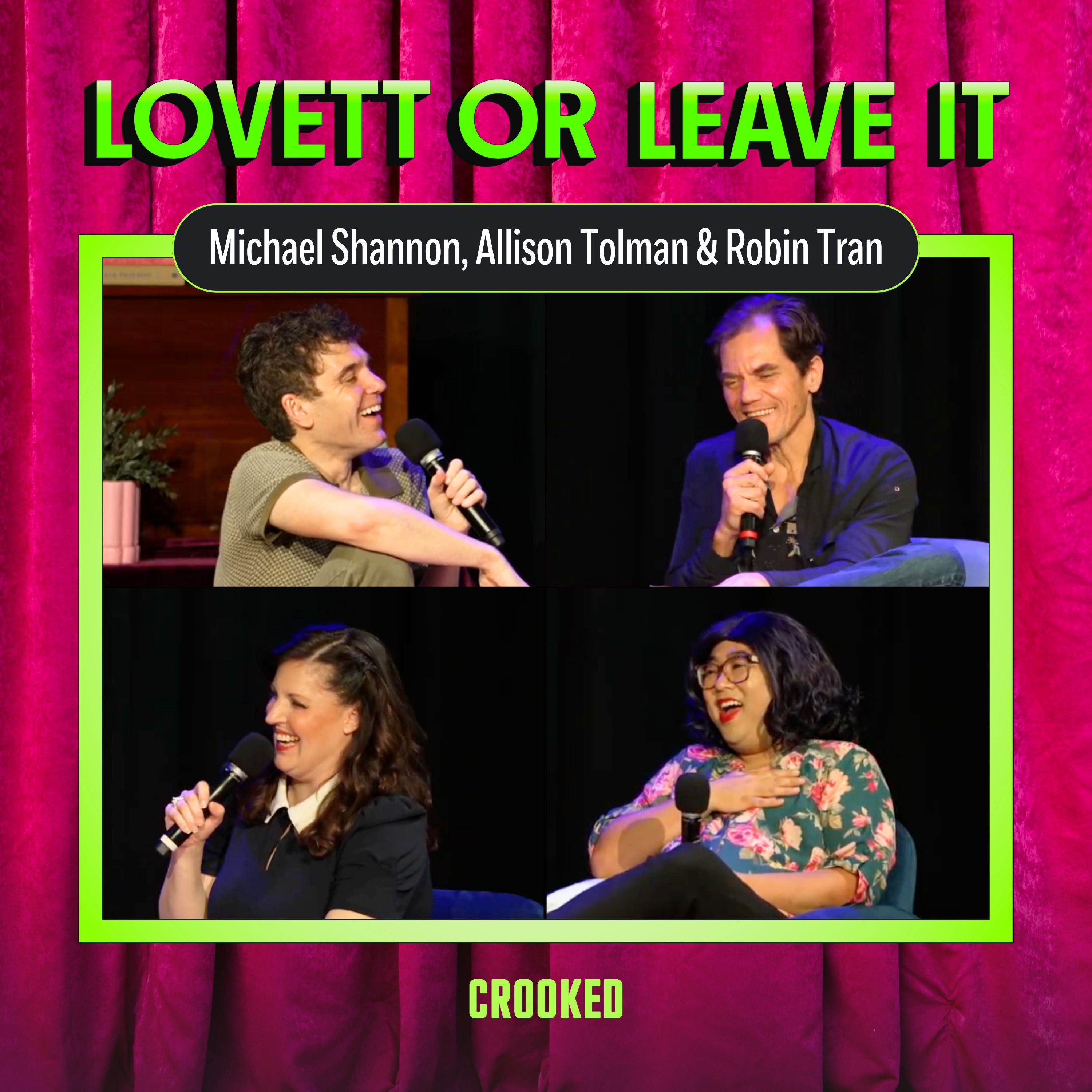
Lovett or Leave It
Sauvignon Blanc Nationalist
01:18:18
This week, Donald Trump takes a wrecking ball to the White House, ICE recruits gasp for breath during a light jog, and Maine Senate candidate Graham Platner re-inks his past. Acclaimed and nearly interchangeable actors Michael Shannon and Allison Tolman grace us with stories about Nuremberg and fake blood gone wrong. Robin Tran joins to give our angelic audience some hellish advice, then we bravely rise to double down on the worst things we love. For a closed-captioned version of this episode, click here. For a transcript of this episode, please email transcripts@crooked.com and include the name of the podcast.
Loading summary
Transcript402 lines
- [00:00]
John Lovett
Love it or leave it. Brought to you by Quint. As the weather cools, I'm swapping in clothes that actually get the job done. Warm, durable and built to last. And Quint delivers every time with wardrobe staples that'll carry you through the season. Quince is the kind of fall staples you actually want to wear on repeat. Like 100% Mongolian cashmere from just $60. Classic fit denim and real leather and wool outerwear that looks sharp and it holds up. They've got this great suede trucker jacket. It's perfect for layering and just looks really casual but put to together. A lot of you out there, you looking casual but you're not looking put together. People are walking around the airports. They look like what John by partnering directly with ethical factories and top artisans, Quint cuts out the middleman to deliver premium quality at half the cost of similar brands. I love Quint. I have a great sweatshirt from there, but I also have great sheets from there. The quality really does hold up. It's more affordable but it's really well made. Quite Quint will become your go to across the board. They have cookware, they got a bunch of like travel stuff that's really great. It's just a great all around place to check out before you buy it from somewhere else. For more, you know, layer up this fall with pieces that feel as good as they look. Quince.com love it. For free shipping on your order and 365 day returns. Now available in Canada too. Q U I n c e.com Love it. Free shipping and 365 day returns. Quince.com Lovet what's up Los Angeles? Welcome to Love it or Leave it live at Dynasty Typewriter. We have got a great show for you tonight. Michael Shannon is here. He's in a new movie. He's Nuremberg. Not a comedy. It's very good. I watched it. It's very good. Alison Tolman is here. Love Alison Tillman. She's in San St. Denis Medical. Great show. Robin Tran is here. Very funny comedian. I'm mostly here and then at the end of the show, we're each gonna share a love that people love to hate. But first, let's get into it. What a week. The east wing of the White House is no more tonight. Sources tell ABC News President Trump is aiming to tear down the entire east wing of the White House by this coming weekend to make way for his new ballroom. This is a metaphor. Trump yelled over the din of construction. Not to get sentimental about the White House, but this Hurts to watch. There's so much history being lost. I mean, this is the building that inspired my one season sitcom. So how did we get here? I remember when the idea of Donald Trump tearing down the White House to make way for a gaudy ballroom was a joke. In fact, I helped write it. Say what you will about Mr. Trump, he certainly would bring some change to the White House.
- [03:06]
Graham Platner
Let's see what we've got up there.
- [03:16]
John Lovett
How did we know? So how did we get here? Like a commercial plane crash or that time you accidentally shit in your car. It wasn't just one mistake that led us here. It was a cascade of failures. Economic dislocation, the decline of community, the dismantling of unions and civil rights legislation, deindustrialization, phones with no home button, depraved elites, craven politicians, right wing propaganda, Hannah Gadsby's Nanette, moneyed interest, alienation and radicalization online Disney adults, moral decay, classic bigotries that imagine video. The ways in which nationalized and globalized society created a deficit in meaning and dignity that consumerism could not close. But I want to add another cause that gets short shrift because it seems less sophisticated. These people are fucking losers. In their hearts and souls, they are losers and they're mad. They're losers and they have no one to blame but themselves. And that is fundamentally unsatisfying. This week we learned more about Paul Ingrazia, Trump's nominee to lead the Office of Special Counsel after Politico reported that he had sent racist texts in a separate and new cursed Republican group chat. At least the only group chat Rudy Giuliani is in is with several uncoordinated scammers, all pretending to be different Ukrainian women. Choose me, Rudy.
- [04:47]
Robin Tran
Choose me.
- [04:48]
John Lovett
No, choose me. In January of last year, In Gracia wrote In the chat, MLK Jr. Was the 1960s. George Floyd and his holiday should be ended and tossed into the seventh circle of hell where it belongs. A big Dante guy, huh? Because you also like to watch. Look at Dante and Virgil there. Let's punch in on those two. Couple of fucking pervs. Look at that. And look at this bat guy that's also in the painting. Who's that guy? The fuck? Jesus Christ. Replied another participant in the in Gracia chat. That participant, the Atlantic's Jeffrey Goldberg. A month earlier, Ingrazia whipped out an Italian slur for black people and said, From Kwanzaa to MLK Jr Day to Black History Month to Juneteenth, every single one needs to be eviscerated. Do you know how racist you've gotta be to wanna see paid federal holidays come off the board unless you're trying to run a business and then July 4th lands on a Wednesday and it blows the whole fucking week? In February of 2024, Ingrazia wrote of then presidential candidate Vivek Ramaswamy, never trust a Chinaman or Indian. Never. And I know what you're thinking is that Pirates of Penzance. It's not. Ingrazia's lawyer said in a statement that the text could be manipulated or out of context. But if they are authentic, they're clearly self deprecating and satirical. A dry wit that Paul and Gracia. Very dry. A Sauvignon Blanc nationalist, if you will. That's a great joke. Sauvignon Blanc nationalist is a fucking great joke. I'm not saying he didn't laugh the right amount. It got what it deserved. A great joke doesn't need to get a great laugh in my theory. But then on Tuesday, Ingrazia backed out of his confirmation hearing, writing on social media, unfortunately, I do not have enough Republicans at this time. This in classic loser fashion after his mother went to Congress on his behalf. Yes, Ingrazia's mom went to Jamie Raskin and Robert Garcia's office in person this summer to confront them after they expressed grave concerns about Ingracia's close association with anti Semitic extremists. But how can Ingracia be anti Semitic when his mother is, at the very least, spiritually Jewish? It's no wonder these guys seek hierarchies that grant status by default. It's why the Trump administration declares war on DEI while filling virtually every leadership position with a bunch of 40th percentile whites like Defense Secretary and guy who is fine to drive. Pete Hegseth, who, according to the conservative Washington Times, has lost the trust and respect of military leaders. But he's gained something even more valuable. Their contempt. The turning point was when Hegseth decided to summon hundreds of generals and admirals from around the world to Quantico for an indulgent and pointless pep rally. Extremely insecure behavior in which he talked about appearance and facial hair. It's like that time in college where you drove four and a half hours to Bowdoin to see your boyfriend perform in his acapella group, Treble in Paradise, and then watching him sing, you immediately got the ick. Pentagon sources also describe chaos that's weakening the military. Said one officer, we are bleeding talent, talented generals and flag officers for what appears to be the opposite of a meritocracy bad for our national security. Great for our newest four star general, a gas station attendant who yelled you got this bro while Hegseth was throwing up next to you, but for some reason not in a trash can. Speaking of wanting to puke, let's talk about OMB director and guy who doesn't understand why this trolley situation is being described as a problem. Russ Vote what happens if Moby eats pork after midnight? Zetteo reported on Tuesday that during his 2024 campaign, Trump was obsessed with getting Vote laid after his recent divorce and bragged about all the pussy Vote would get with Trump as his wingman. I'm also sing, I'm also single boss. I gotta know what voice to do. I'm also single boss, said Paul in Gracia while checking to see if anybody left a little shrimp in those tails. Sometimes people turn them. They leave a lot of good meat in those shrimp, said Paul. Ingra said Paul Ingrazia. But it all makes sense. Vogt was one of the architects of Project 2025 and he's a smart guy, but that wouldn't be enough. He could only dismantle the government with this level of enthusiasm and vitriol with the power of divorced guy energy. After all, if you love one person, you love the whole world. If your marriage falls apart, you destroy usaid. Speaking of disgusting shit, over the weekend Trump posted an AI video in which he wears a crown, flies a fighter jet and dumps what sure looks like poop on Saturday's no King protests. You know, just like a king. Almost every point about this absurd video has been made, but I want to add one more this is content for losers. If you get off on watching an AI video of Trump literally dumping on liberals, your life is not a rich one, filled with friendships and bowling and shared apps. Nobody who gets spinach dip for the table found this funny. This is for people that order spinach dip to their home to eat alone. And yes, I do that. And in fact, it's because I have the soul of a loser and the lived experience of a loser that I feel I can speak on this. Remember earlier when I told what sounded like a true story about traveling to see my boyfriend's acapella group in college? I did not have a boyfriend. I had no one. No one from the acapella group would sleep with me. Paul, please. I'm very successful. Exactly what a fucking loser would say. The point is, I didn't understand until we experienced it just how much the dangers of fascism as a political enterprise mirror the worst qualities of the people who implement it. Domination and insularity and vengeance. A kind of guiltless, proud selfishness. It is a movement for the insecure, for people unable or unwilling to process their private hurts and shames and furies, for those whose talents didn't match their ambitions. And I'm not talking about voters. I'm talking about the functionaries and leaders and dedicants. It's a movement of losers. And yes, it calls upon those feelings and qualities in all of us and it spreads because we all have that in us and it can be fed. But while we are governed by losers, we are not a nation of losers. Not yet. Look at how many people turned out at no kings. Are some of us annoying and pedantic? Yes. Are some of our signs cringe? No, all of our signs are cringe. But what is cringe in defense of democracy if not someone who cares too much and wants too much for you to know how much they care? The price of liberty is eternal. Cringe. Sure, there's no equivalent on their side, they just don't have the guess their side couldn't hang a single puny Mike Pence. Just look at the issues they've had with ICE recruitment. Despite $75 billion in new funding, student loan forgiveness and a $50,000 signing bonus and advert blanketing the airwaves. According to the Atlantic, One third of ICE applicants can't pass the physical exam, which consists of 15 push ups, 32 sit ups and running one and a half miles in 14 minutes. And sure, in the game you can run so fast even while fully equipped, but to tackle someone for speaking Spanish outside of Home Depot, you'll need to use your actual arms and legs. And even though you wore an Under Armour T shirt to your niece's baptism, you haven't done cardio since fucking high school and you're going to have to chase people who have been doing manual labor outside for 20 years. There's an entire digital manosphere built around selling a conservative idea to masculinity back to conservative men. Meanwhile, any of these guys would lose a footrace to the average urban liberal who got up at 5am and hauled her ass to Pilates before a pre work networking coffee. Just as fascism mirrors the flaws in people, democracy calls upon their opposite. Collaboration over dominance, curiosity over inwardness, grace over revenge, seeing in the stranger a soul just like yours. And we fail at practicing these virtues even when we're reaching for them. But at our best, we marshal those qualities which are just as much a Part of us. There are far more bloodless and tactical ways to talk about politics right now, but these are ultimately the lines of battle. Losers on one side, underdogs on the other. Which brings me to Graham Platner. Platner is the progressive oyster farmer and veteran who's running for Senate in Maine in a primary against the sitting governor, Janet Mills. And he's been in a massive controversy over his old Reddit post and a tattoo he got while serving in the Marines. And I think it's fair to say that if you begin the week with an apology for minimizing sexual assault in the military and end the week with an apology for calling the British gay, and in between, do a shirtless interview to prove you've covered up your Nazi tattoo. It's not a great week for your campaign. In an interview with Tommy on Pont Save America, Plattner talked about why someone would post that kind of shit on the Internet in the first place.
- [14:48]
Graham Platner
I do think explaining the fact that I struggled with alienation, isolation, and the effects of PTSD after my military service. And that's why I was on the Internet, frankly, getting in fights with people and shitposting. And it took about a year and a half, two years for me to settle back into, frankly, society. And I'm lucky, I'm immensely lucky that I come from a small town, that I moved back to a small town, that I'm very connected with my neighbors, my community, and my family. I got to meet my wife. I mean, like, life got good.
- [15:23]
John Lovett
There must be a way of pulling men out of a cynical downward spiral that doesn't hinge on them getting wives. And I believe we will find it. But until then, keep up the great work, ladies. In addition to those posts, it also came to light that Platner had a chest tattoo of a very specific skull and crossbones that was a symbol of the ss. But let ye without Nazi tattoos cast the first stone. It's so tricky. You think you're just getting a normal skull and crossbones, but then you accidentally get one that represents death. Platner said he had no idea he'd gotten a Nazi tattoo until very recently, saying in a statement, it was not until I started hearing from reporters and D.C. insiders that I realized that this tattoo resembled a Nazi symbol. I absolutely would not have gone through life having this on my chest if I knew that. And to insinuate that I did is disgusting. Now, I don't know if it's fair to call the insinuation disgusting. It might be wrong. I hope it's wrong, but if you have a Nazi symbol on your chest for many years, it's a little bit daunting until proven innocent. You know what I'm saying? Uh, it's just hard to claim that you did not see this coming. Stop it. By Wednesday, Platner had gotten the tattoo covered up with a Celtic design. And as is only fair, it does suck. Look, it is. It's totally reasonable to argue that Janet Mills is a better choice to take on Susan Collins. She's proven reliable. Less risky. For example, her skull and crossbones tattoo is clearly an homage to Garfield's Halloween adventure. And maybe Platner's not the right guy. Maybe his story doesn't hold up. Maybe there's a second worst butt cheek tattoo we can't even conceive of yet. One that would make Paul and Gracia say, oof. Too much. There's plenty of time to sort out the politics. The primary's in June. Trump will be watching the results roll in from his completed Gold Ballroom, or more likely, a giant pit the ballroom collapsed into because it was not built to code. But what's not fair to me is to reflexively cast someone out or be unwilling to take an honest look at who he is now and how he got there. Doesn't mean every apology is sincere. Doesn't mean you have to accept every sincere apology. But at the very least, we ought.
- [17:46]
Graham Platner
To listen again, not trying to make excuses. It was me. I did it. And the things that I said that I do. I mean, there are things that I said, there are words that I use that I'm utterly horrified by, and I'm not blaming anybody else.
- [18:00]
John Lovett
Look at me. Last week, I said the R word on this very show because it was inside of a joke in which it made sense and because Hallie dared me to do it. And now here we are a week later, and I'm back to saying R word because I listened and I don't want to get yelled at again. Should Platner be a senator? I don't know. But if we're trying to build a movement that welcomes people, including people who have gone down dark roads and found their way back, then we actually have to do that. It's not that hard to be consistent. We ought to hold people accountable for their words and actions and have enough grace to give people a chance to change. That depends on what Graham Platner does, and it depends on what we do. Like how we've all forgiven Hallie for using the R word. So much around the office, but she's clearly sorry she even covered up that R word tattoo. Yeah. Now it's like a car cartoon character named Captain Batardo. I don't know that. Is that good enough? This is America. No one is born a loser. Anyone could become a loser. And inside of every loser is a winner waiting to buy spinach dip for the fucking table. All right? And speaking of winners, coming up next, it's Michael Shannon and Alison Tolman.
- [19:15]
Robin Tran
Hey, don't go anywhere. There's more of Love it or Leave it coming up.
- [19:20]
John Lovett
Love it or Leave it is brought to you by Helix. I love my Helix mattress. It's so comfortable. I have a Dawn luxe. It's plush, but it's firm. I don't use a wearable device like an Apple watch, an Oura ring, because I just simply don't believe in that. But others do. And they will find what I found using my brain and my feelings, which is that it's really comfortable and you get a better night's sleep. I have lots of sleep issues, mostly caused by caffeine and the world. And Helix can't solve all of them. But it does mean that I don't have to worry about whether or not my bed is comfortable. I have such a comfortable bed with Helix. Helix knows there's no better way to test out a new mattress than by sleeping on it in your own home. That's why they offer a 100 night trial and a 10 to 15 year warranty to try out your new Helix mattress. Everybody is unique and everybody sleeps differently. That's why Helix has several different mattress models to choose from, each designed for specific sleep positions and feel preferences. You'll know which Helix mattress works best for you and your body by taking the Helix Sleep quiz. You'll find the perfect mattress. As I said, I was matched with the Dawn Luxe. It's firm, but it's plush. Because I sleep on my stomach, my back, my side, I don't know. I'm rolling around. I'm rolling around. I'm having bad dreams. That's not Helix's fault.
- [20:22]
Robin Tran
But Helix can help.
- [20:23]
John Lovett
But Helix can help. Your personalized mattress is shipped straight to your door free of charge. Go to helixsleep.com love it for 20% off site wide. That's helixsleep.com love it For 20% off site wide. Make sure you enter our show name after checkout so they know we sent you. Helixsleep.com loveit.
- [20:39]
National Debt Relief Announcer
Confronting high credit card debt can feel scary. But the good news is if you owe $10,000 or more in credit card debt. Financial relief options are now available. National debt relief is currently offering debt relief designed to reduce what you owe. Fast tracking your way to being debt free. If you qualify for debt relief, you may be able to pay back significantly less than what you owe and save thousands of dollars. Imagine only paying one low monthly program payment you can afford and saving money as you become debt free. National Debt relief has already helped bring debt relief to over 550,000 US consumers, earning thousands of five star reviews and an A rating with the Better Business Bureau. You're stronger than your credit card debt. Take the first step and visit nationaldebtrelief.com to see what debt relief you qualify for. That's nationaldebtrelief.com.
- [21:32]
John Lovett
And we're back on screen. They couldn't be more different in real life. They share one similarity. They're my first guest of the evening. Please welcome the stage, the wonderful Michael Shannon and the phenomenal Allison Tolman. Thanks for being here. Nice to meet you.
- [21:51]
Michael Shannon
Nice to meet you.
- [21:52]
John Lovett
Hi. Hi.
- [21:52]
Michael Shannon
Hi.
- [21:52]
Allison Tolman
Hi.
- [21:53]
Robin Tran
Thank you.
- [21:53]
John Lovett
Good to see you too.
- [21:54]
Allison Tolman
Hi, everybody.
- [21:55]
John Lovett
Welcome to both of you. Wow. Two of my two incredible actors.
- [22:03]
Allison Tolman
Thank you.
- [22:03]
John Lovett
Such different vibes in your roles, you know, between us.
- [22:07]
Michael Shannon
Yeah, that's true.
- [22:09]
John Lovett
Have you ever.
- [22:10]
Allison Tolman
I did a show with a talking dog for a while. Have you done one of those?
- [22:14]
Michael Shannon
No, I just had a talk.
- [22:16]
Allison Tolman
It wasn't a show, just life.
- [22:19]
John Lovett
Damn. I would like to see you as a kind hearted and sweet nurse trying to. Trying to have it all. I'd like to see you prosecute the Nazis at Nuremberg. Huh?
- [22:30]
Allison Tolman
I'm up for it. I'm gonna start with tattoos. Check them all. Yeah, Very carefully.
- [22:34]
John Lovett
Gotta check all. Check your tattoos.
- [22:37]
Allison Tolman
Yeah.
- [22:38]
John Lovett
To be part of our screening process for candidates from this point forward. So, Michael, you're in Nuremberg, which comes out on November 7th. I've watched it and I was really moved by it. And I'm curious what led you to want to do it? Like what about Robert Jackson as a person or about the story?
- [22:59]
Michael Shannon
Well, I didn't know anything about Robert Jackson. I had never even heard of him. So when I read the script, yeah, I was a little embarrassed that I didn't know more about how this came to be, how the trials came to be. And it seemed like an important story that I assume a lot of people don't know much about it. And so I figured it'd be worth telling.
- [23:24]
John Lovett
Yeah. So Robert Jackson was a supreme Court justice. He was one of the people that dissented in Korematsu. He was one of the nine votes in Brown v. Board of Education. But in between, he took a leave of absence from the Supreme Court to go do the prosecutions at Nuremberg, which is just sort of a fascinating thing for a Supreme Court justice to do. He also served in the Supreme Court even though he had a heart attack and was sort of lying in the hospital. And he had to leave the hospital to be the ninth vote in Brown v. Board of Education, part of a long tradition in this country of Supreme Court justices not leaving soon enough to.
- [24:06]
Allison Tolman
What could you be referring.
- [24:09]
John Lovett
And before you played, you've also played General Zod and you've played Supreme Court Justice Robert Jackson. Who did you know about more before? Be honest, please.
- [24:25]
Michael Shannon
Well, I only knew about General Zod because I had seen Terrence Stamps portrayal in the original film series. Yeah, Terrence. So that's what I knew about that. But I was, I'm not a big, I was never a big comic book collector as a kid, so I didn't know that much about him.
- [24:49]
John Lovett
But if you saw two hours of Terrence doing the role, you seem to that it seems like you knew more about Zod.
- [24:57]
National Debt Relief Announcer
True.
- [24:58]
Michael Shannon
Yeah. Well, I mean, I didn't.
- [25:00]
John Lovett
To return to the question, sorry to.
- [25:01]
Michael Shannon
Yeah, no, I mean you're trying to humiliate me in front of all of us.
- [25:05]
Allison Tolman
Are really a leading question.
- [25:07]
Michael Shannon
Jesus Christ.
- [25:08]
John Lovett
Answer the question. You played a lawyer who prosecuted the Nazis. Isn't that. I'm not that bad.
- [25:12]
Allison Tolman
You're not under oath. You can lie. Michael.
- [25:15]
Michael Shannon
Well, I, when I was. See, I mean, frankly, one of the things I appreciate about my job is that like when I was a kid going to school, I didn't really find history that interesting, but it was partially because of the way it was presented, you know, in a very. In these really dull textbooks. And when you're acting and you get an assignment like this, you dive into these historical situations in a much more four dimensional way where you're actually trying to imagine what it was like to be these people and do the things that they did. And so I've actually learned a lot from doing what I do.
- [25:59]
John Lovett
Allison, do you feel bad at all that St. Denis Medical doesn't do anything to kind of dive into the nature of evil and the ways in which the machinery of bureaucracy and hatred can be combined to do unspeakable horror for which there is truly no just punishment? No, but it's a fun, goofy show.
- [26:22]
Allison Tolman
Listen, it's a loving, heartwarming show. I do think I mean, I think that we do get a little into, hey, our healthcare system is not great. Which is good.
- [26:36]
John Lovett
But not a lot about Nazis in that.
- [26:37]
Allison Tolman
No, no.
- [26:38]
John Lovett
From what I've seen, I'm up later.
- [26:40]
Allison Tolman
Almost no Nazis in season two. You have to tune in to find out.
- [26:46]
John Lovett
Russell Crowe plays a Nazi.
- [26:49]
Michael Shannon
Yeah.
- [26:51]
John Lovett
Hey, there's something funny about Russell Crowe I wanted to ask you about. He seems to have an implacable desire in film to play a big fat guy and go, he does that a lot. I love it when he does it.
- [27:04]
Michael Shannon
I'm not as familiar as with his filmography as you are. I wasn't aware of that.
- [27:10]
John Lovett
But you confront him. He plays. He plays. Is it Gurg? He plays Guring or Goebbels?
- [27:15]
Michael Shannon
Guri Gurung.
- [27:16]
John Lovett
And you confront him in it.
- [27:18]
Michael Shannon
I do. That must be fun. I killed him in man of Steel.
- [27:23]
John Lovett
Oh, my God. Of course. Of course.
- [27:27]
Michael Shannon
That was a little bit more of.
- [27:28]
Allison Tolman
An back off again. Wow.
- [27:31]
Michael Shannon
Yeah, I really got it out for him.
- [27:35]
John Lovett
I didn't even make that connection. That's so funny. You kill him in man of Steel and then you come back and you prosecute him as a Nazi. What are you gonna do to get him next? Maybe he could be in space. Alison, wouldn't that be something?
- [27:50]
Allison Tolman
Yes, I understand my role here.
- [27:57]
John Lovett
Allison. In season one, episode 11 of St. Denis, medical workers are pressured to upsell patients on non critical procedures.
- [28:06]
Allison Tolman
See? Topical Nazis.
- [28:10]
John Lovett
It's a very funny show, but you are diving into the actual realities of healthcare. And was there ways in which that, like, why did you want to do this? Like, was there anything personal to you about it?
- [28:20]
Allison Tolman
Yeah, I. When I got the script, I had actually just spent like the longest stint of my life in the hospital system. My dad had been sick for a few weeks, and I'd gone back to Texas to be there while he was in the hospital. He's better now. Thank you. Way to go, Dave. But, yeah, so I kind of got the script at a time when I just had been spending some time in that space and was really, like, thankful to the professionals who took care of him. And also when my dad was sick, my mom and I could only watch sitcoms. Like, that's all she could, like, stomach at the end of the day. And I hadn't been looking for a sitcom. I was trying to get. Trying to get back to Fargo. Since I shot Fargo, I like, was like, prestige TV is where it's at. And then I got this. This sitcom script and I was like, I think this is what I need to be doing right now. I think this is where I want to spend my energy is just like, making something that feels good at the end of the day for people to, like, let wash over them because things are rough. But Nazi movies are great, too.
- [29:15]
John Lovett
Hey.
- [29:16]
Allison Tolman
Hey. So great. Really great.
- [29:19]
John Lovett
Michael. Don't let that get to you. You do such great work. And I don't want you to leave here thinking that we don't think that you're an amazing actor. Even if your stuff doesn't do what her stuff does. Yeah, her stuff does something that your stuff doesn't. But your stuff does something that her stuff doesn't.
- [29:39]
Michael Shannon
No, I've done things that wash over people.
- [29:45]
Allison Tolman
I will say. I just rewatched Knives out the other day, and you're very funny in Knives Out.
- [29:50]
John Lovett
Oh, yeah.
- [29:50]
Michael Shannon
See?
- [29:51]
John Lovett
Yeah.
- [29:53]
Allison Tolman
Very funny.
- [29:54]
John Lovett
You were in Bad Boys 2.
- [29:56]
Michael Shannon
Yeah, I was in Kangaroo Jack, too. You want to fucking talk about that?
- [30:03]
John Lovett
I don't now. I'm a little scared. That's so cool. Michael Shannon being intense with me, and I love it. So you also directed a film for the first time? I did, and it just came out this year. Can you just talk about that? And why did you want to do that movie?
- [30:22]
Allison Tolman
I watched this film.
- [30:23]
Michael Shannon
Oh, Eric Larue.
- [30:25]
Allison Tolman
I loved this film.
- [30:26]
Michael Shannon
Oh, thank you, Allison. Yeah.
- [30:28]
Allison Tolman
Judy was so great in that.
- [30:29]
Michael Shannon
Yeah. And she's something.
- [30:30]
Allison Tolman
She's wonderful.
- [30:31]
John Lovett
Allison Pill.
- [30:32]
Allison Tolman
Allison Pill, a friend of mine. Yes. Please talk about your movie. But I did see it. Forgot you directed it.
- [30:38]
Michael Shannon
Thanks for watching it.
- [30:39]
Allison Tolman
Yeah, absolutely.
- [30:40]
Michael Shannon
Oh, yeah. Well, it was written by. So I belong to a theater company in Chicago, and. Yes, Chicago. Red Orchid Theater. And we have a playwright in our company, Brett Neveu, and we've done a ton of his plays over the years. And this Eric Larue started out as a play that we did in 2002, and it's a play about the parents of a boy who commits a school shooting. And then, you know, 20 years later, Brett hands me. He says, oh, I've written a screenplay of it. And I'm sitting there reading it and thinking, this damn thing's as relevant as it was 20 years ago. That's really unfortunate. So it's like nothing has changed. So I thought, well, let's get it out there. And I didn't want to play any one of the parts so much as kind of be a part of creating the whole community, because I loved all the characters so much. And. Yeah. So that's why I decided to direct it.
- [31:55]
John Lovett
So there's something interesting to me that happens when renowned actors become directors, which is. I think acting gets short shrift, as people know. It's a magical and amazing talent, but it's not seen as like a hard skill in the same way being a cinematographer is, or being an editor is. And yet it's great actors that have often become a lot of great directors. You see that over and over again. And I'm curious, like, what. Like what you think an actor understands about directing a movie that maybe others wouldn't.
- [32:35]
Michael Shannon
Oh, well, that's interesting. Yeah. Well, first of all, I don't know the answer to that question in. In totality. I mean, I just did my one little movie. I don't even know if I'll make another one. But I think one thing that was very important to me is because the story we're telling and the subject matter was so kind of scary and dark and difficult. I wanted the actors to feel very safe when they were on set. And I don't think that's something that happens a lot of times when you're at work that people really take into consideration just how terrified all the actors are. Because most actors are in some state of, if not terror, at least insane self doubt, like, all the time. So, like, for me, it's a very. There's a common misperception of directing, I think is kind of an authoritarian, dictatorial position where you're just telling people what to do all the time. And for me, I didn't care if anybody did what I told them to do. I just wanted to help them. Like, are you okay? Do you have a question? Is there anything. Do you want a cup of coffee? I want you to feel okay, because I know this is really hard. So I guess that was a long way of saying empathy. Like, I have a lot of empathy for what they're trying to do, you know.
- [34:17]
John Lovett
Allison, do you find your scared all the time?
- [34:21]
Allison Tolman
I find that. I think that good acting is always really vulnerable work, which I think, yeah, can be very scary. And I think that can exist in, like, any medium. You can be, like, doing good work that's really vulnerable because you're doing a gag where you're, like, throwing yourself on the ground or you're trying, like an improv line that you didn't get vetted by any writers, or you're doing what Judy Greer did in your film and just kind of ripping yourself open for the course of an hour and a half.
- [34:51]
John Lovett
Yeah, it just seems like a. I always feel for actors because it's such a hard thing. And then it's totally out of your hands. Once you're done, you have no idea what's gonna be used.
- [35:03]
Allison Tolman
It's bizarre. It is. Really, truly. Especially if you come from the theater, which both of us come from the theater where you really are. Like, it's this little package deal. You rehearse and you have it all down and then you do and you have full control over and knowledge of, like, what happened that night. And when on film, you just sort of surrender it over and you have no idea how it'll edit, how it'll fall out, how it'll come together and how it'll play. It's very, very strange. It's very different.
- [35:29]
John Lovett
So, Michael, you do like a. It's like a 20 or 25 minute scene. It's like 20 pages of dialogue with Russell Crowe, like you did with no cuts. You just did the scene all in one shot. How does that go?
- [35:38]
Michael Shannon
Yeah, I mean, it's the final. You know, I have him on the.
- [35:43]
John Lovett
Stand, he goes, you can't handle the dust truth.
- [35:47]
Michael Shannon
That's true.
- [35:49]
John Lovett
He says.
- [35:52]
Allison Tolman
Cannot wait to see this movie.
- [35:54]
John Lovett
I understand. You don't. This is it. Speak in English. We won, but I'm quoting it, but I don't know the rest.
- [36:01]
Michael Shannon
No, I mean, you know it as well as I did. There was a lot of improv.
- [36:09]
Allison Tolman
Yeah, that's nice. They kept it loose.
- [36:12]
Michael Shannon
Yeah, yeah, yeah. They, they had scheduled the scene to be shot over three days, and the, the idea being that it was too long. And they, they do the first part and then the second part and the third part. And Russell and I both agreed that that sounded like a really shitty idea. So we, we said, can we just do the whole thing? And then. And we wound up saving the production a couple of shooting days, which the director was very grateful for.
- [36:44]
John Lovett
You get a little taste of that. Get your beat wagon. That's money in their pockets.
- [36:47]
Michael Shannon
You don't get anything for that. Yeah, yeah. I don't know why they do that. I mean, I guess there are some people that have never done stage. And so maybe the idea of learning so much dialogue throws them off. But, I mean, I've, I've. I've been learning entire plays for a long time. So I can, I can handle even 20 pages of dialogue.
- [37:11]
John Lovett
And I notice Russell Crowe, as guring, doesn't do a lot of singing in the film. Is that a response to the criticism?
- [37:19]
Michael Shannon
Now, see, this goes to Alison's earlier point. He did do a lot of singing. You just didn't get to see all wound up on the cutting field. And that kind of vulnerability, him putting himself out there.
- [37:32]
Allison Tolman
Yeah. Deeply vulnerable.
- [37:34]
Michael Shannon
Nobody's even gonna see it.
- [37:36]
Allison Tolman
We have no control over the end product.
- [37:39]
John Lovett
He and Rudolph has to do the cell block tango cut from the fucking film.
- [37:44]
Michael Shannon
Time.
- [37:44]
Allison Tolman
Can you imagine the lyrics they wrote for that?
- [37:46]
John Lovett
Deeply disturbing. They had it coming. That's the lyric of the song I mentioned. Follow the thought to its logical conclusion. Ooh, in your own goddamn heads. I'm so sorry for that, Michael Shannon.
- [38:01]
Michael Shannon
It's okay. It's vicious. You should put, like, some barbed wire on here or something.
- [38:08]
Allison Tolman
Does he start throwing beer cans, like, at a honky tonk?
- [38:11]
John Lovett
They forget their place. Michael, are you having fun on this show?
- [38:15]
Michael Shannon
I am.
- [38:16]
John Lovett
Oh, thank God. Allison, how are you doing?
- [38:18]
Michael Shannon
I mean, I'll never do it again.
- [38:23]
Allison Tolman
I'll come back if Michael comes back.
- [38:25]
Michael Shannon
We're a team.
- [38:26]
Allison Tolman
Yeah.
- [38:27]
Michael Shannon
Where's the handcuffs?
- [38:29]
Allison Tolman
We're only doing this together from now on.
- [38:31]
John Lovett
I love that. That was beautiful. And I don't want to spoil the end of Nuremberg, but we get them. That's cool, right?
- [38:39]
Allison Tolman
Not all of them, right?
- [38:40]
John Lovett
I mean. You know what I mean?
- [38:41]
Robin Tran
Yeah, yeah.
- [38:42]
John Lovett
Well, yeah, that's.
- [38:45]
Allison Tolman
You know what I mean, John?
- [38:45]
John Lovett
That's a good point. I guess the thesis of the film, that if we try them here, that'll be that. Hmm. But did you take anything away from playing Robert Jackson now, once you got to know him, because you were preparing for the role?
- [39:01]
Michael Shannon
Take anything away, like, you know, you.
- [39:03]
John Lovett
Learn about this guy to play that. Play him?
- [39:05]
Michael Shannon
Yeah. Well, I mean, I just think he's, you know, a role model. You know, something I learned is, I don't even think he went to law school.
- [39:15]
John Lovett
No, he apprenticed. He was like an apprentice.
- [39:17]
Michael Shannon
Yeah. Yeah. I think it's very easy nowadays to feel like there's nothing you can do. Like, oh, geez, there's all this terrible stuff going on, but there's nothing I can do about it. But this was a guy who never did that. He always said, no, there is something I can do, and I'm going to do it. And he met tremendous resistance to his notion of the. Of the trials, because most everybody in the. All branches of government just said, well, if you catch a Nazi, you just shoot them and kill them, and that's the end of it. And he said, no, that's not the right way to go about it. And, yeah, I just really admire him. I got to play two significant Americans because I also have this death by lightning thing coming out where I play President James Garfield. Another example of someone who's actually living by the dictum that if you're president or if you're in the Supreme Court or whether you're a public servant, you're a civil servant. It doesn't mean you have all the power or you're the king. You're actually more of a servant than you would be if you're just some person walking down the street minding their own business.
- [40:40]
John Lovett
So, Alison, you don't prosecute, as we said, any Nazis in the show.
- [40:44]
Allison Tolman
But not yet.
- [40:45]
John Lovett
No, but there is.
- [40:46]
Allison Tolman
We haven't read the finale yet though, so it's possible that's coming. It'll be a real left turn, but I'm looking forward to it.
- [40:52]
John Lovett
But there are needles about. Yes, there's like, there's like. It's a real, you know, like you're, you're like. People are pretending to be doctors left and right, doing chest compressions and so forth.
- [41:02]
Allison Tolman
Yeah, we're doing real nurse stuff in there. Wait, we can curse real nurse shit.
- [41:06]
John Lovett
In there, you know, because that can go wrong on you Canon.
- [41:10]
Allison Tolman
Yeah, we had, we had a blood visual effects go wrong just this season. November 3rd. Tune in to find out why. But yeah, we had a blood gag where I had to get sort of was in a trauma room. I had to get sprayed with blood, but in a very. Had to be like right here for reasons you'll find out about on November 3rd. But so they have like a little pump and a thing where there's like fake blood in there and they squeeze it at the right time. And like they did it and it didn't go in the right place. And then they were like, oh, we're going to move it like this. And Alison, you have to like lean at this angle. And I was like, great. And they did it again and it didn't go in the right place. And they were like, okay, we're going to add a little bit more. We're going to move it up. We're going to do it. And I was like, okay. And they're like, you got to stand at this angle. And I was like, got it. And I'm like saying medical terms while I'm doing all these things, you know? And then they did it and it went just right in my face. Like. Like Carrie. Like the end of the descent and we're mid scene and all of my co stars are there and we all have a split second where we're like. And then we're all like echocardiogram and 5cc. We like just dove right back into it because no one called cut. So I'm just like, drip. I'm like, this is absolutely unusable. There's no way. There's no way they can use it. I mean, I look like I'm in a horror film. It's so gory.
- [42:33]
John Lovett
You know, Michael, you play James Garfield, and in a sense, he was in a medical mishap because he got shot, but he might have lived had the doctors not, you know, jammed their fingers in there, been like, oh, the humors are out of whack. Bring in the leeches, that kind of thing.
- [42:48]
Michael Shannon
Well, it's pretty insane to think in the late 1800s, many doctors in America still didn't believe that germs existed.
- [42:57]
John Lovett
A lot of our cabinet secretaries.
- [43:01]
Allison Tolman
Are.
- [43:02]
John Lovett
Believing it less and less.
- [43:03]
Allison Tolman
Yeah, I could have saved him. I think my character could have saved your character. I'm pretty sure.
- [43:10]
Michael Shannon
I mean. Yeah, it's mind boggling. And it's funny because we shot the whole thing in Budapest, which is where one of the fellows who discovered germs and hygiene was from Semmelweis. It was Joseph Lister and this guy Semmelweis.
- [43:30]
Allison Tolman
Why don't we have similar viserine? That's not fair.
- [43:33]
John Lovett
Right? Man, they were pasteurized Listerine.
- [43:39]
Allison Tolman
Listerine.
- [43:40]
Michael Shannon
But that's all European.
- [43:43]
John Lovett
Yeah.
- [43:43]
Michael Shannon
Over here in America, we're like, no, no germs. No germs.
- [43:48]
Allison Tolman
We're just a very clean country.
- [43:49]
Michael Shannon
Yeah, yeah.
- [43:50]
Allison Tolman
Obviously.
- [43:52]
John Lovett
Michael Shannon, Allison Tillman, thank you so much.
- [43:55]
Michael Shannon
Thank you.
- [43:56]
John Lovett
That was really fun. Thank you to Michael Shannon for being here. Everybody go check out Newborn. Genuinely a moving, like, very timely film. We'll be right back.
- [44:08]
Robin Tran
Hey, don't go anywhere. There's more of Love it or Leave it coming up.
- [44:12]
John Lovett
Love it or Leave it brought to you by Bombas Falls. Here kids are back in school. Vacations are over. It's officially the start of what it's start of cozy season, which means time to slide into some Bombas. You know, Bombas, most comfortable socks and slippers out there. Made from premium materials that actually make sense for this time of year. Bombas are made from the softest materials, Merino wool that keeps you warm when it's chilly, but cool when it's hot. Supima cotton that's softer, stronger, more breathable than regular cotton, and even Ragwool, that thick, durable, classic, thick, cozy sock you'll want all fall. And it's not just socks. Bombas designed slippers. They make it hard to leave the house. From Sherpa line Sunday slippers to packing friendly Gripper slippers, and even waterproof Eva Friday slides. And I've told you before, I have them. I wear them every single day. Single day. They're great. They're so comfortable. They look good. They come in a bunch of colors. And by the way, little tip, because we live in a world in which boy colors are often, I would say, less varied than what they consider to be girl colors, you can buy. You know what? Nobody knows that my Friday slides, they were for women. Same shoe. Same shoe, just in a kind of a purple. For every pair you buy, Bombas donates one to someone experiencing homelessness. Over 150 million items have been donated thanks to customers. And with their happiness guarantee, if you're not 100% into what you've got spot, they'll make it right. No risk, all reward. Plus, they're available through international shipping to over 200 countries. And you know what? Because Bombas helps people by giving an item away. As for everyone you get, maybe they'll be receptive to my pitch, which is if you're making a bunch of shoes that are the same shoes in different colors in all different sizes, you can put both sets of colors in both places because you know how to translate the different sizes. I figured it out myself. I'm a woman's 11 or whatever it is, you know, okay. And if you're doing that work on the back, I can. You can do it for me, you know? Plus, you know, they have a happiness guarantee, and this makes me happy. If you're not 100 into what you've got, they'll make it right. No risk, all reward. Plus, they're available through international shipping to over 200 countries. Again, I love Mamba socks. I wear them every single day. They are so comfortable. I have the. The vintage styles, which have a different color. I often try to, believe it or not, match the stripe of my sock to my gym outfit. It's a little bit of crazy that I bring every day.
- [46:21]
Robin Tran
I appreciate that level of ocd.
- [46:22]
John Lovett
It's really. It just makes me happy to be color blocked. Head on over to bombas.com Lovett L O V E T T and use Code Love it for 20% off your first purchase. That's Bombas. B O M B A S.com Love it. Code Love it at checkout.
- [46:35]
Allison Tolman
Hey, guys, have you heard of Gold Belly? It's this amazing site where they ship the most iconic famous foods from restaurants across the country, anywhere nationwide. I've never found a more perfect gift than food. Gold Belly ship Chicago deep dish Pizza, New York bagels, Maine lobster rolls, and even Ina Garden's famous cakes. So if you're looking for a gift for the food lover in your life, head to goldbelly.com and get 20% off your first order with promo code GIFT. That's goldbelly.com promo code GIFT.
- [47:09]
John Lovett
And we're back. Hi, Alison.
- [47:13]
Allison Tolman
Hi again.
- [47:13]
John Lovett
Thanks for being here.
- [47:14]
Allison Tolman
Absolutely.
- [47:16]
John Lovett
Joining us now, our next guest is considered the Michael Shannon of trans standup comedy. Please welcome to the stage of the hilarious Robin Trant.
- [47:28]
National Debt Relief Announcer
Hi.
- [47:28]
John Lovett
Good to see you. Thanks for being here.
- [47:33]
Robin Tran
Thanks for having me.
- [47:34]
John Lovett
Yeah.
- [47:34]
Robin Tran
Equal status as Michael Shannon.
- [47:36]
Allison Tolman
You know, I can't wait to find out what I'm the most president of.
- [47:39]
Robin Tran
Equal amount of fame. Me and Michael Shannon, right?
- [47:42]
John Lovett
I think so. Robin, you have a podcast called Trans Talk.
- [47:45]
Robin Tran
Yes.
- [47:45]
John Lovett
The description of which reads, comedian Robin Tran thinks that it's absurd when comedians call themselves modern day philosophers. Unless she's talking about herself.
- [47:54]
Robin Tran
It's true. Yeah. I am pretty. I'm arrogant. And only in comedy and podcasting.
- [48:00]
John Lovett
Oh, yeah. I do it everywhere.
- [48:02]
Robin Tran
Yeah. How's that working out for you?
- [48:04]
John Lovett
It's okay. But is he happy? Yeah. And you? Oh, and very little about Nuremberg in your work.
- [48:16]
Robin Tran
Well, you haven't, you haven't seen my, my stand up yet.
- [48:19]
John Lovett
Yeah, the new special.
- [48:20]
Robin Tran
No, I have no jokes about Nuremberg in my stand up. Not. Not yet.
- [48:25]
Allison Tolman
Her new special is completely about Nuremberg trials. She's a weird choice.
- [48:29]
Robin Tran
It feels like it. Watching it is. What?
- [48:31]
John Lovett
All right.
- [48:31]
Robin Tran
No, I'm sorry. Oh, no. Oh, my God. Sorry. I'm sorry.
- [48:37]
Allison Tolman
You guys wouldn't watch the trials 247 if that was on Court TV. Come on, John.
- [48:43]
Robin Tran
Is it like I like watch you walk a tightrope every week? You have to like, balance between being like edgy and ethical. Is that, does that kill you inside? Like they'll, they'll, they'll hate you if you say the wrong thing. Right? Like this audience in particular, you guys. Right.
- [48:57]
Allison Tolman
Turn on him.
- [48:58]
Robin Tran
Like, you guys, like.
- [49:00]
John Lovett
Because I don't have that.
- [49:01]
Robin Tran
But my, my audience is insane. So like, they'll let me say. That's why I have so few of them because like my, my audience.
- [49:06]
John Lovett
Yeah.
- [49:07]
Robin Tran
Is legitimately insane people.
- [49:08]
John Lovett
Yeah. You self selected to the real freaks. For sure.
- [49:11]
Robin Tran
Yeah.
- [49:12]
John Lovett
That's an interesting question. I, I do, I don't feel it from the audience. I think we. One of the fun parts of doing this show is thinking about how to like talk about what's happening, which is quite serious, but be like unabash it and trying to find the funny in it and direct it at Republicans, which can be easier to be honest, and also at ourselves and the ways in which I think we need to take ourselves down a notch. And in, you know, the. The hard part, I think, is like, what's the right level? I think there's a lot of. There are jokes that are unethical that are funny, and there are jokes that are ethical that aren't funny. And there are jokes that I think are defendable, but they're too dark for the moment. And sometimes I fight for those and I'll try them, and sometimes we'll keep them, and sometimes we won't. And that, to me, is the moments where I'm not exactly sure what, exactly how to strike the balance. Because is it that that means we should keep it in because it means we should be pushing on this, or is it because people are right to feel like, hey, you're being a bit insensitive? It's maybe ethical, but Insensitive, I guess.
- [50:20]
Robin Tran
Yeah, I empathize with this. I used to go through all this stuff, you know, when I used to care about ethics. I mean, like, I mean, if you let it go, I mean, that was a rough, rough couple of years. I mean, saying, I miss laughing too much, you know, that's why I chose laughter. If I was a straight white guy saying this, you would kill me. But I mean, I look like this, I can say anything I want. Like, literally, I can say anything, and I will. No, I'm sorry. I'm not gonna say I'm sorry, but Captain Bertardo was very funny. I laughed backst. That's really funny because I'm glad you didn't say the word. That's what I like. You didn't say the word this time. I don't think, like saying the words are funny just because it's cheap. It's easy, you know, not. Cause I'm offended, but I say them all in private, all the time. I'm saying in public, they're not fun to say because it's like, okay, now it's awkward, but Captain Bertardo, you skipped over all the lines. It was really good. I'm impressed by you.
- [51:15]
John Lovett
Oh, thanks for saying that. I'm loving this so far. Alison, you're an open and empathetic sensitive star of stage and screen.
- [51:25]
Allison Tolman
Those are my talking points.
- [51:26]
John Lovett
That's right, Robin, you do stand up comedy. The devil's art.
- [51:29]
Robin Tran
Yep.
- [51:31]
John Lovett
And so together, you'll offer our audience all the advice they could possibly need in a segment we're Calling high road or demon mode.
- [51:36]
Allison Tolman
Okay.
- [51:39]
Robin Tran
Wait, so you're making the trans person the devil on this show?
- [51:42]
John Lovett
Yeah, that's right.
- [51:43]
Robin Tran
I'm sorry, I thought. Am I on this? Was a liberal love it or leave it or Turning Point usa. Huh, John? I should update that reference, right, guys? Oh, I'm evil, so I can say anything I want. I've been in character the whole time.
- [52:03]
Allison Tolman
For years now.
- [52:04]
John Lovett
For years.
- [52:04]
Robin Tran
For years and years before I met you.
- [52:07]
John Lovett
Fair point. As we flagged our audience earlier, we'll be reading your moral quandaries, Ethical conundrums, Secret radio request for permission to unleash the beast. And Robin and Allison will give you the advice we all know we should give you and the advice we shouldn't. All right, here's the bucket of quandaries.
- [52:23]
Allison Tolman
Okay, I'm ready.
- [52:24]
John Lovett
First up, I'm finishing an environmental science PhD and want to boo.
- [52:31]
Allison Tolman
Yay pussy.
- [52:36]
John Lovett
And I want to know if I should just say, fuck the climate and do, like, consulting. Let's start with the devil.
- [52:43]
Robin Tran
Yeah. No, fuck. Fuck the climate and also fuck consulting. What are you doing either of those things for? You should just quit and commit crimes.
- [52:59]
Allison Tolman
That's difficult. That's difficult to argue with.
- [53:01]
Robin Tran
I mean, whatever, you know.
- [53:04]
Allison Tolman
I mean, yeah, I guess. Like, if you're an invitable into studies and you do consulting, then you're just kind of selling yourself out for profit for big companies. That's probably. That's probably bad.
- [53:14]
John Lovett
It's a lot of schoolwork to end up doing that. You could have just skipped right to that.
- [53:18]
Allison Tolman
Listen, this I truly do believe. I think we are at a moment in history where we could really use some altruism. And I don't know how long we're gonna be here, you know, like, in what iteration will we be here in five years? I think you should just go the altruistic route. That's what I think.
- [53:35]
Robin Tran
Yeah.
- [53:36]
Allison Tolman
What are we doing? Now is the time. I'm gonna sing Les Mittens is now.
- [53:42]
Robin Tran
I really do believe in climate change for real. And I think it's going to wipe out all humans, but also, like, what's great about humans.
- [53:49]
Allison Tolman
Yeah, but. But till when? You know, like. And in the meantime.
- [53:53]
Robin Tran
In the meantime, what are you going to do about that?
- [53:55]
John Lovett
Climate change is. That's a. That's a rare position. Climate change is real and I'm for it.
- [54:00]
Allison Tolman
Can't stop progress, Jon.
- [54:06]
John Lovett
Next up, when your dad is divorcing his wife that no one in the family likes or liked at all, how honest should you or can you be, ooh, wow, that is tough. Great job, everyone.
- [54:27]
Allison Tolman
I find that when someone you love is going through a breakup, you have to wait until, like, six months after it's final before you even join in on being like, that person's a piece of shit. Because in the beginning, they're so tender, and they're like, one day they're like, I miss them. And when they're like, fuck them. And you just have to be like, yeah. Yes to that, too. Like, it's really. I think it's really hard to be like, I never liked them. I've hated them forever. Because they're like little live wires in the beginning, you know?
- [54:55]
John Lovett
Yeah. And you can get a surprising reaction to that, too, which is, it can be run the gamut. Like, it can be. Don't say that. You know, we had a lot of good years together. Yes, it can be. How did you not tell me? Why did you let me do this? Yes, it can be. You're right. And I was stupid. And now I feel even stupider.
- [55:13]
Allison Tolman
Yeah. What's the point of it? I think in the early days that you should just be a mirror to the person that you love. And then you gotta give it a good grace period. And then you can be like, they fucking sucked. In the meantime, hopefully you've got siblings you can talk to about it.
- [55:27]
John Lovett
Yeah. Yeah, that's right. That's right. Robin, what do you think?
- [55:30]
Robin Tran
Are you sure you want to adhere?
- [55:32]
John Lovett
Oh, now I'm nervous.
- [55:33]
Michael Shannon
No, no, no.
- [55:34]
Robin Tran
I think that, yeah, you should tell him that she sucked. And you should also say, and also you sucked for having bad taste. And then you should disown your father, because having a dad is for pussies. So I don't even know why you're talking to your dad.
- [55:53]
Allison Tolman
It's a good time to bring up all past grievances, like, you missed my T ball game.
- [55:57]
John Lovett
Yeah.
- [55:57]
Robin Tran
Yeah. Even good fathers, I'm saying, not just bad ones.
- [56:02]
Allison Tolman
Rake them over the coals. What have they done for us lately?
- [56:04]
Robin Tran
Exactly right?
- [56:05]
Allison Tolman
I love my dad. Hi, dad.
- [56:07]
Robin Tran
My dad doesn't speak English, so I hate you, dad. You'll never see this. Ever.
- [56:13]
John Lovett
Next up, My mom just moved into our small town and lives five blocks away. Despite a few conversations where we've asked for a text or call before she pops by, she still shows up unannounced. Do we let this slide? How many times do we let it happen? Before letting slip the dogs of war?
- [56:33]
Allison Tolman
This woman carried you in her womb for nine months. Or paid a lot of money for surrogacy or did a lot of paperwork for adoption. And you can't let her just drop by to see her grand. Dogs of war. Shame on you.
- [56:56]
John Lovett
You won't let your mother visit. Cerberus. Cerberus. Cerber. Cerberus.
- [57:06]
Allison Tolman
Cerberus.
- [57:07]
John Lovett
That's a good pull either way.
- [57:08]
Allison Tolman
Cerebus is like a computer program, I think.
- [57:13]
John Lovett
Robin.
- [57:15]
Robin Tran
Well, I think that you should, like, let her come, but don't let her know that you put, like, electricity on the doorknob so that when she touches it, she's like, you're home alone.
- [57:24]
Allison Tolman
You're a home alone.
- [57:26]
Robin Tran
Like a dog shot collar.
- [57:27]
John Lovett
Oh, yeah. You're gonna get her. Like, she's the wet bandit.
- [57:29]
Robin Tran
Yeah, yeah, yeah. That'll fucking teach her.
- [57:31]
Allison Tolman
That would.
- [57:32]
John Lovett
That would. Yeah, that's right. You have the Pavlovian thing.
- [57:36]
Robin Tran
Yes. Right. My jokes have no logic to them. I'm just trying to be evil. I don't know what else you want from me.
- [57:44]
John Lovett
Next question, do I honk at bad drivers? What are you gonna do with that devil?
- [57:51]
Robin Tran
You should say, fuck you. You should write them a strongly worded letter. That's right.
- [57:58]
Allison Tolman
You just wanna ram them with your car or something.
- [58:00]
Robin Tran
I do. I actually do wanna ram them with my car. Run them off the road.
- [58:04]
John Lovett
I do struggle with a little bit of road justice.
- [58:09]
Allison Tolman
That is such an interesting word. I love it.
- [58:13]
John Lovett
I don't do anything in extreme, but for example, today I was driving home from the office while driving and watching Nuremberg on my phone. No, it wasn't between this on 2x, but as the author intended. And it was some. Basically, the woman behind me honked me unearned. And so then we turned right and she turned right together. And I will go a little slower, you know, I'll just chill out just a little bit. It's like, oh, you're in a rush. The world isn't bending to your will. What a shame.
- [58:52]
Robin Tran
And now the person thinks that you're Asian, they're gonna go around like, why is this. Oh, my God, is Don Lovett. Damn it.
- [59:01]
Allison Tolman
I didn't know John Lovett was Asian.
- [59:02]
Robin Tran
Yeah, I had no idea.
- [59:05]
Allison Tolman
I have the same issue with road justice, which is what I'll be calling it from now on. And my thing is that, I mean, I'm in character as an angel. My thing is that I don't feel like other drivers get to tell us how we get to drive. Like, I understand if you're like, honk, honk, the light is green now. But I don't. Like, if I were at the front of the line, I would have already turned. I'm like, well, you're.
- [59:30]
Robin Tran
I don't know.
- [59:30]
Allison Tolman
Yeah, you don't know where I'm at today, my friend.
- [59:32]
John Lovett
You know where anybody's at.
- [59:33]
Allison Tolman
You don't know what I'm seeing in front of me. There's a pedestrian you can't see. I just don't like it. I think it's rude. I think it's rude.
- [59:39]
John Lovett
Yeah, that's going.
- [59:40]
Allison Tolman
Cause, I guess, I mean, like, what constitutes a bad driver? I think if I honk at people if they're doing illegal things, but I don't honk at them if I'm just like. I wouldn't do that if I were you.
- [59:49]
John Lovett
Yes. I tried to be fair. Like, I really try to. Like, I. Road justice comes with road mercy. Right? You have. And so, you know, there's an angel and devil on my shoulder every time I'm driving home.
- [60:04]
Robin Tran
You know, I honk my car if I'm seeing a pedestrian and they're, like, really ugly. I just honk my horn. I just go, what's going on here? And I drive off.
- [60:14]
John Lovett
Last. That's cool. Last question.
- [60:17]
Robin Tran
That's cool.
- [60:18]
John Lovett
That's cool. That's cool. I think that's cool.
- [60:21]
Robin Tran
All right.
- [60:21]
John Lovett
Last. Last conundrum. My kid was 100% in the wrong at the playground, and another parent yelled at him, so I lost it. Right or wrong.
- [60:33]
Allison Tolman
Oh, this is hard. The angel would say, I don't know. We all deserve grace. Bleh.
- [60:41]
John Lovett
I. So I am a big believer in Godfather style. Never. Hey, don't. Don't. What's the line? Don't disagree. Don't show a disagreement in front of, you know, what's it. Never. Just never anybody. Come on.
- [60:56]
Allison Tolman
Are there any guys that I dated in my 20s in the audience who none of you are here?
- [61:00]
John Lovett
It's like, never disagree in front of String. Never go against the family right in front of somebody.
- [61:06]
Allison Tolman
Okay?
- [61:07]
John Lovett
And so, like, I.
- [61:10]
Allison Tolman
Said, long time no see.
- [61:14]
John Lovett
I like. I think that, like, whatever the situation, you should be able to deal with it, and you should be able to talk to your own family member. It's very uncomfortable. Like, when spouses don't take each other's sides, you're always, like, not a good sign. Even if one is wrong. And everybody knows, like, the good. You know, the cool move is just like, we're gonna talk about this in the car.
- [61:34]
Allison Tolman
Yeah.
- [61:34]
John Lovett
But right now, I got your back, but Jesus Christ, you're fucking wrong.
- [61:38]
Allison Tolman
You know, you gotta be a good team. Member.
- [61:40]
John Lovett
You gotta be a good team member. Devil.
- [61:44]
Robin Tran
I don't think there's anything, like, wrong with, like, losing it on the other person. I think what the problem deep down inside, underneath it is that, like, you shouldn't care at all about your kid. So I think, like, so that's actually the issue here is why did you.
- [61:58]
Allison Tolman
Have children in the first place?
- [62:00]
Robin Tran
You should be apathetic about what you, your kid did and what somebody else did to it. And I'm saying it. I'm saying it. I'm saying it because that's what they deserve to be called.
- [62:14]
John Lovett
Their pronouns are yes. Catch Robin at the Elysian theater on Sunday, November 23, and watch her special Hear Me out on YouTube and listen to Trans Talk wherever you get your podcast. And everybody can check out St. Denis Medical. You should watch this on Peacock right now. But the new season's coming out in, like, two weeks.
- [62:34]
Allison Tolman
November 3rd.
- [62:35]
John Lovett
November 3rd. It's really funny. It's really great. David Alan Greer. We didn't talk about how great it is. What a. What a.
- [62:40]
Allison Tolman
He's a legend.
- [62:41]
John Lovett
I love.
- [62:41]
Allison Tolman
He's our elder statesman sinking into a.
- [62:43]
John Lovett
Warm bath with you and David Alan Grier. You know, on the show, watching it, that sounded weird.
- [62:47]
Allison Tolman
Thought you were over last night.
- [62:49]
John Lovett
I was, like, just so intrigued.
- [62:51]
Allison Tolman
I drew the curtains.
- [62:52]
John Lovett
You two are so great together. I love watching you with David Alan Grier. It's a pleasure. We'll be right back.
- [62:57]
Robin Tran
Hey, don't go anywhere. There's more of Love it or leave it. Coming up.
- [63:01]
John Lovett
This episode is sponsored by BetterHelp. This month, Better Help celebrated Mental Health day by saying, thank you, therapists.
- [63:06]
Robin Tran
I like that we were first looking forward to Mental Health Day. Then we were celebrating it. Now we're just looking back. What a day it was.
- [63:13]
John Lovett
What a day Mental Health Day was. Better Health therapists have helped over 5 million people worldwide on their mental health journeys. That's millions of stories, millions of journeys, and behind everyone, a therapist who showed up. Listen and help someone take a step forward. I was at a wedding this weekend and there was somebody there who was a POD fan and a therapist. And I was like, how do you clock in and be present? Better Help therapists work according to a strict code of conduct and are fully licensed in the US they match you so you can focus on your therapy goals. A short questionnaire helps identify your needs and preferences and their 10 years of experience in industry leading. Match fulfillment rate means we typically get it right the first time. If you aren't happy with your match, switch to a different therapist at any time from their tailored recs. With over 30, 000 therapists, BetterHelp is the world's largest online therapy platform, and it works with an average rate of 4.9 out of 5 stars for live sessions based on over 1.7 million client reviews. Everyone needs therapy. You need therapy. You needed it on World Mental Health Day. If you didn't get it, then you'll get it on the next one. We're celebrating the therapists who've helped millions of people take a step forward. If you're ready to find the right therapist for you, BetterHelp can help you start that journey. Our listeners get 10 off their first month@betterhelp.com Love it. Everybody needs therapy. If you're not an agent, get some betterhelp H-E-L-P.com love it.
- [64:22]
Allison Tolman
What are you doing in a meeting?
- [64:23]
John Lovett
That could have been an email.
- [64:25]
Allison Tolman
That's right, you're losing interest. Don't let it happen to your money, too. Vanguard's Cash plus account can't help you at work, but we can help with your savings because Vanguard believes in giving you more. So so how much interest could you earn? Find out@vanguard.com cashplus offered by Vanguard Marketing Corporation member Finra and SIPC.
- [64:56]
John Lovett
And we're back. Couple notes in our unrelenting media environment, the news moves quickly and it can feel like we're watching our country whiz past us. The car is moving so fast we can't possibly see the individuals being left behind. Or worse. On her new podcast, Runaway country, veteran journalist Alex Wagner talks to the voices at the center of the headlines. From the fringes of the Resistance to the marrow of maga, to the many people who found themselves smack dab in the middle of a fight they didn't ask for. If you want to understand our unreal times, you've got to talk to the real people who are experiencing it firsthand. Join Alex as she brings together the stories of everyday Americans trapped in her national car with no brakes, alongside conversations with some of the smartest thinkers in politics. Tune in to Runaway country with Alex Wagner every Thursday. Wherever you get your podcast or subscribe on YouTube. It's a great show. We're grateful to Alex doing it with us. Everybody, please, please subscribe right now. Let's get this thing to the top of the fucking charts. And Crooked Con is just two weeks away. As you may have heard, there are a ton of new speakers added to the Nov. 7 lineup. Adam Mockler, Tim Miller, Pramila Jayapal, Jen Psaki, Simone Sanders Townsend. But we are also finally announcing the schedule. I'm going to be hosting a panel called are we having Fun Yet? Which is about why Democrats have become downers and how we. That's right. And how we can get out of it. With Hasan Piker, Simone Sanders Townsend, Tim Miller and Jessica Tarlov from Fox News. I'll also be interviewing Senator Ruben Gallego. Vote save America. We'll have an action hub with all the condoms you'll need. No, it's not. It's just for chit chat. Just for chit chat. But stay tuned for more details. Take a look at the full schedule. Be sure to grab tickets. You haven't yet@crookedcon.com There aren't many left. We, we sold it out. We moved to a bigger space. Have a bunch of tickets added. A bunch. Most of them are gone. So if you're gonna come, buy the tickets. Also, last note, our next episode of Bravo America with Dorinda Medley drops on Tuesday, November 11. In the meantime, catch up on my conversations with Terry Dubrow, Olivia Plath, and Parvati Shallow. And of course, go to crooked.comevents for tickets to upcoming shows right here at Dynasty Typewriter. A lot of plugs.
- [67:03]
Allison Tolman
Good plugs.
- [67:04]
John Lovett
Thank you. All right.
- [67:05]
Allison Tolman
Good plugs.
- [67:07]
John Lovett
Thank you, Bo, for enduring the commerce portion of the show.
- [67:12]
Allison Tolman
I love commerce.
- [67:14]
John Lovett
There are several things I love that people just don't understand. And I used to care, but now I don't. And neither should my guests. So we're each gonna share a yum that people love to yuck all over in a segment we're calling I don't Care. I love it.
- [67:25]
Allison Tolman
I don't care.
- [67:27]
John Lovett
I love it. All right, let's spin the wheel. Allison, it has landed on you. What is something you love that people love to hate?
- [67:40]
Allison Tolman
Okay, listen, you guys. Banana candy. Okay, listen, I have the floor. I just stand up and start pacing. Okay. I love banana candy. I know it doesn't taste like bananas, but the thing that it tastes like, I like it. And nothing else tastes like it. But does grape candy taste like grapes? No. That's insane. I recently, we had like a bowl of candy on set the other day, and I found a banana. Now or now or later? Now and later. Now and later.
- [68:14]
John Lovett
When did you find it, though?
- [68:18]
Allison Tolman
This is going to go on forever. I found a banana candy and I was like, yes, my childhood. And I unwrapped it as best I could. I don't know if you've had one of those in a while, but the paper does not come off. And I had a memory like come back to me fully formed that I would just pop them in my mouth with most of the paper off when I was a kid and then eat some of the paper. I ate a lot of paper as a kid, John, I'm not gonna lie. Some moral fixation going on. Anyway, the point is I think banana candy still snaps and it's great that no one else likes it. Cause then I get all of the bananas from the runtime and I get all of the bananas now or laters or now and laters. Is there any other banana candy I'm forgetting? Laffy Taffy. Laffy Taffy. Delicious and easier to unwrap. So yeah, give me all your banana candy. I don't care what you think. I think it's delicious. Thank you. Thank you.
- [69:14]
John Lovett
When I was very young, like under five years old, I did not like bananas. I am also a stubborn person. I did not try a banana until I was in, I believe my late 20s. Wow, that's right. And the reason was, is cause I kept on having like Charley horse in the middle of the night. You know the thing where you're like your leg seize up and if you don't jump up in time, it's a crazy thing. Like it's like a weird little kind of like 24 style ticking clock that pops up in your brain in the middle of the night. You're like, all of a sudden you feel it happening and if you don't jump up and walk around really quickly, you're fucked up. And everyone's like, have you eaten a banana? And I was like, I haven't eaten a banana since 1988.
- [69:52]
Allison Tolman
I know they say bananas are good.
- [69:54]
John Lovett
For that and they're like, well, you should probably have a banana then. I had a banana. They're great. Let's spin it again.
- [70:07]
Robin Tran
Oh good.
- [70:08]
Allison Tolman
Robin, look at that cute picture of you.
- [70:10]
Robin Tran
Oh yeah, I know. That was when I was cute.
- [70:12]
Allison Tolman
That bow.
- [70:14]
Robin Tran
Yeah. By the way, before I begin, when you said the taking time 24, 24 reference, I actually mentioned the show 24 in my special hear me out on YouTube that you should check out. And also I do an eight minute bit about the show Survivor. Have you ever heard of that show, John?
- [70:31]
Allison Tolman
Oh, now you know, this is a tender subject.
- [70:35]
John Lovett
No, no, you know, listen, I'm sorry. I had a great experience on Survivor. Brief, brief experience on Survivor. But in the grand scheme of things, did I really need to succeed at one more thing, you know what I'm saying?
- [70:54]
National Debt Relief Announcer
Yeah.
- [70:54]
Robin Tran
No.
- [70:56]
Allison Tolman
What a masterful answer.
- [70:58]
Robin Tran
No, I actually was like, no. I was really mad when you got eliminated. Like, it was really pissed, but just wanted to plug my special.
- [71:04]
John Lovett
Oh, thanks for saying that.
- [71:07]
Robin Tran
Well, okay, so I have, like, three, but I'll just narrow down to one. I'm a huge Eminem fan. Been an Eminem fan. That is the correct reaction, by the way. Eminem was, like, the first troll that I knew. You know, Obviously, I'm a fan of trolls based off of what you've seen tonight, but I think it might be a little bit of an autism thing, because, like, Eminem, Weezer, and wrestling are, like, the three things that I liked as a kid. And I, like, never stopped liking those three things, even when they got really bad. Like. Like. Like, I listened to. Like, when I say I like Weezer and Eminem, people try to be nice to go, oh, yeah, like Pinkerton and. Like, Pinkerton and the Marshall Mathers lp. I'm like, no, I listen to, like, New Weezer and New Eminem. Like, that's. That's crazy. That's fucking crazy.
- [71:58]
Allison Tolman
You know that loyalty is inherently autistic, I don't think.
- [72:00]
Robin Tran
Yeah, but now I don't. But I don't listen to them because they're good. I listen to them because, like, I just want to see what they're up to, you know? Like, I listen to Eminem. Like, I'm like, are you still with Kim? How's your mom doing? You know? Oh, how old is Haley now?
- [72:12]
Allison Tolman
Who do you want to kill this year?
- [72:13]
Robin Tran
You don't want to kill this year. And, like, Eminem has, like. Like, I'm. I know way too much about Eminem. Like, I. Like, he talks about, like, four things for 20 fucking years now, you know? But I liked him because when he first came out, he was making fun of everyone. I remember he was making fun of the gays and the Christians on the same album and watching gay people and Christians who hate each other join up to protest. This piece of shit was so fucking funny to me. But then on his next album, the Eminem show, he realized that he had a lot of homophobic fans that he didn't like. So he made a song where he, like, he blows up the World Trade center. He's fucking Dr. Dre inside of a closet. Like, he's just like. So he's like, fuck those people. And if there's. The only thing I think is funnier than gay people being offended is straight people being offended that someone's gay. I think those are my two Favorite topics. And then. And then Eminem got really, like, into drugs, you know, and he got really bad. And then he got. He got sober. And now he's obsessed with puns. That's all he does now. He does puns.
- [73:14]
Allison Tolman
I don't know him in his pun era.
- [73:16]
Robin Tran
So he. So he has these puns that are terrible. He's like, I'm the butt police. I'm looking at your rear, rear, rear. Like. Like, this is the kind of shit he says now. It's crazy.
- [73:26]
Allison Tolman
But the rear rear is a siren, right? I mean, it's layered.
- [73:30]
Robin Tran
Yeah. Like a shepherd having sex with a sheep. Fuck what you heard. This is who he is now.
- [73:37]
John Lovett
What I love about that, it's like.
- [73:38]
Allison Tolman
A guy who does, like, movies for his kids when he gets older.
- [73:41]
John Lovett
I just like that there's, like, inside of every boy, there is an uncle.
- [73:49]
Robin Tran
Yeah.
- [73:51]
John Lovett
And you can be one of the most famous musicians in the world. You can have albums that freak the squares. You can be edgy and, like, go through, like, a phase where you're, like, considered, like, not safe for the kids. But you'll hit a certain age and then it'll be like, got your nose. That's his next album. So Eminem's next album got your nose.
- [74:14]
Robin Tran
But, like, by the way, I don't think he's good anymore. So when people. Well, people will tell me compelling evidence on why he sucks, and I'll be like, yeah, I know. I know he sucks. They're like, well, here's more evidence. I'm like, I know. I agree with the evidence that you're giving me. They're like, why do you still like him? And I'm like, what? Just leave. It's not my choice, you know? And I feel like. I feel like this is the way straight women feel who are attracted to men who was like, do you think I chose this? Like, I get, like, offended, you know? Like, if I had a choice, I wouldn't be into these people, you know?
- [74:44]
Allison Tolman
You just peered into my fucking soul.
- [74:46]
Robin Tran
I know.
- [74:49]
John Lovett
Let's spin it again.
- [74:52]
Allison Tolman
What will happen?
- [74:58]
John Lovett
You know, I want to dive into something. I mentioned it briefly and received some flack over it. So I'll just. I want to reiterate it with more detail. I want to recommend to you something that I do, and I call it my secret burgers. And. And these are my secret burgers. And I go through the McDonald's drive thru and I get a McDouble or a double cheeseburger. And this is the part where I think people will not like it. No ketchup. No mustard. Dry.
- [75:29]
Robin Tran
Oh, no, that's good. I love.
- [75:30]
Allison Tolman
No, no veggies.
- [75:31]
John Lovett
Yes, veggies. I usually say, fine to pickles and onions, but I will sometimes just say nothing. Dry.
- [75:37]
Graham Platner
Dry.
- [75:38]
John Lovett
Meat, cheese, bread. Meat. Cheese, bread. Meat, cheese, bread. And I'll tell you why. I'll tell you why. Okay. One, I'm in my car. It's safe. You are free. You are free. Meat, cheese, bun. You are safe and free. You're not trying to do what never works, which is laying a napkin across your lap and that as a second layer of protection. The pack, the paper, which somehow doesn't work. I don't understand how. The physics of it. But if you're driving and eating a burger, like, the way ketchup and mustard can move physically, it's like, how. Like, maybe it's not a conspiracy, how Kennedy died. You know, like, things move weird in a car. And it's like, how did ketchup get under into my pockets? And it's like, that's not a second shooter. It just fell weird, you know? So that's one and then two. Do you like burgers or do you like ketchup? Oh, I know that I like burgers. Do you? Do you? I don't know that you do. I think you might like ketchup with some meat. I like burgers. Dry burgers.
- [77:02]
Robin Tran
No, I. No, I'm not even. I could completely agree with this. I love dry burgers.
- [77:06]
Allison Tolman
Like, seems insane.
- [77:07]
Robin Tran
I mean, I know. I. I really. I very much agree with it. I. I mean, we might disagree with, like, everything politically, but I mean, with the burger. In terms of burgers, I'm, like, borderline of fascist, but when it comes to burgers, you and me, we're, like, in sync, dude. Like, for real, I didn't have to play with you.
- [77:22]
John Lovett
Robin was having a dry burger at the Insurrection. Yeah.
- [77:27]
Allison Tolman
I did a play with a guy in Chicago who didn't have a car. And so I would drive him to rehearsals, and he would eat in my car, and he would eat a burger from Wendy's, and then he would always have in the other hand, an open ketchup packet that he called a suck pack. And he would go, hump. And then he would.
- [77:45]
John Lovett
Honestly.
- [77:47]
Allison Tolman
And I was like, that's fucking weird, but thank you, because I just got this thing washed, you know, a suck pack.
- [77:52]
Robin Tran
That's like the Republicans, right? Like a suck instead of C pack.
- [77:55]
Allison Tolman
Like a super pac.
- [77:56]
Robin Tran
It's like a suck pack. Bunch of. As a political joke. Right. I have not. I haven't watched. I haven't watched the news in like 10 years. So I don't.
- [78:08]
John Lovett
A dry burger lets the meat speak. And that's our show. Thank you so much to Michael Chown, the great Alison Tolman, Robin Tran. We will see you next week at Dynasty typewriter. There are 374 days until the midterms. Have a great night and have a great weekend. If you're already scrolling endlessly, which we know you are, don't forget to follow us at Crooked media on Instagram, TikTok and all the other ones for original content, community events and more. You can also find Love it or leave it on YouTube for videos of your favorite segments and other YouTube exclusive content. And if you want to type our praises or rip us a new one, consider dropping us a review. Finally, you can join Crooked's Friends of the Pod subscription community for ad free Love it or Leave it and Pod Save America episodes, subscriber exclusive pods and more. Sign up@crooked.com friends love it or Leave it as a Crooked Media production. It is written and produced by me, John Lovett and Lee Eisenberg. Kendra James is our executive producer, Bill McGrath is our producer and Kennedy Hill is our associate producer. Hallie Keifer is our head writer. Sarah Lazarus, Jocelyn Kaufmann, Peter Miller, Alan Pierre and Subba Agrawal are our writers. Jordan Kanter is our editor, Kyle Seglin and Charlotte Landis provide audio support. Stephen Colon is our audio engineer. Our theme song is written and performed by Chercher. Thanks to our designer, Sammy Cadorna Rees for creating and running all of our visuals, which you can't see because this is a podcast. And thanks to our digital producers David Toles, Claudia Shang, Mia Kelman, Delon Villanueva and Rachel Gajewski for filming and editing video each week. Our head of production is Matt de Groat, and our production staff is proudly unionized with the Writers Guild of America East.
- [80:07]
Allison Tolman
Hi, I'm Angie Hicks, co founder of Angie. One thing I've learned is that you buy a house, but you make it a home. And for decades, Angie's helped millions of homeowners hire skilled pros for the projects that matter. Get all your jobs done well@angie.com holiday PSA from DSW. This is your reminder that shoes are a gift.
- [80:27]
John Lovett
Literally.
- [80:28]
Allison Tolman
So unwrap something good, like boots that inspire your next big adventure, or cozy slippers that give you an excuse to stay in, or sneakers that feel like pure joy. Because shoes aren't just shoes, they're exactly what you wanted. Let us surprise you so you can surprise them. Find shoes that get you and everyone on your list at prices that get your budget at DSW stores or dsw dot com.