
Podcast
Machine Learning Street Talk (MLST)
Hosted by Machine Learning Street Talk (MLST) · EN
Welcome! We engage in fascinating discussions with pre-eminent figures in the AI field. Our flagship show covers current affairs in AI, cognitive science, neuroscience and philosophy of mind with in-depth analysis. Our approach is unrivalled in terms of scope and rigour – we believe in intellectual diversity in AI, and we touch on all of the main ideas in the field with the hype surgically removed. MLST is run by Tim Scarfe, Ph.D (https://www.linkedin.com/in/ecsquizor/) and features regular appearances from MIT Doctor of Philosophy Keith Duggar (https://www.linkedin.com/in/dr-keith-duggar/).
71episodes
Episodes
Newest firstAll episodes
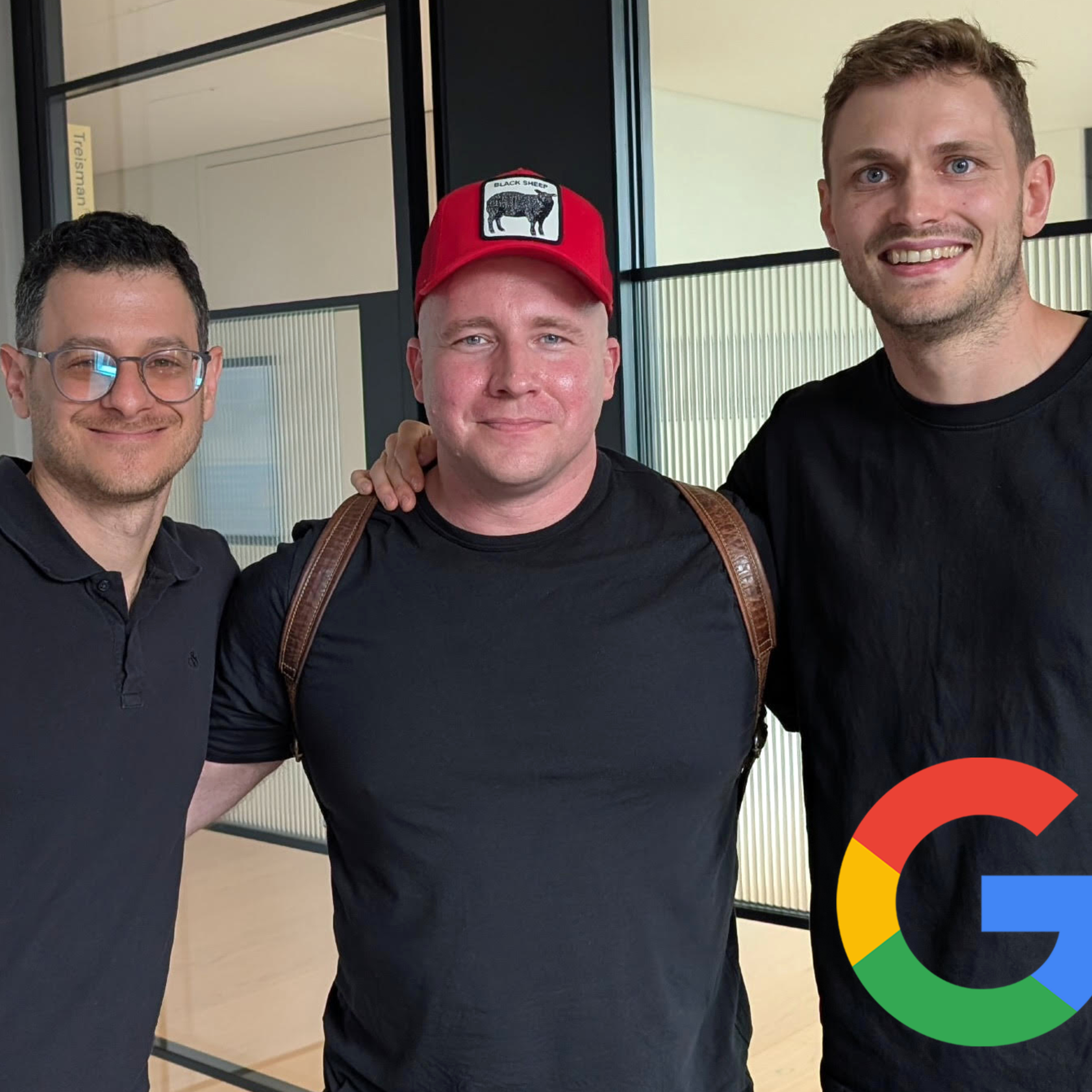
DeepMind Genie 3 [World Exclusive] (Jack Parker Holder, Shlomi Fruchter)
Aug 5, 202500:58:22Tap to summarizeThis episode features Shlomi Fuchter and Jack Parker Holder from Google DeepMind, who are unveiling a new AI called Genie 3. The host, Tim Scarfe, describes it as the most mind-blowing technology he has ever seen. We were invited to their offices to conduct the interview (not sponsored).Imagine you could create a video game world just by describing it. That's what Genie 3 does. It's an AI "world model" that learns how the real world works by watching massive amounts of video. Unlike a normal video game engine (like Unreal or the one for Doom) that needs to be programmed manually, Genie generates a realistic, interactive, 3D world from a simple text prompt.**SPONSOR MESSAGES***Prolific: Quality data. From real people. For faster breakthroughs.https://prolific.com/mlst?utm_campaign=98404559-MLST&utm_source=youtube&utm_medium=podcast&utm_content=script-gen***Here’s a breakdown of what makes it so revolutionary:From Text to a Virtual World: You can type "a drone flying by a beautiful lake" or "a ski slope," and Genie 3 creates that world for you in about three seconds. You can then navigate and interact with it in real-time.It's Consistent: The worlds it creates have a reliable memory. If you look away from an object and then look back, it will still be there, just as it was. The guests explain that this consistency isn't explicitly programmed in; it's a surprising, "emergent" capability of the powerful AI model.A Huge Leap Forward: The previous version, Genie 2, was a major step, but it wasn't fast enough for real-time interaction and was much lower resolution. Genie 3 is 720p, interactive, and photorealistic, running smoothly for several minutes at a time.The Killer App - Training Robots: Beyond entertainment, the team sees Genie 3 as a game-changer for training AI. Instead of training a self-driving car or a robot in the real world (which is slow and dangerous), you can create infinite simulations. You can even prompt rare events to happen, like a deer running across the road, to teach an AI how to handle unexpected situations safely.The Future of Entertainment: this could lead to a "YouTube version 2" or a new form of VR, where users can create and explore endless, interconnected worlds together, like the experience machine from philosophy.While the technology is still a research prototype and not yet available to the public, it represents a monumental step towards creating true artificial worlds from the ground up.Jack Parker Holder [Research Scientist at Google DeepMind in the Open-Endedness Team]https://jparkerholder.github.io/Shlomi Fruchter [Research Director, Google DeepMind]https://shlomifruchter.github.io/TOC:[00:00:00] - Introduction: "The Most Mind-Blowing Technology I've Ever Seen"[00:02:30] - The Evolution from Genie 1 to Genie 2[00:04:30] - Enter Genie 3: Photorealistic, Interactive Worlds from Text[00:07:00] - Promptable World Events & Training Self-Driving Cars[00:14:21] - Guest Introductions: Shlomi Fuchter & Jack Parker Holder[00:15:08] - Core Concepts: What is a "World Model"?[00:19:30] - The Challenge of Consistency in a Generated World[00:21:15] - Context: The Neural Network Doom Simulation[00:25:25] - How Do You Measure the Quality of a World Model?[00:28:09] - The Vision: Using Genie to Train Advanced Robots[00:32:21] - Open-Endedness: Human Skill and Prompting Creativity[00:38:15] - The Future: Is This the Next YouTube or VR?[00:42:18] - The Next Step: Multi-Agent Simulations[00:52:51] - Limitations: Thinking, Computation, and the Sim-to-Real Gap[00:58:07] - Conclusion & The Future of Game EnginesREFS:World Models [David Ha, Jürgen Schmidhuber]https://arxiv.org/abs/1803.10122POEThttps://arxiv.org/abs/1901.01753[Akarsh Kumar, Jeff Clune, Joel Lehman, Kenneth O. Stanley]The Fractured Entangled Representation Hypothesishttps://arxiv.org/pdf/2505.11581TRANSCRIPT:https://app.rescript.info/public/share/Zk5tZXk6mb06yYOFh6nSja7Lg6_qZkgkuXQ-kl5AJqM
Transcribe →
Large Language Models and Emergence: A Complex Systems Perspective (Prof. David C. Krakauer)
Jul 31, 202500:49:48Tap to summarizeProf. David Krakauer, President of the Santa Fe Institute argues that we are fundamentally confusing knowledge with intelligence, especially when it comes to AI.He defines true intelligence as the ability to do more with less—to solve novel problems with limited information. This is contrasted with current AI models, which he describes as doing less with more; they require astounding amounts of data to perform tasks that don't necessarily demonstrate true understanding or adaptation. He humorously calls this "really shit programming".David challenges the popular notion of "emergence" in Large Language Models (LLMs). He explains that the tech community's definition—seeing a sudden jump in a model's ability to perform a task like three-digit math—is superficial. True emergence, from a complex systems perspective, involves a fundamental change in the system's internal organization, allowing for a new, simpler, and more powerful level of description. He gives the example of moving from tracking individual water molecules to using the elegant laws of fluid dynamics. For LLMs to be truly emergent, we'd need to see them develop new, efficient internal representations, not just get better at memorizing patterns as they scale.Drawing on his background in evolutionary theory, David explains that systems like brains, and later, culture, evolved to process information that changes too quickly for genetic evolution to keep up. He calls culture "evolution at light speed" because it allows us to store our accumulated knowledge externally (in books, tools, etc.) and build upon it without corrupting the original.This leads to his concept of "exbodiment," where we outsource our cognitive load to the world through things like maps, abacuses, or even language itself. We create these external tools, internalize the skills they teach us, improve them, and create a feedback loop that enhances our collective intelligence.However, he ends with a warning. While technology has historically complemented our deficient abilities, modern AI presents a new danger. Because we have an evolutionary drive to conserve energy, we will inevitably outsource our thinking to AI if we can. He fears this is already leading to a "diminution and dilution" of human thought and creativity. Just as our muscles atrophy without use, he argues our brains will too, and we risk becoming mentally dependent on these systems.TOC:[00:00:00] Intelligence: Doing more with less[00:02:10] Why brains evolved: The limits of evolution[00:05:18] Culture as evolution at light speed[00:08:11] True meaning of emergence: "More is Different"[00:10:41] Why LLM capabilities are not true emergence[00:15:10] What real emergence would look like in AI[00:19:24] Symmetry breaking: Physics vs. Life[00:23:30] Two types of emergence: Knowledge In vs. Out[00:26:46] Causality, agency, and coarse-graining[00:32:24] "Exbodiment": Outsourcing thought to objects[00:35:05] Collective intelligence & the boundary of the mind[00:39:45] Mortal vs. Immortal forms of computation[00:42:13] The risk of AI: Atrophy of human thoughtDavid KrakauerPresident and William H. Miller Professor of Complex Systemshttps://www.santafe.edu/people/profile/david-krakauerREFS:Large Language Models and Emergence: A Complex Systems PerspectiveDavid C. Krakauer, John W. Krakauer, Melanie Mitchellhttps://arxiv.org/abs/2506.11135Filmed at the Diverse Intelligences Summer Institute:https://disi.org/
Transcribe →
Pushing compute to the limits of physics
Jul 21, 202501:23:32Tap to summarizeDr. Maxwell Ramstead grills Guillaume Verdon (AKA “Beff Jezos”) who's the founder of Thermodynamic computing startup Extropic.Guillaume shares his unique path – from dreaming about space travel as a kid to becoming a physicist, then working on quantum computing at Google, to developing a radically new form of computing hardware for machine learning. He explains how he hit roadblocks with traditional physics and computing, leading him to start his company – building "thermodynamic computers." These are based on a new design for super-efficient chips that use the natural chaos of electrons (think noise and heat) to power AI tasks, which promises to speed up AND lower the costs of modern probabilistic techniques like sampling. He is driven by the pursuit of building computers that work more like your brain, which (by the way) runs on a banana and a glass of water! Guillaume talks about his alter ego, Beff Jezos, and the "Effective Accelerationism" (e/acc) movement that he initiated. Its objective is to speed up tech progress in order to “grow civilization” (as measured by energy use and innovation), rather than “slowing down out of fear”. Guillaume argues we need to embrace variance, exploration, and optimism to avoid getting stuck or outpaced by competitors like China. He and Maxwell discuss big ideas like merging humans with AI, decentralizing intelligence, and why boundless growth (with smart constraints) is “key to humanity's future”.REFS:1. John Archibald Wheeler - "It From Bit" Concept00:04:45 - Foundational work proposing that physical reality emerges from information at the quantum levelLearn more: https://cqi.inf.usi.ch/qic/wheeler.pdf 2. AdS/CFT Correspondence (Holographic Principle)00:05:15 - Theoretical physics duality connecting quantum gravity in Anti-de Sitter space with conformal field theoryhttps://en.wikipedia.org/wiki/Holographic_principle 3. Renormalization Group Theory00:06:15 - Mathematical framework for analyzing physical systems across different length scales https://www.damtp.cam.ac.uk/user/dbs26/AQFT/Wilsonchap.pdf 4. Maxwell's Demon and Information Theory00:21:15 - Thought experiment linking information processing to thermodynamics and entropyhttps://plato.stanford.edu/entries/information-entropy/ 5. Landauer's Principle00:29:45 - Fundamental limit establishing minimum energy required for information erasure https://en.wikipedia.org/wiki/Landauer%27s_principle 6. Free Energy Principle and Active Inference01:03:00 - Mathematical framework for understanding self-organizing systems and perception-action loopshttps://www.nature.com/articles/nrn2787 7. Max Tegmark - Information Bottleneck Principle01:07:00 - Connections between information theory and renormalization in machine learninghttps://arxiv.org/abs/1907.07331 8. Fisher's Fundamental Theorem of Natural Selection01:11:45 - Mathematical relationship between genetic variance and evolutionary fitnesshttps://en.wikipedia.org/wiki/Fisher%27s_fundamental_theorem_of_natural_selection 9. Tensor Networks in Quantum Systems00:06:45 - Computational framework for simulating many-body quantum systems https://arxiv.org/abs/1912.10049 10. Quantum Neural Networks00:09:30 - Hybrid quantum-classical models for machine learning applicationshttps://en.wikipedia.org/wiki/Quantum_neural_network 11. Energy-Based Models (EBMs)00:40:00 - Probabilistic framework for unsupervised learning based on energy functionshttps://www.researchgate.net/publication/200744586_A_tutorial_on_energy-based_learning 12. Markov Chain Monte Carlo (MCMC)00:20:00 - Sampling algorithm fundamental to modern AI and statistical physics https://en.wikipedia.org/wiki/Markov_chain_Monte_Carlo 13. Metropolis-Hastings Algorithm00:23:00 - Core sampling method for probability distributionshttps://arxiv.org/abs/1504.01896 ***SPONSOR MESSAGE***Google Gemini 2.5 Flash is a state-of-the-art language model in the Gemini app. Sign up at https://gemini.google.com
Transcribe →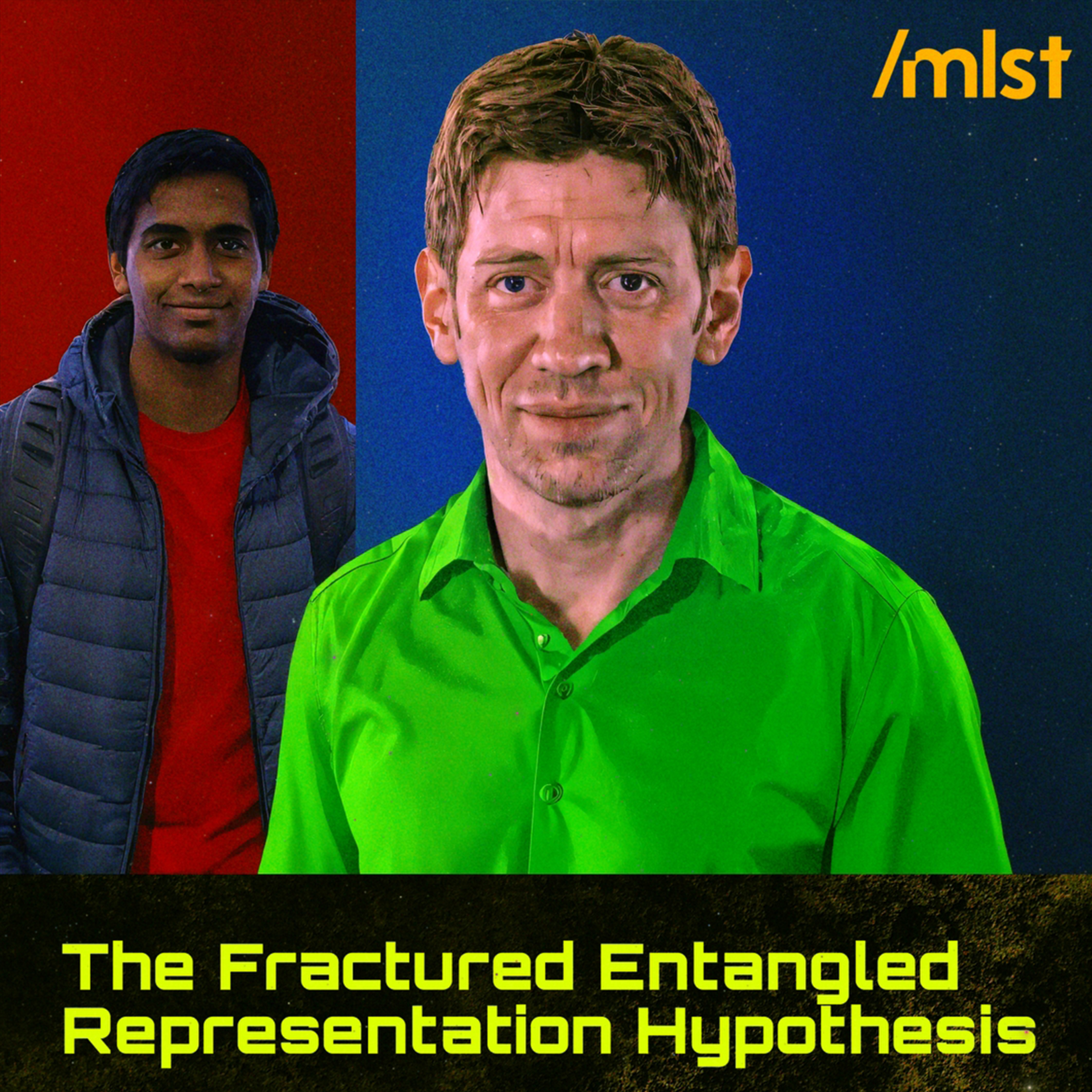
The Fractured Entangled Representation Hypothesis (Kenneth Stanley, Akarsh Kumar)
Jul 6, 202502:16:22Tap to summarizeAre the AI models you use today imposters?Please watch the intro video we did before this: https://www.youtube.com/watch?v=o1q6Hhz0MAgIn this episode, hosts Dr. Tim Scarfe and Dr. Duggar are joined by AI researcher Prof. Kenneth Stanley and MIT PhD student Akash Kumar to discuss their fascinating paper, "Questioning Representational Optimism in Deep Learning."Imagine you ask two people to draw a perfect skull. One is a brilliant artist who understands anatomy, the other is a machine that just traces the image. Both drawings look identical, but the artist understands what a skull is—they know where the mouth is, how the jaw works, and that it's symmetrical. The machine just has a tangled mess of lines that happens to form the right picture.An AI with an elegant representation, has the building blocks to generate truly new ideas.The Path Is the Goal: As Kenneth Stanley puts it, "it matters not just where you get, but how you got there". Two students can ace a math test, but the one who truly understands the concepts—instead of just memorizing formulas—is the one who will go on to make new discoveries.The show is a mixture of 3 separate recordings we have done, the original Patreon warmup with Tim/Kenneth, the Tim/Keith "Steakhouse" recorded after the main interview, then the main interview with Kenneth/Akarsh/Keith/Tim. Feel free to skip around. We had to edit this in a rush as we are travelling next week but it's reasonably cleaned up. TOC:00:00:00 Intro: Garbage vs. Amazing Representations00:05:42 How Good Representations Form00:11:14 Challenging the "Bitter Lesson"00:18:04 AI Creativity & Representation Types00:22:13 Steakhouse: Critiques & Alternatives00:28:30 Steakhouse: Key Concepts & Goldilocks Zone00:39:42 Steakhouse: A Sober View on AI Risk00:43:46 Steakhouse: The Paradox of Open-Ended Search00:47:58 Main Interview: Paper Intro & Core Concepts00:56:44 Main Interview: Deception and Evolvability01:36:30 Main Interview: Reinterpreting Evolution01:56:16 Main Interview: Impostor Intelligence02:11:15 Main Interview: Recommendations for AI ResearchREFS:Questioning Representational Optimism in Deep Learning:The Fractured Entangled Representation HypothesisAkarsh Kumar, Jeff Clune, Joel Lehman, Kenneth O. Stanleyhttps://arxiv.org/pdf/2505.11581Kenneth O. Stanley, Joel LehmanWhy Greatness Cannot Be Planned: The Myth of the Objectivehttps://amzn.to/44xLaXKOriginal show with Kenneth from 4 years ago:https://www.youtube.com/watch?v=lhYGXYeMq_EKenneth Stanley is SVP Open Endedness at Lila Scienceshttps://x.com/kenneth0stanleyAkarsh Kumar (MIT)https://akarshkumar.com/AND... Kenneth is HIRING (this is an OPPORTUNITY OF A LIFETIME!)Research Engineer: https://job-boards.greenhouse.io/lila/jobs/7890007002Research Scientist: https://job-boards.greenhouse.io/lila/jobs/8012245002TRANSCRIPT:https://app.rescript.info/public/share/W_T7E1OC2Wj49ccqlIOOztg2MJWaaVbovTeyxcFEQdU
Transcribe →
The Fractured Entangled Representation Hypothesis (Intro)
Jul 5, 202500:15:45Tap to summarizeWhat if today's incredible AI is just a brilliant "impostor"? This episode features host Dr. Tim Scarfe in conversation with guests Prof. Kenneth Stanley (ex-OpenAI), Dr. Keith Duggar (MIT), and Arkash Kumar (MIT).While AI today produces amazing results on the surface, its internal understanding is a complete mess, described as "total spaghetti" [00:00:49]. This is because it's trained with a brute-force method (SGD) that’s like building a sandcastle: it looks right from a distance, but has no real structure holding it together [00:01:45].To explain the difference, Keith Duggar shares a great analogy about his high school physics classes [00:03:18]. One class was about memorizing lots of formulas for specific situations (like the "impostor" AI). The other used calculus to derive the answers from a deeper understanding, which was much easier and more powerful. This is the core difference: one method memorizes, the other truly understands.The episode then introduces a different, more powerful way to build AI, based on Kenneth Stanley's old experiment, "Picbreeder" [00:04:45]. This method creates AI with a shockingly clean and intuitive internal model of the world. For example, it might develop a model of a skull where it understands the "mouth" as a separate component it can open and close, without ever being explicitly trained on that action [00:06:15]. This deep understanding emerges bottom-up, without massive datasets.The secret is to abandon a fixed goal and embrace "deception" [00:08:42]—the idea that the stepping stones to a great discovery often don't look anything like the final result. Instead of optimizing for a target, the AI is built through an open-ended process of exploring what's "interesting" [00:09:15]. This creates a more flexible and adaptable foundation, a bit like how evolvability wins out in nature [00:10:30].The show concludes by arguing that this choice matters immensely. The "impostor" path may be hitting a wall, requiring insane amounts of money and energy for progress and failing to deliver true creativity or continual learning [00:13:00]. The ultimate message is a call to not put all our eggs in one basket [00:14:25]. We should explore these open-ended, creative paths to discover a more genuine form of intelligence, which may be found where we least expect it.REFS:Questioning Representational Optimism in Deep Learning:The Fractured Entangled Representation HypothesisAkarsh Kumar, Jeff Clune, Joel Lehman, Kenneth O. Stanleyhttps://arxiv.org/pdf/2505.11581Kenneth O. Stanley, Joel LehmanWhy Greatness Cannot Be Planned: The Myth of the Objectivehttps://amzn.to/44xLaXKOriginal show with Kenneth from 4 years ago:https://www.youtube.com/watch?v=lhYGXYeMq_EKenneth Stanley is SVP Open Endedness at Lila Scienceshttps://x.com/kenneth0stanleyAkarsh Kumar (MIT)https://akarshkumar.com/AND... Kenneth is HIRING (this is an OPPORTUNITY OF A LIFETIME!)Research Engineer: https://job-boards.greenhouse.io/lila/jobs/7890007002Research Scientist: https://job-boards.greenhouse.io/lila/jobs/8012245002Tim's Code visualisation of FER based on Akarsh repo: https://github.com/ecsplendid/ferTRANSCRIPT: https://app.rescript.info/public/share/YKAZzZ6lwZkjTLRpVJreOOxGhLI8y4m3fAyU8NSavx0
Transcribe →
Three Red Lines We're About to Cross Toward AGI (Daniel Kokotajlo, Gary Marcus, Dan Hendrycks)
Jun 24, 202502:07:07Tap to summarizeWhat if the most powerful technology in human history is being built by people who openly admit they don't trust each other? In this explosive 2-hour debate, three AI experts pull back the curtain on the shocking psychology driving the race to Artificial General Intelligence—and why the people building it might be the biggest threat of all. Kokotajlo predicts AGI by 2028 based on compute scaling trends. Marcus argues we haven't solved basic cognitive problems from his 2001 research. The stakes? If Kokotajlo is right and Marcus is wrong about safety progress, humanity may have already lost control.Sponsor messages:========Google Gemini: Google Gemini features Veo3, a state-of-the-art AI video generation model in the Gemini app. Sign up at https://gemini.google.comTufa AI Labs are hiring for ML Engineers and a Chief Scientist in Zurich/SF. They are top of the ARCv2 leaderboard! https://tufalabs.ai/========Guest PowerhouseGary Marcus - Cognitive scientist, author of "Taming Silicon Valley," and AI's most prominent skeptic who's been warning about the same fundamental problems for 25 years (https://garymarcus.substack.com/)Daniel Kokotajlo - Former OpenAI insider turned whistleblower who reveals the disturbing rationalizations of AI lab leaders in his viral "AI 2027" scenario (https://ai-2027.com/)Dan Hendrycks - Director of the Center for AI Safety who created the benchmarks used to measure AI progress and argues we have only years, not decades, to prevent catastrophe (https://danhendrycks.com/)Transcript: http://app.rescript.info/public/share/tEcx4UkToi-2jwS1cN51CW70A4Eh6QulBRxDILoXOnoTOC:Introduction: The AI Arms Race00:00:04 - The Danger of Automated AI R&D00:00:43 - The Rationalization: "If we don't, someone else will"00:01:56 - Sponsor Reads (Tufa AI Labs & Google Gemini)00:02:55 - Guest IntroductionsThe Philosophical Stakes00:04:13 - What is the Positive Vision for AGI?00:07:00 - The Abundance Scenario: Superintelligent Economy00:09:06 - Differentiating AGI and Superintelligence (ASI)00:11:41 - Sam Altman: "A Decade in a Month"00:14:47 - Economic Inequality & The UBI ProblemPolicy and Red Lines00:17:13 - The Pause Letter: Stopping vs. Delaying AI00:20:03 - Defining Three Concrete Red Lines for AI Development00:25:24 - Racing Towards Red Lines & The Myth of "Durable Advantage"00:31:15 - Transparency and Public Perception00:35:16 - The Rationalization Cascade: Why AI Labs Race to "Win"Forecasting AGI: Timelines and Methodologies00:42:29 - The Case for Short Timelines (Median 2028)00:47:00 - Scaling Limits: Compute, Data, and Money00:49:36 - Forecasting Models: Bio-Anchors and Agentic Coding00:53:15 - The 10^45 FLOP Thought ExperimentThe Great Debate: Cognitive Gaps vs. Scaling00:58:41 - Gary Marcus's Counterpoint: The Unsolved Problems of Cognition01:00:46 - Current AI Can't Play Chess Reliably01:08:23 - Can Tools and Neurosymbolic AI Fill the Gaps?01:16:13 - The Multi-Dimensional Nature of Intelligence01:24:26 - The Benchmark Debate: Data Contamination and Reliability01:31:15 - The Superhuman Coder Milestone Debate01:37:45 - The Driverless Car AnalogyThe Alignment Problem01:39:45 - Has Any Progress Been Made on Alignment?01:42:43 - "Fairly Reasonably Scares the Sh*t Out of Me"01:46:30 - Distinguishing Model vs. Process AlignmentScenarios and Conclusions01:49:26 - Gary's Alternative Scenario: The Neurosymbolic Shift01:53:35 - Will AI Become Jeff Dean?01:58:41 - Takeoff Speeds and Exceeding Human Intelligence02:03:19 - Final Disagreements and Closing RemarksREFS:Gary Marcus (2001) - The Algebraic Mind https://mitpress.mit.edu/9780262632683/the-algebraic-mind/ 00:59:00Gary Marcus & Ernest Davis (2019) - Rebooting AI https://www.penguinrandomhouse.com/books/566677/rebooting-ai-by-gary-marcus-and-ernest-davis/ 01:31:59Gary Marcus (2024) - Taming SV https://www.hachettebookgroup.com/titles/gary-marcus/taming-silicon-valley/9781541704091/ 00:03:01
Transcribe →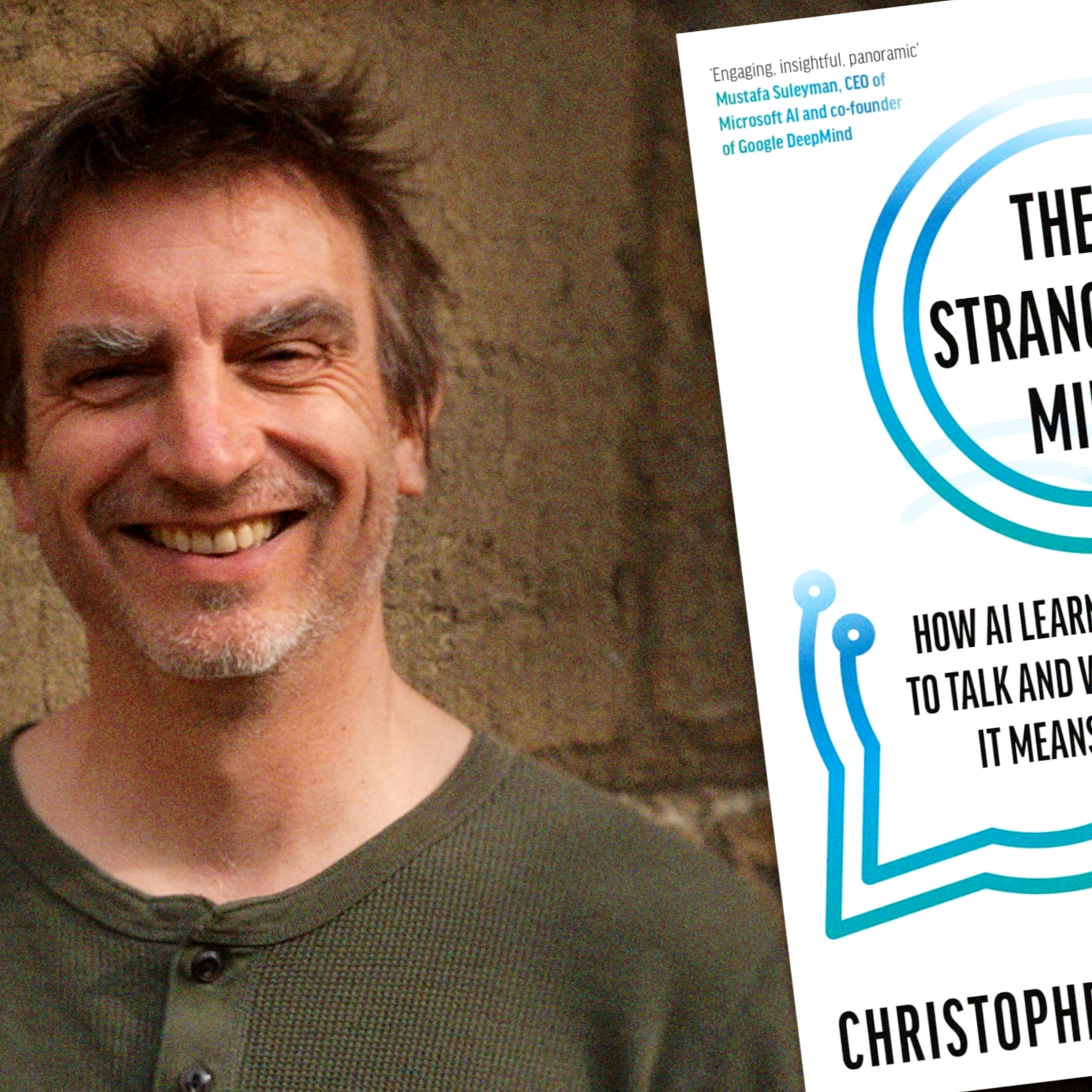
How AI Learned to Talk and What It Means - Prof. Christopher Summerfield
Jun 17, 202501:08:28Tap to summarizeWe interview Professor Christopher Summerfield from Oxford University about his new book "These Strange New Minds: How AI Learned to Talk and What It". AI learned to understand the world just by reading text - something scientists thought was impossible. You don't need to see a cat to know what one is; you can learn everything from words alone. This is "the most astonishing scientific discovery of the 21st century."People are split: some refuse to call what AI does "thinking" even when it outperforms humans, while others believe if it acts intelligent, it is intelligent. Summerfield takes the middle ground - AI does something genuinely like human reasoning, but that doesn't make it human.Sponsor messages:========Google Gemini: Google Gemini features Veo3, a state-of-the-art AI video generation model in the Gemini app. Sign up at https://gemini.google.comTufa AI Labs are hiring for ML Engineers and a Chief Scientist in Zurich/SF. They are top of the ARCv2 leaderboard! https://tufalabs.ai/========Prof. Christopher Summerfieldhttps://www.psy.ox.ac.uk/people/christopher-summerfieldThese Strange New Minds: How AI Learned to Talk and What It Meanshttps://amzn.to/4e26BVaTable of Contents:Introduction & Setup00:00:00 Superman 3 Metaphor - Humans Absorbed by Machines00:02:01 Book Introduction & AI Debate Context00:03:45 Sponsor Segments (Google Gemini, Tufa Labs)Philosophical Foundations00:04:48 The Fractured AI Discourse00:08:21 Ancient Roots: Aristotle vs Plato (Empiricism vs Rationalism)00:10:14 Historical AI: Symbolic Logic and Its LimitsThe Language Revolution00:12:11 ChatGPT as the Rubicon Moment00:14:00 The Astonishing Discovery: Learning Reality from Words Alone00:15:47 Equivalentists vs Exceptionalists DebateCognitive Science Perspectives00:19:12 Functionalism and the Duck Test00:21:48 Brain-AI Similarities and Computational Principles00:24:53 Reconciling Chomsky: Evolution vs Learning00:28:15 Lamarckian AI vs Darwinian Human LearningThe Reality of AI Capabilities00:30:29 Anthropomorphism and the Clever Hans Effect00:32:56 The Intentional Stance and Nature of Thinking00:37:56 Three Major AI Worries: Agency, Personalization, DynamicsSocietal Risks and Complex Systems00:37:56 AI Agents and Flash Crash Scenarios00:42:50 Removing Frictions: The Lawfare Example00:46:15 Gradual Disempowerment Theory00:49:18 The Faustian Pact of TechnologyHuman Agency and Control00:51:18 The Crisis of Authenticity00:56:22 Psychology of Control vs Reward01:00:21 Dopamine Hacking and Variable ReinforcementFuture Directions01:02:27 Evolution as Goal-less Optimization01:03:31 Open-Endedness and Creative Evolution01:06:46 Writing, Creativity, and AI-Generated Content01:08:18 Closing RemarksREFS:Academic References (Abbreviated)Essential Books"These Strange New Minds" - C. Summerfield [00:02:01] - Main discussion topic"The Mind is Flat" - N. Chater [00:33:45] - Summerfield's favorite on cognitive illusions"AI: A Guide for Thinking Humans" - M. Mitchell [00:04:58] - Host's previous favorite"Principia Mathematica" - Russell & Whitehead [00:11:00] - Logic Theorist reference"Syntactic Structures" - N. Chomsky (1957) [00:13:30] - Generative grammar foundation"Why Greatness Cannot Be Planned" - Stanley & Lehman [01:04:00] - Open-ended evolutionKey Papers & Studies"Gradual Disempowerment" - D. Duvenaud [00:46:45] - AI threat model"Counterfeit People" - D. Dennett (Atlantic) [00:52:45] - AI societal risks"Open-Endedness is Essential..." - DeepMind/Rocktäschel/Hughes [01:03:42]Heider & Simmel (1944) [00:30:45] - Agency attribution to shapesWhitehall Studies - M. Marmot [00:59:32] - Control and health outcomes"Clever Hans" - O. Pfungst (1911) [00:31:47] - Animal intelligence illusionHistorical References<trunc, see https://youtu.be/35r0iSajXjA>
Transcribe →
"Blurring Reality" - Chai's Social AI Platform (SPONSORED)
May 26, 202500:50:59Tap to summarize"Blurring Reality" - Chai's Social AI Platform - sponsoredThis episode of MLST explores the groundbreaking work of Chai, a social AI platform that quietly built one of the world's largest AI companion ecosystems before ChatGPT's mainstream adoption. With over 10 million active users and just 13 engineers serving 2 trillion tokens per day, Chai discovered the massive appetite for AI companionship through serendipity while searching for product-market fit.CHAI sponsored this show *because they want to hire amazing engineers* -- CAREER OPPORTUNITIES AT CHAIChai is actively hiring in Palo Alto with competitive compensation ($300K-$800K+ equity) for roles including AI Infrastructure Engineers, Software Engineers, Applied AI Researchers, and more. Fast-track qualification available for candidates with significant product launches, open source contributions, or entrepreneurial success.https://www.chai-research.com/jobs/The conversation with founder William Beauchamp and engineers Tom Lu and Nischay Dhankhar covers Chai's innovative technical approaches including reinforcement learning from human feedback (RLHF), model blending techniques that combine smaller models to outperform larger ones, and their unique infrastructure challenges running exaflop-class compute.SPONSOR MESSAGES:***Tufa AI Labs is a brand new research lab in Zurich started by Benjamin Crouzier focussed on o-series style reasoning and AGI. They are hiring a Chief Engineer and ML engineers in Zurich and SF. Goto https://tufalabs.ai/***Key themes explored include:- The ethics of AI engagement optimization and attention hacking- Content moderation at scale with a lean engineering team- The shift from AI as utility tool to AI as social companion- How users form deep emotional bonds with artificial intelligence- The broader implications of AI becoming a social mediumWe also examine OpenAI's recent pivot toward companion AI with April's new GPT-4o, suggesting a fundamental shift in how we interact with artificial intelligence - from utility-focused tools to companion-like experiences that blur the lines between human and artificial intimacy.The episode also covers Chai's unconventional approach to hiring only top-tier engineers, their bootstrap funding strategy focused on user revenue over VC funding, and their rapid experimentation culture where one in five experiments succeed.TOC:00:00:00 - Introduction: Steve Jobs' AI Vision & Chai's Scale00:04:02 - Chapter 1: Simulators - The Birth of Social AI00:13:34 - Chapter 2: Engineering at Chai - RLHF & Model Blending00:21:49 - Chapter 3: Social Impact of GenAI - Ethics & Safety00:33:55 - Chapter 4: The Lean Machine - 13 Engineers, Millions of Users00:42:38 - Chapter 5: GPT-4o Becoming a Companion - OpenAI's Pivot00:50:10 - Chapter 6: What Comes Next - The Future of AI Intimacy TRANSCRIPT: https://www.dropbox.com/scl/fi/yz2ewkzmwz9rbbturfbap/CHAI.pdf?rlkey=uuyk2nfhjzezucwdgntg5ubqb&dl=0
Transcribe →
Google AlphaEvolve - Discovering new science (exclusive interview)
May 14, 202501:13:58Tap to summarizeToday GoogleDeepMind released AlphaEvolve: a Gemini coding agent for algorithm discovery. It beat the famous Strassen algorithm for matrix multiplication set 56 years ago. Google has been killing it recently. We had early access to the paper and interviewed the researchers behind the work.AlphaEvolve: A Gemini-powered coding agent for designing advanced algorithmshttps://deepmind.google/discover/blog/alphaevolve-a-gemini-powered-coding-agent-for-designing-advanced-algorithms/Authors: Alexander Novikov*, Ngân Vũ*, Marvin Eisenberger*, Emilien Dupont*, Po-Sen Huang*, Adam Zsolt Wagner*, Sergey Shirobokov*, Borislav Kozlovskii*, Francisco J. R. Ruiz, Abbas Mehrabian, M. Pawan Kumar, Abigail See, Swarat Chaudhuri, George Holland, Alex Davies, Sebastian Nowozin, Pushmeet Kohli, Matej Balog*(* indicates equal contribution or special designation, if defined elsewhere)SPONSOR MESSAGES:***Tufa AI Labs is a brand new research lab in Zurich started by Benjamin Crouzier focussed on o-series style reasoning and AGI. They are hiring a Chief Engineer and ML engineers. Events in Zurich. Goto https://tufalabs.ai/***AlphaEvolve works like a very smart, tireless programmer. It uses powerful AI language models (like Gemini) to generate ideas for computer code. Then, it uses an "evolutionary" process – like survival of the fittest for programs. It tries out many different program ideas, automatically tests how well they solve a problem, and then uses the best ones to inspire new, even better programs.Beyond this mathematical breakthrough, AlphaEvolve has already been used to improve real-world systems at Google, such as making their massive data centers run more efficiently and even speeding up the training of the AI models that power AlphaEvolve itself. The discussion also covers how humans work with AlphaEvolve, the challenges of making AI discover things, and the exciting future of AI helping scientists make new discoveries.In short, AlphaEvolve is a powerful new AI tool that can invent new algorithms and solve complex problems, showing how AI can be a creative partner in science and engineering.Guests:Matej Balog: https://x.com/matejbalogAlexander Novikov: https://x.com/SashaVNovikovREFS:MAP Elites [Jean-Baptiste Mouret, Jeff Clune]https://arxiv.org/abs/1504.04909FunSearch [Bernardino Romera-Paredes, Mohammadamin Barekatain, Alexander Novikov, Matej Balog, M. Pawan Kumar, Emilien Dupont, Francisco J. R. Ruiz, Jordan S. Ellenberg, Pengming Wang, Omar Fawzi, Pushmeet Kohli & Alhussein Fawzi]https://www.nature.com/articles/s41586-023-06924-6TOC:[00:00:00] Introduction: Alpha Evolve's Breakthroughs, DeepMind's Lineage, and Real-World Impact[00:12:06] Introducing AlphaEvolve: Concept, Evolutionary Algorithms, and Architecture[00:16:56] Search Challenges: The Halting Problem and Enabling Creative Leaps[00:23:20] Knowledge Augmentation: Self-Generated Data, Meta-Prompting, and Library Learning[00:29:08] Matrix Multiplication Breakthrough: From Strassen to AlphaEvolve's 48 Multiplications[00:39:11] Problem Representation: Direct Solutions, Constructors, and Search Algorithms[00:46:06] Developer Reflections: Surprising Outcomes and Superiority over Simple LLM Sampling[00:51:42] Algorithmic Improvement: Hill Climbing, Program Synthesis, and Intelligibility[01:00:24] Real-World Application: Complex Evaluations and Robotics[01:05:39] Role of LLMs & Future: Advanced Models, Recursive Self-Improvement, and Human-AI Collaboration[01:11:22] Resource Considerations: Compute Costs of AlphaEvolveThis is a trial of posting videos on Spotify, thoughts? Email me or chat in our Discord
Transcribe →
Prof. Randall Balestriero - LLMs without pretraining and SSL
Apr 23, 202500:34:30Tap to summarizeRandall Balestriero joins the show to discuss some counterintuitive findings in AI. He shares research showing that huge language models, even when started from scratch (randomly initialized) without massive pre-training, can learn specific tasks like sentiment analysis surprisingly well, train stably, and avoid severe overfitting, sometimes matching the performance of costly pre-trained models. This raises questions about when giant pre-training efforts are truly worth it.He also talks about how self-supervised learning (where models learn from data structure itself) and traditional supervised learning (using labeled data) are fundamentally similar, allowing researchers to apply decades of supervised learning theory to improve newer self-supervised methods.Finally, Randall touches on fairness in AI models used for Earth data (like climate prediction), revealing that these models can be biased, performing poorly in specific locations like islands or coastlines even if they seem accurate overall, which has important implications for policy decisions based on this data.SPONSOR MESSAGES:***Tufa AI Labs is a brand new research lab in Zurich started by Benjamin Crouzier focussed on o-series style reasoning and AGI. They are hiring a Chief Engineer and ML engineers. Events in Zurich. Goto https://tufalabs.ai/***TRANSCRIPT + SHOWNOTES:https://www.dropbox.com/scl/fi/n7yev71nsjso71jyjz1fy/RANDALLNEURIPS.pdf?rlkey=0dn4injp1sc4ts8njwf3wfmxv&dl=0TOC:1. Model Training Efficiency and Scale [00:00:00] 1.1 Training Stability of Large Models on Small Datasets [00:04:09] 1.2 Pre-training vs Random Initialization Performance Comparison [00:07:58] 1.3 Task-Specific Models vs General LLMs Efficiency2. Learning Paradigms and Data Distribution [00:10:35] 2.1 Fair Language Model Paradox and Token Frequency Issues [00:12:02] 2.2 Pre-training vs Single-task Learning Spectrum [00:16:04] 2.3 Theoretical Equivalence of Supervised and Self-supervised Learning [00:19:40] 2.4 Self-Supervised Learning and Supervised Learning Relationships [00:21:25] 2.5 SSL Objectives and Heavy-tailed Data Distribution Challenges3. Geographic Representation in ML Systems [00:25:20] 3.1 Geographic Bias in Earth Data Models and Neural Representations [00:28:10] 3.2 Mathematical Limitations and Model Improvements [00:30:24] 3.3 Data Quality and Geographic Bias in ML DatasetsREFS:[00:01:40] Research on training large language models from scratch on small datasets, Randall Balestriero et al.https://openreview.net/forum?id=wYGBWOjq1Q[00:10:35] The Fair Language Model Paradox (2024), Andrea Pinto, Tomer Galanti, Randall Balestrierohttps://arxiv.org/abs/2410.11985[00:12:20] Muppet: Massive Multi-task Representations with Pre-Finetuning (2021), Armen Aghajanyan et al.https://arxiv.org/abs/2101.11038[00:14:30] Dissociating language and thought in large language models (2023), Kyle Mahowald et al.https://arxiv.org/abs/2301.06627[00:16:05] The Birth of Self-Supervised Learning: A Supervised Theory, Randall Balestriero et al.https://openreview.net/forum?id=NhYAjAAdQT[00:21:25] VICReg: Variance-Invariance-Covariance Regularization for Self-Supervised Learning, Adrien Bardes, Jean Ponce, Yann LeCunhttps://arxiv.org/abs/2105.04906[00:25:20] No Location Left Behind: Measuring and Improving the Fairness of Implicit Representations for Earth Data (2025), Daniel Cai, Randall Balestriero, et al.https://arxiv.org/abs/2502.06831[00:33:45] Mark Ibrahim et al.'s work on geographic bias in computer vision datasets, Mark Ibrahimhttps://arxiv.org/pdf/2304.12210
Transcribe →