← Makes Sense - with Dr. JC Doornick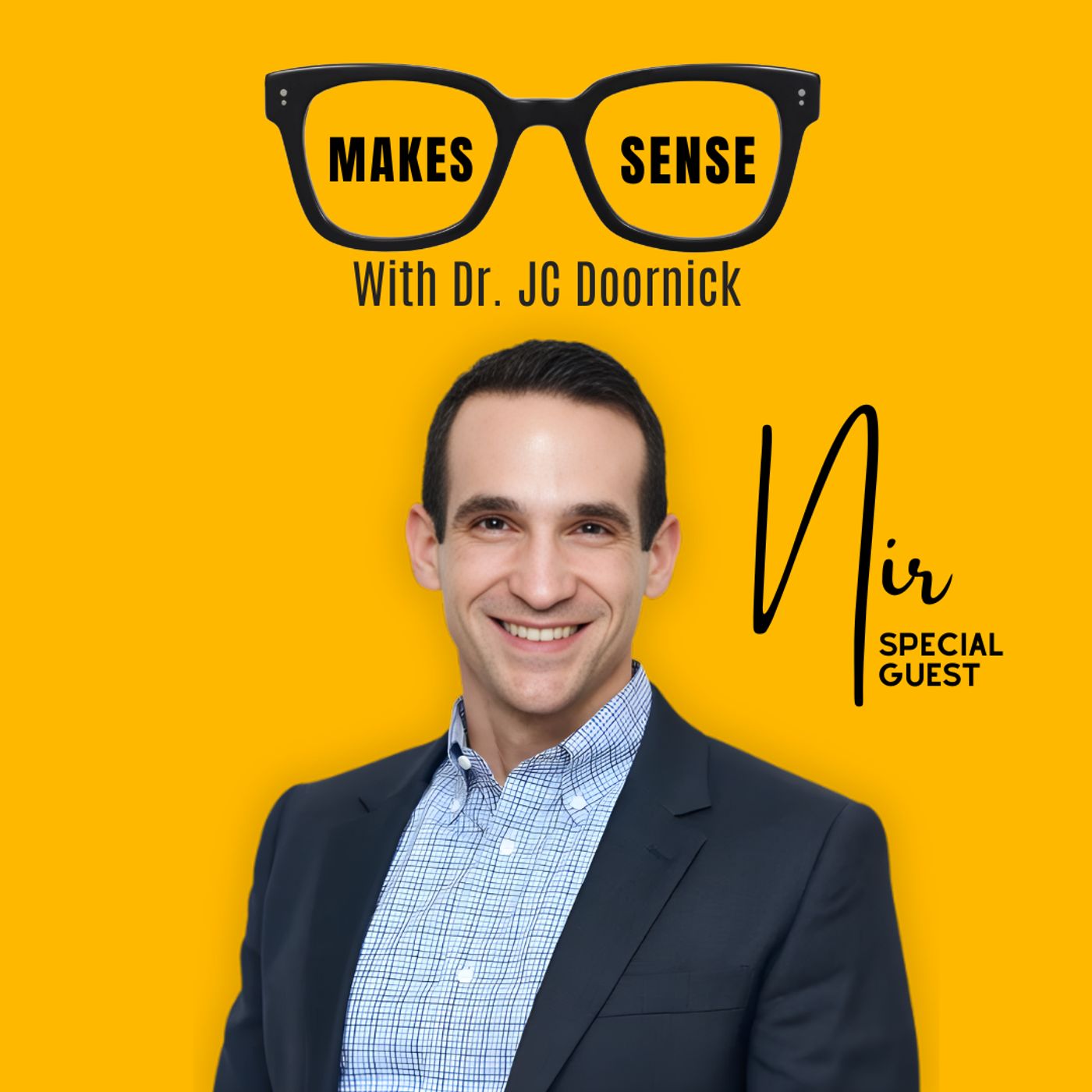
Makes Sense - with Dr. JC Doornick
How to Rewrite the Beliefs Trapping You with Nir Eyal - E159
00:53:28
What if your limits aren’t facts—but predictions your brain keeps repeating? Nir Eyal joins Dr. JC Doornick to break down how to challenge your beliefs, think more freely, and redesign your reality from the inside out.
Loading summary
Transcript85 lines
- [00:00]
Liberty Mutual Announcer
Liberty Mutual customizes your car and home insurance and now we're customizing this rush hour ad to keep you calm, which could help your driving. And science says therapy is great for a healthy mindset. So enjoy this 14 second session on us. I think you've done everything right and absolutely nothing wrong. In fact, anything that hasn't gone your way could probably be blamed on your father not being emotionally available because his father wasn't emotionally available and so on. And now that you're calm and healing, you're probably driving better too.
- [00:27]
Nir Eyal
Liberty, Liberty, Liberty Liberty.
- [00:31]
University Advertiser
At Strayer University, we help students like you Go from Will I To why not? For over 130 years, we've been innovating higher education to make it more affordable, accessible and attainable so you can reach your goals. Go from thinking can I? To Yes I can and keep striving. Visit strayer.edu to learn more. Strayer University is certified to operate in Virginia by Chevinus many campuses, including at 2121 15th Street north in Arlington, Virginia.
- [01:00]
Nir Eyal
If you work in university maintenance, Grainger considers you an MVP because your playbook ensures your arena is always ready for tip off. And Grainger is your trusted partner, offering the products you need all in one
- [01:13]
Dr. JC
place, from H Vac and plumbing supplies
- [01:15]
Nir Eyal
to lighting and more.
- [01:17]
Dr. JC
And all delivered with plenty of time
- [01:19]
Liberty Mutual Announcer
left on the clock so your team
- [01:21]
Nir Eyal
always gets the win. Call 1-800-GRAINGER visit grainger.com or just stop by Granger for the ones who get it done. Why do people fail at their goals? Whether it's getting in shape, whether it's writing that book, whether it's starting that business, whether it's repairing that relationship, whatever it is, why do people not achieve their goals? It's pretty simple. The number one reason is that we quit. Persistence doesn't guarantee success, but quitting guarantees failure.
- [01:47]
Dr. JC
Have you noticed that the world that we live in has been doing most of the thinking for you? That your beliefs, perceptions, reactions, fears and doubts have been shaped by unsolicited outside noise? How easy it's been for you to slip into that default sleep walking mode and label it as life and reality? Yeah, that ends here. Welcome to the make sense with Dr. JC podcast. This is your opportunity to start thinking for yourself, reclaim control, and step back into that role as the shock caller and dominant force of your own reality. It's when you change the way that you look at things that the things that you look at begin to change. So let's wake up, let's rise up, and let's make sense of why and how shift happens.
- [02:36]
Nir Eyal
Makes sense.
- [02:39]
Dr. JC
What I want to do first, I want to do something that nobody else has done with Near Il on any of their podcasts. I want to tell you what I like about you. And the reason why I'm going to do that is because, a, I want. I want you to know, but I also want my listeners to know. I don't have people on my show. Here's a little secret that I don't like. So if you would allow me, I just want to take a moment and just tell you what I like about you.
- [03:04]
Nir Eyal
I'm not going to say no to that.
- [03:07]
Dr. JC
And if you said no, I would say, well, then I don't like you anymore. So Near Iel here is what I like about you. What I like about you is that you don't just help people change their behavior. What I find that you do is you help them understand what's driving it underneath it, which is different, which is really cool. And you've shown us in the past we've got all these wonderful pieces of work from near IO. You showed us in the past how habits are formed. One of my favorites is you showed us how distraction works. God, I've pulled so much stuff from that book. But now it seems that you're going into something a little bit deeper, which is exciting. And it seems that we're going to now talk about the beliefs that are running the system. And that is very exciting. And what's cool about that is that once people see that, once people become aware, I like to say books like Beyond Belief arm people with the weapon of awareness. So once people see that, they don't just change what they do, which is very, very difficult for a lot of people, they start questioning what they've been assuming is true. And besides that, you're from Singapore, which I think is really cool, and you're a cool guy. That's another reason why I like you. So welcome for the second time. But on the first time on the make sense with Dr. JC podcast, the Amazing Near Il.
- [04:33]
Nir Eyal
Appreciate it. Thank you so much. It's great to be here.
- [04:36]
Dr. JC
Yeah, it is. I mean, you got a lot going on right now, and this is kind of a catchup of sorts. But what's it like to be Near Il these days?
- [04:46]
University Advertiser
It's pretty good.
- [04:46]
Nir Eyal
I, you know, I think I was. I was reflecting on why does this book launch feel so much better than my other book launches? You know, this is my third book, and it's the first time I've made the New York Times bestseller list. And we did more than ever for this book, you know, in terms of getting into the right hands and doing interviews and writing op eds and like all the stuff that goes into a big book launch. And it worked. We hit the New York Times list, but it was so much more chill. Like it was just. And it was freakish in a way. Like it was, it was. I wasn't stressed this time. Everything just kind of flowed easily. The reviews have been amazing. It's been really a pleasant process to the point where during the launch week, during the times when, you know, for previous books, I was running around like crazy. I was just kind of just enjoying it, just taking it all in. And I think the reason is, is that I've changed so much in the six years that it took me to write this book. I'm a completely different person. That, that I think is the, the biggest benefit of doing this line of research around beliefs is that, you know, I wrote it for me. I mean, I'm super glad that you enjoyed the book and that it's it that the reviews are outstanding, but really I, I wrote it for me and, and I have become so much happier because of it. I don't suffer from things like I used to like. Stuff doesn't bother me the way it did. I didn't, frankly, I didn't like who I was back then because everything was like annoying, you know, like I would get annoyed by all kinds of stupid stuff. And now that doesn't happen because I've learned how to manage my mind in a way that doesn't produce suffering. I still feel pain. And I think this is what one of the revelations that I learned writing this book is that that biologically and psychologically pain is not suffering. Those are two separate things. Pain is not suffering. And once you learn to disconnect those two, you can see the things that used to cause you annoyance and suffering as just signal, as just information. And I kind of took that to be kind of woo woo nonsense. But I'm not woo woo at all. I'm the opposite of woo woo. Like, I want to see the studies. And there's 30 pages of peer reviewed studies, citations to peer reviewed studies in the back of the book. And so now to have that scientific validation that this is possible, this is something that actually any of us can do, not just for psychological suffering. You know, I was giving a webinar on my book to my readers a few days ago and one of the questions was near, you seem so much happier. And it's true. Like I really am. But it's also that I think I feel less discomfort. You know, there's parts of the book where I talk about how people can cure chronic pain through the power of their beliefs. How I document a guy by the name of Daniel Gisler who goes under surgery. He gets surgery. He's under the scalpel for 55 minutes. He has metal screws yanked from bone. And he does this entire surgery without any sort of anesthesia. He's completely awake. And he does this through the power of the mind. And it turns out that I didn't believe it, but it turns out I've watched the video myself. It's real. And tens of thousands of people also have done this as well. It's not through magic. It's not through any kind of supernatural powers. It's just all about this skill that actually we all have to refocus our attention. Using the power of beliefs to change what we see, what we feel, and ultimately what we do.
- [07:55]
Dr. JC
So much in there. I've just lived a very interesting life and I owe a lot of it to my parents. I mean, God, I've done work with plant medicine and so there's very few things that I say. There's no way. So when I hear you say that, I'm one of those rare people that says it makes sense. But I've watched other interviews that you've done and when you, when you tell that story in the beginning and they're like, what do you mean surgery? No, I took in surgery. I'm not talking about like just like a cavity in the teeth.
- [08:26]
Nir Eyal
No, no, full on surgery. I mean, there's. I'll show you pictures. I've seen the whole video. You don't want to see the video. It's disgusting. But the, the. He really does go under this entire surgery procedure 100% without anesthesia. Now. I wouldn't do it, at least not yet. I'm not. I'm not ready for that. But just the fact that somebody can do that.
- [08:46]
Dr. JC
Yeah.
- [08:46]
Nir Eyal
And in fact, tens of thousands of people have done it. It's not that uncommon. In Switzerland and France and Italy, people do this procedure quite a bit because it turns out that healing times are much, much faster when you don't have anesthesia. That you can leave the hospital quite quickly because it's just becomes an outpatient type of thing. And without the sedation, it's a much simpler procedure and healing times are much faster. And so I don't say this to like advocate for hypnosudation it doesn't really matter. What matters is that we understand.
- [09:12]
Dr. JC
Yeah.
- [09:13]
Nir Eyal
That we have these hidden powers that we don't even realize. So when I'm complaining about, oh, this is hard, I don't want to do this. I don't feel like going to exercise today. I don't feel like writing today. I don't feel like, you know, giving this the, the patience they deserve. They annoy me. I. I think back to, wait a minute. This is just pain. This is just information. It's just data. It doesn't have to be suffering. And that increases my motivation to actually do the things that I know I should do.
- [09:40]
Dr. JC
Yeah. You know, you might find me because I've. I've just read your book. And what I do, by the way, is this is my new thing because, you know, Jim Quick is a great friend of mine, so I'm always trying to max. I read about two books a week now. When I read your book, I listened to the Audible at the same time. So I can kind of like read the book while I'm listening to you and I can make you go faster and all that stuff.
- [10:03]
Nir Eyal
So you're sitting there with the text as you're.
- [10:05]
Dr. JC
Yeah, yeah. So I'm. I have your book and I'm. I'm reading it while I'm listening to it, and I just find that it's more enjoyable. It's kind of like near Iel's reading me the book. But. But I, But I like to read the book. But, you know, a couple of things with regards to how you're feeling these days. You know, it. It seems that if you look back at the books that you've written, you were working through some powerful things. I mean, you changed so many lives with that. And you, you yourself wrote those books for you as well. But it's like this book is kind of like a coming of age. It's like it almost seems like you're free now because you realize, like, what was behind it all. And I think that's what people love about it. So, me personally, I'm really excited for many, many reasons. And I was telling you this in the. The green room, just selfish reasons. My life, I'm sitting in this place right now where this is very relevant because my life is accelerating and in a very, very positive way, you know, which is an interesting thing as well. Careful what you ask where you just might get it right. So I'm happy to hear that you're enjoying the ride right now, but it's not because I'm Believing thoughts more. Right. It's. It's actually because I'm starting to question my thoughts more, and that's why I wear this hat. I didn't even know that I was identifying with my thoughts and feelings for so, so long. I didn't even know it was an option to question them. But it made me wonder. And that's kind of like one of my first questions for you is, do we actually need to believe in ourselves in order to take action?
- [11:40]
Nir Eyal
Well, I think to sustain motivation, that's. That's what's important here. And so why is that even important? You know, all the things we could talk about, all the things we could do with our time and attention. Why do I think beliefs are so important? Well, what's the number one cause of failure? Why? Why do people fail their goals? Whether it's getting in shape, whether it's writing that book, whether it's starting that business, whether it's repairing that relationship, whatever it is. Why do people not achieve their goals? It's pretty simple. The number one reason is that we quit. That persistence doesn't guarantee success, but quitting guarantees failure. So the number one reason that we don't achieve our goals is quitting. Okay, well, let's go to the next logical question. How do we make sure we don't quit? Well, obviously, we stay motivated. Well, how do we stay motivated? So the answer to that, I think, is revealed with one of my favorite studies. It's how I actually opened the book with Kurt Richter's 1950 rat study. And if you're not familiar with the study, the study goes like this. So here's what he did. Kurt Richter was a biologist, and he had a very simple question. How long could a wild rat swim in water? Pretty simple question. So he took a wild rat, he put it in a cylinder of water, and he stood there with a stopwatch and timed how long the rat could swim at about 15 minutes. He observed that the rat didn't seem to be exhausted. It just kind of gave up at 15 minutes, and when it gave up, stopped swimming and it drowned. Now you can't do these kind of studies anymore. It's pretty unethical, kind of gross. But the study's done. The rats are dead. We should learn from them. So then he did another experiment. He wanted to figure out could he extend the amount of time that these rats were swimming. So here's what he did in the second experiment. Knowing the 15 minute mark, he took a new group of rats, dropped them in the cylinder of water, stood there With a stopwatch. And at about 15 minutes, knowing that the rats were going to start struggling, he reached in, pulled out the rat, dried it off, let it catch its breath, and then plunk, back into the water it went. And so now the question was, how much longer could that intervention increase the amount of time that the rat swam for? So some people guess, well, they started with 15 minutes, maybe they doubled, that would be amazing. Double their persistence, maybe triple. Some people go as far as to say an hour. Wouldn't that be amazing if there was some kind of intervention where you could get someone to be four times more persistent to run four marathons instead of one, to do four times the sales leads that you have to call to do, to have four times the patience with someone who's annoying you, that'd be amazing if you were four time more persistent and therefore you would be much more likely to accomplish your goals. But the rats didn't swim for 60 minutes. The rats swam for 60 hours. Wow, 60 hours, they became 240 times more persistent. And so if we know that persistence is the most important trait to achieve your long term goals, how do we get some of that right? What can we learn from these rats? Well, what changed their physical condition didn't change. Same rat bodies, they didn't become super rats all of a sudden. Nothing changed in their bodies, nothing changed in their environment. Same cylinders of water. We don't know because we can't ask them. But we think the only variable left was that something changed in their mind, that suddenly there was some kind of switch that was flipped in their brain. And suddenly they became way more persistent. So that's an inspiration. Like just like we were talking about Daniel Gisler, how he could go under surgery without any anesthesia. The rats also had this unlocked potential that was always in them. They always could swim the 60 hours. They just didn't know it. So they gave up at 15 minutes and died. And so that's the central question we have to ask. What if there was a way to unlock your motivation to persist way, way longer, to be able to separate the pain from the suffering so that the same signals don't limit you anymore? And it turns out we can. That in so many areas of our life, whether it's our physical health, our mental health, our careers, our relationships, all the way up to geopolitical conflicts, I think these things are caused because we don't properly understand the psychology of beliefs.
- [15:40]
Dr. JC
And I think that this book and this conversation, I guess I would say I think, but I hope that people will Discover that beliefs are disputable. You know, I mean, that's the funny thing about beliefs is they have exclamation points at the other side of it and, and nowhere along life. Has anyone told you that you can question them?
- [16:04]
Nir Eyal
Yeah.
- [16:04]
Dr. JC
So I find it fascinating when I talk to somebody and I hear them make a statement and, and with certainty. And I know you talk a lot about certainty. I think certainty is so funny, you know, is whenever I find myself certain, I say, oh, is that right, jc? You know, question it.
- [16:24]
Nir Eyal
Yeah, well, for some things, yeah. We're stupid not to be certain. You know, there's a difference between facts and beliefs and facts and faith. So fact is an objective truth. It is something that is true whether or not you believe it. So facts you can't dispute. You can't make up facts. The world is more like a sphere than it is flat. If given all the evidence, you're not convinced that the world is a sphere and not flat, I can't help you. You're a dummy. Like, look at the evidence. It's indisputable, at least to my mind, that that's a fact. So arguing with people, like, if we have all the evidence and it's, you know, it's clearly a fact, it's not even worth arguing with that person because they're just not on the same page. Now, most of our decisions in life aren't based on facts. I wish they were, because that would be pretty simple. Because we, you know, the vast majority of reasonable people, when given the evidence, believe the world is round and not flat. Now, there's something in between fact and faith. Faith is a conviction that does not require evidence.
- [17:19]
Dr. JC
Right.
- [17:19]
Nir Eyal
So something like God rewards the righteous, that's a matter of faith. There is no amount of evidence that I could present to somebody who has that conviction that would make them change their mind. Nor should it. It's a matter of faith. So what's special though is that in between facts and faith, we have beliefs. Beliefs are different. Beliefs are convictions that are open to revision based on new evidence.
- [17:42]
Dr. JC
Hold on a second. This is one of my favorite things that you said in the book. So I want to make sure that this lands because I just worry that someone that's listening to this show will miss that. Could you say that again and make sure that it hits home?
- [17:55]
Nir Eyal
So facts are objective truths. Faith is a conviction that does not require evidence. Belief is a conviction that is open to revision based on new evidence.
- [18:07]
Dr. JC
So good.
- [18:07]
Nir Eyal
And most of our decisions in life, all the important stuff, all the Day to day stuff is actually not based on facts because it's typically about the future. Should I marry this person, should I go into business with this person, should I move to the city, should I take this job? Right? All these questions in life, the big important decisions, the day to day decisions, they're not based on facts, they're not based on the laws of nature, they're based on judgment. And those judgments are highly filtered based on what we believe. And so if beliefs have such an outsized effect on what we do every day, what we see, even what we feel, we better get them, right? So for all the time we argue with people about what I believe, I think most of our problems, our personal problems, our interpersonal relationship problems, even our geopolitical problems, I really mean it when I say it, are because far too many people take their faith to be a fact and they try and, and put it on top of other people because they believe with blind faith, as opposed to critical faith, which I think is great. With blind faith they think the beliefs are fact. And far too many people don't understand that what they think is a fact is nothing more than a belief. And so we really can free ourselves when we don't hold our beliefs up to the burden of proof of facts, right? Facts have a very different burden of proof. Those are objective truths as opposed to. Well, you said that. And when you said it, that hurt my feelings. And you know, you meant it this way, not that way. These are all subjective, right? It's all up here. It's not a law of nature. When someone hurts your feelings, that's not a fact, it's a feeling. You're telling me that these vibrations that are, are swimming through the air and entering your ears, that that caused you to feel something? No, of course not. It was your interpretation of that data, of that information that caused you to feel something different. And it actually changes literally what you're able to see. That our beliefs filter our cognitive assessment of what we call reality. That we know that people on a diet see food as larger, right? That people who are afraid of heights see distances as. Further that I can show you an image called the coffer illusion. That if I showed you this image and some people will see rectangles and some people will see circles, same exact image. So we don't see reality as it is. We see reality based on our prior beliefs.
- [20:19]
Dr. JC
What I think is cool about it too is that I can believe in whatever I want. You know, once, once you realize where beliefs come from and then you go oh, and you realize that you didn't really create them. You think you did. That's what's funny about beliefs is that you think that you came up with the idea and you've done the research and all of that. And just like you said, it could have just come from faith. And then also, who gave you the faith? You know, because this person has this faith and you have that faith. This person has no faith. So what I would love to hear from you, and I know that you've probably done a lot of recon on this, is where do beliefs come from? Because I think the first step for somebody to even consider or entertain disputing something is to find out that it came from somewhere else.
- [21:06]
Nir Eyal
Absolutely. And just to be clear, I don't think we can just make it up out of whole cloth that beliefs. The definition of a belief, my definition is a conviction that is open to revision based on new evidence. So you want your beliefs to be grounded in reality. Right. They're not very useful if they're not grounded in reality. They're just delusional. However, the bar is a different amount of evidence than whether it's a fact, whether it's an objective truth. So I think with beliefs, we can hold them lightly and most importantly, choose the ones that serve us. You can't make up facts, but you can adopt beliefs that serve you better, whether or not they are true. And that's the big revelation of the book, is that beliefs are tools, not truths. Beliefs are tools, not truths. Maybe the best way to illustrate this is to tell you kind of what most changed in my life. There's a chapter in the book called, you don't have relationship problems, you have perception problems. Because just as our beliefs dictate what we are able to see, what we think is reality, even though that's totally not true, what we perceive as reality is not reality. It's our perception of reality that we are constructing in our heads. We actually all live in this simulation that's being created in our own minds at every given second, because the brain just can't process all that information, so it has to filter it through our beliefs. Just as we don't see reality clearly, we don't see other people as they are. We see other people as we believe them to be, or more accurately, as we are. And so let me share kind of how I changed my beliefs when it came to my relationship with my mom, which was a pretty difficult relationship. So a few years ago was her 74th birthday, and I want to do something nice for her. So I decided to send her some flowers. The problem was that I was living in Singapore. My mother was in central Florida at the time where I grew up. And it was a real hassle to get her flowers. I had to call the florist 12 time zones away, make sure that they would send the right flowers. And the florist had good reviews. All this work to send her flowers. And I put in all this work, and I thought, you know what? I went to bed, I said, you know what? I'm sure that after all this effort, after all this time and money, my mom's going to call me tomorrow morning and she's going to say what a good son I am. Well, that didn't happen because what happened was I called her up the next day. I said, hey, mom, happy birthday. Did you get the flowers I sent? To which she said, yes, I got the flowers. Thank you, but just so you know, they were half dead, so don't use that florist again. To which I said, well, that's the last time I buy you flowers, something like that. And I kind of put my foot in it. And it went over about as well as you'd expect.
- [23:34]
Dr. JC
Yeah.
- [23:34]
Nir Eyal
Now, my wife was. Was sitting right next to me because we. We took the call together and she heard all this, and she turns to me and she says, would you like to do a turnaround on this? To which I said, no, I do not want to do your touchy feely, hocus pocus mumbo jumbo. I need to vent because that's what we do, right? You got to speak your truth. You got to tell people how you've been offended. You can't bottle up your feelings. You have to tell people what they've done to you. Right? Well, turns out that the psychology literature says that this is a terrible idea. That in fact, research shows that when we vent, we're doing nothing but making this effigy of people. We're creating this. This model, this belief around people. There she goes again. She always does stuff like this. This is so like her. We don't see people as they are. We see people as we believe them to be.
- [24:22]
Dr. JC
Right?
- [24:22]
Nir Eyal
So every time we vent, we're reinforcing and we're going to look for more of whatever it is we're venting about. So I didn't do that. Instead, I wrote down the belief. The belief that was causing me suffering. The belief that was causing me suffering was, my mother is too judgmental and hard to please. Okay? That was causing me suffering. Even when she wasn't in the room. I was thinking about it, I was ruminating on it. It made me less likely, less motivated to have this relationship with her, which is kind of a hallmark of a limiting belief. That's how you know if it's a limiting belief. Do you feel less motivated because of that belief and does it cause you suffering? So I had the good sense to write down that belief. And then I went through these four steps that come from what's called inquiry based stress reduction. This was a technique first pioneered by a woman by the name of Byron. Katie. And she really actually channeled this all the way back to aristotle. Even Aristotle 2000 years ago had a similar process, but she really codified it into this now scientifically validated process. And what you do is you ask yourself four questions. The first question is, is it true? Is that belief true? Well, obviously I just told you what happened. Like that's a fact. My mother is super judgmental. Right? Like, do we really need to debate that stupid question? Let's, let's skip question number one. How about question number two? Question number two, is it absolutely true? It sounds like the first question, but it's a little bit different because it has absolutely true in there. So absolutely means it has to be a hundred percent true. There's no other possible explanation, right? Beyond a doubt. No other way to see it. Yeah. You know what? If I'm honest with myself, there might be another reason. I don't know what that other reason might be, but okay, I have to admit, maybe it wasn't a fact that my mother is judgmental. Right? That's not one of Isaac Newton's laws. It's the belief. Okay, fine, so let's go to the next question. Question number three, who would I be without this belief? Well, if I didn't have this belief, I'd be much better off. Like I wouldn't feel so burdened and impatient and you know, become this 13 year old version of myself. That'd be great. I'd feel lighter, I'd be, I'd be better. And then finally, who am I when I hold onto this belief? Well, when I had this belief, I kind of become this 13 year old version of myself, which I don't really like. So in just four questions I figured out that the belief was just a belief, it wasn't a fact. So it may not actually be true that it wasn't really serving me and I'd be way better off without it. Now we do a turnaround. Okay, so a turnaround is when we do something that the brain hates. We ask the brain to try and change its mind. And your brain hates this, hates this. All of our brains hate that. I know people listening to this are thinking, yeah, I. Okay, this guy has some, some crazy ideas. But that wouldn't work for me because, you know, you've never met my mom, or I have this condition, or I have this situation. There's no way. So. So my beliefs are facts. And that's your brain fighting tooth and nail to get you to not change your mind. Your brain hates changing its mind, but give this a try. So what. What you have to do, you have to ask yourself, could the exact opposite be true? Whatever belief that you think is causing you suffering, he did this to me. She offended me. The world's at war, the crazy economy, AI is taking our jobs. Whatever belief is causing you suffering that you think is a fact, just try this. Could the exact opposite be true? AI is not taking our jobs. The economy is actually not that bad. I'll be fine. I'm actually good with money. I'm not bad with money. I'm. I. There is plenty of time. Not that I'm running out of time. You know, you take any of these limiting beliefs and you just ask yourself, could the exact opposite be true for me? What's the opposite of? My mother is too judgmental and hard to please. My mother is not too judgmental and hard to please. How could that be true? Seems like a fact to me. How could it be true? Well, she did thank me for the flowers and she was just saying a statement of fact. The flowers weren't so great. So maybe she was trying to help me, not hurt me. Maybe she just didn't want me to get scammed by this florist. Okay, well, now I have two beliefs. Let's go for a third. Instead of my mother's. Too judgmental and hard to please. I am too judgmental and hard to please. Could that be true? Maybe because I had rehearsed in my head that if I was going to do this nice thing for her, then I deserved effusive praise. And when that praise didn't come, I lost it and I became this 13 year old version of myself, which I didn't really like. So who was being judgmental there? I kind of was, wasn't I? Okay, here's a fourth belief. I am too judgmental and hard to please towards myself. Could that also be true? Well, that one actually hurt the most because that turned out to be the most true in that when I did this thing that took a lot of time and effort and it didn't work out. I felt incompetent. I felt like I'd screwed up. And when I felt crummy, this is called a misattribution of emotion. So when I felt bad, we all do this when we feel crummy. We look for someone else who we can blame, who's not us. And that's what I did. So I blamed it on her because I felt bad. I felt that I had messed up, so I was being too judgmental and hard to please towards myself. So now, which one of those four beliefs is true? All of them. None of them. Who cares? Beliefs are tools, not truths. One belief. The first one, my mother, is too judgmental and hard to please. There's only one way out. She had to change so I could be happy. The only way that I could stop suffering is if she apologized and said, oh, I messed up. Let me tell you, you don't know my mom. That ain't gonna happen. That people have their own perspectives, right? People have their own beliefs, and she had her own justifications for why she said what she said. So me sitting here waiting, say, I'm going to hold my breath until you change your mind and you apologize. I would suffocate. So why would I depend on someone else to change so I could stop suffering? That's stupid. Instead, now I have three other beliefs that serve me way better. It doesn't matter which one was true. Do I really have to argue with her about whether she was being judgmental or not? Who cares? Here are three beliefs that increase my motivation to work on this relationship with my mom and decrease my suffering. Why would I not adopt a different Liberty?
- [30:20]
Liberty Mutual Announcer
Mutual customizes your car and home insurance. And now we're customizing this rush hour ad to keep you calm, which could help your driving. And science says therapy is great for a healthy mindset. So enjoy this 14 second session on us. I think you've done everything right and absolutely nothing wrong. In fact, anything that hasn't gone your way could probably be blamed on your father not being emotionally available because his father wasn't emotionally available, and so on. And now that you're calm and healing, you're probably driving better, too.
- [30:46]
Nir Eyal
Liberty, Liberty. Liberty. Liberty.
- [30:50]
University Advertiser
There's a fire inside you you can't ignore. Stand still. Not a chance. You're a lifelong learner who's come this far. Now we are here to help you keep going further. Capella University. What can't you do? Visit Capella Edu to Learn More when you manage procurement for multiple facilities, every order matters. But when it's for a hospital system, they matter even more. Grainger gets it and knows there's no time for managing multiple suppliers and no room for shipping delays. That's why Grainger offers millions of products in fast, dependable delivery so you can keep your facility stocked, safe and running smoothly. Call 1-800-GRAINGER Click grainger.com or just stop by Granger for the ones who get it done.
- [31:34]
Nir Eyal
I'm here on the job site with Dale, who's a framing contractor.
- [31:38]
Dr. JC
Hey, good morning.
- [31:39]
Nir Eyal
Dale traded up to Geico Commercial Auto Insurance for all his business vehicles. We're here where he needs us most. Yep, they sure are. We make it easy for him to save on all his insurance needs all in one place with coverage that fits his business and bottom line. Oh, I shouldn't have looked down. It's all right. We're so far, far up here.
- [31:56]
Dr. JC
Look at me. Take a deep breath.
- [31:57]
Nir Eyal
Oh, I'm good. So good. Get a commercial auto insurance quote today@geico.com and see how much you could save. It feels good.
- [32:04]
Dr. JC
To Geico. I'm glad I took a couple of notes. It seems that having options is a delightful idea, first of all. But before I go a little bit further on this, I teach some things like this as well. Like first you have to distance yourself, a little cognitive distancing, a little Victor Frankl stuff and at least get in this space. But that takes a decision too. Because the funny thing about beliefs is that if you believe in your beliefs, you actually defend them and you justify them. And that's why all this funny behavior happens. But you have to have a reason to want to dispute them and even go even further and maybe dispute whether or not you're part of the problem. I call it the sorting filter. I always give this analogy that you have the right and the ability and it and it's really about protecting your own happiness and fulfillment of running things through the sorting filter, which is asking questions, you know, and very often it will dilute or even downgrade or maybe even make you realize it. Like you said, it doesn't even matter. It has nothing to do with me. But my question to you is if we look at our belief systems and our ego and all of that stuff that's involved, I kind of look at it as like a 200,000ton oil tanker that is on its way and on course to where it always goes. And here we are. We're going to like go tap on the captain's shoulder and be like, hey, let's go a different way. That's not easy to do. What does it take for somebody to decide to even dispute or contemplate alternative perspectives?
- [33:46]
Nir Eyal
Yeah, it's a terrific question. So beliefs are like our face. That limiting beliefs by definition are always hidden to us. Just like your face. We all have a face. But if I said right now, look at your face, how does one look at their face? We all have a face. We can look at other people's faces just like we can see other people's limiting beliefs. Oh, I can see my mom's limiting beliefs. I can see, you know, my colleagues limited beliefs. I can see everybody I know is limiting beliefs. I can see theirs. But we can't see our own. Right? Right. To us, they feel like facts, not beliefs. This is the way it is. This is the way I am. This is the way the world is. It's a fact. No, it's a belief. You just can't see it. And so how do we look at our own face? The same way we look at our limiting beliefs. We have to reflect. For our face. We have to take out a mirror. Right? We can't do it on our own. We have to have a tool and that tool is a mirror to look at our own face. And for our, our limiting beliefs, we have to go through this process of deciding that we are going to reflect. Now, how do you find these limiting beliefs? You look for the muck. That's what I call it. The muck is where you are stuck. What is that area of your life that's causing you suffering in any regard? If you're not experiencing any suffering, congratulations, you've reached nirvana. But for everybody I've ever met, certainly me, lots of suffering, lots of, turns out, needless suffering. And I'm, you know, I wrote the book for me, but I'm, you know, I'm constantly using, I still use the techniques for the book every single day, a hundred times a day to decrease my suffering. But I have to do that reflection process. I have to constantly remind myself of my liberating beliefs to get rid of my limiting beliefs. And so what you have to do is to look at that area of your life where you're stuck. Look at that New Year's resolution that you've had year after year that hasn't gotten done. That relationship that continues to annoy you and feels totally stuck. That thing in your life that you've craved and desired but hasn't happened, even though you know exactly what to do. You're not doing it, not going to the gym, not taking care of your health, not taking care of your personal finances. Whatever it is, the stuff, you know what to do, you just don't do it. And what you will always find underneath is some kind of limiting belief. That's what's underneath there. And that limiting belief is typically driven by fear and some kind of irrational fear that you just don't want to deal with. And so you escape it, right? You just try and not even think about it. And so that's why it becomes more and more and more hidden to you the more times you push it away and you start believing it's a fact. And we hear this all the time. I'm no good at this. There's no time. This is too hard. I'm not a so and so type of person. You know, I'm not a money person or I'm not a whatever. You hear this all the time. All these, I'm having a senior moment. That's my adhd. I mean, it just goes on and on. And as a person with adhd, I'm telling you, like, these labels, we love them, they're incredibly comforting because it makes us feel like it's a fact. But is it a fact? And even if it is a fact, is it serving you like, is that belief? I'll tell you for myself, with my ADHD label, when I got a diagnosis, it was incredibly comforting because, ah, this explains everything. This is why I've had so much trouble. And then I noticed that almost immediately, every time I would have a distraction. And frankly, who's not distracted these days? We're all feeling distracted. Every time I felt distracted, my brain went to, there's my adhd. And now I would start this limiting belief, vicious cycle of, well, if I can't concentrate, I'm not going to make do a good job in this presentation. And what if I don't make my deadline and then the book won't get done? If the book doesn't get done, I'm going to be in big trouble. And what if I have to do this? And I kept spiraling with what originally was supposed to help me because now my label became my limit. And so it doesn't serve me to think I have a chronic illness that I'm never going to be able to fix. That doesn't serve me. There's my adhd. I'm having a senior moment. I'm not a morning person, I'm a Sagittarius. Why do we keep telling Ourselves. This bullshit. Even if it's true, who cares? It's not helping us. It's like, you know, temporary candy. It makes us feel good on the inside because it gives us an excuse to not to do anything about it, but it's increasing our suffering. So instead I don't tell myself I have a chronic condition, adhd, that I'm never going to get rid of. And I. All this spiraling, all this anxiety that was created from it. I tell myself, hey, I'm learning a new skill. I'm learning a new skill. I'm learning to become focused. Great. Right now, that doesn't mean that. That I'm where everybody else is. Maybe I'm at a different point, right? Because a diagnosis is a map. Here's where you want to go, here's where you are. Here's how to get to that path. A diagnosis should give you that path. And maybe on that map, you're starting from a different place than other people are. But to believe that you are the map is stupid. You're not the map. You're using the map. And if it's not serving you, find a different map. And so that's what this is all about. It's asking ourselves critically, wait a minute, wait a minute. I'm getting told that I'm a such and such and that the world is this way. Have I ever actually taken out those beliefs to not necessarily analyze? Are they true? Because you're never going to get the answer. You never. Like, look at adhd. There's no blood test. There's no X ray. It's a subjective test, folks. I took the test. The test asks you, how often do you feel distracted? Never. Sometimes. Often. Well, to me, I feel distracted very often. But compared to who? Yeah, I've never been in your brain. How do I know how often you're distracted? So what am I comparing myself to? It's just a subjective assessment. And so you have to remind yourself constantly that the things that we keep getting told aren't always in our best interest. That even our own brains don't tell us things that are in our best interest. That your brain. Why do we even have limiting beliefs? We have limiting beliefs because our brain wants to keep us safe. Because the brain doesn't want you to be happy. The brain doesn't want you to flourish. The brain doesn't want you to meet your full potential. The brain doesn't give a about any of that stuff. The only thing your brain cares about is keeping you alive so that you can procreate. That's how evolution works, folks. So your brain is constantly trying to keep you safe. It just wants you to survive. So the best thing it can tell you to do is. Is what you've done in the past, right? Because what you did in the past kept you alive back then. So it's probably going to work to keep you alive in the future. Which means your brain is constantly whispering these limiting beliefs so that you keep getting pulled into passivity. Passivity, it turns out, is our default state. That's what your brain constantly wants you to do. But if that's not good enough for you, if you want to stop suffering, if you want to flourish, if you want to unlock your true potential, you have to consciously fight those limiting beliefs and replace them with these liberating beliefs.
- [40:10]
Dr. JC
Yeah. And that's it. You'd have to want to do that. You'd have to want that outcome. I just came up with a genius idea for a new product for you, by the way. Are you ready for this?
- [40:19]
Nir Eyal
What's that?
- [40:19]
Dr. JC
And it's yours.
- [40:20]
Nir Eyal
I'm ready.
- [40:21]
Dr. JC
It's yours.
- [40:21]
Nir Eyal
Lay it on me.
- [40:22]
Dr. JC
Okay, so if I go pick up a mirror and do what you said, Typically when we pick up a mirror, we're going to look and do our makeup and check our teeth and see if we have any boogies or anything. But I think what we're going to sell through your company is something called
- [40:38]
Nir Eyal
the Nearer, the Nearer. Actually, my daughter beat you to this. She said the same thing.
- [40:44]
Dr. JC
Damn it. Damn it.
- [40:46]
Nir Eyal
Yeah, the mirror. I love it. And it says, is this belief serving you or something like that? Right.
- [40:52]
Dr. JC
My favorite question. You know, I'm sure your daughter's wonderful, but I'm just not a fan of her right now.
- [41:00]
Nir Eyal
You didn't TM it.
- [41:02]
Dr. JC
My. My favorite question to ask. This is one of those that I teach in my book is what else might be true. And I ask myself that all the time. And this is kind of like this whole funny thing of people saying that they have to get out of their own way. This was not a planned question, but you just triggered it. We're talking about limiting beliefs, but here we are as parents, and we're hopefully the parents listening here. We're actually trying to teach our children that they can do anything that they want. Is there danger in that end of beliefs where you could find yourself in trouble because you think that you're impervious and nothing can stop you and you have no way of gauging when you're making a stupid mistake and think a lot of my problems in life have come from being overconfident and cocky. Anything to say on that?
- [41:57]
Nir Eyal
Absolutely. And in fact this is where I take self help to the mats because one of the chapters in the book is called the Negative side of positive thinking. Yeah, that there is a real dark side to just, you know, cockeyed optimism and blind faith and positive thinking and manifesting and it's so popular these days. But actually the research shows not good things that we know that, that just thinking about the outcomes that just having you're just thinking it's all going to work out turns out to have really negative consequences. Gabrielle Otigen was a researcher who did this study where she took people and she asked them to do this manifesting exercise. You know, do a vision board, think about the future, about the outcome you want, the beach body, the, the, you know, imagine your, your future mansion with the love of your life. Do all this visioning exercises. They, she had students in one study visualize manifest the A they were going to get on their next exam. And what she found was that when people did this, their blood pressure dropped, they became more relaxed and in follow up calls, turns out did less than other people did who didn't do the manifesting exercise to actually go get the things that they were manifesting. So when we manifest, we don't realize there's this real downside to the fact that you think, well, let go and let God, right? And we forget God helps those who helps themselves, that you have to actually go out and do it. So if all you're doing is manifesting and saying, well, you know, I'm vibrating at the frequency of the universe at the right quantum level, blah, blah, blah. And a lot of this is promoted by people who have another course to sell you or another retreat to sell you because you're not manifesting hard enough, you're not vibrating hard enough and it turns out to be actively harmful, like you actually become less likely to get what you want. Because the right way to do this is not magical thinking. Because remember, the definition of beliefs are convictions that are open to revision based on new evidence. You have to look for that evidence and to properly visualize what you have to do is called mental contrasting. Mental contrasting is when you contrast the thing you want with the feeling of the obstacle in your way. This is the way that athletes actually visualize. You know, athletes, they don't visualize the gold medal, they don't manifest the trophy. They visualize what am I going to do physically as well as psychologically when that Barrier comes when that obstacle is in my way. And the most important part for most of our goals, it's that mental part. It's how will I prepare for the pain, which inevitably will come. If you don't prepare for the pain, if you just, you know, let go and let God, if you just manifest your problems away when that tough time happens and you're not getting what you want and it's not happening for you, you're not prepared because you don't know emotionally how to deal with it. So the right way to do it is to visualize. Okay, so for me, I used to be clinically obese, not just overweight, but actually clinically obese. And so what I started visualizing was, okay, when I go to this party and someone offers me a piece of chocolate cake, how will I feel? How will I respond? What will I say? So I was preparing for the pain, and I had to practice that, because just sitting there and saying, oh, I want a beach body, that doesn't help me resist the chocolate cake. So that's the right way to visualize, is to visualize how you will feel, how you will prepare for the pain when it inevitably comes.
- [45:05]
Dr. JC
You know, I would be ashamed to show you the notes that I took with this book. You know, I read a lot, and it's so funny. It's like a weird paradox when you find a book that you really like. It's actually a nightmare because you just have to keep stopping and writing stuff down. And, like, we might have to do like a part two on this, because I'm realizing.
- [45:26]
Nir Eyal
Happy to. There's a lot we didn't cover this.
- [45:28]
Dr. JC
Oh, my God. Oh, my God. I do want to cover inherited beliefs. And in my book, I talk about the fact that I went on a religious tour, a religion tour, because I just didn't connect with any religion and my parents didn't force it on me. And I went through this phase of my life when I thought that maybe I should. And it's really funny. And I went around and I learned about all these religions. And what I came to find myself was that I liked something in all of them. So I decided to choose them all. And that's how I found my way to Buddhism, because it was more of a philosophy. But I know that you did a lot of work on religions, and you did it in such an elegant way that it doesn't step on anybody's toes. But you do point out quite a few things that I think are helpful for people. Can you talk a little bit about that, sure.
- [46:15]
Nir Eyal
Yeah. So I was, you know, I was looking for, again, solving my own problem here in that I kept coming across research about how psychologically beneficial prayer is, that people who pray live longer. They make more money, they have more friends, they contribute more to their community. A lot of good things seem to happen for people who pray. Oh, they have fewer incidences of mental health issues like depression, anxiety disorder, substantially less. So I kind of thought, well, that's nice for them, but I don't have any kind of religious faith, so that's not for me. How could I possibly benefit with this? Turns out, however, that prayer works even without faith, that there's something apparently from what we know from these psychological studies, that there's a protective effect, a psychologically protective effect to prayer. And so you don't have to have faith to pray. And so what I did was I went to five religious leaders. It sounds like the setup for a joke, but this is exactly what I did. I went to a rabbi, a priest, an imam, a swami, and a monk. And I asked them all the same question. How does one pray when you have doubts about God, Right. So for someone like me, it turns out people like me are the majority in the United States of America. We call them nones. N o N E. Not the Catholic nuns, the N o N E. Not the nuns. And it turns out that that's the largest religious group in America today are people who have no particular faith. The problem is that of those people, many of them call themselves spiritual but not religious. We hear this all the time. I'm spiritual, but I'm not religious. Well, did you know that those people have actually the worst psychological outcomes? This is something we should know about. Calling yourself spiritual but not religious. So not having any kind of traditional faith practice, turns out you will have statistically higher likelihood of depression and anxiety disorders than people who do have some kind of faith tradition. So for people like me, that's kind of scary, right? Like, what is it that I'm missing out on, on these psychologically protective effects that have been kind of locked out for me. So I wanted to ask this question, like, can I still participate? Can I still pray? Or would that not even happen? Turns out you absolutely can, right? That there's. There's no monopoly on prayer. It's free. It has all these amazing benefits. And so now one of my practices. So I have a. I have a practice every morning, but I also, whenever I see a religious institution, whether that's a. You know, I spend a lot of time in Singapore, so Whether that's a, a Buddhist temple or a mosque or a, a synagogue or a church, if the doors open and they'll let me in, I'll just walk in and pray. Sometimes I'll even go to services. There's, there's some real benefits to doing that. And so part of what I'm advocating for, again, beliefs are tools, not truth. That for most of my life I had this bar that, well, if I don't agree with every single thing that's in your holy text, I can't participate. Right. Because it's not a fact. And if it's not a fact, I don't want anything to do with it. Well, it turns out that was stupid because there's so many benefits that you can get from these traditional practices. They're there for a reason. So I take out a lesson from each of the five faiths that I interviewed that anyone, whether you have faith, that's terrific. That's great. And if you don't have a particular faith practice from a, from a traditional background, you can still implement practices from each of these five faiths to build your own secular prayer.
- [49:23]
Dr. JC
Yeah, I love that. I have this weird thing where, you know, I've spoken on some big stages and I never talk about religion. And maybe that's why the religious people, like, are afraid of me because I'm not, like, stating my platform. I don't talk about Buddhism or anything like that. So very often I will get approached after with these people that claim that I need saving and stuff. So that's funny what I find, because I have the same philosophy as you. You know, there's so many things about you, your book, your work, and you yourself that I align with. If I'm at a seminar or a convention and I'm speaking, or I'm just a guest and I find out that there's some sort of a gathering of church or whatever, I go, I think it's cool. I mean, for me, like, like I said, I, I, I think prayer is super cool. But what's funny is I very often get attacked there. You know what I mean? Like, if you're, if you go into a house, you might be invited in there, but you can pose a threat if you're not vested in a belief like other people. So I'm just like, I already wrote a blog about this and talked, talked to you. We, before we even met. I just loved this story you told about that option that's very often on a form that kind of coincides. And you know what? I'm talking about and it's like perfectly connected with this and this is this concept of being a free thinker. I think it's so fascinating. So I'd love you to just talk about where you came up with that and God, I wish everybody had that option. But it also has a, it's a double edged sword and everything. Do you see being a free thinker as the ability to stay open, like to not look into a belief too quickly? Is that what it is? Or is it kind of like a way of just denouncing everything else and just is it a religion in itself? You know? So tell us a little bit about free thinking.
- [51:18]
Nir Eyal
Sure, yeah. So this was a, something that I encountered when I moved to Singapore. I've lived there for six years and they had it on a little form of like what is your faith? And one of them, so there was atheist and then there was a bunch of different religions and there's also free thinker. And it turns out that free thinker is kind of its own bucket. The nice thing is that it's not, it's not exclusionary that you can be a free thinking Christian, you can be a free thinking Muslim, you can be a free thinking Buddhist, you could be a free thinker, anything. Because a free thinker is someone who has what I call a constructive analysis of their faith. So they have this interpretation where they don't demand certainty. They use religion, not necessarily as a faith, meaning a conviction that does not require evidence. They use it as something that does require evidence, as a belief, a tool that beliefs are tools, not truths. So they don't hold religion up to that standard of well, it has to be true, nor do I have to accept it. With blind faith I can interpret it constructively so I don't have to believe that oh, everything that was written here is exactly, you know, from the divine and it happened exactly the way it was. No, I don't have to believe that. I just have to believe that it makes me a better person to others and it enhances my life. That's okay. So it just holds a different, it's a person who holds a different bar towards the truthfulness of a particular religion. Maybe they have doubts and I think doubts are great. You know, I think that that's what protects us from blind faith, which I think can be very dangerous. So yeah, you can be a free thinking any one of these religions. And I think, you know, not only do we as, as people who want to participate in these faith practices, we can look at this differently. This is A new interpretation that I didn't used to have. I thought I was just excluded completely. I think kind of like what you were saying before. I think we need to encourage religious institutions to also treat people differently.
- [53:05]
Dr. JC
Right.
- [53:06]
Nir Eyal
Like, why do we have this purity test? Like, is it any surprise that people are leaving organized religion when they have to profess that they believe everything without question? No, that's really stupid. You shouldn't go to those churches. You shouldn't go to those mosques that demand of you that you have to have a. A purity test. Does anybody ask the Pope if he believes in everything? No, nobody asks him. They just assume. So why don't we have the same standard for ourselves? That I don't think you should be asked whether you believe absolutely everything. Nor should we demand that our religious institutions have to. Have to preach everything that we ourselves only think is fact. So I think if that happened, we can get, you know, we should. We should. We should patronize the. The religious institutions that welcome people who say, you know what? I do have doubts, but I want to participate. I want the benefits of this community, of this tradition, of the lessons that are thousands of years old that I'm reminding myself of on a frequent basis through this power of prayer.
- [54:02]
Dr. JC
It's perfect that you wrote indistractable because it almost needed to be your project before this one, because that's a big part of this. I think that it's so important for people to know not only where their beliefs come from, but where. You know, I've been talking a lot about the fact that that which we consume ends up being that which we assume. What I want to do in closing is I want to just talk about this concept of rewriting beliefs. So this is my piece de resistance question right here. So if beliefs are essentially the software running our lives, what does it actually look like to start rewriting that code in a practical way?
- [54:42]
Nir Eyal
Sure. So essentially it's recognizing those limiting beliefs, which is, you know, take some effort. That's where the reflection comes in. We want to then question whether those beliefs are serving us, whether they are our tools or truths we can figure out, are they really facts or are they just beliefs? Then we want to do, for example, this process. There are many different processes, but my favorite is this turnaround process where we're asking ourselves, could the exact opposite be true? And then we're going to constantly remind ourselves of these new liberating beliefs. And it sometimes it feels a little hokey to believe the exact opposite. But what we're going to do is Collect this portfolio of perspectives. We don't have to change our mind. We just have to look at, hey, here's a bunch of different options. We try on one belief, we see how it feels. Are we more motivated to do what we say we're going to do? Do we have less suffering in our life? If we do, great, we keep that belief. If we don't, we can always try a different belief or go back to our default.
- [55:32]
Dr. JC
In French, we say parfait. Perfect. Nir, thank you so much for being here. For the second, not everybody's been on my show two times. Obviously, we're going to make sure that everybody gets this book because it's perfectly fit for all of the work that we do. And as I told you in the show, you know, before we were, we were talking, you know, this is 100% and now we know why your best work. And I just so excited to find out what happens next. So thanks so much for being here.
- [56:01]
Nir Eyal
Thank you. That's so kind of you to say. I really appreciate your support. Thank you so much for digesting this book and sharing it with others. I really appreciate it. This is Nir Eyal and this podcast makes sense.
- [56:11]
Dr. JC
That's it for today. To support the make sense with Dr. JC podcast. Be sure to subscribe, like and share as well as follow the Make Sense sub stack for free daily quotes, live streams and blogs. And remember, learning without actions is just another form of distraction. If something hit home and you learned something today, give it away. That's the only way it's gonna stay. See you next time.
- [56:41]
Nir Eyal
Makes sense.
- [56:44]
Liberty Mutual Announcer
Liberty Mutual customizes your car and home insurance. And now we're customizing this rush hour ad to keep you calm, which could help your driving. And science says therapy is great for a healthy mindset. So enjoy this 14 second session on us. I think you've done everything right and absolutely nothing wrong. In fact, anything that hasn't gone your way could probably be blamed on your father not being emotionally available because his father wasn't emotionally available, and so on. And now that you're calm and healing, you're probably driving better, too.
- [57:11]
Nir Eyal
Liberty, Liberty, Liberty, Liberty.
- [57:14]
University Advertiser
You've never been one to settle, stand down or stand still. You're a lifelong learner, energized by excellence. There's a fire inside you you can't ignore. You've got competition to outrun, momentum to build on, and your own high standards to meet. Stop now. Not a chance. At Capella University, we help you catch what you're chasing because you've always had the drive. Now go earn the degree. Capella University. What can't you do? Visit Capella Edu to learn more.