← Makes Sense - with Dr. JC Doornick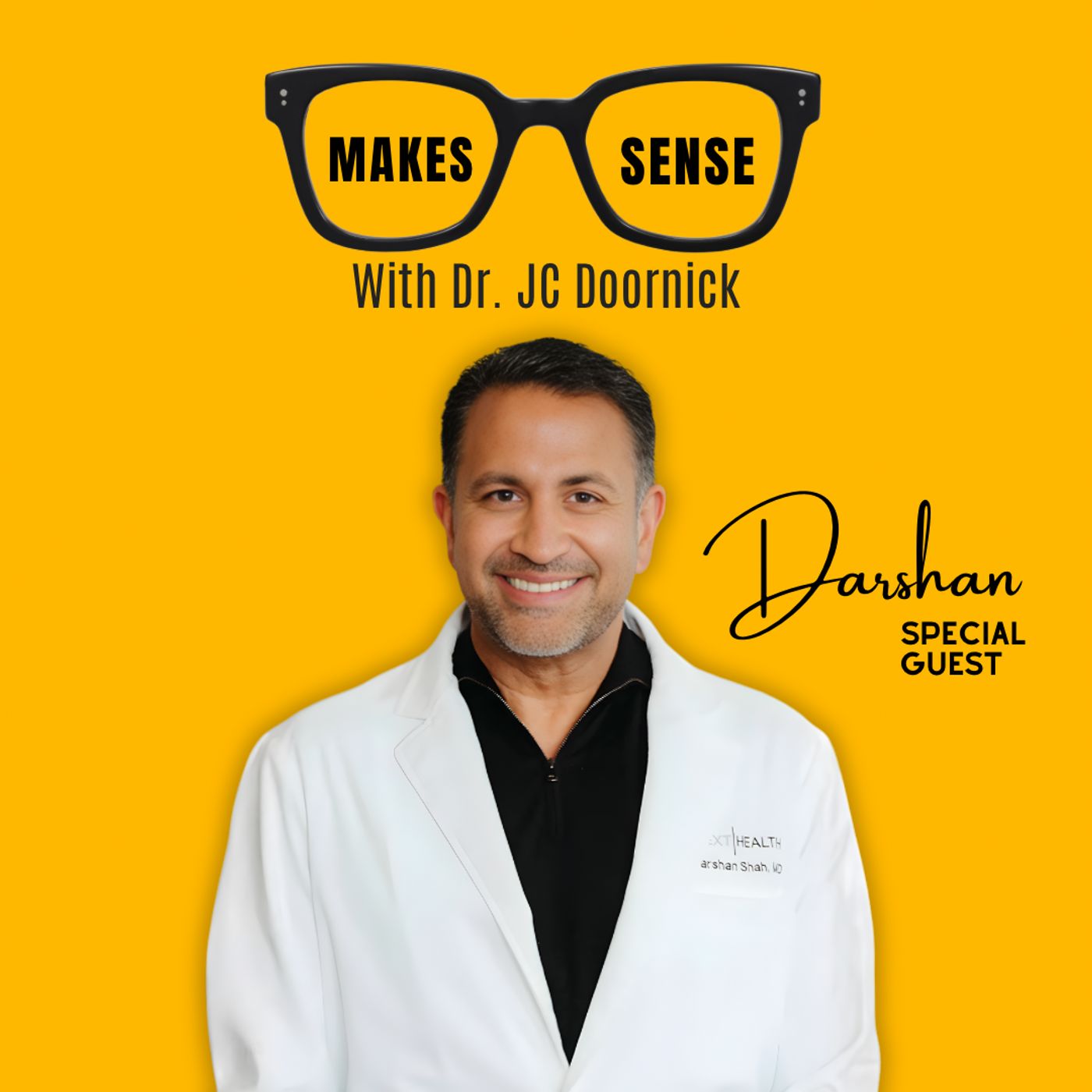
Makes Sense - with Dr. JC Doornick
Stop "Feeling Your Age": The Truth About Your Energy w/ Dr. Darshan Shah - E163
00:55:52
Are you tired of being told your low energy, brain fog, and weight gain are just part of aging? In this episode, Dr. JC Doornick and Dr. Darshan Shah reveal why that’s a myth—and how shifting from reactive “sick care” to proactive health can help you reclaim energy, clarity, and control of your body.
Loading summary
Transcript110 lines
- [00:00]
Commercial Advertiser
What if you could replace your windows and doors today and not pay a dime for two years? This May renewal by Andersen makes it happen. For a limited time, get beautiful new windows and doors with no money down, no monthly payments and no interest until May of 2028 with a minimum purchase of 6. That's right, install now and pay later. Way later. But this offer won't last. It ends May 31. Visit renewalbyandersonhome.com today and take advantage of this limited time offer. Hey there, it's Wayfair here, where delivery and setup are as easy as a feature. A few taps on your phone, you're relaxing in an old hammock. Scrolling Wayfair's app when you spot it, a brand new patio set. Next thing you know, Wayfair delivers it right to your patio and sets it up. Oh, you need a new grill, too. All right, Wayfair's got you covered. With Wayfair's room of choice delivery and fast expert setup on qualifying orders, life gets a little easier. Visit Wayfair.com or the Wayfair app. Wayfair Every style, every home, Hataday presents.
- [00:59]
Host (Dr. JC)
In the red corner, the undisputed, undefeated
- [01:02]
Dr. Darshan Shah
weed whacker guide, champion of hurling grass and pollen everywhere. And in the blue corner, the challenger,
- [01:11]
Host (Dr. JC)
extra strength Hataday eye drops that work all day to prevent the release of
- [01:16]
Dr. Darshan Shah
histamines that cause itchy allergy eyes.
- [01:19]
Host (Dr. JC)
And the winner by knockout is Pataday.
- [01:24]
Dr. Darshan Shah
Pataday. Bring it on. You know, you really have to look at the history of medicine to understand the healthcare system that we have. All of the doctors, the MDs out there that are in the hospital, hospitals, practicing clinics with hundreds of patients. It was never meant to keep people healthy.
- [01:42]
Host (Dr. JC)
Right?
- [01:42]
Dr. Darshan Shah
It was never built for that. It was built around the concept that humans get into horrible situations like accidents, overwhelming infections, heart attacks, and they need their life saved. And so that's why the medical system was developed. It was developed around the concept that, you know, when you need a doctor is when you really need a doctor. What happened then is that chronic disease came about about 80 years ago, really. And all of a sudden, people are coming to their doctor like, I'm not feeling good. What's wrong with me? And the doctors really were looking at their symptoms and they're trying to figure out how do we resolve these symptoms. But there was really no education for doctors. And this is still the case today about the science of nutrition, the science of sleep, the science of exercise.
- [02:27]
Host (Dr. JC)
Have you noticed that the world that we live in has been doing most of the thinking for you that your beliefs, perceptions, re fears and doubts have been shaped by unsolicited outside noise. How easy it's been for you to slip into that default sleep walking mode and label it as life and reality. Yeah. That ends here. Welcome to the make sense with Dr. JC podcast. This is your opportunity to start thinking for yourself, reclaim control, and step back into that role as the shot caller and dominant force of your own reality. It's when you change the way that you look at things that the things that you look at begin to change. So let's wake up, let's rise up, and let's make sense of why and how shift happens.
- [03:16]
Dr. Darshan Shah
Makes sense.
- [03:20]
Host (Dr. JC)
Welcome to the make sense with Dr. JC podcast. Dr. Darshan Shah. I'm so honored and privileged that you've decided to join us on our show today.
- [03:30]
Dr. Darshan Shah
It's my honor. Totally. I'm so excited to be here. After we met in person, and now here we are a few weeks later.
- [03:36]
Host (Dr. JC)
It's always so much cooler to have met somebody and really put your finger on the pulse of, of their energy and their vibration. And I will get to that in a second. But one of the first things that I like to do on the show, a little segment that I call what I like about you. Yeah. And I just don't think a lot of people get enough nice things said about them. So I've done a little bit of research, but I've, I've got my own opinion. So if. Is that okay if I tell you what I like about you?
- [04:03]
Dr. Darshan Shah
Of course. Why would that not be? I'm very humble.
- [04:07]
Host (Dr. JC)
So you've been waiting for this moment all your life, you know, so thank you. One of the things that I noticed right away is that you've got a lot of accomplishments and credentials. So, you know, I have the utmost respect for everything that you've accomplished. So, you know, congratulations on, on all of that stuff. But I had the opportunity, as we just said, you know, to see you take the stage, meet you in person, interview you after the limitless live show where our mutual friend Jim Quick, who. I actually watched one of your podcast episodes with him when I was doing a little bit of stalking. So that was, that was kind of fun. But what I found is that, and you're going to probably take this initially the wrong way, but obviously it's not. You don't act your age. And that was the first thing. And what I mean by that is you don't talk about your career and the reason that you do what you do, like normal People, you speak like an excited child about it. So it was one of the things I noticed. And if people follow you on social media, I mean, like, you look genuinely passionate and excited about what you do. There's not a lot of that going on. So it's very, very cool. And it appears that your passion and your intention is really just about empowering people. Empowering people before accolades and achievements and things like that. Empowering people with knowledge, insights and tools to optimize their health and longevity. And that's appears to be your primary intention and interest. And I like that. That's hard to find in a world where most people seem to be honest with you, even if they're really good at what they do, burnt out and have become victims of their circumstances and fighting the machine. You know, I can see that you're genuinely excited. And I can also attest that you're a very kind person. I mean, people will pick up on that. This guy's always got a smile on his face. He's a very busy man, but he's, he's always going to entertain a conversation. And I would say that in general, you're somebody that would be the kind of person that somebody would be honored to call friend. So I'm going to start working on that myself. But I want to welcome.
- [06:16]
Dr. Darshan Shah
We are friends.
- [06:17]
Host (Dr. JC)
Well, I mean, you know, outside of event and podcast friends, you know, I'm gonna, I'm gonna really work on that because I can see that there's great value. So, Dr. Darshan Shah, I want to welcome what I call the Dragon's Lair.
- [06:32]
Dr. Darshan Shah
Mm. I'm so excited to be here and thank you for that. That was really special and what a great way to start a podcast. I love it.
- [06:37]
Host (Dr. JC)
Yeah, it's one of the things that I like to do and I guess that would be some sort of a hidden desire to have somebody do it to me one day, you know, so if you ever feel compelled, you know, I know that you have a podcast. Maybe you can just talk about me one day.
- [06:50]
Dr. Darshan Shah
Let's make it happen.
- [06:52]
Host (Dr. JC)
So before we dive into the real cool topics that obviously a lot of people are going to be excited about. And it's very ironic because I've just naturally been attracting different groupings of guests, you know, before you. The episodes that are coming are Dr. Wendy Suzuki and Dr. Oz was just on the show. So that probably has a lot to do with my general interest in metabolic health and longevity and stuff. I'm a 54 year old man, so a lot of the stuff that you do, selfishly, I'm very fascinated with and working on, and my friend is Jim Kwik. So, you know, we talk about this stuff all the time. But before we get into longevity and the science behind it, what I'd love to do is just get a little bit of the origin story because I think it's so relevant. So from what I can see, it seems that you started your career in trauma and reconstructive surgery, which is really fascinating. And I know that you wrote a book called Making the Cut, which is not really what your discussion is about now, but there, there's a lot of back history there. And that means that you were literally seeing people prob, in some cases in their worst days, you know, in the worst parts of their lives. So the question is this, what were you noticing back then about the downstream effects of lifestyle? Because I mean, something prompted you to look elsewhere. So what were you noticing about the downstream effects of lifestyle and in the patients that you were treating? That's what I would love to hear.
- [08:22]
Dr. Darshan Shah
Yeah, for sure. So, you know, I started down this path as just a regular doctor. You know, I, I finished medical school, I graduated from residency at Mayo Clinic, started my practice, and I was doing a lot, lot of reconstructive surgery and then also some cosmetic surgery. And what I noticed was there are a lot of unhealthy people out there having surgery. And that's what prompted me to write the book Making the Cut. Because I kept saying the same things over and over again, like, just get healthy. You might not need the surgery. You have to be healthy before surgery so that you have a better outcome. And then I would go into the reasons why. And that was one of my main purposes for writing that first book that I wrot. But then it's so ironic. I actually became a victim of the same problems that my patients were suffering from. So because I was stressed out, I was working 14 hour days, not sleeping great, eating a lot of garbage. I myself became very unhealthy. I was like 40 pounds overweight. But I also had developed diabetes and high blood pressure and an autoimmune disease. And so at that point in my life, this is about 12 years ago, I decided I need to get healthy. This is just too important for me to, number one, not be healthy because I'm too young. I was 40 something years old. And secondly, I was also, I just had my first child. I was a very young dad and I want to stay alive and healthy for him. And lastly, you know, you kind of feel like a hypocrite like, here I am telling everyone to get healthy before surgery. And I myself do not embody that. So I went and learned the science of health. And what I really realized back then was that a lot of the things that we tell people to get healthy in the medical world, in the disease care world, is really only what they need to hear when it's too late. And all the knowledge that you need that prevents you from getting unhealthy in the first place. I didn't even really have a lot of education in that space, the space around nutrition, exercise, hormones, et cetera. And so I went out there and learned about these fields through learning functional medicine. And I completely flipped my entire health journey around in like eight months. And I was like, now this is the piece that I need to add to the western medical part of this. And so that's what prompted me to just start a brand new career. I actually quit surgery in the next few years, wound down, and, you know, handed my practice off to some younger individuals. And I went into the science of health optimization, chronic disease reversal, functional medicine, and now all of that together is lumped longevity medicine. And so our clinics now are all longevity medicine clinics.
- [11:05]
Host (Dr. JC)
It's so fascinating. I have the unfair advantage of interviewing so many people, and I hear the same story all the time. It's just like good intentions going the right path. I mean, I was. I was a chiropractor and I had a huge practice and I was 80 pounds overweight, teaching people about, you know, natural wellness and stuff. Wendy Suzuki, same thing. She just all of a sudden realized she was not dating anybody and she was fat. And she went on her own selfish journey and uncovered the joy of optimization before she decided, just like you, just a question off the cuff, what's the problem there? Because this seems to be a big kink in the chain of healthcare, in that a doctor that's not practicing what they preach probably would not be prompted to take another path like this is this stuff that's not taught in mainstream medicine. You know, this idea of leading by example and being the change that you're inviting other people to, you know, embark on.
- [12:06]
Dr. Darshan Shah
So, you know, you really have to look at the history of medicine to understand why this is the case. Because really, the healthcare system that we have, all of the doctors, the MDs out there that are in the hospitals practicing, you know, clinics with hundreds of patients, it was never meant to keep people healthy.
- [12:25]
Host (Dr. JC)
Right?
- [12:25]
Dr. Darshan Shah
It was never built for that. It was built around the concept that humans get into horrible situations like accidents Overwhelming infections, heart attacks, et cetera, and they need their life saved. And so that's why the medical system was developed. It was developed around the concept that, you know, when you need a doctor is when you really need a doctor. And so what happened then is that chronic disease came about, and this chronic disease started about 80 years ago, really. And then we can talk about why that happened. And all of a sudden, people are coming to their doctor, like, I'm not feeling good. What's wrong with me? And the doctors really were looking at their symptoms and they're trying to figure out, how do we resolve these symptoms. But there was really no education for doctors. And this is still the case today about the science of nutrition, the science of sleep, science of exercise, and how that can prevent you from getting sick in the first, first place. Because the system was never built to prevent people from getting sick. It was built to treat disease once it became a major problem. And look, thank God we have this system, right? Like if you get hit by a bus, if you get stage four cancer and need surgery, you know, we need this system to take care of us. But it was never built for everything that precedes it. And that's why it is that way. Even the doctors are not taught that, and they don't practice it because they don't even know the information, you know.
- [13:45]
Host (Dr. JC)
So when you went and made that decision to become a medical doctor, was that what you wanted to do? Or were you just kind of this. This dreamer that was hoping that you'd have the flexibility to do other stuff? I just think that people are really fascinated when they meet somebody like you and hope that their doctor would wake up like you do, because, you know, a lot of people are trapped in the system as well, but now they're going to find out about next health. But did you have aspirations of just treating sickness? You know, it's like a don't hate the player, hate the game kind of a thing. But do you feel like this is something that you always wanted to do or.
- [14:23]
Dr. Darshan Shah
No, not really. When I went in medical training, I wanted to be a surgeon, and more specifically, my passion was trauma surgery. I mean, I wanted to help people, but I wanted to help them doing trauma in general surgery. And so that's what I did. And so, you know, when you're doing surgery on someone, you're really doing it for, like, really bad issues, especially. Especially, you know, car accidents and gunshot wounds and things like that. So that's why I went. Went into this field and I had this awakening after Like I said, I myself got very unhealthy and I needed to turn my health around. I'm like, oh, my gosh, this is the big missing piece of our healthcare system. And so, you know, rather than try to fix our healthcare system, and I'm making air quotes for people that are listening like, you cannot fix a trillion dollar system that was built to take care of. That's right, like, problems. And so I said, you know what, let's just make a new system. Let's create. This is a disease care system. Let's create a real health optimization system. And so our system of clinics is like the first step in that where, fine, you have your primary care doctor, he put you on blood pressure medications, he's put you on medicines for diabetes. You come to us then to help get you healthy so you can eventually reverse those chronic diseases and maybe even get off your medications. And that's what we do.
- [15:42]
Host (Dr. JC)
Well, I hope you don't take this the wrong way, but I think I speak for everybody when I say that we're really happy that you gained 40 pounds and you felt like crap otherwise. Otherwise you'd just be, you know, we wouldn't have Next Health Point.
- [15:54]
Dr. Darshan Shah
Like, I did see like three or four doctors, and two of them are concierge doctors that I spent a lot of money to see, and they both gave me more pills. Like, their solution was, here's a different pill, he's a newer bill, he's a better pill. And there was never this concept of changing lifestyle, you know, and so it was really a huge kind of leap in my own brain. Like, I'm seeing the best of the best doctors, but they really don't have the solutions that I'm looking for.
- [16:25]
Host (Dr. JC)
Yeah, just not the best for. For your situation. And, you know, just from my vantage point, it appears that there's a natural transformative process where human beings are starting to, you know, the whole sick and tired of being sick and tired. It seems like there's a big awakening right now. So, you know, there's never been a better time for people like you to sprout up. So, you know, if we look at mainstream medicine, it's like if our. If the herd is moving one way and somebody strays from the herd, very often, they hate that because you're highlighting something that they kind of know that needs to be done. So Next Health in that sense is built around a pretty radical idea. And the way I interpret it is that Next Health should. Could be something that is shifting from radical medicine to proactive Optimization, which is a pretty radical word in, in that world. So what was the original vision that you had when you first created Next Health? Because I would assume it's evolved.
- [17:24]
Dr. Darshan Shah
Yeah. So, you know, we live in this current time where now longevity has become like a buzzword and there's so much attention around it. But when I started Next health, it was 10 years ago and no one even was talking longevity. Most people were talking about how do you, how do you go see the primary care doctor that has the best tools available to treat disease? And so when I started down this path and created Next Health as a clinic, it was really around the concept of functional medicine. And this was a new concept that Dr. Jeffrey Bland and Mark Hyman and Dr. Perlmutter. They were just bringing to light and they were fighting the battle. They were like trying to tell people, like, look, you have disease, but there's ways to reverse it. And then, you know, what happened was the mainstream medical establishment thought that these people were selling snake oil. Right. Disease reversal. That's ridiculous. There's no such thing. Once you have a disease, it's permanent is what they were screaming at us and trying to make us all feel as though, number one, not practicing science based medicine, but also, number two, trying to say that we're trying to sell snake oil. And it was a lot of an uphill battle, number one, trying to tell the general public what we were doing. But also number two, with, with other physicians that were basically telling us that we should be shutting down these practices and reporting us to medical boards, et cetera, et cetera. And, you know, look, look at where we come now. You know, we were prescribing hormone replacement therapy when most doctors are telling people, do not do that it will cause cancer. Because we knew replacing hormones, both men and women, is a game changer in people's health journeys. And there wasn't a real risk of cancer. And so now everything's 180 finally. And. And we can see the mainstream medical establishment finally wrapping their heads around like, oh, we were wrong. Hormone replacement theory is healthy for you. And not being on hormones is actually what's causing a lot of rapid progression towards chronic disease. And hormone replacement therapy is just one example of multiple aspects of our care that were poo pooed by medicine even as soon as 10 years ago. And now everything's come completely the opposite direction.
- [19:34]
Host (Dr. JC)
Yeah, you mentioned that longevity is like a buzzword now. It's like trending. And it's interesting because if you look at the emerging world of something that you would be considered a first runner in. It's almost moving the likes of AI now. You know, I mean, it's like you go to Jim Quick's event and you walk through the convention hall and it's like, holy cow. There are so many just amazing new things that we can get our hands on. Jim's my neighbor and you know, whenever I go to his house, I'm laying on some bed with lights on me and all of these things and it's all really, really cool stuff. So I hear you talk a lot about this and this is something that I think is going to really, really resonate with people. One of the biggest frustrations people have, and I saw this when I was in practice as well, they go to their doctor and they feel exhausted, you know, they have brain fog, low motivation, and they're overweight even, you know, and they have all the markers that you can even see and like pretty much guess that this is not a person that is expressing health. But their doctor says your labs are normal. I hear that all the time. You know, people say, oh no, I went to my doctor and he says my labs are normal. So help us understand this because I know you're passionate about this. How can somebody feel terrible even when their lab work falls inside what we call normal range? What does normal range mean?
- [20:57]
Dr. Darshan Shah
Great question. So let me tell you a few things about labs at your typical doctor's office. Number one, the labs are testing you for are disease diagnostic labs. So obviously there's thousands of different markers in your blood that we can test for. And they're only testing the ones that tell us when you're really, really sick. And unless you have symptoms, they're not going to be testing for some of the other markers that, that we like to test score. So that's problem number one. Problem number two, doctors are stressed out and they're seeing way too many people and they only have 15, 20 minutes of visit. And they're looking at those results on a piece of paper. And what's happening is, is they're saying they're normal because it's not flagged as abnormal. But the flag, which is generated by a computer is based on when you can get diagnosed with the disease. I'll give you a perfect example. Hemoglobin A1C is a three month average of your blood sugar. It gets flagged when it's 6.5 or above. Now it's red on the paper. And that's because when you're a 6.5, you get diagnosed with diabetes and you need a pill when you're 5.7, you're pre diabetic, and that is not flagged. The optimal range is 5.2 or below. And it takes decades to go from 5.2 to 5.5 to 5.7 to diabetes. Right. So I want you to know when you're at 5.4, because now you can change, change your lifestyle to get that hemoglobin A1C number to go in the opposite direction, go back down to 5.3, 5.2. And so, like, this is the problem with how the disease care world works is because those same blood works that tell you when you're in a disease, they're actually changing for decades before you get to a disease state. Right. And so I'm a big fan of people becoming the CEO of your own health. And what do I mean by that? When you're a CEO, you know your revenue, you know the number of employees you have, you know what your profit is. You just need to be that same way about your body. And there's about 20 markers that every person should know and follow and know what the optimal range is, not just the disease range.
- [23:00]
Host (Dr. JC)
I love that you mentioned that, because the mainstream world that gives you these labs is just telling you if you're a mess yet. But nobody, until people like you sprout up is saying you're on your way. And every now and then, doctors will warn, you know, say, hey, if you don't do this and that, you're going to be flagged, as you said. But they never give anybody anything to do. I remember one time, because I was very much entrenched in obesity, I had this great idea of, of offering the guys that are doing surgery for weight loss, you know, bariatric surgery. I said, I'm going to go in there and I'm going to come up with a solution. So people don't need bariatric surgery. That doesn't go well, by the way. They don't. They don't. They don't take that call money out of their pockets. But I remember, and I won't throw anyone under the bus. But I remember saying to them, say, well, when you guys send out a mailer to people and people want to get bariatric surgery, what percentage of them qualify for it? And they gave me a number, and then I said, what about everybody else? And with the straightest look ever, they said, oh, we just wait three or four months and send the flyer out again. And that was their way of saying, oh, they'll be Ready. They'll be ready. I'm 54, but someone in their late 40s or maybe early 50s who feels like their energy's kind of fallen off of a cliff. What are the first numbers you're talking about? Some of these markers, what are the first numbers that they should look at to understand what's really happening in their body?
- [24:29]
Dr. Darshan Shah
Awesome question. Okay, so I'm going to give all of your listeners a really great tool. Go to drshaw.com biomarkers and there's a free PDF there that will tell you what are those markers, what are the optimal ranges and how to fix them. But I want to just highlight three of them. So I talked about hemoglobin A1C, which is a measure of your three month average of blood sugar. It's your metabolic health. If your metabolic health is not in order, you're going to have brain fog, weight gain, you're going to have poor sleep, all of it. So get your metabolic health in order. And how do you do that is not just lowering your sugar intake, it's also building muscle because your metabolism lives in your muscle. And most 54 year old men unfortunately are under muscled. Second one is hscrp, that's highly sensitive C reactive protein. This tells us whether or not you have inflammation, another root cause of disease. And so your hscrp, your inflammation level should be as close to zero as possible. I see so many people the first time we measure it is 2 or 6 or 10, and that's because they're inflamed and a lot of inflammation comes from poor gut health or poor oral health. And that's actually deteriorating their health exponentially and leading towards cardiovascular disease, Alzheimer's disease, even cancer. I'll give you a third one that's really important. It's your testosterone level. And this goes for men and women. More for men. Testosterone for many men that I see now is at the level of an 80 year old when they're in their 40s and 50s. And that needs to be fixed. There's a lot of ways to fix it. Hormone replacement therapy is one way, but there's many other things that you can do to improve your testosterone levels. And for women, if they're in this age group, if their estrogen is zero, because they're not on hormone replacement therapy, they're also marching towards disease, bone loss and Alzheimer's disease. So those are three or four big ones right there. There's a few others. Like I said, they're not all blood tests. I actually am a huge advocate of Getting a device called a grip dynamometer where it's like 15 bucks and just see what your grip strength is. Getting a special scale that sends a slight electrical current through your body so you know your fat mass and your skeletal muscle mass. So there's about a few of those as well.
- [26:45]
Commercial Advertiser
Did you know about one in three people with plaque psoriasis may also develop psoriatic arthritis, which causes joint pain, stiffness and swelling. Does this sound like you listen to what it sounds like to be a million miles away? Trimfya gusoquimab, taken by injection, is a prescription medicine for adults with moderate to severe plaque psoriasis who may benefit from taking injections or pills or phototherapy. And for adults with active psoriatic arthritis, serious allergic reactions and increased risk of infections and liver problems may occur. Before treatment, your doctor should check you for infection and tuberculosis. Tell your doctor if you have an infection, flu like symptoms or if you need a vaccine. Imagine being a million miles away. Explore what's possible. Ask your doctor about Trimfya. Tap this ad to learn more about trimfia, including important safety information.
- [27:45]
Dr. Darshan Shah
Shell V Power Nitro plus fuels every drive with a fuel like no other. It removes up to 100% of the performance, robbing deposits to rejuvenate your engine's performance. That means more power when you need it and more performance with every drive. Shell V Power Nitro Plus Premium Gasoline More power, more performance formulation unique to Shell in gasoline direct injection engine fuel injectors with continuous use of Shelby Power Nitro Plus Premium Gasoline compared to lower octane fuels. Actual effects and benefits may vary.
- [28:15]
Commercial Advertiser
Hiring isn't just filling a role, it's about finding people who can drive Results Indeed Sponsor Jobs helps you match with the right candidates faster. Target candidates by skills, certifications or location. Join the 3.3 million employers worldwide that use Indeed to connect with quality talent that fits their needs and listeners of this show will get a $75 sponsored job credit to help get your job the premium status it deserves. Indeed.com podcast terms and conditions apply. Hiring do it the right way with Indeed still waiting in line. Again, that's time you'll never get back. Save time and money with stamps.com over 4 million businesses have skipped the line with stamps.com join them to save up to 90% off carrier rates from your computer or phone right now. Print postage for certified mail, registered mail and packages in seconds. Then schedule a pickup right from your home or office for a limited time. Go to stamps.com and use code podcast for a free welcome Gift taxes and fees apply.
- [29:14]
Host (Dr. JC)
So fascinating. And we'll get into the GLP stuff, but it's so fascinating to watch the landscape change in the realm of weight loss. You know what I love to hear is that people are no longer weighing themselves on scales. They're getting like renfo scales and they're using apps and stuff. So there's different metrics, but we still see the problem out there. We'll touch on that, but just to cover those, you'll get the website and my team will flash cool things on the screen. But he said hemoglobin A1C, HSCRP and testosterone. And I would assume those are kind of some of the frontline metrics that you guys assess when people come in.
- [29:53]
Dr. Darshan Shah
That's exactly right. Yeah.
- [29:54]
Host (Dr. JC)
I want to talk about this thing now. I'm not speaking for myself because I'm just full of piss and vinegar and I'm. I remember I had a 94 year old patient and he was 94, but comparatively he was in fantastic shape. And I asked him, you know, I said, what's the secret? What's the secret to longevity? And this is a long time ago. And he just said, never stop moving. He goes, no matter how much pain you're in, he says, whatever you can do, never stop moving. So we hear people say this all the time. I just feel so old and I know that there's so many components to this, but there's a difference between a chronological age and a biological age. So could you explain what that difference is in simple terms?
- [30:35]
Dr. Darshan Shah
Yeah, absolutely. So, so your biological age, and there's all sorts of now newfangled ways of measuring it, but basically your biological age, in my view is the age that you feel. Right. And so your chronological age is just a number. I was just with Richard Branson last weekend and he is, I think he's almost 80 years old and he's playing tennis every morning, he's kite surfing, he's riding bikes up hills, he's going for hikes. Like this guy moves like most 30 year olds move or even, even people in their 20s. And so really age is. Your chronological age is just a number and you can be biologically any age you want. And how do you do that? You mentioned keep moving. It's so important to never stop moving. Keep lifting heavy things, lift heavy weights, train your VO2 max. That means like do sprints, simple things like that. Just sprinting and lifting heavy things and focusing on your mobility. Put all your joints through a range of motion every single day. Those are the Kind of things that if you do them every day, you will get biologically younger. But here's what most people do. They don't do it every day, or maybe they have a once a week gym routine or twice a week and it gets skipped every once in a while. And the rest of the day they're just sitting in front of their computer. Then every day you're getting biologically older. And then soon your chronological age and your biological age will be the same, and then your biological age will be older than your chronological age if you're really, really avoiding all these things. So I always say, like health and your age, it's just a habit. Is what do you do every single day that adds up over time or goes opposite direction over time?
- [32:14]
Host (Dr. JC)
Yeah, I was brought up and I think everybody resonates with the personal growth concept, that growth takes place outside the comfort zone. But I think what you're saying is that health takes place outside the comfort zone as well. I'd never. I never thought of that until right now. I like that. That's a. That's a cool concept.
- [32:31]
Dr. Darshan Shah
You're not really accelerating your longevity unless every single day you're feeling uncomfortable, you're running so hard and it's hard to breathe, you're lifting so hard that you can barely pick it up. You're moving in ways that you don't normally move. You know, those are the kind of things you gotta do.
- [32:49]
Host (Dr. JC)
So there's some really, really exciting stuff happening. I remember, I want to make sure that I get this right. But. But I took a screenshot of it and I just can't find where I put it. But when you were speaking at Limitless, because there's a lot of people talking about, like, the next version of you. Like sometimes people call, you know, JC 1.0 versus 3.0. And I think I even saw a slide where you were talking about medicine 3.0, and it was cool because you'd think, oh, medicine, oh, new drugs and stuff. But that's not what it said on the slide. It was talking about lifestyle things. Could you just quickly speak to that a little bit? I just think that medicine 3.0 sounds really great.
- [33:27]
Dr. Darshan Shah
Yeah, well, actually, I talk about medicine 4.0. There are other doctors that have written about medicine 3.0. And let me take you through it. Okay, so medicine has been so disease focused for so long, and Medicine 3.0 is putting into place lifestyle habits that you can do to prevent chronic diseases and even reverse chronic disease. Okay, well, medicine 4.0 does. Is it focuses in on bringing four aspects of medicine together to achieve the best goals possible. And those four aspects are, number one, lifestyle medicine. And lifestyle medicine includes your nutrition, metabolic health, your exercise and movement routines, your sleep and stress management. Secondly is bringing functional medicine into the picture. Functional medicine is root cause medicine. That's where we're really looking at what are the reasons people age and how do we stop. Top those, those include hormone health, managing inflammation, making sure your gut is healthy as well, and also making sure your immune system is healthy. Third kind of vertical there is called hyper preventative medicine. That's what I like to call it. What does that mean? It means we know what are the top 10 reasons that humans die. Number one is heart attacks. Number two is going to be Alzheimer's disease. Number three is going to be cancer. But we know that if we catch those diseases early, we can stop progression towards those diseases. I always say cancer's biggest enemy is being diagnosed at stage one instead of stage three or four, where now you're doing major surgeries and talking five year survival rates. The biggest enemy of cardiovascular disease is never getting it in the first place. However, 50% of people don't even know they have it until they have their first heart attack. Biggest enemy of Alzheimer's disease is that people think that if they're destined to have Alzheimer's, they're going to get it. And there's nothing further from the truth. If you catch it early and even if you have the APOE gene and you know early, you can prevent it from ever becoming a big problem in your life. And then lastly is adding the fourth vertical of this new medicine 4.0 paradigm that I talked about, which is longevity medicine. This is where we're going to be using tools that were never available before. Tools like peptides like the GLP1s, tools like Red light therapy that you did, a gym, quicksouth stem cell therapy, regenerative medicine to really, really accelerate your healing and your health outcomes. And so bringing these four aspects together in people's lives is what I talk about, is what I do.
- [36:07]
Host (Dr. JC)
I would just love it. And it will flash it up on the screen when we, when we edit this. If you could, you could send me that slide because I just. And I apologize for calling it 3.0. I mean, 4.0.
- [36:17]
Dr. Darshan Shah
No, no, it's okay. A lot of people, a lot of people call it 3.0.
- [36:20]
Host (Dr. JC)
I've never heard of it.
- [36:21]
Dr. Darshan Shah
Yeah, yeah. Another doctor had written about it and it got, it got a lot of traction. I was like I spoke to that doctor once. I was like, hey, you know What? You got 3.0, but I'm gonna add more to this and we're gonna make this 4.0.
- [36:32]
Host (Dr. JC)
And he's like, and that's.
- [36:33]
Dr. Darshan Shah
Medicine 4.0 is where we're at right now. You know what medicine 5.0 is going to be?
- [36:38]
Host (Dr. JC)
What?
- [36:39]
Dr. Darshan Shah
It's where no one ever gets sick, ever, no matter what.
- [36:42]
Host (Dr. JC)
Yeah.
- [36:42]
Dr. Darshan Shah
And that, that is actually with the acceleration of technology and AI, I actually feel that may come during our lifestyle, the next 30 to 40 years, during our lifetime.
- [36:53]
Host (Dr. JC)
Well, I was talking to Oz about that, and I. I think it's Ray Kurzweil that, you know, talks a lot about. I. I heard him say that at the rate we're going because of these advancements, and it's interesting to say that the advancements are not happening in traditional medicine, like we think reactive. It's more in proactive. You know, reactive. Medicine was never created to prolong life. Right. It was. So I think I heard him say that if things keep moving the way they were five years from now, we'll be able to live till 500 or something like that. Do you have anything to say on that?
- [37:25]
Dr. Darshan Shah
I love Ray. He actually wrote the forward to the book that I have coming out in a few weeks called Artificial Intelligence the new health OS. And he predicted 30 years ago that we're going to reach a point in human history where we reach what's called longevity escape velocity. That's where we learn every year of scientific discovery how to add another year to our lifespan. Okay. The cellular level. And, you know, everyone thought he was kooky when he said this, you know, 30, 40 years ago, but he made a lot of other predictions because he's a futurist. And he's tracking this exponential growth curve of technology and the intersection of technology and human biology. You know, the founder of Nvidia, Jason, he just recently said the one thing he's most excited about is we're at the verge of making our human biology an engineering problem. It is no longer just a biological chaotic problem that we're trying to figure out how to solve. It becomes engineering. And when something becomes engineering, look at engineering right now. Look at, with how much precision we can advance. That convergence is happening live as we speak, and everyone's going to benefit from that. And he's most excited about that. And so am I. And Ray's. I think Ray, yeah. You know, he might not be as kooky as people thought he was.
- [38:46]
Host (Dr. JC)
Well, first of all that's so great to hear that a new book is coming out and you've just made me level up my, my lifetime goals and that would be to have a book where Ray Kurzweil tested the forward for it. I mean, that's pretty freaking cool right there. But it also put your book in the hot seat in many ways. And, and that's why I want to read it. What's that book going to be?
- [39:04]
Dr. Darshan Shah
It's going to be called the New Health os.
- [39:06]
Host (Dr. JC)
Is that available for pre sale?
- [39:08]
Dr. Darshan Shah
It'll be in print in about. It'll be in print in about four to five months and we'll put up for pre sale in about four months.
- [39:15]
Host (Dr. JC)
Perfect.
- [39:16]
Dr. Darshan Shah
Publishers are working through all their publishing things that they got to do.
- [39:19]
Host (Dr. JC)
Well, we will get the, the sense makers on that one quick. That's, that's exciting.
- [39:24]
Dr. Darshan Shah
One of the things, you know, I want to offer to your sense makers too is we can give them free access to a new health OS dashboard. Okay. And so, so what I've done is I've created the opportunity finally for everyone to put all their medical records, all your blood work and your doctor reports and MRI scans securely in a vault that an AI model will come and scrape all the information and make it all understandable and trackable for you. We have all of our health records in a million different places. And you know what? Our health records don't talk to is us. It doesn't have the context of knowing like how am I feeling today? What are my goals with my health? What are the things I'm struggling with? And so with this new dashboard that I created specifically for this book, the, the dashboard will be enabled with what's actually your goals and what you're saying you, because you're going to tell it and all your health records and it's going to put it all together to where you can talk to an AI version of me, me about your health and other doctors that are celebrity doctors that will give you their perspective. And I think this is going to be a game changer for people because for the first time they have agency and control over their data.
- [40:37]
Host (Dr. JC)
That's the first thing I was thinking about is that traditionally the locus of control is maintained by the, the caregiver. And a lot of those guys are not going to like this. But at the same time, how could somebody actually proactively work on their health if they don't understand anything without the help of somebody that might be jaded or something? I've heard you talk about the body's internal battery. Most people are starting to hear these buzzwords like mitochondria, but they really have no idea what that's about. And also, I'd love you to also hit on what's happening inside somebody's body. This is something I think people really need to know. When their internal battery starts running low, what's actually happening.
- [41:21]
Dr. Darshan Shah
Okay, so I'm going to preface this with everyone needs to know what mitochondria are. It's that important. Yeah, most people probably remember from like high school biology. Right. It's one of those organelles inside of a cell. But what's fascinating about these organelles is they were never part of our human cell to begin with. In fact, mitochondria have their own DNA and they were extracellular organisms, meaning another organism prior to then becoming in a symbiotic relationship with human cells. And so when the mitochondria came into our cell, our cell was only able to make about 4 to 5 units of energy for every glucose molecule. Once the mitochondria got in and contributed its ability to make 32 units of ATP from a glucose molecule, everything changed. That's when cells were able to then replicate and expand and turn into multicellular organisms. So they're fascina, sensitive to light, they're sensitive to quantum mechanics. It's just there's so much we don't even know. But what's important for most people to realize is that as we age, our mitochondria, just like our cells, get unhealthy themselves and they become less powerful, less ability to make ATP, and less in number. And if you're able to maintain healthy, strong mitochondria and healthy numbers of mitochondria in every cell, you will have, have the energy that you need to do all of your biological functions. And I'm not just talking about feeling like you're energetic. I'm talking about having the energy to have your immune systems be able to fight cancer, have your heart have the energy to pump hard when you needed to. Every cell in your body needs energy to work like your brain cells need energy to transmit signals. So taking care of your mitochondria is really helping to take care of your overall health and longevity.
- [43:19]
Host (Dr. JC)
Yeah, and that is the proverbial fountain of youth, perhaps. You know, I mean, the, the, you mentioned a lot of interesting innovations that before, like red light therapy and all these things. And, and if you dig deep, they're all in some way working with mitochondria and the proliferation. So I think that that is a very, very big call to action is that just go like, like Chat GPT or Google or go to Dr. Shaw's website and just learn about mitochondria, even just the basic of it, you know, so we have metabolic dysfunction and we have inflammation and things like that. What would you say are the three biggest lifestyle drivers of those things that people can maybe look to eradicate?
- [44:07]
Dr. Darshan Shah
Okay, so I'm going to give you the Pareto principle here because there's so many lifestyle drivers, right? But the Pareto principle is like what is a little bit of information that makes the most difference, right? The 20 that moves the needle, 80%. So in nutrition and metabolic health, that Pareto, 20% is going to be. I don't care what you eat as long as you avoid ultra processed food. Ultra processed food is such a negative to our biology, it's mind blowing. Just by cutting out ultra processed food, you can eat literally any diet you, you, you can name out there, you'll, you'll become healthier. Secondly, what I would say is I don't care if you go to the gym or not. So in the field of movement and exercise, going to the gym really doesn't matter if you're doing this one thing, and that one thing is being sedentary all day long. So that's what most of us do, right? We plop down in front of a computer for, for four hours and then we go plop down in a chair for lunch and then another four hours in front of the computer and then in the car and then home like we, we're always sitting and that's a disaster. And just because you go to the gym for an hour a day, it does not cut out the negative consequences of being sedentary. And we know for every hour that you spend sedentary, over four hours a day, you lose 15% in your life in your all cause mortality. And so it's a massive problem. So the solution There is every 30 to 45 minutes, get up and move around no matter what. That's called an exercise snack. And it's been proven in the literature to be the magic number to where if you move around every 45 minutes, then for like 5, 10 minutes and make it something that actually gets your heart rate up a little bit, you can counteract the negative effects of being sedentary. So those are a couple of them. Sleep is also incredibly important. And I think the Pareto principle with sleep is actually getting some sort of sleep tracker. And the reason I say that is because I can't tell you the number of people that come into my office and say, you know, I sleep great. Like, I sleep seven, eight hours. I don't. I have a problem. And then we put a tracker on them and we see them waking up multiple times throughout the night because of their snoring or sleep apnea or they are getting like zero deep sleep. And so we see this all the time. And then we start working on their sleep and we get their sleep score up, we get their deep sleep up to over an hour. And then they start becoming so much healthier and feeling so much better.
- [46:29]
Host (Dr. JC)
Yeah, I mean, things that people will. Will, as my ecosystem says, make sense. But, you know, execution, you know that this is. And I want to move into the. The popular topic of, of GLPs right now and just talk about the fact that, you know, you could lead a horse to water, but you can't make them drink. But you'll also notice that they'll drink the way that they want to drink as well. So massive, massive advancements going on right now that could be very, very promising, like, you know, Ozempic, WeGovy and the whole GOP thing. But I'd love your perspective on the breakthrough in those. But also the obvious risk when they're used the wrong way, because this is one of my biggest fears is that we could have a massive breakthrough and if everybody uses it the wrong way, it could actually turn to be one of the biggest devastating things that ever happened with the muscle loss and things like that. So I'd love to educate the audience on, you know, that breakthrough, what you. What your perspective is on it, but also the potential risk.
- [47:40]
Dr. Darshan Shah
Yeah, absolutely. So, you know, it's just like driving a car, right? Like, the car was the biggest breakthrough ever for transformation and it changed our entire society. But if you're going to drive a car drunk, obviously you're gonna have a. You'd have a massive problem on your hands. Right. So it's the same thing with GLP1s. If you're buying GLP1s on the Internet, Internet, and you're just getting a bunch of syringes at home and just shooting yourself up and you have no one helping you kind of manage the potential complications or risks of it, you will have a complication or risk of it. And I say that because that's what's happened and that's why there's been so much negative publicity about these things that is, in my opinion, unwarranted, because people just aren't thinking through it A lot of times. Also, you know, people ask for a GLP1 from their overstressed, overworked primary care doctor. They get a prescription, they get a dosing schedule and they go home and just do it. And then, and that's. They haven't given any advice on how to make this work for them or be successful. And then they have all the problems. And so this is what happens. Number one problem with doing GLP1s is that people completely stop eating and they're stopping protein and all other food. And it's so important when you're taking a GLP one to say increase your protein intake and increase your strength training so you don't lose muscle. Because the worst thing is when you lose £20 and £10 of that as muscle, that's a disaster. Then you've actually gone backwards with your health. Secondly is when people get these dosing schedules because they're told to start at a low dose and then every week increase, increase, increase, increase. And that's the wrong way to do it because when you start increasing it to the max dose, you lose too much weight too fast. And then you also get all the GI complications. And so really you only want to take the dose that's going to get you to lose about a pound a week at the moment most. And a lot of people that's the minimum dose actually, believe it or not, of tirzepatide or semaglutide. And now retatrutide is coming out. The third thing I would say is that everyone needs to have a goal for why they're taking these and they need to track that number and have an off boarding program for when it's time to stop taking them. Like once you achieve your goal, you then have a program to stop taking them. And so, you know, for a lot of people that goal might be one weight. But I would tell people, don't make that the goal. That's the wrong number. Instead, get like a RENFO bioimpedance scale and track skeletal muscle mass and fat mass or maybe it's your hemoglobin A1C, your metabolic health, maybe that's the goal. So, you know, make sure you're tracking and make sure you're the CEO of your health and you're making sure that you're getting those numbers right. And when those numbers get to where you want them to be, have an off boarding program.
- [50:22]
Host (Dr. JC)
Yeah, and, and probably more important than everything he said is remember that you can hire and fire your health practitioner. And I don't want to, I'm probably going to lose all. All of my listeners that are, you know, general practitioners right now. But understand that, you know, if your leader in your. In your health program is telling you that you don't need to get off of them, you don't need a plan, and selling you on the idea that it's just a magic pill and it'll take care of the rest. Because, I mean, you can see how they're being promoted to people. There's very little that says, hey, you got to work hard. Still, it's not about that. So it just, once again, highlights, sheds light on just the value of walking into a next health clinic, you know. Yeah. So I want to talk a little bit, so I'm going to just go ahead and throw the 5.0 out there. But it looks like next Health. Health is kind of feeling like medicine 5.0, because you guys are not stopping where you're at. Like scientists, you're always looking to chase better, you know, so instead of, you know, patients waiting to get sick, you know, people are going to start tracking, optimizing, and upgrading their biology. What would you say the next 10 years of health care? Because. Because, you know, think about that one. It's not just the Darshan Shaws out there. There's people that are going to have to change. Change.
- [51:46]
Dr. Darshan Shah
Right.
- [51:46]
Host (Dr. JC)
Because we see the writing on the wall in mainstream medicine. But what do you think the next 10 years of health care look like for this movement if it continues?
- [51:55]
Dr. Darshan Shah
Yeah, yeah. I think what's going to happen is people are going to have more agency over their biology through tools like the one I'm going to be putting out there and other tools out there. People will then understand they have a personal responsibility to stay healthy and get healthy. And we see this mindset happening right now because of this longevity movement. And then what's going to happen is there's going to be other peptides, other molecules that come out that are effective and safe if done correctly with a practitioner guiding them to then accelerate their health journey. And then what is going to happen in maybe 10 or 15 or 20 years is we're going to see therapeutics that come out that basically reverse disease progression. And so I think, you know, the future is very, very bright and. And he's going to stay alive and healthy long enough to participate in this. So that's. That's my goal with everybody, is keep them alive and keep them healthy.
- [52:47]
Host (Dr. JC)
I love it. I was. I won't mention any names, but I took care of some important people when I was a Chiropractor and one of them was the worldwide CEO of a soft drink company. And it was really interesting because what she brought to that software company was like healthy, fast, fast food, you know, like, you know, instead of just soda, there was like drinks that were promoting, they're still not, not healthy. But what, what we can see is that, you know, big pharma, when it comes to dollars and cents, they're going to go where the money is. You know, so what's exciting about medicine 5.0 and what next health is doing is this idea that big pharma will even see that there's money to be made in, in proactive care. So I would assume that that's, that's got to be a big part of this.
- [53:36]
Dr. Darshan Shah
You know, the ones are the, I think, you know, it's a trillion dollar drug now category. Right. And so yeah, I think, you know, hopefully everyone has a mindset shift towards hopefully health versus disease care.
- [53:48]
Host (Dr. JC)
You know, I don't, I don't know how much faith I put in, in, in those people right now, but you know, I think if we can light one candle, we can like many, many others. So hopefully that people will see it. So just a couple of rapid fire questions about longevity to kind of close us out. What is the most underrated health habit for extending lifespan or healthspan?
- [54:13]
Dr. Darshan Shah
I would say the most underrated one is deep squats. Everyone should be doing 10 deep squats every two or three hours during the day. It could be a massive game changer.
- [54:24]
Host (Dr. JC)
Interesting. Okay, great. And, and just for somebody that has no idea what that is, that would be like squatting down like a catcher.
- [54:33]
Dr. Darshan Shah
Right.
- [54:33]
Host (Dr. JC)
So that we have that out there. What is the most overhyped longevity trend right now?
- [54:40]
Dr. Darshan Shah
I think like, you know, cold plunging probably fits way up there. You know, I think it's great. If it makes you feel great, that's fantastic. Right? Will it lead to a longer lifespan span? I don't know. You know, health span? I don't know. You know, but for acute inflammation, acute endorphin release, maybe if you go in there, practice some breath, work to stay in there a little bit longer can help kind of like your vagal tone as well. But you know, everyone, their mother's buying a cold plunge right now and I don't know, I, I just don't see the science.
- [55:11]
Host (Dr. JC)
You've got some guy that's like shredded somewhere that's pissed at you right now, you know, for that. But I'm glad that you said that because I, I actually hate Being freezing cold. Last one. What is one simple health tracking metric, one that people should start monitoring immediately?
- [55:32]
Dr. Darshan Shah
I, I would say their HRV is a really good one. You know, the more and more I look at people that are unhealthy, their HRV really shows it. And your HRV is a measure of how recovered you are and it's your heart rate variability. It is something that you don't get unless you have like a wearable device, like a whoop or an aura or one of these devices. And it's, it's really important because you have agency and control over it. What I really like about it is if once you start tracking kind of forces you to take breaks in your day for breath work, for self care, etc. And I think, I think that's what is really lacking in this society right now.
- [56:09]
Host (Dr. JC)
That's great. I love that. One last visionary statement from Dr. Darshan Shah. I mean God, I have to tell you, I had a lot more questions for you but you know, you struck my curiosity and we went off in tangents but do it again. That's right. Yeah, I would love that, I would love that. We'll call it makes sense with JC 5.0. If somebody is listening today. And, and I know that the majority of people fit into this category and they're you know, in their 40s and 50s and they're thinking, well maybe my best years are behind me. What would you say to them?
- [56:44]
Dr. Darshan Shah
Oh for sure that's not true. I mean I think for me personally my health journey started when I was 42 and I feel better now than I've ever felt in my life, I think. And so it's, it's really possible to start at 50, even 60 now and make a transformational change in your health, your biological age and the trajectory, your chronic disease as well. And so I think, I think it's never too late to start. We see this over and over again and studies, studies around strength development, muscle development, nutritional factors is never too late to start.
- [57:20]
Host (Dr. JC)
If somebody wants to look up next health and you know, how many locations are you in and what's the, what's the vision for that? You know, how would people begin to stalk you?
- [57:31]
Dr. Darshan Shah
Yeah. So I'm next UP is at next-health.com we have 15 locations now. We're going to have many more by the end of this year. We're developing like another 10 locations right now. And then, and as far as me Personally, I'm a doctor shaw.com and also on my social media is at Darshan Shah, MD.
- [57:51]
Host (Dr. JC)
Very cool. Well, man, you know, I'm gonna. I'm looking forward to the next time that I can tell you what I like about you because I like you more now.
- [57:59]
Dr. Darshan Shah
Thank you, my friend. That's really nice.
- [58:01]
Host (Dr. JC)
Yeah. And what, what you're talking about and I just want to make sure people hear this is just so important. You know, one of my favorite tenants in our ecosystem is that it's who you are are that determines how well what you do works. And a lot of people think that that's just a personal growth and a mindset thing, but they forget about. It's on a healthy body that a healthy mind rests. And you know, when you look at all the data, if people are experiencing brain fog and, and all of these symptoms out there, that would prompt them to kind of suck their thumb in life, you know, there's just some simple things that they can do to just start not only improving their health and, and restoring it, but, but also improve their mental clarity and lift some fog. So you're on the cutting edge of that. And once again, I'm so honored and privileged you came on the show and that I got a chance to meet you and I can't wait to see what happens next. Thank you so much.
- [58:52]
Dr. Darshan Shah
Same same. I can't wait to see you again. And let's do this again for sure. And you know, this is incredible that you know, you, I met you and you asked me to speak on your podcast and I feel like I have a connection to you as well. So I cannot wait to do more big things with, with you. Thank you, my friend. Take care. This is Dr. Darshan Shah and this podcast makes sense.
- [59:16]
Host (Dr. JC)
That's it for today to support the make sense with Dr. JC podcast. Be sure to subscribe, like and share as well as follow the Make Sense substack for free daily quotes, live streams and blogs. And remember, learning without action is just another form of distraction. If something hit, hit home and you learn something today, give it away. That's the only way it's going to stay. See you next time.
- [59:46]
Dr. Darshan Shah
Makes sense.
- [59:51]
Host (Dr. JC)
Hello, Hi, this is Regional Power and Utility calling to inform you of an outstanding balance.
- [59:56]
Commercial Advertiser
I thought I paid that.
- [59:57]
Host (Dr. JC)
You're scheduled for immediate shut off unless it's resolved today. I can help you make your payment right now. Learn to pause, reflect and protect yourself from scams with the help of the AARP Fraud Watch Network.
- [60:10]
Commercial Advertiser
Nice try.
- [60:12]
Host (Dr. JC)
Visit aarp.org fraudwatchnetwork to recognize fraud sooner. The younger you are, the more you need AARP Life with kids is non stop.
- [60:21]
Commercial Advertiser
Snacks on the counter, fingerprints everywhere, toys you swear you just cleaned. That's why Lysol is a go to proven disinfectant that kills 99.9% of viruses and bacteria on surfaces. And now a clean that smells great like lavender. Lysol Disinfectant Wipes handle everyday services. The All Purpose Cleaner tackles kitchens and bathrooms and the Power Toilet Bowl Cleaner disinfects the brush and bowl for two in one disinfection. Because when you're juggling everything, cleaning has to keep up. Don't just clean Lysol clean. If the world were like a Sleep Number mattress, everything would adapt for your comfort. Because as your life changes and your body changes, Sleep number mattresses adapt and shift to give you personalized comfort night after night. And now everything's on sale during our Memorial Day event. Save up to $1,200 on mattresses for a limited time. To experience a whole new world of comfort, visit a Sleep number store or go to sleepnumber.com sleep number to a good life sleep
- [61:21]
Host (Dr. JC)
with the new Milo's Pro Rewards American Express Card earn 3 points per dollar spend spent on Lowe's qualifying purchases for the first six months after card account opening. Plus save 5% every day on eligible purchases at Lowe's and earn points on eligible purchases everywhere else. Amex is accepted. Card members get more at Lowe's, subject to credit approval. 5% can't be combined with any other offer. Exclusions and restrictions apply. Points subject to loyalty terms@lowe's.com terms and credit reward terms@synchrony.com MLPRA terms visit lowe's.com business credit I'm here on the job
- [61:50]
Dr. Darshan Shah
site with Dale, who's a framing contractor. Hey, good morning.
- [61:53]
Host (Dr. JC)
Dale traded the up to Geico Commercial Auto Insurance for all his business vehicles.
- [61:57]
Dr. Darshan Shah
We're here where he needs us most.
- [61:59]
Host (Dr. JC)
Yep, they sure are. We make it easy for him to save on all his insurance needs all in one place with coverage that fits his business and bottom line. Oh, I shouldn't have looked down. It's all right. We're so far up here. Look at me. Take a deep breath. I'm good. So good. Get a commercial auto insurance quote today@geico.com
- [62:17]
Dr. Darshan Shah
and see how much you could save. It feels good to Geico.