← Makes Sense - with Dr. JC Doornick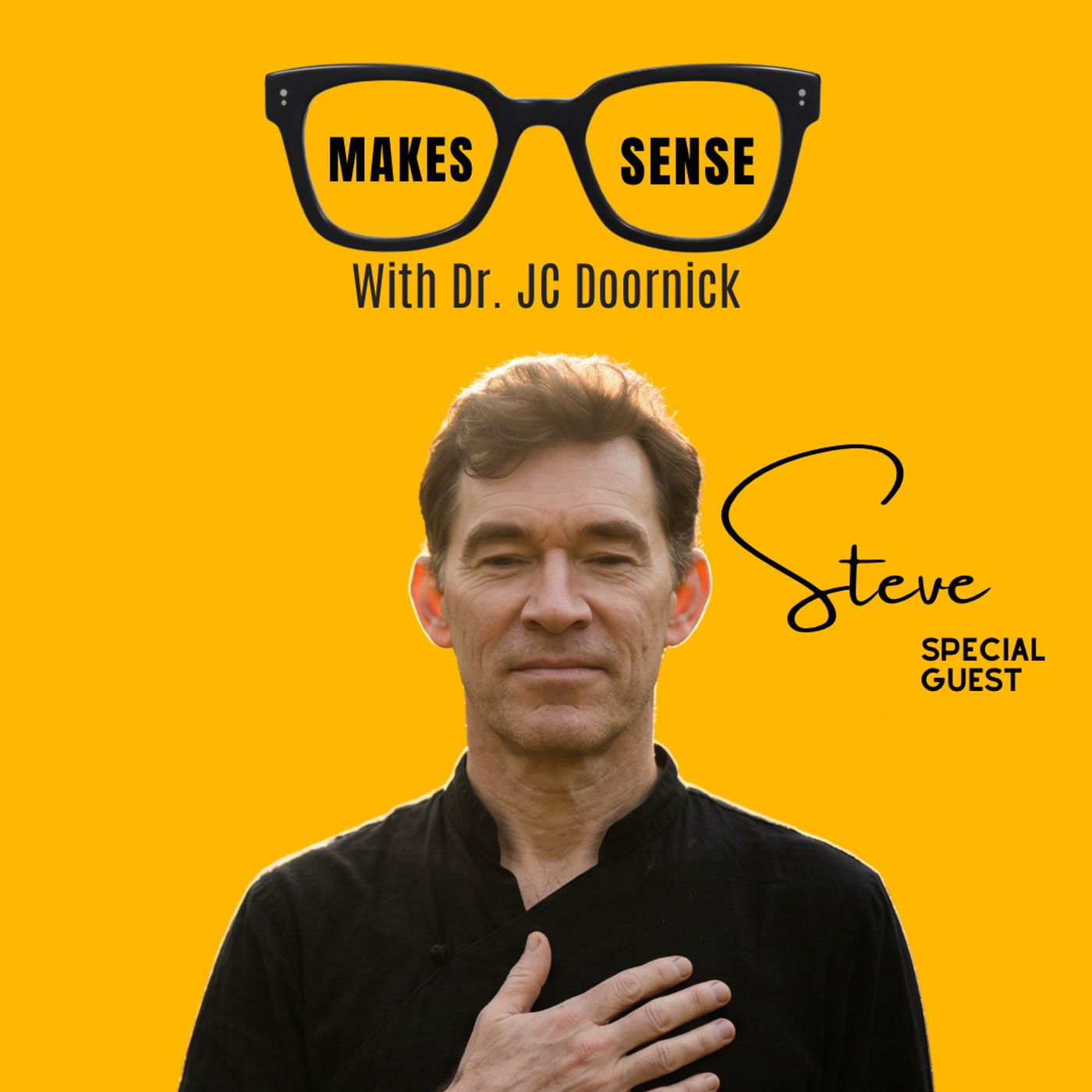
Makes Sense - with Dr. JC Doornick
The Psychologist Who Proved Trauma Can Trigger Enlightenment — Steve Taylor - E187
01:00:25
Steve Taylor — psychologist, bestselling author & consciousness researcher — reveals what really triggers spiritual awakening, why the ego is a recent evolutionary glitch, and the secret behind the Beatles’ genius.
Loading summary
Transcript202 lines
- [00:01]
Grainger Announcer
Grainger knows. When you're a procurement manager for an office park, you're not managing one building, you're managing all of them. And to stay ahead, you need to see through walls and around corners. Lights about to fail, Filters ready to clog H Vac on its last leg. If you wait until something breaks, you're already behind. Count on Grainger for quality products, easy reordering and 24. 7 support. Call 1-800-Grainger click granger.com or just stop by Granger for the ones who get it done.
- [00:30]
Dr. J.C.
Does Certainty expand Consciousness or shrink It? Today, we're going to be exploring one of the biggest questions that a human being could ask. What is that? Who are you beyond the voice that's in your head? Have you noticed that the world that we live in has been doing most of the thinking for you? That your beliefs, perceptions, reactions, fears and doubts have been shaped by unsolicited, elicited outside noise? How easy it's been for you to slip into that default sleep walking mode and label it as life and reality? Yeah, that ends here. Welcome to the make sense with Dr. JC podcast. This is your opportunity to start thinking for yourself, reclaim control, and step back into that role as the shock caller and dominant force of your own reality. It's when you change the way that you look at things that the things that you look at begin to change. So let's wake up, let's rise up, and let's make makes sense of why and how shift happens.
- [01:36]
Steven Taylor
Makes sense.
- [01:39]
Dr. J.C.
My guest today is psychologist, consciousness researcher and best selling author, Mr. Stephen Taylor. Steve is a Senior Lecturer in Psychology at Leeds Becket University, former Chair of the Transpersonal Psychology Section of the British Psychological Society, and the author of more than a dozen books translated into over 20 different languages. His work explores some of the most fascinating and controversial questions in modern psychology. What causes spiritual awakening? Can trauma permanently transform consciousness? Is the ego really who we are, and does consciousness originate in the brain? Or is it something far bigger? His books, including the Fall out of the Darkness, Extraordinary Awakenings and the, have helped bring serious academic attention to experiences that many scientists have traditionally dismissed. Even Eckhart Tolle himself has described Steve as an important contribution to the shift in consciousness happening on our planet. And now, with his newest book coming out called across the the Magic and Mystery of the Beatles, which is set to release in September 2006, it's going to explore the mystery behind the Beatles and their extraordinary success and creativity. So I want to welcome to the make sense with Dr. G.C. podcast Mr. Steve Taylor. Steve, I just want to take a moment and let you know what it is that I like about you. So one of the things that I appreciate most about your work is that you seem comfortable standing in the tension between skepticism and wonder. Most people choose a side. Some dismiss anything that they can't measure, and others believe everything that they can't explain. But you seem to have spent your career exploring some of the most profound human experiences while still maintaining the discipline of a psychologist. You don't ask people to believe. You ask them to investigate. And on this show, we like them. And in a world increasingly addicted to certainty, I think that that commitment to curiosity is incredibly valuable. Steve, welcome to the show. So welcome to the make sense with Dr. J.C. podcast. Mr. Steve Taylor, is it? Do you prefer Steve or Steven?
- [04:00]
Steven Taylor
I prefer Steve.
- [04:01]
Dr. J.C.
Steve.
- [04:02]
Steven Taylor
Yeah. A bit more informal.
- [04:03]
Dr. J.C.
All right. I feel like we're friends already, so it's just such an honor and a privilege to have you here. I was explaining to you, you know, synchronistically, how, you know, I had the. The great Elaine Aaron on the show, and we were talking about highly sensitive people, and I. And I was kind of diving into her work and that's. That saw this video and I heard her speak so highly of this guy named Steve Taylor, and then I said, wow, this is super, super cool stuff. So I'm so excited for my sense makers to find out about you and, you know, want to just dig in. Yeah. So my first question that I ask everybody, and if you're not a listener of the show, which you probably aren't yet, you'll. You'll. You're going to have a question asked to you that you've never had before. So I don't know if you want to stretch out and get ready for it.
- [04:53]
Steven Taylor
No, let's go for it.
- [04:55]
Dr. J.C.
So what's it like to be Steve Taylor these days?
- [04:59]
Steven Taylor
What's it like? Oh, wow, it's interesting. Yeah. I'm involved in a lot of different projects. I've got a research grant, so I'm studying time expansion experiences. I'm writing papers about that. I've got my book about the Beatles which are coming out in a couple of months. And I write poetry. So every so often I write a poem. I play music. I'm just. I used to be. I used to play music when I was younger. I used to play in bands. So I'm just getting back into that. Just starting to do some recording.
- [05:30]
Dr. J.C.
What kind of instruments do you play?
- [05:32]
Steven Taylor
I mainly played the bass guitar.
- [05:34]
Dr. J.C.
Oh, wow.
- [05:34]
Steven Taylor
And did Some singing as well.
- [05:36]
Dr. J.C.
I heard a funny joke, and I can only say these jokes because my son plays bass guitar and somebody was saying, you know, how. How do you hide a guitar so that nobody will find it? And they said, put it in a bass guitar case. That's right. That was it. That was like a standing joke. Well, what a great. What a great position to have, you
- [05:58]
Steven Taylor
know, I love it. I've always loved the bass.
- [06:00]
Dr. J.C.
What's it like to be you these days in the sense of the topics that you discuss as far as your, you know, just level of awareness and awakening and consciousness after everything that you've been working on?
- [06:13]
Steven Taylor
There's more interest in these areas than when I started out. I started out maybe 25 years ago. It seems as though these. These areas are quite sort of abstruse and niche areas. So there's certainly more, you know, it's more mainstream now, but there's still some pushback from, like, from my university, for example, you know, that they don't really understand my stuff is a little bit esoteric for them. So there's a bit of sort of a, you know, a conflict with academic authorities and mainstream, conventional, materialistic perspectives. So, yes, it's still a little bit far out as far as academia is concerned, but I think, you know, there's a lot more interest, you know, within society in general.
- [06:54]
Dr. J.C.
I'm really fascinated to understand. Just if you could share your opinion. Why, why is main. Why is mainstream academia pushing back against stuff that just seems so logical and so well accepted?
- [07:10]
Steven Taylor
I think there's a. There's a worldview. You could call it physicalism, you know, the belief that, you know, fundamentally only physical things, only material things exist together with material or physical forces and energies. But it's a bit of like a dogma, you know, if you. If you subscribe, subscribe to the physicalist worldview, then you're skeptical about altered states of consciousness. You may believe that these. These states exist, but only as a kind of hallucination. You know, I write a lot about awakening experiences. I study what I call awakening experiences. But as far as physicalism is concerned, these experiences are a kind of hallucination. They don't tell you anything about the world. They just tell you something about abnormal brain chemistry. So that. That's the kind of, you know, physicalism kind of reduces everything to a normal state of consciousness, you know, and everything that veers away from a normal state of consciousness is an aberration.
- [08:10]
Dr. J.C.
I think my question to academia would be, pardon me, but who decided what normal Consciousness is like, do we have. Do we have that in writing anywhere? I mean, is that something from the Bible or.
- [08:22]
Steven Taylor
That's a good point.
- [08:23]
Dr. J.C.
Yeah.
- [08:24]
Steven Taylor
Everyone sort of assumes that normal consciousness is the truth. It tells us the truth about reality.
- [08:30]
Dr. J.C.
Yeah.
- [08:30]
Steven Taylor
When it is just one particular state of consciousness.
- [08:33]
Dr. J.C.
Yeah.
- [08:33]
Steven Taylor
And in my view, it's quite a limited state of consciousness.
- [08:37]
Dr. J.C.
This is. This is right up my alley. You know, I. I just find it so funny because the person that really knows the truth knows that they don't. You know, it's kind of a funny topic. So what does it mean? This is some questions that, you know, are. You're so well versed in. But I just want to make sure that people get. Get them from you. What does it mean for someone to experience an awakening?
- [09:03]
Steven Taylor
Well, if you think that our normal state of consciousness is limited in some way, and I suggest that it is a kind of sleep, you know, it is limited in quite, you know, a number of different ways. It provides a sort of a de. Intensified perception of the world so that the world is kind of slightly unreal to us a lot of the time. It creates a sense of separation so that we feel as though we're isolated entities living inside our own mental space. When you have an awakening experience, there's an expansion of awareness. First of all, the world around you becomes much more real and beautiful. It's a bit like becoming a child again. You know, that children have this really intense perception of the world around them. In an awakening experience, we regain that perception and also we transcend our normal sense of separation. We feel somehow connected to other people. Also, we feel connected to the natural world. The natural world seems to be somehow alive and sentient in some ways. So it is a very positive experience in which a lot of barriers seem to fall away and we seem to gain a more authentic perception of the world around us.
- [10:16]
Dr. J.C.
It seems like it's attached to the word understanding. My book is called Makes Sense. So that's kind of everything that. And this is my. My. One of my call signs is I always say. And what that stands for is. Haven't made up my mind yet about anything. So I just love the idea of living open and curious. So I just love the idea of living open and curious. And I just think that, yeah, that's a good perspective.
- [10:44]
Steven Taylor
There's just as soon as you think, like you say, as soon as you think you know the truth, you don't.
- [10:48]
Dr. J.C.
Yeah, exactly. I always wonder what, like, the beings that might be maybe are playing with us in some sort of A petri dish would think when somebody says, by George, I've got it. And they say, is that right? Is that right, sir? So you've spent decades studying this stuff. And, you know, I'm deeply, deeply entrenched in consciousness and reality. I've had Donald Hoffman on this show and, and all the simulation hypothesis people. So I love this conversation. But, you know, after decades of studying consciousness, what would you say is the biggest misconception that people have about who they are?
- [11:26]
Steven Taylor
I would say that it relates to the physicalist biggest misconception is that people believe that or many people believe that they are just physical machines. They're just kind of meat machines and nothing exists within them apart from physical stuff.
- [11:39]
Grainger Announcer
Right.
- [11:39]
Steven Taylor
And that their consciousness is just a product of that physical stuff. So your thoughts are just the product of neurons. Your consciousness is just the product of neurological processes. So I think that's a fundamental myth that many people hold to.
- [11:53]
Dr. J.C.
Yeah, it's fascinating. One of the questions that I love to ask myself whether I just identify, you know, one of the 40 to 70,000 thoughts, and I choose to make that my identity for the day when I just love to ask myself, well, what else might be true? And, you know, this, this con. Concept of, of consciousness is so fascinating because we, whatever people think it is, they. They're putting a lot of weight into it and, and attaching it to reality. So once again, my theme is I just think that the world could use a little bit more open curiosity. So in connection with that, on the topic of ego, a lot of your work is, is, you know, on this topic. And it's. I think you've said that ego is not really our true identity. So for someone hearing that for the first time, how would you define what is the ego? And if we're not that, who are we?
- [12:56]
Steven Taylor
What we think of as the ego? I mean, ego is really. It's the Latin and Greek word for I, and it refers to. I would say it refers to a superficial sense of identity which is created by our conditioning and also by our thoughts and our concepts about ourselves. But often, I often get this when I meditate. You know, if I spend a couple of days with my normal self sort of thinking about things and doing things, I kind of feel as I've become somebody else, some sort of superficial Steve, not the real Steve, but I sit down to meditate, and after maybe 10 minutes, it's like, wow, I'm back to the real Steve. You know, the surface thoughts start to fade away and I seem to attune To a deeper part of myself and it sort of kind of clicks back into place. And that to me that means that I'm disidentifying with my ego self, my conditioned thought self, and I'm reconnecting with my essence, if you like, the set. The self which is not created, the self which, which always existed beneath thoughts and beneath the conditioning which my parents and my environment thoughts imposed on me.
- [14:08]
Dr. J.C.
We, we in our ecosystem, we refer to that as our MFTP se. Like our programmers, we say our mother, father, teacher, preacher, society and then the paying forward of evolution. And we're walking around saying yes, this is what is. You know, this is what is. How do you know? Because you were referring to back to myself, my real self. How do you know that you're your real self?
- [14:34]
Steven Taylor
Well, that's a good question. Well, that's a good question.
- [14:39]
Dr. J.C.
You've just, you've just met somebody that pays attention.
- [14:43]
Steven Taylor
I'm not used to this. So I would say that your ego self is continually changing according to the content of your thoughts, according to the people you're with, according to the activities you're engaged in. It's continually changing. It's almost like you're a different person every minute or every hour. So there's a sense of kind of unsteadiness, this kind of instability. But when you attune to your, your deeper self, it's stable. It's always the same, it's unchanging. It's like the still center of the turning world. So you can, you always know because it's that it's returning to that source, that kind of deep, stable source. The core of your being which. Yeah, so you, you, you're free from the, the constant chatter of the, the normal mind, the constant changing of the normal mind. So that's how you know, that's fascinating.
- [15:42]
Dr. J.C.
I, I always wonder if that version that you're talking about is just the one that I created that I like the most, you know?
- [15:50]
Steven Taylor
Well, no, I don't think so because I think it, that that's how you know, it never changes. It's stable.
- [15:57]
Dr. J.C.
Stable.
- [15:58]
Steven Taylor
It's deep rooted.
- [15:59]
Grainger Announcer
Right.
- [16:00]
Steven Taylor
And it's somehow, you know, it feels, you know, your mind feels like the surface of the ocean, but this part of you feels like the deep ocean beneath the surface. You know, it's really, it stretches way down into the depths of your being.
- [16:15]
Dr. J.C.
Yeah, it's fascinating about humans where there's certain things that we kind of know that we know. I always find that interesting. So you, I've heard you Say in other interviews that you think that or you take a stance that ego may actually be a mistake of evolution. I think you call it the ego explosion you've referred to. So pretty fascinating radical statement that I love. I just love to hear your thoughts on that.
- [16:43]
Steven Taylor
Well, maybe first it's important to point out that I think we need a certain degree of ego to survive in the world. A limited degree in the sense that we need somebody or something to organize our lives, to direct our lives, to make plans and decisions, to make sure that we're living in the real world rather than in our own thoughts. So you need a certain degree of identity. Let's use the word identity rather than ego.
- [17:10]
Dr. J.C.
Sure.
- [17:11]
Steven Taylor
But the ego should really be just a small part of our identity. It should be like an administrator, not a dictator. I think at the moment, for most people, the ego is a kind of dictator.
- [17:20]
Dr. J.C.
Interesting.
- [17:21]
Steven Taylor
Like an authoritarian dictator who runs the whole country or tries to run the whole country. But the ego should just be a part of that. It should just be an administrator who performs an organizing role. But I think what happened early on in our species history, and I suggest that this happened about, well, 6,000 years ago. So just before the dawn of history, there was a sudden change in that people quite quickly developed a much stronger sense of identity, a much sharper sense of individuality, which I call the ego explosion. So unlike earlier peoples, unlike prehistoric peoples, people began to feel separate to their bodies, separate to their environment, and also separate to each other. So there was a new sense of duality. And I suggest that a lot of the social discourse and psychological suffering which entered history at that point was rooted in this new sense of individuality.
- [18:21]
Dr. J.C.
So fascinating. And, and what was it that happened 6,000 years ago?
- [18:26]
Steven Taylor
Well, it's difficult to be sure. But you know, there's a, there's a clear distinction between prehistoric peoples. You can also see this in some of the world's indigenous peoples who don't have the same sharp sense of individuality that we have that so called modern civilized peoples have. There's this sense of connection to the environment, sense of connection to their own bodies, sense of connection to each other. So, but one theory which I suggest in my book the Fall, and by the way, this is the fall, the ego explosion is the fall which is talked about in the Bible and in other cultures around the world. All cultures speak about, some fall from, from harmony into discord, some fall from a collective identity into separation. So, well, there are some evidence that it was connected to an environmental change because the Fall or the ego explosion originally originated in the Middle east and Central Asia around 6,000 years ago. Right at the time that it originated, there was a major environmental change in that a lot of areas around there that were arid and full of vegetation at that point, that were full of vegetation and fertile at that point they became arid. There was a process of desiccation and desertification in parallel with this change. So one theory is that because life became suddenly a lot harder for these people, they had to develop a new sense of individuality to survive. They had to develop a sharper intellect. They had to develop a more kind of practical, abstract intelligence to survive. But unfortunately, at the same time, the development of this new kind of intelligence also led to social pathologies like warfare and patriarchy, which didn't exist in any real sense before then.
- [20:20]
Dr. J.C.
It's kind of a necessary evil. It's.
- [20:23]
Steven Taylor
Yeah, for those people living in those areas, it was. And those peoples began to migrate over throughout Europe and throughout Asia and other parts of the world and gradually began to dominate the whole world.
- [20:35]
Dr. J.C.
It's so fascinating. I just think humans are so fascinating. I know that we're part of that. But, you know, it's. There's just if. If you allow yourself to step out of the participation of being a human and just observe, it's quite an interesting thing to watch.
- [20:53]
Steven Taylor
It is. I mean, every single person is fascinating. I find it interesting just to observe one individual, not too closely in case they, you know, they notice it and get angry and wonder why I'm looking at them. But, yeah, every single person is different is fascinating.
- [21:08]
Dr. J.C.
So my audience hears me talk quite a bit about the topic of certainty, and I think kind of. Kind of like the ego explosion. I think certainty is a big challenge. You know, people just feel. Feel very pressured unconsciously to be right about things. And, you know, this society we live in very often demands certainty. And you've heard me talk about how valuable I think it is to be open and curious. So I like to say that I revel in uncertainty. This is why I love scientists. Scientists are not really so attached to being right. They just seek deeper truth, you know. So I'm curious, from your perspective, does certainty expand consciousness or shrink it? Does certainty expand consciousness or shrink it?
- [22:02]
Steven Taylor
I think it shrinks it. I think certainty is very detrimental to science and consciousness. I think as soon as you're certain you've reached the end. Yeah, yeah. You don't want to go any further, and you immediately close down your perspective. That's the problem with what I call scientism I love science. Like you, I love science and I really respect scientists who are motivated by a sense of wonder and curiosity. But I'm very skeptical about scientism, which is a kind of dogmatic kind of science which seeks to understand the world completely and which creates a worldview which is usually physicalism, in order to close down the world completely. It's like, ah, everything is just physical stuff. Everything is just is reducible to material interactions or neurological processes. Therefore, we can, you know, we've got a few things to work out, but we understand the basic principles of the universe. That's, you know, that's the worst situation to be in as far as I'm concerned.
- [23:04]
Dr. J.C.
So if certainty and knowing and, you know, completeness is not the goal, what would you say the goal is?
- [23:13]
Steven Taylor
The goal is to, you know, to perceive the wonder of the universe and to be open to the wonder of the universe. I mean, I think you got to remember that human beings are essentially animals or a very, very highly evolved form of animal with a very, you know, intricate and deep, intense form of consciousness. But we're basically animals. And every animal has a limited understanding of reality, a limited capacity to understand reality. If you think about a sheep, you know, sheep is kind of sitting on the side of the hill observing the world around it, observing the other sheep, you know, eating the grass. The sheep probably on some level assumes that this is all there is, this is the world. And I think every. An insect probably has a similar perspective. You know, it has a certain awareness. And it probably assumes on some level that this is reality, this is what I know, this is what there is. But we're in the same position. We probably have a more intricate kind of consciousness than an insect or a sheep. But we still, you know, we're still limited in the same way that sheep or an insect is limited. One day, maybe there will be other more developed beings than us in the world, and they will have a more expansive understanding of reality. They will be aware of more than we are in the same way that we are more aware of than what a sheep is. So you have to accept that we are not the end of evolution. We don't have a monopoly on reality. We're not aware of absolute reality. We're only aware of a fragment of reality. It's totally logical to assume that there are forces, energies, phenomena beyond our understanding, which we just don't have the capacity to be aware of. So that's my position. You know, I appreciate that we are limited creatures with a limited awareness and a limited Intellectual capacity. But I, I think that's great. You know, I don't want to send. I don't want to understand everything. Who understands quantum physics, you know?
- [25:13]
Dr. J.C.
Yeah. So fascinating. And, and I'm just seeing that that's probably a very frustrating topic for people to hear that, you know, this whole. What you see is, what you get is it might not be. And, and then I love the idea of, like, maybe eventually some sort of advanced beings will have a more expansive version of it, but at the same time, they will be limited as well. What role does curiosity play in awakening? Now, this was kind of the attachment, you know, what Elaine Aaron was talking about that I found so fascinating was this idea that highly sensitive people, which society very often deems as weak or, you know, problematic, actually have a superpower. You know, they, they have the ability to take note of things. And curiosity plays in that. I'm like, I'm highly sensitive in the realm of curious. Yes, I'd love to be curious. So as far as awakening, what role does curiosity play in awakening? And could awakening simply be the willingness of somebody to begin questioning everything that we think that we know
- [26:31]
Steven Taylor
when we awaken? Curiosity also awakens. I think when you're in the normal state of consciousness, the normal limited state of consciousness, your, your understanding is limited, but also your interest is limited. You live in a kind of familiar world, and you kind of, you, you, you subconsciously assume that you understand the world as it is, that you know the world as it is. So you're not really curious. You, you don't really want to expand your boundaries or live a more adventurous life. You're happy just to repeat the same experiences and to assume that you understand the world. But when you have an awakening experience, you realize that there is a lot more out there. You realize that you don't understand the world. A good example is a friend of mine. He was a very kind of successful, materialistic kind of guy with a sports car, with his own business. And he was quite happy. But he had a kind of a breakdown. Maybe it was due to stress or overworked. And initially he was, he was in a very kind of, you know, broken down state, a state of suffering. But he slowly pieced himself back together and he realized that once he kind of stabilized again, he was looking at the world in a different way.
- [27:49]
Dr. J.C.
Right.
- [27:50]
Steven Taylor
And he realized that he didn't actually know anything before. He'd assumed that he understood life, and he got life worked out. But now he realized that there were expanses of reality that he'd Never sensed before he realized that there were elements of the world that he didn't understand. So he said it was a little bit scary because there was suddenly these. Maybe it's like sort of walking out of a comfortable house into a wilderness, into an expansive landscape full of strange phenomena. But it was invigorating as well. And I think that always happens in awakening experiences. There's this sense of, wow, I don't really understand. There's so much more. And naturally, you are curious, maybe slightly. Slightly scared, but I think your curiosity overrides that. So there's a new sense of exploration, a new sense of adventure, and it's almost like you're. You're born again.
- [28:47]
Dr. J.C.
Yeah. It's like once you get. You tap into a realm that you didn't know existed, you. You start to wonder, what else is there? You know, I've. I've actually had, you know, lots of interesting experiences in my life. I. I don't, you know, suggest that anybody do that, but I've worked with plant medicine for six. Six years or so. So I just remember you made me think of this. The first time that I found myself in that place, you know, wherever that place is that plant medicine takes you. The most profound part of it was that I didn't know that that existed, so I couldn't unsee that. And that started a whole new process of curiosity for me in my life. This is a. This is a great time to ask you. I know that you've. I think you wrote a whole book on this, but you've documented hundreds of cases, and I'm kind of curious why you were so fascinated about, you know, just people that have experienced profound awakenings, specifically after crisis. And you were kind of alluding to that right there. And it's ironic because I'm actually in the throes right now because I very much align with that. This is going to sound crazy to you to hear this from a podcast host, but I just found out four days ago for the first time, that I'm diagnosed with cancer.
- [30:07]
Steven Taylor
Really.
- [30:08]
Dr. J.C.
So. But what's. But what's interesting, you know, it prompts people to go, I'm so sorry. That's so terrible, but I'm having a totally different experience.
- [30:18]
Steven Taylor
Wow.
- [30:18]
Dr. J.C.
And it was one of the things that I was fascinated about because I'm very much aligned with this idea of crisis actually becoming an asset of sorts. And, you know, of course, there's fear and all of that stuff, but that's typically associated with talking to doctors. You know, if. If you're just allowed to just enjoy life. You can find blessings in anything.
- [30:43]
Grainger Announcer
So when you're a maintenance engineer in a beverage manufacturing plant, you keep production lines moving and quality on track because there is no room for slowdowns. With Grainger's vast selection of high quality motors, sensors, belts and hard to find parts, you can get what you need fast and all in one place. So nothing gets in the way of getting the job done. Call 1-800-GRAINGER clickranger.com or just stop by Grainger for the ones who get it done.
- [31:14]
Dr. J.C.
What is actually happening. And feel free to, you know, ask me questions about what I'm going through. But what's actually happening psychologically when somebody reaches, you know, some sort of a breaking point or goes through some sort of a level of crisis. Because my experience shows me that it is woken me up to something unbelievable. I mean I'm not. I have never been so clear and alive and conscious as right now. Wow.
- [31:42]
Steven Taylor
Yeah, that's not uncommon. I've met so many people in particular with cancer.
- [31:47]
Dr. J.C.
Yeah.
- [31:47]
Steven Taylor
You know, it seems to be the great awakener. And obviously it doesn't happen to everybody. A lot of people just suffer from anxiety.
- [31:55]
Dr. J.C.
Right.
- [31:55]
Steven Taylor
And fear. But many, many people undergo an awakening almost immediately after being diagnosed with cancer. There's one woman, a friend of mine, she, she. She was diagnosed with breast cancer at the age of 42. And she said as soon as she came out of the consulting room, everything was different. She said it was the first time she'd realized that life is temporary. She realized it's the first time she'd realized that death is a reality. And she realized that she'd always taken life for granted. Right. She sort of subconsciously assumed that she was immortal like a lot of people do. So she said immediately everything around her looked so much more beautiful and alive.
- [32:37]
Dr. J.C.
Yeah.
- [32:37]
Steven Taylor
There was a kind of energy radiating in the air, a kind of radiance in everything. So I mean, are you experiencing something like that?
- [32:45]
Dr. J.C.
Oh, I mean. Well, here's the funny thing is I was kind of already doing that, you know, like this is the last thing in the world that I thought was going to happen. I didn't have a problem. I don't, I don't have any symptoms. It was just a fluke that I had a scan for something else and they found it. So I was kind of on that journey already because I've been through. This is not the hardest thing I've ever been through. So. But it, but you know, just to, to your point, if you want to Create a visual. We had our family over last night and you know, I'm. I was out in the backyard and my wife was watching me because I was cooking, you know, and I was just out in the backyard by myself, looking up. And my wife made an assumption that maybe I was like struggling or something like that. She goes, sweetie, are you okay? And I'm like, oh, yeah, I'm fine. She goes, what are you doing? And I said, I'm just looking at the trees. So, yeah, I mean, I, I would assume that I'm doing a little bit more conscious, you know, curious looking and stuff like that. But I would say the most profound change, you know, that you can take away just from my own experience is that I knew all of these things before I, I thought that I embodied them, but I, I think I more knew them like from reading about them. Reading your books. And I say, yes, of course, you know, there's, there's a, there's a clearing, you know, and all of that stuff. But it's not until you actually, there's a physical component to it. It's not until you actually experience it that you can go to experience the depth of that awakening and clarity. So I, it's funny because they're going to do like, there's going to be these fundraisers and stuff. We want to raise money for cancer and stuff. And my wife is telling me, you gotta kind of look a little bit sicker when, when we do this stuff
- [34:37]
Steven Taylor
and don't look so happy.
- [34:39]
Dr. J.C.
Well, it's really, it really bothers people when I tell them that. I mean, this, you know, there's going to be some tough things that I have to deal with, but I always have tough things to deal with. But I just, in a weird way, just feel blessed and lucky.
- [34:57]
Steven Taylor
Yeah.
- [34:57]
Dr. J.C.
Strange.
- [34:58]
Steven Taylor
I. I interviewed and he, he said that he'd always been a depressive kind of person, a grumbler, a moaner. There always been something wrong, and he was always afraid of things in the future and regretting things about the past. But he said after his diagnosis, all of that just fell away.
- [35:16]
Dr. J.C.
Right.
- [35:16]
Steven Taylor
He said he just didn't care about the future. He didn't care about the past. Yeah, he was just living in the present and he was happy. You know, it was a big paradox that he was told that he only had a year or so left to live.
- [35:26]
Dr. J.C.
Well, that's, that's, that's a different situation than mine. But, you know, I, I've contemplated that. I've, you know, because when doctors tell you talk to you, they don't say, hey, we got to tell you some news. They just say, oh, this is what we're going to take out your kidney and we're going to do this. But when you have to do something, it's kind of a nice. You know, I think the, the bigger challenge is when you have options and you can choose and you have free will, you know, like, I'll give you an example. I kind of have to eat even cleaner than I was right now.
- [36:05]
Steven Taylor
Right.
- [36:06]
Dr. J.C.
And I don't have a choice. Right. So. So what do I get from that? I'm probably going to get in the best health of my life, you know. So on this topic, this is gonna sound like a funny one because, like, people that are listening right now say, well, then I just need to go get cancer and everything will be fixed. Do you believe that suffering, I don't know if I'd say, is required for awakening or is, or is kind of like a component of it, or do you think that somebody that's just practicing curiosity can have an awakening from a more gentler path? Because I'm telling you that I've had awakenings, but like, this is a different level of awakening. So I'm wondering, do human beings need to be confronted with crisis and adversity on a high level to truly awaken?
- [36:59]
Steven Taylor
So in many cases, suffering is a kind of fast track awakening. Now you can go through a gradual awakening, through many years of meditation or curiosity, many years of following some kind of spiritual practice or some kind of spiritual path.
- [37:13]
Grainger Announcer
Right.
- [37:14]
Steven Taylor
You know, that could take decades, and you may undergo some very, very incremental awakening. In fact, it's probably inevitable. If you meditate every day for 10 years, you'll definitely undergo some form of some degree of awakening. But if you want to undergo a sudden awakening, a dramatic awakening, a kind of life changing awakening, then it usually does happen through intense suffering. I call it transformation through turmoil. And cancer is probably the major area where it occurs. But it also happens after bereavement. Some people experience it after the death of a loved one, their husband or their child. It can happen after a long period of addiction. I've met many people who, they've been through decades of addiction. They've reached a point of rock bottom where they've lost everything. They think they're going to die. Suicide, contemplation, a sudden shift.
- [38:07]
Dr. J.C.
Yeah.
- [38:08]
Steven Taylor
And it is an awakening. It is literally the emergence. I mean, this, this applies to some people. It is literally the emergence of a new kind of self is as if their Normal ego self that we were talking about earlier, right. That dies, it dissolves away and a new self emerges in its place. Maybe that the essence we were talking about earlier, which was obscured by the ego self, it arises in its place. So it, it is a shame, but it seems that many people do have to go through suffering to reach that.
- [38:42]
Dr. J.C.
Yeah.
- [38:42]
Steven Taylor
Or a near death experience, for example.
- [38:45]
Dr. J.C.
This is what drew me to plant medicine is I heard about this. I mean, God, it's everywhere. And we've got all these fascinating guests coming on. Like I've got this guy Andy Golar, I don't know if you've heard of him, but he's figured out that if you put a red laser on the wall and you smell smoke, dmt, you can see that the matrix exists and, and things like that. So I'm, I mean like you're coming on my show, but when I, I went to the Amazon jungle and I experienced what's called 5CEO DMT and you know, that's pretty powerful stuff and I experienced what people would call ego death. And I had that kind of an awakening. That's why I went there as I felt like I just wanted to experience that, that space. But still this is, is, this is, this is bigger.
- [39:35]
Steven Taylor
So yeah, unfortunately this is what's happening in transformation through turmoil. It is a kind of ego.
- [39:41]
Dr. J.C.
I love that transformation from turmoil.
- [39:43]
Steven Taylor
But, but I guess in psychedelics the ego can sometimes return once the psychedelics wear off. Yeah, once you return to your normal context. But in transformation through turmoil, it's very rare that the normal ego returns. It is usually a permanent transformation. And even if in the case of cancer, you know, I've met many people whose cancer has gone into, gone into remission.
- [40:06]
Dr. J.C.
Right.
- [40:07]
Steven Taylor
But they remain in that higher, higher states. In that awakened state.
- [40:10]
Dr. J.C.
Yeah, yeah, that's, that's, that's well said. I love that. Where, where have you written about that transformation through turmoil?
- [40:19]
Steven Taylor
I do, I have, yeah. I've written a book called Extraordinary Awakening.
- [40:22]
Dr. J.C.
That's right. Okay.
- [40:24]
Steven Taylor
Which is, it's based on my research into these areas. I have a different chapter on different forms of turmoil like imprisonment and addiction and cancer and various other forms of turmoil.
- [40:35]
Dr. J.C.
Well, I'm, I, I'm, I hope that my, my share of my story will add to your work.
- [40:40]
Steven Taylor
Yeah, sure. Well, yeah, we'll have to check in again.
- [40:42]
Dr. J.C.
I want to talk about time expansion. I, I love what you say on this. So your research on time expansion and you know, time expansions, experiences which I think everybody can resonate with it just fascinates me. So what have you discovered about those moments where people kind of like lose track of time or time seems to slow down? What is actually happening in those moments? Because this is kind of connected to the flow state as well.
- [41:14]
Steven Taylor
Yeah, I mean, in a flow state time normally goes very quickly. You know, you've been in flow when time seems to disappear and two hours seems to pass in 20 minutes. But I mainly focus on experiences when time slows down radically and the normal situation is an accident, you know, a car crash, which is what happened to me, that's how I got into this because, right, I had a car crash. I thought I was going to die. And I was amazed that our car was spinning around in the middle of the highway surrounded by other cars, you know, driving at 70 miles an hour. So I thought, wow, this is it.
- [41:50]
Dr. J.C.
Yeah, I heard that story. That's just so crazy. And, and you guys were so excited that you were okay.
- [41:56]
Steven Taylor
Yeah. So, I mean, our car spun round towards the shoulder and we crashed into a barrier. And I looked at my body and thought, wow, I'm not hurt. I looked at my wife, she's not hurt. So I was so exhilarated that I survived uninjured. But when I thought back to it, the most amazing thing was that the whole incident probably happened, probably lasted three or four seconds in reality, but in my mind it seemed to be stretched out much, much longer, something like 45 seconds. I fell as I felt as I had so much time to observe the situation, to think of the possibility of preventative action. So after that I began to collect reports of these experiences and I found out that they're very common, that nearly three quarters of people have had at least one time expansion experience. Mostly in accidents or emergencies, but also in, in the concepts of psychedelics or in deep meditation, also in sports.
- [42:51]
Dr. J.C.
I'll have to share the video of me doing the first time 5 Meo DMT with you. I mean, it's very entertaining to say the least. But the experience to your point, when I woke up, you know, not, not what you see in the video, I asked my friend, I said, how long was I out? Because from, from my perspective, I was gone for a week or two.
- [43:20]
Steven Taylor
Really.
- [43:20]
Dr. J.C.
I mean I was. I mean I had left my body and when I came back I assumed that I was going to have a beard. And like, I mean, I was gone for so long. And when I watched the video from st start to finish, I mean start to absolute finish, it was seven minutes.
- [43:38]
Steven Taylor
Seven minutes.
- [43:38]
Dr. J.C.
Seven minutes. So, you know, that's an example of having assistance, you know. But ego death is something you could do that way or a near death experience, you know, And I don't know if this is like a safety measure that our, that our bodies have. You know, it could be, maybe.
- [43:56]
Steven Taylor
Well, that's, that's one theory.
- [43:57]
Dr. J.C.
Yeah.
- [43:59]
Steven Taylor
The theory is that thousands of years ago, when we were living in jungles and forests and surrounded by wild animals, it would be beneficial for us to slow down time. When a tiger jumped in front of us, you know, another wild animal attacked us. So we'd have more, we would have more time to save ourselves and respond to the danger. That's one theory. But the problem with that is that time expansion experiences also occur in other situations like in psychedelics or in deep meditation situations which are not dangerous, where there is no threat to our lives. So I think it is related to ego death. It's another aspect of ego death. Or maybe not complete ego death or ego dissolution or ego softening.
- [44:42]
Dr. J.C.
Right.
- [44:42]
Steven Taylor
My theory is that it's related to the boundaries of the ego. A lot of the time we have a sense that there is a boundary between us and the world. And when this boundary softens, time opens up. And when time disappears. Sorry, when the boundary disappears completely, time also disappears completely. So, you know, time is basically a construct of psychological processes. So.
- [45:09]
Dr. J.C.
Wow.
- [45:10]
Steven Taylor
I mean, I guess this is about certainty. Again, most people assume that time is objective and absolute and it flows at a steady rate. But in these experiences we realize that time is just a construction.
- [45:21]
Dr. J.C.
Yeah, I love not knowing.
- [45:25]
Steven Taylor
Yeah.
- [45:25]
Dr. J.C.
You know, I just love. I. It's my. One of my favorite answers to give people. As I say, I don't know. And that's the truth, you know, or I'm not sure. I just came up with this idea for a fantastic movie or even something we can do in reality if we, if we knew how to access the database. The idea would be that anytime somebody gets diagnosed with cancer or has some sort of near death experience or crisis, this whole group of people kind of gather around them and say, congratulations, welcome to the awakening group. You know, it's. It's almost like you, you made it. Congratulations. Sorry you had to go through that, but it's great. You're going to be so happy over here.
- [46:05]
Steven Taylor
I know.
- [46:06]
Dr. J.C.
This is our leader, Steven Taylor. He's.
- [46:10]
Steven Taylor
Yeah, that would be wonderful. I think, you know, if everybody went. Every human being went through this process, went through this transformation, the world be what. The world would be so different. It would be infinitely more harmonious. It would Be a completely different planet. So that's a paradox, really, that we need to go through these experiences, these experiences of suffering and turmoil in order to awaken. Yeah.
- [46:34]
Dr. J.C.
You know, what's interesting about it is that I. I would say, logistically, everybody does go through something like that in their life, but you also have to be open and curious enough to take a look around because I think.
- [46:47]
Steven Taylor
Exactly.
- [46:48]
Dr. J.C.
We live in a world that just shuts things down so fast because of our programming and our operating system. So I think that somebody that gets in a car accident and turns into a victim, for instance, or somebody that, you know, has some sort of a crazy hallucinogenic experience and just does. Is in disbelief about it. So I do. I do think that there's something about the individual and there.
- [47:14]
Steven Taylor
Yeah. In fact, when I was doing my research, I asked myself, why do some people undergo this transformation while others don't?
- [47:21]
Dr. J.C.
Right.
- [47:21]
Steven Taylor
Because as you say, everybody goes through trauma and turmoil at many points.
- [47:25]
Dr. J.C.
What did you find?
- [47:26]
Steven Taylor
But only a small minority of people undergo this transformation. And I found out that it was largely about their personality type.
- [47:32]
Dr. J.C.
Right.
- [47:33]
Steven Taylor
It was people who were open and curious. You know, they were willing to explore their new state. They were willing to be open to their new experience, whereas other people would. They were afraid. They wanted to control their experience. And also it was about an attitude of acceptance. You know, that's probably the primary thing that if you are willing to acknowledge and accept your predicament, even if it may be painful in some way, then you open yourself to transformation. But if you're, you know, if you don't want to face it or you don't accept it, if you resist the experience, then you won't undergo transformation.
- [48:13]
Dr. J.C.
Interesting. Because what that's saying is that we're all going to go through some sort of crisis and trauma. So that's not the goal. The goal is to be. Allow yourself. Permit yourself to be open and curious. So, I don't know. We'll have to figure that out. That'll be the next episode. So let's talk about this. You know, I'm a huge Beatles fan.
- [48:35]
Steven Taylor
Oh, yeah.
- [48:36]
Dr. J.C.
But, like, I get it. I get it. Like, I don't know how you came up with this idea to look at the Beatles in. In a different light, but, I mean, it makes so much sense. And this is like, what. I'm super excited. So I believe the book is called across the Universe. Right. And the Magic and Mystery. I'm so happy you use those. Those words, the magic and mystery of the Beatles. And that is set to release in September and I can't wait to get my hands on that. But what inspired you to write it? Was it the idea of consciousness? And if so, why did you choose the Beatles?
- [49:12]
Steven Taylor
I've always been a massive Beatles fan from being a child and where I live in England, I live in Manchester, which is quite close to Liverpool, so there's a kind of geographic association. And also I was a musician when I was younger, playing in bands, but I was always fascinated by. The Beatles were so. On the one hand, they were so prolific, they recorded 213 songs in less than seven years. And at the same time, they were continually changing every year. They were effectively a different band. If you compare The Beatles of 1967 in their psychedelic gear and their kind of weird experimental music, compare it to the 1964 Beatles with their suits and their love songs, they're a completely different band. There's no relationship between them at all. So I wanted to explore, on the one hand, why why the Beatles were so prolific and so progressive and also why they had such a massive cultural impact. You know, they were the most famous people in the world at that point. And there was. They were so attuned to the zeitgeist. There was something about. Something about the whole 1960s zeitgeist, which the Beatles represented.
- [50:20]
Dr. J.C.
Yeah, I mean, I don't want to get everybody after me, but I'm a huge Beatles fan. But from the perspective of actual talent, you know, it's like it's more of them hitting everything perfectly. And right at that time, then like, I wonder if that band could make it today, you know, so. So there was timing involved. So my question to you would be, was their genius primarily talent or to the. To the insight, I think, of the book, was it more about maybe a higher level of consciousness that they had? They were tapped into the signal or something.
- [50:59]
Steven Taylor
The essential thing about the Beatles was that they were a really tight collective. They had a group mind. They weren't really individuals. Everybody, everybody said that about them, that. That they had this kind of uncanny unity about them. And what if you look at interviews from, you know, the early 60s, the. Sometimes the interviews ask them a question. Like, for example, one interviewer asked George Harrison, do you believe in God, George? And George said, we haven't decided yet. So every answer was, we, you know, they weren't individuals. And that was the secret. That was a secret really, that they had a group mind and that was. Allowed them to be incredibly prolific. And it also kind of opened them to the zeitgeist allowed.
- [51:42]
Dr. J.C.
You keep saying zeitgeist. Could you explain. Explain what?
- [51:46]
Steven Taylor
Zeitgeist is? The zeitgeist.
- [51:49]
Dr. J.C.
Yeah. Could you explain what that is? The zeitgeist.
- [51:52]
Steven Taylor
The zeitgeist, it's sometimes used to refer to the prevailing cultural trends or the artistic trends of an era or the kind of the collective mood of a time. But in its original meaning, it refers to a spirit that it literally translates as the spirit of the times, time, spirit. So it suggests that there's a kind of undercurrent that flows through every era which manifests itself in people's behavior and in culture and art.
- [52:27]
Dr. J.C.
I'm just trying to go through a scenario of having like the same talent wise, you know, same four people, same songs, but one of them does what they did and the other doesn't. What is the one that doesn't lacking? Is it. Is it the family unity or is it because there was something about, you know, Michael Jackson's another example. I mean, these super talented people, there's, there's physical talent, but then there's like this extraordinary something about these people that makes them iconic. You know, I'm just wondering if that was more about just the individual's awareness. Like how did the Beatles know to always talk about themselves or is that all they knew, is that just was about one another? Is, were they unconsciously conscious?
- [53:25]
Steven Taylor
I think so. I. I think that they knew that too. I think they knew that they had to be unconscious to a degree and let creativity flow through.
- [53:33]
Dr. J.C.
Right.
- [53:34]
Steven Taylor
A lot of their best songs were not consciously written, you know. You know the story about Yesterday how Paul McCartney heard in his mind when he woke up?
- [53:42]
Dr. J.C.
Yes.
- [53:42]
Steven Taylor
Yeah. A lot of the songs were like that. My favorite song is the name of the book across the Universe.
- [53:47]
Dr. J.C.
Right.
- [53:47]
Steven Taylor
And John Lennon heard that in his head when he was trying to get to sleep one night. He just went downstairs and wrote it down. And so I think that the Beatles knew that they as creative people, they had to open themselves to transpersonal forces and their group mind helped them to help them to do that. Whereas once the band had broken up, they seemed to close down to those transpersonal influences and their creative. As solo artists, they were never as good as they were as a collective.
- [54:18]
Dr. J.C.
Interesting how we've just somehow come full circle back to this superpower of becoming open and curious. Like, you know, listening to these messages that come and paying attention to them and saying, hey, I thought of this the other day.
- [54:31]
Steven Taylor
The Beatles were always like that. You know, one of the things which differentiated, differentiated Them from their peers from other pop groups at that time, was that they were always curious. They were always open to influences. They're always. They're always looking for new influences, new sounds to. New ideas to express in their music.
- [54:49]
Dr. J.C.
Super cool. What was. I don't know if you've already mentioned it, but just in case, I want to filter it out. What is the single most surprising thing that you learned about the Beatles while researching them that you didn't know?
- [55:03]
Steven Taylor
Well, one thing that I realized was that, you know, the famous episode when the Beatles went to India.
- [55:09]
Dr. J.C.
Sure.
- [55:10]
Steven Taylor
To meditate.
- [55:10]
Dr. J.C.
Yeah.
- [55:12]
Steven Taylor
With the Maharishi Mahesh yogi.
- [55:14]
Dr. J.C.
Yeah.
- [55:16]
Steven Taylor
Paul. Sorry. John and George spent seven weeks. Paul and Ringo went home a bit earlier. But in those seven weeks, the Beatles wrote 40 songs. John Lennon, on his own, wrote 14 songs. At least 14 songs. And that became the White Album, which was released late that year. So meditation was incredibly fertile for them, you know, so they kind of exemplified the connection between meditation and creativity. But the thing I realized, which. Which had never really occurred to me, to me before, was that the Beatles actually began to break up in India, too, as a result of meditation. Interesting, because John Lennon underwent a kind of psychological breakdown. You know, he basically meditated too much. He was a person who carried a lot of trauma, which he'd never really faced before. He went to India. And in. In India, he wasn't drinking or taking drugs. He was resting and relaxing a lot at the time. So his trauma emerged inside him.
- [56:20]
Dr. J.C.
Wow.
- [56:20]
Steven Taylor
And so when they came back from India, he was a different person, and he was full of frustration and anger. And that's when he got together with Yoko. He became a heroin addict shortly afterwards. And basically he began to withdraw from the Beatles unity at that point.
- [56:38]
Dr. J.C.
Too much awakening, too much meditation, too much of a good thing.
- [56:43]
Steven Taylor
Not ready for it. It can be dangerous.
- [56:45]
Dr. J.C.
That's right. Too much happiness. Too many carrots. Okay, so what I'd love to do is I have a couple of questions that pertain to, like, our. Our philosophy of this, the show, and you can kind of just do your best to answer them in short form. First is, if awakening isn't becoming something new, what exactly are we waking up from?
- [57:11]
Steven Taylor
We are waking up from the ego explosion which disconnected us from nature and from each other and from the whole cosmos. We are rejoining the cosmos.
- [57:23]
Dr. J.C.
Yeah. We've just gone astray. I love that.
- [57:26]
Steven Taylor
Yeah.
- [57:27]
Dr. J.C.
Yeah. It reminds me also that, you know, even after ego death, you never lose your ego. It's just a matter of, like, it no longer Applies. It's there. It's like, hey, I. I often tell my. The people that I mentor, I said, give it a name so you could separate yourself from it. Say, thanks, Stanley. Stanley.
- [57:44]
Steven Taylor
Yeah. If you need to make plans or decisions, you can, you know, you can rejoin, you can reconnect with it briefly.
- [57:50]
Dr. J.C.
It's like your own, like, AI agent. You can deploy it when you want. What belief do you think humanity is holding on to right now that future generations will find absurd?
- [58:07]
Steven Taylor
The belief that we are meat machines. The belief that consciousness is the product of neurological processes. We'll find out that we're much more than physical beings Right.
- [58:21]
Dr. J.C.
In the future and probably find out increasingly how we're more alike than different, you know?
- [58:29]
Steven Taylor
Yeah.
- [58:30]
Dr. J.C.
So if every listener could adopt one practice. We didn't talk much about this in your life, but one practice tomorrow, that would elevate their awareness. So this would be a practice that would be stimulating, elevating awareness. What would it be?
- [58:51]
Steven Taylor
An easy answer would be meditation. But some people do find meditation tricky and it is difficult to sit down and give yourself a mantra or focus on your breathing. It is quite tricky to do. So I would recommend active meditation. I would recommend a silent walk in the countryside or in the park for an hour every day. A solitary silent walk in a state of mindfulness, which is a kind of meditation.
- [59:22]
Dr. J.C.
Sure. Walking meditation. So, first of all, thanks again so much for being here. I mean, what a. An amazing conversation. And just once again, I have not gotten to all of my questions but that we'll. We'll leave that for another time if the universe has us connecting again. For people that want to reach out to you, I guess you could share what you're most excited about. And where would you direct people to learn more about Steven Taylor?
- [59:52]
Steven Taylor
The best place is my website, which is stevenmtaylor.com Stephen with a V M for Mark. You can sign up for my monthly newsletter to find out about my activities. I run online courses on awakening, which you can also join and you can find out, you know, you can join up from sign up for my social media as well.
- [60:13]
Dr. J.C.
Awesome.
- [60:13]
Steven Taylor
My website.
- [60:14]
Dr. J.C.
Well, thank you so much for being here, you know, just really, really more than I thought it was going to be. And I will say thank you to Elaine Aaron for somehow connecting me with you from just studying her. And I wonder who I'm going to meet through you. And I look forward to meeting that person. And thanks for coming.
- [60:34]
Steven Taylor
It's been a pleasure. I really enjoyed it. Thanks a lot. This is Steven Taylor and this podcast
- [60:39]
Dr. J.C.
Makes Sense that's it for today. To support the make sense with Dr. JC podcast. Be sure to subscribe, like and share, as well as follow the Make Sense substack for free daily quotes, live streams, and blogs. And remember, learning without action is just another form of distraction. If something hit home and you learned something today, give it away. That's the only way it's going to stay. See you next time.
- [61:10]
Steven Taylor
Makes sense.
- [61:13]
Dr. J.C.
If you like the show, please take a moment to rate, review, and subscribe.
- [61:18]
Steven Taylor
It really does help the show to grow. Thank you for listening.
- [61:26]
Dr. J.C.
If you like the show, please take a moment to rate, review, and subscribe.
- [61:31]
Steven Taylor
It really does help the show to grow.
- [61:33]
Dr. J.C.
Thank you for listening.