← Makes Sense - with Dr. JC Doornick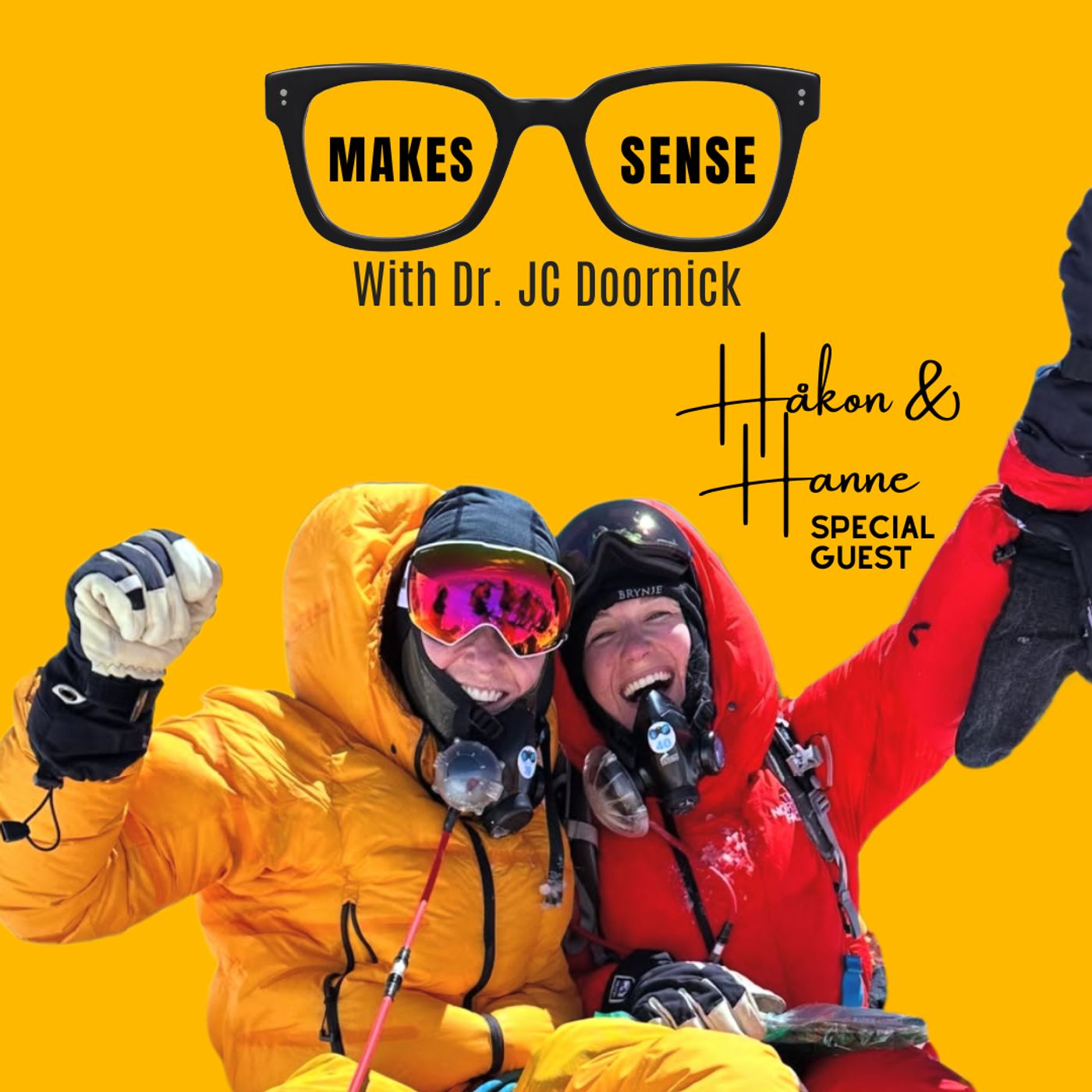
Makes Sense - with Dr. JC Doornick
We Summited Everest Together — Then Went Back to Work on Monday | Håkon & Hanne Hyttedalen - E193
00:58:49
Norwegian couple Håkon & Hanne Hyttedalen summited Everest in 2026 while holding corporate careers. Trail running, UTMB, and the formula for an extreme double life. (158 characters)
Loading summary
Transcript186 lines
- [00:01]
Grainger Announcer
When you're a maintenance engineer in a beverage manufacturing plant, you keep production lines moving and quality on track because there's no room for slowdowns. With Grainger's vast selection of high quality motors, sensors, belts, and hard to find parts, you can get what you need fast and all in one place. So nothing gets in the way of getting the job done. Call 1-800-GRAINGER Click grainger.com or just stop by Granger for the ones who get it done.
- [00:30]
Dr. JC
When you finally reach the summit of Mount Everest, how much of your effort is physical versus mental? Have you noticed that the world that we live in has been doing most of the thinking for you? That your beliefs, perceptions, reactions, fears and doubts have been shaped by unsolicited outside noise? How easy it's been for you to slip into that default sleep walking mode and label it as life and reality? Yeah, that. That ends here. Welcome to the makes sense with Dr. JC podcast. This is your opportunity to start thinking for yourself, reclaim control, and step back into that role as the shock caller and dominant force of your own reality. It's when you change the way that you look at things that the things that you look at begin to change. So let's wake up, let's rise up, and let's make sense of why and how shift happens.
- [01:26]
Hannah
Makes sense.
- [01:29]
Dr. JC
Welcome to the make sense with Dr. JC podcast. Hoka and Hannah, or I should put ladies first. So say Hannah and Hoka coming to us from Norway. Thank you guys so much for being here.
- [01:42]
Hannah
Thank you. It was great to be here.
- [01:45]
Dr. JC
It's kind of serendipitous how we met through a mutual friend. I think you guys attended a wedding and she told me the story about you, and I was like, oh my God, this is cool. And after meeting them, for everybody that's listening, they have no idea that they're co, which is makes them even cooler. So the first question I asked, traditionally people say like, so tell us your backstory and things like that, but I want to go right to May 13th and just look at this idea because I know you had made attempts at this before, but I'd love to hear both of your perspectives about, you know, this moment when you finally reach the summit of Mount Everest. What did it feel like and what did you guys say to one another? And I was also wondering, like, what surprised you most about the experience? Was it all that you hoped it would be? Or was it short lived? Or, you know, was it worth it? Was the juice worth the squeeze? So tell me about that moment.
- [02:43]
Hoka Hitadalen
Well, it's many. I think there's more than one question to cover, but I'll try to answer from my perspective. So May 13th, as you said, that's the day we summited Mount Everest together. I think the background is that we were super early in the season because we were kind of afraid of the queues. We heard rumors, and not just rumors, but we also seen the numbers right for how many people are attempting to climb ERIS this season. And it's a very tight season, so that means a lot of people. And the human traffic, like the human queues is a quite big problem on the wrist. So hence we decided to go as the very first people to mata Wrist this season. And we were very lucky to have a good team of Sherpas to help us get there. That was also one thing that surprised me because I had imagined being surrounded by more people have a very clear path on where to go because of the hundred people that's been there before you. But when we went to the summit, it was completely alone, like didn't see any people around us except from the fixing team that once we reach the Hillary Steppe were just in front of us and fixing, making sure that lines were in place. But that was quite, quite special. And I don't think many people get to experience Mount Everest in such a, let's call it wild conditions because obviously when you are the first people there, you have to make your own path. And the reach is very unstable and more sketchy, I would say, than if you go later in season. So it sounds maybe very scary, but for us it was the obvious choice. We would much rather be in control and be able to get like a proper mountain experience instead of being surrounded by hundreds of people.
- [04:22]
Dr. JC
Let me ask you a quick question on that. So because the preparation weather's got to be right. There's so many different things and we'll. And we'll get more into that, but I never thought of that. You know, it sounds like there's got to be a reason why everybody doesn't try to do it like you did. And it sounds like the reason would be, is that the downside of it is that the reach, as you said, is a little bit sketchy and everybody kind of understands that. Is that what prevents people from trying to do that first ascent.
- [04:49]
Hoka Hitadalen
So you have to take more risk in the sense that when you decide to go for the summit, you decide that not the day before, but you actually decided when you're in Base Camp, which is four days away from the top.
- [05:01]
Dr. JC
Oh, wow.
- [05:02]
Hoka Hitadalen
So what you need in place in order to summit is you need, of course, to be acclimatized, then you need to have a good weather window. And lastly, you need the route with the ropes to be fixed. With all those three things aligned, then you can go for a summit attempt. What we did, we're acclimatized and we had a weather window, but the route was not fixed. So among all of the 500 climbers that were in Base Camp that season, that's like all those three has to align before you should make an attempt. Because what you risk is if you go up too soon. And there is many things that can happen that will prevent the fixing team to establish the route, you end up coming to the last camp. The route is not fixed. And for those of you who are listening, who hasn't been to 8,000 meters, I can assure you that it's not a place you want to stay very long because your body is slowly dying and you literally don't have many hours to spend there. So you risk coming too early and the route is maybe two days away and you're forced to go back down. Your body lost it and the time is running out and you will not have the time to do a second attempt. So that's why it was only us and four other climbers that kind of took this gamble this year.
- [06:19]
Dr. JC
But it seems like it was a great idea. It worked out.
- [06:22]
Hoka Hitadalen
Well, it worked out, but just barely. Like, we got to Camp 4 and it wasn't fixed. Camp 4 is the very last camp to the summit. It wasn't fixed. So we ended up waiting six or between six and eight hours more than we planned. So it was very tight. Six to eight hours more in Camp 4. Then the rope fixing team headed back up to do the final part of the route. And then like I said earlier, on the very last few meters to the summit, we were walking literally 10 meters behind them.
- [06:53]
Dr. JC
Wow. All right, well, then I will let your lovely wife actually answer the question. What was that like? I mean, so first of all, I mean, I'm very happy that you explained it that way, but what was it like? Because you had. You had made a couple of attempts prior. Is this was not your first attempt, Am I correct, or was this.
- [07:11]
Hannah
No, this was actually the first attempt.
- [07:13]
Dr. JC
Wow. Okay, great. And I know that you guys have done a lot of other really, really fun things, so we'll get into that. But what was it like? It's probably better to hear from. From the woman, this experience, but what was it like when you guys got up there, when it finally happened and you're there, was it anticlimactic? Was it everything that you hoped for? And what did you guys like say to each other? Just like scream. And did you say, let's get the hell out of here? Like, what, what was that like?
- [07:41]
Hannah
It is a really good question because I was, I was wondering about the same myself. Before we got there, I was wondering, what if I get to the top and it's like, oh, I'm just. Because we've done a lot of climbing before. I've done many mountains and like, what if we get up there and it's like, oh, this is just another mountain, let's go back down again. But it was pretty amazing because we got up there and it was totally not the case. It felt like, it actually felt like you were on top of the world. And the reason for that is, first of all, you, you see so far back and you see the horizon, it's sort of slightly, what do you call
- [08:19]
Hoka Hitadalen
in English, the curvature of the earth?
- [08:21]
Hannah
Yeah, you sort of see it back there, but even, even more so was the fact that you see all these huge, gigantic, 7,000, 8,000 meter tall mountains around you, yet you are still 300 meters higher than the tallest mountain you can see. Wow. So it was surreal. It really felt like you were, wow, we're on top, on the top of the world. And it was just so beautiful because the weather was perfect. So you saw the view and also the feeling of being there together. I think we were very, very lucky because there's a lot of people who go there without someone they know from beforehand. So you stand there and you're taking all this in, but you realize, or I realize that, wow, I can take it in together with Hoka and we can go back home again and talk about it and both of us will know exactly what we're talking about, which is a very special, special thing to have together.
- [09:21]
Dr. JC
So do you remember what you guys said to each other?
- [09:24]
Hannah
Oh, I don't remember. Do you remember?
- [09:26]
Dr. JC
I mean, are you just, are you speechless? I mean, what, I mean, because you have this experience. This is where my mind is at right now. Because you're a couple, you're a married couple and we're going to get deeper into that stuff. But I mean like, you have this moment. Did you just say like holy or what? Did you say something in, in your native language? I mean, like, what was that? What was it like? Or are there no words for it?
- [09:48]
Hoka Hitadalen
So I think also you need to kind of imagine or Picture the situation where you are at the top of the world.
- [09:56]
Dr. JC
Right?
- [09:56]
Hoka Hitadalen
Yes, the weather is nice, but it's still like blowing 30 miles per hour.
- [10:00]
Dr. JC
Right. You still dangerous.
- [10:02]
Hoka Hitadalen
You have the oxygen mask and you have your hat and your, like, you're very packed in. So whatever you say sounds like.
- [10:13]
Dr. JC
Well, maybe that's why I'm asking. So you each know what you said.
- [10:17]
Hoka Hitadalen
Well, we took off the mask and I remember we gave each other a huge hug.
- [10:21]
Dr. JC
Oh, that's great.
- [10:23]
Hoka Hitadalen
But then I also remember after a while or after a short while, which is. I think it's recurring when, whenever we do climbs like this, I tend to be a bit nervous.
- [10:33]
Dr. JC
Right.
- [10:34]
Hoka Hitadalen
Way more nervous than if I go alone. Because you kind of feel responsible for one another.
- [10:39]
Dr. JC
Sure.
- [10:40]
Hoka Hitadalen
So I was worried about, okay, Hannah, we made it, but now we have to think about getting back down. Yeah, I think I say that almost every time we go on a hike.
- [10:48]
Dr. JC
Yeah. Well, that's kind of, that's kind of the cute dynamic that, that I want to, you know, learn more about because I, you know, when you're talking, you can see her looking at you and smiling. That's my man. And you know, at the same time, you're the, that's. Your job is to protect your, your girl. And you, you achieved this amazing thing. But say we better, we better like, survive so we can tell this story as well. So is it safe to say that when you got perhaps to a different climate where you guys were able to, like, speak to each other, that you really were able to decompress what had just happened? Because that's what's interesting about these challenges that you guys do is they require a hundred percent of your focus and effort and everything. There's no time for chit chat and things like this because your life is on the line. I mean, there's. I guess the last area of the climb is called the death zone. I mean, like, you're not sitting and having tea in the death zone. And then it's interesting to find out that, you know, when you achieve this level of greatness that so few have achieved, all of a sudden you realize you got to get the hell out of there. It's not like something that you can hang out and do. So that. That is amazing. So here's a question for the two of you. First of all, how long have you been married?
- [12:04]
Hannah
Six years this year.
- [12:05]
Dr. JC
Six years. And how long have you known each other?
- [12:08]
Hannah
Ten.
- [12:08]
Dr. JC
Okay, perfect. So if I had met each of you before you met each other, say, 10 years ago, you know, would I have recognized future Mount Everest climbers? All the things that you guys have done in the past 10 years and then six years being married, were you destined for those things back then, each of you?
- [12:29]
Hannah
I actually went to Everest Base Camp with my family. So my dad's a really outdoorsy guy. He loves hiking in the mountains, kayaking, biking, and yeah, being outside and doing things. And so I've grown up together with my. My brother and sister. We've been a lot outside with the family. And we actually hiked to Everest Base Camp. Yeah, a while ago before I met Toca. And I remember when we, when we went on this hike, I was probably the one who handled the altitude the best, just because I was lucky, I guess. And I remember that my brother said to me, well, if there's someone in the Breedus family who will summit Mount Everest, it will be Hana.
- [13:19]
Dr. JC
He looks very proud of you when you just said that. Like, yeah, that's my. That's my wife. So what about, what about you, Hoka?
- [13:25]
Hoka Hitadalen
I think it's a tough question.
- [13:27]
Dr. JC
I'm trying to put the pieces together of how the universe has placed you together as a couple.
- [13:32]
Hoka Hitadalen
So I think when we met each other, we were very lucky, by the way, to have met in such a young age. We both had a strong interest for mountains in general and being outdoor, but we had kind of the same experience. We were not super experienced, but we've been to hikes and some mountains. But I think once we met and kind of discovered that we had this underlying passion for mountains, it kind of escalated as we grew together. But I think also if you want to climb Mount Everest, the typical person who climbs Mount Everest, I think is not necessarily there for the mountain experience, but you would see a lot of people who have amazing support and they will fly into Base Camp and they will do it mainly to kind of check the box, if you know what I'm saying. Like, they want to have it on their resume that they went to Mount Everest. Whereas we have always been after adventures and the experience itself. So hence we as rational people, I think it's safe to say that we wouldn't have spent so much of our savings on such a trip. And then background here is that we suddenly got a sponsorship who wanted to sponsor majority of our trip.
- [14:42]
Dr. JC
Wow.
- [14:43]
Hoka Hitadalen
And then it was then was easy to like, we didn't have to think twice when we got that opportunity. But if we met those 10 years ago, I think we would still be the same kind of people who are quite rational, seeking most Adventures for like, if you compare the amount you have to spend to climb at risk compared to what kind of experiences you can get. If you do other stuff, it's. Yeah, I think you will get. It's hard to explain in English. My English is not perfect. But if you take the same amount and you spend it on 10 other trips, I think accumulated, you would have experiences.
- [15:17]
Dr. JC
Okay. Something. Something equivalent. What. What is. I mean, I know I'm sure it's tough to say, but like from start to finish, what does it cost to climb Mount Everest? Like, how can you. Can you give us like an estimate for people that don't know?
- [15:30]
Hoka Hitadalen
I think the average person would spend roughly 70,000 USD.
- [15:35]
Dr. JC
70,000. And that's us.
- [15:37]
Hoka Hitadalen
Us. And that would exclude gear and transport to Nepal.
- [15:43]
Hannah
Wow.
- [15:44]
Dr. JC
Time off of work too.
- [15:46]
Hoka Hitadalen
Yeah, yeah, yeah. Of course that's also not included. So it's quite pricey.
- [15:51]
Dr. JC
Yeah, well, in a good way.
- [15:53]
Hoka Hitadalen
It really helps the Nepalese society. It's a big business down there. So. Yeah, I guess if you call it part of it, supporting the local communities, it makes you feel better.
- [16:04]
Dr. JC
You know, you mentioned before, and I would just love to. I mean, for me it's like to have this opportunity to speak to people that have done it. You know, you, you, you either hear about these terrible stories, but I mean, we have this beautiful young couple that like did it and they look great and they didn't lose any limbs or anything like that. So I want to take advantage of this. There's a lot of controversy, you know, about the cues and everything that you were saying about how many people they're allowing to do it. And it seems like it's completely out of control. I mean, from, from the, the viewpoint of the guy that just watches these things on tv, it. I don't understand how anybody gets up there where there's like the line of what it looks like hundreds of people. What's happening in that realm? Is there anything being done about that? I mean, I'm sure it's very hard to stop people from wanting to climb that. But is it, is it getting to the point where it's dangerous?
- [16:58]
Hoka Hitadalen
For sure, I would say so. We met a fellow in the region who went later and was part of the larger group that went on the same day. And he ended up getting frostbites on his toes because he had to wait in line to get down from. But to your question, they are looking now, I know, into more regulations. So for example, you have to have climbed a 7,000 meter peak before you get your permit to climb out Everest, which I think is a really good move, because now there are a lot of people who shouldn't be there, in my opinion.
- [17:32]
Hannah
And I guess they've already done this on the Chinese side because the most common way to climb onto Vista is on the south side from Nepal. But there's also a good route on the north side from Tibet. And the Chinese government has decided to restrict the amount of permits they give, which means that there is a lot less people enforced like they. There's a lot less people climbing from the north side because there aren't enough permits to. For more people to go. So that is. I don't know if Nepal will ever do the same or what they'll do, but it is one. Another way that they could restrict the amount of people.
- [18:17]
Dr. JC
Is there. Is this something that you would want to do again, or are you, like, all set when it comes to this?
- [18:24]
Hannah
I think the way it turned out for us was so perfect.
- [18:29]
Dr. JC
So perfect. Yeah.
- [18:30]
Hannah
That if we do it again, I don't know if it will ever be the same. So I would be. I would be afraid to do it just because I'm gonna ruin the fantastic experience.
- [18:40]
Dr. JC
It's like. It's like getting married. Like, you know, you only do it once, you know.
- [18:43]
Hannah
Yeah, that's cool.
- [18:46]
Dr. JC
What was get married twice? What's the story there?
- [18:53]
Hoka Hitadalen
I think that's a different story.
- [18:54]
Dr. JC
Oh, that's a different story.
- [18:55]
Hoka Hitadalen
Engaged in 2019, and then 2020 came and covet hit.
- [18:59]
Dr. JC
Oh, it was a covet story. Sure. We have one of those too. What was the first big either climb? I mean, was it these stairs you climbed in Switzerland? Like, what was the first big thing that you did as a couple?
- [19:13]
Hannah
I think that was Aconcagua, actually.
- [19:16]
Dr. JC
Tell us about that. What was that like? And what was the conversation that you had? Like, hey, let's do this.
- [19:24]
Hannah
So the story is actually that. So we met at university, and it was one year later I was going off on exchange where I was going to Chile for. For half a year before I was going to South Africa for half a year. And before I left for Chile. This might sound stupid, but I heard of some mountain called Aconcagua and I came back. Or I met up with Huaca one day and I said, oh, there's apparently this cool mountain in Chile that would be cool to climb when you come visit me. It's called Aconcagua. And we look it up, and it turns out that it's the tallest mountain in South America, close to 7,000 meter. Yeah. And. And at that point it's like, oh, that was not what we expected, but, oh, it would be kind of cool. And we'd then known each other for one year and we were going to be apart for, for a while. So we thought it would be nice to have some way to kind of feel like we're together, staying in touch, even though we're on different parts of the earth. So we decided to climb Aconcagua, and knowing that it was 7,000 meters high, we thought, we need to train for this. We have to. We have to be fit and ready for it, so we have good chances of getting to the top. So we made our. Our own, like a training program. And we had this online Excel document where we logged everything we did and we log it in the same document and we'd kind of follow up on each other, how we're doing with the training and everything. And it kind of made it feel like we were spending more time together even though we were not in the same place. So it was a really nice way to stay in touch and look forward to seeing each other in half a year when we were actually going to climb Aconcagua together.
- [21:24]
Hoka Hitadalen
I think we were also way over our head because we had very limited experience with high altitude mountaineering before. So it all went well. Like, we got to the summit, but I passed out on the summit. Hannah got altitude sickness. We actually got apart from each other on the way down because I was just. Yeah, couldn't keep my balance, constantly passing out on the way down. So I think we learned that from, from as well. Like, we should probably have some more experience before you get into these big mountains.
- [21:56]
Dr. JC
But that's, but that's how you knew that she loved you. I mean, you passed out and she stayed with you.
- [22:02]
Hoka Hitadalen
No, actually, actually, I know we're deviating a bit from Mount Everest now, but it was on like that I personally realized that I want to marry Hannah because.
- [22:13]
Dr. JC
Right. Tell me about that.
- [22:15]
Hoka Hitadalen
So when we went to the summit, like I said, we've been together now for, I think it was like close to two weeks before we went for the summit push from the last camp. But then on the way down, like I said, I was passing out. And Hannah, luckily were able to walk down mostly by herself. And I remember them being apart from each other for I think maybe five, six hours. I gradually came to myself and got help, like some support to, to get myself down. I kept thinking that we should never done this. Like, maybe she's really sick or I kind of felt guilty. It was my fault because all the way up there, we obviously didn't feel great, but we were too stubborn and probably fresh in our relationship to kind of be completely honest with each other. So we kind of pushed each other, or I at least felt like maybe I pushed Hanne too much. And I felt really guilty on my way down to the camp from the summit. So I felt this guilty and I prepared this speech that I wanted to give Hannah when I met her down in camp with, like, saying how sorry I am and we should never do this again. And it's all my fault. So I kept repeating this speech to myself. And then after five, six hours apart, I eventually get down to the camp below the summit, and I can see Hannah. And then she starts running towards me, or running as fast as you can on 6,000 meter, and we meet in the middle. She throws her arms around me and she says, we made it.
- [23:50]
Dr. JC
That's so funny.
- [23:51]
Hoka Hitadalen
And I forgot my speech. And I was like, man, this woman is hardcore. I definitely have to marry her.
- [23:57]
Grainger Announcer
Grainger knows. When you're a procurement manager for an office park, you're not managing one building, you're managing all of them. And to stay ahead, you need to see through walls and around corners. Lights about to fail, Filters ready to clog H Vac on its last leg. If you wait until something breaks, you're already behind. Count on Grainger for quality products, easy reordering, and 24. 7 support. Call 1-800-GRAINGER Click grainger.com or just stop by Grainger for the ones who get it done.
- [24:27]
Dr. JC
Now that's beautiful. You know, you have a unique relationship because usually people just, like, go out to movies and stuff and try to figure this stuff out. But you guys are going through these experiences that are very, very emotional, and there's so many different feelings. And I. I think we're. We're so fortunate to get, like, a real transparent look at Hookah here, who he really is as a man. And, you know, he obviously very, very much loves her, and she's very happy about that, I can tell. But he. He's also a kind of a typical guy that kind of overthinks things and everything like that. So it looks like this relationship was kind of built organically along the way where she was not that ordinary girl that would think like you thought she would think she was. So I guess my question would be, did one of you, I don't want to say who is the driving force behind the relationship, because I know you both add to It. But did one of you believe in your abilities to do this stuff before the other, or were you kind of both equally crazy about things? Like is, is there. Is one of you the one that says, come on, we can do this? One like one of you says, well, I don't know, you know, let's be, let's think about this first. And the other ones, is one of you just like saying, let's do this. Who cares? We're going to do it. And one of you is maybe a very, very technical and, and a little bit more careful.
- [25:52]
Hannah
The funny thing I think is that we, we think surprisingly alike. And it's very often when one of us has suggested something, the other other one looks at, looks at the other and is like, I thought of the exact same thing. Like, this is something we gotta do. For example, last year we sailed across the Atlantic Ocean together with another couple of friends. And that whole idea came after a dinner that we'd had at our friend's place where this other guy, he told us about a dream, he's a sailor, and he told us about a dream to sail across the Atlantic oce Ocean. And we walked home from that dinner afterwards.
- [26:34]
Hoka Hitadalen
But he, but he put it as like, this is my dream. When I retire, I want to cross that land.
- [26:39]
Hannah
Yeah. And we walked home from that dinner afterwards and we just looked at each other like, Atlantic Ocean, that would be cool. And we were both, we just both agreed that, okay, this is something we just gotta do. We gotta grab this opportunity and convince our friend that this now is the time to do it. And yeah, just jump, jump on the opportunity, basically.
- [27:04]
Hoka Hitadalen
And I think it also comes from other successful things that we done together. Right. We didn't start with Matt Everest, obviously, but the first date we had was actually a, a short hike to a local peak.
- [27:16]
Dr. JC
I would assume nothing other than that.
- [27:19]
Hoka Hitadalen
But then once we, and then we did like a first mountain marathon together. And when you get that sense of accomplishment, you feel like, or you, you build confident. And okay, I'm actually able to, to run a marathon in the mountains. Maybe I can even run an ultramarathon. And then suddenly you're on the start line of UTMB, which is like the pinnacle in ultra marathon, like 170 kilometer race, 10,000 meter elevation. And we did that and we accomplished it. And then I think all these challenges that you are able to complete together successfully kind of strengthen that inner belief that anything is actually possible if you have the right mindset and are willing to dedicate and prioritize correctly. It starts with the small.
- [28:15]
Dr. JC
So fascinating, because this is, I mean, first of all, you guys are so lucky that you found each other. I mean, come on, you know, I mean, let's, let's just acknowledge like there's. And just in case you guys ever go through some hard times and you will, There is nobody better than each. So just never, never screw this up. You're not gonna, you're not gonna replace each other, I promise you. But you know, in all relationships there's some sort of common thread or sometimes there's, you know, there's, there's a chemistry and, and intimacy and there's some. Like my wife and I, we don't climb mountains, but we very much connect on creative thoughts and things like that, you know, and that's our own way of doing that. But it's, it's very interesting that the world looks at some of the things that you guys do as like, massively extreme. But you guys are just in like this growth process as a couple together doing this. And it sounds like the best part about it is doing it together. It doesn't. I don't get the feeling that one of you goes off and does something and the other stays home. It seems like this is a team effort. Am I right in that?
- [29:28]
Hoka Hitadalen
100.
- [29:28]
Dr. JC
Yeah, 100. That's so cool. Let's talk a little bit about. This is your comfort zone. But you know, a lot of the people that are listening think that they can't do things. You know, they, they. I mean, you guys are obviously we're drawn to this, but you know, I'd like to let everybody know that everybody's capable of doing anything that they set their mind to. This just happens to be what you guys are doing. But, you know, what is it? You know, I, Let me, let me see how I could phrase this. This idea of going all in, like deciding you're going to do something, accepting all of the, the risks, the dangers and everything, you know, requires an all in kind of a thing. You have to go all in with something. You can't, I would assume you can't half ass your way through any of these things that you're doing. You have to commit to doing it, like, no matter what. And you guys probably don't have a very easy, like, let's turn around and quit. You know, like you guys push, push each other. So what have you learned about that in life? I mean, because you also have your work life and you know, eventually if you're blessed, you'll have children. You don't have children, right? No, no, That's. That's the biggest mountain you'll ever climb, by the way. That's gonna. That's gonna make Everest look like nothing. But what have you guys learned about or what can you share about, you know, this idea of committing to something and life because, you know, everybody out there does things as long as it suits them. But then when the challenges come and in your, you know, you guys are passing out and, you know, there's frostbite and there's. There's, you know, uncleared paths and all of this crazy stuff, and you guys keep going. So what are. What are you. What have you guys learned about just commitment and just going after things all in? Like, what would. How would you share that with your children? You know, the importance of that.
- [31:34]
Hannah
I think it helps to be really aware of why you're doing something and what you want to achieve from it. And, like, for Mount Everest as the example, I think we knew from the very start that how sad it would be if we didn't actually get to the top or like, I mean, we still. We enjoyed every day of the whole trip. It was. It was beautiful, and we had a fantastic trip, but it would still be kind of a. Yeah, like, oh, it was amazing, but we didn't make it like a shoot. And being really aware of that and that. I don't want that to happen. You don't want the amazing story to end in a sad story or end in a too bad. So knowing that, knowing what your goal is and what you want to achieve really helps in on the hardest points. And it helps being two, of course, because most likely, and hopefully you'll have the hard points at different points in time. So then we can remind each other that, come on, we can make it. We can do it. Remember what the goal is and remember where we're going, why we're here, we're here together, and you can support each other and help each other out if there's something you're struggling with and that and just keeping your mindset that, okay, I just got to go. I just got to keep going, keep going, keep going, and you'll get there eventually. If you just take one step at a time, you'll get there eventually.
- [33:07]
Hoka Hitadalen
I guess what Hana is describing is like, the skill of not giving up easily when things get tough. And what Hannah is saying, I think that's for us at least we find a strength being too together. Like Helen said, if one is down, hopefully the other is a bit higher and you can lean on One another. And of course, it really sucks. We had one incident I was gonna ask you.
- [33:33]
Dr. JC
I would love to hear a story where one of you was like, I can't do it, but the other one lifted you up and when you finished it.
- [33:40]
Hoka Hitadalen
Yeah. So we had some issues in the first week hiking in. During our hike in, in the valley, I got some stomach bug and, you know, couldn't hold any food. And then your energy just drops and you're still in altitude, so it's harder for your body to recover. And you're there and you're like.
- [34:01]
Dr. JC
And that's the easiest part.
- [34:03]
Hoka Hitadalen
And you're. Yeah, yeah, yeah, right? You're at 3,000 meter and you're struggling to get from your bed to the toilet. And you're like, how on earth am I going to make it to the summit? It's like, it looks very dark. But then Hanukkah came and cheered me up and. Yeah. And I felt like, okay, we talked about this. Like, we had even beforehand written down, like, what are likely scenarios to happen? And diarrhea being one of them. Like, well, how will we mitigate that when it first happens? So being able to have that together, I think it's. It's a strength.
- [34:41]
Hannah
And then not many days later, you were finally feeling better, and we've climbed, hiked further in. And then it's the opposite. Suddenly I'm the one with diarrhea, vomiting and everything. And then Hoga's like, hannah, remember this? And this and this. We can do it. We can make it. Yeah. So. So it really, really helps to be too.
- [35:03]
Dr. JC
Is it. Isn't that what makes it. I mean, summiting Everest is amazing, but isn't it the hard work that. I mean, it's the same thing with, like, being in a wonderful relationship, you know, I mean, I know you guys are perfect for each other, but that doesn't mean that it's easy. Nothing's easy. So I just find that, like, this summiting anything, whether it's a mountain or a relationship, you know, what makes it so special is all of these hard times, you know? So I think that the challenge people have to have is like, that's the best part, is getting through things to get, as you said, you know, the why is empowering. How about this when it comes to endurance? Because that's kind of what we're talking about. How much of endurance is physical versus mental? How much of your effort in achieving these things that you've done is physical versus mental.
- [35:58]
Hoka Hitadalen
For Everest, I would say more mental than physical. Strength. So I would probably put it at 70% mental.
- [36:11]
Dr. JC
Wow. So if somebody wasn't in perfect shape, but they were in perfect mental shape, like focus, they would struggle, but they could make it a certain distance.
- [36:21]
Hoka Hitadalen
Yeah, yeah.
- [36:21]
Hannah
And I think that's why. So Hokan mentioned it, mentioned it earlier as well, that we didn't start with Mountain Everest, we started with smaller things. And when you see that you can manage to do this, it really helps your mental strength that. Oh, yeah, but I know my body can do it. I know my body can push itself and it won't get ruined. So you manage to push yourself a little bit more and that really helps build up the mental strength because you've, you know that the body, it's, it's amazing. The body can do amazing things and it can resist so much. So by learning that little by little, you realize that, okay, I can manage it this time too.
- [37:05]
Hoka Hitadalen
And I also see, I think the first time I really discovered this and probably also when I learned that, oh, my mental strength is actually quite good, was when I entered the military. I applied for this selection program for special Forces. And we were roughly thousand people in the beginning of the selection program. And I was, I met up, I had never been to the gym before and I met by, you know, hundreds of 18 years old guys who've been to the gym for years and they just look like machines.
- [37:42]
Dr. JC
Yeah, machines.
- [37:44]
Hoka Hitadalen
I am intimidated by them. Like, okay, this is not the place for me, probably. It was a four, four week selection program and in the end we were 17 people who completed. And I can tell you that it was not the, the one with the biggest biceps.
- [38:04]
Grainger Announcer
Right.
- [38:05]
Dr. JC
It was the ones with the, the biggest endurance and brains and things. Tell me about, you know, I, I kind of looked into your background and all these crazy things and I think that there was a race that you did called the, the Rondane 100. Is that what it's called? So I looked it up because the whole concept of quitting is fascinating to me and we're talking about this now, but it, I looked up a statistic that said that only 23 of people finish that. So. And I know that there's all sorts of reasons people don't. But you guys finished it. Correct. Okay, so how do you distinguish between listening to your body and listening to your fear and your mind and things like that? Because, you know, there's this moment where your brain tells you you can't do something. And what we know, you know, if you look, look at you guys or David Goggins or something like that. It's extraordinary what the body can end up doing if you allow it to have a chance. But how do you distinguish? Do you guys even know how to distinguish, like, listening to your body? Like, do you. Do you know when it's time to quit? Or do you guys just don't have any quit in you?
- [39:19]
Hoka Hitadalen
I guess that's our weak point. Maybe that we should listen more to our body. Because when you do go out and do those extreme right races, for example, and you push your body too far, you get punished for it in terms of injuries or. Yeah. So I'm not sure if I'm the right person to answer that question, actually.
- [39:41]
Hannah
But, yeah, I think it's been. I think it's. I guess it's probably a mix between a lot of luck, I guess. You mentioned the rondein or rondane 100. Um, in that run, we were pushing and we got so far, and in the end, it was a really special experience because the people around us who started quitting, we got to like. It was so cold. It was pouring rain the whole race. This is a race that goes over a couple of days and. Or.
- [40:21]
Hoka Hitadalen
Yeah, 30 hours.
- [40:22]
Hannah
30 hours or whatever. And it was pouring rain some places. It was snowing. It was so cold. And the amazing thing was at some point, a point during the night, we were almost halfways or a little over halfways or whatever, people were quitting. And we said, no, no, we'll try a little longer. We'll go further. And we got. Because we were so cold, but some of the people who were quitting, they said, take our clothes. And they gave us wool clothes and extra stuff so that we would keep. Keep warm, because they saw that we're going to continue. They didn't need their clothes. We needed them. So they gave them to us. And it's like. I think it's just. I mean, there's a lot of. There's a lot of mentality and being two of us together, but also in all the stuff we do, it's also thanks to the people around us again on Everest, the Sherpas on this run, the other runners.
- [41:29]
Dr. JC
Right.
- [41:30]
Hannah
And it's always. Yeah. Having more people around you that want to help and be there for you, it makes a huge difference. And it's a big thanks to that that we actually managed to achieve many of these things.
- [41:45]
Dr. JC
It's interesting, you know, it's. It's almost like there's a. There's moments where you have to trust in the process, trust in the universe. But also trust in the team. You know, when you're. When you're up in your head and you're thinking, there's no way we can do something, like, sometimes we probably forget about the fact that you have prepared for everything, you know, and you've got this amazing team, and then all of a sudden, the universe. Sometimes I think. I think most people don't stay in the arena of play long enough to experience something like that. You know, like, if everybody quits at the same time, nobody will experience somebody saying, here, take our wool coat, and learn from that process. So maybe the lesson there, as far as, like, knowing when you're, you know, to distinguish your body from your. Your mind is. Maybe the lesson is. Is to just go a little further. Allow yourself to always just go a little further so you can experience some of the magic. I mean, does that resonate with you guys sometimes? I mean, have you ever. Has that process ever let you down? Like, have you ever pushed yourself and said that was a big mistake?
- [42:55]
Hannah
Don't think so.
- [42:56]
Hoka Hitadalen
No, probably not.
- [42:57]
Dr. JC
Yeah. So, I mean, that. It seems like that's. That's probably one of the lessons. Okay, so let's. Let's talk a little bit about preparation, because we were talking about mental versus physical. But I know that, you know, whether it's Everest or anything, first of all, are you guys training for anything now?
- [43:17]
Hannah
Not at the moment. Now we're still kind of just processing and being happy about the great adventure we just had and. And living in the moments of knowing that one day there will be a new adventure. We don't know what it is yet, but it will show up eventually.
- [43:33]
Dr. JC
So first question is, let's call this off season, meaning you're not actively training for something. What is your. Because you guys work. You go to work, like, I assume something like 9 to 5. Do you work at the same place?
- [43:47]
Hannah
No.
- [43:48]
Dr. JC
No. Okay. So what is your morning now? Right now we're not training for Everest. What is your morning and after work routine look like now?
- [43:58]
Hoka Hitadalen
I think that's a funny part. Like, it looks very similar.
- [44:02]
Dr. JC
So you're still in full training as if you were getting ready for something. So. So that. Then that'll answer my next question. What does it look like?
- [44:10]
Hoka Hitadalen
But it is a bit less overall. Like, the intensity. Like, now we can allow ourselves to go for a run with friends, even though it wouldn't, like, naturally fit in the schedule. Like, we would accommodate for those kind of things.
- [44:23]
Dr. JC
Right.
- [44:24]
Hoka Hitadalen
Whereas if you're leading up to a race or an expedition, you would have to be more strict with your routines.
- [44:30]
Dr. JC
So what time do you guys get up? What does it look like before work and after work? Because I think everybody here is just assuming that as soon as this interview is over, you're going to go run and climb something.
- [44:43]
Hoka Hitadalen
So we usually get up at around 5:00am or 5:30, depending on what kind of exercise we're doing. Some mornings when we go swimming, for example, there is a limitation of the opening hours. So they don't open before maybe 6am but usually around 5 to 5:30 we get up. We have always one workout before work. Get to work around 8 and then I would say four times, three times a week we would have a second workout in the afternoon. And then depending on workload, we might have to work during the evening. But we try to get in bed between 9 and 10pm because it might sound like, oh, the superhumans. They don't sleep. They, you know, sleep three, four hours.
- [45:39]
Dr. JC
They have to sleep.
- [45:40]
Hoka Hitadalen
Yeah, but sleep is so important.
- [45:43]
Dr. JC
Yeah.
- [45:44]
Hoka Hitadalen
So we try to have a rule that if we get less than six hours sleep, we would have to skip the morning workout and rather sleep in. At least in theory that's how we want to have it. But usually it's like, ah, but it's like, you know, if you take maybe a double espresso in the morning, you can still do it or. Yeah, but, but ideally it's like getting up at five, two workouts a day, to bed at nine to get proper recovery.
- [46:12]
Dr. JC
So first of all, my wife, you said you, you had mentioned Hannah, that you were in South Africa. My wife is from South Africa. She's South African. Interesting place. And we, we actually just adopted a little girl from South Africa. I lived there for almost two years. But you know, my wife is a sex therapist and we were constantly talking about relationships and, and things like this. Here's an interesting question. You know, we're not gonna, we're not, I'm not gonna ask you anything personal about like your bedroom, but when it comes to intimacy, do you guys experience intimacy, like loving intimacy when you're working out together? Is there, is there some sort of thing that happens exercising together and doing all these things together that makes your love grow stronger and, and feel really connected with one another? Because, because the workouts that you guys do, most people would think are like hell, you guys love it. And it's like you probably would be depressed if you didn't do it. I mean, I, I know that I love my, my workouts as, too, as well. But how does that Affect your relationship and stuff. Like, are you guys, do you guys have moments where you're just like, feeling what most people would call intimacy when you're working out?
- [47:34]
Hoka Hitadalen
I think a few things maybe.
- [47:36]
Dr. JC
Wow. He wants to comment on this one. Hannah. This is great.
- [47:40]
Hoka Hitadalen
First one. Definitely, like doing stuff together. I think regardless of what you're doing, like, if your Everest is going to the most perfect cafe in Paris, then sure, that's your Everest. Like, just do it as long as you do it together will eventually create stronger bond. So that would be my advice. Number one to other couples is whatever you do try to do together, even if we have different pace during interval sessions, we still manage to find some way we can do it together. Instead of doing interval per meter, we do interval per second. And then we will finish at the same time as an example. So that definitely, like, whatever you do as long as you do together will strengthen your relationship. Then I think just to correct you, it's not like we love every workout. I would say, at least in a normal work week, most workouts, we do it for consistency because we know that what we really love is, for example, running in the mountains or do a really cool ski tour in the winter. And to be able to do those kind of adventures that we really appreciate, you need a certain level of fitness or at least then, right? That's when it becomes fun, interesting. Like you can go skiing and you can use a lift to get to the top and you'll get amazing downhill skiing. But I can assure you, like, it doesn't taste as good as if you had walked it up. Yeah, because you put in the effort and then you appreciate the, the views much more. Well, that's just, just a minor correction. Like, it's not like we, we wake up at 5am every morning and are super motivated to go for a treadmill into a session. But it's more for, like, consistency.
- [49:37]
Dr. JC
Well, I mean, I, I, I, I'm up every day for probably 15 years at 4am and I have my own routine. And, you know, people think, oh, you're, you're crazy. And I said, well, I, you need to know that I don't like doing that, you know, but, you know, when it comes to relationships and when it comes to people. And this is back to what Hannah, you said in the beginning about, like, if you have a reason to do something and there's value attached to it, you know, you can still hate something, but you'll have no trouble doing it because of the value on the other side. I'm, I Just can't wait if, if the universe ever makes it happen for to meet your children. I mean, like, these kids are going to be like animals, you know, I mean, they're watching their, their, their parents. What a, what a wonderful thing to pay forward. I mean, you guys have such a beautiful relationship and, you know, that's probably one of the most important things for children growing up is to watch their parents. You know, they watch everything. Here's one last, one last question, and I don't know who, who could answer this, but you guys have been through a lot of extreme hardship, and I would assume that you've been through hardship in life in general too. It doesn't always happen when you're doing these mountain climbs and stuff like that. But what have you guys learned through going through all of these, these extreme hardships and things that you've been through? What has that revealed about your relationship with, with one another?
- [51:07]
Hannah
I think it's mostly the value of being there for each other in one way or another. And it's been in many different forms, but just knowing that no matter what it is, I'll always have hookah there in some way. Yeah, just the value of that is basically, I think that's the most, most. The biggest thing I've learned from all of it, how valuable that is.
- [51:32]
Dr. JC
Very cool.
- [51:33]
Hoka Hitadalen
And I think also you can tell a lot about a person on how they deal with setbacks or hardship, as you put it. And personally, we also try to analyze, okay, if something went wrong or didn't go as planned, how do we deal with that in order to do it better next time? Because mostly, I would say probably 99% of the time where you have a setback and your reaction is like a bad reaction, there is usually not something you really can't do about it. But still, you get angry or upset or you quit or you react in a way that is actually quite unnecessary. Because if there's things out of your control that you can't do anything about, then, okay, it sucks, but it doesn't help to, you know, feel bad or not trying to do the best out of it.
- [52:44]
Dr. JC
Right. Would you guys consider yourselves elite athletes? Because you don't seem like that's in. That kind of stuff is important to you. But are you aware of what you've accomplished and how rare it is?
- [53:02]
Hoka Hitadalen
Maybe not. I mean, our main goal is to
- [53:06]
Hannah
have fun.
- [53:07]
Hoka Hitadalen
Have fun. That's the most important thing we even have on our wedding rings. If you put them together, you can see, among other things, you can see an ice cream cone which represents the fun. The fun, yeah.
- [53:22]
Dr. JC
So you guys do eat ice cream every now and then.
- [53:24]
Hannah
Oh, yes.
- [53:28]
Dr. JC
One last question that's popped in into my head is, do you guys ever have moments where you wonder if you're addicted to all this stuff? Because, I mean, there is, there is a, there is a place where you can go too far, you know, and, you know, maybe you don't entertain that right now, but you guys do a lot of dangerous stuff and it seems like, see somebody, do something. And Hannah's like, we, maybe we should do that, you know. So do you guys ever wonder, is there ever a discussion of maybe you guys are, you know, addicted to this stuff?
- [54:03]
Hoka Hitadalen
We probably are. But I would also say that I think if I hadn't met Hamas, I would probably still do extreme stuff. And I think chances of me being here alive today is way less.
- [54:18]
Dr. JC
Yeah. Without her.
- [54:20]
Hoka Hitadalen
With Hana, I think we naturally are more cautious and look after each other. Like when I am scared on a climb, it's mainly because I'm scared something will happen to Hanne. And I know Hana has the same feeling for me. Right, right. So that kind of naturally hold us a bit back from the too extreme. Like, we also set a limit on we would not do rock climbing because we seen too many accidents. And for us, I think we have more to lose because we are a couple as opposed to being single. Yeah, that makes sense.
- [55:06]
Dr. JC
I, I can't wait for you guys to watch the video of this so you can see while each of you are talking, the other one looking at the. You talk because you guys, like, you guys are so cute together. It's great. Did you want to say anything about that? About the idea of like, do you ever wonder if you're addicted to this stuff? Because I think he did a great job of answering that.
- [55:29]
Hannah
No, yeah, I, I agree. I don't really have too much, much to add. I, I think, yeah, I think we are addicted, but we also know where the, where the line goes and know where to not step because we are not reckless either. So. Yeah, yeah.
- [55:48]
Dr. JC
I think you have to be obsessed with anything to get to accomplish it, you know, or else you'll, you'll quit. Go ahead. What were you going to say?
- [55:54]
Hoka Hitadalen
Yeah, no, just maybe a small add on because my, I have a younger sister and she often asked me like, oh, don't you just want to become a mountain guide and you can do this full time? But I think what we are addicted to is kind of the combination of challenging ourselves intellectually at Work, but then also being able to escape into the mountains and challenge ourselves in a more physical way. So that kind of balance, I guess it's called work life balance is what we found really. I don't know how to put it.
- [56:33]
Hannah
Intriguing.
- [56:34]
Hoka Hitadalen
Yeah, yeah, yeah.
- [56:35]
Dr. JC
It's like we. We would call that living your best life. You know what, what is it that each of you do for work?
- [56:43]
Hoka Hitadalen
I used to be a management consultant, but now I'm with company called N Scale building data centers.
- [56:50]
Dr. JC
Interesting.
- [56:51]
Hannah
And Hannah and I'm a data engineer.
- [56:54]
Dr. JC
Okay. So you guys are also smart and you enjoy and you do you. Are you fully engaged in your career and are you. You fulfilled there as well?
- [57:03]
Hoka Hitadalen
Yeah.
- [57:03]
Dr. JC
Yeah. Awesome. So that's the only time that you. You don't see each other. You go to work and then. But you guys, outside of that, you know, that's interesting. Well, what a. What a joy to have you guys on the show. A lot of people are going to want to have you on their shows after they hear this. Are you guys in a position where you're always. Where you're looking for people to support you? Do you guys try to raise funds for anything? I mean, because there's a whole bunch of people that are going to hear about this and they're going to want to look you up. Where should they look you up? And are you actively working on any project that people might be able to help you with?
- [57:38]
Hoka Hitadalen
So we do, or we did recently, as of this year, create the Instagram account. I guess that will be the best
- [57:45]
Dr. JC
way to get in contact.
- [57:46]
Hoka Hitadalen
It's called HH Dot out of office.
- [57:51]
Dr. JC
That's cute. That's very cute. But do you ever, you know, look to raise funds and things like that for any of your adventures?
- [57:58]
Hannah
Yeah. I mean, before this Everest trip, knowing that how much it would cost, that was like one of the main things we tried to do in our preparation phase to minimize our own costs and. And see if we could. Yeah. Do. Do some sponsoring. Yeah.
- [58:18]
Dr. JC
Cool. Well, hopefully you'll have some people interested in also.
- [58:22]
Hoka Hitadalen
I mean, we are. I think our stand is that we are always seeking new adventures.
- [58:28]
Dr. JC
Right.
- [58:29]
Hoka Hitadalen
So happy to connect with anyone who would also have a. Yeah. An idea or project to be a
- [58:34]
Hannah
part of a new adventure for us.
- [58:38]
Dr. JC
Well, thank you guys so much for being here. What a. What a cool experience it was to hear, you know, all of this stuff through your eyes and how special it is that you guys are doing all of this as a couple. Thanks so much for being on the show.
- [58:50]
Hannah
Thank you for inviting us. It's very. It's been very nice to talk to you and get to.
- [58:54]
Hoka Hitadalen
Yeah.
- [58:55]
Hannah
Have this moment.
- [58:56]
Dr. JC
Awesome.
- [58:57]
Hoka Hitadalen
Yes. Thank you.
- [58:58]
Hannah
Hi, this is Hannah. Hey.
- [59:00]
Hoka Hitadalen
And I am Hokka Hitadalen. And this podcast makes sense.
- [59:05]
Dr. JC
That's it for today. To support the make sense with Dr. JC podcast. Be sure to subscribe, like and share, as well as follow the Make Sense substack for free daily quotes, live streams, and blogs. And remember, learning without action is just another form of distraction. If something hit home and you learned something today, give it away. That's the only way it's gonna stay. See you next time.
- [59:34]
Hannah
Makes sense.
- [59:38]
Dr. JC
If you like the show, please take a moment to rate, review and subscribe. It really does help the show to grow.
- [59:45]
Hoka Hitadalen
Thank you for listening.