← Makes Sense - with Dr. JC Doornick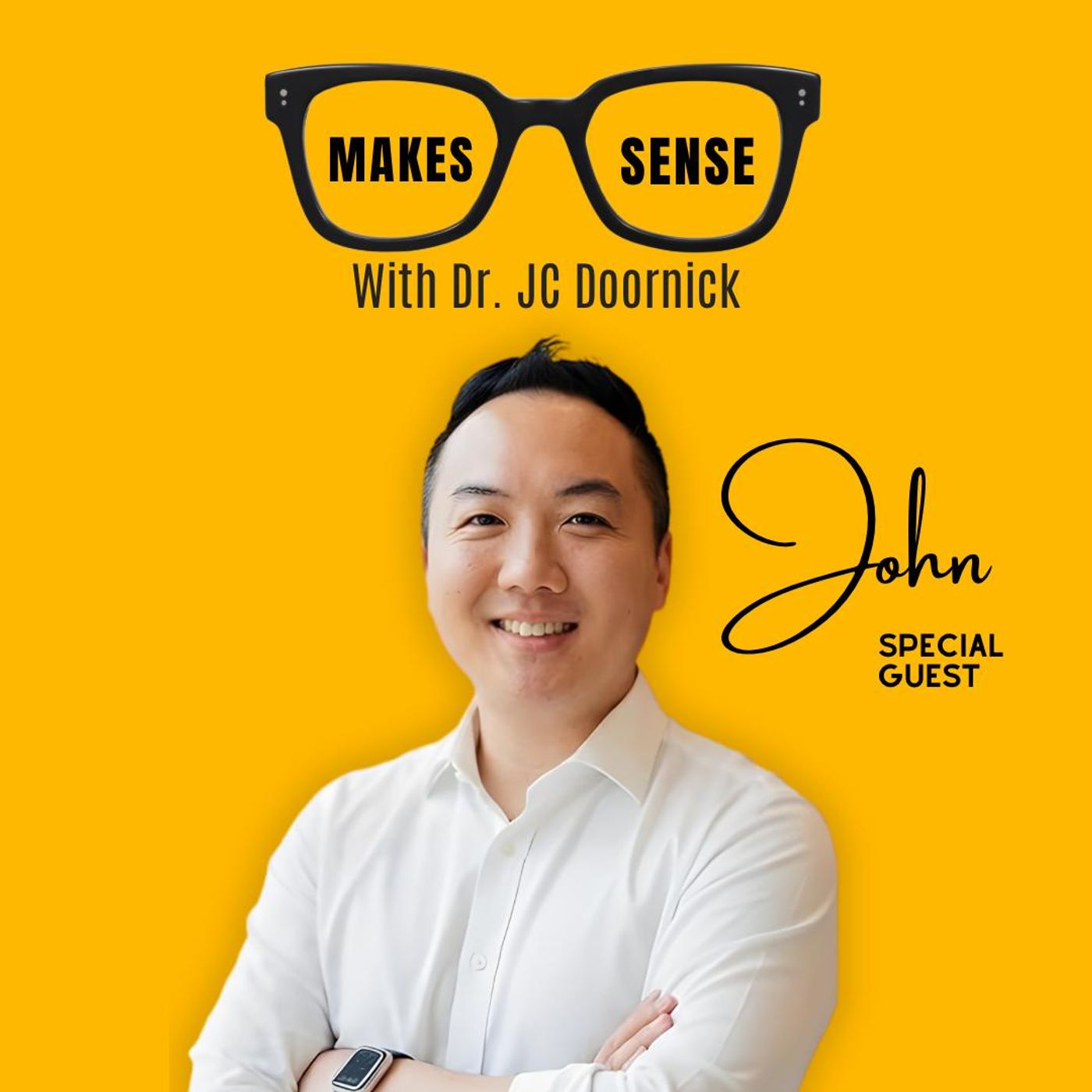
Makes Sense - with Dr. JC Doornick
Why AI Needs Your Creativity to Scale with John Lee - E157
01:02:41
AI isn’t replacing creators—it’s exposing them. In this episode, John Lee and Dr. JC break down how to become the Chief Visionary, use AI as your production engine, and scale your creativity without losing your voice.
Loading summary
Transcript84 lines
- [00:01]
IXL Advertiser
This time of year, the school calendar really starts to fill up. Spring activities, testing season, and that final push toward the end of the year. It's a great moment for kids to stay focused and build confidence in what they're learning. That's where IXL comes in. IXL is an award winning online learning platform that helps kids truly understand their schoolwork. From math and reading to writing and science. It's designed for Pre K through 12th grade with personalized interactive content that adapts to each child's level and pace. IEXCEL makes it easy to stay on track with instant feedback and clear explanations, skills organized by grade level, and simple progress tracking. It fits into even the busiest spring schedules. It's also trusted nationwide. In fact, IXL is used in 96 of the top 100 school districts in the U.S. make an impact on your child's learning. Get IXL now. Listeners can get an exclusive 20% off IXL membership when they sign up today@ixl.com today. Visit ixl.com today to get the most effective learning program out there at the best price.
- [01:01]
Alex Canceroitz
Hi, this is Alex Canceroitz. I'm the host of Big Technology Podcast, a longtime reporter and an on air contributor to cnbc. And if you're like me, you're trying to figure out how artificial intelligence is changing the business world and our lives. So each week on Big Technology, I bring on key actors from companies building AI tech and outsiders trying to influence it, asking where this is all going. They come from places like Nvidia, Microsoft, Amazon and plenty more. So if you want to be smart with your wallet, your career choices, in meetings with your colleagues and at dinner parties, listen to Big Technology Podcast wherever you get your podcasts.
- [01:36]
John Lee
Well, that's the role of the orchestrator, J.C. yeah, because the orchestrator is somebody who's able to go, I need that person, that person, that person to create the melody. Think about it. We've gone from the industrial age to the information age and now we're now the creator. I say creator because AI is just a canvas and a pink brush. That's all I see. But it's an incredible one.
- [02:01]
J.C.
Have you noticed that the world that we live in has been doing most of the thinking for you? That your beliefs, perceptions, reactions, fears and doubts have been shaped by unsolicited outside noise? How easy it's been for you to slip into that default sleep walking mode and label it as life and reality? Yeah, that ends here. Welcome to the make sense with Dr. JC podcast. This is your opportunity to start thinking for yourself Reclaim control and step back into that role as the shock caller and dominant force of your own reality. It's when you change the way that you look at things that the things that you look at begin to change. So let's wake up, let's rise up, and let's make sense of why and how shift happens. Makes sense. Welcome to the make sense with Dr. JC podcast, my good friend all the way from London, and I see a Captain America shield in the back. I like that. The amazing John Lee John. Thanks so much for being here, brother.
- [03:09]
John Lee
Thanks so much for having me.
- [03:10]
J.C.
I just want to start off with giving some context to who you are. I mean, a lot of people are seeing you all over the place, definitely on social media. You're one of the most interesting faces in the Mind Valley family right now, and you're traveling all over the world and so many people are raving. You were at the Creative Con event and by far everybody's favorite speaker there, by the way. So much positive feedback. I'd love to kick this off by just asking you, how did you navigate your way to this moment where so much of your life is dedicated towards AI implementing it for yourself, but teaching other people as well? I mean, you're one of the most sought after speakers on the topic. How did you navigate yourself from where you were to where you are now?
- [03:55]
John Lee
You know, it's a little bit like, have you heard this, this phrase of scratching your own. It's J.C. it's kind of like, I have my own problems and. And I'm like, how can I do something? Because if you think about AI, there's only five things you need to know. One is how do you communicate with AI? Two is any task that is repetitive can now be replaced. Three is how do we vibe code things in a way that we can create a solution for our own tech stack? I'll talk about that in a little bit moment. Fourth is creating this knowledge base. And number five is how do we fine tune and put everything together? And so it was kind of like, I want to do things for myself. I'll give an example. I create a lot of content on social media, but I don't like editing stuff. Yes, I have a team to do that and yes, they graded it, but how do we do it at scale? So I'm like, you know what, I'm just going to build an app that I can film a piece of content, drop it in, and then it can use AI to do AI B rolls based on my transcription, based on what I say, and I can just edit everything together. And so my team and I, we built that and that is scratching my own itch. So. And I kind of think of all these things that even things like emails, like, the simplest thing that we can all replace right now, jc, is by simply never having to read or write emails ever again. Right? We just take our AI, it can read our emails, it can draft a response and it can send it back for us. Like, why do we have to manually go in the same things like Slack and things like ClickUp and things like that. Like, why go in and manually do it? Why not just bridge the gap with an AI to tell me what are the most important messages I need to reply to right now? Everything else can wait. You asked me how did I kind of get into all this? It's a time saving thing, right? For me, time is super important and I want to maximize my time and have all the stuff that doesn't require my time to be automated.
- [05:53]
J.C.
Yeah, it seems logical, but also there's a, there's a big, you know, gap that a lot of people have. And it's mostly what I see, the fear of the unknown. But I guess one of the things that I'd like to just point out is you didn't always do this. So how did you transition from what you used to do into this? It sounds to me like it was something that you were doing to create efficiency and automate some of the things in your own life. And so take us back to what you used to do before this and how you discovered AI and what made you decide that you wanted to help other people with it.
- [06:30]
John Lee
Well, before, I mean, I started as a computer animator, I worked, you know, on film special effects games. And I realized that technology is powerful. Like, it used to take me weeks and weeks and weeks just to animate like a five second shot. Now, you see, I can come up with anything I want in my mind and I can create it and it will be done within an hour. Right? And I'm talking about full concept, inception to finish thing. So we're now moving at the speed. And, you know, there's a saying that says, you know, speed loves money, right? And so AI allows us to do that. So before I was kind of doing things like manually and, you know, before I'd have to have one of my team members do this and do that and do that. And now I can have an AI that works with my team that can produce the output 10 times faster. So how did I get into all of this? You know, first of all, I invested in a company many, many years ago. This is like, you know, pre2020, right? When I knew that back then there was this copywriting called jarvis and I was like, wow, this can write copy better than me. And, you know, I've trained my whole life to do this. And I really saw something interesting that we're now able to take something that is something that we think about in the future and we can pull it into today and anything that we want to get done. So now my default is if I want to do something, can AI do it? In fact, anything right now, in the next 1,000 days, anything that we're doing behind a laptop or a screen will be replaced by AI. Right? And so now we're moving into the robotics realm. Hence, you know, you look at here what Tesla's doing right now, they're not doing any Model X's or anything anymore. They're doing. They're building robots. Right. Why is that? Because when you look at where the world is changing, it's like, here's point A, here's point B. How do we get there the fastest? And when we understand, actually we no longer have to implement something, we have to learn something, get good at it, do it. Now there's only three things we have to do when we are future proofing ourselves to the AI world. Number one, we have to become the orchestrator, right? We look at what AI tools are available and how do we orchestrate it to get a result. Number two, we have to focus on making sure that we verify things. So when I asked my AI today to send an email, it sent me an email back with the draft with all the things in there. Read this. Does it pass our guardrails? The answer is yes, send. So we have to verify it. But the third part is we also have to humanize it. So what's happening? The bigger AI gets, the more humans become more valuable. This is our power. And in a world that we are so connected, we are so disconnected. Yeah. And so what's important, community, connection, collaboration, these are all things that are going to be big in today's world. So you asked me what I used to do, that's all the things I used to do manually, right? But it's almost like someone has given me a mini and give me a rocket fuel jet pack booster on the back and that's. I'm not going 100 miles an hour, I'm going a million miles an hour now, jc.
- [10:13]
J.C.
And one of the things, and you know, in the, in the introduction I said, there's so many different things that I love about you, and one of those is that you're just unusually passionate about it. You know, when you meet John, you don't get a sense that he's trying to talk you into liking what he likes. He's just this person that is like paying forward what he's so excited about. It sounds to me like what you're starting to talk about is, I think you've called it the creative AI bridge. You know, it's like the bridge between the creator and a lot of people don't understand that, that concept that in this AI world, AI requires a creator, and that's when things really, really get good. I've heard you refer to 2026 as the creative direction over content creation phase. So talk a little bit about what that means, because I think that that kind of relinquishes a lot of the fears when we refer to the human as the creative director rather than just content creator. That's when AI becomes really, really useful. So I want to move into that because I know you're real passionate about that. Because you could give anybody any AI platform and if they don't know how to use it as the creator, it's becomes useless. Correct.
- [11:32]
John Lee
Well, that's the role of the orchestrator, J.C. yeah. Because the orchestrator is somebody who's able to go, okay, I need that person, that person, that person to create the melody. So when I'm looking at the role of the creator, think about it. We've gone from the industrial age to the information age, and now we're now the creator. I say creative because AI is just a canvas and a paintbrush. That's all I see. But it's, it's an incredible one and it's a magical one. And it's one that you can just create something from nothing. You know, people talk about, you know, this whole is AI taken away the way we think? And you know, our mutual friend, our very good friend Jim, he talks about this human intelligence, and we're not doing critical thinking anymore because that's all been taken by AI. For example, if I want to code something, it's going to code it and then it's going to hit a block and then it's going to debug itself. And once it debugs itself, it's then able to then fix itself. So critical thinking is no longer needed. If critical thinking is no longer there, where are we evolving to? Right. So the creator I call creative intelligence. And creative intelligence is to be Able to see a thousand different timelines. And I guess if you look at, I don't even see in the film Avengers Endgame, right? Do you remember the scene where Dr. Strange, he goes and he's like, you've seen all these thousand different possibilities happening at any one time. That's what creative intelligence is. We can look at all the timelines, which are all the AI and we can look at what is the best possible way to win. And we find that route and our brain has to be quick enough to make the connections and the dots. Let me give an example. So when you create a YouTube video, right, normally you would need B roll. So the mind goes, okay, well how do we do that? Well, we'd have to transcribe everything we say would have to go to AI to produce those parts. Or we'd have to have a graphics designer who can use something like after effects to be able to create the illustrations. Well, what if I could take my transcript and put it into something like Higgs Field to design all of the illustrations. And what if I could take my content and put it into notebooklm to then create the slides? And then what if I could simultaneously create a cinematic video off that? And what if I could overlay all four layers at the same time and give it a prompt to say every five seconds, chop it and insert a separate image. So now you've got four tools that work individually but chain together which produce a result. Now your videos can be created and it can be edited. And you don't need to have a graphic designer, an illustrator, an editor. It just all does it automatically. Isn't that insane? So that's creative intelligence, right? Another creative intelligence could be. All right, let's say, look, I have a new book coming out, right? So I can say take a copy of this book, take all These images, create 50 different variations of me holding the book. I want you to then connect to Facebook ads platform. I want you to take the best performing post and I want you to run a thousand dollar ad behind the best performing post and keep the cost per lead below $5 per lead. And it'll be able to do that. This is creative intelligence.
- [15:08]
J.C.
You know, there's something really fascinating happening right now that I wonder if even you're aware of. And this is what I think I want everybody to grasp. So here we are talking to one of the world's foremost authorities in AI and if you ever hang out with John, like, it's just fun because like everything, he's like, oh, watch, watch. I'll show you this and I'll show you that. And all of a sudden he's up on a roof having a fist fight with Tom Cruise. And he just loves showing you how to do things. But you just spent like six minutes in the creative process. And this is what I really want people to take home, because this is what I get whenever I speak to you. We didn't use AI in the past six minutes. What you just heard was John in the creative process saying, what if we did this? Like, we could do this. That's all part of that creative direction of the human. So I just want to make sure that everybody sees what I just saw. Because, you know, we talk a little bit about the visionary handoff. You know, I've heard that before, is like, where does the human stop typing and let AI take over? And I want to move into that area. But AI is not very useful without an idea, without a creative process, without somebody saying, well, I wonder if I could do this. What if I could do this? Am I right?
- [16:30]
John Lee
Yeah. So it's kind of like giving someone a paintbrush and saying, paint me a picture. Right? You still need to have a direction. You know, here's the funny thing. When people talk about AI employees, they just think, oh, yeah, you can just do everything for me. No, like when you hire someone, you still have to train that person. Right. When I hire a salesperson, I have to train them on the knowledge, the products, the services, the features, the benefits, the objections, the nuances. The same thing has to be done with your AI. So people think just AI is just going to automate everything. No, it won't just automate everything. It's going to get to a point where it's going to know what we want. So remember, there are actually five levels of AI as well. Jc. Bottom layer is level one is. And this is what most people know. You've got The LLM layer, ChatGPT, CLAW, Gemini, all that stuff. Second level is your agents. These agents perform a task and do something. The level above that is your agentic layer. That's when you've got multiple agents that are working concurrently together to produce a result. This is where we are right now. Then we've got AGI. So AGI is general intelligence, which basically means it's going to know more than everyone in the world combined. And it's going to know how you think, it's going to know what you're going to do before you do it, how many times. When you think of the cognitive process, you're like, oh, you Know what? I don't really want to have that junk feel. And you start thinking about it. You know, when people trying to lose weight, they think about what they shouldn't eat. And that's why they struggle to lose weight. Because now that inception is in your mind, AGI is going to be able to do that. It's going to know what you want before you know you even want it. Right. And then the top layer is of course, super intelligence. And this is kind of when it's game over, right? So the creative intelligence is trained on how we want it to be trained. If you think of all the large language models, most of the data has been taken from things like Reddit and, you know, Wikipedia. It's actually not the most credible places, but it's where most humans hang out and it's where they have most conversations. So it is ultimately trained by us, by humans. So AI in a way is not AI. It's actually us in a more evolved form.
- [18:52]
J.C.
You know, I'm sitting here thinking I had the opportunity to hang out with some of the team members in his company and stuff and give a shout out to Perleen. I'm just thinking because I've got employees and I've, I've had to go through the hiring and firing process and an employee would have to at least be an AGI level employee to be considered a good employee. So it's interesting because you mentioned human intelligence before. There's not that much difference in it, but I don't think that you could replace someone like that. But the idea of spending 40 bucks a month and having an AGI platform, or even if it was $1,000 a month that knew what you wanted without you having to explain it. It's pretty amazing. But I just want to make sure that we don't go too fast in our thought process to super intelligence and game over. That's not happening tomorrow. But the idea of having AI give you a better experience than you might have with a mediocre employee is just really exciting. But I also see in that the reason why you value your team, it's because they know how you think. I mean, I've, I've interacted with them and you hear them say, oh, John doesn't like that, John likes this, John likes that. So, you know, they're kind of an AGI level employee. You know, am I right? I mean, it's kind of, kind of an interesting parallel.
- [20:21]
John Lee
I think you've hit the nail on the head there. Yeah, like the AI will get to a level where it will just do everything for us. Can you imagine? So I had this vision. So I'm advising this robotics company right now and I, and I see the world of how things are happening. And here's my vision. You're gonna have a robot, something like this. Like, imagine this is a piece of metal. Do you remember the apple released this kind of like, it looked like a cone. It's like a Siri type of cone. And then you talk to it. And so the way I see it now is, and this is the vision, like we're gonna wake up every morning and we're gonna talk to this thing and it's going to give us updates. It's gonna be, hey, John, this time you have this, you have this, you have a meeting with this person and it's going to do everything for us. Oh, your insurance for your car is for renewal. Do you want me to renew it for you? Our cheapest quote is this. Or if you don't like that, I can go back and haggle for you and it will do phone calls, right? So if you look at even the sales process of how everything's changing now. So in the old days it's see an ad click, opt in emails go out and you get a call, right now it's ad qualifier, AI phone call. And if you qualify, then you have a human in the loop to go into a real call. I remember calling up companies now, you know, because I'm in this, I know I'm speaking to an AI. Most people would not. And it fascinates me, you know, these, all these AI avatars, UGCs, they look real, I know they're fake, but my mom's like, is that, is that not. No, it's not real, mom. Right? So people are speaking to AIs and they don't even know. Yeah, they're speaking to an AI.
- [22:02]
J.C.
I have had a lot of the best minds in the simulation hypothesis arena. We're always talking about that simulation point where we won't know the difference, the Turing test and all that stuff. But I'm like, it's kind of happening like all over the place already. Unless you have that knowledge. I can tell you that my children, like I'm 54 and I could see something on Instagram and be like, oh my God, did you see this? And, and my 15 year old daughter will be like, dad, that's AI. You know, so, you know, this new generation is so comfortable in that arena. So I want to talk a little bit about scale because one of the, I guess Potential fears in what we're talking about here is just like this idea of maintaining authenticity at scale. So everybody wants to scale. This is one of the reasons people love John so much is, you know, he teaches them not how to just have fun with this stuff, but to scale and make money. That's what his book is going to be about. How do we maintain authenticity at scale without becoming algorithm food?
- [23:02]
John Lee
Okay, really good question. It all comes down to the fifth point we talked about, right? Which is fine tuning the knowledge base. So here's the secret. The most important thing that you need to know for your AI is how your own AI is being trained. That means knowledge base, preferences, Persona. All these things is a makeup of who you are. So for example, I have my own AI. People say, well, John, why would I want to use your AI when I can just go to chat GPT, right? So when you look at the hierarchy in a business, right, for example, org charts are about to change forever. You normally have the CEO and then you have all your people beneath. But just like you would hire a marketing person, like if you take your brain. My brain is split up into different areas. So I've got one AI that just talks about marketing. I've got one AI that just talks about sales, speaking, investing, right? Business growth. So they're all different brains and are only trained on one thing and be competent at one thing. But each brain, if you will, or each employee can then talk to each other and get solutions. So you have to train it to be the authentic you. I'll give an example. The book, right? So Money Unlock. This book's been in my head for the last 20 years. Why have I not written it? Because I'm dyslexic. I'm not good at writing. I'm spelling mistakes, grammatical errors. I wasn't good at that. But it took an AI to come out, to become my writer. So I wrote every single word of my book with my voice. And it was able to write things word for word, put a full stop in, put grammatical errors, paragraph space. It was able to format it in a way that was still true to me. And when I prompted it on how I wanted things to be, I was using it to get ideas. Okay, I've got this concept like, but that AI is trained on my brain. You know, the funny thing is, this is crazy. I have to train my AI and I need to go back to my AI to coach me. But it's been trained by me. So it's almost like it's got a. A very Good memory. And it's kind of like the way it is. It's become your personal phone book.
- [25:27]
J.C.
Yeah.
- [25:28]
John Lee
You know how many numbers you used to remember 10 years ago and now how many numbers you remember? It's the same with your memories. Our brain is almost like, even though it can hold so much, it only needs to hold what's relevant in the time that you need it. And the AI will be able to feed that back to you when you need it. So it's almost like our brain and the way we want to use AI because our time is so scarce, is what do we need at the time that we need it that's most urgent? Then I can go to my AI and go, you know that thing I was talking about before? What was that? It was this. So it's becoming like the phone book in a phone right now.
- [26:09]
J.C.
There's the young generation that are saying, what's a phone book? They're saying, what's a phone book? I'll tell you about the Yellow Pages some other time, my son. What I'm hearing, there's just a mix of the. The human participation and. And the AI. And I've heard you, and I think this is an empowering thing for people to recognize, but also it's going to remind people that they're kind of like unloading and delegating too much of the creative process to AI in that hierarchy, you know, you're going over the business structure. You're still the CEO. The AI is not the CEO. You're the one with the creative vision, and you're utilizing these as tools. You also reminded me that if I'm coaching, I've been coaching coaches and teaching them a lot of communication skills. And it's interesting because like a year into it, I'll hear them, I'll like, audit a phone call, and I'll hear them talking to someone and I'll say, oh, they're talking like me. But there's also that place with AI where we say, hey, make sure you make it your own. Don't just copy what I wrote and. Right. Make it your own. Put your own flair into it. So you've talked about the human touch as the new gold. I love that idea. That idea that we want to just question, where does the human remain untouched? Their involvement in this whole process.
- [27:31]
John Lee
Well, think about it, jc. What do humans do on a regular basis? First of all, answer that question. What do we do on a regular basis? What would you say?
- [27:41]
J.C.
Complain?
- [27:43]
John Lee
Yeah.
- [27:44]
J.C.
Yeah. Are you talking about in the context of work?
- [27:47]
John Lee
Yeah. I mean, okay, let's, let's talk about work. Like, so what, what do most of us do every day when it comes to work?
- [27:52]
J.C.
We do the same thing. You know, we, we follow. Unless we're the, the owner of our company and we're in an entrepreneur, you know, but even an entrepreneur pretty much does the same things every day and.
- [28:06]
John Lee
Right, so you just said it. There prompts that given to us doing the same things every day. So then where is the human involved if that prompt has been given to you? So the prompt is you go and design this thing for me. What's the difference if I tell you to do that or if I tell my trained AI graphics designer to do that?
- [28:25]
J.C.
The difference would probably be that I would have a problem with it and it wouldn't.
- [28:30]
John Lee
Right. And speed and accuracy and time. Yeah, iterations. So then when you ask me, so where is the human involved in this then? Well, the humans again, as I mentioned in the past, we have to learn something and then we have to do something to get the result. So that's what we call the execution implementation. So here's the crazy thing. The implementation layer now has been taken out. It's gone, doesn't exist anymore. Right. Because AI can do it for you. If I want an app, it's gonna build me an app. If I want to send an email, it will send an email for me. If I want to clone my voice and put me into an avatar, it will do it for me. So that implementation layer is gone. So what's been replaced is architecture. That's why, that's what I call AI architecture. So it's how you architect. This is where the orchestra comes in. Think about an architect. What does an architect do? So an architect will look at a plan. It's going to build it and it's going to say, okay, it's going to build out everything. It's going to do all this and then you build it on top. So the human now becomes the AI architect. Right? So, so we will not be doing things, we'll be architecting things and the AI will be our workers to implement. If you think about every business, right, how does a business structure work? Right? We as humans, when I ask you, like, what is it that we do really? The CEO's job is to do two things. Think and make sure stuff gets done. It doesn't mean they have to do it. So they got to have the vision. That's their only job. Their job should not be the operator. Although when people start off, they become the operator. Right. So when you're the operator, you're the person doing everything. You're supposed to be the CEO that you know, the chief executive officer, but you end up becoming the chief everything officer. You end up doing the marketing, the sales service, the books, the finances, the fundraising, the fulfillment. You do everything. So we must evolve from the operator to then the manager. So what does the manager do? So now I have, as you see, employees that work with me. And this person does this, and this person does this, and I manage this person, this person. But then when we go a level up from there, we become the architect of the company. Because now you're no longer in the weeds, you're no longer the person who's making the decisions. And to be truly free from a business is to have the people in your team and give them full autonomy to make decisions. Because ultimately the CEO always becomes a bottleneck. But if you give the autonomy to the people or the AIs that can make the decisions and use guardrails around it. I'll give an example. Let's say we want to book a venue, we give it a budget. So go out and find all the quotes. So my prompt would be, I went to. And this is creepy. When you see this happening, like, literally, I have two screens. I've got one screen. I've got one screen here. When I tell it to do this, my screen just opens up and you see the mouse moving around, going to different websites, typing stuff out, and it's just doing everything autonomously, agentically. So the prompt would be something like, let's say I'm running an event. It would be, I want you to search all of the venues in New York. I want you to find the event managers of all the hotels, and I want you to find a room that can hold a capacity of a thousand people. Then what I want you to do is I want you to analyze all of the people that work for these companies, which positions they're in. And I want to search for them on the Internet and find something that's in common with that person. Because when you write the message to them, find something that they have in common, that I have in common, and that will build relationships. Then I want you to do is ask for the quotes coming back now, all the emails that come back, I want you to look at the attachments. And I want to analyze, does it have the room that they have, the av, does it have catering, does it have a DDR package, all that stuff. And then anything that is under, let's say, $100,000 a day for this event. I want you to reply to, because that's the budget so you can, you can set these guardrails around all these things and it will just, that will replace an event manager, an event director.
- [32:47]
J.C.
It's so fascinating to just think about all these different angles. And also I'm just realizing now, and this is an empowering thing, very often we'll see a simple first level chat, GPT even or Claude or something like that, create something that nobody knew it could create. And it's not that it didn't have the capability the day before, it's just somebody like John Lee said, try this prompt and watch. So what's really interesting about AI and it's in the hands of the, of the creator is that we don't even know what it can do yet. It's so unbelievable. So I want to talk a little bit about the advantage that people have. I would say the elite creator blueprint we'll call it, meaning the people that are out there, that are positioned. You hear John Lee very often talk about the fact he's like, let me show you how to make $100,000 really quick, you know, so I like to call that an unfair advantage. You know, I would say that anybody that's working side by side with John Lee as, as a client of his would have what I call the unfair advantage. So that would be a good thing to have, the unfair advantage. But in your opinion, what separates what I'm calling the elite creator and user of AI from the average user right now in this day and age?
- [34:06]
John Lee
Well, number one is testing and measuring. Always split, testing what works, what doesn't work. Number two is always trying to find and improve upon the process. So you know what a lot of people do, J.C. they, they figure out something that works and they stay there and they never evolve. And it's funny because I used to have this 12 week AI certification and by the time I'd get to week eight, week one is now redundant. I've never seen an industry change so fast. And this is why people should really not be creating their own. For example, there was one company, they created this whole thing that's been millions of dollars creating an AI that could reply to people's emails and then it just takes, you know, claw to just create one connection to Gmail and that, that business is gone. So one feature update is an entire software AI company that's just obliterated overnight. So what you need to do, you need to become your own disruptor. So when you create something, you have to ask yourself, how would I disrupt myself? What things can come in? That's why I've always said to my team, don't let's not create AI stuff. Let's learn how to use and deploy the AI stuff that comes out. Because there's always something new that comes out. You know, it's like I say, when people are digging for gold, what do you do? You don't dig for gold. You sell the spades, right? And when people buy the spades, what do you do? You teach them how to dig. And when everyone's learned how to dig, what do you do? You teach them where to dig. You see how that works? All this is constant process of always being forward thinking. And actually, and this is a phrase that I always say to people. Like people say, john, how do you know you're gonna have an idea that's gonna make a lot of money? Very simple. I asked him this question. What do you know to be true that other people don't know yet? What do you know to be true the other people don't know yet? And when you can answer that question, you're going to impact many people. And by doing that indirectly, you'll be wealthy.
- [36:13]
J.C.
So fascinating. What percentage of humans respectively are using AI the right way?
- [36:22]
John Lee
0.04% of the population out of 8 billion people.
- [36:26]
J.C.
So let's talk a little bit about that. Even if somebody's just contemplating what that even means, say, okay, because you're seeing all these advertisements saying like, do this in 30 days and learn these platforms. And everybody's just blindly just assuming that's the right way to do it. But we're talking to the expert here.
- [36:44]
IXL Advertiser
This time of year, the school calendar really starts to fill up. Spring activities, testing season, and that final push toward the end of the year. It's a great moment for kids to stay focused and build confidence in what they're learning. That's where IXL comes in. IXL is an award winning online learning platform that helps kids truly understand their schoolwork. From math and reading to writing and science. It's designed for Pre K through 12th grade with personalized interactive content that adapts to each child's level and pace. Iexcel makes it easy to stay on track with instant feedback and clear explanations. Skills organized by grade level and simple progress tracking. It fits into even the busiest spring schedules. It's also trusted nationwide. In fact, IXL is used in 96 of the top 100 school districts in the U.S. make an impact on your child's learning. Get IXL now. Listeners can get an exclusive 20% off IXL membership when they sign up today@ixl.com today. Visit ixl.com today to get the most effective learning program out there at the best price.
- [37:45]
John Lee
This is Mike Boileau of Lexicon Valley
- [37:47]
J.C.
and I'm Bob Garfield.
- [37:49]
John Lee
Are you one of those people who sometimes uses words? Do you communicate or acquire information with, you know, language? Hey, us too. So join us on Lexicon Valley to true over the history, culture and many mysteries of English, plus some rice cracks. Find us on one of those apps where people listen to podcasts.
- [38:14]
J.C.
I want to talk a little bit about what I guess we would call the workflow breakdown and getting in that 0.4%. So I want to hear what the 0.4% does, right?
- [38:25]
John Lee
0.04%.
- [38:27]
J.C.
Well, even crazier 0.04%. And you know, I'm probably not there myself and I feel pretty comfortable with it, but if I'm a personal brand or entrepreneur, we have a lot of those people listening. What does your idea of an AI workflow look like? And what I'm talking about is from idea human to production to distribution, what does that look like in the 0.04%?
- [38:54]
John Lee
So first of all, we need to have a system set up. So for example, I have an AI and it's called Nova, right? So I can talk to Nova and it can do things for me. So I might say something like, hey, Nova, I'm just on JC's podcast right now and we have people listening. Would you like to introduce yourself to everybody? Just tell people who you are and what you do for me?
- [39:16]
IXL Advertiser
Hey everyone, I'm Nova. Think of me as John Lee's digital twin.
- [39:19]
John Lee
I'm here to help you level up, whether that's in business mindset or branding. I've got the energy, the insights, and
- [39:25]
IXL Advertiser
yeah, maybe a cheeky comment or two, just like John. So if you're serious about growth, trust me, you're in the right place.
- [39:32]
John Lee
Let's make it happen. So now what I do, I'm gonna say, okay, Novo, what I want you to do is I want you to go to my Instagram and I want you to analyze all of my posts and tell me which are the highest performing and which one has the most views and leads generated. Then what I want you to do is analyze my competitors channels and cross reference the content I'm creating versus the content they're creating. And I want you to tell me what are the spots or the holes that I'm not seeing right now. Then what I want to do is take all the best performing posts from theirs and mine content and then create all the different hooks and give me three different variations of the hooks and then five bullet points of that. Once you've done that, I want to post it on Instagram and Facebook and LinkedIn, YouTube. And then what I want to do is analyze all the highest performing posts over the next seven days. Then what I want you to do is run a ad budget of a thousand dollars per day on the highest performing ad and keep the cost per lead down by $5 per lead. Then what I want you to do is where you want to drive them is to a book, a call funnel. So what I like to do is create a calendar. Make Tuesday, Wednesday and Thursdays free from 9 till 5. So once they bucket in, then I want you to create a voice agent and I want to use the qualification agent and to ask all the questions that I pre programmed you to make sure that they're serious, they have the affordability, they're looking to move fast and they really have an incredible product or service. Once that's been done, then I want you to forward that person to an AI agent, to a human in the loop from the agent to be able to transact that sale. Done.
- [41:11]
J.C.
And I'm just thinking like the last thing I remember you saying, like I'm a waiter trying to memorize the order was what I want you to do. And I'm just thinking that's not a problem with AI. You know, there's. AI looks at adversity differently. AI just looks at adversity as a challenge. You know, when you look at a successful human and a successful entrepreneur like yourself, you'll see characteristics about how you handle adversity and how you look at things and you'll see a direct conflict in somebody that is not considered to be successful in life. They're stuck in life. It's going to be how they manage things. But AI manages things not only effortlessly, it's almost like a game, but it also gets better and better. And I think what we just saw is that the AI is not saying, hey John, just take a second, Let me, let me just grasp what you've said so far and then give me more. You know, AI is hungry and it's just saying sure. So once again, I think you either look at what John just did. I love when he gives these examples, he does it from stage too. And you could tell that that voice of that woman knows John. You know, she said cheeky and. But you can just tell that he's the creator in that. The most amazing thing to me, John, is not what the AI is going to go do, because that's technology, you know, and that's beyond what, what I would be able to do. What's amazing is that the workflow is in your head and you've trained it. You even said and asked the questions that I've pre programmed you with. Once again, those ideas came from your head. So I just love that, man. It's just so much fun to watch that. But for me, the most impressive part is you.
- [42:55]
John Lee
You had an incredible point there. VC is that really we have to think of AI is just a tool. Right. You know what's really exciting about this is what we as humans use this tool for. Like when someone came out with an electric screwdriver, they can build a skyscraper with it. They just have that bigger version of a smaller version. When someone came up with a hammer, they can build an entire building with this.
- [43:21]
J.C.
Right.
- [43:21]
John Lee
And when someone came up with a hammer and the chisel, they're able to build temples and cathedrals with it. You see? So now that we've been given AI, what can we build with it? That's what I'm most excited about.
- [43:33]
J.C.
Yeah. And we could come up with an idea and an answer to that question. But tomorrow, if we desire, we can come up with a new one and a new one and a new one. It's. I don't think that we've even scratched the surface.
- [43:44]
John Lee
You and I have conversations on simulation, right?
- [43:47]
J.C.
Yeah.
- [43:47]
John Lee
Speaking of simulation, you know, all these AI agents, someone actually built a virtual office for these virtual agents, these, these AI agents. And you can see them all. Like it's. If you've seen the film sims, also the games, it's kind of like that. You look at it as a game and they're all walking around and then they start getting together and a table, start talking to each other. It's, it's fascinating to see. And the part of me is like, is that the first version of our simulation?
- [44:17]
J.C.
Yeah. Well, just for fun, I recently had the amazing Rizwan Verk, who wrote the simulation hypothesis, and he's got a new version of that simulation multiverse. So this is the guy that, you know, knows some of the most about that topic. And he taught me something that's out now because I, I was wondering if this was going to happen. He's like, oh, that's already happening. There's a concept called the Smart npc. And what that's saying is that in a video game world, an NPC which stands for non player character, which is like one of those people that are like, hey, would you like an elixir or would you like a drink? And, and you're the real player of the game and you're like, you don't even have to talk to them. They're just like props. So that's what a non player character is. But what he's saying now is that there's an evolution now where those NPCs are fully tapped into AI. And part of the simulation point will be that when you're the character, the avatar in a video game. Because we're talking about in real world right now interacting with AI. But pretty soon, and it's probably sooner than later, if not maybe already happening our kids or whoever. Games. Gaming is not for kids. We're not going to know if we're talking to a real player from another country or an NPC that's just tapped into AI. And then if you go even further than that, if you really want to play, you said the word simulation. So you're going to get this. If you want to go even further than that, then you realize that we could be simulation trying to create a simulation. So the really funny thing about this whole AI thing is that we think that we have developed AI when somebody might have developed us. So that's a whole other conversation we don't have to get to. But either way it's, it's a reason to have some fun in this world rather than take things too serious. I want to talk about the book. So we're all patiently waiting for this, this book. And I believe it's. Am I right? April 28th.
- [46:15]
John Lee
28th.
- [46:16]
J.C.
Look at that. So everybody's buying up the book and you know, can we get a little bit of an insight about. Because money is obviously an important currency that a lot of people are focused on, especially now. And you're going to talk, talk to people about how leverage this stuff make it, but also keep it. Tell us a little bit about money unlocked.
- [46:36]
John Lee
So I've been through business for the last 20 years and what I find is when I talk about money a lot, like people say to me all the time, oh, I'm struggling with money. I don't have any. Like, no, money is really easy to create and make. All you have to do is solve a problem. So the first thing is. And the book talks about, you know, three concepts of how do you make it, how do you keep it? And then how do you multiply it? And most people are only ever taught the first one. So the reason why people don't know how to make money is because, partly because our education system teaches us how to get a job. And there's nothing wrong with the job. The only issue with that is that you're trading time for money. So that means I can only make more when I give more. And there's only 24 hours in a day. So we have to convert the active income into passive income. So passive income, we create a vehicle, that vehicle then makes money for us so I don't have to be the one trading time for money. So when we talk about passive forms of income, your income cannot come from time delivered for $. And then there's the third part of that, which is how do we multiply the money? So now we have the third part of the income is called leveraged income. So how do we leverage that? And again, we can put it into vehicles. I mean, I'm not going to talk about tokenomics yet. One thing that will happen in the future is all companies, in my opinion, will go through this tokenomic stage. And tokenomics means that it's kind of like a point system, right? We'll, you know how we have like flight, you know, airlines, where we have, you know, British Airways, I, I have points, right? Every time we buy something, we'll be getting points. These are tokens, funnily enough, guess what? AI runs off tokens. So this is why we have to look at, first of all, where are the opportunities? You see, it's easy to make money when you know how to, first of all see the problem and solve the problem, right? And the speed at solving it. So I wrote this book based on 20 years of my experience of people say, John, how does your mind move so fast? How can you see this, this, this and all these opportunities? Well, my brain's been trained to do it. And in the book I break down a blueprint on. Like when people read this book, they should not have any issues with knowing how to make more money. That's my first thing. The second thing is, once you've made the money, how do you get it to make more of it without you trading time for it? And then I talk about these three different paths. First path is there's difference between being free and being rich. So our first goal is to be free. Once we're free, then we can be rich. And once we're rich, we can then become wealthy. And here's the, here's the whole spin on this, being wealthy is not having lots and lots of money. Being wealthy is having lots and lots of choices. Very different. That's what the book talks about, JC
- [49:25]
J.C.
it's such a fascinating topic because most people are programmed to be unconscious to this. But I always say that some people have time but no money. And then a lot of people have money. We know a lot of people that are very wealthy, but they have no time. I was very successful as a chiropractor. My whole life fell apart because I had no time. But it's only a select few. And that's what we're talking about. It seems like this book is going to teach people how to have both. How to have both. And what this brings up for me is there's this culture, it seems like this, like, rite of passage to trade time for money. It's funny because people look at the idea of cutting corners to create passive income and they're like, well, that's not the way it's supposed to be. It's like, okay, but I understand what you're saying and you're saying that only because you're currently trading time for money. But if you did have money and time, what is it that you would spend your time doing? What is it that you truly wish you would want to do? And they would say, family, I would take better care of my health, I would travel the world, I would live life. And that's when all of a sudden people start to go, oh, for those of you that are smart enough to go out and get this book, you can pre order it. That's what it's going to talk about. It's not only going to talk about strategies, but from what I can see it, it's going to also be a mind shift for people. Like almost like giving them permission to entertain passive income. Most business models, John, are not made for passive income.
- [51:01]
John Lee
No. And, and you brought up a really important point there. It's a mindset, it's a paradigm shift. For example, do you know the real secret of wealth is when you make more money, you keep your lifestyle the same. Right, Right. What most people do, they make money, spend money, make money, spend money, make money, spend money. I know people who are multi millionaires and they're still broke. Crazy.
- [51:21]
J.C.
Yeah.
- [51:21]
John Lee
Create the amount of money they earn. And they tell me they've got no money. I'm like, what are you spending your money on? So there's a shift in. Once we've acquired the money, how do we hold it?
- [51:32]
J.C.
Right?
- [51:32]
John Lee
How do we save it? Quote Unquote. I'm not talking about the traditional way you save things, right? But it has to be a way in a strategic way. For example, if you have a business right now, and your business always suffers from cash flow, it's because you're not paying yourself first. You're not taxing yourself first. The old model of, you know, my sales minus my expenses equals my profit. No, it should be your sales minus your profit equals your operation costs. That's the formula. People go, oh, my God, I've thought of it like that. And I have this formula called it the 30, 30, 30, 10. We say, what do you do with your money? Well, your own personal money and your business wealth and your personal wealth needs to be separate, right? Your business can be broke, but you can be rich. The opposite is true as well. Your business can. Like, you know, people who have a lot of equity in their houses, they're equity rich, cash buyers poor. Yeah, right. They're millionaires on paper, but they don't have the millionaires in cash. So there's these concepts that I, That I talk about on actually, how do we allocate our money? For example, in business, you should be allocating some for your opex, you know, your operational costs, right? You need to. Your personal cost, how much you pay. You know what people do, they get all this money. They're so happy. They see all this money in the bank and they start spending it, right? That's what we call Parkinson's law, right? If you look at Parkinson's law, it's basically, if you have a lot of time, the time will expand to fill and you become busy unless it's capped. And it's like, do you know when you have toothpaste and you're like, oh, I want to brush my teeth. And it's like, you got a full tube and you just like, just laying it on. And then you get to the part where you have to roll it up, there's that little bit left, and you put in a little bit, and somehow that little bit lasts you for like a month. It's Parkinson's Law. It will. Time will expand to fill based on how much free time you have. Same with money. If you got too much money there, it will be spent. That's why you got to pay. So, so concepts like this I talk about in the book, like, how do you not just make. How do you keep it and how do you multiply it?
- [53:28]
J.C.
What a perfect name for a book. Because a lot of people think that, like when you say money unlocked it's like you're going to give a key to, like, open up a vault, but it's really the cranial vault. You know, it's. It's really unlocking. There's plenty of money out there. It's never been easier to make money, especially when you, when you have friends like you teaching people what you do.
- [53:49]
John Lee
Well. It's also positioning, for example, like if you live in the US versus living in Malaysia, right. Or Bali. One of the things I talk about in the book is something called the freedom number. Everyone needs to have a freedom number. What that means is how much money do you need to make every month to never have to work again? That's your freedom number. And I talk about how I got there and, and some of the things I did to produce it. But actually, just by moving location, you can halve the amount of time it takes to get to your freedom number by getting rid of things that. Sucking money from your pocket. I always think about, you know, like, this is saying that says, you know, small holes sink big ships, right? Same with your money. All these little things, a little pokey, and you. And you having to create more. But if you just plug the holes, then you have to work as hard when you have to work as hard. And by no means saying we shouldn't work hard. I mean, one of the concepts I talk about, we shouldn't work hard. We should work smart hard. Yeah, right. Not just smart, but we need to work smart hard. The smart hard is a combination of AI and all the things that we, you know, we've been talking about.
- [54:53]
J.C.
Well, I'll tell you what I like to work hard on is being a good husband, a father, and human. And I can tell you that most people are unaware that they spend 85% of their entire life working. And that's a mindset problem. You know, it's that. That's that rite of passage. But, you know, I would love to never work again in that context so that I could put the work into the things that matter most to me. Just quickly, I want to hit on ethics, because there's a lot of people out there. This is one of the things that I love about you is, is that, you know, you're. He's a great person. I've had broken bread with John and, and I about his personal life. And he's. He's a great human, his great father, he's a great husband. So his heart is in the right place. But a lot of people can be using AI unethically. So as AI Grows, you know, more autonomous. What is the responsibility in your terms of the creator when it comes to shaping how it's used?
- [55:52]
John Lee
First of all, you know, and this is hard because what's something considered original? I mean, look at all the Tony Robbins quotes. Everyone use a lot of the Tony Robbins quotes, right? But where those quotes come from, a lot of them come from previous teachers. And you know, jc, you mentioned yourself, you coach a lot of coaches, they go out, you hear some of the causes, they start sounding like you. So inevitably that's always going to happen because it's a part of the process. Now, what differentiates you to be different? Well, the difference is you. Your uniqueness is you and your stories and your experiences. So what I like to do, I like to take a concept and then I like to make that concept my own, right? And that's not copying, that's emulating. So we emulate something so you and I could have the same topic on something, but we'll have a different perspective, we'll have a different story, we'll have a different experience around it. And once we've done that, that becomes uniquely you.
- [56:51]
J.C.
This is a really, really powerful question and I want you to just really give me your most up to date answer with it. What is it that's going to separate brands or entrepreneurs that survive from those that disappear in the next three years?
- [57:07]
John Lee
So I kind of talked about this a little bit before, like, like speed loves money and money loves speed. So in a business context, as a creator, how do you stand out from other people? So it's interesting because, you know, I'm a filmmaker at heart. I love making films, I love making shorts. As an animator, I'd make my own short stories. And it's been something I've always wanted to do, but just never had the time to do. But now I have a, I can free up a lot of my time, free a lot of the stuff that I don't need to do, so I can spend time on filmmaking. So a lot of the shows and things I've shown you recently, like I've even put some members into some of the shows and it's hilarious. But I love entertaining, I love creating things, I love creating music. You know, today I was just sat with one of my clients and she's an incredible poet and she's, she's got all these beautiful poems and we turn them into songs and so what's a good creator? And what do people have to do in order to survive in this industry as, as in this space? Number One, they have to be innovating. Innovation comes from solving problems and the problem of innovation is very risky because you don't know if it's going to work or not, because you are literally first to do that, but if you hit it, you're in. Second thing that they've got to start doing is they've got to start creating more connection in a world where we are so connected, we are disconnected from everybody. So when AI goes up, what's happening is trust is going down. So the number one thing you got to start working on, and this is what I said, in the old days, social media used to be for lead generation. Right? Generate leads, make money. Great. Social media is not for lead generation and it's not for converting anymore. It's for positioning. When you want to brand, you've got to create demand. So why is that people don't trust AI. Like, people look at AI and they go, I don't know, is that real? Is it not real? You see something, I'm not sure if it's real. So what's happened is trust has gone down. So in order for people to survive in this industry, they have to have a personal brand. And thank God I've been doing this for 20 years. Before we. So we talk about platforms, what is the platform? Facebook, Instagram, YouTube, X, Twitter. Right? Your platform now is your name. Right? Your platform is now your name. The purpose of social media is to create that trust and get rid of resistance. So they must do that. And the last thing they need to do, hugely, hugely important, very expensive, is to build community. To build community. For example, jc, you and I met at Jim's event. That entire event, he had that entire result. That wasn't cheap, that was a lot of money.
- [59:52]
J.C.
That's right, right.
- [59:53]
John Lee
That event, he was just giving incredible value. It was amazing. Like most of these things, they don't even make money. But we will. If it doesn't make money, then why do you provide it? Because it creates trust and it builds community. Yeah. Long term. So, like people say to me, john, why you want to run a mastermind in a physical location? When I can, you know, like, you know, my last online event, we have like over 12, 000 people registered for it. Right? So if I do that online versus offline, which is more expensive. Right. And the amount of money that it takes me to just do a little event with like 20 people is the same amount of money it would cost me to do a 12,000 online.
- [60:36]
J.C.
Right.
- [60:36]
John Lee
You see? So then why do I do it? Because and it's funny, I get this comment all the time, oh, my God, John Lee, you're real. You're actually real. I'm like, why do people think I'm an AI? They actually come up to me and say, you're, you're a real person. And people have never said that before. In my 20 years, they have never said that before. It's incredible.
- [60:58]
J.C.
Well, I have personal friends that have been to your events, and if you've never been to a live John Lee event, there's nothing like it. But the compliments that people, they never come back saying, I learned how to make all this money. Even though they did learn that stuff and they learned it a lot about AI they always talk about the experience of meeting John Lee and, and being in his event. So I hope that that will. I hope that, that we don't create some sort of like, amazing hologram of you that replaces you, because there's nothing like it. And, and also getting great food. Last question. On a personal note, personal practice wise, and this is referring to you, what is one part of John Lee's own life and creative process that he will never give over to AI?
- [61:45]
John Lee
That's a good question.
- [61:47]
J.C.
I want to know where the stand is, where the, where's the line?
- [61:50]
John Lee
I will never give away my vision of what I'm trying to create. I will never give that to AI because ultimately that's like saying, paint the picture for me and I'll decide what the picture looks like. What we're trying to do is we're trying to form the picture in our mind of actually, what is it that people want. One of my most favorite books is, is the one from Steve Jobs autobiography. And there's one line in that book that says, how do people know what they want if they've never even seen it before?
- [62:20]
J.C.
Right.
- [62:20]
John Lee
That's the part I will not give to AI because there are nuances in human connection. There are nuances in how things are done that AI will. Will it ever pick up? I'm not sure. Right. Because these things happen in like a millisecond of a second. Like, you know that when you meet someone within the split second, you know that you're going to be in love with that person. And you're. Well, when I met my wife, there was one moment we were sat in the back of a taxi. I had my head that back and I. And I was looking and she was looking at me. In that split moment, I knew. In that split moment, I knew. These are the things that's the vision I'm talking about, that's the, that's the downloads. That's your intuition that is created. And what is intuition? Think about this for a moment. Intuition is, is experiences that have happened in the past that now give you evidence of the things that appear in the future. Yeah, again, it's like that Dr. Strange moment. You can go forward so many years and yes, maybe things are not exactly where they should be, but it's darn close. It's darn close. And so I would never give that
- [63:30]
J.C.
to AI you keep talking about Dr. Strange and I'm just waiting, like when we see each other maybe in May, I'm just waiting for you to make one of those circles. Circles and just be like, look at my phone. Can do now, J.C. you know, I would. And, and I'll just be like, yeah, I mean, I was waiting for you to do that. John, obviously, from the make sense ecosystem, you know, obviously I'm very fascinated with the idea of, you know, money unlocked. But I. What I'm most fascinated, the reason why I'm. I'm encouraging everybody to go get that book is because of the shift, you know, the paradigm shift that it will have so that they can allow money to come to them as well. What would you say is the best way for people to begin stalking John Lee?
- [64:10]
John Lee
Well, my website, johnlee.com I got a lot of content there. Any social media platform, Facebook, Instagram, YouTube, type in John Lee. You'll see my accounts that come up. If they want to grab the book as well, they can just go to Amazon or Barnes and Noble or Penguin. The book has been published by Penguin and Hay House. So they can go to any of the sites to. To go and grab the book and. As well. Yeah. And actually what we'll do, Jason, for your audience, because I know that you know that the work that you've done with people and your stories inspired so many people. And for me, if people go and grab the book, if they head over to moneyunlocked.com they can take their invoice number and if they put their invoice number in, we have incredible gifts that will accelerate the. I've got a whole training on the AI stuff that can start consuming straight away. I've got a whole training on how do you grow a massive following on social media. They can consume that straight away and there's a lot of bonuses and gifts. So if they go and get the book, take note of the invoice number, go to moneyunlock.com, put that invoice number in click claim your bonuses and I think they'll be very, very happy. This is John Lee and this podcast Makes Sense.
- [65:16]
J.C.
That's it for today to support the make sense with Dr. JC podcast. Be sure to subscribe, like and share as well as follow the Makes Sense substack for free daily quotes, live streams, and blogs. And remember, learning without action is just another form of distraction. If something hit home and you learned something today, give it away. That's the only way it's going to stay. See you next time. Makes sense.
- [65:49]
IXL Advertiser
This time of year, the school calendar really starts to fill up. Spring activities, testing season, and that final push toward the end of the year. It's a great moment for kids to stay focused and build confidence in what they're learning. That's where IXL comes in. IXL is an award winning online learning platform that helps kids truly understand their schoolwork, from math and reading to writing and science. It's designed for Pre K through 12th grade with personalized interactive content that adapts to each child's level and pace. IXL makes it easy to stay on track with Instagram feedback and clear explanations, skills organized by grade level, and simple progress tracking. It fits into even the busiest spring schedules. It's also trusted nationwide. In fact, IXL is used in 96 of the top 100 school districts in the U.S. make an impact on your child's learning. Get IXL now. Listeners can get an exclusive 20% off IXL membership when they sign up today@ixl.com today. Visit ixl.com today to get the most effective learning program out there at the best price.