← Makes Sense - with Dr. JC Doornick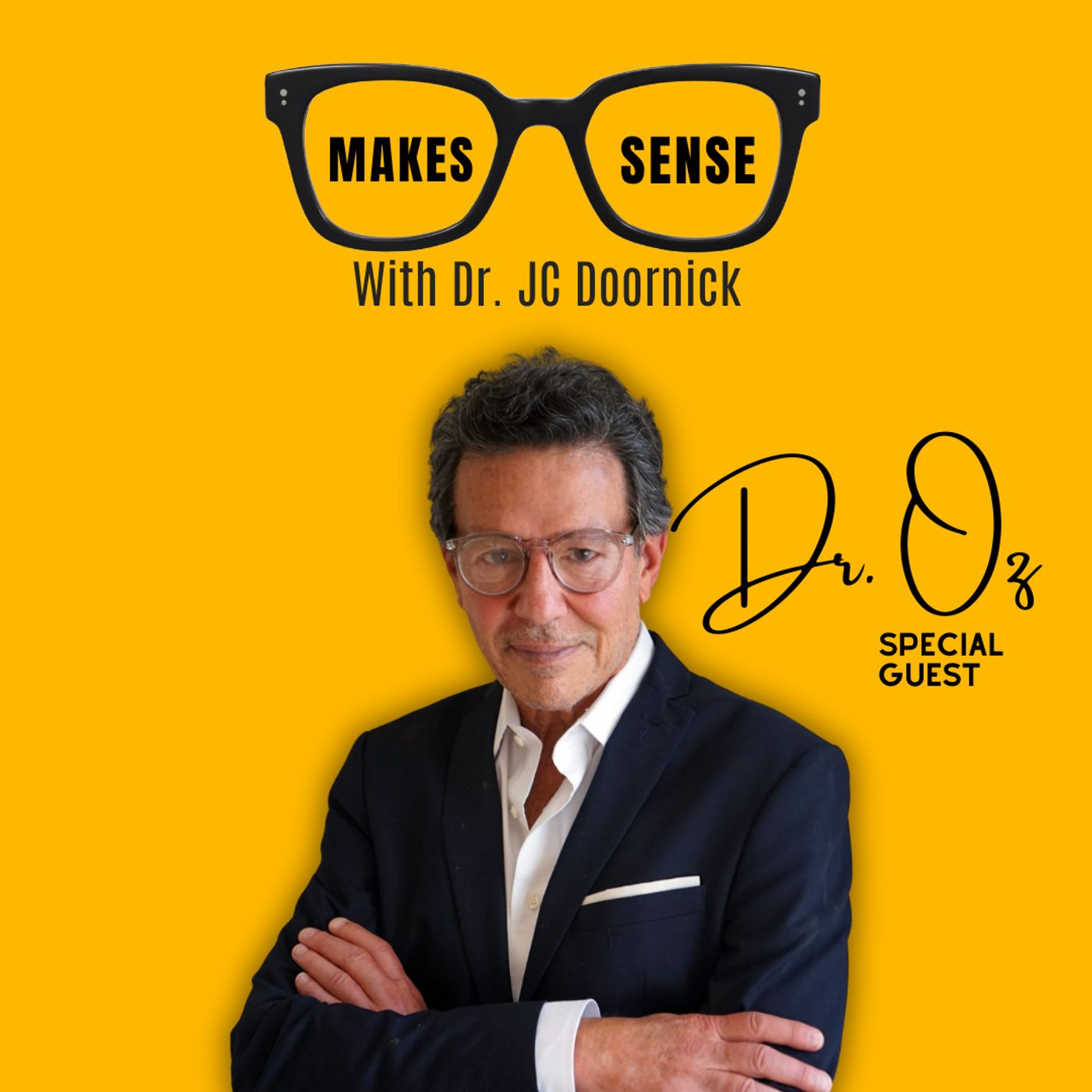
Makes Sense - with Dr. JC Doornick
Why You Feel Depleted: Oz Garcia on Healthspan & Brain Vitality - Episode 149
00:55:37
Feeling depleted, foggy, or older than your years? In this episode, Dr. JC Doornick and Oz Garcia break down healthspan vs. lifespan, mitochondrial energy, post-COVID fatigue, brain vitality, and how to age with clarity, strength, and purpose—not just more time.
Loading summary
Transcript62 lines
- [00:00]
A
It's tax season, and at Lifelock, we know you're tired of numbers, but here's a big one. You need to billions. That's the amount of money and refunds the IRS has flagged for possible identity fraud. Now, here's another big number. 100 million. That's how many data points LifeLock monitors every second. If your identity is stolen, we'll fix it, Guaranteed. One last big number. Save up to 40% your first year. Visit lifelock.com specialoffer for the threats you can't control. Terms apply.
- [00:30]
B
Take an egg. Egg has all the perfect amino acids to make an egg. I don't know, 22, 23amino acids. In that configuration, you've got an egg. You take the building blocks out of an egg. Let's say we take 1, 2, 3 different amino acids, reconfigure them in ways that are not found in nature, and create a whole new novel entity that's called a peptide.
- [00:54]
C
Hmm.
- [00:54]
B
And what peptides do is they create pretty remarkable natural events within the human body.
- [01:02]
C
Have you noticed that the world that we live in has been doing most of the thinking for you? That your beliefs, perceptions, reactions, fears, and doubts have been shaped by unsolicited outside noise? How easy it's been for you to slip into that default sleepwalking mode and label it as life and reality? Yeah. That ends here. Welcome to the makes sense with Dr. JC podcast. This is your opportunity to start thinking for yourself, reclaim control, and step back into that role as the shot caller and dominant force of your own reality. It's when you change the way that you look at things that the things that you look at begin to change. So let's wake up, let's rise up, and let's make sense of why and how shift happens.
- [01:51]
B
Makes sense.
- [01:55]
C
So welcome, everybody, to the make sense with Dr. J.C. podcast, and very, very excited about our guest. And I'm gonna take some time to tell you a little bit about him, but today's episode is called why you feel depleted. And we have Oz Garcia, who's just an amazing individual who's going to talk about health span and brain vitality. We're going to talk about the idea of ceasing to just put all of our eggs in one basket of living longer and start living better. And this is the foremost expert on this, and I just want to say my observation that made me interested beyond meeting him as a friend is that most people, and this is how it relates to our show here, most people are taught to focus on lifespan, and this is A big thing right now, and that just has to do with how long they live. I think a lot of people are trying to, like, live longer, but what if that's the wrong metric entirely? And we're gonna. We're gonna discuss this today. This is a really cool topic. So today we're gonna discuss health span versus lifespan, biological age. This is gonna be a real big takeaway today. And why so many people feel depleted, foggy, and worn down, despite doing all the right things. That's what's interesting about it, is, like, a lot of people think they're doing all the right things, but then at the end of the day, they say, why am I still so tired? We're going to welcome this amazing guest, and I always do a fun intro to this podcast that is called what I Like about yout. This is. This is Dr. Oz and all of his accolades that's going to come out. You're going to find out how spectacular this man is. But I just wanted to say on a personal level why I've invited him to be on the podcast and specifically what I like about him. So before we dive in, I just want to share some personal interest that I have in this individual. Ironically, we met at a pretty cool event, you know, I mean, I was at an event that was hosted by Jim Kwik, our mutual friend, and the spectacular Gary Vee. So you never know who's going to be in that room, you know what I mean? And one of those high performers in that room. There's a big. A bunch of big dogs in that room that had big, big personalities. But lo and behold, sitting just to the right of me, right? You always wonder who's going to be sitting next to you. And this is the guy that really stood out that night, and that is Dr. Oz. He's a genius. He knows so much, and he's one of those people that you're never going to believe his age. He's one of those guys. But his knowledge wasn't as powerful as his presence. You know, first and foremost, I always appreciate people that are not posturing, that have tons of, tons of things to sell and help people with. But there was a conversation that was more about listening and learning. And that was one thing I noticed right away. It's only a small group of people that become candidates to be legitimate friends. And not everybody gets into that category. So in a room full of people chasing the next edge, Oz was grounded in something much deeper. And that was wisdom earned over time. That's the thing that I noticed about this guy, it's like, you know, you meet these certain people and you just want to sit there and talk to them because they have experience and wisdom. So he has the rare ability to discuss advanced optimization, which can get pretty dry and technical, but without losing sight of the person in front of them. And I really appreciated that. So that combination of precision and restraint is exactly why he's the right person for the rise up with Dragon culture and what we call the Dragon Slayer. So I want to welcome you, my friend, to the make sense with Dr. JC podcast and say that it's absolutely an honor that you've taken the time to be here today.
- [05:40]
B
J.C. thank you. I'm very pleased myself. It's absolute, absolute privilege.
- [05:44]
C
What I want to do is the typical first question would be like, tell me your backstory and things like that. I'm hoping that that'll just organically come out because there's some topics that I think people are just going to be super, super excited to discuss and they're super relevant right now. It's an interesting time to be a human being because I feel like people are waking up more than ever and considering things that we used to sleepwalk through, which is an exciting thing to acknowledge. But at the same time, I think people are flying blind as well. There's so many different things that maybe mainstream media is not showing them because mainstream media is telling us what to do that makes them profitable. So most people focus on lifespan, but you've said that that's actually a dangerous mistake. I find that fascinating. Like, what do you mean lifespan is a dangerous mistake? So my first question to you is, why is healthspan the only metric that really matters, in your opinion? And if we want to stay in the game and preserve quality of life, why is healthspan something that we should really acknowledge?
- [06:53]
B
There's an immense amount of interest in living indefinitely. It's a lot of money, there's a lot of technology, There are a lot of businesses, organizations, individuals that are pouring millions into the subject matter of lifespan. Can we exceed the 120 year cutoff point which human beings are for the most part designed to live right? And there aren't all that many people that we've documented have hit that point. And from my point of view, I don't want to die. I just don't want to live forever. So I'm interested in taking from the technologies that are arising, the biotech technologies, in terms of can we improve certain things about the human body that may make you live longer? Possibly. I Think the field itself is still really quite young, that we can take the crumbs. I can take the crumbs of certain things that may affect genetics, epigenetics, that can affect how it is that I build muscle, that affect how it is that I can protect my heart, my microbiome, make my immune system bulletproof. And actually instead of trying to live longer, can I live better so long as I'm alive? And that's a critical point. So I'll take the crumbs that are coming off of the whole lifespan movement.
- [08:19]
C
JC I'll take the crumbs as well. It's interesting what you're saying because I've heard multiple times and there's some experts in the field of like evaluating what's possible because of advancements in technology and advancements in medicine and things like that. And I've heard many, many times that predictions that in five years time, if you're still alive, the life expectancy will increase to certain, certain. And this opens up that discussion of like, I don't know how long I want to live, you know what I mean? It's, it's more about quality of life and I think people forget about that. So just off the cuff, what's your stance on the advancement of medicine and technology and what does it hold in store, not necessarily for healthspan, but for lifespan?
- [09:06]
B
Like I said, a lot of research going on. Bucks Institute, Life Extension Department in University of California in San Diego, independent studies worldwide, different studies that are being financed by, like I said, biotech companies and so on. You've got great thinkers that are doctors, scientists, researchers. Eric Topol, probably one of our greatest thinkers in medicine these days and speaks a lot about the subject matter of living a fulfilling life. Eric is someone who understands the role of AI, where it is that science has taken us in the years ahead, so that medicine itself becomes refined and more capable of supporting a human body rather than just diving after symptoms, the symptom oriented form of medicine which we still live in. So the institutions of medicine themselves are changing as you find a better educated consumer. So if I'm a medical consumer, what I can do before I go see my doctor is I can prepare myself better through AI, through online searches, different chat engines and so on. And this is very different than what you could do even five years ago, certainly 10, 20 years ago, where most of us would be at the mercy, let's say the doctors that we'd work with. That doesn't take away from the critical aspects of the care that you and I need. Should I break a bone? Should I have a problem within my heart? If I've got a cancer? We want the best medical advice in the world. And what's happening is with the advancement of AI and the way that things are going, we'll probably find different means by which medicine will exist. It's not going to be in the form that it is now, the way that robotics is, altered surgeries, for instance. So medicine itself is evolving now at a certain clip. And I think listening to people like Eric Topol and his book about the future of medicine is fascinating. To just sit there, turn the page and see that things are going to be very different within five years. If you speak to somebody like Ray Kurzweil, who's the science guru for Google. Ray wrote a book called the Singularity is Near and he just came out with an upgrade on that particular book called the Singularity Is Nearer. His prediction is that within five years it's going to be emerging between human beings and AI. We'll say, what I want to do is make sure that I'm around in five years to see the phenomena of what's occurring within medicine, the evolution of medicine itself, the evolution of functional medicine. Where is it the genetics are going, where's CRISPR technology going? Where's the ability to utilize many different kinds of nutrients that have nothing to do with the existence of pharmaceuticals, the tremendous explosion these days within peptides with nutrients that nobody even understood, what they did, how they worked, even several years ago. And so it makes you and me almost like a citizen doctor, citizen scientist, where you can be extraordinarily well informed about how you can also take care of yourself, how can you optimize your health so you're in the best condition possible and you're using medicine for the best that they offer in diagnostics, the best that they can offer in terms of feedback based on diagnostic testing, and the fact that you've got access to information online that you can go to ChatGPT and actually find out very quickly if certain medicines are suitable for you or not, depending on your condition. But in terms of this discussion, there are many tools that we can bring to bear to actually maintain our health. And, and these are things that are commonly known, whether it's how you sleep, the improvement within the quality of your sleep, the choices that you make with food, how it is that you conduct yourself insofar as how you deal with stress, we can talk about that in and of itself as subject. So there's a lot that we already know. You And I can be doing as individuals. That has nothing to do with medicine. That has a lot to do with, with biological intelligence. So that you and I can actually experience something that I call biological autonomy. I'm in my mid-70s and I'm a competitive cyclist. And I was a long distance runner, a racer, marathoner for 40 years. So I've always been interested in what's the next level, what's the next edge, what's the next thing that I can do in terms of what's available. 40 years ago, not 1/100th of what's available in the market today to take care of ourselves existed. That's where we began this conversation. When certain companies are looking at how can you extend life? Can you live longer? They're also on the way looking at how can you regenerate organs. There are studies for women that may not be able to conceive naturally, may have difficulty with reproductive system, where at the Bucks Institute, they're actually developing ovaries that eventually, someday, I mean, the science behind ovary invention in a laboratory so that women that are infertile at some point can actually have these put into their bodies. And it just fascinates me listening to all of this. It's not so much science fiction anymore, if it ever was, just things that nobody could have ever imagined.
- [14:35]
C
One of the things that I picked up is just this idea of the better educated consumer. And it's so great to hear somebody from the field actually recommending that the patient become educated, because that's a very scary thing for a general practitioner or something like that. They just want you to do whatever you're told. So is it safe to say that a lot of the locus of control of health needs to be placed in the hands of the consumer? You know, just like if you put your kid in a school right now, they're going to learn outdated stuff. So there's so much more interesting information, especially in this field, that you're not going to get from your doctor, and you're going to get whatever the doctor likes. Do you think that this is an important shift for people to take a little bit more responsibility to become educated?
- [15:24]
B
Wisdom, self education, reading, curiosity, mindset. There's all the ways that you need to prepare yourself to be the best version of you. And let's say I'm dealing with a medical concern. Let's say that I'm concerned with my aging body. There are certain things that I want to address. Let's say that there are genetics. I've done a gene test of which there are many that people can take advantage of. And there's certain things that pop up, and you want to be preventative. You want to make sure that certain genes that may pose a threat to your body stay quiet. Prostate genes, cancer genes, heart disease genes, diabetic genes, and so on. But you want to know this stuff, and you don't want to go in to a doctor's office, let's say, if that's what you're doing, unprepared. These are institutions, medical institutions, that have been around historically, forever. And as they've evolved, they've become in some ways misogynistic when it comes to women, dismissive when it comes to both men and women. The average amount of time, if somebody doesn't know it by now, because it's. Everybody knows this, I would suspect, with a doctor. And a doctor's Visit varies between 4 to 12 minutes. And so I think knowing what may be important for your body and starting with the most basic things of all that actually move the needle in terms of how well you feel, your states of mind, how well you can work out, begins with you. I can go to Amazon. I can get any number of books or information on my heart. If I'm a man, and I've got concerns as I get older and in my family, there were problems with heart disease, with prostate cancer, I can be really well informed and get a substantial amount of wisdom and no choices that I have that may not line up all that well with mainstream medicine so that I can use particular products, ways that I can take care of myself to reduce my risk, let's say, of prostate cancer, heart disease. And in that regard, you've got a lot more to say from your perspective as being an educated consumer. You can do a test now, a blood test, for instance, through Cleveland Clinic. Now, Cleveland Clinic will provide, through Quest, a particular kit that you can do at a Quest lab or through your doctors, where they can take apart your whole heart and everything that may be a problem that has nothing to do with cholesterol. Your HDL good cholesterol could be at the right level. Your LDL bad cholesterol could be at the right level. Yet there are other moving parts within what's going on in your body that could blow a hole through your heart. Homocysteine, CRP apob, for instance. And most consumers are just not aware of these things. You know what? I'm going to go to my doctor. I'm going to request that particular test, or can I get these on a standard test? So That I can understand really what's going on with my heart and do I have any concerns.
- [18:28]
C
I don't think a lot of people understand that they can like interview and hire or not their support team, right? They don't have to, like, just do whatever they're told. So it's the informed and better educated consumer that can ask questions to see if your health practitioner is in alignment. Now, every medical doctor that listens to my show has just stopped listening to my show. You know, they don't like that, but I like it. So let's talk about an interesting phenomenon. And we brushed on it. So we live in a world where we have more access to amazing stuff. You know, I mean, I've learned so much just from meeting you. I've learned more about peptides and creatine and we'll talk about that. But we have so many people now that are doing a lot of the things that they think are right and their labs are normal, but they're saying, I feel depleted. So tell me, why do people feel biologically older today than they did years ago at the same time that we are projecting this longer lifespan?
- [19:31]
B
That's a really useful question. There are many moving parts that come to the picture that contribute to, I would say, mindless suffering, where for reasons that are within a person's control, biological suffering increases, mental suffering increases. So it doesn't have to be issues of, let's say, mental health, let's say lack of mental fitness, and we lose track of, or we're just not aware of how many things can actually make me feel better. Talking about feeling better is very topical. What's happiness? What are the different ways that a person can be happy? Knowing that there's joy, that there's peace of mind, that there's energy within your body, you know that you can feel it. And unless you know that you're a primate before you're anything, you're an animal. Where we come from, a very long history through evolution have become these. These remarkable apes with these amazing brains that can think, that can cogitate, that can actually begin to figure out in the environment that we're in today how it is that you can be best equipped to actually deal with circumstances in the world today. World on fire, environments that are constantly pulling energy out of us. If you're on your cell phone, if you've got more digital equipment, if you've got a laptop and you've got an iPad and you've got WI fi going, so much that's pulling at you, and whether or not you're fit and whether or not you're able to do mindfulness work where you can back off and learn that in today's post modern world, post postmodern world, becoming a mindful human being and spending time meditating actually can do tremendous amount of repair. The average lifespan of people that are meditators, 10 year 15, 20 year meditators, is an increase of 3.5 up to 7.5 years.
- [21:32]
C
Wow.
- [21:32]
B
From being able to meditate alone. And this has nothing to do with the supplements and the peptides and the IVs and the stem cells and the, you know, getting to the gym and running in the park and whatever. So that's a big distinction right there.
- [21:46]
C
Jc, you made me think of a stoic philosophy and called learned helplessness. And I don't think people ever know that they're subjected to that. But you know, I like to always release my listeners from shaming themselves and say, I forgive you for, you know, not what you do, you know, but this is such a fascinating topic and I love the wisdom that you bring into this. So I want to talk about a hot topic right now. I mean, among a million hot topics. And that's just chronic inflammation and post Covid fatigue. I, I feel like there's a lot of just people out there that just don't even know what the fuck is going on. You know, they're, they're just, sometimes they'll make a connection that it's been since COVID or, you know, most of the time they just think it's like it's just them or something like this. But is what we call normal aging just chronic inflammation in disguise? So why does post Covid fatigue linger for so many people? So that's two questions. Normal aging, is it just actually another form of chronic inflammation in disguise? And also why do people have that post Covid fatigue? And why is it lingering for so long?
- [22:58]
B
Very good. So I'm going to break it up into two parts. Chronic inflammation is a function of entropy occurring on the human body. The corruption of systems that actually control what's going on. The way that you replace yourself through DNA, the way that DNA corrupts ultraviolet light, gravity, entropy systems that the repair systems that repair DNA, for instance, so that you get, as we all get older, mutations within DNA. So DNA begins to spit out wrong versions of uma. That's why more cancers show up later in life, more health problems, joint problems, and so on. So we're dealing with not only our bodies, but we're bodies in an environment. And the environment is exerting immense pressure on our systems. So that's one thing in that regard. Aging a function of a multitude of things that are all coming apart. And as that occurs, your ability, my ability to control inflammation, begins to break down. So there are people that study the brain. Inflammation within the brain, inflammation within our joints and stomach inflammation, and certainly inflammation in your heart. So that you can measure in a blood test through crp, cardiovascular reactive protein. And then there are other metrics that can actually show you that. But CRP is a really good measure of systemic inflammation. So usually on a blood test, a standard blood test, CRP should be in a range of 0 to 1. And to have somebody come in, let's say we look at the blood, we're going to CRP around 8, 9, 10, there's something going on. And certainly in your 50s, 60s, 70s, and 80s, if CRP is elevated, if sedimentation rate is elevated, then there may be inflammation going on in your heart and systemic inflammation that's occurring, that's a big problem. And you and I both recognize that inflammation is now kind of like a buzzword, like we need to control inflammation. But it is an effect of a body that's not repairing itself in a timely and relevant manner. Now, when you talk about COVID and we talk about post viral syndrome and recovering from it, you already know my story. You know that I got severe Covid pneumonia five years ago. Right now I was in Mount Sinai Hospital. I went in for elective sports surgery and I got a titanium platelet in my neck January of 2021 and picked up Covid pneumonia in the hospital, very severe form called Delta Plus. And I spent six weeks in the hospital. So I went from 150 pounds and being a runner to under 98 pounds. And they put me on a wheelchair hugging an oxygen tank and I had to rebuild my body back. Now, the first two years, nobody knew anything about long haul post viral syndrome. What's all this exhaustion about? The advantage that I had and still have is that I was deeply embedded in the functional health field, progressive health field, since the 1970s. So I just started to figure out very quickly, can I appropriate different technologies that are used for supposedly extending your life and could it have an impact on post viral syndrome in a post viral syndrome in post Covid, long haul Covid. What you're dealing with, also people with chronic fatigue syndrome and so on, is corruption within mitochondrial tissue or mitochondria. Mitochondria, as you know, and I hope your listeners know, are the engines that drive and produce energy, thousands of them, every cell in our body. And what they do is they take fat, they take sugar, they convert it into energy into ATP, adenosine triphosphate. And so you have energy. When you go through what I went through and you're dealing with post Covid syndrome, there's a lot of corruption within the mitochondria. The membranes themselves are damaged. The ability to produce energy adequately, to actually absorb molecules of sugar or fat through the membrane is not working well. And so when you magnify that by billions of times, which experiences exhaustion and those are the main problems, let's say, with post viral conditions. And that contributes to other problems, brain fog, mood problems, inability to feel well. And there's a lot that we could add to that. But I've worked really diligently over the past five years to actually try and figure all of this out. And yeah, they're remarkable tools that really move the needle in terms of rebuilding your mitochondria back, getting your muscle mass back and getting rid of brain fog. And that's that. That's a lengthy discussion that you and I could have.
- [27:54]
C
Lifelock, how can I help? The IRS said I filed my return, but I haven't.
- [27:58]
A
One in four tax paying Americans is paying paid the price of identity fraud.
- [28:01]
C
What do I do?
- [28:02]
B
My refund though. I'm freaking out.
- [28:04]
C
Don't worry, I can fix this.
- [28:05]
A
Lifelock fixes identity theft guaranteed and gets your money back with up to $3 million in coverage.
- [28:11]
C
I'm so relieved.
- [28:12]
B
No problem. I'll be with you every step of the way.
- [28:14]
A
One in four was a fraud paying American. Not anymore. Save up to 40% your first year. Visit lifelock.com Special offer terms apply.
- [28:24]
C
You said before you just mentioned this idea of recognizing that something is going on. I think a lot of people are thinking like that. And I also just had this moment where I almost am happy that I had not met you five years ago. Because I would have been really worried about you. I would have been really worried about you, man. Yeah, I'm happy to hear this as a story. But also this brings a lot of validity beyond your knowledge and your education because you actually were forced into a situation to see if all this shit you talk about works.
- [28:55]
B
That's correct.
- [28:56]
C
That's pretty cool. You mentioned brain fog and I for one work very hard on this. And when you're best friends with Jim Kwik, you don't really have much choice, right? You gotta, you gotta deal with that stuff all the time just, just to have a conversation with him, you gotta be on point. He's fast on point. But why does the brain feel foggy? First of all, what causes brain fog? Cause we're noticing like 10 years post pandemic, you know, people are getting so far away from pandemic they're forgetting about maybe the effect of it. And also, is cognitive decline reversible?
- [29:29]
B
Good question. Again, better than good. Useful. Multiple reasons why the brain may not be operating the way that it ought to. Certainly in terms of brain fog and so on. If you're not physically conditioned, that's going to contribute to brain fog. So we do know that being fit and being well oxygenated builds better neurological tissue, allows your brain to focus better, your cerebral cortex operates better, your recall, long term, short term, all of that works better. To the extent that you work out, there are two schools of thought on the subject matter, whether or not you're going to work out with weights or aerobic. I kind of split it between both. These days I do a lot more upper body, but in the warm weather, I'm on my cycle and I'm out the door. Certainly if it's a sunny day, being exposed to nature, as lame as that sounds, if you're going to live in a city like New York, you want to have access to Central park, where the environment itself, I'm on my bike or I'm walking, is getting exposed to elements that, as primates, are critical for the human brain. Separate from that is whether or not we've bothered to cultivate our thinking, our ability to build up wisdom. And again, I want to be careful how I say this. I think reading is really critical. I think educating yourself daily and committing to reading 50 pages a day, minimum of a book, polishing off a book every week to two weeks at the very least, is unbelievably important. Using the kinds of nutrients, nutraceuticals. It's a category of nutrients that are called nootropics. I think it comes from the Greek, meaning to make intelligence that actually do some fascinating things. They increase an enzyme in the brain called bdnf, brain derived nootropic factor. BDNF builds brain tissue. And what you want to do is take nutrients and elements that actually build up BDNF and build up your brain. And there are nutrients that you can take, vitamin like compounds, amino acid like compounds. You know, you brought up creatine before taking creatine. And there are two forms of creatine, monohydrate and buffered. If you take either one, I like the buffered because it's easier on my stomach. It has the effect of improving neurological signaling. In other words, it optimizes how well the brain can work and hence deal with things like brain fog. So what I'm doing is I'm stacking. I've got the different nutrients, amino acids, peptides that increase bdnf, improve signaling within the brain. I'm aerobically well conditioned. And you need to sleep, you need to sleep. Well, from my point of view, you need to quantify your sleep. So whether you use a whoop or a garment, I use an OURA ring so that I can actually track and see the quality of my sleep because that makes a huge difference in terms of your thinking, how well your brain is doing. And yes, there is some deterioration that is occurring as we get older. What I'm finding is my brain. So long as I'm doing everything that we're talking about here, there's a lot more than I'm doing too. Then my brain seems to stay more or less the way that it was when I was in my early 40s. And so again, what I want to point out is the different things that need to be done. It's not one thing. It's not going to be a bottom line pill. You know, if you do Jim Quick's courses, that completely expands your ability to think better. Lifts brain fog. Right.
- [33:05]
C
You know, there's so many things that you just said and learning is, is a big one. But also we're looking at a generation coming up now that's learning without reading books. Right. I mean, like some kids, I don't even think pick up a pen and write or anything like that. Let's just make sure he, he mentioned a word that a lot of people might not understand and he said the word pages. Right. So we're, we're not talking about like scrolling and things like that because it's a muscle, right?
- [33:32]
B
Yeah.
- [33:33]
C
Here's something that is always on my mind. I've been asked several times what my biggest fear is. I'm not afraid of dying. I'm more afraid of not living than dying. But what I do fear is losing my faculties like these, these ideas of dementia and Alzheimer's and things like that. It doesn't run in my family, but like, that's my biggest fear. So I want to talk a little bit about brain vitality for a second. And you've touched on, on it. What does it really look like for someone like in their 50s to work on brain optimization? Like what does it, what does it look like. What are the basic things that somebody in my age range should be looking at to enhance their brain vitality, but also in turn avoid some things that I'm afraid of.
- [34:18]
B
Several things come to mind right away. J.C. sleep critical. I put that number one above everything else secondarily is diet. The choices that you make with food. I'm not going to go one way or the other in terms of like being vegan, being carnivore or paleo. I'm kind of like down the middle for the most part. My diet tends to be, you know, kind of like Greek, classical, Mediterranean diet. There's a lot of data behind that, how it works, the different ingredients that are in it. For some people, carnivore works great, maybe it'll help their brain. Some people being vegan, vegetarian works terrific. I tend to follow more or less the way that it must have been when we were hunter gatherers. So several days a week, I fast. You and I were just talking before about how you did, you know, a five day water fast. Doing fasting, intermittent fasting is critical for the health of the brain to avoid dementia, reduce the risk of Alzheimer's. I mean, you and I could come up with a shitload of stuff about how fasting works in the human body and what it does. There's two things that, that occur when you cross the 14, 16 hour point of being without food in your system. Autophagy and apoptosis. Autophagy is triggered when there are cells that are not doing much, senescent cells, zombie cells, and they're just kind of floating around, taking up space and accelerating the speed at which you age. And one of the ways to actually speed up those cells getting removed, which is called autophagy, is by doing intermittent fasting, right? So once you go 16, 18 hours, then you go 24 and you're on bone, broth, juices, water, teas and so on. You do a tremendous amount of repair and you just may live longer if you're interested in that, but you're certainly going to live better, longer. And then apoptosis, where other cells come in to take cells that aren't doing all that good in your body anyway, rev them up and recycle the remains. You need that. And that's how you and I repair ourselves better as we get older, certainly our brain. So I think fasting, intermittent fasting, being unbelievably cautious about the choices that you make as you get older. We do know that with age you need to be much more careful with what you eat. And you need to eat less. And in a culture where you and I don't need to go hunt or gather for our food, where the keto calorie problem has been solved, you know, a couple of bucks can go down the block and buy 3,000 calories worth of food and just blow your body up. It's just horrifying. So learning to be a modest eater is critical in terms of dealing with having a brain that works remarkably well. And the same thing in terms of how stable our bodies are, certainly our microbiome and our bowel. Here we are stuffing food into our mouth all day long, and it's going into our gut. And the pressure that puts in our stomach and the pressure it puts in our bowel, and it is disturbing. It costs us energy. Takes a lot of energy to break food down and produce energy. So you're thinking across multiple platforms. If what it is that you. If what you want is a brain that's. That's not aging that fast. And you think about really brilliant people in their 70s, 80s, and 90s whose brains are intact. Some of it's genetic. But if you're not blessed with the great genes, then you've got to do everything, most of the things that you and I are talking about in order to conserve our brain, our neurons, neurological tissue. Then on top of that, you add the supplementation. I think doing a cold plunge is terrific. I think doing cold plunging does wonders for our bodies and our heart and our brain. You know, think about whenever you do a cold plunge. I mean, how amazing is that and how clear and sharp you feel. You know, what about doing a sauna? What about going to a Russian bathhouse? Do a sauna, Cold plunge. Sauna, cold plunge. I mean, you walk out of there, you're high, your brain is swimming in gaba and cannabinoids, and, you know, you name it. I mean, these are things that actually then elevate mood, reduce pain, reduce discomfort. So there are plenty of things that we can do to have a power brain.
- [38:48]
C
I think the biggest problem is that these things require work. This is the paradox that I'm seeing is that, you know, we're living in a world that is promoting more and more and more efficiency, and people are hooked on that. And this new generation, man, I mean, like, the last thing that this new generation does on a macro scale is want to hear the wisdom from some guy that's actually lived long, right? You know, they're listening to, like, the characters in Grand Theft Auto about, you know, that stuff the manosphere It's a big, big, big challenge. So I hear. You know, obviously sleep. Something that is easier said than done, but something worthy of, of taking note of fasting. I'm a big fan of that. I find that the only people that tell me that fasting is a bad idea are either people that just don't want to have to do that or are making money off of something else. And then obviously, nutrition. Here's a question I want to ask somebody that has access and knowledge about so many amazing supplements. What would Dr. Oz Garcia say are the top three most essential supplements that somebody should and, you know, for longevity, quality of life, and brain health?
- [39:59]
B
Same thing. Great question. Tough question. Hard to limit to three. You got to start with probiotics. You need to learn about probiotics and understand how they drive the body, how they drive the immune system. 70% of our immune response is driven completely by the microbiome, the bacteria that live in your bowels. And if you're not replacing them, often fermented foods, getting different kind of commercial probiotic products. You know, doing a search, going to Amazon, asking ChatGPT, can you give me the top probiotics that I can use so that you're building up the bacteria in your body, in your bowel? That's a big miss. If you're not dealing with your microbiome, that's going to take up a tremendous amount of, I'd say, heavy lifting in terms of being healthy. The other supplements, what on earth would I pick? You know, vitamin D I think has to come up there. I mean, I can get really complicated and come up with some really outrageous suggestions. But when you look JC at the benefits of vitamin D at 5 to 10,000 IUs for many people, and vitamin D is more like an immune modulator than it is a vitamin and its impact on mood, brain cancer, now heart health, who would have thought? I mean, I could just go on and on and on. So the benefits of that, then I think the third one that comes to mind is omega 3 fatty acids from fish. EPA, DHA, same thing. We could go on forever in terms of the benefits of fish oil in the human body, certainly the human heart, certainly in terms of controlling inflammation, the impact on the brain, the ability to think better. We do know that there are different forms of mental health that benefit immensely from the use of fish oil. So I'd say those are my top three. How about that?
- [42:02]
C
Awesome. I knew that would be tough for you because you're swimming in the deep end of the pool. And this is a lot about the body of my work. You know, one of my favorite tenants that I live by is that it's who you are that determines how well what you do works. So a lot of times when I have a guest like you come on, every single thing you talk about is just pure, pure gold. But I know a lot of people will get paralyzed because they haven't even started yet. So, you know, just to go over those, he said probiotics, he said vitamin D, omega 3. And what's cool about that, if you, if you just took that start, here's what's really cool about it. And we're going to get into another thing that I know he's really passionate about. Who you are determines how well what you do works. So if you're out there knowing things that you shouldn't do and you're not doing them, it's because you're not the right version version of yourself yet. But if you did probiotics, vitamin D and Omega 3 with consistency, I'm gonna encourage you to acknowledge that you're going to become a different version of yourself that can probably see the next steps like the one we're about to talk about. So, you know, any starting point is great. If everybody wants a guarantee in life here, I'll give them a guarantee. If you do nothing, you're guaranteed to get nowhere, right?
- [43:11]
B
That's correct. So I call it no acquisitive effort, no acquired result.
- [43:16]
C
That's it. That's it. That's a guarantee. So you got a guarantee here on the show. There's a huge buzz going around about peptides. I mean, you know, something is like really powerful when, when you see it, show it up in direct sales and network marketing. I mean, it's like everywhere. Now. How do you explain peptides? And I've heard you talk about, and you've referred to them as signaling molecules. Could you just give us, for the. The common person that is not fully engaged in them, explain the value and why there's such a buzz about peptides.
- [43:50]
B
Sure. Peptides are very novel combinations of protein building blocks. Protein building blocks are called amino acids. Take an egg. Egg has all the perfect amino acids to make an egg. I don't know, 22, 23amino acids. Now, in that configuration, you've got an egg. You can, you can spin a certain amount of amino acids and make a vegetarian protein like a bean. I would go on and on and on. You take the building blocks out of an egg. Let's say we take 1, 2, 3 different amino acids. Kind of reconfigure them in ways that are not found in nature and create a whole new novel entity that's called a peptide. And what peptides do is they pretty remarkable natural events within the human body. That's like a really simple basic way of understanding what a peptide is without getting complicated. What we now know about peptides and the information the data just keeps accumulating is that there are categories of peptides. They work almost like, if you want to get into it, like a shadow body. Like when I couldn't breathe well after I had Covid pneumonia and I really and I a lot of damage that occurred to my lungs. There are peptides that rebuild lung tissue. One is called bronchogen and that's really good for asthmatic and people with COPD and for post Covid pneumonia. So I was able to build my lungs back and I still use it in certain amounts. So you can use peptides like that. You can take a different configuration of amino acids, put them together, create another peptide that actually seems to have an impact on improving thinking. Right. Talking about brain fog. That you can actually cogitate and think better with different peptides in the ways that they're formulated. There are peptides that can build a better body. As your body and my body gets older, the breakdown in muscle is called sarcopenia. Sounds horrible, right? So sarcopenia is where you begin to lose power and shape to the muscles themselves. And you can work out and work out and work out. You're just not getting it. There are peptides that actually are anti sarcopenic and will build a better muscle, more power, more resilience. There are peptides that actually will uncorrupt mitochondria. They make your mitochondria perform like they ought to, in a way you can shave off if you know what you're doing. You're working with the right people and you're working with the right family of peptides and different combinations, you can rebuild the body. You can make your body work almost 20 years younger than it ought to. I don't know if you're 25 year old if you're going to do that, but you can certainly optimize your performance. So if you're interested in working out better, building up the power, getting behind cycling like, like I have now in my 70s, but, but intense cycling, it's not, it's very similar to how it was when I was a runner. There are peptides that give me a lot more power, that allow my legs to work with greater efficiency. That allow my lungs to actually convert oxygen into and turnover better, that allow me to recover the next day quicker. So they're wonderful things that you can do with peptides that you just can't do with even many of the really great supplements that are on the market right now. That's a little bit about peptides. They say.
- [47:33]
C
Yeah, it's so fascinating. I think I heard you one time say that they're kind of like, they're almost like a device to signal cells to repair themselves.
- [47:43]
B
That is correct.
- [47:44]
C
I mean, that's a fascinating thing because in your case, you were looking for help with, with your lungs and, you know, I mean, why wouldn't somebody do that? And once again, I think somebody's going to hear this and say, great idea, but maybe they're just focused on something else that is not as important or has nothing to do with longevity. So unfortunately, we live in a world where somebody has to have some sort of a scare or something to threaten longevity. I think people are walking around thinking they're going to live forever and it's not going to happen to them. That's just human nature. Right.
- [48:18]
B
Remember, philosophically, people have been talking about. Yeah, man's fear of death. Right?
- [48:24]
C
Yeah.
- [48:25]
B
And, hey, listen, a lot of philosophical conversation.
- [48:28]
C
I just want everyone out there to know, like, you're all nuts, but I love you, I love you all. I just want to talk about something that's mainstream trending right now. And we're kind of coming to the end here. But this is important to me when it comes to longevity, brain vitality. What's your take on this GLP1 craze? I know that, you know, it looks to me that it started off as this whole weight loss thing. Ironically, it wasn't for weight loss, it was for, you know, diabetics and stuff like that. But now, you know, the pharmaceutical industry is so intelligent that they're like, hey, man, we could spin this off as this. But I noticed that now that some of the sarcopenia is coming in and all of that stuff, they're looking to position them in your realm. Like I, I heard somebody other the other day saying, like, I won't say the name of the specific one, but I, I hear them saying there's early studies saying that GLP1s are preventing, you know, dementia and things like that now. So beyond weight loss, where's your stance on GLP1s?
- [49:26]
B
GLP1s turn out? They're actually Peptides, by the way. Just that, you know. Yeah, they, they're designed to regulate blood sugar in diabetics. That that was the original premise. Secondarily, what was discovered, especially with the first GLP one that hit the market, semaglutide, which is commercially known as Ozempic, is that people drop tremendous amount of weight. And along with that, what they were finding was that people's behavior was changing. Some people that smoked a pack two pack cigarettes a day would just stop. People that were drinking would stop. People that were very indulgent with media would back off. People that were thinking about food all day wouldn't be doing that. They would just have their breakfast or their lunch and that it would end there. So what we're finding is that certain GLP1s and I would advocate for some people, microdosing GLP1s is a profound effect on mental fitness, mental health and behavioral aspects. There may be other things that it does do. There are studies that seem to indicate that if you have the APOE gene, apoe apoe, which indicates that you may, you could be a candidate for Alzheimer's, that using GLP1s would reduce that the possibility that that would ever happen to you. So GLP1s are turning out to be not in the amounts that you use. For diabetics, we get an ozempic pan at 2.5, you inject yourself. You know that that works for a certain part of the population. But as we learn more, we're learning more about the fact that in smaller amounts, in smaller dosing, it can do wonders for your brain and your mood and your thinking. And some people sleep better with, with low dose TLP1s. It varies from person to person. So I don't want to say that it's a miracle, but what I've seen with some people has been nothing short of miraculous.
- [51:30]
C
Just to clarify, because I want to make sure everybody that's listening because you know, there's. This is like politics. You know, you've got your Republicans and Democrats out there on GOP1s because a lot of people are taking them and what they like about them is that it shuts off food noise, which make them.
- [51:44]
B
That's correct.
- [51:44]
C
You're not advocating for, for them in the sense that we have to still focus on everything else we've talked about, you know, that nutrition and fueling your body and acknowledging a lot of things that your body requires, not just saying, hey, put all your eggs in that basket.
- [52:00]
B
That's right. But this is the world that you and I are in now. We're in a world where science, medicine, functional medicine, biohacking all of these are rapidly evolving. When you and I meet up again a year from today and we do this, can you imagine what would you and I'll be talking about?
- [52:19]
C
I'll probably just have my AI version do it for us. You know what I mean? Like, I don't. I mean, I could be doing that right now, as far as we know, but I would never do that to you, though, at this stage of your life and your career. What does quality of life mean to you?
- [52:36]
B
Peace of mind. Peace of mind. And I mean that with great sincerity. That. That's not the way I always was. You know, I'm a kid from New York. Like we were talking before the show. I grew up. I grew up on the Upper west side. After school activity was take a broom, cut off the broom part. And you played stickball for hours. Skelzy on the street, or handball off the walls on your building. You know, you're in a fistfight every three or four days with some kid. And this is. This is the world that I grew up in. I grew up in New York. And it was always very, very, very tough coming from an immigrant family and finding that their values in the end, were not my values. You're an immigrant and you come in, you're poor. What you want is the American dream. You want that for your kids. But as I've gotten to this point and having gone through a very scary death experience five years ago, what I'm interested in is just like I said, joy, peace of mind, tranquility. And I'm very comfortable hanging out most evenings with my Dotson Good book and doing my work, which is unbelievably satisfying. That doesn't mean that. That I'm a goody goody. Let's get that straight. But, you know, I'm still a kid from New York. But in the end, these are things that I think I value. Now when I look back and I think about how we would all go out and stay out all night, it's kind of like, what was I doing? How did I ever do that? You know, and. And then, and then stepping back from a lot of what. What can corrupt your thinking? Be careful with, with. With the news. Watch out what you're watching. In that way, you can control what, what's on your mind most of the time.
- [54:16]
C
I just remembered this moment, you know, just to give you an idea. He said he's in his mid mid 70s, this guy. But I remember we were. We were in San Diego, and I think it was like 10 o' clock at night, and I. I was barely staying awake because, like, I. I just turned into a pumpkin. And I remember Dr. Oz walks up and he's like, so where are we going now? You know, so, you know, don't. For those of you just listening to this podcast, you know, make sure you go look him up, because, you know, he does not look or act his age. I want to just give kind of one. One takeaway that I'm getting from this. Make an attempt to do something impossible and sum it all up. But I know that a lot of people are interested in longevity, but longevity isn't necessarily about adding years to your life. That's what I'm getting from this right now. It's more about adding things like clarity, vitality, and as you said before, presence, peace of mind to the years that we already have.
- [55:12]
B
And relevance. Yeah, you said that. Significance, relevance, and staying relevant.
- [55:17]
C
Man, I'm so, so honored and privileged to have you here. If people want to look you up and potentially stalk you because there's going to be some stalkers out there, what would you recommend is a good way to start the dating process with Dr. Oz Garcia?
- [55:31]
B
Go to my website. It's simple enough. Osgarcia.com Most of my books are on Amazon, including the last one that I wrote about. COVID There's another one that's coming up about all the things that you and I talked about today. Right, Right. How to have a meaningful life and all the different things that you should be paying attention to as the world goes up in flames, you know, so that we actually have a life, like I said before, filled with autonomy, joy, and peace of mind. You're awesome. Much love. Okay. Hi, this is Dr. Oz Garcia, and this podcast makes sense.
- [56:05]
C
That's it for today. To support the make sense with Dr. JC podcast. Be sure to subscribe, like and share, as well as follow the MakeSense substack for free daily quotes, live streams, and blogs. And remember, learning without action is just another form of distraction. If something hit home and you learned something today, give it away. That's the only way it's going to stay. See you next time. Makes sense.