← Making Sense with Sam Harris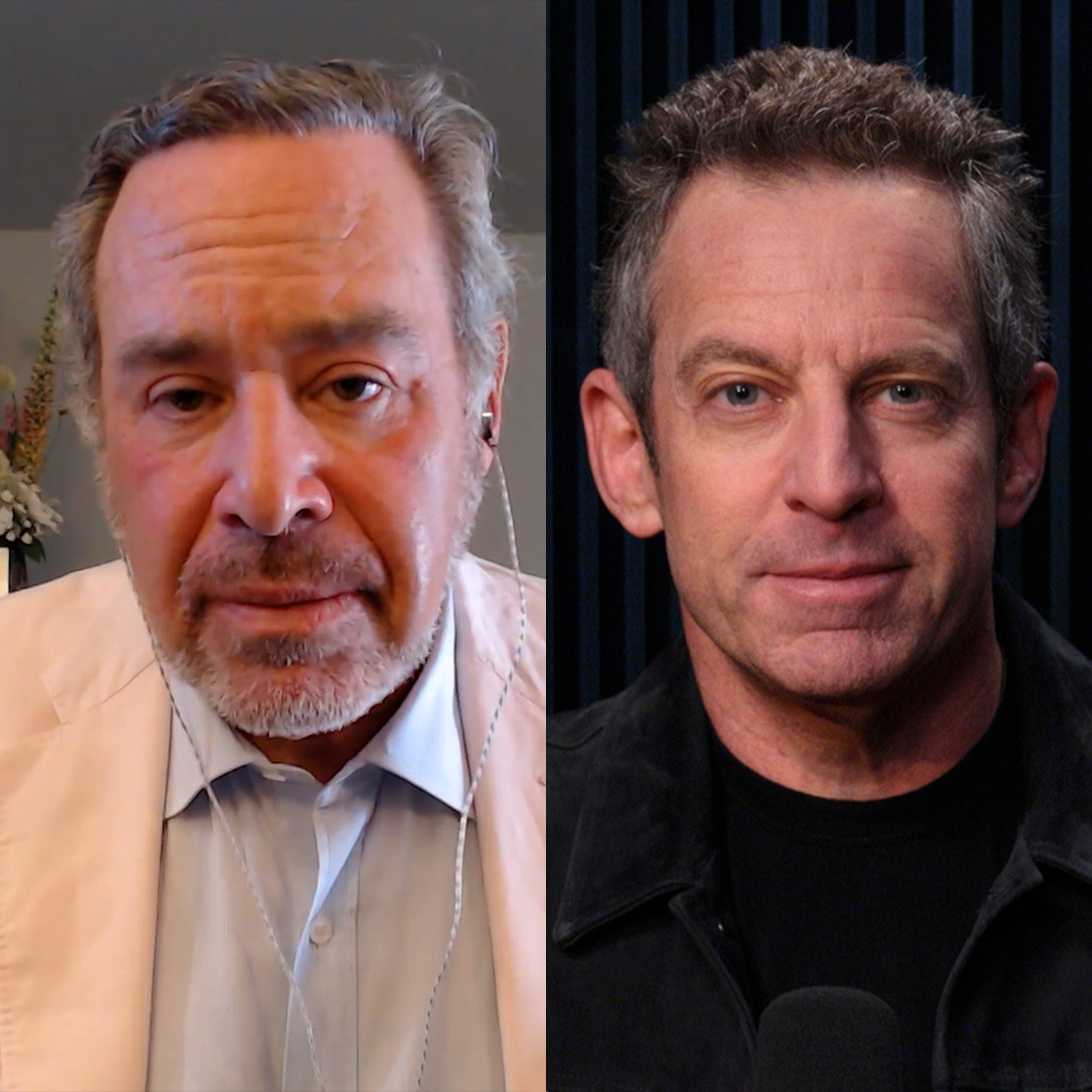
Making Sense with Sam Harris
#426 — How Bad Is It?
00:27:37
Sam Harris speaks with David Frum about the current state of American politics. They discuss the extent of Trump’s corruption, his immigration crackdowns, what’s going well under Trump 2.0, Trump’s support for Ukraine and Israel, U.S. foreign...
Loading summary
Transcript35 lines
- [00:07]
Sam Harris
Welcome to the Making Sense Podcast. This is Sam Harris. Just a note to say that if you're hearing this, you're not currently on our subscriber feed and will only be hearing the first part of this conversation. In order to access full episodes of the Making Sense podcast, you'll need to subscribe@samharris.org we don't run ads on the podcast, and therefore it's made possible entirely through the support of our subscribers. So if you enjoy what we're doing here, please consider becoming one.
- [00:37]
David Frum
I am here with David Frum. David, thanks for joining me.
- [00:40]
Thank you.
- [00:41]
It's been a while. I feel like we speak more than we do because I just consume your stuff over at the Atlantic, so I know what you're thinking about. But I think it's been some years since we've done a podcast together.
- [00:53]
I think that's right. Since then, I've ventured into your domain. I've started a podcast of my own, and I want to salute you. I think I always knew that it was not easy. I didn't know how not easy it was. So, maestro, you know how it's done, and I take my hat off to you.
- [01:09]
Oh, nice. Well, congratulations on the show. It's the David Frum show over at the Atlantic.
- [01:14]
Thank you.
- [01:14]
That's fantastic. Well, let's jump into the current moment. We're, what, six or so months into the second Trump administration. There's a lot we could talk about. The fires of controversy are currently raging about the Epstein case. Trump and his courtiers have been amazingly inept at putting those fires out, and I would love to know the reasons why you think that is. But. But let's start with just the big picture on the domestic front. How has it been these last six months from your point of view, and what has surprised you? What has been worse than you thought? What has been better than you thought?
- [01:58]
Yeah. Well, here's the thing that has been worse than I thought, and this is one of the two or three biggest stories, which is the corruption has been on a fantastically larger scale than anything I imagined or anything that I was ready for from the first Trump administration. In the first Trump administration, Trump used techniques like making the Secret Service follow him around to his various resorts. He used techniques like making sure that any Republican candidate who wanted his blessing had to use one of his facilities. He pressed foreign governments that needed American favor to use his facilities for their National Day events. And to stay, he would ask diplomats who visited him, where did you stay last night? But that probably moved Some single millions of dollars into his pocket, maybe something over 10 million. There are different estimates in the first term. So in the second term, he has left all we're talking now much vaster sums of money through the meme coins as you and I speak, that President Trump is about to go to Scotland to open a new golf course of his own. He's got golf courses in Vietnam and other countries that seek America's favorite. So all of that is bigger by a factor of 10 or 100 than it was in the first term. So that's one thing that has changed. A second thing that has changed is the trade disputes of the first term were definitely a problem that hurt Americans. Before Trump became president, the United States was the largest exporter of soybeans in the world. And over the first Trump term, it fell into second place behind Brazil because Trump alienated so many soybean buyers. But the trade disruptions we're seeing and the threat to the American economy and the world economy, that's much bigger. The damage to alliances is much bigger. And of course, the shock to America's future standing from this enormous debt that Trump is incurring through his fiscal measures, that's much bigger.
- [03:43]
Yeah. And also some of those indiscretions are linked. Right. So the trade disruptions seem in many cases to be motivated by Trump's personal corruption. Right. I mean, you cited Vietnam. Right. So the reason to slap a 46% tariff on Vietnam is that their remedy for that is to immediately greenlight a $1.5 billion Trump family resort deal, Right?
- [04:07]
Exactly.
- [04:08]
Yeah.
- [04:08]
I'm speaking to you right now from Canada, which has been a special target of Trump's animosity. And a lot of people in Canada are sort of baffled, like, what the hell happened here? What did Canada do? Canada's linked to the United States. Canada signed all these trade agreements that signed a new trade agreement with the United States that was signed by Donald Trump. He's just ignored that. And I think a big part of the Canadian problem is the Trump Organization had two hotels in Canada, one in Toronto and one in Vancouver, and they both went bust. The Toronto Hotel, Trump just licensed his name, and it went bust for sort of semi objective economic reasons during the Great Recession or soon after. But the Vancouver Hotel went bust. Trump owned it and operated it. It went bust because Vancouverites wouldn't set foot in his building during his first round. And he seems to be really mad about that and is blowing up the North American Common Market or the North American Trading Zone to punish Vancouver for Not liking his hotel more.
- [04:59]
So why is it, in your view, that half of America appears not to care about this? Is the problem that people don't know any of the facts you just elucidated? Or they've heard about them, but they think it's fake news? Or they understand exactly the shape and scope of this corruption. They understand that the meme coin is a device for the pain of bribes directly to the First Family. They know that really there is no precedent in American history for a president to use US Trade policy and foreign policy as a mechanism by which to extract tribute from foreign governments. And essentially he's running a protection racket. And it's both internationally, where he's putting the global economy at risk for his personal gain, and it's domestically, where he's shaking down some of our largest corporations. I mean, we have news organizations settling spurious lawsuits that they were almost certain to win, but this is a way of just funneling money in Trump's direction and hopefully getting his favor on future deals. Is it that people know all of this and simply do not care? What's your interpretation of half of America that still supports Trump?
- [06:20]
Well, I don't think we should be so surprised that this would happen. Look, American politics has always been deeply tribal. This has been a two party system more or less for almost all of its political existence. Now, who's in the tribes changes from time to time. The tribes are always remaking themselves, but there are two big tribes. And I think the way to think about how strong these tribal loyalties are. So 1932 is probably one of the worst years in American history. Bottom of the Great Depression, people are literally. Americans are literally going hungry. Incumbent President Herbert Hoover, who presided over the disaster, ran for reelection in 1932 and got 38% of the vote.
- [07:00]
There's a core 35% that's just unmovable.
- [07:04]
It's called the base for a reason. It doesn't move. And if you ask people in 1932, look, things are terrible. Why are you voting for President Herbert Hoover? They would have deep reasons of identity. Well, my grandfather was at Antietam under Grant, and we vowed we will always vote Republican no matter what. Or the Democrats are the party of the Catholic Church or the Democrats of the party of liquor. So we don't care about these economic facts. We are voting for the union against the Catholic Church, against liquor. And that's why this household votes Republican in 1932. And there you could tell the same story about Democrats. So elections are always decided at the Margins. And I think that's one of the reasons that Donald Trump is so freaked out about the Epstein story, because that is one of those rare events that can shake up the tribal structure and move people from column A to column B, because Trump has already told them, Trump talkers and validators have told them, this is the biggest scandal in the world, it's the most important scandal in the world, and only Donald Trump can get to the bottom of it. And it's as if, I'm going to borrow an analogy from my son. It's as if they built a giant device of paranoia and fear and rage and hatred and never thought to ask, in whose basement are we building this device? Oh, it's the basement of the guy we think we're supposed to be following. It's in his basement. And when it blows, it blows him up. Not the people we wanted to blow up.
- [08:26]
Yeah. Yeah. Well, I want to get to Epstein because it's the one thing, the one controversy that seems to be doing him some damage with the base or with certainly parts of the base. But before we get there, let's linger on this litany of abuses you have put forward. I mean, there's the additional problem of how needlessly provocative and cruel the immigration crackdown has been. Again, I feel like there are many people who voted for Trump who, in the abstract, supported some of these policies and would have been even insouciant about his corruption, because they just think, oh, well, it's more or less the same thing all politicians do. Nancy Pelosi made some stock trades that are hard to explain, et cetera. So they just put it all in the same bin. They're insensitive to the scale of the problem. Right. A million dollars is the same as a billion dollars, really, if you're gonna look at it that lazily. But I think many people are genuinely surprised by the optics of the immigration crackdown. How has the implementation of this policy struck you? And why does it seem. I mean, frankly, seems reckless? I'm surprised by how ruthless and chaotic they seem to want to be in the implementation of this policy.
- [09:48]
Yes, that's a very important question. I should have mentioned it at the opening. And it's one that hits me especially hard because I have been arguing for a long time that America needs a stronger border policy. And this is before the surge of 2020. This is before even the surge of 2014. I've been writing this since the 1990s. My view has always been immigration, if done right, is a great benefit to a country. So it's very important to do it right, because if you do it wrong, you will get a backlash. And the backlash will be even worse than a failed immigration policy.
- [10:21]
I'll remind you of your own famous line. Many of us have made this point, but you made it most sententiously. You said, I believe if liberals won't police borders, fascists will.
- [10:32]
Right. And you get Brexit and you get other forms of self harm. My first article about the Biden administration when it took over in January of 2021 was they began undoing many of the Trump restrictions on the border that had kept people from flowing across. I said, this is the first and biggest mistake they make. If they undo this, they are courting a lot of damage because the whole world wants to come to the United States. And if you don't police the border, you'll have the problem. The answer, people like me insisted, was the way you enforce the border is not at the border, it's at the workplace. And you should have a system where when an employer is looking to hire people, there's a requirement the employer check that they're legal in the country the same way that the employer should check that they're not a minor, in the same way the employer should check that they actually work the number of hours that are legally allowed to be worked and that there should be consequences for the employer. You should treat immigration as another aspect of labor law. And if employers get the message that the government is checking whether the employees are legal, there will be less incentive for people to enter the country in the first place. And the reason I so emphatic about this over many, many articles was if you start, because the alternative is our walls and roundups and the country won't stand for it, we are seeing scenes that shock the conscience. We've got this network now of camps that are being built in which people have not been convicted of any crime or just here illegally in the country, which is not a crime, it's a violation of status, but it's not a crime to be in the country illegally. It's against the law, but a lot. So is driving recklessly not necessarily a crime. They're rounding up people. They're removing status from categories of people like Venezuelans and others who were granted temporary protected status who thought they did the right thing and who now find themselves without status and subject to being dragged to a camp. The country won't wear this. And Trump is going to create a situation where in addition to all of the terrible suffering that people have done nothing really wrong other than break a labor law to make a better life. They're in camps. He's also going to change the political structure about immigration in this country in a way that is going to be to his own harm and those of the people who follow him.
- [12:38]
Do you actually think that the country won't put up with it? I mean, haven't we shown an inclination to put up with it thus far? I mean, obviously there are people, a handful of people in the streets of Los Angeles who at least for a time showed some signs of not putting up with it. But in terms of the way the rest of the country views the so called sanctuary cities where these raids are happening, I feel like there's, it's not even an acquiescence. There's basically at least perceived full acceptance of it as this is what you liberals get. I mean, you wanted your nannies and your housekeepers and your gardeners to be as cheap as possible. We don't have the same black market economy and that kind of labor over here in Ohio or Pennsylvania. You're getting what you deserve and we wanted these people out of the country.
- [13:24]
Well, as I said, the base doesn't change. But here are two things to keep in mind. One is there is a lot of polling about how attitudes toward immigration, which hardened during the Biden administration, are softening under Trump, quite dramatically so. And the second thing to keep in mind is one of the reasons that Donald Trump won the presidency with an actual plurality of the vote in 2024, unlike 2016, was that quite a number of Hispanics, especially Hispanic men, moved in his direction. Now, I'm going to forget the statistic off the top of my head and I probably shouldn't quote statistics off the top of my head anyway, but what percentage of Hispanic voters have a relative who is in the country without status but it's high and Hispanics are not immigration single issue voters. That was a big mistake that Jeb Bush made back in 2011. And 12 to believe, sorry, 15, 16 to believe that they would be single issue voters on immigration. That's not true. And many Hispanics welcome more enforcement. But if you're rounding up their mother in law and putting her in a camp, that's going to be a problem and it's going to be a problem with people with voters that were trending Trump and that Trump needed to keep.
- [14:25]
Do you think we're just getting started in the unveiling of this ugliness or have we seen sort of the peak of what is morally outrageous in the.
- [14:36]
Immigration sector, we've built a new bureaucracy. ICE is soon to be bigger than the Marine Corps, if I read the numbers right. And you can't build up a law enforcement agency that fast without terrible risks. So the bureaucratic machinery that is built is going to keep chomp, chomp, chomping. And there'll be more and more terrible stories. And first people will read about them and then they will hear about them and then they may feel them. And then you'll have cases where a family, some of whose members are in the country legally has other members who are in the camps. And so it's not just going to be the Fox News audience. It's not just going to be the die hard voter for one side or another. It's going to be people who were potential Republicans who are gonna say, well, I would have been, but now my mother in law's in a camp. I'm not voting for that.
- [15:18]
So what else strikes you as surprising from the first six months? We've got three. I'll remind you, we have three and a half years left. Right. So many things. I have to remind myself of this because I keep noticing that I'm living with a kind of political illusion that the shape of the thing is already fully manifest, whereas it's obviously evolving hour by hour. And who knows what we're going to be talking about a year from now.
- [15:48]
Yeah, well, let's start with some things that are not as bad as they could be so we don't sink too deep into the gloom. Ukraine is still fighting. Trump is obviously not sympathetic to Ukraine. Vice President Vance even more hostile to Ukraine, but he's not stopped the Ukrainian forces from fighting. And weapons and support do continue to trickle to Ukraine. They're interruptions, but they're getting something. And it looks like they may get some more stuff. Again, not enough. Not as much as they should have. Not maybe enough to win, but enough not to lose. I have to say, as a supporter of the state of Israel, I have been impressed and grateful that the Trump administration has improved the already generous support for Israel that the Biden administration gave. And that has led to some decisive results. I think also the kind of I had thought the uncertainty that Trump was creating about trade would move us faster to recession, but the opposite seems to be happening. It's because Trump, he does something dumb and then he retracts it. He does something else dumb and then he retracts it. I thought the market would say, well, in that case we have to stop investing altogether because who knows what the future is. But the market keeps hoping for the best and paying more attention to the retractions of the dumb policy than the dumb policy. So we're not in a recession, it looks like right now, in the summer of 2025, it doesn't seem so. And we hope that maybe we can get through the rest of this year without too much of a recession. So that would be a good thing if we could avoid that.
- [17:07]
Although it does seem, on its face, completely irrational, the market seems to have drawn the lesson that there's actually less uncertainty now than there was before. So called Liberation Day. All of this lurching back and forth seems to have convinced the market that this is better than it was four months ago.
- [17:26]
Well, the Trump trade policy has failed. And as predicted, to do what it pretended to want to do, what it's pretended to want to do is to bring back manufacturing to the United States. And that is doomed to fail for two reasons. One is if you're producing something where your costs are higher than a Chinese or Vietnamese competitor and the government says, okay, we'll protect you from the competition, you're safe. It doesn't matter that your costs are 20% or 30% or 40% higher than the Chinese or Vietnamese, we're going to put up a wall to protect you, to which the investor will say, okay, but the investment I'm contemplating is a very big one and it's going to take quite a lot of years to pay itself off. Can you assure me that this protection is going to be in place for the next 15 years? Because I'm not making this investment unless I'm guaranteed 15 years of protection. And obviously Trump can't protect that. And so we have seen business investment not responding. The second thing, and this is a point that the Trump people cannot, will not understand and that you can't get protectionists to understand. Every product is also an input. So when you raise the price of a product, you are making one step in the industrial process. You're raising every price. So fine, when you protect steel and protect it from foreign competition, and you then say, we also want to bring back shipping to the United States, what do you think ships are made of? You've raised the cost of the ship, so you pretty soon, it's like the house that Jack built. And when America was more protectionist back in the 19th century, this was all that politics was about. The wool people would want protection, so the coats would need protection. The coat people would get protection. So every industry that used coats would need protection. And so on forever. And one of the reasons that the United States changed and abandoned the protections policy was to say, you can't protect everything, but you must protect everything if this is going to work. And the whole thing is crazy and dysfunctional and expensive, so don't do it.
- [19:16]
Well, as you said, there are a few, if not silver linings. There are things that are not as bad as one would have feared. The change of posture with respect to Ukraine since that awful Oval Office meeting with Zelenskyy has been good, although it hasn't been principled. I mean, there's been this deterioration in his love affair with Putin simply because Putin keeps humiliating him. And so we're seeing, again, U.S. foreign Policy get bent by the brain chemistry of the lone maniac in the Oval Office who perceives everything through the politics of personal slights and flattery and the payments of tribute, et cetera. So who knows what policy will change as a result of the next insult or the next piece of flattery? And one hopes that there's a more principled stance underwriting his support for Israel. I mean, he has, on balance, always been quite supportive of Israel, and that would explain his popularity there, except he has shown signs of, again, just being pushed around by any perceived slight. I mean, I remember in the immediate aftermath of October 7th, I really think, I think the first thing he had to say about the. That atrocity was something petty about Netanyahu not treating him well. I mean, one can only imagine had the mullahs in Iran offered him a sufficiently large golf course deal, we might have a different policy with respect to the Middle east. Right now.
- [20:58]
I think we have another big problem with coming with Iran, which is, look, we all hope, I think we all hope that the Trump actions against Iran were decisive and we've reached the end of the story, that he's done significant damage to their nuclear program, and we can close the books on this for a long time. But what if that's not true? What if either the damage was not as total as Trump said, or will those have other tricks to play? Whether that's regional, whether that's global terrorism, whether it's something. What if this is a problem that requires more work than just press a button, collect the accolades, forget about it. The whole Trump foreign policy idea is you do something once and then it's over and you're a winner and you give yourself a parade. But foreign policy doesn't work that way. And one of the things that. One of the ways I think we should consider, we're trying to think how serious are the threats to the United States from what's happening today? One of the questions asked is how difficult will it be to undo? So the good news about the Trump corruption is actually you can, as happened in the 1970s, you can have a period of cleanup. So you could have four or five years where both Congress and state legislators say, okay, the corruption got out of hand and we're going to pass rules to make sure that nothing like this ever happens again. You can dial it back, you can fix it up. American politics is sometimes more clean, sometimes less clean. We're in a dirty period. You can have a clean period. The damage to world trade is not so easily fixed. If Ukraine goes under, that's not fixed. If you get a long term conflict with Iran that's bigger than the one we've had. And above all, and this is the most important thing, if American leadership is questioned by the allies who benefit from it, by the adversaries who used to fear it, I don't know how quickly you get that back. That's a hard thing to reassert.
- [22:42]
I don't know how you get it back. Given that whatever we do to get it back, I mean, just imagine the next president who's presumably, if he did this or she did this would not be. J.D. vance just offers this omnibus mea culpa on behalf of the nation saying, we're terribly sorry we did this to you. Trump was a monstrosity. He was a gift to our enemies and an enemy to our friends. We want a hard reset of all of our relationships. And we were gonna resume something like a normal role of leadership and collegiality with all other liberal democracies. The problem is that there's one bell that cannot be unrung here, which is that we have announced to the that within any four year political cycle, we are capable of reneging on everything. We're capable of producing a tsunami of corruption and stupidity the likes of which no one could have expected. And I mean, it's impossible to exaggerate. We can befriend dictators. We can claim that the victims of a war of aggressions actually started the war. I mean, there's just up is down and down is up. And we are capable as a nation of given all the protections against this that one would have thought existed against this. We are capable of doing this on a dime in response to a 51% vote. And who knows when we're going to do this to you again.
- [24:08]
And it's happened twice, right? So let Me give you some concrete examples of things that I think are going to be with us for a long time. With the European allies whom Trump is so hostile to, there are deep commonalities of history, of culture, legal systems. The British, the Germans, they'll probably forgive the United States sooner or later. But the great challenge to American power in this coming century, in this present century, will be China. And of course, China's neighborhood is very different. The allies you need to balance China are countries that don't have that kind of affinity. Vietnam has no sentimentality about America's role in Vietnamese history. The Indonesians don't have much. The Indians have zero. The Filipinos may have a little, but not much. So what all these people are wondering about is the Chinese are close, you're far. The Chinese and you are about equally strong. You say you will protect us if things get tough. Can we trust you? And the American answer is, about 50% of the time, yes, we're good for 50% of the time. And you never know in advance which 50% it's going to be. So the Vietnamese are going to think, and not just the Vietnamese, but even more congenial countries like Australia are going to think, we need to hedge our bets here. We can't be so close to the United States because they're not so reliable. Or here's another concrete problem. Trump has used American weapons sales as a tool of not only national strategy, but personal irritation. So one of the big questions that the Europeans have is the European Union economy is at least equally big to the United States. Europe does not have an arms industry competitive with the United States. And the French government has always said the Europeans should buy European, even if the European weapons aren't at the moment quite as good as the American weapons, because then they won't have to worry about being cut off. So when Trump is saying, we've got a kill switch in every weapon, whether that's true or not, he's the best salesperson the French arms industry ever had. If you're a German, if you're a Pole, and you think, should we buy the French system? I was in a. I won't use the specifics here. I was in a NATO country the earlier part of this year and had dinner with the defense minister who was contemplating a major weapons purchase, at least major by the standards of that country. They had a series of bids, one from American, the United States, one from France, one from some other country. The American system was clearly the best, most capable, but it was also the most expensive. And they also had lost confidence that they could trust it. They had heard about this kill switch rumor. Trump hadn't said it yet, but they had heard about it. They were worried about it, and they were going to lean instead to a French or South Korean system because at least they could trust that system. And after all, while it wasn't as good as the American system, it was still better than the Russian system.
- [26:46]
Yeah, yeah. So are you anticipating a new wave of nuclear proliferation as a result of what's happened of late, especially our on again, off again support of Ukraine? I mean, it seems to me that the only rational lesson to draw from Ukraine's experience on the one hand, and maybe you could hold North Korea over as a counterpart.
- [27:08]
Sam Harris
If you'd like to continue listening to this conversation, you'll need to subscribe@samharris.org Once you do, you'll get access to all full length episodes of the Making Sense podcast. The Making Sense podcast is ad free and relies entirely on listener support, and you can subscribe now@samharris.org.