← Making Sense with Sam Harris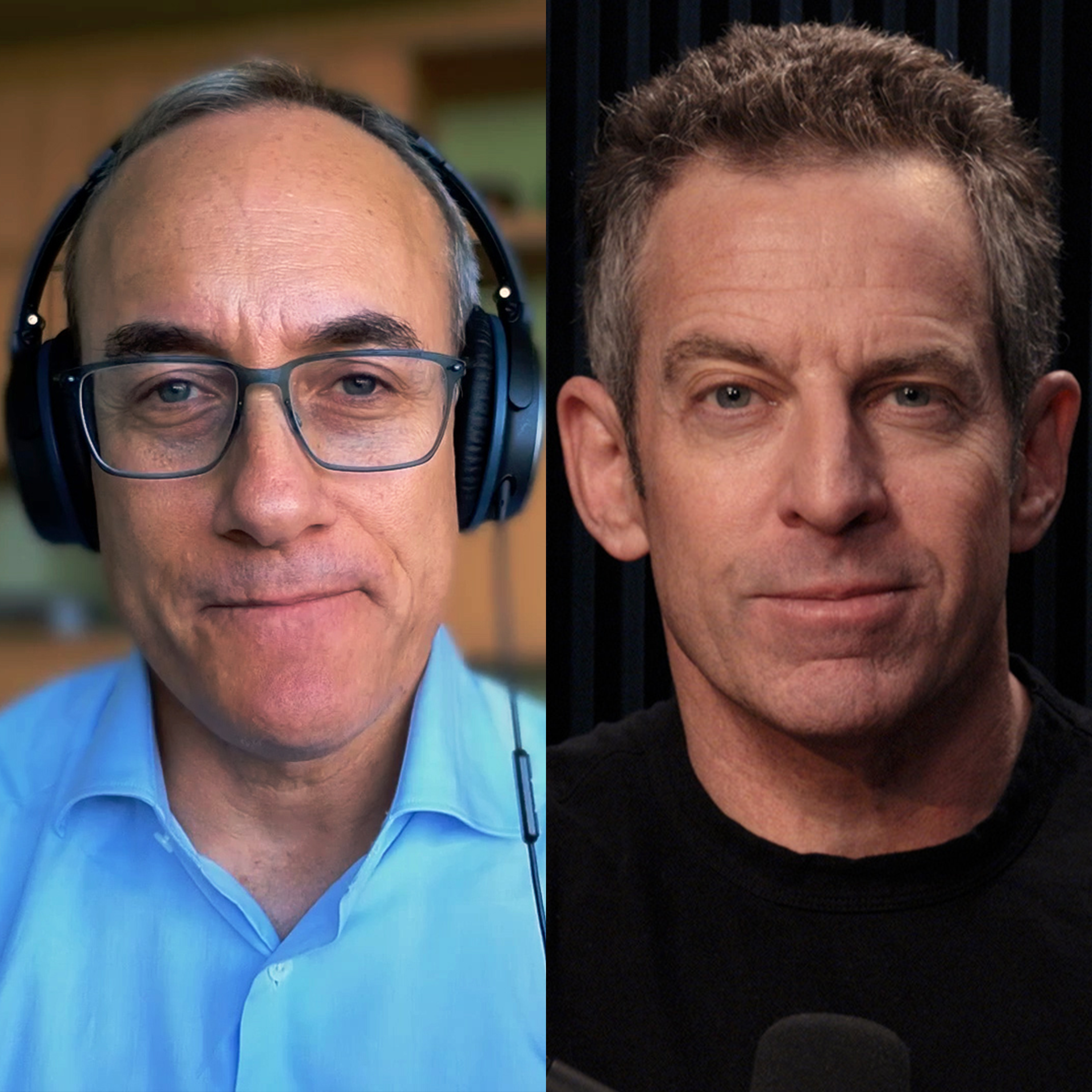
Making Sense with Sam Harris
#437 — Two Years Since 10/7
00:20:08
Sam Harris speaks with Dan Senor about the state of the world two years after the October 7th attacks. They discuss the rise of global antisemitism, immigration and the failure of Western nations to contend with the spread of Islam, the dramatic...
Loading summary
Transcript23 lines
- [00:07]
A
Welcome to the Making Sense Podcast. This is Sam Harris. Just a note to say that if you're hearing this, you're not currently on our subscriber feed and will only be hearing the first part of this conversation. In order to access full episodes of the Making Sense podcast, you'll need to subscribe@samharris.org we don't run ads on the podcast, and therefore it's made possible entirely through the support of our subscribers. So if you enjoy what we're doing here, please consider becoming one. Dan Sinore, good to see you.
- [00:38]
B
Good to be with you, Sam.
- [00:40]
A
We're doing a simulcast here, which I've been on your podcast. You've never been on mine, so apologies to your listeners. But I think we need to start this simulcast with you giving a potted bio. How do you explain yourself? How do you have strong opinions on the topics we're about to touch?
- [00:55]
B
I spent a number of years in and out of US Government foreign policy positions, and I've spent a lot of time in the Middle east in those positions and also a lot of time in Israel, studying and writing about Israel, written a couple books about Israel. And since October 7th, my podcast has been all but exclusively focused on what has been happening in Israel, the Middle east, and in the West's reaction to events of October 7th. So, in a nutshell, that's how I found my voice.
- [01:26]
A
Yeah. Well, I'll just tell my listeners that that podcast is Call me back. And I have found it indispensable these last two years. It's really just been fantastic. So thanks for doing it, and I highly recommend that people listen to you directly over there.
- [01:40]
B
Thank you. Well, my, my. I think most of my listeners are already listeners of yours, but if they're not, they should be and should be subscribers. Because your voice, while you come in and out of this issue, I think a number of the issues you address on your podcast are actually like the surround sound of what has been going on and the issue that I've been covering. So your voice and your clarity have been extremely important, and I'm glad we're able to have this conversation.
- [02:06]
A
Yeah, well. So, Dan, there's a lot we could talk about. I don't really have much of an agenda, except that there are two things that I feel like we really should touch in addition to anything else we might touch. One is I want to learn from you just the state of the landscape out there. I mean, just how I want to get your impression as to how bad things are on at least two fronts. I mean, the antisemitism globally and specifically the degree to which Israel has lost this information war with the entire world and the consequences of all that. So I just want to learn from you in this conversation. But also I think it might be interesting to explore how we come to these topics from different angles, because I think you are much more comfortable in just arguing for and in defense of Jewish identity. And that's not really how I come to these same problems and seem to make the same noises. I'm much more in the business of getting out of the business of identity. And so we can talk about that, but people on those two fronts, I want to talk about anything that interests you.
- [03:16]
B
So, yeah, well, let me start with. And I'll respond to both of those questions. But I guess I've. Last time we spoke, Sam, at least on a podcast, was a year ago, which was on the one year anniversary of October 7th. And I remember in that conversation you and I had, I asked you what surprised you most in the year since October 7, 2023, and you said the explosion of antisemitism is what surprised you the most. And I guess my question now, on the second anniversary of October 7th, what, if anything, has surprised you in this second year of the war, the second year since October 7th, what surprised you in year October 7th, 24 to 25?
- [04:02]
A
I think, unfortunately I have the same answer. It's just, I mean, now I am even further surprised about the size and depth of the crater. It's a bigger problem than I imagined and it's a bigger problem than I imagined a year ago. It just seems to be getting worse, not better. And I keep finding new details that shock me. So you and I are talking in the immediate aftermath of the murders of Jews in Manchester on Yom Kippur, and that's horrible enough, but then to know that there were celebrations in the streets of London in the immediate aftermath, you know, just unabashed celebrations of the murder of Jews in the uk it's shocking. And our tacit toleration of it is shocking. I mean, just the fact that we have backed ourselves into a corner, you know, we now is not everybody. Obviously there are people who would resist this as stridently as they can at this point. But left of center, where I spend most of my time intellectually and politically, there's so much moral confusion about what is rational to want and to do in the current circumstance. And it just seems, especially in Western Europe, the writing is on the wall. It is totally rational to worry that Western Europe is completely unraveling culturally in a way that not just Jews, but really anyone who cares about the defense of open societies needs to worry about. And I don't often find myself agreeing with President Trump, as you know. But when he stands up in front of the UN in addition to anything else he might have said, which I would find indefensible, when he tells them that your societies are going to hell. And what he means is, you have completely failed in this project to integrate the millions of Muslims you've brought into your society, and you have ghettos filled with religious maniacs who have no inclination to assimilate into your culture. In fact, they're explicit in wanting to overthrow your culture and replace it with their own. The situation is totally untenable, and it is as bad as Trump or J.D. vance or anyone else who I would otherwise not want to be aligned with say it is.
- [06:27]
B
Yeah, I guess I'm surprised by what happened, and I shouldn't be in the uk I mean, because it is a natural extension. It's like a logical extension of what we had been witnessing during the first year after October 7th and then well into the second year. The Chief Rabbi of the UK, Rabbi Mervis, put out this statement after the Manchester attack, saying something along the lines of were shocked by what happened, and yet we all knew this day would come. And when I read that line, it was like. Right. Like we knew this day would come, which is if we spend two years, as you said, tolerating this rhetoric in the media and social media and college campuses that Israel is a genocidal state and Israel is an apartheid state, and you're just indoctrinating, you know, lots of people, young people especially, but not only young people across Europe and elsewhere, that this is a genocide and that these people, these Jews living in your midst, living in your society, are supporting this country and have a love for this country, Israel, then they are complicit in the genocide, then why wouldn't people start trying to kill the supporters of the genocide? I mean, I hate to talk in such clinical terms, but it's actually quite logical that this would happen.
- [07:45]
A
Yeah. Yeah. I mean, for me, the problem goes back much further than October 7th, and again, it escapes the frame of antisemitism or hatred of Israel. And it just, again, my focus is more on the defense of open society. So when I think of the Manchester attack, I think of the previous Manchester attack at the Ariana Grande concert that killed, I think, 22 people. And that had nothing to do with Israel or Jews, but it was the same genius of jihadism being expressed there. And I think of the Charlie Hebdo massacre in Paris and the Bataclan massacre, all of these moments where the stark fact that Western Europe has imported a death cult into its midst and has failed to acknowledge the gravity of this fact has just bent over backwards in the most masochistic way to imagine that something more benign is happening where, you know, on any given day, you can see people with placards saying, you know, behead those who insult the prophet. I mean, it's just the character of these protests, the density of these protests, the fact that you can get this number of people in the streets who are clearly calling for Sharia law. And, you know, in this case, the UK just can't figure out what to do about it. And this is of a piece with the grooming gang scandal that no one wanted to talk about for more than a decade because no one wanted to be called racist. Right. As though that made any sense. It's just the masochism and delusion has now been turned up to 11. And honestly, I don't know what the next step is. I mean, my concern has always been that if left of center or centrist or even just normal conservatives can't get their arms around this problem, fascists will. I mean, I think if we see a rise of the real right wing in Europe, it will be because of this. And that's not to be hoped for. But this is David Frum's line which distills it. If liberals won't enforce borders, fascists will. But honestly, this is even a deeper problem than the problem of unregulated immigration. It's the fact that ideas spread and become contagious. This recent jihadist was a British citizen. Right. He was an immigrant, but he was not, you know, he was not an immigrant yesterday. He was somebody who grew up in the uk.
- [10:12]
B
Yeah. But if you look at. I don't know if you've been following this, the Facebook. There were like Facebook posts of his father that have just been being examined in the British.
- [10:20]
A
No, I haven't seen that.
- [10:22]
B
Where he was celebrating on October 7. He was celebrating the massacre of October 7. So this is the home. This is where, you know, this is where this young man was being. This is the water he was swimming in, you know, and so, I mean, this was not something that, oh, the war got really bad. The quote, unquote, genocide. These were the ideas that were being incubated with these people in the days after October 7th.
- [10:46]
A
Yeah.
- [10:47]
B
I would also just add to that, I do think we're going to see a big right wing swing in European politics from the UK through France through, you know, Germany through elsewhere for the reasons we're talking about here. But what's so incredible to me is I think these politicians in Europe, Starmer, Macron, they knew they had this problem that you're describing and they have wanted to try to keep the temperature, you know, from spiraling out of control, you know, from just keep it at like a relative level from spiraling a completely unraveling society. And the approach they took was we can kind of feed the beast by criticizing Israel, by attacking Israel, by criticizing the Jews. I mean, I was just in France a few weeks ago and I was meeting with leaders of the Jewish community and they said, Macron, after October 7th was fantastic. They said, first of all, he was one of the first leaders in the west to travel to Israel. He lured Israel to show solidarity with Israel. And he even was proposing a response to October 7th that is actually unimaginable now, which is he said, we need an international, a global response to October 7th like we did to ISIS. We need to treat Hamas like ISIS. And then there was this 50 nation plus coalition that responded that took on ISIS. We need to do the same thing to Hamas. That's what he was talking. I mean, just imagine that now it really is unimaginable. And that's how he was talking. And then a couple weeks later after that, there was a solidarity. The Jewish community in France held this solidarity march or solidarity event similar to the one in November of 23 that was held in Washington where, you know, in the US something like 300,000 plus people came to the Mall. And so France had its own version of that and they just assumed Macron would participate. And then he was a no show. And they were like, wait a minute, how did he swing from showing up in Israel talking about this robust response and then just a couple weeks later, nowhere to be found. And when leaders in the Jewish community went to his advisors, he said, well, we need to show some balance. We're concerned about showing balance. Now what balance is he's talking about? The balance he was talking about was not between Israel and Hamas. The balance he was talking about was the seven and a half plus million Muslims that live in France and that represent something like 10% of France's population.
- [13:08]
A
Yeah, and so I think it's 8%.
- [13:10]
B
Yeah, yeah, 8%. So it's just this idea that, oh, we'll pull back on support for Israel, we'll pull back on showing solidarity with Israel? No, we'll actually go farther than that. We'll participate in calling what Israel's doing a genocide, and we'll cut off arms supplies to Israel, and we'll go ahead and recognize a Palestinian state with no conditions or calls on anything for Hamas. So there was this hope, I think, that they could just continue to pander to their local population and that would kind of keep things quiet. And of course, the opposite happens, right? It's not like this. The people who are on the front lines of these attacks against the Jews are gonna. Are gonna be mollified by these foreign policy positions that their leaders are taking.
- [13:54]
A
This is what is often referred to as feeding the crocodile. Right, right. In the. In the hopes that it's not gonna eat you. But.
- [14:01]
B
Well, here's my question, though, is then, so what happens now? I mean, so I, I clearly, Starmer in the UK is rattled, and I've got to believe Macron is rattled because he knows that this kind of thing could have easily happened in France. These things like this, as you just said, have happened in France. So what do they do now? I mean, I, you know, because to. To truly deal with the issue means to confront big political constituencies in their own governing coalitions.
- [14:27]
A
Well, what's amazing is, is it's not that big. I mean, so as you. We just said that France is 8% Muslim, the UK is 6% Muslim, last I looked. So the depth of this problem, the fact that you can get hundreds of thousands of people in the streets exerting what seems scarcely tolerable pressure on the political system and the need to pander to it, all of this mayhem is the result of 6% of the population making itself noisy. I mean, can you imagine what it would look like with 30% of the population? I mean, it's completely untenable to not confront it at this stage. Right? I mean, honestly, there's no. And this is going to sound like bigotry to anyone who's not actually doing the moral algebra here. I mean, so first, everything I'm saying is addressing the consequences of certain deeply held ideas, right? This is nothing. I'm not talking in principle about any race or ethnicity or. I mean, the color of a person's skin is completely irrelevant for this conversation. But left of center, all of this gets coded as xenophobia and racism and white supremacy the moment you begin making noises like this. But you have to think about Islam as a set of ideas that is analogous to any other set of ideas, like communism. So to criticize Communists to worry about having more communists in your country, to not want more of them, to want to be able to point out that certain fundamental ideas within communism are inimical to how you want to organize your own society. All of that. That conversation can be had without any sense that you are expressing bigotry toward people based on their indelible characteristics acquired at birth. Right. The same attitude has to be taken when discussing the differences between our religions, especially religions that are religions of conversion. Right. That are aggressively missionary faiths that are spreading in 100 countries. Right. So Christianity and Islam are unlike Judaism in this regard. When you're talking about Jews and Judais, you are almost by definition, because Judaism is not a missionary faith and because there are only 15 million Jews, and virtually all of them are Jews by virtue of being born to a woman who was herself born to a woman who was herself born to a woman who was Jewish. When you're talking about Jews, you are talking, at least implicitly, about an ethnicity and a race. And it's not to say people don't convert to Judaism, but it's just not that common. And the Jews don't make it easy, et cetera.
- [16:57]
B
And they don't seek it out.
- [16:58]
A
They don't seek it out. Right. And so there's a big difference here. And that's why you can't just swap the terms antisemitism and Islamophobia into various sentences and pretend that they're functioning in the same way. There's no such thing as Islamophobia. There's such a thing as racism. There's such a thing as xenophobia. There's such a thing. But Islamophobia is a word that has been made up to prevent criticism of Islam and to conflate it with bigotry. So any secularist who wants to argue against creeping Islamic theocracy or to even just argue for the human rights of women and girls in the context of Islamic theocracy, that person gets painted as a bigot and as Islamophobe, and it's just not true. It's just a rhetorical trick that has been foisted on the left half of our society, and everyone left of center has been taken in by it. And that's why they're uniquely unfit to even participate in this conversation at the moment. Unfortunately, as you go right of center, you begin to meet people who are rather eager to have this conversation for some bad reasons, right? Then you begin to meet real racists and xenophobes and white supremacists and Christian identitarian lunatics and proper Nazis. And then the guilt by association police come out of the woodwork and you get defenestrated for having talked to somebody who talked to someone who was himself untouchable. And so there's a problem here in just how we talk about this, which is to say that there's a reason, for instance, why I haven't had Tommy Robinson on my podcast. It's not because Tommy Robinson is wrong about most of what he says. He's absolutely not wrong about most of what he says. But he's just rough enough around the edges and just has enough of a colorful history that I'm uncomfortable being directly associated with him. And frankly, I'm right to be uncomfortable, given the consequences of being associated with him. But I can talk to Douglas Murray, and yet Douglas Murray, for many people, left of center is considered beyond the pale. And, you know, because he'll talk to people, he'll talk to Tommy Robinson without hesitation, right? So the landscape here is a mess. But what is, what is real is that we have to deal with the reality of religious fanaticism and its consequen. And the problem here is especially acute in the Muslim community, wherever it has anything like influence, right? The more influence it gets, you know, Even at the 6% level, you start hearing demands for, you know, not just Sharia law being observed by Muslims, but everyone outside of the community bending the knee to their religious strictures. Right? None of us can. If you'd like to continue listening to this conversation, you'll need to subscribe@samharris.org Once you do, you'll get access to all full length episodes of the Making Sense podcast. The Making Sense podcast is ad free and relies entirely on listener support. And you can subscribe now@samharris.org.