Loading summary
Transcript32 lines
- [00:07]
Sam Harris
Welcome to the Making Sense Podcast. This is Sam Harris. Just a note to say that if you're hearing this, you're not currently on our subscriber feed and will only be hearing the first part of this conversation. In order to access full episodes of the Making Sense podcast, you'll need to subscribe@samharris.org we don't run ads on the podcast, and therefore it's made possible entirely through the support of our subscribers. So if you enjoy what we're doing here, please consider becoming one.
- [00:37]
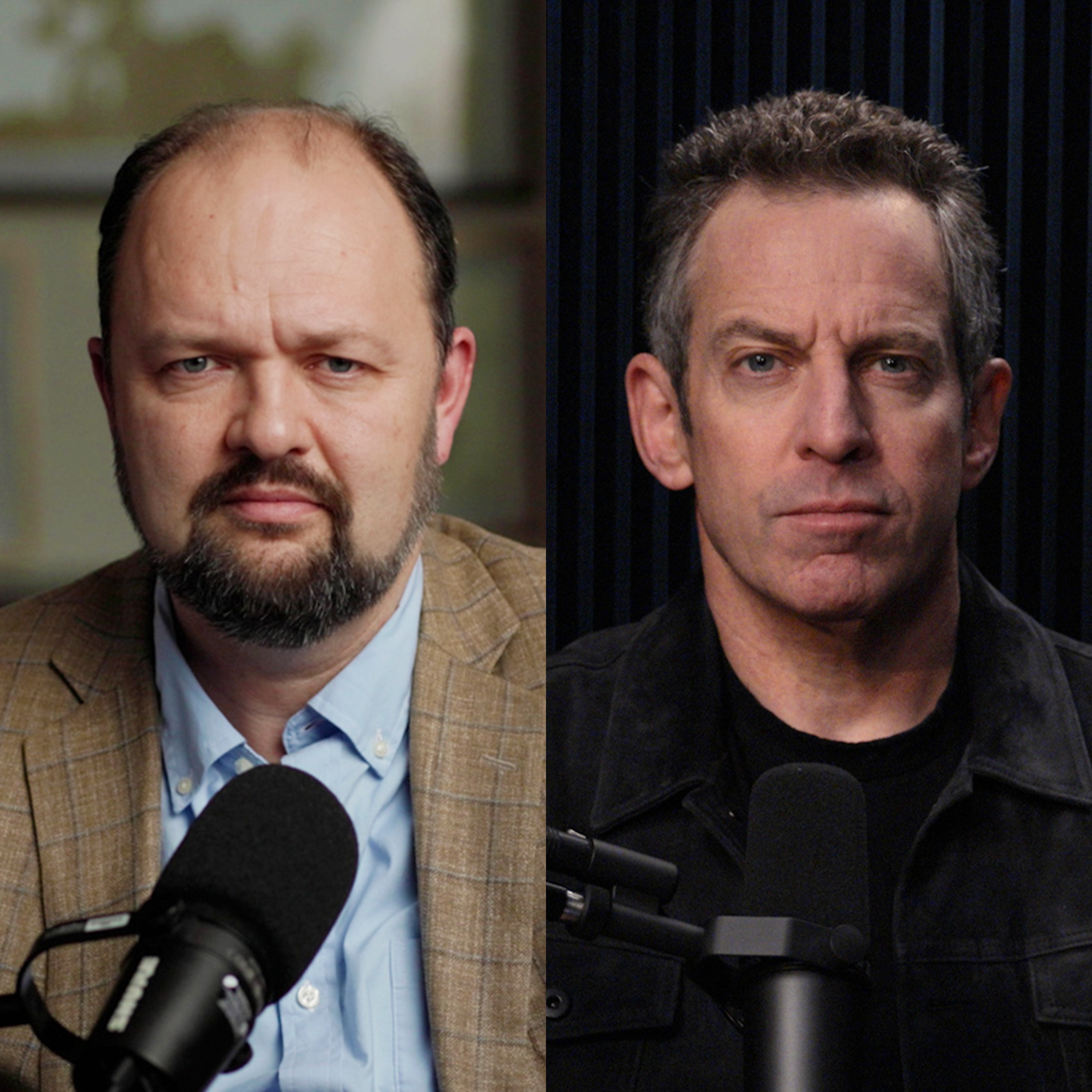
I am here with Ross Douthet. Ross, thanks for joining me, Sam.
- [00:41]
Ross Douthat
Thanks for having me. It's a pleasure.
- [00:42]
Sam Harris
So we've never met. Am I right in thinking that? Or we have never met.
- [00:47]
Ross Douthat
Stroke.
- [00:47]
Sam Harris
Okay.
- [00:48]
Ross Douthat
This is. No, this is the closest I've come to your physically embodied presence.
- [00:52]
Sam Harris
All right, well, let's see if the Internet keeps us together here for the requisite hour or hour or two. Well, so I've been reading your book this week, Believe, which. When did this come out? It's pretty recent, right?
- [01:05]
Ross Douthat
Yeah, it came out, I think, February of this year of 2025.
- [01:10]
Sam Harris
And this is where you make your case for the rationality and even necessity of religion, which I think we're going to get to, because I think you and I have a. We share a sense that our culture is ailing, but I think we probably diverge, at least on several key points as to whether religion is part of the cure or part of the disease. But we don't. You know, I don't think. I mean, I think our core concerns are so held in common so fully that I think we. I don't know. I'm interested to see where this conversation goes because I don't want to have, and I don't think we will produce a conventional debate between an atheist and a believer about the rationality of faith. Although I think some of those points are gonna be unavoidable.
- [02:04]
Ross Douthat
Yeah, we'll have a dynamic interaction that ends with your conversion.
- [02:08]
Sam Harris
I think that's what's for this to me.
- [02:12]
Ross Douthat
Right.
- [02:12]
Sam Harris
On both. If you're right, we're both hoping for that.
- [02:17]
Ross Douthat
That's right.
- [02:17]
Sam Harris
O. Well, I think we should probably start with a problem. What most worries you at this moment, when you look at. Because you spend a lot of time thinking about politics, as I do, you probably spend more. You're over at the New York Times commenting on culture regularly. What most concerns you at this moment.
- [02:33]
Ross Douthat
I guess, big picture, a little bit separate from the turbulence of politics right now, is I'm worried About a kind of sense of human obsolescence in the 21st century that I think has been partially forged by the experience of digital culture and disembodied ways of living and is visible in a lot of different trends, including political polarization, but especially in sort of general unhappiness, anxiety, issues of mental illness and so on that are in turn connected to people not getting married, not having kids, and effectively not perpetuating human culture. And I think we're in the shadow right now of trends in artificial intelligence that however far they go, are likely to kind of ramp up the pressure on human beings as human beings. And I wrote an essay, I think around the time actually that my book on religion came out, where I suggested that we were in this kind of bottleneck, almost this kind of evolutionary bottleneck, which is maybe more a cultural evolutionary bottleneck, but where there was just going to be all this pressure on human nations, human cultures, human families, human individuals to sort of figure out how to live under this, you know, very, very novel technological dispensation. And that a lot of institutions, people, whole countries might not make it through that. You know, with extreme examples being, you know, nations in East Asia like South Korea and Taiwan that have incredibly low birth rates to the point where it's unclear how these nations will survive the next 50 or 60 years. And yeah, so I think that's, maybe that's a slightly unusual way of putting it. But I think this is a widely shared concern that shadows a lot of, again, a lot of more immediate political debates, like in a lot of the kind of new polarization of our era, the reactionary and far left politics and so on, I think you can see people sort of searching for a form of politics that's adequate to the 21st century challenge. And I don't think people have found it at all. And I think our politics is a mess because of that. But I think people are sensing that we're in a pretty unique squeeze on human cultures as we've known them and we need to figure out how to get through.
- [04:54]
Sam Harris
Yeah, it's interesting. Just take the AI piece as a first facet of this ghastly object. It's interesting that even in success, I mean, even in perfect success, if AI amounts to exactly the drudgery canceling all purpose technology that we hope for, without any of the terrifying downsides, many people are still worried that this could be something like an extinction level event for human purpose, human solidarity, human culture. I mean, just people are terrified that without the necessity of work to take Just one piece here, not all of us certainly, but most people will find life much harder to live. I actually don't share that concern. If you do, maybe you can prop up that fear because I think there are reasons to think that's actually a mirage.
- [05:50]
Ross Douthat
I mean, I think it depends on the human being and the human culture. Do I think that the human race will be able to survive and find ways to flourish and thrive and do amazing new things under optimal aid AI conditions, even if that means that lots of jobs go away in the long run? Yes. I'm in that sense a long range optimist about the future of the human species. I think anything short of the total dystopian AI scenarios are scenarios in which human beings are going to be able to survive and thrive, but I think there's going to be a lot of turbulence, angst, difficulty and sort of disappearance along the way, that there are going to be all these forms of life and ways of, of living that are just not adapted to again, even the few, even the world we live in now with kind of this level of digital existence, sort of people separated from physical reality, from meeting other people in reality. Like there's, there's already a lot of strain on very basic things like having friends, getting married, having kids, and when you add in, let's say lots and lots of jobs disappearing and a kind of, you know, existential metaphysical anxiety about AI being able to sort of substitute for things that we thought of as human distinctives plus, you know, whatever, whatever other weirder forces come in. Yeah, I think it is a, a very difficult situation that people need to be prepared for, I guess is how I would put it. Doesn't mean that we're doomed at all, but some things are going to be doomed, some places and, and people are going to be doomed. And you want to start thinking now, really, you want to start thinking, you know, 25 years ago about how you. Right. Like you as a, you know, a person with relationships and friendships and you as someone who's involved in culture and politics, what you're doing that is sort of making your humanity resilient, I think, against these forces.
- [07:51]
Sam Harris
Yeah. So if you take the job piece, which is really the first point of concern for people, imagine a world where something like UBI was the necessary response to all of the abundance that AI has created so people don't have to work, everything has become like chess, which is to say the computers are better at everything or virtually everything that humans have used to do to work. Clearly we need to figure out some new ethic and economics and politics around the non necessity of human labor and figure out how to spread the wealth around. And so in that point it would be true to say that something like ubi, I don't know if UBI is the actual right framing, but let's say that was the case. Many people, certainly most people commenting on this issue, seem to think that most of their neighbors, if not themselves, need to spend eight hours a day doing something they might not want to do in order to feel like they have a purpose in life. But it seems to me we have a kind of ready sample of people, a fairly large population, if you look at it historically, who haven't had to work and figured out how to live reasonably or at least recognizably happy lives under those conditions. And those are, we call them rich people or aristocracies of one flavor or another. People who really didn't have to figure out what to do that others would pay them for, or if they did that early in lives, in their lives, they got to a point where they didn't have to do it any longer, and then they had to figure out what to do with leisure. And it would seem very surprising to me if in the presence of unlimited leisure, we as a species and as a culture couldn't figure out how to enjoy it. I mean, there might be some painful bottleneck where all the people who were totally dependent on drudgery to find some structure in their lives spin out of control. But it just seems like this would be a problem of education and culture and a new kind of ethical and political conversation, rather than some kind of insuperable obstacle that we couldn't clear.
- [10:04]
Ross Douthat
Yeah, I mean, I'll be more pessimistic a little bit. I mean, first I would say that in my most optim, my optimistic scenario for AI is a kind of middle ground scenario where, which I also think is fairly likely in terms of the capacities of AI to just sort of replace human labor. I think the people who think it's more likely to be a complement to various kinds of human labor, that you'll still have lots of people, you know, working jobs and doing things in the world that earn money. I'm hopeful that that is still the most likely pathway in the pathway you.
- [10:39]
Sam Harris
See, even in the limit. I mean, do you actually think you're hopeful that even in with a hundred years of progress, that's likely to be how we organize ourselves?
- [10:48]
Ross Douthat
Again, one of the striking things about AI, as a journalist who tries to write about it and like you interview people about it is that, you know, even the people who see deeply into the technology struggle to sort of form any kind of consensus predictions about just how far it would go. My basic view tends to be that I'm skeptical of true superintelligence theories. I'm skeptical that you get to a point where they're embodied in the world in ways that are completely substitutionary for what human beings can do. Some of that probably does have to do with some views I have about the human mind that are connected to religious ideas and assumptions. Maybe. But, but let's just for the sake of the conversation, let's say that you're right.
- [11:36]
Sam Harris
Yeah.
- [11:37]
Ross Douthat
And, or not that you're right per se, but you know, that this, this world is, is the one we head into where there is some kind of guaranteed basic income derived from the productivity of, of robots and so on. I think you have to work very hard, very hard, given human nature as we have it, to prevent that from being a world where lots and lots of people lead fundamentally debased lives. I think you said enjoyment or pleasure and so on. Right. Like, yes, leisure people with leisure seeking pleasure. It's very easy. And we see this again right now in I think, societies around the world. It's very easy to default to a kind of round the clock entertainment cycle. This is before you even get into issues related to, you know, drug use and so on. It's just like there are, you know, the experiments we have with ubi, while not entirely depressing or not super optimism inducing. And just to take your example of the aristocracy, so the historical aristocracy in the Western world, one, lots of aristocrats did have to work because they were managing large estates or engaged in politics to protect those large estates. Lots of them fought in wars and got killed in large numbers and found purpose and meaning in that, in that form. And then there was also just this constant struggle within aristocratic groups to prevent decadence and debasement. You know, if you think about the stereotypes of the third generation, Rockefeller or Vanderbilt, as opposed to the first one, it's not like, oh, you know, these people are all sitting in an English garden reading Plutarch's lives and, you know, painting watercolors, they're out sort of wasting their inheritance and squandering it and being, you know. Yeah, being sort of debased and decadent. And I think such a society, the society you're envisioning, it could create you. I'm not going to say you can't create a world where the mass of Human beings gets to have like a Montesquieu style aristocratic reverie experience. But it would be incredibly hard and require constant, for a constant, constant reinvention, constant effort in ways that we have never seen in a human society to date. So you just have to be, I think you just have to be aware of the magnitude of the challenge if you're talking about a purely leisure based society. You know, one interesting model is the vision of something like Star Trek, right, where you have this kind of utopian vision where apparently some form of, you know, AI and things related to AI have relieved scarcity and want and so on. And that's a show, a story that's all about human daring and, and mastery and accomplishment. But it does focus on people who are choosing to be explorers who have set up a system where they're still in charge of the ship even if the computer could make better decisions. Right. There's never a moment where Kirk or Picard says to the computer, okay, you decide how to handle the Romulans, right. And then you also don't know like what, what is actually going on on Earth. Are people just, you know, people are just sort of hanging out like everyone isn't doing space exploration. I think the question of what the average citizen of the Federation is doing with their life under Star Trek conditions is sort of the question that sci fi speculative thought needs to reckon with in the sort of AI abundance scenario.
- [15:08]
Sam Harris
Well, I didn't think we were going to talk about AI Ross, but I think it's an interesting window onto some of these concerns because. Well, first let me just add a little fine print so that you understand the abundance I think is conceivable. I'm not by nature an optimist and I'm not optimistic really that we're going to escape some of the real downsides of AI but if we were, I think it would be surprising to find that the only thing keeping us sane was that most people spend most of their lives doing sort of fairly arbitrary things to earn a living that at least they imagine they'd rather not do and only to get to the weekend where they're free to debauch themselves. And there's. Yeah. And that just basically having that kind of the opportunity costs thrown up against a life of pure leisure was the thing keeping us relatively sane. I think we just have the same problem.
- [16:07]
Ross Douthat
But do you think that. I don't know if that's a fair description exactly of the way human beings think about work historically, yes, it obviously does have elements of arbitrary force Productivity and toil. I think of the, the broad achievement of modern civilization, though, as one that has partially, not completely, but partially liberated people from the purely arbitrary and punitive nature of work that's allowed lots and lots of people, not just a narrow elite, to have jobs that they take some kind of genuine satisfaction in that are themselves sources of community. I think one of the lessons of the COVID era and the Work from Home era is that not everyone, but lots and lots of people did find a form of sort of community and solidarity and so on in the workplace, in those kind of collect, in collective action that employment offers, even when it's not the most exciting thing in the world. And then it's also. Yeah, I mean, it's not like historically people who are working, I mean, a historical model in the United States of America, right, for long periods of time has been communities and situations that are oriented around family. Where you are working for your family, you're working to support them. In agrarian societies, you're working collectively with your family. And again, I don't want to say from a 21st century perspective, like, you know, ah, the dignity of the toiling serf for something like, obviously there's incredible impositions involved in work and child rearing and all these things in most of human history. But I think it's too dismissive to say, you know, oh, we're just liberating people from something that is inherently forced upon them that they don't really want. I think people are working creatures, they're communal creatures. They like doing things together, they like having a sense of mission, they like doing things to help the people closest to them. So you are taking something away if you're saying, oh no, here's your UBI and just decide what to do with yourself.
- [18:14]
Sam Harris
But Ross, any part of a job that maps onto what people actually like doing that they would do for free, well, then that's precisely the kind of thing presumably they would do if they could do anything they wanted, right? If they were given 24 hours in the day to spend however they wanted with their friends and family and with other collaborators they meet. All of this highly potentiated by access to unlimited intelligence and wealth. And again, this is the utopian version of AI we're talking about. Then if they want to become Christian contemplatives or build houses that are bespoke for people who want their houses built by human, human artisans or whatever the it would be, it could be Burning man for half the people and, you know, Meister Eckhart for The other half, there would just be no impediment to just using your attention the way you want to use it. And that's. It's just. We're living in that condition anyway. Except it's just framed by periods of time where most people have to do things. They, at least within their own minds, they think, well, I wish I were free to do less of this and more of the thing I really want to do. And I think you and I both fear that most people are capable of wanting to do the wrong things, right? I mean, our attention gets captured by mere entertainment, say more than in retrospect, seems good for us. And so I think you're worried, and I'm also worried. But we're already in that culture now. It's just people just don't have unlimited time to explore it. We're worried about a kind of a digital entanglement with things not worth paying attention to on some level.
- [20:05]
Ross Douthat
Yes, and I agree with you. I think we are in some version of that culture now. And so far the results are that large numbers of people given a profound degree of freedom, but also confronted with incredibly addictive devices, substances and entertainments to varying degrees, lose themselves in those things. And don't do, don't you don't do Burning man or Meister Eckhart, don't, again, don't get married, don't have sex. Which is sort of, you know, the, the interesting endpoint for now of the liberated 21st century society is not more sex, but less sexual. These, again, you, I, I think you need. It's not that you can't imagine a society that has perfect abundance and also does not fall prey to these kind of snares, but you have to imagine entirely novel forms of essentially communal and political self restraint imposed on those human tendencies. Or maybe, I mean, look, I, you know, maybe there are people who would say, well, no, what you need are pharmaceutical interventions, right? Instead of Soma from Aldous Huxley's Brave New World to sort of, you know, take the edge off everything. You need, you know, a perfected Ozempic that removes, you know, that, that cures original sin, right? Cure, cures, cures certain kinds of temptations. I mean, I think there's a lot of different narratives you could offer. All I would say is I think you need a pretty dramatic, pretty substantial change in either human nature or human societies to prevent the perfect abundance future from looking like Brave New World, looking like the, you know, sort of the spacecraft in Wall Ere, you know, or a world, a world that has a kind of a kind maybe a kind of, you know, digital age aristocracy that does seem to be doing pretty well, but that doesn't have a large, large share of human beings. Again, sort of debased by the experience of addictive conditions under and plenty.
- [22:20]
Sam Harris
Well, it seems like we need some radical changes even in our current situation with respect to our culture. What's your view of what's happening right of center? I mean, I know you consider yourself right of center and I don't know how far right, but depends. Yeah, perhaps. Perhaps you can depends on the month. Give me the potted the potted version of your political persuasion. But then let's talk about what's happening in the Republican Party in America.
- [22:47]
Ross Douthat
The potted bio is that I'm some kind of religious conservative who has generally like in the past I have been more focused on religious and cultural issues.
- [23:00]
Sam Harris
If you'd like to continue listening to this conversation, you'll need to subscribe@samharris.org Once you do, you'll get access to all full length episodes of the Making Sense podcast. The Making Sense Podcast is ad free and relies entirely on listener support and you can subscribe now@samharris.org.