← Making Space with Hoda Kotb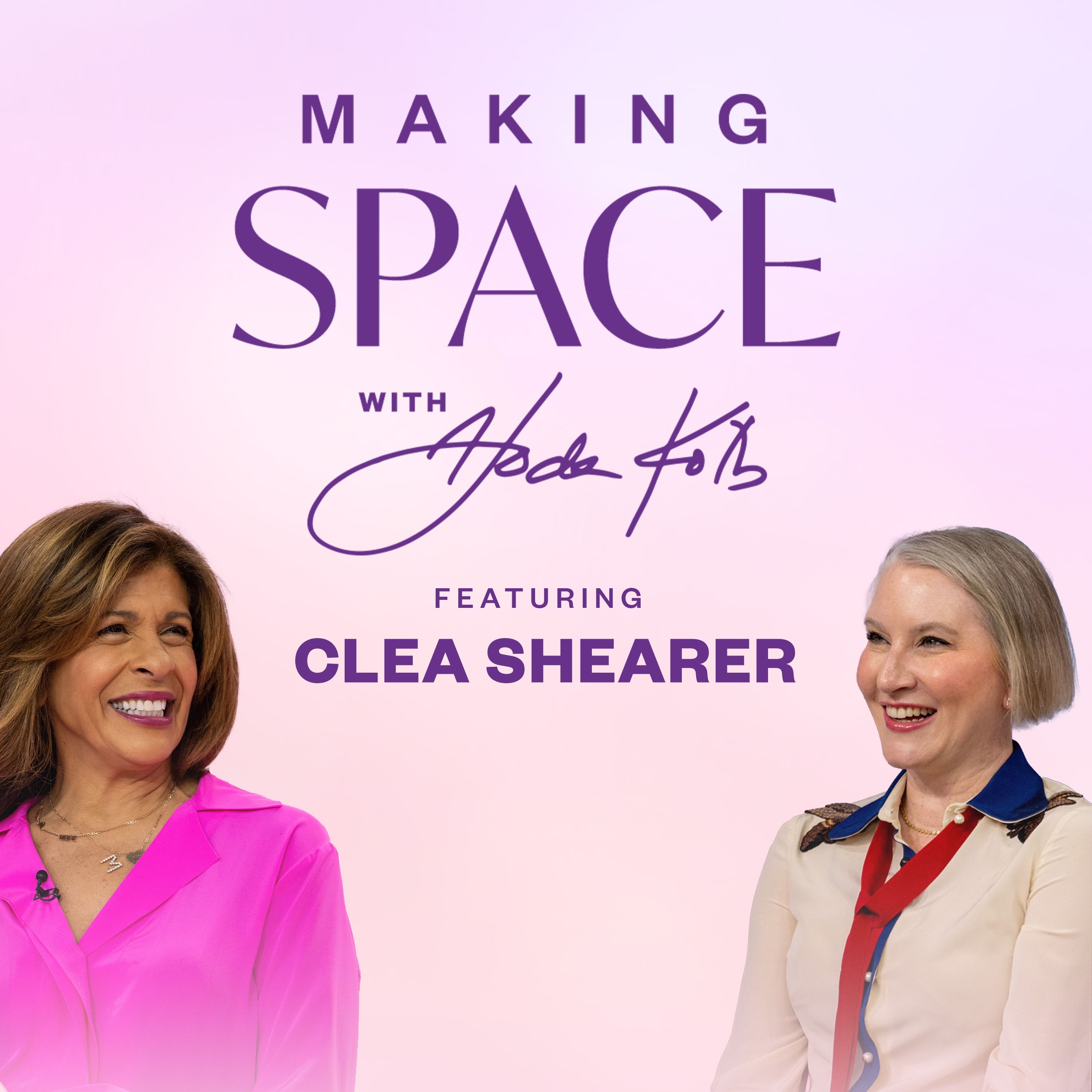
Making Space with Hoda Kotb
Clea Shearer on Controlling the Controllables and Conquering Breast Cancer
00:46:31
Clea Shearer is the co-founder of The Home Edit, star of the hit Netflix series, "Get Organized with The Home Edit," and a New York Times bestselling author who’s sharing the lessons she’s learned in her cancer journey in her new book, "Cancer Is Complicated and Other Unexpected Lessons I’ve Learned." Clea opens up to Hoda about how she learned to advocate more for herself amidst her cancer journey, the importance of accepting help from others and why she views her diagnosis not as “why me,” but as “why not me.” In addition, she shares how she spoke to her kids about her diagnosis and how her perspective has broadened after the trying experience.
Loading summary
Transcript102 lines
- [00:01]
A
Rated M for mature. Who are you?
- [00:04]
B
A wandering spirit seeking vengeance.
- [00:07]
A
You live. I thought we killed your whole family.
- [00:12]
B
But here you are, Little wolf. My name is atu. Every member of the Yotei Six will suffer. Get lost in the hunt.
- [00:23]
A
Forge a new path at the edge of Japan. Ghost of Yotei, available October 2nd on.
- [00:28]
B
PS5 for a limited time at McDonald's.
- [00:32]
A
Get a Big Mac Extra Value meal for $8.
- [00:35]
B
That means two all beef patties, special.
- [00:37]
A
Sauce, lettuce, cheese, pickles, onions on a sesame seed bun, and medium fries. And a drink. We may need to change that jingle.
- [00:44]
B
Prices and participation may vary.
- [00:54]
A
Life can change in an instant, and often the true test of who we are is how we rise in the face of adversity. CLE Shearer faced that moment. What emerged is a story of incredible strength and resilience. Clea is known around the world for bringing beauty and order into people's lives. Together with Joanna Teplin, she built the home edit into a global empire with three New York Times bestsellers, a hit Netflix series, and a line of products sold in 31 countries. Their success caught the attention of Reese Witherspoon, whose company, hello Sunshine, acquired the home edit in 2020 and even produced a reboot of Extreme Home Edition with Clea and Joanna as the hosts. But while Clea's professional life was soaring, she was facing one of her biggest personal challenges she'd ever faced. She was diagnosed with breast cancer, forcing her to shift her focus from editing spaces to surviving. After multiple rounds of radiation and chemotherapy and even more health complications, Clea has continued to show the world what it means to face life's toughest moments with courage, honesty, and hope. In our conversation, Clea shares how her journey has changed the way she sees herself, her work, and her family, and how it's made her rethink so many parts of her life. Her story and resilience are remarkable, and I can't wait for you to hear more. I'm Hoda Kotb. Welcome to my podcast, Making Space. Well, first of all, I just want to say hi. And I want to say congratulations on your new book, Cancer is Complicated and Other Unexpected Lessons I've Learned. First of all, how are you? I mean, I know you've been busy. Obviously this book's out, but how are you doing?
- [02:57]
B
Oh, my gosh, Hoda. I had a major surgery which is supposed to hopefully end my reconstruction nightmares. And then one day after that surgery, I had a major complication and had to get rushed back into surgery, back into the hospital I had lost a ton of blood and needed a blood transfusion on top of it. I am just, I'm still in major recovery mode and it just feels never ending. It's so fun because now I get to write a second book. So that's how I feel.
- [03:33]
A
Okay, good, good. I like your optimism. Let's start because there are people who know you intimate, like me, and there are people who are like Clea Shearer. I think I know her. I think I know her. So let's just start with it.
- [03:45]
B
Okay.
- [03:46]
A
You are Clea Shearer. You're part of the home edit team. You and Joanna are like a team. We fell in love with you on the Today show and you start off in 2015 saying, My life is bumping. We've got this thing like you guys kind of came out of nowhere and started this incredible show with Reese Witherspoon and people were like, wow, you know how sometimes you're. And you're like, life can't get better than this.
- [04:14]
B
I do know. Do you remember? And then it knocks you off its axis. But yes, just a month ago was our 10 year anniversary starting the home edit. So much has obviously transpired in a decade. And for those of you who don't know, the home edit is rooted in home organization and is now a lifestyle brand. And you know, we have TV shows and books and products all over the world and life couldn't have gotten better. But then, of course, you know, the universe is here to remind you.
- [04:44]
A
Otherwise, how do you explain. Because your life is one way on Monday and then on Tuesday, you get a phone call, you get news, you get something. And literally within hours, you went from feeling completely and totally healthy, alive and vibrant to, oh, like, what's going on? Tell me about the moment that you learned that you had cancer and how your life changed in that moment.
- [05:13]
B
Well, one of the most defining moments to me was actually when I found my own lump. And I was in the shower getting ready for the Today show. And you know, I had just turned 40 just a couple weeks prior. And so I was, you know, just in the shower washing up, and I felt something that I think I had felt maybe months before, but it came into crystal clear view because I had just turned 40. And the second I felt it in my mind, I had a mammogram just kind of looming over me because I had just turned 40. And I realized that maybe what I had felt before and dismissed is just like, well, breasts are kind of lumpy now was like a red alert alarm on my breast that was telling me that this was not just lumpy. This was the lump they talk about. This was a lump. And I got out of the shower immediately, called my gynecologist and said, I need a mammogram. I think I. And I said the words, I found a lump. And it was so scary coming out. Cause that's. Those are the words you hope you never have to say. And I was denied a mammogram. I was told at that point that the books were completely full. And this was in February of 22. And they said, you know, April's completely closed. May is not open yet, so just keep trying back. And at that point, I found a new gynecologist. Let me just say that that was the end of that relationship. But I will never forget that moment of just. And that was February 22nd. I called my general practitioner, and she immediately mobilized and got me into a mammogram and an ultrasound. And I was ultimately diagnosed 3-8-22.
- [07:04]
A
Do you remember our conversation that you and I had shortly?
- [07:09]
B
What do you remember?
- [07:10]
A
Tell me about that.
- [07:11]
B
We were the home edit team, and I, we were organizing your office for the Today show along with Ms. Jenna Bush. Well, she wasn't doing the organizing, but she had arranged the surprise. We had just shown you your office, and I pulled you aside and I just said, you know, Hoda, I haven't told anyone this, but I just need to let you know, like, I feel so compelled to let you of all people know that I was just diagnosed with breast cancer. And you were just like you were a human hug. Not just because I got a hug, but you just enveloped me and held my hand and you imparted a lot of beautiful words and wisdom. But you said something that stuck with me forever, which was, you know, I have a lot of friends who have had breast cancer, too. I know a lot of people who have breast cancer. And the beautiful thing is we're all here. We're all here today to talk about it. And you are going to be, too. And here we are talking about it. So you were right, as you always are.
- [08:18]
A
Well, you know, when you get diagnosed with something, and I was diagnosed many years ago, and I remember how it felt, Clea. So I remember all the scariness about it. Because in your position, too, you had children. So it wasn't, you know, you and your husband only. It was you, your husband and your children. Part of. I thought this. Some of the scariest stuff when it comes to cancer is telling.
- [08:42]
B
Oh, absolutely.
- [08:43]
A
Is telling people who love Us. How did you tell your kids?
- [08:48]
B
Well, I waited. So my diagnosis was March 8th, and my surgery, my double mastectomy was April 8th. And I waited until the day before my surgery to tell the kids. Cause I didn't want them to hold the burden of fear. Fear of what's to come. And what does this mean? Is mommy gonna be okay? I didn't want them to it to fester for too long. So the day before, I sat them down on the couch and I explained that I have breast cancer. But I have spoken with my doctors and everyone feels so confident that I'm gonna go into surgery tomorrow, they're gonna remove the cancer, and I am going to get to the other side of this. My oncologist told me, along with your words of wisdom, he specifically said, clea, I believe your cancer is not just treatable, but curable. And I held that very tightly to my heart. I so firmly believed and of course believe that I was able to confidently say to my kids, I'm not scared. I'm not afraid. And I said, and mommy's afraid of snakes. You know what I mean? Mommy's afraid of a lot of things. So I don't even like to fly. So I said, I am telling you this from the bottom of my heart, that I am not afraid.
- [10:12]
A
How old were your kids at that point, Clea?
- [10:15]
B
11 and 8.
- [10:16]
A
Wow. How did they process it? Or did they, I guess seeing you not afraid, it probably gave them some comfort.
- [10:22]
B
There were tears, but they were not hysterical. You know, like, they, I think, cried from the shock and the confusion of it all. And of course, you know, we. I answered as many. Any question they had. I answered truthfully and honestly. I did not sugarcoat anything. They had questions and they wanted to know, for instance, are you gonna be bald? Are you gonna lose all your hair? And I don't think they meant it from a vanity perspective, of course. More like, is it that type? Like, are you sick sick? Like, is it sick cancer? Or is it the kind of cancer that, you know, our dog at the time had had cancer. Tumors removed were like, is it just like Emmett had? And I was like, you know, at the time, I was like, kind of like Emmett, I don't know. But I said at that moment, we didn't know if I would need chemo. Not until I got into my nine hour surgery did they find more cancer and found that it had spread. So at that moment, I absolutely answered what I felt was honestly, which I said, I don't think so. I would have to revise that later.
- [11:37]
A
Now when you are. Because the weird thing about being diagnosed with cancer and anybody who's listening to this podcast probably either knows somebody or has themselves been through it. When you are going, you are sort of flying blind. And it's so crazy because so many women have come before us who've been through it, who learned all these lessons, but somehow you just go, oh, I'm done with it. And you just want to put, put it in a box under the bed and forget about it. But what you decided to do was take the things that you learned along the way, things you wish someone would have said. You know, as you're looking for a doctor, or when a doctor says X, or when a doctor does this, or what you should bring with you when you, you know, go to the hospital, go to chemo, go to radiation, you put them all in your book. It's called Cancer is Complicated and Other Unexpected Lessons I've learned. If you had a friend who was diagnosed with breast cancer today and she said, give me five things, important things that you think that you didn't know, that you wish you had, that I can take with me, what would you offer up?
- [12:41]
B
One of the most important things that I learned is that I would have more good days than bad days. And I was terrified of the opposite. I was worried I would be bedridden, I was worried I would be sick all the time. And you know, one of those lessons I learned is that but, you know, don't believe the only thing you see on TV and movies. You know, chemo is an important drug, it's a critical drug, it'll save your life. And my good days far outnumbered my sick days.
- [13:14]
A
I want to talk about that because that's important, because it's also a lot of what goes on in your head because even on your non sick days you can feel terrible about life.
- [13:24]
B
Sure.
- [13:25]
A
How did you like comb through that and realize like bad day, good day, how does one have a good day?
- [13:32]
B
Sometimes you'll fall into bad days mentally. And that is something that, you know, that is like a personal kind of up and down struggle that we all go with. But I think that the way we physically feel obviously impacts the way we mentally feel. So for me, I was just terrified. I just thought that I'm not gonna be able to talk to people, see people, interact with people. And as you know, I am quite an extro and I, I fill my energy tank by being with people. So for me I would get chemo on Thursdays, Fridays were iffy, Saturday I was sick Sunday. I started to rebound. And then. So I always had that beginning part of the week where I actually felt pretty good. And I realized, okay, if I think about my chemo sessions, and I think that I'm going to be sickest on that Saturday after my Thursday, and the other days around it maybe aren't amazing, but they're fine. And then I have some days that are actually decent. I was like, okay, I can do that. I can actually. I can conquer that. And if. If I know that I have this many sessions and maybe I have this many sick days, I mean, I. I can get through that, get through that. And. And that helped me feel a level of fortitude where I felt like I could conquer this, I could sustain it, I could deal with it, and that helped me mentally.
- [15:05]
A
I like that. So more good days than bad days. Great. But first of all, great headline with almost anything anyone's going through, whatever your cross to bear is, you lost a parent. You were going through an illness. At the end of the day, when you start looking at the days, okay, so that's a great piece of advice. What else would you tell a friend who said, you know, I don't know, help me?
- [15:24]
B
I would start at the beginning with the first lesson I learned, which was self advocacy. Every single thing about your cancer journey relies on you speaking up and you talking to your doctor and talking to your loved ones and you being your own best advocate. Not that your doctors are not working absolutely the hardest they can for you. Not that they are not steering the ship here, but every single. I had so many twists and turns where if I hadn't even been like, hey, this side effect is too much for me. This. You know, the steroids, I'm not able to sleep, or, you know, all of these different things. What I learned was that your advocacy doesn't stop when you get diagnosed. It's not like all of a sudden now your care is just in someone else's hands. There are things that you will experience that your doctor needs to be informed of. They don't know every twist and turn of the way you physically feel. And. And every single time I spoke up and said, this doesn't feel like I can manage it. This feels out of my ability. Every single time there was a solution, there were things that we could do. Do not just suffer in silence. And, you know, like, if you're really nauseous, take the Zofran. You know, talk to your doctor. There are so many things that you can actually do, and there's so much Innovation that has occurred since, you know, decades ago. Do not consider cancer to just be a sick sentence. There's so much that you can do to be resilient.
- [16:58]
A
That's good because often people do think of the doctor like they know best. And everyone says cancer's hard. So I just have to slog through this and be miserable and not sleep or sweat all the time or feel nauseous. What's the third one?
- [17:09]
B
Another that is in tandem. Accept help. Accept help from your friends, from your family. Everyone wants to be there. You are not a burden.
- [17:19]
A
That's good.
- [17:20]
B
That, to me, is something that was hard for me personally, because I am a very independent, you know, empowered person. And I don't love to accept help. I'm the helper. Like, I'm the person that goes and helps people. And for me specifically, that was hard. Maybe that's not hard for everyone, but I think that, you know, when you're in this moment and everyone around you, part of what they need is to help you, you know, part of what your friends, your family. It's not just for you and for your benefit. It's for their benefit, too. This is a combined cause.
- [17:57]
A
Do you remember a moment? I mean, and there were many, and everyone's probably thinking of theirs, but when you were on your knees and finally you said, I need to ask for help, like, I can't do this by myself. Was there an epiphany, kind of an aha that you remember?
- [18:14]
B
It was in my very early days after my surgery, before I went to chemo, I realized that I was just incapacitated in a way that I had never been in my life. I'd never had surgery before. My double mastectomy was my first surgery ever. I never broke a bone. And what I realized is that I was recovering from a major surgery on my way to a major life turn, which would be chemo. I had a six week recovery period. And it was really, really. It was a scary time. So it wasn't just like a physically I need to get better time. It was a really, really scary time. And I was dealing with a lot of mental demons as well as I need to physically recover. And that was a moment where I really just had to, like, literally sit in my medical recliner chair and let people come to me. Like, it was not a situation where I was like, let's go to brunch. And what I really needed more than anything for me was I wanted to be around people. I craved that connection and friendship that I always had. And I Accepted people to come by and bring me lunch.
- [19:30]
A
What you said about mental demons is a big one that I don't think people spend enough time on because you had the tasks at hand. Go to chemo, take care of this, do that, do this. But sometimes when you're sitting by yourself and I've thought about this many times, you're like, did they get it all? Is it gone? Am I, you know, what mental demons were you wrestling with? And how did you kind of come on the other side or face them?
- [19:56]
B
Well, I will say that it is. It's a journey like everyone says it is, not a one and done with. Your mental demons, they come and go. I think it morphed and transcended as the journey went on. But I think a lot of my initial feelings were number one, am I ever gonna feel better? Am I ever gonna. I believe I will get better. Am I ever going to feel better? Am I ever going to be clear of this kind of shadow over me? And the truth is, I don't know if I ever will be clear of the shadow over me because I will deal with this risk of recurrence for probably the rest of my life. But I feel stronger and more empowered and more in control. I believe in my ability to do the hard things. I believe in my ability to manifest all the good, all the time, all that I need in my life. And not that it's ever pushed aside, ever. I mean, it can't be. But I do feel like I can talk to myself when I go down a bad path. You know, I can be like, come on. And, you know, another thing you learn that you just absolutely. You don't know what tomorrow's gonna bring. And you, you know, why spend a day. Why waste a day just being scared or just being worried that it doesn't really achieve anything? Not that, you know, and it's natural. It happens. But yeah.
- [21:32]
A
Cause we're humans. So funny. I interviewed Christina Applegate and Jamie Lynn Sigler. Christina, who of course wrote A Beautiful. My Dear Friend. She wrote on the back of your book, by the way. You have great people on the back of your book. You have Christina Applegate. Well, you've got Jenna Fisher, Maria Shriver, Olivia Munn. All great people. But something struck me when Christina and Jamie Lynn were talking. And Christina, you know, as early on in her. And Jamie Lynn Sigler, of course, is kind of has been dealing with Ms. For a long time. And Jamie said something and it struck me. She said, sometimes I meditate. And I was like, okay. And she Said I. And her son asked her, what do you think about when you meditate? Because she says she tries anything that you were talking about getting your mind right. And she said, well, I'm really not supposed to think about anything. Meditation is supposed to be clearing your mind. But I actually do think about something. And he said, mommy, what do you think? And she said in my meditation, I'm running with you guys on the beach. And that's something that she can't do. And he said, does that make you happy or sad? And she said it makes me happy. And he said, why? And she said, because when I'm there, I feel the feelings of running. I feel the euphoria of being with you. And so it struck me as you a way to take your mind. Because so much of our life is here, right here. It's like. And that's why I admire you so much. Because you from the beginning. And I'm not. Look, you have your darkest days and you're not rose colored glasses, you're not pretend you're real. But yet in there when I speak to you, I feel the sense of hope always. Is there something. Do you have practices things you do that help you get your mind right when to it comes that kind of strays down a path?
- [23:28]
B
I mean sometimes you just, you have to give in to some rough feelings, you know, like every. You know, there are times it would be impossible, it would also be untrue and not genuine to not allow yourself to sometimes just feel it. I can count on one hand how many times I have absolutely broken down and sobbed in my cancer journey. It's been three and a half years and one of those times was three weeks ago when I had to get cancer, get rushed back to the hospital the day after my surgery. It just was too much, you know what I mean? Like sometimes it's just too much. And that is okay. I have learned that there is no shame in that. There is value in it, in fact of just sometimes releasing that emotion and being like, you know what? I work really hard every day to do my best, to feel my best, to be my best. And there are moments where sometimes it just. Just the demons get the best of you. And there is absolutely nothing wrong with that. And I think that one of the reasons why I share things so publicly is because I want people to understand that I work really hard to be positive and to focus on all the good that I can do, the good that I, that I can feel the mom, I can be the business partner, the wife, all of those things. But then sometimes I also just have had it on on a given moment, given day. And that is absolutely fine too.
- [25:04]
A
More with Clea Shearer when we come back.
- [25:14]
C
You just realized your business needed to hire someone yesterday. How can you find amazing candidates fast? Easy. Just use Indeed. When it comes to hiring, Indeed is all you need. Stop struggling to get your job posts seen on other job sites. Indeed sponsored Jobs help you stand out and hire fast. With Sponsored Jobs, your post jumps to the top of the page for your relevant candidates so you can reach the people you want faster. According to Indeed data, Sponsored Jobs posted directly on indeed have 45% more applications than non sponsored jobs. There's no need to wait any longer. Speed up your hiring right now with Indeed and listeners of this show will get a $75 sponsored job credit. To get your jobs more visibility@inn Indeed.com space, just go to Indeed.com space right now and support our show by saying you heard about Indeed on this podcast. Indeed.com space terms and conditions apply. Hiring Indeed is all you need.
- [26:12]
A
I'm Julio Vaqueiro, anchor of Noticias Telemundo. You can watch Dateline, the hit true crime on Telemundo. And now you can listen to Dateline as a podcast. Stories of love and betrayal, of secrets revealed of the men and women who stand between evil and justice. Every twist and turn can now be heard in Spanish, with new mysteries arriving every week. Just search Dateline en Espanol wherever you get your podcasts and start listening. Hey guys, Willie Geist here reminding you to check out the Sunday Sit down podcast. On this week's episode, I get together.
- [26:48]
B
With Tony and Grammy winner and Academy Award nominee Leslie Odom Jr. As he returns to the role that made him.
- [26:56]
A
Famous as Aaron Burr in Hamilton 10 years after the original run. You can get our conversation now for.
- [27:04]
C
Free wherever you download your podcasts.
- [27:13]
A
Can I just say, anybody who's been through the number of surgeries you've been through? Like, I had three and I thought, I'm tapped out.
- [27:23]
B
I remember 14.
- [27:25]
A
13.
- [27:26]
B
Yep, 13.
- [27:28]
A
Now, are the 13 surgeries the result of something went wrong? This didn't work. Like what. What's been happening here? And why did. Why are we at 13 surgeries?
- [27:39]
B
Well, there are a few things, and it literally started the the week after my double mastectomy. I had to go in for emergency surgery for necro. And that was like, okay. And it was such a big deal that it was seven days after my double mastectomy. It was on Easter Sunday, and the doctors Were like, we need to operate immediately. So that was like my first taste of, okay, this might not be a linear path. This is going to have some turns and, you know, you just have to adjust. And I was so in the throes of it the first time that I don't even think I really was like, whoa. A second surgery right away just kind of like, you know, a Jesus take the wheel situation. And, you know, it just got rushed in. And through that period, through chemo and radiation, when I finally got to reconstruction, I had a lot of complications. And part of, part of my issue was radiation. My radiated skin made things extremely complicated. I had an inch and a half thick of scar tissue around my entire casing. I've had infections, I've had wound, like incisions that have opened. Unfortunately, been dealt kind of a bit of a rough hand with the way my body has responded to a lot of things. Just like in this last surgery, having to go back in a day later. And I, you know, my body's just rejected a lot. And I've also had, for instance, I've had an oophorectomy to get my ovaries and fallopian tubes out to reduce my risk. Cause I'm hormone positive, My breast cancer is hormone positive. So there's just been so much.
- [29:23]
A
Are you a why me? Person? Are you like, what the hell's happening here? What the.
- [29:28]
B
I was why me? For one week. I would say, like, maybe a little less, but I would say five to seven days. I was definitely a why me? Person. And I was beside myself. And we were in Paris right after my diagnosis. My mom says, you're still going. I was like, well, what else am I supposed to do? You know, it's like, like just waiting for my doctor. I didn't even have doctors yet assigned. So I was like, yes, I'm still going. And it was a pretty depressing trip for half the week. And then something just flipped inside of me where I realized, this is not a why me? It's like a why not me? Like, of course some people get breast cancer. One in eight women get breast cancer. People get diagnosed every day, multiple all day long. Why wouldn't I? I'm not exempt, number one. And number two, if someone has to get breast cancer, why shouldn't it be me? I have all the resources, all the capabilities. I have excellent medical care that is in my hometown. You know, I live in Nashville. Vanderbilt is a world class renowned hospital. I have the most incredible team at the home. Edit and hello sunshine. I have the most supportive husband I have, the most supportive parents my kids are. You know, it's like everything is lined up to take care of me. I will be okay. And maybe I can take the place of someone who might otherwise not. So for me, the why me went away really quickly. And then I felt empowered. Then I felt like, why not me? And then, yes, definitely me. And I am going to make my cancer purposeful. I have a platform. I was like, this, of all people, it should be me.
- [31:23]
A
Do you feel like people only want to have one conversation with you? And I remembered thinking to myself, I can't talk about this anymore. It's like I remember going like, please, let's talk about something else. Or the way people looked at me and I hated the looks. I didn't want to feel like they were looking at me that way, like with pity or sorrow. I didn't like that. It was the thing that was. I felt like was defining me. Even though I had lived so many years that that wasn't even part of me. Do you. How do you deal with that? Or have you. Have you decided, like, for now, this is me and let's sing.
- [32:03]
B
I think that this has become a really crucial part of my identity, but not because I had cancer. Like, I don't feel like a cancer patient is part of my, necessarily my identity. I think that trying to be a purposeful figure within this horrible disease and trying to help people has become part of my identity. And I'm great with that. You know, I don't wanna just be known as a cancer pat. I don't wanna be known as someone who just is like, always fighting through cancer. But I do wanna be known as someone who tries to aid and help people through my own experience. And I feel like that, to me, is really purposeful.
- [32:50]
A
I was and am kind of type A in control. Like, I needed to be in control. I was like, I need to be in control of anything, everything. And when I got my diagnosis, I remember spinning because, I mean, I was cleaning my house, which I. I was doing weird things to control corners of my life because I was so. I was spinning out. I'm looking at your background. You're a control person. So how did you handle this kind of out of control monster that you, no matter what you did, you couldn't control it. It was going to take you where it was gonna take you.
- [33:29]
B
Well, I had a mantra, and I still do, which is control the controllables and know when you can't control things. And that is. That was with me Pretty early on where I just realized, okay, nine out of these ten things I can't do anything about. But I'm gonna take this little sliver that I can. For instance, I shaved my own head. I was like, I am not. I don't wanna lose my hair. I don't want to deal with the anguish of it falling out in the shower and on the pillowcase. I'm gonna shave my own head. There are certain things that I felt I can actually control this little bit. And even if I can't control the whole thing, I can do what I can. And that gave me a little bit of the step that I needed to feel like, okay, I can do this little piece. I can control the way I eat. I can make sure. One of the lessons that I learned was I can control 30 minutes of intentional movement every day. I can take a 30 minute dedicated walk. There are just certain things that I can do. I don't have to just sit back and let it all happen to me.
- [34:41]
A
Cancer changes everything. And I mean, again, just thinking back, for me, it was like it gave me things. Which always sounds weird if you are someone who hasn't been around it or had it. It's like, ew. Cancer was a gift, right? For me, it gave me courage. It made me realize, ask for things you want. Time isn't always on your side, but I think it changes everything. How did cancer change you as a wife, a parent, a friend, a worker? Like, it's a tectonic plate shift, but how did it alter you?
- [35:16]
B
Oh, my gosh, it changed so, so much. And I agree with you, I think it's insane, but I feel like I'm a better person. Like it's. It actually changed me for the better. Not that anyone should ever want cancer. We can find other ways to make ourselves better, but. But for me, I learned so much about myself. I truly thought I was like a very delicate flower in the snow all the time. I did not know that I had so much strength and so much resilience. And now I tap into it like a superpower. I didn't know I had it. I knew what I knew. I knew that I was a really good organizer, that I. That I had talent and skill in a lot of different ways, and that I was a strong, independent person. I didn't know that I could rise to another occasion. I've never really been someone who had to do, like I said, I've never even broken a bone. I haven't had to deal with a lot of, like, pain, physical pain. I'm in a wonderful marriage. I have beautiful children. I just hadn't had to really tap into what I needed to do to make it through the day. You know, I didn't know that I had that inside of me, and that not only could I tap into something deeper for my own healing, for my own self, but that I could tap into it to be strong for other people, too. It was surprising, and surprising in a way that I, like, learned an entire new part of my identity. I learned a whole new facet of myself that after 40 years I didn't know was in me. And I use that every day now. I think about all the things that truly don't really matter anymore. I prioritize things differently. I am a different type of parent. I look at the world differently. I look at my day differently.
- [37:21]
A
How has parenting changed? How are you different there?
- [37:23]
B
Stella just started high school this year. Wow. And Sutton just started middle school. So all of a sudden, I'm now thrust into a whole new world of emotion and pain. But, you know, but it's made me help. You know, like in high school, for instance, as we all know, we all remember, everything is at such a heightened sense of urgency and embarrassment and, you know, mortification and just everything. And it's really helped me dial back and be like, you know what? We're gonna do the best we can here. We're gonna get through this. And it is not the thing. It is not the big deal we think it is. And, you know, that could go from a grade on a test to, you know, something on the cheer. Whatever it is, things are not insurmountable. Because let me tell you about something that could have been insurmountable and it wasn't. So, you know, I think that my household has a different perspective. And, you know, they've watched me weather really big storms, and it's so funny. I mean, now my kids are experts. Like, the other day when I had to go back to the hospital without knowing that I was gonna have to go back in, my son says, but you ate already today. Because he knows surger.
- [38:43]
A
Oh, my God.
- [38:43]
B
He knows that. Well, you actually had to fast before surgery, so how's this gonna work? You know, and he's 11, so they've seen really hard things happen. And my kids are better for it. I'm better for it. And, yeah, it's a. You know, it's a group effort.
- [39:01]
A
The thing I love about this book, too, is it's got a lot of kind of practical things that I think people don't let you know, for instance, when you go to radiation or when you go to chemo, like, what are some things that, that people can take there if you've never done it, it's the big scary monster. What's something you can do to help yourself?
- [39:19]
B
Well, that's another controllable. You can make sure that you are set up for success going into chemo. And this was actually something that I took great joy in. This is not going to be a shock to anyone who knows me, but I packed a bag and I had, you know, and I took a lot of time thinking about what I would want in a room that made me scared. And some of it was really practical things. Like I wanted like warm fuzzy socks. I wanted my own blanket. You know, I didn't want to have the prison blankets that you get at doctor's offices. And that was actually kind of like Jamie Lynn in a very different way. I would just spend time during my surgery recovery, like really trying to be proactive about thinking of all the little things that I. And so I collected kind of the usual stuff and then also like the unusual stuff, like little objects that made me feel good. In fact, this right behind me is my little gold Buddha that one of my best friends gave me and that went in my bag. It wasn't just snacks and water bottles. It was things that I could hold, that I could feel and that the love kind of poured through. So. So I would tell people, think about the immediates, Think about again, a nice warm fuzzy blanket, warm fuzzy socks. Chemo rooms are often cold. Think about headphones, kindle your charger, all kind of the practical things, and then allow yourself maybe a couple extra things that just fill you a little bit more. Might be a childhood stuffed animal. It might be a gold Buddha. My mother gave me a beautiful little stamped four leaf clover that I brought with me. And of course I brough mother too. So I brought the clover, but I also brought my mother. And she sat with me every single session.
- [41:19]
A
That's so important, by the way, having another human, whether they're there to hear what doctors are saying or whether they're sitting there to hold your hand. I mean, that was probably a game changer for you.
- [41:30]
B
It was the most wonderful thing. Every single session, every single treatment, every single appointment. I had John and my mother and I absolutely recognize that that is not necessarily usual. People have to work, people's schedules get in the way. This is, you know, not everyone has the luxury of having their mother and husband with them. So I fully recognize how lucky I am. But it was oddly like some treasured moments. And it was real quiet time, you know, it was a real moment, I think, for all three of us. And we recognized it every single time. And not all of it was bad. Sometimes it was just, that's good. Lovely to be together.
- [42:17]
A
Were you mad at people who didn't show up like you thought they should have?
- [42:21]
B
Yeah, absolutely. And I can admit that, you know, again, not every part of anyone's journey through this is like, heroic by any means. You know, you're not like I am. I have everything lined. I am positive poly. I am. You know, I feel like I get it all. No, sometimes you're mad. Sometimes people, they drop off. Sometimes people don't show up the way you want. Sometimes people might never have checked in in the first place and maybe you'll never speak to them ever again. You know, there. There are those moments, and I think that that, that is absolutely human of us. I think that that is fine. Where I had to start making mental boundaries is there are reasonable expectations to put on people. There are reasonable things where you can expect your friends, your loved ones to check in at least semi frequently. There are people in your life who you expect to check in more. There are people who you're like, oh, wow, I can't believe they checked in at all. You know, like, there are both of those sides of the co. The unreasonable expectations. I had to check myself a few times of like, now wait a minute, I didn't tell this person what I need from them. I cannot expect people to be a mind reader. I cannot expect people to know that maybe today I need company. I can't put that unreasonably on someone. I need to speak up again. Be your own advocate, be your own voice and, and accept the help. Tell people you need them to sit with you or drive you to a chemo appointment. Tell people that sometimes, do you wanna just have lunch and watch something on tv? Just ask, put that out there. And if someone disappoints you, then that's on them. If you didn't ask and you feel disappointed by someone for not just automatically showing up and doing it, I think that's a you problem.
- [44:25]
A
By the way, that's a great life lesson to do that. And I also do think when you are sick, when you go through any crisis, if you're listening, going through anything, there are people who show up and you ask and they show up, and there are people who don't and you are shocked that they didn't bother and then maybe the guilt was too heavy, so they never did. And then maybe that was how that relationship was meant to sort of die on the vine. And that's life. But I do think the weird thing is your life does snap into focus. You're like, there's a beginning and an end. Only a certain number of people are gonna be in my boat for this ride. Everyone doesn't get to climb in. There's not room for everybody. So now I know who my group is, who my people are, and I'm going to sail on and, you know, and picture how this goes. More to come with Clea Shearer. Stay with us.
- [45:22]
B
Hey, everyone, it's Jenna Bush Hager from Today with Jenna and friends, reminding you to check out my podcast, Open Book with Jennifer and this week's episode I sit down with special guest Hoda Kapi. We catch up on life after the Today show, her new app Joy 101, and her book Jump and Find Joy. You can listen to the full conversation now by searching Open Book with Jenna wherever you get your podcasts. Hello, I'm Gretchen Rubin. And I'm Lori Gottlieb. We're two friends, one a happiness researcher and the other a therapist. And we are here to tackle the problems of everyday life with all of you, from big issues to small. We'll share advice and fresh perspectives, and we'll also highlight responses from you, our listeners, to the questions we discuss. Whether it's that pet peeve that's been bugging you for years, a tricky dilemma, or just something you've always wondered about. We'll talk it through the since you.
- [46:13]
A
Asked podcast from Lebanon Media is out.
- [46:15]
B
Now, wherever you get your podcasts.
- [46:24]
A
I love this book. Obviously, it has your personal journey, and then at the end of each chapter, it gives you something that's practical. And I think we long for practicality in this world of emotion. And we long for something that we can do and a list we can check off. And that's what this book has. So our podcast is called Making Space because we like to make space for things in our lives. So if you have a day that is just for you and nobody else is gonna come, in your day, you can do whatever or you can invite people in, but from the minute you open your eyes to the minute you close them at night, they're like, clea, you do you whatever you want. How would you spend that day?
- [47:07]
B
I would walk the length of Manhattan because when I went to college in New York City, one of my absolute favorite things to do one of my favorite pastimes with one of my best friends, the one who gave me my gold Buddha merit. We would spend the day, we would start uptown, maybe Upper west side, and walk all the way downtown. And we would stop along the way. We would get lunch or we would get iced coffee, or we would stop into a shop. And that was how we spent our days, our weekends. And not only was it, I think, in my mind, one of the best times in my entire life. And I was in my 20s living in New York City, but New York fills me with so much. New York is the first thing in my life that I think changed my identity and changed me for the better. It's still my happy place, and it also reminds me of what my body could do. And I think that I still crave the connection of being able to just go, go, go without the physical limitations. So if I could just have a day to myself, which Joanna and I love to do. We do this often. We don't. We don't really necessarily get to start, like up in the 80s and work our way down to the Lower east side, but we just love to walk in New York. Who doesn't?
- [48:35]
A
Well, I love everything you're talking about. The lessons are all in here. It's called Cancer's Complicated and Other Unexpected Lessons I've Learned by Clea Shearer, New York Times bestselling author. And I love that you're on Maria Shriver's imprint because nobody's better.
- [48:50]
B
No her.
- [48:52]
A
I love you. Good luck. Thank you for spreading all this goodness because, you know, that's what you do, girl.
- [48:58]
B
Well, you know, we try. We, we, you know, we get up and try and some days it works and some days it doesn't, but, well.
- [49:03]
A
I think it's working. All right, you have a good one.
- [49:06]
B
Thank you.
- [49:07]
A
Love you, too. Thank you so much. Hey, guys. Thank you so much for listening and for coming on this journey with me. If you like what you heard, and I hope that you do, please give Making Space a five star rating and review on Apple Podcasts. And make sure you tell your friends. Follow us on Apple Podcasts, Spotify or wherever you're listening right now. Making Space with Hoda Kotb is produced by Alison Berger and Mitch Rissmiller, along with Kate Saunders. Our associate audio engineer is Juliana Masterilli. Our audio engineers are Katie Lau and Bob Mac. Original music by John Estes. Bryson Barnes is our head of audio production. Missy Dunlop Parsons is our executive producer. Libby Least is the executive vice president of Today and Lifestyle.
- [50:06]
B
Law and Order Thursday on NBC.
- [50:09]
A
Go, please. Freeze.
- [50:11]
B
First on law enforcement, justice hangs in the balance.
- [50:14]
A
Are we gonna let the killer walk free?
- [50:17]
B
Then on svu, Kelly Gittish is back as Sergeant Rollins.
- [50:21]
A
I'm ready to work.
- [50:21]
B
And Benson means business.
- [50:24]
A
My job is taking care of victims.
- [50:26]
B
And on organized crime, Stabler infiltrates a dangerous gang.
- [50:31]
A
I'll do what needs to be done.
- [50:32]
B
Law and Order Thursday on NBC.