← Marketing Against The Grain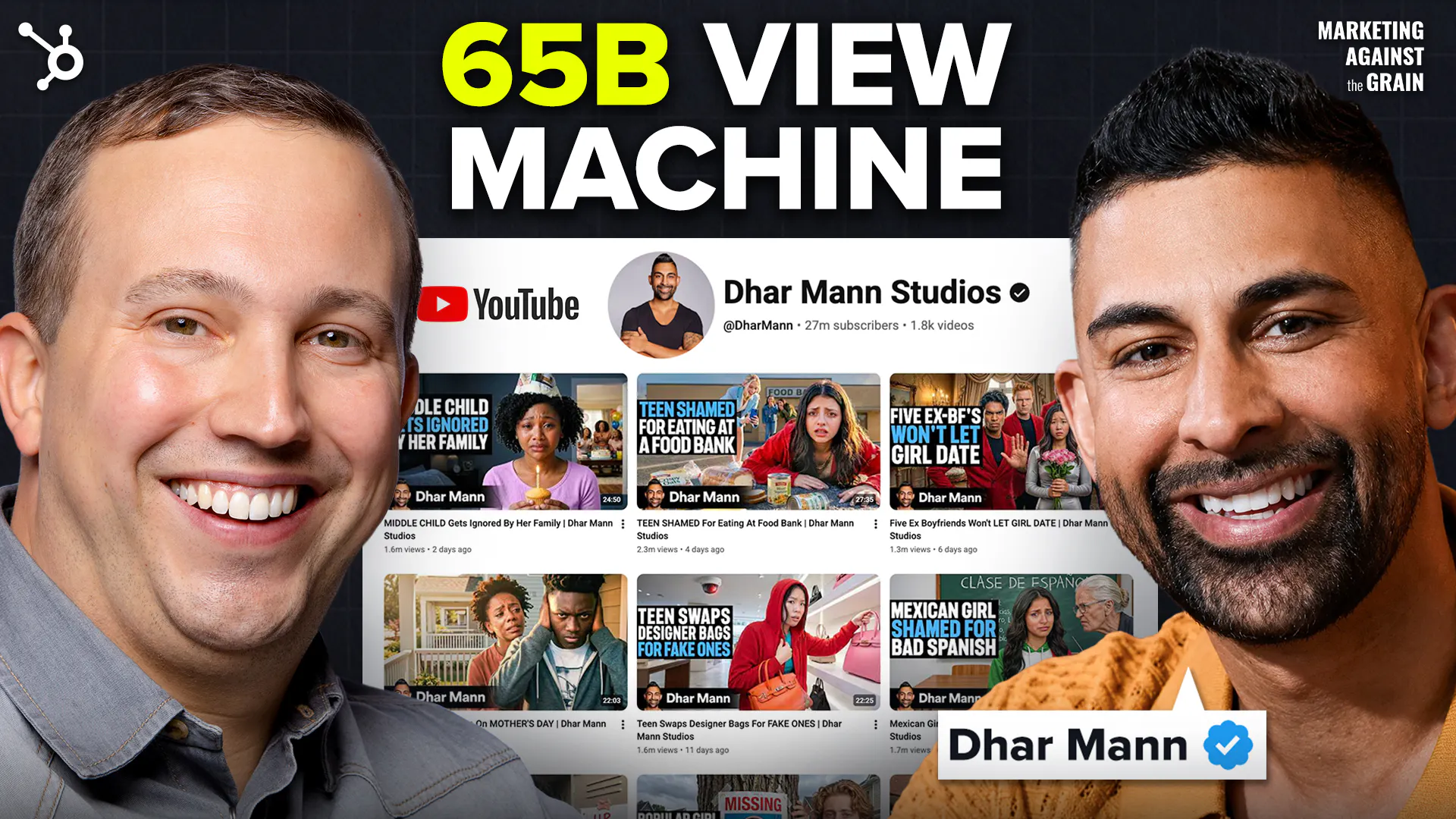
Marketing Against The Grain
How Dhar Mann Built A 65B View Machine Without Chasing The Algorithm
00:42:43
Loading summary
Transcript55 lines
- [00:01]
A
All right, welcome to today's show. We are here with Dhar Mann, who is one of the biggest YouTubers on the planet, an overall creative force, and we're talking storytelling. We're talking about how brands should work with creators on today's show. Dhar, thanks so much for joining us on marketing. It's the grain today.
- [00:16]
B
Yeah, thanks. It's a true honor.
- [00:18]
A
You've built this incredible YouTube audience, and maybe to just give everybody a little bit of backstory, we have a quick video that kind of tells you how we got here. AI evolution of dar. Okay. I love. Nothing like failing at a bunch of stuff early in life, man. I mean, that's pretty. It's pretty exciting. You have.
- [01:03]
B
So you.
- [01:03]
A
First of all, you have a Samsung TV show coming. That's. Congrats. That's a big deal.
- [01:08]
B
Thank you. I appreciate it. There's a lot of people when I would say I'm a YouTuber in traditional film, that would just sort of roll their eyes. And then. Only what I got to do was Samsung and we started appearing on tv. Did a lot of folks actually take us a little bit more serious? So it's funny how it works. You can have a very large audience, a very large, you know, viewership or even studio, but until you actually hit traditional platforms, that's when traditional folks start to give you a little bit of street cred.
- [01:35]
A
Well, and I think that's kind of what the opportunity is, especially for brands or marketers, is to go work with people like yourself before all that traditional validation, because your YouTube audience, not just the size, but the engagement of that audience, one of the biggest audiences on video today. And if you're outside of the YouTube ecosystem, you might not realize that, but I imagine that you've had huge brand success with your early partners because they were able to support you in a way that might have seemed a little risky at the time to maybe some conservative brands. But, like, just walk us through. Like, what does that look like? What are the early partnerships? There are people watching the show are like, oh, man, how would I ever work with somebody like DAR? And to actually get my brand out there?
- [02:20]
B
Yeah, it's a great question. So since you mentioned audience stats, this all started in my apartment where I was just trying to talk to the camera and help people that were going through some kind of a hard time in their life. The same types of hard times that I had been through at that time. My format was talking directly to camera. Nobody would watch those videos. I just keep iterating, you know, different Formats. And especially because my messaging was all about knocking, giving up after your dreams, not giving up after you've been knocked down. I couldn't give up on my, you know, content creation process and putting out videos. So I kept iterating. Eventually I landed on storytelling and I would just have friends and family members be actors in videos. And when I started that new format, that's when things took off. So, you know, in the beginning, I couldn't even get 350 views on a video. Now we're averaging about 350 million views a week. So just for, you know, some sort of context, because when we talk about these big numbers, you know, it's hard to visualize. That's about three times the super bowl audience every week. And every day we get more long form views than the Game of Thrones season finale. Just to have some sort of context around the numbers across all platform, Dhar mann Studios has 170 million followers. But I look at it more than just audience reach, because audience to me are folks that are watching. What I'm most passionate about is the community that we've built because the community are a group that is actually emotionally connected. And three out of four of our community members say that they feel compelled to take some sort of positive action in their life after watching one of our videos. And 89% of our audience says that watching our videos is actually more therapeutic to them than talking to friends or family members or even a therapist. So, you know, I'm pretty excited about the emotional connection that we've been able to build with our community. And that emotional connection now has been able to translate to us working with brands and helping them solve the piece of helping to tell them their stories, helping them build communities and, you know, building an audience that really resonates with their messaging.
- [04:48]
A
Hey, if you love the video today, we've got a bunch of resources. You can scan that QR code on the screen. You can click the link in the description below and check those out.
- [04:57]
C
You said you were started A1 format and you iterated your way to another format. How long did that take take? And what were some of the revelations along the way that helped you get into the winning format?
- [05:08]
B
Yeah, so in the beginning it was me talking to camera. The message was like, hey, what if Michael Jordan quit playing basketball after he got cut from his high school basketball team? And no one would quite watch those videos. And then my wife would tell me, like, don't tell them, show them. And that really landed on me. So I started storytelling instead. And I started talking about my own experiences. Here's what happened in my life, here's the lesson that I learned from it. And once I started storytelling, my views would still. I was getting a ton of views, but I'd go from, you know, maybe 10 views to like 100 views. And then I started trying different formats where I would incorporate like 2D animations in my messaging to make it more visual. I started adding B roll footage that you can license online. And none of that was quite again getting me like past, you know, a thousand views at that time. But then I sort of had this eureka moment where I was writing a script on a napkin. I was doing a video about infidelity and I was talking about how infidelity could happen with relatively seemingly innocent acts. And the story I was coming up with was about this husband who was in the kitchen scrolling Facebook and he happened to see his ex's post and he was debating if he should like it or not while his wife was cooking him dinner in the kitchen and had her back to him. And as I'm writing this, I happen to look up and my brother in law is visiting me. He's in my kitchen scrolling Facebook because Facebook was the platform back then and. And my wife's friend was in the kitchen cooking something with her back towards him. So that was my big sort of eureka moment. I walked over to them and I said, oh my gosh, would you guys be in a video of mine? Because keep in mind, up until then, all my content was just me talking to camera. And they were like, yeah, we'd love to be in a video, but what do we have to do? And I was like, nothing. All you have to do is do exactly what you're doing right now. I mean, in hindsight, I probably should have told him that I'm going to portray him as a cheater. I didn't think that anyone would actually watch those videos. So, you know, I had my videographer start recording. They were just standing there doing improv and I started narrating the story. And that was the first time I ever got a video to break a million views. So that's when I realized I didn't even know it was called live action filmmaking at that time. Because I didn't go to film school. I never aspired to be a filmmaker. I was just trying to put out positive, inspirational messages to help people. But you know, I'm very grateful that that format caught on.
- [07:52]
A
Well, I think one of the things that's interesting is that you started out doing a Lot of kind of like, production, kind of incremental things. And it was really like, emotion and storytelling that broke you through more than like, better camera or B roll. And. And I imagine you, those things mattered once you found the right storytelling vehicle. Like, those things probably helped you increment your to better and better performance. But I find that a lot of people who aren't successful in the path that you went down, they just get caught in the loop of, like, I'm just going to try to make things look better or sound better versus, like, oh, I actually need the audience to feel something very differently. Like, is that what you discovered throughout that whole process?
- [08:31]
B
Yeah, absolutely. People, you're right, K. They get hung up on the quality of videos and all the what versus the wise. And, you know, for me, a lot of people think that I live in our analytics dashboard and I'm looking at all the data. I'm sure there's a lot of marketers that they obsess about that. But I would say the best retention that you can have is emotional connection. If your audience is connected to what you are saying, they're going to stick around. And that has been our secret for success since day one. Kind of goes back to how I see it, that we are not just building an audience, we're building a community. Our community actually takes action when they watch our videos. They want to share our videos. They like, they subscribe, they engage. So, like, when we work with brands, we take that same type of psychology. We're not just trying to read ad formats in the middle of videos. We look at it as, how do we actually create some sort of emotional connection between the brand and the audience that they're trying to serve. So one great example is when we had the opportunity to be the creator of the week through YouTube's NFL partnership. When I spoke with Tim Ellis from the NFL and he's like, gar, what is it that you want to do? First off, I was like, wow, you're actually asking me. You're not. I was shocked.
- [09:50]
A
It's a key lesson.
- [09:51]
B
That's key because there's never any collaboration directly between brands and creators. It usually happens between, you know, if a CMO makes a directive that we need to get into working with creators, that goes down to their SM SVP, that goes down to, you know, the 10 other people within the company right before. Then he goes to a brand agency, then a creator agency, then a creator's manager, then a creator's creative director. By the time it gets to the actual creator, it's had to gone go through 17 different layers. And now it's all really come down to these four corner ad briefs that really kill creativity. But when we had the opportunity to work with the NFL, Tim was like, dar, what do you want to do? And I knew it was important to me that the NFL was trying to show more heart behind the sport. Right? They were having this helmets off strategy. So we get to know the players on more of a human level. Tim said that, hey, I want the audience to know that the players on the field are humans, the coaches are humans, the audience members are humans. How do we focus on that? And so my whole idea was, huh, what if the NFL appointed a chief kindness officer? And then we went out and started doing all these kind acts associated with football leading up to the actual Super Bowl. In my mind, I'm like, there's no way two weeks before the super bowl that the CMO of the NFL is going to prove such an idea. Maybe if we're talking about 2029, right, like this, you're going to have to go. So much bureaucracy, so much red tape. But Tim, you know, I'll give him so much credit. He saw the opportunity and then as soon as he realized, like the emotional connection behind it, he said yes. And that turned out to be the most successful creator activation that the NFL has ever done by their own words. So our campaign generated just to give you an idea of like the type of content. So we take like a high school football team in an underprivileged area who didn't have a school locker room, and we built them an entire school locker room and we gave them brand new football gear. We recorded all of this. So that video alone, you know, probably got about 20 million views. Then I found out about this boy who had lost his father. The father had promised the boy that I'm going to take you to a Super bowl game. Never got the chance to. So instead we surprised the mom with two super bowl tickets so she could carry out the promise that the father had made to the boy. And, and if you saw that video, it would just bring you to tears because you could imagine how emotional of an experience.
- [12:20]
A
I'm not crying. You're crying.
- [12:24]
B
It just got blurry all of a sudden.
- [12:25]
A
Exactly.
- [12:27]
B
So, you know, between all those campaigns, we had over a hundred million views, over a billion impressions when combining earned media and such. But more importantly, we had a 94% positive sentiment from watching our videos, whereas the NFL historically has been around the 65% range. And our videos got a 10.4 brand lift through an independent study, the highest brand lift through any super bowl commercial was 5.2, and that was the Toyota ad. So it was more than double the highest performing super bowl commercial. And this was all based on organic views. So, you know, that's to the credit of Tim and, you know, my team that helped put all this together in a very quick amount of time. But it just goes to show that if you can move hearts, that's how you can move communities.
- [13:18]
C
So you talk like a lot of what you're talking about is how you can build an emotional connection to an audience. And being a kind of YouTube star or being a creator on YouTube, you're kind of having to think about your audience and you're also having to think about the algorithm. And there are like, shows on YouTube that have done really well. Diary of a CEO is a good example from Stephen Bartlett, where if you actually listen to what he's done, he's just like really analytical about the algorithm, like really trying to solve for every kind of component of the algorithm. If you actually look at his show and how his show has evolved, it's pretty much just structured around how the algorithm works and what triggers the algorithm. How do you think about that balance?
- [13:56]
B
Yeah. So data to us is an amazing feedback loop. We are an audience first company. And so whereas traditional media players, they have to create content hoping that they're going to find an audience after their show comes out 18 to 24 months later. For us, we actually have a direct relationship with our audience. So we're creating content based on what our audience is asking for. So I'll give you one example. One of the things that we do is actually let our audience greenlight what videos that we create. And so we do this through allowing them to join surveys where every single week they know that they can come to our survey page. They get to choose titles of the videos, they get to choose themes of our videos. They also get to choose plot points like, hey, here's five different pitches. Which would you like see happen? When we're deciding whether we want to build a single video into an actual franchise, we go to our audience first and ask them which one they prefer. So we build with the audience from the start, and because we own our distribution and data, we're able to make decisions with them in mind throughout the whole process. Going back to when I started making content. If I, if I had approached things from a traditional standpoint, I would have spent all of my money on my very first video. It would have flopped, and I would have been deep in debt and I never would have gotten off the ground. It took me over 100 videos before one went viral. But our model works because we spend a fraction of what traditional media costs. So when something didn't work, I could iterate. I could iterate, I could keep trying. And I think that's the reason that Production is down 35%. Last time I checked, within LA, film studios are vacant because the old model just isn't working. And whereas a traditional model has to go from script to screen in 18 to 24 months, sometimes multiple years, if you look at a Marvel product project, our Turnaround time is 21 days. So from the time that we actually write a script to actually premiering on our YouTube channel, there's only three weeks that has gone by, and that's on our longest form of content. Our shortest production window is actually seven days from start to finish. And so what does that mean? We can get feedback from our community much faster than traditional players and we can iterate all along the way.
- [16:33]
C
Is there ever a time where, because I imagine brands think about this when they want to get into YouTube, where what the algorithm wants and what you want to give your audience are in conflict. And I'll give you like, an example. I watch YouTube for most of my content, like, especially for sports content. And one of the problems with YouTube is everything has to be so extreme, right? And so every piece of analyst now is like, this person is slam. This person should be sacked. This person sucks. There's no like, in between anymore because the has to be opposite ends of the spectrum to, like, trigger the algorithm. When you're a brand, you're trying to figure out, like, how do I stand out within this noise? And I suspect there's times where you're like, what the algorithm wants. It's not really where I want to be. Do you ever feel that tension between what the algorithm wants and what you want to create?
- [17:21]
B
Yeah, there's constantly that tension. And I think the difference is between someone that creates a company versus someone that actually builds a brand. Like, if you think about Disney, they have brand equity. They actually stand for something that's a brand, that people are eager to want to take their children or their girlfriends or wives to. To have some sort of special experience because of the emotions that that brand connotes. So I'll give you a personal example. I often will now try to incorporate AI into our various creative processes. And so when I plug in what are our top 100 performing videos over the past three years help me generate new titles based on that. The title started going negative. Right? More clickbait rage bait. And so AI is recognizing that there is an audience interest in that. And so, yeah, you know, for me, I totally understand that we could probably get more views if we did certain things, such as show a little bit more skin or have a little bit more controversial titles, go into more steamy romance. But the moment that we did that, there's going to be some mom out there that happens to be walking by her child watching one of our videos that instantly says, you are not allowed to watch Dhar Mann. I had to sort of learn this by trial and error because even when we would show like cheat videos where somebody is cheating, kind of going back to my original example, I remember one of my staff members was like, my daughter didn't know what cheating was until she saw one of the videos. Right. So they have. So then I have to start thinking about these types of things, like what types of moral values do I actually want to convey through our videos and our content. I think the interesting part is there is so much negative content that exists in the world. Right. And sure, we are all within the media space realizing that that's the way to catch your eyeballs. But the more important question is what do you want to be known for? What do you want your brand to be associated with? For a long time we didn't get brand deals because the brands that were looking to advertise with creators on YouTube were not thinking about scripted. Right. They were thinking about spectacle. Because anytime you go to YouTube, if you're a brand allocating a budget, you'd say, put the scripted budget within linear. And then if we go to YouTube, I want to work with a creator that is going to be doing some sort of big exploding Lamborghinis or whatever it is, right?
- [19:54]
A
Yep.
- [19:55]
B
And I had my team come up to me, my agency was like, hey, Dar, if you start creating more spectacle based videos, you can get a lot more brands interested in working with you. So two years ago I had that. I was at a really interesting crossroads. I had to make a decision which route I was going to go. I, at that time made the decision that we started this whole studio to put out positive content, to put out heartfelt content, to teach positive life lessons. I'm not going to alienate our audience in our mission in search of views or in search of brand deals. So we stayed true to our mission. And up until last year, all of our revenue and growth has come from platform revenue. Just because of how big our audience is. And we never relied or even received brand partnerships. But an interesting thing has happened in the past 12 months is that brands now are less interested in spectacle based content and they're more interested in emotional connection with, with audiences. And so suddenly who is that player that stayed true to that mission? It's us. And so this year like within the first quarter alone, our brand partnerships were 10 times the amount of the entire last year combined. And so it's one of those things that if you stay true to your mission, it might seem difficult in the beginning and you might be foregoing some opportunities but, but that strategy will ultimately pay long term dividends.
- [21:27]
A
Don't go chasing the algorithm. Stay true to whatever the ethos, the mission of the storytelling you're trying to do. And in that like you need to solve for the algorithm, the algorithm is a way to get discovered. But if you just do solely with the algorithm once, you're never going to have a soul is kind of what you're saying. And you're not going to have any differentiation, you're just going to be in the sea of sameness with everyone else. And I think what's interesting, Dar, is Kieran, I have a book coming out in the fall, it's called Loop Out, Learn Out, Market, Outgrow you can, we'll drop a link in for people watching the video and we have a whole chapter in there about creators. And like one of the thesis there is you have a lot of brands out there doing advertising and most of that advertising is getting ignored, right? People are just like, oh cool, like I'm just going to, you know, skip your pre roll, I'm going to do all of these things. But the creators like yourself, have all of this deep resonance with their community, right? Like they're not, you're not doing these spectacle based things, you're doing very emotional based storytelling. So when a brand partners with you, they don't just get like awareness, they get the brand halo effect of working with you and what your brand represents, what your storytelling represents. And that to me is what creators are all about. Whether you're a consumer business, a B2B business, doesn't matter. It's that a creator has built this unique reputation with their audience. And even like you deciding with a brand, deciding to work with a brand, you probably, I imagine saying like, hey, does this brand represent the brand I've built myself? And are they going to be complimentary? And you probably turn down a bunch of partnerships because they're probably not a Fit for your audience. Like maybe tell us a little bit more about how you work with brands, how you pick and decide what brands to work with. Because I think this is so new for so many marketers out there.
- [23:08]
B
Yeah, really interesting question. So, you know, going back to what I said earlier, I'm really grateful that we were able to build the company without relying on brand deals. And that was just by focusing on the audience first trust and owning our own distribution. But you know, as the landscape shifts, we're seeing declining trust, ad fatigue and more content that's than ever. And so brands, in order to stand out in this sea of sameness, as you mentioned, they're looking for real engagement, not just reach. And that's where we operate. Our audience is emotionally invested and they're action oriented, which drives stronger performance. So, you know, in thinking about some of the brand activations that we did last year, I mentioned the NFL and the Chief Kindness Officer activation. Another activation that we did was when we were talking to Adobe. Adobe said, dar, one of our goals is to show that we are the official partner for creators and we want you to help us tell that story. And I was like, oh, that's easy. Because all I have to do is tell the truth. Because when I was going back to starting out back in my apartment, I had $600 in my bank account and I went to Best Buy. I get the chills sometimes thinking about this. I was looking at a box, it was soft lights and a Webcam that cost $400. That was like two thirds of my life savings at that time. I bought that, I couldn't afford like real camera gear, so I had to learn how to film everything either on my webcam or my iPhone. And the third thing that I did was learn Adobe Premiere. And that's pretty much the same journey as every creator. And so once I realized that, hey, you know what? Adobe has been in Creators Journeys from the very inception. Now how do we tell that story, especially in this world of AI and disruption, that Adobe is still there for creators today? That's when I came up with the idea of creating an Adobe creator training camp. And my thought was, I will get some OG creators, some of, you know, the biggest creators on the planet. I'm going to assemble them together and I'm going to have them teach other aspiring creators on how to create. And not just by speaking on panels and giving lectures, but by actually co creating with them. So we had creators learning from creators on how to create. And I see that you got a video. So yeah, let's check this out. Billion combined followers. And I think that's what's so cool about today. You get to learn from other creators. Adobe really makes the process of creating content so much easier, especially now that
- [25:56]
C
you get on your phone.
- [25:57]
B
I actually just shot a video with Adam.
- [26:00]
A
It's such an incredible experience to be
- [26:02]
B
in the same room with so many talented content creators. I've never done anything like this. To hear from other types of creators
- [26:09]
A
expands my inspiration and creativity.
- [26:11]
B
We're able to create our own voice. I taught myself how to edit.
- [26:15]
A
We just collaborated with Matt and Rebecca.
- [26:17]
B
We're so looking forward to working with them. I've been using Adobe for 10 years
- [26:20]
A
and what I love the most about
- [26:21]
B
it is I get to use all the tools under the same Adobe umbrella.
- [26:25]
A
Barman is the goat. Adobe is the goat. It makes sense why two goats would.
- [26:30]
B
I do think with our powers combined, we've pulled off something that nobody has.
- [26:35]
A
One of the things I love about this is it's one of the ultimate marketing cheat codes. You bring a lot of high influence people and let them work together, right? Because then they get a lot of value. They're inspired to talk about it. They have like, they want to share each other's influence. And like, this is a great example of like, Adobe was just a benefactor, got the whole halo effect of this effort. And if you're a marketer out there and you're looking to do something, whether it's on a big scale, like that's a pretty big scale, having a big event, having a bunch of people there or a much smaller one off scale, you get that through that kind of shared influence and shared alignment. But you also said some magical things in there, Dar, where it's like you came up with the idea, not the company. It happened. All the, all of these brand partnerships seem like they happen quickly, right? Weeks, months, not years. And I think that Adobe example was, was really interesting. Like what you learn from putting that all together.
- [27:29]
B
You know, it's funny is as I was after I finished my talk doing the keynote at that Adobe Creator Summit, I get off stage and this lady comes me and she goes, dar, I want you to look at this. This was a brief to work with the creator that the company was signing. And there was 24 signatures required from the brand to, in order to sign this contract. And she's like, whatever activation we were trying to do with this creator for this cultural moment that was happening, that cultural moment already passed. So, you know, there's, there's so much red Tape and bureaucracy. And like, if you want to work with creators, you have to move at the speed of creators and creativity, not at the speed that you know folks are traditionally used to. Like, I have this acronym that I use and if you follow these five steps, these are the five steps that I would say are critical to making it as a successful content creator. And the acronym I use is heart. H E A R T. And so H is honor your story. It goes back to even when I was saying I started off in my apartment, not with a mission to actually start a company or build a brand. I was just trying to help people. That's my story and that's baked into my mission. Everyone listening to this has a story and that's what makes you unique. Second is E. Earn your audience's trust. Always remember why the audience is there in the first place and create content that makes them feel seen and heard. Third is a architect, a system. The goal isn't just to create one piece of viral content. The goal has to be to create a whole ecosystem that allows for a lot of viral content. What makes Dharman Studios unique is that every single week we put out about five hours of content across 82 different channels. So don't just build content, build a company that creates content. Step four is R and that is reach hearts. Going back to that emotional connection, you can build a large audience, but in order to build a community that is actually going to take action, you have to have them emotionally connected to whatever you're creating that's going to inspire them to share, comment, engage, and ultimately purchase. And 5 T is turn views into impact. And that's always about just trying to find ways of giving back and making the world a better place. Because yeah, it's great to make money, but I think all of our mission here on this earth is to do something greater than that to give back and help people. Kip, you mentioned you guys have got a book coming out. I'm sure that's all about adding value to other aspiring marketers and companies in the world. You're turning your views now into impact. So if you follow that five step process, H E A R T. Honor your story, Earn your audience's trust. Architect a system, Reach hearts and turn views into impact. You become a very successful content creator or business owner.
- [30:48]
C
What do you think are if you apply that to YouTube? Because I think that's one of the predominant platforms people are migrating to with the disruption in search because the AI everyone wants to try to figure out YouTube. It's a hard platform to figure out if you had that framework, what are the core beats to get right in a YouTube video that really help you trigger both your audience and trigger the algorithm.
- [31:08]
B
Yeah. So even when we go back to talking about packaging and we were talking about clickbait and negative titles, I'm very cognizant of the world that we live in. And so some of our. Even a lot of our videos, they appear as if it's going to be some sort of a negative storyline. Like, for instance, on Mother's Day, we posted a story called Son ditches his mom on Mother's Day that appears to be, you know, like some sort of a negative story. But in actuality, if you watch the story, it's about a kid who ditches his mom on Mother's Day, learns about the importance and all the things that the mom does for him, and then he decides to come back, join her, and surprises her on that special day. So everybody still ends up so still a positive message with the positive moral. But it could be in packaging that helps to bring in an audience. So I would say you always have to start with packaging number one. Like, if we have an amazing story but we can't figure out what the title and the thumbnail is going to be, then I say we don't have an amazing story. So packaging is your first gatekeeper. Creators like to say that packaging is about 80% of the success of a video. The reason that can be somewhat of a misleading statistic is because if that's 80%, then what? The actual content and the editing and the directing, the shooting and the actors and every. The story is like 20%. That doesn't make sense. So what I've come to realize is it's like you're trying to drive to the beach, and there's different guardrails that you have to get through every single time. And so 80% of that effort, I would say, is in that first guardrail, which is the packaging. If you don't get past the packaging, you will never make it to guardrail 2, which is the actual pitch of the story. So how we spend most of our time is thinking about what the packaging of that video is going to be. Once you get through the packaging, then you could start to put together what is the. What is the pitch? If I had to explain this video to you in 30 seconds, how would I describe it? And it's just like, you know, folks call it an elevator pitch. Within business, content should work that same way. You should be able to explain, like, Kip you did an amazing job when we started out just saying what the audience is going to gain from this video. Where with Darman, we're going to learn about creators, how brands can work with creators, how you could optimize your content, how you can grow your following. Right. Like you're giving the value proposition up front and then that also includes whatever your hook is because you want the opening of your video to match whatever the packaging is. Like if I was to share my screen and show you, you know, one of our, our last video is called Five Ex Boyfriends Won't let Their Sister Date. And so when you open that video, within 20 seconds you're going to see the five ex boyfriends preventing the girl's love interest from being able to date. Because if you're not getting that experience that you clicked on, then people feel like they're going to be bamboozled and they're going to swipe away. So whatever the core idea of your packaging is, try to deliver that in the first 10 seconds, if not definitely within the first 30 seconds. And then from there, you know, it's what we know. We're traditional media, I would say starts with inception, Rising action, climax, falling action, resolution. This is just a classic story structure within YouTube. It has to happen on a much faster, accelerated basis. You almost have to start with the climax. You have very little time of rising action. You have to get to the climax and then you have to keep building from there. So you have to be able to tell that story much more concisely. And you know, if you're wondering where you're starting to lose your audience's interest or how you can improve your view through rate, of course you can just look at your retention graphs for each video and that will usually give you a sign as the areas that you're losing audience interest.
- [35:27]
C
That's awesome.
- [35:28]
A
That was the masterclass. Like that, that two minute clip is what anybody needs to, to watch if they're, if you're creating on YouTube.
- [35:35]
C
Last one for me. Thar. What's like one thing that has surprised you about your journey within YouTube that works much better than you thought or is overblown and doesn't work anywhere near as much as you were told.
- [35:47]
B
YouTubers can't make it more than five years, right? Like enjoy your five seconds of fame kind of a thing. You can't build a real business off of YouTube. And I think now with the way that creators have evolved into real businesses, like we don't just have audiences, we're not just talent, we're running real vertically integrated media companies. Right. We're not just distribution anymore. We are actually creative, we're production and we're strategy. So what's amazing to me is how big of a platform that you could build by being a YouTuber or having any sort of really engaged audience. YouTube is definitely the platform where you can have the most connected audience. Why? Because it's long form storytelling. Like how are you going to be able to build a close audience when you're doing 30 second reels and you're just at the mercy of the algorithm? With most of our viewers, people are actually searching Dhar Mann coming to our channel. They're wanting to see our videos versus it just being suggested in their feedback and because we've been able to build a real business, you know, now whereas before, if you had asked me two years ago, 95% of our revenue was built off of just platform revenue. That's AdSense from YouTube and Facebook through the ads that play in the commercial breaks between our content. Now we're such a diversified business that 20% of our revenue comes from YouTube, 20% of our revenue comes from Facebook, 20% of our revenue comes from an in house agency. And then the rest gets spread out between fast. Our partnership with Samsung where we reach over 100 million households. And we were the first creator to come to have a deal with Samsung to do original content that actually comes out in June. It's our series called Unlikely Romances with Samsung. Second is vertical dramas. Now we've announced a partnership with fox where we're jv ing to create 40 films for their vertical drama platform called Holy Water. Third, we are about to announce a landmark deal with another major studio in the SVAD linear space. Fourth, we also are now going into audio with the launch of my podcast that comes out on May 18th. And finally is brand partnerships, which is becoming a more meaningful part of our business. So look at just through a YouTube business and community, how much of a flywheel we were able to create to build other businesses on top of it. So I'd say people probably still underestimate, I know I did. How big of an opportunity it is to create an audience that's really connected with your content and mission on YouTube.
- [38:51]
A
I think what's fascinating is you're showing people, both creators who want to build a real business, that you can anchor that on YouTube and then really expand. And that's kind of what you're seeing. And you got the podcast coming up, you've got the new scripted show with Samsung, but I think the same thing holds true for brands that if you're a brand, you can go and place ads a bunch of different places, but you're better off to work with really awesome creators like yourself because one, you get your creative ideas, you get the audience affinity, but as the creators you partner with grow and scale, you also then have new platforms, new channels to work with them on. And it's not like you're limited to, you know, the amount of 30 second slots that are out there. And so I think you've given everyone a way to rethink how they can partner and how they can build their own, own content. And quite frankly, it's just been a really inspiring to hear your story starting out from literally like $600 in your bank account to now it seems like every quarter you've got some awesome new project that's coming out. You've been able to like scale your impact in a really remarkable way. Congrats on your success, star.
- [39:57]
B
I really appreciate it. And yeah, I mean, if I'm just for one takeaway for brands out there, you know, you don't just need influencers, you need a whole creator infrastructure and creator ecosystems. Don't think of influencers as transactional relationships or one off deals where they're just going to be doing ad reads and interrupting the content. Try to form direct relationships with creators and that real creativity comes from those conversations and the collaboration between brand and influencer rather than an ad brief. I'm sure you're hitting out a lot of these things in your book.
- [40:36]
A
Yeah, we cover a lot of that in the book. But there's also like, that was great party advice. And to recap, some of the other advice is like trust the creator. Understand that it's a whole different speed and process that has to happen. Like those three pieces of advice plus the framework I think are really valuable lessons for anybody out there who's trying to work and partner with creators to create great content. So, Dar, thanks so much for joining us on Marketing against the Grain. We appreciate it. You were up very early to make this happen for us, so we appreciate you. Thank you so much.
- [41:07]
B
Thanks guys. It was a real honor.
- [41:08]
A
I want to tell you about a podcast I love. It's called Nudge. It's hosted by Phil Agnew, it's brought to you by the HubSpot Podcast Network, the audio destination for business professionals and it's the UK's fastest growing business podcast. What I love about it is that the Nudge listeners love no fluff, no bs, evidence based marketing tactics they get in each episode. You're going to want to listen because this is like an MBA's worth of insight in every single podcast. And entrepreneurs. You're going to love the show because it's filled with repeatable, proven studies. Not hearsay, not one off success stories. Marketers. You're going to love it because it discusses the psychology behind great marketing and what marketers are getting wrong. Listen to the nudge wherever you get your podcasts.
- [41:53]
B
This data is wrong every freaking time.
- [41:56]
A
Have you heard of HubSpot? HubSpot is a CRM platform where everything is fully integrated.
- [42:02]
B
Whoa. I can see the client's whole history. Calls, support tickets, emails. And here's a task from three days ago I totally missed HubSpot Grow better.