← Marketing Vanguard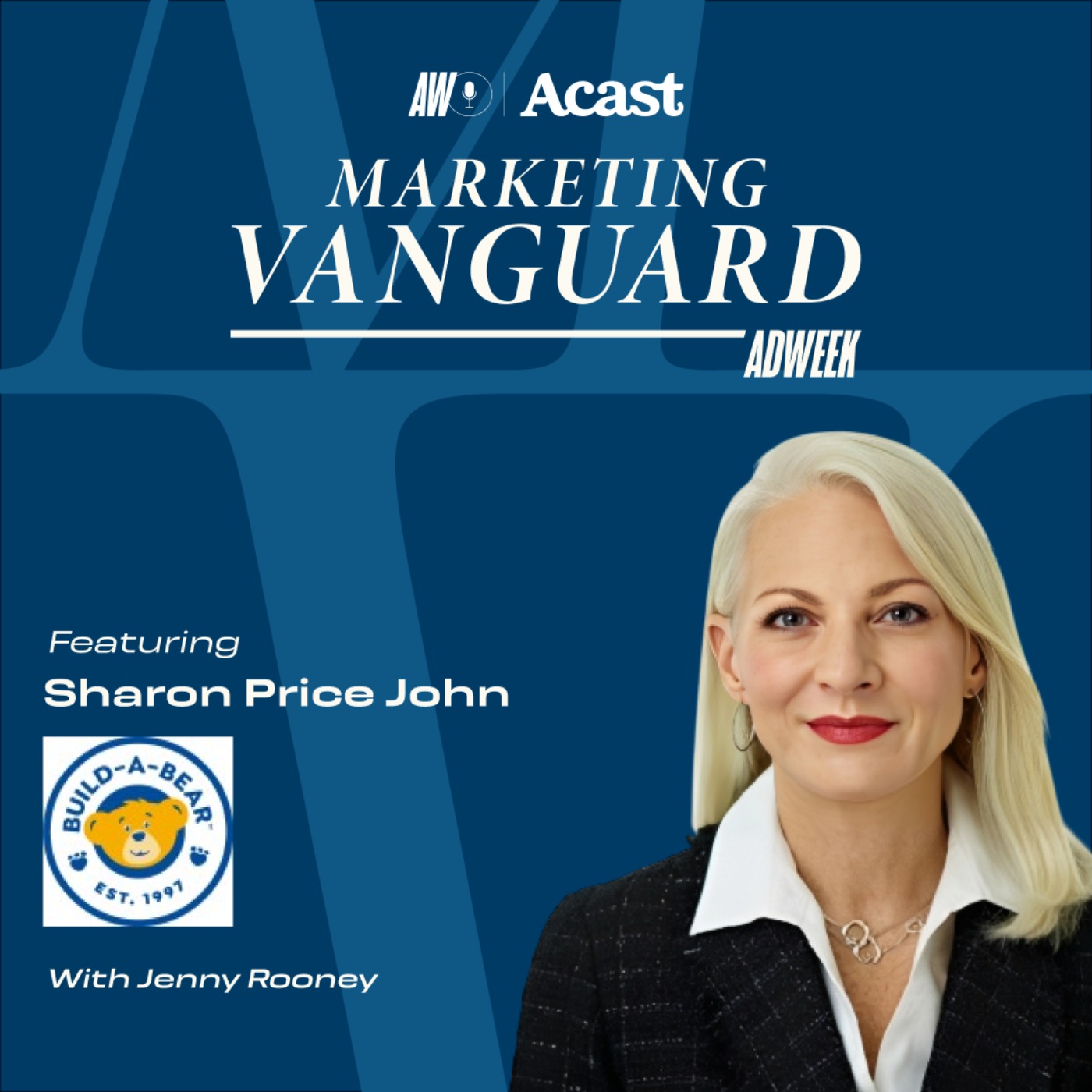
Marketing Vanguard
Brandweek 2025: Build-A-Bear’s CEO, Sharon Price John on Claiming Your Place, Being a CEO and More
00:37:47
Loading summary
Transcript63 lines
- [00:00]
A
Does it ever feel like you're a marketing professional just speaking into the void? But with LinkedIn ads, you can know you're reaching the right decision makers, a network of 130 million of them. In fact, you can even target buyers by job title, industry, company seniority, skills, and. Did I say job title? See how you can avoid the void and reach the right buyers with LinkedIn ads. Spend $250 on your first campaign and get a free $250 credit for the next one. Get started@LinkedIn.com Campaign terms and conditions apply.
- [00:30]
B
What we needed to do is to pivot the company to not just be a place called Build a Bear Workshop, but to separate the concept of the brand from the place.
- [00:41]
C
Hi, everyone, and welcome to the Marketing Vanguard Podcast. I'm Jenny Rooney with adweek, and I'm thrilled today to be joined by Sharon John. She is the CEO of Build a Bear Workshop. Sharon, welcome.
- [00:52]
B
Thank you.
- [00:53]
C
Thanks for being here. We're having this live from Atlanta, or at least on site in Atlanta during brand Week. And we're thrilled to be here. It's only Tuesday, but already I feel like we've had a week rich with conversations, dialogue, debate even, and some inspirational content on our main stage. And I'm thrilled to have you here to talk with me about certainly what Build a Bear is and the journey it's been on as a brand in business, but also in the Marketing Vanguard Podcast. I love to ask questions and get into learning more about you, you as a business leader, you as a marketer. Some people say they like to listen to this because they get into the minds of marketers and really understand it's a scary place. Yes, we all know that. But it's interesting, see the similarities and differences in terms of how you all are thinking about solving for the equation around engaging with your consumers, growing your market, showing up in new and unexpected places. So we'll get into that, but why don't we start by having you share a little bit about who you are and your career journey that got you to this role?
- [01:54]
B
Yeah, I'll make that super tight. But I did, as you know, started out in the advertising industry. Yep. I was a assistant account executive trainee at DDB Needham in New York. Still the longest title I've ever had. And that was the beginning of the journey after I went to college to do that. So it was a big adventure to move from Tennessee to New York City and sort of tackle Manhattan with a lot of passion and very little knowledge. But sometimes you do better when you don't know better. And ended up making a lot of friends and working my way up there and eventually decided to get my MBA at Columbia. And then when I figured out all the different kind of jobs that you could get from Columbia, mostly like pe, all the bunch of letters, P, E V, C, you know, so venture capitalism, private equity, maybe management consulting. I'm like, I don't want to do any of that because the same reason I was drawn to advertising, which was consumer centric brand building types of things that just is not who was interviewing. And I made this short list of five companies that I was, had a lot of passion for and one of them happened to be Mattel. And so I reached out and ended up working on Barbie fashions.
- [03:09]
C
Oh my goodness, that's great.
- [03:10]
B
Most of the folks were like, you're doing what? Like I probably made less than their signing bonuses for some of these management consulting firms. Like, I'm following my heart. They don't laugh anymore.
- [03:26]
C
That is so true. But what was it that drew you to marketing work? I mean, and Barbie, such an iconic brand, obviously Mattel, such a great fun category. What was it about that space, I mean, besides the obvious, that caused you feel like that's where I want to spend my time?
- [03:42]
B
If you are going to follow your heart. They say this in psychology. If you're not sure what you want to do, what did you love as a kid? That's usually a really good directional data point for you. And I really did love my Barbies and I loved toys and I've always been very brand aware and just a good communicator, good writer. You'd have to look for stuff like that, right? You know, I'd always be the one, whether it was college or even in high school or junior, like, oh well, let Sharon read her story today. You know, whatever the teacher did, I have to get up in front of the class and read my story. So you learn about yourself by looking at these road signs and for this love fashion, love toys. And you know what? It was a great choice for me. But interestingly, the biggest learning about that experience wasn't because I got in the right place at the right time or right when Barbie was in a resurgence in the 90s. It was because there were so many powerful women running the brand and the truth is I didn't know any better, but that all it was was women. Like I'm at the lowest rung and all the way to the CEO who eventually became the CEO, which is Jill Berard, a legend. It was women like, five, six layers of powerful, amazing women. And so I'm like, oh, this is just the way business is. And that was really, I think, a great way for me to have jumped over from the ad side to the client side, to just be surrounded by that. And it was also a journey for me to then not be intimidated. So in this world of almost what I was perceiving, this is not on them. This is on me as power and perfection. And they're all beautiful and dressing great and brilliant. And I'm like, I'm never going to get out of it. Like, this is not going to work out for me. And I had a very strong woman who's still a good friend of mine today said, okay, you're not speaking in meetings. What's going on here? And I'm a pretty assertive person. And she said, that's not why we hired you. If you're waiting to be a part of the team, you're already on the team. We don't make mistakes in who we hire. You're here to create value. So I see your wheels turning. I expect you to create value. And it was like something was just unleashed. And that interaction was really an important tool for me to learn to find your voice and to speak in the meeting, even though it might not be right. It's just a matter of you having respect in how you say it. Right? Look, guys, I'm not real sure about this, but here's what I'm seeing. Here's a possible solution. And then all of a sudden, you find the way to communicate, and then people start to listen to you. And so to sort of finish that trail, I stayed in the toy industry. Ended up. They sent me to Paris for a year, and I was like, oh, no, don't do that. And I worked on the Disney business and then ended up going from the assistant product manager on Barbie Fashions all the way to the vice president of Disney International for that, and then eventually ended up at Hasbro, another big toy company, and started as vice president, Tiger, and ended up being the head of the U.S. toy Division. And then I worked at Stride by Children's Group as the president of the division, which gave me this vertical retail experience. And then all of that made me like an okay candidate for the Build a Bear CEO when the founder was ready to step down. It was a turnaround situation, so I had turned around brands and business units, and that skill set was something that they needed. Right place, right time, for sure.
- [07:19]
C
But you managed businesses full stop in every turn. And I Do think that's an important distinction. You are at companies that had a deep marketing focus. Right. They were very brand first but you know, you were operating obviously in a much more business management role in all of those instances. And I just think that's so interesting because obviously a lot of the conversations I have with CMOs these days is around how do you assert yourself as a relevant and necessary business executive in the C suite.
- [07:52]
B
Yes.
- [07:53]
C
And not just the person who's managing the next campaign, which is such a different way of thinking about it. And you know, many CMOs will say, well the way you advance is if you have, you should really at some point manage a P and L at some point in your career. Now that you're a CEO, what would be your best advice for CMOs who haven't managed businesses in the way you have? Like where can they go to get that experience, that hands on knowledge so that if they aspire to a president or CEO role, it's within reach for them?
- [08:21]
B
Yeah, that's a really good question. It's also really important to understand that because now I see it from a different perspective being a CEO, I expect everyone that's going to sit at that table to come to the challenge with a business mindset, not a marketing mindset or an advertising mindset. What are we trying to solve? Think about it from a financial perspective. We're always trying to grow profitably, Right? That is the goal. That's your metric. Figure it out. But to what you're saying. When I decided to evolve from the ad industry and choosing an mba, I decided not to go to a marketing focused school where my skill set was purposefully decided to go to a quantitative school and made that learning curve very steep. I never even had an accounting class. I'm in accounting class with accountants guys. Something wrong with that. But I like I can learn this.
- [09:21]
C
Did you always aspire to be a CEO?
- [09:23]
B
No, no. In fact I wouldn't have thought that I could do that. I don't think there's a funny story associated with that. But being willing to not just keep honing what you're great at. Like so at some point you're going to get in the 90th some odd percentile on your marketing skills. So what's your next step to get to the 95th percentile in marketing skills. Start getting on the radar with the rest of the entire circle of what its business. And that aspect is what unlocked it for me. So now I think that I am more of a CEO that happens to have been A marketer versus a marketer that accidentally became a CEO. But in fact, what had happened is that gave me sort of this aspiration, if I can go that far, that it's possible that I could be a CEO. I was getting a 360 review, and the individual said, you know, so what do you think? What do you want to do with this company? What? I'm like, I don't know, maybe I'll be a CMO someday. And he, like, pushed back from the table. He's like, I'm like, what have I done wrong? And he said, I don't think you realize that you've already scored at or above all of our average CEOs on every metric.
- [10:37]
C
Wow.
- [10:38]
B
You literally can be whatever you want. You just have to decide. And that was incredibly unleashing for me. And that belief was a big game changer. And I've done a lot of research on this. And it concerns me, particularly with women, that the statistics show that if there's 10 different criteria for a job description, unless they have nine or 10 of them, they won't even apply. I just want you to think about this. And men tend to apply if like five or six. And some of that is a causal factor for women not applying particularly for a CEO role, because it is the single largest step that you will take. Most likely what you've done in any other functional area is you're going up the ladder by knowing the most in that vertical. Right? So you keep getting a bigger scope, but it's your area of expertise. The step to CEO is you're probably the best at your job in that vertical, but now you're going to take over functional areas you've never managed in your life. So if that's a tendency to believe that you have to have 9/10 of everything that's on that list, you're never going to apply because it's impossible. And I do want people to. Not only there's two messages in that. One, keep expanding your horizon and learning about things that you don't know about. Right. That is on you. But two, recognize that it's not necessary to know everything about everything before you apply to something. In fact, it's much more desirable to hear something like, I can figure that out. I'm willing to learn that. I've managed situations similar to that in the past, and here's how I would go about that. They're not looking for somebody that knows all the answers. They're looking for somebody that can figure it out. Hi, everyone.
- [12:27]
C
Jenny Rooney with Adweek. And in this special segment of the Marketing Vanguard podcast, I'm thrilled to be joined by Joshua Spanier. He's Google's VP of AI and Marketing strategy. Josh, welcome.
- [12:40]
D
Thank you, Jenny. I'm excited to be here and have a chat with you.
- [12:42]
C
I am, too. I'm thrilled to have you here. Listen, you have something new going on called Frontier cmo and I would love for you to share with us what that is.
- [12:51]
D
So Frontier CMO is a new podcast and weekly insights letter written and hosted by me about the future of marketing. And it really came about because inside of Google, we have a lot of talk around Frontier models. The models like Gemini, which are reinventing society and culture and business. And I came to recognize in talking with our teams that something similar is happening in marketing. There are marketers out there, there are technologists out there, there are entrepreneurs out there who are pushing the boundaries of marketing, who are mapping a new course, finding a new frontier for us all to learn from. So I'm going out in the world, I'm meeting these amazing, interesting people and synthesizing what we learn. And it's all packaged up within Frontier CMO. Wherever you listen to podcasts, on YouTube and beyond.
- [13:36]
C
No, I love that. It is very to your point. It's very on brand with Google. Right? It's what Google has always meant to represent and frankly, it's brand promise. So I love that leaning into that part of it. You know, look, we often hear about AI as an efficiency play, but you've been exploring it as a leadership test. So explain what that means to me and what is the human side of this moment that CMOs are missing and especially as they go into this year.
- [14:03]
D
So AI sucks the most it will ever suck. Today, right now, tomorrow AI is going to be better, and next month it's going to be even better. And in six months and a year, it's going to be exponentially better. And this is kind of the challenge for CMOs and for marketing organizations. It's not a technological challenge. Nano banana veo, the embedded AI solutions across the Google stack and YouTube are remarkable. They can drive business growth. The challenge we have is our capacities as marketing teams and as humans to leverage these technologies as much as we can. The exponential improvement in the tools is there. Our ability to process and use those tools is declining. It's a little bit like your washing machine, which has 700 programs and you use hot and cold. And that's about it. We need to change how we think about AI so it's not Just how do we make our marketing processes a little bit better? 10%, 20% better? How do we reinvent marketing? And that's where really the human part of this comes from. We actually need to change how we work, not just use the technology.
- [15:06]
C
I completely agree. And if you think about it, it's almost reprogramming our brains to think differently when we approach AI. But that's a very hard ask, or at least the ramp time for that. We want it to happen overnight. And I hear you. The ability for especially business leaders, and certainly marketing leaders to think differently, literally about how they should be using is something that they probably need to also have assistance with.
- [15:31]
B
Right?
- [15:31]
C
Like where are they getting that education? Where are they getting that retraining or that rethinking about AI?
- [15:38]
D
So I think this is a leadership challenge in large part because it comes from the top. If you are a leader in marketing, if you are a cmo, if you have any level of senior position, you actually have to not just talk the talk, you gotta walk the walk. You need to be using the tools yourself in your personal life and then in your business world as well. No one's going to start adopting using tools and systems and changing ways of working if you're still working in the same traditional ways. What we've seen inside of Google Marketing is there are actually quite simple things you can do to actually accelerate that. You can find your AI rock stars. Inside of Google Marketing, there are people who are leaning into technology. They are raising their hand. They're excited about the possibilities. You have to listen out for those people. You have to find them and then give them the opportunity to have impact, to have scale, to actually use those tools. And over time, those people are going to be more successful because they're using AI to do their job and have more impact. And we can all learn. They are our change agents. A second thing that we all need to do is actually have a little bit of grace for each other and with our most senior stakeholders. AI is changing the world, but it's not changing everything overnight instantaneously. So it's going to take time. Yes. There's iteration and testing and learning and then scaling. And what great marketers are doing right now is they're finding the things which are solving problems and then they're scaling them. And when they save time, save money and reduce friction, people like using them. And so actually, AI is just a tool to do your job better. And what we see is marketers are excited about doing their jobs better. They're not excited about the technology, just for the sake of technology. So finding the right tools, putting them in the hands of your marketers, and then get creative with it, letting them play with it. Because ultimately the great marketing comes from the brains of the humans we have, amplified and accelerated by the tools they get to work with.
- [17:28]
C
I love that. Another topic discussed on Frontier CMO is that in the AI world, brand becomes the ultimate differentiator because functional attributes are being commoditized. I know AI is front and center for marketers and CMOs. Is there anything beyond AI that you're seeing and exploring with Frontier CMO?
- [17:45]
D
I'm so excited about the possibilities for marketers today. In fact, this is the best time ever to be an advertiser. There has been a democratization of ideas of creativity and the possibilities of doing things. So there are all sorts of spaces and places we need to explore and understand. I think YouTube and creators is an absolutely untapped opportunity. The creators on YouTube are the next generation of media moguls. They are the ones with the audiences at scale. And you can just look at what happened in the recent super bowl in the Winter Olympics. YouTube creators are all over these platforms because they are the people who are actually breaking the mold of what creativity looks like today. So partnering with creators on YouTube is a fabulous opportunity and a place where we do a lot of exploration. I recently did an episode with Colin and Samir, two YouTube creators with large followings, who are the preeminent experts on the creator economy. Beyond that, I actually think, and I'm going to use agentic commerce, but the notion of accelerating and actually reducing the friction within shopping is something which is really exciting. It used to be, or it has been. If you want to buy something, you either have bought it really quickly on an impulse, or you spent days, hours, or weeks or even months researching it. And what we're seeing with agentic commerce technology coming out of Google is the ability to get the best of both worlds. Fast decision, but informed and smart and actually powered to the things that you want. That's another huge area which is beyond just AI. It's about understanding human psychology and what you're willing to let the machines do for you, but also how you guide and lead those machines yourselves. It's a really fascinating space and still as yet unwritten, even as Google launches technologies to enable you to do it.
- [19:25]
C
It's so exciting. It's daunting, but it's exciting at the same time. You've talked about now, this is kind of a different take on what we were talking about before around how CMOs need to themselves get access to learning, education and new ways of thinking. But how are you talking about on Frontier CMO? The concept of CMOs actually restructuring their teams to keep up.
- [19:50]
D
So restructuring teams is a big deal. What I've been refocusing on is asking where is the technology going to help you speed up and where is it actually going to help you be smarter? But who's going to do the work? And there is an ongoing debate between hybridization, bringing stuff in house, letting your agencies do stuff. Who are you going to trust with the data you input? One of the things I'm really excited about is we have in Google marketing a closer relationship with our agency partners than I think we've ever had before. We are more reliant upon the analytics on the measurement, on the insights, on the creativity as we work through things together. And actually it's elevated our agency partners to a more senior level than we've previously had before because we're working through these problems together in real time. That's been a great, exciting bonus for us because as much as we'd like to do all the stuff ourselves, no one is an island. And actually we need those outside inputs to actually stimulate us and actually get us to think about the world in different places. We get that from our outside partners and it's been really compelling to see how more relevant they're becoming.
- [20:55]
C
You've explored the connection economy with creators on Frontier cmo and we were just referencing creators for a legacy brand entering 26. What's, what's the first step to moving from being an interruption in someone's feed to becoming a character in their universe.
- [21:10]
D
So that concept of a character in someone's universe came from Colin and Samir, the YouTube creators I reference. And it was a real big unlock for me. Brands want to be controlling, they want to be matching luggage. And the reality is we're all fluidly moving through our lives and we need the brands in our lives to represent and reflect that. So being relevant is the key. How are you relevant to your audience? That's what really is important. And how do you show up in the places and spaces where your audience is? You know, the Oscars has been held up historically as sort of this tentpole moment. It struggled on the TV platform, but the debate about celebrity, the debate about Oscar fashions, the debate about who does the best speech in a movie or whatever it is, that hasn't changed. It's just that moved online. If that's engaging, powerful content, how do you show up as a brand? So I think legacy brands just need to approach things from a perspective of how are we relevant to our customers, why are we there? What's our rationale for being? And does it sit right?
- [22:13]
C
You know, Josh, you started our conversation by saying that AI today sucks. It's as bad as it's ever going to be. It's only going to get better, better, better, better. If we were to sit here, I'm not even going to put this in years. I'm going to put this in months, eight to ten months from now. How do you think our conversation might be different?
- [22:33]
D
For all my excitement about the future and what's coming and the opportunities afforded to marketers today through technology, I also recognize that we don't want to throw the baby out with the bath water. Human behavior doesn't change fundamentally month to month. Individual tactics might do. So at eight or nine months, we're still going to be talking about brand purpose. We're still going to be talking about understanding your unique selling proposition. We're still going to be talking about relevancy, how we go to market, how we do some of these things is going to evolve and change. But honestly, people are still going to be searching and scrolling and shopping the way they have been for a very long time. And that's going to continue. So let's not throw everything out. Let's actually focus on our customers, let's focus on our products. Let's focus on how technology can enable us to connect those things together in more relevant, exciting and interesting ways, which actually drives real business growth for our businesses.
- [23:28]
C
Well, Josh, thank you so much for joining me. This has been tremendous. I've loved getting a glimpse into what you're doing with a Frontier cmo. I'm sure our audience has as well. And I look forward to the next time we can have a conversation. So thank you so much.
- [23:40]
D
Thank you, Jenny. I appreciate it. And everything you guys do.
- [23:43]
C
I'll let that sit there for a minute because that's a really important point. A couple things you said. One is you're looking for people who don't come into the room with a marketing strategy. You want them to come in with a business first, like a business strategy, which to me means it's not a knock on marketing, but it's a push to think further, think bigger.
- [24:00]
B
Right.
- [24:00]
C
Like, marketers need to think holistically about the business. Right. And so that's an interesting point that you shared. You also referenced this concept of value. And you know, it's funny My dad used to always say that to me way, way back when I was younger. It's all about the value you bring, full stop. At the end of the day, 9 out of 10, we're for profit businesses. People just need people who are actually going to bring value. Figure out what that is and how you can deliver that and articulate that, and that's really what people want to hear. And that's actually why we're all here. I hired you because you're going to bring value to this organization, full stop. Right. I just think it's just an important point. And then the last thing you said, which is interesting to me, is when you got your 360, when they said you can do anything you want. You know, it's this concept of, like, each of us needs to stop and think. What would you do if there were no barriers, real or perceived? And that's a really scary thought for a lot of people because you almost, like, thrive in the confines of what you think you can only do or what's only possible, because at least that gives you a little, like, narrow lane. And you can think, oh, well, this is all I can really do anyway. But like, what if, you know, what if you expanded your thinking around and if somebody said to you in that moment, no, there's no confines. It's an interesting exercise, I would imagine, for people to go through.
- [25:19]
B
It's a fantastic exercise, and I encourage everyone to do it. And if it's making you uncomfortable, that's a good thing because we spend a lot of time putting these narrow bands around ourselves. And without the pause moment to say, why am I questioning this? What's the worst thing that could happen if I applied to that job or if I learned this thing? You don't get it. You know what else happens is you've signaled to your company that you're interested in moving up in the organization. You've also said, when you don't get it now, you've got to be gracious about that. Okay, thank you. What can I do to get on a path to understand? I want to learn more. I want to be. I want to expand. Sometimes you want to go cross functionally. There's nothing wrong with that either. And I do believe that there is an important need for people that have made it kind of, if you want to call it that, kind of made it through the system. Whether you want to call it a ladder or a path or whatever, it's so rarely a straight line. And we turn it into that just because it's what it looks like on your LinkedIn or that's what it looks like on a CV. But you have to share the bumps of the journey. Because I'm concerned that a lot of times people get in a situation where it didn't go exactly right and they make a judgment call on that. That. That's it and it's not it. Every single successful person has that bump on the journey. They just don't always amplify that because that's not of benefit to do so. But it is there. And I think it's incumbent upon people to say, just keep going. That happens to everybody. No big deal. It's going to work out.
- [26:57]
C
And frankly, build it into your story. I mean, it's part of your story. Like those bumps are what define you because it's what you do on the other side of it. That.
- [27:05]
B
Exactly right. It is. And that's an entirely different theory. Right. About nothing's anything until you put a name on it. It's just a thing until you decide what it means.
- [27:15]
C
So we can tell that story about you. But you.
- [27:18]
B
So exactly right.
- [27:19]
C
Let's talk about Build A Bear because this is a company that's been around for how many years now?
- [27:23]
B
In 2027 will be our 30th anniversary. Yes.
- [27:26]
C
So when I think about that, you know, to me, Build A Bear has always been about the product, but it's really also been about the. So talk about that. There's an interactive element, you know, even when we weren't using that terminology back in the late 90s. But share a little bit about the journey that Build A Bear as a company has been on.
- [27:42]
B
Yeah. So in 1997, Maxine Clark, who is the founder of Build A Bear and often considered a pioneer in experiential retail, which there was not a name for it at the time, but she is acknowledged as that created this amazing mostly mall base where. Cause that's where people were going for fun and entertainment. Kids, make your own teddy bear company. Right. And had a few fabulous. Run great ipo, but in the recession struggled a bit because they'd been on such a high trajectory. And when you're growing as quickly as they were, you're not always cutting the absolute best deals, getting all the, you know. So usually in the curve of a company, you've got a high growth and you're not really being as efficient as you can, then you level out on your growth and you focus on the bottom line for a while and then you scale again. Right. So a big chunk of the rev was cut off at the top line because of the recession and they had not had time to sort of naturally focus on the expansion of the profitability. So that was a burden to this company. And I was asked to come in and correct that. Which, by the way, if you want to be a CEO, learn to be a turnaround person. Raise your hand every time a brand, a business unit, just say, I'll do it, I'll do it. Because here's the thing, particularly if it's an under the radar kind of brand, if you don't fix it and it's been broken for a long time, you will not be blamed. If you do fix it, you will be a hero because just keep going through this thing about what's the worst thing that could happen? What's the worst thing, the worst thing that happens is usually not bad at all. Like apply for no job, sorry, use your hand for this, try this, do that. Usually not bad. That's all. Just you've got some crazy story going on in your head about how terrible that's going to be. It's just not. So that skill set kept making me the best candidate for this business unit or fix that. And then in Hasbro, that was everything from Nerf to My Little Pony. So you just, you're always the. Well, put Sharon on it. She'll figure it out. Right? And sometimes those are good things and sometimes they're bad, but most of the time we made a dent. And so you got to do something different. And that's why I was the perfect candidate for stride, right. Which was failing. So that kind of process, which I have now created a process and how to turn around things from a financial perspective, a strategic perspective, but also from a change agency perspective. These first two things are really business questions. The last thing is a question of psychology. Change agency is how do you bring people with you in the change. But the reason I came, besides thoroughly reading all of the financial reporting and seeing, you know, we've got enough cash flow to make it these many years or whatever, it's because the power of the brand. Now what we were, in addition to everything that I just explained, mall based retailer for kids, we were all of those things. But we had happened to have created a brand, it's almost accidentally created a brand, one heart ceremony at a time across millions and millions of people. And what we needed to do is to pivot the company to not just be a place called Build a Bear Workshop, but to separate the concept of the brand from the place. So we need to become an intellectual property company that just happened to have a revenue stream called vertical retail. And you take all of that equity and then monetize it across new verticals that you're going to create after you make your revenue stream of vertical retail profitable, which we knew what to do and how to do that and I brought in a team to do that and then take that really well run. Vertical is a cash machine that you can then invest in all of these other verticals. Right. And that could be international expansion, building out the website, outbound licensing, content creation, wholesale toys. We're still in the emphasis of some of these things. But all of that equity that was trapped in there, that needed to be monetized was not still just in malls as a construct. We could go anywhere where people were going now for fun and entertainment, which was shifted largely to tourism and hospitality and amusement parks and things like that, which we did shifted globally. We could also take this multi generational aspect of the brand and expand the addressable market to now speak to adults and teens with new licenses, new approaches, create the whole website in a way where that is not cannibalistic to your in store business. And that's now 40% of our sales. Wow.
- [32:13]
C
Given all of that and where you are now, as you look at 26, what are you hoping to accomplish and what's on the horizon for you?
- [32:19]
B
This is a great place to be. When your core business, where your big competency is financially sound, you then are making choices like what's the next best choice? And to make those choices includes what's the market doing? You know, is there a white space for this? I can do this, but should I do this? And then it's like a question, I could do this, but can I do this? Like, do I have the right talent to do it? You kind of work your way through all these questions. I could do this, but is it profitable to do this right? So we have a lot of things that we are going to continue to do, which is expansion into more countries with more consumers. You're right. Just spreading that consumer base as well as more categories. So Build a Bear and what's held in that brand, which is not a teddy bear. It's a feeling. That's the best way. I can talk about how when you really get to what is your equity about? You have to get down to what's going on in the core. How does this make you feel? And Build a Bear is packed with friendship, memories, love, families, empowerment, creativity, self expression, comfort, nostalgia. We're right in the middle of the nostalgia industry that's emerging right now, re emerging and some of the sort of crosshairs of nostalgia and comfort coming straight from post pandemic. And so, you know, sometimes you're good and sometimes you're lucky. Some of that's just luck that we happen to be repositioning the brand to lean into, cadulting and all of that right at a moment that it was incredibly relevant. But getting to the underlying core of what your brand really means. And if you keep saying like the tangible, you're probably missing the boat. Keep pushing till you get to the feeling about what you mean, and then if you can find ways to capture and amplify that feeling, that's when you can really get on a flywheel of opportunity. Right. And Build a Bear has extremely valuable feeling and that makes that equity powerful.
- [34:26]
C
Sharon, there's so much there. Both your story coupled with the Build a Bear story, I feel like you've given everybody in this room some incredible food to chew on, if you will, and to kind of dig into for themselves and for their businesses. Any last thoughts as far as for you, what you will have looked back and said, I'm happy that I accomplished that. So let's say we come back here in five years time, 10 years time, you know, what's on the next roadmap for Sharon?
- [34:53]
B
The happy that I'm accomplished without this incredible team and you know, what we've been able to do. The world's a better place with Build a Bear in it, and I'm glad to have been some small part of assuring that's still the case and that's important. Kids and adults need something like this, and I'm really proud of that. But I think from a self evolution perspective, I learned a lot about the importance of not only adding a little bit more heart to life, which is our mission statement through the expression of the bear and the wishes that kids are putting inside of these teddy bears. But I had to go on a personal journey of how to bring an entire team with me to go through some of the tough, transitional aspects of turnarounds. And they needed to know where my heart was before they would go on this journey. And so leading with heart is critical. Everyone talks about authenticity and sometimes I think we sort of talk about authenticity in an inauthentic way. Like you have to be authentic when saying it like that. Like, let's make sure we're checking all the boxes of authenticity is not authentic. So something fundamentally wrong with that. Right. And in today's world, particularly A consumer facing brand like a build a bear, if your CEO is not truly on brand like inside out, that's going to show. And I had to get myself aligned with what our promise was before the consumer as well. All the way back from my executive team down through the system, our bear builders could feel. It was almost like they could just feel what we were trying to do. I think without that it wouldn't have worked. And it wasn't that I wasn't emotionally aligned with that. But there's particularly coming up through the system and a variety of companies, there's a guardedness. Maybe it's just the awareness of being that female energy in the room sometimes and you think about that. The goal was for me to let down that guard and that creation of trust and emotion. When we got to something like a Covid where we had to switch to command and control from much more of a camaraderie type of leadership was absolutely critical. It was almost a polar opposite inclination for me of what it would take to turn it around was not power, it was softness.
- [37:18]
C
So, so, so, so interesting and inspirational. There's so much there. I can't thank you enough because I'm sure everybody in this room and everybody listening is just going to take a lot of this back to their lives and their work and make sure they think intentionally about what they're doing and why they're doing it and how that actually is going to both power themselves and their businesses forward in a really important way. So, Sharon, thank you so much for joining me for the podcast. I look forward to our next conversation. Thank you so much.
- [37:50]
B
Thank you.
- [37:51]
A
Thank you for listening to Marketing Vanguard.
- [37:53]
B
Part of the Adweek Podcast Network and Acast Creator Network.
- [37:57]
A
You can listen and subscribe to all.
- [37:58]
B
Of Adweek's podcasts by visiting adweek.com podcasts. Stay updated on all things Adweek Podcast Network by following us on Twitter @AdWeekpodcast.
- [38:08]
A
And if you have a question or suggestion for the show, send us an.
- [38:12]
B
Email@Podcastadweek.Com thanks for listening.
- [38:18]
A
Does it ever feel like you're a marketing professional just speaking into the void? But with LinkedIn ads, you can know you're reaching the right decision makers. A network of 130 million of them, in fact. You can even target buyers by job title, industry, company seniority, skills and Did I say job title? See how you can avoid the void and reach the right buyers with LinkedIn ads. Spend $250 $50 on your first campaign and get a free $250 credit for the next one. Get started at LinkedIn. Com. Campaign terms and conditions apply.