← Marketing Vanguard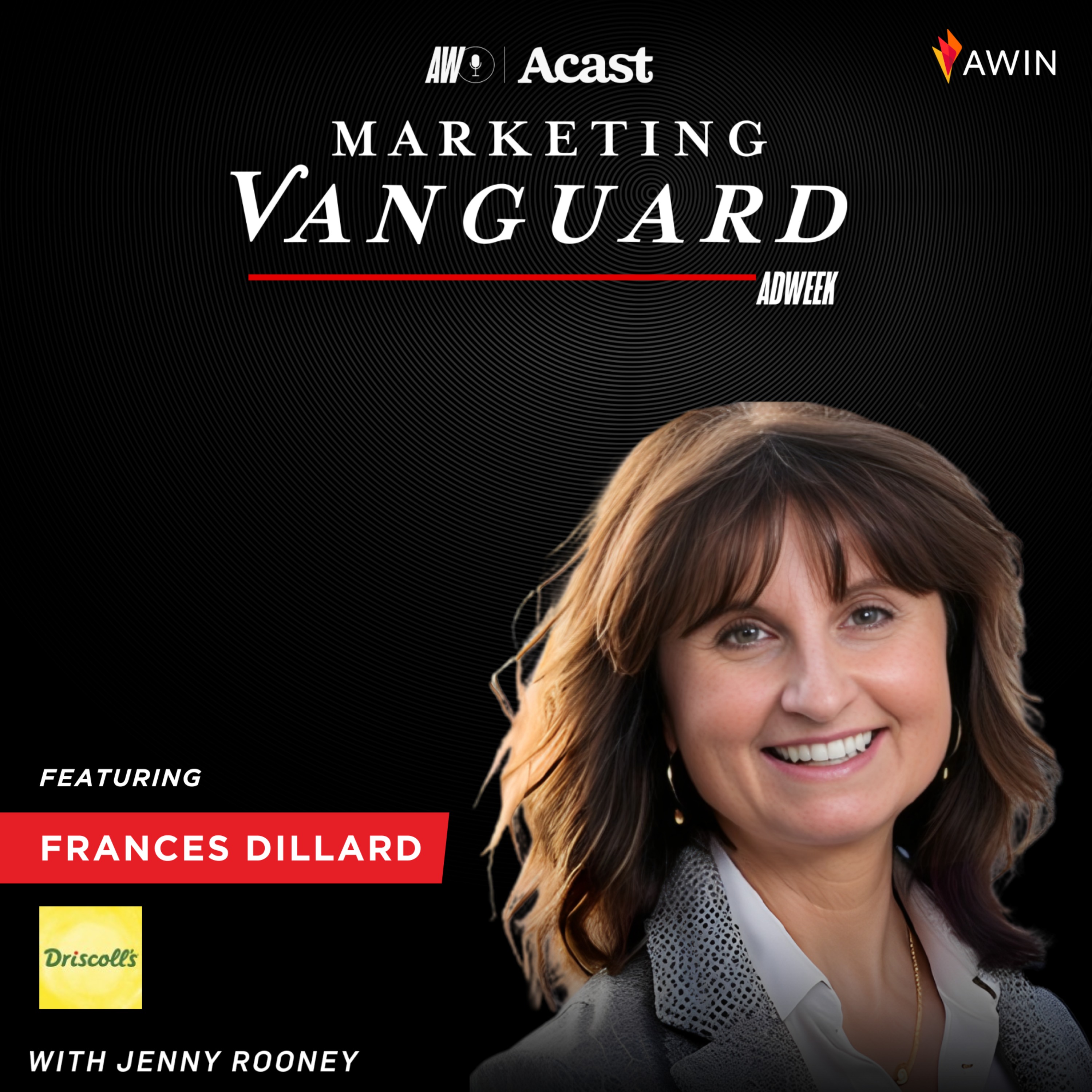
Marketing Vanguard
Flavor Fanatics: Marketing Fresh Produce with Frances Dillard, VP of Marketing at Driscoll's
00:25:26
Loading summary
Transcript38 lines
- [00:00]
Jenny Rooney
Did you know Influencer marketing drives twice as many sales as display advertising with a 37% higher retention rate. AWIN helps brands unlock the full potential of the creator economy with their influencer management solutions. Utilize their robust discovery capabilities and creator management tools to build your perfect creator roster and track full funnel performance. Visit AWIN Link Adweek today and start building high performing partnerships. That's AWIN Link Adweek.
- [00:34]
Frances Dillard
The whole mission of the organization being flavor fanatics where if you come visit us, we're almost like wine company or coffee company in the sense of sensory wheels, agronomists, the amount of flavor testings that we do to get to the right berries.
- [00:53]
Jenny Rooney
Hi everyone and welcome to the Marketing Vanguard Podcast. I'm Jenny Rooney with Adweek and I'm thrilled today to be joined by Frances Dillard. She is the VP of Marketing at Driscolls. Frances, welcome.
- [01:05]
Frances Dillard
Thank you very much. This is exciting to be sharing the story of fresh berries.
- [01:10]
Jenny Rooney
Well, I'm excited too. This is our first time meeting and this is really an opportunity for me, along with the listenership, to learn more about Driscolls because I certainly know it as a consumer, but I haven't spent time with you or the brand in terms of your marketing leadership and marketing strategy and really what the company is. So would love for you to kick it off. And by the way, that's why I love, frankly, I love what I do. But I love the Marketing Vanguard podcast in particular because it's really our opportunity as adweek to get to know new marketing leaders. I mean, every day we're meeting new people who have this mantle in the industry. You're the head of marketing there and it's really a unique role, as we know in all companies. But we want to dive into how it's a unique role at Driscolls. So we'd love for you to just say a few words about who you are. A little bit about your background too, Frances. That would be great.
- [01:57]
Frances Dillard
Of course, a little bit about my background. If there was a theme or a thread to everything that connects my career path, I would say it is focused on beloved brands. So as marketers, our opportunity is to connect with the consumer and make a positive impact. I mean, that is the value of the brand. So being able to know that you have fulfillment and purpose, that the work that you're doing is meaningful to other people's lives. I would say the other thread that is common to all the roles that I've had previously includes the fact that women wind up being the purchase drivers in many cases I played a lot of in products or categories or industries where the end user were children, but mom or the female usually being the purchase driver. And then as marketers, I think we all love to work in industries or categories that are disruptive. So I've been very fortunate, I think to join companies at times where they were at an inflection point or something was dynamic that was happening in the category. And as a marketer, I think our mantra, probably our common DNA is we love organized chaos. So the ability for us to dive in and add value, but keeping ourselves fresh and engaged and exciting. So specifically for companies that I've been with post my MBA at Penn State, I had the opportunity to work for Mattel. And it's nice that my first brand at Mattel, it's nice to see come full circle was the Barbie brand. Oh my goodness, yes, it was quite an amazing time. So as a marketer to be able to walk into a category where at the time we had a 90% market share, we had gone through the process of adding more than just pink I think in the brand architecture side. So it's been an interesting journey to see it come full force and see another generation enjoy the brand. And I took my team to to go see the Barbie movie and it really spoke to a lot of the things that were true that we knew about the company and resonated quite well. So I think from the Mattel side I was fortunate enough to move to the West Coast. So the connection in my next role was moving to the learning company which at the time was in the process of being transitioned to core technologies. The learning companies. Most people know the learning company from educational software. They grew up on Carmen San Diego, the Oregon Trail. And it was at a point of inflection where technology is also the center. So I would say actually that's probably another common theme in my career that the concept of story data and technology I love being on the cutting edge of how do you deliver content, how do you reach people? And at the Learning Company at that time it was about franchises and how do we break the paradigm shift of where a CD ROM company, but more of a franchise of products that consumers love. After that I had an opportunity to leapfrog. I did a little bit of a startup gaming. So one of my dark secrets is I'm a secret gamer. The company at the time was play first and it was gaming for women. So again just common themes of technology and women purchase power and that your end product moves people in a sense so very Fulfilling, I think.
- [05:10]
Jenny Rooney
I think that's great. So you started out and by the way, you answered my next question, which is what is something that not many people would know about you just by looking at your LinkedIn profile?
- [05:18]
Frances Dillard
So yes, the gaming. I want to tell you my secret devices right now, but Cookie Jam knows me quite well and that was an interesting time period as well when I was at playfirst in terms of disruption and what was happening in the marketplace and us identifying a business model that would meet the marketplace needs, it really was about casual gamers and gaming was typically for men. So how do we disrupt the industry? Go in, find a niche, find a business opportunity that spoke to women with games that were less violent and more casual. At the time it was about the Facebook games of FarmVille. And so how did our brand, our portfolio, play a role into that?
- [05:58]
Jenny Rooney
Very interesting. Well, fast forward to now. Your Driscolls, right? And for anybody listening who can't see what I'm seeing, I think you have a strawberry necklace, which is fantastic. But that should be the clue for anybody who's listening that in fact Driscoll's is a berry company.
- [06:14]
Frances Dillard
Hopefully we're in everybody's fridge. We are a hundred year old company. Our only focus is fresh berries. So strawberries, blueberries, raspberries, blackberries. We've been around, we're private, we're family owned, we're generational. And I joined the company 14 years ago and I never imagined that I would be in an industry that defines itself as agriculture. So I remember my interview at Driscoll's where I was a consumer of Driscolls, but I didn't know the dynamics behind produce and the category. And my first interview was with the scientists and the research development team and I was blown away that it was not a commodity, that there's actually science behind our berries. So really what most folks don't know is that all our seedlings and all our berries are proprietary IP to just Driscolls. So we have a research and development organization that focuses solely on flavor. Then we take those proprietary seedlings and then we make baby plants out of them. And then we work with independent growers around the world. They grow the berries and then they bring them back to us for sales and marketing. So when I had interviewed with Driscolls at the time, again, I was just so blown away because not a lot of people know where their food comes from and the science behind it. And the perception could be, oh, it's just a commodity and you're Farming. But the reality is the complexity of the science behind the berries and the flavor. Our mission. And so it wasn't a marketing forward organization, but the mission of Driscolls is to continually delight our consumers through the alignment of our customers and our growers. And as a marketer, it was a perfect setup because flavor is the number one purchase driver for consumers. And so the whole mission of the organization being flavor fanatics, where if you come visit us, we're almost like wine company or coffee company in the sense of sensory wheels, agronomists, the amount of flavor testings that we do to get to the right berries. So there is an entire obsession that we're all focused on trying to select the right berries and understand the consumer marketplace. And that's what it was, our magic sauce. I mean, as marketers, we want to work on a category or a product where there is a true IP and that you can say, hey, the proof point is there. And for me, I was completely blown away after the interview that I felt I knew strawberries had a personal and emotional connection to me. I was relatively new to raspberries and blackberries, but certainly strawberries. We all have childhood memories of what it meant and moments. And I thought this was so untapped. Again, being at the intersection of disruption. We talk about branded produce, but I would say there aren't that many. When you think about when you walk into the produce aisle in your local grocery store, some have seemed to want.
- [09:20]
Jenny Rooney
To jump on the brand bandwagon, if you will. But I feel like, to your point, yours has been historically one of sort of the cornerstone brands that you see, and people actually opt for that brand. You might see two barriers side by side, but you're going to go for the Driscolls. Cause there's some inherent equity there that I think, to your point, they grew up with them. There's a trust thing. It creates sort of a unique kind of challenge for you because you want to make sure you're always delivering on the brand promise, even as new entrants come into market. I want to ask you, though, about this concept of there's so many things. I'm talking about forces and challenges, and we're living in a world where people care about what they're putting in their bodies more than ever. The organic piece is huge for some people. It's debated for others. Right. And I can't help but my mind goes to pricing. And right now we're dealing with an egg shortage. So food is one of those things that. And fresh Food. There are so many forces at play that I would argue are not at play for Oreos. Talk a little bit about how would you line up the priorities or the forces that you have to, as a marketer, think about constantly and then how are you thinking about optimizing against those?
- [10:25]
Frances Dillard
One of the largest challenges that we have, and it's interesting you brought up, like Oreos. What I didn't realize the biggest challenge was going to be that we're not widgets and the amount of variance that we have in forecasting, that we are actually working with a live product and there are factors that we cannot control from Mother Nature. Climate change, rain. You could see weather and conditions around the world, whether it's fires and more.
- [10:53]
Jenny Rooney
By the way, were the farms affected in the California fires.
- [10:56]
Frances Dillard
They weren't effective, but the LA area is a very important marketplace for us. So we did work with World Central Kitchen. We have a strong commitment to local communities and we did mobilize to try to contribute where we could. And so personally, for me, having worked at Disney, having lived in the Pasadena area as well, there was a strong connection for me of people that were impacted. So I think this is where people rally and help and at times, this is where the power of the brand is. It's not about selling, but living your mission of helping communities and delivering on that side. I think if you talk about climate change forecasting as a marketer here at Driscolls, you have to be agile and pivotal to understand where to move your marketing funds, where brand awareness works, where performance works, and understand from a customer perspective where the allocation is going. So it is a constant checking in with the sales team, product leadership teams, and then you try to pivot to make sure that the funding is going. Our motto here is follow the berries. So we try to do our best to put our dollars and our resources where berries will be available. If you're not finding us in the grocery stores, it's probably because we have not been able to meet the demand in the marketplace. So one of our biggest challenges, flattening out the production curve, making berries available year round, and then knowing that it's even so that we can market against the product that's available in the marketplace.
- [12:28]
Jenny Rooney
You recently won an award that I know that you feel very proud of. Tell us what that is and talk about why it was so meaningful to you.
- [12:37]
Frances Dillard
Last year we won the Fast Company Award for innovation, which I think is highly connected to the recent announcement of the ranking from Circana. And so we've been a Little bit stealth and humility is one of our value. But we didn't release the rankings that we are actually the number two food brand in retail and that is against some large iconic brands. And I think we're the only fresh produce company in the top 25. I think 2025 and our growth rate was incredible. So not only did we move from number seven to number two, but we were considered one of the top 40 fastest growing companies and brands as well.
- [13:18]
Jenny Rooney
So that's amazing. Congratulations. It's interesting because influencer marketing isn't just about reach, it's about results. The right creator partnerships can transform your brand and AWIN makes it easy. As a global affiliate marketing platform, AWIN offers fully managed influencer solutions tailored to your unique needs. Their end to end campaign management takes the guesswork out of influencer marketing, helping you identify the right creators, build lasting relationships and measure performance across the entire funnel. Utilize AWIN's powerful discovery tools and platform integrations to build your ideal creator roster and track influencer activity from brand awareness to conversions. With data driven insights at your fingertips, you can make smarter decisions that drive real impact. Ready to elevate your influencer marketing strategy? Visit AWIN Link Adweek today and start building partnerships that deliver measurable results. That's a W I N dot Link Adweek what I'm hearing from you is it's not about just being the best berry brand, it's about being one of the best food brands. And not only that, it's just about being one of the most iconic brands. Right? I'm talking to more and more marketers these days where their aspirations or their ambitions go beyond the product, they go beyond the category. They go to just being sort of one of the world's most appreciated or respected brands. I'm not saying that's new, but I'm seeing kind of a unique uptick, if you will, in focus around that from your vantage point. How do you think about that? Like where does that ambition come from? Right, that your brand transcends your category. Why is that as a marketer important to you?
- [15:08]
Frances Dillard
Excellent question. As marketers we sometimes focus on the debate between brand and performance. I think the other struggle that we sometimes talk about is the benefit ladder. So I always say functional, emotional and then the one of societal. What is a purposeful brand and a purposeful career and where does that societal sit in the brand purpose? And Driscolls is the company that I've stayed at the longest 14 year career with. Driscolls is amazing and I think when you feel part of a higher purpose. And when you feel that you are impacting more than I guess just the product, I do feel like we're part of the food system, we have an obligation to food. And so I think that drives us as marketers that we want to contribute to that societal purpose. And Driscoll's culture is very unique as a private company. There's also some unique dynamics as a marketer that I had not experienced at other companies. And so when you're private and the company is committed to the next generation, it allows you to take a breath. As marketers, we're always on the go. What's the next thing? We love meeting short term goals and those little things that drive us. But when I started at Driscoll's first, we were berry competitors, produce competitors, and now over 14 years, the business has doubled every five years. And it feels just very satisfying to know that we are a formidable food company. And that for me is a testimony to the organization and the clarity of the mission and the commitment of the family in order to drive that longer term impact. I love that.
- [16:49]
Jenny Rooney
And you mentioned earlier you're kind of a quiet company. You're not very boastful. I'm thrilled you're on the podcast though, because I think my mind goes to the talent piece. Right. And you want to continually attract really great talent to come into your organization and particularly work on the brand and in the marketing team. If you're not out there publicizing, there might not be folks who know that you all create a great opportunity for doing some incredible marketing. Are you thinking about that? How are you thinking about the talent equation? Especially as times change, we new skills in house, we need to meet the demands of everything from brand collaborations to AI. Like how are you sort of tackling that, that talent equation?
- [17:29]
Frances Dillard
Excellent question. And the talent for us, it's almost authentically born into the Gen Z. That level that we have been able to recruit right now organically reflect the needs and the purchase drivers of that consumer segment. They truly want to know where their food comes from and they truly want to know what they put in their body and who is growing their food. So I have been so impressed and inspired by the younger generation on my team that they come in and they ask more questions and in some way they equally hold us accountable as an organization. Some of the things that you pointed out in terms of where do we stand in terms of water conservation, where do we stand in terms of one of the biggest challenges that we're tackling right now, is plastic. I mean berries come in plastic clamshell. So all those things authentically are what Gen Z wants to see. And it's been incredible for us to actually recruit them because they want to make a change. This next generation of marketers want to make a change and leave their thumbprint on something. So it's been actually easier to recruit.
- [18:39]
Jenny Rooney
I love that I referenced brand collabs A minute ago you were at Barbie. This kind of concept of brand collaborations, brands as entertainment. I'm not going to say branded entertainment. I mean Barbie being obviously the most visible manifestation of that in recent years. How are you thinking about getting into culture and collaborating with celebrities, a listers creators? What are you doing in that realm? And is that something that holds appeal?
- [19:05]
Frances Dillard
It has to hold appeal in the most authentic way for the brand because there can be certain celebrities I think that would represent the brand well. But that may not be the most authentic way in the way that we would talk about the brand. When I first joined Driscolls, the number one focus was to really establish a global brand positioning, understand what the drivers were for the category and find the diamond and shine it. We had done a piece of work called Meet State Mapping to understand where the biggest opportunity was for the brand and how we would rally against it. And there was this bubble of joy and need and sharing versus it being about health control. I think it may not be about brands specifically, but some of the things that you're seeing to be living in the zeitgeist right now is like strawberries palate to palette. You're seeing it expressed in fashion and beauty and the celebration of berries of themselves, especially in this younger generation. What berries mean to them, what is the role that they play to them and them playing that back and not necessarily having to need a celebrity to speak on behalf of your brand because it's organically demonstrated through the lifestyles that consumers choose and what's happening in the marketplace. So I don't have my blueberry milk manicure today and I chose not to wear my strawberry sweater. But I think anybody can take a look at what's happening in the beauty and the fashion world right now. And if you don't have one of those items in your home and your lifestyle right now, you're not in.
- [20:42]
Jenny Rooney
Well, my 16 year old daughter most definitely does.
- [20:45]
Frances Dillard
So there you go.
- [20:47]
Jenny Rooney
And not to mention listen, berries are such an ingredient, literal ingredient brand like and all the smoothies and sort of the healthy lifestyle, I mean they always have been a cornerstone of that. But frankly the Cooking creators, recipes that people are doing. You're always front and center in all of that kind of content as you move forward. We didn't see you in the Super Bowl.
- [21:05]
Frances Dillard
Right.
- [21:05]
Jenny Rooney
We're just off the Super Bowl. Any grand plans for big media buys that you may, you know, in uncharted territory that you might consider.
- [21:13]
Frances Dillard
I can't remember which one of your recent episodes had all the super bowl players. It's probably not the most authentic play, I would say, for Driscolls. And our humble play, I would say, as far as where we're focusing on our media spend or strategy or campaign work, going back a little bit to that benefit ladder only the finest berries being our functional promise and fresh, beautiful, delicious berries being the bread and butter. We do have a campaign called Sweetness we're sharing that demonstrates the togetherness of what our berries do, bringing people together. But our newest campaign that we've just launched is called One Family, One Earth, and that is focused on the needs of Gen Z, wanting to know who grows their berries and what is our social responsibility to the communities that grow our berries and shedding a little bit more light on water conservation, our grower story. And so those are our most authentic stories that move people, I would say, and resonate to the authenticity of the family as well. So we have to balance what do the consumer needs are and then authentically, what are the needs that make sense for our organization internally. The family has to be able to see themselves in it and it has to represent that.
- [22:32]
Jenny Rooney
Last two quick questions. One is I'm going to ask you the soccer question because you said you want to answer this. So and this is really to get your leadership style right, like who you are as a leader, not just in marketing, but within your organization in general. Using players on a soccer field as a metaphor, where do you see yourself? Are you in the purely offensive position trying to beat your competitors at every turn? Are you in the midfield line trying to sort of be the connective tissue between your offensive players and your defensive players? Or are you on the defensive line really trying to sort of ward off attack from competitive onslaught at every turn? Obviously, folks also like to say that they might be the coach on the sidelines. So when it comes to your team, and frankly, when it comes to you collaborating with your other peers, how would you position yourself?
- [23:21]
Frances Dillard
Sure, I would say the role of the connective tissue. And again, given some of the business dynamics of how Driscolls has been able to grow and where do we feel the competition is and in some way we almost don't get hung up with competition. We feel like we are focused on our own mission of being able to deliver the best tasting berries possible. So the connective tissue that I play is not necessarily just on my team, but I think marketing's responsibility and role within the organization is to bring the consumer voice back into the organization and make sure it's embedded cross functionally. And so as we think about what makes marketer successful, I think you've talked a little bit about the role of like, is the CMO dead? Not dead. What are the changing titles? I think if you put titles aside, our responsibility is to make sure the internal operations understand the marketplace needs the macro trends. We find the diamonds and we are responsible to be that connective tissue to bring it inside the organization. And then my responsibility I think for my team is to make sure they are the brand advocates throughout the organization. So we find the diamonds, we find the insights that could move the business forward, we bring them in, we shine them as a team, but we have to deploy it inside the rest of the organization which is very production focused, farming focused. So we do spend a lot of time in making sure the consumer is still at the table. And that's I think what the responsibility is. Not just on my leadership, but I would say on the responsibility of our.
- [25:01]
Jenny Rooney
Team of that last question, who's next?
- [25:04]
Frances Dillard
Yeah, I think in the spirit of being disruptors and in the spirit of finding white space and taking on challenges, I love it when marketers are able to move into CEO roles. So I would like to hear a little bit more from Peter McGinnis.
- [25:20]
Jenny Rooney
Oh yeah, I haven't had him and I love Peter.
- [25:23]
Frances Dillard
Good. I just find him fascinating in the sense of when he took over Impossible Foods and you could see the marketer ooze out of him because he was raw and honest. I think in interviews of how the go to market strategy needed to change and he understood the marketplace needs and so he has the CEO hat, but he's just, he's a hardcore marketer and I love when a business is driven through the needs of a consumer and I love to see what he's going to do with plant based needs. And that's a whole disruptive space that we're watching and the implications. So we'd love to hear more from him.
- [26:01]
Jenny Rooney
Well, I have a part two. We'll have you both on in the meantime, Francis, thank you so much. This has been an education really and should be required listening for anybody who's exploring frankly maybe some categories in, in this marketing world that they may not have spent much time getting to understand. So fresh food. Not only fresh food, but specifically berries. I mean, it's such a unique category onto its own. Thanks for telling your story with us. I appreciate it.
- [26:25]
Frances Dillard
And thank you for all that you do for marketers and for brands. I really enjoyed being on the podcast. Thank you.
- [26:31]
Jenny Rooney
Thanks so much, Frances. Take care.
- [26:33]
Frances Dillard
Thank you for listening to Marketing Vanguard, part of the Ad Week Podcast Network and Acast Creator Network. You can listen and subscribe to all of Adweek's podcasts by visiting Adweek.com podcasts. Stay updated on all things Adweek Podcast Network by following us on Twitter @AdWeekpodcast. And if you have a question or suggestion for the show, send us an email@podcastdweek.com thanks for listening.