Loading summary
Transcript44 lines
- [00:00]
Experian Adweek Announcer
Finding the right audience shouldn't feel like doom scrolling with Experian. It doesn't. Experian syndicated audiences help you reach holiday shoppers, car buyers and more across over 200 top platforms. With over 2,400 pre built audiences, there's no more doom scrolling. It's audience targeting you can trust. Made simple. Learn more@experian.com Adweek that's exp er I.
- [00:27]
Sumit Permani
Ian.Com Adweek it doesn't matter whether you are a B2B marketer or a B2C marketer. At the end of the day, marketing's job is to create an emotional bridge between an organization and its consumer. And that's as important in B2B as it is in B2C.
- [00:48]
Jenny Rooney
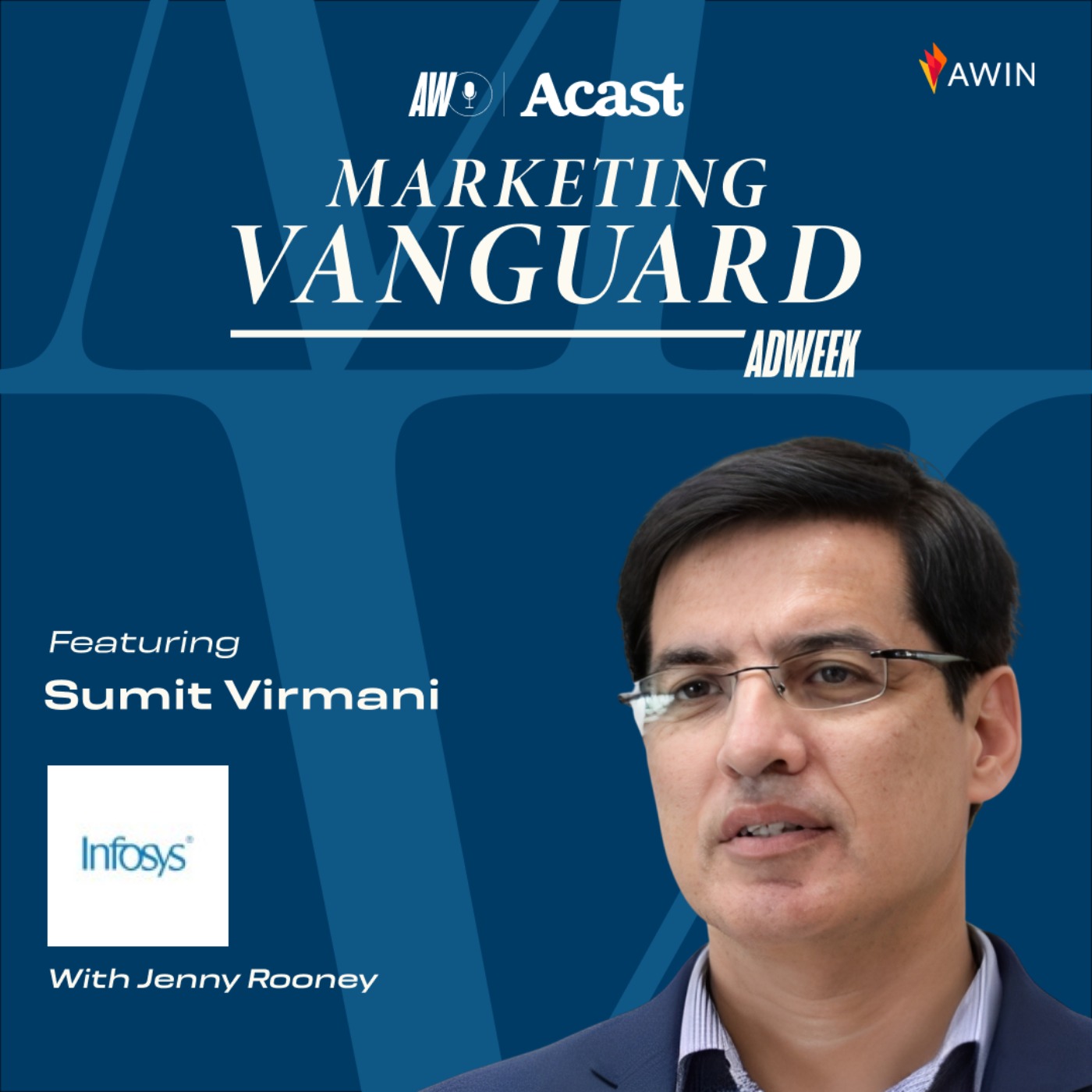
Hi everyone and welcome to the Marketing Vanguard Podcast. I'm Jenny Rooney with Adweek and I'm thrilled today to be joined by Sumit Fi Girmani. He's the CMO of Infosys. Sumit, welcome.
- [00:59]
Sumit Permani
Thank you Jenny. Great to be here.
- [01:01]
Jenny Rooney
It's great to have you. We're really going to dive into who you are as a marketing leader and I think we also want to learn more about Infosys in this conversation and really sort of the place that you all sit in business. And there's so much to unpack around what it means to be a B2B brand these days, how you guide the brand strategy and marketing leadership for that. But before we get into that, I'd love for you to introduce yourself and tell everybody a little bit about your own personal career background. What led you to this current role?
- [01:33]
Sumit Permani
My name is Sumit Permani. I'm the Chief Marketing Officer at Infosys as you introduced already. I have been in the space of marketing for close to three decades. Two of those three decades have been with Infosys. I love to call myself an accidental marketeer because growing up I never thought marketing would be a career path that I will actually embark on. And a happy accident actually led me into this journey. And here I am three decades later, quite enjoying the path that was chosen for me and well, it continues.
- [02:09]
Jenny Rooney
Okay, well, you're going to have to tell us about that happy accident and I'd also love to know what you studied.
- [02:14]
Sumit Permani
Well, I guess there's only one answer to the two questions that you raised and that really is the happy accident. Because I did my undergrad in finance with a clear pathway aspiration laid out to make a career in finance, I joined a management course with the intent to specialize in finance. At that point of time the first year used to be the common year where you restudied the foundation. I guess nowadays it's all changed a little bit. In some programs it's six months common and then you specialize in some of the others. Possibly it's different, but in our day that used to be one year of common foundational understanding of business and the second year used to be the specialization year. I of course went through my common year with the full intent of getting through into my finance pathway for which I trade for several years in the past. And I was quite excited about. I've always been the numbers guy. I used to enjoy that journey. But here I was being taught brand management by an incredible marketing professor who possibly introduced the idea of marketing and brand building in such amazing ways that I realized that, well, there's more to business than numbers. It's the whole idea of making these emotional connections between organizations. It's the whole idea of understanding the science of building brand. I was so excited and enamored by that course, that brand. By the time it was point to make a decision on finance or marketing, I did take that leap and choose to specialize year two in marketing. And three decades later I'm sitting right in front of you pretending to be an expert in a space that I did study foundationally for.
- [04:04]
Jenny Rooney
I love that you said that business is about more than numbers and it's interesting to hear you say that. Obviously, you know, in CMO dialogues there's just so much swirl around the conversation around art and science and especially now where everything can be measured. And the Talk is that CFOs they have a hard time understanding or appreciating marketing as a practice within our organization if it's not measurable. And so this push for marketers who may have, unlike you, but came from the true marketing foundational education or more the creative way, you know, the sort of latched onto or wanted to pursue the creative aspects, the art of marketing. Now they're shifting to a finance focus, to a numbers focus, to a data focus. Right. And it's interesting that you have that finance foundation which arguably sets you up to be just extraordinarily successful because there's always on the other side so many CMOs who are trying to now gain that knowledge. When you think about that, how much of the dialogue around marketing do you think we're still getting wrong?
- [05:08]
Sumit Permani
Ginny, first of all, I think you made a great point and I think I've often taken a moment to reflect on that. How much is the foundation in finance actually helped me navigate this career in marketing. And I would like to believe that it had a tremendously critical role to play because I share a fantastic relationship with my cfo, with my CEO, and with the board. And I would like to believe that one of the reasons that we have been able to do that is because from early on, the way we think about marketing is from a perspective of what business cares. And business in the C suite, in the boardroom only cares about growth and profitability. And marketing or any other function that exists in the organization should not lose sight of that because that's all that matters. When you're a public company, you're responding to shareholders quarter on quarter. You have to not lose sight of what matters to the C suite. Having said that, as a marketer you actually have to wear two hats. You have to wear hat of the short term business objectives that businesses chasing and the long term business aspirations that the C suite and the board is chasing. Because when you're playing the role of a marketeer, you're actually playing a role to accelerate growth in the short term and actually lay the foundation of growth and market share gains in the long term. And you can't do that without having the right balance in what I call brand marketing versus performance marketing. The debate that is possibly timeless with marketeers and by virtue of the role that I play, by virtue of the global brand that we are and the marketing organizations I get to sit with as build with other marketers. You're right. The conversations for several years now have been around the balance of art versus science, the balance of brand versus performance. And I think most successful marketers, and I'm sure you've come across many of those yourself, have at some point or another found the right balance between the two. Because the sense of one or the other is a sure shot recipe for marketing and business disaster.
- [07:28]
Jenny Rooney
Couldn't agree more. And figuring out how you as an individual gather and sort of hone to your point. Trying to get to that balance requires a level of knowledge or skill or education because you can't just come at it. I mean you do have to have some foundational learning. And I'm sure, listen, I mean there's tons of executive education programs and ways for marketers to continue to level up. But unlike probably any other role in the C suite, it is a duality of responsibility which is totally neat.
- [08:00]
Sumit Permani
Absolutely. And you're right, the foundational understanding of just marketing it as discipline may not be adequate to be able to navigate the business demands of what the function needs to Translate into. I mean, in the absence of that, there's a risk that marketing will end up becoming a glorified promotion function, a glorified events function, or a glorified communication function. And for marketing to truly become a strategic function, that balance has to be addressed. But having said that, I would say there's another important skill that has become quite integral to every successful marketeer over the last few years and that is a skill on tech. And once again, I'm quite blessed to actually be marketing. For an organization where you are a technology company, the tech comes quite naturally because technology has actually brought that foundational difference that existed in marketing possibly two or three or four decades ago, where attribution was a huge challenge and attribution is a challenge. Showing correlation between investment and outcomes, between marketing plays and business impact becomes very difficult. But I think in the last two decades and more so in the last decade, the evolution of very strong attribution models, very strong tech platforms, emergence of digital as a channel, has all ensured that there is very little which is gray and not attributable. If you really have made the effort to invest in the right platform, the right technology, and you have an attribution engine feeding your short term and long term goals, I think there is absolutely no reason why marketing cannot play alongside any other function at the C suite in terms of driving business impact.
- [09:53]
Jenny Rooney
Such a call to any marketer listening to this. I mean, there really isn't an excuse. I mean there's very little that needs to be gray to your point. And I just want to emphasize that I do want to ask you about Infosys because It is a B2B marketer. At the end of the day, it's a tech company. We'll get into that piece of IT in a minute. But tell us about Infosys. Tell us about its history, where it operates. I know it's a global tech company. Tell us a little bit about that. Where does it sit? What particular market is IT serving?
- [10:20]
Sumit Permani
So, Jenny, Infosys is close to 44 years old. It was founded in 1981 by a group of seven founders that started with a dream and a seed capital of $250. So that itself is an ambition that was laid out of sheer boldness of being. And today we are a little over $19 billion in revenues present across 50 countries, over 300,000 people as employees and serve markets and industries with IT services. We are one of the largest IT services companies in the world and we also happen to be the fastest growing IT services brand in the world. Wow.
- [11:01]
Jenny Rooney
You said this is your second stint at Infosys, is that correct?
- [11:05]
Sumit Permani
It's my third job in life and over two decades of that has been spent at Infosys.
- [11:12]
Jenny Rooney
Got it. Okay, so already you're upending the 10 year stats that show that CMOs only last, you know, about two to four years in any given company.
- [11:21]
Sumit Permani
Of course I haven't been CMO all this while, but yeah, I have been CMO well beyond that stat already for sure. But I think it's a fantastic platform that really presents the right foundation of pole ambition deep rooted in a sense of purpose and values, which I believe is quite unique and possibly one of the reasons why the organization has been so successful over the last four decades.
- [11:47]
Jenny Rooney
So where do you find that your biggest challenge coming from? Either from a brand challenge standpoint or a business standpoint. And obviously those are one and the same. But you know, if you have been around for as long as you have, you had so much success, where do you take it from here?
- [12:01]
Sumit Permani
When you look at the world of technology and the world of technology is a world that is incredibly dynamic. And unlike most other industries, the success of failure of tech companies depend on how well they're navigating every turn of technology. And one of the, I mean if you just look at the multiple cycles we have seen over the last two decades, I mean at least this industry itself, it's evolved from an era of pure play outsourcing, to an era of digital driven innovation, to an era of cloud driving the next gen disruption, and finally to an era of AI. So clearly there's been multiple significant turns of tech that we have seen over the last two or three decades. And the only companies who've actually successfully navigated every turn are the ones who continue to be successful and continue to gain market share. We happen to be one of those and we're quite delighted that we've been able to successfully navigate these transitions. But I would like to believe that one of the reasons why we've been able to do that is because the foundational principles that we were created on the whole aspiration of Insecure Startup, that feeling has been deeply rooted across a large organization. I mean, we don't take our success casually. We would like to believe that we have a great responsibility as a company that is actually running a technology backbone of some of the largest organizations around the world. We have a deep responsibility of ensuring that we are able to very successfully transition our clients as new tech disrupts their business. So that's the business we are In, I mean, whether you are a financial services company or a retailer or a manufacturing player or a bank, you need tech transitions to reimagine your customer experience. You need tech transitions to successfully run your ops. And that's what they rely on us for. And we ought to make sure we stay on the cutting edge of it to stay relevant for our clients.
- [14:16]
Jenny Rooney
So really, in that regard, you're a consultant. You're like, basically taking on the heavy lifting of making sure, and I use that term loosely, but like, you're making sure that you remain expert in where the puck is going. You have to basically go back to your clients and say, here is how tech is transforming. This is where you need to adopt. This is where you need to be as an organization. Because those companies, probably they're in the main, you know, they're spending day in, day out actually doing the business right. They're running their operations. But to have somebody who's a trusted partner who's basically saying, you know, watching those shifts and making sure that what you're delivering back to your clients is of the moment, and not just of the moment, but future forward from a tech capability standpoint, I mean, that is the value that you're bringing, but that's a lot of responsibility on you. And trust is a huge factor in that equation because if you get it wrong, you lose all their trust because they're putting a lot of trust in you.
- [15:10]
Sumit Permani
Well, Bharat, I'll give you one data point and one metaphor to actually respond to your question. 95% of our business is repeat business. So that essentially means that when we work with clients, we work with clients for decades on end. And that's only possible, like you rightly said, because there's deep institutionalized trust and institutional knowledge. And therefore the responsibility is immense on us to make sure that we stay deeply connected to the client's business while bringing them the best of tech that we have expertise in. Now, in terms of the role that we play, I mean, I like to say we are the navigators. I mean, if you're actually in the business of crossing oceans on this incredibly wonderful ship, you need a navigator by the side of the captain to make this journey as smooth and as successful as possible. And that's the role we see ourselves playing. And that's how it's even manifested in our promise. I mean, Infosys promise is all about navigating your next. Everybody's next might be unique. It'll be. It'd be different for a financial services firm vis a vis a Consumer products firm. But when it comes to adapting our tech to your specific requirements, that's the expertise we bring and that's the role of the navigator we aspire to play with every client that we partner with.
- [16:30]
Jenny Rooney
I love that. And, you know, it's interesting because I do talk to a lot of B2C company CMOs, and obviously this concept of being the voice of the customer, being the voice of the consumer is something you hear over and over again. But you essentially answered the question. I mean, yes, absolutely, you have to be the voice of the customer. You have to bring that customer knowledge back into your organization and make sure that everything you're selling or putting back out to your client base absolutely solves for their pain points. So how do you personally, like, where do you spend your time in that mandate? I mean, are you constantly spending time with your clients? You know, as cmo, where are you spending a lot of that time specific to that responsibility?
- [17:11]
Sumit Permani
I would like to believe that I have three primary roles. I mean, first is you have to actually invest in building the trust of the business, which is the C suite and the board. You got to understand what they're looking for, what are the constant challenges they are navigating, what are the constant opportunities you got to feed them as a marketeer because you have that, that one foot in the market. So basically the role that you're playing as a strategy partner, that's where I see an important focus for myself. The second is the role that I play in actually creating an incredibly strong team that is able to run with the large bowl aspiration that we've laid out for ourselves. And finally, the role that I actually play in the market in terms of quantity that possibly ends up becoming the larger chunk of the three. Because marketing, after all, is the voice of the market into the organization. And we have structured programs through the year where we have platforms to interact with our clients. And I make it a point that a fair amount of my quarter is spent in the market to get a sense of what our clients are dealing with, what the industry influencers are thinking about so that we can actually bring in all that learning from the market into the boardroom to shape the strategy, be the growth catalyst, and actually protect and promote the reputation of the brand of the organization.
- [18:50]
Jenny Rooney
Did you know influencer marketing drives twice as many sales as display advertising with a 37% higher retention rate? AWIN helps brands unlock the full potential of the creator economy with their influencer management solutions. Utilize their robust discovery capabilities and creator management tools to build your perfect creator roster and track full funnel performance. Visit Awin Link Adweek today and start building high performing partnerships. That's Awin Link Adweek. Sure. And then let the flywheel continue. AI I'm going to ask the question. I mean I'd love for you to answer it from two levels. One is the organizational response or thinking around it. But I also want submit specific personal view of AI. You know, in your career, obviously, especially given where you sit in the type of organization you work for, technology is constant. Do you feel that this is different and if so, why? Or why not?
- [19:50]
Sumit Permani
I think our two responses will converge, but I will take a lead with Sumit's point to Ryu and if you want me to double down on something from an organizational level, I'm happy to do that as well. And I've said this before, if you've read some of the things I talk about often, this is one of those I deeply believe that AI is not an incremental shift for the business. It's a disruptive one. It's not an incremental shift for marketing as a function, it's a disruptive one. I guess possibly once a decade or once in two decades we come across disruptions that fundamentally reshape the foundations of functions. And I would like to believe that AI is one of those. The reason I say that is because typically and again, I'm seeing it both as someone who's grown up in the world of tech and someone who's actually also a deep user of tech in the marketing function. If you were to go back a decade or so, ever since marketing and Martech has become an integral tool for every successful marketer, you normally come across point solutions that solve a specific problem. We've encrm then that came into being small campaign management solutions. We had performance marketing playbooks. So we always had like point solutions that have been making marketing's job easier. In fact, a lot of debate has been around are there far too many tools that marketers should be navigating with? And I know, I know, possibly you and I both have answered that question and explored that debate often. But AI is not a piecemeal tech. AI is a disruptive technology. And if I were to look at marketing as a function, the earlier debate, a year and a half or two years was AI is all about driving efficiency. AI is all about automation. It's going to take away the low value tasks that you can do marketing at 1 3rd, 1 4th, 1 5th, depending on what research you look at that level of productivity. And absolutely AI is definitely a tool that is driving more productivity. But having experimented this over the last two years now I would like to believe that this is one technology that is going to really transform the entire life cycle from efficiency to experience to effectiveness. It'll actually vertically transform every single sub function of marketing because it has the potential to do that. It's intelligence that's contextualized intelligence that is evolving. I mean if you just think, look at the last two years we talked about AI for automation. Then we had generative AI came into being. Now we're talking about agentic AI. And who knows, by the time we are done this podcast there might be a new version of AI that we might be cap with. That's the pace at which this tech is evolving. But what I have been truly excited by is not the automation potential, possibly not even the effectiveness potential. What has been truly excited by is how this tech is making things possible that weren't possible in the age before AI. And I'll give you an example if we have the time for it. If you look at it, it's a marketeer's dream to potentially have millions of consumers co create their campaigns with them, isn't it? Maybe we'd love to have our campaigns become this fanboy craze about our campaigns. People can participate in it, they can actually contribute to it. Well, it's possible. Now we have now done that a couple of times already where we are deeply invested, say in the sport of tennis and Rahul La Dal apple be a brand ambassador. So last year when he was retiring, we actually created a platform to pay tribute to the legend of Rafael Nadal and to celebrate his life. Wow. Little platform. We introduced some pre approved imagery of Rafa and we opened it to the billion fans of the sports around the world. We said, you know what, get into the platform, choose one of your favorite styles and imagery, enter a little promotion which possibly lets you imagine Rafa in your living room or Rafa on top of Mount Style, Fraser up, tennis in the swimming pool, whatever suits your fancy. And we had thousands of thousands of fans actually riding the platform and publishing it on social media, truly joining in the celebration. Now could you imagine something like this even remotely possible before the age of AI came into me? So to me that's the potential and that's how it has to be seen. How does it truly amplify a marketeer's imagination? It's a true tech that has a potential to amplify humanity.
- [24:50]
Jenny Rooney
I'm just gonna like let people sit in that for a Minute because that is such a great way to distill it. And that's so exciting. I don't even have to ask the question, which seems silly at this point, but does it excite you or does it scale scare you in any regard? Sounds like you're all in on the excitement piece of it.
- [25:07]
Sumit Permani
No, no. And having said that, Jerry, I'm glad you still asked the question because it's an important one to navigate. People like us are living and breathing technology day in and day out. And potentially many of my fellow marketeers are looking at this tech from a distance, would like to think about how to really handle the enormity of what's coming their way. There's a question that you raise is very important. The potential of technology is there, but it cuts both ways. If you don't embrace it responsibly, it has a potential to hurt your brand in ways you can't even imagine. And we've seen, we've seen stories around that that have taken place where AI chatbots have gone on to speak things that are not what the brand propagates, but it has happened on the brand handles. And therefore the brand has seen a lot of backlash. And therefore I'm wearing Infosys had, not necessarily. The marketeers had. We've actually. We were one of the first companies in the world to set up what we call the Infosys responsible AI office. And any tech that we embrace at Infosys, including everything that we embrace within marketing, actually has to go through the checks and balances of the responsible AI office before it's approved to be deployed externally. The example that I gave you about the Rapha Forever campaign, that was actually series of checks and balances that were put so that people who want to just take liberties with the brand don't embarrass the brand. So they were ensuring that it is blocking the right set of prompt, it is checking for the imagery, it's validating it for appropriate net before it's publishing on the public platform. So responsible embrace of this tech is crucial and critical. And that is the reason why you can't just randomly go out there, pick up a publicly available large language model, generate imagery and publish it on your brand platform. You cannot do that because you may be infringing on copyright, you may be infringing on multiple other dimensions which may not be in sync with your brand language, your brand standards, et cetera. So work with AI leverage AI for sure, but work in partnership with the right organization that can help you embrace AI responsibly.
- [27:24]
Jenny Rooney
Such a great point. And honestly we could continue on just this topic for another half hour because it's so extraordinary and I would love to connect with you again just to continue on that thread just because it is so dynamic and I absolutely love your perspective on it. You know, last couple few questions. What is on the horizon for Infosys and what are you thinking about? Especially we're heading into fourth quarter of 2025. We've got 26 ahead of us. Obviously there's cultural, global, political issues that go on in the world. Obviously business is impacted, you know, and has an impact. So obviously you're not immune to any of that, as is no company. But how do you think about kind of the biggest priorities for you heading into the remainder of this year and as you look into 26 and what can we expect to see from you new on the horizon?
- [28:11]
Sumit Permani
It in some sense is related to the larger question that I answered for Infosys earlier, but that's the same question our customers are asking themselves. Especially if I look at this global environment that's dynamic, supply chains that are being tested every quarter, consumer sentiment that it's getting impacted by the economic reality. I guess when you work with some of the largest organizations across industries, your focus ends up becoming how can you actually help them navigate disruption. We work with them across both the spectrums. We work with them to use tech to really drive deep efficiencies in their business so that in an environment like this, they can actually leverage technology, drive more productivity, drive more efficiency. At the same time, we are helping them actually embrace the potential of new technologies to serve their customers better, to create experiences to drive targeted growth, to focus on doing their marketing in a more effective way, helping them embrace AI, for example, overall in a way more responsibly. So clearly I think our focus is as businesses navigate this turn of economic turn, are they well equipped to leverage the potential of existing digital technologies and the potential of evolving AI?
- [29:42]
Jenny Rooney
And by the way, your clients are both B2C and B2B companies?
- [29:47]
Sumit Permani
Oh yes, absolutely.
- [29:49]
Jenny Rooney
Across the board.
- [29:50]
Sumit Permani
Yep.
- [29:51]
Jenny Rooney
Last quick question. Who is a CMO that I should have on the show next? Who is somebody that you admire for the work that they're doing? You admire them for the brand work that they're putting out in the world, for their marketing strategy? It could be somebody that you know really well, or it could just be somebody that you admire from afar but would love to get to know them better.
- [30:12]
Sumit Permani
I'll give you two names. We may already have them on the show. But if not, I guess as both are worth evaluating because again, I am biased because I look at it from a perspective of who's leveraging tech while making the impact both in the market and the boardrooms. And I would like to believe that both these individuals are doing that quite remarkably. One is Asmita Dube of l', Oreal, good friend and she's also the Chief Marketing and Digital Officer at l'. Oreal. I think Asmita is doing incredible work in using tech to reimagine products to reimagine experiences and she sits on top of our portfolio of brands. So she'll be able to give you a couple of incredible examples on how the world of consumer is evolving in the world of tech. In fact, she was a guest for one of my marketing all hands meeting earlier in this quarter, but I thought my colleagues can get inspired by the work she is doing so I think that would be an exciting one to go for.
- [31:13]
Jenny Rooney
She's amazing. I haven't had her on the show yet, but absolutely I'm going to reach out to her.
- [31:18]
Sumit Permani
So that's one a second I would say is Raja. Raja Ramana?
- [31:22]
Jenny Rooney
Oh, Russian.
- [31:24]
Sumit Permani
Be someone. I actually shit a deep rooted belief in that. It doesn't matter whether you are a B2B marketeer or a B2C marketeer. At the end of the day, marketing's job is to create an emotional bridge between an organization and its consumer and that's as important in B2B as it is in B2C. And I think Raja has done an incredible job of that through his sensory marketing playbook, through actually beautifully shaping the priceless campaign that he actually inherited. But he's given it a completely new flip. So I think that would be another one that is worthy of talking to again if you haven't talked to him for a bit of for a while.
- [32:05]
Jenny Rooney
So Raja, if you're listening, I'm going to have you on the show again to Mitt Recommends and I absolutely love Raja and he and I have had many conversations but it has been a minute since my last time having him on the show. We reach out to him and have him back but in the meantime submitted this has just been wonderful. It's been a pleasure getting to know you. It's been a pleasure getting to know more about Infosys and how you're thinking about AI, serving your customers and showing up in the world in a way that's truly valuable for your clients. So thank you so much for being on the Marketing Vanguard podcast and I Look forward to talking with you more next time we're in person.
- [32:41]
Sumit Permani
Thank you Jenny. Thanks again for having me and appreciate being part of the wonderful Vanguard community.
- [32:48]
Marketing Vanguard Podcast Outro Announcer
Thank you for listening to Marketing Vanguard, part of the Adweek Podcast Network and Acast Creator Network. You can listen and subscribe to all of Adweek's podcasts by visiting adweek.com podcasts stay updated on all things Adweek Podcast Network by following us on Twitter at Adweek Podcasts and if you have a question or suggestion for the show, send us an email at podcastadweekpod. Thanks for listening.
- [33:15]
Experian Adweek Announcer
Finding the right audience shouldn't feel like doom scrolling with Experian. It doesn't. Experian syndicated audiences help you reach holiday shoppers, car buyers and more across over 200 top platforms with over 2400 pre built audiences. There's no more doom scrolling. It's audience targeting you can trust made simple. Learn more at experian.com adweek. That's exp e R I A N Com Adweek.