← Marketing Vanguard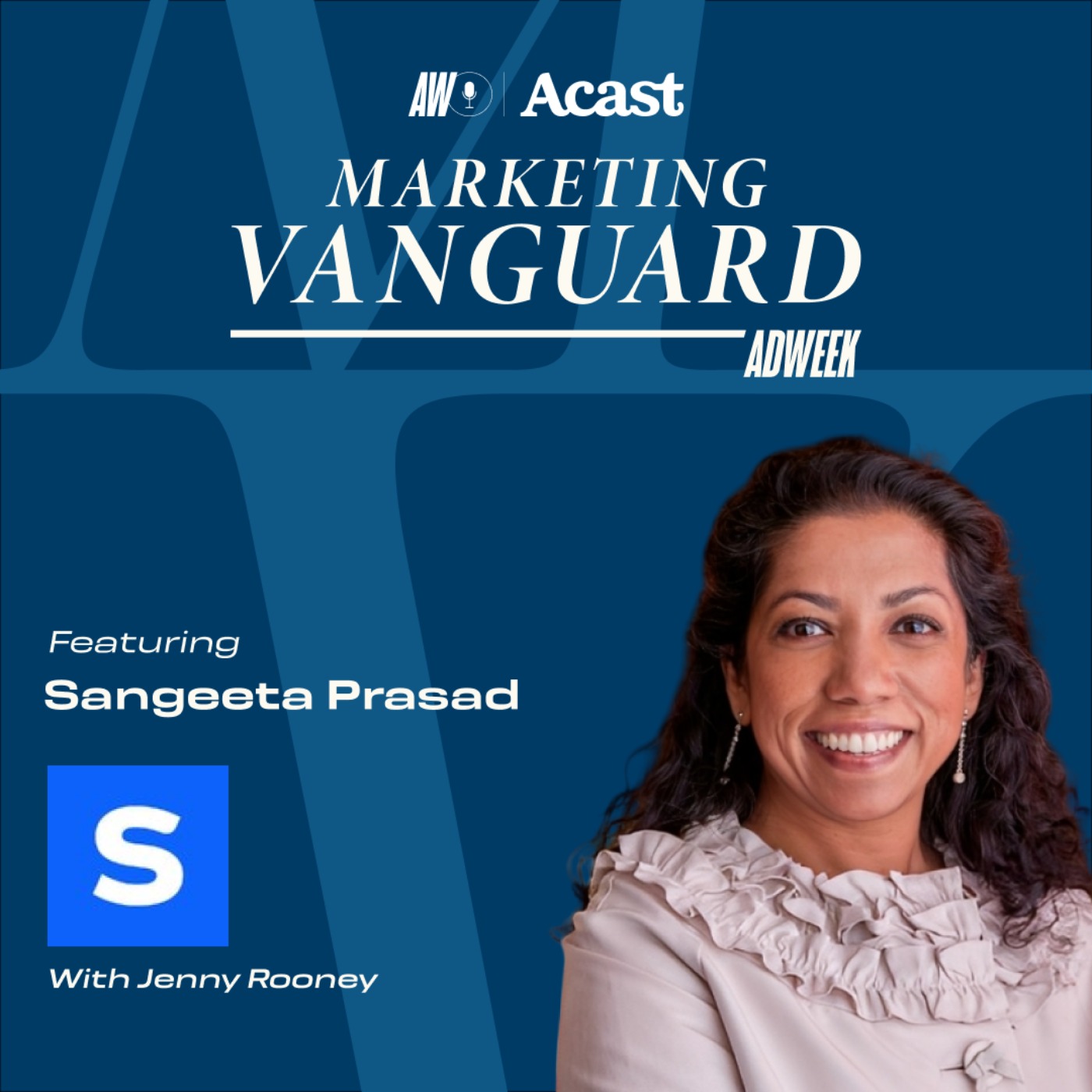
Marketing Vanguard
Marketing Evangelism and B2B Transformation: Insights from Sangeeta Prasad, CMO of Slalom
00:29:17
Loading summary
Transcript61 lines
- [00:00]
Adweek Announcer
Finding the right audience shouldn't feel like doom scrolling with Experian. It doesn't. Experian syndicated audiences help you reach holiday shoppers, car buyers and more across over 200 top platforms. With over 2,400 pre built audiences, there's no more doom scrolling. It's audience targeting you can trust Made simple. Learn more@experian.com Adweek that's exper Ian.com Adweek.
- [00:30]
Sangeeta Prasad
I'm a marketing evangelist rather than just a marketer because I do believe that we have to be evangelists to convert the skeptics in our organizations into believers. And that's something that I take a lot of pride and passion in doing.
- [00:48]
Jenny Rooney
Hi everyone and welcome to the Marketing Vanguard Podcast. I'm Jenny Rooney with adweek on the Marketing Vanguard Podcast. I'm thrilled to be joined by CMOs of all different industries and coming from all different perspectives who can share a little bit about their own journeys and also a little bit about the backstory of the decisions that they make in that leadership role within their organizations as critically important C suite executives helping to drive not just brand but business forward. And today I'm thrilled to be joined by Sangeeta Prasad. She's the CMO of Slalom. Sangeeta, welcome.
- [01:21]
Sangeeta Prasad
Thank you for having me. Jenny, I'm delighted to be here.
- [01:24]
Jenny Rooney
It's great to see you and I'm excited to dive into this because perhaps there might be some people who aren't as familiar with slalom and we'll get to that. But I'd love for you to start by just introducing yourself. I know you have quite an extensive marketing leadership background yourself and so why don't you tell that story and what brought you to slalom?
- [01:42]
Sangeeta Prasad
Thank you. Yeah, I'd be happy to tell that story. I've been a marketer for a long time and what I'd like to say now is I'm a marketing evangelist rather than just a marketer because I do believe that we have to be evangelists to convert the skeptics in our organizations into believers. And that's something that I take a lot of pride and passion in doing. My journey started in classic consumer products, P and g, American Express, JPMorgan Chase. And then I decided to take the leap and do something totally different. And I went to a professional services privately held company, Russell Reynolds. I was their first cmo. And then I got bitten by the first CMO bug. I think it's a very different thing being a first cmo. And so when Salim came calling to be their first cmo, I Thought, why not? I don't love the stress of it, but I love the transformational ability of it. So that's why I jumped into B2B and professional services. And so here I am five years into my tenure at Slalom.
- [02:43]
Jenny Rooney
That's fantastic. It's interesting. And I'll come back to that in a minute. But you mentioned you're an evangelist as well as a practitioner, and you're an evangelist because you need to refute the assumptions of the skeptics within organizations. Why are there still skeptics around the CMO role in couples?
- [03:01]
Sangeeta Prasad
Such a good question. At the same time, in B2B, there is such a strong focus on sales that marketing truly takes a backseat. And Salim is a great example. Salim grew organically, exponentially for 20 years with no marketing. And so it was driven entirely by the selling organization. And then our CEO has a vision that to take it to the next level, you do need marketing. But he has a vision. That doesn't mean the entire leadership team has a vision. They often have grown up in sales and they think, this is what I've done for a living. Why do I need you now? And so to come in and show what marketing can do in partnership with sales, I think is the key. And to show them we're not taking away anything. We're actually boosting sales something. There already is. And I grew up at P and G, so the thought of not having marketing was completely alien to me. And then I came into these organizations and I realized I can see why they are saying that, because they're the face of the brand in many ways.
- [04:01]
Jenny Rooney
Yeah. At Slalom, are you working with B2B companies exclusively or are you working with companies across the board?
- [04:07]
Sangeeta Prasad
We're working with B2C companies as well as customers, but we are a B2B organization.
- [04:13]
Jenny Rooney
Yeah, but there's something meta about your role now, right? I mean, so advising, consulting, helping companies with all of their business needs. Even as you're leading as CMO of Slalom, how Slalom needs to show up as a B2B marketer.
- [04:28]
Sangeeta Prasad
Exactly. There is something meta about that. You're right.
- [04:31]
Jenny Rooney
Very meta. There's just layers there to that. You were at Russell Reynolds. That's consultancy and executive search. Is Slalom also in that same business?
- [04:42]
Sangeeta Prasad
Well, Slalom is a fiercely human business and technology consulting company. So Russell Reynolds was very much executive search. We're very much about technology and business consulting. We partner with the world's biggest technology companies like aws, Salesforce, Microsoft, Google, and we bring their technologies to customers and help implement them. In ways that are practical, realistic and drive results.
- [05:09]
Jenny Rooney
Love that. So what from your previous experience do you bring to bear in your role? You know, how many times a day are you referring back to in your mind? Even if it's, you know, almost subconsciously, like things that you distilled or digested from your time at companies like P and G into the work we're doing now.
- [05:27]
Sangeeta Prasad
It's such an interesting question, Jenny, because we are all talking to other human beings, whether it's B2C, B2B, whatever, we're talking people to people. And what I learned at P and G was how to focus on the consumer, how to understand the consumer, how to meet the needs of the consumer and sometimes share with them what needs they don't even know they have and sell those to consumers. So in B2B, we are doing that at a much larger scale, but we're still talking to consumers and customers. And the way we like to approach it is how can we make a difference for the customer's customer? So what can we do with our customer to really change the lives of people who are their customers? So I'm always thinking about the customer and Slalom, where we call ourselves fiercely human. So we're always really focused on the people aspect of it and what are the insights we can glean and how can we meet their needs? So there's a lot that I'm bringing from my history in marketing totally.
- [06:28]
Jenny Rooney
Well, you know, look, I mean, you're talking about B2B. B2C. How much of that bifurcation is real and how much is A imagined? You know, that it makes for an interesting dialogue in the industry to say that they're either depending on where you sit, totally different or exactly the same. Where do you fall in that? I mean, you've already referenced the fact that sales traditionally lean to be very sales driven, which actually sort of takes the need for marketing seemingly out of the equation. But you know, that sort of B2B versus B2C dynamic and conversation continues to exist in industry. However, we're seeing, like yourself, many, many very strongly B2C companies moving to B2B and vice versa.
- [07:10]
Sangeeta Prasad
It's a good question. I would be curious where others fall as well. But I fall somewhere in the middle across B2C and B2B being totally different to exactly the same. I think there's some very clear similarities and some very clear differences. And now when I look back at B2C, in B2C we sell a product. So it's the what? Like, what are we Selling. We're selling a product. Here's a packaging, here's the pricing, here's the placement, et cetera.
- [07:35]
Jenny Rooney
Yeah, B2B.
- [07:37]
Sangeeta Prasad
I think it's more complex because we're not selling the what, we're selling the how. So if you think of a customer, they know what the outcome they're looking for. They want a technology transformation. That is the what. And we are telling them how to get there. And it's really building that credibility, trust, delivering results along the way. And that is the special sauce that we bring, which is more complex to sell than a product. The what? And so I have become a convert to B2B because I think it's much more intellectually challenging because every time you have to think a little bit differently. And as you know, our budgets are much smaller than in the B2C world, so we're doing a lot more with less.
- [08:21]
Jenny Rooney
Yeah, for sure. No, you have to be nimble.
- [08:23]
Sangeeta Prasad
You have to.
- [08:24]
Jenny Rooney
There's a lot more nuance to it, I would argue, and probably B2C marketers wouldn't like hearing that because there's tremendous nuance certainly on the B2C side as well. But there's also sort of this need to understand the business in perhaps different ways. Obviously, with the CMO narrative, there's so much around. If you don't really truly understand the priorities of the overall business and where marketing fits into that equation, you've lost before you've even gotten started. So is there anything unique to being a B2B CMO vis a vis that requirement? You know, and who are you spending your time with? The CEO, the cfo? Like, where does the priority come for you?
- [09:05]
Sangeeta Prasad
It's a very thoughtful question because marketing, as you know, can sit in different parts of an organization. And in B2B, I may be a convert to this fairly recently because in Russell Reynolds, I was in the Cost center, right? That's where marketing was at Slalom. We're now in the customer organization, so we're the revenue organization. And what I'm finding is that the whole perspective has changed by being part of the revenue organization. At the Cost center, everything we did was a lens of how much are you spending? And here everything we're doing is with the lens of how much are you generating. And I love that change because I think marketing is a growth generator and driver. And the other thing in the customer organization sitting side by side with me is the sales organization. So I'm working much more collaboratively with sales. So our go to market motions are much more aligned Our goals are very consistent. And so that move from cost center to revenue generator, while seemingly is just an organizational shift, is a significant change in how the organization perceives marketing and how we can do much more with marketing.
- [10:16]
Jenny Rooney
Yeah, no, I love that last quick question on this bit because, and I didn't mean to divert so much into this, but it is just fascinating and you having been somebody who's moved from one to the other, it's just an interesting perspective. You know, obviously there's some school of thought and this probably was bubbling up more so maybe a year and a half ago, two years ago, that actually some of the greatest creativity and actual advertising executions are coming from B2B marketers, which is interesting because normally you'd think CPG, true, B2C, that's where you're going to get the most creative advertising and brand marketing. But you know, folks like Dart Terceter at Autodesk is but one example of somebody who's employed decidedly B2C strategies around advertising, creativity and brand marketing to great effect. Where do you think B2B is right now vis a vis creativity and just sort of the outward facing advertising and brand marketing and where do you think it needs to get to?
- [11:13]
Sangeeta Prasad
B2B is such a big world. Maybe I'll narrow it down to professional services. Because B2B, a lot of that is professional services. And I think professional service has a long way to go as a whole. If you look at the professional service as a whole, I don't think it's as creative or innovative as I see some B2C companies. At the same time, I think there are one or two or a handful of B2B companies who are extraordinarily innovative and creative and leading the way in that space. And in some ways we have permission to do more because in general we do less. I don't know if that makes sense.
- [11:48]
Jenny Rooney
But there's nowhere to go but out. Yeah, exactly.
- [11:51]
Sangeeta Prasad
The experimentation is encouraged in B2C companies like P and G. It's almost a formula. You know what works. Keep doing more of that here, try it. See what happens. So I think there's an opportunity for B2B to be more invested in really being cutting edge creative and we're doing some of that work or experimenting with it. So more to come.
- [12:11]
Jenny Rooney
You want to share a little bit? Tease a little bit?
- [12:13]
Sangeeta Prasad
No, not yet. Not ready yet. But we're working on it.
- [12:20]
Jenny Rooney
That's awesome. That's awesome. Credibility and trust are everything. So what's some of the positioning that you're bringing to slalom. You know, it is a competitive sector. I mean, there are alternatives that a lot of the companies that you will be marketing to can turn to. How do you differentiate? You know, what are the platforms, the positioning platforms that you lean into, and why?
- [12:39]
Sangeeta Prasad
As you know, Jenny, in professional services, really hard to differentiate. Which is why I talked about not selling the what, but the how. And we have really, when we think of our positioning and Astralom is a purpose driven core value, but when we think about our positioning itself, we talk about bringing more. And when we talk about bringing more, we talk about bringing more results, bringing more value, but bringing more care. And that is the fiercely human aspect that I talked about earlier. We come in to an organization to deliver a result and we have deeply technical people with excellent background and results. However, what differentiates us is the relationship that we build with our customers. And we have this thing called a customer love survey that we do every year to tell us what our customers think of us. And we track it year after year. But I don't know any other company that measures customer love. And love is a very deliberate word there because we really want the journey to be joyful with emphasis on working with teams. Because projects, as, you know, fail or succeed not because of technology, but because of people. So we bring the teams along with us. And this is the first company where when we are leaving a project, I've seen tears from our customers like, don't go away, I really want you to stay. And that's the kind of relationship we build. And so even when I'm at different conferences, I meet people like, oh, you're. First of all, I love you so much. And I know it's not me, but we have relatively low awareness that we need to build our awareness. But the people who know us truly love us. And I think that is our secret sauce.
- [14:12]
Jenny Rooney
Okay, but that's a hard metric to say that, you know, I can see in conversation with the cfo, they're going to be like, but how is that translating to the business? You know, what's the other KPI on the other side of that? Is it customer retention? Is it upselling the arrangement? Like, what's that metric?
- [14:29]
Sangeeta Prasad
So that was the soft side. And then we have, of course, the ROIs. What are those? We are customer loyalty. We have customers recommending us to others or the recommendation. And so we have a whole series of measures on top of that. But every company has a lot of those measures. So I was just trying to pull apart what makes us a little more different. But we have all those typical measures as well. And we're very analytical. So we are looking at growth from that perspective. But we also know that the customer love survey, the software aspects do drive loyalty, software aspects do drive those recommendations. And so we put emphasis on both.
- [15:09]
Mark Ritson
Are you a marketer facing a big challenge or a big opportunity? Maybe you're moving to a big new job. Well, you need the Mini mba. I'm Mark Ritson and I launched the Mini MBA to pack every little slice of valuable learning into a tiny amount of time. It will give you all the tools, all the language, and all the confidence you need to tackle any marketing challenge. That's why we like to say Mini mba, major roi.
- [15:39]
Jenny Rooney
And who better than you? I mean, you have to own that connectivity. Connecting those dots.
- [15:44]
Sangeeta Prasad
Exactly. And knowing the customer, understanding their needs and really pushing for that is a key part of what we do in marketing. Right. But in B2B, there are two brands. It's the Slalom brand and the consultant brand. And if they work synergistically, we have exponential growth. But if they don't work synergistically, it can be a disaster. So I very much recognize that I'm working with a consultant. They build the trust, they build the credibility, they build the one on one relationship. I am providing that broader, credible awareness. I'm trying to make sure our customers understand the breadth of services we provide and the kind of services we provide. So there's a role for both. And I'm trying to sort of walk that fine line where I'm treating both with respect.
- [16:30]
Jenny Rooney
I need to back up for a minute and I'm curious because I'm thinking about people who might be listening to this. You know, frankly, young people or people earlier in their career, career, or even people who are at the MBA or college level who are thinking about marketing as a career path. And their minds might immediately go to Taco Bell or Ford or, you know, the companies that come to mind first or P and G. Right. I mean, absolutely. Two questions. One is, how would you want the next generation of marketers to rethink the opportunities that exist for them in companies like Slalom? Because, I mean, I don't imagine that anybody who starts out in their career maybe goes directly in their minds to a company like Slalom as a place where they can hone and grow their career in marketing? And then the other part of that question is, I'm just curious what your educational background was and when you initially started out in this industry, what did you aspire to do? So you can dig into either One.
- [17:24]
Sangeeta Prasad
Of those firsts, my undergrad degree is in economics. And then I went straight to business school, Chicago Booth Business School and did an MBA with a dual major in finance and marketing. And then I got recruited from Chicago Booth to P and G for a marketing role, for a brand management marketing role. The interesting twist to that is at orientation in Cincinnati, they offered me to stay in Cincinnati to go to Sydney, Australia. I chose Sydney, Australia. So I spent my entire career at P and G in Sydney, Australia. Ten years.
- [17:56]
Jenny Rooney
Oh my goodness.
- [17:57]
Sangeeta Prasad
That's an exciting little for a 20 something year old. Was such a wonderful experience for me. Bringing it back to the young people who are just graduating trying to think about what they want to do. I think today's marketing world is so much broader than the marketing world that I was in when I was growing up. And I think you see this, I'm sure as well, even the majors in college are not marketing anymore. It's like very specific areas within marketing. I think it's incumbent upon people graduating to experiment with different areas of marketing so that they can figure out where they want to grow up and what they want to be in marketing. And I would say one path is to go to a consumer products company like a P and G. If you went to P and G, Cincinnati, you would be an assistant brand manager in a brand with a small portfolio in a very focused area. And you go deep into that. You learn a lot. If you come to somewhere like a slalom, even a very early career, you would have a breadth of visibility. You would look across what market research looks like, what digital marketing looks like, what ABM looks like, what brand building look like. So you have a flatter but broader purview versus a deep purview. So if you want to explore marketing and what areas could interest you, I would say go to somewhere like Asylum where you can really understand the different technical aspects of marketing if you know what you want to do within marketing, say brand management is my passion. That's what I wanted to go to one of those big companies like a P and G or Colgate J and J and just go deep into that.
- [19:29]
Jenny Rooney
Fascinating. Yeah, I mean look, it's such an upended world right now. It always has been though. Marketing itself has just always been such a moving target in the practice and expertise in it. And obviously I can't not ask the question about AI because that's clearly the thing that's now, I would argue, disrupting marketing unlike anything else that's come before to include the Internet, digital, social, mobile, all the Things that we've experienced. How are you thinking about AI in your organization? How much of the overall slalom AI business priority are you either involved in or guiding or. Not just at the marketing level, but just more broadly. How much are you part of those conversations?
- [20:14]
Sangeeta Prasad
AI is part of every conversation that we're having today. So let me start at this slalom level. We just announced a partnership with OpenAI. We're working with all of the leading AI leaders in the world and we are very much part of that leadership group and thinking on what's coming next. So we think of ourselves at the front end of where AI is going and we have people who are deeply knowledgeable about that space. I don't see myself one of them, but I'm on the periphery of that understanding where it's going. Then let me pull back into marketing. And I agree with you that marketing is already being disrupted by AI. It's not a future thing. It's happening today. And like you said, change in marketing is not new. But the pace of change that AI is bringing is pretty radical. And I've never seen things change this fast. And my biggest challenge is getting my organization to keep pace with the change that's happening to them. So I want them to lead the change versus the change happened to them. But it's challenging to bring a whole group of people, many of who are very change averse, into leading with AI. And I truly, deeply believe that AI certainly in marketing is not replacing what we do, it's enhancing what we do and disrupting what we do. And our journey, judgment, our strategy, our thinking cannot be replaced, but it can be enhanced with AI. So if you are a marketer, with a learner mindset, with curiosity, with wanting to grow, you will take all of this AI knowledge and make it into something better. And that's what I'm trying to my organization to do. We are not at the disruption phase as an organization. There are people within my organization who are disrupting every day, which I love to see. But then there are people who are farther behind and I can see where we need to go. Ish, because a year from now we might be having a different conversation. But my biggest challenge is bringing everyone along and it's been tough.
- [22:09]
Jenny Rooney
Another CMO said I'm not going to sit here and say I want to see examples of other marketers who have done it right with AI. Because she was clear eyed enough to know that nobody actually has actually fully figured it out, but would love to see or have access to companies that are directionally Correct. With AI. And now I'm talking specifically more about the marketing, how it is integrated into marketing practices. And I think that's absolutely true.
- [22:39]
Sangeeta Prasad
Right.
- [22:40]
Jenny Rooney
I mean, there are just aren't full fledged examples yet, but there are companies that are doing pretty interesting things. Is there anybody out there in the world that you have noticed doing some pretty cool things in terms of how they've been integrating AI into their operations or into their marketing?
- [22:57]
Sangeeta Prasad
There's a smattering of interesting things happening across the different companies. I'm not sure I can look at one company saying they're doing a ton of great things all in one. MasterCard is doing some cool stuff in the front end of it. But I was just at a CMO Summit and the CMOs are bringing in external experts on AI to train their people on AI. So that's on like a foundational level. So we're, most of us are at a foundational level, even though there are a couple of bright spots in all of that. So I can't look out and see someone doing amazing things. I, you know, once in a while you'll see an ad 100% created by AI and looks like something that an agency would take, you know, a few months to create. I'm like, oh, wow, that's future. And so there's some stuff like that, but I don't see consistently A to Z someone doing everything.
- [23:49]
Jenny Rooney
Exactly. No, we're just not there yet. We will be soon. But yeah, as you think about next year, right. Some things are very new, some things not entirely new. There's always been headwinds. But what do you think 2025 will have been known for in terms of the marketing community in general? Maybe AI is the headline in retrospect for 25, where we stopped worrying about it, but actually started accepting it as not going anywhere. It's part and parcel of where marketers need to be putting their time, effort and attention or anything else. I mean, 25 has been an interesting year. We still have a few months left of it. But what have you noticed to have been the biggest sort of inflection point this year so far?
- [24:27]
Sangeeta Prasad
I'm trying to cast my mind to the beginning of 25, which feels like 10 years ago to now. At the beginning of 25, we were talking about what we could do with AI by the end of 25. We're operationalizing AI within marketing. The sophistication of that operationalizing is different, but we're not talking about just what can AI do. We're actually trying it out So I think that's a big change in 12 months. And I think 26 is going to be how do you drive ROI through the operationalizing of it? So I think 25 is going to be all about making AI real for all of us. And I think we have done it in different ways. I also think 25 is very much about what is the right level of investment for marketing in an organization. And I think I heard you say this at some point. And I agree with, with marketers are always complaining about not having enough. And I think the conversation needs to shift to what is the right investment. Not that don't start with we don't have enough. Start with where should we be and how should we justify that in order to drive business? And I think AI is helping in that because we can do better and faster quantitative research now utilizing AI than ever before. So we should be able to pivot and be agile and drive results more than ever before. So 25 could be that pivotal year where we can go to our CFOs and say, look, this is what I tried, this is what I delivered. Not 26. We should be investing here.
- [25:57]
Jenny Rooney
Yep. Yeah. No, I love that. Just the specificity and the clarity and the efficiency moving forward is just going to be so key. What's next for slalom? You said you couldn't share any news, but you know, as you look to next year and I'm sure you're Already deep in 26 planning, where are you going to be spending your time personally? What's going to be most important to you as a cmo? Where do you want to level up what you're currently doing?
- [26:21]
Sangeeta Prasad
I think there are two things that I personally am going to focus on in 2026. One is more broader, probably more relevant to people outside of slalom as well, which is personalization at scale. I think AI is allowing us to do things that we couldn't do before. We need to take advantage of that and talk to our customers in ways that are meaning and relevant to them for what they are facing today. And we have the data to do this. We just don't use it. So in 2026, I want to really be able to finesse how our conversations are happening with our customers so they know that we understand them. That's the first part. The second part is around sales and marketing in B2B world. I talked a little bit about how we're becoming more collaborative, but we are becoming more collaborative, but we are on separate train tracks. We are moving on our own train track. I want us to become on one train track, on one train, so that we are truly working synergistically together to deliver results. I think that can be done and that would be my goal.
- [27:27]
Jenny Rooney
Yeah. I mean, that is ambitious and multilayered, I'm sure. But the fact that still remains something that needs to happen. I'm sure your company's not alone in wanting to figure out how to better wed those practices, those focuses. It's interesting that it still persists, but to me that goes to the experience and education backgrounds of individuals who choose sales versus individuals who choose marketing. And I think there's continued misalignment there, or at least not as much overlap.
- [27:54]
Sangeeta Prasad
There is definitely misalignment. And I also think that for a long time, marketing folks have felt like this is what we do in marketing. There's no question about it. This is what we and salespeople, this is what we do. And the two are two separate motions if you think about them. But there is no this is what we do. It's really about how are we going to do it in the future when everything is changing around us. We need to change too. And so I think that has to be changed on both sides to bring us together. And if you take a step back and look, sales and marketing are so close together, but if you talk to a salesperson or a marketer, they think they're completely different.
- [28:29]
Jenny Rooney
Well, we have hope that that will continue to improve as we move forward. Last quick question. I asked this of everybody in this podcast. Who's next or who's someone I should have on the show and interview them? This can be a CMO that you know really well or somebody that you admire from afar and you actually haven't met them yet, but you think the work they're doing is pretty extraordinary. It can be a mentor. It can just be somebody who inspires you as a marketing leader. Who should I have on?
- [28:56]
Sangeeta Prasad
One that comes to mind immediately is she's a customer of ours, a TD bank cmo, Terrell Schmidt. I think the work she's doing is exceptional in the financial services category and she is such a open thinker. I just love how she's open to new ideas, open to thinking, trying. And we both know financial services is a tough category to experiment in, but I really admire the work she's doing.
- [29:23]
Jenny Rooney
That's great. No, I would love to reach out to her and learn more. So I will do that at your suggestion. And Sangeeta, in the meantime, thank you so much for being here. It's, you know, we scratched the surface of so many different topics, but you're doing some extraordinary things at Slalom, and I love your perspective on the market in general and the state of the industry. So thank you for being here.
- [29:44]
Sangeeta Prasad
Thank you, Jenny. It was such a fun conversation. I'm honored to be on your podcast.
- [29:48]
Jenny Rooney
Thanks so much. We'll talk again soon.
- [29:50]
Sangeeta Prasad
Talk soon. Take care.
- [29:52]
Adweek Announcer
Thank you for listening to Marketing Vanguard, part of the Ad Week Podcast Network and Acast Creator Network. You can listen and subscribe to all of Adweek's podcasts by visiting adweek.com podcasts. Stay updated on all things Adweek Podcast Network by following us on Twitter Dweek Podcasts. And if you have a question or suggestion for the show, send us an email@podcastdweek.com thanks for listening.
- [30:19]
Mark Ritson
Are you a marketer facing a big challenge or a big opportunity? Maybe you're moving to a big new job? Well, you need the Mini mba. I'm Mark Ritson and I launched the Mini MBA to pack every little slice of valuable learning into a tiny amount of time. It will give you all the tools, all the language, and all the confidence you need to tackle any marketing challenge. That's why we like to say Mini MBA Major ROI.