← Marketing Vanguard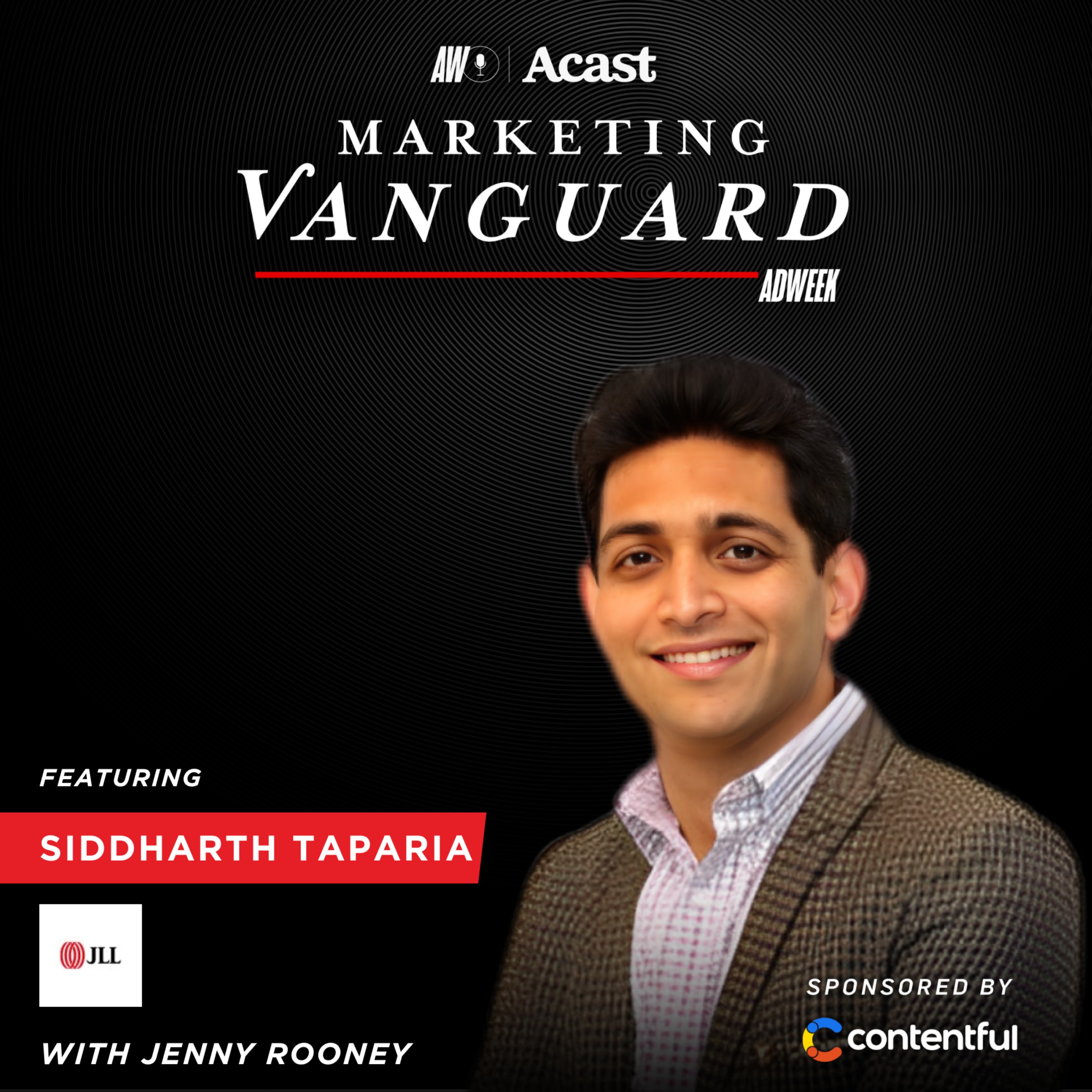
Loading summary
Transcript44 lines
- [00:00]
Siddharth Tabharia
My sort of lesson learned over the last 20 plus years of doing this is if you're not in sync with your business stakeholders, it doesn't matter what you're doing or how good it is, it's not going to be seen as value accretive for the company. And so I think marketing strategy and the company strategy have to be in close sync with each other.
- [00:21]
Jenny Rooney
Hi everyone and welcome to the Marketing Vanguard podcast. I'm Jenny Rooney with adweek and I'm thrilled today to be joined by Siddharth Tabharia. You're the CMO of JLL and I that you were named to the inaugural Marketing Vanguard list last year. So congratulations on that. I know you and I have spent some time together. You've come to our summit and I've really enjoyed the pleasure of getting to know you over these last few years. And frankly, the unique marketing leadership you bring to your company, but also the unique lens you have on marketing in general in this day and age and how that needs to be applied to both B2C companies, but certainly B2B companies as well. So, Siddharth, welcome.
- [01:05]
Siddharth Tabharia
Thank you for that introduction and it's great to be here, I think.
- [01:08]
Jenny Rooney
I do want to start by asking you to share for everybody what JLL is because there might be some folks who aren't as familiar. And so I'd love for you to share a little bit about the company.
- [01:17]
Siddharth Tabharia
Yeah, happy to. JLL is a publicly traded Fortune 200 company. We work primarily in the global commercial real estate services space. We're one of the leaders in the space. We help clients buy, build, occupy, manage, invest, basically any type of commercial real estate property, whether it's a commercial, industrial, hotel, residential. Over 20 billion in revenue. We do business in about 80 countries around the world. Over 100,000 employees. Very focused on our client success and really just trying to shape. Our mission is to shape the future of real estate for a better world. And that's what we focus on every single day.
- [01:58]
Jenny Rooney
Probably a different world now being on the other side of COVID I don't want to bring that up, but obviously the industry's probably gone through some ebbs and flows, if you will, in recent years.
- [02:07]
Siddharth Tabharia
It's been a very happening two years, not just during COVID but actually even since COVID Of course, Covid saw people working from home. I think that return to office is gradually progressing back to whatever the new normal is going to be, but that continues. We also have had some macroeconomic factors like higher interest rates and high inflation, and that has A direct impact on commercial real estate. And so commercial real estate has sort of had a couple of years where the industry's kind of gone through a reset in the sense of finding just its balance with all these factors coming into play. Covid also saw a lot more growth in things like E commerce, which led to more demand for industrial and warehousing space. And now we have this boom in AI, which sees a lot more demand for data center space. And so commercial real estate is an industry that you may or may not pay attention to, but it always changes with what's happening in the economy at large.
- [03:07]
Jenny Rooney
It probably begs a very different mindset as a chief marketing officer as opposed to somebody selling sneakers.
- [03:17]
Siddharth Tabharia
Yeah, I mean, I grew up in the tech industry. I spent 15 years at SAP, which is a wonderful company and one of the large players in the software as a service and technology space. And this is a very different industry. I mean, there's lots of similarities. It's B2B and its services, and there's a lot more use of technology in commercial real estate at the same time. This is industry that's very dynamic with what's happening in the macroeconomic factors, but also in people's personal lives. Whether we're going out shopping in retail or we're ordering things from home home, whether we're working in an office or in a hybrid model, all of those things have a direct impact on the world of commercial real estate.
- [03:57]
Jenny Rooney
Yeah. So tell me a little bit about your educational background. I'm just so curious. Did you come up through business school, have an mba? Is it in marketing, or did you focus on something else entirely?
- [04:08]
Siddharth Tabharia
My background was in technology. I did a degree in engineering and then I went to business school and did information sciences focused education, did a master's and I just happened to stumble upon marketing by accident mostly. And I was working in the world of technology and my future ambition was to be a world class programmer, but that didn't turn out to be the case. And so I got a start in marketing and never looked back and been in marketing for over 20 years at this point.
- [04:37]
Jenny Rooney
So, I mean, how do you think about that pivot? Right. Because some people go to school and they spend all their time focusing in marketing classes, focusing on marketing. And there isn't a whole lot of crossover. Obviously over the years it's been interesting to track CMO journeys and there are frankly a lot more folks who have perhaps engineering backgrounds, computer science, things like that. And it would make sense in the fact that marketing has become so much more of a numbers and a data driven practice. The joke used to be, certainly when I was in college among the business school students was you chose marketing because it was the least challenging from a metrics, data, numbers standpoint. And how ironic that is now, but I mean, how much did you have to learn marketing on the job as a result of the fact that you really were so firmly rooted in tech? Or was it just not a big shift to have happen for you?
- [05:34]
Siddharth Tabharia
I think it'll be disrespectful to say that I didn't have to learn on the job. That would make marketing sound too easy and simple, and we both know it isn't. I got my start in the world of product marketing, so that helped because I at least knew the product part of product marketing so I could do product marketing. But look, I think the point that you're making is a very good one, which is, in my view, if you look at all corporate functions, finance, HR, marketing, et cetera, they've all evolved in the last 10 years. But I would argue that marketing has changed the most. The amount of data, the amount of technology, and truly just the science that is now available to marketing practitioners is just unprecedented. And so for me, I think that pivot became a little bit easier because I find my comfort in numbers, I find my comfort in metrics, and that's what a lot of modern marketing is becoming. Measurement is the name of the game. It's not the only thing, but it is one of the core pillars of modern marketing now. And if you are a CMO that's not comfortable with numbers, you're going to have some challenges. And so I feel like that my background in technology has really helped me be very comfortable in those conversations because a lot of marketing conversations are now conversations about technology and AI and data and customer behaviors. And so that gives me a leg up in some ways and I really enjoyed. But it has been a learning process and started in product marketing and then went into general more corporate marketing and learned my way. And so I always think I have deep respect for people who learned marketing in school. And I think I can balance that out with my teams and bring more of a general practitioner perspective, but also more of a business perspective that I think every CMO needs to have as well. If you're not thinking about your company's P and L, you're not going to be relevant in the boardroom. And that I think is critical to any marketing practitioner today.
- [07:35]
Jenny Rooney
We at adweek spend a lot of time and there's so much I Mean, listen, the super bowl is upon us, one of the biggest creative advertising stages in the world. Still, we spend a lot of time with and talking about, and frankly, our culture loves consumer brands. Right? Like focused on the dazzle and the excitement around that kind of thing. I think we have been spending a lot more time also looking at and being inclusive around B2B marketers, and specifically tech marketers. And folks I talked to today in the know say some of the greatest creative innovation is coming out of the B2B marketer landscape, and particularly tech marketers.
- [08:16]
Siddharth Tabharia
Yeah, when you're making a decision as a consumer, the impact is personal, but the decisions are small. You're buying a bag of Doritos, you're buying a Coke, you're buying whatever, right? Like you're buying a product. You might be buying an iPhone or even a laptop. I mean, those are $1,000, $1,500, $2,000 decisions at the most. When you are in the office and you're making a decision as a B2B decision maker, typically the decisions are worth hundreds of thousands, if not millions of dollars. And so the relevance of the brand is more than ever before because your ability to go wrong can be catastrophic. It can be personally catastrophic, but it can be catastrophic for your company if you make wrong decisions. And so I think there started to become a recognition for this, and I agree with you, it started more in the technology companies because I think technology companies were fiercely competing with each other and they needed to win a lot more of the business that was coming their way. But I think in general with B2B companies now there is a lot more creativity and a lot more relevance of marketing that's starting to get recognized because everybody now realizes that brand becomes truly important when you have a B2B decision that's being made. It's not just for the world of B2C. And so I hope that we're going to see a bit of action on the B2B side as well with super bowl and other things that are going to come later this year. But I think there is a renaissance happening in B2B marketing as well.
- [09:45]
Jenny Rooney
Yeah, Talk a little bit about what you would say to students who are thinking about, frankly, the next generation of marketers. Again, it's almost like B2B and specifically tech marketers are against the very fierce competition, if you will, among folks who think they want to go into marketing and advertising. And they do go to. No disrespect, but the pepsicos of the world, or the P and GS or Even some of the car companies, like, how do you make B2B marketing appealing to the next generation so that we can start to get some of those creative thinkers and strategists into B2B companies and into B2B marketing organizations? And what would you say to them? As far as anybody who's questioning, but is there a place for me as a creative thinker?
- [10:25]
Siddharth Tabharia
I think all of the companies that you mentioned are wonderful companies and they have great marketing talent that works for them. I think the world of B2B is a little bit different. The world of B2B is more about having a direct impact on the company's top line and bottom line. And usually you're able to directly measure the impact of your work. If you put a campaign in market, you're able to track its performance and you're able to say how many leads came in, what converted, what didn't convert, did the campaign perform, did we have good return on investment or not? I think you can still do better measurements and measurements are improving, but that's just simply not the case in the world of B2C. I think you have a lot more direct impact on the business and that's what's exciting. And I think this wasn't the case 10 years ago because you didn't have the technology to be able to track and trace everything and be able to say, what is the impact that my marketing is having? But now you have the ability. So I think anybody that wants to come to work in a B2B marketing context, the ability to now have the impact on the business is a lot more than it ever was. And I think that's really exciting because the work that some of these companies do, the work that JLL does, you can have a marketing campaign that can have an impact of millions of dollars of company's top line performance. And that's just simply not something that you can have the same level of satisfaction in the world of B2C. I mean, I could go on, it's a long list of things, but that's one big reason. And the second one I will say is you have limited resources, which most B2B marketing teams do. By comparison of B2C, you are almost forced to innovate and you are forced to sort of make the most out of every dollar that you are given. And so I think you will start to see with things like artificial intelligence and so forth, some of the innovations happen very quickly in the world of B2B marketing because people are forced to, because the resources are limited. And it's not like B2B marketing practitioners want to be any less than anyone else doing marketing out there. And so I think now these tools are going to make their lives easier and want them to innovate more and be able to get more out of less. And so there's going to be a lot of exciting things happening in the world of B2B marketing as well, particularly for people that are starting out their careers.
- [12:45]
Jenny Rooney
Well, let's talk about that. Somebody recently told me this concept that has resonated or stuck with me since, which is that creativity loves constraint, right? Like it thrives in constrained environments. Because to your point, like, it's the whole concept of doing more with less. And as people are going about trying to navigate AI. And that's a really good segue, if you will, for frankly, what is something that so many marketers are talking about and trying to get their heads around? Some more successfully, than others, I would argue. But I mean, it's a work in progress. Every day brings something new. How do you think that's going to be transformative for marketers, for business in general, for humans notwithstanding, but specifically for marketing? And what are you doing now at jl?
- [13:31]
Siddharth Tabharia
I think it's big. I think it's very significant. We will look back at this time and say this was one of the most significant steps since probably the Internet. And I don't think that's a hyperbolic statement. I think companies are looking at this generally, sort of saying, what does it mean for me? What does it mean for my business? Am I still going to have a business? Am I still going to be relevant to my clients? And what type of products and services should I now be thinking about in the world that everybody is going to have access to artificial intelligence either on their computers or on their smartphones or both? My personal perspective on this is you are already seeing a big amount of change in how companies do programming, for example. That's a field that is going to get disrupted quick because a lot of the code is going to be written by machines and overseen by humans than the other way around. I think you're already seeing headlines of companies starting to do that. You're going to see a big amount of impact on customer service, as another example, where a lot of tasks can be handled by artificial intelligence and there will be more specialized tasks that will be handled by humans. And then I think you will see a big impact on marketing. And I mean a positive impact, not a negative one, because marketing is one of those fields that I believe lends itself quite easily and quite well for some of its work to be done by artificial intelligence. The way I look at this and the way I've talked about it with my teams is it frees up our humans, our people, to be able to focus on higher order tasks, on more complex thinking, on being able to align with the business strategy, because AI cannot do those things. And so they need to focus on things that they are best at and let AI take on a lot of the repetitive tasks that AI is going to be better at. So our journey in this regard has been interesting because when ChatGPT was launched in November of 2022, coming from a tech background, I started using it myself. And I think I've been using a lot of the AI tools that have come since then. And I quickly realized this had a massive potential for our people, particularly in marketing and communications, which are the two functions I lead. And so that kickstarted a series of conversations, first with my leadership team and then also involving our legal teams and our data team, to just understand, like, what is possible, what are the risks, what is it that we're already doing, where do we want to go? And we quickly found out that a lot of our people were also playing with different tools and experimenting different tools. And so six months later, in May of 2023, we shared sort of guidelines for responsible AI use with our people. And then a few months after that, In August of 2023, we launched what we call GLN GPT, which was the first large language model for the commercial real estate world. Purpose built. And that really just opened the floodgates because it allowed our people to leverage generative AI in really everything that they do. But then also not worrying about uploading any data, working with client data, because nothing was leaving the four walls of the organization and ensuring that we had robust privacy standards, security standards, and it was in full compliance. And those were the early days. And it marked a shift in sentiment because we were not only encouraging, but we were easily making a tool available to our people and saying to them, go explore, see how you can use this. We even added a couple of people that were focused on just looking at the possibilities of AI in the world of commercial real estate marketing. And we developed over 60 use cases, we put them on a roadmap like anything else, and we said, what are the things that are going to have high return on investment and that require low investment versus high investment? Because you have to remember, a lot of things still in the world of AI are unproven. And so a Lot of our time in the last 18 months has been spent looking at different things, and we have said no a lot more than we have said yes to new tools. Now we have over a dozen different tools that we're using within the company, but it's a process that doesn't go from zero to 60 in a day. You have to sort of work through it and look at things and say, does it apply to my actual use case? And there's a lot happening in the shifting landscape on the AI side as well. It's not like you're working with a static landscape. Something that you might have looked at six months ago is now completely different in terms of its capabilities.
- [18:11]
Jenny Rooney
And just recently Deepseek, and there's a lot of publicity around Deep Seat that came out. I mean, the tools themselves, the offerings are changing every day. So it's almost like it's a fastly moving river and you have to figure out, like, where you jump in and how you continually adjust to that. I'm curious how you think about it. You mentioned you came up with rules for responsible use internally. Right. So is that something that all marketers you think need to be doing or should have done by now?
- [18:37]
Siddharth Tabharia
If they haven't, it's every marketing leader's prerogative to do that. But I think it's really important that you are clear about where you stand on this, because I think it's going to be critical for you to be in compliance with the law. I'm not a legal expert, but also continue to have the trust of your clients and your customers. And I think that's important. How you use their data, where you keep it, how you protect it. I think it's really important. And the legal frameworks are still evolving. But I think it's critical for every leader to have that in place. Right.
- [19:09]
Jenny Rooney
And to obviously to have marketers frankly lead the conversation, not just be sort of responding to the conversation around it.
- [19:16]
Siddharth Tabharia
And that's what we have found as well, that oftentimes we were the first ones asking a lot of questions. And then our legal frameworks, our purchasing frameworks were evolving because the policies have to be different in many cases than what they were for some of the more traditional, let's call it tech tools or even data privacy and policy practices. Doesn't mean we compromise on those things, but it just means that you have to take a different view of those things.
- [19:42]
Jenny Rooney
I remember going back maybe 10 years or so, companies, marketing organizations would set up, like Innovation Labs or like a skunk works, right where they would sort of like sample or try out a new technology and have budget for it, but it would be parsed out and sort of separate from the main flywheel. I'm not hearing that as much now. It feels like the trial is happening just within the marketing organization, just on the fly in a day to day framework. Is there any reason why you think there's less of an inclination to treat AI as something that you go do often? A smaller team, special team to investigate and sample and experiment with, as opposed to just having it sort of bleed every day, bleed more and more throughout the organization and have various people trying it out?
- [20:29]
Siddharth Tabharia
I don't think CMOs have the luxury to do that anymore. I think the technology is evolving too fast and the applicability is changing so rapidly that you don't have the luxury of having a team that's playing with it and then taking six months to a year to decide what can be scaled. I'll tell you the approach that we took, which is we created a very small team that was responsible for sort of single threading the different tools and technologies that we were evaluating the different use cases and prioritizing them. But then that rapidly evolved into a group of self selected champions. We told people if you want to come play with AI tools, you're welcome to do that. And now we have over 300 people that are part of that champion group that are raising their hand by themselves and saying, I want to explore new tools, I want to play with technologies, I want to figure out what makes sense, what use cases make sense. So I find that's a much more scalable approach rather than if I had handpicked five or 10 people to go play with AI and then let us know what happened. So I think it's just if you just look back within the last two years we started with, I mean it's been two years since ChatGPT was launched, November of 2022. That was really the first generation of the Chatbots. And now you have things like the second generation, which is more like copilot, things that are working to augment humans, not a separate thing that you have to go look at. And now you mentioned Deepseek and now we're in the third generation. It feels like already where you have automated AI agents. I know that OpenAI just launched deep Research and they launched Operator, which are agents that can do everything from complete purchases for travel and groceries and book events and make reservations for dinner and so forth. So we're already looks like three different generations in the past. Two years. That just gives you an idea of the speed at which all of this is evolving. And we're just talking about one small component of it. We're not even talking about all the innovation that's happening in all of the applications and all of the use cases that it's throwing up.
- [22:28]
Jenny Rooney
Yeah, for sure. Yeah. Coming off of ces, I mean, obviously that was the buzzword that came out, was agentic. Right, like that concept. So, yeah, I hear you on we're already third generation. It is so quickly moving. I'm curious one of the sort of prevailing debates that continues, although I quite understand why it continues and I'm not sure why. I mean, I think I know why, but it's curious to me, the bifurcation between so called brand and performance that a lot of marketers are talking about. First of all, two questions. One, how does that apply in your world? Do you even think about it in those terms, yes or no? And if so, how does that manifest? And is AI ultimately the thing that's going to finally stitch together brand and performance? Maybe in ways we haven't heretofore been able to connect dots around, which is still, again, sort of strange to me. Brand drives performance.
- [23:16]
Siddharth Tabharia
In my mind, 100% agree. Brand drives performance. And you are not going to have efficient performance based marketing unless you have investments that you're making in the brand. So the two sort of reinforce each other. I think this debate prevails because brand investments by themselves are still incredibly hard to measure in a way that performance investments are not. Right. I can put $10 in a campaign and I can tell you exactly how many leads came out of it, what converted and what closed. I put $10 in putting a billboard outside your office. I have no idea who looked at it and what they did afterwards. And so brand marketing, I think, is still based on conviction that a strong brand, and there's lots of data to prove this, a strong brand ultimately drives better company performance, better employee satisfaction, you're able to attract better talents, you're able to have more pricing power, et cetera, et cetera. But at the same time, I think it's very hard to still measure brand. And that's why I think companies tend to look at these things in two separate buckets instead of looking at them as 1. Is AI going to stitch these things together? I certainly hope so. I think you're starting to see AI able to scale the things that were maybe a couple of years ago, incredibly hard to do. For example, be able to personalize things, because personalization is something that then starts to lend itself much better in terms of your ability to measure things. And so I can create really infinite number of variations of something and serve it up to my audiences. I can still continue to sort of use more predictive capabilities in terms of how something is going to perform. So I certainly hope that AI will stitch these things together. But I think AI is still evolving and I don't think it's quite there in terms of being able to make these things, which fundamentally improves the measurement of brand investments, at least the traditional brand investments. I'm not talking about Facebook or paid search, but just more of the traditional out of home brand investments. Still hard to measure how they perform, even with AI.
- [25:21]
Jenny Rooney
Yep. One other question for you. I'm curious. In recent years we've seen CMOs move from B2C side to B2B and back again and vice versa. Any thoughts around that? Are there any trends you've witnessed in that regard? Do you have any sort of peers and friends that you've paid attention to? Is that transition becoming harder or easier, do you think?
- [25:42]
Siddharth Tabharia
I think the transition is definitely becoming easier because I think there is more similarities now between B2B marketing than there are dissimilarities. I think B2B marketing becoming a lot more sort of revenue oriented but also brand oriented, works well because that mindset is applicable in the world of B2C. I think B2C marketing, with its focus on brand, certainly for companies, and I think every company should have an aspiration to build a stronger brand. I think it works well for B2B companies as well. So I think that transition is becoming easier. The technologies are basically the same. The platforms are the same between B2B and B2C. They're no different. It's just how they're used and how widely they're used. And the audiences tend to be different because B2C is typically built more for scale and B2B needs to be built more for precision. You're targeting certain audiences, certain roles, certain titles. You're not going after mass market. And I think that's the big distinction between these two sort of disciplines.
- [26:42]
Jenny Rooney
Let's get into talking about how you work within your organization, how you work within the C suite. Who are you most collaborating with on a day to day basis? I would have to think it's the CTO or the Chief Information Officer, given your bent and your expertise. But is it the cfo? Is it the CEO, Chief Operations Officer? Who are you spending most of your time with and why?
- [27:04]
Siddharth Tabharia
So we are organized by our three business lines. They tend to sort of drive the bulk of our revenue. And so a lot of my time gets spent with our business line leaders which are sort of consider them as business line CEOs as well as our global CEO. I think that alignment is so critical because that is at the heart of how much you invest in marketing. Whether you invest in brand or performance marketing or client experiences, what type of tactics you put in place. My sort of lesson learned over the last 20 plus years of doing this is if you're not in sync with your business stakeholders, it doesn't matter what you're doing or how good it is, it's not going to be seen as value accretive for the company. And so I think marketing strategy and the company strategy have to be in close sync with each other. Of course you have to spend your time with the CFOs. I was at the Adobe conference last year and I was on the stage with Adobe CFO talking about the partnership and how critical it is between CFOs and CMOs. Because as you see marketing driving more of the revenue contribution, particularly within B2B companies. I think that CFO partnership becomes critical partially because CFOs need to look at marketing differently than they might have looked at it in the past. If you have a very brand focused view of marketing, that cannot be measured. And so it's I can invest a dollar or ten, I can't really tell the difference. That's very different than the modern world of marketing where you have a lot more ability to be able to predict what investments in marketing are going to generate in terms of value. So I think that CFO partnership becomes critical as well. And then of course you need to partner with your chief Data officer, with your chief Technology officer, with the cio. So my short answer to your question is I don't think it's any one role that you spend most of your time with, but I think it starts with business alignment. Alignment with the cfo. And then in order to execute, you need to have strong partnerships with really all of the C suite.
- [29:02]
Jenny Rooney
Yep. So think about as you're on a field, and I use this as an analogy, the sports analogy. Are you playing offense, are you at in a defensive position, sort of trying to protect your goal from the offense at all costs? Or are you sort of in that midfield line trying to be the connective tissue between the strikers scoring the goals offensively for your company and your marketing team and the defensive players protecting the goal?
- [29:28]
Siddharth Tabharia
That's a really Hard question to answer, because in my experience, marketing and the combination of marketing and communications has to play in all three positions. And it really varies from time to time. If you're a company that's having reputational issues or if you're having any kind of challenges, whether they're on social media, whether they are on any kind of reputation, you have to play defense. But at the same time, most CMOs, myself included, would like to play offense, would like to show the market why they are better than the competition, how they're driving growth, why they're building a stronger brand, how amazing of a company they have, and why people should use its services or products, and why people should come and work there. That's what every CMO wants to do. But then marketing inevitably also plays this connective tissue between people who make stuff and people who sell stuff. And marketing almost always squarely sits in the middle, connecting the dots between the value proposition and being able to deliver that to a client, and ultimately being responsible for collecting the client feedback, for thinking about the brand and if people are actually delivering on the promise of the brand, making sure that things like pricing and promotions and how a brand is perceived always remains true to its core principles. And so I feel like marketing is this unique discipline that has to play in all of the positions up and down the field. I wish I could just say we only play offense or we, we only play in the midfield, but it's not quite true.
- [31:01]
Jenny Rooney
You work with agencies, External agencies, creative agencies, digital agencies.
- [31:05]
Siddharth Tabharia
Okay, yes, all of the above. Yeah.
- [31:07]
Jenny Rooney
Who comprises your stable, if you will, of external talent?
- [31:10]
Siddharth Tabharia
We use HAVAS as our agency of record for all of our creative things. We use BCW as our communications agency. We use a number of, as any CMO would tell you, a number of smaller agencies on everything from digital to client experience to content production and everything else in between.
- [31:28]
Jenny Rooney
Some of your proudest campaigns, examples of some work that you've done that you feel like has really moved the needle for the branding business lately.
- [31:35]
Siddharth Tabharia
Yeah. Two years ago, we relaunched the JLL brand. We refreshed it that hadn't been done in over 10 years. And we came out with this tagline of see a brighter way, which is all about helping our clients see a better way, a smarter way, a more innovative, more intelligent way of looking at things. And it's really resonated. I mean, you cannot go to an office or look at any of our client facing collateral where people haven't embraced that timeline. It's literally everywhere, in all of our materials, in everything. That our clients see. But our push has been to make sure that we're continuing to deliver on that promise. So that was a big thing for us to completely refresh the brand two years ago, and that's gone really well. And then more recently, we were at the New York Stock Exchange and we rang the closing bell, which was a great moment, but we were celebrating not just a big milestone in us being listed as a publicly traded company, but also all the innovations that we have launched around artificial intelligence. And we launched a new set of solutions called AI Falcon, which are all oriented towards commercial real estate and bringing the power of artificial intelligence in the hand of our clients. And so that was a very big moment, not just for marketing, but for the whole company to celebrate. And you wouldn't think a commercial real estate company would be leading the way in the industry in terms of launching innovations in the world of artificial intelligence, but that's what we've been focused on doing.
- [33:04]
Jenny Rooney
Well, Siddharth, this has been so fascinating, such a really interesting look inside what it means to be a B2B marketer, what it means to be truly innovative and harnessing the new technology that is AI and all the potential that it has. And even as you think about moving forward, how you continue to build Frankie, your products around it. So I'm sure so much more to come from you. Anything you want to tease as we close, anything we can look forward to seeing from you.
- [33:30]
Siddharth Tabharia
We're focused on driving new things around the brand, being able to do new things in performance marketing, to be able to reimagine the client experience. So it's really all of the above at the moment and I couldn't be more excited right now in terms of where we are in this journey, the evolution of marketing, and it's wonderful to talk to you and be able to share some of what I do and what is happening in the world of B2B marketing.
- [33:54]
Jenny Rooney
Thank you so much for being here. And until the next, thank you, Jenny.
- [33:58]
Siddharth Tabharia
I appreciate it.
- [34:00]
Jenny Rooney
Thank you for listening to Marketing Vanguard, part of the Adweek Podcast Network and Acast Creator Network. You can listen and subscribe to all of Adweek's podcasts by visiting adweek.com podcasts. Stay updated on all things Adweek Podcast Network by following us on Twitter at Adweek Podcasts. And if you have a question or suggestion for the show, send us an email@podcastadweek.com thanks for listening.