← Marketing Vanguard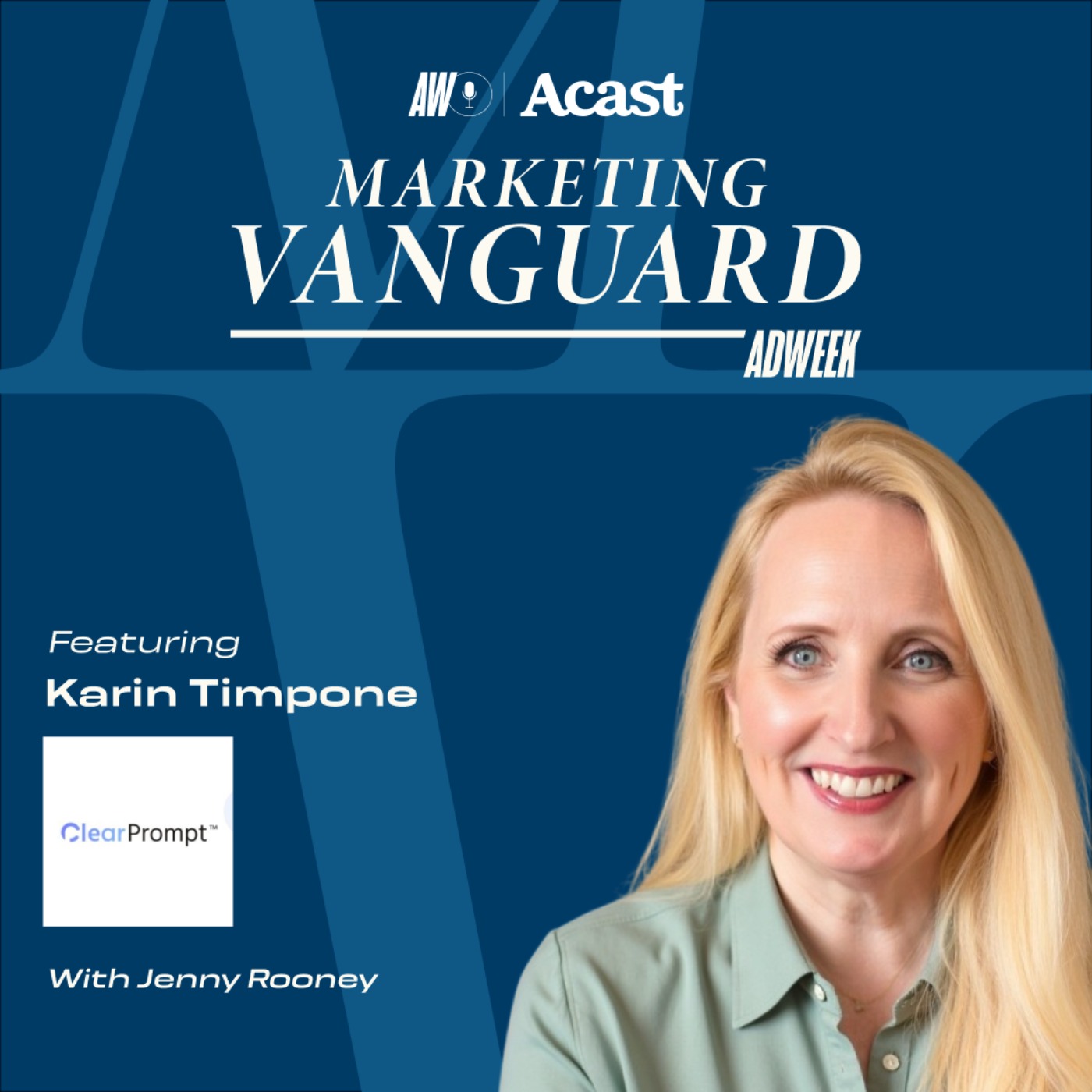
Marketing Vanguard
Successfully Using AI in Business with ClearPrompt CEO, Karin Timpone, at the World Economic Forum Event
00:18:14
Loading summary
Transcript40 lines
- [00:00]
LinkedIn Ads Voiceover
Does it ever feel like you're a marketing professional just speaking into the void? But with LinkedIn ads, you can know you're reaching the right decision makers, a network of 130 million of them. In fact, you can even target buyers by job title, industry, company seniority, skills and. Did I say job title? See how you can avoid the void and reach the right buyers with LinkedIn ads. Spend $250 on your first campaign and get a free $250 credit for the next one. Get started@LinkedIn.com Campaign terms and conditions apply.
- [00:30]
Karen Timpone
I think it would be really great to not try to boil the ocean of all things AI. You don't need to be an expert in something that's literally being invented. Continually pick a lane of something that's going to be important for you, that you're actually going to want to drive.
- [00:44]
Jenny Rooney
Hi everyone and welcome to the Marketing Vanguard Podcast. I'm Jenny Rooney with adweek and I am coming to you from Davos. We're doing a special series of the Marketing Vanguard Podcast here in Davos in the beautiful FQ Lounge. And and I'm thrilled to be joined by Karen Timpone. She's the CEO and founder of Clear Prompt. Karen, welcome.
- [01:04]
Karen Timpone
Thanks, Jenny. I'm glad to be here.
- [01:06]
Jenny Rooney
It's great to see you. We're going to get into a lot about what you're doing now, having been a CMO several times over, most recently at MLB and Marriott, and you've got a great new venture that you've recently launched. So we're going to talk about that in a minute. But here in Davos, which is such a special opportunity for CMOs because they don't ordinarily get invited. It's usually their CEOs who come. But we're talking a lot about this concept of cmos at the center. They need to be the driving force of not just brand growth, but business growth. And this is sort of a metaphor for that. If you have to put yourself in those rooms, literal and figurative, that enable you to affect change within your organization, that's what sort of Davos represents. So we're excited about this. I need to ask you your opinion because I know you have so many opinions about this. Why is now the cmos moment to be more than ever a literal driving force for business?
- [01:58]
Karen Timpone
Well, first of all, thank you for hosting CMOs at Davos. This is the first time ever. So kudos to you and to Adweek and Marketing Vanguard for really stepping out and creating real leadership moment. I have felt really, really fortunate to be here. And it is very much to do with your question. I think CMOs are really among the most versatile executives that exist and really have to think about every part of the experience of not just their custom, but their teams and how they're going to execute. Constantly changing and being here at Davos World Economic Forum, economic being in the middle of it, the rubber meets the road on all of interpretation of what CMOs do to transact somehow in a really good business outcome. And I think having CMOs here, it really makes the statement that what marketing does is economic driving and business strategy. I think it's really important. The conversations I've had not just in formal environments, but informal environments really run the gamut from many different topics. And it's so like the CMO world to really have to think about really many different inputs and then find a way to get that to be really crisp and clear for a really good customer experience.
- [03:19]
Jenny Rooney
It's so interesting because that perspective is so well informed. Having been a practitioner yourself, one of the things that's part and parcel of that conversation is the CMO relationship in the C suite with their peers, whether it be the CEO, the cfo, the CTO or cio. We've long talked about this, but it does feel different now. Can you dive into a little bit your perspective on not just the why CMOs need to be better connected to the CEOs in particular, but the how they need to be doing it?
- [03:52]
Karen Timpone
Yeah, I think it's a really important question. I think it really does vary by company, by sector. I've worked in many different sectors and I respect that each sector has its own way of operating and I think that that's okay. But I think at the very top of the organization, there needs to be alignment around the goal and the strategy of what the business is driving for and how the teams that are executing on that are aligned. That's what the top jobs are for, is to outline the vision and provide the resources and remove the obstacles. And so when I think about the role of the CMO in all of the C suite, whatever the titles are called, it's really about aligning together around those internal external goals together and making sure that they are really crisp. Kind of going back to the trends of Davos, which there are many things to talk about. Everyone talks about how fast change is coming. That could have been said 10 years ago, 20 years ago, totally. But everyone's seen the charts on the adoption curve for AI. And I think that going back to the role of the CMO there's been an adaptability that CMOs have had for decades. Really, it's not the same job. When I started out in marketing, many decades ago, a different mix of things were available and different platforms were available. Now there's just an unprecedented opportunity to connect with your customer, your communities, and actually even talk about the reputation of your company as it relates to your customer. Those have come together in such an incredible instant way. And I think CMOs are the right ones in the senior leadership room to talk about what's real, what we can actually use, what we should try, how we should push things forward. And to me, being at Davos and having a presence here of a marketing track that really I've been in other conversations that are not marketing, it's bringing up the discussions that we would normally be trained on and I think that is really time because that's where technology's taken us today.
- [05:52]
Jenny Rooney
Yeah. All right, so now obviously AI, it's the single biggest focus as well of every conversation we're having. You recently launched your venture and I want you to explain and talk a lot about that, but to sort of segue us into that. There's this conversation around the fact that CMOs should not just be responding to the changes that AI is creating, but they should actually, this is an opportunity for them to actually direct what, what's happening, not just in marketing, but for the entirety of the organization. Yeah, I do talk about that and talk about how AI is finally, as many have said here, the unlock that finally has CMOs in a highly influential role within organizations as never before.
- [06:34]
Karen Timpone
Yeah, I've said this in other rooms with CMOs and with clients that I now advise too. I will just say we've always been at this forefront trying to introduce new things and now AI is like the fastest track to explain the many parts of the marketing mix. I don't expect every executive to understand all the facets of the marketing mix, but AI brings into sharp relief that it could be everything from a piece of creative to the data piece to the customer platform itself, to a in person experience and customer service. I mean, I could go on and on. It would fill up the rest of this time just to list all those things. AI is accelerating each of those pieces. So the fact that CMOs have had to be expert in all of the change really kind of like, wow, wait a second, CMOs are the right ones to actually talk about it. So what I've done is created an AI tool and my name of my company is Clear Prompt. The labs portion I have Clear Prompt advisory which I do one on one advising. I have labs which I've actually created, AI tool product which I'll talk about in a second and then Clear Prompt Ventures. The reason I set it up that way is that I always believe in that Venn diagram of the human wisdom and pattern recogn meets technology acceleration. We've done it in many other forms before, video, social media, search, you name it. Now with AI we can apply it to all the things that I'm talking about in the marketing plan. What's essential though is I didn't create a tool only to create a marketing plan very purposefully. The tool that I've created, together with some engineering resources that are outside the US have basically taken a whole business strategy intake process and correlated to be instant so that what the client or brand wants to be able to do can be articulated in a strategy that the whole C suite can get around. And that is the unlock for me.
- [08:35]
Jenny Rooney
That is big.
- [08:36]
Karen Timpone
That's huge. Also, there is an AI agent inside of it. We've named her Claire and you can talk to her as you are working through the teasing out the questions of your business strategy about what your four Ps should be, product promotion, price play, about what your growth template should be, what your brand positioning should be, how you want to message all of that, the whole message house, bring in the comms team on it, the SWOT analysis, everything. So it's a really instant way for everyone to gather around a draft, not because you've just put it in ChatGPT, although we do use ChatGPT to help perfect it. The intake is done by a human and it correlates exactly what it is that you're trying to get as a business strategy and go to market plan in a way that everyone can understand and interact with. And I think that the reason I've done this is I wanted to illustrate that the thinking of marketing really belongs in all of those tools that I just mentioned. That's really the lane that we're in business strategy and take it out to the market.
- [09:37]
Jenny Rooney
So you know, I want to talk about your personal career history, by the way. You're a CMO who in my experience has always been very technologically focused. Like you were talking about blockchain before people were talking about blockchain. You are all in on AI. First of all, why? And then secondarily to that and related is what was it about your previous experiences as CMOs? What did you take from those that now are informing what you're doing Actually
- [10:01]
Karen Timpone
I'm going to go back. Even before I was a cmo I worked in communications and public relations. And the irony to me is that today the whole idea of reputation management has a lot to do with creating the narrative. And my journey has been really around finding whatever tool is available today to connect with people and in communication. It has to be true, it has to be authentic. Everybody's talking about authenticity in AI. That's always been the case in communications. You never really wanted to sound like it was a put on. Nobody wants to talk like that. I think about when I moved into marketing and then really accelerated in technology, really getting my hands on making products. It was all just a way to be closer to my customer, to get my message out.
- [10:47]
Jenny Rooney
That's it just means to an end.
- [10:49]
Karen Timpone
Just means to an end.
- [10:50]
Jenny Rooney
Yeah. So here you are now. What are you seeing among your peer set in CMO communities? One of the things I hear is a lot of CMOs who speak behind closed doors say I'm just so frustrated with all the talk about AI but I'm not seeing any real implementation, I'm not seeing any real good case studies and you know, there's a little bit of carpet for the horse situation here too. Are you seeing some really good examples?
- [11:13]
Karen Timpone
I have done some in previous organizations taking some e commerce activity and driving sale using AI so I've definitely seen it. But the overall takeaway that I would give to any new technology adoption, whether it's an AI piece and AI is a broad, broad term, many things, is to break it down into pieces. There's one example of something that I did in sports, driving ticket sales across 30 teams, but broke it down into many stages of first getting the strategy really right, then getting the team really organized and trying it out with a few groups and then adding more and more and more. Same with things that I did digital video at Disney which was breaking it down into various pieces. When we launched Marriott Bonvoy it was in various stages of technology release. So it's not a secret that like to get to that vision it takes steps to do it. And one of the best things about working on my own product now is having that focus. I know there's a hundred other things to make but I think starting at the start is really important. And the ones that have reached out to me to work with me using Clear prompt, the tool in, in the lab or to do one on one advising, know that there's an unlock pivot that they are not seeing and they want to find what that Is. And how can I break that down into pieces? I think when we talk big vision things and it doesn't come true, it's a drag for the team versus hey, we started out with a proof of concept. We saw this thing and we took action on it. It worked. Now we made it better. That's happened in every single one of those examples I've given you. Because over time you can look back and say, look at all we did. But it's a learning curve and I think having a thirsty brain to learn and a doer attitude to get your hands on it and then actually getting it and doing it is really the important way to go as opposed to just pitching something that takes a year to get approved and by that time the market's moved on.
- [13:06]
Jenny Rooney
So is that your best advice to other CMOs?
- [13:08]
Karen Timpone
Absolutely.
- [13:08]
Jenny Rooney
Start small.
- [13:10]
Karen Timpone
Focused is the word I would say.
- [13:11]
Jenny Rooney
Focused. Okay, good.
- [13:12]
Karen Timpone
Be focused and be strategic. If it does not connect to a strategy and a business outcome, there are plenty of things to do do that are fun and creative. I'm not saying that we shouldn't have those, but I think if you're trying to introduce, let's just talk about AI systems inside an organization where the way they're going to make creative and how that connects to strategy and what are you doing with analytics. You need to orchestrate that whole conversation with all those teams at the same time, which is really different than years ago, is how an assembly line worked of making a campaign. So getting the team really in sort of an agile. That's a word I would use from the engineering world, an agile kind of setup saying let's take this piece and in phase one, let's try this particular approach. With success, we can learn and continue to adapt. And I said before, the adaptability for CMOs to me is really around. We all know that the end goal is more growth, more customer engagement, more overall output. But I think at the end of the day it's like choosing which ones and not being afraid to try them, but not making such a risk that it's like you bet your whole form on it.
- [14:22]
Jenny Rooney
It's interesting though, because like, and I'm listening to you carefully about this concept of it's a means to an end and sort of make sure you figure out that it's strategic and it's additive to the bottom line and it's actually driving growth. It feels like there's interim goals with AI that people get a little caught up in, whether it's cost savings, efficiency or speed.
- [14:41]
Karen Timpone
Well, I have heard That a lot here at Davos and even outside of Davos too. About like that there's a lot of belief at the most senior levels and then there's a gap between what are we actually doing and can we actually do it. And that's really why the advice I have is to focus on something. So my message not just to CMOs, it's to other board directors, other C suite, give the air cover. But also holding a task on specifics on focused activities and I think that's the right way to go. So it doesn't feel like it's pie in the sky. It feels like, like it's a very specific deliverable, connected to something that the company needs to do and that the brand needs to grow in.
- [15:18]
Jenny Rooney
Yeah. And it's not about the AI, it's about the work. It's always still going to be about the work in the business. Last couple quick questions. I've Talked to other CMOs who are frankly they're maybe between CMO roles and a lot of them are loving that break because it's a breather opportunity and so many of them are using it as an opportunity to really lean into AI and get educated on it and to learn more and explore. What advice would you give to CMOs who don't have that luxury quite frankly, you know, who are just trying to maintain the blocking and tackling of a day to day, you know, day job.
- [15:55]
Karen Timpone
Yeah.
- [15:55]
Jenny Rooney
But also up level their awareness and understanding of AI and all of its manifestations.
- [16:00]
Karen Timpone
It's a multifaceted question. I'll just throw out a few areas. But to my focus to give my own advice another double click. I think it would be really great to not try to boil the ocean of all things AI. You don't need to be an expert in something that's literally being invented continually.
- [16:14]
Jenny Rooney
Totally.
- [16:15]
Karen Timpone
But you could pick a lane and decide. I'm going to really figure out what this can do for my storytelling. I'm going to figure out what it's going to do for my data. I'm going to figure out what it's going to do for my customer insight. I'm going to speed to market. Pick a lane of something that's going to be important for you, that you're actually going to want to drive and that your teams probably believe like, oh, she's always talking about that. Of course this is a natural adjunct of that idea. Right. And so I think this idea of making it scary and big. Nobody wants to be on those projects but if they like, oh, you were Always talking about that particular metric and now you're finding a faster way to do it and you're putting a little fun together and you're looking for somebody with a twinkle in their eye who wants to be on the project. You get a lot of hand raisers for that. That's the way to go. So pick something you love and go deep.
- [17:02]
Jenny Rooney
I love that because that just feels much more digestible. You can get your arms around it. Last question. What's your, your biggest takeaway from Davos in a practical sense? Everybody talks about their boots, everybody talks about the cold. What have you been most surprised by?
- [17:16]
Karen Timpone
Well, it's not surprising, but it's really gratifying in the world as it is today, where, you know, there's a lot of messages everywhere. Davos is incredibly personal and personable. I have been blown away. People told me about the serendipity conversation. That is absolutely true. And that's why I would suggest other CMOs lean into this experience. Not that there's not other industry events, of course there are, but there's a different kind of personal experience here where there's a plethora of topics. I've had a wide array of topics come up in spontaneous conversations that are really enriching and I'm definitely going to be in contact with some new friends and that feels like a whole new realm for me.
- [17:55]
Jenny Rooney
I love it. I love it. Well, we'll bring you back next year, Karen, and you know, have loved spending time with you here, learning more about your story, obviously. And we'll continue to watch so enthusiastically as you continue to build clear, prompt and in all the things. So thank you so much. And by the way, you have kicking boots, so you nailed that one.
- [18:13]
Karen Timpone
Wear good footwear.
- [18:16]
Jenny Rooney
Thanks, Karen.
- [18:16]
Karen Timpone
Bye, Johnny.
- [18:18]
Marketing Vanguard Podcast Host
Thank you for listening to Marketing Vanguard, part of the Ad Week Podcast Network and Acast Creator Network. You can listen and subscribe to all of Adweek's podcasts by visiting adweek.com podcasts. Stay updated on all things Adweek Podcast Network by following us us on Twitter Adweek Podcast. And if you have a question or suggestion for the show, send us an email@podcastadweek.com thanks for listening.
- [18:44]
LinkedIn Ads Voiceover
Does it ever feel like you're a marketing professional just speaking into the void? But with LinkedIn ads, you can know you're reaching the right decision makers. A network of 130 million of them. In fact, you can even target buyers by job title, industry, company seniority, skills and. Did I say job title? See how you can avoid the void and reach the right buyers with LinkedIn ads. Spend $250 on your first campaign and get a free $250 credit for the next one. Get started@LinkedIn.com Campaign terms and conditions apply.