← Master Plan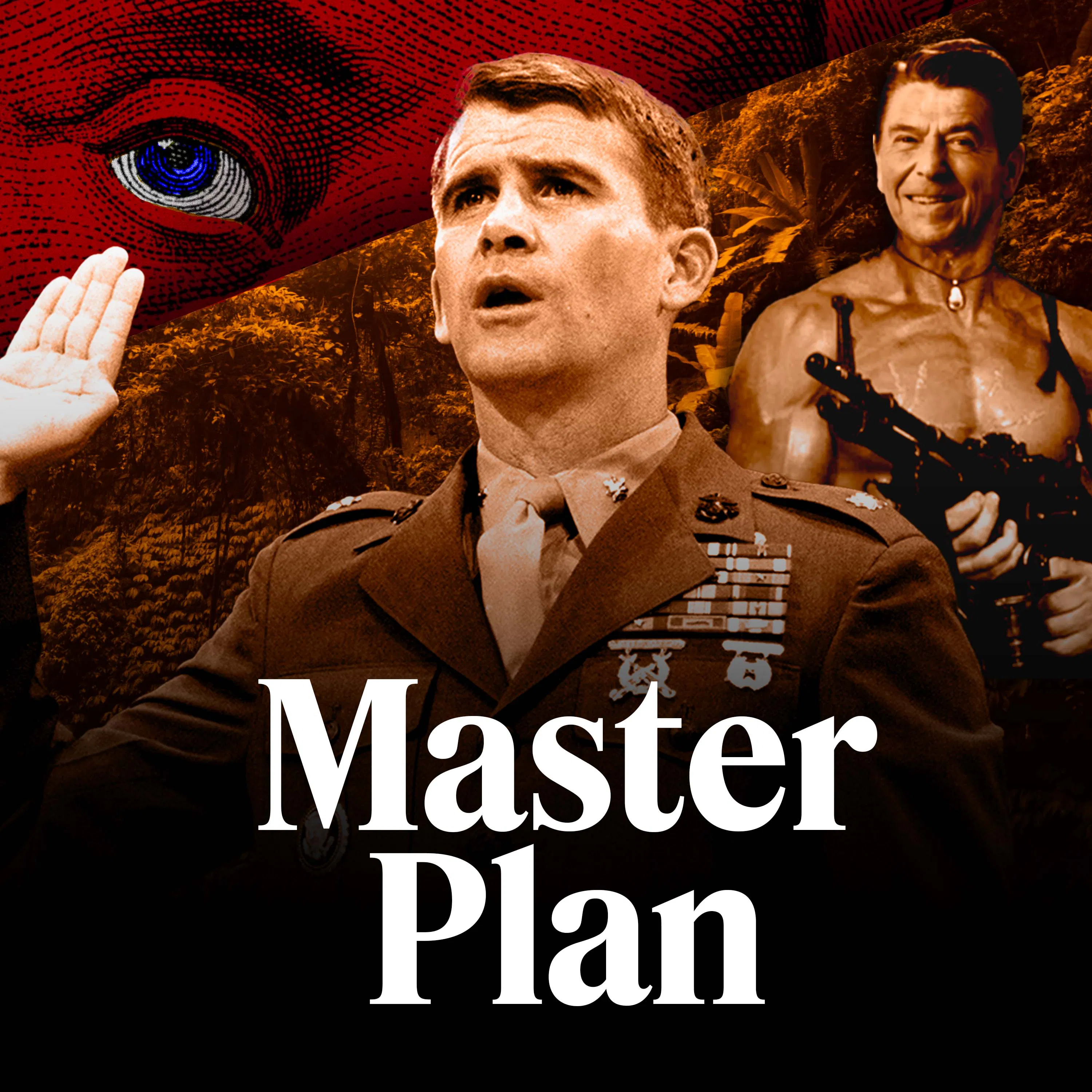
Master Plan
Episode 3: President Rambo | The Kingmakers
00:40:06
A rogue White House’s secret arms deal tests the limits of presidential power.
Loading summary
Transcript173 lines
- [00:00]
David Sirota
This podcast is brought to you by Avocado Mattress and if healthy, comfortable sleep matters to you, this is one organic brand worth knowing. That's because what you sleep on actually matters.
- [00:12]
Avocado Mattress Advertiser
Most mattresses rely on synthetic foams and chemical materials that trap heat, break down over time or off gas. Avocado does it differently. Their mattresses are handcrafted with natural organic latex, organic wool and organic cotton designed to be naturally cooling, incredibly supportive and long lasting. They're certified organic by Gotz and meet multiple non toxic and safety certifications made for people who care about their health and the environment without sacrificing comfort. I love that Avocado proves you don't have to choose between comfortable, supportive sleep and your values. And now, during our Earth Month sale, you can get up to 15% off avocado mattresses. Just go to avocadogreenmattress.com get up to 15% off at avocadogreenmattpress.com avocadogreenmattrush.com
- [01:02]
Narrator (David Sirota)
the lover
- [01:05]
Ed Meese
that's what I'm going to say, what it's all about. Why don't I tell you what is the situation and then I'll take your
- [01:12]
Narrator (David Sirota)
questions it was late November 1986. Ronald Reagan's Attorney General Ed Meese had hastily called an impromptu press conference at the White House to address a political emergency.
- [01:23]
Ed Meese
On Friday afternoon or Friday at noon, the President asked me to look into and bring together the facts concerning these
- [01:32]
Narrator (David Sirota)
should have been high times for the Reagan administration. After spending his first term clawing power back from Congress, the Gipper was reelected in a landslide in 1984, and he was now entering the final half of his second term. But just before Ed Mises emergency press conference about an unfolding scandal, Reagan and his revolutionaries had suffered a brutal political setback.
- [01:55]
David Sirota
President Reagan returned to the White House tonight. It was not a very happy homecoming for him because he now faces a Democratic majority in the United States Senate.
- [02:03]
Narrator (David Sirota)
Instead of the last two years of his presidency looking like the end of a Reagan cowboy movie where the protagonist heads off into the sunset as a hero, this was starting to look more like a horror show for the Republican Party.
- [02:17]
Reporter/Interviewer
Tom I'll tell you how bad it is. Most of the senior White House officials have turned out the lights, locked their offices, and already gone home to bed.
- [02:25]
Narrator (David Sirota)
Now, just weeks after that crushing electoral defeat, with the new Democratic led Senate ready to put the screws to the White House, Reagan's Attorney General Ed Meese stood at the podium facing a wall of cameras and a barrage of hostile
- [02:40]
Ed Meese
Questions over the weekend this inquiry was conducted. Yesterday evening I reported to the President.
- [02:49]
Narrator (David Sirota)
Meese spoke cautiously, carefully choosing his words to describe his investigation into a shadowy arms deal unfolding on the other side of the world. A scandal that some were already calling a new Watergate.
- [03:03]
Ed Meese
We continued our inquiry and this morning the President directed that we make this information immediately available to the Congress and to the public.
- [03:14]
Narrator (David Sirota)
Nice cautioned that they were still gathering facts, but he tried to lay out what had happened.
- [03:19]
Ed Meese
Certain monies which were received in the transaction between representatives of Israel and representatives of Iran were taken.
- [03:31]
Narrator (David Sirota)
And it was something about Israel and weapons being sold to Iran and apparently the CIA was involved in. And somehow money from those arms sales had ended up in Central America funding rebel forces in Nicaragua.
- [03:46]
Ed Meese
This money was then repaid by the CIA to the Department of Defense under the normal procedures.
- [03:53]
Narrator (David Sirota)
During that pivotal press conference back in 1986, one detail got everyone's attention.
- [03:59]
Ed Meese
How much money, sir? We don't know the exact amount yet, but our estimate is that it is somewhere between 10 and $30 million.
- [04:08]
Narrator (David Sirota)
It would later turn out to be nearly $48 million money made from selling weapons to America's sworn enemy, Iran. And some of that cash was then secretly funneled into a covert war in Central America. And it was money that Congress hadn't merely failed to approve. Congress had explicitly forbidden it. Suddenly, this wasn't just a messy foreign policy scheme, it was potentially a crime.
- [04:37]
Reporter/Interviewer
Who in the NSC was aware that this extra amount of money was being transferred to the so called Contras or under their control?
- [04:45]
Narrator (David Sirota)
And at the center of it was a name many Americans had never heard before.
- [04:49]
Ed Meese
The only person in the United States government that knew precisely about this was Lieutenant Colonel North.
- [04:58]
Narrator (David Sirota)
Lieutenant Colonel Oliver North. His name kept coming up at this press conference.
- [05:03]
David Sirota
Did what Colonel north do?
- [05:05]
Ed Meese
Is that a crime?
- [05:06]
David Sirota
Will he be prosecuted? What did Colonel north actually tell you? Why did he do it?
- [05:11]
Ed Meese
And where was the money deposited?
- [05:12]
Narrator (David Sirota)
He was a decorated Marine. He was a White House staffer. But on that November 1986 day, Oliver north was also on his way to becoming a national celebrity in the middle of a scandal that would engulf the White House and and become known as Iran Contra.
- [05:28]
Conservative Commentator
Iran CONTRA THE Iran Contra Affair to
- [05:31]
Narrator (David Sirota)
some Americans, Oliver north would come to be seen as a criminal. To others, he would be viewed as a hero. A soldier who broke the rules to win. But whether you loved or hated him, it was indisputable that Oliver north had become the central character in the story about executive power.
- [05:49]
Senator Daniel Inouye
A story of deceit and Duplicity and the arrogant disregard of the rule of law.
- [05:56]
Narrator (David Sirota)
In this episode, the Iran Contra scandal exposes just how far a president and his loyalists were willing to go to get around the law.
- [06:05]
David Sirota
I told the American people I did not trade arms for hostages.
- [06:08]
Narrator (David Sirota)
It was a scandal that nearly broke the Reagan revolution's quest to rebuild the imperial presidency.
- [06:14]
David Sirota
There are reasons why it happened, but no excuses. It was a mistake.
- [06:20]
Narrator (David Sirota)
I'm David Sirota and this is Master Plane.
- [06:35]
Oliver North
Maybe when you'd like a dictator.
- [06:45]
David Sirota
Power.
- [06:50]
Narrator (David Sirota)
This mission is over, Rambo. Do you understand me? If you grew up in the 1980s like I did, you definitely remember a very specific kind of pop culture hero that seemed to be everywhere. The loan operator who didn't ask permission, didn't take orders, didn't follow rules, and did not care who got in the way. Nothing is over nothing. And I did what I had to do to win. But somebody wouldn't let us win. John Rambo did not ask for permission mission and he had nothing but contempt for politicians and bureaucrats who tried to rein him in. And Rambo wasn't alone. He was part of an entire cinematic universe of rule breaking rogues. There was Martin Riggs from Lethal Weapon.
- [07:30]
David Sirota
I got a bad reputation. I mean, sometimes I just go nuts, like now.
- [07:34]
Narrator (David Sirota)
There was John McClane from Die Hard. And there was my personal favorite, Knight Rider.
- [07:41]
David Sirota
Michael Knight, a young loner on a crusade to champion the cause of the innocent.
- [07:45]
Narrator (David Sirota)
The helpless Knight Rider ruled. It was David Hasselhoff as a vigilante crime fighter driving a talking AI powered Pontiac Trans Am.
- [07:55]
David Sirota
You're going to crash.
- [07:56]
Conservative Commentator
I can handle it, kid.
- [07:57]
Narrator (David Sirota)
Over and over, Reagan era pop culture returned to the same masculine archetype. The lone fighters, violently decisive, who hated the rules, institutions and bureaucracies getting in their way as they tried to stop the bad guys. And Ronald Reagan, a former B movie actor himself. He leaned into that mythology.
- [08:19]
David Sirota
And in the spirit of Rambo, let me tell you, we're gonna win this time.
- [08:25]
Narrator (David Sirota)
I was exactly the right age in the 1980s to absorb all of this. When I was 11 or 12, my friends and I were old enough to go to the movies on our own, to watch stuff like Commando, the Delta Force and Top Gun.
- [08:38]
David Sirota
God damn it.
- [08:39]
Narrator (David Sirota)
Movies about renegade soldiers blowing up bad guys in far off countries. That they were everywhere. The characters and storylines changed, but the message was the same. The ends always justified the means. And right at the height of all of this, the nightly news started running stories about what seemed to be a real life 1980s action hero named Oliver North. Wait, who's Oliver North? If you're an American dad like me, you might be old enough to remember him. What?
- [09:08]
David Sirota
I can't believe you kids don't know
- [09:10]
Narrator (David Sirota)
about the great patriot Ollie North. In the mid-1980s, Ollie north would become the central figure in the Iran Contra scandal and an international celebrity.
- [09:19]
David Sirota
Lieutenant Colonel Oliver north is being called a renegade cowboy.
- [09:23]
Conservative Commentator
His admirers, especially those on the far right, have come to think of north as a real life James Bond.
- [09:29]
David Sirota
He did Grenada, he shut down the death squads. He ensured the democratization of El Salvador. He did the intercept of the Egyptian jet.
- [09:39]
Narrator (David Sirota)
I know Ali.
- [09:40]
David Sirota
I think he's a bonafide American hero.
- [09:42]
Narrator (David Sirota)
As a kid I remember seeing Lieutenant Colonel north on tv, always in uniform. And I remember genuinely wondering, was this a real person or was this a new live action version of my favorite cartoon, G.I. joe?
- [09:59]
David Sirota
G.I.
- [09:59]
Narrator (David Sirota)
joe is there. But Oliver north was not a cartoon character. He was very real. As one of the architects of the Iran Contra scheme, North became a central character in American politics. Handsome, well spoken, theatrical and fiercely loyal to President Ronald Reagan. For most Americans, Iran Contra is remembered, if at all, as a complex, globe spanning spy thriller, Secret operations, rogue commandos and shadowy arms deals. But at its core, Iran Contra was actually pretty straightforward. It was about power. A direct showdown between Congress and the President over who actually controls the government and what happens when the executive branch defies the law. This scandal started out with some pretty basic ingredients. First up, Ronald Reagan's abiding hatred of commies.
- [10:51]
David Sirota
Communist conspiracy is a deliberate and predictable plan of action to subvert the world.
- [10:56]
Narrator (David Sirota)
Second ingredient. When Reagan took office in 1981, Central America was in the middle of left wing revolutions that he despised.
- [11:05]
Reporter/Interviewer
In July, the Sandinistas celebrated the second
- [11:07]
Ed Meese
anniversary of their popular revolution. But they've incurred the wrath of the Reagan administration in Washington. And there is talk again of another American inspired intervention.
- [11:17]
Narrator (David Sirota)
Back in the 1980s when the Constitution still seemed to mean a little bit more than it sometimes does today, invading a sovereign country like Nicaragua required an act of Congress. And only a few years removed from Vietnam, Congress had absolutely no appetite for that. So the anti communist hawks inside the Reagan administration found a workaround. They authorized the CIA to support right wing rebels that became known as the Contras. The Contras became such a fixture of the American psyche that they eventually inspired a Nintendo video game that my friends and I played in my basement as kids. But there was a problem. After Watergate and the investigations into abuses by US intelligence agencies, Congress had passed laws requiring Presidents to notify key Congressional committees about COVID CIA operations. The Reagan administration was determined to support the Contra rebels, and it didn't like having to abide by those congressional restrictions.
- [12:21]
David Sirota
This whole controversy over Nicaragua is ignoring some realities that the the Nicaraguan government is a revolutionary government that took power by force, but with the promise of democratic elections, none of which have taken place.
- [12:37]
Narrator (David Sirota)
What followed was a cat and mouse game between congressional opponents of foreign entanglements and a White House determined to keep supporting the contras, covertly or otherwise. Eventually, Congress pushed back. As we discussed in the last episode, lawmakers had already watched the Reagan administration deploy troops into Grenada and Lebanon without congressional approval. Lawmakers did not want the same to happen in Central America. So in the early 1980s, Congress tried to reprise their actions at the end of the Vietnam War. They tried to cut off the money. They passed something called the Boland Amendment, which explicitly barred the CIA from using taxpayer resources to try to overthrow the Nicaraguan government. Funding could support intelligence gathering, but not regime change. Publicly, Reagan insisted he was complying.
- [13:29]
David Sirota
But let us be clear as to the American attitude toward the government of Nicaragua. We do not seek its overthrow. Our interest is to prevent the flow of arms to El Salvador, Honduras, Guatemala and Costa Rica.
- [13:43]
Narrator (David Sirota)
But behind the scenes, Reagan officials were furious. To them, congressional restrictions like the Boland Amendment felt like the legislative branch dictating foreign policy. Remember the Mandate for Leadership, the Heritage Foundation's policy manifesto that Reagan championed? The Mandate for Leadership instructed the new administration to act as if, quote, only the President and the White House can assume real leadership in foreign policy. So the administration pushed ahead with its real plans in Central America. News reports towards the end of Reagan's first term revealed that CIA linked commandos had been planting mines in Nicaragua's harbors despite the Boland Amendment. When that leaked out, lawmakers were pissed, including Reagan's Republican congressional allies like Congresswoman Olympia Snow. No one knows what is going to be the next step.
- [14:36]
Linley Dixon
And so I'm asking you, if it's mining the ports today, what can we expect tomorrow?
- [14:41]
Narrator (David Sirota)
Even the granddaddy of the conservative movement expressed outrage.
- [14:44]
Conservative Commentator
Republican Senator Barry Goldwater made public an angry letter to CIA Director William Casey calling the mining an act of war and saying, for the life of me, I don't know how we're going to explain it.
- [14:55]
Narrator (David Sirota)
The fear of being dragged into another Vietnam hardened congressional opposition. In October 1984, Congress, including dozens of Republicans, passed an expanded version of the Boland Amendment, cutting off all US Funding for the Contras unless Congress explicitly approved it.
- [15:13]
David Sirota
The House of Representatives late today delivered Another blow to President Reagan's plans to aid the Conta guerrillas of Nicaragua.
- [15:20]
Narrator (David Sirota)
Inside the CIA, orders went out to shut the operation down. Meanwhile, Ronald Reagan kept publicly praising the Contras as freedom fighters.
- [15:30]
David Sirota
They are the moral equal of our Founding Fathers. We cannot turn away from them.
- [15:35]
Narrator (David Sirota)
That contradiction created a dilemma inside the White how do you keep a covert war alive? With no money, no CIA, no legal authority, and Congress watching every move, White House lawyers, including Ed Meese believed they'd found a loophole. Technically, the Boland Amendment applied to intelligence agencies like the CIA, but not the Reaganites argued to the National Security Council, which sits inside the White House and reports directly to the President. In this real life game of Nintendo Contra. This legal maneuver by Reagan officials was essentially their Konami cheat code.
- [16:18]
David Sirota
Up, up, down, down, left, right, left, right, B A start.
- [16:25]
Narrator (David Sirota)
Player one in this game was Ronald Reagan's national security advisor, John Poindexter. Player two was Poindexter's staffer. The loyal American patriot, the real life Rambo, Oliver North.
- [16:38]
David Sirota
Did we get to win this time?
- [16:39]
Narrator (David Sirota)
North had recently plotted the successful and congressionally unauthorized invasion of Grenada. So he confidently approached this new off the books mission with the zeal of a startup founder. He operated through something called the Enterprise. No, no, no. Not Captain Kirk's Starship, but a shadowy network of arms dealers, shell companies and secret bank accounts designed to make move money and weapons. The operation raised funds from foreign governments and wealthy conservative donors back home. One of those donors was someone you heard from in the last episode, Colorado beer magnate and Powell Memo fanboy Joseph Coors.
- [17:17]
David Sirota
He was very anxious to provide me with an area where he thought I could be of most help.
- [17:24]
Narrator (David Sirota)
How did Coors help? He poured $65,000 of his foamy beer money into a secret Swiss bank account. To support the effort, Oliver north built a secret airstrip in Costa Rica and kept Congress completely in the dark while keeping the CIA just far enough away to maintain plausible deniability. Rambo would have understood.
- [17:45]
David Sirota
Fuck him.
- [17:48]
Narrator (David Sirota)
So executive branch officials brazenly ignoring Congress to fund the Contras. That's the Contra part of Iran Contra. So where does Iran come in? That's after the break. Hey everyone, David Sirota here. I have a favor to ask. If you're enjoying Master Plan, please consider becoming a premium subscriber to the Lever. As an independent news organization, we rely on the support of readers and listeners just like you. For a limited time only, we're offering a special membership discount to Master plan listeners. Visit levernews.com/masterplan discount to get started. That's lever news.com masterplandiscount. You'll get ad free episodes of Master Plan and our weekly podcast, Lever Time, premium access to all of our reporting, exclusive bonus content and more. It's our mission to hold the powerful accountable, but we can't do that without your help. Again, visit Levernews.commasterplandiscount to start holding the powerful accountable. While the Contras were fighting their war in Central America with the COVID support of the Reagan administration, the White House was simultaneously locked in a very different conflict on the other side of the globe.
- [19:01]
David Sirota
In Iran, international law and common decency were mocked. The United States was routinely held up to abuse and ridicule by outlaw regimes and police state dictatorships.
- [19:14]
Narrator (David Sirota)
By the mid-1980s, Iran was not just any other country. To Americans, the Islamic State was public enemy number one. And to Iran, America was the Great Satan. At the time, Iran was led by
- [19:28]
David Sirota
this man, the Ayatollah Khomeini appears tonight to have come to full power in Iran as he said he would in another of those bloody convulsions that have recently swept the country.
- [19:36]
Narrator (David Sirota)
The Ayatollah. To American kids like me, he was portrayed as the scariest person in the whole world. He was like a real life composite of every fictional Middle Eastern villain that Hollywood's Islamophobia machine was mass producing at the time.
- [19:52]
David Sirota
Prepare to die.
- [19:53]
Narrator (David Sirota)
Do not provoke me. Introducing the challenger, the iron sheep. Iran. Iran. Iran. Ayatollah thinks he's better than America. Is he right?
- [20:08]
Ed Meese
Yes.
- [20:09]
Narrator (David Sirota)
The hostilities between Iran and the United States ran deep. Back in the 1950s, the United States helped overthrow Iran's democratically elected government and installed a dictator, the shah. Then, in 1979, a popular uprising in Iran swept the Ayatollah into power and overthrew the Shah in a revolution that blamed the United States for the Shah's repression and corruption.
- [20:33]
Ed Meese
Khomeini demonstrators in Tehran have overrun the American Embassy and now appear in control of as many as 90American lives.
- [20:40]
Narrator (David Sirota)
By the mid-1980s, the United States retaliated with a strict arms embargo. And then, in 1985, came the next flashpoint.
- [20:48]
David Sirota
We are following the dramatic flight of TWA Flight 847, which was hijacked in Athens.
- [20:53]
Narrator (David Sirota)
Iranian back groups began taking hostages.
- [20:56]
David Sirota
They are threatening to kill the passengers. They are threatening to kill the passengers. We must need fuel. We must get fuel.
- [21:02]
Ed Meese
The hijackers are demanding the release of Shiite Lebanese prisoners.
- [21:05]
Narrator (David Sirota)
Americans were being held overseas. Their families were on TV pleading for their release. And publicly, Ronald Reagan drew a hard line.
- [21:13]
David Sirota
America will never make concessions to terrorists.
- [21:17]
Narrator (David Sirota)
But behind the scenes, that line was starting to blur. In a dramatic break from official US Policy, some of Ronald Reagan's advisors quietly opened a back channel to Tehran. They cooked up a plan that seemed ripped from that year's hit TV show, MacGyver. Secretly sell weapons to Iran in exchange for help freeing American hostages.
- [21:40]
David Sirota
All right, MacGyver, think. Rope, a smoke alarm, sheets of plywood. It just might work.
- [21:46]
Narrator (David Sirota)
And then Oliver north suggested they funnel the profits from the Iran weapons sales around the Boland Amendment to fund the Contras.
- [21:55]
David Sirota
You can do anything you want to do if you put your mind to it.
- [21:57]
Narrator (David Sirota)
To north and the other MacGyvers in the White House, it seemed like a foolproof scheme that would kill two birds with one stone, fund the Contras and get the hostages back. What could possibly go wrong?
- [22:09]
Reporter/Interviewer
President Reagan says he wants to set the record straight on the reported arms for hostages deal with Iran.
- [22:15]
Narrator (David Sirota)
In early November 1986, a Lebanese magazine blew the story open. The United States had secretly defied its own embargo and sold arms to Iran, with Israel acting as the middleman.
- [22:27]
David Sirota
The armed shipments to Iran were conducted
- [22:29]
Senator Daniel Inouye
in total secrecy and under cover of darkness.
- [22:32]
Narrator (David Sirota)
For a time, Reagan stonewalled and played dumb.
- [22:35]
David Sirota
Those charges are utterly false.
- [22:37]
Narrator (David Sirota)
But as more information leaked out, Reagan struggled to get the details of the story straight. Could you explain what the Israeli rule was here?
- [22:46]
David Sirota
No, because we, as I say, have had nothing to do with other countries or their shipment of arms or doing what they're they're doing.
- [22:54]
Narrator (David Sirota)
It was the Gipper's version of the big Lebowski. No, man, Nothing is fucked here. But of course, everyone could see this was a full on five alarm shitshow.
- [23:04]
David Sirota
Nothing is fucked.
- [23:05]
Narrator (David Sirota)
No, man. The goddamn plane has crashed into the mountain. With Congress calling senior officials in to testify, Reagan's longtime ally, Attorney General Edwin Meese, volunteered to personally conduct an internal review. Over a weekend in November 1986, Meese recruited a few of his closest Justice Department aides and began interviewing the key players in in the secret operation. And what they found wasn't just about Iran. They found a trail leading all the way back to the Contras. That's right. Inside Oliver North's office, mies aides found a memo detailing the whole plan. Not just to sell weapons to Iran, but to then divert the profits from those sales to fund the Contras in Nicaragua in direct violation of the Boland Amendment that Congress had passed. We actually found handwritten notes from Mies lawyers on the day of their discovery, if you want to see them for yourself. Along with Oliver North's so called diversion memo in which he literally wrote down the whole plan, there's a link in our show notes.
- [24:10]
Ed Meese
Colonel north had verified that there was such a scheme.
- [24:13]
Narrator (David Sirota)
Reagan's Attorney General Ed Meese understood immediately how serious this was. So after telling the President, he called that emergency press conference you heard at the top of this episode. Reagan's National Security Advisor John Poindexter resigned. Oliver north was fired. But that was not enough. President Reagan faces a serious problem.
- [24:34]
Reporter/Interviewer
This whole issue of clandestinely funding Contra rebels against the stated will of Congress opens the lid on a much broader question.
- [24:41]
Narrator (David Sirota)
President Reagan went on national television to try to lower the temperature in what had become a constitutional crisis.
- [24:48]
David Sirota
I have stated we will cooperate fully with the Congress if illegal acts were undertaken. Those who did so will be brought to justice.
- [24:57]
Narrator (David Sirota)
Suddenly, the swaggering President Ronbo, he didn't sound so tough. He wasn't talking about stomping all over Congress. He was instead backing down to Congressional demands. Which was a stunning reversal in the Reaganites fight for executive power. Soon after, the presidency was engulfed in overlapping investigations. There was the Tower Commission appointed by Reagan himself.
- [25:22]
David Sirota
President Reagan today appointed a special board
- [25:24]
Narrator (David Sirota)
to investigate the activities of the National Security Council. Former Senator John Tower will head the panel. Congress also established special select committees to conduct public hearings. To many observers it felt eerily reminiscent of the early days of Watergate. Shifting explanations, internal reviews, a White House under siege, an evasive Justice Department seemingly trying to protect the President rather than enforce the law.
- [25:49]
Ed Meese
Remember, that was not a criminal matter.
- [25:51]
Narrator (David Sirota)
This was Attorney General Ed Meese in a press conference insisting that his investigation into the matter could be trusted, even though he was investigating his longtime pal Ronald Reagan.
- [26:02]
Ed Meese
I was in the process in my role as the legal adviser to the government, of assisting in bringing the facts together for the purpose of developing testimony and giving the President a full picture of what had happened.
- [26:14]
Narrator (David Sirota)
But this time there was something new. After Watergate, Congress passed the Ethics in Government act, that law that we discussed in episode one that created a mechanism designed to prevent the Justice Department from quietly protecting a President. If allegations of wrongdoing reached the highest levels of government, an independent prosecutor could be appointed. Ed Meese and his allies hated that law. They saw it as a direct encroachment on presidential authority. But with the public outrage over Iran Contra growing, Nice had little choice. He formally requested the appointment of an independent counsel and the three judge panel selected a no nonsense ass Kicker named Lawrence Walsh.
- [26:58]
David Sirota
He is a dogged person with a steel backbone.
- [27:01]
Narrator (David Sirota)
And then the country started watching the congressional hearings on national television. That's after the break.
- [27:08]
Senator Daniel Inouye
Do you solemnly swear that in the testimony you're about to give will be the truth, the whole truth, and nothing but the truth, so help you God?
- [27:18]
Oliver North
I do.
- [27:19]
Narrator (David Sirota)
Here in 1987, the fight over executive power went public. This was no longer just squabbling inside the bowels of the bureaucracy. Through esoteric legal memos and obscure offices like OIRA that you heard about in the last episode, the fight over executive power had spread to the national stage. And this tragicomedy's central character, Oliver north, quickly became a Rorschach test. To critics, he was a rogue operator who broke the law. But to many conservatives, he was something else entirely. The man who turned Ronald Reagan's tough talk into action.
- [27:57]
Conservative Commentator
Oliver north filled a bureaucratic vacuum, taking on risky national security matters nobody else wanted to touch. He became invaluable because he pushed the Pentagon, the State Department, the CIA to do what President Reagan wanted them to do.
- [28:14]
Narrator (David Sirota)
In this depiction, Oliver north was a real life ends justify the means action hero. A Han Solo type straight out of the movies. I take orders from just one person.
- [28:25]
David Sirota
Me.
- [28:26]
Narrator (David Sirota)
And when north took the stand, he. He pointed the blame back at politicians in Congress.
- [28:30]
Oliver North
It is difficult to be caught in the middle of a constitutional struggle between the executive and legislative branches over who will formulate and direct the foreign policy of this nation.
- [28:41]
Narrator (David Sirota)
Oliver north did not view the incident as a scandal. He framed it as a grand battle over the separation of powers. In North's telling, this was not about secret bank accounts or shredded documents. It was about loyalty. It was about patriotism.
- [28:56]
Oliver North
I observed the President to be a leader who tried and in my opinion, succeeded by acting to restore and sustain democracy throughout the world and by having the courage to take decisive action when needed.
- [29:08]
Narrator (David Sirota)
North didn't sound chastened.
- [29:10]
Oliver North
In my opinion, these hearings have caused serious damage to our national interests. Our adversaries laugh at us and our friends recoil in horror.
- [29:19]
Narrator (David Sirota)
Like a 1980s Action Heroes, north framed defying the rules not as criminal conduct, but as courage. His defiance and contempt for lawmakers rendered him a real life Clint Eastwood in Heartbreak Ridge, a then recent hit movie that had Eastwood playing a North like hero leading the Grenada invasion that north himself had orchestrated.
- [29:41]
David Sirota
With all due respect, sir, you're beginning to bore the hell out of me.
- [29:46]
Narrator (David Sirota)
And Oliver north, when pressed on how he and other military officers on the White House staff had tried to keep lawmakers in the dark. He didn't deny it. He bragged about it.
- [29:56]
Oliver North
I didn't want to show Congress a single word on this whole thing.
- [30:00]
Narrator (David Sirota)
North said some members of Congress simply couldn't be trusted not to leak classified information. And he brushed off accusations that he had tried to cover up wrongdoing by shredding documents.
- [30:11]
Oliver North
I do not deny that I engaged in shredding. I engaged in shredding almost every day that I had a shredder.
- [30:17]
Narrator (David Sirota)
Helping him with that shredding Spree was his 28 year old secretary, Fawn hall, who famously testified that she trusted north had good reasons for destroying documents and going rogue.
- [30:28]
David Sirota
Sometimes you have to go above the written law.
- [30:32]
Narrator (David Sirota)
The hearings pulled back the curtain on an ideology that had been quietly coursing through the Reagan White House during its first term. The one we described in the last episode. The idea that when the President believes the cause is righteous, guardrails and rules become secondary. In that view, executive power can override oversight, even override the law itself. It was basically a real life rendering of the same story playing out in all those tough guy blockbuster movies in theaters at the time. In this version, Congress was the problem, not the imperial presidency. The heroes were the creative, daring rule breakers. The villains were the bureaucrats trying to hold them back. In the words of Rambo, I did what I had to do to win, but somebody wouldn't let us win. But unlike the Reagan administration's past executive power grabs, the Iran Contra transaction ran up against a very vocal and very public opposition.
- [31:30]
David Sirota
You have an extraordinarily expansive view of presidential power.
- [31:34]
Narrator (David Sirota)
This was Iran Contra Committee chairman Democrat Lee Hamilton confronting Oliver north on national television.
- [31:41]
David Sirota
I do not see how your attitude can be reconciled with the Constitution of the United States.
- [31:48]
Narrator (David Sirota)
Then came the closing statement from Democratic Senator Daniel Inouye, the World War II hero also chairing the committee.
- [31:55]
Senator Daniel Inouye
These hearings have been about issues much more profound than who did what or knew what. They have presented two visions of government.
- [32:04]
Narrator (David Sirota)
And he described that second vision in stark terms.
- [32:07]
Senator Daniel Inouye
A secret government, a shadowy government with its own Air Force, its own Navy, its own fundraising mechanism, free from all checks and balances and free from the law itself.
- [32:21]
Narrator (David Sirota)
Over 41 days of testimony, the hearings exposed a White House operation that had gone to extraordinary lengths to avoid concurrent congressional scrutiny. For the first time in Ronald Reagan's presidency, the question was no longer how boldly he could wield executive power, but whether he had gone too far. As Reagan's poll numbers plummeted and his legacy seemed tarnished, the investigations made his aides and acolytes feel under siege, like they had gone from the conquering heroes of the early Reagan revolution to fugitive outlaws on the run from US Marshals trying to hunt them down.
- [32:57]
David Sirota
What I want out of each and every one of you is a hard target search of every warehouse, farmhouse, hen house, outhouse or doghouse in that area.
- [33:05]
Narrator (David Sirota)
The situation with Oliver north and Iran Contra drove Ed Meese crazy. But Meese was not about to give up. He started hatching a plan, a counterattack. He was dogged, determined and indomitable because
- [33:18]
David Sirota
Crazy Eddie can't be beat.
- [33:20]
Narrator (David Sirota)
Even as independent counsel Lawrence Walsh and his police force began rooting through the executive branch, Ed Meese and a small circle of Justice Department lawyers were heading upriver into the deep, unexplored jungles of legal theory. They were pursuing something bigger, something designed not merely to survive one scandal, but to terminate the possibility of anyone ever threatening the presidency again.
- [33:46]
David Sirota
Terminate with extreme prejudice.
- [33:48]
Narrator (David Sirota)
This was their Apocalypse Now. They were on a secret mission engineered not just to survive Iran Contra, but to make future accountability impossible.
- [34:00]
David Sirota
This mission does not exist, nor will it ever exist.
- [34:03]
Narrator (David Sirota)
That's next time on Master Plan. If you want to go deeper into the history of Iran Contra, we've posted original additional archival documents from our reporting on our website. Just follow the link in the show notes. Master Plan is a production of the Lever. This episode was written and produced by Jared Jakang Mayer. Additional writing and production by Laura Krantz and me, David Sirota. Fact checking of this episode by Emma Wilkie. Original music is by Nick Byron Campbell. Legal review by Mike Bailkin. Our Director of Podcast production is Ron Doyle. Special thanks to to the staff at the Hoover Institution Library and Archives. Thanks also to Ariella Markowitz, the National Archives, the Reagan Library and the American Archive of Public Broadcasting. You can listen and subscribe to Master Plan on Apple Podcasts, Spotify, iHeartRadio, YouTube Music or wherever you get your podcasts. While you're there, please leave us a review or a rating. It really helps. And for ad free episodes, bonus content, full transcripts and access to all of the Lever's investigative journalism, head to lever news.com and become a subscriber. The Lever is a reader and listener supported independent outlet, so when you become a subscriber, you're literally making our work possible.
- [35:40]
David Sirota
Maybe.
- [35:46]
Professor Mike Toffel
Have you ever wondered what businesses are doing and should be doing to tackle climate change? Then check out the award winning and chart topping podcast Climate Rising, produced by Harvard Business School and hosted by me, Professor Mike Toffel. Recently named one of the Best environmental podcasts by Earth.org, climate Rising shares a behind the scenes look at how some of the world's top on entrepreneurs and business leaders are addressing climate change. From climate storytelling and marketing to AI regenerative agriculture and beyond. Don't miss out. Follow and listen to Climate Rising wherever you get your podcasts.
- [36:17]
Linley Dixon
Do you want the truth about the organic food on your plate? Then check out the chart topping Real Organic Podcast. Recently named one of the best climate podcasts by earth.org it's hosted by Dave Chapman and me, Linley Dixon. Each week we feature eye opening interviews with farmers, scientists, authors and journalists to uncover the forces reshaping the food system from why corporate lobbying is redefining what organic means to how organic farmers are fighting back. So don't miss it. Follow and listen to the Real Organic Podcast wherever you get your podcasts.