Loading summary
Transcript397 lines
- [00:04]
Jonathan Cohen
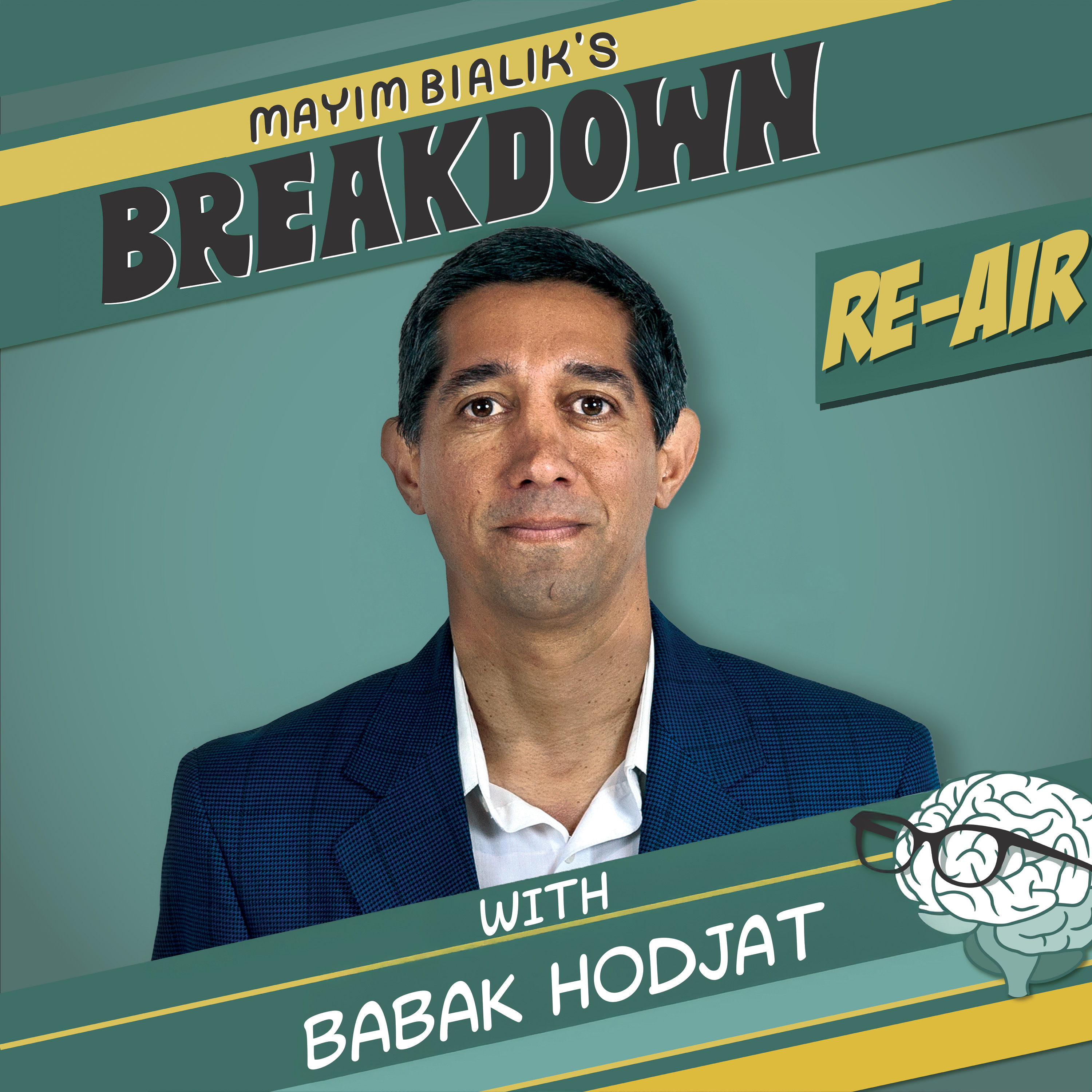
Hi, everyone, and welcome to Mayimbialics Breakdown. I'm Jonathan Cohen and I'm here today to share a very special conversation that I had on my personal Substack page, practical Spirituality. I'm sharing it today because it is such an important topic, and for me personally, it is a fascinating look into the world of. Of artificial intelligence, how it's shaping our world and where we are all going next that we may not even realize we're going. We're talking today to Babak Hojat. If you don't know his name, you absolutely know his work. He's the primary inventor of the natural language technology that became Apple's Siri. He holds 39 US patents, and he's the chief AI officer of the the company Cognizant. He has a PhD in machine learning, and he started thinking about an economy of agents, what we now call Agentic AI back in 1998. Why is this important? Well, we unpack it in the conversation. Right now, our world is being set up for AI agents to take on tasks, communicate with one another, and very quickly to act on our behalf. What does that look like? Well, it could mean that they book
- [01:27]
Mayim Bialik
a flight for you.
- [01:28]
Jonathan Cohen
They may have access to your credit card to do tasks for you, to do personal shopping, to order your groceries, to schedule doctor's appointments, to run your household. We also talk about what does it look like in the near term midterm, in terms of the job markets? What type of disruption should we be expecting? Are we concerned about the concentration of wealth amongst only a handful of large companies that control these AI systems? And ultimately, what our AI does is a reflection of our own humanity. AI is programmed with the views, beliefs and priorities of the people who program it. So should we be worried about AI taking over?
- [02:14]
Babak Hojat
Should we?
- [02:15]
Jonathan Cohen
The real question might not be about the AI itself. It's actually about us. If you like this conversation, check out the Practical Spirituality Substack page or Mayim Bialik's breakdown on Substack, where we explore the intersection of science and spirituality. And there's a growing Breaker community that convenes there. Please enjoy this conversation with Babak Hojat.
- [02:39]
Alex Breakdown
Break it down.
- [02:42]
Babak Hojat
Queen Carvania stood haloed by the morning sun. An army hung on her every word.
- [02:49]
Alex Breakdown
My champions, I have sold my chariot on Carvana. Twas a lovely suv, an inexplicably queenly offer. They're even coming to the castle to collect it.
- [03:02]
Mayim Bialik
Tonight we feast.
- [03:06]
Alex Breakdown
An offer you can feast, feast on.
- [03:07]
Mayim Bialik
Sell your car today on Carvana. Pickup fees may Apply maybe Alex Breakdown
- [03:12]
Jonathan Cohen
is supported by Helix Sleep.
- [03:14]
Alex Breakdown
We were so excited to hear that Helix wanted to partner with us. I've had my Helix mattress for I think it's close to six years now, and it helps me sleep really, really great. Jonathan and my kids also have Helix mattresses. Everybody loves them. And all of those issues, night sweats, back pain, motion transfer, all of those things are completely gone. Helix Sleep makes premium mattresses and bedding that are customized to fit your personal needs and they're conveniently shipped to your door. I was so happy with their shipping process. I even ordered my son a new mattress when he needed one. It shipped right to his apartment. It's amazing. Helix combines innovative tech with high quality materials to deliver comfort and support. They offer soft, medium and firm mattresses. There are different options. Are you a side sleeper, a stomach sleeper, a back sleeper? Helix Sleep mattresses have a supportive hybrid design. You can choose to elevate your mattress with premium cooling options. The Helix line, plus unique mattresses to choose from, any variety of mattress toppers. Helix has a sleep solution for just about everyone. Go to helixsleep.com breakdown for 20% off site wide, 25% off Luxe mattresses and 30% off Elite mattresses. That's helixsleep.com breakdown for twenty percent off site wide, 25% off luxe mattresses and 30% off elite mattresses.
- [04:26]
Mayim Bialik
Helixsleep.com breakdown for someone who doesn't know a little bit about your background, I do not have a full bio for you, but I do know that you were a foundational person in the invention of the technology that became Siri. Can you give people a quick snapshot to just orient them to your background?
- [04:47]
Babak Hojat
I was the main inventor of the natural language technology in Siri. I started a company in 98 called Dejima and we built natural language interfaces using an agentic system. Not too many people know that the original Siri was actually multi agentic, while those agents were very different than the agents that we have today. You know, obviously we didn't have a large language model as the brain of those agents. A lot of the mechanisms do carry over. Those are things that we actually have implemented now in our multi agentic platform, which we've open sourced. And a lot of it borrows from some of the work I did in 97 and 98, believe it or not,
- [05:32]
which was actually within AI circles was
- [05:35]
the heyday of agentic systems. There's a book published that became the textbook on AI. I taught it actually in Japan called Artificial Intelligence. A modern approach. And modern, which was in the 90s meant agentic approach.
- [05:53]
So for some of us, agents have
- [05:55]
been around and that concept actually I think dates all the way back to Turing.
- [06:00]
Anyway, back to me. I have a PhD in AI.
- [06:03]
I've done several AI startups, I've worked in larger companies. I've always been in AI, always done AI straddle research and development and strategy and all that kind of fun stuff.
- [06:15]
Mayim Bialik
Some people are already asking what is agentic? Which we're going to cover, we're going to get to. But before we talk a little bit technical, which is where the future of this technology is going. What was it like from your perspective in the late 90s? A lot of people were not using email at that time. Right. So like what was the landscape that you were like, oh, we can do something where people are going to be speaking to the computer. Like what was going on for you? That, that it was either obvious for you or you were like this, this is the next wave that I want to pursue. Like what was happening.
- [06:50]
Babak Hojat
Yes, it was very, very ambitious of
- [06:53]
us actually at the time. Natural language is famously the first non numerical application of computers. Like people try to get computers to understand our language from the get go and they failed and they failed miserably.
- [07:11]
A lot of folks followed approaches that
- [07:13]
were grammatical and let's come up with the grammar of natural language and try to kind of parse natural language and understand what it means. And that, that failed. It was too rigid and it was
- [07:24]
too complex at the time.
- [07:26]
In 97 I got into it through a misunderstanding really. I was looking for real world applications of multi agent systems and my professor at the time in, in Kyushu University in Japan said why don't you form a agentic soccer team? And you know, RoboCup had just started so you know, enter that. And I was into soccer and I
- [07:51]
was starting to think about that when
- [07:53]
a friend of mine misunderstood what I meant by agents and thought agents are, you know, human representatives that understand us and can do things on our behalf,
- [08:02]
which now that is a real definition.
- [08:06]
Back then it wasn't. And it was audacious to think that agents would be able to understand us. And so I kind of made fun of him a little bit and I said, I think you misunderstood what I meant. And he said, well, if you think agentic systems are that powerful, why can't they just understand me? And that was a, that was a challenge that I took to heart and I worked on it and I realized that you can actually understand natural language.
- [08:29]
Over multi agent systems and they representing the domain of discourse. You know, you have agents representing various
- [08:36]
different functionalities in your system. You can actually build that system and it works really, really well, to my surprise. So we, we started that off and, and led to Siri and at the
- [08:47]
time, like the holy grail was programming
- [08:49]
your, your vcr, your video cassette recorder, which is where you play videos and,
- [08:57]
and you know, those sorts of things. Setting up a meeting, it's still a holy grail.
- [09:02]
Like, you know, it's set, setting up a meeting and coordinating meetings between multiple people and working out how your zoom or team is still complex and like
- [09:12]
translating that into like a single command
- [09:15]
that says, you know, I want to meet Jonathan next week sometime and go figure it out.
- [09:20]
Mayim Bialik
There's a lot of steps involved in
- [09:21]
Babak Hojat
that that are many steps involved, very complicated.
- [09:25]
Mayim Bialik
Like I have to check if you're available. We have to go back and forth. We have to match the calendars because it can't see your calendar.
- [09:30]
Babak Hojat
Like we actually had a system like that working.
- [09:33]
We were part of the DARPA project. Kalo Siri kind of came out of that. And I think year two of Kalo,
- [09:42]
we set up a system where you would pick up the phone, talk to
- [09:47]
an AI based system and say, set up a meeting with Adam and Joe and Mary and whoever and then hang up.
- [09:56]
And if it had access to your, if it had access to your calendar, if it had access to your friend's
- [10:01]
calendar, it would look it up. If not, it would send them an email and if not, it would actually call them. So your phone landline back then would ring and you would pick it up and it was this, you know, assistant asking you, you know, whether you can make it to a meeting and what time you can make it.
- [10:17]
So it would actually coordinate all that, all that was happening without you knowing.
- [10:20]
You just said set up this meeting.
- [10:22]
And then it would show up on your calendar and on the day you would go into the conference room, didn't
- [10:28]
have to do anything, the conference phone would actually ring. You answered it and everybody was there
- [10:34]
and we demoed it and everybody was like, oh my God, this is it, this is, this is the future. But of course, we don't have that. Even today. Even today.
- [10:44]
Mayim Bialik
What year was that?
- [10:46]
Babak Hojat
This was 2000,
- [10:49]
I want to say three or four.
- [10:52]
Mayim Bialik
Okay, let's talk about the speed of progress and the development of technology and how you could have something like that. And yet it's not rolled out. So a lot of this technology comes out of DARPA and DARPA grants. As you mentioned, Siri came out. When Siri was developed, were there aspects that got watered down in order to commercialize?
- [11:14]
Babak Hojat
Big time. Big time. You talk to the founders of Siri, my friend Adam, my brother cmac, those guys, Nick Treadgold, still at Apple, they will tell you that the original Siri app that was not part of Apple was more powerful, had many more properties and aspects that were watered down and it had a roadmap that was amazing. And then when it got into Apple
- [11:44]
they kind of went for quality over
- [11:46]
breadth and then there were issues with oh yeah, we want to exclusively own this and we don't want to own that and all that kind of stuff that water did down significantly and then other things happen and Siri today is not the best assistant out there. But yeah, when, when you have the idea and you know you're left to your own account, you you come up
- [12:06]
with things that are, I think much
- [12:08]
more powerful and interesting. And then reality hits and maybe Alex
- [12:15]
Jonathan Cohen
Breakdown is supported by AG1 it's summertime
- [12:18]
Alex Breakdown
and that means sun, vacations and changes to your usual routine. We're so excited to take a break from our regular hustle and bustle, but sometimes that means we take a break from good habits too. Except for the 30 seconds it takes to mix AG1 one scoop plus 8 ounces of water every morning. AG1 AG1 is a healthy drink with multivitamin, pre and probiotics, superfoods and antioxidants. 1 Scoop 8 ounces of water ag 1 helps to maintain energy, support gut health, and support immune health. It's clinically shown to support gut health and fill in common nutrient gaps. Summer may be your license to chill, but with all the late nights, long weekends and spontaneous plans, AG1 helps you keep one thing consistent high quality nutritional support every single day, no matter where you start your morning. The next gen formula delivers 75 plus ingredients clinically shown to support gut health, fill common nutrient gaps and improve key nutrient levels within three months. AG1's comprehensive nutrition provides nutrients that support our bodies, our brains and our gut health all in one scoop. We are so thrilled to use it every morning and glad that it's gonna support our immune defense as continue planning our travel summer vacations. Visit drink ag1.com breakdown to get a free ag1 travel case with seven free ag1 travel packs in your welcome kit with your first ag1 subscription order while supplies last. That's drink ag1.com breakdown.
- [13:36]
Jonathan Cohen
My MB Alex breakdown is supported by Incogni.
- [13:39]
Alex Breakdown
Over the past year, data Breaches increased by more than 200%. Your name, past addresses, phone numbers, even court records can be collected and sold by data brokers. The easier you are to find, the more vulnerable you are to scams, identity theft and harassment. Privacy isn't about paranoia, it's about peace of mind. And that's why we partner with Incogni. Incogni works on your behalf to remove your personal data from data brokers and online databases. And their custom removals feature goes even further. If you find a specific page or listing that concerns you, you can send them the link and a dedicated privacy specialist will handle the takedown process directly. It's simple. Create your account, provide one time authorization and let Incogni do the work. Incogni is the only data removal service independently verified by Deloitte and offers a 30 day money back guarantee. If you're satisfied, you can cancel at any time.
- [14:25]
Mayim Bialik
They can't harm you if they can't find you.
- [14:27]
Jonathan Cohen
Use code mime@incogni.com mime and get 60%
- [14:32]
Mayim Bialik
off an annual plan. That's incog.com mayim so just for anyone who hasn't built technology, the roadmap is where it can possibly go, starting with the core basic features and then all the lists of, hey, we could do this, add this Lego block and expand its capability. So when it got watered down like that, is it because there, when you say they were trying to prioritize control or you know, repeatability, was it that it just became less reliable as more things were added? Was it about bandwidth at the time where Internet didn't have as much capability? Was it about battery life of the phone, like what's which of those constraints made it have to sort of pair off some of the capability.
- [15:15]
Babak Hojat
Siri was supposed to be sort of
- [15:19]
a growing ecosystem of features.
- [15:21]
The original Dejima system also was, was
- [15:24]
supposed to be extensible.
- [15:26]
So you had these agents, these semi
- [15:30]
autonomous AI systems that have a responsibility, they look at their state and they
- [15:36]
make decisions within a certain scope that's, that's an agent. Basically you had these systems, the coordination mechanism between the agents.
- [15:46]
So the way they spontaneously decide who
- [15:49]
needs to do what and how they
- [15:51]
respond to a command from a user
- [15:54]
allowed them to be extensible. In other words, you could add more agents in without having to re engineer everything else. So the domain of what you could do could potentially keep expanding. And so the idea was just like
- [16:07]
the Internet, as you add more apps and you add more pages, there's more value you're creating and adding to the system. It was supposed to be this Internet of agents that comes together and kind of expands.
- [16:22]
When it ended up being owned by
- [16:24]
Apple, that started watering down means that
- [16:28]
it became a very engineered and centrally
- [16:31]
controlled set of features. And the breadth was very, very controlled.
- [16:36]
And so it took away a lot
- [16:37]
of what we had in mind as far as this, its organic growth.
- [16:41]
Mayim Bialik
When I listen to that, what I hear is that you were actually envisioning where AI is going now back before 2000.
- [16:49]
Babak Hojat
Yes, but I can't credit, I can't take credit for all of this. I mean, the fact is that the Internet was brand new in the 90s. There was no very good search engine at the time.
- [17:02]
So Google wasn't around yet. And there was altavista and some search engines that weren't that good.
- [17:08]
And there was still this tug of war between, you know, let's organize the web.
- [17:13]
You know, Yahoo's whole thing was like, let's organize everything for you. We organize the web for you versus searching it.
- [17:21]
And there was this third alternative that
- [17:22]
the AI folks were looking at was,
- [17:24]
okay, what if we have agents, like on behalf of you, they go browse
- [17:28]
the web and they're specialized in finding certain things or certain apps or whatever, and they go off and do that for you and come back.
- [17:36]
It felt like a natural progression. Also, we had failed in creating AI. There was a point of folks in AI who had grand visions of creating
- [17:48]
a generally intelligent system that operated in our human world and was as smart as we are, came to the recognition
- [17:55]
that with the processing capacity and technology of the time, they just can't do that. The world is way too complex. And so what they decided was, let's simplify the world within which our artificially intelligent systems operate and let's call that an agent. And so these two kind of came together. The web, which at the time was
- [18:15]
very simple, you know, text and hypertext
- [18:18]
and some images with the connections and everything, that's a simplified world. And then you have agents now that
- [18:23]
are operating in that world, which is much, much simpler and tractable than our human world.
- [18:31]
So those two things kind of naturally came together and there was a big
- [18:35]
push in creating agentic and multi agentic systems, having them coordinate and having them do things on our behalf and be semi autonomous.
- [18:42]
I mean, I played a small part in that.
- [18:44]
But at the time it felt a very natural extension within the world of AI. By the way, the world of AI was very, very small. Not that many people were in that world back then. I started most of my Presentations with a slide, just basically saying, you know, what is AI? I don't have to do that anymore.
- [19:05]
Mayim Bialik
Well, let's talk about where it has gone and the moment that we're in right now in artificial intelligence. There's obviously the birth of the large language model has made it so that almost everyone is interacting with AI, either all the time or it's running parts of their phone, their maps. Like, you can't almost not interact with some version of it. The most common version is the one that we're all typing into. We had a conversation with Mustafa Suleiman and he says and confirmed that from his perspective, the largest use of artificial intelligence right now with a direct consumer framework is for advice on mental health and your life. Could you have imagined that back in 2000 that people would be interacting directly
- [19:53]
Babak Hojat
in that way in 2000? Well, imagining was easy.
- [19:58]
And in fact, I think in some paper that I published, I had this whole schema of you, like asking for Entertainment from your TV and your TVs agent, then talking to the broadcaster and that, going out and finding like that,
- [20:13]
that sort of like economy of agents
- [20:16]
where agents represent different entities.
- [20:19]
That was all the way back.
- [20:20]
I think it's actually even 98 or 99. In that original paper. We, we kind of talked about it.
- [20:26]
Imagining it was easy.
- [20:28]
Actually making it work was very, very hard.
- [20:30]
And so in a contained, limited way,
- [20:33]
we kind of achieved that with things like Siri Dejima and Siri.
- [20:37]
It was only in the past few years where we've come to this major
- [20:44]
Mayim Bialik
breakthrough, the large language model.
- [20:47]
Babak Hojat
Yeah, so large language models kind of happened and we were all actually in
- [20:54]
the world of AI, it was a very common benchmark. So people were actually trying out. Large language or language modeling was a benchmark basically predicting the next word in the sequence of words.
- [21:06]
It has some properties that makes it
- [21:07]
a very interesting benchmark, including the fact that you don't have to go off and label data and do all of that. So people were working on that, but
- [21:16]
folks in the neural network world came up with a fascinating architecture, basically the
- [21:23]
way to create this neural network and connect the neurons in this neural network.
- [21:28]
It started doing very, very well on language modeling to the point where it was so contextually correct in predicting the next word and the sequence of words that people thought, oh, maybe it's actually learning much more than just like predicting a word. Like, it's forced, in order to be able to predict the word, the next word in a sequence of words, it's forced to understand the world. That's a big leap. You don't kind of think, okay, you know what? I'm going to set up a machine learning system that tries to predict what's
- [22:06]
the next word in a sequence of words.
- [22:08]
And I know that if I do that it will learn the world and
- [22:11]
learn to talk about the world the way us humans do, and it will learn language and learn how multiple languages and how to translate between them, and it can do poetry, and it can be empathetic, and it can actually solve
- [22:23]
math problems and it can do reasoning.
- [22:26]
No way. No one, no one expected that. If anybody says otherwise, they're lying.
- [22:32]
But it happened. It happened. And it turned out that there are very simple scaling laws. So you take that system that's doing so well on language modeling, and it seems like it's learning more than just like a statistical prediction. And you grow it, you just throw more neurons at it, you just make it larger. That's it. It's a very simple scaling, and you make it larger and you throw more
- [22:57]
data at it and it gets better.
- [23:00]
And so that's where we are right now. People pouring in money on data centers and all that. A lot of it is because, you know, the bigger these systems are, the better they are. When we got to that point initially people thought, oh, it feels like we've solved the AI problem. So we actually have a system that has all these intelligent properties. I mean, they kind of glazed over some fundamental weaknesses of these systems.
- [23:25]
We can get to those later.
- [23:27]
But generally they seem to abstract the
- [23:30]
world the way we abstract the world. And they understood language and are able to produce language. That's already a lot.
- [23:36]
Initially we thought, okay, so we'll just
- [23:38]
have one large language model and one
- [23:39]
of these like, AI systems, and we
- [23:41]
can have it do whatever we want.
- [23:43]
Turns out it's not, it's not as simple as that. And it turns out that even though you have this generally intelligent model as the brain of your system, you still want to tell it, here's the domain
- [23:55]
within which you operate, here are the tools that you have.
- [23:58]
You have expertise in this particular area,
- [24:01]
be an expert only in this.
- [24:03]
It just makes sense to modularize these systems. Also, again, kind of counterintuitive, you have this generally intelligent brain, which is your
- [24:11]
large language model, but you kind of restrict it. You put it in a box and
- [24:14]
you restrict it and you say, this
- [24:15]
is where I want you to focus.
- [24:17]
It just makes more sense when you think about it. In the world of humans, we do the same. We're all kind of more or less Generally intelligent, but we're all experts in
- [24:27]
various different fields and we come to.
- [24:29]
Mayim Bialik
You can only focus on so much and you can only be successful at so much.
- [24:33]
Babak Hojat
Exactly right. In a roundabout way, we came back to this concept of agents and multi agency just by virtue of the fact that we can take this generally intelligent brain, give it some job description, some responsibilities, some tools.
- [24:48]
You know, you can search the Internet, you can operate this app, you can,
- [24:51]
you know, do this, that and call it an agent. And the moment you do that, the moment you create an agent that's kind of restricted in its scope and you create a second agent that's restricted in some adjacent scope, you want to have
- [25:04]
them talk to each other.
- [25:05]
So in some weird way we came back to multi agency, but this time the agents are super powerful.
- [25:10]
Mayim Bialik
They were like fledgling little babies when you started.
- [25:13]
Babak Hojat
Exactly right.
- [25:14]
Mayim Bialik
Idiot.
- [25:15]
Babak Hojat
Savage. So you don't have to worry about natural language. That's just out of the box. It's there reasoning for the most part is there being able to make decisions in situations that it's never encountered before.
- [25:27]
They're pretty good at that.
- [25:28]
We've come back to that concept of multi agency and building agents, engineering systems of agentic systems. And you know, what it's done is interesting because it's gone beyond just like let's take apps and software and make them agent oriented. We're starting to augment things that humans do.
- [25:49]
Like we are augmenting organizations with agents as well.
- [25:53]
So that's kind of the new frontier because these things are so capable.
- [25:58]
Mayim Bialik
I want to talk about the augmentation and real world interaction, but you said something in this last description of the progress where you talked and you said they're empathetic. And are they empathetic or they've just been programmed to play empathy?
- [26:14]
Babak Hojat
They've not been programmed.
- [26:16]
These AI systems learn from scratch.
- [26:18]
They learn from nothing.
- [26:19]
Mayim Bialik
I want to ask about that because I don't know, I don't really understand it. But when we spoke to Mustafa, he said that they were designed to have the fundamental aspects of nonviolent communication. So they were taught how to sort of be reflective in that way, which sort of mimics empathy versus they can't feel per se. So what is empathy as it relates to a machine?
- [26:44]
Babak Hojat
So there are two parts to this, right? What Mustafa is talking about is the
- [26:49]
after the fact fine tuning of these models.
- [26:52]
So when the model is trained, remember the model is trained just to predict
- [26:56]
the next word in the sequence of words.
- [26:58]
But we need it to react in a certain Way, for example, we need it to react if we're building ChatGPT, for example. In that case, we want it to act as if it has a Persona and it's some sort of like back and forth.
- [27:10]
Mayim Bialik
So it's the front code, the front face of it.
- [27:13]
Babak Hojat
Yeah, Right.
- [27:14]
So even that is something that we fine tune. What does fine tuning mean? So you have this massively, generally intelligent model that can predict the next word in a sequence of words. It can be anything. So you prompt it and it'll continue. And if, if what you prompt it with, in other words, the first few words that you give it are about, I don't know, some, not like evil, whatever. You start off with the beginning of Mein Kampf and say, you know, you know, continue on in that realm and it will continue.
- [27:46]
Right.
- [27:47]
So there's no stopping it because all it knows is I want to come up with words that pass muster. If a human sees it, it's actually in line with what they would continue.
- [27:56]
Right.
- [27:57]
But we don't want that in the real world. There are certain things we don't want it to do. If it's out there for everyone to use. We don't want it to teach you how to do child abus or, you know, how to make a bomb or. So what we have to do this is after that initial training is done, we have to bias it. And that bias is through examples. We tell it, you know, hey, for this input, this response good, this response not so good, you know, so that's at a, at a very, very simplistic level. The way we do some post training,
- [28:31]
fine tuning is what it's called.
- [28:33]
So we bias it to prefer certain predictions over other predictions. And so that biasing regime, which is completely in our hands, like what examples we use and how we bias it, is what Mustafa is referring to where he says, okay, so, you know, we're really biasing it to be in this
- [28:52]
way versus that way.
- [28:53]
Empathy might come through that bias, but it might also be intrinsic to these models.
- [29:00]
Mayim Bialik
This is the interesting point. From your perspective, is it intrinsic if
- [29:04]
Babak Hojat
you're able to bias it to do something today with the approaches that we take, that means inherently it was already there. We just pushed it to answer in a certain way and not in another way. We can't. Typically with today's fine tuning, we can't teach it new stuff. We just take the universe of everything it knows and we bias it towards
- [29:25]
certain parts of that.
- [29:26]
Famously, we lose some of their capabilities
- [29:28]
too with this fine tuning.
- [29:29]
So it gets a Little dumber, but it is more biased. So it does things more in line. We call it alignment.
- [29:36]
So it's more aligned to what as humans we would prefer.
- [29:40]
But that means that intrinsically there was something like the capability of being empathetic was there. We just biased it to be more empathetic more of the time. And so that's one thing from perspective of whether it was there or not. And where did it come from? At the end of the day, it's trained on the corpus of everything that humanity has produced. So if it's empathetic, that's because there's a lot of empathy in what humans have produced. If it's evil, that's because there is evil out there. Let's face it, there are bad things
- [30:12]
out in the Internet.
- [30:13]
We try to kind of sift through
- [30:15]
the training material and not have a
- [30:17]
lot of that there, but there is
- [30:18]
some of it, right?
- [30:19]
So it's a reflection of what we've put out there in the Internet, but abstracted out. So of course it's not memorizing the entire Internet, it's trying to abstract that and have an abstracted view. That's why. And how it can actually produce output, even for input that it's never seen before.
- [30:35]
So that's the learning part of it.
- [30:38]
And how do we know it's empathetic? The only way we have to gauge these systems is through benchmarks and tests. So if we have a test for empathy for humans, we can run it against these systems and see how they score. Is that a perfect way of knowing whether or not it's empathetic?
- [30:56]
I don't know.
- [30:58]
Does it have feeling? Does it have emotions? Really? You'd have to define those things in non ambiguous terms.
- [31:05]
For me first.
- [31:06]
For me to be able to put together a benchmark, to be able to test that.
- [31:11]
Otherwise I don't know.
- [31:12]
And the reason a lot of these answers ends up in I don't know is because no one engineered these systems. We didn't go in and write a whole bunch of rules of how they should behave. What is a neural network? It's just this may huge table of numbers. When I say huge, it's like trillions of cells, right? Just numbers. So if I, if I show you an Excel sheet with trillions of numbers, you also say, I don't know. If I tell you this Excel sheet is what produces this output that seems to be empathetic and I ask you how does it do it? You're just going to stare back at
- [31:50]
me and go I don't. It's just a bunch of numbers, right?
- [31:53]
So that's the reason it's an inherently black box system. And so we don't understand exactly why
- [31:59]
it works, why it has these properties.
- [32:02]
Mayim Bialik
Do you use please when interacting with your agents?
- [32:07]
Babak Hojat
I do. Part of it is just, you know, you anthropomorphize these systems very easily and it's somehow like your whole reward system triggers when it does something and you really, really love it and you just can't stop yourself.
- [32:19]
Right?
- [32:19]
So part of it is that. And you're wasting a bunch of tokens
- [32:22]
and all that over it.
- [32:24]
Part of it though is that there are techniques to get these systems to work. Well, there's this whole science of prompting now and there are people that are better at prompting these systems, basically typing
- [32:36]
in some stuff to.
- [32:37]
To get it to answer or behave
- [32:39]
in a certain way.
- [32:41]
And there are people that aren't that good at it. It turns out that certain keywords help. This is actually an experiment I'm running right now. If you tell the system it should try these various different things and then there will be an exam, it does better than if you say, you know, we will try these different things and
- [33:01]
then I'll ask you a question. Okay. I mean, it's the same thing.
- [33:04]
You told it.
- [33:05]
It's an exam. Somehow it pays attention.
- [33:07]
Mayim Bialik
It's going to try harder.
- [33:09]
Babak Hojat
It's going to try harder, harder. If you say please. I feel like some of these words
- [33:14]
do help, but I don't know about
- [33:15]
please, but I do know about the exam thing. Repeating something in different ways does help. Repeating the exact same prompt twice or
- [33:23]
three times somehow just makes the system better.
- [33:26]
So there are these idiosyncrasies that you learn about how you should prompt these systems. So a please is not necessarily wasted
- [33:34]
is what I want to say.
- [33:36]
Jonathan Cohen
Mind Bialix Breakdown is supported by I
- [33:38]
Alex Breakdown
N D S. Are you fascinated by near death experiences and related phenomena? Do you wonder what they might actually reveal about consciousness, life and death? Well, this August, nearly 1,000 people are expected to gather in Bellevue, Washington for the International association for Near Death Studies annual conference. The conference features an all star lineup of speakers including Eben Alexander, M.D. and author Anita Moorjani. Attendees will explore NDEs through research, personal experience, mental health and the expanding study of consciousness. The event also includes continuing education for professionals, a healing center, the exhibit floor bookstore with author signings and a Saturday night social gathering. Early bird registrations available through July 15th. Visit iands.org join a powerful community of Experiencers, researchers, professionals and curious minds.
- [34:33]
Progressive Insurance Announcer
Insurance isn't one size fits all. That's why customers have enjoyed Progressive's name your price tool for years now. With the name your price tool, you tell them what you want to pay and they'll show you options that fit your budget. So whether you're picking out your first policy or just looking for something that works better for you and your family, they make it easy to see your options. Visit progressive.com find a rate that works for you with the name your price tool. Progressive Casualty Insurance company and affiliates Price and coverage match limited by state law
- [35:04]
Progressive Truckers Announcer
Ever wonder who's out there making the world go round? It's truckers. Who unites baristas with coffee beans. Truckers. Who unites dogs with their favorite chew toy? Truckers. That's why Progressive offers truckers even more protection with cargo plus coverage to keep truckers moving right along. Quote Truck insurance today in as little as 8 minutes at progressive commercial.com progressive casualty insurance company and affiliates. Coverage subject to policy terms, limits and conditions not yet available in California, New York and Virginia.
- [35:33]
Mayim Bialik
I mean, I have no data on this whatsoever, but I notice that I am giving my system positive reinforcement when it does something I like hoping that it will like that. Positive reinforcement. I have no idea if it responds to that. Within.
- [35:46]
Babak Hojat
Yes. Within the system, same chat. Yes, it is because it will see your prior responses and all of that is collectively the input that allows it to give you the next output. So if within that single chat you use some of these words, it is effective across chats. Typically it is not unless they play some, some, some tricks. Which brings us to the fundamental flaw of these systems. They do not learn from lived experience. So some people tell me there is this like common mistake that. Oh yeah, you know, if we talk to it this way or if we
- [36:25]
do that, you know, it'll learn or
- [36:27]
it'll learn about us and then, you
- [36:28]
know, OpenAI or you know, Gemini or whoever will end up knowing about us or whatever. No.
- [36:34]
Unless elaborately collected. So if, if your data, if you allow these companies to collect your data and then do fine tuning or training of newer versions of the LLMs using that data, your immediate feedback is not going to have a long lasting effect. The analogy I use is the movie Memento.
- [36:56]
Have you seen Memento?
- [36:57]
Yeah, so this guy has short term memory issues, wakes up, has forgotten everything, right? And so it has to be told everything all over again. He starts putting tattoos and notes and stuff like that. It's almost exactly the same. So the model when you start talking to, it knows nothing. You know, it has its prompt and you know all that kind of stuff, it's tools. And you start talking to it and you kind of bring it into the context of what you need it to do for you. But if you turn it off or you go away and come back and start a new session, none of that is there anymore.
- [37:29]
You have to remind it everything all over again.
- [37:31]
So concepts like, oh, the agent memory. There is no such thing as memory. It's just repeating the whole thing all over again in the input. And these things now have rather large input windows. That's a fundamental limitations of the AI.
- [37:47]
Mayim Bialik
Are we going to break through that limitation and is it about storage and capacity and just volume or are they fundamentally unable to based on their core design?
- [37:56]
Babak Hojat
So currently there's a brute force path that people are taking which I think
- [38:01]
will not scale and will not result in solving the problem satisfactorily, which is
- [38:06]
let's grow and grow and grow that input size of the input that we
- [38:11]
can give to the model.
- [38:13]
So it's at, I don't know, 2 million tokens. Now let's go to 5 million tokens, I don't know, a billion tokens. When it's large enough, we can just feed it everything like the, its entire memory and everything is in there. If it's still smart enough, it'll take all of that every time and process it. And so in the, in the context of all of that, it will have
- [38:33]
a notion of memory.
- [38:34]
So that's the brute force scaling way of doing it. It's costly.
- [38:39]
I don't like that approach.
- [38:41]
But the other approach would be to allow these systems to learn on the job rather than learning offline, you know, in batches of like basically a snapshot
- [38:51]
of the Internet being fed to them over and over again.
- [38:54]
That's how we train these systems. So rather than doing that, you know, what if we started the system like a tiny little baby with very little, you know, starting point knowledge, but as it interacts with the world, it kind of learns. It's slow babies and humans are very, very fast at learning. So the learning mechanism is not back,
- [39:17]
back propagation the way we're using in neural networks.
- [39:20]
So we'll have to discover inventory, some
- [39:22]
new way of doing that.
- [39:24]
As humans, you know, you, I tell you one thing right now, one time and it changes your mind forever. These systems don't have that. So it will take some fundamental rethinking
- [39:35]
of the architecture of AI to enable it to learn.
- [39:39]
Mayim Bialik
And I think that's what people get frustrated with is because they feel so much like a human so much of the time when you're interacting with them. And then they fundamentally have this momento style memory gaps where you're like, why can't you understand me? And it feels very frustrating, as though it's choosing to be disobedient versus it has a fundamental.
- [40:03]
Babak Hojat
That's right.
- [40:04]
Mayim Bialik
In its interaction with you.
- [40:06]
Babak Hojat
So that's part of it. You're right. There are two things that. That sets it apart, I think two, two big things that sets it apart from human intelligence. That's why some of us in the AI community think of it as a different kind of intelligence. One of them is this. It's the fact that it doesn't learn from lived experience. Related to that is the fact that it's generally intelligent. What does that mean? That means depending on the input, it will give you a different output. If you tell it that it is a French sous chef, it becomes that we don't become a French chef if someone tells us that we have to go learn it.
- [40:41]
Right.
- [40:42]
But. But you're like, who are you really?
- [40:44]
Mayim Bialik
Who are you really?
- [40:46]
Babak Hojat
Exactly right. Exactly right. It has all of that in its model. And you kind of tell it that now you're this. And then it becomes that that's a fundamentally different intelligence than what were you.
- [40:57]
Mayim Bialik
It's like dating a bad actor. You can never really get to know them. They're constantly playing a part.
- [41:03]
Babak Hojat
Exactly. So because they anthropomorphize in a way that they think this thing, this being is similar to us, but they run into lack of consistency or they run into issues where it says something that they. They didn't expect or behaves in a way that they didn't expect. It might actually be their own fault. It might be that through the dialogue and so forth, they veered it to be something else. It can change its entire character and personality and the way it reacts to you depending on how you know what is in its input. As humans, we are one like, at least we think we are. And in any snapshot of the moment, we have some more integrity as far as our character is concerned.
- [41:51]
Like we are.
- [41:52]
That is still fluid and changes, but it's really not at the same level of these systems with one word. It can just change its character.
- [42:00]
Mayim Bialik
The likelihood of me responding in a similar way is far greater than the system is. Like, I'm all. My reaction is going to be just like this, you know, 1 to 10, where its reactions are going to Be exactly there.
- [42:13]
Babak Hojat
There are consistencies known or unknown to you, like conscious or subconscious, in your
- [42:19]
behavior, in your character.
- [42:20]
There are consistencies that transcend your behavior over time. They can still change, but they're there. Like your value system, right? You kind of try to stay true
- [42:31]
to your values more or less.
- [42:33]
Most of the time non aligned systems don't have a value system. You kind of have to give it to them.
- [42:41]
Mayim Bialik
In 2002, I was at a school where Ray Kurzweil came to speak. Because it was a school that was built on the technology that he designed, which was the Kurzweil 3000 text to speech program, which absolutely changed my life. Because I was an auditory processor. I was a very slow reader. I could not get through school with the amount of texts, especially in undergrad with these massive texts, all the generalized knowledge. I couldn't break down that material. And so I got to that school and finally I felt like this excitement for learning in life that I'd never had before because I was able to. They scanned the books, our textbooks, they chopped the bindings off, scanned them and then digitized them and then we're fed them back through the Kurzweil system. And Ray came to talk and I didn't really, I didn't have a cell phone at the time. And he was talking about how we will all be carrying computers more powerful than NASA's most powerful computers. And he talked about uploading our consciousness to the cloud. And it sounded totally like science fiction. And of course now I'm speaking to you on such a computer that was more powerful than machines that used to take up the entire room. What is happening now that people may not realize that AI is already doing? And like, where are we going? Where are these agentic systems going? And I know it's a really, really big question and it's hard to like pull back to the specifics, but like we already know that it's, it's impacting medical care, that doctors are, you know, being augmented in their diagnostic decisions, often for amazing benefits. We know that insurance companies are using it to analyze risk in, in very specific ways, sometimes to maximize profits, and that's a concern. But also to, to help sort of expand care and treatment. Talk to us a little bit about like where we are right now and where we're going in a way that feels like very personal to people's lives.
- [44:32]
Babak Hojat
First, a caveat. Unlike Ray Kurzweil, I'm not a futurist. In the 90s, he set up this
- [44:39]
conference, invited all the AI folks and, and most of us made fun of him with his wild, wild predictions.
- [44:49]
Mayim Bialik
It felt like too unreal, like the promise wouldn't happen.
- [44:52]
Babak Hojat
Absolutely. It's not in our lifetime, you know, what are you smoking? That sort of thing. A couple years ago, I was having dinner with him at a Time 100 gala. I went up to him and I said, I want to apologize. You were right, we were wrong.
- [45:08]
Many of your predictions, having said this, and with all the respect I have for Ray, there is this thing as confirmation bias. And when you have many, many predictions that seem to be a logical progression from where you are, the ones that
- [45:25]
you get right, people will remember and the ones that you don't get right, people will let slip.
- [45:31]
So just putting that caveat out there. Every once in a while I fund it on TV and they say, you got this whatever thing right?
- [45:39]
I'm like, okay, yeah, but how many
- [45:40]
things did he get wrong? And just because that one thing he
- [45:43]
got right, now he's like big.
- [45:45]
Anyway, just, just putting that out there. Having said all of this, I think Ray, it came from a position of knowing he was actually, he's a great
- [45:53]
scientist, he was working in AI and
- [45:56]
so it was informed predictions. I still don't subscribe to some of
- [46:01]
the predictions he made in the, in the 90s and I do think some of them are still very wild and out of reach, including, you know, uploading consciousness and all that kind of stuff.
- [46:09]
But in the shorter term, I think we will have agentic systems as the fabric of our companies and soon the fabric of our society. So we will have agents augmenting what we do. We will let, we will have them go off and do things for us.
- [46:23]
You know, it's already starting to happen with shopping and, you know, travel and stuff like that.
- [46:28]
Except that right now it's like the agent that I use is going in on my behalf, going to some website or some API and doing the shopping for me or at least giving me, I'm still not comfortable giving it my credit card.
- [46:40]
So it gives me like the top three and then I decide.
- [46:43]
But you know, it'll, it'll. As we trust these systems more, you
- [46:46]
know, we will entrust them with our credit cards.
- [46:49]
But it's also going to be two ways. So it's not my agent going off to an API, it's going to be my agent talking to another agent. So an agent may be representing the travel agency and so forth.
- [47:01]
So more and more of the fabric
- [47:03]
of what we know of the Internet is going to be the worldwide agentic web. There's actually an effort around this out
- [47:10]
of MIT Project Nanda that we're collaborating with that is starting to put this together.
- [47:16]
So I think in the shorter term we will see more and more of this. We will swing between trusting and over trusting and then not trusting at all, as bad things happen as usual with technology. So there is some of that. I think it's going to be hugely
- [47:31]
disruptive to jobs in the short term,
- [47:34]
in the long term, I do think that we're all going to be busier.
- [47:37]
In the very long term, I don't know.
- [47:40]
And a big question that I have
- [47:42]
is whether or not the way we've set up society and we've defined progress
- [47:47]
and we've defined value, has the capacity to allow for this amount of autonomous
- [47:52]
intelligence being pumped into it.
- [47:54]
I don't know that we see the implications of that. So there are, there's this darker side
- [47:59]
that we absolutely need to avoid and then there's the lighter side. You mentioned things like breakthroughs in medicine
- [48:05]
and care and climate and efficiencies, technologies
- [48:09]
that will help humanity.
- [48:11]
It is an inherently democratizing technology. So we have a choice. I do see this bifurcation, a little
- [48:18]
bit of, oh, you know, if you're
- [48:20]
on the left side of the spectrum of politics in the us, you're anti
- [48:25]
AI, whatever that means. And if you're on the right, you're pro AI.
- [48:28]
Just that's totally meaningless. We need to pick our battles for humanity and we need to use our most powerful tools in this realm. So for us to say we're anti
- [48:38]
AI and not use it at all puts us in a huge, huge, huge disadvantage. I'd rather use AI for the good of humanity.
- [48:47]
Mayim Bialik
Very hard to consider, sort of pulling back to a point of not using it. One of the things that we've touched on or you're alluding to is like the notion of energy and the changing potential of making the energy grid far more efficient. Battery storage. We talked with Mustafa. If there's like a 10x increase in battery storage, what does that do to energy costs around the world? And then what does that do to the rest of the economy? Lowering costs of goods and services, of food production could be a massive, massive change.
- [49:20]
Babak Hojat
Yeah, Mustafa actually did this when he
- [49:22]
was still at Google. They actually optimized their data center energy
- [49:28]
consumption and saved a ton of money
- [49:30]
for Google just with that one project. And that was actually, I think, even before the advent of LLMs, if I'm not mistaken.
- [49:36]
Mayim Bialik
You know, it's hard for anyone, especially people who are not in the field, to understand the massive leaps forward that it could provide, the protein fold experiments and so understanding finding breakthrough cures for diseases, thinking about energy, thinking about infrastructure. What do you think in terms of like finding solutions? Like one of the things that humans are the worst at is working together. Globally, we seem to be constantly divided. Do you see any hope for that?
- [50:08]
Babak Hojat
When we simulate environments in which we
- [50:12]
have autonomous agents working together, only autonomous agents working together, one of the problems we run into is that they're too nice with one another, so they don't
- [50:23]
quite simulate how humans behave. And that's kind of surprising.
- [50:27]
I, I there was a researcher presented here at our lab and he was
- [50:32]
trying to get agents to mimic how
- [50:35]
news disseminates, depending on your
- [50:40]
political tendency,
- [50:41]
whether you right or left.
- [50:43]
And he had actual data from news,
- [50:46]
for example, with respect to vaccines or
- [50:48]
Covid or whatever else, and how that
- [50:50]
news kind of disseminated between different groups.
- [50:54]
So he actually had real data on real people and how they react. And then he had this whole ecosystem of AI agents mimicking people. And in their prompts they were told
- [51:05]
like, you're a Democrat or you're a Republican or you're right or left or whatever.
- [51:09]
And so giving them some of that. So there's a tendency that the news comes out and each side views it their own way and, and there's some like biases in the way the news disseminates, but after a while when, when
- [51:21]
there's more and more follow up news,
- [51:23]
everyone ultimately ends up with kind of the fact that some slower, some faster,
- [51:29]
depending on their biases.
- [51:31]
But that tendency, that convergence happened much,
- [51:34]
much faster with LLMs than with humans.
- [51:37]
And Mustafa talked to you about bias as well, right? If we're actually teaching our intelligence systems and trying to align them to be kinder and nicer and more rational in their thinking and then augment what we do and go off and talk to other agents to get something done, we might actually be in a better place than we are today.
- [52:00]
Mayim Bialik
If we're not bringing a radicalized perspective or deeply felt emotional hurt into an, into a situation, we may end up with two agents negotiating to a better outcome.
- [52:13]
Babak Hojat
Exactly right. There's this whole thing about oh, SaaS is dead, the UX or the brand doesn't matter as much. The reason for that is because your agent isn't really looking. It's not like mesmerized by the brand
- [52:23]
and how nice it looks or the ads that it's seen on billboards. Anymore.
- [52:27]
It's looking at the quality of what is being offered and the price at
- [52:30]
which it's being offered.
- [52:31]
So that's kind of taking away a lot of the human bias in that decision making. So, okay, that's the positive side. Obviously these agents could also be doing harm.
- [52:41]
I mean, it depends on how they're
- [52:43]
aligned or misaligned and who's controlling them. At the end of the day though, Jonathan, it all comes back to us. It's a reflection of humanity like so I don't think we can get away from trying to fix our biases and our deficiencies and AI systems will only
- [53:00]
be a reflection of that.
- [53:02]
Mayim Bialik
Beautifully said. A couple things just for the audience. There is a lot of evidence of AI catching cancers a lot faster, solving pancreatic cancers, which can be a very hard one, coming up and giving increasing access especially to like skin diseases by just sending pictures. It's like kind of amazing, the democratization just on, on the physical health level, on the mental health level. As we interact more and more with these models, people are finding out more about themselves. It's a fun exercise to be like, tell me what you I don't know about myself exercise. I did that recently and I was like really impressed by some of the insight that it had. I did not like its suggestions what to do about what I didn't know. But it's actual insight into me. I found like, when else would I have gotten that, like you're playing Frogger on my machine as an 8 year old wouldn't have gotten me any insight about myself. You mentioned something about the world maybe not being set up for this type of agentic system.
- [54:07]
Babak Hojat
Just imagine if you have agents running
- [54:10]
around and making money. Just, just a very simple thought experiment. Who's taking that money?
- [54:16]
The person that owns the moral most
- [54:19]
agents, I guess, going out and doing stuff and making money.
- [54:24]
It's all that value is accruing to
- [54:26]
the person that owns them. It's not going to be distributed between the agents. The agents are like, you know, they're just conduits.
- [54:33]
And so this whole thing that we're
- [54:35]
seeing in the world where a lot of wealth is being concentrated and a few individuals or corporations and so forth will just be exasperated in this setting.
- [54:44]
I don't know what the solution is to that. I mean you can, for example, an increasing percentage of music on Spotify is AI generated and people, you and I will listen to it.
- [54:57]
I mean, maybe you and I are more informed and won't.
- [54:59]
But people can't distinguish and they are listening to it, it's much cheaper to
- [55:03]
generate that music automatically and you don't
- [55:06]
have to pay anything to the artists
- [55:08]
anymore because there is no artist.
- [55:10]
And so who makes the money like off of that?
- [55:13]
Right.
- [55:13]
So that's what I mean. And it's not these like points, oh, let's label it so people know it's AI generated. It'll go so far, but it's, it's
- [55:22]
much more fundamental, I think of a problem that we need to deal with as a society.
- [55:27]
Mayim Bialik
Yeah, that's, that's fascinating. Last question for you. If a person is in university right now or heading into university, what do you recommend that they focus on? That's a tough question. I'm sorry.
- [55:40]
Babak Hojat
For a hard one at the end.
- [55:42]
Yeah, I like do what you love is my thing always. Because whatever you love, you'll be the best at.
- [55:50]
But if you are interested in pursuing some technology track, I think if you are a domain expert in any domain, any domain, there will be a premium
- [56:03]
on you because you know that domain very, very well and so you can apply AI to that particular domain.
- [56:07]
So right now that is more interesting
- [56:10]
and important than being purely an AI, for example, or purely a data scientist. It's the domain expertise right now that's at a premium, at least for the next few years.
- [56:19]
Mayim Bialik
Babak, thank you so much. It's really a pleasure to speak with you and thank you for helping us get into the world we're now in and we're excited to see what happens next.
- [56:28]
Babak Hojat
My pleasure.
- [56:28]
Thank you so much for having me. It's my Bialix Breakdown. She's going to break, break it down for you. She's got a neuroscience PhD or two now. She's going to break down, so break down. She's going to break it down.
- [56:47]
Elastique Athletics Announcer
Mind.
- [56:47]
Jonathan Cohen
Bialix Breakdown is supported by Elastique. Where science meets style in wearable wellness.
- [56:53]
Alex Breakdown
Elastique Athletics is designed for daily life, travel ready, workout optional and beauty enhancing. Elastique fits into your routine with zero extra effort. Their chic sculpting designs provide therapeutic compression while still keeping you looking stylish. Elastique Athletics creates fashion forward compression wear. Engineered to enhance circulation, reduce swelling and support lymphatic flow effortlessly. Rooted in science and trusted by wellness professionals, their patented micro Pearl technology blends proven results with premium design making Elastique the go to brand for wellness that works while you wear it. Endorsed by physical therapists, lymphatic specialists and featured in Vogue, Oprah, Daly and Goop, Elastique Athletics are perfect for post workout recovery, post surgery recovery, travel, swelling, fatigue and sluggish circulation. Their micropearl technology is clinically tested to support lymphatic flow, reduce inflammation and visibly improve skin texture. It's fashion forward compression that doesn't look like compression. Feel the difference in circulation, recovery and skin smoothness in just one wear? Go to the link in the show notes and use the code MAYIM50 for $50 off your elastique order. That's M A Y I M50 for $50 off your elAstique order.
- [58:03]
Talkspace Announcer
This podcast is sponsored by Talkspace.
- [58:06]
Elastique Athletics Announcer
Last year I went through many different life changes. I needed to take a pause and examine how I was feeling in the inside to better show up for the ones who need me to be my best version of myself.
- [58:18]
Talkspace Announcer
When you're navigating life's changes, Talkspace can help. Talkspace is the number one rated online therapy bringing you professional support from licensed therapists and psychiatry providers that you can access anytime, anywhere.
- [58:31]
Elastique Athletics Announcer
Living a busy life, navigating a long distance relationship, becoming a first stepfather, Talkspace made all of those journeys possible. I could speak with my therapist in the office. I could speak to my therapist in the comfort of my home. I was never alone.
- [58:45]
Talkspace Announcer
I Talkspace works with most major insurers and most insured members have a zero dollar copay. No insurance, no problem. Now get $80 off your first month with promo code SPACE80 when you go to Talkspace. Com. Match with a licensed therapist today at talkspace. Com. Save $80 with code SPACE80@Talkspace. Com.