Loading summary
Transcript71 lines
- [00:00]
Bison Wealth Advisor
How much growth could your 401k be missing right now? Did you set it and forget it? That could be expensive. Studies show professionally managed 401ks could add hundreds of thousands by retirement. That's where Bison comes in. Our advisors actively manage your existing 401k. No transfers or rollovers helping power your retirement. Try the no obligation calculator at powermy401k.com. Bison wealth is a Fiduciary SEC registered investment advisor. See powermy401k.com for additional information.
- [00:29]
IBM AI Representative
The thing about AI for business, it may not automatically fit the way your business works. At IBM we've seen this firsthand. But by embedding AI across hr, IT and procurement processes, we've reduced costs by millions, slash repetitive tasks, and freed thousands of hours for strategic work. Now we're helping companies get smarter by putting AI where it actually pays off. Deep in the work that moves the business. Lets create smarter business.
- [00:58]
Cincinnati Insurance Representative
IBM if you follow markets, you know the value of long term thinking. You plan, you diversify, you prepare for volatility. But in life, even the best strategies can't prevent every bad day. A fire, a loss, a disruption that demands immediate attention. When that happens, what matters isn't just what you planned. It's who shows up. That's where Cincinnati Insurance comes in. For more than 75 years, they've helped individuals and businesses navigate life's toughest moments with care, expertise and personal attention. Together with independent agents, Cincinnati Insurance focuses on relationships, not transactions. Their approach is grounded in experience, follow through and trust built over time. Bad days happen and when they do, you deserve an insurance partner who understands risk, respects what you've built and is ready to help you move forward. So the Cincinnati Insurance companies, let them make your bad day better. Find an independent agent@cin fin.com
- [02:02]
Marion (Podcast Host)
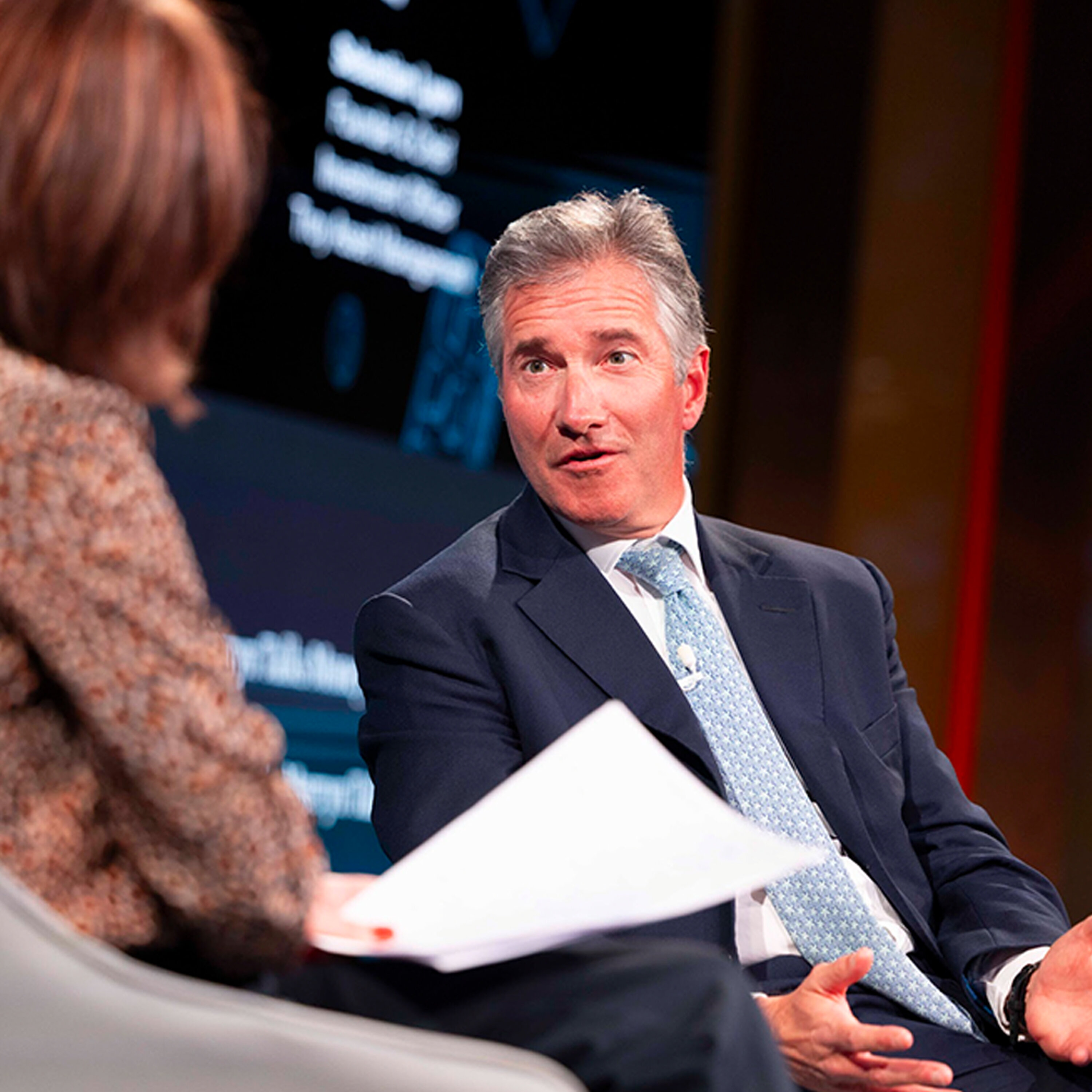
Bloomberg Audio Studios podcasts Radio News hey Marion Talks Money listeners. Earlier this week we had our subscriber event in the Bloomberg offices in London. It was so wonderful to see so many listeners and so many readers there. So thank you so much to all of you who came and to those of you who couldn't come. We are bringing you some of the conversations we had that evening for the podcast feed. So first up we have my conversation with Sebastian Lyon of Troy Asset Management. Enjoy. Welcome everybody and thank you for coming to Marin Talks Money, the podcast in which people who know the markets explain the markets. Now we are recording this episode for those of you who aren't here. Do come next time in front of an audience of subscribers at the Bloomberg London offices Now there's going to be three sections to it. There's going to be this bit where I talk to Sebastian and then we'll do some more personal finance stuff and we'll take lots of questions. Do use that QR code to ask questions, but you will also be able to ask with a mic at the end, so don't feel you have to use the QR code. Now we're going to start all this with Sebastian, who's a long term friend of the show and mine. We were just saying earlier we started our businesses around the same time, 25 years ago and I think we've been talking about the gold price pretty much ever since. Pretty much ever since without break.
- [03:17]
Sebastian Lyon (Troy Asset Management)
We've aged well.
- [03:18]
Marion (Podcast Host)
We have, we have. And so is the gold price.
- [03:20]
Sebastian Lyon (Troy Asset Management)
Certainly has, yeah.
- [03:21]
Marion (Podcast Host)
Right, Sebastian, thank you for coming and doing this again. Let's start with the general miseries, shall we? Yeah, I mean, listening.
- [03:29]
Sebastian Lyon (Troy Asset Management)
How many are there?
- [03:29]
Marion (Podcast Host)
So many. Listening to that list of Simons, the first thing that I think strikes you is how extraordinarily calm markets are in the wake of that bizarrely unexpected list of things that have happened in the last two and a half, three months
- [03:43]
Sebastian Lyon (Troy Asset Management)
on two and a half weeks, let alone two and a half weeks. I mean, people have forgotten about the Fed appointment, really, that happened at the end of January and it's just sort of in the midst of time, but actually so much has happened since then. So having to deal with that, having to keep your focus, having to be consistent as a fund manager with all of that, I mean, the noise levels are off the scale at the moment, but consistency is. Your consistency is. Yes, absolutely. What we do try, that's what we are there for.
- [04:08]
Marion (Podcast Host)
So I think what we really want to talk about this evening is how exactly you manage money and construct a portfolio in this kind of environment. Because really the style that you used was really designed for this kind of environment. Right. I mean, there are periods in the markets when you want to be in expensive growth stuff and where you want to be thinking mainly about how do I grow my capital, how do I make more money all the time. And then there are periods such as this when mainly you're thinking about how on earth do I protect what I already have.
- [04:35]
Sebastian Lyon (Troy Asset Management)
It's about preparing for dislocations, basically, because dislocations happen, whether it be Covid, whether it be the financial crisis, whether it be the dot com bust, another instance, whether it be the Gulf War, the invasion of, well, not the invasion of Iran yet, but we'll see about that maybe in a few weeks time. So we are waiting for those. We are. Those events give us opportunities, but we also know that we need to be ready for them. We were ready for Covid, although Covid came totally out of the blue. We were prepared from the point of view of our equity allocation was relatively low because equity markets were high going into Covid, there was a lot of vulnerability, there was a lot of fragility within equity markets.
- [05:14]
Marion (Podcast Host)
So you weren't ready for Covid because you're ready.
- [05:15]
Sebastian Lyon (Troy Asset Management)
So we weren't ready for Covid because. No, absolutely not. But you've got to be ready for these instances and they come from left field. I mean, if you think about even three weeks ago, markets were very, people were talking very positively about cyclicality, about bank stocks, about house builders, all those areas of the market, heavily cyclical businesses, which we tend to steer clear of, those businesses now are down 15 to 25% just in the last two and a half weeks with the oil price going up. What you've got to do is be prepared to say, actually those are not the kind of companies that I want to be in. Because you know that those sort of instances can happen and do happen and those businesses are more fragile, more vulnerable. I was with a property agent, a West End property agent this afternoon. He said that all transactions have just stopped, literally on a pin, just until this situation is resolved, which may be weeks, it might be months. Transactions have just finished. So one has to be ready for events such as that. What they actually bring is opportunity. So as a long term investor, one can actually take opportunities. When one sees, one sees huge risk aversion. And we haven't seen that yet, by the way. But if and when we see huge risk aversion, we see markets fall as we did during COVID markets fell 35% within the space of nine weeks. Then you've got to be ready to act and lean in and take more risk because you're paid to take more risk. That's how you generate long term returns, but also protect the downside. The key thing for us for personal assets or for the Trojan fund is that we want to give our investors a more comfortable ride, that they sleep at night, that we're consistent, that they know they can rely on us. So if markets do suddenly fall 25 or 30%, that they know that the treasury fund or personal assets would have fallen considerably less than the market. A couple of percent, well could be a couple of percent.
- [07:14]
Marion (Podcast Host)
And when you look at the portfolio, you are not measuring yourself relative to A benchmark. You're always thinking about inflation and that's it. About first maintaining the real value of the assets before you think about growing them. How's the FTSE doing? It's not about.
- [07:30]
Sebastian Lyon (Troy Asset Management)
Absolutely not. I mean obviously we look at the ftse, obviously we look at the msci, the long term track record of the Trojan Fund, which is the longest track recording back 25 years. You mentioned we've generated equity type return 77 percentage about. About the same as the UK stock market, but with less than half the volatility. So about 6% per year. Volatility rather than the market being 13
- [07:50]
Marion (Podcast Host)
and measuring itself against RPI rather than CPI.
- [07:54]
Sebastian Lyon (Troy Asset Management)
Well, that's going to change, but I don't want to give any too many surprises away because of the change in the rpi. That will ultimately change. We need to review that. But yes, it has always been the rpi. We are trying to protect the real value of people's capital income, helpful though it is, is a residual. We never reach for income. It's one of the pluses of the way that we do it. Some of the people who invest for capital preservation have the tendency to reach for yield and we actually do the opposite.
- [08:25]
Marion (Podcast Host)
Okay, let's start this next bit by talking about your inflation expectations because I know a lot of the portfolio has historically been designed around your expectation of faster rising inflation and obviously the war is going to feed into that.
- [08:41]
Sebastian Lyon (Troy Asset Management)
Absolutely, yeah. So I mean with the oil price up at $100 and it might spike further, I wouldn't be surprised if it spikes further, then obviously we're going to see inflation shock to the rpi. So that none of those numbers have gone in, we think. I mean, I was very interested listening to your podcast two weeks ago with Edward Chancellor. That book the Price of Time, we've given it to clients. It's a remarkably well timed, brilliant book. But what he's effectively saying and what we have recognized as investors over the last five, six years is that in 2020 with COVID things changed. And things were going to change anyway when an event happened, whether it be a recession or whether it be a pandemic, as it happened, but interest rates basically bottomed. And we had this extraordinary period of a decade where interest rates were at zero and nailed to the floor. And we recognized that we were going to go into a world of rising rates and probably as a result higher inflation or the other way around. We saw those inflationary pressures build up, which we saw with the war in Ukraine. RPI went to 13% CPI in the US went to 9. It has been above target since then. So central banks have failed to get it below target. And we think we are in a world obviously clearly helped by the oil price going up to $100, where the surprise will be on the upside for inflation rather than the downside. 2010 to 2021. The surprise was permanently on the downside. The central banks were struggling as hard as they could to get actually inflation up. Now we're in a very different world.
- [10:22]
Marion (Podcast Host)
Okay, but you felt very much the case before the oil price started to move.
- [10:26]
Sebastian Lyon (Troy Asset Management)
Yes, well, we've, yeah, absolutely. We, we, we believe that we're in a secular period whereby as, as Edward, is where yields are rising, where the bond market. Bond market yields bottoms in August, July, August of 2020. Yields have been rising since then. Yes, there will be downward moves. What's very interesting about this period, the last few weeks, is that actually, although the expectation would be with a rising oil price, a flight to quality, yields would actually fall. They haven't, in fact, they've risen. So there isn't that protection, that natural protection of a 60, 40, 60 equity, 40 bonds. And we knew that we were in a different world where 60, 40 type structure of a portfolio. You asked me about the structure of the portfolio. We moved from a world where you do not want to have 60, 40, because actually equities and bonds can go down at the same time within an inflationary world.
- [11:20]
Marion (Podcast Host)
Stick with inflation. What are the drivers of this change? I mean, I think we, we can probably list them all, can't we? Geopolitics, supply chain.
- [11:30]
Sebastian Lyon (Troy Asset Management)
Well, geopolitics, but, but in particular, tariffs. The world getting larger, rather the world was always getting smaller with globalization. That really has been reversing for quite a long time now. That has meant that there's a greater fragility in supply chains. And that has meant when we've seen these crises, whether it be Ukraine, whether it be Iran, that the response is higher prices. Whereas we've been used to lower and lower and lower prices and it takes these shocks where there's a, oh, okay, we're back in this world again. We're back in this world of higher prices. The oil price. There is a view that higher oil prices are deflationary. Well, yes, if the oil price goes to $150, suddenly demand disappears because people can't afford the oil price at that level. So that, that's when we get the risk. I think there is a risk which I don't think is being discounted at the moment of Recessionary horses.
- [12:33]
Marion (Podcast Host)
And you also think that the public debt problem feeds into the inflationary environment.
- [12:38]
Sebastian Lyon (Troy Asset Management)
The public debt problem doesn't help. Doesn't help at all. No, because effectively policymakers are stuck. They're stuck in this period whereby they have to consequently out of the debt. I mean, in the UK the interest bills now were at 110 billion pounds. In the US it's 1.1 trillion. So they're desperately trying to keep the interest rates down. But clearly at the moment that's not necessarily likely to be the case. If anything, interest rates are going to be on hold as central banks try and work out. Could there be a policy error of putting rates up or keeping rates on hold when actually demand falls off due to a higher oil price or should there be cutting because it's that we're into a recession and you think recession
- [13:23]
Marion (Podcast Host)
risks in Europe, in the us Everywhere, globally.
- [13:27]
Sebastian Lyon (Troy Asset Management)
Yes, absolutely. So that it's not. I'm not predicting a recession, but there is far more of a risk recession than markets are discounting after two and a half weeks of this. If this carries on and the Gulf of almost stays shut for a prolonged period of time, call it three to six months rather than three to six weeks, then you could have real issues. And I do see the likelihood of downturn and a downturn. There were risks of a downTurn back in 2022, 2023 with the invasion of Ukraine. But fortunately in that situation there were huge pent up savings from consumers. So consumers were actually in a very good place back in 2022, 23. They could withstand the higher prices to some extent this time around. You've got a K shaped recovery that is a mismatch between the haves and the have nots in the uk basically, as you know Marion very well, you've got zero growth as of the third quarter to the end of January before this happened. And in the US actually growth has been not as strong as many have expected, sort of 2% but by U.S. standards, actually relatively modest. So it's coming at a difficult time.
- [14:47]
Bison Wealth Advisor
How much growth could your 401k be missing right now? Did you set it and forget it? That could be expensive. Studies show professionally managed 401ks could add hundreds of thousands by retirement. That's where Bison comes in. Our advisors actively manage your existing 401k. No transfers or rollovers helping power your retirement. Try the no obligation calculator@powermy401k.com Bison wealth is a Fiduciary SEC registered investment advisor. See powermy401.com for additional information.
- [15:16]
IBM AI Representative
The thing about AI for business, it may not automatically fit the way your business works. At IBM, we've seen this firsthand. But by embedding AI across hr, IT and procurement processes, we've reduced cost by millions, slashed repetitive tasks, and freed thousands of hours for strategic work. Now we're helping companies get smarter by putting AI where it actually pays off, deep in the work that moves the business. Let's create smarter business. IBM.
- [15:47]
Cigna Healthcare / Sonesta Representative
For many men, mental health challenges aren't recognized until they've already taken a toll. Work pressure, financial stress, changing relationships and traditional expectations around masculinity can quietly wear men down, often without clear warning signs. In season three of the Visibility Gap, Dr. Guy Winch and his guests explore how these pressures show up, how to spot them earlier, and how men can access meaningful support. Listen to the new season of the Visibility Gap, a podcast presented by Cigna Healthcare.
- [16:23]
Marion (Podcast Host)
The challenge to your Moving away from from recession the challenge to your view on inflation is, is that the technological progress that we're making at the moment is very deflationary. That the combination of AI, robotics, all these things coming together is a, is a huge deflationary impulse across the global economy.
- [16:45]
Sebastian Lyon (Troy Asset Management)
Technology always has been a deflationary impasse. But I think that what's happening in terms of the reversal of globalize globalization makes it, I think, much more difficult. That's why, I mean, technological gains have been made over the last five years, have been made materially since 2020, since 2022. Yet we're in a position where inflation is above and sticky and above target. So I think the technological revolution view of keeping inflation down, yes, at the margin. But I think there are other factors at play which are frankly more important that are sort of overruling the factors of technology just at the moment. We will see, maybe that will evolve. But so far that technological argument over the last five years hasn't really worked.
- [17:40]
Marion (Podcast Host)
Ok, let's go back to the conversation we started about bonds and the 6040 portfolio. That really doesn't work anymore. But that doesn't mean there aren't fixed income holdings in your portfolio.
- [17:52]
Sebastian Lyon (Troy Asset Management)
No, but they're very, very short duration. So we're just not taking any duration risk at all. And we haven't taken any duration risk for a very long time. So with a very long bond, clearly you're taking a lot of duration risk. A lot of the value of that bond is out into the 2000s, 2000s, 2000s. The capital value to that bond is at risk if yields rise, as we expect yields to be sticky and continue to rise over time until governments ultimately intervene, which I expect them to do at some stage in the next four or five years because this whole situation is ultimately unsustainable.
- [18:27]
Marion (Podcast Host)
Intervene how?
- [18:28]
Sebastian Lyon (Troy Asset Management)
Intervene in possibly two ways. One would be yield curve control because the interest is just not affordable. Well, the tried and tested ways are either your curve control or actually a cutting of the coupon which has been done in the past as well. I mean, I don't know if you remember, but war loan, which I used to own in the. I remember, yeah. Which is a very, very long dated UK government bond, in fact about the longest dated, that the yield was cut of 7% to 3 and a half percent between the wars. So yields coupons have been cut, but yield curve troll is probably the most likely that was used in the US after the war. But there are tried and tested. They're not very pleasant and clearly they're a default and clearly they have implications for currencies. But the unsustainable nature of sovereign government bonds at higher yields than today are very material. That is why the UK government is so obsessed by the gilt market, because that has huge ramifications for them.
- [19:27]
Marion (Podcast Host)
Okay, so what replaces the traditional bond part of a portfolio?
- [19:32]
Sebastian Lyon (Troy Asset Management)
So effectively it's liquidity. And we've got liquidity, we've got index linked. So for example, we benefit from that inflation. If you look at what index linked bonds have done since 2020, since inflation started to pick up and what conventional bonds have done, index linked bonds have done much better because we've been taking that inflation every month. So we've got short but short dated index linked. The longer dated index linked bonds were very, very badly hit in 2022 when we saw that inflation. But ironically people had long duration index linked bonds thinking that they were going to get the upside and actually the duration killed them even though they got the inflation. The shorter dated index links which we had got the inflation without the risk of the duration. So we didn't get hurt nearly as badly in 2022 as some. But I think the key thing is liquidity and then you've got the greater flexibility as well. So our bonds are less than 2 years in duration and we could liquidate them very, very quickly and move into other asset class if need be. And the other thing obviously within equities, 40% in equities and gold as well, which is 10% of the portfolio.
- [20:40]
Marion (Podcast Host)
Let's talk gold.
- [20:42]
Sebastian Lyon (Troy Asset Management)
Must we?
- [20:43]
Marion (Podcast Host)
Yes, I think we must say everyone expects us to talk about gold. Right. We like it. If we didn't yet everyone wants us to talk about gold. 10% of the portfolio still its biggest holding. But you have sold down quite a lot.
- [20:53]
Sebastian Lyon (Troy Asset Management)
We have sold down quite a lot. I think it's more a question of tempering our enthusiasm. We have done very well in gold, going right the way back to when we met. I think we first bought gold for the Trojan fund back in 2004. So over 20 years ago. Gold price was $424 back then. We've held it uninterrupted all of that time. We haven't been in and out and in and out. We held it a long time and since after the financial crisis, we've owned between about 10 and 12%. When I met you three years ago, sitting on this stage, I think the price was around just over $2,000, $2,200, something like that. Today it's $5,000 plus or minus. It's been a hell of a run. We know the reasons as to why that has been that are well exercised, particularly interesting. Not about consumers or institutional investors, particularly adding to gold. Been much more about central banks diversifying their portfolios and that has continued and that's been of great support to the market. So I'm not overly pessimistic about gold at these levels. However, they have had a great run and we need to get our risks proportionately correct. We allowed gold to run up to 14% at the end of last year within the portfolio. In January, the price spiked above $5,500. We sold some just over about $5,100, $5,200 and we brought it down to 10%. So it's a very mature. We've cut our goal holding by 30% in a day. Shows how liquid it is.
- [22:25]
Marion (Podcast Host)
But 10% still expressing quite a lot of confidence.
- [22:28]
Sebastian Lyon (Troy Asset Management)
10% I think expresses long term confidence. In the short term, I think it's going to be quite bumpy. It's traveled a long way very quickly and I think it's not necessarily going to protect in a way that it has done in the past from volatility within markets because of that high level. So it's just not going to be necessarily that portfolio insurance. And we've seen that in the last two, three weeks. We've seen the bombing of Iran at a time the gold price actually hasn't done anything in sterling. It's up a little bit because the dollar strengthened, but really it's done nothing. And you would have expected it if you were to say to me, right, okay, the US is going to bomb Iran with Israel tomorrow morning. What do you expect the gold price to do? You would naturally expect it as a flight quality for the gold price to go up. It hasn't. And I think that. And when, eventually, whenever it is the US steps back from the war, then it'll be interesting to see what happens to the gold price then I wouldn't be surprised if it has a correction. But I would view that as a long term opportunity. I think with everything we've talked about in terms of sovereign debt risk, that is not going away and that will be very positive gold, both from the point of view of weaker currencies and debasement, but also from the point of view of owning another asset other than fixed income. So I don't think the bull market is over, but I think we have had a very strong run and I think there's reason to be a little bit more circumspect from these levels. And just there is no right answer about how to size this thing. I've got friends who've got 50% in gold, I've got friends who've got 1% in gold, I've got friends who've got no gold. So it is not necessarily easy to size. What I've always felt is that you've got to have enough to make a difference, but not so much that the tail wags the dog. So I've always felt between 8 and 12% is about right. We're allowed to get to 14, we came back to 10. But I think that's the right sort of level for the environment that we're in. And it is an educated guess, frankly, always, of course.
- [24:37]
Marion (Podcast Host)
But you would expect investor demand for gold to go up if you think that.
- [24:41]
Sebastian Lyon (Troy Asset Management)
Yes.
- [24:42]
Marion (Podcast Host)
For many decades, until relatively recently, everyone had 4, 5, 6, 7% of their portfolio in gold. And now the average person still has maybe 0% in gold. So you would expect, as people start to build up gold holdings again, in response to the conversation we just had about bonds and diversifiers and balances, you would expect there to be a big level of retail demand coming through.
- [25:01]
Sebastian Lyon (Troy Asset Management)
Yes. And I think that a lot of the diversifiers that people hope were going to work, let's say in 2022, didn't work. And so gold has worked for the right reasons.
- [25:13]
Marion (Podcast Host)
So many people would say that Bitcoin has worked to a degree.
- [25:15]
Sebastian Lyon (Troy Asset Management)
To a degree, perhaps.
- [25:17]
Marion (Podcast Host)
But you've got none of that.
- [25:19]
Sebastian Lyon (Troy Asset Management)
No, I'm afraid there are. Sometimes I admire the works of Mr. Buffett, Mr. Munger. And sometimes they say it goes into the too hard bucket. I know it's cop out, Marin. It is cop out.
- [25:30]
Marion (Podcast Host)
But I'll take it.
- [25:31]
Sebastian Lyon (Troy Asset Management)
Bitcoin. Bitcoin definitely goes into the two hard bucket. And I will leave that to far, far cleverer of people.
- [25:35]
Marion (Podcast Host)
Let's talk.
- [25:36]
Sebastian Lyon (Troy Asset Management)
Or more speculative people than me.
- [25:38]
Marion (Podcast Host)
I don't know who holds bitcoin.
- [25:42]
Sebastian Lyon (Troy Asset Management)
Well, they're your listeners.
- [25:43]
Marion (Podcast Host)
Their audience are on your side.
- [25:45]
Sebastian Lyon (Troy Asset Management)
Everyone else who owns gold.
- [25:47]
Marion (Podcast Host)
I know everyone owns gold. Right. Hands up for gold. Yeah. For those who aren't with us, pretty much the entire audience has put up their hands. We are an audience of the converted. Listen, let's talk about the equ Part of the portfolio and how you do that. Because, you know, when I look at it, I don't see any of much of the stuff that John and I have been talking about on the podcast recently. You don't see much in the way of energy stocks or metals and miners or anything that really fit the halo vibe in hot assets, low obsolescence, etc. You haven't. You haven't gone in for that and I might have expected you to.
- [26:26]
Sebastian Lyon (Troy Asset Management)
Yeah, we have a little bit. We have diversified more. I mean, we like to invest in higher quality businesses. Quality is in the eye of the beholder. And the key thing is that we don't overpay for those quality businesses. So when events like Iran happen, when events like Covid happens, those businesses get hurt. Actually, the miners have sold off quite a lot in the last two, two or three weeks. So that was very much the zeitgeist of two or three weeks ago. Whether it is in a year or two's time, we will see our preferences to own businesses which are defensive, where there's consistent cash generation, where there's consistent rewards for investors in terms of particularly dividends, which we prefer, rather than buybacks. And we hold companies usually for a very long time. Where we have changed a little bit in the last year or two is we've been reducing our exposure to US equities in favor of European and UK but particularly European equities, where we think valuations are better, which we agree with you. And also where we have sold out in the US we've sold things like American Express, which is very vulnerable to a downturn, which we did phenomenally well. And for example, we own that for over a decade, so we can hold companies for a very long period of time. We sold Procter and Gamble similarly, we'd own that for a decade, which had done very well and had a very material RE rating. And we also sold Moody's because we were concerned about the risk there in terms of valuation. So quality is fine. Quality is a given. It's a question of the valuation. And what we don't do is what we don't do, unlike some quality growth investors, run their winners. Run their winners. We're very careful about making sure that we manage the risk. And coming back to your point about trying to not target an equity index, we don't structure the portfolio in any way along index lines. But also we have pretty strong risk controls whereby if a stock goes above 5%, we trim it naturally anyway, because we don't want to have. We never know what could go wrong. But the other thing that we've been doing within the portfolio is. So we've been selling those sorts of stocks and buying things like railroads. We've got Canadian national, we've bought, which obviously is. It does fit the theme. We bought insurance. So we've always had an exposure to insurance because we like insurance. From a portfolio construction point of view, it does something very different. It plays to a different cycle from the equity cycle or the financial cycle. So we bought Chubb 18 months ago, which has done well, and we bought Hubble, which actually makes grid infrastructure. Not an AI play, particularly actually, but just, I mean, I don't know if you're aware of this, Marin, but in the California wildfires that we had just over a year ago, one of them was started by electricity equipment that was 104 years old. The US really, really, really needs to invest in its electricity infrastructure. And Hubble will be a beneficiary of that, whatever happens to AI. So we have shifted subtly. The portfolio quality is a difficult one because people quality evolves and the portfolio has to evolve with it. And we don't want to get stuck in things that in particular where valuations are too high and there's valuation risks. That's the biggest risk to the way that we invest is valuation risk, because the businesses generally continue to grind out pretty well. But what we don't want to do is we want to be careful when markets get overexcited, as they did particularly in 2021. And we reduced our exposure quite a lot during that period.
- [30:04]
Marion (Podcast Host)
Okay, we're going to have to finish. I feel like we could go on for a very long time. So I'm just going to finish with one last question. What is the thing you are most worried about at the moment? I would ask other people what they're most optimistic about. But with you, I'm going to go with what are you most worried about?
- [30:18]
Sebastian Lyon (Troy Asset Management)
Sovereign government bonds. It has to be that over the next and I'm thinking about the next five years. That has got to be the thing that's the major worry because while I've said how it might be solved, it will be messy before then.
- [30:32]
Marion (Podcast Host)
Excellent. Thank you for finishing on that high note, Sebastian.
- [30:35]
Sebastian Lyon (Troy Asset Management)
Pleasure as always.
- [30:36]
Marion (Podcast Host)
Thank you so much for joining us today in Life. Right, you're off. Thank you. Thank you. Thanks for listening to this week's MarineTalks Money. If you like our show, rate, review and subscribe wherever you listen to your podcasts and keep sending questions or comments to marinmoneyloomburg.net you can also follow me and John on Twitter OR x I'm MarionSW and John is John. Underscore Epic. This episode was hosted by Meat, Mirror and Somerset Web. It was produced by Sam Asadi and Moses Andam Sound designed by Aaron Kaspar. And special thanks of course, to Sebastian Lyon.
- [31:14]
My Policy Advocate Representative
Here's a paradox. We buy insurance for peace of mind. Yet the very policies we trust can deliver the biggest financial shocks across America. Millions of claims are denied every year, not because people did anything wrong, but because policies quietly excluded the things that happened. The psychology of trust tells us we assume the contract is fair. But in insurance, the information gap is massive. The insurer knows every detail of what's covered. The policyholder rarely does. That's where my policy advocate comes in. For just 27 cents a day, their platform reads your policies and shows you in plain language where you're vulnerable. They're not selling insurance. They don't do that. It's about transparency, giving ordinary people the same understanding insurance companies have had for decades. Because when you know what's really in your policy, you can plan, protect and avoid surprises. Before you trust your policy to protect, protect you, let my policy advocate tell you what it really says. Visit mypolicyadvocate.com today. Peace of mind starts with knowing the truth.
- [32:14]
Cigna Healthcare / Sonesta Representative
Mypolicyadvocate.com find home wherever you roam at Sinesta? Es and Simply Suites, where longer stays feel comfortable, flexible and easy. Stretch out and enjoy spacious accommodations and homelike amenities designed to help you settle in and stay productive or relaxed for however long you need. And when you're a Sonesta TravelPass member, staying at Sonesta? Es and Simply Suites means earning points toward free nights, upgrades and more with every eligible stay. Go to Sonesta.com to book your stay and unlock the best rates with Sonesta TravelPass. Here today, roam tomorrow. Join now at sinesta.com, terms and conditions apply. These days, it seems like AI agents are just about everywhere you turn every field and every function. But without identity, you can't trust they'll serve your business instead of jeopardizing it. Fortunately, Okta. Okta helps you get identity right by securing your AI agents identities, giving you a single layer of control, a single standard of trust. So whether an AI agent supports a single user or your entire enterprise, with Okta you'll turn risk into opportunity. Secure every agent. Secure any agent. Okta secures AI.