
Podcast
Meta Tech Podcast
Hosted by Meta · EN
Brought to you by Meta. In addition to remaining active in the open source community and conference circuit, this podcast offers another channel that allows us to highlight the technical work of our engineers who will discuss everything from low-level frameworks to end-user features. Throughout the podcast, Meta engineer Pascal Hartig (@passy) will interview developers in the company.
19episodes
Episodes
Newest firstAll episodes

BONUS: Send Us Your Questions About Engineering at Meta
2w ago00:01:44Tap to summarizePascal is going on Recharge for August so there will be no regular interview episode. However, we want to hear your questions for our mailbag episode. Send them to us on Instagram (https://www.instagram.com/metatechpod) or Threads (https://www.threads.com/@metatechpod) or via good old email to techpodcast@meta.com.
Transcribe →
87: Everything is Power: Battery Life Engineering for AI Glasses
4w ago00:41:21Tap to summarizeWhat changes for you as a developer when the device moves from your pocket to your face? The battery shrinks by an order of magnitude, the thermal budget is whatever won't make your nose uncomfortable, and your mental model of "one process, one device" goes out the window. Rey and Dmitrii talk us through their custom power monitors, how they've extended Perfetto to give a coherent trace across a multi-device system, why robotic arms make surprisingly good QA engineers, and what it takes to catch the kind of regression that quietly costs you thirty minutes of call time. All of this and more is discussed in this episode. Got feedback? Send it to us on Threads (https://threads.net/@metatechpod), Instagram (https://instagram.com/metatechpod) and don't forget to follow our host Pascal (https://mastodon.social/@passy, https://threads.net/@passy_). Fancy working with us? Check out https://www.metacareers.com/. Links Migrating Data Ingestion Systems at Meta Scale: https://engineering.fb.com/2026/05/12/data-infrastructure/migrating-data-ingestion-systems-at-meta-scale/ Timestamps Intro 0:05 Introduction and Setup 1:51 Battery Life Optimization in AI Glasses 1:57 Challenges in Testing and CI Architecture 5:37 Detecting and Managing Power Regression 8:27 Developer Tools and Best Practices 13:04 Advanced Monitoring and Synchronization Techniques 16:53 Advanced Power Monitoring in Wearables 21:26 Real-World Examples of Performance Optimization 23:53 Battery Life Improvements Through Engineering 25:21 Engineering Culture and Performance Mindset 27:49 Continuous Testing and Profiling Strategies 29:36 Balancing Profiling Overhead and Accuracy 32:15 Simulating Real-World Scenarios in Testing 34:27 Best Practices for Efficient Wearable Code 37:21 Outro 40:26
Transcribe →
86: A Hard Cell: Engineering Ultra-Narrow Batteries for AI Glasses
Jun 900:42:46Tap to summarizeYour smart glasses run all day on a battery narrower than your pinky finger and building it required reinventing how batteries are made. In this episode, Pascal talks to Karthik and Myuran, the engineers behind Meta's steel can battery technology, to explore why traditional pouch cells couldn't cut it for the ultra-slim temple arms of AI glasses like Meta Ray-Bans and the Oakley Vanguards. Tune in to learn how Meta designed, built, and scaled the batteries powering your glasses, wristbands, and cases from first prototype to mass production. Got feedback? Send it to us on Threads (https://threads.net/@metatechpod), Instagram (https://instagram.com/metatechpod) and don't forget to follow our host Pascal (https://mastodon.social/@passy, https://threads.net/@passy_). Fancy working with us? Check out https://www.metacareers.com/. Links SilverTorch: Index as Model — A New Retrieval Paradigm for Recommendation Systems - https://engineering.fb.com/2026/05/26/ml-applications/silvertorch-index-as-model-new-retrieval-paradigm-recommendation-systems/ Timestamps Intro and News 0:06 Guest intros 1:49 The problem with existing batteries 4:16 Pouch vs Steel Can Batteries 6:40 What does lower impedence mean? 10:27 Power requirements 12:25 Synchronising two batteries 16:02 Manufacturing never-done-before batteries 23:11 Software vs hardware iteration cycles 28:12 Collaborations across the globe 30:51 Market compliance 37:00 Outro 42:24
Transcribe →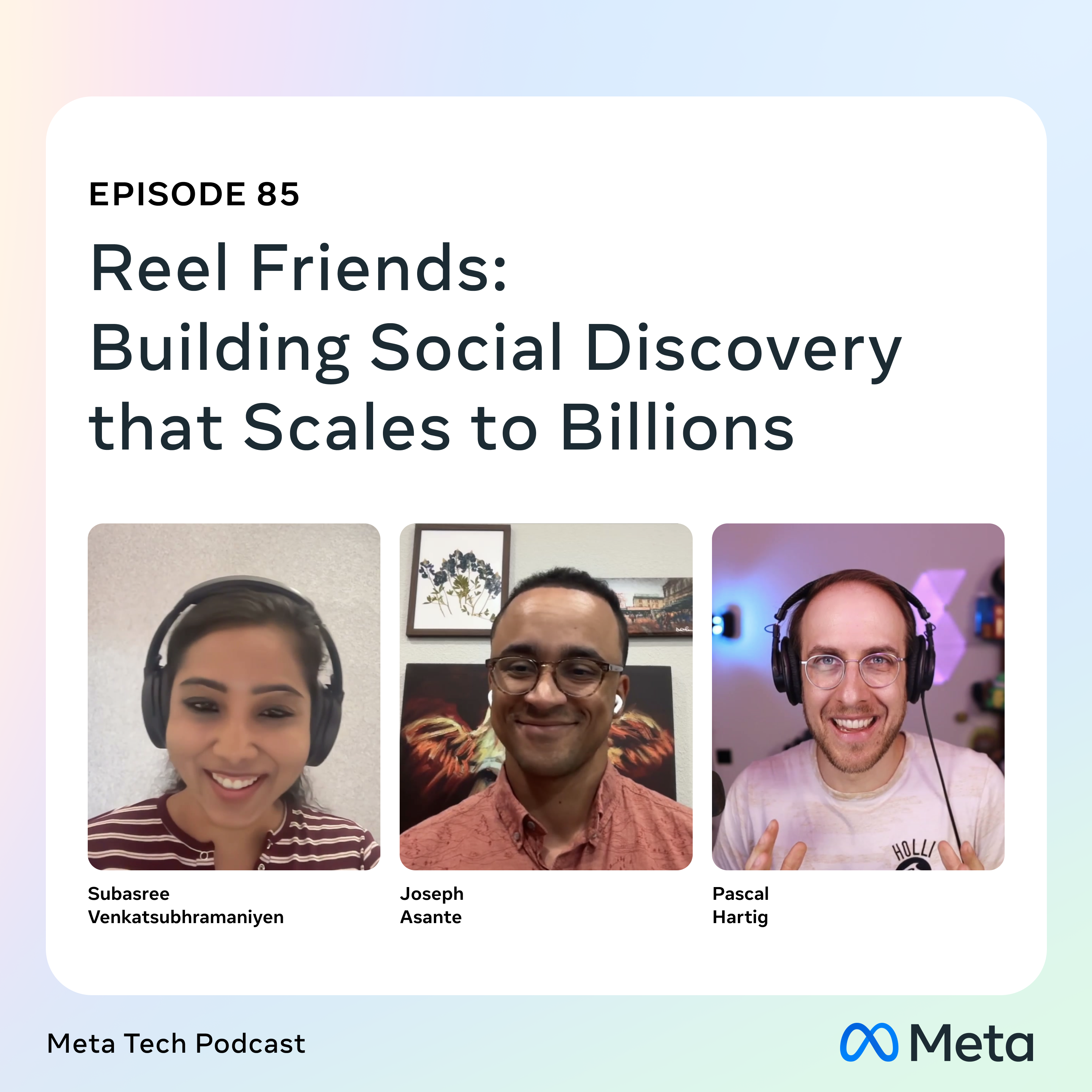
85: Reel Friends: Building Social Discovery that Scales to Billions
May 800:38:34Tap to summarizeYou've probably spotted those little circles of your friends' faces popping up on Facebook Reels. They look simple enough, but building them was a proper engineering challenge. In this episode, Pascal chats to Joseph and Subasree about Friend Bubbles, a feature that surfaces which of your close friends have been watching and reacting to the same Reels as you. We get into the details of how prefetching keeps things snappy without wrecking scroll performance, why the team's ML model had to move from survey-based friend rankings to real-time interaction signals, and the surprising discovery that showing fewer bubbles actually made the whole feature click. If you've ever underestimated a "simple" feature, this one's for you. Got feedback? Send it to us on Threads (https://threads.net/@metatechpod), Instagram (https://instagram.com/metatechpod) and don't forget to follow our host Pascal (https://mastodon.social/@passy, https://threads.net/@passy_). Fancy working with us? Check out https://www.metacareers.com/. Links https://engineering.fb.com/2026/03/18/ml-applications/friend-bubbles-enhancing-social-discovery-on-facebook-reels/ https://engineering.fb.com/2026/04/21/ml-applications/modernizing-the-facebook-groups-search-to-unlock-the-power-of-community-knowledge/ Timestamps Intro 0:06 Meet the Engineers: Backgrounds and Roles 1:53 Goals and Aspirations in Video Recommendations 4:20 The Origin of Friend Bubbles 4:41 Defining Success: Metrics and User Experience 5:40 Client-Side Constraints and Challenges 6:57 Feature Description: What Are Friend Bubbles? 8:31 Initial Challenges and Performance Issues 9:29 Architectural Changes for Performance 11:34 Impact of Performance on User Experience 15:14 Addressing Client-Side Challenges 16:58 Model Development: From Surveys to Interactions 20:07 Evolving the Model: Real-Time Data and User Interactions 23:35 Exploring Model Training and Performance 24:58 Feedback Loops and User Engagement 25:56 The Role of AI in Development 29:49 Collaboration Across Teams 32:17 Future Directions for Friend Bubbles 34:02 Safe Rollout Strategies for Features 35:22 Outro 37:31 Bloopers 38:27
Transcribe →
84: Trust But Canary: Configuration Safety at Scale
Apr 200:37:08Tap to summarizeHave you ever wondered how Meta makes config rollouts safe at scale? In this episode, Pascal sits down with Ishwari and Joe to discuss Meta's approach for propagating changes across services in seconds and discuss why speed increases the need for strong safeguards. Catch the episode to discover canarying and progressive rollouts, the health checks and monitoring signals used to catch regressions early, and how incident reviews focus on improving systems rather than blaming people. We also hear how data and early AI/ML are slashing alert noise and speeding up bisecting when something goes wrong. Got feedback? Send it to us on Threads (https://threads.net/@metatechpod), Instagram (https://instagram.com/metatechpod) and don't forget to follow our host Pascal (https://mastodon.social/@passy, https://threads.net/@passy_). Fancy working with us? Check out https://www.metacareers.com/. Links FFmpeg at Meta: Media Processing at Scale - https://engineering.fb.com/2026/03/02/video-engineering/ffmpeg-at-meta-media-processing-at-scale/ Reliably Changing Configuration @ Scale - https://atscaleconference.com/reliably-changing-configuration-scale/ Timestamps Intro 0:06 Introduction and Overview of Configuration Changes 2:31 Understanding Configurations in Distributed Systems 4:02 Meta's Configuration Management Systems 6:43 Safeguards and Incident Prevention 9:22 Deployment Mechanisms: Canary and Progressive Rollouts 12:06 Challenges in Configuration Consumption 14:39 Health Checks and Incident Response 17:13 Mitigation Strategies for Configuration Issues 19:18 Balancing Developer Velocity and Configuration Safety 21:09 Data-Driven Improvements in Incident Management 22:12 Leveraging AI for Change Detection 26:05 Challenges in Deployment and Testing 28:21 Reinventing Change Safety Strategies 30:24 War Stories: Learning from Past Incidents 32:59 Outro 36:10
Transcribe →
83: Patch Me If You Can: AI Codemods for Secure-by-Default Android Apps
Feb 2700:47:47Tap to summarizeAt Meta, even seemingly simple engineering tasks—like updating an API—become monumental undertakings when you're dealing with millions of lines of code and thousands of engineers, especially if the changes are security-related. In today's episode, Pascal talks to Alex and Tanu about the challenges and learnings from the journey of making Meta's mobile frameworks more secure at a scale few companies ever experience. Tune in to this episode and join us as we explore the compelling crossroads of security, automation, and AI within mobile development. Got feedback? Send it to us on Threads (https://threads.net/@metatechpod), Instagram (https://instagram.com/metatechpod) and don't forget to follow our host Pascal (https://mastodon.social/@passy, https://threads.net/@passy_). Fancy working with us? Check out https://www.metacareers.com/. Links How AI Is Transforming the Adoption of Secure-by-Default Mobile Frameworks - https://engineering.fb.com/2025/12/15/android/how-ai-transforming-secure-by-default-mobile-frameworks-adoption/ RCCLX: Innovating GPU Communications on AMD Platforms - https://engineering.fb.com/2026/02/24/data-center-engineering/rrcclx-innovating-gpu-communications-amd-platforms-meta/ The Death of Traditional Testing: Agentic Development Broke a 50-Year-Old Field, JiTTesting Can Revive It - https://engineering.fb.com/2026/02/11/developer-tools/the-death-of-traditional-testing-agentic-development-jit-testing-revival/ Timestamps Intro & News 0:06 Meet the Product Security Team 2:07 Understanding the Intent System 4:13 Security Challenges in Android's Intent System 6:44 Proposed Solutions for Intent Security 9:39 Meta's Unique Challenges at Scale 12:34 Implementing a Secure Link Launcher Framework 15:32 Leveraging AI for Contextual Understanding 17:55 Navigating AI-Driven Code Modifications 20:47 Developer Experience with AI Code Mods 21:49 Validation Challenges in AI Code Generation 25:37 Evolution of AI in Code Modifications 29:29 Identifying AI's Strengths in Security 36:20 Future Directions in AI and Framework Development 42:58 Outro 46:58
Transcribe →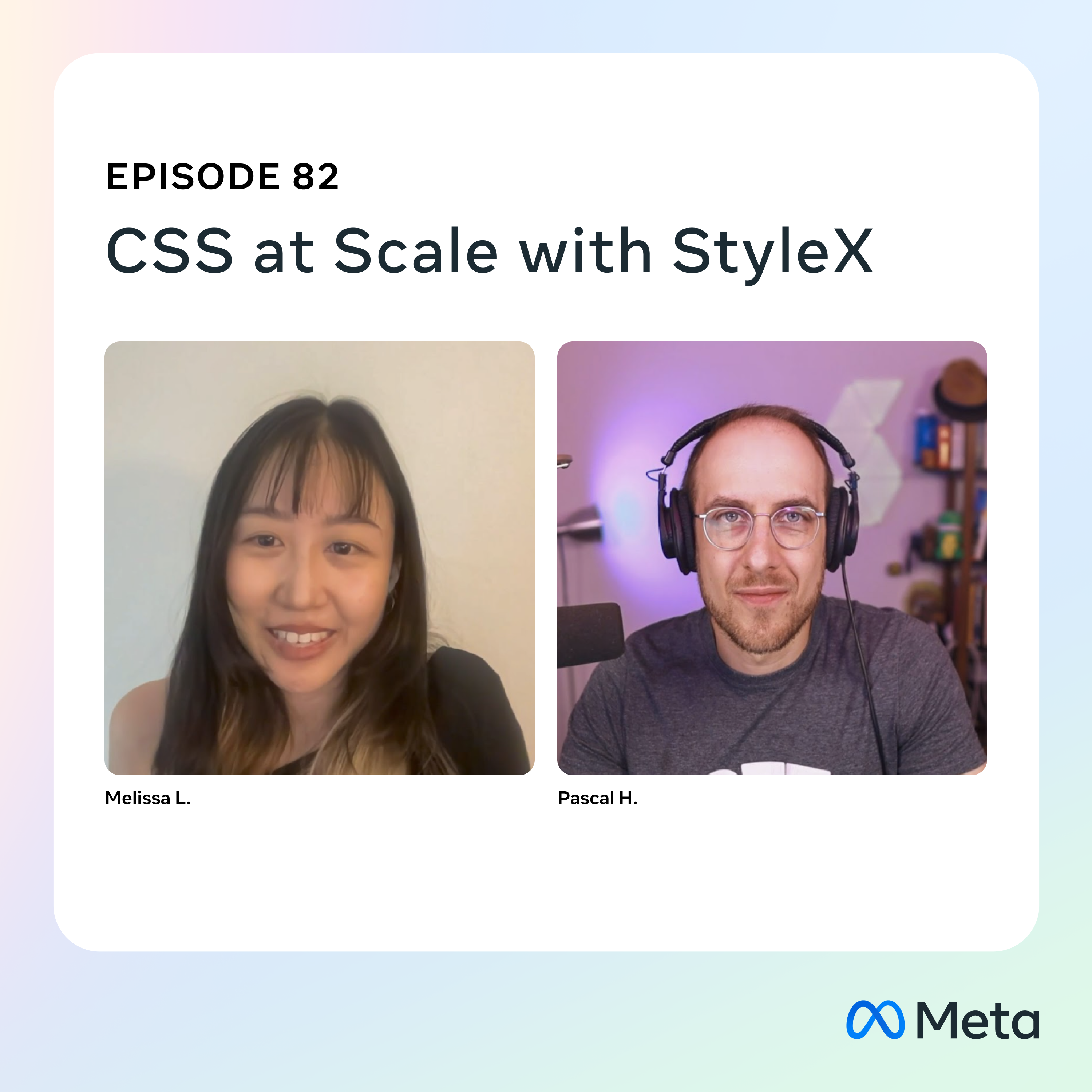
82: CSS at Scale with StyleX
Jan 800:44:14Tap to summarizeIt's not just Not Invented Here Syndrome. Some technologies like CSS simply don't scale if you're building some of the largest websites on the planet with thousands of engineers committing to the same code base every day. StyleX is Meta's open-source solution for CSS at scale and allows atomic styling of components while deduplicating definitions for bundle size and exposing a delightfully simple API for developers. Tune in to learn from Melissa, one of the StyleX maintainers how Open Source has acted as a force multiplier for the project, how interacting with other large companies adopting StyleX has been, and much more! Got feedback? Send it to us on Threads (https://threads.net/@metatechpod), Instagram (https://instagram.com/metatechpod) and don't forget to follow our host Pascal (https://mastodon.social/@passy, https://threads.net/@passy_). Fancy working with us? Check out https://www.metacareers.com/. Links How AI Is Transforming the Adoption of Secure-by-Default Mobile Frameworks: https://engineering.fb.com/2025/12/15/android/how-ai-transforming-secure-by-default-mobile-frameworks-adoption/ StyleX: A Styling Library for CSS at Scale: https://engineering.fb.com/2025/11/11/web/stylex-a-styling-library-for-css-at-scale/ StyleX: https://stylexjs.com MTP 67: Measuring Developer Productivity with Diff Authoring Time: https://pca.st/pt4p4tv5 Timestamps Intro and news 0:06 Introduction Melissa 1:47 Why did we build our own styling system? 4:07 StyleX API 5:36 cx vs StyleX 7:37 Component styling and priorities 10:38 How StyleX evolved in the past seven years 15:20 Community influence 19:33 Open Source 24:07 Challenges of OSS 27:02 Managed breaking changes in OSS 29:48 Measuring success for StyleX 32:04 Packaging challenges 34:34 StyleX competition 38:42 Creating the StyleX roadmap 40:24 Outro 43:15
Transcribe →
81: From Zero to Polish: Building Meta Ray-Ban Display
Dec 1200:47:53Tap to summarizeYou've likely heard of Meta Ray-Ban Display by now — but what's it actually like to work on it? In this episode, Pascal talks to Kenan and Emanuel about the exciting features of Meta's First-Gen Display Glasses and Neural Wristband, the engineering and product challenges they encountered during development, and their vision for future generations of these devices. Got feedback? Send it to us on Threads (https://threads.net/@metatechpod), Instagram (https://instagram.com/metatechpod) and don't forget to follow our host Pascal (https://mastodon.social/@passy, https://threads.net/@passy_). Fancy working with us? Check out https://www.metacareers.com/. Links Pyrefly Beta: https://pyrefly.org/blog/pyrefly-beta/ Pyrefly and Pydantic: https://pyrefly.org/blog/pyrefly-pydantic/ Meta Ray-Ban Display: https://www.meta.com/gb/ai-glasses/meta-ray-ban-display/ Timestamps Intro 0:06 Introduction Kenan 1:35 Introduction Emanuel 5:03 Roles and responsibilities 8:07 What is Meta Ray-Ban Display? 11:13 Memorable challenges: Clasps 15:52 Memorable challenges: Display 19:24 Celebrating incremental wins 23:51 The feedback cycle in hardware engineering 26:29 Open culture and dogfooding 31:39 One-way doors 32:44 Striving for quality and polish in fast-moving environments 36:25 UI principles for AI glasses 40:15 Future Plans 44:04 Outro 46:53 Blooper 47:49
Transcribe →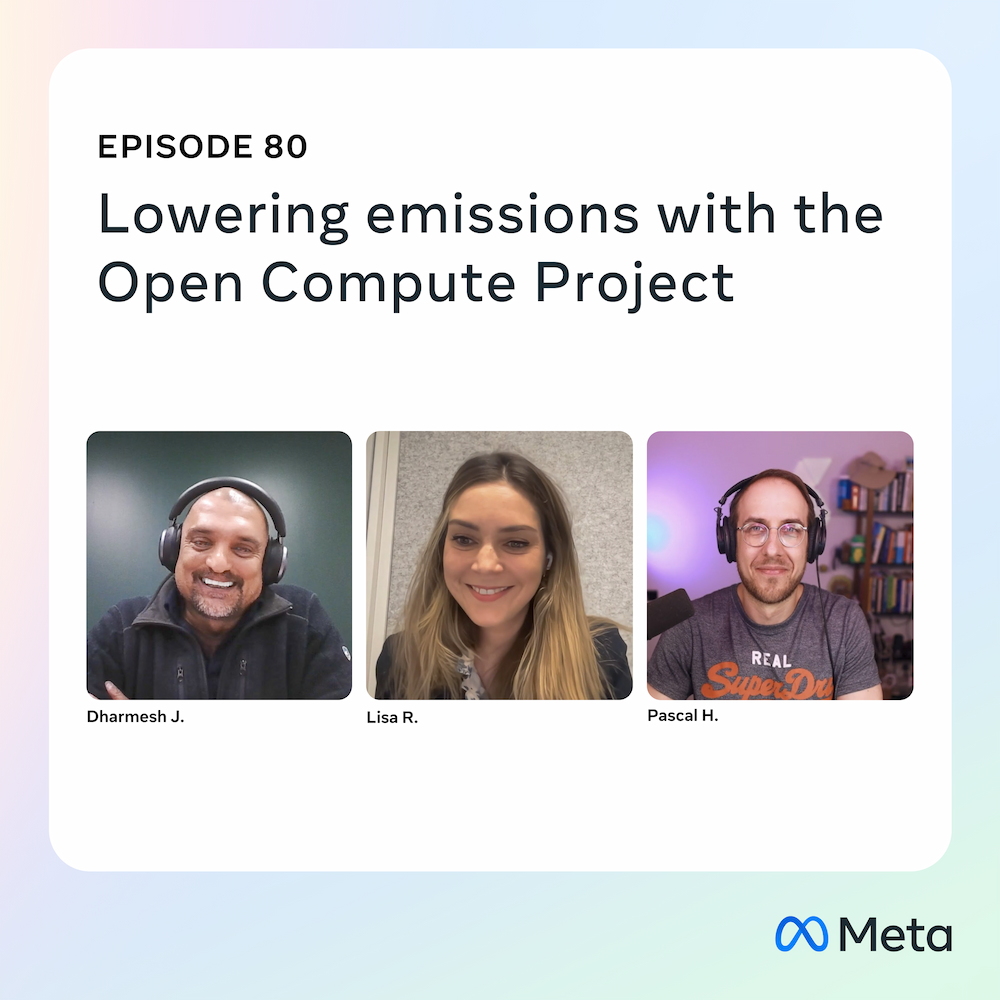
80: Lowering emissions with the Open Compute Project
Nov 1400:38:24Tap to summarizeIn this episode, Pascal talks to Dharmesh J. (DJ) and Lisa about the vision for the open, scalable future of networking hardware for AI and to break down Meta's big announcements from the 2025 Open Compute Project (OCP) Summit. We dive into the OCP ecosystem, explore how AI is used to enhance our carbon modeling, and share our progress toward achieving Net Zero emissions across all scopes by 2030. Got feedback? Send it to us on Threads (https://threads.net/@metatechpod), Instagram (https://instagram.com/metatechpod) and don't forget to follow our host Pascal (https://mastodon.social/@passy, https://threads.net/@passy_). Fancy working with us? Check out https://www.metacareers.com/. Links OCP: https://www.opencompute.org/ OCP Summit 2025: https://engineering.fb.com/2025/10/13/data-infrastructure/ocp-summit-2025-the-open-future-of-networking-hardware-for-ai/ How Meta Is Leveraging AI To Improve the Quality of Scope 3 Emission Estimates for IT Hardware: https://engineering.fb.com/2025/10/14/data-center-engineering/how-meta-is-leveraging-ai-to-improve-the-quality-of-scope-3-emission-estimates-for-it-hardware/ Timestamps Intro 0:06 Introduction Lisa 1:49 Introduction DJ 3:16 What is OCP? 4:04 OCP's scale 5:24 Open vs closed hardware ecosystems 9:26 Examples of OCP projects 11:33 Sustainability in OCP 14:08 How did you get into OCP? 15:59 Marrying infrastructure growth with sustainability 19:05 Emissions scopes and tracking 25:07 Measuring scope 3 26:06 What components embed the most carbon? 30:47 DFE vs DFS 32:34 Hardware reuse 33:39 Outro 37:48
Transcribe →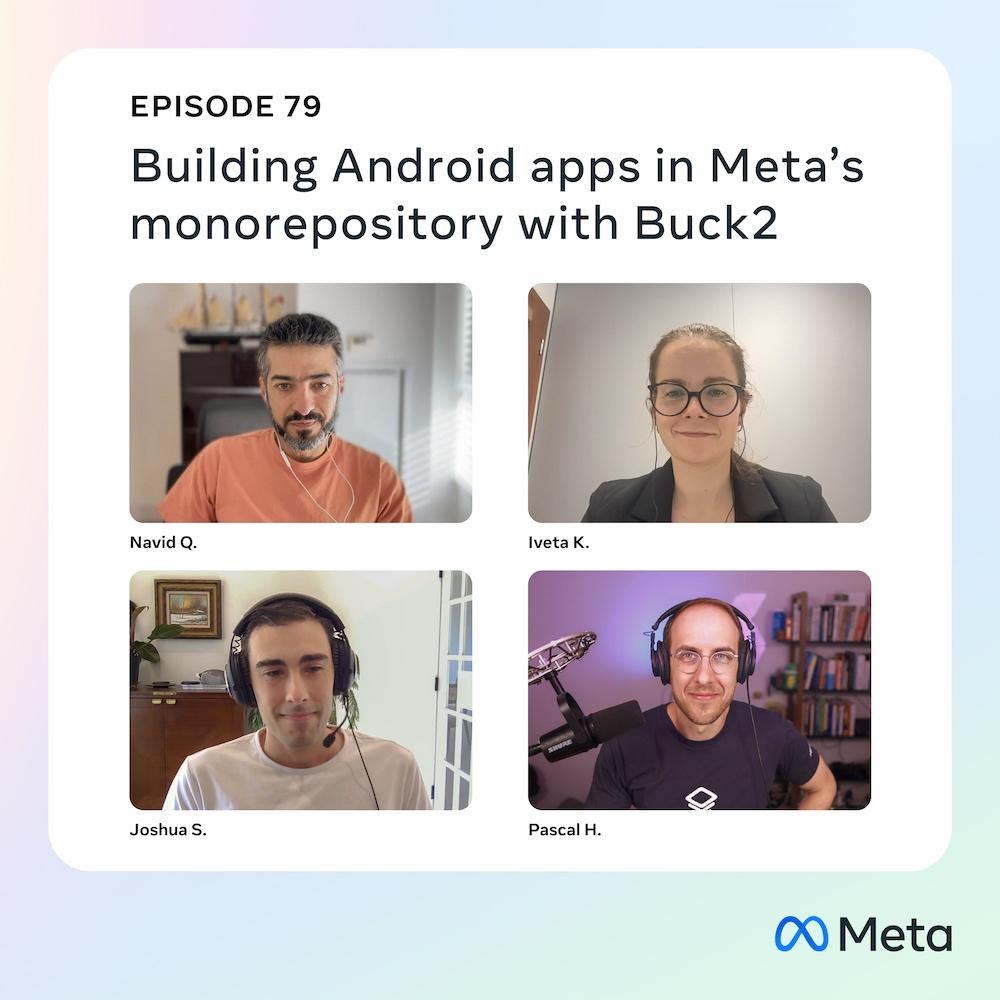
79: Building Android apps in Meta's monorepository with Buck2
Oct 1000:37:11Tap to summarizeHow do you keep Android build times under control when your codebase spans tens of thousands of modules and millions of lines of Kotlin? In this episode, Pascal talks with Iveta, Navid, and Joshua from Meta's Android Developer Experience team about the technical strategies that help Meta's engineers stay productive at scale. We discuss approaches like source-only ABIs and incremental compilation – clever solutions that have helped us tackle the challenges of building fast in a monorepo, as well as what you can do to keep your builds fast with Buck2. Got feedback? Send it to us on Threads (https://threads.net/@metatechpod), Instagram (https://instagram.com/metatechpod) and don't forget to follow our host Pascal (https://mastodon.social/@passy, https://threads.net/@passy_). Fancy working with us? Check out https://www.metacareers.com/. Timestamps Intro 0:06 Introducing Iveta 2:09 Introducing Joshua 3:29 Introducing Navid 4:00 Android DevX Team 4:36 The challenges of build speed 6:28 Buck2 and Android 7:34 How to add new language support to Buck2 9:01 What's new in Open Source? 11:02 Optimising Kotlin builds 12:55 Source-only ABI 14:25 Developer restrictions 17:33 From Jasabi to Kosabi 20:33 Strategies for keeping builds fast 22:08 Working with big modules 23:00 Bringing incremental Kotlin compilation to Buck2 24:48 Speed improvements 28:52 Third-party library upgrades 30:54 What's next? 33:56 Outro 36:14 Links Meta Connect 2025 Developer Talks: https://www.youtube.com/playlist?list=PLb0IAmt7-GS2cONiFVhtdKWEsyNkF6uUP Buck2: https://buck2.build/ Incremental Kotlin compilation at Meta: https://engineering.fb.com/2025/08/26/open-source/enabling-kotlin-incremental-compilation-on-buck2/ Blog post about Jasabi (the Java counterpart to Kosabi): https://engineering.fb.com/2017/11/09/android/rethinking-android-app-compilation-with-buck/ Kotlin Conf talk about source-only ABI compilation: https://2025.kotlinconf.com/talks/857571/ Meta Connect 2025 Developer Talks: https://www.youtube.com/playlist?list=PLb0IAmt7-GS2cONiFVhtdKWEsyNkF6uUP Buck2: https://buck2.build/ Incremental Kotlin compilation at Meta: https://engineering.fb.com/2025/08/26/open-source/enabling-kotlin-incremental-compilation-on-buck2/ Blog post about Jasabi (the Java counterpart to Kosabi): https://engineering.fb.com/2017/11/09/android/rethinking-android-app-compilation-with-buck/ Kotlin Conf talk about source-only ABI compilation: https://2025.kotlinconf.com/talks/857571/
Transcribe →