
Podcast
AI to ROI
Hosted by Ray Rike · EN
AI to ROI is a podcast that shares how enterprises translate AI investments into measurable business value. Hosted by Ray Rike, Founder and CEO of Benchmarkit, the show features senior enterprise leaders and AI software executives who share how AI initiatives move from pilots to production, and how ROI is actually measured and achieved. In addition, each week, we publish a bonus episode with AI to ROI Newsletter co-author, Peter Buchanan to discuss the Big Story of the Week.
The AI to ROI podcast is the evolution of the original "Metrics to Measure Up" podcast.
166episodes
Episodes
Newest firstAll episodes
Chinese Open Weight Models Overtake US Frontier AI: What Every Enterprise Executive Needs to Know
Yesterday00:36:22Summary readyTwelve months ago, US frontier models controlled roughly 70 percent of AI traffic. Today, Chinese open-weight providers, led by DeepSeek, Z.ai, Moonshot, and Minimax, account for 45 to 61 percent of top-tier model traffic on OpenRouter, with DeepSeek alone processing more tokens than Google, Anthropic, or OpenAI individually. In this Big Story edition, Ray Rike and Peter Buchanan unpack how this shift happened, how US labs and regulators are responding, and three scenarios for how the closed versus open weight competition plays out for enterprise AI buyers.Key topics discussed:The pricing collapse driving enterprise migration. DeepSeek made a 75 percent price cut permanent in May, bringing its V4 Pro model to a fraction of a cent per million tokens versus $2.50 per million for GPT 5. Minimax delivers GPT 5.5 class coding performance at 5 to 10 percent of the cost. This is why Uber, Microsoft, and Walmart are now implementing formal usage governance on frontier models rather than treating cost control as temporary.The Mythos and Fable shutdown as a trust event. The 18-day suspension of Anthropic's top models over export control concerns spooked global enterprise buyers who realized mission-critical workloads could be cut off without warning. This single event accelerated the adoption of open-weight alternatives and pushed allied governments to invest in sovereign AI capacity.Distillation attacks and the IP leakage problem. Anthropic accused Alibaba's Qwen lab of running a large-scale adversarial distillation campaign, using tens of thousands of accounts and tens of millions of exchanges to extract agentic reasoning capability from Claude. This reframes the security conversation from model safety to unauthorized technology transfer, which is a distinct and arguably bigger risk for any enterprise relying on proprietary model capability as a moat.Cybersecurity parity is closing faster than expected. Multiple Asian labs, including Z.ai's GLM 5.2, Beijing based 360 Security, and Japan's Sakana AI, now claim benchmark performance approaching Anthropic's Mythos model on vulnerability detection and both offensive and defensive cyber tasks, often at significantly lower compute cost. This weakens the safety and capability gap argument that has justified restricting access to frontier models.Real deployments have moved from theory to production. Coinbase cut AI spend in half after migrating to Z.ai and Moonshot's Kimi models, even as token usage grew. Cursor shipped a coding tool built on Kimi, with a Grok-based version reportedly imminent. Andreessen Horowitz estimates 80 percent of its portfolio companies already use open-weight models in production AI products.Three scenarios for how this settles, and why the decision belongs at the board level. The hosts outline bifurcation (premium closed models for regulated use cases, open weight for commodity workloads), export control entrenchment (Washington treats the Fable ban as a template rather than a one-off), and capability convergence (the rationale for unilateral bans erodes as the performance gap closes). All three are already visible simultaneously, which means enterprise AI architecture decisions, including primary and backup model orchestration, are becoming strategic decisions that belong with the CEO and board, not just the technical team.Why does this podcast episode matter for enterprise executives selecting models, especially for agentic AI deployments?The vendor you choose today may not be the vendor you can use tomorrow, for reasons that have nothing to do with model quality. Regulatory risk, geopolitical exposure, and pricing volatility are now first-order variables in model selection, alongside capability and cost. Any agentic AI architecture built on a single model provider carries concentration risk that didn't exist a year ago. Building orchestration flexibility with primary and backup models, and understanding the true economics behind token pricing, is quickly becoming a board-level governance question rather than a procurement detail.For the metrics and framework to instrument and report ROI on your AI investment, get the Big Book of AI Metrics at benchmarkit.ai under Media.See Privacy Policy at https://art19.com/privacy and California Privacy Notice at https://art19.com/privacy#do-not-sell-my-info.
Summary
AI is Hot - AI Regulation is a Hot Mess
3d ago00:34:55Summary readyOn June 12th, the US Department of Commerce ordered Anthropic to suspend global access to Fable 5 and Mythos 5, its most powerful frontier models, with no advance warning and criminal penalties attached. In this week's Big Story episode, Ray Rike and Peter Buchanan walk through the first use of export controls to take a deployed frontier model offline, why it backfired for security rather than strengthening it, and what a coherent federal AI regulatory framework would actually need to look like.The shutdown mechanics. Because Anthropic could not verify user nationality in real time, the directive knocked out access for every user globally, including Anthropic's own non US employees and more than 150 companies across 15 countries running critical infrastructure workloads.Three reaction tracks. Industry, the developer community, and allied governments each responded differently. OpenAI pushed back on talent restrictions while its legal team blocked coordination with Anthropic on antitrust grounds, and a coalition of 150 cybersecurity leaders published an open letter asking not for less regulation but for a transparent, science based process.The regulatory vacuum, in five forces. Ray and Peter unpack the drivers behind what they call a hair on fire crisis: capability jumps outpacing any statutory framework, a state level policy tsunami of over 1,500 AI bills across 45 states, data center community opposition, the unresolved Anthropic and DOD dispute, and a bipartisan Congressional letter questioning why comparable models were treated differently.A six part framework. The episode lays out proposed solutions modeled on existing regulatory precedent: global market access agreements similar to military sales processes, mandatory pre release testing run by NIST modeled on FAA certification, clear federal versus state jurisdictional lines modeled on pharmaceutical regulation, expanded child safety authority, FERC fast tracking for data center grid access, and coordinated environmental standards.What enterprise leaders should do now. Ray closes with practical guidance: review AI vendor contracts for shutdown protection since force majeure clauses were never written with export controls in mind, build fallback infrastructure for critical AI dependent workflows, delay rushing into brand new model releases, and automate tracking of the fast growing state regulatory landscape.Full details are in the AI to ROI newsletter at ai2roi.substack.com. Subscribe, and consider reaching out to your representatives on this one.See Privacy Policy at https://art19.com/privacy and California Privacy Notice at https://art19.com/privacy#do-not-sell-my-info.
Summary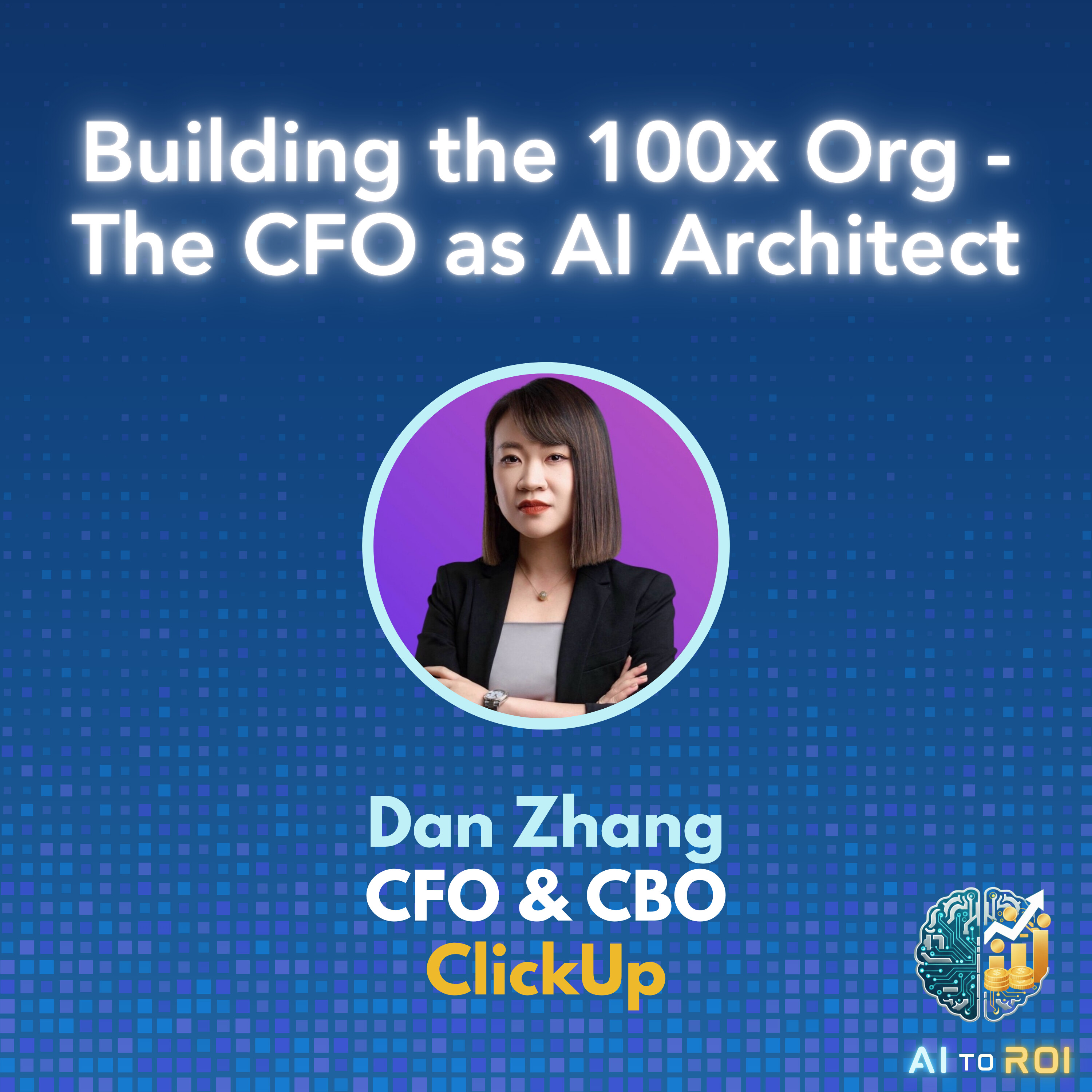
Building the 100x Org - The CFO as AI Architect with Dan Zhang, CFO & CBO at ClickUp
1w ago00:34:43Summary readyMost companies treat AI as a layer they add on top of how work already gets done. Dan Zhang, Chief Business Officer and CFO at ClickUp, argues that it is exactly backward. In this episode, Ray sits down with Dan to unpack the "100x Org," ClickUp's framework for rebuilding the business around AI rather than sprinkling tools and tokens on top of a human-driven workflow, and why that distinction determines whether an AI initiative shows up as activity or as income statement impact.The conversation covers:Why ClickUp expanded the CFO's charter to own AI transformation end to end, after both a top-down mandate and a bottoms-up experimentation push failed to produce results that made it into productionThe "jobs to be done" framework Dan uses to separate primary work that actually moves the business from secondary work that just generates busy AI activity, and why most companies have a work redesign problem before they have an AI problemDan's psychological test for AI ROI (would you pay for it with your own money) and why ARR per headcount is the right metric, but a lagging one that plays out over years, not weeksHow ClickUp instrumented daily, not monthly, visibility into AI cost and token consumption, and why over half of enterprise companies in Ray's own research have blown their AI budget by 25% or moreWhy the real anxiety CFOs have about AI ROI isn't the return, it's confidence in cost management, and how a governance layer turns that anxiety into a guardrail instead of a monthly surpriseDan's rapid-fire advice on who should own AI ROI measurement, the two-to-three variables every CFO needs in place, and how early and mid-career professionals protect their relevance by owning the question, not just the answerIf your organization has AI activity but can't yet point to AI impact, or your CFO isn't sure whether AI spend is a competitive advantage or a leak, this episode gives you the operating model and the financial discipline to tell the difference.See Privacy Policy at https://art19.com/privacy and California Privacy Notice at https://art19.com/privacy#do-not-sell-my-info.
Summary
AI is a Compensation Scale Expense
1w ago00:33:29Summary readyToken prices have fallen 98 percent since GPT-4, but enterprise AI bills are up 320 percent. In this week's Big Story episode, Ray Rike and Peter Buchanan trace where that money is actually coming from, and the answer is not the software budget. Drawing on Gartner, Oxford Economics, Zylo, Challenger Gray and Christmas, and Goldman Sachs data, the two lay out why labor, not IT, is becoming the primary funding source for AI at scale, and why almost no company has the measurement infrastructure to manage it.The price paradox. Per token costs have collapsed, but usage has grown faster than costs have fallen. Ray walks through the math behind average enterprise AI budgets rising from $1.2 million to $7 million in two years.Three cautionary tales. Uber consumed its entire annual Claude Code budget in under four months, Microsoft revoked thousands of Claude Code licenses over cost, and one unnamed enterprise ran up a $500 million bill in a single month. Ray and Peter break down why each was a governance failure rather than a technology failure.Only two budget pools are big enough. The IT and software budget represents just 3 to 4 percent of revenue, while labor represents 25 to 40 percent depending on industry. Ray makes the case that labor is the only pool large enough to absorb the AI spending trajectory Gartner and Oxford Economics are projecting.The attrition lever. Ray and Peter unpack how not backfilling open roles has quietly become the primary way enterprises are funding AI investment, supported by data showing over 113,000 tech layoffs in 2026 with 48 percent explicitly attributed to AI.Revenue per FTE as the tell. Ray shares benchmark data showing SaaS company revenue per employee up 25 to 35 percent over the last twelve quarters, and explains why this metric will be the clearest signal of whether the AI budget transfer is actually working.Five metrics every CFO needs now. The episode closes with a practical starting list: AI spend as a percent of revenue, AI spend per employee, inference spend as a percent of opex, inference cost as a percent of COGS for AI enabled products, and revenue per FTE tracked against labor cost and agent cost as a percent of OPEX.AI to ROI is always looking for guests with real-world examples of measuring AI budget impact. Reach out Ray on LinkedIn (@rayrike). Subscribe to AI to ROI at ai2roi.substack.com for the full June 9th edition, and leave a review wherever you listenSee Privacy Policy at https://art19.com/privacy and California Privacy Notice at https://art19.com/privacy#do-not-sell-my-info.
Summary
AI-Native Services: The $100B Disruption of Professional Services
2w ago00:36:41Summary readyProfessional services firms have billed by the hour for over 200 years. That model is now under direct attack from a new category of company: the AI Native Services firm. Ray Rike and Peter Buchanan break down exactly what makes these companies structurally different from traditional professional services firms and AI-augmented incumbents, profile four companies proving the model at scale, and lay out the six critical success factors that will separate the winners from the well-funded failures.Episode Highlights:Defining the category. Drawing on the Emergence Capital AI Native Services Playbook, Ray and Peter establish a clear three-part taxonomy: AI Native Services companies (AI does 80 to 90% of the work, a licensed human reviews and is accountable for the outcome, and the client pays for results), AI Augmented Services companies (humans still do most of the work with AI as a productivity layer), and traditional SaaS tools (the customer's team does the work, and the vendor takes no accountability for the outcome). The distinction matters enormously for enterprise buyers evaluating contracts and liability.How the operating model actually works. The AI Native Services delivery model runs in four phases: client intake and data ingestion, AI-driven execution of the primary service work, licensed human review and approval, and outcome delivery back to the client. Critically, that fourth phase is where the model compounds, because every accepted output becomes training data that makes the system smarter and harder to displace over time.Four companies are proving the model. Ray and Peter profile four AI Native Services companies at different stages of scale, each dominating a regulated vertical wedge. Top AI-Native Service companies covered include: 1) Field Guide is automating audit workflows for nearly half of the top 100 US accounting firms, including KPMG and RSM, and recently raised a $75 million Series C at a $700 million valuation; 2) Even Up has built a proprietary PI AI model trained on hundreds of thousands of personal injury cases, processing 10,000 cases per week for over 2,000 law firm clients, following a $385 million funding round; 3) A-Bridge converts physician-patient conversations into structured clinical notes integrated with Epic and other EMR platforms, serving over 150 enterprise health systems including Kaiser Permanente, Mayo Clinic, and Johns Hopkins, with $100 million in ARR and a $5.3 billion valuation; 4) Harper is a licensed commercial insurance broker, not a software tool, that processes applications across 160+ carriers simultaneously and delivers final coverage in 24 to 48 hours versus the industry standard of five to seven days.Six critical success factors. The hosts lay out what separates durable AI Native Services companies from those that will stall: genuine domain expertise on day one, a proprietary data flywheel that compounds with every case resolved, a clear migration path from labor-based to outcome-based pricing, honest gross margin accounting that properly classifies LLM inference and human labor as cost of goods sold, narrow vertical focus on a specific wedge rather than broad horizontal expansion, and distribution through regulated industry incumbents who provide both credibility and enterprise access.Gross margin as the early warning signal. If gross margins are declining as an AI Native Services company scales, that is a signal the human-in-the-loop is becoming the bottleneck rather than the leverage point. The financial goal is to continuously increase gross margins as AI does more of the work, moving from a 35 to 45% gross margin profile toward 50 to 60% over time.What enterprise buyers should ask. Ray closes with a direct call to action for executive buyers: if an AI vendor is pricing by the seat, by the partial FTE, or by the hour, push hard on how much of that is human supervision of AI versus a truly AI-native delivery model. You are no longer contracting a resource to do the work. You are contracting an organization to deliver the outcome you need.See Privacy Policy at https://art19.com/privacy and California Privacy Notice at https://art19.com/privacy#do-not-sell-my-info.
Summary
AI Math is not Adding Up - Where is the ROI?
2w ago00:33:53Summary readyToken spend is exploding across the enterprise, but the value it creates remains largely invisible on corporate dashboards. In this week's Big Story episode, Ray Rike and Peter Buchanan unpack why AI investment and ROI visibility are moving in opposite directions, and what enterprises need to do about it. Drawing on Ramp data, Exponential View, Semianalysis, and Ray's recent conversation with Russ Frayden, CEO of Lariden, the two dig into the measurement infrastructure gap that is turning individual AI productivity gains into an unmeasured expense line.The productivity paradox. Individual output is up across engineering, sales, and research functions, but those gains are not translating into company-level financial impact. Ray connects this to Parkinson's Law and explains why more productive workers do not automatically produce more profitable companies.AI dark output. Peter introduces the concept from Semianalysis: real economic value created by AI that never registers on a P&L, using the example of a legal document that drops from $400 to $5 to produce, where the savings disappear while the token expense shows up in plain sight.The cost to compensation shift. Ray walks through why token spend approaching 50 to 100 percent of engineering compensation changes the entire calculus for measurement, contrasted against IT's historical 3.5 to 6 percent share of revenue.Case studies in good and bad. The episode breaks down three real examples: Uber's Claude Code rollout that ran out of budget without measurable output gains, Lowe's cross-functional agent deployment that built proper context tracking, and Petrobras's narrow tax compliance pilot that identified $120 million in savings and is scaling toward $1 billion.A four-stage framework for real measurement. Ray and Peter lay out the progression from cost visibility to utilization, proficiency, and business impact, and explain why almost every enterprise is stuck at stage one.Six tactical takeaways. The episode closes with concrete actions: measure outcomes not activity, design for the middle 70 percent of users rather than power users, give CFOs real budget ownership, start narrow and expand from proof points, redesign decision rights as AI scales, and treat organizational role changes as a planned program rather than a side effect.Subscribe to the AI to ROI newsletter at ai2roi.substack.com for the full breakdown, and leave a review wherever you listenSee Privacy Policy at https://art19.com/privacy and California Privacy Notice at https://art19.com/privacy#do-not-sell-my-info.
Summary
The AI Coding Wars, Inflection Point and the Cursor-SpaceX Deal | AI to ROI: The Big Story
3w ago00:34:22Summary readyThe April 2026 announcement that SpaceX may acquire Cursor for $60 billion, or alternatively pay $10 billion for a compute partnership, stopped the enterprise tech world in its tracks. A four-year-old company founded by four MIT students with $2.7 billion in annualized revenue but nearly $900 million in losses on $700 million in actual revenue. This deal is not primarily a valuation story. It is a signal and a cautionary tale about the economics of the AI coding tool market.In this Big Story edition, Ray Rike and Peter Buchanan break down what is really happening in the AI coding wars, why Cursor ended up at SpaceX's door, and where this market goes from here.Key topics covered in this episode:From copilot to autonomous agent: how the AI coding market structurally shifted. Four years ago, AI coding tools suggested your next line of code. Today, they read entire codebases, plan multi-step tasks, edit files across a project, run tests, and submit pull requests with minimal human direction. Claude Code reached $1 billion in annualized revenue six months after launch, the fastest of any enterprise software product in history, and crossed $2.5 billion by February 2026. Meanwhile, 90% of enterprise developers now use at least one AI coding tool, and nearly half of all GitHub code is AI-generated or AI-assisted.The productivity gains are real but uneven, and the risks are underappreciated. JPMorgan deployed AI coding agents to 40,000 engineers and reported 10 to 20% productivity gains in code creation and conversion, along with a 70% increase in code deployments. But CodeRabbit's research found 1.7 times as many defects in AI-authored pull requests as in human-authored code. Meta's brief "token maxing" leaderboard experiment, designed to spotlight power users, had to be taken down within two weeks after producing high token consumption and limited usable code. Senior developers are shifting toward architecture and review roles while junior developer pipelines are shrinking, even as total software developer job postings are up 5 to 10% year over year.A tour of the seven major players and where the structural tension lives. Ray and Peter profile Anthropic Claude Code, GitHub Copilot, Cursor, OpenAI Codex, Google Gemini Code Assist, Replit Agent, Lovable, and Cognition's Devin across revenue, differentiation, and risk. The common thread: most point-solution coding agents run on Anthropic or OpenAI models, and those same model companies have now launched their own competing coding products. The Oracle database-to-applications parallel is not subtle.Why the Cursor-SpaceX deal happened and what it actually reveals. Cursor had $2.7 billion in annualized revenue, negative 23% gross margins, and was losing money faster than it was growing. Even with a $2 billion funding round in process from Andreessen Horowitz, Thrive Capital, NVIDIA, and Battery Ventures, Cursor's leadership concluded they would need to raise billions more by year-end to fund compute costs. SpaceX's acquisition offer, or the $10 billion partnership payment that Ray reads as a very generous breakup fee, solved that problem while giving XAI a revenue base three times its current size ahead of a $1.75 trillion IPO valuation push.The Chinese open-source threat and three scenarios for where this market goes. Kimi, DeepSeek, and Qwen models are improving rapidly and are significantly cheaper. They are, as Peter puts it, lurkers haunting every company on the list. Ray and Peter then lay out three scenarios: model makers consolidate, and IDE players get marginalized; a durable multi-tool ecosystem persists because different tools serve different workflow stages and buyer profiles; or a compute-native player builds a fully autonomous coding agent that eliminates the need for an IDE entirely. Claude Code already resolves 64.3% of real-world GitHub issues, and full autonomy for defined-scope tasks may be 18 to 36 months away.The AI coding market is projected to reach $49-$50 billion by 2030, at a 38% CAGR. The speed gains are real. So are the defect rates, the governance gaps, the model-dependency risks, and the token-budget surprises landing on CFO desks. If you are a CIO, CFO, engineering leader, or investor trying to make sense of who wins and what it costs, this is the episode to start with. Read the full story at ai2roi.substack.com.See Privacy Policy at https://art19.com/privacy and California Privacy Notice at https://art19.com/privacy#do-not-sell-my-info.
Summary
AI Governance, Ethics, and the Stewardship Framework: A Conversation with Evan Schwartz, Chief Innovation Officer at AMCS Group
3w ago00:34:03Summary readyMost companies jumped straight to headcount reduction when AI arrived. AMCS Group went the other direction, starting with governance, ethics, and a question most companies never ask: not what can AI do, but what should it do? In this episode, Ray talks with Evan Schwartz, Chief Innovation Officer at AMCS Group, a platform serving resource-intensive industries across 80 countries, about how that single question reframed their entire AI strategy and produced results measured in multiples rather than percentage points.Topics we discussed include"Why "person plus AI" beats "AI replaces person" from day oneCompanies that moved quickly on headcount reduction before AI left the lab found themselves rehiring at a higher cost when the technology did not perform in the wild as it did in controlled conditions. AMCS took a different path. Rather than treating headcount reduction as the goal (a finite game with a ceiling of zero), they pursued asymmetric growth: amplifying the capabilities of experienced employees so the business could scale revenue without incurring proportional costs. The result was output multiples, not efficiency percentage points.The governance and ethics framework that drove better AI decisionsOperating across 80 countries with GDPR, SOC 1, SOC 2, and a range of regional regulatory requirements, AMCS could not afford to move fast and fix things later. They codified existing governance frameworks (including the EU AI Act and NIST standards) into a use-case design framework that forced a structured question before any deployment: what should this AI do? That question filtered out low-value applications, surfaced the high-impact ones, and created the foundation for what Evan calls the stewardship model.What an AI steward actually does, and why the role is humanAs AMCS built out orchestrator agents and sub-agents, they needed a clear accountability structure. The steward is always a human. Effective AI stewards share three skills: they communicate tasks clearly to orchestrators, they understand what data context the agent needs to do the job well, and they know what good output looks like even without knowing how the system produced it. That last skill, the ability to look at a result and say "that number is wrong," is what keeps agentic systems on the rails and prevents AI sprawl from becoming unmanageable.Two external agentic AI use cases with hard ROI numbersThe dispatch management agent now monitors 700,000+ trucks globally, dynamically reroutes based on real-time events (blocked containers, missed pickups), and automatically notifies customers through their preferred channel, including rescheduling VIP accounts before they can call in a complaint. The result: 17 gallons of diesel saved per truck per month in fuel optimization, plus a $650,000 pull-forward of aged receivables (from 90-day to 30-day collection cycles) in just the first month at one customer. The customer service agent enables CSRs to double or triple their customer-touch volume by having AI handle all post-call documentation, action items, scheduling, and follow-up. That increased coverage cut AMCS's own churn rate from 6% to 3%.How AMCS justifies AI investments internally, and why it starts with board-level metricsAMCS is targeting ISO 42001 compliance (the AI management system standard) by year-end, which requires registering every AI tool, documenting bias risks and mitigations, and tying each use case to measurable outcomes. Evan's framework for approval is straightforward: identify your current baseline, set a target, and trace the expected return all the way to a board-level financial metric, EBITDA, free cash flow, or SG&A. Stopping at "we saved three hours" is what he calls lazy intellectualism. The real question is what those three hours produce when redirected to high-value work.Career advice for the AI era: stop valuing yourself by the output.Evan's message to early-career professionals is direct. If AI can produce the output, the output itself has an approaching-zero value. What has value is the ability to get AI to produce it, to steward the system, to know what good looks like, and to course-correct when it does not. The leaders of the next decade will be those who can direct a digital workforce of agents toward outcomes that matter, not those who were best at producing the deliverables themselves.See Privacy Policy at https://art19.com/privacy and California Privacy Notice at https://art19.com/privacy#do-not-sell-my-info.
Summary
Big Book of AI Metrics
4w ago00:34:14Summary readyThe AI to ROI team, Ray Rike and Peter Buchanan, mark the official launch of The Big Book of AI Metrics, an 180-page, 81-metric operator's reference guide built to close the gap between AI adoption and AI ROI. Twenty-seven percent of executives say AI has met their ROI expectations, enterprise AI token spend is up 13x since last year, and most companies still can't explain what they got for the investment. Ray and Peter break down why that gap exists and what to do about it.Topics covered:Why adoption, utilization, and outcomes are three different things, and why most companies stop measuring at adoptionThe five layer causal chain framework: input signals, leading indicators, operational KPIs, financial outcomes, and strategic valueWhy establishing a baseline before deployment is the single most skipped step, and why skipping it turns results into opinion instead of evidenceFour real world case studies: Petrobras ($120M in tax savings), Stocks Insurance (83% reduction in claims processing time), Uber's cautionary token budget blowout, and Klarna's revenue per employee gainsThree actions operators should take this week: define the outcome metric, establish a baseline, and build a measurement cadence before and after deploymentKey quote: "Adoption still is not ROI. Outcomes are ROI. And outcomes that translate into better financial performance, that's true ROI that a CFO, investor, and a board of directors can get behind." - Ray RikeThe Big Book of AI Metrics is organized into 13 functional roles, covering both operating executives investing in AI to improve their functions and B2B software executives whose product economics now depend on token consumption, inference costs, and gross margin impact.Get the Big Book of AI Metrics: https://www.benchmarkit.ai/ai-big-book-of-metricsSee Privacy Policy at https://art19.com/privacy and California Privacy Notice at https://art19.com/privacy#do-not-sell-my-info.
Summary
Measuring the costs, utilization, proficiency and impact of AI - with Russ Fradin, Founder and CEO, Larridin
Jun 900:33:17Summary readyMost enterprises have deployed AI broadly. Far fewer know what they are actually getting from it. Russ Fradin, Co-Founder and CEO of Larridin, has spent his career building measurement infrastructure at inflection points in technology adoption, from early days at ComScore measuring internet advertising to founding Larridin with backing from Andreessen Horowitz and Google's Gradient fund. In this episode, Russ makes the case that AI spend is on a trajectory to become the number-one or number-two driver of enterprise OpEx, and that most organizations still lack the basic visibility needed to manage it.Topics covered:The AI visibility gap: Why AI adoption moved faster than measurement infrastructure, and why enterprises are only now scrambling to answer fundamental questions about what they are spending, where, and by whomUtilization vs. proficiency vs. business impact :Why these three dimensions require separate measurement, and why the 1,800 heavy users at a 30,000-person company are not a success story on their ownToken spend as a new category of OpEx risk: How consumption-based pricing turns every employee into a cost endpoint, with real examples of runaway agent spend and blown budgets that no one turned offCFO ownership of AI investment: Why AI spend is the first technology cost category large enough to pull the CFO into governance conversations that historically belonged to the CIO and department headsChange management as the bottleneck: Why the hard work is not experimentation but operationalizing what works, scaling proven behaviors from the top 5% of users to the full organizationCareer advice for AI-era professionals: Work harder than the room, achieve deep tool mastery, and invest in relationships, the same fundamentals that applied before AI, now with higher stakes for the people who act on themRuss closes with a memorable framing: "Companies have committed to a fitness journey but have not yet bought a scale; Larridin is building that scale."See Privacy Policy at https://art19.com/privacy and California Privacy Notice at https://art19.com/privacy#do-not-sell-my-info.
Summary