← Mick Unplugged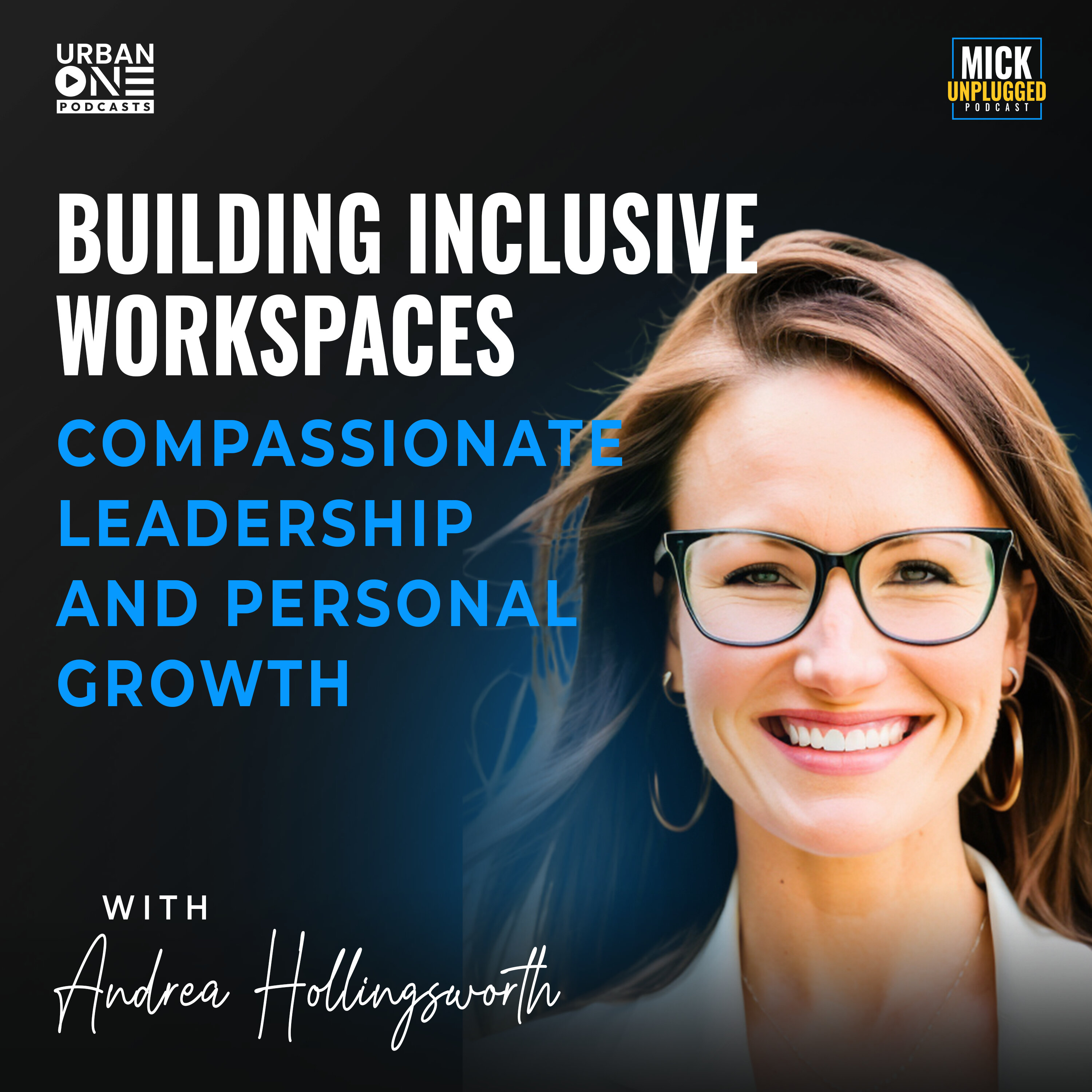
Mick Unplugged
Andrea Hollingsworth | Building Inclusive Workspaces: Compassionate Leadership and Personal Growth
00:33:16
Loading summary
Transcript74 lines
- [00:00]
Andrea Hollingsworth
What is it that makes people transform for the better? What is it that fuels positive healing and change in human lives?
- [00:10]
Mick
It's in our human DNA to do two things. To care and offer help. What are some things that you're seeing organizations do wrong or struggle with the most? Where you bring the impact.
- [00:23]
Andrea Hollingsworth
Always start with self compassion. We have to hustle and grind all the time and we have to overperform. And if we don't at any point, our worth is under threat.
- [00:34]
Mick
Just be you right. Show up as you every day and the surroundings actually adjust and adapt.
- [00:40]
Andrea Hollingsworth
Yeah, that. The power of vulnerability, the power of authenticity. Being real, being you.
- [00:50]
Mick
Welcome to Mick Unplugged, where we ignite potential and fuel purpose. Get ready for raw insights, bold moves and game changing conversations. Buckle up up. Here's Mick.
- [01:01]
Ladies and gentlemen, welcome to another exciting episode. And today's guest is a distinguished consultant, speaker, and academic with an extensive expertise in organizational psychology and leadership development. As the founder of Hollingsworth Consulting, she has dedicated her career to helping organizations enhance their leadership capabilities and foster inclusive work environments. Her deep understanding of human behavior and commitment to promoting diversity and inclusion have made her a trusted advisor and thought leader in her field. Please join me in welcoming the insightful, the innovative, the influential, Minnesota's own Ms. Andrea Hollingsworth. Andrea, how you doing today, dear?
- [01:43]
Andrea Hollingsworth
I'm great, Mimi. Sodas on.
- [01:48]
Mick
I can't do the accent as good as I know.
- [01:50]
Andrea Hollingsworth
It's okay. I don't expect you to. I'm going to do it for you.
- [01:53]
Mick
There we go. There we go. You know, I was telling you offline, one of my really good friends is from Minnesota, and every once in a while, she'll give me a little word that I've never heard before or an emphasis. I'm like, oh, yeah, I forgot, you're from Minnesota. Mm.
- [02:06]
Andrea Hollingsworth
Mm. Yeah.
- [02:08]
Mick
Good start.
- [02:09]
Andrea Hollingsworth
It's wonderful to be here. Thanks for the invite.
- [02:11]
Mick
I'm honored to actually have you on. And there's so many things that I know we can talk about, but I want to start with this. Andrea, you know, I'll make Unplugged. We talk about going deeper than your why. Yeah, right. And really being fueled by your purpose or your because, as I like to call it. So for Andrea and all the amazing things that you do and the things that you help organizations with, I love to know, like, what's your because? What's your reason for taking this path and saying every day, this is my purpose, this is my mission.
- [02:42]
Andrea Hollingsworth
Yeah, well, that's the question, isn't it, you know, my. My stepfather, who had such an influence on me, used to talk about the burn in the belly. You know, what's the burn in the belly? And that has stuck with me. And so I try to keep sight of that for so long. For several decades, I have had this burn in the belly question in me of what is it that makes people transform for the better? What is it that fuels positive healing and change in human lives? And I know that's a huge question, but I first started thinking about it in my master's program in my early 20s. My whole career has been really a whining, winding road of exploring that question of healing from different angles. And really early on, what I landed on was that the power of human empathy, of human care, human compassion, and trusting connection is absolutely at the core of positive transformation and healing in human life, in pretty much every domain. And so for many years, I've been studying various aspects of human relationships. You know, healthy human relationships, relationships that foster wholeness and inclusion and people feeling seen, safe and supported, because that really is the spot where folks learn to live into the best of themselves, whether they're a business leader, whether they're a parent, or whether they're just a human being trying to get by in this extremely wounding and confusing and conflicting conflicted world that we're all navigating. So that's the. Like. That's the high level, I would say.
- [04:28]
Mick
No, I love that. And so I want to go unplug a couple of things that you said, or at least one in particular. So you said that your stepfather had a huge influence on your life. Can you talk a little bit about that and how that shaped who you are today?
- [04:42]
Andrea Hollingsworth
Absolutely, yeah. He's actually a lot of the reason why I talk about compassionate leadership, because compassionate leadership made a big difference in his life. And then he became a compassionate leader. To many people, I call it compassion contagion. So back in the 60s, so he passed away in 2016, and so he's been gone for a while, but back in the 1960s, he was a young man navigating his way in the world. He grew up on a farm in rural Minnesota, and he kind of tried college, but that wasn't for him. And around the age of 20, he got a job working at a manufacturing plant in Anoka, Minnesota, which is where I'm from. And at the time, he was dating a girl named Tess, and Tess got pregnant unexpectedly. And back in those days, what people often did is they just got married. And so that's what they Did. They got married. And by the time my stepdad was 24, he found himself a family man, the father of three young children. And he had a job working on the floor of a manufacturing plant. Life was going along okay until Tess was diagnosed with a fatal liver disorder. And so then, at the tender age of 24, my stepdad found himself a widower with three young children under the age of five. And it was devastating. Now, my stepdad. I'll just. I'll call him Jerry. That was his name. Jerry. His boss at Federal Cartridge where he worked, was a guy named R.B. old R.B. i grew up hearing stories of old R.B. because R.B. saw Jerry struggling. He observed Jerry. He started coming in late to work. You know, he was clearly hungover from another night of, you know, closing out the bars in Anoka, Minnesota. He knew that Jerry was dropping his three kids off at MA and PAWS for long stretches and just really, really struggling to hold onto himself, right? And old R.B. you know, he believed in Jerry. He had been the one to hire him. You know, here's a kid who knows how to work hard. Here's a kid who cares about other people. Here's a kid who. Who's got promise, who's got that burn in the belly, you know, he gave it some time. He was compassionate. But after a while, after enough, you know, late. Late showing up to work, he was kind of frustrated. So he pulled my stepdad aside and he said, look, kid, I know I can't even begin to understand what you must be going through right now. And I feel for you. I really, really do feel for you. But you're coming in late to work. Everybody here knows you're drinking too much, you're dropping your kids off at your parents for long, straight. Your kids need you right now, and you gotta pull yourself together. And if you don't, you've got a pink slip coming. But here's the other thing, kiddo. I care about you. And say, I've been going to the local AA group at the local parish for a long time, and if you'd ever like to come, we'd love to have you. And so that was a turning point for my dad. In a moment of deep struggle and of deep trauma, my dad did indeed start to go to the AA group. And with the sort of the tough love, compassionate leadership, support of RB and others in his workplace, he was able to really find healing and to really find himself again in the lowest moment of his life. And, you know, he went on actually to become vice president of Federal Cartridge. You Know, later in life, mentored so many people who were going through hard things. He was one of the first to advocate for hire women and promoting women, you know, back in the 60s and 70s at federal. And, you know, I'll be vulnerable and share even me myself, when I, in my late 20s and early 30s realized, you know, I think I have a problem, you know, relying too much on alcohol in my own, you know, work life and personal life, this is impacting me. I sat down, I talked to my stepdad and I said, you know, what can you tell me? And he said, annie. He always called me Annie. He said, you know, why don't you come with me to that. He was still going to that same AA group.
- [08:51]
Mick
Wow.
- [08:51]
Andrea Hollingsworth
And so he. So that's a very, that's a personal story of just how compassionate leadership has made a difference. But my mom also extremely compassionate person. And so those are some of the stories that have really driven me.
- [09:05]
Mick
I love that. And what I love and I know about you is you take that same energy, that same moral compass, and that's what you're doing with leaders and organizations today. And so one, I appreciate you for sharing that story and most importantly, just the impact that you're having with organizations I truly admire. So thank you for that too.
- [09:28]
Andrea Hollingsworth
Well, thank you. I truly, you know, we're in a unique moment right now societally, you know, at least here in the United States, it's tense right now. People are. There's a lot going on, you know, economically, politically, socially. We have a mental health crisis on our hands. We have, you know, employees still record numbers of burnout and exhaustion and, you know, this whole quiet quitting thing. It gets called different things, but it's just basically workers feeling like I can't even anymore and I'm going to show up physically but be checked out mentally. And so it's really my joy to go in and say, how can we give leaders, you know, everyone from frontline managers to the very top, you know, the C suite leaders, the tools and the skills, because compassion is a skill. There's a lot of research out there showing that, you know, it's not that you're either born compassionate or not everybody has the capacity to develop skills, interpersonal skills, to be more aware, to be more empathetic, and to be more action oriented for others. And so to go in and just give leaders those skills that will make people feel seen, feel safe and supported at work. Because I believe work should be a place where at least we're not re traumatized, you know, and, you know, I've also had many years of experience as a psychotherapist. And you would be amazed at the number of clients I have had who have come in and said, I have experienced verbal abuse by my manager. You know, outright yelling. A lot of times it's more insidious. You know, those microaggressions that wear on you day after day after day, assuming that you don't know something or you can't do something or, you know, you're not included in this conversation or whatnot because of some aspect of your identity, and that's there, too, and that's just as destructive. But there's also this outright, you know, like, verbal abuse that can happen in the workplace, too. And I think it's evidence of human pain. It's evidence that we all need reminders and we need helps for how can we care for one another? We're built to care for one another. We. We are created to care for. It's our DNA. And we all need that permission to care. And we need the skills to do it in ways that are, you know, that certainly are professional and you have boundaries at work, but that really do build those humanizing connections that are going to help people heal and show up and do their best work.
- [12:02]
Mick
That's amazing, Annie. And I'm calling you Annie. It's not.
- [12:05]
Andrea Hollingsworth
That's fine. I love it. My favorite people call me Annie.
- [12:09]
Mick
There you go. It's also my mother's name.
- [12:11]
Andrea Hollingsworth
So, you know, there we go.
- [12:13]
Mick
So you get to be Annie. I love what you said about it's in our human DNA to care. I also say this when I coach salespeople and I coach leaders.
- [12:22]
Andrea Hollingsworth
Yeah.
- [12:22]
Mick
I actually say that, too. I say it's in our human DNA to do two things. To care and offer help.
- [12:29]
Andrea Hollingsworth
Yes.
- [12:30]
Mick
Because I don't care who you call. And the folks that know me know I always use this analogy. If you call Domino's Pizza right now, how are they going to answer the phone? Thanks for calling Domino's. How can I help you?
- [12:42]
Andrea Hollingsworth
How can I help you? Yeah.
- [12:44]
Mick
Domino's knows 100% of the time you're calling to order pizza. They don't say, thanks for calling Domino's. What's your order?
- [12:50]
Andrea Hollingsworth
Right. Yeah.
- [12:51]
Mick
Because it's in our human DNA to help. I would say everyone that's listening or watching this, whether you own a business, a leader of the business, work at a business, whatever it is, someone at your organization answers the phone, how can I help you? But it's so robotic that we don't actually try to really offer help. And I know that that's one of the things that you really embrace or coach and teaches, the care, the empathy with what you do with leaders. What are some things that you're seeing organizations do wrong or struggle with the most, where you bring the impact?
- [13:24]
Andrea Hollingsworth
Yep, absolutely. So one of the things that really gets in the way of offering help is our own. Like if you're a leader, sometimes your own either exhaustion and suffering yourself, or I've often seen your own inner critic or your own perfectionism really can get in the way of being aware of other people and supportive of other people. So when I work with leaders around compassionate leadership, I always start with self compassion. Because, you know, so many of us have these muscled up inner critics that nobody else sees or hears and we just feel harangued and oppressed by these perfectionistic standards. And we're so hard on ourselves. We've got shame and we've got all kinds of inner scripts going where like we have to hustle and grind all the time and we have to over perform. And if we don't at any point, our worth is under threat. That's the society we live in, right? We've got this like, you're never enough thing going on everywhere for everybody. And so leaders, especially the research shows that leaders are often very hard on themselves and that can impact the way they show up for others. And so I actually have a story about that, about that myself. One of the reasons I'm so passionate about self compassion is that my inner critic basically ruined my academic career. I used to be a professor. I spent my 20s, my early 30s climbing the ranks of academia. And by the time I was 34, I had like arrived at the top of the mountain. I had gotten this tenure track job at Boston University. And all my colleagues were like, how did you do it? And I was like, oh, you know, I love what I do and I work hard and I'm so passionate. All that was true. But what nobody else saw is that this inner critic was driving me all the time. All the time. I remember one time I was, I was giving a presentation at Princeton on ancient meditative spiritual practices in the medieval era and modern day neuroscience. Right. I was putting those two things together. That was what I did. And the presentation went really, really well, I thought. Except that the whole time there was this haired scholar in the front row and he was scowling. And I remember I was thinking to myself, I don't think the Q and A is going to go very well. Because this guy. This guy. And I was right. When I was done, he stood up and he raised his hand and he said, excuse me, did you consult the original Latin of the medieval text that you were referencing? Because in the original Latin, it seems to indicate that, you know, And I don't even remember what he said, but he. He went on to undercut my entire argument based on the fact that I was relying on an English translation of this. I don't know Latin, right? So I handled it okay in the moment, but my inner critic, she sprang into action. She was like, why didn't you consult the original Latin? Because you don't know Latin, do you? You better get your ass in gear, girl. Like, in addition to all the teaching and publishing and research and mentoring and blah, blah, blah, you better learn Latin now. And so I found myself, like, 3:30am Every single day, seven days a week, I'm up looking at my Latin flashcards. I burned out. I burned out. At the age of 36. I walked away from my dream job at BU and I sometimes wonder, you know, if I would have learned to give myself a little bit of grace. I mean, I'm all for high standards. Healthy striving is one thing, but it's this maladaptive perfectionism, that's what researchers call it, that really. It ruined me. It also, you know, it really impacted the way that I showed up for my students, for my colleagues, for my research assistants. I was just. I had this inner criticality and, like, constant anxiety and stress about performance, and it was impacting everybody. And so to get back to your question of what hinders leaders showing up for others, I think we have to start really close to home and help leaders realize, like a. You need to be aware, you need to be curious about what is, you know, when you make a mistake or when you feel insecure about something. What are you telling yourself? What is your inner critic saying to you? Right? And just be curious about that. And then to try to connect with other people and try to say, like, look, you know, I need to talk this through. Like, am I overblowing this? Are my standards? Like, you know, you have to have people you can talk to about your perfectionism and about your anxiety so that they can go like, oh, sweetheart, I've made that mistake a million times. You are doing awesome. So you can get some perspective. And then you have to learn to talk to yourself differently and say, like, you know, I made a mistake. I'm a human. Mistakes are a part of life. I'm going to choose kindness you know, and if there's accountability needed, I'm going to choose accountability too and move on. Because if we can't be aware of that inner critic and soften it with some kindness and with some, hey, you know, I can support myself and learn and grow, but I'm not going to be hard on myself. If we can't do that, we stay in this very kind of amped up, anxious, hypercritical mode. And I don't know, Mick, have you ever been around somebody who just oozes criticality? Like you can tell they're hard on themselves and other people?
- [18:50]
Mick
Absolutely.
- [18:51]
Andrea Hollingsworth
Yeah, absolutely. It's in their energy, right?
- [18:54]
Mick
Correct, correct.
- [18:55]
Andrea Hollingsworth
And I used to be that person. And so what I do is I start out by helping leaders work on themselves. And what that does then is it frees them up. All of a sudden they get rid of a lot of mental noise and they learn to bounce back more quickly and then they can be more aware of other people, like, hey, what are you going through? How can I support you? Hey, are you down on yourself for whatever mistake? It does so many wonders. It just calms us down so that we can truly be present in the ways that we want to and need to as leaders.
- [19:31]
Mick
You know, I love that. And I will even say a step deeper for the person that's not a leader of an organization, because all of us that are listening and watching, even if you don't lead an organization, you're probably a leader in your household or a leader in your community, right? So everyone's a leader.
- [19:47]
Andrea Hollingsworth
Like lead ourselves through our lives, right?
- [19:48]
Mick
Everyone's a leader. So I would say that that is also critical for the non business leaders. Don't be overly critical of yourself. I would say one of the top five things that most humans do that adds to mental health stress is you're over critical. You're thinking of what every 2 billion people in the world could be thinking about you. And I have this saying, just be you. Everybody else will adjust. I actually got that shout out to the comedian Mookie G. Right. One of my really good friends and comedian, like he gave me a shirt that literally says that be yourself. They'll adjust. And I think that that's really important.
- [20:30]
Andrea Hollingsworth
Can you send me a shirt that says that shirt?
- [20:32]
Mick
I will totally send you that shirt.
- [20:34]
Andrea Hollingsworth
I want that shirt.
- [20:35]
Mick
Yes, I got you covered offline. I'll get your size and get it shipped to you. But it's really important that people understand whether you're a leader in a business leader in your household, leader in your community, always, authentically, be you. Because people can see when you're faking.
- [20:53]
Andrea Hollingsworth
Yes, they can.
- [20:54]
Mick
People can see when you don't believe in you. And most importantly, people can see when you're trying too hard. Right. Even if you're not baking, but you're trying too hard, People see that, and it comes across weird. And we do those things as humans because we think that it's our purpose to either please everyone to be the person or people that people want us to be. And that's not the case. And I know that you talk a lot about that in your psychology as well, too. Just be you, right? Show up as you every day, and the surroundings actually adjust and adapt.
- [21:30]
Andrea Hollingsworth
Yeah. That. The power of vulnerability, the power of authenticity, being real, being you is so critical, you know, it's critical in every area you mentioned. Maybe a lot of listeners, maybe they're not a business leader, but maybe they're a leader in their household. You know, what is it like when maybe you're. You're having maybe a tense moment with your partner, with your child, and you just take a deep breath and you say, I gotta be honest with you now. Right now. I just. Here's what I'm feeling, you know, or, you know, maybe make a mistake and take a deep breath and say, you know, I gotta be honest with you. I need to apologize. You know, instead of, like, we put up these masks and it distances us from ourselves and from other people. But in organizational context, it's really powerful when leaders are vulnerable, when they choose to just show up as themselves and they're not putting on anything. That's actually another big element of healing, especially when you've got work contexts where there's a lot of tension going on, maybe around really sensitive subjects. I actually have a story there. So a number of years ago, I was working with a leader in a key division of the city of Minneapolis. I'm not going to say which one, but. And his team. And in the wake of the murder of George Floyd, a member of his team responded publicly to that event, like, made a public statement about that event that ended up really wounding and hurting some other members of his team. So he got the contacts, somebody made a public statement. It was just like other people were just like, oh, hell no. Right. And so he found himself then on a zoom meeting shortly after that. And everybody was there. You know, the people who were pissed off about the public statement and also the folks who had crafted the public statement were on the call. Everybody's there. This is what we're going to address and really all these tensions around inclusion and race and privilege, it's all there, and people are feeling all the feels. And he gets on and he says, he takes a deep breath, and he goes, everybody, I need to start out with by taking a deep breath. He said, I can feel my heart pounding. I can feel myself. You know, I can feel my body. He said, I just. I'm feeling a lot right now. I'm feeling a lot of grief. I'm sad about the pain in our city. I'm sad about the pain here on this call. And then he led everybody in, just taking a few deep breaths together. And then he said. He said, I want you to know that whatever you're feeling here today, before we get started, maybe you're grieved as well. Maybe you're angry, maybe you're confused. He said, all of those feelings are welcome. He said, if you didn't feel them like I'm feeling them, you wouldn't be human. And more than anything, we here in this division need to hold on to our humanity. And so he gave everyone a minute to kind of connect with themselves and what they're feeling. He laid down some ground rules for safe dialogue. And then they dived in and. Or dove in. And it was really a turning point in this group starting to heal some of these deep divisions around culture, race, inclusion, privilege that had been, you know, like, of course, the George Floyd murder, like, brought everything to the fore and for all, you know, for so many of us. And so. But that conversation, just by him being vulnerable and real, not coming in with, like, all right, I'm going to fix this, and here's how it's going to go. And hiding behind some kind of mask of, like, I've got it all figured out.
- [25:12]
Mick
He did.
- [25:13]
Andrea Hollingsworth
Didn't have it all figured out. He was feeling just as, you know, amped up and grieved and probably angry and confused as everybody else. And just by giving people permission to be human, it opened the way for actual deep healing in the team. So that is so powerful.
- [25:32]
Mick
Agreed, Agreed. And you teach a lot of that. And one of the things that. And 1. Annie, I could talk to you all day, right? So I could totally talk to you all day. One of the things that I know you're really amazing at is culture within organizations. Right. And again, just where we talked about where leaders go wrong with themselves, I also think leaders miss the boat on culture. One of my biggest pet peeves in the world are mission and vision statements, because. And I say this When I speak publicly, right. Like, I guarantee you 90% of your staff and I don't care how many team members you have, can't recite your mission and vision statement with passion and energy. Right. They probably don't know it. And most of the leaders don't know their own mission and vision statement.
- [26:17]
Andrea Hollingsworth
It's true. Isn't it sad?
- [26:18]
Mick
They hired a marketing company and everyone's mission and vision statement sounds pretty much the same. I believe in having because statements. Right. Like, you know, one of my companies that I own, our because statement is because results matter. We always show up, easy to understand, easy to communicate, easy to feel, because results matter. Another one is because we care about the community and what we serve. We're always there. Right? And so I think if businesses went with because statements, or they don't even have to be because statement, but really had a handful of core values that they really talked about and really communicated and were transparent with their teams and had their team involvement in what those core values really were, business culture would immediately improve. Not going to say it's going to change overnight, but you would see an immediate improvement when you get rid of mission and vision statements that nobody cares or knows about.
- [27:25]
Andrea Hollingsworth
Right.
- [27:25]
Mick
But really talk about the heart of this is our reason, this is our purpose, and let's go from there. So I'd love your thoughts.
- [27:32]
Andrea Hollingsworth
That's right. I love everything you just said, Mick. I just, I don't know that I have a whole lot to add to it. I, you know, just like we're built to care and connect with. With other people, we're also built to have meaning in our lives. And I think there's this dearth of meaning in work lately. People just go and they don't know. They don't even know why they're there. And so when leaders can say, can, as you said, work with teams to say, this is our. Because this is what you know, this is the reason that we're all doing what we're doing and to keep that top of mind. It meets this deep, almost spiritual need in people to have meaning in what? In the work that they do. And when people don't have that, when they don't have shared meaning, I really think it's a key driver for a lot of the alienation, the isolation, the irritability, the conflict, the exhaustion and disengagement that we see in teams. And so I think culture is built in those really small moments of true, genuine human interaction where people are building relationships of trust and connection and where they're reminding one another, whether it's a small like, hey, here's a story of an interaction I had yesterday with a client where, you know, let's say you're because you, I don't know, maybe you're in the financial industry and because you want to help your clients have confidence in a strong, secure financial future for themselves and their children. I don't know, I just made that up. You know, maybe you tell a story about someone who's on the verge of retirement and that may that you've been working with and like who they had a really emotional moment with you or they were like, oh my gosh, like I did, I did it, I think I can retire. And sharing little things like that that exemplify whatever your because is with your colleagues is so important. Those stories, those human connections that remind everybody, like, oh, right, you know, right. This is what it's all about. And that's such a gift, not just for the company. Obviously the organization is going to do better when people feel that deep, authentic motivation to show up with all of themselves. Right. But it's also such a gift just on a human level. We spend so much time at work and when we can feel that sense of like, wow, my life matters here at work, it goes way beyond business goals. It goes into like human blessing is what I want to say.
- [30:08]
Mick
Totally agree, Annie. Again, like I just said, I could talk to you forever, but I know you're a very busy person and I won't hold you hostage like that. But what does Annie have going on now? What do you have coming up in the future? Like talk to us about Annie.
- [30:22]
Andrea Hollingsworth
Sure. So I'm so excited. I do quite a bit of keynote speaking, so I love to get in front of audiences and inspire them to be more radically self compassionate because we all need that, but also more compassionate leaders. And so yeah, keynote speaking is something I love to do. I have workshops where I work with groups of leaders on things like becoming more aware, becoming more self compassionate, becoming more empathetic, becoming more resilient, doing hard things with heart, having difficult conversations, making difficult business decisions while still being compassionate. Whole workshop on that. But then I also do coaching, so I'm trained as a therapist, but I also, you know, have coaching skills and so I kind of blend them. I do something kind of interesting called therapeutic coaching. And so I work with leaders who feel like maybe they need some healing, but they also want to keep track of, you know, what are the goals that I'm working towards as well in my professional career. So That's a little bit of what I've got going on. I also published a book this year, just a couple months ago, called the Compassion Advantage, How Top Leaders Build More Humanizing Workplaces. And that's available on Amazon, Barnes and Noble, anywhere you could. Anywhere you want to get a book. It's. You can. You can find it.
- [31:33]
Mick
How about this? How about the first 10 people? And whenever I do this, I always get like, 100. And so I always have to let people know it's for the first 10. The first 10 people. I will purchase a book for you if you message me, Annie.
- [31:49]
Andrea Hollingsworth
Yep.
- [31:50]
Mick
That way I'll know. Annie leader.
- [31:53]
Andrea Hollingsworth
Nice.
- [31:55]
Mick
I will purchase a book and ship it out to the first ten.
- [31:58]
Andrea Hollingsworth
Oh, that's fantastic.
- [31:59]
Mick
How about that?
- [32:00]
Andrea Hollingsworth
I love it. I love it. That's fantastic.
- [32:03]
Mick
Yeah. And what about your social handles? How do you want people to connect and follow you and find you?
- [32:08]
Andrea Hollingsworth
Yeah. So if you're on the Interweb, you can just type in hollingsworthconsulting.com and that's my website. And then LinkedIn is my main social handle. You can just search Andrea Hollingsworth, Ph.D. and I'll. Hopefully I'll come right up. I don't think there's another Andrea Hollingsworth, PhD, but maybe there is. So, yeah, I'd love to connect with any of your listeners if they, you know, if they're interested in working on their inner critic, if they're interested in becoming a more compassionate leader, shifting some culture stuff in their organization, would love to talk to them.
- [32:41]
Mick
Yeah, absolutely. Absolutely. Annie, thank you so much for sharing some time with us today.
- [32:47]
Andrea Hollingsworth
It's been such a joy, Mick, to talk with you. We have so many shared passions, and so it's been an honor. Thank you.
- [32:54]
Mick
Absolutely. And to all the listeners and viewers, remember your. Because is your superpower. Go unleash it.
- [33:05]
Thank you for tuning in to Mick Unplugged. Keep pushing your limits, embracing your purpose, and chasing greatness. Until next time, stay unstoppable.