← Mick Unplugged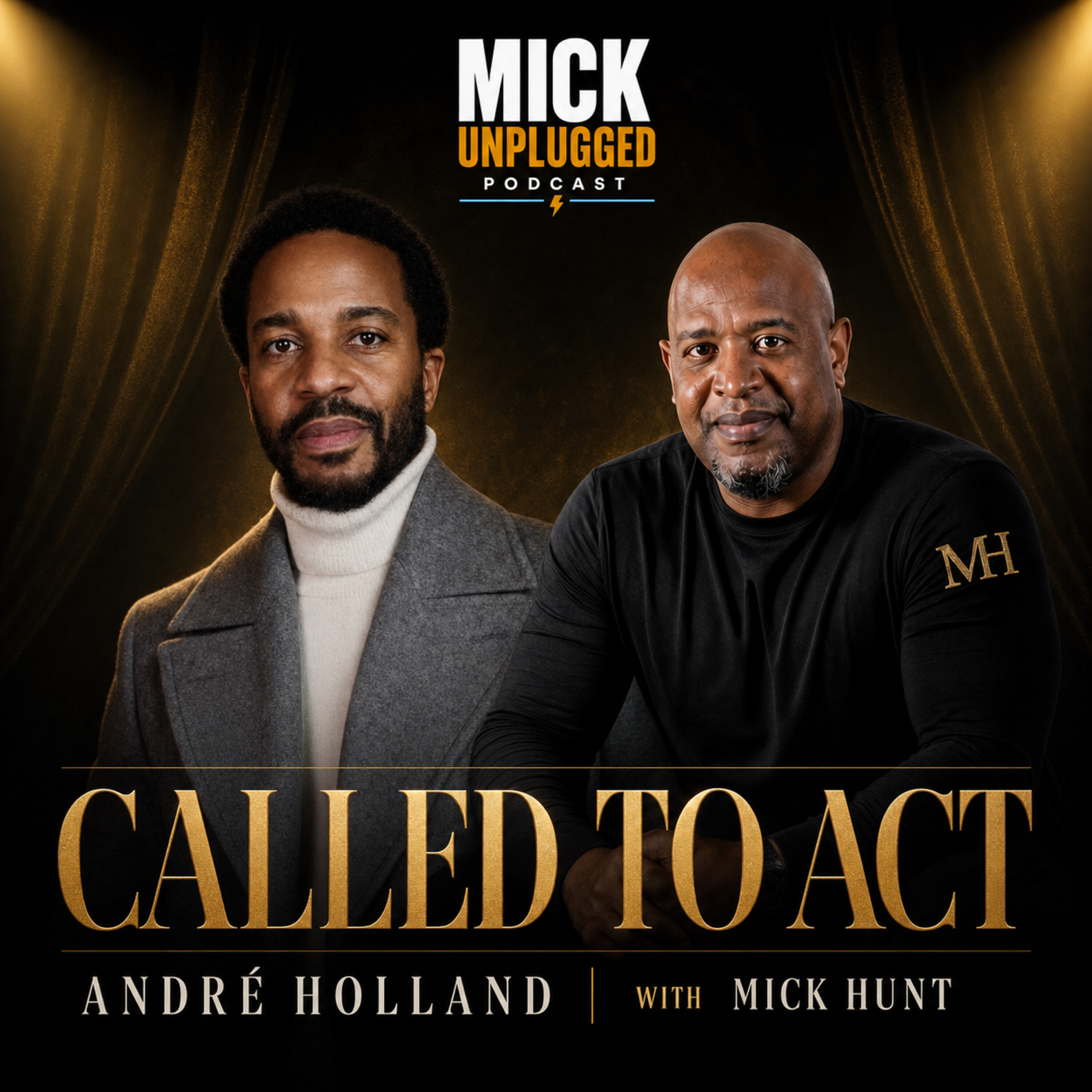
Mick Unplugged
Called to Act: André Holland on Purpose, Community, and Creating Room for Others
00:34:50
Loading summary
Transcript62 lines
- [00:00]
A
Even sometimes, like the kind of dreams I allowed myself to have were sometimes a little too small, if I'm honest with you. You know, there were certain things I didn't know were even possible. God has shown up in my life in ways that I can't even describe. You know, doors just keep opening. Doors that I didn't even know were there opened themselves to me. And I know I'm eating the fruit from trees I didn't plant. So I want to do my job to plant some trees for the next folks that come along.
- [00:29]
B
Ladies and gentlemen, welcome to another exciting episod episode of Mick Unplugged. And today I am with the Legend of Legends and the Goat of Goats. He is someone who I have looked up to for a very long time, not just from his acting chops, but what he means to community, the things that he does to uplift others, and the fact, you know, he's from the south, just like me. Ladies and gentlemen, please join me in welcoming the brilliant, the amazing, the one of a kind, Mr. Andre Allen. Andre, how you doing today, brother man,
- [01:03]
A
I'm doing better now. Thank you for that beautiful introduction, man. That's very generous of you.
- [01:08]
B
Thanks, man. I have been a fan from day one. We're gonna talk about Bessemer, Alabama in a moment. But I've been just a huge fan, like I said in that intro, not of just your acting ability, but just who you are. Right. I believe that talent does take you so far, but I think you know it better than I would in the industry that you're in. Character matters more than almost anything, and the character that you have speaks volumes of who you are. And I just want to give you your flowers of just the human being
- [01:43]
A
that you are, brother man. Thank you for saying that. Thank you for recognizing that, man. I appreciate it, and it means a lot to me. I mean, mainly because my parents, you know, are my. Still my biggest influence, man. And they raised me to be a person who's concerned about community and who, you know, tries to move with integrity and kindness. And so, you know, the fact that you see that, I think is really a testament to them, man. So I appreciate it.
- [02:10]
B
Nah, all day, brother. All day. And, you know, I love to start the podcast by asking my guests about their be caused. I call it your true purpose, that true reason for doing what you do. And it changes from. From season to season. And it, to me, it's deeper than your why. Right? Like, if I were to ask you what's your why? It's probably your kids Your family, your community, whatever it is that you're working with. But when I say but why, that sentence usually starts with, well, because. And that's what I care about. So if I were to say, andre, bro, like, you do all these amazing things, you continue to find the better version of you and every, every thing that you do, what's your. Because what's your true purpose of why you continue to do those things that you do?
- [03:01]
A
That's a great question. I would say it's because I feel called to do it. You know, I feel that this is my calling. You know, I think story, storytelling of all fashion, of all facets, being concerned about community, trying to be a, you know, of use to other people feels like my life's calling. So I would say that's why, you know, and it's also because that's how I was raised, man. I grew up around people who, who walked in there, walked in their calling, you know, who really treasured the gifts that they were given and, you know, you know, saw them as being precious and tried to take good care of them. And so I, I want to do the same, you know, and I want to be, you know, I want to be respected by the people that I respect, you know, and, and I think in order to earn my way into their company, I, you know, I gotta, I gotta live, live a good life, man. And that involves those things, you know, being concerned about community, taking care of myself and, and caring for the gifts that, that, that God has given me.
- [04:09]
B
And again, I'm going to keep saying it because I, I want you to hear it and receive it and feel it, man. Like, that's what makes me adore you is all of what you just said, and embodying a hundred percent of that because it's real. And talking about growing up in, in the south and growing up in Alabama and then having the, the amazing opportunity to win the part in Selma that you did. Like, when did you know that this was really your true calling? And again, I'm not talking about acting like I'm gonna give you all those accolades, but I'm talking about the leader that you are, the human being that you are. Like, when did you know that you had that responsibility?
- [04:54]
A
I think I knew that before I knew I wanted, I was an actor, you know, Like, I, I can't say enough about my mom and daddy, you know, you know, my, my, my mother is a person who's coming to mind right now because, you know, I was just with her and so she's on top of my mind. But, you know, she grew up. When I. When I was growing up, she was always active in the community. Always everything from. I mean, you talked about Selma, man. We would go down to do the commemorative march at Edmund Pettus Bridge. Ever since I was a little boy, my mama would take me and my sisters, and we'd go down there and. And we do it, you know, and anytime there was anything going on in Birmingham that was at all related to civil rights or to history or to civic engagement, she was like, come on, we going. We're going to be a part of this. So she just lived in that kind of ethic. You know, she. She. When she graduated from college, she was. Worked on the voter education project, so she was doing a lot of organizing work. She, you know, she. I got to be in the movie or something, but she actually did work for Julian Bond and John Lewis, and, you know, she did the work. So I think, you know, that's just what I. That's just, like, the kind of, like, water I swim in, man, that I grew up in, you know? So I knew that I had to make her proud. And I had a big calling on my life long before I knew I wanted to be an actor.
- [06:14]
B
Yeah, that's amazing, bro. And, you know, again, I'm gonna talk about Bessemer for a minute. I'm from South Carolina, but I know. I know the history of Bessemer. I know the history of Birmingham. And in the high school you went to and growing up in Bessemer, right, You got Bo Jackson, you got Jameis Winston, you got d', Amico, you got. You got them all
- [06:34]
A
Gucci mane.
- [06:36]
B
Gucci mane. Exactly. Exactly. You carrying that torch, doing your part for Bessemer, man? Like, what does that mean to you personally,
- [06:48]
A
man? Everything. You know, Bessemer is. It's gotten a bad rap over the years. You know, it's. It's. You know, if you Googled, as you probably saw it, it doesn't have the best reputation in terms of crime. And. And, you know, the education system is. Is often struggling, and yet, like, I know the people of that place, you know, and I know how beautiful they are and how deserving they are, you know, And I think, you know, in my case, man, the only reason that I'm sitting here talking to you today is because somebody, in this case, it was my parents, saw fit to give me some opportunity, right, to explore my gift and to make the most of it. And that wasn't. You know, they did more for me than I deserve, you understand? So, like, the fact that I am here today is really just because I was planted in a place where I was allowed to flourish, you know what I mean? And my parents made sure that. And so I feel like if given the opportunity, if the young people in Bessemer are given that same opportunity, man, there are gifts that will come out of that community that we can't possibly anticipate, you know, So I feel it's my responsibility to. To give back. I don't mean give back in a sense of like, I'm, you know, in a. In a sort of top down kind of way. But I mean, like, I am a part of that community and I want to always be shoulder to shoulder with those folks. And if I have something that I can offer, you know, then I think that's just repayment for all that they've already given to me.
- [08:13]
B
I love that, dude. I love that so much. And like, this next part of the show I always call the unplugged truths. So I'm gonna give you unplugged truth right here.
- [08:26]
A
Okay.
- [08:28]
B
And I'm gonna try not to get emotional because I mean it in everything that I'm about to say. I feel like you are a symbol of hope for a lot of people. A lot of people that I'm gonna be real that look like you and I that most of the time. And I don't know what it was like for you growing up, right? But I know for me growing up, we didn't have a lot of just, I wanna be that person or I can be like that person, right? Like, we didn't have social media like we have today. We didn't have the Internet like we have today, I feel, brother, like, you are that symbol of hope for a lot of people. Because when I Google the name Andre Holland, when I put Andre Holland in AI now, which is crazy to think that that's the world that we're in. There's so much positivity that comes out. There's so much just joy and positive energy that comes out, man. Like, you are my unplugged truth. And just the fact that how you carry yourself every day when the cameras are off, when you're in the community, like, I think people need to understand why that's so important that you ground yourself in that. And I know, I've heard you talk about your parents and your mom, and that's why I feel like we connect. Because my mom was that for me, my grandparents were that for me, and they taught me that you're carrying A name, right? Like, no matter. No matter what you do, there's a name and there's a legacy that you're carrying, and I feel like that connection with you, and that's what gets me so emotional by. By that. But I'd love to just get your. Your insights on that a little bit.
- [10:10]
A
Yeah, man, thank you for sharing that with me, brother. That's really beautiful. And I appreciate your honesty, you know what I mean? And your vulnerability around it. I feel it and I appreciate it. Yeah, man. You know, it's something. I guess it's just something about going up, down south that. That puts that thing in you, you know, and you. Right. Like, there wasn't really a kind of, like, model for what I wanted to do. To tell you the truth, I didn't even really know what I wanted to do, you know, like, it, you know, a lot. I see. I read these articles now, people talking about these young people coming into Hollywood and, you know, their parents are agents or their parents were actors or whatever, and, you know, people talking about nepotism and so on, and. And I was about as far from that as you could imagine. You know what I mean? Like, one. Nobody from where I'm from doing this. So there was a lot along the way, a lot of mistakes that I made. A lot of things, you know, that I got wrong. That. Yeah. Even sometimes, like the kind of dreams I allowed myself to have were sometimes a little too small, if I'm honest with you. Because I didn't know, you know, there were certain things I didn't know were even. Were even possible, you know, And I. I was raised to be grateful for any and everything that I got. And so I was grateful, you know, when I got my first job, you know, doing a play off Broadway in New York, I thought, man, this is, you know, as they say in the old church, this feels like heaven to me. You know, it don't get no better than this. Yeah, but. And I wanted to do the best that I could with it. But, man, like, you know, God has shown up in my life in ways that I can't even describe. You know, doors just keep opening. Doors that I didn't even know were there opened themselves to me. And I try to just do a good job every time, because like you said, I know it's not just me. I'm representing my mom and my daddy, my whole community, you know, and not only the ones that I know, but all the people, the ancestors who came before, who made it possible for me to be here today. The Ones who had to get up and go when they didn't want to go, you know, who had to stay longer than they wanted to stay. Who, you know. Yeah. Who planted trees from which they never got to eat the fruit? You know what I mean? And I know I'm eating the fruit from trees I didn't plant. So I want to do my job to plant some trees for the next folks that come along, bro.
- [12:38]
B
I don't know if it's in there. I don't know where this is coming from. I'm gonna be real. But there's a book. There's a memoir or something about those trees and the fruit, bro. Like the Andre Holland story. I don't know what it is, but that is it right there. I think people of faith like you and I, we can feel those spirits, and that spirit just told me, bro, you got a book or memoir coming.
- [13:04]
A
Thank you. It's interesting you said it, because I did about a week ago have the thought that. Not that I necessarily wanted to write a book, but I. You know, I have all these journals that I keep and old scripts and just things, and it's all piled up in my. In my home in Brooklyn, and I want to do something with that. I want to organize that, and maybe it is some kind of a. I don't know if it's a memoir or a story or something to. Yeah, yeah, it's definitely there. It's definitely.
- [13:30]
B
So I know you have a lot going on, man, and so I'm gonna go to some hot takes now, and this is my hot take right here. They Fight is gonna be that film. They Fight is gonna be that film. I think, you know, we've got some early releases, but the main thing is coming out here really soon, man. Talk to us about they Fight, the spirit behind that. I know you've been in the gym a little bit, too. I heard your jab is amazing right now. But talk to us about they Fight, bro.
- [14:09]
A
Yeah, man. It's a great little film. It is written and directed by Sheldon Candice, who directed the movie Love, which was at Sundance a number of years ago. And he and I met there at Sundance that year that his movie was there. His was there the same year that Ava DuVernay was there with her film Middle of Nowhere. So I met him then, and I was really taken with him. I said, man, it's a cool young brother. He's, like, smart. He's got his thing together. It'd be cool to work with him one day. And then over the years, I would run into him. I'd always see him. When I would go to la, he'd be at this one coffee shop that I like to go to as well. And he's always there on his computer. And I say, hey, man, you know, what you up to? He's like, man, I'm working, you know, I'm writing. He's always hustling, always grinding, and that really touched me. And so when he came to me with this. With this script, I knew I wanted to do it because I knew I wanted to be in community with him. And then I read it and I thought, there's something really sweet about this movie. I play a man named Walt Manigan, who's based on a true story. And Walt has just come in the beginning movie. He's just come home from prison. He's been in and out. He's had some substance abuse issues and along with other challenges. And he finds himself back at this boxing gym that was kind of his home back in the day. And he discovers that there's this new group of young boys who are curious about the sport of boxing and who also are bringing their own kind of traumas and challenges into the gym. And so he gets an opportunity, a sort of second chance at life through. Through these young people, these young men. And that. That really touches me, you know, that kind of story of, like, mentorship and second chances. You know, we all need them and we all deserve them, and sometimes we don't. We, as black folks, don't get them, you know, in the ways that other people do. So I was really proud to be a part of a story that really highlights that.
- [16:00]
B
Nah. And I'm excited to see it. For those that are watching, those that are listening, we've got links everywhere in the show, Notes, the descriptions, make sure that you are going to support this film. Which leads me to hot take number two. Andre, man, like, your ability to truly immerse yourself in a character is freaking amazing. And these are the words of Mick and Mick only. So Andre's not saying this. There are actors that you can tell when they're acting, right? And that's not a bad thing. It's really not a bad thing. But I study the art of what you all do, and so I can kind of see it. It's very rare that you can see someone truly immerse themselves in their character. And you do that. Freaking amazing. Like, what's your process to.
- [16:56]
A
To do that, brother, man, thank you. You make me feel good about myself, man. I appreciate it.
- [17:01]
B
Yes, sir.
- [17:01]
A
It is so much, man. Thank you. Well, you know, I work. I work hard at it, man. You know, I went to school. I did an undergrad degree in acting, and then I did a master's degree in acting. And so it's really what I've done my whole life. And I've always been very most excited about actors who do have that ability to, like, disappear into a part, you know, I was always a fan of, like, Daniel Day Lewis. That's the guy who I really admire, you know, and on stage, actors like Mark Rylance, you know, and obviously like Denzel and Sidney Poitier and all these other people who I grew up watching. But I always wanted to be. I considered myself to be more of a character actor than like. Yeah, than like a leading man. Not because I. You know, only because those character actors were the ones who I felt like had played the most interesting parts, you know. And so my process is like, you know, I do a lot of research when I'm working on a part. I try to be honest and vulnerable about, like, the places where me and the character are not the same, but then also find those places where we are the same, you know, and really allow those things to be. To be. To be real for me, to feel real for me. So that at a certain point, the distance between the character and myself, it starts to kind of close, you know, and then you ultimately want to get to a place or aspire to get to a place where you can think like the character, you know, and be spontaneous within the framework of the world of the character that you built. So that's the kind of, like, technical part of it, but it's also just an act of faith, man. Like, I think at the end of the day, like, my job is to make your imagination believe in my imagination by any means necessary. So whatever I gotta do to make that happen, I'm willing to do it. And I think some of that is me, and a lot more of it is. That is, like, from somewhere else, you
- [18:57]
B
know what I mean?
- [18:58]
A
That thing that I think was put in me to do. Yeah. So I can't even take much credit for it because sometimes I don't even know how I be happening, to be honest. It's like a working, working work. And then there comes a point where you step out on faith and you just go, well, now I'm out here and I hope people are. Are coming with me, you know?
- [19:14]
B
Yeah.
- [19:16]
A
So, yeah, like, that. I mean, I could talk about craft stuff all day, so I don't want to Bore your listeners with that.
- [19:21]
B
But no, no, no, that's what we're here for, man. Like, that's what we're here for. And so I'm going to transition to what I call the room. And yeah, I know I'm an ACC guy. Like, I went to the University of North Carolina. I know you went to Florida State. Like, we'll talk about before NIL was real. We'll talk about the bag. Florida State was trying to give their. Not only their athletes, but apparently their, their, their fine arts department too. But we'll talk about that later. But, but was there, I call it the room, but was there a room, a conversation, a meeting, a lunch, a dinner? Was there anything that like, changed the trajectory of your career? Right? Like, was there a moment where it was like, not only is am I there but now the door is open?
- [20:15]
A
Yeah. I think the thing that comes to mind for me is it was. There were a lot of things at Florida State that happened that really helped me because it was there where I started to believe that I could be an actor. And I started to learn what the work of being an actor really was. So I had great teachers down there, great classmates, and I learned a lot. But then when I went to nyu, I did the three year master's program there. And there was a moment in my second year where I had this class. We were in this room with this teacher named Jim Calder, who to this day is. He's. He's my guy. Like, I really. He's my guy. And we were doing this, this kind of workshop or, you know, project where we had to take a piece of literature, a short story, for example, and then we would break into small groups and we would perform that. Find a way to perform the short story. It's hard to describe, but you really, you're supposed to do it physically and like, really embody the characters and, and it's kind of improvisatory. So you don't have a lot of time to prepare. You just got to do it. And at that time, I always felt like I was struggling because I felt like most of the plays that we were working on at that time were plays that were written by white. White writers. You know, we hadn't, we didn't really spend a lot of time working on black texts to such a point where I didn't even know about many black texts, you know, And I was seven years acting at this point. Six. Anyway, this one particular day, Jim, while we were working on this process, came to me and he said, well, Andre I want you to bring in a story tomorrow. I said, well, what. You know, what kind of story? You said, well, I want you to go home and why don't you write something? He said, just write something. And I thought, well, I'm thinking, I'm not a writer. Why would I do that? You know? Anyway, I went home and I wrote this story that took place in Bessemer. The lead character was a man named Zanny Ray. It took. It was, like, really pulled from my life, you know, Church there was. It was. It was about. You know, it was. It was down home, and I brought it in. He said, when I read it to the class and I read it, and then he assigned some people in the class to go and do my story. Now, mind you, most of my classmates were white, right? And so they were being asked to inhabit these characters, these black characters, you know, even though I never said they black, it was clear that they were right. Anyway, at the end of the process, he said to them, well, how. How was that experience for you all? And I remember them saying, well, it just felt uncomfortable for us. It didn't feel right. You know, we didn't really feel like, you know, we had the right to be inhabiting this and that. And they were very upset by it. And then he turned and he said, you know, I bet that's how Andre feels every day. And in that moment, I felt like for the first time, he saw me and he understood my experience. And he also gave me permission to take some charge over my career and to understand that the stories that I have to tell are valuable and that they do have a place and that we don't always have to lean on the Arthur Millers and the Clifford Odets and the Ibsens and the Shaws and the Chekhovs. They're all great. But there's a whole other world of stories that have yet to be told that come from our experience. And just because they haven't been celebrated at the Tony Awards doesn't mean that they're not worthy. And I feel it was in that moment that I started to say, oh, my job is not just to be an actor. My job is to bring new stories into the world by any means necessary. You know, So I think that that room was the one in which I felt like there suddenly was room for me.
- [23:46]
B
Okay, I love that, bro. Yeah, I love that.
- [23:50]
A
And.
- [23:51]
B
And. And one of the things, again, I know what you do for the community, and I want to give you the floor for this, too. When we talk about rooms, I can also say this. Andre Holland creates those rooms for others. And so if we were to say, what does it take? And I don't mean literally the rooms that you create, but what do you look for in those people that you support and the communities that you give back to? I want to give you the floor to talk about, you know, the different foundations that you're part of, the different communities that you help move. Like, like what is it like when you are now creating those rooms for others, those moments for others?
- [24:37]
A
It's so satisfying. You know, it's hard work, but it's satisfying. One of the projects that I'm working on is we're calling it the Holland Project. So myself and my mother and my family are restoring an old theater that was in Bessemer, that is in Bessemer, but that's been closed for many, many years. And so I bought the theater about five years ago. We've been in the process of restoring it and turning it into a performing space, also a single screen cinema and then an arts space where we could do educational programs. And I can bring people that I know down to come and do workshops and really give back to this community and also encourage them to, you know, think about what a career in arts might look like. So that's one. Also I have a production company now, it's called Harper Road and we are producing film, television and theater. We made a movie called Love Brooklyn Last or two years ago, which is all about community. And it really was, you know, I live in Bedside. We, you know, the whole movie was me calling friends, being like, can we shoot in your coffee shop? And oh my God, wait, you know, we. I ain't got nowhere for these people to stay. Can I use your spare bedroom? Because it was by hook or by crook, you know, but we managed to make this really lovely movie. We had a first time director, Rachel Abigail Holder. It was her, her first feature, Black Woman. She did a great job. And yeah, we have like 15 other projects that are in different stages of development. So we're busy and, and you know, I'm always interested in who's next, like who's a new voice. Who. Who are the people who haven't had a chance yet, you know, who, who just who just need a shot. One thing I'll say, and I can, like I said, I don't want to preach, Nick, but let's go. But I feel like sometimes this business does this whack thing where it's like, you know, if they haven't seen you do something they don't think you can do it right. And so it kind of turns into this self fulfilling prophecy where like we get the same actors over and over again, we get the same directors over and over again. And it becomes so difficult for people to break through. Now that's true for everybody that's in this business. It's hard to break through. But if you black or brown or, you know, otherwise not mainstream, you have an added layer of challenge, you know, because there are fewer projects that are going to get green lit because, you know, for all the various reasons that we know it's going to be more challenging for you. And so for me, I feel like in whatever way I can be useful to help people get their things done. I want to be that. And I think when you're to your point of like, what do I look for? I look for somebody that's passionate about the thing that they want to do. I want to see like the whites in their eyes, like when they telling me the story, like this is the story that they have to tell that only they can tell and that they are committed to doing it with or without me, you know? You know what I mean? Because it is very difficult. It takes a very long time, you know, and like you got to really want to do it. I think lastly, I'll say I take, you know, as you probably can tell, I take great pride in like the craft of what I do of acting. And I like people who have a similar kind of dedication to whatever it is that they're doing. Like, I don't really want to work with people who just want to be famous or just be seen or just be known. But people who have something that they have to put in the world, you understand something they got to say. And I don't need to know why you got to say it, but I need to know that you got to want it, that you really, really desperately need to do it. Those are the kind of people that excite me. And I don't really care where they come from, you know, And I think that's a, that's a part of our tradition too. It's like we don't care. Like if, if you get up to sing in church and you can't sing, we don't care. And everybody know we all gonna look at each other and be like, baby, you need to sit down. But if you get up there and you can sing, then we don't care that you went to, if you went to NYU or that you went to, you know, whatever from the Metropolitan Opera. It don't matter. If you got it, you got it. And I believe that, you know, many of us have it and just need an opportunity. So I like to try to be helpful in whatever way I can.
- [28:35]
B
I love that, dude. I love that so much. I don't know what it is just yet, but we're gonna do something at this theater. I've got some friends, I'm gonna make some phone calls. We're gonna do something. The production company that you have, like, I'm gonna hire them for something. I don't know what it is yet, but, like, I wanna be a part of any and everything that the Holland Project is doing. That the theater, the production company. Like, I wanna be a part and do my part as well. Because the energy that you have, the heart that you have, is so contagious. And if I can help, brother, I'm gonna help. And I'm committing to that right now. I'm committing to that right now.
- [29:21]
A
Thank you, brother. I appreciate that, man. And that, that means a lot to me. I know you. A lot of people, A lot of people listen to you and trust you, man. So I, I, I really appreciate you lending that trust to me. Thank you.
- [29:33]
B
I'm. I'm committed a thousand percent. And I, I mean that. It's, it's on film, it's on audio. I'm committing to it. That this is my accountability. But it's because I believe in you and that I have that conviction to do my part, bro. I really do, man.
- [29:49]
A
Thank you so much. I truly.
- [29:51]
B
So I know you're busy. I know you got a lot going on, so I'm gonna get you out of here on this. Rapid fire. Unplug five. All right, Ready? Rapid fire.
- [30:03]
A
Okay. All right.
- [30:04]
B
You're from Bessemer. The best athlete to come from Bessemer, according to Andre Holland, is Bo Jackson.
- [30:12]
A
Sorry, sorry.
- [30:14]
B
Ms. Bo Jackson all day. Which then leads to number one and number two. Roll Tide or War Eagle?
- [30:24]
A
Roll Tide. Okay.
- [30:28]
B
Okay.
- [30:28]
A
Die hard. Roll Tide.
- [30:30]
B
Die hard. So no Seminoles. You say how I did that, right? You see, I didn't put FSU in the mix.
- [30:35]
A
I'm glad you did. To be honest with you, man, on the weekends when I was in school of Florida State, I would get in my car and drive back to Tuscaloosa on game day to go to Alabama instead of going to Florida State. That's how much of an Alabama fan I was.
- [30:47]
B
Okay, so I'm gonna touch on something. I'm gonna see how far removed from the south you are. Cause I know you're in New York, and they don't do this in New York. Are you still grits, or are you a breakfast potatoes kind of guy now that you're in New York?
- [31:02]
A
Come on, man. Grits all day. Grits all day with a little salt and pepper. Come on, man.
- [31:09]
B
Yes, sir.
- [31:10]
A
Yes, sir.
- [31:11]
B
Yes, sir. What's. What's. What's one? Or who's one person aside from your mom and dad? Because we're going to hold them on this whole other level, because they should be, because they've done a great job in being that in your life. Who's another person that's been like, an inspiration to Andre Holland from Bessemer or just in general? In general.
- [31:36]
A
Oh, man. So many rapid fire, I would say. I mean, Jim Calder, is that that man I mentioned to you before? That's what comes back to my mind. You know, he really inspired me to be myself and to trust myself and my own. My own voice. So I would say probably, yeah, that would be my. That's my guy.
- [32:00]
B
I like it. I like it. So when we do this memoir on Andre Holland, what's one word that you want to make sure defines you in this memoir?
- [32:11]
A
Committed. Ooh, committed. Yeah. That's deep. Yeah, I think that covers it, man, because I, you know, whether that be, like, as an artist, I want to. I want to be committed. And ain't nothing worse than when you watch an actor who's not committed to what they're doing as a. As a community member and the service work I want to do. I want to be committed politically. I want to be committed to holding my lines, you know, I want to be committed to myself. I want to be committed to my family. I want to be known as a person who was committed to everything that he did. There it is.
- [32:47]
B
I love that, man. I love that. Ladies and gentlemen, this has been Andre Holland. This is one of my most favorite interviews. Just because of the man that he is, the person that he is, they fight. Make sure you're supporting that. Go check that out. I would say Google Andre, connect with him on all the social platforms. All those links are here below all. All the things, whether it's Selma, moonlight, like, we got it all, but just support him, right? Like, you'd be surprised how much. Hey, Andre, I believe in you. Hey, Andre, thank you for being who you are. Like, that goes a long way. So have his back, because he's gonna have your back. And if you can do anything to support the project, do we take donations or anything, bro.
- [33:43]
A
We do. We have a website with a little bit of. With a donation page. But even more important than that, man, like you said, just the spiritual support just to words of encouragement and just keeping an eye on what we're doing. I think that, you know that that's the main thing and I appreciate any support that, you know, people want. People want to support me, man. I truly, truly appreciate it. And I promise I won't, I won't ever take it for granted.
- [34:06]
B
Nah, we got you. We love you. And more than anything, man, like, I'm going to keep saying it because it's genuine for me and from my soul, bro. You mean the world to a lot of people. The human being that you are manifests into others. And I can't thank you enough because there's been times you don't know this, but, like, I've just needed you and your goodness, man. Like. And I can't thank you enough for that, bro. I really can't make.
- [34:31]
A
Any time you need it, man. Just hit me up, brother, Anytime, it don't matter. Day, night, whenever it is, you know I'll be there, I promise.
- [34:38]
B
I love it. I love it. And I love you. To all the viewers and listeners, remember your because is your superpower. Go unleash it.