← Mick Unplugged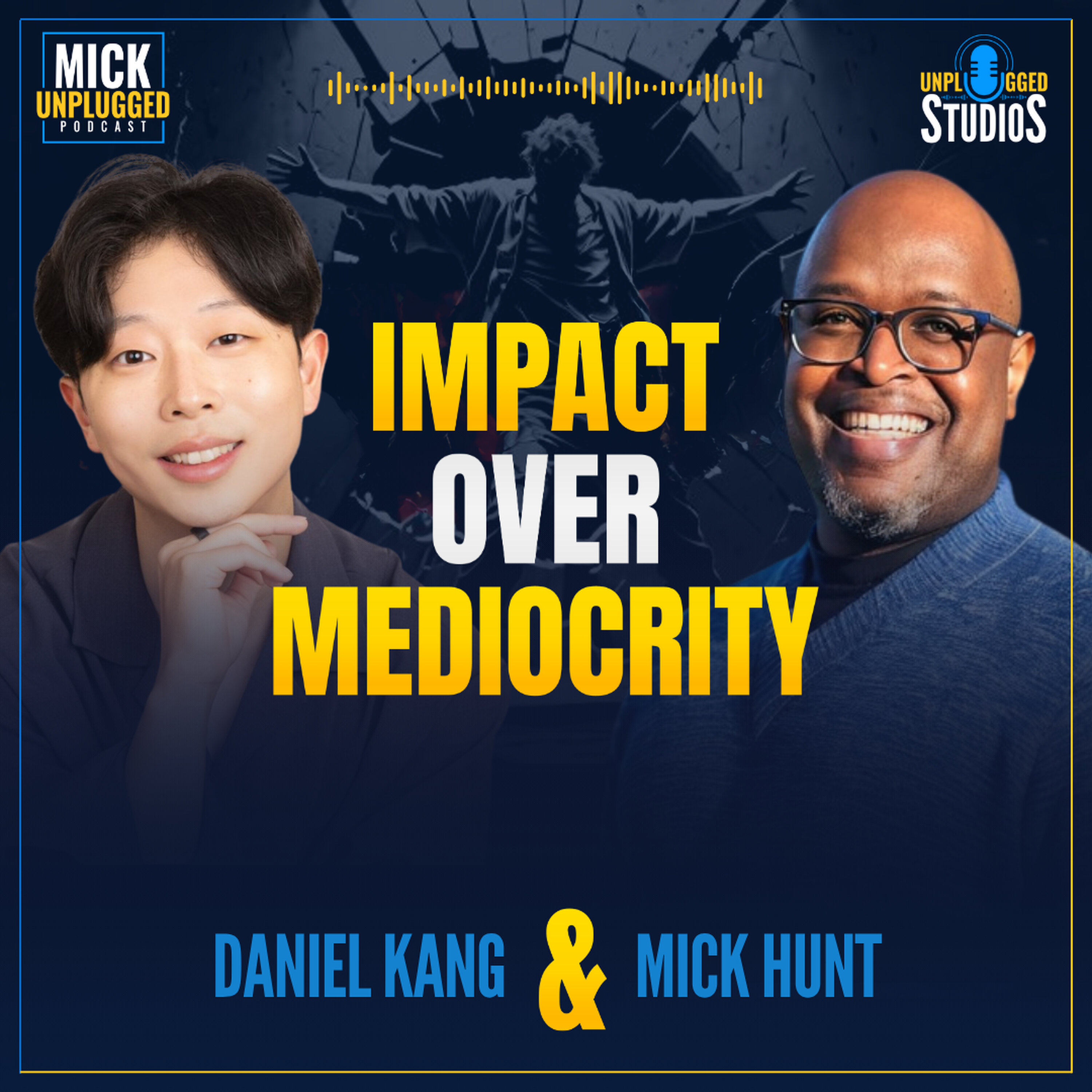
Mick Unplugged
Daniel Kang’s Path: From Scholarships to Fintech Innovation and Scalable Impact
00:29:34
Loading summary
Transcript53 lines
- [00:01]
McDonald's Advertiser
McCrispy strips are now at McDonald's. I hope you're ready for the most dippable chicken in McDonald's history. Dip it in all the sauces. Dip it in that hot sauce in your bag. Dip it in your McFlurry. Your dip is your business. McCrispy strips at McDonald's.
- [00:15]
Daniel Cain
One of my biggest fears is living in mediocrity. I would rather live on the edge of possibility, trying to do what I think would be extraordinary rather than be mediocre.
- [00:29]
Mick
Welcome to MC Unplugged, the number one podcast for self improvement, leadership and relentless growth. No fluff, no filters, just hard hitting truths, unstoppable strategies and the mindset shifts that separate the best from the rest. Ready to break limits? Let's go.
- [00:53]
Ladies and gentlemen, welcome to another exciting episode of Mick Unplugged. And today we've got a banger for our guest is the co founder of Flobo of Finance. I'm sorry, let me start that over. He is the co founder of Flobo, a fintech trailblazer reshaping how creators and entrepreneurs access capital, empowering the next generation to grow on their own terms. From idea to execution, from hustle to scale. He is the innovative, the driven, the game changing. My guy, Mr. Daniel Cain. Daniel, how are you doing today, brother?
- [01:27]
Daniel Cain
I'm doing very well. Thanks for having me in for that flattering introduction.
- [01:32]
Mick
I appreciate you my guy. I appreciate you so much. So Daniel, on Mick Unplugged, we like to talk about your because that thing that drives you, that thing that's deeper than your why. You know, I love Simon Sinek and I love start with why, but I like to go a little bit deeper. So if I were to say, Daniel, today, what's your because? What's your purpose, brother?
- [01:55]
Daniel Cain
That's, that's a great question. I think the because that I'm going through right now is how do I think about having the greatest amount of impact related to making opportunities fairly accessible to everybody as possible. And I think it goes back to sort of how I grew up, right? So I grew up in a low income immigrant family and, and money was a big problem. And one of the ways that I was able to get an education was actually through the generosity of many scholarship foundations. So throughout high school I applied to about 120 different scholarships and was lucky enough to win, you know, a few of them so I could get an education. And that became the platform for me to do many, many other things. So you know, from then I did everything from microfinance to crowdfunding all the way to, you know, things I'm doing with technology and finance today. And obviously with a book. I'm also trying to share some of my mental models and thinking so that hopefully at least a few people who are in my scenario can think about breaking through without risking everything and get to where they want to go.
- [02:59]
Mick
I love that dude and I want to get into all of that. We've heard a lot, a big trend lately has been biohacking and that's been phenomenal. But I think what you're doing and reading your book a little bit, I'd almost call it financial hacking. Right? Like it's how do we take the good parts and really understand what I like to say is financial literacy. How do you understand what's going on in the world of finance and money? And I think you do a really good job of that. So let's go into that piece, man, the super upside factor. Talk to us about, you know, why the journey of writing this book, who the audience is and what are some things people are going to get out of it.
- [03:45]
Daniel Cain
Yeah, that makes a lot of sense. So the book is centraled around this theme of asymmetric bets. It's how a unique breed of investors like to think about investing money. And that's the world of venture capital. So venture capital is a trillion dollar industry, but they make money despite being wrong 90% of the time. And the way they're able to do this is because the few wins that they have have extraordinary outsized outcomes and all of their losses are capped and floored. So an example of this is, you know, I used to work for a venture capital firm called Softbank Vision Fund. And the founder, Masayoshi San became the richest man in the world for a brief moment using lists, which is he invested $20 million in a company called, you know, Alibaba. It's a relatively well known company. And that 20 million became 100 billion. Right? That's a 5000x return. And even if he was wrong on, you know, 90% plus of his bets, that one would be sufficient to make up for everything.
- [04:45]
Mick
Covered it all.
- [04:45]
Daniel Cain
Exactly. So that's the whole premise of the book. And this has been proven out in a trillion dollar industry. This has been proved out for, you know, for founders, for investors. The premise is, can I bring this and allow other people to make good career decisions using these asymmetric principles? And what are some of the conditions that must happen for this to sort of play out in your life? And that's sort of the premise of the book. And I think it'll be really, really helpful for people who want to have a breakout in their career who feel stuck after following all of these signposts. Right. You already went to the Ivy Leagues, you already did an investment banking consulting or law or whatever. But you're like, you know, there must be more. There must be something more than just directions. How do I think about making those big outsized bets?
- [05:31]
Mick
I love it. I love it. So going a little bit deeper, you talk about the principles. What are a couple of these principles that I'm going to say the everyday person can put into their lives? Right. Like that maybe that person that's considering investing or, you know, you could be someone like me who has been an investor for a while. And While I'm not 90% wrong, I'm also not 100% right either.
- [05:57]
Daniel Cain
Yes. So I think what you need to be really careful about is little bit of knowledge is almost too dangerous. So when I talk about this, sometimes people immediately think about the lottery. Right? So if you win the lottery, you get, you know, millions of dollars, and if you lose, you lost a 10 bucks or whatever. But that's not how the asymmetric principles work, is we know the lottery doesn't really work for most people. I'll talk about like three most important ones.
- [06:21]
Mick
Okay.
- [06:22]
Daniel Cain
The first one is to budget for a 90% failure rate. What that means is it doesn't matter where you're starting. You need to budget that you will fail most of the time. So a single failure shouldn't knock you out, and you can start anywhere. So if you have a dollar, you need to start betting in pennies, not in quarters, Right. So that you can continue to play the game. And you need to give luck enough chance to catch up. The second thing that's really important is about positioning the bets for 100x outcomes. And that usually involves using other people's infrastructure that's scalable. I'll give you an example of this. So I talked about how I was able to win scholarships and go to school. This was my first asymmetric bet. Minimum wage in my province in Canada at the time was $10 an hour, while a single scholarship could be worth over $10,000. Meaning if I want just one scholarship, it's the equivalent of me working 1000 hours part time. Right. So that's why I said, I'll spend 400. I ended up spending 400 hours applying to 120 different scholarships. My hit rate was like 10, 15%. But that got me close to $80,000. If I had spent the same 400 hours working a part time job, that would have gotten me $4,000. Right. That's like a 20x difference in outcome. And that's what I mean by position. Every single bet needs to be positioned for these large outcomes so that even if you win 10% of the time, you still outperform much of else of what you could have done. And then the final principle I'll talk about is this idea of creating a positive feedback loop. So every single one of your bets should be informing the other 99 bets. So these aren't happening in vacuums and silos. And the probability of success isn't independent from each other like a lottery ticket. Right. So you buy one, same probability, they should all feed into each other and what you find is a non linear progression of getting better and tilting the luck in your favor so that you get those really big outsized returns. And an example of this is, you know how my book came about. So I started writing one Saturday a month, about six hours or something. If I translate that, that's like 15 minutes a day. And when I first started writing, no one was reading my stuff. But in the back of all of that, I got a little bit better every time I started writing. You know, every one of these, even this conversation would become fuel to talk about my next piece of writing. Or I'll see what people commented or what they highlighted or what they liked and I'll try to get better and better and better. And you know, about a year of doing this, I was able to get a couple thousand followers. Medium.com reached out and asked me to give a talk. And then in that talk was an acquisition editor from Wiley and Sons. And that's how I got my book, the Super Upset Factor published. And all of this wasn't this extraordinary amount of work. It was like 15 minutes a day of just writing. But it was just positioned in a really, really good way so that it's scalable through the Internet, through Medium and writing blogs. And I just got a little bit better. And you can see how, you know, this led to a book. I recently, this book led me to speak at TEDx Stanford. And I'm sure that will lead to many other things. And you can see how by making these sort of bets, even in the everyday context, it can lead to really, really good outcomes.
- [09:54]
Mick
No, I love that. I love all the principles. I even love the theory from a personal development and even a leadership perspective. Right. Like you're talking about the time you understood what it was going to take, but you said, hey, I'm going to do 15 minutes a day. And then I'm sure at some point that 15 went to 20 and then that 20 went to 25 or 30 and then before you knew it. Right. Like you had a book. And I think that same principle in life is really relevant to everyday people, is sometimes you just got to get started with what you're doing and understanding that it's a journey. And I think where most people go wrong, I'd say even in financial literacy, is they want big results really fast. And the truth of the matter is, in almost everything that we do in life is there's a journey. It takes time. Right. Like Michael Jordan, my greatest, my favorite basketball player of all times, it was a journey before he was Michael Jordan, the six time world champion.
- [10:54]
Daniel Cain
Yep.
- [10:55]
Mick
Right. And I think, you know, tying this back to you and the financial literacy piece, it's just understanding that things take time. You've got to look at historical performance to see what to do next. But no matter what, don't give up. Right?
- [11:10]
Daniel Cain
Yep. And I think just to add to that, I call this intellectual obesity, where people try to understand the most optimal way of doing things, whether it's related to financial literacy or leadership or whatever. But really it boils down to how well you execute on a very simple set of principles. Right. And I think the reason people are looking for the answer is they're looking for shortcuts. How do we think, how do I get the best thing and get the best workout or get the best financial investment or get whatever. But you know, if you've worked out at all, you know, it's a very boring process of like a pretty set, training set and you just keep doing it. Same thing with finance, same thing with really everything. And I think, you know, just taking a few of these principles and really going deep on execution is what really matters.
- [11:55]
Mick
Yep, absolutely, man, Absolutely. What's one piece of financial advice that you'd give to again, the everyday person that's really looking to start investing? Like, what are some things that people can do? What are some things that they should look at or look for?
- [12:13]
Daniel Cain
I see. I'm just going to qualify this shouldn't be taking this financial advice because I'm not authorized to give out financial advice. But I think it starts with the boring stuff. Right. In the startup, in the venture world, angel investing is very common. People are like, oh, I'm going to angel invest in this company and it's going to be Uber or Stripe or Airbnb. My view is that angel investment should be a very small piece of your portfolio, if anything at all. It just really goes down to can you do the biggest bare minimum and the basics of can you put away, you know, like 20, 30, 40% in savings? Can that go into, you know, low cost index fund? Can you optimize for taxes so that you're not paying all of these taxes? Can you look at usps? There's all of these things that are out there that's very, very boring. But I think that's sort of how you build the foundation and then after that you can be a little bit more creative. Right. And I was actually recently at the last shareholders conference for Berkshire Hathaway and it's the last one where Warren Buffett.
- [13:13]
Mick
Will be.
- [13:15]
Daniel Cain
Leading, presumably. I mean, definitely leading Berkshire. I don't know if he'll be leading the shareholder meeting anymore. But that's sort of what he was saying. He's like, hey, you don't need to be invested all of the time. You don't need to be very creative. It's about time. Can you just do the right things over and over and over and over again until these actions start to compound over time?
- [13:35]
Mick
Yeah, yeah. Really good stuff, man, really good stuff. So talk to us about Flobo, man. Like the fintech product software that you have. Tell us a little bit about that.
- [13:46]
Daniel Cain
Yeah, so fintech was an extension of what I wanted to do and of you started with the why. And my big why was can I make access to opportunities a little bit fairer than what it is today? And I thought one of them was going to be around financial access. And I think whether it's finance or knowledge or mental models, it'll continue for the rest of my life. But Flobo was about providing financial access and services to non salaried employees. So think freelancers, think creators. So we were able to enable a bunch of these creators, for example, to launch their own business or provide funding to, you know, creators actually who started their own venture capital businesses. Right. So the way we thought about it at the time was banks generally don't like freelance income for two reasons. The first is it's very volatile, right? It's like a $thousand dollars today, $10,000 tomorrow and then it moves up and down. The second thing is the credit rating of the person who's paying is uncertain. So if I'm employed by Google, the bank knows that Google is like a double a triple A credit rated institution. If I start working with you or Joe or whoever. The bank actually has no idea what the credit rating is. So that's why it's even harder for them to finance it. And what we ended up doing is why don't we just take a look at traditional finance models for credit scores, but also overlay the social aspect of it. If we plug into YouTube's API. If you plug into sort of Patreon's API and say, we know how you've been growing since the beginning of time, how many. How much content you've been releasing, how much money you've been making per video, like all of these things, we thought we could do a much better job of giving them a credit score and on top of that, provide financial services. But I think this is like one of the many projects that I'm working on, and hopefully, along with the book and things, I can continue to sort of make good impact on this stuff.
- [15:44]
McDonald's Advertiser
McCrispy strips are now at McDonald's. I hope you're ready for the most dippable chicken in McDonald's history. Dip it in all the sauces. Dip it in that hot sauce in your bag. Dip it in your McFlurry. Your dip is your business. Mc Crispy strips at McDonald's.
- [16:00]
Mick
I love that, man. And you one of your. I'm going to say core values, and you're not saying it out loud, but I hear it is you really want to make an impact, right? I would say, you know, one of my mentors, Robert Irvine, he talks to me about that on a daily basis of, hey, Mick, if you're not making an impact, why are you even doing it? And so I'd love to hear a little bit about why making an impact matters to you.
- [16:30]
Daniel Cain
I think this is a personal reflection that I've had a little bit, and maybe it's a little bit selfish, but I think my biggest fear is, or one of my biggest fears is living in mediocrity. I would rather live on the edge of possibility, trying to do what I think would be extraordinary rather than be mediocre. And that's one of the reasons the second is you only get one life and you try to make the most of it. And a lot of impact is a lot about positioning and less about just work. So if I'm going to work just as hard as everybody else. And by the way, people who make more impact, I don't think necessarily work that much harder. I think it's really about how do they position themselves so that are able to leverage other people's stuff, might as well sort of be in that position where I'm able to scale the positive impact that I have. And I think, you know, for example, technology is one of them. But we talk a lot about AI and democratization of AI from foundational models like ChatGPT or like Gemini and whatever else, what that allows people to do is whatever you are today, whatever impact, whether good or bad, it just allows you to amplify that impact in a much bigger way. And where I want to be is in a node where I'm having that good positive impact where I get to work with a lot of interesting people and do a lot of good in the world because I think that's probably the better way for me to live and far away from my fear of just pure mediocrity.
- [17:57]
Mick
Yeah, yeah. And you just brought up AI. So what, what role is AI playing today in fintech? And I'm going to have a follow up question.
- [18:06]
Daniel Cain
Oh yes, AI. Like I said my. Here everyone has their opinion, here's my opinion. Um, A.I. is going to be democratized in terms of the models that are provided, right? So you know, whether it's, whether it's anthropic or OpenAI or any of these large models and even open source models now the models are getting better and better. And if you've been following sort of the pricing for access to their API, it's been considerably getting lower and lower. And I think Sam Altman recently said that they expect the price to be cost plus from whatever the GPU costs are going to be and what the energy costs are going to be long term. What that means is everybody now has access to this technology. So I think there's a couple things that'll happen. The first is the winners that are going to win with this is going to be organizations or groups that have unfair access to distribution. So can I reach people capital? Like can I put more money in than everybody else? Or data? Do I have unfair access to data so I can train my own models to go do things? And unlike the software era, like the B2B SaaS era, a lot of large companies, incumbents like the Googles and the Microsofts and are moving quite quickly. So they are moving really, really rapidly to sort of capitalize using their unfair advantage of distribution capital and data. And I think there will be a really, really big place for the incumbents, unlike just the software where all the startups started disrupting everything. On the other hand, I think the startups have a place, individuals have a place because the cost of getting started became really, really Low. Particularly if you're a non technical founder, you can now use these vibe coding tools like Lovable, Replit and Bolt or whatever and pump out and test your ideas at a pace that's unprecedented. And when that happens, you can start building a niche for yourself where you build that distribution, you build that unique sort of user experience for a very niche group of people and sort of grow from there, which is how traditionally startups have sort of survived. So I think the dynamics are going to continue, but the big players are going to have a lion's share, I think of the value that's being created with AI.
- [20:19]
Mick
I love that. So you saw me writing notes just now, I wrote down, so where do you think if we were to fast forward three years and you look at FinTech today versus where it could be in three years, where do you see it going? Like if you were to paint a picture of three years, what does that world look like?
- [20:39]
Daniel Cain
Fintech is such a broad, broad piece but.
- [20:45]
Mick
Or choose one avenue of fintech, like what's the. I don't want to say low hanging fruit, but what's something that everyone could correlate to?
- [20:53]
Daniel Cain
I see. Yeah, I think an interesting piece that I'm thinking about right now, I don't know if it'll be the biggest piece is one of the limitations of agents and the obvious one that's talked about is the inability for them to complete the transaction. So suppose you have a personal agent, you say, hey, can you book a hotel in Okinawa or I don't know, Seoul or something like that. It can get you all of the recommendations, it can even get you probably the pricing with the right APIs and search or whatever. What the agents can't do is complete the transaction for you. And I think that'll be in interesting play where finance, if they can figure out a way to do this in a regulatory, safe way. Right now I don't think you can because of KYC and AML problems. Then I think agents will become extremely powerful and be very embedded into any of these sort of experiences. I think we start to see a little bit of this already. So ChatGPT announced their partnership with Shopify. So now in the search results you get Shopify results and things. But what if you can now execute the entire sales from all of this? So I think if the payments can be implemented and agents become a large part of our day to day interactions, I think the interfaces that we're familiar with will start to disappear a little bit, unless it's for entertainment. So instead of me going to Amazon.com, searching for all of the things that I want and then putting in a basket and then pressing checkout. Hopefully it'll be an interface where I just tell the agent to say, this is what I want. You know what I want, get me what I want. And then there is no need for this interface thing. And I think the use for interface might disappear unless it's entertainment related, right? So, like, I will watch this video, not because I can't get this information, but I enjoy watching the videos and the hand moving or whatever. So that's what I expect that to happen. We'll. We'll see what happens in the future.
- [22:44]
Mick
Good stuff, man. Good stuff. So how do you personally, how does Daniel personally balance the innovative side of you? Because you're one of the most innovative people that I know. And then balancing the business owner, the. You've got to run a team, you've got to develop. How do you balance those worlds, man? Because I think for most leaders and for most entrepreneurs in general, like, that's a big challenge that we have, right? It's like, okay, I know I've got to be the big vision, but there are times that I also need to step into the execution side of this too.
- [23:17]
Daniel Cain
That's a great question. I think one of the hard things about being an early stage founder is you need to have two very conflicting things in your head. You have to have this really, really big vision of like, what it's going to be. And then you have to figure out what am I doing the next minute to make sure that I get to these metrics and, you know, prove that I'm right and if I'm wrong, you know, move somewhere else and pivot. Right. And for most entrepreneurs, I think the level of strategic decision making, like the vision stuff is going to be a very small sliver of what you do. And everything else is going to be how to, like, how do I execute this thing, how do I get to the retention numbers I want or the acquisition numbers I want and so on and so forth. And that's honestly most of my day, writing has been a good outlet to balance that a little bit. Right. So writing I talk about, you know, how I cope with all of these failures and getting punched in the face every day or, you know, the small wins or some of the small insights that I found that were super helpful for me. And I think that is a creative outlet for me to sort of balance both things. And actually taking a little bit of time to write helps me refresh the mind and then give a new perspective on even the execution part. So that's how I've been trying to balance these, these, these two things.
- [24:34]
Mick
Good stuff, good stuff. What's one tip? I don't want to say trick, I don't believe in tricks. What's one tip or piece of advice that you have for the entrepreneur that's in that early startup phase to not just balance but to really focus on the growth side of everything. Because again, I also feel like a lot of entrepreneurs, especially when they're in early startup phase, the energy is there starting out, but then they hit a hiccup and it's like oh boy, right? Like how do you, what's the one piece of advice you have for them to, to get over the hump and.
- [25:09]
Daniel Cain
Say I'll probably come full circle back into what we started with. Which is the why any time a entrepreneur says they're going to start a venture backable company, not a lifestyle business, but truly, you know, one of these billion, $10 billion companies, everyone says it's gonna take 10 years, but nobody believes, no first time founder believes it's gonna take 10 years. Myself included, by the way. I thought, you know, I'd be doing this for two, three years and I'd, I'd be the exception, right? I'd be the Brex, that's unicorn in three years or whatever. But it takes a very, very long time. And unless you have like the mission of, like I said, I want to make opportunities accessible in a fair way to everybody else as much as possible. And it's going to be something I'm going to working on whether it works or it doesn't, whether I have impact or not for the next 10 years. Pick something like that, pick that and then you can have an iteration of that thing, right? It's a pretty broad way, you know, whether it's this book or my fintech company or whatever, it's a very broad way and a broad stroke of working towards this mission. I would just pick that and then continue to sort of do it. The other couple of things that I would think about is don't lie to yourself. So you can pretend you work really, really hard or you can fake it, but you know deep down that whether you're working 100% or not 100% and the biggest regret is not going to be based on the outcome. The biggest regret is going to be did I give it my all? And if you didn't give it your all and you give up or it doesn't Work out. That's going to be the biggest regret ever. So those are, like, the two things I'd really consider when you start a company in your earliest stages.
- [26:54]
Mick
I love that. I love that. Daniel, I know you're a busy guy. I appreciate your time. I'm going to do a rapid fire. Five quick questions before we wrap up. You ready? All right. What's your favorite productivity hack or tool that you use on a regular basis?
- [27:08]
Daniel Cain
Sleep as much as you can, protect your sleep and then everything else, you're able to focus and be productive.
- [27:13]
Mick
But I need to work on that, bro. I still, I try everything. I'm still four and a half, five hours max. And my body just is like, get up. My mind is up and I gotta roll. So I do need to work on that, though. What is your go to music or playlist like, when you really need to focus?
- [27:31]
Daniel Cain
All right. I love Max Martin. He's like the number one pop producer of our time or something close to that. Ariana Grande's into youo is like how it gets started and then the rest of the playlist just follows.
- [27:41]
Mick
Okay. All right. I like it. I like it. What's one book or podcast that's really shaped your thinking?
- [27:50]
Daniel Cain
I'll do two really quick ones on this one. James Clear, Atomic Habits. If you haven't read it, it's great. The premise is simple. It's an easy read. Go through it. The other one, most recent one, was buy back your time. I think it was by Dan Martell or something. I wish I would have read this a year sooner. It's really talking about how you optimize your time as an entrepreneur and build sort of productivity and leverage through other people. And it was a great one.
- [28:14]
Mick
I love it. I love it. What is one word that describes your entrepreneurial spirit?
- [28:21]
Daniel Cain
Resilience. I'll just keep going.
- [28:25]
Mick
That's me. That's one of my pillars right there. And the last one, Dan, like, where can people find, follow and connect with you?
- [28:32]
Daniel Cain
Anywhere? With my handle, it's dankang I T S D A N K A N G. It's dankang.com I'm on LinkedIn. I'm on Instagram. I'm everywhere. So look forward to connecting with everybody. And the super upside factor is out officially, so happy to share that as well.
- [28:49]
Mick
Let's go. The super upside factor. You definitely want that. I'm going to put links to that everywhere, so it'll be in the show notes. I'll connect with you and share it with you on socials as well. Definitely a great book. We again co publishing together with Wiley so we're part of the Wiley family on that piece. Daniel dude, honored to have you on. Honored for you taking time out of your day and thankful for the wisdom and tips that you gave the listeners and viewers. Man.
- [29:20]
Daniel Cain
No thank you. Thanks for your time.
- [29:22]
Mick
You got it. And to all the viewers and listeners, remember your because is your superpower. Go unleash it.
- [29:30]
Thanks for tuning in to this episode of Mick Unplugged. If today hits you hard, then imagine what's next. Be sure to subscribe, rate and share this with someone who needs it. And most of all, make a plan and take action because the next level is already waiting for you. Have a question or insight to share? Send us an email to hello@mcunplugged.com until next time, ask yourself how you can step up.
- [30:05]
McDonald's Advertiser
McCrispy strips are now at McDonald's. I hope you're ready for the most dippable chicken in McDonald's history. Dip it in all the sauces. Dip it in that hot sauce in your bag. Dip it in your McFlurry. Your dip is your business. McCrispy strips at McDonald's.