Loading summary
Transcript181 lines
- [00:00]
Dr. Darrell Stickle
Trust is the willingness to be vulnerable when we can't completely predict how someone else is going to behave. And so for me, it means uncertainty times vulnerability gives us a level of perceived risk, and we each have a threshold of risk that we can tolerate. Welcome to Mick Unplugged, the number one podcast for self improvement, leadership, and relentless growth. No fluff, no filters, just hard hitting truths, unstoppable strategies, and the mindset shifts that separate the best from the rest. Ready to break limits? Let's go.
- [00:43]
Mick (Host of Mick Unplugged)
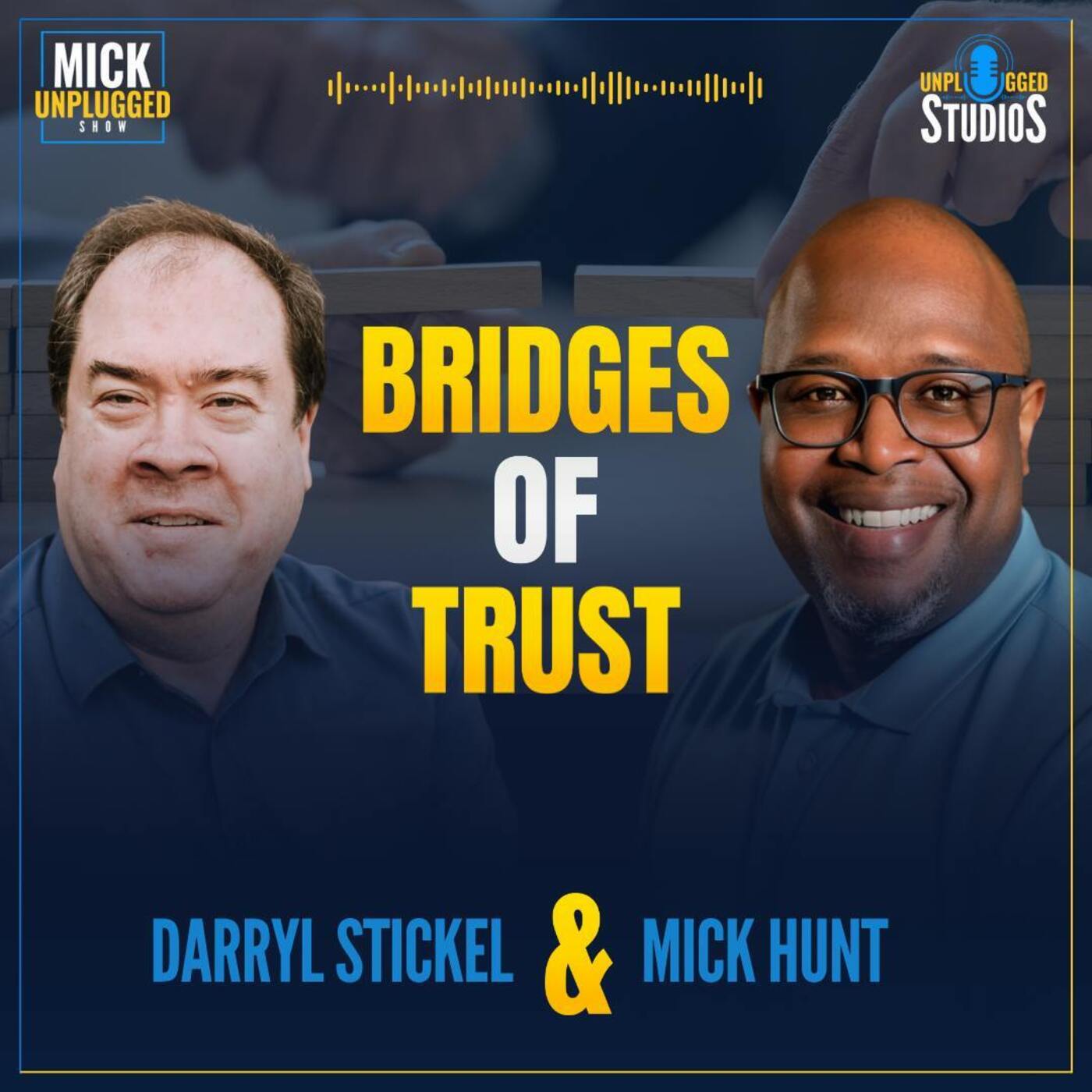
Ladies and gentlemen, welcome back for another powerful episode of McPlug. And today's guest is the man that I call the architect of trust. Building bridges where walls once stood. From global corporations to conflict zones, his work unlocks the human code behind true modern leadership. He's insightful, he's grounded, he's transformational. He is the good doctor. Dr. Darrell sticker. Dr. Darrell, how are you doing today, brother?
- [01:13]
Dr. Darrell Stickle
Brother. I really appreciate you having me on the podcast and I'm looking forward to spending some time together.
- [01:18]
Mick (Host of Mick Unplugged)
I appreciate you being here. You know, off top, we have to let the viewers and listeners understand this. We kind of don't like each other. Dr. Darrell, you know, I'm a UNC grad, and you went to that school that starts with D in Durham, North Carolina, that I can't pronounce very well, Right? How did we get here?
- [01:40]
Dr. Darrell Stickle
Well, the cream always rises is what I would suggest. And we may not like each other, but I think given time, we come to love each other.
- [01:49]
Mick (Host of Mick Unplugged)
No, absolutely. Absolutely. As you know this, right? And I think. I think most people understand this. Duke and UNC do have a love hate relationship, right? A lot of hate. But it's a bunch of mutual respect, right? Like, take sports out of it. You have graduates of Duke, graduates of unc. We always like to rib each other, right? But there's so much mutual respect. We just don't like when outsiders talk about the other school. Like, you can't hate Duke more than I hate Duke, I promise you.
- [02:17]
Dr. Darrell Stickle
Right.
- [02:18]
Mick (Host of Mick Unplugged)
And I'm sure that's how it is for you too, right? Like, when it comes to sports, no one can hate UNC more than you can hate unc. So unless you went to Duke, you don't understand. Unless you went to unc, you don't understand.
- [02:27]
Dr. Darrell Stickle
It's that intense rivalry. But also, as I was saying to you before we started recording, I took half my. During my doctoral studies, I took half my classes at UNC Chapel Hill. I have so much respect for the faculty and the institution and the graduates Absolutely.
- [02:43]
Mick (Host of Mick Unplugged)
Absolutely. And you're wearing a Carolina blue shirt today in honor of the University of National Champions. So I understand. Appreciate it. So, Dr. Darrell1, I am truly honored to have you on, man. Like, you know how much I respect you. I'm. I like to consider myself a person that's pretty well respected in the modern leadership phase of life. And I know that you were there as well, too. But before we get into all of your great work, I like to ask my guest this first question is, what's your because? What's that real why behind the why that keeps you doing what you do? Right. You are well acclaimed. Right. Lots of awards, lots of articles about you. You have Fortune 100 clients and you're speaking all over the world. What's your passion? What's your. Because that keeps you doing what you do.
- [03:38]
Dr. Darrell Stickle
So I. Wow. I'm going to get a little emotional here. I'm sorry.
- [03:49]
Mick (Host of Mick Unplugged)
No, that's what we're here for.
- [03:52]
Dr. Darrell Stickle
The path I've traveled has included some real hard knocks. And I believe that sometimes a hard road can be a good teacher. And I have learned from that experience how to help people better understand one another, how to help people build trust with one another. And I have a perspective that's unusual. I won't say it's unique, but it's. It's rare. You know, there's a blend of theory and practice that gives me a. An unusual perspective on the world. I also have two sons that mean more to me than anything.
- [04:30]
Mick (Host of Mick Unplugged)
Yeah.
- [04:31]
Dr. Darrell Stickle
And when I see the world the way it is now, with trust levels the lowest we've ever seen, our struggles to get along, I feel like I have an obligation to try to make the world a better place and a strong motivation. Because of my sons. I want the world to be a better place for them.
- [04:49]
Mick (Host of Mick Unplugged)
Yeah, that's beautiful, man. That's beautiful. You know, and you talk about your unique path, and I want to ask you about that and just why trust means so much to you and why it's so important that this is the message that's shared across the world. You know, knowing you like I do, doing a ton of studying of you. Right. Like you're legally blind. So trust is multifaceted for you. Right. So. So let's talk about your path a little bit and that journey that's so unique to you.
- [05:25]
Dr. Darrell Stickle
So I grew up in a small town in northern British Columbia, Canada. And it was fairly remote. It was about an hour drive to the next tiny community. And winters were harsh. People had to pull together, you know, There was a sense of, if you could help someone, you should. And so I grew up with that kind of feeling, that instinct, that set of values. And then, you know, I. I played hockey because most people played hockey when I grew up. Yeah, I was playing at a fairly high level. I was playing junior, and I got attacked by a fan with a club. Shattered my helmet, knocked me unconscious. I stopped breathing three times on the way to the hospital. It was traumatic. And at the time, you know, I was 17, I knew that I was going to lose my sight, that. That I was going to become legally blind at some point. I had a hereditary retinal disorder that was the. That was going to rob me of the ability to do many things. And so I had come to the conclusion that I would train my brain so I could think for a living. Now, all of a sudden, I couldn't think at all, Right. I had the attention span of a fruit fly. And it was the mid-80s, 1984, and we didn't know a lot about concussions. And so people were saying, well, it'll just pass. Just walk it off. It'll be fine. It took a couple of years for the symptoms to reside. And, you know, I. I was tired all the time, struggling to pay attention, struggling to learn. And so there was this feeling of helplessness and hopelessness and loss that gave me real empathy for people who were struggling. And when I started to recover, I. I moved to Victoria, which is on Vancouver island, just off the west coast of Canada. And I was going to school there, and I'd be on the. On the bus, and complete strangers would just sit down next to me and say, I'm really having a hard time. And so I wanted to understand what it was that drew people to me, that allowed them to feel open and comfortable with me. And so I started working with families in crisis and troubled teens and working on crisis lines, trying to hone those skills and. And come to a better understanding of what it was that was driving that. And at the same time, I was going to school, right? Like I was. I did an undergraduate degree in psychology, a master's degree in public administration. And while I was working in native land claims in British Columbia, they would ask me these deep philosophical questions, like, what is self government? Or what will the province look like 50 years after claims are settled? The last question they asked me, Nick, was, how do we convince a group of people we've shafted for over 100 years they should trust us? And I thought, man, that's a good question. Wow. And so I went to Duke, wrote my doctoral thesis on building trust in hostile environments, and had the good fortune of having two of the world's leading academics on the topic of trust. On my committee at Duke. One of them showed up the year I did. The other one showed up the year after I did. And it's hard not to feel like it was intentional somehow. Right. Like this whole pattern of events was leading to me learning and understanding this topic the way that I do. And after I finished, they sat me down and they said, you know, when you first came to us, we, we had a conversation with each other. We said, topics too big, he'll never solve it. It's too complicated. We'll give him six months, he'll come crawling back to us, and we'll let him chisel off a little piece of this, and that'll be his thesis. They said six months in, you were so far beyond us, we couldn't help anymore. All we could do is sit and watch.
- [09:53]
Mick (Host of Mick Unplugged)
Wow.
- [09:55]
Dr. Darrell Stickle
Now here we are a couple years later, and we think you've solved it. And so I ended up going to McKinsey Co. Working as a consultant. And they said, wow, you've got good client hands. Let's send you to the worst places possible. So now I'm getting a chance to apply the concepts that I've worked on. Right, right. And then I was injured again, post concussion syndrome. I was on the way to a client site, cab I was in, rear ended, another vehicle. And I was back to struggling with fatigue and memory and concentration problems. And. And so I ended up starting my own little company called Trust Unlimited.
- [10:45]
Mick (Host of Mick Unplugged)
Yeah.
- [10:45]
Dr. Darrell Stickle
And for the last 20 plus years, I've been helping individuals and organizations better understand what trust is, how it works, and how to build it. And I, I've been learning that whole time, Nick.
- [10:56]
Mick (Host of Mick Unplugged)
Right.
- [10:57]
Dr. Darrell Stickle
You know, from helping financial services organizations to helping nonprofits, to helping the Canadian military try to figure out how to build trust with the locals in Afghanistan. Each of those teaches me something, which is, which is what helps differentiate me. Right. It's a very practical, applied approach to what feels like a complex problem.
- [11:18]
Mick (Host of Mick Unplugged)
Yeah. Yeah. You know, Darrell, you've said trust is a risk. Right. Can you unpack that for the listeners and viewers? Like, what makes trust a risk in this high stake world that we're in?
- [11:37]
Dr. Darrell Stickle
Yeah, well, yeah. So for me, trust is a combination of uncertainty and vulnerability. Right. The definition that I use is trust is the willingness to be vulnerable when we can't completely predict how someone else is going to behave. And so for me, it Means uncertainty times vulnerability gives us a level of perceived risk, and we each have a threshold of risk that we can tolerate. And if we go beyond that threshold, we don't trust. If we're beneath it, then we do. And what that means then, Mick, is that if uncertainty is really high, vulnerability has to be pretty low. And as our relationships deepen, the uncertainty comes down. The range of vulnerability we can tolerate starts to grow. What we're seeing right now is that our vulnerability is fairly set, but uncertainty is bouncing all over the place. And so you and I connect, and you're already experiencing discomfort with how volatile the world is, and I ask you to make yourself just a little bit more vulnerable. For me, that's a harder ask than it used to be. Because you're already feeling overexposed. Yeah. That's why our trust levels are so low right now.
- [13:05]
Mick (Host of Mick Unplugged)
That's great perspective. You know, I didn't even look at it from that lens, but you're exactly right, man. And, you know, working with all the organizations that you do and leaders that you do, what's like one common trust destroyer that you see as a common theme amongst companies, big or small? Like, what are. What are companies and leaders getting wrong about trust that they could easily do to fix it? Wow.
- [13:33]
Dr. Darrell Stickle
That is a great question. You know, and I don't know that there's a silver bullet. I think that, you know, for me, there's 10 levers that we can pull to build trust.
- [13:48]
Mick (Host of Mick Unplugged)
Yeah.
- [13:50]
Dr. Darrell Stickle
And those who are really good at building trust understand that. And they know how to pull multiple levers and when to pull them. Right. A lot of people have this profound lack of awareness of trust, and they have a lever that they pull over and over again. Right. So if we wanted to build trust, we'd have to understand where does uncertainty come from? Where does vulnerability come from? How do we influence perceptions of outcomes? And what are the emotional stakes? I think the. The biggest challenge for most organizations is just a complete lack of awareness.
- [14:33]
Mick (Host of Mick Unplugged)
Agree.
- [14:34]
Dr. Darrell Stickle
And so 95% of people believe they're more trustworthy than average. Like, I suspect you and I could go to a prison and we could interview the inmates and say, do you think you're trustworthy? And they go, oh, yeah, yeah. You can trust me. Nobody else in this place but me. I'm. I'm golden.
- [14:51]
Mick (Host of Mick Unplugged)
Right.
- [14:52]
Dr. Darrell Stickle
The problem that creates for us is that if we do have a misunderstanding, if we do have a disagreement, I assume it's somebody else's fault. I don't do the work I need to do, and I Don't take their perspective into account. Right. And so, you know, the biggest gap we find is between leader. How much leaders believe they're trusted and how much they actually are. So I think the. The impact that we see is often around creating a vocabulary that people can use.
- [15:29]
Mick (Host of Mick Unplugged)
Yeah.
- [15:29]
Dr. Darrell Stickle
Talking about uncertainty, talking about vulnerability, talking about, you know, what's a good outcome look like, being clearer and actually having conversations with one another. Yeah. One of my, you know, my aspirations to be one of the best guests you've ever had, which is a high bar.
- [15:49]
Mick (Host of Mick Unplugged)
You're doing a great job.
- [15:51]
Dr. Darrell Stickle
But to do that, I'd have to ask you, what does great look like for you?
- [15:56]
Mick (Host of Mick Unplugged)
Right.
- [15:57]
Dr. Darrell Stickle
Right. So what's it. What would it look like if I was a great guest for you?
- [16:01]
Mick (Host of Mick Unplugged)
Yeah. A great guest for. For Mick. Unplugged provides amazing insights that the viewers and listeners can put in the application immediately.
- [16:10]
Dr. Darrell Stickle
Right.
- [16:10]
Mick (Host of Mick Unplugged)
I like things in simple forms, and so do my viewers and listeners.
- [16:14]
Dr. Darrell Stickle
Okay. And if I wanted to do an even better job, we would ask your listeners.
- [16:21]
Mick (Host of Mick Unplugged)
Correct.
- [16:21]
Dr. Darrell Stickle
What are some of the best episodes you've heard from Mick?
- [16:24]
Mick (Host of Mick Unplugged)
Right.
- [16:25]
Dr. Darrell Stickle
And what was it about those episodes that really drove things home for you? And so if I don't include you in the conversation, I just assume what excellence looks like. Yeah. I miss often. Right. I could come on here and say, oh, I'm from Duke, and be naive to the fact that that actually doesn't work in my favor for you. Correct, Right. Correct. And I. I could say, oh, I've spoken at Harvard. You could say, la di da. Right. So does the janitor.
- [16:58]
Mick (Host of Mick Unplugged)
Right, Right.
- [16:59]
Dr. Darrell Stickle
And so I could trot out all these things. But if I don't know what you think excellence looks like, then that I'm going to miss. And so a lot of times, what we encourage people to do is actually have a conversation about what good looks like, you know, And I do that with my sons. I say, what does a good dad look like? And I got to tell you, it's terrifying, Mick.
- [17:21]
Mick (Host of Mick Unplugged)
It is.
- [17:22]
Dr. Darrell Stickle
Because what if they say not you? Right, right.
- [17:25]
Mick (Host of Mick Unplugged)
That's the risk. Right. Trust is a risk.
- [17:27]
Dr. Darrell Stickle
Trust is a risk. And it wouldn't be so rare if.
- [17:32]
Mick (Host of Mick Unplugged)
If.
- [17:34]
Dr. Darrell Stickle
If it didn't have the potential to be harmful.
- [17:36]
Mick (Host of Mick Unplugged)
Correct.
- [17:38]
Dr. Darrell Stickle
Right. We. We know that trust provides incredible benefits, and it's actually more. More valuable now than it's ever been because it's so scarce. But the reason we don't have it is because it comes with risk.
- [17:52]
Mick (Host of Mick Unplugged)
Totally agree. Totally agree. You know, on the leadership track, I asked my kids, you know, Tell me who a good leader is in your opinion. Like, who are your top three people that you would classify as good leaders? Right. Take dad out of the equation. Right. I did a little bit differently, Daryl. I took myself out so they couldn't say dad. Right?
- [18:17]
Dr. Darrell Stickle
Right.
- [18:17]
Mick (Host of Mick Unplugged)
I wasn't gonna hurt my feelings.
- [18:19]
Dr. Darrell Stickle
Right. Good call.
- [18:21]
Mick (Host of Mick Unplugged)
But what each of them did was they gave me three social media influencers.
- [18:27]
Dr. Darrell Stickle
Okay.
- [18:28]
Mick (Host of Mick Unplugged)
And it made me pause, and I was like, but you don't know that they're a good leader. You don't even know that they're famous. You just know that they have a lot of followers. Right. And that's someone that you listen to or that you follow. And it really made me pause. And it's. And I said, okay, when I grew up, right. Like, we went to libraries and there were biographies.
- [18:48]
Dr. Darrell Stickle
Right.
- [18:49]
Mick (Host of Mick Unplugged)
There used to be expose on TV around great leaders and the history of leaders. And when you go to an amazing school like the University of North Carolina, you're indoctrinated into great leadership because we have libraries about specifically great leaders and good leaders. And I said, the world is missing that. And it made me go a little bit further. And this is why I connect with you so well. You know, I say, for the modern employee, trust is the number one form of currency today.
- [19:23]
Dr. Darrell Stickle
Right? Right.
- [19:24]
Mick (Host of Mick Unplugged)
It's not your benefits package, it's not your pension, it's not your 401k. Because the modern employee, whether corporations want to believe it or not, 63% of modern employees are thinking about how to become an entrepreneur, whether that's a side hustle job for them. But they're thinking of some other means of income that they can control. Doesn't mean that they're going to go full fledged, start another company. But the benefits aren't as important to them as much as me trusting Darrell as my leader to be transparent about his vision, his purpose, where the company is going, good or bad. That's what the modern employee seeks first and foremost. And I'd love your response or your take on that as well, too, being that you are who I consider the guru of trust, the godfather of trust.
- [20:13]
Dr. Darrell Stickle
Yeah, I. Brother, you've nailed it. We see there's a Gallup poll not too long ago that showed that 70% of employees are disengaged. I believe the social contract is broken. We used to have this mindset of, you go to school, you work hard, you're going to be successful, you're going to have a house and a family and vacations and the things in a retirement. Yeah.
- [20:39]
Mick (Host of Mick Unplugged)
Yeah.
- [20:39]
Dr. Darrell Stickle
And it doesn't feel like any of that's true anymore.
- [20:42]
Mick (Host of Mick Unplugged)
Right.
- [20:43]
Dr. Darrell Stickle
And people sort of denigrate the generations that are following us. My son gave me this great quote about, you know, the kids of today are lazy and ill informed and lack motivation. And it just went on and on. Right. And, and the quote was from the 1930s.
- [21:04]
Mick (Host of Mick Unplugged)
Yeah.
- [21:05]
Dr. Darrell Stickle
So this is not a new phenomena. And what older people like us need to realize is that they're reacting to the context that they're embedded in. The rules of the game have changed and they have a better understanding of it than we do.
- [21:19]
Mick (Host of Mick Unplugged)
Oh, for sure.
- [21:21]
Dr. Darrell Stickle
And so when they don't sell out for a corporation, you know, when they hear these billionaires saying, you need to work harder, what they hear is, you need to work harder. So I make more money. And I believe that the more senior we become, the less direct control we have over outcomes, the more we rely on those we lead to reach our goals and objectives.
- [21:42]
Mick (Host of Mick Unplugged)
Totally agree.
- [21:44]
Dr. Darrell Stickle
So if I'm a leader today, I need to be able to think about how to build a safe harbor, create a place of stability for those I lead so that they're willing to work hard for a shared objective. Yeah, yeah, yeah, yeah. We're completely in alignment.
- [22:06]
Mick (Host of Mick Unplugged)
So for the business leader, I don't, I'm not even saying business owner, but for the business leader. Right. What are some steps that they can take to, to start this culture of trust? Like, what are two or three things that they can implement today? And I'm going to say think of like the, what the, the Small Business association considers a small business. So 25 million and under revenue. Right. So that business leader, okay, so you're.
- [22:36]
Dr. Darrell Stickle
Still in a fairly manageable state in terms of being able to have direct connections with your employees at that size. Yeah. Those personal relationships are actually really important. And the levers I think about, particularly when it comes to uncertainty, uncertainty comes from us as individuals and from the context we're embedded in. Right. The rules of the game. And so I encourage people to be really mindful of how they structure things, how they manage the context. So what are the formal and informal mechanisms that they put in place? Do they reward the right behaviors? Do they evaluate people not just based on their production, but based on how they contribute to the production of others? And do we have a mindset around growth, learning and development for everybody that's there? And so that's the context piece when we start talking about, you know, the things that I control individually as a leader. There's benevolence, integrity, and ability. And benevolence is just a fancy word that means having your back, having your best interest at heart. And so, you know, a lot of times people will say, well, and this is. I'll give them some. A conversation they can start tomorrow.
- [23:56]
Mick (Host of Mick Unplugged)
Okay.
- [23:57]
Dr. Darrell Stickle
They can say, I heard this yahoo from Duke talking, and he gave me confidence that not everyone from Duke's an idiot.
- [24:06]
Mick (Host of Mick Unplugged)
There you go.
- [24:08]
Dr. Darrell Stickle
And he said that having people's best interest at heart or having their back is actually a strong way to build trust with them. And I think I do that. But it doesn't always seem to land that way. Have you ever experienced that? And the person they're going to talk to is going to say, oh, God, yeah, get curious about that. What did you try? Right. How did it go wrong? Yeah. How did they misinterpret then narrow the funnel. Have you ever had someone really have your back? What did they do? What did it look like? How did it feel? Now you're priming them to think about what their best interests are, what success means to them, and some situations where they've experienced it before. Then you narrow the funnel a little further and you say, what is success for you? How do I help you get there? What would it look like if I had your back? And now you've created a moment where there's a possibility for transparency. And so if, if one of your employees says to you, I'd like to get promoted here, doesn't mean you're going to be nice to them all the time. It means, okay, I'm going to hold you to the standard of the next level up. I'm going to start giving you opportunities that go beyond the scope of your current job. I'm going to expose you to other folks so that they get a chance to see that, yeah, you deserve to be promoted so that I can make the argument to others when the time comes.
- [25:31]
Mick (Host of Mick Unplugged)
Yeah.
- [25:32]
Dr. Darrell Stickle
And these are going to be the expectations. And so now you can start to be transparent when you say, remember when you said you wanted to get a promotion? This is what it looks like in the next role. This is what good looks like in the next role. This is the feedback I'm going to give you.
- [25:50]
Mick (Host of Mick Unplugged)
Nice.
- [25:50]
Dr. Darrell Stickle
And so there's not a miscommunication there.
- [25:53]
Mick (Host of Mick Unplugged)
Yeah.
- [25:55]
Dr. Darrell Stickle
And integrity is, you know, following through on your promises, actions that line up with the values you express. And so we actually need to understand what promises people think we've made. Not just the promises we've explicitly made, but the ones that they think we've made. And so when I do workshops, I'll start off by saying, what would make this one of the best workshops you've ever seen? And I create a list, and then as I go through, I try to hit that list and I check back in with them, am I doing what you asked me to do? And if they come up to me at the break or after the session and say, I wish I'd included this piece in the list, it's not me failing to deliver something they expected, it's them having forgotten.
- [26:46]
Mick (Host of Mick Unplugged)
Yeah.
- [26:48]
Dr. Darrell Stickle
And I can take the chance then to correct that in the moment. Right. So that I can show integrity, so that I can follow through on the commitment that that is implied between us.
- [26:59]
Mick (Host of Mick Unplugged)
Love it.
- [27:01]
Dr. Darrell Stickle
And then for ability, I asked them, you know, what would excellence look like? And we actually have a conversation. You've had good bosses in the past. What did they do? What. What did you really like about bosses you've had in the past? What did you really not like? Like you were asking with your kids? Yeah.
- [27:20]
Mick (Host of Mick Unplugged)
That's deep, Darrell, brother, that is so deep. That is so deep. Another question I wanted to ask you quickly because I get asked this question a lot and you're the guru. So I get to go to the guru of trust today. Right. And again, we're talking about modern leadership today. We have to deal with remote work, which is something in the 90s, early 2000s wasn't a thing.
- [27:45]
Dr. Darrell Stickle
Right, right.
- [27:46]
Mick (Host of Mick Unplugged)
How can a corporation, I'm not even going to say, build trust, evaluate trust when you don't see everyone day to day. And a lot of times you're not looking people in the eye.
- [28:01]
Dr. Darrell Stickle
Right.
- [28:01]
Mick (Host of Mick Unplugged)
I have clients, Darryl, who literally. And we're talking teams of thousands.
- [28:07]
Dr. Darrell Stickle
Yeah.
- [28:08]
Mick (Host of Mick Unplugged)
I've never seen each other in person. And when they do have interactions, it's interactions virtually like this. And there's not a requirement. I'll say that differently. Before hiring me, there wasn't a requirement to have your camera turned on in a virtual meeting. And I said, first thing we're doing is we're not bringing everybody together, but it has to be mandatory that you look people in the eye. So for you, quickly, how can someone evaluate trust in a remote environment?
- [28:39]
Dr. Darrell Stickle
That's a great question. And you and I could talk about this topic for quite a while, actually.
- [28:43]
Mick (Host of Mick Unplugged)
Yeah.
- [28:46]
Dr. Darrell Stickle
I will often ask leaders, who do you trust? And I get these sort of close, tight personal relationships. Right. Like siblings, spouse, best friend, parents. And the reality is we trust people all the time. It's just that we trust some people more than others. Right. When I Flip the question and say, who trusts you? I'll get this really long pause, right? And inevitably someone will say, how would we know? How do I know if somebody trusts me or not? And I go back to the definition, which is the willingness to be vulnerable. And so how can their employees make themselves vulnerable to them? And then do they. Right. Do they tell them what the real development needs are? Do they push back against ideas they don't think are going to work? Do they speak up in meetings? Do they try new things? Are they willing to make mistakes and take risks? Who hears about the bad news first? Right. Is it the boss or are you the last one to hear? Those are all ways we can understand if people trust us or not. And, you know, I'm getting this question often from leaders who say, I, I want people to be in the building more often, not just for monitoring purposes, but because I think it's important for the culture. And they're right. Some level of collaboration is facilitated by us being together. Right? Right. You and I, if we were sitting in the same room, would have the chance to observe different things about each other, to have a side conversation after the session, to just connect as human beings. Right. There'd be a vibe that builds. And I feel comfortable with you already. And we haven't really been speaking for all that long, but I just. There's something about it. And, you know, I've advised companies that are truly global, and for them, they say it's the vocabulary. It's not saying, do you trust me? Because people aren't comfortable answering that question. And sometimes they don't know.
- [30:54]
Mick (Host of Mick Unplugged)
Right.
- [30:54]
Dr. Darrell Stickle
You know, how much the right response to that question is. With what? Right. So I think being able to say, where's your uncertainty at? What. What are you feeling vulnerable about right now with this?
- [31:12]
Mick (Host of Mick Unplugged)
Yeah.
- [31:12]
Dr. Darrell Stickle
It lets them have conversations that are easier to have. Does that make sense?
- [31:19]
Mick (Host of Mick Unplugged)
It totally makes sense. It totally makes sense. I actually, I just took a quick note on that because it's something that I need to start asking my team members. Right. Like, I have three different companies, and. And they're remote as well, too. So I need to start asking those questions for us, because while I think we have. Or not, I think I know we have a great culture. I know that we have a culture of trust. I still. Some of that's assumption.
- [31:47]
Dr. Darrell Stickle
Right?
- [31:48]
Mick (Host of Mick Unplugged)
Some of that's assumption. So I need to. To truly make sure by asking the.
- [31:52]
Dr. Darrell Stickle
Questions, you have a presence that's comforting. It's. It has wisdom embedded in it. I have no doubt that your Teams trust you. I have no doubt that you're a great leader. Even you, as skilled as you are, can get better. This is a skill that we can build. Yes. Right. So.
- [32:15]
Mick (Host of Mick Unplugged)
Absolutely.
- [32:16]
Dr. Darrell Stickle
Absolutely.
- [32:17]
Mick (Host of Mick Unplugged)
Well, Darrell, before I let you go, because I know you're. You're busy, you've been gracious with your time. I like to do what I call, like my quick five segments. So five quick questions.
- [32:27]
Dr. Darrell Stickle
All right. All right.
- [32:28]
Mick (Host of Mick Unplugged)
So you went to that school over in Durham.
- [32:31]
Dr. Darrell Stickle
Yeah.
- [32:32]
Mick (Host of Mick Unplugged)
D O O K is how it's spelled for the viewers and listeners, in case you didn't know. So my first question for you, Darryl, because I know that you said you went to Chapel Hill quite a bit, Right?
- [32:43]
Dr. Darrell Stickle
Yeah.
- [32:44]
Mick (Host of Mick Unplugged)
So the first time that you went to Chapel Hill and then you had to drive back to Durham, how disappointed were you?
- [32:59]
Dr. Darrell Stickle
Oh, brother.
- [33:01]
Mick (Host of Mick Unplugged)
You know what?
- [33:02]
Dr. Darrell Stickle
I. I don't know if it's still there, but 411 west was one of my favorite restaurants.
- [33:07]
Mick (Host of Mick Unplugged)
Yes.
- [33:08]
Dr. Darrell Stickle
Bessemi Burrito was awesome. Chapel Hill is a much nicer community than Durham.
- [33:15]
Mick (Host of Mick Unplugged)
Thank you.
- [33:17]
Dr. Darrell Stickle
It's not even close.
- [33:18]
Mick (Host of Mick Unplugged)
Dr. Daryl said that. I didn't say it.
- [33:22]
Dr. Darrell Stickle
Yeah, yeah, it's. It's a much nicer place.
- [33:28]
Mick (Host of Mick Unplugged)
There you go. There you go. So for. For my buddy Chris Paradiso, you heard him shout out 411 West. We'll see 411 west in September together. All right, Darrell, a couple other questions. What's one book that's changed how you see human behavior?
- [33:45]
Dr. Darrell Stickle
It's called Building Trust. Exceptional Leadership in an Uncertain World by Daryl Stickle. I will give it to you.
- [33:52]
Mick (Host of Mick Unplugged)
I was giving it to you because that is mine. That's why I put that question in there. Yeah.
- [33:57]
Dr. Darrell Stickle
I think Thinking Fast, Thinking Slow by Kahneman, Daniel Kahneman.
- [34:02]
Mick (Host of Mick Unplugged)
Okay.
- [34:03]
Dr. Darrell Stickle
Is a good book. Exit Voice and Loyalty by Albert O. Hirschman, who looks at the different way that economists and. And political scientists think about how people react when things start to go wrong. Yeah, those are books that have really caused me to think, okay. Yeah, if.
- [34:26]
Mick (Host of Mick Unplugged)
If you're at a trust building dinner, what meal are you ordering for yourself?
- [34:35]
Dr. Darrell Stickle
Depends on what shirt I'm wearing, because it's. The shirt's got to blend with the stains of the food that I'm going to leave on it. Probably something simple.
- [34:46]
Mick (Host of Mick Unplugged)
What's the simple?
- [34:48]
Dr. Darrell Stickle
Yeah, it's got to be simple. Maybe like a chicken breast or. Yeah, maybe. Maybe a steak.
- [34:57]
Mick (Host of Mick Unplugged)
Okay.
- [34:58]
Dr. Darrell Stickle
Probably not pasta, because I can spill that too easily.
- [35:00]
Mick (Host of Mick Unplugged)
There you go. I always told people a steak dinner is a. Is a psychological trust moment. Right. You sit at a Steakhouse. The, the naturally, the steakhouse is going to have a darker but warmer feel and environment. And people are naturally trusting in that type of environment.
- [35:21]
Dr. Darrell Stickle
Yeah. More relaxed.
- [35:22]
Mick (Host of Mick Unplugged)
Yeah, exactly, exactly.
- [35:24]
Dr. Darrell Stickle
All right.
- [35:25]
Mick (Host of Mick Unplugged)
What's one daily habit that you have for you in trust building for yourself?
- [35:33]
Dr. Darrell Stickle
Oh, so I try to have positive impact on somebody every day. So I try to have one conversation. Often it's with my sons where I talk to them about. We interpret the world through stories. Yeah, Right. And that positive narrative that I have for them needs to be refreshed often. Because the world's a hard place.
- [36:04]
Mick (Host of Mick Unplugged)
Yes, sir.
- [36:04]
Dr. Darrell Stickle
And so my sons need to know that I've got their best interest at heart, that I've got their back. And if I'm not talking to one of them, I'm talking to a friend or colleague every day. I try to have positive impact because it's part of how I maintain my sense of self.
- [36:24]
Mick (Host of Mick Unplugged)
I love it. You kind of. You've already answered my, my last question, but I'm going to give you the floor again. What is the best book on trust, Trust foundation and Building Trust? And why is it titled Building Trust?
- [36:42]
Dr. Darrell Stickle
I, you know, I've, I've actually received external feedback from folks who've read the book saying, okay, I've read everything on trust. This blew me away.
- [36:49]
Mick (Host of Mick Unplugged)
Yes.
- [36:51]
Dr. Darrell Stickle
And it's because it's talking about building trust. So many people are talking about the importance of trust and the fact that we don't have much of it. Almost no one's talking about how to build it.
- [37:05]
Mick (Host of Mick Unplugged)
Correct.
- [37:07]
Dr. Darrell Stickle
There was a conference a couple of years ago titled Building Trust in Institutions that Duke was sponsoring. And I was virtually attending. And they went through and they were talking about all the symptoms, like end of democracy, kinds of numbers for trust in government, trust in media, trust in technology and AI. And somebody finally said, okay, you know, we get it, things are bad. But the title of the conference is Building Trust. What do we do? And the moderator looked into the camera and said, we just don't know.
- [37:40]
Mick (Host of Mick Unplugged)
Wow.
- [37:42]
Dr. Darrell Stickle
And I do know. Right. That's what I do for a living. And so the book is written in a way that normal people can read it. And there's a lot of things that I do that the existing trust literature just doesn't do. Right. So the inclusion of vulnerability.
- [38:02]
Mick (Host of Mick Unplugged)
Yeah.
- [38:03]
Dr. Darrell Stickle
Most of the trust literature treats trust like a dichotomous variable, Nick. It treats it like it's either present or absent, like an old time light switch. Really. And the reality is we trust some people more than others. Truth and the Inclusion of perceived outcomes. We interpret the world through stories and so we can have the same experience and have dramatically different perceptions of what just happened. We're seeing that play out across the US Right now in alarming fashion.
- [38:32]
Mick (Host of Mick Unplugged)
Yeah.
- [38:34]
Dr. Darrell Stickle
And the inclusion of emotions. Right. Trust literature treats people like they're rational actors. And you've met people, right?
- [38:44]
Mick (Host of Mick Unplugged)
A couple.
- [38:45]
Dr. Darrell Stickle
We're not always rational. Correct. So. So I think I wrote the book so that if I disappear, what I know doesn't. Trying to get the signal through the noise.
- [38:59]
Mick (Host of Mick Unplugged)
Love that. Love that.
- [39:01]
Dr. Darrell Stickle
Yeah.
- [39:02]
Mick (Host of Mick Unplugged)
Well, Dr. Darrell, where can people find you? Follow you, get more insights from you.
- [39:09]
Dr. Darrell Stickle
So I have my own podcast, which I'd love to have you on. The Imperfect Cafe.
- [39:14]
Mick (Host of Mick Unplugged)
Yes.
- [39:16]
Dr. Darrell Stickle
I'll send you a link and you can schedule a time.
- [39:19]
Mick (Host of Mick Unplugged)
Yes, sir.
- [39:20]
Dr. Darrell Stickle
It's an excuse for us to talk again, at least once more.
- [39:23]
Mick (Host of Mick Unplugged)
Absolutely.
- [39:24]
Dr. Darrell Stickle
And we can talk about your book. Let's come up. Let's do it.
- [39:28]
Mick (Host of Mick Unplugged)
Yes, sir.
- [39:30]
Dr. Darrell Stickle
So the Imperfect Cafe is the podcast I have. You can check me out on trustunlimited.com there's articles on there, there's videos connected to it. It's all free. People can find the book anywhere. You buy books online. It's available as an ebook or an audiobook. And if people want to reach out to me because they're struggling with something, It's Darrell@Trustrustunlimited.com D, A, R, R, Y, L.
- [39:59]
Mick (Host of Mick Unplugged)
I appreciate that, sir. I'll make sure that we have links to all of that in the show notes and the descriptions. Dr. Darrell, honored to have you on. You are the person I consider the expert, the guru when it comes to trust. And I have notes right here that I took down that I have to start implementing today, too, because as you said it, everyone should be trying to get better. Right? And I know that I can get better. So I thank you for the wisdom that you gave me today.
- [40:31]
Dr. Darrell Stickle
It's a skill we can all build. And I really appreciate you letting me talk with you and your listeners.
- [40:36]
Mick (Host of Mick Unplugged)
You got it. And for all the viewers and listeners, remember your because is your superpower. Go unleash it.
- [40:44]
Dr. Darrell Stickle
Thanks for tuning in to this episode of Mick Unplugged. If today hits you hard, then imagine what's next. Be sure to subscribe, rate, and share this with someone who needs it. And most of all, make a plan and take action, because the next level is already waiting for you. Have a question or insight to share, send us an email to hello. Ickunplugged.com until next time, ask yourself how you can step up.