← Mick Unplugged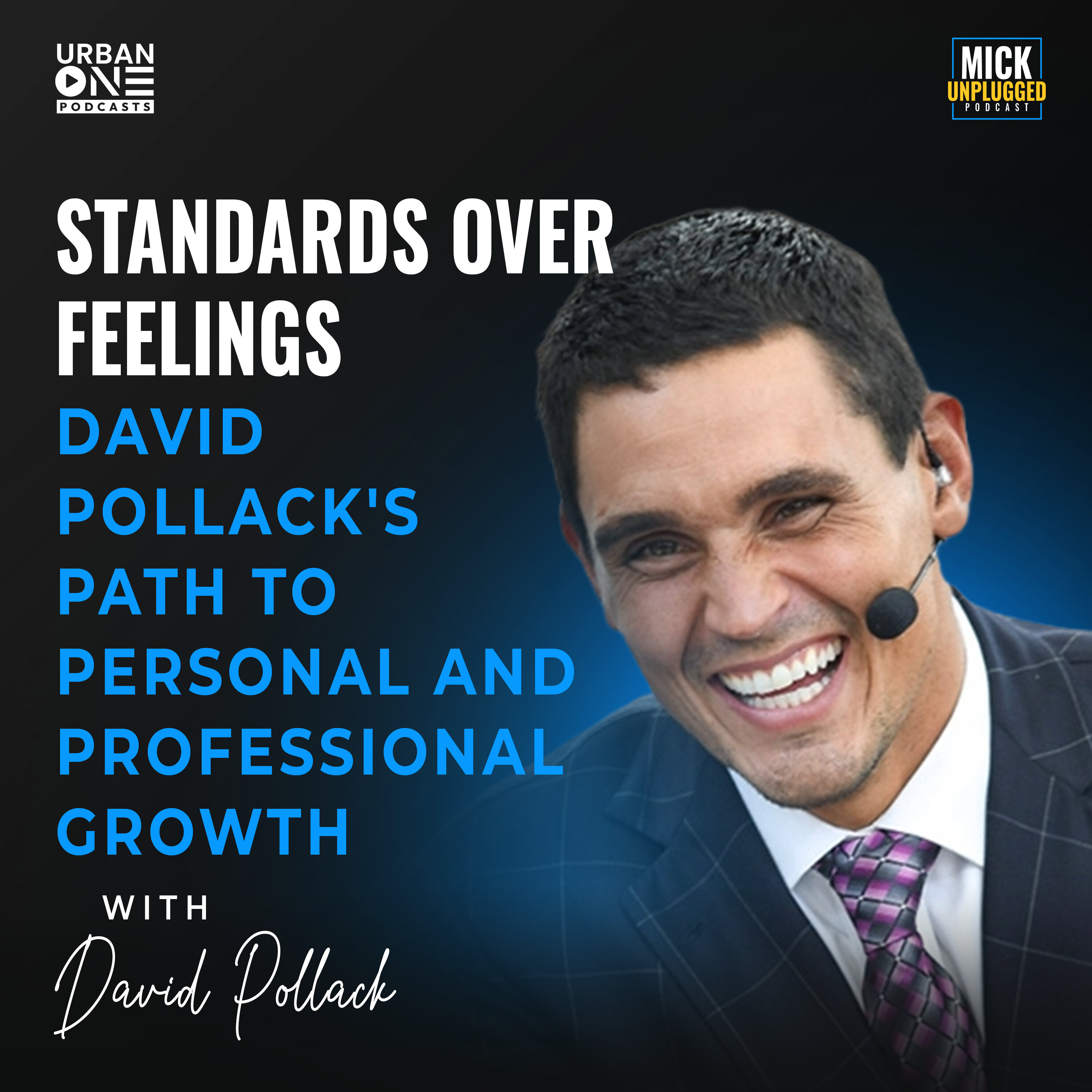
Mick Unplugged
David Pollack | Standards Over Feelings: David Pollack's Path to Personal and Professional Growth
00:36:34
Loading summary
Transcript54 lines
- [00:00]
David Pollack
Two big things happen in my life that I always like to share.
- [00:03]
Mick
50, 40, 10 by David Pollack.
- [00:05]
David Pollack
You can outdo 50% of the people in this world by showing up more, showing up with a good attitude, showing up ready to rock and roll. 40% is the next step in the right direction. With the right effort, I'm beating 90% of people, but we got 10% left.
- [00:21]
Mick
Mick, to you, white standards are important.
- [00:25]
David Pollack
Don't worry about how you feel every day because your feelings change every day. And what people say change and the task changes, but that doesn't change who you are and what you bring to the table every single time. Will you succeed all the time? No.
- [00:40]
Mick
I tell people leadership is a four letter word. C A, R, E. Yeah.
- [00:45]
David Pollack
I think first of all, if you have influence over one person, you're a leader. So everybody got that crazy person in your family that likes you for no reason. So you're. Everybody's a leader. Dude. I've failed all along the way. I mean, I have failed so much more than I have succeeded. And I like to share those because Those are real. The 3H is hard, it's hot and it hurts.
- [01:10]
Mick Unplugged
Welcome to Mick Unplugged where we ignite potential and fuel purpose. Get ready for raw insights, bold moves and game changing conversations. Buckle up. Here's Mick.
- [01:21]
Mick
Ladies and gentlemen, welcome to another exciting episode of Mick Unplugged. And today we're about to get personal with a really good friend of mine. We're talking about a ton of accolades. SEC Player of the Year two times. We're not talking about one side of the ball, we're talking about player of the year two times. Defensive player of the year one time, All American two times, three times. You name it, he is that guy. Number one or first round draft pick. But what's more important to me, he's a man of God. He's an amazing father, and he's an amazing husband. And to me that solidifies the man of who he is. Ladies and gentlemen, it is my distinct honor to bring my friend, Mr. David Pollack on to make Unplugged.
- [02:08]
David Pollack
David.
- [02:08]
Mick
How you doing, brother?
- [02:09]
David Pollack
Mick. Way to sell me, dog. Golly, I'm not worth a million bucks, but I feel like it right now.
- [02:14]
Mick
Hey, you know that $5 you sent me? It goes a long way, bro. $5 still goes a long way in my world.
- [02:21]
David Pollack
I appreciate it. Thanks for having me on, man.
- [02:23]
Mick
I'm honored to have you here. You know, I've got a connection to Georgia. One of my uncles played football at Georgia in the early to mid-80s, was the running back, like, right after Herschel. So shout out to my Uncle Tron, because I'm a bulldog first. Right. So growing up Tar Heel second. Absolutely. All I knew was Georgia, right? So me and my family, we're talking my Uncle Wayne and my Uncle Randy, my. My cousins Torrance. I gotta give everybody their shout out now because they'll kill me if I have David Pollack on. And I don't talk about Torrance and Randy Jr. And Dexter. So I did my job. Now, David, it's about you.
- [03:00]
David Pollack
Covered. Covered. Now I guess I'll do mine now.
- [03:03]
Mick
Yes, sir. But, David, man, like, we can go so many places. You have an amazing journey, an amazing story. But for me, it all starts with you being that man of God first. And I would love for you to just talk about not necessarily your spiritual journey, but that moment that you knew God's my everything.
- [03:23]
David Pollack
Yeah, I didn't grow up with it at all in the household. And I had two great parents, Mama and Daddy, Kelly and Norm. And they did everything for me, loved me, supported my dreams like crazy. But church just wasn't something we did. And two events happened. Two big things happened in my life that I always like to share. One, it started with an invite. And I think that's what we all have the ability to do. My neighbor across the street, he was like, hey, man, we're going to the church and we're happy. And I was like, yeah, okay. And he's like, we're having this lock in. I was like, double out. Church. And you're gonna lock me in the church? I'm out, bro. No way. And then he said, this is what got me, Mick. He said, we play sports and stay up all night in right now. Punch that ticket. And I was like, I get to stay up all night and do that. So that's the first time I'd ever heard about God. I never heard about God, really. And I'm sure there were examples of people that tried, but I wasn't ready for it. And God put this moment in front of me. So a simple invite got me in the door. And then I had a teacher named Mark Watson, who was my physics teacher. And Mark was so chill and so even. Calm, cool, nice. And he had a Jesus sticker on his computer. And he played praise and worship music at a public school in between classes. And I'll never forget, man, I had the good ability to annoy just about anyone. And I had so much energy, and I was all over the place. And Mark was just like, ah, it's okay. Chill. And just had a really different spirit it about. And then I was like, this dude's different, man. So I tell people all the time, it started with an invitation and then a life worth emulating. A dude that was living out the gospel that was so crazy and so different and unique that I said, that's different. I want that. And then when you spin it forward going into the summer. So that was my junior year. That summer we had to read 200 pages for outside reading for English. And I went to the. To my English teacher, and I said, hey, I'd like to pick the Bible. And she was like, why? And I was like, I don't know. I just. I want to read it. And she was like, well, I can't because you can't, because I can't sit down with you. I don't know. And I said, Mr. Watson can. And I went to Mr. Watson, he said, Absolutely. And Mr. Watson sat down with me. He volunteered his time, and he literally sat down and he started to take me through Matthew, Mark, Luke, and John. And he was laying out the gospels for me. And I was like, holy cow. Wait a minute. Like, go back. What? Like, Matthew did this, and this is Mark, this is Luke, this is John. Different accounts of Jesus and who is Jesus? And started to learn, man, and just fire questions. And Mark. Mark was so patient and so kind and just started to answer my questions. And then from that point on, man, my life was absolutely never the same. Accepted Christ, started going to church, and then got to go to the University of Georgia, where God put more people in my life to continue my development.
- [06:06]
Mick
I love that, man. And to me, that's what it's about, right? It's how do we bring others, which you talked about it, starting with the invite, but then how do we go deeper and then begin to share that knowledge, that love, that joy with others? And I commend you for that. It's one of the things that I've always loved about David Pollock. You know, again, I talked about the accolades in the opener. Amazing. You are my uncle. Tron's gonna kill me. My favorite Bulldog player of all times. Just like many others, right? I'm not the only one. But you are my favorite bulldog player of all time. But before I got to know you personally, always understood your journey, always heard stories about you, and that's just who you are. And that's what I love the most, man, is that you are genuinely you, but you are passionate about your love for Christ, you're not ashamed of it. And you know where I'm going with this? Because there are a lot of people that behind closed doors, they're there, but then they feel like certain opportunities, they need to hold back or, you know, certain things you've got to hold back. I love the fact that you're always David Pollock, brother.
- [07:09]
David Pollack
And I get that, Mick. I understand why. And I'll be honest. Like, I've also failed in some opportunities that I think I could have done better with sharing my faith and being more bold. But, like, I remember I got invited to the Playboy Mansion. You know, I was an all Playboy, all American as a junior. And I remember I turned it down because that's not like what I wanted to be known for or in alignment with. And I remember, like, that, that all of a sudden it got. It went crazy. And I had so many opportunities to talk about it, I was like, holy cow. And then I started to. To go and to do. But like, again, there's a process, man, that I think when we come to faith, we don't automatically know how to share, you know, our testimony and articulately put certain things. But if we go back to my last story and how I came to faith, everybody can invite somebody to church. Everybody can do that. It's the preacher's job then to deliver the word or bring them to someone that they know and everybody. The most important witness that we have is living our lives, is living out the gospel. I don't care if you know scripture inside and out. If you don't treat people with respect and you don't love others, like, if you don't do those things, nobody's going to go, man. I want to emulate that Mark Watson. Like, he was so different and so unique and so. And he lived the fruits of the spirit so much that I'm like, I want more of that in my life. And so we have an awesome opportunity to turn people on. And we have a awesome or a bad opportunity a lot of times to turn people off by the way we live our lives and the way we treat them.
- [08:31]
Mick
Totally agree, brother. Totally agree. So let's go into some of these accolades, but not the accolades, but more of how you got there. Because these are the words of Mick and Mick only. And because we're not face to face. You can't, like, slap me or anything. You were not supposed to be there, bro. I'm just gonna be honest. Like, you were not supposed to be there. It takes a lot of hard work, a lot of consistency Because I tell people this all the time, especially in the business world. Talent's great, right? But it's going to get you so far. And, you know, people always say hard work outworks talent when talent doesn't show up. And I always say that's great. But when talent does show up and it's mixed with hard work, you have David Pollock. And to me, that's what it's about, right? Like, you've got the talent and the hard work. And when you and I were face to face, we got to meet. You talked to me about this 50, 40, 10. And I'm not going to lie to you. I don't think I've slept since because I've been so invigorated by that. And I know that is your message. And so I'm trying to, like, contain myself. I've been waiting for this moment to share the world, the 50, 40, 10. Because I think that makes you who you are. And I know that there are other people that are like you again, whether it's sports, whether it's business, whether it's entrepreneurship that have that same thing. And you've given it a label, and I love it. So. 50, 40, 10 by David Pollack.
- [09:52]
David Pollack
If you're going to be great and you have big dreams and big goals, it's going to come with sacrifice. And, like, I had a mindset. Now, listen, I don't know. God gave me this. Like, God gave me physicality and a mindset and a work ethic. Like, that was God given. And then I slowly started to learn to hone it. And I'll never forget when I was in eighth grade watching the World cup, and it's the one with Brandy Chastain, the famous one when they won gold. And I'll never forget the semifinal game. They're talking on the broadcast, and they said the girls stopped drinking carbonation because it hurts their conditioning. I'm in eighth grade, Mick. I'm 14 years old. It's the last time I've ever touched a carbonated beverage in my life. Because I was like, dude, if I want to get here, like, I got to give that up. And so I started to learn at a young age. Like, I got to do things that are different. I got to outwork people. And I do it with my daughter. And I love it because my daughter, Me and my daughter have this little thing where she loves to work, and she's starting to really embrace it. And I always say, baby girl, I said, we're working the dark. We're working the Dark. Like, we're working the dark. Don't worry about anything else. It will come to light, like, but you just keep working the dark. And it's kind of our own, you know, little thing that we've been able to do. But 50, 40, 10, you can outdo 50% of the people in this world by showing up more, showing up with a good attitude, showing up ready to rock and roll, like, every time you're there. Be where your feet are. There is no elevators to the penthouse, bro. We taking the steps. We are taking the steps. We are going to be here and we are going to do it every single day. I don't care about your feelings. I care about where you are. Okay? So there is a standard that we meet. It's standard over feelings. Like, you're going to be here. This is who you are. This is what you are. And I compare that with football. Like, when I walk in, like, at practice, I'm not always going to be 100%, but there's also times that I stepped in Stanford Stadium. Stanford Stadium, where I was 70%, but that's where I'm at. So I gotta find it and I gotta give what I got. And so I had to learn that on the practice field by showing up continuously. 40% is the next step. 40% of people, man, you can out think, you can out prepare, you can out organize. It's amazing to have a work ethic. That is a great thing. That is not a bad thing. But if we're climbing this mountain feverishly and we're getting to the top, like, I'm gonna get to the top no matter what. And you get to the top and you go, oh, crap, I climbed the wrong mountain. Like, you did a lot of hard work and you grinded, but you in the wrong spot, right? Like, I went the wrong direction. So getting organized and realizing, like, with the direction I go every single day matters. So watching tape in football was so huge because you build instincts, you build mental reps, you understand the game, you see things faster. So that was a big part of my success was I think I built more reps in my head and more success by thinking. And then when I got in it, it was slow, it was still. It was easy. Now I could be crazy and I could give in the right direction with the right effort. I'm beating 90% of people. All right, I'm not a math major. I play defense, and I'm not the smartest in the world. But we got 10% left, Mick. And the 10% left is you are left with those people that work their tail off. You are left with those people that have direction, that have guidance, that use nutrition, diet. And in my field, whatever it took to get to there now is who's got this, man. Like, you're left with a bunch of dogs who's going to eat your heart with a spoon. Like, who's going to stab until who's going to give in? Who's going to keep fighting? Like, it's going to suck. You're going to lose a lot of battles, but you better get your butt back up and you better get ready to roll because there's another one coming and another one coming. So that's how I define 50, 40, 10, man.
- [13:39]
Mick
So you can't see it, but just like when I was at your house, I have chills, bro. Like, the leader in me connects with that so well on a business level and an entrepreneur level, because that is it. You're going to outwork 50% of the people, right? You can out think, you can out prepare, you can out organize 40% of the people. Is that last 10. To me, that separates who really is committed to it, who can I depend on and who can I count on. But more importantly, how can I deliver when no one else does? And, bro, so the business side of me, that night when I got home, man, if you could see my wall, it is nothing. But I have 50, 40, 10 everywhere. And I circle 10. And when I wake up, this is no lie. When I wake up, I circle the 10 and I say, what's the dog gonna do today? What's the dog gonna do that no one else has committed?
- [14:36]
David Pollack
I can influence the great Mick. I mean, that's great. Thank you, brother.
- [14:41]
Mick
Bro, I love that, man. And I know that there is a big story behind that. There's a big message behind that. And I don't want to tease the world with that yet today, but when David starts going in on that, you're going to feel just like I feel. I'm sure there are listeners and viewers right now that just got cold chills too, because that is literally the most powerful concept I think that I've heard. And if you haven't started it yet, that there's a book about 50, 40, 10, brother.
- [15:13]
David Pollack
Well, in the works, it's definitely something that's swirling and we're working on. But, you know, it's amazing. Like, we all have different gifts and blessings. And, man, I am ADD and you can tell probably like I'm high energy all over the place. And one thing that's been a struggle for me is like, can you get still enough and can you sit down and can you do the things that need to get done? I'm really learning that challenge. Like, that's a. That's a challenge for me that I've done more of embracing, more reading. Like, that's something that doesn't come natural. Like, I'd rather work and be physical and go do something and be interactive and, you know, just with my kids, like, circling them up and making intentional time to pray and intentional time to read and intentional time to talk about things and stuff. So, like, that's something for me. That's. That's always a work in progress. That an area in my life that I gotta continue to grow and get better at.
- [16:04]
Mick
I love it, man. I love it. And I know you're gonna do it because of who you are. I wanna tackle, no pun intended. One of the things that you said, standards over feelings. I'm a big believer in standards, right. Like, I personally am not into goals as much as I am standards, because to me, you can't set a goal until you have a standard. Right. You know, Mike Tomlin, I said this in a previous podcast. One of the things I love most about him, I'm not a Steelers fan, but he said, the tradition in Pittsburgh is the standard is the standard. And I immediately connected with that. And I know you, being the person that you are, truly connect and not only connect, but embody that. So I'd love to talk a little bit about to you why standards are important. And if you have a story around that, that'll be awesome, too.
- [16:49]
David Pollack
Mike at Tomlin, by the way, there are a few guys in professional sports that when they talk, I listen. And he's one of them. I mean, just. He is liquid gold. I mean, that dude is just in the way he says things, I'm just like, yeah, like, I'll run through a wall for that. I can't imagine being a player every day and being called out and being held to that standard. But, you know, I saw so much of it making in my life, and I just. I see so many people, and I started to, like, see, okay, well, this is a person that want to work. And then I would see other people that would come in and I'd be like, all right, they complain all the time, but they work. And then I saw people that came in and they always worked, and they didn't talk and they didn't complain. And you say you're like, what are the keys? Like, how do we bring this together and understand this? And so we started talking with our football team, man, like, it's. Nothing that happened today, nothing that happened yesterday changes where you are right now. And where you are right now is at football. And if you're at football, I need to be my best. If I'm in school, I need to be my best, and I am going to adhere to this standard that whatever I do, I'm going to run the race and I'm going to be consistent, and I'm going to do it in a manner in which to get the prize right. Like, I'm not just here to participate. I'm not here just to show up. There's such a big difference in life in showing up into something, like showing up and being there, like, showing up and being present. Just like with the football players, being able to tell them when they started their first day. This year, when you walk in, you go to your teacher. I'm here to be a leader. I'm going to sit in the front row. I'm going to pay attention to the whole class. Like, I'm setting a standard. Like, this is who I am. This is what I am. This is what I'm going to be. And I think that takes some thought sometimes, and that takes some. I'm going to run and I'm going to go, well, oh, okay. This happens, and it kind of knocks me down, man, this stinks. I'm where I'm at. Whoa, whoa, whoa, whoa. We ain't staying here, though. That's not who we are. That's not what we are. When we show up, we show up with excellence. When we show up, we're going to punch that clock and we're going to make sure we fit the standard. So, you know, don't worry about how you feel every day, because your feelings change every day, and what people say change and the task changes, but that doesn't change who you are and what you bring to the table every single time. Will you succeed all the time? No. But I know you're gonna bring your best effort. I know you're gonna compete. I know you're gonna fight, and I know it's gonna be important to you because you have a standard that you're gonna actually hold yourself to.
- [19:20]
Mick
Yes, sir. Yes, sir. So when you got to Georgia, right, you were a fullback. What was the switch to defense? And then what was that initial moment like when it's like, yeah, Dave, we appreciate all this fullback stuff. We need you on the dumb side of the ball.
- [19:37]
David Pollack
I like that you put it that way. Cause you're right. So when I got to Georgia, we started conditioning in the summertime, and I went in early so I could condition all through that summer. And Coach Van Gorder was my defensive coordinator, and he was always like, hey, Pollock, come to the dark side. And my coach. It's Pollock. He's like, hey, Pollock, come to the dark side. I'm like, all right, forget it. Like, he knows my name. Like, he's calling me that on purpose, obviously. But he was like. He said he watched me in conditioning in the summer, and it just. Like, he said, you were looking and beat. Trying to beat everybody. And he was like, I just love the competitiveness. And so our defensive tackle room gets decimated with injuries. And I played defensive tackle in high school and running back, so I played both. So coach was like, hey, man, we need. We need some defensive tackles. And so they throw me at defensive tackle, and I started playing defensive tackle, and it was awesome. It was great. It was. It was. It was a new challenge. It was hard. There was a lot coming at you fast. And so I started at fullback, moved to defensive tackle in camp, and then had a pretty decent freshman year. And then, Mick, before my sophomore year, like, I moved the defensive end. So you're talking about three positions in less than a year on campus. And so it was a lot that came at you. But Coach Van Gorder saw me and kind of my attitude, and he was like, I think we can work with that. He was like. He always said, like, you're more of a defensive player. Like, your mindset and your mentality, you need to be over here with us.
- [21:01]
Mick
Yeah. What he was saying was, you're a little crazy, right?
- [21:04]
David Pollack
Yeah.
- [21:05]
Mick
You tried to be politically correct there. He was saying, you're a little crazy. You're a little off.
- [21:08]
David Pollack
You got to be a little crazy to play football. Like, you can be a little crazy to, like, beating people up and banging your head against other people to. And enjoy it. Like, yeah, yeah. A hundred percent.
- [21:18]
Mick
Yeah. An amazing career at Georgia. All the accolades that I mentioned aren't even a tenth of all the things that you accomplished at Georgia and being a leader. And that's, again, one of the many things I love about you, is that you are a leader as well, too. And not only that, but you take pride in being a leader. You take pride in, hey, the buck stops with me, or, everyone's counting on me. Right. Can you talk about how that shaped your career professionally, outside of sport and your family as well? Because I think that's something that a lot of people don't spend enough time embodying is you're a leader and there are people that count on you and there are moments where it's you and you've got to rise to the occasion. Again, I'm not just talking sports there. Can you talk a little bit about that?
- [22:09]
David Pollack
Yeah. I think first of all, if you have influence over one person, you're a leader. So everybody got that crazy person in your family that likes you for no reason. So you're. Everybody's a leader. Okay. And everybody has influence and opportunity to use it. And I would say this. When I was younger, I did it by example 100%. And I didn't know how to communicate with people. It wasn't a strength of mine. And my definition of how I led was a direct reflection of how I like to be led and how I responded to how I was led. So I was firing brimstone and I was get your butt to the ball. I didn't use those language because I wasn't a believer when I was younger a lot of times. And so I used a lot worse. But it was by challenging, it was by insults. You know, that was what I thought was leadership. That's what I saw from my coaches. And so that's what I kind of emulated. As I've gotten older, I've really learned the value of understanding who you are leading because not everybody's going to respond the same way. And it took me till having kids, Mick, to figure that out. I had a son who was totally different than me. He's my wife's personality to a T. Nothing bothers Nicholas, nothing. And he's just chill and everything's fine and it's going to be okay. And I'm like, what is this alien? Sweet baby Jesus, what am I doing? Like, God, what did you give me? And so really like coaching kids and 6 year old kids with football and 7 year old kids and starting to see the different personalities and, and really what makes people tick. And then pour into them individually and then, then you realize, oh man, you can get to know. And now I think more than ever, like understanding, they've got to know you care about them. They have to know you care about them. When they know you care about them, you really have a position of authority with people and you can speak them. And then nowadays I think with kids especially just they got to know the why. Back in the day, Mick, back in our day, back in your day, daddy said dig a hole, you freaking dug A hole. Like, you went and dug a hole? Yeah. Now, like, if I said that to my 16 year old son, be like, why? Why am I digging a hole? I'm like, man, I said go dig a hole. You know, I mean, so I think teaching them, first of all, showing up, being an example, understanding who you're leading, leading with humility, leading with character, and leading with standards over feelings. Like knowing that I got a guy that, like, when that dude checks in, man, he's the same. If everything's raised to a 10 right now, he's still the same. If it's at a 1, he's the same. So those are things that I've learned along the way. I wish I'd have learned them when I was younger and I think I'd have been a lot more effective. But I think God's still teaching me things in my journey of learning how to lead kids to middle schoolers, to high school kids, to grownups.
- [24:54]
Mick
Yeah, I love that parallel that you talked about us growing up. Dad, mom, whoever tells you to go do something, you just go do it. Probably gonna do it wrong, but you're gonna figure it out. And I think our parents expected us to just kind of figure it out right now. And I can say this with my sons and they'll laugh at me. I'm not talking bad about you, Jay Kamen, but you tell them to go do something, you get the why, then you get the how. And then it's like a whole bunch of questions. And then they go to YouTube. I'm like, dude, just figure it out.
- [25:26]
David Pollack
Then they go to YouTube and look.
- [25:27]
Mick
At it and then just figure it out. But like, it's different, man. And so you're right. As a leader, you have to understand those things. And you hit it on the head. I tell people leadership is a four letter word, C, A, R, E. And if you start there, if you start with care, everything manifests the way that it's supposed to be because it's a new era of life.
- [25:49]
David Pollack
Totally.
- [25:50]
Mick
To me, it's about humans showing humans that you care and then everything else will follow. But if they don't believe in you, that you care for them, their best interest and their journey, like nothing else will happen.
- [26:03]
David Pollack
Nope. They're not gonna give you their best.
- [26:05]
Mick
Nope, nope. You know, Dave, I could talk to you forever. I feel like there's a lot that we haven't uncovered yet. And I don't want to hold your time because I know you are a very busy human being. But I do want to talk about Another thing I admire about you is your ability to overcome, right? Because life is never easy. Life never goes the way that we plan it. We can plan out the most amazing tomorrow, and in about 10 minutes, we got to reshift, right? But you've had to do that with a few things, right? So we're talking about football, career. We're talking about. How did you say it? What happened to espn? You were let go.
- [26:42]
David Pollack
Fired.
- [26:43]
Mick
Say that again.
- [26:44]
David Pollack
Fired. My mom, my mama. Nick knows this. My mama be like, man, you were let go. I was like, stop. She goes, stop telling people you were fired. I was like, mama. They told me to go away and not come back. So you can spend it however you want. Mama. Like, fired, Let go. Whatever they say, go away. We don't want you anymore. So, yeah, paycheck stopped. Unfortunately, Mick, I got a lot of experience with that. And I think sometimes people just like you introduced me with so many accolades and things that I've been successful at. Dude, I've failed all along the way. I mean, I have failed so much more than I have succeeded. And I like to share those, because those are real. And I think God has used every single one of them. Like, you don't have the success without the failure. And so for us, learning how to deal with failure, learning how to deal with adversity is huge. Kid, teenager, adult, senior citizen. Like, we have to understand, if you're not in a storm, if you're not in adversity, it's coming. It's not if, it's when. And so, you know, for me, I got it in high school. When I was a sophomore in high school, I didn't play varsity. I didn't play JV because I was kind of stuck between two worlds. I had a dream. I told you, Mick, I had a dream of playing in the NFL. I was giving up all these things, got frustrated, got ticked off in a moment. Then I quit. Just, I quit. And guess what? I had a coach, Eddie Shaddocks, who believed in me and saw something in me before I did. And he's like, hey, man, just come work out. We'll do some curls and we'll get pretty for the girls. I'm like, deal. Cool. I'm in. And then all of a sudden, I grow. And then all of a sudden, I get stronger and stronger and stronger. And now football's really fun when you're the hammer, not the nail. And so, like, he believed in me, but I had to face that adversity to learn to work and to grow and to get bigger and stronger. And then I knew what it was like to succeed, but I also knew it was like to fail. And, you know, same thing at Georgia, switching three positions in three years or in one year, one calendar year. I think nowadays it's easy. And some of us are like, no, I'm this. I think my goal is this. I think I'm that you have no clue. Like there are going to be things that change along the way. Are you willing to see it? Adapt and adjust and be great where you're at? Like, if you're in a job right now and your job is to get coffee, do it to the best of your ability. Like, crush it. Do it to a point where somebody looks at you in the company like, man, they do that with joy. They do that with something a little bit different, man. Like, that's how we've got to approach those things. Because when we hit that adversity, when it comes to you, how do I respond? What does my response look like? Because here's what I've learned from adversity. Every Single daggum time. 17th pick in the NFL draft, I'm making my NFL dream come true that I dreamed about since I was 6 years old. I'm doing it like exactly what I wanted to do. One play, bam. Broken neck, done, gone. Like, you know what I learned in that one moment? I learned that that one moment led to two years of rehab and two years of recovery and a lot of grind. And I went from a healthy body that was strong as crud, that could do anything I wanted to do to a guy that could do very little with a halo in my skull and couldn't lift weights. I benched 450 in college. When I got out of my neck brace and I got cleared to lift, I benched 135 twice. And it looked like this. Shaking like this. What's inside of you? What's next? Am I going to quit? Am I going to roll over? No. Every day. What can I do today to get me better? What are my goals today? And really that's when it started developing for me. For every day counts. That was my mantra. And I started texting myself the night before and I started just saying, I will not go to bed without these three things done. Like this is going to get done. And that was most of those, by the way, then were physical because I was trying to get my body back to some assortments of normalcy. And then it turned into spiritual and then it turned into like family related, as simple as, like hey, I'm going to tell my baby girl today, three times that I love her. And it's a small goal, but, like, I had to start developing those systems and those small goals so I could get wins. So now, man, here's the thing. We survey God that is so big and so great, and a God that tells us in the scripture that he is for us. He didn't say he's for us when you're getting a raise or he's for us when things are going the way you want them to go. He's for us all the time. He wants good things for us. And so when I go through a challenge, man, and something's hard, good. What is God going to teach me in this moment? There's something that I need to learn in this moment, there's something that's coming my way. Like, my NFL career, Gone. College game day. Fantastic. This is awesome. Got to travel the country and go see all the different schools and got to be do things that I never thought I would get to do. I got to do that. Gone. I'm not crying because it's over now. I'm smiling because it happened. Like, I'm so thankful that that happened. I got to do that. I can't imagine what God has for me next. Like, whatever it is, I know it's good. And all those situations, man, I can take all those different individual adversity moments, and I can tell you, like, with my neck. And I'll close with that. Like, with my neck, like, I'm a better dad right now because I broke my neck. I'm a better husband because I broke my neck. I'm a. I'm better. I'm a better friend. I'm a better son, like, because God said, slow down, be still. And my relationship with God was one way when I had time, like, I'll talk to you. Yeah. Yeah. I got a little bit of. I got a little bit of time between team meetings. I got a little bit of time. I'm running here, running there. Got a little bit of time to talk to you. It's really hard to hear from God when you don't sit still and listen to him. Like, a relationship requires talking back and forth and communication back and forth. Show me your girlfriend that you have when you don't communicate with her. I would argue they don't exist. It doesn't happen. So I really. The Bible says, be still and know that I am God. And I got to do that in those situations. And then God's taking me to the Next step and the next step and the next step, and teaching me all these different things about me, about my family, those in my life, who are in my life for the right reasons. And it's really gotten me ready to be a dad, man, and to be able to handle some of those moments with my kids with adversity and to show them and to teach them what it looks like and how we've used those things in a positive way and how God brings those trials and those tribulations for us to grow, for us to learn and to depend on him, and he will get us through every single situation.
- [33:19]
Mick
Brother, I could do this all day. I could literally be inspired and moved by David Pollack all day. So I just want to thank you, number one, for taking the time. But like I said earlier, man, just thank you for being the dude that you are.
- [33:35]
David Pollack
Well, thank you, man, for having me on. Thank you for. You drove all the way to me, you know, not too long ago, and spent some time with me, helping me on this speaking stuff. So I'm getting my organized. Mick plan on. Okay. Like, Mick has a. Has a. Has a schedule, and he's. He's helping the ADD dude, kind of. All right, let's streamline this. Let's think about this. Think about this. So I appreciate you, big Dog, and I love the message, man. Just keep. We're keeping this. Spreading the good news, man. The good news of Jesus, the good news of leadership and plugging in and helping our communities get better.
- [34:05]
Mick
Amen to that. Amen to that. And before we wrap up, what do you have coming up next? I know you're. You're getting out on the speaker circuit so people can get access to you, but where can people find you, follow you? And what do you have going on?
- [34:18]
David Pollack
Yeah, man, we got a good bit going on right now. It's crazy what God does again with different turns. I wrote a children's book like, we already talked about. The Dumb people are on defense. So dumb people don't write. So sat down and got still and wrote a children's book about the whole message you just heard. By the way, it was very much in that vein, like, life is hard. That's what I use in the book, the three H's. It's hard. It's hot, and it hurts. Football does. Life does. And so it's the won't quit kid. And so it's literally a story of perseverance and teaching parents, like, how do we help them when they say it's hard? Like, structure the next day and let's go attack today and let's build these little goals. So it's kind of very similar to my lifestyle, but the speaking, you know, you can hit me on any of my social stuff with X or with Instagram or whatever they are, whatever those fun socials are. And I have my website now, davidpolock.com and the speaking is fun. Mick, you know, I've talked to you about that and just, I just love being able to share my message and my failures and adversity and successes and some of those ways to get in touch with people because I love being around them. So I think no matter what I do, whether it's coaching and commentating or whatever, speaking is something that will always be a big part of my life.
- [35:30]
Mick
You got it, man. I'll make sure we have links to all of that in the description and show notes and for all the organizations, the nonprofits, your next speaker needs to be David Pollack. I put my stamp on that for sure. Like I said, I know a lot of you listening and watching have got chills through various moments of this conversation. That is how he leaves every audience and he leaves you on fire with action plans. So he's not just going to talk to you about a story. He's going to give you things that you can start doing that moment to have a better life, to have better structure, to create standards. And, David, that's why I love you, brother. So thank you so much.
- [36:09]
David Pollack
Appreciate you, my man. Thank you so much for having me on. And thank you all for all your help as well.
- [36:13]
Mick
You got it. For all the listeners and viewers, remember your because is your superpower. Go unleash it.
- [36:22]
Mick Unplugged
Thank you for tuning in to Mix Unplugged. Keep pushing your limits, embracing your purpose and chasing greatness. Until next time, stay unstoppable.