Loading summary
Transcript79 lines
- [00:00]
A
I think goals are great. They're motivating, they create vision, but they also can be very distracting because you're right, there's so much of it that we can't control. And so we end up focusing on the very things we can't control. Welcome to Mick Unplugged, the number one podcast for self improvement, leadership and relentless growth. No fluff, no filters, just hard hitting truths, unstoppable strategies, and the mindset shifts that separate the best from the rest. Ready to break limits? Let's go.
- [00:40]
B
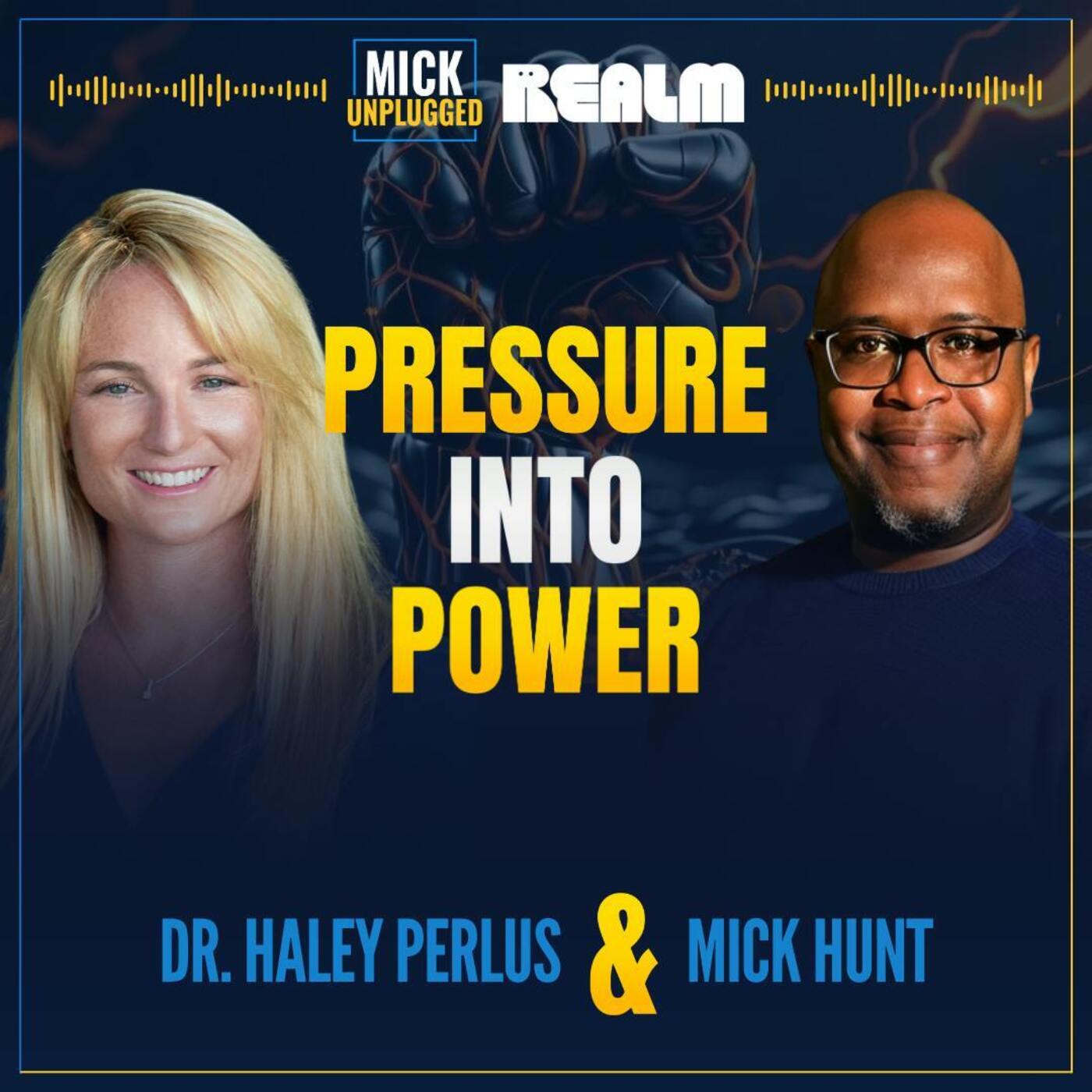
Ladies and gentlemen, welcome back to Make Unplugged. And today's guest is one of my favorite followers on social media and someone who's become a dear friend. We're going from alpine ski prodigy to Fortune 500 Performance Whisperer. She is the PhD powerhouse coaching Olympian, CEOs and everyday warriors to master their mental game. She's the author of Personal Podium and creator of the hashtag Mental Toughness Moments. She turns pressure into power. So get ready for the dynamic, the relentless, the strategic, the electrifying, the mentally challenging herself. The good doctor, Dr. Haley Perlis. Haley, how you doing today, dear?
- [01:20]
A
Oh, I'm awesome. Super excited, Mick. And I've got all my becauses ready.
- [01:25]
B
Well, let's just go there since you're prepared. So you know you've done a lot in life. There's not a lot of people that are proclaimed prodigies, but you actually are one of them. And so if we were to say Dr. Haley today, what's your because, what's that thing that keeps you pushing and striving for greatness?
- [01:49]
A
I believe in people. I believe in myself and I believe in people. I do believe people can grow. I do believe people can change. I do believe we have control, more control than we give ourselves credit. I do believe we control our emotions more than we give ourselves credit. And I also have this. My favorite movie of all time is Flashdance. Do you remember that dance?
- [02:15]
B
Yeah.
- [02:16]
A
And it is. And my theme song is what a Feeling. But that, that movie and song reminds me of a time when I was younger. I had a lovely, wonderful childhood. And I remember dancing innocent and free in my parents house to this song, what a Feeling. And now today I still use that song because the lyrics are take your passion and make it happen. Dance through life. And whenever I need a boost, that song inspires me. And so there's this combination of believing in people to grow and be challenged and embrace pressure combined with this childhood innocence and curiosity and just to be free in life, put those together that's what I want for myself and everyone that I. I know, everyone that I don't know, too.
- [03:07]
B
Wow. So, so deep. I want to unpack a little bit there. So when did you know that that was really you like the, the cerebral ness that you have, right? The. The people care that you have, the impact that you go get. When did you really know that that was who you were?
- [03:28]
A
I don't. I want to say always, because my parents always said that that was my nature. But I chose this profession, if you will. I chose to help people realize their potential when I was 12. And it was because of a leader that I had. So, as you mentioned, I was an alpine ski racer and I was, I was talented. I was one of the lucky ones that had the talent. And I was competing in this really big race and my coach pulled out a hundred dollar bill and told me that he had bet on me to win. And so. Exactly. So in that moment, it's going to go one of two ways, you know, and that's when we talk about pressure, turning it into power. You know, on one hand, it could not go well. And I could think of all the anger, how could he bet on me? Or all the fear, what if I let him down? But I didn't. I thought, wow, if my coach believes in me so much that he's willing to bet on me, doesn't that mean I'm doing something right?
- [04:25]
B
Yeah.
- [04:25]
A
And then I remembered, I've won every race so far this season, and this is a technical course and all of the reasons why I can't. And I went down and I won, which was great. My coach came down, congratulated me, kept the money for himself. But he said to me, it's amazing what your performance can be when you get your head straight. And then two weeks later, he brought a sports psychologist to come and speak to my team. And at 12 years old, I went home and I told my parents, this is what I'm going to do.
- [04:55]
B
Yeah, yeah. You know, I love that Dr. Haley. And you know, I talk to people all the time about pressure, and I believe we have this, this huge myth or this big misquote, right? Like people say that you rise to the occasion, right? Like you're ready for the pressure. And I actually counter that by saying you don't rise to the occasion. You rise to your level of preparation. Right? And so for me, if I know that I'm prepared, I'm willing to live with the outcome. Right? Like I'm the, I'm the guy that always wants to take the last shot. I want to be at bat when it's bottom of the ninth, two outs and I've got to hit a grand slam to go. Like I want that because I'm always going to be prepared. So you work with, I mean even for yourself, but working with Olympians and CEOs and high performing individuals, how do you take that of? Preparation is really the key.
- [05:52]
A
It's everything. Right? You're right. The, what is it? The rule of 7P is proper prevention, proper preparation prevents piss poor performance. But you know, preparation, but, but it's the right kind of preparation. And so the first thing that I do with everyone, doesn't matter what life, domain, health, enthusiast, business, sport, we prepare our three best strengths. And everything I do comes from professional sports. And professional athletes do not run out onto the field thinking about all their weaker links. They run out onto the field, court, mountain, water, whatever it is, ready to highlight their strengths because that's what they've prepared for. Now they've also prepared for resilience, you know, moments for recovery, but it's. They prepare for their strengths. So in every practice session that I have or consulting session, what are your three strengths? Technical, tactical, strategic, like, let's get specific so that when you go out there and you say, just do the best you can. I understand the concept, but what does that mean? It means you're going to do this and you're going to do this and you're going to highlight this because those are your three strengths. And be prepared to always be ready to pull out your strengths in addition to obviously improving all the time. But it's the both, it's the highlighting your strengths and improving those weaker links.
- [07:12]
B
Amazing, Amazing. So I want to go back to something earlier when I said it kind of fast because I knew I wanted to have a moment to talk to you about this. So you were labeled a prodigy in alpine skiing, right? Like, and I don't want to say the pressure, I just want to say the knowing and that hitting you and accepting that that's who you are, right? Because a lot of times people that are great, people that are exceptional, I think they become that way because they accept it, right? Like it's almost like a challenge. And you accept that. Okay, this is my label, this is what I'm going to do. But I always wanted to ask, and there's only a few prodigies in the world, right? I've always wanted to ask someone, did you feel that about yourself? Did you feel, man, I'm a prodigy, like there's not a lot of people at this age that can do what I'm doing.
- [08:04]
A
Well, I do feel I need to correct a little bit, because there are many people in my sport that went much farther than me, but I did, at a very young age, had the pressure of being expected to win.
- [08:18]
B
Yeah.
- [08:19]
A
And I think with my upgrade, with my upbringing, so with my parents, and I had some amazing coaches, even the coach that bet on me to win, he is probably one of my top three, if not top two coaches of all time. And so I learned to embrace that, to take that on, to use it. It's all energy. It's all energy. And we're either going. That energy is either going to get stuck, you know, and then cause us to brace and cause us to freeze, or that energy is going to flow through us and just propel us. And when someone looks at me and has high expectations, like when I'm about to. Well, you know this for sure. When you're about to deliver a keynote and you have this great introduction. Let's go.
- [09:13]
B
Right.
- [09:14]
A
Let's use that. Yes. And so I think I earned it, and I want to continue to earn it.
- [09:22]
B
That's it.
- [09:24]
A
And live up to my potential.
- [09:27]
B
Yep. Yep. You know, you often say mental toughness is a skill, not a trait. Can you talk to the viewers and listeners about that and what that really means for you?
- [09:41]
A
Yes. You know, with experience, we can learn through experience, but I believe that this is mental toughness is showing up when you don't really want to, is accepting with courage. And I know you like that word, courage, and enduring, maybe not pain, but certainly discomfort in order to grow and giving every ounce of effort that you have, even though it may not be 100% of that day. So that's what mental toughness is. And it takes motivation, and it takes confidence, and it takes focus, and it takes anxiety control. Those would be the skills. So that's why I say mental toughness is a skill. Now, it's not like a bicep that I can, you know, see grow.
- [10:24]
B
Right.
- [10:24]
A
But you do. With time, you do have the experience. It does become more tangible. And it is a skill. Those four mental skills allow you to embrace your mental toughness.
- [10:38]
B
I love that and I love a part that you just said on that. Give all that you have that moment, even if it's not 100% right. Like, again, I hate cliches. And I think part of what I do for younger people is to help break those myths or old cliches that we have. Right. Like, I hate give 110%. You can't. You physically cannot give more than you actually have. Right. And I also tell people it's naive to think that if your max is 100% right, that you can give 100% all the time. There are days that you're physically ill and you can't, but you can give the best that you have. Right? And the best that you have. If all you can give is 70%, then give the best that you have. That doesn't mean limit yourself to, oh, I'm not going to execute, or I'm only going to do. But sometimes in a lot of situations, your very best usually isn't 100%. Like, people actually don't believe it. But then I say, okay, go bench press. Right? And go bench press the most that you can. And let's just assume that that's 100%. Now go do it 10 times. Can you do it 10 times? No, because you can only do it once. But you did it once. So again, I'd love for your thought process on that too, just. Or dive deeper into. Give the best that you have at that given moment or that given situation.
- [12:04]
A
Sure. I have a rule for myself and a rule that I share with others. Give yourself some grace. And that's what we just said, right? If you only have 70% to give today, accept the fact that, you know, today might be that 70 percenter. So give yourself some grace. Never let yourself off the hook. And here's why I put the two together. People can give themselves grace and then come up with every reason why they don't need to get off the couch. Come up with every reason why they can put, you know, this. This call, you know, delay this call or push this deadline, whatever, whatever their challenges that they're looking at. So giving themselves some grace is not. Is important, but it's not the complete tool here. Never letting yourself off the hook is, okay, I understand the situation. I understand my circumstances.
- [12:54]
B
I.
- [12:55]
A
But I'm going to do something. And then you're right. You know, just three days ago, I'm just. I was getting over a little bit of a cold. I had a lot of travel and it was just, you know, overrun maybe a little bit. And so I intended to go for a bike ride and I wasn't feeling my best. I'm like, okay, well, I'm just going to go to the first goal because I have like three. Three lengths, three durations, if you will. I'm like, oh, yeah, I'm just going to go to the first goal, I'm not going to time myself. I'm just going to get outside and do it. So I didn't let myself off the hook, but I gave myself some grace. And then you know what happened, Mick? I ended up up going to the second goal because you never know what you find while you're doing it. Energy came, motivation came. I was outside, I was listening to good music, I was embracing, and I'm like, oh, you know what? What I thought was maybe 70 actually is 80, right? Because our head plays tricks with us. So, you know, that's why. Don't let yourself off the hook. Go and do something and then be curious and open minded to what can take effect, what can take it on from there.
- [13:55]
B
Love it. Love it. And I want to segue to your book, the Personal Podium, because in your book you have a lot of really huge gems that I just go back to, but you talk about achieving your personal gold standard, and it was as if we're best friends and we have so much synergy in how we think. Dr. Haley, because I talk to people about creating standards, not goals. When I talk to leaders and when I talk to companies, it's about creating standards. Goals are always personal, right? Like, I need to have a standard, which is my minimum expectation. And if I want to achieve above that, that's my personal goal, right? And you know, I'm a football nut and Mike Tomlin has a thing at Pittsburgh. The standard is the standard, right? We don't talk about goals. We have a standard of excellence, and that's what we do. And in your book, you really talk about your personal gold standard. I'd love for you to talk to the viewers and listeners about one, how they establish it, what's the mindset needed for it, and why that's a critical component to mental toughness.
- [15:05]
A
I think goals are great, they're motivating, they create vision, but they also can be very distracting because you're right, there's so much of it that we can't control. And so we end up focusing on the very things we can't control when it comes to our personal standard. And it's funny, my, my full name is Haley Suzanne Perlis hsp and my company's hsp, but my mother said that's also your highest standard of performance. And so, you know, thanks, mom, because she brought that in and I started really embracing, you know, what is my highest standard of performance. And I know a little bit, but I don't know everything. And as I grow and as I develop that standard can, can change. And I just, I, I'm constantly searching for that standard and when I know and I, and coming back to, you know, giving out every ounce of effort you have in the moment, when I know that I've done everything that I can do and it's a. You really know this. You know when you're, you know when you're lying to yourself about it and you know when it's true, that is all that you can do. And that's your standard.
- [16:17]
B
Love it. I love it. Another thing that I love in the book, and I know you talk about this a lot on social too, and at first I was challenged by it and then I had to go back and self reflect and it's don't let yourself off the hook. Right. Like, I think a lot of times, because even you just said, well, you've got to give yourself grace. But then I understood exactly where you were going. Because grace and letting yourself off the hook are two totally different things. And I think a lot of times people will say, well, okay, it's okay, I didn't do this today. And maybe it's okay to say that, but there needs to be a second part to that, right? I need to do X so that this doesn't happen again. So can you talk about the power of not letting yourself off the hook?
- [17:04]
A
Something is always better than nothing. And so when you let yourself off the hook, we end up doing nothing. A lot of the times we really do, we go for the easy route. One of the greatest researchers is Mihaly Csikszentmihalyi, founder of Flow State. And of course we're talking about, it's called flow state. So we're talking about that flow, right. When your challenge meets your demands and everything's seamless and everything's going great. But his research also talks about many different. In his chart, he also talks about something just above flow, just above your, your high, your highest standard, which would be like the arousal zone. And then there's also something just below, which is the control zone. And I believe, I don't know that we can be 1% better every day. You know, I think, you know, giving what you talked about, it's can't even be your best every day. So how can you be 1% better every day?
- [18:02]
B
Right, Right.
- [18:03]
A
But if we open our eyes up to this control piece, which is if your current level ability is like a is, we'll just call it the 10 because that's your current level ability. If you like, if you don't Let yourself off the hook. You'll go for like a 9 or an 8, but if you don't even think about that, you'll just won't even try. You'll go for the zero, the one. And that's boredom. According to Mihaly Csikszentmihalyi. That's when things are so easy and then complacency kicks in and then just apathy. You use it or lose it. You don't do it, so you lose it. So that's why I'm really big on the giving yourself some grace part. Because it can't always be amazing perfect. But the letting yourself off the hook, don't do it because there's always some level of control that you can embrace.
- [18:48]
B
Haley, that's why I love you. Because people that know me know. And I'm going to go to your getting 1% better. That's also a myth that I tell people isn't true, right? Like you can lose weight and you have a starting number and a goal number and you can track 1% and you know what that looks like. You can talk about income, you can talk about saving money, growing money, and you know what 1% is because you've got a quantitative start and a goal above or below. But you don't know what your whole personal self is capable of doing in anything. So there to me in the context of get 1% better every day that we all can assume, right? You don't know what your starting point is, nor do you know what your destination is. So I just say Instead of getting 1% better every day, just freaking get better. How about that, right? If you just focus on just getting better, being better, whatever that is, just get better. Because what you're going to do is surprise yourself. Because sometimes 1% isn't good enough. Sometimes 1% doesn't move the needle on a daily basis. And you need to be able to understand that if I just focus on just getting better or being better, everything will take care of itself. But I'd love your take on that too.
- [20:04]
A
And where are you getting better? One of my longtime friends, one of my greatest girlfriends, she is a former Ironman. She owns her own company. I mean she is talk about achievement and she is competitive and she challenged herself. Well, just recently she was supposed to ride in this fundraiser. It was like a 100 mile race or something like that. She's a cyclist and she hurt her back and for like two weeks, flat on her back. And so now she has this decision to make. Am I going to do this race. I'm kind of told not to. My body's telling me not to. Am I going to go in the slow group or am I going to. Am I not going to do it at all? And just support. Now, we all kind of laughed when she said she's going to go in the slow group because that's not her style. So she said, I'm not going to do it. And for her, that was getting better because she was now getting better at listening to her body. She's now getting better at the recovery piece. So we, you know, even though you have your certain level of performance, there's all these different factors that go into optimizing your performance. And for her, recovery is one of those pieces. So she may not have gotten better on her bike, but she got better in recovery, in her mental discipline in that aspect. So you're right. We're always getting better, but it may not be directed at the 1% better at the. At the specific, specific, you know, activity that you're pursuing.
- [21:35]
B
That's right. That's right. You know, Haley, you work with Olympians, CEOs, power performers across the globe. What's one or two traits or skills that all of these individuals have in common?
- [21:51]
A
They want the ball. No matter what the ball is. You see, And I take that well. Even though it's just a movie, it's still football. Do you remember the movie with the replacements? With Keanu Reeves?
- [22:03]
B
Absolutely. Keanu Reeves. Yeah.
- [22:05]
A
I'll never forget. It's one of my favorite lines. Winners want the ball. They. They don't want to fail. Who wants to fail? They want to be perfect. We all want to be perfect, but that is not. That can hold us back. Those two things. I'm afraid to fail, I had. I want to be perfect. Those actually can be distractions. They want the ball because they're willing to risk. They're willing to grow. They're willing to challenge themselves. They're willing to see what they're made of. They're willing to endure the sadness. They're willing to endure the defeat. They're just not going to give up. No matter happens. Give me the ball. And I think that is one of the greatest traits a leader, top performer in any industry has.
- [22:51]
B
Yeah, I love that. And I want to ask you this question, because I think that there's a difference between wanting the ball for the ball because you're ready for it versus not necessarily wanting the ball, but wanting the end result if the ball goes in the hoop. Right. Like, there are a lot of people that want the celebration, but they don't want the work, the preparation to take the shot or, or to take the swing or to jump the mountain or whatever it is. Right. Like there's a lot of people and Dr. I know you know this because you work with leaders just like I do. You work with high driven people like I do. There's a lot of people that in their mind, they think they want the ball, but what they actually want is the result of the actual ball going in. How do you distinguish between the two.
- [23:45]
A
Two you just did. And it's a. And I think that's one of the best illustrations of it. There's the catching the ball in the end zone or it goes through the net and then I catch the ball. You know, great point. There's the cherry picking. Standing, standing there so that you don't have to do any of the work, but you'll have the ball to throw it in at the end and take all the credit for it. Or like you said, it's climbing the mountain, it's doing the work. It's making sure that you are prepared. And that is what I meant by winners. Winners want the ball. You know, there's a lot of talk of AI and I didn't hear, I didn't come up with this. I learned it. And you know, we talk about life as a journey, not a destination. Well, AI is really helping us focus a lot on the destination and not on the journey because it, you know, we're not writing those emails anymore. We're getting AI to do it. We're not. So I'm for myself. I want the ball. I actually want to sit here and write out my content. And then I'm going to ask AI because I, you know, to help me make it better, to show me, to teach me. And I'm going to learn. But I'm not just going to say, please, AI come up with five mental skills that I could put in this newsletter. I'm going to write it down. I'm going to do the work because I still want to embrace the journey and also see where that takes me in the end. And I think that is what I meant by winners want the ball. I want to do the work. I don't want to hog the work. I want to take my team with me, but I definitely want to be part of that process.
- [25:14]
B
Yeah. Yeah. You know, Dr. Haley, again, huge fan of you and the work that you do. I also know that you're a huge mental health advocate as well too. When you're talking and working with these high performers, how do you balance what I'll call the drive versus mental wellness?
- [25:34]
A
Yeah. So being a consultant like I am and not a clinical psychologist, even though I have a great passion for it, the work that I can do is around identity, which allows us, I think, to stay mentally healthy. And one of the greatest things that we can do is understand that our identity is not the same thing as our roles. So in sport, you know, athletes are playing the role of an athlete. You know, a leader is playing the role of a leader. But it's exact same thing when people are leave their sport. Whether they're forced out or they retire. A lot of them have mental health issues because, well, who am I without my sport? Same thing with a lot of people in business looking to retire. Well, who am I without my career? Or their kids leave, you know, leave home and they go off to college and then, you know, start their own lives. And who am I if I'm not a parent? Those are all roles. And if we completely identify ourselves based on the role, that can lead to tremendous, you know, mental illness, depression and burnout and all of these things and just deflate, just feeling deflated. So the work that I can do is help people understand their identity, which is their values in life, what they value, and who they truly are, their best attributes. For me, love, health, and adventure are my top three values. And I know that because I've done the work to create that. And who am I as a person? I'm a bright person. I've got a full heart. Everything I do comes from heart motivation. And I'm a strength magnet. I look for the positives while improving my weaker links. I highlight my strengths and I help people do that. That's who I am. That's my identity. And then I can apply that to all the various roles so that when roles come and go, right. I've been married, now I'm divorced, so I wasn't, you know, so that is a role that came and left.
- [27:31]
B
Right.
- [27:32]
A
I'm not. I'm not so attached to that role because I still have my identity, and that allows me to stay mentally here and mentally empowered and on. On the way to increasing my fulfillment.
- [27:49]
B
I love that. Dr. Haley, you're an amazing human. I told you before, I tell you on Instagram all the time, you're someone I look up to. You're someone who inspires me to be the best version of me that I can on a daily basis. So I wanted to tell you that personally, I appreciate all the amazing things that you do for the world.
- [28:10]
A
Well, I'm just going to take a moment and breathe that in because it means a lot. And you just. I know we connected initially on social media, which I just started. I had a huge mental block with regards to social media.
- [28:22]
B
Yeah.
- [28:23]
A
And it's people like you and comments and me being able to follow you and seeing what you're doing that makes me change my story around something like social media, which then all. It just inspires me to create more content and to share, because I do believe.
- [28:40]
B
There we go. I appreciate it. So you have time for a quick 5 rapid fire?
- [28:45]
A
Of course.
- [28:46]
B
You ready? All right. So you told me that your first gambling addiction started when you were 12 with your coach. How much money did your coach make on you?
- [28:56]
A
100 Canadian dollars.
- [29:00]
B
100 Canadian dollars. Love it. What's one book that you've read? It doesn't matter. In your lifetime, that's been like a huge spark for the version of yourself that you are today.
- [29:14]
A
Love is letting Go of fear.
- [29:17]
B
Ooh.
- [29:18]
A
And it's funny because I know the author, but because maybe because I'm just ready for the next question. The author escaped me, but Love is Letting Go of Fear is a book that I actually take with me everywhere I go.
- [29:30]
B
Mm. Love it. Gonna go get it now. If you could have dinner with any athlete, past or present, who would it be and why?
- [29:40]
A
Carrie Walsh Jennings, who's a volleyball.
- [29:44]
B
Beach volleyball superstar.
- [29:46]
A
Oh, yeah, because I just. She once said, and I appreciate it, and I. And I understand it, but she once said that the bronze medal in the Olympics actually was the most fulfilling than all the other goals, gold medals. And I get it. What she said, she said, you know, in the. In the championship, whether I was either going to go home with a gold or a silver. In the bronze, I was going home with a medal or nothing.
- [30:11]
B
There you go. That makes a ton of sense. Makes a ton of sense.
- [30:16]
A
That's just one thing that she says. And I would love to meet her.
- [30:20]
B
Love it. Love it. What's one daily habit that is a must have in your life?
- [30:29]
A
My partner and I, we go for a walk. When I'm in here and I'm not traveling, we go for a walk every single morning. And just yesterday, we said, after dinner, we're going to do it the same thing every single morning. The two of us, before work, we go for a morning together. Sunshine, companionship, movement.
- [30:47]
B
Love it, love it, love it, love it. All right, complete this sentence. Mental toughness means fill in the blank.
- [30:56]
A
Striving for perfection, but also at the same time striving to be my best recoverer.
- [31:04]
B
Mm. That is so deep. That is so deep. That was your quick five. Look at you. You did it. You did it. All the pressure's off now. All the pressure's off.
- [31:14]
A
No, give me more. I embrace it. I'm joking.
- [31:18]
B
There you go. All right. So, Dr. Haley, where can people find and follow you?
- [31:23]
A
Best place is my website. Dr. Just Dr.haleyperless.com. they can opt in for my weekly newsletters, but there's also a little area where you can write a note and I get those. So you write me a note and I will respond.
- [31:37]
B
Perfect. I'll make sure we have links to that in the show notes. I'll throw in your Instagram as well. I'll also send a link to the book. Do you want them to do that from the website or would you prefer me to list Amazon, Barnes and Nobles? Where do you want me to do that?
- [31:51]
A
It's on Amazon. And everything, everything that you need about my master classes, my coaching, everything's my book, everything's on the website. So that's perfect.
- [32:01]
B
Perfect. We're going to send people there. I promise you. For all of the MC Unplugged viewers and listeners, she's a great follow. Definitely check out the masterclass. You definitely need to have a book. The book is a must have in your life. If you're a high performer, if you lead people, if you just want to overall get better with your personal mental toughness, that's the book for you. Dr. Haley, I appreciate you more than you know. This time was well spent. I think we should do it again. But that's your call. I'm not going to force you to come on, but if you want to be on, I'll have you.
- [32:36]
A
Are you kidding? I'm ready tomorrow. But you're so popular and you're so. So whenever I can fit into your schedule, just holler.
- [32:47]
B
I'll do that. I'll do that. For all the viewers and listeners. Remember your because is your superpower. Go unleash it.
- [32:57]
A
Thanks for tuning in to this episode of Mick Unplugged. If today hits you hard, then imagine what's next. Be sure to subscribe, rate and share this with someone who needs it. And most of all, make a plan and take action because the next level is already waiting for you. Have a question or insight to share, send us an email to hellocunplugged.com until next time, ask yourself how you can step up.